第 11 讲 Unit6 Beyond Earth
Section A Why do we explore space?
Part 1:单词加油站
英文 音标 中文 英文 音标 中文
beyond /bɪˈjɒnd/ tie /taɪ/
mission /ˈmɪʃn/ geology /dʒiˈɒlədʒi/
telescope /ˈtelɪskəʊp/ satellite /ˈsætəlaɪt/
rover /ˈrəʊvə(r)/ crazy /ˈkreɪzi/
manned /mænd/ human being /ˈhjuːmən ˈbiːɪŋ/
maintain /meɪnˈteɪn/ require /rɪˈkwaɪə(r)/
launch /lɔːntʃ/ rocket /ˈrɒkɪt/
weightless /ˈweɪtləs/ cancel /ˈkænsl/
movement /ˈmuːvmənt/ publish /ˈpʌblɪʃ/
asleep /əˈsliːp/ exoplanet /ˈeksəʊplænɪt/
fall asleep /fɔːl əˈsliːp/ solar /ˈsəʊlə(r)/
Part 2:课文知识讲
解
1.beyond---p52
【含义】prep. __________;adv. 在远处
【搭配】beyond one’s ability __________;beyond description __________;beyond doubt __________
beyond the sea __________
【例句】The beauty of the universe is beyond description.
2.mission---p52
【含义】n. __________
【搭配】space mission __________;carry out a mission __________;
【同根词】missionary n. 传教士
【例句】The rover is on a mission to explore Mars.
3.rover---p52
【含义】n. __________
【搭配】Mars rover __________;lunar rover __________;space rover __________
【例句】The rover can work in very bad environments.
4.manned---p52
第1 / 12
页 共 页【含义】adj. __________
【搭配】manned spaceship __________;manned mission __________;manned flight __________
【反义词】unmanned adj. __________
【例句】Shenzhou is a series of manned spaceships.
5.maintain---p52
【含义】v. __________
【搭配】maintain peace __________;maintain health __________;maintain a car __________
【同根词】maintenance n. __________
【例句】We should maintain good learning habits.
6.launch---p52
【含义】v. __________;n. 发射
【搭配】launch a rocket __________;launch a project __________;launch into __________
【同根词】launcher n. __________
【例句】They plan to launch a new satellite next week.
7.weightless---p52
【含义】adj. __________
【搭配】weightless environment __________;feel weightless __________
【同根词】weight n. __________;weigh v. 称重;weightless → weightlessness n. 失重状态
【例句】Astronauts feel weightless in space.
8.fall asleep---p52
【含义】 __________
【搭配】fall asleep quickly __________;fall asleep during class __________
【近义短语】go to sleep __________
【反义短语】wake up __________
【例句】It’s not easy to fall asleep in a weightless environment.
3a
Host: Our question today is: Why do we explore
space? Let's talk to space scientist Dr Yang.
Welcome, Dr Yang!
Dr Yang: Thank you very much. Well, there are
three good reasons to explore space. First, to
improve our knowledge of Earth and its place in
the universe.
Host: Could you explain that a bit more?
第2 / 12
页 共 页Dr Yang: Sure. The study of other planets helps us better understand Earth's geology, history, and
relationship with other planets.
Host: Oh, right.
Dr Yang: Second, technology developed for space can benefit us here on Earth.
Host: Could you give our listeners an example?
Dr Yang: Of course. Some satellites, for example, help us deal with problems caused by climate
change.
Host: Yes, that's very useful. And the third reason?
Dr Yang: Well, at some point in the far future, we may find new resources in outer space. It might
sound crazy, but our Earth may run out of resources. In that case, a new home for us human beings
will be needed.
Host: Wow, interesting! Maybe Mars will be made into our new home in the future.
1.benefit
【含义】v. __________ n. 益处;好处
【搭配】benefit from __________;bring benefit to __________;for the benefit of __________
【同根词】beneficial adj. __________;beneficiary n. 受益人
【例句】Technology developed for space benefits all human beings.
2.deal with problems
【含义】 __________
【搭配】deal with environmental problems __________;deal with problems calmly __________
【近义短语】solve problems __________;address problems __________
【例句】Satellites help us deal with problems caused by climate change.
3.climate change
【含义】 __________
【搭配】effects of climate change __________;global climate change __________
【例句】Many countries are working together to fight climate change.
4.run out of
【含义】 __________
【搭配】run out of resources __________;run out of time __________;run out of energy
__________
【例句】If we waste natural resources, we will run out of them one day.
5.In that case
【含义】 __________
【搭配】In that case, we need a backup plan.
【近义短语】In this case __________;If so __________
【例句】Our Earth may run out of resources. In that case, we need to find a new home.
第3 / 12
页 共 页6.human beings
【含义】 __________
【搭配】all human beings __________;human beings and nature __________
【近义短语】humans 人类;mankind 人类(正式)
【例句】Exploring space is a great mission for human beings.
7.exploration---p55
【含义】n. __________
【搭配】space exploration __________;scientific exploration __________;the exploration of Mars
__________;
【同根词】explore v. __________;explorer n. __________;exploratory adj. 探索性的
【例句】Space exploration helps human beings understand the universe better.
【即学即用】
一、短语互译
英译汉
1.space mission → __________ 4.deal with problems → __________
2.carry out a mission → __________ 5.climate change → __________
3.benefit from → __________ 6.run out of resources → __________
汉译英
1.太空探索 → __________ 4.入睡 → __________
2.载人飞船 → __________ 5.在那种情况下 → __________
3.失重环境 → __________ 6.全人类 → __________
二、词汇变形
1.improve(v. 改善;提高)→ ____________(n. 改善;改进)
2.explore(v. 探索)→ ____________(n. 探索)
3.maintain(v. 维持)→ ____________(n. 维护)
4.benefit(v. 受益)→ ____________(adj. 有益的)
5.weigh(v. 称重)→ ____________(n. 重量)
6.launch(v. 发射)→ ____________(n. 发射器)
7.mission(n. 任务)→ ____________(n. 传教士)
8.weightless(adj. 失重的)→ ____________(n. 失重状态)
三、语法填空
第4 / 12
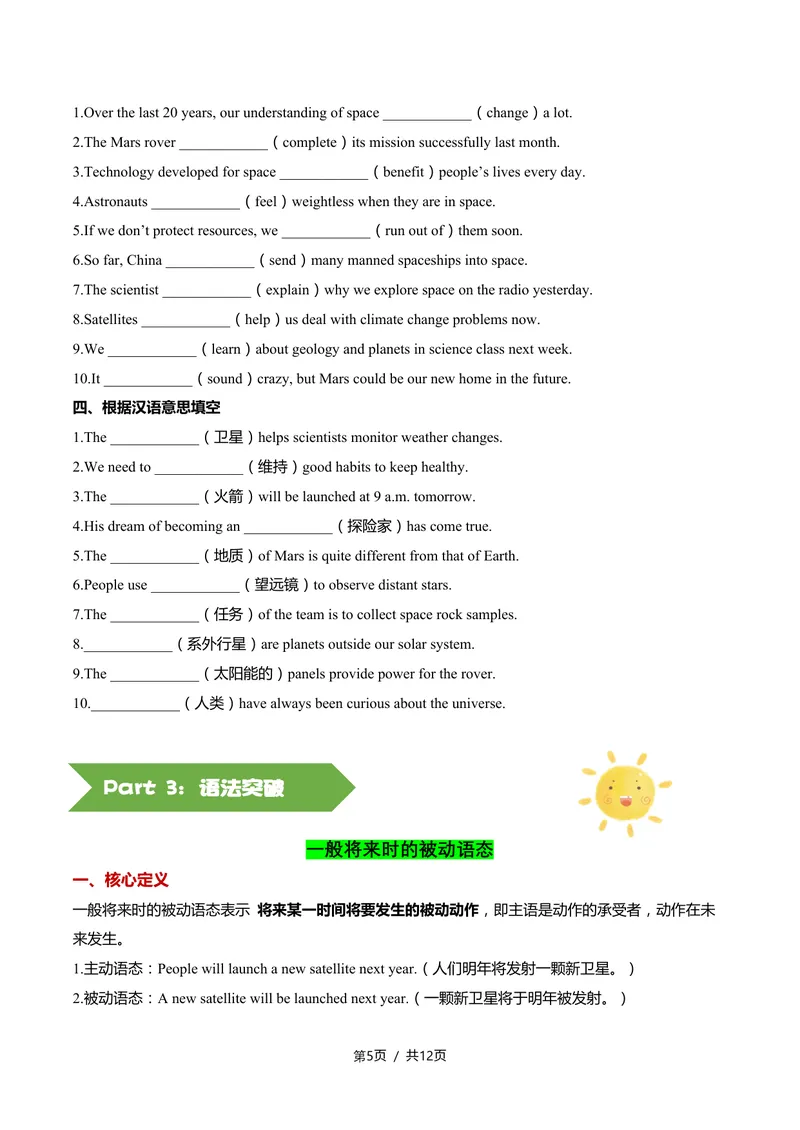
页 共 页1.Over the last 20 years, our understanding of space ____________(change)a lot.
2.The Mars rover ____________(complete)its mission successfully last month.
3.Technology developed for space ____________(benefit)people’s lives every day.
4.Astronauts ____________(feel)weightless when they are in space.
5.If we don’t protect resources, we ____________(run out of)them soon.
6.So far, China ____________(send)many manned spaceships into space.
7.The scientist ____________(explain)why we explore space on the radio yesterday.
8.Satellites ____________(help)us deal with climate change problems now.
9.We ____________(learn)about geology and planets in science class next week.
10.It ____________(sound)crazy, but Mars could be our new home in the future.
四、根据汉语意思填空
1.The ____________(卫星)helps scientists monitor weather changes.
2.We need to ____________(维持)good habits to keep healthy.
3.The ____________(火箭)will be launched at 9 a.m. tomorrow.
4.His dream of becoming an ____________(探险家)has come true.
5.The ____________(地质)of Mars is quite different from that of Earth.
6.People use ____________(望远镜)to observe distant stars.
7.The ____________(任务)of the team is to collect space rock samples.
8.____________(系外行星)are planets outside our solar system.
9.The ____________(太阳能的)panels provide power for the rover.
10.____________(人类)have always been curious about the universe.
Part 3:语法突破
一般将来时的被动语态
一、核心定义
一般将来时的被动语态表示 将来某一时间将要发生的被动动作,即主语是动作的承受者,动作在未
来发生。
1.主动语态:People will launch a new satellite next year.(人们明年将发射一颗新卫星。)
2.被动语态:A new satellite will be launched next year.(一颗新卫星将于明年被发射。)
第5 / 12
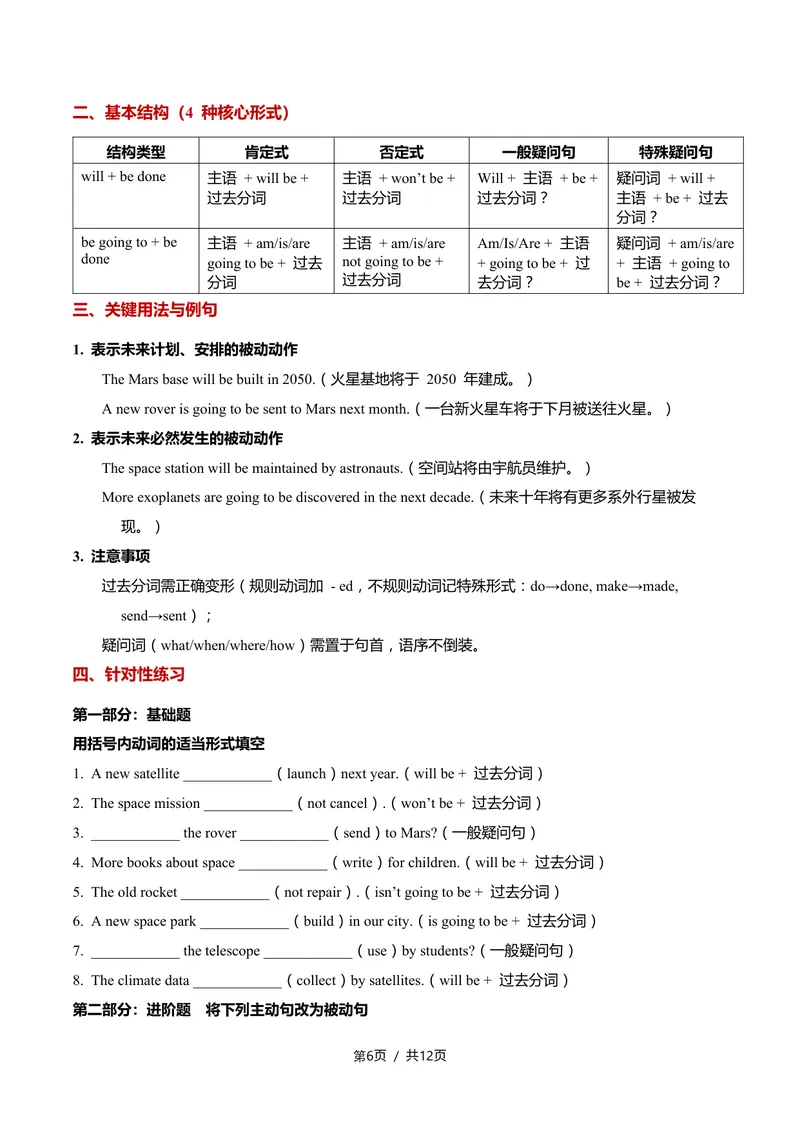
页 共 页二、基本结构(4 种核心形式)
结构类型 肯定式 否定式 一般疑问句 特殊疑问句
will + be done 主语 + will be + 主语 + won’t be + Will + 主语 + be + 疑问词 + will +
过去分词 过去分词 过去分词? 主语 + be + 过去
分词?
be going to + be 主语 + am/is/are 主语 + am/is/are Am/Is/Are + 主语 疑问词 + am/is/are
done going to be + 过去 not going to be + + going to be + 过 + 主语 + going to
分词 过去分词 去分词? be + 过去分词?
三、关键用法与例句
1. 表示未来计划、安排的被动动作
The Mars base will be built in 2050.(火星基地将于 2050 年建成。)
A new rover is going to be sent to Mars next month.(一台新火星车将于下月被送往火星。)
2. 表示未来必然发生的被动动作
The space station will be maintained by astronauts.(空间站将由宇航员维护。)
More exoplanets are going to be discovered in the next decade.(未来十年将有更多系外行星被发
现。)
3. 注意事项
过去分词需正确变形(规则动词加 - ed,不规则动词记特殊形式:do→done, make→made,
send→sent);
疑问词(what/when/where/how)需置于句首,语序不倒装。
四、针对性练习
第一部分:基础题
用括号内动词的适当形式填空
1. A new satellite ____________(launch)next year.(will be + 过去分词)
2. The space mission ____________(not cancel).(won’t be + 过去分词)
3. ____________ the rover ____________(send)to Mars?(一般疑问句)
4. More books about space ____________(write)for children.(will be + 过去分词)
5. The old rocket ____________(not repair).(isn’t going to be + 过去分词)
6. A new space park ____________(build)in our city.(is going to be + 过去分词)
7. ____________ the telescope ____________(use)by students?(一般疑问句)
8. The climate data ____________(collect)by satellites.(will be + 过去分词)
第二部分:进阶题 将下列主动句改为被动句
第6 / 12
页 共 页1. People will build a small Mars base._____________________________________________
2. They will launch a new rocket._____________________________________________
3. Teachers will teach us about space._____________________________________________
4. The team will send the rover to the moon._____________________________________________
5. Workers will repair the space station._____________________________________________
6. Scientists are going to study the exoplanet._____________________________________________
7. We will watch the launch live._____________________________________________
8. The government will open a space museum._____________________________________________
9. Astronauts are going to plant trees in the space station._________________________________________
10. People will use solar energy for the rover._____________________________________________
第三部分:提升题 用括号内动词的适当形式填空
1.When ____________ the space mission ____________(carry out)?
2.More training courses ____________(provide)for young astronauts soon.
3.The problem ____________(not solve)easily, but we will try.
4.____________ the data ____________(analyze)by computers?
5.How many rockets ____________(launch)this year?
Part 4:课堂综合练习
一、根据汉语意思选择填空
1.The _____(solar /weightless)energy is a clean and renewable resource.(太阳能的)
2.The idea of living on Mars sounds _____(crazy /useful)to some people.(疯狂的)
3.We need a _____(manned /unmanned)spaceship to send astronauts to the moon.(载人的)
4.The _____(movement /mission)of the planets follows certain rules.(运动)
5.Space exploration requires a lot of _____(time /energy)and money.(精力)
6.The magazine will _____(publish /cancel)an article about space travel.(刊登)
7.It’s hard to _____(fall asleep /wake up)in a noisy environment.(入睡)
8.The project will _____(require /benefit)more people to join in.(需要)
9.They had to _____(cancel /launch)the space mission due to bad weather.(取消)
二、语法填空
1.Over the past five years, scientists __________(make)great progress in space exploration.
2.When the astronaut arrived in space, he __________(feel)weightless immediately.
第7 / 12
页 共 页3.The new satellite __________(launch)next year will help predict climate change.
4.We __________(not finish)our report on space mission yet.
5.The teacher said that the Earth __________(have)a special relationship with the sun.
6.If we work hard, we __________(achieve)our goal of exploring Mars.
7.Many people __________(watch)the live broadcast of the rocket launch yesterday.
8.The technology __________(develop)for space travel is now used in daily life.
9.By the end of this year, we __________(learn)more than 50 space-related words.
10.It’s important for us __________(protect)natural resources for future generations.
三、完形填空
阅读下面短文,掌握其大意,每小题所给的 A、B、C三个选项中选出能填入空白处的最佳选项。
At 11:14 a.m. on October 26th, China launched (发射) Shenzhou XVII, carrying China’s man-made
spacecraft, from the Jiuquan Satellite Launch Center. The launch was a very 1 moment for people all
across the country. In a village of Henan province, people eagerly gathered to watch the rocket 2 . They
counted down, “Five, four, three, two, one!” As the rocket was sent up, the tension turned into 3 .
Jiang Xinlin, who was on the rocket, was born in Qixian county, Henan province. He always dreamed of
going to space. He did well in his studies and, in his free time, he would help with 4 and care for the
family’s cattle and sheep. After graduating from university, he wanted to become a 5 . He passed the Air
Force flight selection and 6 the PLA Air Force Aviation University. During his 10-year flying career, he
flew safely for over a thousand 7 and became a top Air Force pilot.
Jiang’s parents were very 8 about his successful rocket launch. His father, Jiang Xiaotoo, watched
the launch with other relatives. He was nervous and excited. He said, “I can 9 my son among the astronauts
just by looking at his nose. ” His mother, Shi Shimin, said, “I will cook his favorite food for him 1 0 he
comes back next year.”
Another astronaut, Tang Shengjie, who is the youngest person to participate in space station missions in
China, was born in 1989 in Dingxi city, Gansu province. His family also watched the launch with great
excitement.
1.A.interesting B.boring C.exciting
2.A.turn off B.take off C.get off
3.A.calmness B.danger C.cheers
4.A.studying B.exercising C.farming
5.A.scientist B.pilot C.teacher
第8 / 12
页 共 页6.A.entered B.finished C.began
7.A.months B.weeks C.hours
8.A.happy B.disappointed C.surprised
9.A.mention B.recognize C.organize
10.A.when B.though C.until
四、语法填空
阅读下面短文,在空格处填入一个适当的单词或括号内单词的正确形式,将答案填写在答题卡规定的
位置上。
Have you ever looked up at the night sky and dreamed of living among the stars? The great Chinese poet
Su Shi once 1 (write), “Riding the wind, there I would fly, yet I’m afraid the crystalline palace would be
too high and cold for me.” (我欲乘风归去,又恐琼楼玉宇,高处不胜寒) For many 2 (century),
people have wondered: what would it truly be like to live in the sky?
Today, Chinese scientists have done excellent work in space science, 3 we are getting closer
to this ancient dream. We have built 4 (we) own “crystalline palace” in space—the Tiangong Space
Station. Astronauts live there for months 5 (help) us understand more about our universe.
This dream keeps 6 (grow). On November 11, 2025, the Shenzhou-22 spacecraft went into the
sky for an important task. It had to arrive 7 the space station quickly to solve a problem. In just about
three and a half hours, it 8 (successful) reached Tiangong.
Looking back at the poem of Su Shi, we might ask: if he could see today’s warm, safe, and 9
(beauty) space station, will he still be afraid? Perhaps not. He might even write 10 new poem about
our blue planet.
五、任务型读写
For thousands of years, people have hoped to explore the Moon. Today, this wish has come true through
Chang’e Project. It is China’s special program to explore and study the Moon.
Since Chang’e-1 successfully flew around the Moon in 2007, China has finished the Chang’e-2,3,4 and
5 missions (任务). Among them, Chang’e-4 was the first in the world to land softly on the far side of the Moon.
In 2020, Chang’e-5 brought back 1,731 grams of regolith (月壤), which gave scientists valuable materials to
research and learn more about the Moon’s history and how it came to be. China has also shared some lunar
samples (样本) with other countries, supporting international space research together.
Based on these successes, Chang’e-6 has made new progress in exploring the Moon. These include the
world’s first sample return from the far side of the Moon, collecting about 1,935 grams of regolith. Another new
第9 / 12
页 共 页discovery is that negative ions (负离子) were found on the Moon’s surface for the first time. These ions are
difficult to find because they last for only a very short time. This discovery opens new possibilities for space
science.
▲ Chang’e-7 will explore the Moon’s south pole (极地). It will look for water ice and study the
environment to get ready for a future lunar base. Chang’e-8 will land on the Moon’s south pole too. It will build
communications and energy systems. It will also test using regolith to build a lunar base.
Together, these missions show China’s rapid development in space technology and its wish to work with
other countries to explore the universe.
根据语篇内容,按要求回答问题。
1.What is Chang’e Project?
2.When did Chang’e-5 bring back regolith?
3.Why are negative ions on the lunar surface very hard to find?
4.Write a topic sentence (中心句) for Paragraph 4.(不超过15个词)
5.If you can design a new Chang’e mission, what will it do?(不超过15个词)
六、短文还原
阅读下面短文,从短文后的选项中选出可以填入空白处的最佳选项。选项中有一项为多余选项。
“Are we alone? What’s out there?” People have always looked up at the stars and wondered about space.
Before the mid-20th century, most people felt traveling into space was only a dream. 1 After many
tests, they succeeded in making rockets that could overcome Earth’s gravity (重力). Ever since then, human
exploration (探索) of space has started.
2 China’s space program started late in the last century, but it has made great progress in a short
time. China became the third country in the world to independently send humans into space in 2003. 3
It is large enough to allow astronauts to carry out many important scientific studies. More recently, Shenzhou-20
manned (载人的) spaceship was successfully sent into space on April 24th, 2025.
Besides the exploration near the earth, many countries are doing some research on other planets. For
example, on July 23rd, 2020, China sent Tianwen-1 to explore the surface of Mars. Planets like Mars might be
第10 / 12
页 共 页safe enough for humans to live on. 4
There is still a long way for humans to go to explore space. If you are interested in space walking, go for
your dream. 5 Maybe you will become one of the engineers who work on China’s space
exploration.
A.China has never stopped its steps exploring space.
B.So far, no more progress in space has been made.
C.It certainly requires a lot of hard work and a strong will.
D.However, scientists made up their mind to make it come true.
E.In 2022, China completely set up its own space station Tiangong.
F.This shows that exploring other planets could help find humanity’s (人类) future homes.
七、阅读理解
Many of us dreamed of being astronauts when we were kids. However, only a small number of people
can realize this dream. But does that mean you’ll never get the chance to work in space? Not exactly.
In fact, some space-related jobs aren’t just for astronauts and they all sound really amazing. One of the
most interesting space jobs is “chief sniffer (嗅探员)”. NASA has already had a sniffer named George Aldrich,
whose job is to smell materials before they are used in spaceships. Using your nose at work might sound a bit
strange, but actually the job is very important. A spaceship has a small space and high temperature, which makes
smells inside intense. And once a spaceship is sent, astronauts cannot run away from unpleasant smells. What’s
more, smelling objects can help find things that might be harmful to astronauts’ health.
Another job, the “space tour guide”, may seem a little ahead of its time—after all, there aren’t any tourists
in space yet. But now, many companies are starting to provide space travel services and some rich space lovers
have booked the tours. It may not be long before space becomes one of the top travel places. Being a space tour
guide requires rich knowledge to help passengers get the most from their journey. Space tour guides also have
to be great storytellers so that passengers can experience the real beauty of space travel.
Astronauts often stay in space with the same group of people for a long time. That’s why a “space
psychologist (心理学家)” is also needed to help astronauts overcome bad feelings.
“We’re breaking the boundaries (界限) between science fiction and real life,” said Rohit Talwar, director
of the US company Fast Future Research, “Things we’ve seen in movies are now coming true!”
1.How many space jobs are mentioned in the passage?
A.One. B.Two. C.Three. D.Four.
2.What is the main duty of a “chief sniffer” at NASA?
第11 / 12
页 共 页A.To design spaceships for astronauts.
B.To check the temperature inside spaceships.
C.To train astronauts to get used to smells in space.
D.To smell materials before they are used in spaceships.
3.What does the underlined word “intense” mean in Paragraph 2?
A.Weak. B.Strong. C.Strange. D.Pleasant.
4.Why is a “space psychologist” necessary for astronauts?
A.Because astronauts often feel lonely in space.
B.Because astronauts need psychological knowledge.
C.Because staying long with the same group may cause bad feelings.
D.Because space psychologists can help astronauts book space tours.
5.What’s the main purpose of the passage?
A.To introduce different space jobs besides astronauts.
B.To describe the hard life of people working in space.
C.To show the importance of space travel for tourists.
D.To explain how to become a successful space astronaut.
第12 / 12
页 共 页