第 09 讲 Unit5 Power of ideas
Section A What changes can inventions bring to our
lives?
Part 1:单词加油站
英文 音标 中文 英文 音标 中文
invention /ɪnˈvenʃn/ n. 发明;创造 invent /ɪnˈvent/ v. 发明;编造
camera /ˈkæmərə/ n. 照相机;摄影机 all over the world 全世界
laptop /ˈlæptɒp/ n. 笔记本电脑 suppose /səˈpəʊz/ v. 认为;推断
high-speed train 高速列车 be supposed to do 应当做 (某事)
super /ˈsuːpə(r)/ adj. 超级的;顶好的 wheel /wiːl/ n. 车轮;轮子
sunglasses /ˈsʌnɡlɑːsɪz/ n. 墨镜 frozen /ˈfrəʊzn/ adj. 冻硬的;冰封的
mini- /ˈmɪni/ pref. 微型的 complete /kəmˈpliːt/ v. 完成 adj. 完全的
itself /ɪtˈself/ pron. 它自己 layer /ˈleɪə(r)/ n. 层;表层
button /ˈbʌtn/ n. 按钮;扣子 melt /melt/ v. (使) 融化
hundreds (of...) 许多;大量 pipe /paɪp/ n. 管道;管子
produce /prəˈdjuːs/ v. 生产;繁育 tunnel /ˈtʌnl/ n. 隧道;地下通道
file /faɪl/ n. 文件;文件夹 tourism /ˈtʊərɪzəm/ n. 旅游业
plastic /ˈplæstɪk/ n./adj. 塑料 (的) gain /ɡeɪn/ v. 获得;取得
printer /ˈprɪntə(r)/ n. 打印机
Part 2:课文知识讲
解
3a
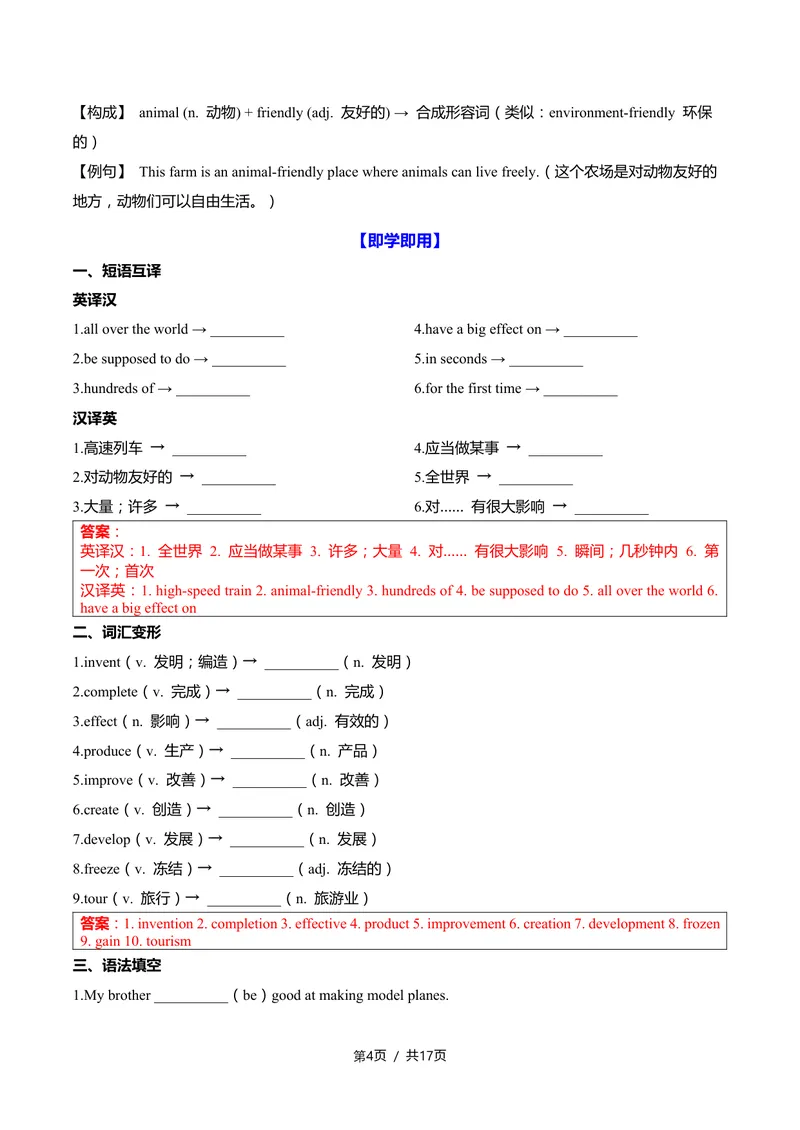
Fu Xing: What do you think is the most useful invention of all
time, Peter?
Peter: It has to be the radio.Fu Xing
FuXing: The radio? Why?
Peter: Before the radio was invented, information travelled very
slowly. The world was made much smaller by the radio.
Suddenly, news could be spread around the world in seconds.
FuXing: Right. Who was the inventor?
Peter: An Italian inventor called Guglielmo Marconi. He developed the idea in the 1890s. In 1901, a
radio message was sent across the Atlantic
Peter: Ocean for the first time.
FuXing: Wow! That was quite a distance at that time.
Peter: Yeah. And because of the radio, some other important inventions were developed as well.
Fu Xing: Like the television?
Peter: That's right. It also had a big effect on music. The radio made it much easier for people to
enjoy music from artists around the world.
1.invention
【含义】 n. 发明;发明物;创造力
第1 / 17
页 共 页【搭配】 a great invention 一项伟大的发明;the invention of the phone 电话的发明
【同根词】 invent (v. 发明) → inventor (n. 发明家) → invention (n. 发明)
【例句】 The smartphone is one of the most useful inventions in the 21st century.(智能手机是 21 世纪
最有用的发明之一。)
2.in seconds
【含义】 瞬间;几秒钟内
【搭配】 finish the work in seconds 瞬间完成工作;reply in seconds 立刻回复
【例句】 He solved the simple math problem in seconds.(他几秒钟就解出了这道简单的数学题。)
3.for the first time
【含义】 第一次;首次
【搭配】 try sth. for the first time 第一次尝试某事;meet sb. for the first time 第一次见到某人
【例句】 She felt nervous when she gave a speech for the first time.(她第一次演讲时感到很紧张。)
4.distance
【含义】 n. 距离;间距;远方
【搭配】 a long distance 长距离;keep a distance 保持距离;distance between A and B A 和 B 之间的
距离
【同根词】 distant (adj. 遥远的) → distance (n. 距离)
【例句】 The distance between my home and school is about two kilometers.(我家到学校的距离大约是
两公里。)
5.had a big effect on
【含义】 对…… 有很大影响
【搭配】 have a big effect on study 对学习有很大影响;have a big effect on life 对生活有很大影响;
have a positive/negative effect on 对…… 有积极 / 消极影响
核心短语:have an effect on = influence (v./n. 影响)
【同根词】 effect (n. 影响) → effective (adj. 有效的);
【例句】 The new method had a big effect on his memory improvement.(这个新方法对他的记忆力提升
有很大影响。)
4c Complete the passage with the correct forms of the words in brackets. Make a profile of
the Qinghai-Xizang Railway.
第2 / 17
页 共 页The Qinghai-Xizang Railway was completed in 2006. It________(connect) Xining to Lhasa, a huge
distance of 1,956 kilometres, and it is the highest railway in the world, reaching S,072 metres above
sea level at Tanggula Pass.
The building of the railway was a great challenge. Creative ideas________(need) to solve different
problems. In summer, the top layer of the frozen ground would melt and become too soft to build
on, so pipes________(use) to keep the ground hard. However, in some places, it was impossible to
build the railway over the frozen ground, so tunnels had to________(create) instead. In some other
places, bridges ________(build) to keep the railway up above the ground. These bridges are animal-
friendly and________(allow) animals to pass under the tracks.
As an important and successful project, the railway has_______(increase) tourism and economic
development in the area. The lessons learnt and experience gained from building this railway will
help________(improve) transport in other similar places in the world.
6. complete
【含义】 adj. 完整的;完全的;v. 完成;结束
【搭配】 a complete set 一整套;complete information 完整的信息;complete the task 完成任务
【同根词】 completely (adv. 完全地);completion (n. 完成)
【例句】 She needs three days to complete the project.(她需要三天时间完成这个项目。)/ This is a
complete story with a happy ending.(这是一个结局圆满的完整故事。)
7. layer
【含义】 n. 层;层次;v. 分层;覆盖
【搭配】 a layer of snow 一层雪;a layer of skin 一层皮肤;layer sth. with 用…… 覆盖某物
【例句】 There is a thick layer of ice on the lake in winter.(冬天湖面上有一层厚厚的冰。)
8. frozen
【含义】 adj. 冻结的;冷冻的;v. freeze (冻结) 的过去分词 / 过去式
【搭配】 frozen food 冷冻食品;frozen water 冰水;frozen ground 冻土
【同根词】 freeze (v. 冻结) → froze (过去式) → frozen (过去分词 /adj. 冻结的)
【例句】 We bought some frozen vegetables for dinner.(我们买了一些冷冻蔬菜当晚餐。)
9.animal-friendly
【含义】 adj. 对动物友好的;利于动物的(合成形容词)
【搭配】 an animal-friendly policy 对动物友好的政策;animal-friendly products 动物友好型产品;
第3 / 17
页 共 页【构成】 animal (n. 动物) + friendly (adj. 友好的) → 合成形容词(类似:environment-friendly 环保
的)
【例句】 This farm is an animal-friendly place where animals can live freely.(这个农场是对动物友好的
地方,动物们可以自由生活。)
【即学即用】
一、短语互译
英译汉
1.all over the world → __________ 4.have a big effect on → __________
2.be supposed to do → __________ 5.in seconds → __________
3.hundreds of → __________ 6.for the first time → __________
汉译英
1.高速列车 → __________ 4.应当做某事 → __________
2.对动物友好的 → __________ 5.全世界 → __________
3.大量;许多 → __________ 6.对…… 有很大影响 → __________
答案:
英译汉:1. 全世界 2. 应当做某事 3. 许多;大量 4. 对…… 有很大影响 5. 瞬间;几秒钟内 6. 第
一次;首次
汉译英:1. high-speed train 2. animal-friendly 3. hundreds of 4. be supposed to do 5. all over the world 6.
have a big effect on
二、词汇变形
1.invent(v. 发明;编造)→ __________(n. 发明)
2.complete(v. 完成)→ __________(n. 完成)
3.effect(n. 影响)→ __________(adj. 有效的)
4.produce(v. 生产)→ __________(n. 产品)
5.improve(v. 改善)→ __________(n. 改善)
6.create(v. 创造)→ __________(n. 创造)
7.develop(v. 发展)→ __________(n. 发展)
8.freeze(v. 冻结)→ __________(adj. 冻结的)
9.tour(v. 旅行)→ __________(n. 旅游业)
答案:1. invention 2. completion 3. effective 4. product 5. improvement 6. creation 7. development 8. frozen
9. gain 10. tourism
三、语法填空
1.My brother __________(be)good at making model planes.
第4 / 17
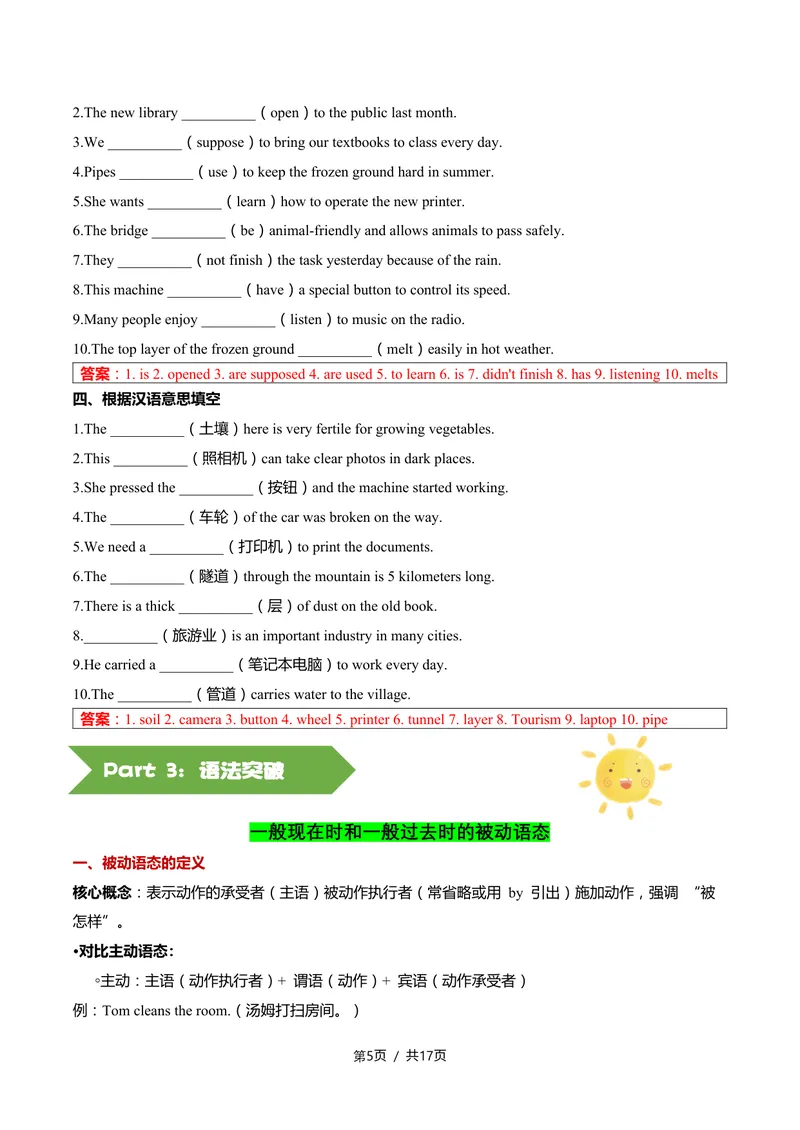
页 共 页2.The new library __________(open)to the public last month.
3.We __________(suppose)to bring our textbooks to class every day.
4.Pipes __________(use)to keep the frozen ground hard in summer.
5.She wants __________(learn)how to operate the new printer.
6.The bridge __________(be)animal-friendly and allows animals to pass safely.
7.They __________(not finish)the task yesterday because of the rain.
8.This machine __________(have)a special button to control its speed.
9.Many people enjoy __________(listen)to music on the radio.
10.The top layer of the frozen ground __________(melt)easily in hot weather.
答案:1. is 2. opened 3. are supposed 4. are used 5. to learn 6. is 7. didn't finish 8. has 9. listening 10. melts
四、根据汉语意思填空
1.The __________(土壤)here is very fertile for growing vegetables.
2.This __________(照相机)can take clear photos in dark places.
3.She pressed the __________(按钮)and the machine started working.
4.The __________(车轮)of the car was broken on the way.
5.We need a __________(打印机)to print the documents.
6.The __________(隧道)through the mountain is 5 kilometers long.
7.There is a thick __________(层)of dust on the old book.
8.__________(旅游业)is an important industry in many cities.
9.He carried a __________(笔记本电脑)to work every day.
10.The __________(管道)carries water to the village.
答案:1. soil 2. camera 3. button 4. wheel 5. printer 6. tunnel 7. layer 8. Tourism 9. laptop 10. pipe
Part 3:语法突破
一般现在时和一般过去时的被动语态
一、被动语态的定义
核心概念:表示动作的承受者(主语)被动作执行者(常省略或用 by 引出)施加动作,强调 “被
怎样”。
•对比主动语态:
◦主动:主语(动作执行者)+ 谓语(动作)+ 宾语(动作承受者)
例:Tom cleans the room.(汤姆打扫房间。)
第5 / 17
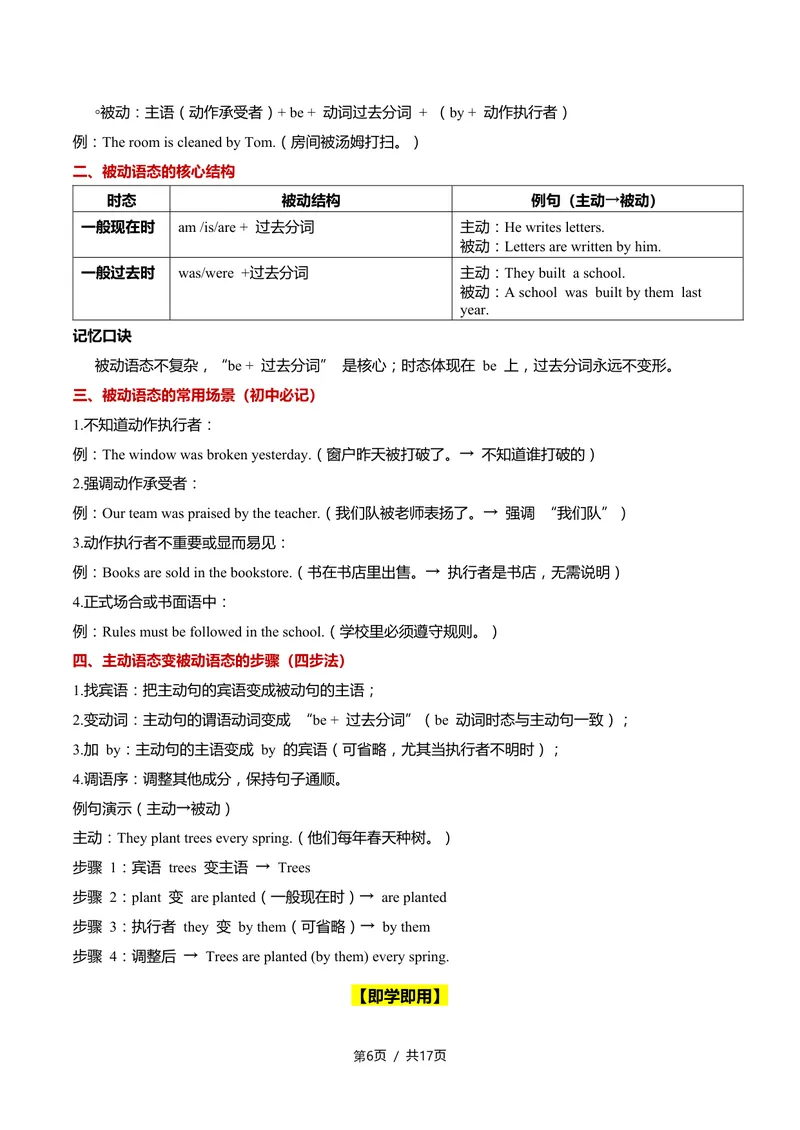
页 共 页◦被动:主语(动作承受者)+ be + 动词过去分词 + (by + 动作执行者)
例:The room is cleaned by Tom.(房间被汤姆打扫。)
二、被动语态的核心结构
时态 被动结构 例句(主动→被动)
一般现在时 am /is/are + 过去分词 主动:He writes letters.
被动:Letters are written by him.
一般过去时 was/were +过去分词 主动:They built a school.
被动:A school was built by them last
year.
记忆口诀
被动语态不复杂,“be + 过去分词” 是核心;时态体现在 be 上,过去分词永远不变形。
三、被动语态的常用场景(初中必记)
1.不知道动作执行者:
例:The window was broken yesterday.(窗户昨天被打破了。→ 不知道谁打破的)
2.强调动作承受者:
例:Our team was praised by the teacher.(我们队被老师表扬了。→ 强调 “我们队”)
3.动作执行者不重要或显而易见:
例:Books are sold in the bookstore.(书在书店里出售。→ 执行者是书店,无需说明)
4.正式场合或书面语中:
例:Rules must be followed in the school.(学校里必须遵守规则。)
四、主动语态变被动语态的步骤(四步法)
1.找宾语:把主动句的宾语变成被动句的主语;
2.变动词:主动句的谓语动词变成 “be + 过去分词”(be 动词时态与主动句一致);
3.加 by:主动句的主语变成 by 的宾语(可省略,尤其当执行者不明时);
4.调语序:调整其他成分,保持句子通顺。
例句演示(主动→被动)
主动:They plant trees every spring.(他们每年春天种树。)
步骤 1:宾语 trees 变主语 → Trees
步骤 2:plant 变 are planted(一般现在时)→ are planted
步骤 3:执行者 they 变 by them(可省略)→ by them
步骤 4:调整后 → Trees are planted (by them) every spring.
【即学即用】
第6 / 17
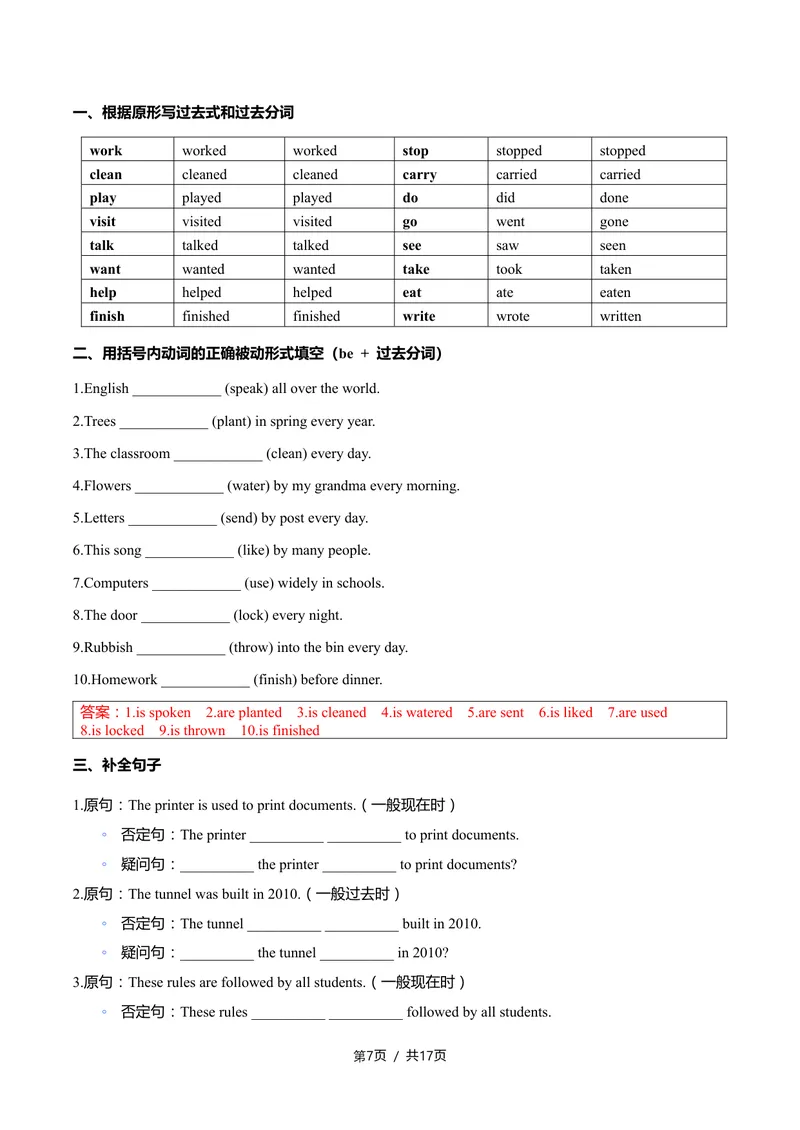
页 共 页一、根据原形写过去式和过去分词
work worked worked stop stopped stopped
clean cleaned cleaned carry carried carried
play played played do did done
visit visited visited go went gone
talk talked talked see saw seen
want wanted wanted take took taken
help helped helped eat ate eaten
finish finished finished write wrote written
二、用括号内动词的正确被动形式填空(be + 过去分词)
1.English ____________ (speak) all over the world.
2.Trees ____________ (plant) in spring every year.
3.The classroom ____________ (clean) every day.
4.Flowers ____________ (water) by my grandma every morning.
5.Letters ____________ (send) by post every day.
6.This song ____________ (like) by many people.
7.Computers ____________ (use) widely in schools.
8.The door ____________ (lock) every night.
9.Rubbish ____________ (throw) into the bin every day.
10.Homework ____________ (finish) before dinner.
答案:1.is spoken 2.are planted 3.is cleaned 4.is watered 5.are sent 6.is liked 7.are used
8.is locked 9.is thrown 10.is finished
三、补全句子
1.原句:The printer is used to print documents.(一般现在时)
◦ 否定句:The printer __________ __________ to print documents.
◦ 疑问句:__________ the printer __________ to print documents?
2.原句:The tunnel was built in 2010.(一般过去时)
◦ 否定句:The tunnel __________ __________ built in 2010.
◦ 疑问句:__________ the tunnel __________ in 2010?
3.原句:These rules are followed by all students.(一般现在时)
◦ 否定句:These rules __________ __________ followed by all students.
第7 / 17
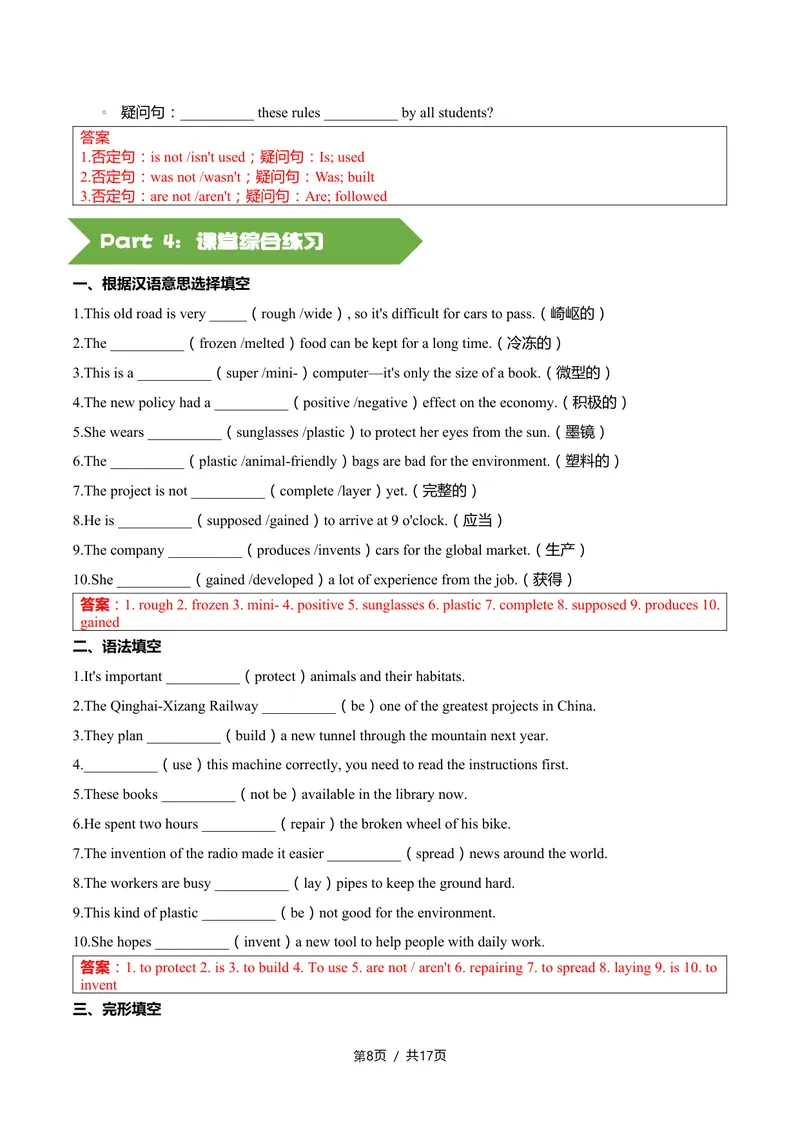
页 共 页◦ 疑问句:__________ these rules __________ by all students?
答案
1.否定句:is not /isn't used;疑问句:Is; used
2.否定句:was not /wasn't;疑问句:Was; built
3.否定句:are not /aren't;疑问句:Are; followed
Part 4:课堂综合练习
一、根据汉语意思选择填空
1.This old road is very _____(rough /wide), so it's difficult for cars to pass.(崎岖的)
2.The __________(frozen /melted)food can be kept for a long time.(冷冻的)
3.This is a __________(super /mini-)computer—it's only the size of a book.(微型的)
4.The new policy had a __________(positive /negative)effect on the economy.(积极的)
5.She wears __________(sunglasses /plastic)to protect her eyes from the sun.(墨镜)
6.The __________(plastic /animal-friendly)bags are bad for the environment.(塑料的)
7.The project is not __________(complete /layer)yet.(完整的)
8.He is __________(supposed /gained)to arrive at 9 o'clock.(应当)
9.The company __________(produces /invents)cars for the global market.(生产)
10.She __________(gained /developed)a lot of experience from the job.(获得)
答案:1. rough 2. frozen 3. mini- 4. positive 5. sunglasses 6. plastic 7. complete 8. supposed 9. produces 10.
gained
二、语法填空
1.It's important __________(protect)animals and their habitats.
2.The Qinghai-Xizang Railway __________(be)one of the greatest projects in China.
3.They plan __________(build)a new tunnel through the mountain next year.
4.__________(use)this machine correctly, you need to read the instructions first.
5.These books __________(not be)available in the library now.
6.He spent two hours __________(repair)the broken wheel of his bike.
7.The invention of the radio made it easier __________(spread)news around the world.
8.The workers are busy __________(lay)pipes to keep the ground hard.
9.This kind of plastic __________(be)not good for the environment.
10.She hopes __________(invent)a new tool to help people with daily work.
答案:1. to protect 2. is 3. to build 4. To use 5. are not / aren't 6. repairing 7. to spread 8. laying 9. is 10. to
invent
三、完形填空
第8 / 17
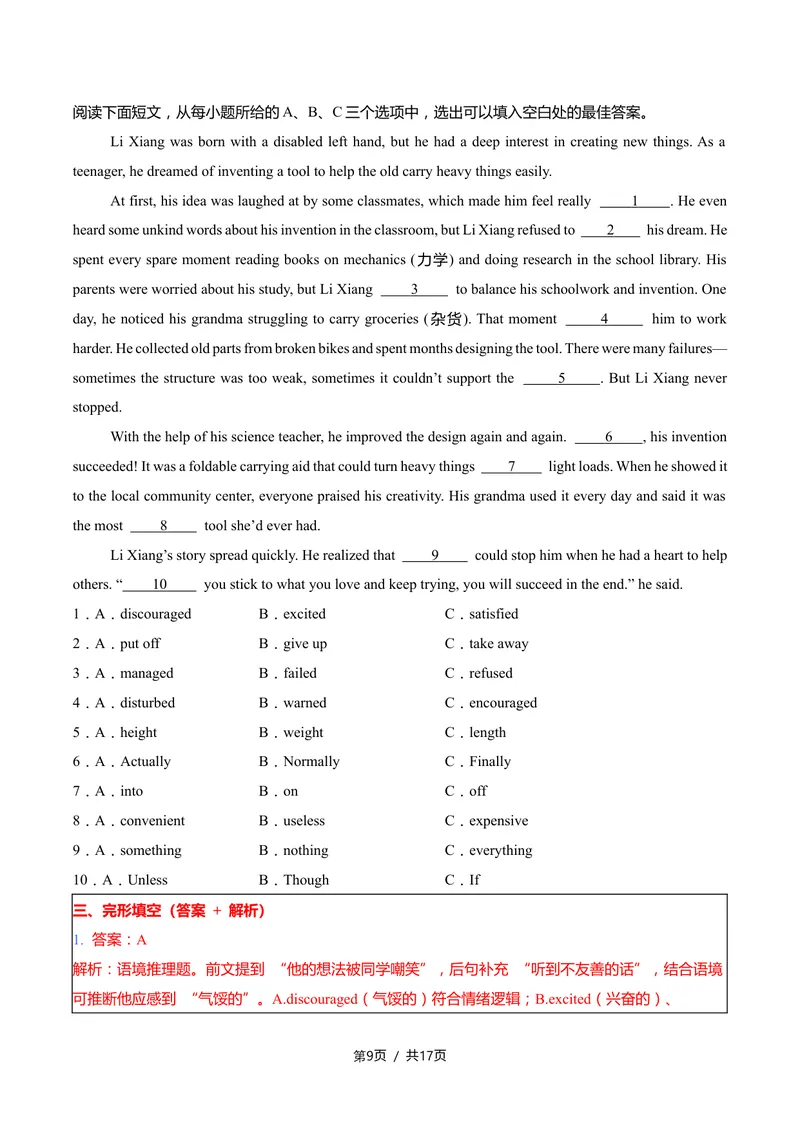
页 共 页阅读下面短文,从每小题所给的A、B、C三个选项中,选出可以填入空白处的最佳答案。
Li Xiang was born with a disabled left hand, but he had a deep interest in creating new things. As a
teenager, he dreamed of inventing a tool to help the old carry heavy things easily.
At first, his idea was laughed at by some classmates, which made him feel really 1 . He even
heard some unkind words about his invention in the classroom, but Li Xiang refused to 2 his dream. He
spent every spare moment reading books on mechanics (力学) and doing research in the school library. His
parents were worried about his study, but Li Xiang 3 to balance his schoolwork and invention. One
day, he noticed his grandma struggling to carry groceries (杂货). That moment 4 him to work
harder. He collected old parts from broken bikes and spent months designing the tool. There were many failures—
sometimes the structure was too weak, sometimes it couldn’t support the 5 . But Li Xiang never
stopped.
With the help of his science teacher, he improved the design again and again. 6 , his invention
succeeded! It was a foldable carrying aid that could turn heavy things 7 light loads. When he showed it
to the local community center, everyone praised his creativity. His grandma used it every day and said it was
the most 8 tool she’d ever had.
Li Xiang’s story spread quickly. He realized that 9 could stop him when he had a heart to help
others. “ 10 you stick to what you love and keep trying, you will succeed in the end.” he said.
1.A.discouraged B.excited C.satisfied
2.A.put off B.give up C.take away
3.A.managed B.failed C.refused
4.A.disturbed B.warned C.encouraged
5.A.height B.weight C.length
6.A.Actually B.Normally C.Finally
7.A.into B.on C.off
8.A.convenient B.useless C.expensive
9.A.something B.nothing C.everything
10.A.Unless B.Though C.If
三、完形填空(答案 + 解析)
1. 答案:A
解析:语境推理题。前文提到 “他的想法被同学嘲笑”,后句补充 “听到不友善的话”,结合语境
可推断他应感到 “气馁的”。A.discouraged(气馁的)符合情绪逻辑;B.excited(兴奋的)、
第9 / 17
页 共 页C.satisfied(满意的)与 “被嘲笑、听坏话” 的场景相反,排除。
2. 答案:B
解析:固定短语辨析。句意:但李翔拒绝放弃梦想。A.put off(推迟)侧重时间上的延后;B.give up
(放弃)侧重主动停止追求;C.take away(拿走)侧重实物被夺走。结合后文 “坚持阅读力学书
籍、做研究” 的行为,可知是 “不放弃梦想”,故选 B。
3. 答案:A
解析:动词词义辨析。句意:他的父母担心他的学习,但李翔设法平衡了学业和发明。A.managed
(设法做到),常用搭配 “manage to do sth.”,体现克服困难后的结果;B.failed(失败)与后文
“发明成功” 矛盾;C.refused(拒绝)不符合 “父母担心但他仍兼顾” 的逻辑,排除。
4. 答案:C
解析:动词词义辨析。句意:那一刻鼓励他更加努力。A.disturbed(打扰)侧重干扰他人;B.warned
(警告)侧重提醒危险;C.encouraged(鼓励)侧重激发动力。看到奶奶搬杂货吃力,应是 “激发他
坚持发明的动力”,故选 C。
5. 答案:B
解析:名词词义辨析。句意:有时结构太弱,有时无法支撑重量。A.height(高度)、C.length(长
度)与 “工具搬重物” 的核心功能无关;B.weight(重量)符合 “支撑重物” 的场景,故选 B。
6. 答案:C
解析:副词词义辨析。句意:最后,他的发明成功了!A.Actually(实际上)侧重转折补充;
B.Normally(通常)侧重常规情况;C.Finally(最后)侧重经历过程后的最终结果。前文提到 “多次
失败、在老师帮助下反复改进”,此处表最终成功,故选 C。
7. 答案:A
解析:固定搭配题。“turn...into...” 为固定短语,意为 “把…… 变成……”,句意:这是一款可折叠
的辅助搬运工具,能把重物变成轻负载。其他介词 on(在…… 上)、off(离开)均不与 turn 构成
“转化” 含义的搭配,排除。
8. 答案:A
解析:形容词词义辨析。句意:奶奶每天用它,说这是她用过的最方便的工具。A.convenient(方便
的)与 “每天使用” 呼应,体现工具的实用性;B.useless(无用的)与 “日常使用” 矛盾;
C.expensive(昂贵的)未在文中提及价格相关信息,排除。
9. 答案:B
解析:不定代词辨析。句意:他意识到,当他有心帮助别人时,没有什么能阻止他。A.something(某
事 / 物)表肯定,不符合 “无阻碍” 的语义;B.nothing(没有什么)表否定,符合 “坚持初心就
第10 / 17
页 共 页无人能挡” 的逻辑;C.everything(一切)表全部,与语境矛盾,排除。
10.答案:C
解析:连词辨析。句意:“如果你坚持自己热爱的事并不断尝试,最终会成功。”A.Unless(除非)
表条件转折,相当于 “if not”,不符合句意;B.Though(虽然)表让步,此处无 “转折让步” 逻
辑;C.If(如果)表条件,“坚持 + 尝试” 是 “成功” 的前提,符合语义,故选 C。
四、语法填空
Wu Zeyin, 11, comes from Hubei, China. He 1 (move) to Botswana with his family seven
years ago. “I can see only a few kinds of fruit and vegetables at supermarkets here. They don’t look good,
2 their prices are high,” Wu said.
Because of the desert climate (气候) in Botswana, it is difficult 3 farmers there to grow fruit
and vegetables. Botswana has to buy lots of fruit and vegetables from other 4 (country), such as
South Africa.
Botswana has been working with China to solve this problem. In July last year, Botswana started a
program to grow China’s water-saving rice. Knowing it, Wu wanted to help with local agriculture (当地的农
业) in his way. “I wanted to 5 an app. It can help local farmers to 6 the production,” Wu
said.
Wu has a good brain and he has made his dream come true by 7 (develop) a new app called
Farm Assistant. The app can teach farmers how to grow vegetables like potatoes, onions, carrots and cabbages.
Farmers who use the app can click (点击) on a picture of a vegetable to see 8 (it) seed (种子) price,
watering needs, selling price, etc. After the farmers plant the seeds, the app can remind them what they need to
do at different times. Wu hopes his app can help farmers to work 9 (easy).
What 10 useful app and what a smart boy!
四、语法填空(答案 + 解析)
1. 答案:moved
解析:时态题。根据时间状语 “seven years ago”(七年前),可知句子需用一般过去时。move 的过
去式为 moved,句意:七年前他和家人搬到了博茨瓦纳。
2. 答案:and
解析:连词题。前半句 “它们看起来不好”,后半句 “价格很高”,前后为并列递进关系,用 and
连接,句意:它们看起来不好,而且价格很贵。
3. 答案:for
第11 / 17
页 共 页解析:固定句型题。“It is difficult for sb. to do sth.” 为固定句型,意为 “对某人来说做某事很困
难”,此处 for 引出动作的逻辑主语 farmers,句意:对当地农民来说,种植水果蔬菜很困难。
4. 答案:countries
解析:名词单复数题。other 后接可数名词复数,country 的复数形式为 countries,句意:博茨瓦纳不
得不从南非等其他国家购买大量水果蔬菜。
5. 答案:make
解析:动词原形题。want to do sth. 为固定搭配,to 后接动词原形,句意:我想做一个应用程序。
6. 答案:improve
解析:动词词义题。结合语境,应用程序的功能是 “帮助农民提高产量”,help sb. to do sth. 中 to
后接原形,improve(提高)符合句意,句意:它能帮助当地农民提高产量。
7. 答案:developing
解析:非谓语动词题。by 为介词,后接动词 - ing 形式,develop 的 - ing 形式为 developing,句
意:他很聪明,通过开发一款名为 “农场助手” 的新应用程序实现了梦想。
8. 答案:its
解析:物主代词题。此处需修饰名词 “seed price”(种子价格),用形容词性物主代词 its(它
的),指代前文提到的 “a vegetable”,句意:使用该应用的农民可以点击蔬菜图片,查看其种子价
格、浇水需求、售价等。
9. 答案:easily
解析:副词修饰动词题。此处需修饰动词 “work”(工作),用 easy 的副词形式 easily,句意:吴
希望他的应用能帮助农民轻松工作。
10.答案:a
解析:冠词题。app 为可数名词单数,且 useful 以辅音音素 /juː/ 开头,用不定冠词 a,句意:多么
实用的应用程序,多么聪明的男孩啊!
五、任务型读写
Robots that look just like real people, including an Albert Einstein robot, went for sale in Beijing, China
recently.
A new robot store has opened in Beijing selling human-like robots. These robots can be home helpers,
cooks, or copies of famous scientists. According to a report, the store offering 100 kinds of products is the first
of its kind to sell human-like robots for everyday use. The store is located next to a robot-themed restaurant
where food is cooked and served by robots.
The store owner Wang Yifan said, “If we want robots to go into many homes, just robot companies can’t
第12 / 17
页 共 页do it alone.” Many of the companies have no experience in sales and there are few chances to show their
products, he added. The store allows visitors to touch and play with many different robots from chess players to
dogs. The human-like robots are priced between 2,000 yuan and over a million yuan.
China is one of the top countries in robot technology. This year, the government plans to help new robot
and AI companies grow.
1.Where did human-like robots go for sale recently? (no more than 2 words)
2.How many kinds of robots can you see in the new robot store? (no more than 2 words)
3.What can visitors do in Wang Yifan’s robot store? (no more than 7 words)
4.What does the government plan to do this year? (no more than 7 words)
5.What do you think of China’s robot technology? (no more than 1 word)
五、任务型读写(答案 + 解析)
1. 答案:In Beijing
解析:细节查找题。题干要求 “不超过 2 个词”,原文第一句 “Robots that look just like real
people... went for sale in Beijing, China recently.” 直接给出销售地点,提炼核心词 “In Beijing”。
2. 答案:100 kinds
解析:细节查找题。题干要求 “不超过 2 个词”,原文第二段 “the store offering 100 kinds of
products” 明确提到机器人种类,直接提取 “100 kinds”。
3. 答案:Touch and play with robots
解析:细节查找题。题干要求 “不超过 7 个词”,原文第三段 “The store allows visitors to touch
and play with many different robots”,简化为 “Touch and play with robots”,符合词数要求。
4. 答案:Help new robot and AI companies grow
解析:细节查找题。题干要求 “不超过 7 个词”,原文最后一句 “the government plans to help new
robot and AI companies grow”,直接提取核心短语,符合词数限制。
5. 答案:Top
解析:细节推理题。题干要求 “不超过 1 个词”,原文 “China is one of the top countries in robot
technology” 提到中国是 “顶尖国家之一”,提炼核心形容词 “Top”。
第13 / 17
页 共 页六、短文还原
An invention may be a new product or a new way of doing things. Inventions come about in many ways.
Most of the time, inventions happen because someone works to solve a problem. 1 Look at your
schoolbags. You have pencils, pens, crayons, rulers and some books. None of these things were planted in fields.
They were made in factories and invented by someone. Inventing is interesting and exciting and everyone can
be an inventor. Do you want to be an inventor? 2
●Use your imagination. You can have wild and crazy thoughts. 3 Many people laughed at the
Wright brothers and said they would never fly. But they weren’t discouraged by what people said. That’s why
now we have planes.
●Plan and design your invention. Careful planning is important in the invention process. This is the time
to brainstorm for ideas and to evaluate (评估) them.
● 4 Make a detailed drawing of your invention so others will understand how your invention
works.
●Make a model of your invention.
●Test your invention. See if your invention works as it is planned. 5
●Name your invention. Every invention needs a name.
●Share your inventions with others.
A.If not, do more research, redesign it, and test it again.
B.Never give up!
C.There are a few simple steps to follow in the invention process.
D.Remember that no idea is too silly.
E.Sometimes inventions are the result of accidents.
F.Draw your invention.
六、短文还原(答案 + 解析)
1. 答案:E
解析:上下文衔接题。前文提到 “发明产生的多种方式,大多是为了解决问题”,空后需补充另一
种方式。E.Sometimes inventions are the result of accidents.(有时发明是意外的结果)承接 “多种方
式”,与后文 “莱特兄弟被嘲笑仍坚持发明飞机” 的例子呼应,符合逻辑。
2. 答案:C
解析:上下文衔接题。前文问 “Do you want to be an inventor?”(你想成为发明家吗?),空后列出
“想象、规划、画图” 等步骤。C.There are a few simple steps to follow in the invention process.(发明
第14 / 17
页 共 页过程中有几个简单步骤可遵循)起到承上启下的作用,引出下文步骤,故选 C。
3. 答案:D
解析:上下文衔接题。前文提到 “可以有大胆疯狂的想法”,后文举 “莱特兄弟被嘲笑但发明飞
机” 的例子。D.Remember that no idea is too silly.(记住没有想法是太傻的)呼应 “大胆想法”,支
撑后文例子,故选 D。
4. 答案:F
解析:段落主题题。空后提到 “画详细的发明图,让别人理解其工作原理”,F.Draw your invention.
(画出你的发明)直接概括该步骤,与前后步骤 “规划、做模型” 的结构一致,故选 F。
5. 答案:A
解析:上下文衔接题。前文提到 “测试发明,看是否按计划工作”,空后需补充测试后的处理方
式。A.If not, do more research, redesign it, and test it again.(如果没有,就做更多研究、重新设计并再次
测试)承接 “测试结果”,符合 “测试 - 调整” 的逻辑,故选 A。
七、阅读理解
One day in 1903 French scientist Edouard Benedictus climbed high to get something on a high shelf in
his laboratory. He carelessly hit an empty glass flask (烧瓶) and it fell to the stone floor.
Benedictus climbed down, expecting a mess, but he found a surprise. The glass hadn’t broken into a
million pieces! It had cracked (破裂), but it had held together. Benedictus wondered why.
His helper explained he had used the flask to hold liquid plastic (液态塑料). Then he had put the flask
aside and forgotten to wash it. The liquid plastic dried, so the flask looked empty. Benedictus found that the
dried plastic had kept the cracked glass from falling apart.
The same week, Benedictus read a report about a car accident in the newspaper. The car was a new and
exciting invention, and many people were driving fast on the roads. When accidents happened, people were
often hurt by flying broken glass. Suddenly Benedictus thought of the broken flask. Could his accident be
something useful?
Benedictus spent a lot of time in the lab, trying to find out the best way to make safety glass for cars.
Finally, Benedictus put some liquid plastic between two pieces of glass and pressed them together. When he hit
it, the “glass-and-plastic sandwich” cracked, but it didn’t break into small pieces.
Benedictus succeeded. He wrote in his diary, “I produced my first piece of Triplex (the name for his
invention) —full of promise for the future.”
Benedictus was right. His method of putting plastic between pieces of glass is still used today. And that’s
how a careless accident led to an invention that made us all safer!
第15 / 17
页 共 页1.How did Benedictus feel when he saw the cracked glass flask?
A.Angry. B.Sorry. C.Excited. D.Surprised.
2.The glass flask didn’t fall apart because ________.
A.the floor was not so hard B.the shelf was not so high
C.there was dried plastic in it D.Benedictus’ helper caught it
3.When did Benedictus decide to work on his invention?
A.When he read a news report.
B.When he climbed high on a shelf.
C.After his helper had a car accident.
D.After his helper gave him a suggestion.
4.What do we know about Triplex?
A.It was invented in 1900.
B.It had plastic on its cover.
C.It got popular as soon as it was invented.
D.It had an influence on today's safety glass.
5.Which of the following is the best title of the passage?
A.Magic of Plastic B.Lessons from Accidents
C.A Great Accidental Invention D.Daily Life of a French Scientist
七、阅读理解(答案 + 解析)
1. 答案:D
解析:细节查找题。原文第二段 “Benedictus climbed down, expecting a mess, but he found a surprise.
The glass hadn’t broken into a million pieces!” 明确提到他的感受是 “惊讶的”,对应选项 D。
A.Angry(生气的)、B.Sorry(抱歉的)、C.Excited(兴奋的)均未在文中提及,排除。
2. 答案:C
解析:细节查找题。原文第三段 “Benedictus found that the dried plastic had kept the cracked glass from
falling apart.” 直接说明原因是 “烧瓶内有干涸的液态塑料”,对应选项 C。A. 地板不硬、B. 架子
不高、D. 助手接住了,均与原文描述不符,排除。
3. 答案:A
解析:细节查找题。原文第四段 “The same week, Benedictus read a report about a car accident...
Suddenly Benedictus thought of the broken flask. Could his accident be something useful?” 可知,他是在
“读了一则车祸报道后” 决定研发安全玻璃,对应选项 A。
第16 / 17
页 共 页4. 答案:D
解析:细节推理题。原文最后一段 “His method of putting plastic between pieces of glass is still used
today.” 说明他的发明方法至今仍被沿用,对现代安全玻璃有影响,对应选项 D。A. 发明于 1900 年
(原文是 1903 年);B. 表面有塑料(原文是玻璃间夹塑料);C. 一经发明就流行(文中未提及流
行程度),均排除。
5. 答案:C
解析:主旨大意题。文章围绕 “本尼迪克特意外打翻烧瓶,发现塑料能固定破碎玻璃,进而发明安
全玻璃” 展开,核心是 “意外带来的发明”。C.A Great Accidental Invention(一项伟大的意外发
明)概括全文主旨;A. 塑料的魔力(侧重材料,非核心)、B. 意外的教训(侧重教训,无发明主
线)、D. 法国科学家的日常生活(偏离 “发明” 主题),均排除。
第17 / 17
页 共 页