话题:人与自我(卫生与健康)
体裁:议论文
词数:828
FK Grade Level: 9.3
Dear fast food chains: Please stop giving our kids free toys
For mum-of-two Jo, the recent call to ban free toys with a fast food meal is something
that needs to happen before it’s too late.

If I had to average it out, I'd say that I take my son to McDonalds once
every six weeks. Sometimes it’s for a treat, other times it’s purely for
convenience. We’re all tired, and the idea of making dinner is much akin to
completing Ninja Warrior – yes, sometimes it really does feel that hard.
Regardless of the reason for entering the golden arches, there’s never any
5
argument from my son. In a perfect world, when given the choice in the food
court, he’d say, ‘oh I’ll have a salad’. But, this is reality. He’s seven-years-old
and he’s the perfect target for McDonalds.
Happy meals are always the pick of the day and, while he’s partial to a
chip or two (who isn’t?), the main driver for this choice is the plastic fantastic
10
toy. This piece of child movie-themed merchandise gets relished more than
any bloody expensive toy I’ve ever brought him.

Let’s face it, all they want is the toy
Nine times out of 10 most of his meal is nibbled on and subsequently left
while he’s distracted shooting a minion across the table.
15
It’s no different on the occasions that I drag him to the grocery store. I
enter in survival mode, my goal being to rush through the store at top speed
while fighting as fewer battles as I can. Inevitably, this translates to ending up
with $20+ worth of unhealthy snacks and food.
But my son doesn’t always choose these unhealthy foods because they’re
20
filled with sugar and, to him, taste amazing. It’s often more about the
packaging. The fact that the food is emblazoned with an appealing movie
初中英语外刊阅读精讲直播课(拓展阅读)
SSP OverAchiever 联合出品
1/4
character, cartoon or the offer of a ‘free’ toy is enough to suck him in.

Pester power in the young is strong and marketers know this well.
Try to find healthy kids’ snacks and food that hold the same kind of
25
incentive packaging or appeal and you really struggle. But this needs to
change.
The number of overweight children in Australia has doubled in recent
years. A 2016 Government inquiry found that, in 2015, 22 per cent of NSW
children were overweight or obese. Similarly, of those aged between two to
30
four years old, 20 per cent were already above a healthy weight.
The causes for children being overweight or obese include lack of physical
activity, poor family eating habits and, of course, unhealthy food choices.
Sadly, the effects of such weight gain are not pretty.
In the short term, a poor diet can impact on children’s mood and tiredness
35
levels which can, subsequently, affect their school work and ability to
concentrate.
In the longer term, more serious health concerns pose a risk. These include
everything from respiratory problems, sleep apnoea, and eating disorders
through to increased risk of fatty liver, early ‘adult’ diabetes and heart
40
disease.


初中英语外刊阅读精讲直播课(拓展阅读)
SSP OverAchiever 联合出品
2/4
Something needs to change
So, what are we, as a country, trying to do about it?
To date, there have been many attempts by Government and health
organisations to try to implement healthy eating incentives in schools, and
45
educate children and parents on the right food choices. But a recent study by
Cancer Council Victoria is calling for even more action.
The study, involving 900 Melbourne school children, found children were
more likely to choose the McDonald's Happy Meals that had toys.
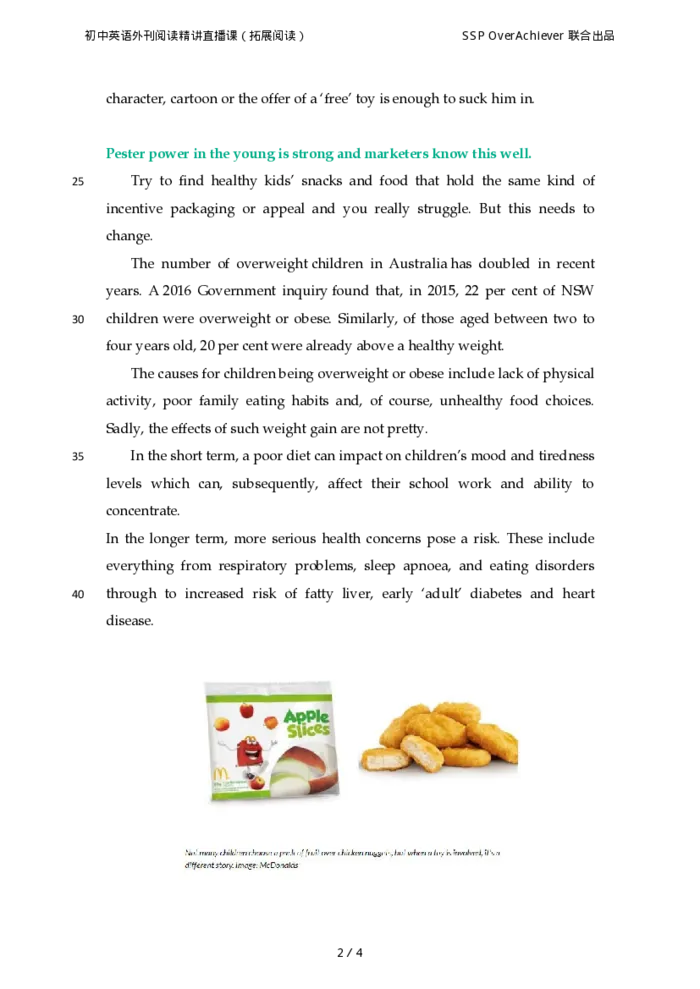
Only 17 per cent of children choose the healthier Happy Meal option
50
(such as a wrap and fruit bag), over less healthy options (such as
cheeseburgers and soft drink), when meals did not include a toy.
But when only the healthy meals came with a toy the number of children
that choose the healthier option almost doubled, to 32 per cent.
"Rather than ban food-related premiums altogether, [our] findings
55
support the use of these promotions as vehicles for promoting healthier meal
choices to children," the study concluded.
Such a measure would reverse current trends, where free toys, stickers,
collectables and competitions tend to be used to promote chocolate, fast food,
sugary cereals and other unhealthy options.
60


初中英语外刊阅读精讲直播课(拓展阅读)
SSP OverAchiever 联合出品
3/4
Hearing of this call was like music to my much-pestered ears
For me, and millions of other parents, the removal of such child lulling
incentives on unhealthy food would be a winning formula all round.
Switching promotions and advertising to appear on healthy food options
instead makes so much more sense.
65
There’s no reason for our children to be drawn in by the sugary snacks or
even get the opportunity for developing a taste for them. And, more
importantly, our children’s health won’t be constantly put at risk.
Going grocery shopping or out to dinner would be so much less of a
battle. Of course, there’ll still be pestering. But if it relates to a minion banana
70
or a bag of healthy transformer snacks, that’s a battle that I’m ok to let my son
win.
初中英语外刊阅读精讲直播课(拓展阅读)
SSP OverAchiever 联合出品
4/4