文档文本内容
话题:人与社会(工作与就业)
体裁:议论文
来源:CNBC, 20200217
词数:446
FK Grade Level: 9.2

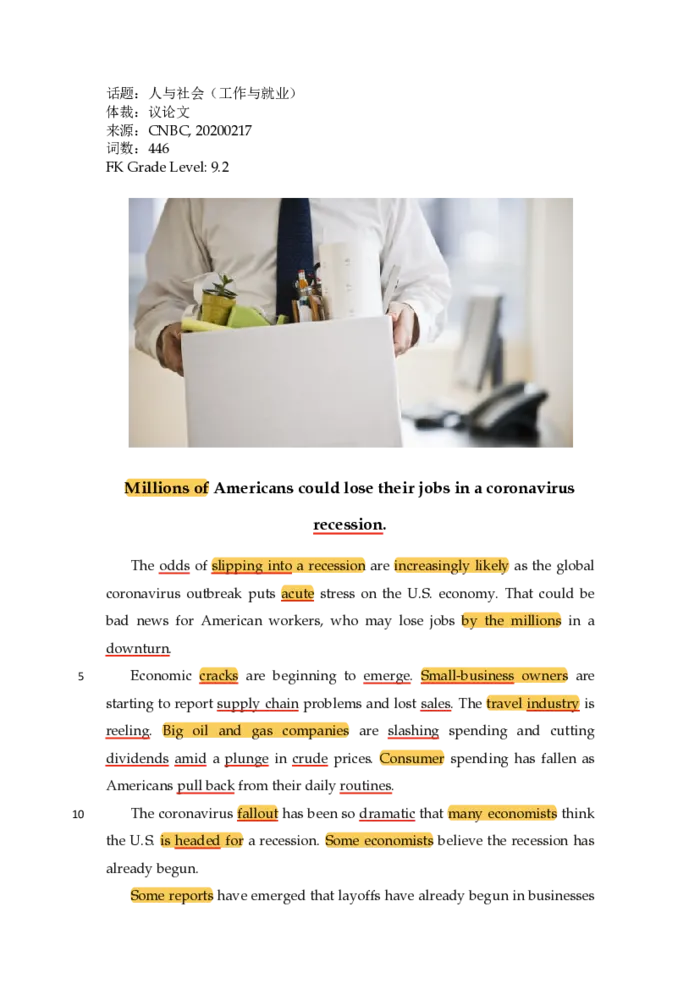
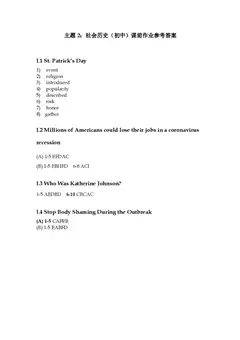
Millions of Americans could lose their jobs in a coronavirus
recession.
The odds of slipping into a recession are increasingly likely as the global
coronavirus outbreak puts acute stress on the U.S. economy. That could be
bad news for American workers, who may lose jobs by the millions in a
downturn.
Economic cracks are beginning to emerge. Small-business owners are
5
starting to report supply chain problems and lost sales. The travel industry is
reeling. Big oil and gas companies are slashing spending and cutting
dividends amid a plunge in crude prices. Consumer spending has fallen as
Americans pull back from their daily routines.
The coronavirus fallout has been so dramatic that many economists think
10
the U.S. is headed for a recession. Some economists believe the recession has
already begun.
Some reports have emerged that layoffs have already begun in businesses
across the country.

Financial backstop lacking
15
Many workers don’t have an adequate financial backstop in layoff
situations, experts said.
Half of U.S. adults expected to be living paycheck to paycheck this year
and 53% did not have an emergency fund that covers at least three months of
expenses, according to a financial planning survey conducted prior to the
20
coronavirus outbreak by First National Bank of Omaha in Nebraska.

3.5 million jobs
The typical post-World War II recession has led the unemployment rate to
increase about 2 to 2.5 percentage points, according to David Wilcox, a senior
fellow at the Peterson Institute for International Economics.
25
An economic downturn due to the coronavirus would put an abrupt end
to the longest-running expansion in U.S. history. If it were like an average
recession, it would translate to a roughly 6% unemployment rate (given
today’s 3.5% rate, which is near 50-year lows).
That would mean about 3.5 million lost jobs, Wilcox said.
30
During the country’s last recession — the Great Recession, the worst
downturn since the Great Depression — about 8 million Americans lost their
jobs.
Job loss during recessions doesn’t all come via layoffs, Wilcox said.
And rather than reducing the size of their workforce, businesses could
35
instead cut employees’ hours and overtime pay. That approach could still
strain workers’ finances but wouldn’t leave them jobless.

Uneven impact
Recessions don’t impact Americans uniformly — workers in certain
industries, such as hospitality, restaurants and food services, which tend to
40
employ many younger workers under 40, are more likely than others to be
laid off in the event of recession, according to Carter Price, a senior
mathematician at the Rand Corp.
Minorities and Americans with less education also tend to lose their jobs
with greater frequency during recessions, Wilcox said.
45
“The economic cost, the burden of a recession, is very unequally
distributed,” he said.