文档文本内容
主题语境:人与自然
主题群:科学技术
语篇类型:新闻报道
来源:wgbh.org, 2019/7/31
Word count: 463
Flesch-Kincaid Grade Level: 10.0
Lexile Range: 1210L - 1400L

Teaching Kids The Ethics Of Artificial Intelligence
Research suggests kids growing up on Alexa and Google Home think that
these devices are smarter than them. But a new kind of summer camp wants
kids to know that artificial intelligence (AI) is far from perfect.
Welcome to AI Ethics camp.
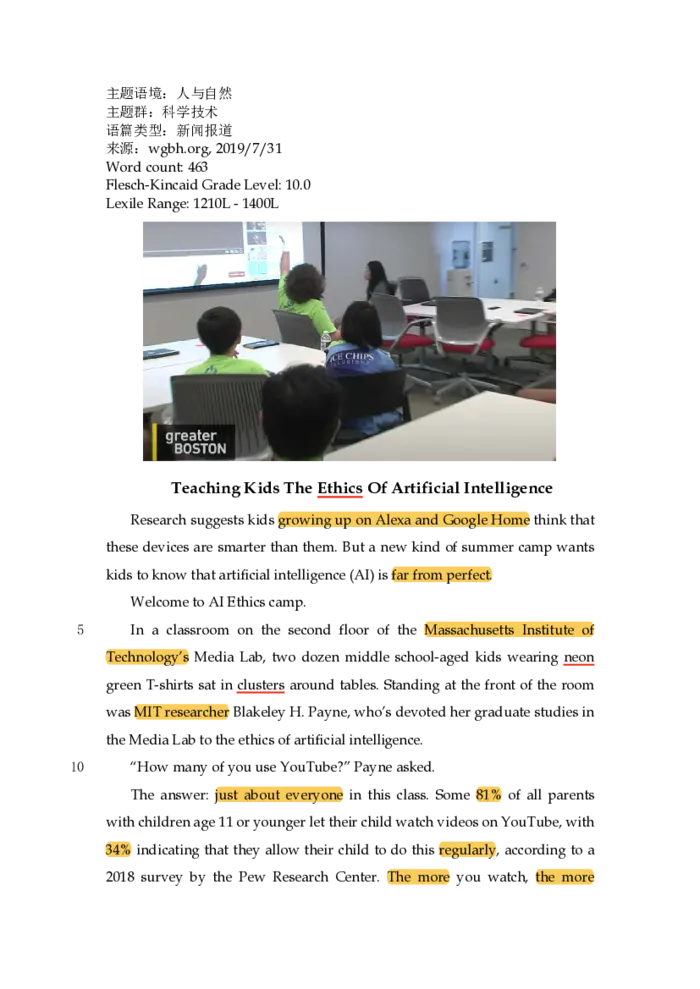
In a classroom on the second floor of the Massachusetts Institute of
5
Technology’s Media Lab, two dozen middle school-aged kids wearing neon
green T-shirts sat in clusters around tables. Standing at the front of the room
was MIT researcher Blakeley H. Payne, who’s devoted her graduate studies in
the Media Lab to the ethics of artificial intelligence.
“How many of you use YouTube?” Payne asked.
10
The answer: just about everyone in this class. Some 81% of all parents
with children age 11 or younger let their child watch videos on YouTube, with
34% indicating that they allow their child to do this regularly, according to a
2018 survey by the Pew Research Center. The more you watch, the more
YouTube is able to target all kinds of content, including advertising.
15
“Do you ever think about the algorithm (算法) behind the ‘Who’s
trending’ page?” Payne asked.
Most of the kids shook their heads no.
Payne thinks all kids should not only understand how AI works, but
approach its design through an ethical lens. Artificial intelligence is a human
20
creation, prone to flaws and biases. A 2018 study by Joy Buolamwini, a
researcher at the Media Lab, found that the facial recognition software of tech
giants IBM, Microsoft and Google struggled in detecting the faces of black
women. The study suggested that when biased data sets are fed into
machine-learning algorithms, they perpetuate (使持续) inequalities in various
25
pipelines where artificial intelligence is being used, from job recruitment to
prison sentences.
The capstone project for the week is redesigning YouTube. It may sound
like a heady undertaking, but Payne says these digital natives are already
sharp media consumers.
30
“They have such an ability from a young age to empathize with different
stakeholders, to put themselves in other people’s shoes,” Payne said. “If you
ask them about YouTube, they can exactly explain to you who the
recommender algorithm benefits, who it harms and why.”
Payne thinks the way to influence the next generation of programmers
35
and consumers is to teach AI ethics more broadly, in schools across the
country.
“Because what I don’t want to happen is, I don’t want the ethics piece to
go to an elite few. And then you’re just perpetuating these systems of
inequality over and over again,” she said. “I love to think about a future
40
where the students in this workshop make up the majority of the people who
work in Silicon Valley or the majority of the people who work on Wall Street.”
加入慧享社群,零开销,尽享亲子成人精品课程,加微信 396014713