8 Questions for Andrew Morgan
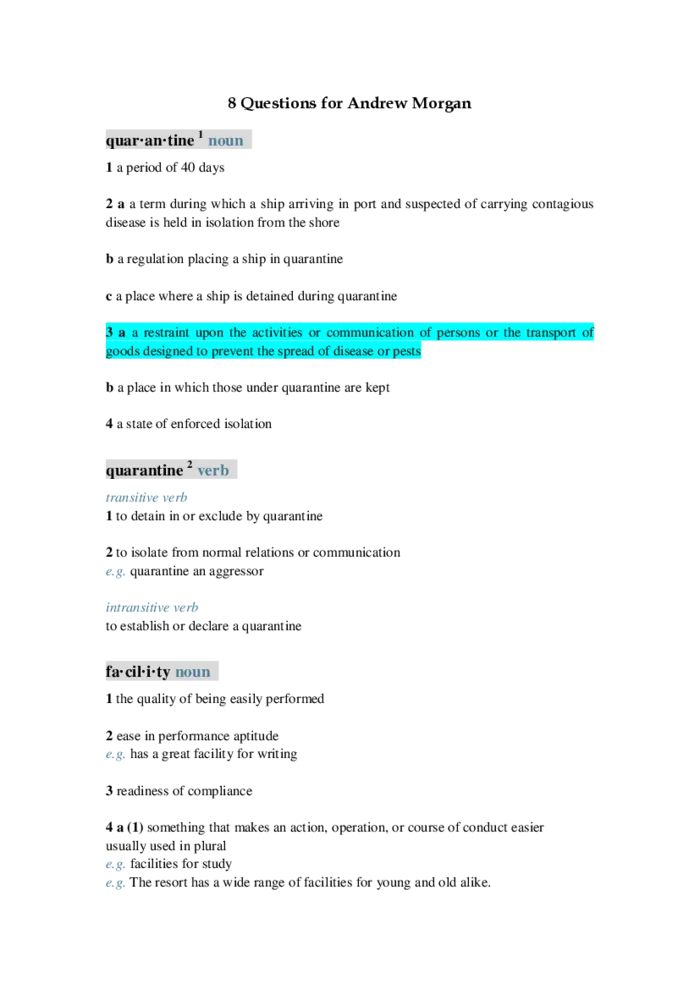
quar·an·tine 1 noun
1 a period of 40 days

2 a a term during which a ship arriving in port and suspected of carrying contagious
disease is held in isolation from the shore

b a regulation placing a ship in quarantine

c a place where a ship is detained during quarantine

3 a a restraint upon the activities or communication of persons or the transport of
goods designed to prevent the spread of disease or pests

b a place in which those under quarantine are kept

4 a state of enforced isolation

quarantine 2 verb
transitive verb
1 to detain in or exclude by quarantine

2 to isolate from normal relations or communication
e.g. quarantine an aggressor

intransitive verb
to establish or declare a quarantine

fa·cil·i·ty noun
1 the quality of being easily performed

2 ease in performance aptitude
e.g. has a great facility for writing

3 readiness of compliance

4 a (1) something that makes an action, operation, or course of conduct easier
usually used in plural
e.g. facilities for study
e.g. The resort has a wide range of facilities for young and old alike.

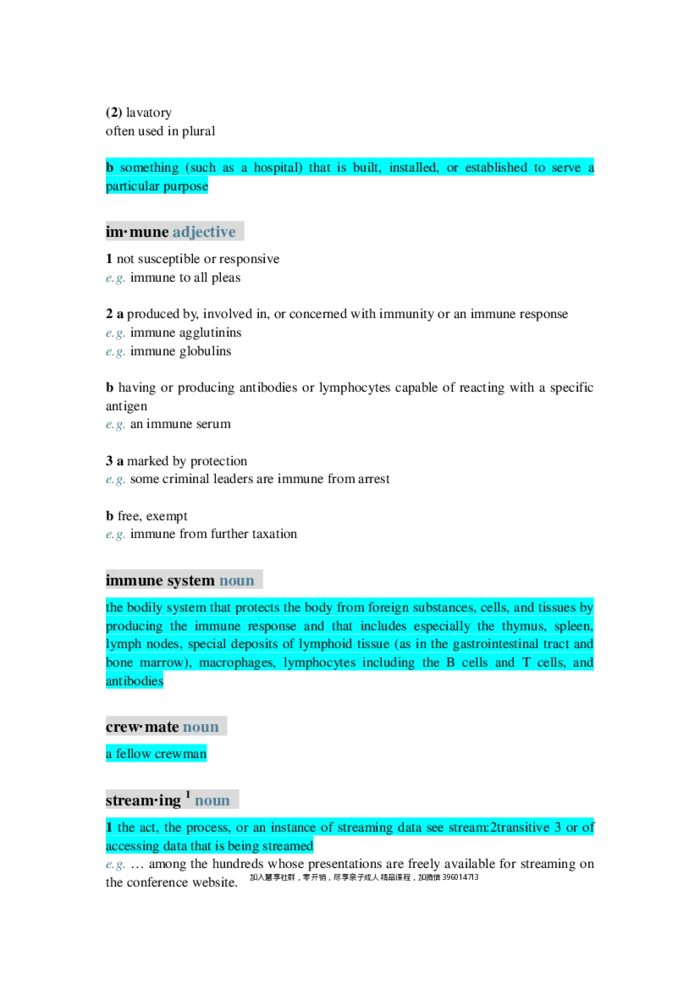
(2) lavatory
often used in plural

b something (such as a hospital) that is built, installed, or established to serve a
particular purpose

im·mune adjective
1 not susceptible or responsive
e.g. immune to all pleas

2 a produced by, involved in, or concerned with immunity or an immune response
e.g. immune agglutinins
e.g. immune globulins

b having or producing antibodies or lymphocytes capable of reacting with a specific
antigen
e.g. an immune serum

3 a marked by protection
e.g. some criminal leaders are immune from arrest

b free, exempt
e.g. immune from further taxation

immune system noun
the bodily system that protects the body from foreign substances, cells, and tissues by
producing the immune response and that includes especially the thymus, spleen,
lymph nodes, special deposits of lymphoid tissue (as in the gastrointestinal tract and
bone marrow), macrophages, lymphocytes including the B cells and T cells, and
antibodies

crew·mate noun
a fellow crewman

stream·ing 1 noun
1 the act, the process, or an instance of streaming data see stream:2transitive 3 or of
accessing data that is being streamed
e.g. … among the hundreds whose presentations are freely available for streaming on
the conference website.
加入慧享社群,零开销,尽享亲子成人精品课程,加微信 396014713
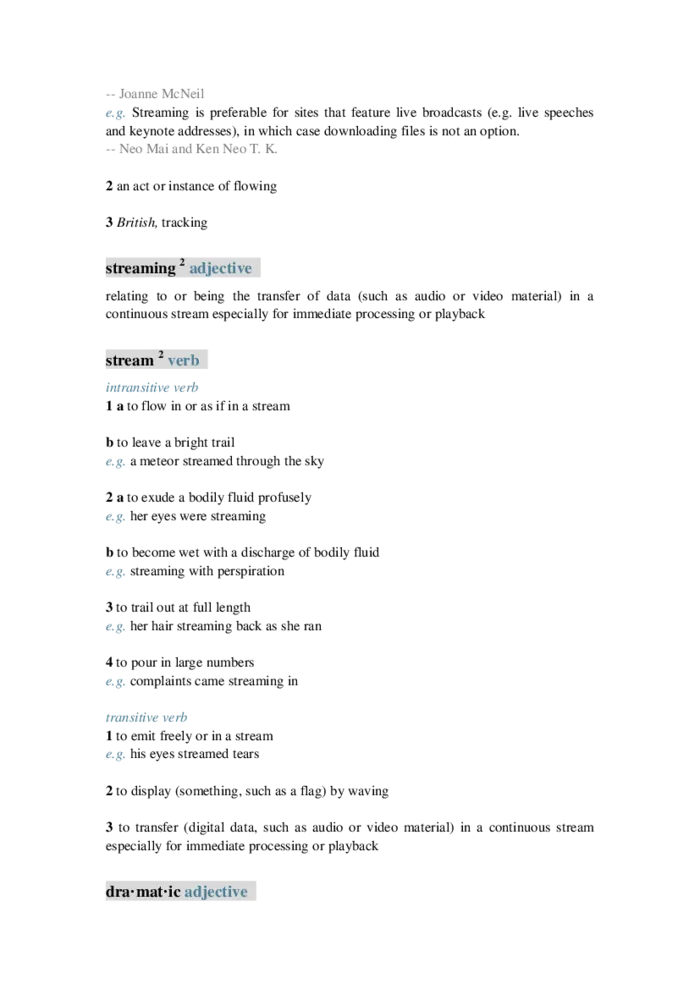
-- Joanne McNeil
e.g. Streaming is preferable for sites that feature live broadcasts (e.g. live speeches
and keynote addresses), in which case downloading files is not an option.
-- Neo Mai and Ken Neo T. K.

2 an act or instance of flowing

3 British, tracking

streaming 2 adjective
relating to or being the transfer of data (such as audio or video material) in a
continuous stream especially for immediate processing or playback

stream 2 verb
intransitive verb
1 a to flow in or as if in a stream

b to leave a bright trail
e.g. a meteor streamed through the sky

2 a to exude a bodily fluid profusely
e.g. her eyes were streaming

b to become wet with a discharge of bodily fluid
e.g. streaming with perspiration

3 to trail out at full length
e.g. her hair streaming back as she ran

4 to pour in large numbers
e.g. complaints came streaming in

transitive verb
1 to emit freely or in a stream
e.g. his eyes streamed tears

2 to display (something, such as a flag) by waving

3 to transfer (digital data, such as audio or video material) in a continuous stream
especially for immediate processing or playback

dra·mat·ic adjective
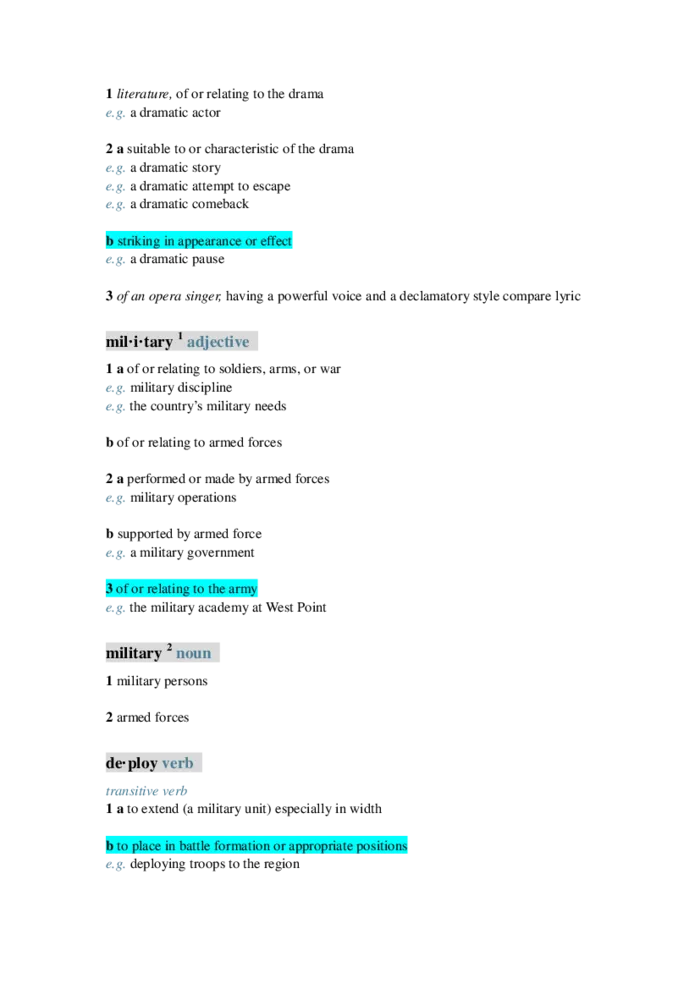
1 literature, of or relating to the drama
e.g. a dramatic actor

2 a suitable to or characteristic of the drama
e.g. a dramatic story
e.g. a dramatic attempt to escape
e.g. a dramatic comeback

b striking in appearance or effect
e.g. a dramatic pause

3 of an opera singer, having a powerful voice and a declamatory style compare lyric

mil·i·tary 1 adjective
1 a of or relating to soldiers, arms, or war
e.g. military discipline
e.g. the country’s military needs

b of or relating to armed forces

2 a performed or made by armed forces
e.g. military operations

b supported by armed force
e.g. a military government

3 of or relating to the army
e.g. the military academy at West Point

military 2 noun
1 military persons

2 armed forces

de·ploy verb
transitive verb
1 a to extend (a military unit) especially in width

b to place in battle formation or appropriate positions
e.g. deploying troops to the region

2 to spread out, utilize, or arrange for a deliberate purpose
e.g. deploy a sales force
e.g. deploy a parachute

intransitive verb
to move, spread out, or function while being deployed
e.g. the troops deployed along the front
e.g. the parachute failed to deploy

over·seas 1 adverb
beyond or across the sea
e.g. lived overseas for a time

over·seas 2 adjective
1 of or relating to movement, transport, or communication over the sea
e.g. an overseas liner

2 situated, originating in, or relating to lands beyond the sea
e.g. overseas installations
e.g. overseas immigrants

capture 2 verb
1 a to take captive

b to gain or win especially through effort
e.g. captured 60 percent of the vote

2 a to emphasize, represent, or preserve (something, such as a scene, mood, or quality)
in a more or less permanent form
e.g. … at any such moment as a photograph might capture …
-- C. E. Montague

b to record in a permanent file (as in a computer)
e.g. The system is used to capture data relating to the buying habits of young people.

3 to captivate and hold the interest of
e.g. The performer captured our attention.

4 to take according to the rules of a game
e.g. A knight captured his pawn.

5 to bring about the capture of (a subatomic particle)

6 astronomy, to draw into the gravitational influence of a larger body
e.g. Asteroids were thought to be too small to capture a moon, but the moon might be
a fragment that broke off.
-- Kenneth Chang

un·load verb
transitive verb
1 a (1) to take off deliver

(2) to take the cargo from
e.g. unload the truck

b to give outlet to pour forth
e.g. unloaded her bitter feelings

2 to relieve of something burdensome, unwanted, or oppressive
e.g. unloaded the pack animals
e.g. unloaded himself to his friend

3 to draw the charge from
e.g. unloaded the gun

4 to sell or dispose of especially in large quantities dump

5 to hit or propel with a great release of power
e.g. unloaded his ninth homer

intransitive verb
1 to perform the act of unloading

2 to release or deliver something especially with power
e.g. unloaded on the ball

3 to give forth a usually sudden angry outburst
e.g. the coach unloaded on his players

car·go noun
the goods or merchandise conveyed in a ship, airplane, or vehicle freight
e.g. Dock workers were unloading the ship’s cargo.

ob·ser·va·tion 1 noun
1 a an act or instance of observing a custom, rule, or law
e.g. observation of the dress code

b observance
e.g. The characters in her novel are based on close observation of her family.

2 a an act of recognizing and noting a fact or occurrence often involving measurement
with instruments
e.g. weather observations

b a record or description so obtained
e.g. Scientific observations were sent to the committee.

3 a judgment on or inference see inference from what one has observed

4 obsolete, attentive care heed

5 the condition of one that is observed
e.g. under observation at the hospital

phe·nom·e·na noun
nonstandard,
phenomenon

phe·nom·e·non noun
1 an observable fact or event

2
a an object or aspect known through the senses rather than by thought or intuition

b a temporal or spatiotemporal object of sensory experience as distinguished from a
noumenon

c a fact or event of scientific interest susceptible to scientific description and
explanation

3 a a rare or significant fact or event

b an exceptional, unusual, or abnormal person, thing, or occurrence

cri·sis noun
1 a the turning point for better or worse in an acute disease or fever

b a paroxysmal attack of pain, distress, or disordered function

c an emotionally significant event or radical change of status in a person’s life
e.g. a midlife crisis

2 the decisive moment (as in a literary plot)
e.g. The crisis of the play occurs in Act 3.

3 a an unstable or crucial time or state of affairs in which a decisive change is
impending

b a situation that has reached a critical phase
e.g. the environmental crisis
e.g. the unemployment crisis

identity crisis noun
1 personal psychosocial conflict especially in adolescence that involves confusion
about one’s social role and often a sense of loss of continuity to one’s personality

2 a state of confusion in an institution or organization regarding its nature or direction

midlife crisis noun
a period of emotional turmoil in middle age characterized especially by a strong
desire for change

en·dure verb
intransitive verb
1 to continue in the same state last:1
e.g. the style endured for centuries

2 to remain firm under suffering or misfortune without yielding
e.g. though it is difficult, we must endure

transitive verb
1 to undergo especially without giving in suffer
e.g. endure hardships
e.g. endured great pain

2 to regard with acceptance or tolerance
e.g. could not endure noisy children

as·sure verb
transitive verb
1 to make sure or certain convince
e.g. glancing back to assure himself no one was following

2 to inform positively
e.g. I assure you that we can do it.

3 to make certain the coming or attainment of guarantee
e.g. worked hard to assure accuracy

4 to make safe (as from risks or against overthrow) insure
e.g. assured the security of the country

5 to give confidence to
e.g. And hereby we know that we are of the truth, and shall assure our hearts …
-- 1 John 3:19 (King James Version)

assure oneself idiom
to make oneself sure or certain about something
e.g. He tried opening the door to assure himself that it was locked.
e.g. They managed to be third in line, assuring themselves of good seats for the
concert.

(as) sure as I’m standing here idiom
US, informal,
used to say that one believes that something is certainly true, will happen, etc.
e.g. They may claim that this was a surprise to them, but as sure as I’m standing here,
they planned it all along.