L4 What are vaccines, how do they work and why are
people sceptical

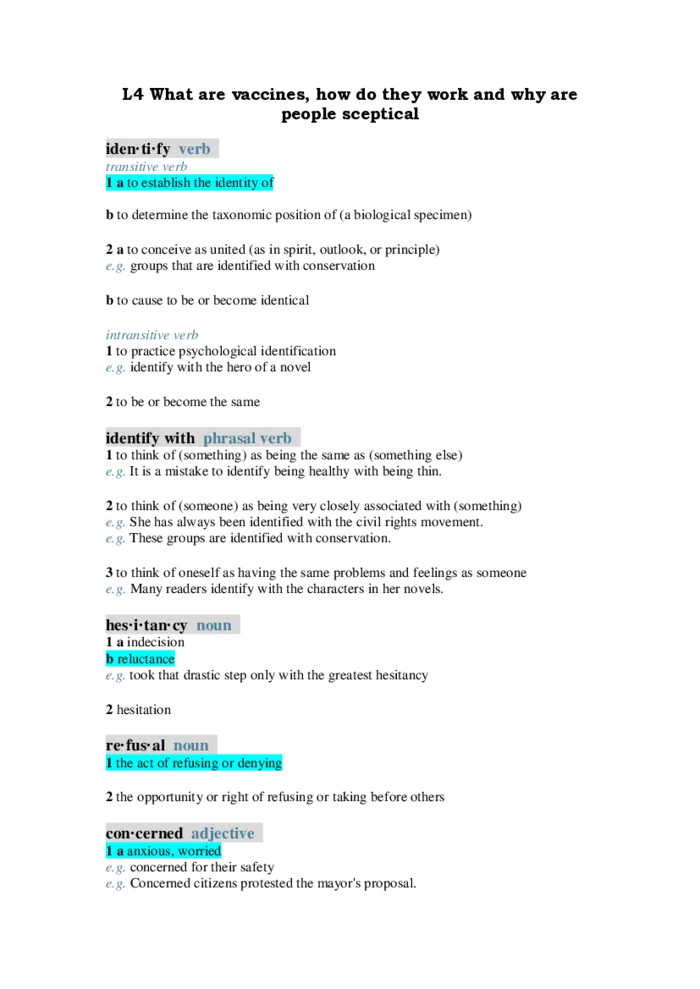
iden·ti·fy verb
transitive verb
1 a to establish the identity of

b to determine the taxonomic position of (a biological specimen)

2 a to conceive as united (as in spirit, outlook, or principle)
e.g. groups that are identified with conservation

b to cause to be or become identical

intransitive verb
1 to practice psychological identification
e.g. identify with the hero of a novel

2 to be or become the same

identify with phrasal verb
1 to think of (something) as being the same as (something else)
e.g. It is a mistake to identify being healthy with being thin.

2 to think of (someone) as being very closely associated with (something)
e.g. She has always been identified with the civil rights movement.
e.g. These groups are identified with conservation.

3 to think of oneself as having the same problems and feelings as someone
e.g. Many readers identify with the characters in her novels.

hes·i·tan·cy noun
1 a indecision
b reluctance
e.g. took that drastic step only with the greatest hesitancy

2 hesitation

re·fus·al noun
1 the act of refusing or denying

2 the opportunity or right of refusing or taking before others

con·cerned adjective
1 a anxious, worried
e.g. concerned for their safety
e.g. Concerned citizens protested the mayor's proposal.

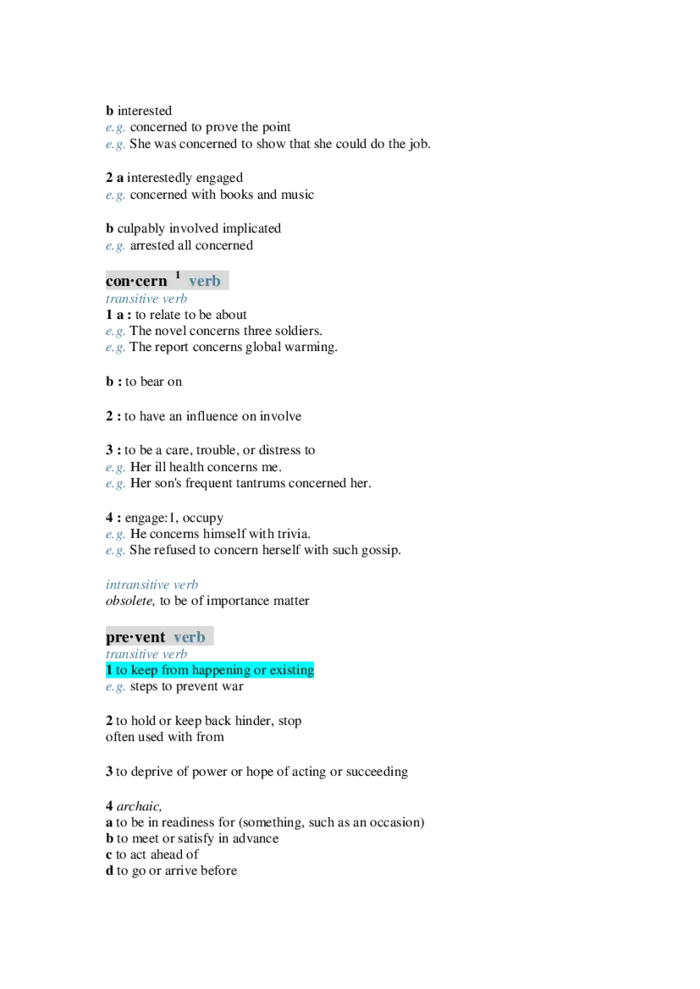
b interested
e.g. concerned to prove the point
e.g. She was concerned to show that she could do the job.

2 a interestedly engaged
e.g. concerned with books and music

b culpably involved implicated
e.g. arrested all concerned

con·cern 1 verb
transitive verb
1 a : to relate to be about
e.g. The novel concerns three soldiers.
e.g. The report concerns global warming.

b : to bear on

2 : to have an influence on involve

3 : to be a care, trouble, or distress to
e.g. Her ill health concerns me.
e.g. Her son's frequent tantrums concerned her.

4 : engage:1, occupy
e.g. He concerns himself with trivia.
e.g. She refused to concern herself with such gossip.

intransitive verb
obsolete, to be of importance matter

pre·vent verb
transitive verb
1 to keep from happening or existing
e.g. steps to prevent war

2 to hold or keep back hinder, stop
often used with from

3 to deprive of power or hope of acting or succeeding

4 archaic,
a to be in readiness for (something, such as an occasion)
b to meet or satisfy in advance
c to act ahead of
d to go or arrive before

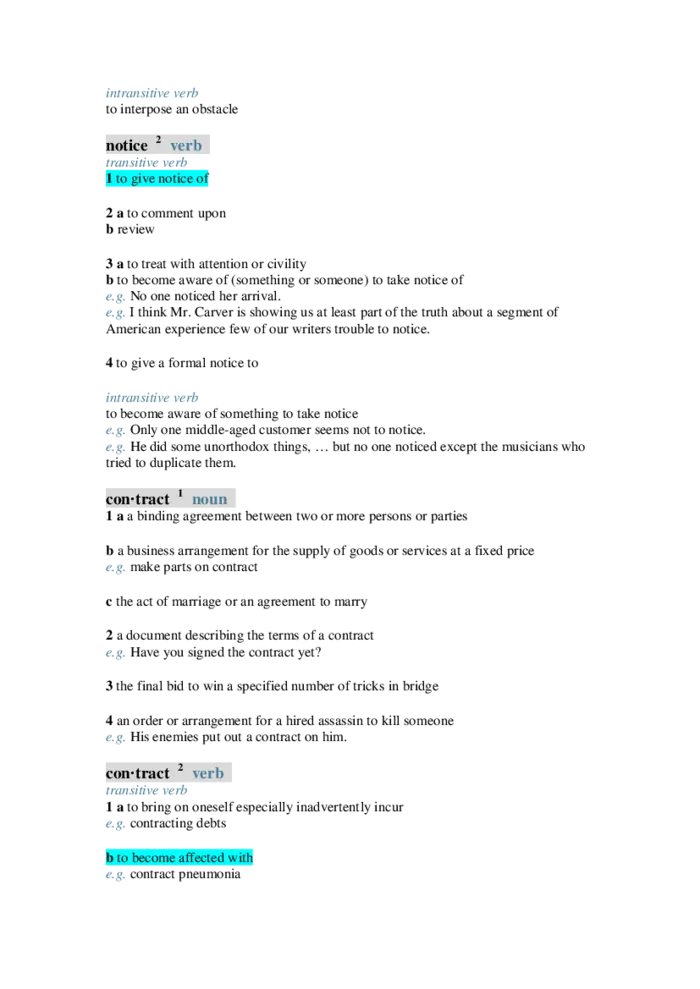
intransitive verb
to interpose an obstacle

notice 2 verb
transitive verb
1 to give notice of

2 a to comment upon
b review

3 a to treat with attention or civility
b to become aware of (something or someone) to take notice of
e.g. No one noticed her arrival.
e.g. I think Mr. Carver is showing us at least part of the truth about a segment of
American experience few of our writers trouble to notice.

4 to give a formal notice to

intransitive verb
to become aware of something to take notice
e.g. Only one middle-aged customer seems not to notice.
e.g. He did some unorthodox things, … but no one noticed except the musicians who
tried to duplicate them.

con·tract 1 noun
1 a a binding agreement between two or more persons or parties

b a business arrangement for the supply of goods or services at a fixed price
e.g. make parts on contract

c the act of marriage or an agreement to marry

2 a document describing the terms of a contract
e.g. Have you signed the contract yet?

3 the final bid to win a specified number of tricks in bridge

4 an order or arrangement for a hired assassin to kill someone
e.g. His enemies put out a contract on him.

con·tract 2 verb
transitive verb
1 a to bring on oneself especially inadvertently incur
e.g. contracting debts

b to become affected with
e.g. contract pneumonia

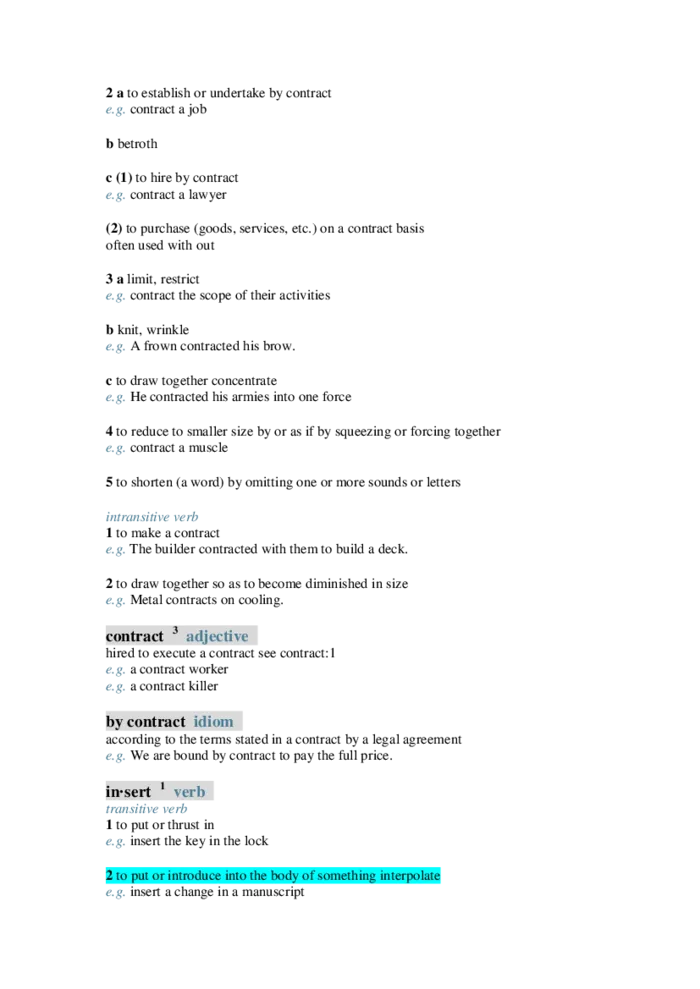
2 a to establish or undertake by contract
e.g. contract a job

b betroth

c (1) to hire by contract
e.g. contract a lawyer

(2) to purchase (goods, services, etc.) on a contract basis
often used with out

3 a limit, restrict
e.g. contract the scope of their activities

b knit, wrinkle
e.g. A frown contracted his brow.

c to draw together concentrate
e.g. He contracted his armies into one force

4 to reduce to smaller size by or as if by squeezing or forcing together
e.g. contract a muscle

5 to shorten (a word) by omitting one or more sounds or letters

intransitive verb
1 to make a contract
e.g. The builder contracted with them to build a deck.

2 to draw together so as to become diminished in size
e.g. Metal contracts on cooling.

contract 3 adjective
hired to execute a contract see contract:1
e.g. a contract worker
e.g. a contract killer

by contract idiom
according to the terms stated in a contract by a legal agreement
e.g. We are bound by contract to pay the full price.

in·sert 1 verb
transitive verb
1 to put or thrust in
e.g. insert the key in the lock

2 to put or introduce into the body of something interpolate
e.g. insert a change in a manuscript

3 to set in and make fast

4 to place into action (as in a game)
e.g. insert a new pitcher

intransitive verb
of a muscle, to be in attachment to the part to be moved

wound 1 noun
1 a an injury to the body (as from violence, accident, or surgery) that typically
involves laceration or breaking of a membrane (such as the skin) and usually damage
to underlying tissues

b a cut or breach in a plant usually due to an external agent

2 a mental or emotional hurt or blow

3 something resembling a wound in appearance or effect

wound 2 verb
transitive verb
to cause a wound to or in

intransitive verb
to inflict a wound

wind down verb
intransitive verb
1 to draw gradually toward an end
e.g. the party was winding down

2 relax, unwind
e.g. wind down with a good book

transitive verb
to cause a gradual lessening of usually with the intention of bringing to an end

wind up verb
transitive verb
1 to bring to a conclusion end

2 a to put in order for the purpose of bringing to an end
e.g. winds up the meeting

b British, to effectuate the winding up of

intransitive verb
1 a to come to a conclusion
b to arrive in a place, situation, or condition at the end or as a result of a course of
action
e.g. wound up as millionaires

2 to make a pitching windup

symp·tom noun
1 a subjective evidence of disease or physical disturbance

b an evident reaction by a plant to a pathogen

2 a something that indicates the existence of something else
e.g. symptoms of an inner turmoil

b a slight indication trace

im·mune adjective
1 not susceptible or responsive
e.g. immune to all pleas

2 a produced by, involved in, or concerned with immunity or an immune response
e.g. immune agglutinins
e.g. immune globulins

b having or producing antibodies or lymphocytes capable of reacting with a specific
antigen
e.g. an immune serum

3 a marked by protection
e.g. some criminal leaders are immune from arrest

b free, exempt
e.g. immune from further taxation

coin 2 verb
transitive verb
1 a to make (a coin) especially by stamping mint

b to convert (metal) into coins

2 create, invent
e.g. coin a phrase

dras·ti·cal·ly adverb
in a drastic manner severely or seriously
e.g. The industry has changed drastically over the last 30 years.
e.g. This … car will allow you to drastically reduce the amount of time (and money)
spent pumping gas …
e.g. Some of those plants … are native species present before humans drastically
altered the land.

in·tro·duce verb
transitive verb
1 a to cause to be acquainted

b to make preliminary explanatory or laudatory remarks about

c to bring (someone, such as an actor or singer) before the public for the first time

d to present or announce formally or officially or by an official reading
e.g. introduce legislation

e to present formally at court or into society

2 to lead or bring in especially for the first time
e.g. … U.S. fishery managers have introduced exotic species into most waters in
North America, largely to please sport fishermen.

3 a to bring into play
b to bring into practice or use institute

4 to bring to a knowledge of something
e.g. introduced them to new ideas

5 place, insert
e.g. introduce foreign genes into crops

pro·por·tion 1 noun
1 harmonious relation of parts to each other or to the whole balance, symmetry

2 a proper or equal share
e.g. each did her proportion of the work

b quota, percentage

3 the relation of one part to another or to the whole with respect to magnitude,
quantity, or degree ratio

4 size, dimension

5 a statement of equality between two ratios in which the first of the four terms
divided by the second equals the third divided by the fourth (as in 4/2=10/5) compare
extreme, mean

proportion 2 verb
transitive verb
1 to adjust (a part or thing) in size relative to other parts or things

2 to make the parts of harmonious or symmetrical

3 apportion, allot

blow out of proportion idiom
to cause (something) to become larger than it should be or to be treated as something
worse or more important than it really is
e.g. You are blowing things (all/way) out of proportion.
e.g. The story was blown out of proportion in the newspapers.

get out of proportion idiom
to become larger, worse, or more important (than something really is or should be)
e.g. Their fears have gotten (totally/completely) out of proportion.

in proportion to idiom
1 related in size, number, or amount to (something else)
e.g. Your share of the profits will be in proportion to the amount of work that you do.

2 having the correct or appropriate relationship in size, shape, or position to (some
other part of the same thing)
e.g. The garage is not in proportion to the house.

3 when compared to the size, shape, or position of (some other part of the same thing)
e.g. His head is large in proportion to his body.

keep things in proportion idiom
to understand which things are truly important and not become upset by small things
that are not important
e.g. Let's keep things in proportion. You should be able to wait one more day after
you have waited two months already.

out of proportion with idiom
lacking the correct or appropriate relationship with the size, shape, or position of
(some other part of the same thing)
e.g. His ears were drawn out of proportion with his head.
e.g. The size of the window seems out of proportion with the height of the wall.

vac·ci·nate verb
transitive verb
to administer a vaccine to usually by injection

intransitive verb
to perform or practice vaccination

herd 1 noun
1 a a typically large group of animals of one kind kept together under human control
e.g. a herd of cattle

b a congregation of gregarious wild animals
e.g. herds of antelopes

2 a (1) a group of people usually having a common bond
e.g. a herd of tourists

(2) a large assemblage of like things
e.g. herds of cars

b the undistinguished masses crowd
e.g. isolate the individual prophets from the herd

herd 2 verb
transitive verb
1 a to gather, lead, or drive as if in a herd see herd:1
e.g. herded the children into the car

b to keep or move (animals) together
e.g. dogs that are trained to herd sheep

2 to place in a group
e.g. herd us with their kindred fools

intransitive verb
1 to assemble or move in a herd see herd:1
e.g. herding onto the subway

2 to place oneself in a group associate
e.g. it is desirable that young noblemen should herd

break down verb
transitive verb
1 a to cause to fall or collapse by breaking or shattering
b to make ineffective
e.g. break down legal barriers

2 a to divide into parts or categories
b to separate (something, such as a chemical compound) into simpler substances
decompose
c to take apart especially for storage or shipment and for later reassembling

intransitive verb
1 a to stop functioning because of breakage or wear

b to become inoperative or ineffective fail
e.g. negotiations broke down

c to fail in strength or vitality
e.g. her health broke down

d to succumb to mental or emotional stress
e.g. broke down and cried

e to lose one's resolve give in
e.g. finally broke down and bought a computer

2 of horses, to severely injure the supporting ligament or bones of the fetlock joint

3 a to be susceptible to or undergo analysis or subdivision
e.g. the statistics break down like this

b to undergo decomposition

dis·trib·ut·ed adjective
1 characterized by a statistical distribution of a particular kind
e.g. a normally distributed random variable

2 computing, having at least some of the processing done by the individual
workstations and having information shared by and often stored at the workstations
e.g. a distributed network
e.g. … makes it possible to take massive tasks and spread them out over a large
number of personal computers—a practice called distributed computing.

dis·trib·ute verb
transitive verb
1 to divide among several or many apportion
e.g. distribute expenses
e.g. distributes toys to needy children

2 a to spread out so as to cover something scatter
e.g. evenly distribute the seeds

b to give out or deliver especially to members of a group
e.g. distribute newspapers
e.g. distribute leaflets
e.g. distribute a TV show to local stations

c to place or position so as to be properly apportioned over or throughout an area
e.g. 200 pounds distributed on a 6-foot frame
e.g. distribute the frosting around the top and sides of the cake

d logic, to use (a term) so as to convey information about every member of the class
named
e.g. The proposition "all men are mortal" distributes "man" but not "mortal."

3 a to divide or separate especially into kinds
e.g. distributing specimens into their proper classes

b to return the units of (something, such as typeset matter) to storage

4 mathematics, to use in or as an operation so as to be mathematically distributive see
distributive
e.g. Addition is not distributed over multiplication.

intransitive verb
mathematics, to be mathematically distributive
e.g. multiplication distributes over addition

con·flict 1 noun
1 fight, battle, war
e.g. an armed conflict

2 a competitive or opposing action of incompatibles antagonistic state or action (as of
divergent ideas, interests, or persons)
e.g. a conflict of principles

b mental struggle resulting from incompatible or opposing needs, drives, wishes, or
external or internal demands
e.g. His conscience was in conflict with his duty.

3 the opposition of persons or forces that gives rise to the dramatic action in a drama
or fiction
e.g. The conflict in the play is between the king and the archbishop.

con·flict 2 verb
intransitive verb
1 to be different, opposed, or contradictory to fail to be in agreement or accord
e.g. His statement conflicts with the facts.

2 archaic, to contend in warfare

conflict of interest noun phrase
a conflict between the private interests and the official responsibilities of a person in a
position of trust

come into conflict idiom
1 to be different in a way that prevents agreement
e.g. Unfortunately, their goals for the project came into conflict.
often + with
e.g. There are cases in which these rules come into conflict with one another.

2 to enter a situation in which there is a struggle for power, property, etc.
often + with
e.g. groups coming into conflict with neighboring tribes

in conflict idiom
1 different in a way that prevents agreement
e.g. They're in conflict over which car to buy.
usually + with
e.g. The law is in conflict with the state's constitution.
e.g. Her ideas were in direct conflict with those of her professor.

2 in a struggle for power, property, etc.
e.g. The two clans were in constant conflict (with one another).

dem·o·crat·ic adjective
1 : of, relating to, or favoring democracy see democracy
e.g. democratic elections
e.g. a democratic government

2 of or relating to one of the two major political parties in the U.S. evolving in the
early 19th century from the anti-federalists and the Democratic-Republican party and
associated in modern times with policies of broad social reform and internationalism
e.g. the Democratic candidate for governor

3 relating to, appealing to, or available to the broad masses of the people
e.g. democratic art
e.g. democratic education

4 favoring social equality not snobbish
e.g. disagrees with her very democratic husband

com·pla·cen·cy noun
1 self-satisfaction especially when accompanied by unawareness of actual dangers or
deficiencies
e.g. When it comes to safety, complacency can be dangerous.

2 an instance of usually unaware or uninformed self-satisfaction

self-com·pla·cen·cy noun
complacent satisfaction with oneself or one's position or achievements complacency,
self-satisfaction
e.g. … It's rather a strong check to one's self-complacency to find how much of one's
right doing depends on not being in want of money. …