文档文本内容
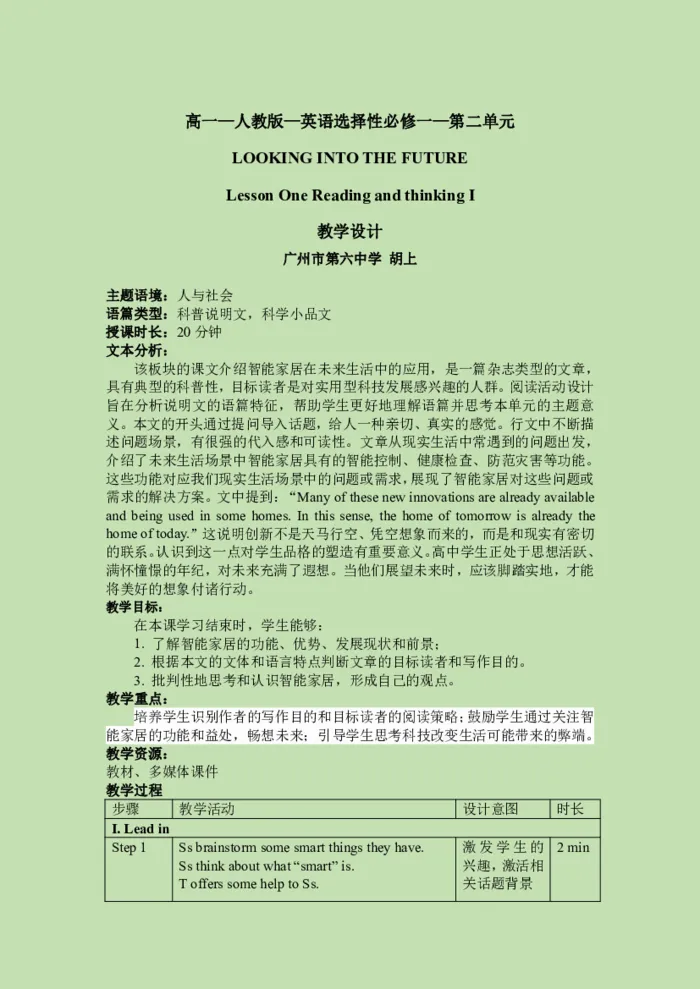
高一—人教版—英语选择性必修一—第二单元
LOOKING INTO THE FUTURE
Lesson One Reading and thinking I
教学设计
广州市第六中学胡上
主题语境:人与社会
语篇类型:科普说明文,科学小品文
授课时长:20 分钟
文本分析:
该板块的课文介绍智能家居在未来生活中的应用,是一篇杂志类型的文章,
具有典型的科普性,目标读者是对实用型科技发展感兴趣的人群。阅读活动设计
旨在分析说明文的语篇特征,帮助学生更好地理解语篇并思考本单元的主题意
义。本文的开头通过提问导入话题,给人一种亲切、真实的感觉。行文中不断描
述问题场景,有很强的代入感和可读性。文章从现实生活中常遇到的问题出发,
介绍了未来生活场景中智能家居具有的智能控制、健康检查、防范灾害等功能。
这些功能对应我们现实生活场景中的问题或需求,展现了智能家居对这些问题或
需求的解决方案。文中提到:“Many of these new innovations are already available
and being used in some homes. In this sense, the home of tomorrow is already the
home of today.”这说明创新不是天马行空、凭空想象而来的,而是和现实有密切
的联系。认识到这一点对学生品格的塑造有重要意义。高中学生正处于思想活跃、
满怀憧憬的年纪,对未来充满了遐想。当他们展望未来时,应该脚踏实地,才能
将美好的想象付诸行动。
教学目标:
在本课学习结束时,学生能够:
1. 了解智能家居的功能、优势、发展现状和前景;
2. 根据本文的文体和语言特点判断文章的目标读者和写作目的。
3. 批判性地思考和认识智能家居,形成自己的观点。
教学重点:
培养学生识别作者的写作目的和目标读者的阅读策略;鼓励学生通过关注智
能家居的功能和益处,畅想未来;引导学生思考科技改变生活可能带来的弊端。
教学资源:
教材、多媒体课件
教学过程
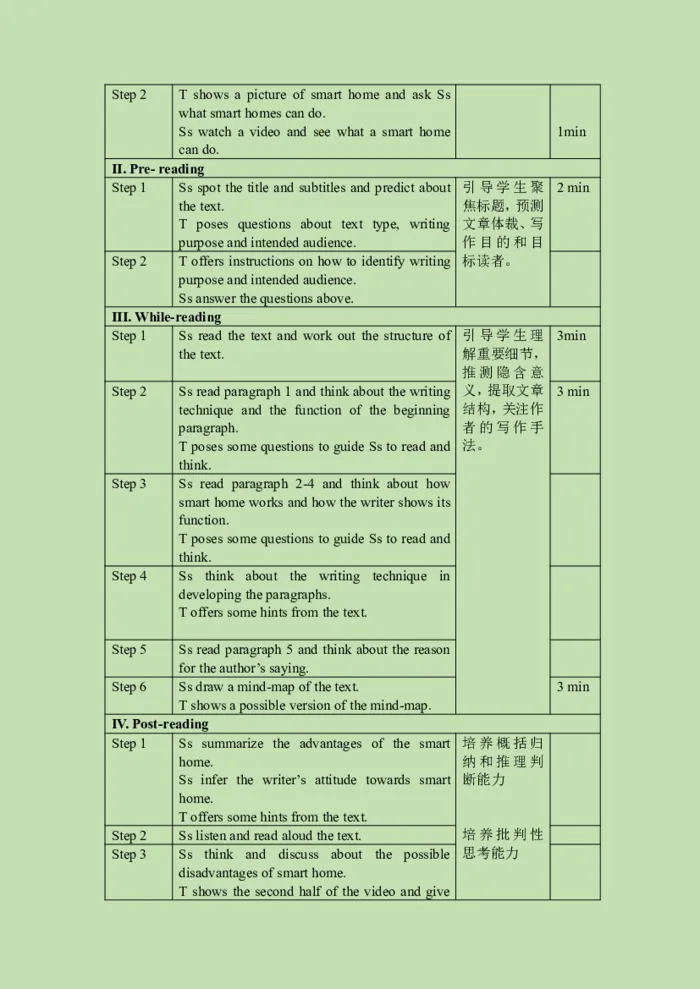
步骤
教学活动
设计意图
时长
I. Lead in
Step 1
Ss brainstorm some smart things they have.
Ss think about what “smart” is.
T offers some help to Ss.
激发学生的
兴趣,激活相
关话题背景
2 min
1min
Step 2
T shows a picture of smart home and ask Ss
what smart homes can do.
Ss watch a video and see what a smart home
can do.
II. Pre- reading
Step 1
Ss spot the title and subtitles and predict about
the text.
T poses questions about text type, writing
purpose and intended audience.
引导学生聚
焦标题,预测
文章体裁、写
作目的和目
标读者。
2 min
Step 2
T offers instructions on how to identify writing
purpose and intended audience.
Ss answer the questions above.
III. While-reading
Step 1
Ss read the text and work out the structure of
the text.
引导学生理
解重要细节,
推测隐含意
义,提取文章
结构,关注作
者的写作手
法。
3min
Step 2
Ss read paragraph 1 and think about the writing
technique and the function of the beginning
paragraph.
T poses some questions to guide Ss to read and
think.
3 min
Step 3
Ss read paragraph 2-4 and think about how
smart home works and how the writer shows its
function.
T poses some questions to guide Ss to read and
think.
Step 4
Ss
think
about
the
writing
technique
in
developing the paragraphs.
T offers some hints from the text.
Step 5
Ss read paragraph 5 and think about the reason
for the author’s saying.
Step 6
Ss draw a mind-map of the text.
T shows a possible version of the mind-map.
3 min
IV. Post-reading
Step 1
Ss summarize the advantages of the smart
home.
Ss infer the writer’s attitude towards smart
home.
T offers some hints from the text.
培养概括归
纳和推理判
断能力
培养批判性
思考能力
Step 2
Ss listen and read aloud the text.
Step 3
Ss
think
and
discuss
about
the
possible
disadvantages of smart home.
T shows the second half of the video and give
Ss a vivid picture of the possible disadvantages.
V. Summary
T summarizes the whole lesson.
回顾总结整
节课,及时巩
固
Practice
Ss read the text and complete Activity 3 on P15.
T fills the first column as an example.
T shows the answers to the Activity 3.
细节阅读,梳
理智能家居
的功能
1min
Homework (After class)
1. Read the text aloud and finish activities 3 and 4 on page 15.
2. Design a smart home including its functions, advantages, disadvantages and ideas
to make it better.