[三⼩⻔⽅法论讲义]
[主讲⼈@刘琦⽼师更多刘琦⽼师全程课程,扫码咨询助教]
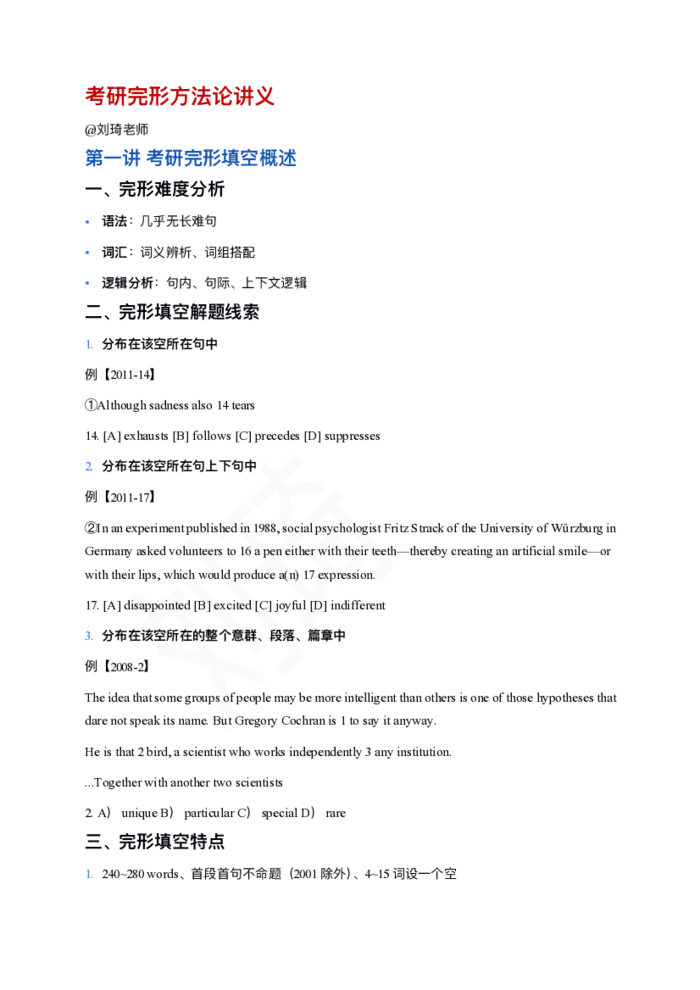
考研完形⽅法论讲义
@刘琦⽼师
第⼀讲考研完形填空概述
⼀、完形难度分析
•
语法:⼏乎⽆⻓难句
•
词汇:词义辨析、词组搭配
•
逻辑分析:句内、句际、上下⽂逻辑
⼆、完形填空解题线索
1. 分布在该空所在句中
例【2011-14】
①Although sadness also 14 tears
14. [A] exhausts [B] follows [C] precedes [D] suppresses
2. 分布在该空所在句上下句中
例【2011-17】
②In an experiment published in 1988, social psychologist Fritz Strack of the University of Würzburg in
Germany asked volunteers to 16 a pen either with their teeth—thereby creating an artificial smile—or
with their lips, which would produce a(n) 17 expression.
17. [A] disappointed [B] excited [C] joyful [D] indifferent
3. 分布在该空所在的整个意群、段落、篇章中
例【2008-2】
The idea that some groups of people may be more intelligent than others is one of those hypotheses that
dare not speak its name. But Gregory Cochran is 1 to say it anyway.
He is that 2 bird, a scientist who works independently 3 any institution.
...Together with another two scientists
2. A)unique B)particular C)special D)rare
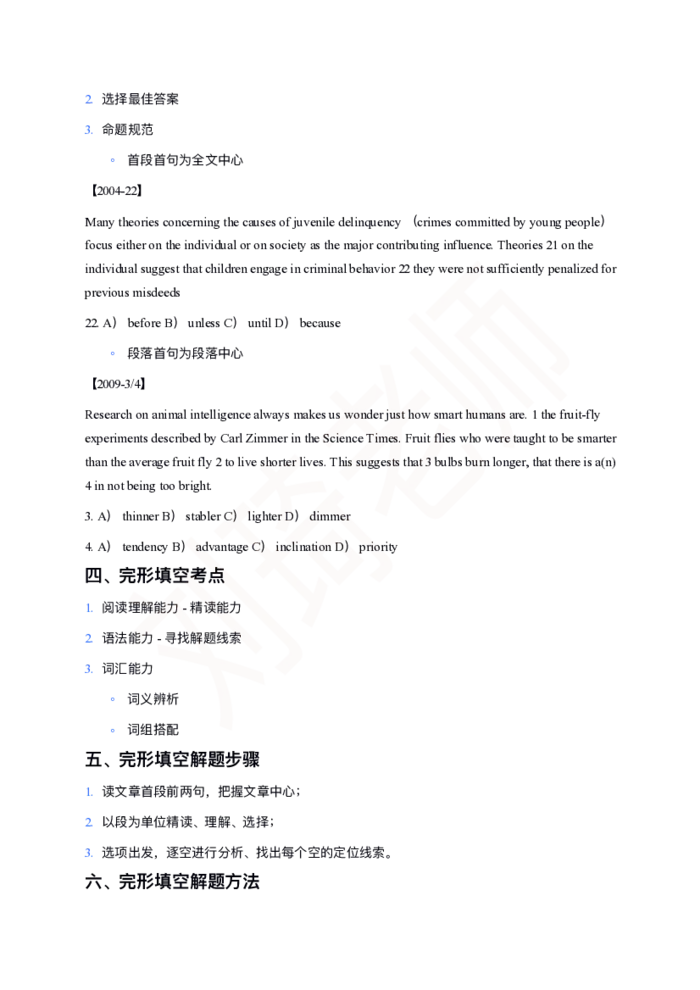
三、完形填空特点
1. 240~280 words、⾸段⾸句不命题(2001 除外)、4~15 词设⼀个空
2. 选择最佳答案
3. 命题规范
◦
⾸段⾸句为全⽂中⼼
【2004-22】
Many theories concerning the causes of juvenile delinquency (crimes committed by young people)
focus either on the individual or on society as the major contributing influence. Theories 21 on the
individual suggest that children engage in criminal behavior 22 they were not sufficiently penalized for
previous misdeeds
22. A)before B)unless C)until D)because
◦
段落⾸句为段落中⼼
【2009-3/4】
Research on animal intelligence always makes us wonder just how smart humans are. 1 the fruit-fly
experiments described by Carl Zimmer in the Science Times. Fruit flies who were taught to be smarter
than the average fruit fly 2 to live shorter lives. This suggests that 3 bulbs burn longer, that there is a(n)
4 in not being too bright.
3. A)thinner B)stabler C)lighter D)dimmer
4. A)tendency B)advantage C)inclination D)priority
四、完形填空考点
1. 阅读理解能⼒- 精读能⼒
2. 语法能⼒- 寻找解题线索
3. 词汇能⼒
◦
词义辨析
◦
词组搭配
五、完形填空解题步骤
1. 读⽂章⾸段前两句,把握⽂章中⼼;
2. 以段为单位精读、理解、选择;
3. 选项出发,逐空进⾏分析、找出每个空的定位线索。
六、完形填空解题⽅法
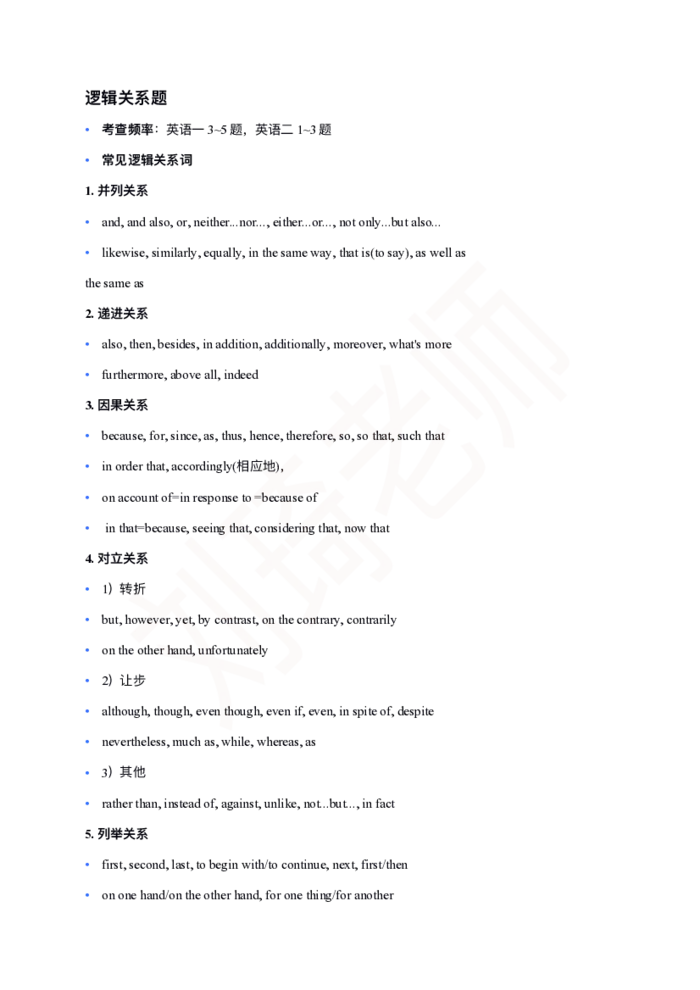
逻辑关系题
•
考查频率:英语⼀3~5 题,英语⼆1~3 题
•
常⻅逻辑关系词
1. 并列关系
•
and, and also, or, neither...nor..., either...or..., not only...but also...
•
likewise, similarly, equally, in the same way, that is(to say), as well as
the same as
2. 递进关系
•
also, then, besides, in addition, additionally, moreover, what's more
•
furthermore, above all, indeed
3. 因果关系
•
because, for, since, as, thus, hence, therefore, so, so that, such that
•
in order that, accordingly(相应地),
•
on account of=in response to =because of
•
in that=because, seeing that, considering that, now that
4. 对⽴关系
•
1)转折
•
but, however, yet, by contrast, on the contrary, contrarily
•
on the other hand, unfortunately
•
2)让步
•
although, though, even though, even if, even, in spite of, despite
•
nevertheless, much as, while, whereas, as
•
3)其他
•
rather than, instead of, against, unlike, not...but..., in fact
5. 列举关系
•
first, second, last, to begin with/to continue, next, first/then
•
on one hand/on the other hand, for one thing/for another
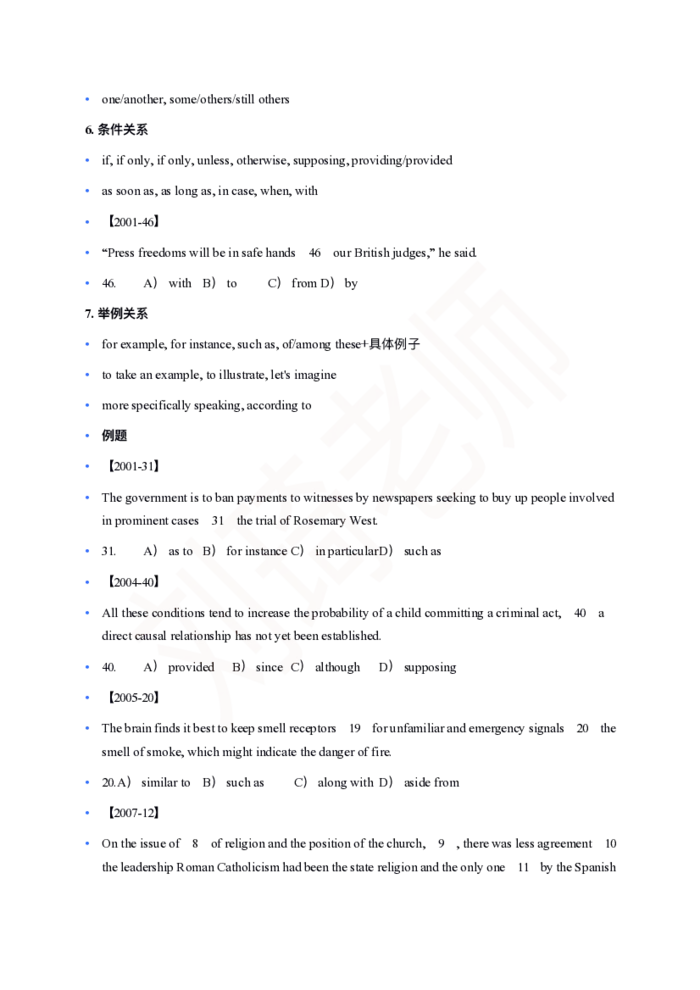
•
one/another, some/others/still others
6. 条件关系
•
if, if only, if only, unless, otherwise, supposing, providing/provided
•
as soon as, as long as, in case, when, with
•
【2001-46】
•
“Press freedoms will be in safe hands
46
our British judges,” he said.
•
46.
A)with
B)to
C)from D)by
7. 举例关系
•
for example, for instance, such as, of/among these+具体例⼦
•
to take an example, to illustrate, let's imagine
•
more specifically speaking, according to
•
例题
•
【2001-31】
•
The government is to ban payments to witnesses by newspapers seeking to buy up people involved
in prominent cases
31
the trial of Rosemary West.
•
31.
A)as to B)for instance C)in particularD)such as
•
【2004-40】
•
All these conditions tend to increase the probability of a child committing a criminal act,
40
a
direct causal relationship has not yet been established.
•
40.
A)provided
B)since C)although
D)supposing
•
【2005-20】
•
The brain finds it best to keep smell receptors
19
for unfamiliar and emergency signals
20
the
smell of smoke, which might indicate the danger of fire.
•
20.A)similar to
B)such as
C)along with D)aside from
•
【2007-12】
•
On the issue of
8
of religion and the position of the church,
9
, there was less agreement
10
the leadership Roman Catholicism had been the state religion and the only one
11
by the Spanish
crown.
12 most leaders sought to maintain Catholicism
13 the official religion of the new states,
some sought to end the
14(exclusion)
of other faiths.
•
12.A)Since
B)If
C)Unless
D)While
•
【2009-14】
•
Research on animal intelligence also makes us wonder what experiments animals would
13
on
humans if they had the chance. Every cat with an owner,
14
, is running a small-scale study in
operant conditioning.
•
14.
A)by chance
B)in contrast C)as usual D)for instance
•
【2009-18】
•
They would try to decide what intelligence in humans is really
17
not merely how much of it
there is.
18
, they would hope to study a(n)
19
question: Are humans actually aware of the
world they live in?
•
•
18.A)Above all
B)After all
C)However
D)Otherwise
逻辑关系题解题⽅法PLUS
1. 同义相斥原则
例【2005-1】
The human nose is an underrated tool. Humans are often thought to be insensitive smellers compared
with animals, 1 this is largely because, 2 animals, we stand upright.
1. A)although B)as C)but D)while
【2006-14】
And a significant number of the homeless have serious mental disorders. Many others,
14
not
addicted or mentally ill
14.
A)when B)once C)while D)whereas
【2006-1】
The homeless make up a growing percentage of America’s population. 1 , homelessness has reached
such proportions that local governments can’t possibly 2 .
1. A)Indeed
B)Likewise
C)Therefore
D)Furthermore
2. not 题:代表前后意思相反的对⽴关系
例【2002-31】
radically changed the process, 31 its impact on the media was not immediately 32 .
31.A)unless B)since C)lest D)although
【2003-38】
38. This does not mean that adults must accept irresponsibility. 38 they can help students acquire a sense
of commitment by 39 for roles
A)On the contrary
B)On the average
C)On the whole
D)On the other hand
3. 段⾸选词原则:除第⼀段以外的段⾸若填逻辑关系词,优先选对⽴关系词;若⽆对⽴关系词
选项,选递进关系词。
4. 总- 分关系原则:若逻辑关系词前后内容为总- 分关系,选举例关系词。
第⼆讲考研完形解题⽅法
动词题解题⽅法
1. 根据主语和宾语的逻辑关系做题
2. 看主语:是⼈还是物
e.g. _____ believe
sth_____ (doubt or challenge)
◦
主语必须为⼈的动词:doubt, intend, require, regard 等
◦
主语必须为物的动词:manifest(表明、显示)
◦
主语可为⼈或物的动词:show
3. 看宾语
◦
A. 是⼈还是物
◦
只能跟⼈做宾语的谓语动词有:assure,impress,side with;
◦
可跟⼈可跟物的动词:ensure,agree with;
◦
B. 看宾语是抽象名词还是具体名词
◦
跟抽象名词做宾语:enhance(quality)
◦
跟具体名词做宾语:fasten;label(贴标签);feed
◦
既跟抽象⼜跟具体名词做宾语:tighten
4 根据动词后的介词及宾语
•
例题
【2001-32】
In a significant 32 of legal controls over the press
31. A)tightening B)intensifying C)focusing D)fastening
【2001-37】
Lord Irvine said he
37
with a committee report this year
37. A)sided
B)sharedC)complied
D)agreed
【2002-38】
The communications revolution has
38
both work and leisure and how we think and feel both about
place and time
38. A)regarded B)impressed C)influenced D)effected
【2004-30】
For example, changes in the economy that
30
to fewer job opportunities for youth
30. A)point
B)lead
C)come D)amount
【2006-9】
One of the federal government's studies
9
that the number of the homeless will reach nearly 19
million by the end of this decade
9. A)predicts
B)displays C)proves
D)discovers
【2009-1】
1
the fruit-fly experiments described by Carl Zimmer in the Science Times.
1. A)Suppose B)Consider C)Observe D)Imagine
【2009-13】
Research on animal intelligence also makes us wonder what experiments animals would
13
on
humans if they had the chance.
12. A)deliver B)carry C)perform
D)apply
【2010-1】
It hoped they would learn how shop-floor lighting 1 workers' productivity.
1. [A] affected
[B] achieved [C] extracted [D] restored
【2010-19】
Workers 19 to be diligent for the first few days of the week in any case
18. [A]attempted[B] tended [C] chose [D] intended
形容词题解题⽅法
1. 形容词做定语时,修饰的名词是解题线索;
2. 形容词做表语时,主语是解题线索;
3. 形容词修饰名词且后有定语或同位语,三者共同作为解题线索;
4. 副词修饰形容词时,副词是解题线索。
例题
【2001-40】
Lord Irvine caused a
40
of media protest
40.
A)storm B)rage
C)flare
D)flash
【2001-44】
the European Convention on Human Rights legally
44
in Britain
44.
A)binding
B)convincing C)restraining D)sustaining
【2002-39】
but there have been
39
views about its economic, political, social and cultural implications
39.
A)competitive B)controversial C)distractingD)irrational
【2003-30】
A variety of small clubs can provide
30
opportunities for leadership
30.
A)durable
B)excessive
C)surplus
D)multiple
【2006-8】
that the number of the homeless is
8
.
8.
A)inflating
B)expanding C)increasing
D)extending
【2006-15】
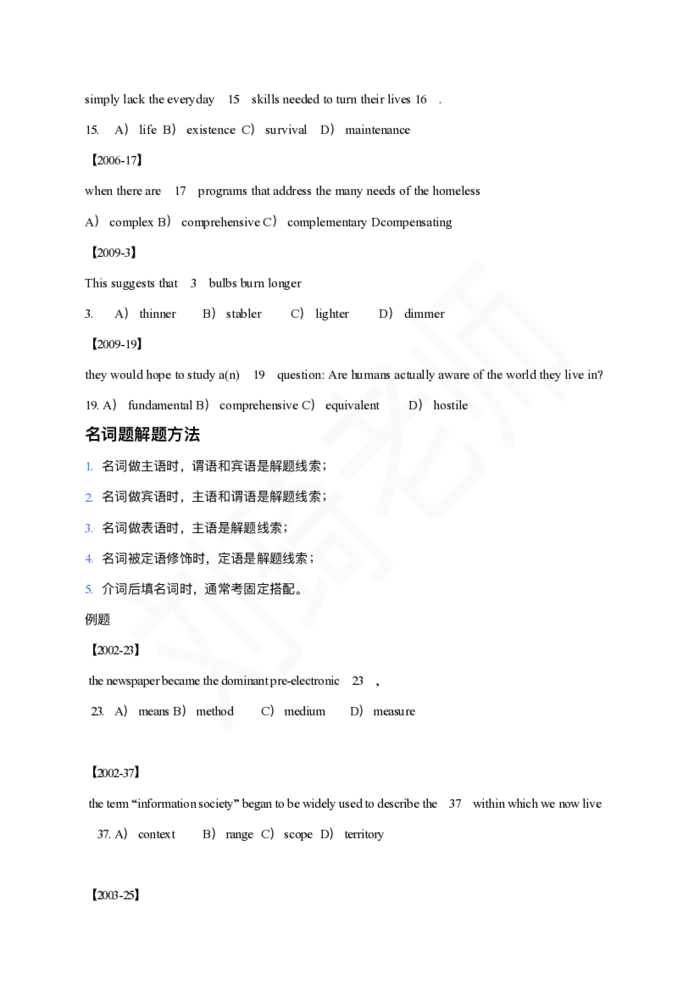
simply lack the everyday
15
skills needed to turn their lives 16
.
15.
A)life B)existence C)survival
D)maintenance
【2006-17】
when there are
17
programs that address the many needs of the homeless
A)complex B)comprehensive C)complementary Dcompensating
【2009-3】
This suggests that
3
bulbs burn longer
3.
A)thinner
B)stabler
C)lighter
D)dimmer
【2009-19】
they would hope to study a(n)
19
question: Are humans actually aware of the world they live in?
19. A)fundamental B)comprehensive C)equivalent
D)hostile
名词题解题⽅法
1. 名词做主语时,谓语和宾语是解题线索;
2. 名词做宾语时,主语和谓语是解题线索;
3. 名词做表语时,主语是解题线索;
4. 名词被定语修饰时,定语是解题线索;
5. 介词后填名词时,通常考固定搭配。
例题
【2002-23】
the newspaper became the dominant pre-electronic
23
,
23. A)means B)method
C)medium
D)measure
【2002-37】
the term “information society” began to be widely used to describe the
37
within which we now live
37. A)context
B)range C)scope D)territory
【2003-25】
teenagers are especially self-conscious and need the
25
that comes from achieving success
25. A)assistance
B)guidance
C)confidence
D)tolerance
【2006-12】
find a
12
that will give them three meals a day and a place to sleep at night
12. A)lodging
B)shelter C)dwelling
D)house
【2009-4】
This suggests that
3
bulbs burn longer, that there is a(n)
4
in not being too bright.
4.
A)tendency
B)advantage
C)inclination D)priority
副词题解题⽅法
1. 根据副词所修饰对象做题;
2. 根据副词所在语境做题;
3. 根据⽂章中⼼做题。
【2003-33】
some kind of organization with a supportive adult
33
visible in the background.
33.
A)particularly B)barely C)definitely
D)rarely
【2009-10】
Instead of casting a wistful glance
10
at all the species we’ve left in the dust
10. A)upward B)forward
C)afterward
D)backward
考研翻译⽅法论讲义
@刘琦⽼师
第⼀讲考研翻译概述
⼀、考研翻译整体复习节奏
•
真题使⽤三阶段
◦
2005-2009:5 年25 句话,适合⼊⻔练习
◦
2010-2020:很重要
◦
2021-2025:极重要,适合考前模考
⼆、考研翻译题型、命题原则和评分标准
1. 题型
•
⼤:主观题:写汉字(需猜词、背真题单词,书写⼯整)
•
猜词:2003/61
•
61)Furthermore, humans have the ability to modify the environment in which they live, thus
subjecting all other life forms to their own peculiar ideas and fancies.
•
⼩:阅读题
•
1)阅读理解part C
•
2)5 个⻓难句
•
3)分值:满分10分,每句2 分,平均分3分,2013年全国平均分2.99分
•
4)⽂章⼀般不⽤通读,但是划线句上下⽂需要看。(句中某⼀个单词的理解,代词的指代)
句内,句外上下⽂。
•
5)考场时间控制
•
20-25分钟
•
每句话4-5分钟
2. 命题原则
1)体裁:偏向学术⽂献,属于通识读物
2)话题:偏向⽂科、社会科学领域
3)划线句⻓度:每句30 个单词左右,总⻓度150个单词。英语⼆⽂章⻓度为150个词。
3. 评分标准
严复:信、达、雅
傅雷:神似
钱钟书:化境
考研:准确、通顺、完整
2008/50
50) Darwin was convinced that the loss of these tastes was not only a loss of happiness, but might
possibly be injurious to the intellect, and more probably to the moral character,
第⼆讲考研翻译解题⽅法
1. 翻译总论:三步法拆分
•
第⼀步:找谓语动词
•
第⼆步:找连词,初步切分句⼦并确定主⼲
•
第三步:梳理修饰成分,进⼀步切分句⼦
•
2005/46
•
(46) Television is one of the means by which these feelings are created and conveyed –and perhaps
never before has it served so much to connect different peoples and nations as in the recent events in
Europe.
2. 各类句型翻译示例
•
简单句:2005/50
(50) In dealing with a challenge on such a scale, it is no exaggeration to say, “United we stand, divided
we fall”.
•
并列句:2006/50
(50)They may teach very well, and more than earn their salaries, but most of them make little or no
independent reflections on human problems which involve moral judgment.
•
名词性从句翻译2008/50
(50) Darwin was convinced that the loss of these tastes was not only a loss of happiness, but might
possibly be injurious to the intellect, and more probably to the moral character.
•
定语从句翻译
•
2006/46
(46)His function is analogous to that of a judge, who must accept the obligation of revealing in as
obvious a manner as possible the course of reasoning which led him to his decision.
2007/47
(47) On the other, it links these concepts to everyday realities in a manner which is parallel to the links
journalists forge on a daily basis as they cover and comment on the news.
•
状语从句翻译
2009/20
(49) Since our chief business with them is to enable them to share in a common life we cannot help
considering whether or not we are forming the powers which will secure this ability.
考研英语新题型⽅法论⼊⻔
@刘琦⽼师
第⼀讲⼩标题题
例题⼀:⼤纲样题(英⼀)
•
Directions: You are going to read a list of headings and a text about plagiarism in the academic
community. Choose the most suitable heading from the list A-F for each numbered paragraph
(41-45). The first and last paragraphs of the text are not numbered. There is one extra heading which
you do not need to use. Mark your answers on ANSWER SHEET 1. (10 points)
•
选项:
A)What to do as a student?
B)Various definitions of plagiarism
C)Ideas should always be sourced
D)Oversight plagiarism can be forgiven
E)Plagiarism is equivalent to theft
F)The consequences of plagiarism
•
Scholars, writers and teachers in the modern academic community have strong feelings about
acknowledging the use of another person’s ideas. In the English-speaking world, the term plagiarism
is used to label the practice of not giving credit for the source of one’s ideas. Simply stated,
plagiarism is “the wrongful appropriation or purloining, and publication as one’s own of the ideas,
or the expression of ideas of another.”
•
41.____________________________________________________________________The
penalties for plagiarism vary from situation to situation. In many universities, the punishment may
range from failure in a particular course to expulsion from the university. In the literary world, where
writers are protected from plagiarism by international copyright laws, the penalty may range from a
small fine to imprisonment and a ruined career. Protection of scholars and writers, through the
copyright laws and through the social pressures of the academic and literary communities, is a
relatively recent concept. Such social pressures and copyright laws require writers to give
scrupulous attention to documentation of their sources.
•
42.____________________________________________________________________Students,
as inexperienced scholars themselves, must avoid various types of plagiarism by being self-critical
in their use of other scholars’ ideas and by giving appropriate credit for the source of borrowed ideas
and words, otherwise dire consequences may occur. There are at least three classifications of
plagiarism as it is revealed in students inexactness in identifying sources properly. They are
plagiarism by accident, by ignorance, and by intention.
•
43.____________________________________________________________________Plagiarism
by accident, or oversight, sometimes is the result of the writer’s inability to decide or remember
where the idea came from. He may have read it long ago, heard it in a lecture since forgotten, or
acquired it second-hand or third-hand from discussions with colleagues. He may also have difficulty
in deciding whether the idea is such common knowledge that no reference to the original source is
needed. Although this type of plagiarism must be guarded against, it is the least serious and, if
lessons learned, can be exempt from being severely punished.
•
44.____________________________________________________________________Plagiarism
through ignorance is simply a way of saying that inexperienced writers often do not know how or
when to acknowledge their sources. The techniques for documentation—note-taking, quoting,
footnoting, listing bibliography—are easily learned and can prevent the writer from making
unknowing mistakes or omissions in his references. Although “there is no copyright in news, or in
ideas, only in the expression of them,” the writer cannot plead ignorance when his sources for ideas
are challenged.
•
45.____________________________________________________________________The most
serious kind of academic thievery is plagiarism by intention. The writer, limited by his laziness and
dullness, copies the thoughts and language of others and claims them for his own. He not only steals,
he tries to deceive the reader into believing the ideas are original. Such words as immoral, dishonest,
offensive, and despicable are used to describe the practice of plagiarism by intention.
•
The opposite of plagiarism is acknowledgement. All mature and trustworthy writers make use of the
ideas of others but they are careful to acknowledge their indebtedness to their sources. Students, as
developing scholars, writers, teachers, and professional leaders, should recognize and assume their
responsibility to document all sources from which language and thoughts are borrowed. Other
members of the profession will not only respect the scholarship, they will admire the humility and
honesty.
例题⼆:2007(英⼀)
•
Directions: You are going to read a list of headings and a text about plagiarism in the academic
community. Choose the most suitable heading from the list A-F for each numbered paragraph
(41-45). The first and last paragraphs of the text are not numbered. There is one extra heading which
you do not need to use. Mark your answers on ANSWER SHEET 1. (10 points)
•
选项:
A)Set a Good Example for Your Kids
B)Build You Kids’ Work Skills
C)Place Time Limits on Leisure Activities
D)Talk about the Future on a Regular Basis
E)Help Kids Develop Coping Strategies
F)Help Your Kids Figure Out Who They Are
G)Build Your Kids’ Sense of Responsibility
How Can a Parent Help?
Mothers and fathers can do a lot to ensure a safe landing in early adulthood for their kids. Even if a job’s
starting salary seems too small to satisfy an emerging adult’s need for rapid content, the transition from
school to work can be less of a setback if the start-up adult is ready for the move. Here are a few
measures, drawn from my book Ready or Not, Here Life Comes, that parents can take to prevent what I
call “work-life unreadiness”:
41._________________________________________________________________
You can start this process when they are 11 or 12. Periodically review their emerging strengths and
weaknesses with them and work together on any shortcomings, like difficulty, in communicating well
or collaborating. Also, identify the kinds of interests they keep coming back to, as these offer clues to
the careers that will fit them best.
42._______________________________________________________________________Kids need
a range of authentic role models—as opposed to members of their clique, pop stars and vaunted athletes.
Have regular dinner-table discussions about people the family knows and how they got where they are.
Discuss the joys and downsides of your own career and encourage your kids to form some ideas about
their own future. When asked what they want to do, they should be discouraged from saying “I have no
idea.” They can change their minds 200 times, but having only a foggy view of the future is of little
good.
43. _____________________________________________________________________
Teachers are responsible for teaching kids how to learn; parents should be responsible for teaching them
how to work. Assign responsibilities around the house and make sure homework deadlines are met.
Encourage teenagers to take a part-time job. Kids need plenty of practice delaying gratification and
deploying effective organizational skills, such as managing time and setting priorities.
44._______________________________________________________________________Playing
video games encourages immediate content. And hours of watching TV shows with canned laughter
only teaches kids to process information in a passive way. At the same time, listening through
earphones to the same monotonous beats for long stretches encourages kids to stay inside their bubble
instead of pursuing other endeavors. All these activities can prevent the growth of important
communication and thinking skills and make it difficult for kids to develop the kind of sustained
concentration they will need for most jobs.
45._______________________________________________________________________They
should know how to deal with setbacks, stresses and feelings of inadequacy. They should also learn
how to solve problems and resolve conflicts, ways to brainstorm and think critically. Discussions at
home can help kids practice doing these things and help them apply these skills to everyday life
situations.
What about the son or daughter who is grown but seems to be struggling and wandering aimlessly
through early adulthood? Parents still have a major role to play, but now it is more delicate. They have
to be careful not to come across as disappointed in their child. They should exhibit strong interest and
respect for whatever interests their fledging adult (as naive or ill conceived as it may seem)while
becoming a partner in exploring options for the future. Most of all, these new adults, must feel they are
respected and supported by a family that appreciates them.
例题三⼤纲样题(英⼆)
Read the following text and answer the questions by choosing the most suitable subtitle form the list
A-F for each numbered paragraph (41-45).There are two extra subtitle which you do not need to use.
Mark your answers on ANSWER SHEET 1.(10 points)
[A] Follow on Lines
[B] Whisper: Keep It to Yourself
[C] Word of Experience: Stick to It
[D] Code of Success: Freed and Targeted
[E] Efficient Work to Promote Efficient Workers
[F] Recipe: Simplicity Means Everything
[G] Efficiency Comes from Order
①Every decade has its defining self-help business book. ②In the 1940s it was How to Win Friends and
Influence People, in the 1990s The Seven Habits of Highly Successful People. ③These days we’re
worried about something much simpler: Getting Things Done.
41.____________________________________
①That’s the title of productivity guru David Allen’s pithy 2001 treatise on working efficiently, which
continues to resonate in this decade’s overworked, overwhelmed, overteched workplace. ②Allen hasn’t
just sold 500,000 copies of his book. ③He has preached his message of focus, discipline and creativity
everywhere from Sony and Novartis to the World Bank and the U.S. Air Force. ④He counsels
swamped chief executives on coping with information overload. ⑤He ministers to some clients with an
intensive, two-day, $6,000 private session in which he and his team organize their lives from top to
bottom. ⑥And he has won the devotion of acolytes who document on their blogs how his Getting
Things Done (GTD) program has changed their lives.
42.____________________________________
①Allen admits that much of his basic recipe is common sense. ②Free your mind, and productivity will
follow. ③Break down projects and goals into discrete, definable actions, and you won’t be bothered by
all those loose threads pulling at your attention. ④First make decisions about what needs to get done,
and then fashion a plan for doing it. ⑤If you’ve cataloged everything you have to do and all your
long-term goals, Allen says, you’re less likely to wake up at 3 a.m. worrying about whether you’ve
forgotten something: “ Most people haven’t realized how out of control their head is when they get 300
e-mails a day and each of them has potential meaning.”
43.____________________________________
①When e-mails, phone calls and to-do lists are truly under control, Allen says, the real change begins.
②You will finally be able to use your mind to dream up great ideas and enjoy your life rather than just
occupy it with all the things you’ve got to do. ③Allen himself, despite running a $5.5 million consulting
practice, traveling 200 days a year and juggling a business that’s growing 40% every year, finds time to
joyride in his Mini Cooper and sculpt bonsai plants. ④Oh, and he has earned his black belt in karate.
44.____________________________________
①Few companies have embraced Allen’s philosophy as thoroughly as General Mills, the
Minnesota-based maker of Cheerios and Lucky Charms. ②Allen began at the company with a couple of
private coaching sessions for top executives, who raved about his guidance. ③Allen and his staff now
hold six to eight two-day training sessions a year. ④The company has already put more than 2,000
employees through GTD training and plans to expand it company-wide. ⑤“Fads come and go,” says
Kevin Wilde, General Mills’ CEO, “but this continues to work.”
45._____________________________________
①The most fevered followers of Allen’s organizational methodology gather online. ②Websites like
gtdindex. marvelz. com parse Allen’s every utterance. ③The 43Folders blog ran an eight-part pod-cast
interview with him. ④GTD enthusiasts like Frank Meeuwsen, on whatsthenextaction. com gather best
practice techniques for implementing the book’s ideas. ⑤More than 60 software tools have been built
specifically to supplement Allen’s system.
第⼆讲七选五+ 排序题(英⼀)
例题⼀:2013(七选五)
In the following text, some sentences have been removed. For Questions 41-45, choose the most suitable
one from the list A-G to fit into each of the numbered blanks. There are two extra choices, which do not
fit in any of the blanks. Mark your answers on the ANSWER SHEET. (10 points)
The social sciences are flourishing. As of 2005, there were almost half a million professional social
scientists from all fields in the world, working both inside and outside academia. According to the
World Social Science Report 2010, the number of social-science students worldwide has swollen by
about 11% every year since 2000.
Yet this enormous resource is not contributing enough to today’s global challenges, including climate
change, security, sustainable development and health. (41) ________ Humanity has the necessary
agro-technological tools to eradicate hunger, from genetically engineered crops to artificial fertilizers.
Here, too, the problems are social: the organization and distribution of food, wealth and prosperity.
(42) ________This is a shame—the community should be grasping the opportunity to raise its influence
in the real world. To paraphrase the great social scientist Joseph Schumpeter: there is no radical
innovation without creative destruction.
Today, the social sciences are largely focused on disciplinary problems and internal scholarly debates,
rather than on topics with external impact. Analyses reveal that the number of papers including the
keywords “environmental change” or “climate change” have increased rapidly since 2004. (43)
________
When social scientists do tackle practical issues, their scope is often local: Belgium is interested mainly
in the effects of poverty on Belgium, for example. And whether the community’s work contributes
much to an overall accumulation of knowledge is doubtful.
The problem is not necessarily the amount of available funding. (44) ________This is an adequate
amount so long as it is aimed in the right direction. Social scientists who complain about a lack of
funding should not expect more in today’s economic climate.
The trick is to direct these funds better. The European Union Framework funding programs have long
had a category specifically targeted at social scientists. This year, it was proposed that the system be
changed: Horizon 2020, a new program to be enacted in 2014, would not have such a category. This has
resulted in protests from social scientists. But the intention is not to neglect social science; rather, the
complete opposite. (45) ________That should create more collaborative endeavors and help to develop
projects aimed directly at solving global problems.
选项
[A] It could be that we are evolving two communities of social scientists: one that is discipline-oriented
and publishing in highly specialized journals, and one that is problem-oriented and publishing
elsewhere, such as policy briefs.
[B] However, the numbers are still small: in 2010, about 1,600 of the 100,000 social-sciences papers
published globally included one of these keywords.
[C] The idea is to force social scientists to integrate their work with other categories, including health
and demographic change; food security; marine research and the bio-economy; clean, efficient energy;
and inclusive, innovative and secure societies.
[D] The solution is to change the mindset of the academic community, and what it considers to be its
main goal. Global challenges and social innovation ought to receive much more attention from
scientists, especially the young ones.
[E] These issues all have root causes in human behavior: all require behavioral change and social
innovations, as well as technological development. Stemming climate change, for example, is as much
about changing consumption patterns and promoting tax acceptance as it is about developing clean
energy.
[F] Despite these factors, many social scientists seem reluctant to tackle such problems. And in Europe,
some are up in arms over a proposal to drop a specific funding category for social-science research and
to integrate it within cross-cutting topics of sustainable development.
[G] During the late 1990s, national spending on social sciences and the humanities as a percentage of all
research and development funds—including government, higher education, non-profit and
corporate—varied from around 4% to 25%; in most European nations, it is about 15%.
例题⼆: 2008
Directions: In the following article, some sentences have been removed. For Questions 41-45, choose
the most suitable one from the list A-G to fit into each of the numbered gaps. There are two extra
choices, which you do not need to use. Mark your answers on ANSWER SHEET 1. (10 points)
The time for sharpening pencils, arranging your desk, and doing almost anything else instead of writing
has ended. The first draft will appear on the page only if you stop avoiding the inevitable and sit, stand
up, or lie down to write. (41)_____________________
Be flexible. Your outline should smoothly conduct you from one point to the next, but do not permit it to
railroad you. If a relevant and important idea occurs to you now, work it into the draft. (42)
____________Grammar, punctuation, and spelling can wait until you revise. Concentrate on what you
are saying. Good writing most often occurs when you are in hot pursuit of an idea rather than in a
nervous search for errors.
(43)_________________ Your pages will be easier to keep track of that way, and, if you have to clip
a paragraph to place it elsewhere, you will not lose any writing on the other side.
If you are working on a word processor, you can take advantage of its capacity to make additions and
deletions as well as move entire paragraphs by making just a few simple keyboard commands. Some
software programs can also check spelling and certain grammatical elements in your writing. (44)
________________ These printouts are also easier to read than the screen when you work on revisions.
Once you have a first draft on paper, you can delete material that is unrelated to your thesis and add
material necessary to illustrate your points and make your paper convincing. The students who wrote
“The A & P as a State of Mind” wisely dropped a paragraph that questioned whether Sammy displays
chauvinistic attitudes toward women. (45)________________
Remember that your initial draft is only that. You should go through the paper many times—and then
again—working to substantiate and clarify your ideas. You may even end up with several entire
versions of the paper. Rewrite. The sentences within each paragraph should be related to a single topic.
Transitions should connect one paragraph to the next so that there are no abrupt or confusing shifts.
Awkward or wordy phrasing or unclear sentences and paragraphs should be mercilessly poked and
prodded into shape.
选项
A)To make revising easier, leave wide margins and extra space between lines so that you can easily
add words, sentences, and corrections. Write on only one side of the paper.
B)After you have clearly and adequately developed the body of your paper, pay particular attention
to the introductory and concluding paragraphs. It’s probably best to write the introduction last, after you
know precisely what you are introducing. Concluding paragraphs demand equal attention because they
leave the reader with a final impression.
C)It’s worth remembering, however, that though a clean copy fresh off a printer may look terrific, it
will read only as well as the thinking and writing that have gone into it. Many writers prudently store
their data on disks and print their pages each time they finish a draft to avoid losing any material
because of power failures or other problems.
D)It makes no difference how you write, just so you do. Now that you have developed a topic into a
tentative thesis, you can assemble your notes and begin to flesh out whatever outline you have made.
E)Although this is an interesting issue, it has nothing to do with the thesis, which explains how the
setting influences Sammy’s decision to quit his job. Instead of including that paragraph, she added one
that described Lengel’s crabbed response to the girls so that she could lead up to the A & P “policy” he
enforces.
F)In the final paragraph about the significance of the setting in “A & P”, the student brings together
the reasons Sammy quit his job by referring to his refusal to accept Lengel’s store policies.
G)By using the first draft as a means of thinking about what you want to say, you will very likely
discover more than your notes originally suggested. Plenty of good writers don’t use outlines at all but
discover ordering principles as they write. Do not attempt to compose a perfectly correct draft the first
time around.
例题三: 2010
For questions 41-45, choose the most suitable paragraphs from the list A-G and fill them into the
numbered boxes to form a coherent text. Paragraph E has been correctly placed. There is one paragraph
which does not fit in with the text. Mark your answers on ANSWER SHEET1. (10 points)
[A] The first and more important is the consumer's growing preference for eating out; the consumption
of food and drink in places other than homes has risen from about 32 percent of total consumption in
1995 to 35 percent in 2000 and is expected to approach 38 percent by 2005. This development is boosting
wholesale demand from the food service segment by 4 to 5 percent a year across Europe, compared with
growth in retail demand of 1 to 2 percent. Meanwhile, as the recession is looming large, people are
getting anxious. They tend to keep a tighter hold on their purse and consider eating at home a realistic
alternative.
[B] Retail sales of food and drink in Europe’s largest markets are at a standstill, leaving European
grocery retailers hungry for opportunities to grow. Most leading retailers have already tried
e-commerce, with limited success, and expansion abroad. But almost all have ignored the big, profitable
opportunity in their own backyard: the wholesale food and drink trade, which appears to be just the kind
of market retailers need.
[C] Will such variations bring about a change in the overall structure of the food and drink market?
Definitely not. The functioning of the market is based on flexible trends dominated by potential buyers.
In other words, it is up to the buyer, rather than the seller, to decide what to buy. At any rate, this change
will ultimately be acclaimed by an ever-growing number of both domestic and international consumers,
regardless of how long the current consumer pattern will take hold.
[D] All in all, this clearly seems to be a market in which big retailers could profitably apply their
gigantic scale, existing infrastructure, and proven skills in the management of product ranges, logistics,
and marketing intelligence. Retailers that master the intricacies of wholesaling in Europe may well
expect to rake in substantial profits thereby. At least, that is how it looks as a whole. Closer inspection
reveals important differences among the biggest national markets, especially in their customer
segments and wholesale structures, as well as the competitive dynamics of individual food and drink
categories. Big retailers must understand these differences before they can identify the segments of
European wholesaling in which their particular abilities might unseat smaller but entrenched
competitors. New skills and unfamiliar business models are needed too.
[E] Despite variations in detail, wholesale markets in the countries that have been closely
examined—France, Germany, Italy, and Spain—are made out of the same building blocks. Demand
comes mainly from two sources: independent mom-and-pop grocery stores which, unlike large retail
chains, are too small to buy straight from producers, and food service operators that cater to consumers
when they don’t eat at home. Such food service operators range from snack machines to large
institutional catering ventures, but most of these businesses are known in the trade as “horeca”: hotels,
restaurants, and cafés. Overall, Europe’s wholesale market for food and drink is growing at the same
sluggish pace as the retail market, but the figures, when added together, mask two opposing trends.
[F] For example, wholesale food and drink sales came to $268 billion in France, Germany, Italy, Spain,
and the United Kingdom in 2000—more than 40 percent of retail sales. Moreover, average overall
margins are higher in wholesale than in retail; wholesale demand from the food service sector is
growing quickly as more Europeans eat out more often; and changes in the competitive dynamics of this
fragmented industry are at last making it feasible for wholesalers to consolidate.
[G] However, none of these requirements should deter large retailers (and even some large food
producers and existing wholesalers) from trying their hand, for those that master the intricacies of
wholesaling in Europe stand to reap considerable gains.
排序
41.
→42.
→43.
→44.
→E
→45.
第三讲多项对应题(英⼆)
例题⼀⼤纲样题(英⼆)
Directions:
Read the following text and choose the best answer from the right column to complete each of the
unfinished statements in the left column. There are two extra choices in the right column. Mark your
answers on ANSWER SHEET 1. (10 points)
①The World economy has run into a brick wall. ②Despite countless warnings in recent years
about the need to address a looming hunger crisis in poor countries and a looming energy crisis
worldwide, world leaders failed to think ahead. ③The result is a global food crisis. ④Wheat, corn and
rice prices have more than doubled in the past two years, and oil prices have more than tripled since the
start of 2004. ⑤These food-price increases combined with soaring energy costs will slow if not stop
economic growth in many parts of the world and will even undermine political stability, as evidenced
by the protest riots that have erupted in places in Haiti, Bangladesh and Burkina Faso. ⑥Practical
solutions to these growing woes do exist, but we’ll have to start thinking ahead and acting globally.
①The crisis has its roots in four interlinked trends. ②The first is the chronically low productivity
of farmers in the poorest countries, caused by their inability to pay for seeds, fertilizers and irrigation.
③The second is the misguided policy in the U.S. and Europe of subsidizing the diversion of food crops
to produce biofuels like corn-based ethanol. ④The third is climate change; take the recent droughts in
Australia and Europe, which cut the global production of grain in 2005 and 2006. ⑤The forth is the
growing global demand for food and feed grains brought on by swelling populations and incomes. ⑥In
short, rising demand has hit a limited supply, with the poor taking the hardest blow.
①So, what should be done? ②Here are three steps to ease the current crisis and avert the potential
for a global disaster. ③The first is to scale-up the dramatic success of Malawi, a famine-prone country
in southern Africa, which three years ago established a special fund to help its farmers get fertilizer and
high-yield seeds. ④Malawi’s harvest doubled after just one year. ⑤An international fund based on the
Malawi model would cost a mere$10 per person annually in the rich world, or $10 billion in all.
⑥Such a fund could fight hunger as effectively as the Global Fund to Fight AIDS, TB and Malaria is
controlling those diseases.
①Second, the U.S. and Europe should abandon their policies of subsidizing the conversion of food
into biofuels. ②The U.S. government gives farmers a taxpayer-financed subsidy of 51 cents per gal of
ethanol to divert corn from the food and feed-grain supply. ③There may be a case for biofuels produced
on lands that do not produce foods — tree crops (like palm oil), grasses and wood products — but
there’s no case for doling out subsidies to put the world’s dinner into the gas tank. ④Third, we urgently
need to weatherproof the world’s crops as soon and as effectively as possible. ⑤For a poor farmer,
sometimes something as simple as a farm pond – which collects rainwater to be used for emergency
irrigation in a dry spell – can make the difference between a bountiful crop and a famine. ⑥The world
has already committed to establishing a Climate Adaptation Fund to help poor regions climate-proof
vital economic activities such as food production and health care but has not yet acted upon the promise.
[A] poor countries
41. Anti-hunger campaigns are successful in
[B] all the world
42. Production of biofuels is subsidized in
[C] the Climate Adaptation Fund
43. Protest riots occurred in
[D] the Global Fund to Fight AIDS, TB and
Malaria
44.The efforts were not so successful with
[E] Bangladesh
45. Food shortage becomes more serious in
[F] Malawi
[G] the US and Europe
例题⼆:2011
Directions:
Read the following text and answer the questions by finding information from the right column that
corresponds to each of the marked details given in the left column. There are two extra choices in the right
column. Mark your answers on ANSWER SHEET 1. (10 points)
Leading doctors today weigh in on the debate over the government’s role in promoting public health by
demanding that ministers impose “fat taxes” on unhealthy food and introduce cigarette-style warnings to
children about the dangers of a poor diet.
The demands follow comments made last week by the health secretary, Andrew Lansley, who insisted
the government could not force people to make healthy choices and promised to free businesses from public
health regulations.
But senior medical figures want to stop fast-food outlets opening near schools, restrict advertising of
products high in fat, salt or sugar, and limit sponsorship of sports events by fast-food producers such as
McDonald’s.
They argue that government action is necessary to curb Britain’s addiction to unhealthy food and help
halt spiraling rates of obesity, diabetes and heart disease. Professor Terence Stephenson, president of the
Royal College of Paediatrics and Child Health, said that the consumption of unhealthy food should be seen
to be just as damaging as smoking or excessive drinking.
“Thirty years ago, it would have been inconceivable to have imagined a ban on smoking in the
workplace or in pubs, and yet that is what we have now. Are we willing to be just as courageous in respect of
obesity? I would suggest that we should be,” said the leader of the UK’s children’s doctors.
Lansley has alarmed health campaigners by suggesting he wants industry rather than government to
take the lead. He said that manufacturers of crisps and candies could play a central role in the Change4Life
campaign, the centrepiece of government efforts to boost healthy eating and fitness. He has also criticised the
celebrity chef Jamie Oliver’s high-profile attempt to improve school lunches in England as an example of
how “lecturing” people was not the best way to change their behaviour.
Stephenson suggested potential restrictions could include banning TV advertisements for foods high in
fat, salt or sugar before 9pm and limiting them on billboards or in cinemas. “If we were really bold, we might
even begin to think of high-calorie fast food in the same way as cigarettes—by setting strict limits on
advertising, product placement and sponsorship of sports events,” he said.
Such a move could affect firms such as McDonald’s, which sponsors the youth coaching scheme run by
the Football Association. Fast-food chains should also stop offering “inducements” such as toys, cute
animals and mobile phone credit to lure young customers, Stephenson said.
Professor Dinesh Bhugra, president of the Royal College of Psychiatrists, said: “If children are taught
about the impact that food has on their growth, and that some things can harm, at least information is
available up front.”
He also urged councils to impose “fast-food-free zones” around schools and hospitals—areas within
which takeaways cannot open.
ADepartment of Health spokesperson said: “We need to create a new vision for public health where all
of society works together to get healthy and live longer. This includes creating a new ‘responsibility deal’
with business, built on social responsibility, not state regulation. Later this year, we will publish a white
paper setting out exactly how we will achieve this.”
The food industry will be alarmed that such senior doctors back such radical moves, especially the call
to use some of the tough tactics that have been deployed against smoking over the last decade.
[A] “fat taxes” should be imposed on fast-food
producers such as McDonald’s.
41. Andrew Lansley held that
[B] the government should ban fast-food outlets in the
neighborhood of schools.
42. Terence Stephenson agreed that
[C] “lecturing” was an effective way to improve school
lunches in England.
43. Jamie Oliver seemed to believe that
[D] cigarette-style warnings should be introduced to
children about the dangers of a poor diet.
44. Dinesh Bhugra suggested that
[E] the producers of crisps and candies could contribute
significantly to the Change4Life campaign.
45. A Department of Health spokesperson
proposed that
[F] parents should set good examples for their children
by keeping a healthy diet at home.
[G] the government should strengthen the sense of
responsibility among businesses.
例题三: 2010
Part B
Read the following text and decide whether each of the statements is true or false. Choose T if the statement
is true or F if the statement is not true. Mark your answers on ANSWER SHEET. (10 points)
Copying Birds May Save Aircraft Fuel
Both Boeing and Airbus have trumpeted the efficiency of their newest aircraft, the 787 and A350
respectively. Their clever designs and lightweight composites certainly make a difference. But a group of
researchers at Stanford University, led by Ilan Kroo, has suggested that airlines could take a more naturalistic
approach to cutting jet-fuel use, and it would not require them to buy new aircraft.
The answer, says Dr Kroo, lies with birds. Since 1914, scientists have known that birds flying in
formation—a V-shape—expend less energy. The air flowing over a bird’s wings curls upwards behind the
wingtips, a phenomenon known as upwash. Other birds flying in the upwash experience reduced drag, and
spend less energy propelling themselves. Peter Lissaman, an aeronautics expert who was formerly at Caltech
and the University of Southern California, has suggested that a formation of 25 birds might enjoy a range
increase of 71%.
When applied to aircraft, the principles are not substantially different. Dr Kroo and his team modeled
what would happen if three passenger jets departing from Los Angeles, San Francisco and Las Vegas were to
assemble over Utah, assume an inverted V-formation, occasionally change places so all could have a turn in
the most favourable positions, and proceed to London. They found that the aircraft consumed as much as
15% less fuel (coupled with a reduction in carbon-dioxide output). Nitrogen-oxide emissions during the
cruising portions of the flight fell by around a quarter.
There are, of course, knots to be worked out. One consideration is safety, or at least the perception of it.
Would passengers feel comfortable travelling in companion? Dr Kroo points out that the aircraft could be
separated by several nautical miles, and would not be in the intimate groupings favoured by display teams
like the Red Arrows. A passenger peering out of the window might not even see the other planes. Whether
the separation distances involved would satisfy air-traffic-control regulations is another matter, although a
working group at the International Civil Aviation Organisation has included the possibility of formation
flying in a blueprint for new operational guidelines.
It remains to be seen how weather conditions affect the air flows that make formation flight more
efficient. In zones of increased turbulence, the planes’ wakes will decay more quickly and the effect will
diminish. Dr Kroo says this is one of the areas his team will investigate further. It might also be hard for
airlines to coordinate the departure times and destinations of passenger aircraft in a way that would allow
them to gain from formation flight. Cargo aircraft, in contrast, might be easier to reschedule, as might routine
military flight.
As it happens, America’s armed forces are on the case already. Earlier this year the country’s Defence
Advanced Research Projects Agency announced plans to pay Boeing to investigate formation flight, though
the programme has yet to begin. There are reports that some military aircraft flew in formation when they
were low on fuel during the Second World War, but Dr Lissaman says they are unsubstantiated. “My father
was an RAF pilot and my cousin the skipper of a Lancaster lost over Berlin,” he adds. So he should know.
41. Findings of the Stanford University researchers will promote the sales of new Boeing andAirbus aircraft.
42. The upwash experience may save propelling energy as well as reducing resistance.
43. Formation flight is more comfortable because passengers cannot see the other planes.
44. The role that weather plays in formation flight has not yet been clearly defined.
45. It has been documented that during World War II, America’s armed forces once tried formation flight to
save fuel.