《使用说明》
一、讲义与课程配合使用,并非老师授课逐字稿,课程中扩展以及补充内容,请同学们做好
笔记。
二、“语法基础精讲”讲义内容为老师编写,与授课 并非一一对应,请同学将两者结
合使用。 PPT目录
语法基础精讲
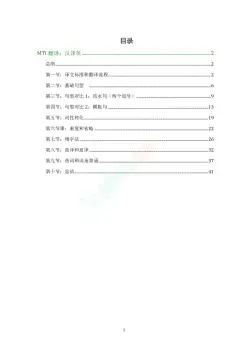
第一章:名---词------------------------------------------------------------------------------------------3
第二章:代词---------------------------------------------------------------------------------------3
第三章:限定词---------------------------------------------------------------------------------------5
第四章:形容词和---副---词-----------------------------------------------------------------------------12
第五章:比较结构 ------------------------------------------------------------------------- 16
第六章:谓语动词--------------------------------------------------------------------------------19
第七章:非谓语动词--------------------------------------------------------------------------------24
第八章:情态动词 ---------------------------------------------------------------------------- 36
第九章:虚拟语气--------------------------------------------------------------------------------45
第十章:名词性从句--------------------------------------------------------------------------------50
第十一章:定语从句---------------------------------------------------------------------------- 54
第十二章:状语从句---------------------------------------------------------------------------- 61
第十三章:反义疑问句---------------------------------------------------------------------------- 66
------------------------------------------------------------------------- 76语法基础精讲
第一章:名词
名词是一种词性,属于实词范畴,用来指代可以感知的具体或抽象事物的词汇,包括人
名、物体、情感、状态等。在句子中,名词可以做主宾表等成分,承担不同的语法角色,是
英文中构建句子的基本元素之一。在考试试题中,对于名词的考察主要集中在以下几个部分。
一、可数名词变复数
1、直接加s
2、以s,x,ch,sh,z结尾的,加es
3、以元音字母+o结尾的,加s
以辅音字母+o结尾的,有生命的加es, 无生命的加s
4、以元音字母+y结尾的,直接加s
以辅音字母+y结尾的,把y变i+es
5、部分以f/fe结尾的,把f/fe变v,再加es;
6、复合名词变复数
① 以两个名词构成的复合名词
例:
appletree——appletrees
computergame——computergames
② 以woman或man作定语修饰的名词
例:
womandoctor——womendoctors
mandriver——mendrivers
③ 以-man,-woman,-child结尾的词,将man,woman,child变复数
例:
postman---postmen
grandchild---grandchildren
chairwoman---chairwomen
④ 名词+介词/介词短语,将重心名词变复数
例:mother-in-law——mothers-in-law
looker-on——lookers-on
editor-in-chief——editors-in-chief
⑤ 动词短语演变而成的名词,直接在后面加s
例:
grown-up——grown-ups
stand-by——stand-bys
⑥ 名词+形容词构成的复合词,名词变复数
例:
secretarygeneral——secretariesgeneral
7、变复数时意思发生改变的词
例:
arm——arms
custom——customs
spirit——spirits
security——securities
真题演练
Therehasbeenanincreasingnumberof__________inprimaryschoolsinpastfewyears.
[A]manteacher
[B]menteacher
[C]manteachers
[D]menteachers
MsEnnabisoneofthefirstPalestinian________withsevenyears’ racingexperience.
[A] womandrivers
[B] womendriver
[C] womendrivers
[D]womandriver
二、名词的格
1、 ‘s表示所属关系
表示有生命之物的所属关系
姓名:Mary’sbrother;Tom’scar人称:mybrother’sbook,thelawyer’soffice
不定代词:nobody’smistake,everybody’sduty
集体名词:theparty’sdecision
高等动物:thehorse’smouse,thebird’swing
时间:today’snewspaper
度量:twotons’steel
国家或城市:China’spopulation;thecity’sweather
交通工具:thecar’swindow
在职业之后加’s可表示该职业的工作场所
thebutcher’s 肉铺
thedoctor’s 医生的诊所
thebarber’s 理发店
thebaker’s 面包房
2、 of结构表示所属关系——AofB
表示无生命之物的所属关系
theroofofthehouse
有生命之物的修饰成分过长,用of结构
thehairofthegirlsittingnexttothedesk
第二章:代词
代词往往用来指代前面出现的一个词或者一句话,英文中,代词按其意义、特征及在句
中的作用可分为:人称代词、物主代词、指示代词、反身代词、相互代词、疑问代词、关系
代词等多种类型。
一、指示代词
指示代词是代词的一种,其定义是用来指示或标识人或事物的代词。它们的主要作用是
代替名词,用来起指示作用,或用来代替前面已提到过的名词。
常见的指示代词包括:
① this/that/these/those—可单独指代某个名词或放名词前修饰名词
this——近指,单数these——近指,复数
that——远指,单数
those——远指,复数
② that/those—可以指代前文提到的某件事或某个句子,避免重复
例:DoyourememberwhenwewenttoNorway?Thatwasagoodtrip.
③ this/that—可以当副词,相当于so
例:Itwasquitealargefish–aboutthatlong.
④ such—“这样,如此”;“这样的,如此的”
例:
Wepredictedthathewouldwinthegameandsuchwastheresult.
Hesaidhedidn'thavetimeormadesomesuchexcuse.
⑤ so—之前对话中前面的内容,一般用于肯定;或表示对前一句话的进一步肯定;位于句
首,用于强调相同情况
例:
Imightbeawaynextweek.Ifso,Iwon'tbeabletoseeyou.
TheyaskedmetocallthemandIdidso.
There'sanotherone.——Sothereis.
Ipreferthefirstversion.——Sodowe.
真题演练:
Itisgoingtobefinetomorrow.________.
[A]Soisit
[B]Soitis
[C]Soitdoes
[D]Sodoesit
Few eyewitnesses give us _______ of actual life on the battlefront as Stephen Crane, the
authorofTheRedBadgeofCourage.
A.suchkeenasenseB.sokeenasense
C.suchkeensense
D.asensesokeen
Mydaughterhaswalkedeightmilestoday.Weneverguessedthatshecouldwalk_____far.
A./
B.such
C.that
D.as
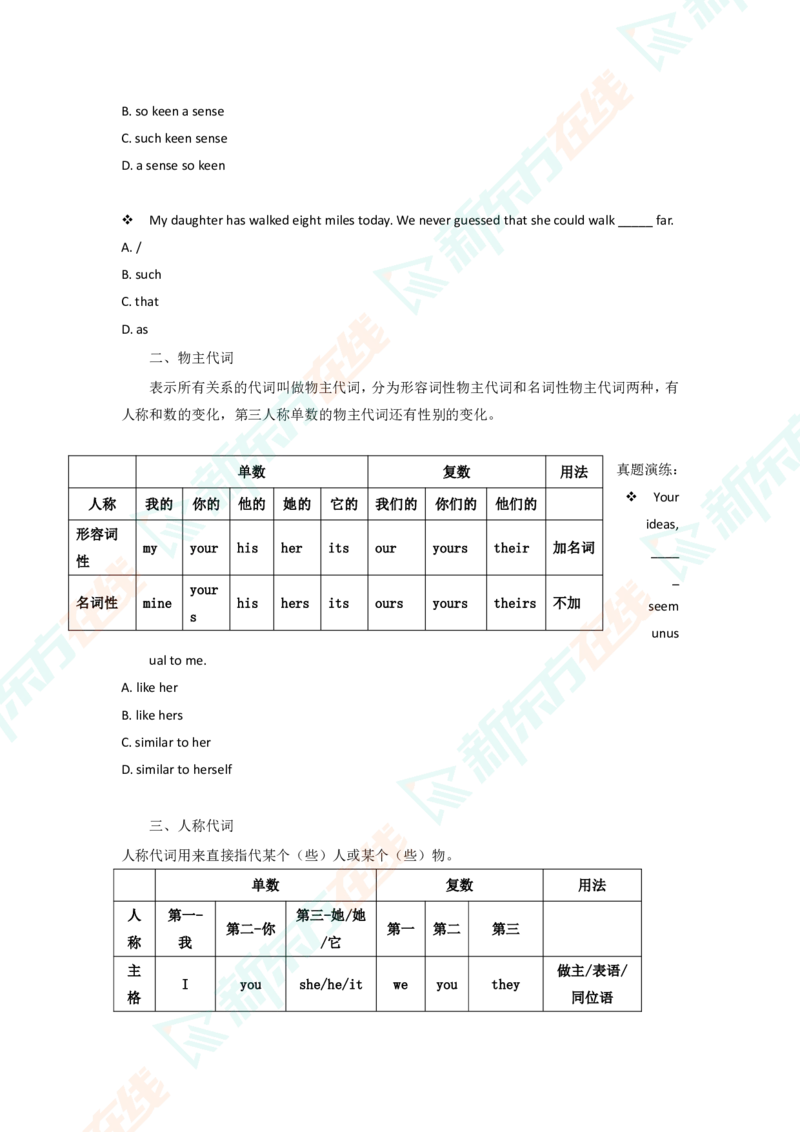
二、物主代词
表示所有关系的代词叫做物主代词,分为形容词性物主代词和名词性物主代词两种,有
人称和数的变化,第三人称单数的物主代词还有性别的变化。
单数 复数 用法 真题演练:
Your
人称 我的 你的 他的 她的 它的 我们的 你们的 他们的
ideas,
形容词
my your his her its our yours their 加名词
____
性
_
your
名词性 mine his hers its ours yours theirs 不加
seem
s
unus
ualtome.
A.likeher
B.likehers
C.similartoher
D.similartoherself
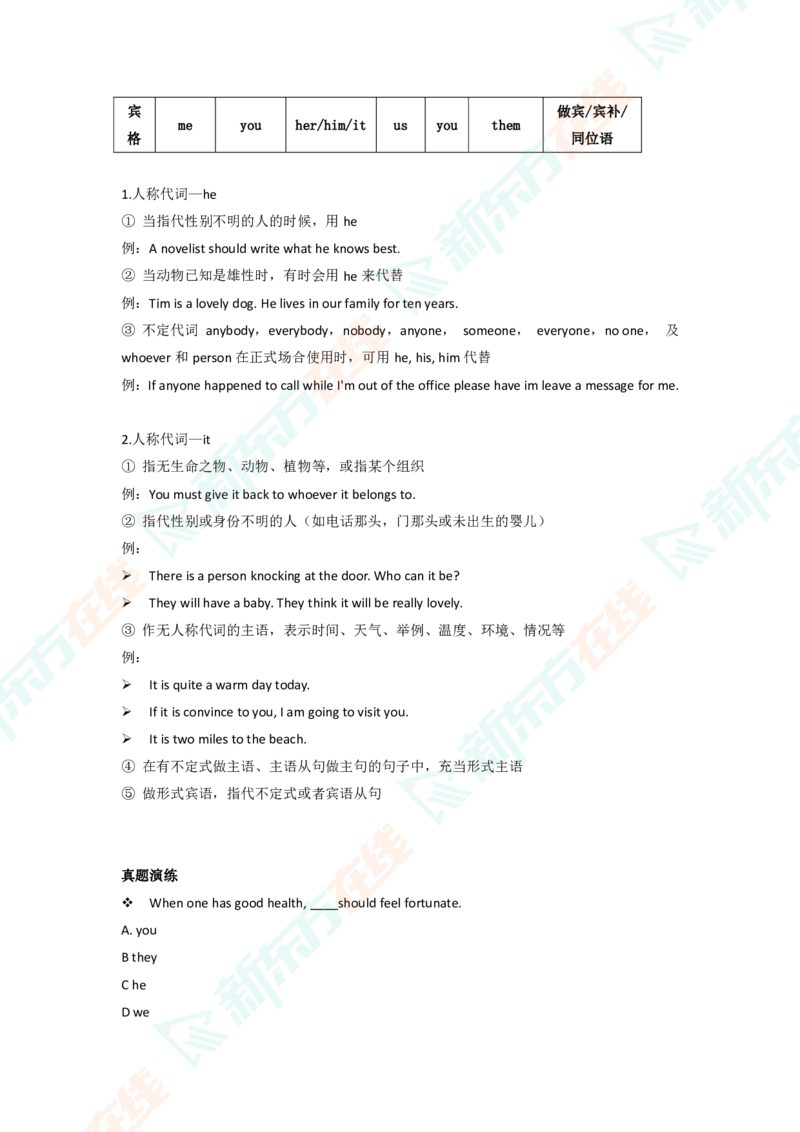
三、人称代词
人称代词用来直接指代某个(些)人或某个(些)物。
单数 复数 用法
人 第一- 第三-她/她
第二-你 第一 第二 第三
称 我 /它
主 做主/表语/
I you she/he/it we you they
格 同位语宾 做宾/宾补/
me you her/him/it us you them
格 同位语
1.人称代词—he
① 当指代性别不明的人的时候,用he
例:Anovelistshouldwritewhatheknowsbest.
② 当动物已知是雄性时,有时会用he来代替
例:Timisalovelydog.Helivesinourfamilyfortenyears.
③ 不定代词 anybody,everybody,nobody,anyone, someone, everyone,noone, 及
whoever和person在正式场合使用时,可用he,his,him代替
例:IfanyonehappenedtocallwhileI'moutoftheofficepleasehaveimleaveamessageforme.
2.人称代词—it
① 指无生命之物、动物、植物等,或指某个组织
例:Youmustgiveitbacktowhoeveritbelongsto.
② 指代性别或身份不明的人(如电话那头,门那头或未出生的婴儿)
例:
Thereisapersonknockingatthedoor.Whocanitbe?
Theywillhaveababy.Theythinkitwillbereallylovely.
③ 作无人称代词的主语,表示时间、天气、举例、温度、环境、情况等
例:
Itisquiteawarmdaytoday.
Ifitisconvincetoyou,Iamgoingtovisityou.
Itistwomilestothebeach.
④ 在有不定式做主语、主语从句做主句的句子中,充当形式主语
⑤ 做形式宾语,指代不定式或者宾语从句
真题演练
Whenonehasgoodhealth,____shouldfeelfortunate.
A.you
Bthey
Che
Dwe Our association, which has consistently pressed for greater employment opportunities for
thedisabled,willpublish______proposalsinthenearfuture.
A.their B.our C.his D.its
四、不定代词
不定代词是不指明代替任何特定名词或形容词的代词,在句中可以作主语、宾语、表语、
定语和状语。
1.
both,either,neither
① both指两者全部,either指两者其中一个,neither指两者都不
② both+可数名词的复数,either/neither+可数名词单数
③ both可以当形容词性使用,either/neither只能当代词,可与of连用
④ not…both 并非两者都
2.
eitherVSneither
either指两者中的其中一个,经常与or连用
neither 指两者都不,经常与nor连用
真题演练
_____ofthetwinswasarrested,becauseIsawbothatapartylastnight.
A.None
B.Both
C.Neither
D.All
3. all,each/every,none——与三者有关
① all指三者或三者以上的全部,none指三者或三者以上的“都不”
② all,each和every可以跟在名词前面,none不可,只能当代词
③ not…every=some 并非所有人(部分否定)
4.
eachVSevery
① each+可数名词单数,指两个及两个以上中的每一个
every+可数名词单数,指三个及三个以上的每一个
② each可以作为代词单独使用,而every不能③ every 后面可以加数词,而each不能
everyfouryears √
eachfouryears ×
5.
someVSany
① some—肯定句中,可加可数名词复数/不可数名词
any—否定句中,可加可数名词复数/不可数名词
② some+可数名词单数—某一个;any+可数名词单数——无论哪一个,任意一个
例:
IfeltasifIhaddiedand,forsomeunknownreason,wasstillbreathing.
Devilcanturnhimselfintoanybirdexceptforadove.
6. (a)littleVS(a)few
相同点:
little,few 都有否定含义,表示几乎没有。
alittle和afew具有肯定含义,表示有几个
差异点:
(a)little+不可数名词;(a)few+可数名词
Little有副词词性,可以修饰形容词
7.
AnotherVSother
① another+可数名词单数,表示不确定的“另一个,再一个”
other+可数名词单数、可数名词复数、不可数名词,表示不确定的“另外的,其余的”
② another+数量词+可数名词复数
anothertwodays—在原有基础上多加三天
例:Wewillstayhereforanotherthreedays.
数量词+other+可数名词复数
threeotherdays——另外的三天,另外的三天
例: IamalwaysbusyfromMondaytoThursday,butIcanvisityouthreeotherdays.
真题演练:
Theadditionalworkwilltake______weeks.A.theother
B.anothertwo
C.othertwo
Dthemore
8. Other 特殊用法
① some/several/every/each/数量词都可以放在other之前
例:someotherdays,threeotherdays,etc.
② other——限定词,后面必须有名词
③ others——可以当代词单独使用
④ theother——在某个特定范围内剩下的+可数名词
真题演练:
14.WhichofthefollowingsentencesisINCORRECT?
[A]Theyeachhavetwotickets.
[B]Theycosttwentyyuaneach.
[C]Eachtheyhaveboughtthesamebook.
[D]Theyweregiventwomagazineseach.9. nobody/noone,nothing,none
是否加of短
指代 用来回答 相当于
语
nobody/no not anyone
人 who 否
one not anybody
nothing 物 what not anything 否
how many not a/an/any+名词
none 人或物 是
how much 或no+名词
五、其它代词
1.反身代词
在句中充当宾语,表语,同位语
单数 myself yourself himself herself itself
复数 ourselves yourselves themselves
2.相互代词
eachother(两者之间的相互,彼此)
oneanother(三者之间的相互,彼此)
真题演练:
Whichofthefollowingreflexivepronouns(反身代词)isusedasanappositive(同位语)?
[A] Hepromisedhimselfrapidprogress.
[B] ThemanagerherselfwillinterviewMary.
[C] Ihavenothingtosayformyself.
[D] Theyquarreledthemselvesredintheface.
第三章:限定词
限定词是放在一个名词的前面,起特指、类指以及表示确定数量和非确定数量等限定作
用的词类。一、前位限定词
包括:all/both/half/倍数/分数/what/sucha(n)
区分:both VS. all
① both修饰两者;all修饰三者或三者以上
② both否定neither;all否定用none
二、中位限定词
1. 中位限定词的分类
① 冠词——a/an,the
② 指示代词——this,that,these,those
③ 形容词性物主代词——my,your,his,her,its,their,our
④ 所有格——sb’s
⑤ 不定代词——some,any,no,every,each,either,neither,enough
2.冠词的用法
① 不定冠词—a/an
a/an+单数名词—表示泛指
例:Itisrainingoutside.Ineedanumbrella.
a/an+单数名词——第一次提到
例:Imetagirltoday.Thegirlisverybeautiful.
② 定冠词—the
the+名词,特指上文中所提到的某个名词或已知的某个特定东西
the+单数名词,泛指某一类东西
例:Thetigerisbecomingendangered.
Tigersarebecomingendangered.
Thetigeriseatingsomechicken.
the+单数名词——表示独一无二的事物
例:Theearthgoesaroundthesun.
TheRenaissancetookplaceintheEurope.
the+名词+后置定语——特指
例:Theeffortsofthesupportwasdetectedbythescientists.
the+国籍/形容词——表示一类人例:
TheChinesearegreatpeopleandcreateagreathistory.
Therichalwayshelpthepoor.
其他特殊用法
乐器前需要加the
the+姓氏(s) 表示很多该姓的人(常表示一家人)
有时可用the表示强调
③ 零冠词
不可数名词前不加冠词,表示泛指
例:
Humanalwaysliveonwater.
Thewaterintheriverbecomesgreenbecauseofpollution
可数名词复数前不加冠词,表示泛指
例:
Booksarethesteppingstonestohumanprogress.
Thebooksinmyhousebelongtomyfather.
其他零冠词情况
球类前不加冠词
星期/月份/季节前不加冠词(如特指某一个有时可加)
某些时间段之前不加冠词(night,dawn,noon,sunset等)
三餐之前不加冠词
某些固定搭配中不加冠词
真题演练:
Ican’tputupwith__________.
[A]thatfriendofyou
[[CB]]tthheatfrfireinedndofoyfoyuours
[D]thefriendofyours
Theboysinthefamilyareoldenoughfor________.[A]schools
[B]school
[C]theschool
[D]theschools
三、后位限定词
基数词、序数词等
数量限定词
next,last,other,another等;
next,last,other,another等;
many,much,(a)few,(a)little,fewer,(the)fewest,less,(the)least,more,most;several,such
等;
plentyof,alotof,lotsof,agreatnumber/dealof,agreat/goodmany,alargeamountof,a
greatquantityof等。
such
注意点:
such+a/an+可数名词单数
such+可数名词复数/不可数名词
如such没有a/an时,做后位限定词
类型 举例
接可数名词单数名词 each, every, either,neither, manya, such a, what a,
a/an,one
接可数名词复数名词 several,both,all,(a)few,anumberof等
接不可数名词的 (a) little, much, less, the least, a bit of,a greatdeal
of,anamountof等
接可数名词的(单复数皆 基数词,序数词,thelast,thenext等
可)
只接单数+不可数名词的 this,that
只接复数可数+不可数的 alotof/lotsof,plentyof,enough,more,most,such
等
可以跟任何连用的 the,some,any,no,other,所有格,形容词性物主代
词等真题演练
____________ areonthedesk.
A.Allyourthreebooks
B.Allthreeyourbooks
C.Yourthreeallbooks
D.Threeallyourbooks
WhichofthefollowingsentencesisINCORRECT?
[A]Allhislecturesareveryinteresting.
[B]Halftheirsavingsweregone.
[C]Manyhisfriendscametotheparty.
[D]Bothhissistersarenurses.
The woman had persuaded him to do _______ he was hired never to do—reveal the
combinationforthelockontheentrance.
[A]onething
[[CB]]asnuychonoenethtihnigng
[D]theonething
Which of the following determiners(限定词)can be placed before both singular count
nounsandpluralcountnouns?
[A]manya
[B]few
[C]such
[D]thenext
第四章:形容词和副词
一、形容词
1. 形容词的顺序
This beautiful, round, old,
(限定词) (观感) (形状) (年龄)
red, Chinese wooden tablebelongstomy(颜色) (国家) (材料)
grandpa.
2. 形容词的位置
一般情况:置于所修饰名词前
① 在everything/anything/something/nothing/-one/-body等词,放在所修饰名词之后
例:Thereisnothingimportantforhimtodo.
② 一些以a-为前缀的形容词,放在所修饰名词之后(多做表语)
例:
Theweatherhereisalwayscold,summerandwinteralike.
MysisterandIdonotlookalike.
③ 形容词词组修饰名词时,放在所修饰名词之后
例:Agirlinterestedinreadingbooksalwaysshowsherelegance.
④ and/or连接多个同类型形容词修饰同一个名词,需后置
例:Theywillturntheirmotherlandacountry,beautifulandmodern.
3.其它注意点
① 形容词/比较级的修饰
abit;alittlebit,alittle,alot,agreatdeal,any,even,far,byfar,much,verymuch,norather,
still,slightly
enough修饰形容词放其后,修饰名词放其前
② -ing VS–ed
-ing形容词描述“引起人的某种感觉的事物”,或“给人某种感觉的事物”;-ed形容词主要
描述人的主观感受,表示“人对某件事物产生某种感觉”,一般用来修饰人或其他有情绪
的东西
例:
Sheisaboringwoman.
Sheisveryexcited.
-ing形容词可以描述主动意义或正在发生的意义;-ed形容词可以描述被动意义或已经
发生的意义
例:
boilingwater 沸腾的水boiledwater 烧开的水
acharminggirl—一个迷人的女孩
acharmedgirl—一个着了魔的女孩
③ beof+名词=同类型形容词
例:
beof (great/some/little/any)value, importance, use, help, significance,benefit
=valuable,important,useful,helpful,significant,beneficial
beofasuccess=successful
真题演练
Susanisveryhardworking,butherpayisnot___forherwork.
[A]enoughgood
[[CB]]agsogoodoedneonuoguhgh
[D]goodasenough
Hewas_______totellthetrutheventothisclosestfriend.
[A]toomuchofacoward
[[CB]]atocoowmaurcdhetnhoeucgohward
[D]enoughofcoward
二、副词
位置:较为灵活,可放在所修饰词之前或之后。
功能:修饰动词、形容词、副词、介词短语或句子等,用来说明时间、地点、方式、原因、
程度等
成分:多充当状语,偶尔可充当表语、定语、宾语补足语等
真题演练:
Whichofthefollowingitalicizedpartsmodifiesanadverb?
[A]Doitrightnow.
[B]Thatwasaveryfunnyfilm.
[C]Iratherlikemyteacher.[D]Wewalkedabout6miles.
Whatdoes“Hewiselyrefusedtospendhismoney.”mean?
[A]Itwaswiseofhimtorefusetospendhismoney.
[B]Herefusedtospendhismoneyinawisemanner.
[C]Hewasshortofmoneyanddidn’twanttobuyanything.
[D]Herefused,inawisemanner,tospendhismoney.
第五章:比较结构
一、同级比较结构
1.as+形容词/副词+as…/as+形容词+名词+as
“和……一样”
例:Ithasbeenpredictedatleastasoftenasthecomingofthepaperlessoffice.
2.as+much/littleof+n.+as……“和……一样……”
AisasmuchofBasC
A 和C一样都有B这种特性
3.asmuch/many+名词+as+分句
否定:notso/asmuch/many+名词+as
例:
Hehaswrittenasmanypapersashisbrother.
Hehasnotwrittenas/somanypapersashisbrother.
4.as+adj.+ 名词+as……
例:
TomisascleveraboyasTim.
=TomisaboyascleverasTim.
HeisasdiligentastudentasLily.
=HeisastudentasdiligentasLily.
5.notso…as…
“和……不一样”
例:Ithasbeenpredictedatleastasoftenasthecomingofthepaperlessoffice.6.notsomuchAasB
“与其说是A不如说是B”
例: Heisnotsomuchasingerasadancer.
7.thesame…as/thesameas“和…一样”
例:
Shelooksjustthesameasbefore.
Igotthesamefeelingasyoudid.
真题演练
Thereareasgoodfishinthesea______evercameoutofit.
[A]than
[B]like
[C]as
[D]so
Itwas_______wehadhoped.
[A]moreasuccessthan
[B]asuccessmorethan
[C]asmuchofasuccessas
[D]asuccessasmuchas
Itisnotsomuchthelanguage______theculturalbackgroundthatmakesthebookdifficult
tounderstand.
[A]but
[B]nor
[C]as
[D]like
一、比较级
1.than
①A 比较级 thanB
例:Devices like Kindle make reading more convenient and are a lot more environmentally
friendlythanthetraditionalpaperbook.②A 比较级 thanother/else,表示两者比较对象中一方包含另一方,需要用other/else将
其与整体区别开来
例:Thislandisgeographicallymorediversethananyothercontinent.
③than比较结构中的省略和指代
TherosesoftheSoutharemorebeautifulthanthatoftheNorth.
Shemadefewermistakesthanyou(do)
④than的特殊用法
moreAthan B “更……而不是…”,“与其说是B不如说是A”
例:
MymotherwasmoreangrythanworriedwhenIcamehomelate.
Heismoreaartistthanahomelessman.
真题演练:
Sheisabetterspeakerthan__________intheclass.
[A]anyboy
[B]theotherboys
[C]otheranygirl
[D]allthegirls
2.moreandmore/比较级 and 比较级
“越来越……“
例:Therearemoreandmorereaders,andmoreandmorebooks.
3.morethan
① morethan+数量词,表示“超过……“
例:MorethanhalfofallU.S.workerseitherlosttheirjobsorwereforcedtotakecutsinhoursor
payduringtherecession. 【2012】
② morethan…… ,表示“不只是“
例:“Thisismorethanajob,”saysHarrington.“It’samission.”
③ more……than,表示 “比……更……“例:Parentsfeelmoredisappointedthantheirchildren.
④ moreAthanB=ratherAthanB,“与其说是B,不如说是A“
例:MorethanhalfofallU.S.workerseitherlosttheirjobsorwereforcedtotakecutsinhoursor
payduringtherecession.
⑤ nomorethan…,表示“只是,仅仅,不超过“
例:
……nomorethan140characters
HeisnomorethananEnglishteacher.
⑥ nomore/比较级 …than…=not…anymore/比较级 than
,表示“两者都不,和……一样都不……”
例:
Sheisnomorediligentthanhersister.
Sheisnotdiligentanymorethanhersister.
Sheisnobetterthanhersister.
Sheisnotbetteranymorethanhersister.
⑦ notmorethan…,表示 “不多于,至多”
例:Hehasnotmorethanthreechildren.
⑧ notmore/比较级…than…,表示 “不如”
例:Sheisnotmorediligentthanhersister.
真题演练:
Johnis_____hardworkingthanhissister,buthefailedintheexam.
[A]noless
[B]nomore
[C]notless
[D]noso
4.lessthan
①“不到,不太 “
例:Textmessagescostcarrierslessthantraditionalmobilevoicetransmissions.②nolessthan,表示“多达,不少于”
例:Read carefully the following excerpt on term-time holiday arguments in the UK, and then
writeyourresponseinNOLESSTHAN200words...
③noless…than
“不亚于,和……一样都……”
例:heisnolessdiligentthanhersister.
5.the+比较级+句子,the+比较级+句子,表示 “越……,越……”
例:ThemoreIearn,thehappierIam.
名词 形容词比较级
6be.bmeoleresso/fmimorpeo+rtoafn+ce=m=oreimportant
belessofafool=belessfoolish
二、倍数表达
1. 基数词+timesas+adj.+as
两倍 twice
三倍及以上 基数词+times
例:Thisroadisthreetimesaslongasthatone.
2基数词+timesthe 名词+of
例:Thisroadisthreetimesthelengthofthatone.
可用名词:size, length,width,weight,height,depth等
3. 基数词+times+比较级+than
例:
Thisroadisthreetimesaslongasthatone.
Thisroadistwicelongerthanthatone.
真题演练
Anewlaptopcostsabout________ofasecond-handone.
[A]thepriceofthreetimes[B]threetimestheprice
[C]asmuchasthethreeprice
[D]threetimesmorethantheprice
第六章:谓语动词
谓语:在主动语态中,谓语是主语发出的动作,是全句的核心动作
主语:在主动语态中,谓语动作的发出者
宾语:在主动语态中,谓语动作的承受者
一、时态
1. 一般现在时
① 用于不受时间限制的客观表述
例:
Theearthgoesaroundthesun.
BeijingisthecapitalofChina.
② 表示习惯性或经常性发生的动作或状态(通常跟表示频率的副词)
例:
Ialwaysgototheparkafterdinner.
Myfatherneversmokes.
③ 表示现在的状态或现在的瞬间动作(一般用于对话或场景解说)
例:Youlooktired.Whathappened?
Someoneisatthedoor.
“Nowsheenterstheroomandtakesthefilesout!”
④表示将来发生的动作
在一些状从(条件状语从句和时间状语从句)中,用一般现在时表将来
例:Whenhecomesback,Iwilltellhimtheexcitingnews.
⑤ 谈到未来计划和时间安排时,用短暂性动作表将来
例:
Thetrainstartsat7pm.
TheyleaveforShanghaibytrain.
或者在hope,wish 等词之后,表示将来时
例:
Iwishyouhaveagoodsleep.
Ihopeshelikestheflowers.
2. 一般过去式
① 表示在过去时间内完成的动作或一度存在的状态
例:
Ivisitedafamousmuseumyesterdaywithmybrother.
IwasreallytiredlastweekbecauseIhadalotoftasks.
WelivedinBeijingforfiveyears.
② 表示过去习惯性发生的动作或存在的状态。
例:
WhenIwasachild,IalwayshelpedMs.Smithcleanheryard.
Heworkedforachemicalfactoryinallhislife.
Iwashappywhenmyfatherbroughtmetothepark.
③ 在某些特殊句型中,使用过去时态,暗含一种主观想象的意思。
例:
It’s(high)timesb.didsth. 是时候做某事了
Comeon!It’stimewemadeastart. It’sabouttimesb.didsth.
It'sabouttimeyougotajobtoearnyourkeep.
3. 一般将来时
① 一般将来时的几种表达形式:
will/shalldo
begoingtodo
betodo
beabouttodo
bedoing(leave,go,start,reach,arrive,come,move 等)
② will和begoingtodo的区别
will表示更普遍的“将要发生”;begoingtodo 则是根据明显迹象来推测的某件事的发生
will比begoingtodo 更正式
will可以表示说话人的意愿,begoingtodo 表示一种计划
will除了表示将来之外,还可能表示某种猜测(情态动词详解)
例:
Iwillgivesomeadviceaboutyourstudy.
Thewindissostrong.Itisgoingtorain.
③ bedoing 表示将来时
将来做出的计划或者安排,已经确定的将要发生的事
必有时间状语
必须人称主语
例:WewillflyingtoBeijingtomorrow.
④ betodo
表示已经安排好将来要发生的事
表示某种强烈命令
例:
IamtohaveadatewithLilythisafternoon.
Youaretostandthere!⑤ beabouttodo
表示在短时间内即将要发生的动作
例:Sheisabouttoembarkonadiplomaticcareer.
4. 现在进行时
① 说话的瞬间正在进行或者发生的动作
② 当前一段时间内进行或发生的动作或状态
例:
——Whatareyoudoing?
——Iamdoingmyhomework.
Theyarestudyinghardinthisyear.
③ 表示强烈感情色彩,如与always,continuously, forever,constantly 等表重复的词连用
例:
Lilyisconstantlycomplainingthepoorserviceinthisrestaurant.
Heisalwaysputtinghisstaffonmydesk.
④ 最近已经计划或确定安排的近期会发生的动作
(go,come,start,leave,do,have,wear,sleep等词)
例:
IamgoingtoShanghaiformysummerholiday.
Wearemeetinghimafterthisexcellentshow.
5. 过去进行时
① 表示在过去某个时间正在发生的事情
② 表示过去某个时间段正在发生的事情(经常跟表示时间的状语)
例:
Whatwereyoudoingat7pm?
Theywerestudyinginthisuniversityin2010.
③ 表示在过去的时间,按照计划即将发生的事情(过去将来时)
例:TheyweregoingtoShanghaiinafewdays.
④ 有时,过去进行时态会表示温婉请求或提建议,常与wonder,think,hope连用
例:
Iwashopingtotalktoyouaboutmyessay.
Iwaswonderifyou’dliketolendyoucartome.6. 现在完成时
① 表示过去这件事已经完成了,并对现在造成了一定影响。
例:
Ihaveeatentwoapples.(强调现在已经吃饱了)
Hehasturnedontheradio.(强调现在收音机还开着)
② 表示过去已经开始,持续到现在的动作以及状态;
可以和表示从过去延续到现在的时间状语连用。
例:
IhavelivedheresinceIwasten.
MyfatherhasbeenaEnglishteacherfor10years.
③ 表示反复或者习惯性的动作,常与severaltimes,once,twice等连用
例:
Ihaveseenthismoviethreetimes.
Formanyyears,scientistshavearguedoverwhetherlifeexistsonMars.
④ 一些特定句型中,只用完成时态
例:
Itisthefirsttimethat…have/hasdone…
Itwasthefirsttimethat…haddone
7. 过去完成时
① 两个动作都发生在过去,先发生的用过去完成时,后发生的用一般过去时。(站在过去某
个时间点对过去的过去进行回顾)
例:ThemoviehadbeganbeforeIarrivedatthecinema.
② 表示过去本打算实现而未实现的的希望或计划。常见用于此的 动词有:hope,want,
expect,think,mean,suppose,plan,intend等
例:Wehadhopedtocatchthetrain,butwefailed.
8. 现在完成进行时
基本形式:have/hasbeen+v-ing
基本内涵:该动作在说话之前一直发生,并且可能一直延续要说话之后。
特征:包含进行态中的持续性、暂时性和未完成性。
9. 易混淆时态① 一般现在时VS现在进行时
Helivesinthecity. VS Heislivinginthecity.
② 现在完成时 VS 一般过去式
IhavelivedinBeijingforthreeyears.
IlivedinBeijingforthreeyears.
一般过去时只是对过去某一时刻发生的动作进行描述,现在完成时强调过去发生的动作
对现在造成的影响或结果。
Ilostmywalletyesterday.
Ihavelostmywallet.(强调我现在还没找到钱包)
一般过去时常跟具体的时间点,现在完成时经常跟模糊的时间状语或无时间状语。
IhavehadlunchwithTom.
IhadlunchwithTomyesterday.
现在完成时可表示持续到现在的动作或状态,一般用延续性动词,而过去式经常用非延
续性动词。
Hisfatherdiedtwoyearsago.
Hisfatherhasbeendeadfortwoyears.
一般过去时表示该动作已经不存在了;现在完成时表示现在有可能该动作或该动作的影
响还在延续。
Hehasturnedoffthelight.
Heturnedoffthelight.
③ 现在完成时 VS 现在完成进行时
现在完成时表示动作已经完成或还可能继续进行下去;现在完成进行时表示动作仍在进
行中或未完成.
Wehavediscussedthisproblemwiththem.
Wehavebeendiscussingthisproblemwithhim.
现在完成时强调动作对现在的影响;现在完成进行时强调动作从过去延续到现在甚至延
续到将来(强调进行的过程)
Heisill.Hehasbeenlyinginbedfortwodays.二、主谓一致
1. 谓语用单数
① 个体名词单数形式做主语
② 不可数名词做主语
例:
Thebagisreallybeautiful.
Thewaterrunsintotheriver.
③ 并列主语表示同一概念或作为整体不可分割
例:
Athiefandmurdererwasarrestedinthepark.
Breadandbutteristheirdailyfood.
④ 时间、距离、重量、价值等数目复数当做整体做主语
Twentymilesseemslikealongwalktohim.
⑤ 报刊、地名、组织等做主语
TheUnitedStatesbordersCanada.
⑥ 以-s结尾但是表示某种学科做主语
Physicsisanimportantschoolsubject.
maths,physics,politics,statistics等
⑦以-s结尾的但是表示单数概念或不可数名词的名词做主语
例:
Mumpsisakindofinfectiousdisease.
Newscomesfromhissocialmediaplatform.
⑧ 不定式、动名词、从句做主语
例:Seeingisbelieving.
⑨不定代词 something, somebody, nothing, nobody, everything, everybody, anything,
anybody等做主语
Nobodywantstogothere.
⑩ manya/morethanone名词单数做主语
例:Morethanoneboyhasbeenthere.
⑪ each/every/no/manya修饰的名词单数并列做主语
例:Everyboyandeverygirlenjoyedtheparty.
⑫ each,either,neither,another,theother,(a)little,或much做主语或修饰主语
例:Muchofwhatyousaidistrue.⑬ oneandahalf+名词复数做主语
例:Oneandahalfbananasisleftonthetable.
⑭ a/an+单数名词+ortwo做主语时用单数
例:Astudentortwohasfailedtheexam.
⑮ 运算数次做主语
例:Threetimesfiveisfifteen.
2.谓语用复数
① 个体名词复数做主语
② 集合名词做主语
people,police,cattle,crew,clothes,public等
③ 以复数形式出现的岛屿、瀑布等专有名词做主语
例:
TheNiagaraFallsareinNorthAmerica.
TheHimalayashaveprofoundlyshapedtheculturesofSouthAsia.
④ the+adj.表示一类人做主语
例:Theyoungarethirstyforknowledge.
⑤ the+姓氏+s做主语
例:TheGreensareinvitedtothisconcert.
⑥ oneortwo+复数名词做主语(对比a/an+单名+ortwo)
例:Oneortwostudentswereplantingtreesyesterdayafternoon.
⑦ 两个或两个以上的主语从句,动词不定式,动词ing 形式作主语,表示两个或两个以上
的概念或意义时
例:Swimminginsummerandskatinginwinterarehisgreatestpleasure.
3.视情况而定
① aswellas/(together) with/ratherthan/suchas/like/but/except等做后置修饰时,谓语动
词与前面的主语保持一致
例:
HeaswellasIisabsentfromthemeeting.
Tom,togetherwithhisparent,goestotheparkeveryday.
② army,class,crew,family,team,audience,group,enemy等集合名词作主语时,视情况而定
例:Herfamilyissmall,butthefamilyarealladvancedworkers.
③ 分数/百分数/half/all/part/rest/plenty等+of+名词做主语,视情况而定例:
Mostofthefoodisdelicious.
Mostoftheapplesarered.
④ 名词单数+and+名词单数,指同一个,用单数,指不同两个,用复数
例:
Thewriterandteacheriscoming.
Thewriterandtheteacherarecoming.
⑤ what/who/which/such常与其后的名词做表语保持一致
例:
Whatyousaidisreallyimportant.
Whattheboyneededarejustseveralbooks.
⑥ atotalof+有明确的数量的可数名词复数,用复;thetotalof……谓语一般用单数形式
例:
Atotalof300letterswerereceivedyesterday.
Thetotalof26goals(进球) isfargreaterthananyothersideinEurope.
⑦ anaverage/numberof+名词复数,谓语用复数,theaverage/numberof+名词复数,谓语
用单数
例:
Anaverageof3studentsareabsenteachday.
Theaverageof4,5and9is6.
三、就近原则
1.therebe 句型
例:
Therearethreeteachersandastudentintheclassroom.
Thereisastudentandthreeteachersintheclassroom.
2.neither…nor,either…or,not…but,notonly…butalso…
例:
NeitherheorIamright.
NeitherIorheisright.
NotonlyMary’sfriendsbutalsoshestaysathome.
NotonlyMarybutalsoherparentsarestayathome.真题演练
Whatisthefunctionofthepresentprogressivein“Theyarealwayscallingmebythewrong
name”?
[A]Toexpressunfavorablefeelings.
[B]Toalleviateunnecessaryhostility.
[C]Toindicateuncertainty.
[D]Todramatizeafact.
Whichofthefollowingsentencesexpressesafutureaction?
[A]Lucyiscontinuallyfindingfaultwithhersister.
[B]Wearemeetingthevisitorsaftertheperformance.
[C]ThecoachisnowcrossingtheGardenBridge.
[D]I’shopingthatyouwillgiveussomeadvice.
InhisplaysShakespeare______hischaracterslivethroughtheirlanguage.
[A]wouldmake
[B]hadmade
[C]made
[D]makes
AllthefollowingsentencesdefinitelyindicatefuturetimeEXCEPT________.
[A] MotheristohaveteawithAuntBettyatfour
[B] Theschoolpupilswillbehomebynow
[C] ThePresidentiscomingtotheUNnextweek
[D] Heisgoingtoe-mailmethenecessaryinformation
WhichofthefollowingsentencesisINCORRECT?
[A] Twentymilesseemslikealongwalktohim.
[B] Nooneexcepthissupportersagreewithhim.
[C] NeitherJulianorIweregoingtotheparty.
[D] Fewstudentsinmyclassarereallylazy. WhichofthefollowingsentencesinINCORRECT?
[A]Physicsisanimportantschoolsubject.
[B]TheUnitedStatesbordersCanada.
[C]TheNiagaraFallsisinNorthAmerica.
[D]Mumpsisakindofinfectiousdisease.
Theaudience__________excitedonseeing__________favoritestarglideontothestage.
[A]were…their
[B]were…its
[C]was…their
[D]was…one’s
Thestudentsaidtherewereafewpointsintheessayhe______impossibletocomprehend.
[A]hadfound
[B]finds
[C]hasfound
[D]wouldfind
HowcanIconcentrateifyou__________continually__________mewithsillyquestions?
[A]have…interrupted
[B]had…interrupted
[C]are…interrupting
[D]were…interrupting
U.S. News ________ rankings of colleges since 1983. They are a very popular resource for
studentslookingtoapplytoauniversitycampus.
[A]maintains
[B]ismaintaining
[C]maintained
[D]hasbeenmaintaining
四、语态
1. 语态的定义 主动态:谓语动作是由主语主动发出了,如果有宾语,则宾语为谓语动作的承受者。
例:Idrewabeautifulpicture.
被动态:谓语动作变成了由主语承受,谓语动作翻译成“被……”
例:Abeautifulpicturewasdrawnbyme.
2.各类动词变被动
① 动词——主谓宾结构
Ibrokeawineglass.
Awineglasswasbrokenbyme.
② 动词——主谓宾宾结构
IsentTomaletter.
Tomwassentaletterbyme.
AletterwassenttoTombyme.
③ 动词——主谓宾宾补结构
WechoseTomourchairman.
Tomwaschosenchairman.
④ 动词+介词
Thesekidarewelllookedafter.
Aleafislookedatunderamicroscope.
⑤ 动词+副词
Theconferencewillbeputoff.
Thecomputerissetup.
⑥ 动词+副词+介词
Badhabitsshouldbedoneawaywith.
Aliarisalwayslookeddownupon.
⑦ 动词+名词+介词
Manyscholarspayattentiontoyourstudy.
Yourstudyispaidattentiontobymanyscholars.
Attentionispaidtoyourstudybymanyscholars.⑧ 动词+名词+介词
Don’tworry.Theywilltakegreatcareofthiskid.
Don’tworry.Thiskidwillbetakengreatcareof.
Don’tworry.Greatcarewillbetakenofthiskid.
真题演练:
When the sentence “They had made a mess of the house” is turned into passive voice,
whichthefollowingiscorrect?
[A]Amesshadbeenmadeinthehouse.
[B]Amesshadbeenmadebythem.
[C]Thehousehadbeenmadeamessof.
[D]Thehousehadbeenmadeamess.
第七章:非谓语动词
一个简单句里有且只能有一个谓语,其它动词需以非谓语动词的形式出现,所以非谓语
动词是指在句子中不是谓语的动词,主要包括以下三种常见形式。
一、非谓语动词—
doing
注明:及物动词以make为例;不及物动词以go为例
1.不同形式的意义
一般式:现在分词动作与主语动作同时发生,或者分词动作与主句动作先后发生,无时
间间隔。
例:Ithadahighcollarwithatinyruff,makingherlookwonderfullyawoman.
完成式:表示先于谓语的动作,即当现在分词所表示的动作先于谓语动作发生时,现在分词就用完成式。
例:Anti-smokingforceshaveplentytocelebratethisweek,havinghelpedavoid8million
prematuredeathsinthepast50years.
2.所做成分
① 动名词——在句子里充当主语、宾语、表语
例:
Harringtonispassionateaboutprovidingopportunitiestoall230employees.
Eatingisametaphorthatissometimesusedtosignifymarriage.
② 作定语
Carterfoundasolidblockofgoldweighing110kg.
……arulingnobleclass.
③ 做状语
例:SoI’dvisitamillandsend themphotosofmyself,holding asign thatsay‘Iwanttobeyour
baker.’”
注意:
need,worth,require,want,deserve等词,+doing表被动
例:Thetreesneedwatering.=Thetreesneedtobewatered.
真题演练
There ________ nothing more for discussion, the meeting came to an end half an hour
earlier.
[A]tobe
[[CB]]btoehavebeen
[D]being
Facingtheboardofdirectors,hedidn’tdeny________breakingtheagreement.
[A] him [B]his
[C]it [D]its In phrases like freezing cold, burning hot, or soaking wet, the -ING participle is used
________.
[A]asacommand [B]asacondition
[C]forconcession [D]foremphasis
Thisisoneoftheissuesthatdeserve__________.
[A]beingmentioned
[B]mentioning
[C]tomention
[D]formention
二、非谓语动词—
done
1. 作定语
…the young Japanese couldn’t reject the partner chosen by his parents and their
middleman.
…manyJapaneseabandonedthearrangedmarriageaspartoftheirrushtoadoptthemore
democraticwaysoftheirAmericanconquerors.
2. 作状语
例:Inundated by more information, we’re increasingly handing off the job of remembering to
searchenginesandsmartphones.
三、非谓语动词—
todo1.不同形式的意义
一般式表示与谓语动作同时发生
例:Sciencehelpsmantogainincreasingcontroloverhisenvironment.
完成式先于谓语动词之前
例:Iamsorrytohavekeptyouwaitingsolong.
进行时表示在谓语动词动作发生时正在进行
例:Shepretendedtobesleeping.
2.所做成分
① 做主语、宾语、表语
例:Myuniversity’sphilosophywastogetstudentsseeingpatientsearlyintheireducation.
做宾语
动词+todo
例:Hepromisedtowritealettertome.
动词+疑问词+todo
例:
Idon’tknowhowtodothisjob.
Pleaseshowmewhattodo.
动词+it+宾补+todo
例:
Hethinkstoovercomethisdifficultyachallenge.
Hethinksitachallengetoovercomethisdifficulty.
② 作定语
所修饰词作不定式的宾语
Ihavealettertowrite.——所修饰词做动词的宾语
Ineedapentowritewith.——所修饰词做介词的宾语
所修饰词作不定式主语Heisthebestmantodothejob.
Ineedakeytolockthedoor.
③ 状语
例:To make me disappear, the woman gave me the phone number for Windows’ creator,
Microsoft.
④ 形容词+todo
Iamverygladtohelpyou.—主谓关系
Thisproblemisdifficulttoworkout.—动宾关系
=Itisdifficulttoworkoutthisproblem.
3.省略to 的情况
① 常见动词搭配:
感官动词:see,hear,watch,notice,feel,observe
使役动词:make,let,have
其他:help
② 一些并列结构中
例:Iwanttoliedownandhaveanap.
③ 前有do,后无to
例:
Wehadnochoicebuttowait.
HedidnothingbutwatchTV.
注意点—非谓语动词变否定
Trytomakesomenoise.
Trynottomakeanynoise.
Havingfinishedhiswork,hewentbackhome.
Nothavingfinishedhiswork,hecouldn’tgobackhome.
Thecitychangedmuchismyhometown.
Thecitynotchangedmuchismyhometown.动词+todo/doing 意思不同的情况:
独立主格结构(往往在句中充当状语)
对比:① Seeingfromthehill,Icanseeabeautifulvillage.
② Iwaitingforthebus,abirdfellonmyhead.
独立主格结构的常见形式:
名词/代词+分词/动词不定式/形容词/副词/介词短语
例:
① Thequestionbeingsettled,wewenthome.
② Theoldmansatinhischair,hiseyesclosed.
③ Nobodytocometomorrow,wewillhavetoputoffthemeetingtillnextweek.
动名词的复合结构(往往在句中充当主语或宾语)
1. 在句子中做主语,名词的所有格/物主代词+动名词。
Tom’sleavingmakesallofussad.
Hisleavingmakesallofussad.
2. 在句子中做宾语,名词/人称代词宾格+动名词
名词所有格/物主代词+动名词
IamannoyedaboutLily/Lily’srefusingmyinvitation.
Iamannoyedabouthis/himrefusingmyinvitation.
注:在deny,postpone,defer等动词后,大多数使用所有格。
3. 逻辑主语是物或不定代词时,一般用普通形式。
Someoneknockingatthedoormakesreallyangry.真题演练
The Bent Pyramid outside Cairo _________ancient Egypt’s first attempt to build a
smooth-sidedpyramid.
[A]hasbeenbelievedtohavebeen
[B]wasbelievedtobe
[C]isbelievedtohavebeen
[D]isbelievedtobe
________shouldnotbecomeaseriousdisadvantageinlifeandwork.
[A]Tobenottall
[B]Nottobetall
[C]Beingnottall
[D]Notbeingtall
Some Martian rock structures look strikingly like structures on Earth that are known
________bymicrobes.
[A]havingbeencreated
[B]beingcreated
[C]tohavebeencreated
[D]tobecreated
After_______forthejob,youwillberequiredtotakealanguagetest.
A. beinginterviewed
B. B.interviewed
C. interviewing
D.havinginterviewed
Youwillseethisproduct_______whereveryougo.
A.tobeadvertised B.advertised
C.advertise D.advertising
The local health organization is reported ___ twenty-five years ago when Dr. Adudon
becameitsfirstpresident.
A.tobesetup B.beingsetupC.tohavebeensetup D.havingbeensetup
Hewasn’taskedtotakeonthechairmanshipofthesociety,___insufficientlypopularwith
allmembers.
A.beingconsidered B.considering
C.tobeconsidered D.havingconsidered
Allflights______becauseofthesnowstorm,manypassengershadtotakethetrain.
A. hadbeencanceled
B.havebeencanceled
C.havingbeencanceled
D.werecanceled
A series of attempts ______ made, he came to realize that he had underestimated the
enormityofthetask.
A. were
B.tobe
C.hadbeen
D.havingbeen
Somanydirectors___________,theboardmeetinghadtobeputoff.
A. wereabsent
B.beingabsent
C.beenabsent
D.hadbeenabsent
Allthetasks________aheadoftime,theydecidedtogoonholidayforaweek.
A. beenfulfilled
B.havingbeenfulfilled
C.werefulfilled
D.hadbeenfulfilled
Agriculture is the country’s chief source of wealth, wheat _________ by far the biggest
cerealcrop.
A. isB. been
C. be
D.being
Anewtechnique__________,theyieldsasawholeincreasedby20percent.
A. workingout
B.havingworkedout
C.havingbeenworkedout
D.tohavebeenworkedout
________,themayorconcededdefeatinhisbidforre-election.
A.Havingrackedupaleadofsome150,000votes
B.Havingbeenrackedupaleadofsome150,000votes
C.Hisopponenthavingrackedupaleadofsome150,000votes
D.Hisopponentrackingupaleadofsome150,000votes
There ________ nothing more for discussion, the meeting came to an end half an hour
earlier.
A. tobe
B. tohavebeen
C. be
D. Being
Facingtheboardofdirectors,hedidn’tdeny________breakingtheagreement.
[A] him
[B] his
[C] it
[D]its
In phrases like freezing cold, burning hot, or soaking wet, the -ING participle is used
________.
[A] asacommand
[B]asacondition
[C]forconcession[D]foremphasis
Thisisoneoftheissuesthatdeserve__________.
[A]beingmentioned
[B]mentioning
[C]tomention
[D]formention
第八章:情态动词
情态动词是一种本身有一定的词义,表示说话人的情绪,态度或语气的动词,但不能单独
作谓语, 只能和其他动词原形构成谓语。
一、表示推测
1. 一般表示对现在的推测
must+do
例:Youlooktired.Youmustbesick.
may,might,could
例:
Hemaybeanactor.(50%)
Hemight/couldbeanactor.(25%)
will/should
例:
Hewillathomenow.(90%)——主要用于对现在的推测
Heshouldathomenow.(90%)
2. 表对将来的预测
will,shouldmay
—Whatdoestheweatherforecastsay?
—Itwillraintomorrow.
Itshouldraintomorrow.
Itmayraintomorrow.
could/might/would
例:Theremight/couldbeaheavyraintomorrow.
Ifyouwenttoseehim,hewouldbedelighted.
3. 表示对过去的推测
Tomdidn’tgotoschoolyesterday.
——Hemusthavebeenill.
——Hemayhavebeenill.
——Hecould/mighthavebeenill.
二、表示现在或者将来的能力
can/could——能够做某事
beableto——能够做某事
canVSbeableto
① 在表示做某件事的能力时,can和beableto 通用
例:Ican/amabletohelpyou.
② 在表示原来就有的某种能力时,多用can,表示通过努力学到的能力,用beableto
例:Birdscanfly,andfishcanswim.
Iamabletoplaypiano.
③ 在表示过去的某种能力或实际行动时,多用beableto,否定句中则通用
例:
Hewasabletotranslateanarticle.
Hecouldn’t/wasn’tabletoplaythepiano.
④ 如果表示过去的“潜力”时,可通用
例:Hecould/wasabletospeakEnglishwhenhewas6.
三、表示许可
1. 肯定许可
Youcanborrowmycar.
=Youareallowedtoborrowmycar.
IcouldbuyeverythingIlike.
=IwasallowedtobuyeverythingIlike.
—MayIcomein?
—Youmaycomeinifyouwant.2. 否定许可
Youmaynottakethisbookoutofthelibrary.
=Youarenotallowedtotakethisbookoutofthelibrary.
Youcan’ttakethecinemaintothemuseum.
Studentsmustnotcopyothers’ homework.
四、表示建议和忠告
1.could/can
例:
Ithinkyoucandothistaskinthatway.
Ithinkyoucoulddothistaskinthatway.
2.should/oughtto
例:
Youshouldfinishthistaskinthisway.
Yououghttofinishthistaskinthisway.
五 表示意愿和意图
. will
Iwilltakesomebooksforyou.
VS
Thesciencewillchangeourlifealot.
注:表达询问对方意愿或请求的疑问时
Willyousendthisletterforme,please?
Willyoumarryme?
六、表达请求
1. 第一人称的请求
Could/CanIborrowyourcar,please?
Might/MayIaskyousomequestions?
2.第二人称的请求
Can/Couldyoupleaseclosethewindow?
Will/Wouldyouputoutthecigarette?
七、一些情态动词的特殊用法1例.s:hould
Hedidn’tbelieveme.HeshouldthinkIdidthisthing.
Ihavebroughtmyumbrellaincaseitshouldrain.
2.shall
ShallI/weclosethewindow?(我帮你把窗户关上吧?)
Shallwemeetatthebusstation?
=Let’smeetatthebusstation,shallwe?
HowshallI/wecookdothisjob?
InChapter3,IshalldescribesomeofthedocumentationthatIgathered.
Eachcandidateshallprepareapresentation.
Thechairmanshallbeelectedonceeverythreeyears.
Youshallhavethemoneybacknextweek.
Youshallpayforit.
3.need
Youneedn'tfinishthatworktoday.
—Needyougohomenow?
—Yes,Imust./No,Ineedn’t.
真题演练
WhichofthefollowingsentencesexpressesWILLINGNESS?
[A] Bynowshewillbeeatingdinner.
[B] Ishallneverdothatagain.
[C] Mybrotherwillhelpyouwiththeluggage.
[D] Youshallgetapromotion.
Whichofthefollowingbestexplainsthemeaningof“Shallwebuytheticketsfirst”?
[A] Hesaidthatweweregoingtobuytheticketsfirst.
[B] Herequestedthatwebuytheticketsfirst.
[C] Hesuggestedthatwebuytheticketsfirst.
[D] Headvisedustobuytheticketsfirst. Whichofthefollowingsentencesexpressesafact?
[A] Maryandhersonmustbehomebynow.
[B] Carelessreadingmustgivepoorresults.
[C] Hemustbeworkinglateattheoffice.
[D] It’sgettinglate,andImustleavenow.
Among the four sentences below, Sentence __________ express the highest degree of
possibility.
[A]Itmaytakealongtimetofindasolutiontotheproblem.
[B]Itmighttakealongtimetofindasolutiontotheproblem.
[C]Itcouldtakealongtimetofindasolutiontotheproblem.
[D]Itshouldtakealongtimetofindasolutiontotheproblem.
“It’s a shamethat the city official should have goneback on his word.” The modal auxiliary
SHOULDexpresses_______
[A]obligation
[B]disappointment
[C]futureinthepast
[D]tentativeness
PersonA:Shallwegetsomedinnertonight?
PersonB:Thatsoundslikefun.
Inthedialogueabove,PersonAis_______.
[A]offeringasuggestion
[B]extendinganinvitation
[C]givingapieceofadvice
[D]makinganinquiry
Nancy’sgonetoworkbuthercar’sstillthere.She________bybus.
[A]musthavegone
[B]shouldhavegone
[C]oughttohavegone
[D]couldhavegone第九章:虚拟语气
虚拟语气是说话者用来表示假设,或难以实现的情况,而非客观存在的事实,所陈述的
是一个条件,不一定是事实,甚至完全与事实相反。此外如需表达主观愿望或某种强烈的感
情时,也可用虚拟语气。虚拟语气通过谓语动词的特殊形式来表示。
一、 引导的虚拟语气
1.一般if情况
① 对将来时间的虚拟—对未来某个不太可能实现的愿望进行虚拟
例:
IfIshould/weretogetalotofmoney,Iwould/should/couldbuyabighouse.
Ifitshould/weretorain,Iwould/should/couldstayathomeallday.
VS
Ifitisrain,Iwillstayathomeallday.
② 对现在时间的虚拟—主句和从句都表示对现在时间的虚拟
例:
IfIcouldchangethestoneintogold,Iwouldbecomeabillionaire.
IfIwerethepresidentofauniversityIshouldestablishacompulsorycoursein"HowtoUseYour
Eyes".
③ 对过去时间的虚拟—对过去发生过的事情的假定虚拟
例:
IfIhadknownthetruth,Iwouldhaveactdifferently.
Ifyouhadn'tsavedhim,hewouldn'thavesucceededtoday
2.特殊情况① 省略if 的虚拟倒装
IfIhadknownthetruth,Iwouldhavenotdidthethinglikethat.
=HadIknownthetruth,Iwouldhavenotdidthethinglikethat.
IfIwereyou,Iwouldaccepthisidea.
=WereIyou,Iwouldaccepthisidea.
Ifitshouldraintomorrow,Iwouldstayathomeallday.
=Shoulditraintomorrow,Iwouldstayathomeallday.
② 混合时态的虚拟
主句和从句的时间不一样 根据各自所表述的时间进行虚拟
例:Ifhehadacceptedmy—advice,hewouldbemuchmoresuccessful.
二、其它形式的虚拟
1. 情态动词+havedone
shouldhavedone——本应该做某事而没有做
couldhavedone——本能够做某事而没有做
mighthavedone——本可能做某事而没有做
2.跳层虚拟
① 陈述句+or/otherwise+虚拟句
主语+一般现在时的谓语形式,or+主语+woulddo→表示对现在事实的虚拟
例:IforgetwhereIputthisbook;otherwiseIwouldgiveittoyouimmediately.
主语+一般过去时的谓语形式,or+主语+wouldhavedone→表示对过去事实的虚拟。
例:The actor was willing to make the interview; otherwise he would not have make such an
appointmentwithyou.
② 虚拟句+but+陈述句
主语+would/should/might/coulddo,but+主语+一般现在时的谓语形式→表示对现在
事实的虚拟;
例:Hewouldlosssomeweightbuthealwayseatstoomuch.
=Ifhedoesn’teattoomuch,hewilllosssomeweight.
主语+would/should/might/couldhavedone,but+主语+一般过去时的谓语形式→表示
对过去事实的虚拟。
例:Iwouldhaveattendthemeetingontime,butImissedthetrain.3.特殊句型
① Itis+adj./n./v-ed/+that从句(虚拟语气)
例:It'sessentialthatpeople(should)beabletoresisttheimpactofeconomicrestructuring.
Itis+astonishing,amazing,advisable,appropriate,crucial,desirable,essential,important,
imperative,keen,necessary,natural,normal,odd,proper,preferable,strange,sorry,
shocked,surprising,urgent,unusual和vital等+that+主语+(should)do…
例:Itisrequestedthatallmembersbepresentatthemeeting.
Itis+decided,desired,demanded,ordered,requested,required,recommended 和
suggested等+that+主语+(should)do…
例:Itismyproposalthathebesenttostudyfurtherabroad.
Itis+advice,decision,desire,demand,suggestion,motion,pray,resolution,wish,
preference,proposal,recommendation,requirement,idea和order+that+主语+(should)
do…
② 动词+宾语从句(虚拟语气)
在ask(要求,请求),advise,beg,command,demand,decide,deserve,desire,determine,
insist,move(动议,提议),order,prefer,propose,require,recommend,request,suggest
和urge等词之后的宾语从句,时态用虚拟语气。
例:Theboardofdirectorsdemandthatthesefilesshouldbefinishedrightnow.
③ 在wish,hadhoped,wouldrather等动词之后,用虚拟语气,从句的谓语根据具体假设时
态而定
例:
IwishIlivedinatotallydifferentworld.
I’dratherIhadnotgonetothepartylastnight!
④ 在ifonly,asif/asthough等引导的从句中用虚拟语气,谓语动词根据虚拟的时态而定
例:Ifonlyhehadacceptedmyadvice!
Weshouldcherisheverydayasifitwerethelastdayofourlife.
⑤ Itis (high)timethat…did/shoulddosth
例:Itishightimethatwewenthome.真题演练
Iftherewerenosubjunctivemood,English________mucheasiertolearn.
[A]couldhavebeen
[B]wouldbe
[C]willbe
[D]wouldhavebeen
Itisnecessarythathe________theassignmentwithoutdelay.
[A]handin
[B]handsin
[C]musthandin
[D]hastohandin
Mybossorderedthatthelegaldocuments________tohimbeforelunch.
[A]besent
[B]weresent
[C]weretobesent
[D]mustbesent
Whichofthefollowingsentencescontainssubjunctivemood?
[A] Lucyinsistedthathersongethomebefore5o’clock.
[B] Sheusedtodrivetowork,butnowshetakesthecitymetro.
[C] Walkstraightahead,anddon’tturntillthesecondtrafficlights.
[D] PaulwillcancelhisflightifhecannotgethisvisabyFriday.
If you explained the situation to your lawyer, he________ able to advise you much better
thanIcan.
[A]willbe
[B]was
[C]wouldbe
[D]were
“If I were you, I wouldn’t wait to propose to her.” The subjunctive mood in the sentence is
usedto________.[A]alleviatehostility
[B]expressunfavorablefeelings
[C]indicateuncertainty
[D]makeasuggestion
__________youradvice,Iwouldhavemadethewrongdecision.
[A]Hadn’titbeenfor
[B]Haditnotbeenfor
[C]Haditbeenfor
[D]Hadnotitbeenfor
第十章:名词性从句
从句相对于主句而言的一种结构,是用一个句子在整个大句子中表示某种成分。一般来
说,从句往往需要有连接词,构成陈述句的语序。根据从句的功能,我们往往会把从句分成
三大类型:名词性从句、定语从句、状语从句。其中名词性从句又分成:主语从句、宾语从
句、表语从句以及同位语从句。
名词性从句的构成与其它从句一样:主从连词+陈述句语序的句子。从连接上来说,名
词性从句的连接词除了起到连接功能之外,还可以表示相应的疑问含义。其中:
—起连接作用,无疑问含义
tifh/awthether—起连接作用,表示”是否”
wh-—起连接作用,表示相应疑问含义
一、主语从句
定义:一个从句在主句中充当主语的角色
位置:1. 置于句首;2. 置于句末
例:
Thattheearthgoesaroundthesunisunknownbyeveryone.
Whetherhecomestothepartyornotisstillunknown.
Whenhewillcomebackisstillunknown.
注意点:that 引导的主语从句 That a single man in possession of a good fortune must be in want of a wife is a truth
universallyacknowledged.
Itisatruthuniversallyacknowledgedthatasinglemaninpossessionofagoodfortunemust
beinwantofawife.
常见it做形式主语的形式
① It+be动词+形容词+that从句
例:Itisnotsurprisingthatanthropologists(人类学家)findthattheadolescentsofprimitive
communitiesdonotsufferfromthesameneurotic(神经质的)“difficulties”asthoseofcivilized
life.
② It+be动词+v-ed+that从句
例:Itwasreportedthata73-year-oldmandiedonanEtihadflightboundtoGermanyfromAbu
Dhabi.
③ It+be动词+名词+that从句
例:Itwasproofthattheywerelivinginadynamic,economicallysuccessfulcountry.
④ It+动词+that从句
例:Itquicklybecameclearthatthewomanwasnotacomputertechnician.
it做形式主语 VS 强调句
强调句的基本形式:Itis/was+被强调部分+that/who+句子其他
主语,宾语,表语,状语
例:
ImetMr.Jamesyesterdayinthestreet.
ItwasIwho/thatmetMr.Jamesyesterdayinthestreet.
ItwasMr.Jameswho/thatImetyesterdayinthestreet.
ItwasinthestreetthatImetMr.Jamesyesterday.
ItwasyesterdaythatImetMr.Jamesinthestreet.
主语从句 VS 强调句
…itisacitythatisfulloflife—fromthesmallroadsiderestaurantstothecoffeeshops…VS
…itisarguablethatbodyshatteringistheverypointoffootball…
wh-引导的主语从句
主从连词 含义 所作成分
what 什么 充当主宾表
which 哪一个 往往充当定语
who 谁 充当主宾表
whom 谁 充当宾语
whose 谁的 往往后加名词
when 什么时候 充当状语
where 什么地方 充当状语
why 为什么 充当状语
二、宾语从句
定义:一个从句在主句中充当宾语的角色
位置:① 置于动词之后;
② 置于介词之后(that/if/which一般不可以)
③ 置于形容词之后;
④ 置于句末
例:
Somestudiessuggestthatasmanyas40%ofmarriageseachyearareomiaikekkon.
Itisthefirstresearchtolookatwhethertheyhavealong-termimpactonlifespan.
Weneedtheabilitytofocusandunderstandwhatishappeningtous.
1.在及物动词之后的宾语从句
例:
BarryGoldwatersaidthatmostpoorpeoplearepoorbecausetheydeservetobe.
KnowingthatMrs.Mallardwassufferingfromahearttrouble,greatcarewastakentobreak
toherasgentlyaspossiblethenewsofherhusband’sdeath.
Experts said the findings, reported online in Science, suggest that literature might help
peopletobemoreperceptiveandengagedintheirlives.
She smiled and told me it wasone she’d enjoyed when she washer son’sage and thatshe
hopedhewouldenjoyitasmuchasshehad.2.在介词之后的宾语从句(不能用that, if 和which)
例:
Weengageinwhatresearchershavenamed“micro-coordination”.
Ifindthebestwaytoconcentrateistomakenotesonwhattheteachersaresaying.
Attheendofeachconversation,fivequestionswillbeaskedaboutwhatwassaid.
3. 在形容词之后的宾语从句
例:Three friends had declared bankruptcy and weren’t sure whereor how they were going to
live.
注:表示主观情感态度类的形容词:sure,certain,confident,afraid,anxious, eager,aware,
ashamed,annoyed,certain,convinced,disappointed,determined,glad, proud,pleased,
satisfied,surprised,sorry,thankful,worried 等
4.在句末的宾语从句
形式宾语:make/think/consider/find等+it+宾语从句
Weallthoughtthatthemeetingwascanceledapity.
Weallthoughtitapitythatthemeetingwascanceled.
whetherVSif
一般情况下,宾语从句中 和 可以通用
特殊情况下只能用whethewr hether if
① 连接词与ornot 连用;
② 宾从在介词后面;
③ if会引起歧义
三、表语从句
定义:在主句中充当表语的角色
位置:置于系动词(be动词最通用)之后
例:
Whatisclearisthattreasurehuntingisnotjustinnocentchild’splayanymorebutprofitable
bigbusiness.
Onekeyquestioniswhetherliteraryfictionreallyisbetterthanotherfiction.
Thewaypeopleusetechnologyiswhatgivesitsignificance.四、同位语从句
同位语
定义:用一个名词、短语或句子来对前面的事物进行补充说明
位置:通常放在名词或代词之后
特征:通常用逗号或破折号与前后文隔开
例:BarryGoldwater,acandidateforthepresidencyin1964,saidthatmostpoorpeoplearepoor
becausetheydeservetobe.
同位语从句:
定义:用一个完整的句子来补充说明名词(多为抽象名词),进一步说明名词内容
位置:① 名词之后
② 修饰成分之后
③ 不及物动词之后
1. 名词(多位抽象名词)+that+完整陈述句
例:
Thefactthatthiscountryhasthemostefficientagriculturalindustryintheworldisanother
goodexample.
But it also gets to the heart of one of life’s greatest, saddest truths: that our most
“memorable”occasionsmayelicitthefewestmemories.
2. 名词+修饰成分+that+完整陈述句
The proposal made by the politician that we will ban children from surfing the Internet is
refusedbythegovernment.
Thetraditioninthistownthatyoungmenshouldhelptheelderlystillexists.
3.名词+ 不及物动词/不及物动词短语(充当谓语)+that+完整陈述句
Thenoticecamearoundtwointheafternoonthatthemeetingwouldbepostponed.
Thetheoryexiststhathumansevolvedfrommonkeys.
特殊情况
1. 宾语从句连接词省略的情况
宾语从句中的that可以省略,若出现并列,第二个不可省 Experts said the findings suggest that literature might help people to be more perceptive
andengagedintheirlives.
She smiled and told me it wasone she’d enjoyed when she washer son’sage and thatshe
hopedhewouldenjoyitasmuchasshehad.
2. whethervsif
主语从句、表语从句以及同位语从句只能用whether.
宾语从句中只能用whether的常见情况:
① 连接词与ornot 连用
例:Theystilldon’tknowwhetherornotthesportmeetingwillbedelayed.
② 宾从在介词后面
例:Idon’tcareaboutwhethertheywillpassthetest.
③ if会引起歧义
例:Pleaseletmeknowifyouwanttojoinus.
3. 疑问词+todo
whether,wh-(why除外)后面可以直接加todo,可看成是省略。
Iknowjustwheretofindtheanswers.
Weknowhowtotakecareofanimals.
Knowingwhattodoisnotthesameasbeingabletodoit.
真题演练
Thereisnodoubt_____thecompanyhasmadetherightdecisiononthesalesproject.
[A]why
[B]that
[C]whether
[D]when
Weconsider________heshouldhaveleftwithouttellinganyonebeforehand.
[A]strangewhy
[B]itstrangewhat
[[DC]]tithasttrsatnragnegtehat After ________seemed an endless wait, it was his turn to enter the personnel manager’s
office.
[A]that
[B]it
[C]what
[D]there
Theteamcanhandlewhatever______
[A]thatneedshandling
[B]whichneedshandling
[C]itneedshandling
[D]needstobehandled
Whichofthefollowingitalicizedpartsisasubjectclause(主语从句)?
[A] Wearequitecertainthatwewillgetthereintime.
[B] Hehastofacethefactthattherewillbenopayrisethisyear.
[C] Shesaidthatshehadseenthemanearlierthatmorning.
[D] Itissheerluckthattheminersarestillaliveaftertendays.
Whichofthefollowingreflexivepronouns(反身代词)isusedasanappositive(同位语)?
[A] Hepromisedhimselfrapidprogress.
[B] ThemanagerherselfwillinterviewMary.
[C] Ihavenothingtosayformyself.
[D] Theyquarreledthemselvesredintheface.
Whichoftheitalicizedpartsfunctionsasasubject?
[A] Weneverdoubtthatherbrotherishonest.
[B] Theproblemisnotwhowillgobutwhowillstay.
[C] Youmustgiveitbacktowhoeveritbelongsto.
[D] Itisclearthatthecrimewasdonedeliberately.
AllthefollowingsentenceshaveanappositiveEXCEPT________.
[A] sheboughtherselfapairofnewshoes
[B] onlyoneproblemstillremains—thefood[C] myfriendsallunderstandandsupportme
[D] shelikedhercurrentjob,teachingEnglish
Theresearchteamcanhandle________needstobehandled
[A]whenever
[B]whichever
[C]wherever
[D]whatever
第十一章:定语从句
定语是用来修饰、限定、说明名词或代词的品质与特征的成分,当定语写成一个句子形
式的时候,就是定语从句,所以,定语从句指的是以从句形式来修饰、限定一个名词的结构。
定语从句所修饰的内容又叫做先行词,可以是一个词,一个短语,甚至是一个句子;其
主从连接又叫做关系词,用来连接主句和从句,指代先行词,在从句中做成分。
一、定语从句的关系词
定语从句的关系词分成关系代词和关系副词两大类型,其中关系代词包括:that,which,
who,whom,whose以及as,在从句中分别充当主语/宾语/补语等成分;关系副词包括:when,
where,why,在从句中充当状语。
主从连词 先行词 所作成分
that 人或者物 往往充当主语/宾语
which 物 往往充当主语/宾语
who 人 往往充当主语/宾语
whom 人 只能充当宾语
whose 人或者物 充当定语
when 与时间相关的词 充当时间状语
where 与地点相关的词 充当地点状语
why 与原因相关的词 充当时间状语1.thatVS.which/who的区别
① 在therebe 句型中,先行词是物,只能用that
例:TherearetwobooksthattellaboutthestoryofLuXun.
② 先行词是最高级或者被最高级、序数词修饰时,只能用that
例:ThisisthebestfilmthatIhaveeverseen.
③ 先行词被theonly/thenext/thevery/thelast等特指性词修饰时,只能用that
例:Sheistheonlywomanthatcanfinishthistask.
④ 先行词是不定代词或被不定代词修饰时,只能用that
例:
ThisisallthatIcandoforyou.
Idon’twanttoseeanybookthatareworthless.
⑤ 先行词即有人,又有物时,只能用that
例:Thewriterandhisworkthatyoutoldmearereallyfamous.
⑥ 先行词前面有who/which等疑问代词时,只能用that
例:Whichistheselectedbookthatisaboutourmajor?
2.when/whereVS.which/that
① when和where引导的定语从句,需满足两个条件
先行词是与时间或地点相关的名词
when和where在从句中充当时间/地点状语
② that/which引导的定语从句,先行词不定,但一定在定语从句中充当主语或宾语(或表
语)
二、定语从句的几种形式
1. 先行词+定语从句
例:Ididn’tvisittheparkwheretherearemanybeautifulflowers.
例:Ididn’tvisittheparkwhichissurroundedbymountains.
2. 先行词+其他修饰+定语从句
例:Themineralelementsfromthesoilthatareusablebytheplantmustbedissolvedinthesoil
solutionbeforetheycanbetakenintotheroot.
3. 先行词+谓语动词+定语从句例:Questionswillarisewhichwillrequirespecificscientificanswers.
三、先行词的判断方式
1. 一般情况下先行词与定语从句位置最为靠近
例:…it could be relevant to grand-scale economic problems that require solutions involving
cooperationbetweennations.
2. 如从句前出现多个名词,则可根据
① 从句谓语动词的单复数判断
例:Itcreatedsomethreatstocompetitionthatwerefearedacenturyago.
② 根据从句句意判断
例:Especiallysignificantwashisviewoffreedom,which,forhim,wasassociatedwiththerights
andresponsibilitiesoftheindividual.
四、定语从句的分类
定语从句可分成两大类型:限定性定语从句以及非限定性定语从句。
Ilikethepeoplewhoalwayskeeptheirwords. VS
Hismother,whois80thisyear,liveswithhim.
主要区别:
通常用逗号与主句隔开
对先行词起到了补充说明而不是修饰限定的作用
翻译时不必处理成“……的”,可单独翻译
五、非限定性定语从句
1. 关系词的范围
which,who,whom,whose
when,where
as
的特殊用法
2.asVwSh.iwchh和ichas都可以引导非限定性定语从句,且都可以指代整句话
which可以单独指代前面某个名词,as不行
which指代整句话时,放在主句之后,as一般放在主句之前
例: Ithankedhim,andwechattedabouttheweather,whichwasthesameoutsidemywindow
asitwasoutsidehis.
Now, something had been happening there a little before, which I did not know anything
aboutuntilagoodmanydaysafterwards…
As film director and technophile Steve Spielberg explained, “Technology can be our best
fiend,andtechnologycanalsobethebiggestpartypooperofourlives…
六、定语从句的其它注意点
1. 关系词省略的定语从句
2. 介词提前
Thegirlwithwhomyoutalkishisdaughter.
Wecanchoosetoinstallanoperatingsystemwithwhichwearefamiliar.
Thecompany,ofwhichhewasthechairman,hasmadelossthisyear.
2. thatVS.which
非限定性定语从句中,只能用which
介词之后,只能用which
先行词是that时,只能用which
3. 特殊的关系代词
① than
注:more...than…;less…than…;fewer…than等结构中,than可以作为关系代词,指代前面的
名词
例:Children are likely to have less supervision at home than was common in the traditional
familystructure.
② but
主句先行词通常被否定词修饰
主句中的否定与but共同构成了双重否定,表示肯定
相当于that/which/who/whom…not…
例:
Thereareveryfewpeopleinthisclubbutheknows.
=Thereareveryfewpeopleinthisclubwhomhedoesn'tknow.4. 定语从句 VS 同位语从句
① 定语从句:名词+that+不完整的句子
同位语从句:名词+that+完整的陈述句
② 定语从句相当于形容词,起修饰、描述和限制的作用;
同位语从句相当于一个名词,对其前面名词内容的具体表述
真题演练
Iwasveryinterestedin________shetoldme.
[A]allthat [B]allwhich [C]allwhat [D]that
She followed the receptionist down a luxurious corridor to a closed door, ________ the
womangaveaquickknockbeforeopeningit.
[A]onwhich
[B]butwhen
[C]wherein
[D]then
My uncleis quiteworn out from yearsof hard work. He isno longer the man ________ he
wasfifteenyearsago.
[A]which
[B]whom
[C]who
[D]that
“Harry wascompelled toresign and to come down to London, wherehe set up asan army
coach”Therelativeclauseinthesentenceservesto________.
[A] supplyadditionalinformationaboutLondon
[B]describetheantecedent“London”
[C]putrestrictionsontheidentityofHarry
[D]narrateasequentialactiontakenbyHarry
Data has shown that more Hispanic and black students are majoring in computer science
andengineeringthan_______.
A. thosearebeinghired
B. beinghiredC. arebeinghired
D.hired
Have you ever been in a situation ___ you know the other person is right yet you cannot
agreewithhim?
[A] bywhich
[B] that
[C] inwhere
[D]where
Heisquitewornoutfromyearsofhardwork. Heisnottheman____ hewastwentyyears
ago.
[A] which
[B] that
[C]who
[D]whom
Abovethetreesarethehills,____magnificencetheriverfaithfullyreflectsonthesurface.
[A] where
[B]ofwhose
[C]whose
[D]which
They overcame all the difficulties and completed the project two months ahead of time,
____issomethingwehadnotexpected.
[A] which
[B] it
[C]that
[D]what
第十二章:状语从句
状语从句是指句子用作状语时,起副词作用的句子, 可具体分成以下几种类型:
时间状语从句地点状语从句
原因状语从句
目的状语从句
结果状语从句
条件状语从句
让步状语从句
方式状语从句
比较状语从句
一、时间状语从句
1.时间状语从句的连接词
① when VS.while VS.as
when+延续性动词/短暂性动词
从句动作可先于主句动作,也可和主句动作同时发生
例:
Shestartedtocrywhenheleft.
Whenthefilmended,thepeoplewentback.
Iwastelephoningwhenthedoorbellrang.
Iwilltellhimthenewswhenhecomeback.
while+延续性动词,主句侧重与其同时发生且有所对比的动作
例:ThephonerangwhileIwastakingmybath.
as+延续性动词
侧重于两事同时发生或交替进行,“一边……一边……”
Hefellintotheriverastheboatwasdriftingontheriver.
Theatmospherebecomesthinnerandthinnerastheheightincreases.
② since
现在完成时态+since+一般过去时
例:
IhaveworkedforthiscompanysinceIgraduated.
IthasbeenthreeyearssinceIsmoke.
现在完成时态+since+完成时态
例:Hehasn'tcontactedmesinceIhaveworkedinthatcompany. Itis+ 时间+since从句
Itwasfouryearssincethewarbroke.
ItwasfouryearssinceIsmoke.
注意:
since+短暂性动词的一般过去式
——自从……,字面意思理解即可
since+延续性动词的一般过去式
——自从不……,以该动作截止算起
since+延续性动词的完成式
——自从……,字面意思理解即可
③ 一……就……
ItbegantorainassoonasIgothome.
Themoment/minute/instantIheardthevoice,Iknewmyfathercameback.
Theboybegantocryimmediately/instantly/directlyhismothercameback.
Ihadhardlygothomewhenitbegantorain
HardlyhadIgothomewhenitbegantorain.
Ihadnosoonergothomethanitbegantorain.
NosoonerhadIgothomethanitbegantorain.
Ihadscarcelygothomewhenitbegantorain.
ScarcelyhadIgothomewhenitbegantorain.
④ until/till
till在句中,untill在句首/句中—直到...
主句的谓语必须是延续性动词,表示某动作一直延续到某时间点才停止
例:Thechildrenremainedthereuntil/tillitwasdark.
例:UntilyoutoldyouIhadnoideaofit.
not...until—主句谓语必须是非延续性动词,表某动作直到某时间才开始
一般句式:not…until
Hedidn’tgotobeduntilhismothercameback.
强调句式:itisnotuntil…that…
Itwasnotuntilhismothercamebackthathewenttobed.=Hedidn’tgotobeduntilhismothercameback.
倒装句式:Notuntil+正常语序 ,部分倒装语序
Notuntilhismothercameback,didhegotobed.
⑤ bythetime—到……时候,在……之前
例:
Thetrainhadstartedbythetimewearrivedatthestation.
Thetrainwillhavestartedbythetimewearriveatthestation.
二、地点状语从句
where+陈述句,表示主句发生的地点
例:
Wherethereisawill,thereisaway.
Anewbuildingwasputupwheretherehadoncebeenatheatre.
三、原因状语从句
1. 常见连接词
① because
例:Idon’tlikethisbookbecauseitisworthless.
② since
例:Sincewedon’thaveaclass,whynotgoourforapicnic?
③ as
例:Ashewasill,hedidn’tattendthemeeting.
④ for
例:Itrainedlastnightforthegroundiswetinthemorning.
⑤ inthat
例:Shewasfortunateinthatshehadfriendstohelpher.
⑥ seeing/considering/given/now(that)
例:Usually,Iamsensiblewithmoney,giventhatIdon'tearnthatmuch.
的否定转移
2例.b:ecause
Hedidn’tmarryherbecausehelovedher.
Idon'tstudyEnglishjustbecauseIliketo.四、目的状语从句
① sothat/inorderthat
例:
Heangledhischairsothat/inorderthathecouldsitandwatchher.
Inorderthatwemightseethesunrise,westartedforthepeakearly.
② forfearthat
例:Heworkedhardforfearthathemightbefiredbytheboss.
③ incase
例:Incaseyoushouldneedanyhelp,here'smynumber.
④ lest
例:
Iwasafraidtoopenthedoorlestheshouldfollowme.
Hegrippedhisbrother'sarmlesthebetrampledbythepeople.
五、结果状语从句
1. 常见连接词
① so……that……
例:Theweatherissohotthateveryonewantstogoswimming.
例:Hestudiessohardthathemakesgreatprogress.
例:Theimagesaresolargethattheycanonlybeviewedataheightof1,000feet—meaningfrom
anaircraft.
② such……that……
例:Itissohotadaythatwewanttogoswimming.
例:Itissuchhotadaythatwewanttogoswimming.
例:Electricityissuchapartofoureverydaylivesandsomuchtakenforgrantednowadaysthat
werarelythinktwicewhenweswitchonthelightorturnontheTVset.
2.soVSsuch
① so+adj./adv.
例:
ThehouseissoexpensivethatIcan’taffordit.
Herunssofastthatnoonecancatchhim.
② so+adj.+a+单数可数名词ThehouseissoexpensivethatIcan’taffordit.
=ItissoexpensiveahousethatIcan’taffordit.
③ so+many/much/little/few+名词
例:
Shesaiditsomanytimesthatshecametobelieveit.
Hepaidsolittleattentiontohisstudythathefailedinthisexam.
④ such+a/an+adj+名词
ThehouseissoexpensivethatIcan’taffordit.
=ThisissuchanexpensivehousethatIcan’taffordit.
注意点:状语从句的倒装
So/Such……+部分倒装+that(不倒装)
Hestudiessohardthathemakesgreatprogress.
=Soharddoeshestudythathemakesgreatprogess.
Heissuchafoolthathebelievesallthemansaid.
=Suchafoolishethat hebelievesallthemansaid.
六、条件状语从句
① if
例:ifwintercomes,canspringbefarbehind?
② unless=if…not
Iwillsleepalldayunlessyoucallmeout.
=Iwillsleepalldayifyoudon’tcallmeout.
③ onlyif
例:
Astudentisallowedtoleavetheroomonlyifateacherhasgivenpermission.
Onlyifateacherhasgivenpermissionisastudentallowedtoleavetheroom.
④ suppose(that);supposing(that); providing/provided(that)
例:
Supposing(that)youarewrong,whatwillyoudothen?
Iwillgoproviding/providedthatmyexpensesarepaid.
⑤ solongas,aslongas例:Aslongasyouhaveyourhealth,nothingelsematters
⑥ onconditionthat
例:Heagreedtospeaktoreportersonconditionthathewasnotidentified.
七、条件状语从句
1.although/though;eventhough/evenif
例:
AlthoughIdidn'tknowanybodyattheparty,Ihadaverygoodtime.
Evenifyouhavedarkskin,youstillneedprotectionfromthesun.
2. despite/inspiteof+名词/名词性从句
例:
Inspiteof/Despitehisinexperience,hedidagoodjob.
Inspiteof/Despitewhatheachievedinhisfield,hestillremainmodest.
3. while——置于句首
例:
Whilethenewshasbeengood,theremaybedaysaheadwhenitisbad.
Somepeoplethinkthemeasureisuseful,whileothershavetheoppositeopinion.
Isatonthechairtounwrapthepackagewhilehestoodbehindme.
4. nomatterwh-/wh-ever
例:
Nomatterwhat/Whateveryousay,Iwillnotbelieveyou.
Iwillnotbelievewhateveryousaid.
5. Whether…ornot
例:
Whetheryoulikehimornot,hewillcometothepartytonight.
Whetherhewillcometothepartyornotisstillaquestion.
6. as
① adj./adv./分词/(无冠词)名词+as+其他
例:Althoughheisayoungboy,heknowsalot.
Youngboyasheis,heknowsalot.
Althoughheisyoung,heknowsalot.
Youngasheis,heknowsalot.
例:
Althoughheworkedsohard,hefailedintheexam.
Hardasheworked,hefailedintheexam.
Althoughhewaspraised,heremainedmodest.
Praisedashewas,heremainedmodest.
② 动词原形+as+主语+助动词
例:
FailasIdid,Iwouldneverstoptrying.
Tryashewill,Iamafraidthathewillnotsucceed.
八、比较状语从句
1. as……as
例:
Theworkisasdifficultasyouthink.
Heworksashardasshedoes.
A technological development had as great an impact on so many aspects as the growth of
electronics(do).
Smallasitis,theantisasmuchacreatureasareallotheranimalsontheearth.
2. notsomuch...as
notAsomuchasB/notsomuchAasB
例:Science movesforward notso much through the insightsof greatmen asbecause of more
ordinarythingslikeimprovedtechniquesandtools.
3. than
例:
HeistallerthanI(am).
Theweatherofthesouthiswarmerthanthatofthenorth.
Femaleproducedmoretriggerchemicalsthandomaleunderthesamecondition.
Onthewhole,ambitiousstudentsaremorelikelytosucceedintheirstudiesthanarethosewithlittleambition.
4. AistoBwhat/asCistoD
例:Thepeopleistothepeople'sarmywhatwateristofish.
5. what/asCistoD,soisAtoB或AistoB
例:
Aswateristofish,soisthepeopletothepeople'sarmy
Aswateristofish, thepeopleistothepeople’sarmy.
九、方式状语从句
1例.a:sDothisjobasyourteachertellsyou.
2. like
例:Peoplearestrolling,buyingicecreamfortheirchildren,justliketheydoeverySunday.
3. asif,asthough
例:Ifeltasifmyhearthadstopped.
4. theway
例:Helovedthewayshesmiled.
注意点:状语从句的省略
Whenleftinthedarkroom,thesmallboybegantoscream.
Atigercan'tbetamedunlesscaughtveryyoung
Although not an economist himself, Dr. Smith has long served for the government's
economicpolicies.
真题演练
Fool________Michaelis,hecouldnothavedonesuchathing.
[A] who [B]as [C]that [D]like
Dramainfictionoccursinanyclashofwill,desires,orpowers-whether_______aconflictof
characteragainstcharacter,orcharacteragainstsociety.
[A] itmustbe [B]itbe [C]itoughttobe [D]itwas Thecouplehadnosoonergottothestation________thecoachleft.
[A]when [B]as [C]until [D]than
________thebosssays,itisunreasonabletoaskmetoworkovertimewithoutpay.
[A] Whatever
[B] Whenever
[C] Whichever
[D]However
The hole in the stratospheric ozone layer over Antarctica did not grow as fast this year
_______onaveragebetween1991and2006.
A. asit
B. asthat
C. asthatdid
D.asitdid
Ienjoyedmyselfsomuch_____IvisitedmyfriendinPairslastyear.
Athat
Bwhen
Cwhere
Dwhich
_____thebosssays,itisunreasonabletoaskmetoworkovertimewithoutpay.
A.Whatever
B.Whenever
C.Whichever
D.However
Barryhadanadvantageoverhismother______hecouldspeakFrench.
A.sincethat
B.inthat
C.atthat
D.sothat第十三章:反义疑问句
前肯定, 后否定;前否定,后肯定
Hefinishedthisjob,didn’the?
Theylovethecatverymuch,don’tthey?
Theboyplaysthepianowell,doesn’the?
Hewillgotothepark,won’the?
Youareastudent,aren’tyou?
Heisateacher,isn’the?
一、不同情况的反义疑问句
1. 陈述部分有must,may,might 的反义疑问句
must表必须
例:
Youmustgonow,needn’tyou?
Youmustn’tsmokehere,may/mightyou?
must/may/might 表推测
例:
Youmustbehungrynow.→Iamsureyouarehungrynow,aren’tyou?
Youmayfeelreallytired.→Iamnotreallysureyoufellreallytired,doyou?
2. 陈述部分有usedto 的反义疑问句
例:Youusedtosleeplate,didn’tyou?
3. 陈述部分有oughtto的反义疑问句
Heoughttoattendthemeeting,shouldn’the?
4. 陈述部分有usedto 的反义疑问句
Youusedtosleeplate,didn’tyou?
5. 陈述部分有oughtto的反义疑问句
Heoughttoattendthemeeting,shouldn’the?
6. 含有宾语从句的反义疑问句① 当陈述部分带有宾语从句时,疑问部分的主语和谓语应和主句的主语和谓语保持一致
例:Hesaidhecouldn’tcometomyparty,didn’the?
② 主句谓语think,believe,suppose,guess,except,image等且,主语为第一人称时,疑问部
分的主语和谓语与宾语从 句的主语和谓语保持一致;
例:Idon’tbelievehewillsucceed,willhe?
③ 若主语为第二、三人称时,疑问部分 的主语和谓语与主句的主语和谓语保持一致。
例:Theydon’tbelievehewillsucceed,dothey?
7. 祈使句的反问疑问句
① 动词原形开头的祈使句
例:
Openthewindow,will/won’tyou?
Donotsleeplate,willyou?
② let的祈使句
例:
Let’splaycomputergames,shallwe?
Letusgohomenow,willyou?
不定代词做主语的陈述句的反义疑问句
Onecansucceedfinally,can’tone/you?
This/Thatisabook,isn’tit?
These/Thosearebooks,aren’tthey?
Everything/Anything/Somethinghappened,didn’tit?
Nothinghappened,didit?
Nobodylikesdishonestpersons,doeshe/they?
LearningEnglishisimportantforus,isn’tit?
二、反义疑问句的回答
按照实际情况回答
真实情况为肯定,则 yes
真实情况为否定,则
例: no
Youareastudent,aren’tyou?
Yes,Iam.
No,Iamnot.真题演练
Sheseldomgoestothetheatre,________?
[A]doesn’tshe
[B]doesshe
[C]wouldshe
[D]wouldn’tshe
Whenyouhavefinishedwiththebook,don’tforgettoreturnittoTim,______________.
[A]doyou [B]willyou [C]don’tyou [D]won’tyou
WhichofthefollowingtagquestionsinINCORRECT?
[A]Carrythisparcelforme,willyou?
[B]Nobodywantstogothere,doeshe?
[C]Fewpeopleknowhim,don’tthey?
[D]Everythingisready,isn’tit?
Wehavefinished,haven’twe?”Thetagquestioninthissentenceisusedto_______.
A. expressregret
B. showsurprise
C. askforconfirmation
D.elicitinformation