 夜雨聆风
夜雨聆风


TensorRT-LLM 0.5.0 源码之十
linear.py
def _gemm_plugin(input: Tensor,
                 mat2: Tensor,
                 transa: bool = False,
                 transb: bool = False,
                 use_fp8: bool = False) -> Tensor:
    plg_creator = trt.get_plugin_registry().get_plugin_creator(
        'Gemm', '1', TRT_LLM_PLUGIN_NAMESPACE)
    assert plg_creator is not None

    transa = 1 if transa else 0
    transa = trt.PluginField("transa", np.array(transa, dtype=np.int32),
                             trt.PluginFieldType.INT32)
    transb = 1 if transb else 0
    transb = trt.PluginField("transb", np.array(transb, dtype=np.int32),
                             trt.PluginFieldType.INT32)
    use_fp8 = 1 if use_fp8 else 0
    use_fp8 = trt.PluginField("use_fp8", np.array(use_fp8, dtype=np.int32),
                              trt.PluginFieldType.INT32)

    p_dtype = default_net().plugin_config.gemm_plugin
    pf_type = trt.PluginField(
        "type_id", np.array([int(str_dtype_to_trt(p_dtype))], np.int32),
        trt.PluginFieldType.INT32)
    pfc = trt.PluginFieldCollection([transa, transb, pf_type, use_fp8])
    gemm_plug = plg_creator.create_plugin("gemm", pfc)
    plug_inputs = [input.trt_tensor, mat2.trt_tensor]
    layer = default_trtnet().add_plugin_v2(plug_inputs, gemm_plug)
    return _create_tensor(layer.get_output(0), layer)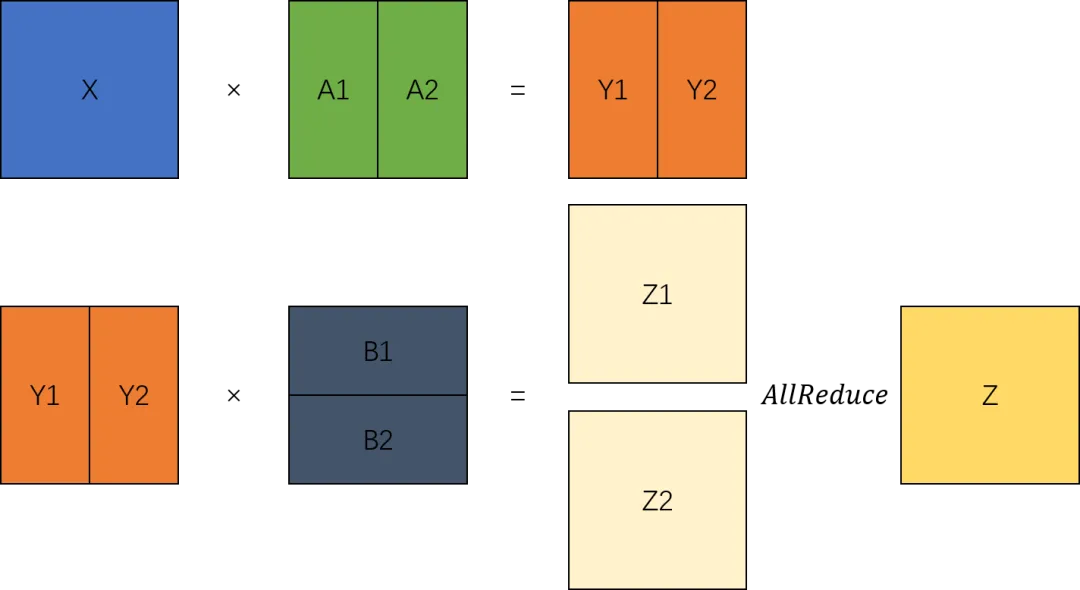
模型模块并行方案
Linear层作为切分主要的网络层,其核心是MatMul矩阵计算,因此矩阵切分计算也是模型并行最重要的一部分。
基础矩阵乘模块

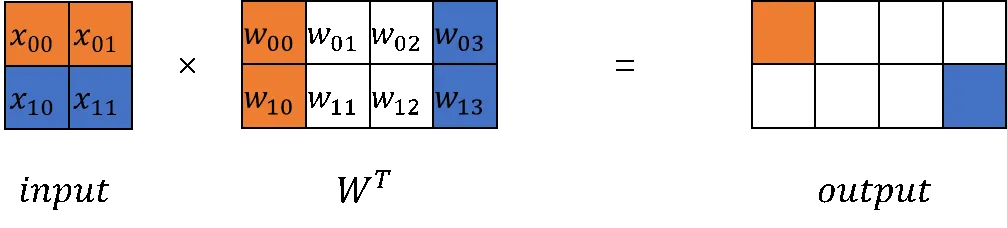
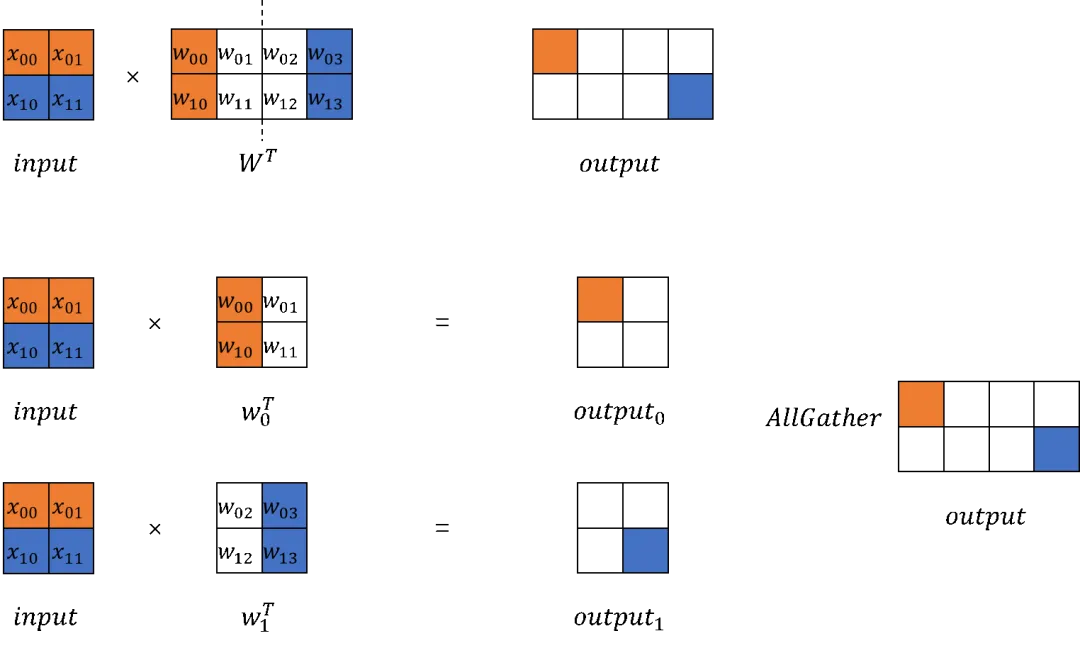
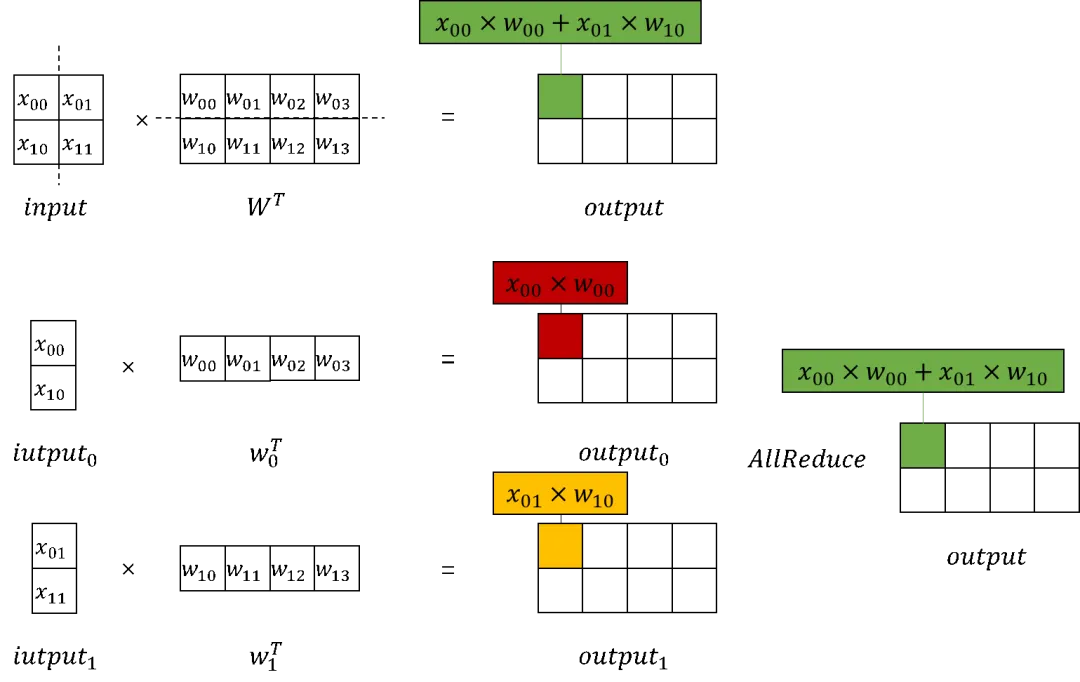
在大模型计算中,矩阵乘(MatMul)不管是在权重还是计算量上都占了相当大的比例。观察矩阵乘,其拥有列可切分性(Column-wise Parallelism)和行可切分性(Row-wise Parallelism)。
Column-wise Parallelism
Row-wise Parallelism
ColumnLinaer
class Linear(Module):

    def __init__(self,
                 in_features,
                 out_features,
                 bias=True,
                 dtype=None,
                 tp_group=None,
                 tp_size=1,
                 gather_output=True,
                 share_weight=None):
        super().__init__()
        self.in_features = in_features
        self.out_features = out_features // tp_size
        self.dtype = dtype

        if not share_weight:
            self.weight = Parameter(shape=(self.out_features, self.in_features),
                                    dtype=dtype)
        else:
            self.weight = share_weight

        self.tp_size = tp_size
        self.tp_group = tp_group
        self.gather_output = gather_output

        if bias:
            self.bias = Parameter(shape=(self.out_features, ), dtype=dtype)
        else:
            self.register_parameter('bias', None)

    def multiply_gather(self, x, weight, gemm_plugin, use_fp8=False):
        if gemm_plugin:
            x = _gemm_plugin(x, weight, transb=True, use_fp8=use_fp8)
        else:
            x = matmul(x, weight, transb=True)

        if self.bias is not None:
            if x.dtype != self.bias.value.dtype:
                x = cast(x, self.bias.value.dtype)
            x = x + self.bias.value

        if self.gather_output and self.tp_size > 1 and self.tp_group is not None:
            # 1. [dim0, local_dim] -> [dim0 * tp_size, local_dim]
            x = allgather(x, self.tp_group)

            # 2. [dim0 * tp_size, local_dim] -> [dim0, local_dim * tp_size]
            # 2.1 split
            split_size = shape(x, dim=0) / self.tp_size
            ndim = x.ndim()
            starts = [constant(int32_array([0])) for _ in range(ndim)]
            sizes = [shape(x, dim=d) for d in range(ndim)]
            sizes[0] = split_size
            sections = []
            for i in range(self.tp_size):
                starts[0] = split_size * i
                sections.append(slice(x, concat(starts), concat(sizes)))
            # 2.2 concat
            x = concat(sections, dim=1)

        return x

    def forward(self, x):
        return self.multiply_gather(x, self.weight.value,
                                    default_net().plugin_config.gemm_plugin)


ColumnLinear = Linear
RowLinear
class RowLinear(Module):

    def __init__(self,
                 in_features,
                 out_features,
                 bias=True,
                 dtype=None,
                 tp_group=None,
                 tp_size=1,
                 instance_id: int = 0):
        super().__init__()
        self.in_features = in_features // tp_size
        self.out_features = out_features
        self.dtype = dtype

        self.weight = Parameter(shape=(self.out_features, self.in_features),
                                dtype=dtype)

        if bias:
            self.bias = Parameter(shape=(self.out_features, ), dtype=dtype)
        else:
            self.register_parameter('bias', None)

        self.tp_group = tp_group
        self.tp_size = tp_size
        self.instance_id = instance_id

    def multiply_reduce(self,
                        x,
                        weight,
                        gemm_plugin,
                        use_fp8=False,
                        workspace=None):
        if gemm_plugin:
            x = _gemm_plugin(x, weight, transb=True, use_fp8=use_fp8)
        else:
            x = matmul(x, weight, transb=True)

        if self.tp_size > 1 and self.tp_group is not None:
            x = allreduce(x, self.tp_group, workspace, self.instance_id)

        if self.bias is not None:
            if x.dtype != self.bias.value.dtype:
                x = cast(x, self.bias.value.dtype)

            x = x + self.bias.value

        return x

    def forward(self, x, workspace=None):
        return self.multiply_reduce(x,
                                    self.weight.value,
                                    default_net().plugin_config.gemm_plugin,
                                    workspace=workspace)
参考文献
-
• https://github.com/NVIDIA/TensorRT-LLM/blob/v0.5.0/tensorrt_llm/layers/linear.py -
• https://www.mindspore.cn/tutorials/zh-CN/r2.7.1/model_infer/ms_infer/ms_infer_parallel_infer.html