 夜雨聆风
夜雨聆风


OpenClaw.NET 技术解读(第四篇):OpenClaw.Core 核心库
摘要:Gateway 负责组装进程,Agent 负责对话循环;OpenClaw.Core 则是跨进程的 共享契约层:配置模型、会话与持久化抽象、消息管道、安全与校验、插件与技能元数据、可观测性原语。本篇按目录与职责梳理,并说明它为何被标为 AOT 友好。

一、定位与包身份
OpenClaw.Core 在 csproj 中的描述是:abstractions, models, validation, security, and memory primitives(抽象、模型、校验、安全、内存原语)。它被 Gateway、Agent、Channels、CLI 等引用,是 “领域模型 + 可插拔接口 + 横切能力” 的集中地,而不是某个 HTTP 宿主。
<IsAotCompatible>true</IsAotCompatible> <Description>Core abstractions, models, validation, security, and memory primitives for OpenClaw.NET.</Description>为何单独成库:把 GatewayConfig、Session、InboundMessage、IMemoryStore、ITool 等稳定边界沉淀在这里,宿主与运行时只做组合;便于测试、裁剪(trim)与 NativeAOT 发布。
二、目录地图(按文件夹)
仓库内约 百余个 C# 文件,可按顶层文件夹快速导航:
|
|
|
|---|---|
Models/ |
GatewayConfig
Session / SessionBranch、契约与集成 API 的 DTO、Operator / Admin 相关模型 |
Abstractions/ |
IMemoryStore
ITool、IChannelAdapter、沙箱与钩子、自动化与画像存储等 端口接口 |
Sessions/ |
SessionManager
IMemoryStore 协同持久化 |
Memory/ |
FileMemoryStore
SqliteMemoryStore 等默认存储实现(不含 MemPalace 插件) |
Pipeline/ |
MessagePipeline
ToolApprovalService、CronScheduler、命令处理器等 |
Middleware/ |
IMessageMiddleware
|
Plugins/ |
PluginDiscovery
PluginModels、PluginConfigValidator、PluginCapabilityPolicy |
Skills/ |
SkillLoader
SkillPromptBuilder、技能模型与巡检 |
Security/ |
SecretResolver
|
Validation/ |
ConfigValidator
ProviderSmokeProbe、医生与 setup 验证、Ollama 端点规范化等 |
Observability/ |
Telemetry
RuntimeMetrics、TurnContext、用量与审计辅助类型 |
Setup/ |
|
Http/ |
HttpClientFactory
|
Features/ / Contacts/ / Canvas/ |
|
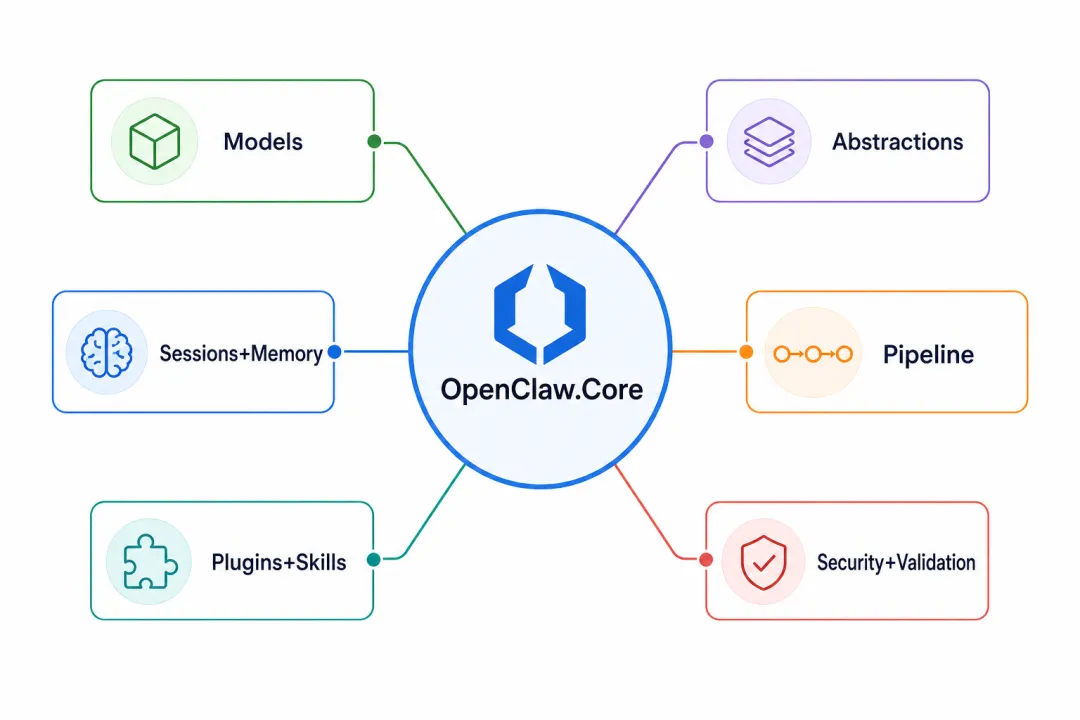
三、配置:GatewayConfig 是一棵大树
几乎所有运行时行为都能追溯到 GatewayConfig(见 Models/GatewayConfig.cs):绑定地址与端口、Runtime(Mode / Orchestrator)、Llm、Memory(Provider、Sqlite、Mempalace 子块)、Plugins、Skills、Security、Channels、Tooling、Sandbox、Delegation……
网关启动时的 ConfigValidator 对这棵树做一致性校验;Core 还提供 GatewayConfigFile、ConfigPathResolver 等,支持外部 JSON 与环境变量合并。理解 Core 的第一步往往是:你要改的行为落在哪个配置节点下。
四、会话与内存:端口与实现分离
IMemoryStore 定义会话与持久化笔记、分支等的最小契约:
public interface IMemoryStore{ ValueTask<Session?> GetSessionAsync(string sessionId, CancellationToken ct); ValueTask SaveSessionAsync(Session session, CancellationToken ct); ValueTask<string?> LoadNoteAsync(string key, CancellationToken ct); ValueTask SaveNoteAsync(string key, string content, CancellationToken ct); ValueTask DeleteNoteAsync(string key, CancellationToken ct); ValueTask<IReadOnlyList<string>> ListNotesWithPrefixAsync(string prefix, CancellationToken ct); // ── Conversation Branching ───────────────────────────────────────── ValueTask SaveBranchAsync(SessionBranch branch, CancellationToken ct); ValueTask<SessionBranch?> LoadBranchAsync(string branchId, CancellationToken ct); ValueTask<IReadOnlyList<SessionBranch>> ListBranchesAsync(string sessionId, CancellationToken ct); ValueTask DeleteBranchAsync(string branchId, CancellationToken ct);}扩展接口(如 IMemoryNoteSearch、ISessionAdminStore)由具体存储实现;Gateway 在注册 DI 时根据 Memory.Provider 选择 文件 / Sqlite / 动态插件(如 MemPalace)。
SessionManager 在内存中维护 活跃会话字典、每会话信号量、准入与超时扫描,并把负载落到 IMemoryStore:
/// <summary>/// Manages active sessions with automatic expiry. Thread-safe, allocation-light./// </summary>public sealed class SessionManager : IAsyncDisposable, IDisposable{ private readonly ConcurrentDictionary<string, Session> _active = new();会话键约定 channelId:senderId 或显式 sessionId(文档与源码注释中有说明),渠道与 Web UI 共用同一套会话语义。
五、消息管道:MessagePipeline
MessagePipeline 使用 System.Threading.Channels 实现有界入站/出站队列,用于在高负载下 背压、避免无界堆积:
/// <summary>/// High-throughput, zero-allocation message pipeline using System.Threading.Channels./// Bounded channel applies backpressure to prevent OOM under load./// </summary>public sealed class MessagePipeline : IAsyncDisposableGateway 侧的 Worker 从 Reader 取 InboundMessage,再交给 MiddlewarePipeline 与 Agent;出站同理。Core 定义消息信封(如 Models/Messages.cs),保证 Host 与 Channels 解耦。
六、插件与安全策略
Plugins/
:发现、manifest、配置校验、AOT 下能力封锁策略(与 PluginCapabilityPolicy、GatewayRuntimeMode配合),详见系列第一篇、第二篇。Security/
:密钥解析、URL 拉取安全、工具路径策略、配对与 Ed25519 等——与 SECURITY.md中的运维建议一一对应。Validation/
:启动前配置校验、模型 doctor、provider smoke,减少 “服务起来了但运行时才炸” 的概率。
七、技能与兼容性
Skills/ 负责加载 SKILL.md、拼装注入提示词;Compatibility/ 嵌入 public-smoke.json 等兼容矩阵数据,供 CLI/Admin 展示。它们把「生态兼容」从 Gateway 里剥离成 可版本化的数据 + 纯逻辑。
八、与前几篇的衔接
|
|
|
|---|---|
|
|
|
|
|
IMemoryStore 的一种实现,通过插件与 Gateway DI 接入;契约仍在 Core |
|
|
AddOpenClawCoreServices 等扩展方法注册的就是 Core 中的管理器与默认实现 |
| 本篇 |
|
延伸阅读(仓库内)
|
|
|
|---|---|
src/OpenClaw.Core/Models/GatewayConfig.cs |
|
src/OpenClaw.Core/Validation/ConfigValidator.cs |
|
src/OpenClaw.Core/Sessions/SessionManager.cs |
|
docs/GETTING_STARTED.md |
|
版权声明:基于开源仓库 OpenClaw.NET 整理,仅供技术交流。