ARTICLE · 1060909
教学研究:AI赋能高中英语语法教学
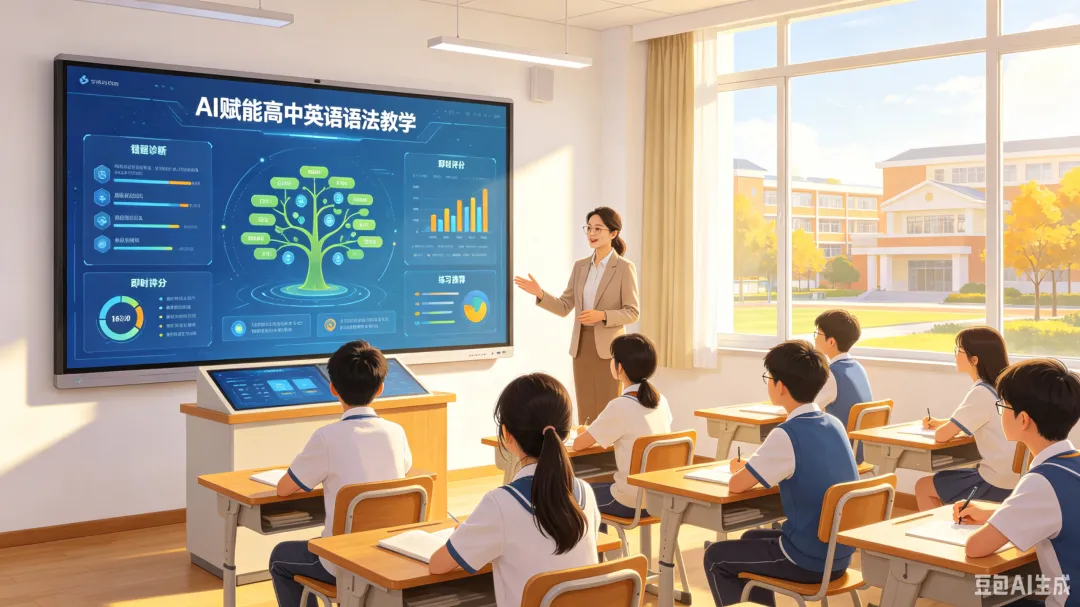
在教育数字化转型的大背景下,人工智能技术深度融入基础教育课堂,为传统高中英语语法教学的革新提供了全新路径。语法是英语语言体系的核心框架,是学生提升听说读写综合能力的基础,但长期以来,高中语法教学陷入“重记忆、轻运用、同质化、低效率”的困境。传统课堂以教师讲授规则、学生机械刷题为主,教学模式固化、情境单一,难以适配不同学生的知识基础与学习节奏,导致学生普遍存在语法规则熟记于心,却无法在真实语境中灵活运用的问题,语法学习沦为枯燥的应试任务。而AI技术的普及应用,有效破解了传统教学的痛点,推动高中语法教学从“灌输式教学”向“个性化、情境化、高效化教学”转型。
AI赋能高中语法教学的核心优势在于实现个性化分层教学。高中生英语基础差异显著,部分学生对时态、句型等基础语法掌握薄弱,部分学生可熟练掌握基础规则,但对非限制性定语从句、虚拟语气、倒装结构等复杂语法存在认知盲区。传统课堂采用统一教学进度与教学内容,无法兼顾学困生的补差与优等生的拔高需求。依托AI智能教学平台,可通过课前测评精准采集学生的语法错题、薄弱知识点、答题速度等学习数据,构建个人学情档案,自动划分基础、提升、拓展三个学习层级,为不同学生定制专属学习方案。针对基础薄弱学生,AI侧重梳理核心语法规则、搭配基础习题、拆解简单句式;针对进阶学生,侧重长难句分析、语法易错点辨析;针对优等生,侧重语法语境运用、高考难点突破与拓展训练,彻底解决传统教学“一刀切”的弊端。
其次,AI让枯燥的语法知识实现情境化、可视化落地。高中语法知识点抽象细碎,单纯的文字规则讲解晦涩难懂,学生难以理解语法的语用价值。借助AI图像生成、情境创设、智能对话等功能,可将抽象语法转化为直观生动的真实场景。例如讲解现在进行时、状语从句等知识点时,AI可生成生活化、场景化的图文素材与短句案例,结合日常场景、校园生活、经典语段构建沉浸式学习情境,让学生直观感知语法规则的适用场景。同时,AI可实时拆解长难句结构,标注句子主干、修饰成分、语法考点,将复杂的语法逻辑可视化,帮助学生跳出死记硬背的误区,真正理解语法本质,实现从“机械记忆”到“理解内化”的转变。
此外,AI具备实时诊断与精准反馈的教学价值,大幅提升语法教学效率。传统语法教学中,学生作业批改、错题分析依赖教师人工完成,反馈滞后、纠错笼统,难以精准定位学生的个性化问题。而AI智能批改系统可实现语法习题、写作语句的秒级批改,精准识别主谓一致、时态错误、介词搭配、句式混乱等各类语法问题,错误识别准确率可达95%以上。同时,AI会针对每一处错误标注原因、解析规则、推送同类变式题,形成“做题—纠错—解析—巩固”的闭环学习模式。课堂教学中,教师可依托AI学情数据,精准把握班级整体薄弱考点,针对性调整教学重难点,让课堂教学更贴合学生实际需求。
当然,AI赋能语法教学并非替代教师,而是重塑师生角色、优化教学模式。AI擅长数据统计、精准纠错、个性化训练,而教师专注于教学设计、思维引导、情感赋能与课堂互动。在AI辅助下,教师从繁琐的批改、重复性答疑工作中解放出来,聚焦核心教学环节,开展深度课堂探究活动,培养学生的语用能力与逻辑思维。同时,教学中需规避过度依赖技术、忽视人文引导的问题,坚持AI辅助、教师主导的教学原则,让技术服务于教学本质。
综上,AI技术为高中英语语法教学注入了全新活力,有效解决了传统教学枯燥、低效、同质化的难题,实现了分层教学、精准教学、情境教学的深度落地。在教育数字化进程中,教师应合理运用AI教学工具,整合技术优势与传统教学优势,优化语法教学模式,帮助学生夯实语法基础、提升语言运用能力,助力高中英语教学高质量发展。
English Version
Against the backdrop of digital transformation in education, artificial intelligence (AI) technology has been deeply integrated into basic education classrooms, offering a brand-new approach to innovate traditional high school English grammar teaching. As the core framework of the English language system, grammar lays the foundation for students’ comprehensive abilities in listening, speaking, reading and writing. However, high school grammar teaching has long been trapped in the dilemma of "emphasizing memorization over application, homogeneity and low efficiency". Traditional classroom teaching relies on teachers’ rule explanation and students’ mechanical exercises with rigid models and single contexts. It fails to adapt to students’ varied knowledge foundations and learning paces, resulting in a common problem: students can memorize grammar rules rigidly but cannot apply them flexibly in real contexts, making grammar learning a tedious exam-oriented task. The popularization and application of AI technology effectively solves the pain points of traditional teaching, transforming high school grammar teaching from cramming education to personalized, contextualized and efficient teaching.
The core advantage of AI-enabled high school grammar teaching lies in personalized hierarchical teaching. High school students have distinct differences in English foundations. Some students struggle with basic grammar knowledge such as tenses and sentence patterns, while others master basic rules proficiently but have cognitive blind spots in complex grammar points including non-restrictive attributive clauses, subjunctive mood and inverted structures. Traditional classrooms adopt a unified teaching progress and content, failing to take into account the needs of underachieving students for make-up lessons and top students for advanced improvement. Relying on AI intelligent teaching platforms, teachers can accurately collect students’ learning data such as wrong grammar questions, weak knowledge points and answering speed through pre-class assessments, establish personal learning profiles, automatically divide learning levels into basic, improvement and expansion, and customize exclusive learning plans for students at different levels. For underachieving students, AI focuses on sorting out core grammar rules, matching basic exercises and disassembling simple sentence structures. For intermediate students, it focuses on analyzing long and difficult sentences and distinguishing error-prone grammar points. For top students, it emphasizes contextual grammar application, breaking through difficult college entrance examination points and expanded training, completely eliminating the "one-size-fits-all" drawback of traditional teaching.
Furthermore, AI turns abstract and boring grammar knowledge into contextual and visualized content. High school grammar knowledge is abstract and fragmented, and simple verbal rule explanation is obscure for students, making it hard for them to understand the pragmatic value of grammar. With the help of AI functions such as image generation, context creation and intelligent dialogue, abstract grammar can be transformed into intuitive and vivid real-life scenarios. When teaching knowledge points such as present continuous tense and adverbial clauses, AI can generate life-oriented and situational graphic materials and short sentence cases, and build immersive learning contexts combined with daily life, campus scenes and classic passages, allowing students to intuitively perceive the applicable scenarios of grammar rules. Meanwhile, AI can disassemble the structure of long and difficult sentences in real time, mark sentence main bodies, modifiers and grammar test points, and visualize complex grammatical logic. This helps students abandon rote memorization, truly understand the essence of grammar, and realize the transformation from mechanical memorization to understanding and internalization.
In addition, AI has the teaching value of real-time diagnosis and accurate feedback, greatly improving the efficiency of grammar teaching. In traditional grammar teaching, teachers manually correct students’ homework and analyze wrong questions, leading to delayed feedback and general error correction, which cannot accurately locate students’ personalized problems. In contrast, the AI intelligent correction system can correct grammar exercises and writing sentences in seconds, accurately identifying various grammatical errors including subject-verb disagreement, tense mistakes, preposition collocation errors and sentence structure confusion, with an error recognition accuracy of over 95%. Meanwhile, AI marks the causes of each error, explains relevant rules, and pushes similar variant exercises, forming a closed-loop learning mode of "doing exercises - correcting errors - analyzing principles - consolidating knowledge". In classroom teaching, teachers can accurately grasp the overall weak grammar test points of the class based on AI learning data, adjust key and difficult teaching points targeted, and make classroom teaching more in line with students’ actual needs.
It is worth noting that AI assists rather than replaces teachers in grammar teaching. It reshapes teacher-student roles and optimizes teaching modes. AI excels in data statistics, accurate error correction and personalized training, while teachers focus on teaching design, thinking guidance, emotional empowerment and classroom interaction. With the assistance of AI, teachers are freed from cumbersome correction and repetitive Q&A work, and can concentrate on core teaching links, carry out in-depth classroom exploration activities, and cultivate students’ pragmatic language ability and logical thinking. Meanwhile, excessive reliance on technology and neglect of humanistic guidance should be avoided in teaching. We must adhere to the teaching principle of AI assistance and teacher dominance to make technology serve the essence of teaching.
In conclusion, AI technology injects new vitality into high school English grammar teaching, effectively solving the problems of dullness, inefficiency and homogenization in traditional teaching, and realizing the in-depth implementation of hierarchical, accurate and contextual teaching. In the process of educational digitization, teachers should rationally apply AI teaching tools, integrate the advantages of technology and traditional teaching, optimize grammar teaching modes, help students consolidate grammar foundations and improve language application abilities, and promote the high-quality development of high school English teaching.