ARTICLE · 1181522
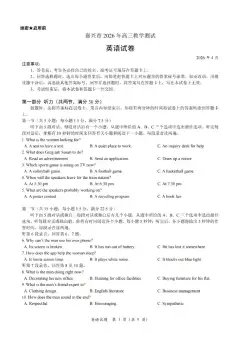
2027届高考模拟试题 | 嘉兴市高三教学测试英语试题2026.9











试题下载

通过手机百度网盘app,复制下面内容,可下载试题(word版)及听力音频:
https://pan.baidu.com/s/1UPp-LTg4Y2725_VZFmor1g?pwd=r6cq 提取码: r6cq 复制这段内容后打开百度网盘手机App,操作更方便哦
或扫一扫下面的二维码下载:


PART 01
试题原题

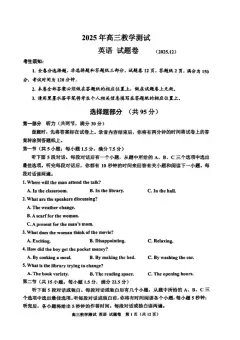
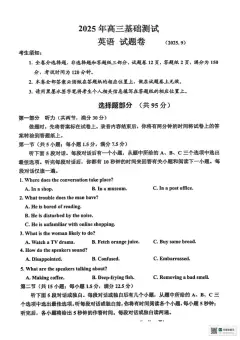
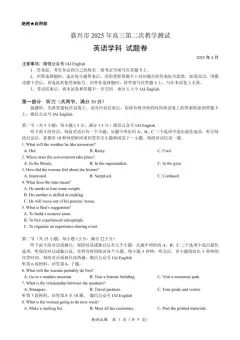
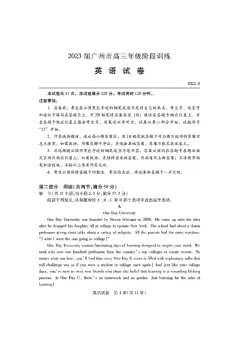
2027届高考模拟英语试题
2027届 嘉兴市
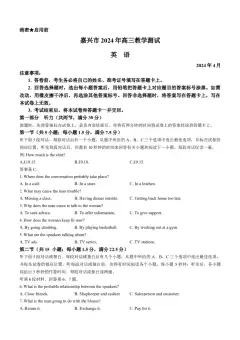
2026年9月高三教学测试
英语 试题
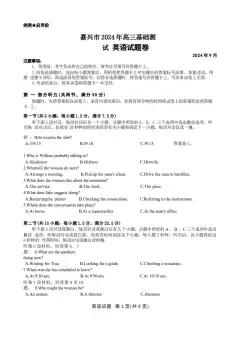
第I卷 选择题(共95分)
第一部分 听力 (共两节,满分 30 分)
第一节 (共 5 小题;每小题 1.5 分,满分 7.5 分)
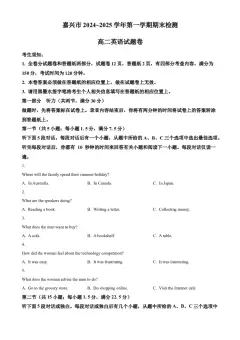
听下面 5 段对话。每段对话后有一个小题,从题中所给的 A、B、C 三个选项中选出最佳选项。听完每段对话后,你都有 10 秒钟的时间来回答有关小题和阅读下一小题。每段录音读两遍。
1. When will the meeting be held?
A. On Monday.
B. On Tuesday.
C. On Wednesday.
2. How does the woman sound in the end?
A. Excited.
B. Angry.
C. Nervous.
3. How many students passed the exam?
A. 5.
B. 15.
C. 35.
4. What is the woman probably planning to do?
A. Interview a person.
B. Attend a class.
C. Apply for a job.
5. Why does the woman apologize to the man?
A. She ran into him.
B. She damaged his bag.
C. She blocked his way.
第二节 (共 15 小题;每小题 1.5 分,满分 22.5 分)
听下面 5 段对话或独白。每段对话或独白后有几个小题,从题中所给的 A、B、C 三个选项中选出最佳选项。听每段对话或独白前,你将有时间阅读各个小题,每小题 5 秒钟;听完后,各小题将给出 5 秒钟的作答时间。每段录音读两遍。
听第 6 段录音,回答第 6、7 题。
6. What is the relationship between the speakers?
A. Guide and tourist.
B. Receptionist and guest.
C. Driver and passenger.
7. What will the woman probably do tomorrow?
A. Walk around the city.
B. Watch a baseball game.
C. Visit universities in Boston.
听第 7 段录音,回答第 8 至 10 题。
8. What does the woman probably try to do?
A. Fix the lock.
B. Return some books.
C. Open the bookcase.
9. What do we know about the head librarian?
A. He’s lost the key.
B. He’s on holiday.
C. He’ll meet the man.
10. What will the man most likely do next?
A. Contact Rachel.
B. Call in a repairman.
C. Phone the head librarian.
听第 8 段录音,回答第 11 至 13 题。
11. What made Mr. Jason step into the herbal field?
A. His teacher’s impact.
B. His passion for plants.
C. His own health problem.
12. Why are herbs a powerful tool in Mr. Jason’s opinion?
A. They benefit future generations.
B. They carry ancient medical wisdom.
C. They provide low-cost natural cures.
13. What should be the first step for students to study herbs?
A. Mastering lab technology.
B. Doing experiments on herbs.
C. Knowing the functions of herbs.
听第 9 段录音,回答第 14 至 16 题。
14. What major does Luke want to choose at GCU?
A. Engineering.
B. Business.
C. Natural sciences.
15. What are the specialists responsible for according to the woman?
A. Calculating students’ credits.
B. Assessing students’ qualifications.
C. Guiding students in choosing a major.
16. What are the speakers mainly talking about?
A. Planning a new career.
B. Applying to another college.
C. Improving academic performance.
听第 10 段录音,回答第 17 至 20 题。
17. Where did the public sale take place?
A. In Britain.
B. In America.
C. In Switzerland.
18. Who did the humanoid robot get its name from?
A. A painter.
B. An art dealer.
C. A computer programmer.
19. What was the expected valuation of the painting?
A. $0.18 million.
B. $1 million.
C. $1.08 million.
20. What does the speaker think of the painting?
A. Realistic.
B. Overpriced.
C. Meaningful.
第二部分 阅读理解 (共两节,满分 50 分)
第一节 (共 15 小题;每小题 2.5 分,满分 37.5 分)
阅读下列短文,从每题所给的 A、B、C 和 D 四个选项中,选出最佳答案。
A
The Uffizi Gallery occupies the first and second floors of the large building constructed between 1560 and 1580. It is famous worldwide for its outstanding collections of ancient sculptures and paintings (from the Middle Ages to the Modern period). Its painting collections from the 14th-century and Renaissance period include some absolute masterpieces: Giotto, Simone Martini, Correggio, Leonardo, Raffaello, Michelangelo and Caravaggio. Moreover, the Gallery houses invaluable ancient statues collected by the Medici family, which decorate the corridors (过道).
Timetable
•Opening hours: From Tuesday to Sunday, 8:15 am to 6:30 pm
•Closed on: Mondays, 1 January, 25 December
•Notes: The ticket office closes at 5:30 pm. At 6:30 pm visitors will be asked to make their way to the exit.
Tickets
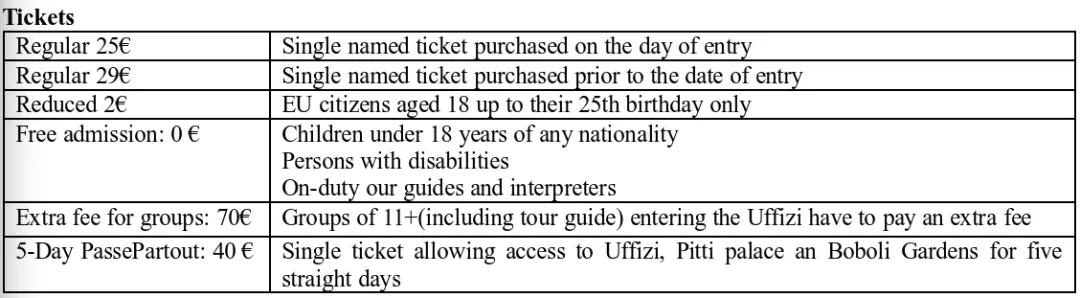
Single ticket allowing access to Uffizi, Pitti palace an Boboli Gardens for five straight days
Guide Audio Equipment Rule
Tour guides and accompanying staff providing commentary during visits must use whisper audio systems (microphones and earphones) for all groups larger than six people.
21. What can we learn about the Uffizi Gallery?
A. It was built in the 14th century.
B. It is often inaccessible on weekends.
C. It houses artworks from different periods.
D. It exhibits statues created by the Medici family.
22. How much should a 20-year-old Chinese pay for a same-day ticket?
A. 2€.
B. 25€.
C. 29€.
D. 40€.
23. What is required for a group of eight visitors on a guided tour?
A. Paying an extra 70 euros.
B. Booking tickets in advance.
C. Buying PassePartout tickets.
D. Using whisper audio systems.
B
Last week, I emerged from the Tube in central London for a day that would once have been unthinkable. First I bought a morning coffee. Then I went out for a box of sushi. A few hours later, I dropped into a mini-supermarket to buy some tea bags. Each time, I had zero contact with a human. Instead, I ordered and paid for everything using one of the touchscreens that now pepper our life.
Looking back, I find it hard to remember the last time I bought anything entirely from a person. The business logic is obvious: screens reduce staff costs, shorten waiting lines, and encourage more purchases through appealing food photos and non-judgmental ordering.
I believe that customers often prefer the ease and speed of touchscreens and that not all human interactions are enjoyable. Yet, I still prefer a world with more time-consuming people than machines. It’s not just because machines often fail, but because finding a human can be exciting. That’s why I was surprised during a recent trip to Brazil, where I found so many staff in a local supermarket --- at checkouts, in aisles, upstairs --- that I took photos to show people back home. Two men even helped me decide which umbrella suited me best.
That novel experience heartened me so much that I wasn’t surprised to learn some European retailers (零售商) are boosting such human interaction. The Dutch chain Jumbo introduced a slower “chat checkout” for customers to talk with cashiers and expanded it to about 200 stores, especially in places where loneliness was a big problem.
Earlier this year, an expert noted software engineers felt lonely when they turned to AI instead of their coworkers. I find this easy to imagine. Technology can lead us down many paths, but that does not mean all should be taken.
24. What is a feature of the author’s shopping habit in London?
A. Interacting with store staff.
B. Placing orders on the phone.
C. Using self-service machines.
D. Avoiding mini-supermarkets.
25. Which word best describes the author’s shopping experience in Brazil?
A. Pleasing.
B. Annoying.
C. Disappointing.
D. Amusing.
26. Why did Jumbo introduce “chat checkout”?
A. To expand its business.
B. To simplify the checkout process.
C. To help its employees fight loneliness.
D. To encourage interpersonal communication.
27. What message does the author deliver in the text?
A. The best is yet to come.
B. Convenience comes at a cost.
C. All roads lead to Rome.
D. Every cloud has a silver lining.
C
Two friends are seated in a busy restaurant. They acknowledge it has been “too long” since they last caught up. Then a tense silence follows. One friend asks, “So, how are you?” Such a simple question weighs heavily on the other. She forces a smile and replies, “I’m fine. How are you?”
The strange part is that she doesn’t say it intentionally. “Fine” seems to arrive on its own before she even questions if it’s true. For many of us, being “fine” is a reflex, like pulling our hands back from something hot before we feel the pain. This behavioral pattern sticks because it works, at least on a surface level. It keeps the childhood dinner table calm, or a boss from further asking personal questions. “Fine” creates a boundary without us having to voice the need for space.
There is a trade-off, of course. “I’m fine” isn’t so much a lie. Rather, it’s a stand-in for something more authentic (真实的) and complicated. Often we lack the time, safety or language to name what is under “fine.” The reflex to be “fine” becomes so automatic that rarely does anyone get a real answer, including ourselves.
This “I’m fine” reflex is seldom built in a single event. Instead it’s incubated in moments when “fine” keeps things working: with easily stressed parents, or in a household where no one truly cares to listen when asking “how are you”. None of the exchanges has to be dramatic to leave a mark; enough repetition tells the nervous system that honesty here is unsafe or unwanted.
Fortunately, once identified, the reflex can be changed --- just a brief pause (暂停) before saying “fine”. In that pause, you don’t even have to voice the truth to break the habit, start simply by noticing the gap between the automatic answer and the real one. Then start with one low-pressure person, like a friend, to practise honest replies before opening up to others.
28. Why does the author mention the two friends in paragraph 1?
A. To share communication skills.
B. To give a reason for small talk.
C. To introduce a response pattern.
D. To illustrate the safe social distance.
29. What can we infer about the “I’m fine” reflex?
A. It allows people some personal space.
B. It is a white lie meant to hide bad moods
C. It does more harm than good in daily life.
D. It efficiently expresses complicated emotions.
30. What does the underlined word “incubated” in paragraph 4 mean?
A. Hidden.
B. Replaced.
C. Developed.
D. Discovered.
31. What is suggested in the last paragraph?
A. Questioning the honesty of others.
B. Sharing pressure with trusted friends.
C. Avoiding simple answers in conversations.
D. Examining automatic replies before speaking.
D
Searching deep in the DeLuca Preserve in central Florida, Lawrence Reeves found various local creatures like diamondback rattlesnakes, cotton rats and gopher tortoises. But he didn’t spot them by sight: Reeves and his team detected their DNA within the blood of local mosquitoes.
Reeves’ work is part of the growing field of iDNA-DNA sourced from invertebrates (无脊椎动物). It originates from the wider discipline of environmental DNA (eDNA), where researchers survey biodiversity using genetic (基因的) material left by organisms. “Early eDNA relied on water samples, but sampling ecosystems like forests was more challenging.” says Gogarten, a wildlife disease ecologist. “And so invertebrates were proposed as a practical solution since they exist in great numbers and often feed on a range of animal hosts.”
Traditionally, a biologist would need all sorts of tools to map species. Those might include camera traps for large animals and sound detectors for birds, and a single survey could stretch over weeks. With the new approach, however, researchers can detect just as many animals with a single iDNA analysis, which is of particular value in remote, protected areas.
And researchers are excited about another advantage of iDNA. Gogarten used fly iDNA to map out the distribution of sylvatic anthrax, a deadly bacterial (细菌的) disease that frequently kills monkeys around villages in Cote d’Ivoire. By collecting flies that fed on animal bodies in the region, Gogarten mapped where the disease-causing bacterium was present. “The results suggest that iDNA offers a window into disease dynamics in wildlife, much like wastewater analyses for human populations,” Gogarten says.
But iDNA methods can be tricky --- taking out partially degraded genetic material and removing impurities both pose challenges. “A focus on training, especially in the Global South, could make iDNA efforts more commonplace in biodiversity hotspots,” says geneticist Torrey Rodgers of Utah State University. “And that, we hope, will cast light on the lives of a wide variety of both large and tiny creatures.”
32. What role do invertebrates play in the field of iDNA?
A. Carrying genetic samples.
B. Promoting biodiversity
C. Identifying environmental DNA.
D. Reflecting hosts population.
33. What is a major strength of iDNA analyses?
A. Greater safety.
B. Lower expense.
C. Better reliability.
D.Higher efficiency.
34. What application of iDNA is mentioned in paragraph 4?
A. Tracking wildlife diseases.
B. Controlling insect numbers.
C. Predicting disease outbreaks.
D. Monitoring human wastewater.
35. What does Torrey Rodgers say about iDNA?
A. It has spread across the globe.
B. Training can increase its accessibility
C. It will help clarify the origin of creatures.
D. Removing its technical limitations is a priority.
第二节 (共 5 小题;每小题 2.5 分,满分 12.5 分)
“Stop overthinking. Start doing.” It’s what many overthinkers have heard before. Overthinking generally refers to repetitive, and sometimes unproductive thoughts around a particular task or event. _36_ Reflective thinking often leads to clarity or action, while overthinking can be linked to anxiety. But overthinking can also have some benefits, too.
Rather than focusing on a single, “best” solution, overthinkers can be more likely to consider the broader consequences, risks, and alternative approaches before they act. They might be more mindful of how their actions might affect others. _37_
Overthinkers often like feeling prepared. This might come as anticipating questions, practising conversations, and playing out different outcomes. _38_ Yet, it can also mean that they feel more organised. Whether that’s a job interview, or a difficult conversation with a friend, that extra time can provide an unexpected confidence boost.
_39_ Letting your mind explore the possibilities, imagine different outcomes, and make unusual connections, can lead to unexpected creative ways of thinking.
Thinking deeply isn’t always a bad thing, but when you let your mind run wild, it can be a little stressful. If you find yourself getting stuck, a good starting point can be trying to notice when your thoughts are helping you move forward, or holding you back. _40_ For example, you might give yourself ten minutes to think something through, then shift your attention elsewhere.
Overthinking isn’t always the enemy. Sometimes, it’s a hidden strength as long as we learn how to guide it.
A. Sometimes that preparation can be tiring.
B. Overthinking can offer a chance to reflect.
C. It is slightly different from healthy reflection.
D. This can lead to carefully considered decisions.
E. Setting gentle limits can be another helpful tool.
F. Letting go of the little details can be a good thing.
G. Overthinking and creativity often go hand in hand.
第三部分 语言知识运用 (共两节,满分 30 分)
第一节 (共 15 小题;每小题 1 分,满分 15 分)
阅读下面短文,从短文后各题所给的 A、B、C、D 四个选项中,选出可以填入空白处的最佳选项。
These past weeks have been difficult for me as I lost my job in April. It _41_ me to become a writer, a goal I’ve had in my mind for a while. I just didn’t _42_ to be thrown into it like this. As a result, I’ve been reading self-help ebooks, subscribing to copywriting newsletters and _43_ virtual workshops.
Combined with my own personal habit of constantly _44_ myself to others, these past few months have made me _45_ indeed. Am I cut out for this lifestyle? How do these professionals make it sound so _46_?
Recently, I’ve taken up a new hobby that has helped me _47_ these voices: calligraphy. In the beginning, I just copied love poetry --- a great _48_ for calligraphy. Soon I _49_ to other poetry that I loved.
I’ve found that I enjoy clearing my _50_ and seeing it happen in the form of _51_ on paper. I’m absorbed in the _52_ between the pen and the paper and the faint smell of the paper itself.
As a writer, I once believed that the most magical thing about writing was _53_ words to inspire an emotional or thoughtful response. Through calligraphy, I learned to _54_ the very act of putting a pen to paper. In this _55_, I let the lines I wrote piece me back together, one self-loving letter at a time.
41. A. taught
B. pushed
C. required
D. convinced
42. A. expect
B. manage
C. bother
D. deserve
43. A. assessing
B. sponsoring
C. attending
D. recommending
44. A. adapting
B. exposing
C. linking
D. comparing
45. A. curious
B. moved
C. anxious
D. embarrassed
46. A. easy
B. special
C. practical
D. serious
47. A. raise
B. quiet
C. express
D. follow
48. A. fit
B. reward
C. reason
D. replacement
49. A. gave in
B. got around
C. turned back
D. branched out
50. A. voice
B. image
C. mind
D. memory
51. A. drafts
B. patterns
C. letters
D. signs
52. A. bond
B. friction
C. balance
D. distance
53.A. coining
B. spelling
C. defining
D. stringing
54.A. enjoy
B. accept
C. understand
D. explain
55. A. session
B. process
C. experience
D. situation
第II卷 非选择题(共55分)
第二节 (共 10 小题;每小题 1.5 分,满分 15 分)
阅读下面短文,在空白处填入 1 个适当的单词或括号内单词的正确形式。
Step into any shopping centre in Singapore and you’re likely to find waiting lines _56_ (snake) outside shops with catchy names and bright-coloured signboards. Chinese brands (品牌) like Chagee and Mixue are drawing crowds not just in Asia, but _57_ (increasing) worldwide. Alongside fashion labels and toy stores, these tea chains represent a shift from low-cost manufacturing (制造) to globally _58_ (recognise) consumer brands.
Built in the world’s second-largest consumer market, they already have scale (规模) and operational power. However, intense domestic _59_ (compete) makes expanding overseas a necessity. China _60_ (be) the world’s workshop over the past decades, producing goods for Western companies. In the meanwhile, local suppliers have been learning how to make and sell goods at scale. Companies like Miniso have benefited _61_ that kind of know-how. The chain store, _62_ sells toys and movie products, now operates stores in over half the _63_ (country) around the world, prioritizing consumer experience.
Beyond consumer goods, BYD has become the world’s largest electric vehicle maker and is now developing ultra-fast charging systems as an effort to build _64_ ecosystem around its vehicles.
In short, Chinese companies are no longer defined by low prices. They are building brands, adapting to local markets _65_ going head-to-head with established global players.
第四部分 写作 (共两节,满分 40 分)
第一节 (满分 15 分)
你校英文报“Campus Life”栏目正在征稿,请同学们就“食堂里独自用餐还是结伴就餐”这一话题开展讨论,发表看法。请你结合自己的观察或经历,写一篇短文向该栏目投稿。
注意:
(1) 写作词数应为 80 左右。
(2) 请按如下格式在答题纸的相应位置作答。
Dine Alone or Together?
_____________________________________
_____________________________________
_____________________________________
第二节 (满分 25 分)
阅读下面材料,根据其内容和所给段落开头语续写两段,使之构成一篇完整的短文。
Benjamin Belinski considered himself completely talentless while his friends were quite gifted: Kate could make anything using her folding techniques; Tommy created breath-taking beats on overturned plastic buckets (水桶); Olivia trained her small dog to do tricks. There were also four dancers, a gymnast, two bakers, six singers, and five artists in his grade. Every day his teacher Miss White asked if he had decided what to do for the upcoming talent show, and every day he reminded her that he had no talents.
“Nonsense, Benjamin,” Miss White insisted that he think of something. Benjamin, however, planned to be sick on the day of the show to avoid performing. He even asked his friends to cough on him if they got a cold.
Kate shook her head, gathering the group around him. “You must have a talent. Let’s make a list. What are you good at?” Benjamin joked that he was only good at eating and watching TV. Kate rolled her eyes, urging the others to come up with Benjamin’s talents.
Olivia immediately mentioned Benjamin’s remarkable bond with animals, as her dog loved him. Tommy praised his humour and suggested a comedy routine, while Kate reminded him of his excellent birthday parties and game nights. Olivia agreed, adding that he always brought everyone together to do fun things, and noted how boring the week was when he caught a cold. “Yeah, he’s like the glue that holds us together,” Tommy added. “Oh, great. Benjamin Belinski, Human Glue Gun,” Benjamin joked.
But their comments got him thinking. Lying in bed that night, Benjamin came up with a plan so exciting that it took him two hours to fall asleep. In the morning, he couldn’t wait to tell his teacher he wanted to be an organiser for the talent show. He rushed into the office and shared his vision. Miss White smiled warmly, recognising his idea as resourceful and original and true to who he was. It seemed Benjamin had found his unique talent.
注意:
(1) 续写词数应为 150 左右。
(2) 请按如下格式在答题卡的相应位置作答。
Paragraph1: With passion, Benjamin began to organize the show. _______________________________
______________________________________
______________________________________
Paragraph2: Finally the big day came. _______________________________
_____________________________________
_____________________________________


PART 02
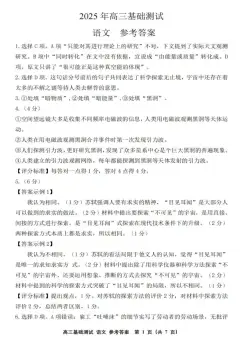
参考答案
&
听力原文

2027 届 嘉兴市
2026 年 9 月高三教学测试
英语试题
参考答案+听力原文
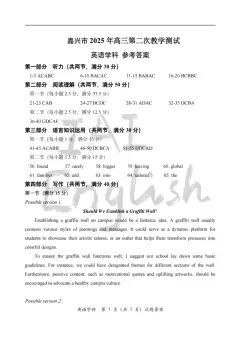
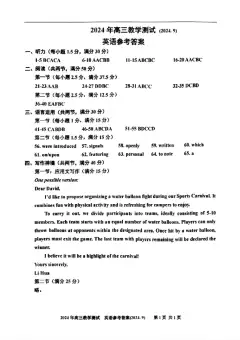
第一部分 听力(每小题 1.5 分,共 30 分)
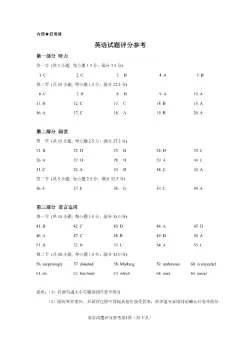
1-5 CBCAA
6-10 BACBA
11-15 ABCAB
16-20 BBCAC
第二部分 阅读理解
第一节 (每小题 2.5 分,共 37.5 分)
21-23 CBD
24-27 CADB
28-31 CACD
32-35 ADAB
第二节 (每小题 2.5 分,共 12.5 分)
36-40 CDAGE
第三部分 语言运用
第一节 完形填空(每小题 1 分,共 15 分)
41-45 BACDC
46-50 ABADC
51-55 CBDAB
第二节 语法填空(每小题 1.5 分,共 15 分)
56. snaking
57.increasingly
58. recognised
59. competition
60. has been
61. from
62. which
63. countries
64. an
65. and
第四部分 写作(共两节,满分 40 分)
第一节 应用文(15 分)
Possible version :
Dine Alone or Together?
When the lunch bell rings, our cafeteria fills with two types of students: those who cluster around tables laughing, and those who slip into quiet corners alone. I choose to dine with others.
My preference stems from personal experience. Last term, I ate alone for weeks, thinking it saved time.Yet I felt increasingly isolated. One day, a classmate waved me over. That twenty minutechat about homework and weekend plans lifted my mood entirely. I returned to class more energized than ever.
While solitude has its place, dining together is our daily chance to connect and truly enjoy the companionship. (90 words)
第二节:读后续写(满分 25 分)
One Possible Version:
With passion, Benjamin began to organize the show. He made detailed schedules and assigned different tasks to his classmates. He talked with every performer to learn about their acts, prepared bright decorations for the stage, and arranged seats for the audience patiently. Whenever someone met troubles, Benjamin was ready to offer help and cheer them up. He kept communicating with Miss White to check every detail, making sure no small part was ignored. Gradually, all performers grew more confident with Benjamin’s careful arrangements. (64 words)
Finally the big day came. The hall was filled with excited audience. Kate’s foldingart, Tommy’s bucket beats and Olivia’s dog show won loud cheers one after another. At the end of the show, Miss White walked onto the stage, praising the whole amazing event. She told everyone that the success came from Benjamin, who united all these gifted kids together. The whole room burst into warm applause. Benjamin smiled proudly and realized his talent was bringing people as one. (67 words)
【听力原文】
Text 1
W: Shall we have the meeting on Tuesday?
M: No. It was originally scheduled for Monday, but it has been postponed to Wednesday.
Text 2
W: Darling, what are we doing on Saturday?
M: I don’t have anything planned. What is so special about Saturday?
W: Are you kidding me? I shouldn’t even have to remind you it’s my birthday!
Text 3
W: How is the exam? Did all 50 students pass it?
M: No. It is pretty tough. Only 10% got A, and 30% failed to pass it.
Text 4
W: What should I take with me when I talk to the schoolmaster?
M: Bring a pen and notebook and some kind of small recording equipment. Oh, and a prepared list of questions, of course.
Text 5
W: Oh, my! I almost made you drop your bag! I didn’t see you turning the corner. I’m so sorry!
M: That’s all right, Miss. Accidents happen. At least no one is hurt!
Text 6
M: I’ll tell you about the area after you check in. But for detailed information, I’d recommend a tour guide service. W: No worries! My driver told me Boston is one of the most interesting cities in America.
M: Yes. Most visitors come for the history or the world famous universities.
W: Well, I’m just a simple tourist. I’d like to explore on foot.
M: Great. Are you leaving right after dropping your suitcase?
W: Yes. I’ll spend the day at the baseball stadium. And tomorrow, I’ll go for a wander and try to make friends with locals.
Text 7
W: I’m sorry, Mr. Marshall. I couldn’t get the books you asked for.
M: Why not? I’m sure they’re over there.
W: But I think the bookcase is locked or stuck.
M: OK, sit back down and I’ll go and try to open it myself.
W: I’m almost sure it’s locked. The door just wouldn’t move at all.
M: If it is, I’ll have to get the key from the head librarian. Oh, but he’s not in today, is he?
W: No, he’s away vacationing. He might have taken the key with him.
M: No, he wouldn’t do that but he might have left it with Rachel.
W: She was in the library today. I saw her this morning.
Text 8
W: Tonight, we have a very special guest, Mr. Jason, the 2025 National Herbal Research Award winner.Welcome to the show, Jason.
M: Thank you, Zoe.
W: It’s fantastic to have you here. So what first got you into researching herbs?
M: Actually, I had a college professor who showed me studying herbs isn’t just about leaves and roots. It’s about promoting human health.
W: I see. What do you think makes herbs such a powerful tool for modern medicine?
M: Herbs help scientists explore natural treatments. But more importantly, they hold centuries of medical knowledge passed down through generations.
W: That’s beautifully said. So how do you keep students engaged?
M: By reminding them that technology is just a tool. The natural balance is irreplaceable. My students do various experiments with herbs, but I recommend that they should first figure out the uses of each herb.
W: You are so sensible! Thank you for sharing.
Text 9
W: Welcome to GCU admission center.
M: Hello, Professor George. I’m Kevin Woods. I wonder if you could give me information on moving to GCU. My son Luke majors in engineering and has been performing excellently at college.
W: Well, if he plans on staying within the same field of study, he will need more credits. Actually, the hot majors are business and natural sciences in GCU.
M: Oh, he has no intention of changing his major. Then, what should we do afterwards?
W: Submit his academic records. Our admission specialists will review all of his information and form a final evaluation report. Lastly, he needs to write an important essay about his career expectations.
M: It doesn’t sound complicated.
W: Yeah. But after entering our school, Luke should spare no effort to earn credits towards his degree.
M: Of course.
Text 10
M: Last week, a painting featuring mathematician Alan Turing became the first artwork created by a humanoid robot to be sold, fetching an impressive $1.08 million in New York. The painting of Turing was created by Ai-Da, an AI-powered robot introduced in 2019 by British art specialist AidanMeller. It was named after Ada Lovelace, the woman thought by many to be the world’s first computer programmer. The work honors Alan Turing, the pioneering mathematician whose work laid the foundation for modern computing and artificial intelligence. Although the work was initially estimated to fetch up to $180,000, a series of offers drove the price over $1 million. The work was exhibited in 2024 during the AI for Good Global Summit in Geneva. The painting of Turing not only honors his contributions but also invites us to think about how technology is reshaping human life and creativity.




END
【版权所有】
原创不易,转载请注明出处
坚叔带你看世界
....................................................................

记录
学习生活工作行走的点点滴滴
与您
分享人生行动理想