ARTICLE · 1319608
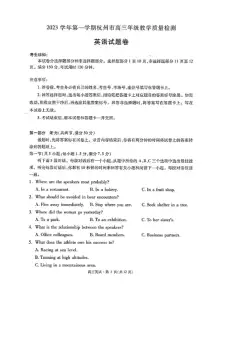
26年11月杭州市高三年级教学质检英语试题及完整答案解析纯净打印版
⬇️PDF可打印下载版放在评论区⬇️
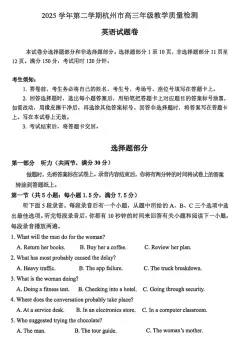
第一部分听力(共两节,满分30分)
做题时,先将答案标在试卷上,录音内容结束后,你将有两分钟的时间将试卷上的答案转涂到答题卡上。
第一节(共5小题:每小题1.5分,满分7.5分)
听下面5段录音。每段录音后有一个小题,从题中所给的A、B、C三个选项中选出最佳选项。听完每段录音后,你都有10秒钟的时间来回答有关小题和阅读下一小题。每段录音播放两遍。
1. How does the man sound?
A. Worried.
B. Confused.
C. Delighted.
2. What will the woman probably do next?
A. Pet the dog.
B. Feed the dog.
C. Adopt the dog.
3. What does the man mean?
A. He refused the job invitation.
B. He should have worked harder.
C. He is upset about not landing the job.
4. What is the woman's opinion of the talk?
A. It is one-sided.
B. It lacks depth.
C. It inspires her.
5. What does the teacher stress about the final essay?
A. Unique perspective.
B. Academic integrity.
C. Original ideas.
第二节(共15小题:每小题1.5分,满分22.5分)
听下面5段录音。每段录音后有几个小题,从题中所给的A、B、C三个选项中选出最佳选项。听每段录音前,你将有时间阅读各个小题,每小题5秒钟;听完后,每小题都有5秒钟的作答时间。每段录音播放两遍。
听下面的录音,回答第6、7小题。
6. Which country does the woman live in now?
A. Italy.
B. Sweden.
C. England.
7. What challenge does the woman face in her language learning?
A. Seeking a proper course.
B. Getting learning materials.
C. Finding chances to practise in real life.
听下面的录音,回答第8至10小题。
8. What is the probable relationship between the speakers?
A. Driver and traffic officer.
B. Customer and parking guard.
C. Student and driving instructor.
9. How much will the woman pay?
A. $8.
B. $25.
C. $29.
10. Which of the following payment methods is allowed?
A. Cash at the machines.
B. Credit card at the machines.
C. Cheque at the attendant's station.
听下面的录音,回答第11至13小题。
11. What problem does the man face?
A. He has made no progress.
B. Long workouts exhaust him.
C. He struggles to maintain his motivation.
12. What does the woman suggest doing?
A. Teaming up as partners.
B. Sticking to the old routine.
C. Trying less intense workouts.
13. What is the man likely to do next?
A. Attend a new class.
B. Do an extreme workout.
C. Exercise for an hour daily.
听下面的录音,回答第14至16小题。
14. What are the speakers talking about?
A. A flower.
B. An exhibition.
C. A painting.
15. What does the man think of the piece?
A. It's abstract.
B. It's realistic.
C. It's traditional.
16. What do we know about the artist?
A. She applies creative skills.
B. She prefers using oil paints.
C. She focuses on simple lines.
听下面的录音,回答第17至20小题。
17. What is the speaker doing?
A. Promoting city tourism.
B. Presenting a project summary.
C. Introducing a conservation plan.
18. Which animals have returned to London's city centre?
A. Bees and butterflies.
B. Squirrels and fireflies.
C. Black redstarts and bats.
19. What plays a key role in Chicago's urban rewilding?
A. New pipes.
B. Clean rivers.
C. Rain gardens.
20. What has caused the Parkroyal hotel's room rates to double?
A. Eco-friendly spaces.
B. Excellent room service.
C. Improved water quality.
第二部分阅读理解(共两节,满分50分)
第一节(共15小题:每小题2.5分,满分37.5分)
阅读下列短文,从每题所给的A、B、C和D四个选项中,选出最佳答案。
A
MEET THE AGENT
Catherine Cho
PAPER LITERARY
Catherine Cho grew up in Kentucky and studied English literature at New York University before moving to Hong Kong to study for a Juris(法学)Doctor degree at The University of Hong Kong. Cho then went back to New York to find a job in publishing. Later she moved to London to work for Madeleine Milburn Literary Agency. She started Paper Literary in May 2021.
"Going to law school taught me to bargain, to understand a contract," Cho says. "I learned about persuasion and influence. I love the feeling of advocating for someone, and honestly that moment of discovering a novel from an email submission, and the thrill of being able to tell someone their book will be published — it is such a high," she says.
In 2020 Cho published a memoir, A Memoir of Motherhood and Madness. The book was a New York Times Editors' Choice and Cho was shortlisted for The Sunday Times Young Writer of the Year.
"I think having been an author has made me kinder as an agent," Cho says. "It was only once I was on the other side of the submission process that I understood just how vulnerable it is to share your work."
You can find Cho online at PaperLiterary.com and on X @Catkcho.
21. How did Cho's law school experience benefit her career?
A. It built her literary competence.
B. It deepened her human empathy.
C. It developed her negotiation skills.
D. It expanded her professional networks.
22. According to the text, which book was represented by Cho?
A. Cup of Jo.
B. Lies We Sing to the Sea.
C. The Peace of Wild Things.
D. A Memoir of Motherhood and Madness.
23. What is the main purpose of this text?
A. To profile a literary agent.
B. To honor a book publisher.
C. To provide advice on writing.
D. To recommend popular novels.
B
A few years ago, I assigned a reading to my class about the experience of a young woman standing in line to register for her university classes in the 1980s. In the personal essay, the writer reflected on how she second-guessed her choices while waiting, and how other students in the line offered both positive and negative opinions on her course selection. As discussion of the reading unfolded, a student asked, "Why didn't she just register on-line?" This question was met with a few snickers, but also with knitted brows and nods. Why, indeed?
Feeling like a relic from the Natural History Museum, I reminded the students that the article was written in the early 1980s. "There was no 'on-line'," I explained. "There was just a human line. Before the internet, we waited in line for hours during freshers' week — for registration, student cards, financial aid, health insurance... for everything. Sometimes there were barbeques, bands playing, T-shirt giveaways. It was fun!"
The class looked at me with pity. And I understood. Online services, like shopping and registrations, have reduced our in-person wait time significantly. Those willing and able to pay can upgrade their tickets to skip the long lines at amusement park attractions. Self-checkout and drive-up delivery offer time-saving alternatives to waiting in line at the supermarket.
Still, I sometimes choose to wait. The supermarket checkout offers several off-line pleasures. I scan the magazine display, survey other peoples' purchases as they move along the conveyor belt, and marvel at new chewing gum flavours. Grapefruit-melon — who knew? Most people are absorbed with their phones, but the old and very young are happy to make eye contact and exchange a few words. I talk to elderly shoppers and make faces at toddlers. The other day, a happy two-year-old chatted me up. "BAH!" she said, and held out a sticky candy bar from a tiny red box.
24. What did the class think of the woman's waiting in line for registration?
A. They considered it fun.
B. They saw it as pointless.
C. They regarded it as controversial.
D. They found it eye-opening.
25. How did the author respond to the students' question?
A. He expressed a deep sense of self-pity.
B. He briefed them on the historical context.
C. He scolded the students for their ignorance.
D. He admitted online registration was far superior.
26. What is paragraph 3 mainly about?
A. Why modern conveniences are criticized.
B. Why technology changes almost everything.
C. How the tradition of queuing has been reshaped.
D. How the students viewed the teacher's experience.
27. What is the best title of the passage?
A. The Lost Art of Waiting
B. The Magic of Online Service
C. Technology: A Time-saving Solution
D. Standing in Line: A Real Struggle
C
AI is learning our beauty standards. Looking for a fitness model for a social media post? AI can generate an endless stream of attractive faces without the involvement of a single real person. Many people assume it creates something entirely new. In reality, AI does not invent a new standard of attractiveness. It simply recycles — and in some cases intensifies — the one that already dominates popular media.
Research has long shown that exposure to idealized bodies contributes to body dissatisfaction. Social comparison is almost automatic and those comparisons can affect self-esteem, eating habits, exercise behaviors, and overall psychological well-being. What makes AI different is its scale. Anyone can now generate thousands of seemingly realistic images in minutes. That creates a false impression that these bodies are common or typical — but they aren't. Instead, they represent statistical averages drawn from internet content that already overrepresents conventionally attractive, highly fit individuals. The result is a feedback loop. Existing media influences AI, AI produces more idealized images, and those images become part of the media that future AI systems learn from. The cycle reinforces itself.
This is especially relevant for athletes. Sports emphasize performance, discipline, and physical capability. Yet appearance now shapes public identity. AI-generated athletic bodies often appear posed for admiration rather than engaged in sport. When looks become the primary measure, athletes risk body dissatisfaction, unhealthy weight control practices, or disordered eating. The psychology behind it is even more troubling.
For a broader sense, perhaps the most concerning is what is missing from the AI-generated images: few bodies reflect diversity in fat, muscle, age, disability, or shape, with women especially restricted to a narrow range. Such bodies become psychologically invisible, making most people feel excluded.
Ironically, AI has enormous potential to promote inclusion, but current systems reproduce training data stereotypes. AI is often described as a mirror of society. The danger is that mirrors do not always merely reflect reality. They can also distort it.
28. What phenomenon does the author describe in paragraph 1?
A. AI ignores body image issues.
B. AI creates new beauty standards.
C. AI reproduces existing beauty standards.
D. AI plays a dominant role in popular media.
29. What is the correct understanding of "a feedback loop" in paragraph 2?
A. Media and AI boost each other.
B. AI reduces social comparison pressure.
C. Internet users reject AI-generated images.
D. The standards of idealized bodies keep changing.
30. What worries the author most about AI-generated images?
A. They draw too much attention to athletes.
B. They fail to shape certain public perceptions.
C. They lack diversity and exclude many people.
D. They feature women with athletic body shapes.
31. What does the author want to say in the last paragraph?
A. Stay true to yourself.
B. The mirror never lies.
C. Beauty is only skin deep.
D. Seeing is not always believing.
D
Nighttime light is a well-known threat to migrating birds and sea turtles. New research suggests it may also pose risks for human health — The itchy-eyed misery of allergy(过敏症)season may be getting a boost from the glow of city streetlights.
Plants time their flowering and pollen(花粉)release by both temperature and light, and the artificial glare that bathes urban areas at night appears to upset their internal clocks. In a study published in PNAS Nexus, researchers analyzed pollen counts and satellite data across the eastern United States from 2012 to 2023, using NASA's Black Marble nighttime images. They found that the more light pollution a place endured, the higher its pollen levels and the longer its allergy season. In low or no light areas, pollen counts were significant for 170 to 210 days a year. In brightly lit locations, days with significant pollen counts reached 300 days annually in places like New York City. The exposure severity also increased: as much as 27% of pollen season days reached severe levels in brightly lit areas, compared to 17% where there was little or no artificial lighting.
Longer and more intense pollen seasons boost allergy sufferers' symptoms, raising the risks for people living with asthma or other ailments worsened by airborne pollen. "Seasonal allergies cost billions of dollars in health-care costs as well as making life miserable for those who are highly sensitive," says Andrew Richardson, an ecologist at Northern Arizona University who wasn't involved in the study. "If you're one of those people, then this research is clearly nothing to sneeze at."
Environmental scientist Lin Meng, lead author of the study, calls the link a "blind spot" in urban planning. The trend for planners these days is to pack cities with trees and lights, but a longer pollen season is bad for a city's bottom line. She plans to share this study with planners and urban decision-makers so they can take light pollution's impact on pollen into consideration when building cities.
32. What does the new study mainly show?
A. Light pollution elevates health risks.
B. Artificial lights cause allergy directly.
C. Allergy has been a great danger to health.
D. Nighttime lighting harms migratory animals.
33. How does light pollution affect urban plants?
A. By delaying their flowering.
B. By slowing down their growth.
C. By restricting their pollen production.
D. By disturbing their biological rhythms.
34. Why does Andrew Richardson bring up the costs and the misery?
A. To compare allergy rates across cities.
B. To stress the study's practical importance.
C. To prove light pollution is the main cause.
D. To challenge current urban tree-planting policies.
35. What advice would Lin Meng probably give to city planners?
A. Identify all urban blind spots.
B. Upgrade lighting facilities.
C. Introduce more pollen-free plants.
D. Weigh greenery and lighting impacts.
第二节(共5小题:每小题2.5分,满分12.5分)
阅读下面短文,从短文后的选项中选出能填入空白处的最佳选项。选项中有两项为多余选项。
Critical thinking refers to the ability to make objective, reasoned judgements based on interpreting and applying evidence. These days, we are constantly exposed to so much conflicting information. 36 Here's how to sharpen them.
Be open to a range of ideas.
It's easy to get stuck in your own bubble, particularly on social media where algorithms(算法)tend to feed us more of the same ideas. But being open to different perspectives can help us to take a step back and assess problems in a new way. 37And listen with curiosity to people who see the world differently from you.
Try to be less reactionary.
Training yourself to be less reactionary can enable you to create space to consider a topic more fully. Say you're having a debate with someone about a topic you're passionate about, and they bring up a new idea that you wouldn't usually agree with. 38 Curious questioning and taking a moment to turn over the idea in your mind could allow you to make a more informed judgement.
39
Sometimes, we might only see part of the problem that we're facing. If you suspect this may be the case, try to fill in the gaps. Do your own research, consider what other perspectives may be out there, and look for information that may have been overlooked.
Learn how to spot a bias.
A bias is the act of giving disproportionate weight for or against something. A bias isn't always negative. For example, someone who personally had a great experience with a service may give it more praise than the average person. But it's important to be aware of biases. 40 Consider the language used, look into sources and validate information.
A. Look for the full picture.
B. Don't reject it immediately.
C. Try reading diverse news sources.
D. They're driven by politics, values or agendas.
E. After all, they can quietly influence your opinions.
F. In such a context, the skills involved can go a long way.
G. We're also likely to be surrounded by like-minded people.
第三部分语言知识运用(共两节,满分30分)
第一节(共15小题;每小题1分,满分15分)
阅读下面短文,从短文后各题所给的A、B、C和D四个选项中,选出可以填入空白处的最佳选项。
When I found Granddad's old leather-bound album in the attic, I was amazed: its pages packed with magnificent stamps arranged with 41. Historical Figures, Art, Landscapes, Science and more — I had never realised stamps 42such a broad range. Each page left a few blanks, waiting to be 43. A letter inside confessed Granddad's 44 attempt to complete it. Now it was in my hands, with gaps still to complete.
I never forgot that 45. When I became a history-and-geography teacher, I realized stamp-collecting could be a doorway to 46. So I designed a Friday project: explore the 47 through stamps. I photographed thirty pages from Granddad's album, printed workbooks with the same blank spaces, and set my students to 48 the missing ones. For the first week I asked them to start with British royalty. Most students were 49, a few were doubtful.
That very Friday in class, Harold came forward: he had filled two of five 50. Rosemary then showed two from her grandmother's collection. That first class 51with a lively discussion about Britain, all through the lens of stamps.
As the year progressed, the Friday 52 involved the whole school. Now at year's end, as I turned the pages of the album, I saw very few blanks 53. My students had brought me extraordinary stamps and far more than that: they had caught the same 54 I once felt in the attic. Granddad would have been 55. I would finally have time to complete his collection.
41.
A. sizes
B. themes
C. locations
D. purposes
42.
A. invented
B. covered
C. required
D. symbolized
43.
A. filled
B. studied
C. identified
D. exchanged
44.
A. failed
B. renewed
C. ambitious
D. random
45.
A. trial
B. hobby
C. challenge
D. secret
46.
A. learning
B. understanding
C. freedom
D. entertainment
47.
A. map
B. school
C. future
D. world
48.
A. give away
B. sort out
C. track down
D. look into
49.
A. cautious
B. curious
C. relieved
D. unaffected
50.
A. albums
B. stamps
C. blanks
D. tasks
51.
A. ended
B. differed
C. dragged
D. started
52.
A. tests
B. games
C. celebrations
D. sessions
53.
A. growing
B. remaining
C. completed
D. claimed
54.
A. pride
B. warmth
C. wonder
D. sympathy
55.
A. regretful
B. passionate
C. ashamed
D. pleased
第二节(共10小题;每小题1.5分,满分15分)
阅读下面短文,在空白处填入1个适当的单词或括号内单词的正确形式。
From the rich aroma(芳香)of tradition to the innovative scents(香气)drifting from modern studios, fragrance has always been a silent yet powerful cultural language. Picture 56(breathe)in a fragrance dating back 5,000 years. Such 57(be)the immersive journey offered by Scents of China, a newly launched eight-part documentary series aiming to capture 5,000 years of Chinese fragrance tradition on film.
Each 30-minute episode operates 58 a time machine powered by scent, tracing how fragrance weaves through Chinese civilization, culture and aesthetics. 59(give)a full picture of it, the production team ventured into mountains, forests, and remote workshops to find 60 very roots of Eastern perfumery(调香工艺). By spotlighting industry standardization, clever branding and 61(globe)reach, the documentary captures a fascinating transformation: how an ancient craft upgrades for modern consumers worldwide.
62(produce)Zhang Bei describes the project as both a cultural and industrial expedition. And the ambition is huge: Scents of China is set to broadcast in over 180 63(country), using the universal language of scent to spark cross-cultural connections. For anyone fascinated by niche perfumes, cultural heritage, or the evolution of traditional industries, this series 64(promise)to be an eye-opening watch 65 encourages a new way of thinking about modern lifestyles.
第四部分写作(共两节,满分40分)
第一节(满分15分)
班里有些同学课桌杂乱却觉得理所当然,也有人认为桌面整洁十分必要。你校英文报拟就此组织讨论。请你写一篇短文投稿,表达你的观点并说明理由。
注意:
(1)写作词数应为80左右。
(2)请按如下格式在答题纸的相应位置作答。
A Tidy Desk: A Necessity or Just a Preference?
第二节(满分25分)
阅读下面材料,根据其内容和所给段落开头语续写两段,使之构成一篇完整的短文。
Mr Watson ran the local bookshop when I was a child. Conveniently located on the high street, next to a cafe, it was on my way home from school. So, most afternoons, Mum would go for a coffee and leave me to browse the books in the shop under the watchful eye of Mr Watson.
Mr Watson's bookshop was one of those Aladdin's cave sort of places. Treasures piled high. I have so many fond memories of my after-school hours, tucked up on the bench by the window with a book.
The most exciting thing about Mr Watson's bookshop was his story exchange policy. He had an agreement that if you brought him a story that you had written and he liked it, he would exchange it for a book of your choice from the shop. He would display these stories on their own special shelf on the wall by the counter and anyone could ask to read them.
From the time I was eight to when I was ten, I watched this collection grow steadily. I was proud to say that I was responsible for a good portion of these works. I enjoyed writing stories about anything and everything, and often I would illustrate them too. Mr Watson would give specific feedback. I probably learned more about writing from him than from any teacher I had before or since.
Mr Watson made me want to push myself more in my stories, especially adventure stories.
This blissful period of my childhood came to an end when I decided to really try and impress Mr Watson. I had recently read an adventure novel and there was a passage in it that I liked so much that I lifted the whole thing and put it in my next story. There was no way Mr Watson would ever spot this, or so I thought.
注意:
(1)续写词数应为150左右。
(2)请按如下格式在答题卡的相应位置作答。
Paragraph 1: As usual, I went into the shop after school.
Paragraph 2: That night I tore the pages into pieces and started over again.
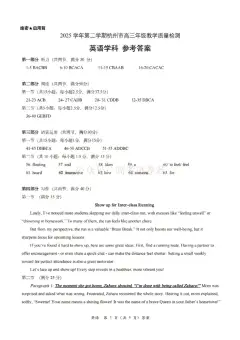
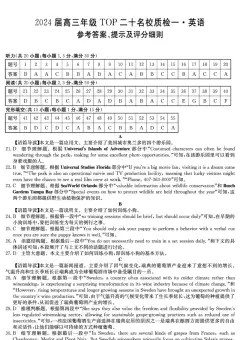
2026学年第一学期杭州市高三年级教学质量检测
英语试题参考答案
第一部分听力(共两节,满分30分)
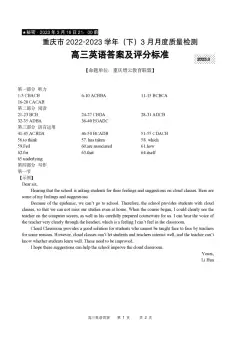
1-5 CACBB6-10 ACBBB 11-15 CAACB 16-20 ABCCA
第二部分阅读理解(共两节,满分50分)
第一节(共15小题;每小题2.5分,满分37.5分)
21-23 CBA24-27 BBCA 28-31 CACD 32-35 ADBD
第二节(共5小题;每小题2.5分,满分12.5分)
36-40 FCBAE
第三部分语言知识运用(共两节,满分30分)
第一节(共15小题;每小题1分,满分15分)
41-45 BBAC46-50 ADCBC 51-55 ADBCD
第二节(共10小题;每小题1.5分,满分15分)
56. breathing
57. is
58. like/as
59. To give
60. the
61. global
62. Producer
63. countries
64. promises
65. that/and/which
第四部分写作(共两节,满分40分)
第一节
A Tidy Desk: A Necessity or Just a Preference?
Should our desks be kept neat and tidy, or is it fine to leave them messy and piled high with books and papers? My view is clear: a tidy desk is definitely a necessity, especially when deadlines pile up.
Some may argue that a messy desk makes for a creative mind and that tidiness is simply a matter of personal preference. However, I believe a well-organized desk helps us concentrate. With less visual clutter around us, we can focus more easily and work more efficiently. Moreover, tidiness saves time, as we no longer need to hunt through piles of papers for a notebook or a worksheet. In a shared classroom, it also shows respect for classmates by keeping our materials from spilling onto their desks.
In brief, a tidy desk boosts focus and efficiency. So let's start with small changes and keep our desks neat!
第二节
Paragraph 1: As usual, I went into the shop after school. Mr Watson was sorting shelves when I handed him my story, full of hope and pride. He paused his work and began reading with his usual keen interest. I pretended to browse the shelves, though my heart was racing. Soon I noticed his brows knitted and his expression grew serious. When he finished, he called me over, silently handed the pages back. "I'm sorry Michael, but I can't exchange your story when you pass off someone else's work as your own," he said. My head drooped. How I wish I could disappear among the rows of books!
Paragraph 2: That night I tore the pages into pieces and started over again. I knew I had to make things right, so I decided to write a story that was truly my own. I rewrote it again and again, crossing out sentences, searching for better words and shaping every line with care. The next day after school, I placed the new pages in front of Mr Watson. His eyes lit up as he read, and a warm smile slowly spread across his face. To my amazement, he handed me two books — one for the story I had written myself, and the other, he said, for having corrected the mistake I had made. I never plagiarised anything ever since.
听力原文
Text 1
W: Oh My Goodness, James! This meal is absolutely incredible.
M: Really? I'm glad you think so. I was a bit worried about the seasoning at first.
Text 2
W: Oh, what a cute dog!
M: Thanks. This is Buster. He was adopted. He's super friendly.
W: Would he mind if I touch him?
M: No, go right ahead.
Text 3
W: Hey John. Still feeling down about that job rejection? I really thought you had that in the bag.
M: Yeah, a bit. It's tough to shake off. I put so much into that application and the interviews.
Text 4
M: How do you like the talk on climate change?
W: Well, it's such a big topic, and I feel like the speakers barely touched the surface. There's still more to dig into.
Text 5
W: Hey Jimmy, I missed yesterday's class. What did the teacher say about the final essay on Oral history?
M: Nothing special about perspectives, but he stressed that we must state where every borrowed idea or quote comes from.
Text 6
M: You were living in Italy when we last met in Switzerland, weren't you?
W: Yes, still there.
M: So, how's your Italian coming along?
W: Not too bad. I did a course a while ago, and I can more or less follow the news and read a paper. The problem is most of the people I deal with speak perfect English, so it's hard to get a chance to practice.
M: I know what you mean. It's the same in Sweden.
Text 7
W: Excuse me, I'm just about to park, and I was wondering what the parking fees are here?
M: No problem. It's $5 for the first hour, and then $3 for every subsequent hour.
W: Okay, got it! Is there a daily maximum charge?
M: Yes, the daily maximum is $25.
W: Good to know. It's 2pm now, and I will pick up my car at 11pm. And what about payment methods? Is it card only, or can I pay with cash?
M: We accept only major credit cards. Unfortunately, we don't take cash at the machines, but you can pay with cash at the attendance station if someone's there.
W: All right. Thanks for the information.
Text 8
W: Hey Michael, how's your new workout routine going? I'm still trying to find my rhythm.
M: To be honest, I'm finding it hard to stay motivated after a long day at work. What about you?
W: Well, my biggest challenge is definitely time. It feels like there aren't enough hours in the day to fit everything in, especially a workout.
M: Absolutely. I also experienced a slowdown in my progress recently, which is super upsetting. Any tips on breaking through that?
W: I think switching up routine or increasing the intensity helps. As for motivation, maybe we could try being practice partners.
M: That's a great idea. I'm definitely in, and good point about switching things up, I might try a new class next week.
W: Perfect! And for the limited time, I've been trying to do shorter workouts. Even 20 minutes is better than nothing.
M: You're right. We just need to make some progress, not perfection.
Text 9
W: This piece, Ethereal Bloom, is absolutely fascinating. I love the way the artist uses light and shadow to create such a dynamic sense of movement.
M: I agree. The flower looks so real that you feel like reaching out and touching it. Do you think the artist uses oil or something else?
W: Hmm... It certainly has that rich quality of oil, but the fine details make me wonder if it was painted with thin, see-through paint.
M: That's a good point. The artist Nina Petrova is known for her innovative techniques, isn't she? I remember reading about her experimenting with mixed materials.
W: Right! Her work often mixes traditional painting and touchable art. It's fascinating how she manages to turn a passing moment of a flower into a lasting memory.
Text 10
Hello, everyone. For our school science project, my group chose Urban rewilding, a movement bringing nature back into busy city centers. In London's West End, an initiative called Wild West End has built green walkways between parks like Hyde Park and Regent's Park. Each walkway, or green stepping stone, covers at least 100 square meters every 100 meters, with green roofs and street trees. As a result, black redstarts, one of Britain's rarest birds, now nest in the city center together with four bat species. In Chicago, a project using 108 rain gardens now sends 40,000 cubic meters of rainwater into the river each year instead of the old pipes, and the gardens bring bees and butterflies into the city. In Singapore, the Park Royal Hotel covers more than twice its site with gardens and water, and its green spaces have attracted squirrels and even fireflies. While its room rates have since doubled. And so our research shows cities can share space with wildlife. Thank you!