ARTICLE · 1360241
2027届模拟试卷速递43:202611湖北圆创联盟 试卷+答案+听力文本(word版本)
开学了,推荐高中英语学习必备书:最新2026版应用文写作和读后续写:
2026年7月第10版《新高考英语应用文写作+读后续写+人教版单元词块整理三驾马车》来啦!
试卷下载链接:
我用夸克网盘给你分享了「202611湖北圆创联盟.docx」,点击链接或复制整段内容,打开「夸克APP」即可获取。
链接:https://pan.quark.cn/s/8a3182f3c3a0
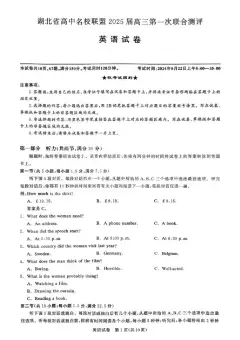
英 语
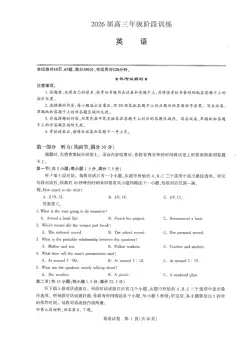
第一部分 听力(共两节,满分30分)
第一节(共5小题;每小题1.5分,满分7.5分)
听下面5段录音。每段录音后有一个小题,从题中所给的A、B、C三个选项中选出最佳选项。听完每段录音后,你都有10秒钟的时间来回答有关小题和阅读下一小题,每段录音播放两遍。
1. What will the girl do with her scholarship?
A. Get a digital device.B. Register for courses.C. Buy college textbooks.
2. Why did the man fail to get in shape?
A. He ate irregularly.B. He rarely exercised.C. He stayed up too late.
3. What led the man to quit his job?
A. Low pay.B. Schedule conflict.C. Tiring environment.
4. When is the man expected to arrive?
A. At 1:00 P.M.B. At 2:00 P.M.C. At 2:45 P.M.
5. What does the man ask the woman to do?
A. Pack her spare clothes.B. Go downstairs at once.C. Attend to a patient.
第二节(共15小题;每小题1.5分,满分22.5分)
听下面5段录音。每段录音后有几个小题,从题中所给的A、B、C三个选项中选出最佳选项。听每段录音前,你将有时间阅读各个小题,每小题5秒钟;听完后,各小题将给出5秒钟的作答时间。每段录音播放两遍。
听第6段录音,回答第6、7题。
6. What is the man selling to the woman?
A. A washing machine.B. A dishwasher.C. A refrigerator.
7. What does the man promise to do?
A. Apologize for the call.
B. Remove the call records.
C. Delete the woman's number.
听第 7 段录音,回答第 8 至 10 题。
8. Why will Jacky grade students' essays with Unicorn?
A. It makes multitasking a reality.
B. It focuses on sentence patterns.
C. It improves students' efficiency.
9. What does the woman think Unicorn fails to offer?
A. Human touch.B. Practical advice.C. Critical thinking.
10. What might the speakers do later?
A. Carry out a survey.B. Go to Jacky's office.C. Text other classmates.
听第 8 段录音,回答第 11 至 13 题。
11. Why do Cindy's parents oppose her choice?
A. They worry about her future.
B. They think she is not right for it.
C. They misunderstand the major.
12. Where does the conversation probably take place?
A. In a restaurant.B. In a university.C. In a bookstore.
13. What does Bob suggest Cindy do?
A. Enter a contest.B. Do more reading.C. Show her efforts.
听第 9 段录音,回答第 14 至 16 题。
14. Why did Coco decide to look after the tiny homeless cat?
A. It got injured.B. It looked cute.C. It was starving.
15. How does Coco help the homeless cats?
A. She cooperates with a pet hospital.
B. She cleans feeding spots regularly.
C. She keeps an eye on their health.
16. What is Coco's future plan for the cats?
A. To build more shelters for them.
B. To run an animal rescue center.
C. To move them to better places.
听第 10 段录音,回答第 17 至 20 题。
17. What is the purpose of the city exploration project?
A. To enrich students' vacation life.
B. To integrate knowledge into real life.
C. To train students' interview skills.
18. How long will the summer project last?
A. 10 days.B. 12 days.C. 18 days.
19. What rule does the project have?
A. No absence is allowed.B. Students must live in school.C. Students need online tests.
20. What does the speaker think of the project?
A. Easy but important.B. Tiring but enjoyable.C. Demanding but rewarding.
第二部分阅读(共两节,满分 50 分)
第一节(共 15 小题;每小题 2.5 分,满分 37.5 分)
阅读下列短文,从每题所给的 A、B、C、D 四个选项中选出最佳选项。
A
Ranger(护林人)-Led Bike Tours
Looking for an exciting way to explore Acadia?
Explore the stunning carriage roads of Acadia National Park under the expert guidance of our knowledgeable guides. More than just a scenic ride to explore the beauty of Mount Desert Island, the tour offers opportunities to learn about the park’s rich history, and gain fascinating insights into the park’s landscape and wildlife.
Schedule:
●July & August:Monday–Friday, 8:30–11:00 A. M.
●September–October 15:Monday, Wednesday, Friday, 8:30–11:00 A. M.
Cost: $ 75 per rider, including the use of bikes for the rest of the day.
Child Seats: Children under 8 years old must use child seats. There is no tour fee for them, but each child seat costs $ 15. Make sure to reserve a spot for the child when booking.
Age Limit: All riders must be at least 8 years old.
Land: Mount Desert Island is mountainous, so there are hills on this route. The hills are manageable, but please note there’s rolling land throughout the tour.
Bike Return: Either return your bike to the same place you picked it up at the Visitor Center or keep it through the end of the day. If you choose the latter, it must be dropped back off at our bike shop by 5:00 P. M.
Cancellation Policy:The cancellation policy is 72 hours in advance due to the tour’s popularity. No refunds outside the cancellation window.
21. What characterizes the bike tour?
A. It is adventurous.B. It is self-guided.C. It is informative.D. It is competitive.
22. How much will a couple with a 6-year-old kid pay in total?
A. $ 150.B. $ 165.C. $ 225.D. $ 240.
23. What should a rider do if he keeps his bike after the tour?
A. Return it to the bike shop.B. Drop it back off after 5 P. M.
C. Pay for another day’s use.D. Leave it at the Visitor Center.
B
At the age of 37, I can count on one hand the years I have spent free from body dissatisfaction. My experience with being big started when I was a kid and by ten I could confidently calculate calories. Meanwhile, people kept bringing up my weight. My role in this little dance was to swallow the shame, listen to their opinions, and apologize for the awkwardness.
When the body positivity movement exploded, at first, its message was at odds with my thinking. For decades, I assumed that I was born wrong—until it made me realize, for the first time, that I deserved unconditional love. However, those good days were short-lived. A sudden wave of new weight-loss medicine arrived. When online stars who once supported body acceptance quickly tried to become thin, I fell off the lifeboat on which I had pinned all my hopes. For those of us left behind, their change felt like a betrayal(背叛)and the drugs were a temptation(诱惑).
Bone-achingly tired, I eventually crossed the line and tried diet drugs as a desperate fix, even if it meant upsetting others. The drugs worked, but almost too well. I lost my entire appetite and about 15kg in a scarily fast time. Meanwhile, extreme side-effects made me no longer a happy and calm working mother. I absolutely felt foolish for believing this one thing might solve all my problems, for being tricked into hoping for a loving world and for not recognizing that online content only served one purpose: to make companies more money.
Our society has fought against the old habit of commenting on people's bodies. But it feels like two steps forward, one step back. I need to be well for my children, and if that means mostly tolerating body dissatisfaction, then better the devil you know, right? I will teach my children that their weight is the least interesting thing about them, and that their worth is not defined by their bodies.
24. What do we know about the author's childhood?
A. She enjoyed counting calories.B. She danced a lot to lose weight.
C. She laughed off others' opinions.D. She struggled with her body image.
25. What is the author's emotional journey like in paragraph 2?
A. Ashamed → trusting → relievedB. Resistant → determined → grateful
C. Curious → embarrassed → angryD. Doubtful → hopeful → discouraged
26. Which of the following best describes the author?
A. Confident and sociable.B. Hesitant and easy-going.
C. Reflective and responsible.D. Independent and open-minded.
27. What does the author's experience show?
A. Self-acceptance is a long fight.B. Losing weight requires resolve.
C. Shame encourages personal growth.D. Online voices do more harm than good.
C
City pigeons have adapted to ever-changing environments. But their surroundings are not the only things that are constantly changing. New research suggests that these birds also avoid stability in their decision-making, instead choosing to live "at the edge of chaos." As model species for learning and behavior, pigeons are helping scientists test a century-old law about how humans and other creatures take in information.
When learning something new, people and animals alike tend to repeat behaviors that are rewarded. This principle, which was first proposed by Edward Thorndike in 1898, is so well established in psychology that it's become known as the law of effect. However, the law also implies that rewards, beyond making a behavior more frequent, also make it more consistent, reducing variability in the specific way the behaviors are performed over time. While scientists have repeatedly tested whether rewards increase frequency of behavior, their effect on consistency is less well studied.
To see how rewarded behaviors vary, Edward A. Wasserman and his team studied pigeons, a species that has been integral to the study of learning for over 50 years. The birds were given five colorful buttons to peck(啄). They could peck any buttons in any order, but if they pecked five times, a reward would appear. Based on earlier theories, the scientists expected the pigeons to settle into a routine—perhaps repeating a pattern that worked or simply pecking the nearest button five times. Instead, the pigeons kept pecking in a variety of patterns.
“There would be no reason not to expect that the animals would settle on one favorite, but it never got to that point,” Wasserman says. The team believes that this love of variety may be an evolutionary advantage, helping pigeons cope with new challenges in their environment. They are currently testing whether other animals also avoid fixed behaviors, which might reveal how the brain makes behavioral decisions while learning.
28. What may be a feature of city pigeons' decision-making?
A. Stability.B. Unpredictability.C. Complexity.D. Uniformity.
29. Which of the following best illustrates the law of effect?
A. Hearing a noise, a child covers his ears.
B. Without being taught, a bird builds a nest.
C. Given treats, a dog does a trick more often.
D. Watching her brother, a girl learns to swim.
30. How did the scientists feel about the findings?
A. Astonished.B. Satisfied.C. Concerned.D. Disappointed.
31. What will the next step of the research focus on?
A. How rewards affect behavior frequency.B. Whether pigeons can recognize patterns.
C. How pigeons manage to adapt to city life.D. Whether variability exists across species.
D
Humans, as an evolutionary group, are often said to be losing their sense of smell. “But our sense of smell is not simply declining,” says Lian Deng of the School of Life Sciences at China’s Fudan University. “It is still being reshaped by lifestyle, diet and even culture.” That’s the result of a recent study aimed at uncovering how the genetics of human smell has changed over the past few thousand years.
The study grew from the fieldwork of Hoh Boon-Peng, a geneticist at the IMU University in Malaysia, who saw the importance of smell in the daily life of hunter-gatherers. “They follow their noses to distinguish among herbs, identify ripe fruit and figure out where animals have traveled and their language has a strikingly rich vocabulary for smell,” Hoh says. Such observations made Deng wonder if smell’s importance has left traces in the smell-receptor gene evolution.
In their Cell Reports study, Deng, Hoh and colleagues analyzed the data of smell-receptor genes from 50 Malay Peninsula natives—hunter-gatherers plus two farming groups—and measured them against other populations around the world.
The results suggest that the Malay Peninsula hunter-gatherers have preserved a more complete set of smell-receptor genes than the other groups studied. In most populations around the world, many of these genes have accumulated mutations(突变) over time that have left about 60 percent of them no longer working. But the hunter-gatherers showed significantly fewer mutations in their smell-receptor genes. The intactgene variants they carry are linked to sensing earthy, flowery and fruity smells—signs often tied to food and other vital resources.
The genetic differences among the populations go beyond smell. In one of the farming groups, the researchers identified a receptor gene called OR12D3 which might reflect adaptation to the higher-carbohydrate diet that came with agriculture.
“Even among modern humans, sense of smell varies widely from person to person, and much of that variation is thought to come from differences in smell-receptor genes,” says geneticist Hiroaki. To him, the study provides evidence that humans' recent evolutionary history might have helped shape these genes.
32. What is the goal of Deng’s study regarding human smell?
A. To confirm its decline.B. To find factors reshaping it.
C. To explore its importance.D. To reveal genetic shifts in it.
33. How was the study carried out?
A. By conducting fieldwork.B. By comparing genetic data.
C. By categorizing smell-related genes.D. By observing hunter-gatherers.
34. What does the underlined word “intact” in paragraph 4 mean?
A. Unaltered.B. Nonfunctional.C. Insensitive.D. Irregular.
35. What can be a suitable title for the text?
A. Human Smell: A Key to SurvivalB. How Does Human Smell Work?
C. Human Smell: An Evolutionary StoryD. Why Does Human Smell Matter?
第二节七选五(共5小题;每小题2.5分,满分12.5分)
阅读下面短文,从短文后的选项中选出可以填入空白处的最佳选项。选项中有两项为多余选项。
The river flows steadily under the high summer sun. Alder trees line its banks, while sheep feed on grass quietly in nearby fields. High above, birds circle on warm air currents, their cries breaking the heavy, damp stillness. Feeling the heat of the summer sun on my skin, I put down my belongings at the bank and slip into the river. Cool wet mud meets my toes. I stride (大步走) into the deepening water. ___36___ My breath slows as I lower myself into the depths and swim out into the main channel.
___37___ Underwater plants wave gently, and tiny air bubbles rise from unseen fish. This unique perspective comes only when you step inside nature, rather than merely watching it from the bank. Beneath the vastness of the sky, I feel deeply at peace in water. ___38___
Ella Foote, an author and magazine editor, shares this same sense of comfort. “When life becomes overwhelming, a dip in natural water can calm my anxiety,” she says. ___39___ Rivers keep flowing, tides rise and fall, and lakes lap at their shorelines, untouched by human troubles.
I am drawn to the water for the same reasons as Ella. In my early 30s I discovered that swimming in cold water was the ideal way to slow my brain to a more manageable pace.
Having swum around the UK myself, I feel natural water has always had the magical power to cure. ___40___ The world remains the same, but I return to it feeling different.
A. And I am not alone in this.
B. Life is chaotic, yet nature follows its cycles.
C. Jumping into cold water takes great courage.
D. Many choose it for the pleasure of adventure.
E. I can dive in with a long face and emerge cheerful.
F. The sharp contrast places me totally in the moment.
G. From here, I gain a frog’s eye view of the proceedings.
第三部分语言运用(共两节,满分30 分)
第一节(共 15 小题;每小题 1 分,满分 15 分)
阅读下面短文,从每题所给的 A、B、C、D 四个选项中选出最佳选项。
Great-Aunt Marian was my husband's family historian. She had never seen any reason to ___41___ with a single reminder of a bygone era in her house. One summer she showed us the glass case of her cherished items. None was worth much, but each one ___42___ a story, told with such ___43___ that we hung on every word.
In the back sat two wooden pencil boxes; one hand-carved with a delicate pattern, the other simply painted with lovely race cars. However, it was the latter one that ___44___ my fancy. “That one belonged to my sister Mildred. She died at twelve, but I’ve kept it just as she ___45___ it the last time she closed it. Go ahead. Open it,” Aunt Marian smiled.
Inside lay a key, pencils ___46___ down to stubs (小块) and some erasers. I could ___47___ read the name: MILDRED on the wood. The handwriting had ___48___, but the memory of Mildred was as vivid as ever.
Aunt Marian died the following summer. Her son planned an auction (拍卖) to ___49___ the house. The pencil boxes were listed. To others they were ___50___, nothing but two old boxes, yet I meant to bring Mildred’s home.
At the auction, dealers made ___51___ eagerly on the most valuable items. Paddles (拍卖牌)shot up, but mine stayed in my lap. The hand-carved box was far more ___52___ than Mildred's childish one and sold quickly. However, by the time the auction was declared closed, the other pencil box had still not ___53___. Suddenly, the auctioneer announced an ___54___ item: Mildred's box. No one else bid, so it was mine for $ 5.50.
Holding the box, I realized I was meant to keep the family’s real ___55___—love.
41.A. dealB. partC. connectD. live
42.A. carriedB. createdC. retoldD. inspired
43.A. bitternessB. sympathyC. warmthD. fluency
44.A. containedB. struckC. followedD. expected
45.A. abandonedB. carvedC. paintedD. left
46.A. wornB. brokenC. burnedD. scaled
47.A. eventuallyB. loudlyC. barelyD. genuinely
48.A. driedB. transformedC. worsenedD. faded
49.A. clear outB. move intoC. fix upD. show off
50.A. necessaryB. worthlessC. mysteriousD. reliable
51.A. recommendationsB. profitsC. offersD. remarks
52.A. durableB. desirableC. accessibleD. affordable
53.A. workedB. existedC. openedD. appeared
54.A. overlookedB. unfinishedC. overpricedD. unnamed
55.A. secretB. reputationC. promiseD. treasure
第二节(共 10 题;每小题 1.5 分,满分 15 分)
阅读下面短文,在空白处填入 1 个适当的单词或括号内单词的正确形式。
Across China, a new generation of craftsmen is looking for fresh ways ____56____ (preserve) age-old crafts such as weaving(编织), leather carving and embroidery(刺绣). Though faced with enormous challenges from machine-made products, these young craftsmen, driven by passion for traditional culture, have added new ____57____ (vital) to intangible cultural heritage items while adapting traditional crafts to modern life. Rather than ____58____ (mere) copying ancient patterns, they explore creative approaches to make these time-honored treasures attractive to young audiences, most of ____59____ are exposed to diverse digital content every day.
Xia Yu, from Ningxia Hui Autonomous Region, ____60____ (integrate) freehand brushwork in traditional Chinese painting into Ningxia embroidery over the past few years. When he was a child, his grandmother often embroidered by the window, which sparked his interest and developed his lifelong commitment ____61____ the craft. He repeatedly asked his grandmother to teach him basic skills. Gradually, he combined delicate Chinese painting techniques with embroidery, creating works ____62____ (root) deeply in local culture.
As his works continue to be widely shared on social media platforms, more and more people at home and abroad have come to recognize the ____63____ (increase) appeal of Ningxia embroidery. For Xia, passing on the craft means keeping traditions alive and telling Chinese cultural ____64____ (story) to the wider world. ____65____ he firmly believes is that only by combining tradition with modern creativity can intangible cultural heritage develop in the fast-changing era.
第四部分写作(共两节,满分 40 分)
第一节(满分 15 分)
外教 Edward 要求同学们在课前演讲活动中,分享自己认为使用 AI 辅助学习受益最大的一门学科,并说明理由。请你以 “AI-assisted learning benefits me most in ____________” 为题写一篇演讲稿。
注意:(1)写作词数应为 80 左右;(2)请按如下格式在答题卡的相应位置作答。
AI-assisted learning benefits me most in ____________
第二节(满分 25 分)
阅读下面材料,根据其内容和所给段落开头语续写两段,使之构成一篇完整的短文。
Lila had been trapped in sadness ever since she lost her beloved grandma. She rarely talked with her parents and pulled away from her classmates, losing interest in almost everything. Her smiles had disappeared, and the world around her seemed to lose its colors. Grandma used to own a small garden behind their house, where red roses were in full flower all summer. Those flowers now stood as the only reminder of warmth in Lila's life. Lila would often sit there alone, staring blankly at the roses for hours, lost in memories of grandma—her gentle voice, her warm hands, and the soft stories she used to tell.
One rainy afternoon, on her way home from school, faint soft cries caught her attention from behind a tree. Curious, she bent down and spotted a thin homeless cat, one front leg slightly injured, trembling in the cold rain. Its golden eyes stared at her, filled with fear yet a little expectation.
Lila hesitated for a moment. Memories flooded back. Grandma once kept a gentle cat and often told her small animals were secret helpers curing people's hearts. Carefully, she wrapped the cat in her coat and brought it home. She named it Sunny.
Her mom spotted her coming in with the cat tightly wrapped. "What have you got there, honey?" Mom asked softly. "An injured cat. Can we keep it?" Lila whispered, her eyes filled with expectation. After a brief discussion, her parents agreed.
Day by day, Lila cleaned Sunny's wound and prepared warm food for it. Sunny slowly grew less nervous. It would follow Lila to the garden and sit beside her when she stared at the roses. It would lie close beside Lila when she sat alone, its soft cry of comfort filling in the quiet room. For the first time in months, Lila felt a little less lonely.
One morning, Lila woke up and found Sunny nowhere to be seen. Panic seized her.
注意:(1)续写词数应为 150 左右;(2)请按如下格式在答题卷的相应位置作答。
She began to search the house anxiously.
Staring at the rose in Sunny's mouth, Lila realized she was not the only one giving comfort.
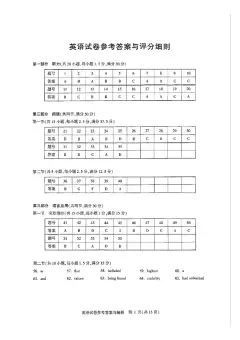
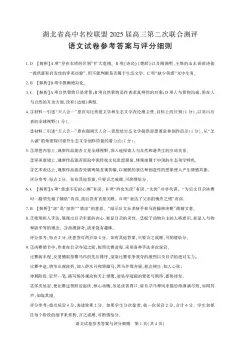
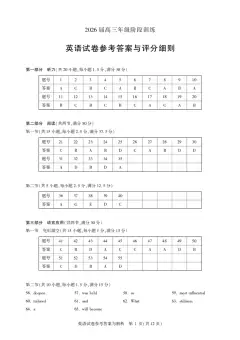
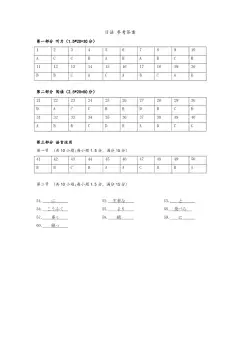
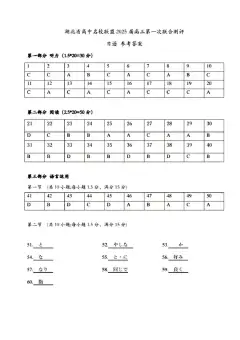
1-5. BABCC 6-10. BCABA 11-15. BACAC 16-20.CBBAC
21-23. CBA 24-27. DDCA 28-31. BCAD 32-35. DBAC 36-40.FGABE
41-45. BACBD 46-50. ACDAB 51-55.CBDAD
56.to preserve 57.vitality 58.merely 59.whom 60.has integrated/ has been integrating 61.to 62.rooted 63.increasing 64.stories 65.What
第四部分写作 (共两节,满分 40 分)
第一节:应用文写作 (满分 15 分)
参考范文
AI-assisted learning benefits me most in Chinese
Good morning, everyone! Today, I’d like to share how AI has made a difference in my studies. Among all the subjects, Chinese is the one in which I benefit most from AI-assisted learning.
To begin with, AI helps me become a better writer. Whenever I struggle to find the right words, it offers creative suggestions and inspires me to express my thoughts more vividly. Moreover, AI opens a window into the world of Chinese literature. By explaining ancient poems and the stories behind them, it helps me gain a deeper understanding of traditional Chinese culture. What once seemed difficult now becomes meaningful and enjoyable.
To me, AI is more than a learning tool. It is a bridge that connects me with knowledge and creativity. With AI as my learning partner, I hope to discover even more of the beauty of Chinese. Thank you!
第二节:读后续写 (满分 25 分)
参考范文
She began to search the house anxiously. She called Sunny’s name again and again, her heart pounding with fear. She looked under the bed, behind the sofa, and even outside in the rain-wet yard. Just as tears welled up in her eyes, she noticed a slight movement near the garden. There, behind the roses, was Sunny, holding something carefully in its mouth. It trotted toward her, its golden eyes shining with joy and pride. In its mouth was a single red rose, slightly crushed but still glowing with color.
Staring at the rose in Sunny’s mouth, Lila realized she was not the only one giving comfort. Sunny was giving something back, warmth, companionship, and a reason to smile again. Kneeling down, she gently took the rose and hugged the little cat tightly. For the first time in months, a genuine smile spread across her face. The world around her slowly regained its colors. That evening, she talked with her parents at dinner and reached out to her classmates the next day. She had finally found her way back to life, carrying her grandma’s love and Sunny’s companionship in her heart.
听力部分录音稿
(Text 1)
W: Dad, I’ve just got the university scholarship.
M: Congratulations! Will you buy yourself a new laptop?
W: No, improving my French is more urgent. (1) I will attend some training courses and buy relevant textbooks online.
(Text 2)
M: Joyce, I tried to get in shape these days, but it didn’t work at all.
W: What a pity! Did you keep jogging every day? I guess you gave in to snacks late at night.
M: Not exactly. (2) I skip dinner sometimes, only to find it leads to the opposite effect.
(Text 3)
W: I heard you gave up your part-time job at the café. Was the salary unsatisfying?
M: Not really. (3) It took up too much time, affecting my review for the coming exam.
(Text 4)
W: Hello, this is Mrs. Smith. My washing machine breaks down. Could you come to repair it at 9 a.m. tomorrow?
M: Sorry, I’ll be busy then. What about 1 p.m. tomorrow afternoon?
W: (4) I won’t get off work by 2 o’clock. Make it a quarter to three tomorrow afternoon.
(Text 5)
M: Dear, pause your short videos. (5) Grandma is in hospital and we need you to look after her for three days.
W: Okay, Grandpa. I will pack some spare clothes. When should I go to the hospital?
M: Your aunt will drive to pick you up in an hour.
(Text 6)
W: I’m calling to ask you to stop ringing me to sell products.
M: I’m sorry to disturb you, Mrs. King. (6) Our new product can save you much time after meals.
W: (6) I don’t believe it can help me save on electricity and make the plates look like new. Please don’t call me any more.
M: (7) All right. It will take two days to apply to have your phone number removed from the system. W: OK. After that, please make sure I won’t receive any more calls from your company.
M: No problem. I will mark your number.
(Text 7)
M: Have you heard that Jacky will mark our compositions with a new tool called Unicorn?
W: Yes. (8) He says AI can check spelling mistakes, faulty sentences, paragraph logic, structure and word count at the same time.
M: But most of us prefer comments written by a real teacher.
W: I totally understand your feelings. (9) Although it gives warm comments, the results produced by AI, which contain few concrete and down-to-earth tips, are too simple.
M: I can’t agree more.
W: However, Jacky thinks Unicorn is time-saving.
M: I hope he can reconsider this plan and read our essays in person.
W: (10)
: Long time no see, Bob. I’m stressed out lately. I can’t stop thinking about my major.
M: Oh, Cindy, I heard you wanted to study philosophy in college. Did something stop you?
W: (11) My parents firmly believe I’m just not cut out for philosophy. They think it requires strong logical thinking and deep insight. They insist I choose computer science.
M: Have you tried talking to them patiently?
W: I’ve tried several times, but they always interrupt me.
M: (12) Take it easy. Try this pork ball. It’s a specialty here. I think your parents misunderstand you. Actually, you’re really good at independent thinking.
W: But they just won’t listen. Do you have any useful advice?
M: Sure. (13) You can present your reading notes and related competition records to prove you have solid learning ability in this field.
(Text 9)
M: Hi, Coco. I heard that you’ve been helping homeless cats around our school for nearly two years. How did it start?
W: Well, it all started on a rainy afternoon. I found a tiny homeless cat hiding in the teaching building. (14) It was wet, scared and its nose was bleeding, so I decided to take care of it.
M: It’s so kind of you! What do you usually do to help these homeless cats?
W: (15) Every morning before class, I bring clean cat food and fresh water to the fixed feeding spots. On weekends, I will check their physical conditions carefully. If some cats get sick or hurt, I will take them to the nearby pet hospital.
M: It must take you a lot of time and energy. What will you do next?
W: (16) I desire to cooperate with local animal rescue centers to find suitable adoptive homes for those cats.
(Text 10)
Nowadays, more high school students choose to participate in social practice programs during vacation. Different from traditional volunteer work, a new kind of city exploration project has become popular in recent years. (17) The project aims to help teenagers connect textbook knowledge with real social life. Participants will be divided into small groups to complete field research, record local cultural features and interview residents. Teachers will offer guidance online and evaluate students’ performance based on their research reports and field records. (18) This summer’s project will last from July 18th to July 29th. Students need to sign up before July 10th. The school suggests students arrange their personal time in advance, (19) because no leave is permitted during the whole research period. According to previous experience, most students improved their independent thinking and teamwork ability. (20) Though the task is challenging, it offers precious experience that cannot be gained from classroom learning.