夜雨聆风学习资料网

ARTICLE · 1425460

人教版六年级下册英语期末核心考点复习
人教版六年级下册英语期末核心考点复习

复习目标:吃透课内核心词汇、短语、语法、句型和基础写作,稳拿期末基础分与课内必考分。
使用建议:先背单词和短语,再练语法句型,最后用写作模板仿写。


第一部分:全册考点总览与高频考法

一、全册复习目标

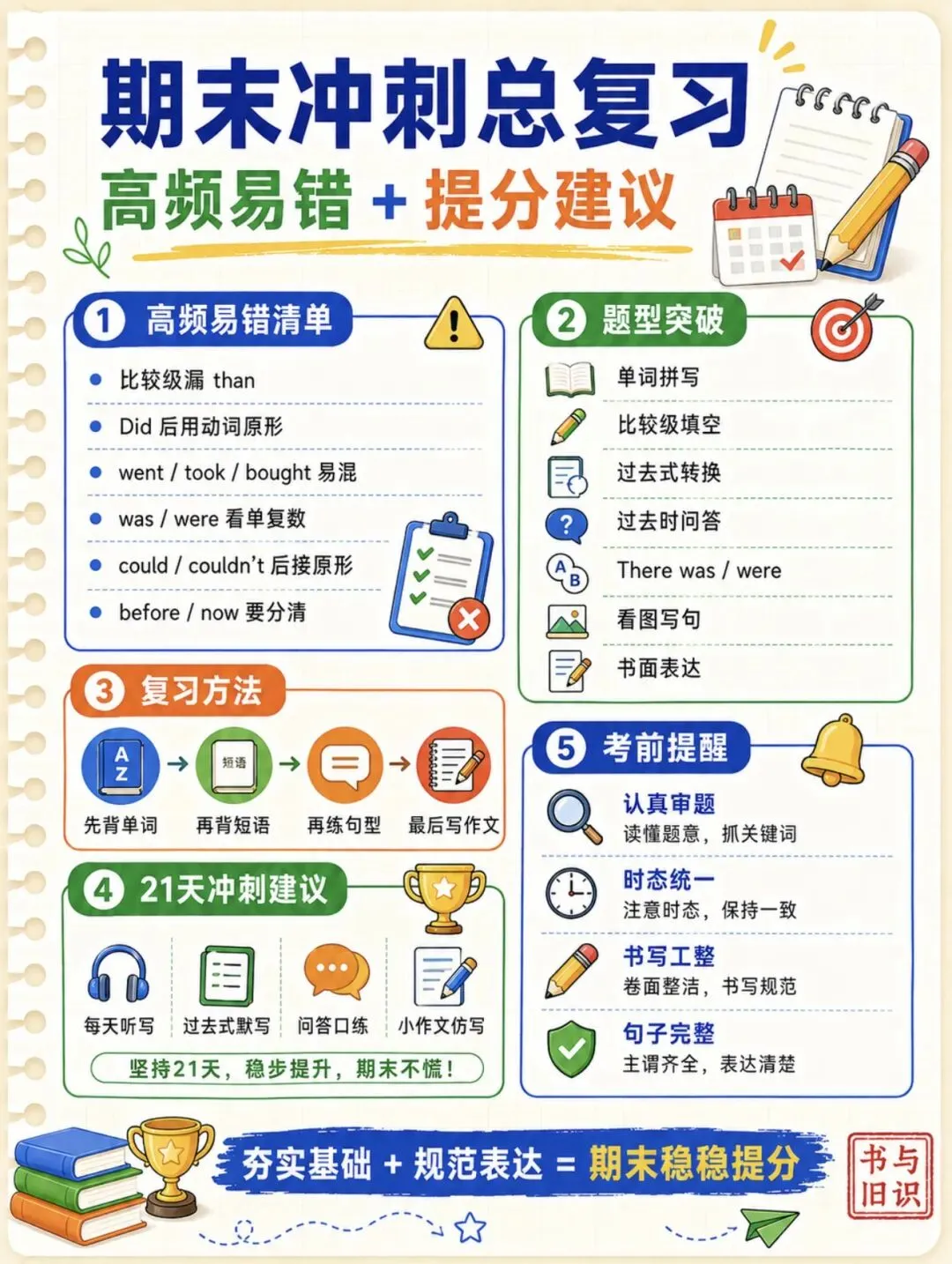
六年级下册是小学英语收尾复习册,期末核心不在“新难题”,而在比较级、一般过去时、过去时问答、过去与现在对比、毕业复习整合。本册最需要稳住的是:

  1. 1. 形容词比较级:会用 taller / shorter / older / younger / heavier 等比较人物、身高、体重、年龄。
  2. 2. 一般过去时:会用 cleaned / stayed / watched / washed / went / took / bought / rode / hurt 等表达过去发生的事。
  3. 3. 过去时问答:会问 What did you do? / Where did you go? / How did you go there? / Did you…? 并能完整回答。
  4. 4. Then and now 对比表达:会用 There was / There were / I couldn’t … before. / Now I can … 描述过去和现在的变化。
  5. 5. Recycle 综合复习:能把人物介绍、学校生活、旅行经历、过去与现在、毕业回忆整合成短文。
二、全册单元考点地图

单元
主题
期末核心内容
最容易失分点
Unit 1 How tall are you?
身高、体重、年龄比较
比较级、How tall / How heavy、than
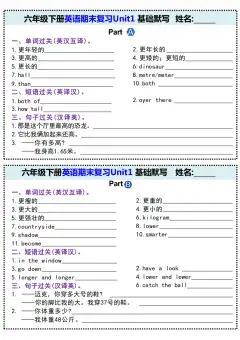
than 漏写;比较级拼写错误;metre / kilogram 混淆
Unit 2 Last weekend
上周末活动
一般过去时、规则动词过去式、Did you…?
did 后动词用原形;过去式拼写错误
Unit 3 Where did you go?
假期旅行经历
不规则动词过去式、Where / How / What did…?
went / took / bought / rode 拼写;问答不匹配
Unit 4 Then and now
过去与现在
There was/were、could/couldn’t、before/now
was/were 用错;before 与 now 逻辑不清
Recycle Mike’s happy days
综合复习
人物、学校、旅行、过去与现在、毕业回忆
内容能说但写不完整;过去时和现在时混乱
Appendix
附录复习
单词、表达、不规则动词、语音规律
不规则过去式、常用表达遗漏

三、全册核心必备得分模块

模块
重要程度
必须达到的标准
检查方法
核心单词
【★必考】
每单元核心词会认、会读、会拼、会用
每天听写 10—15 个
动词过去式
【★必考】
规则和不规则过去式都能正确写
原形 → 过去式快速转换
比较级
【★必考】
会用 adj.-er + than 比较
给两个人物信息造句
过去时问答
【★必考】
What / Where / How / Did 问答不混
看图或表格问答
Then and now
【★高频】
会用过去和现在对比
写 5 句变化
写作模板
【★必考】
能写周末、旅行、变化、毕业回忆
背模板后替换关键词

四、全册高频语法总框架

1. 形容词比较级【★必考】

结构
用法
例句
A + be + 比较级 + than + B
A 比 B 更……
I’m taller than you.
How tall are you?
询问身高
I’m 1.61 metres.
How heavy are you?
询问体重
I’m 48 kilograms.
原级
比较级
中文
易错提醒
tall
taller
更高的
直接加 -er
short
shorter
更矮的;更短的
直接加 -er
old
older
年龄更大的;更旧的
直接加 -er
young
younger
更年轻的
直接加 -er
long
longer
更长的
直接加 -er
strong
stronger
更强壮的
直接加 -er
heavy
heavier
更重的
y 变 i 加 -er
thin
thinner
更瘦的
双写 n 加 -er
big
bigger
更大的
双写 g 加 -er
small
smaller
更小的
直接加 -er

高频易错:

  • • I’m tall than you. ❌ → I’m taller than you. ✅
  • • He is heavier me. ❌ → He is heavier than me. ✅
  • • heavyer ❌ → heavier ✅

2. 一般过去时【★必考】

一般过去时表示过去发生的事情,常和 yesterday, last weekend, last night, last Monday, over the holiday 等时间连用。

类型
规则
例词
一般动词
直接加 -ed
clean → cleaned
以 e 结尾
加 -d
live → lived
辅音字母 + y 结尾
y 变 i 加 -ed
study → studied
重读闭音节
双写末尾辅音加 -ed
stop → stopped
不规则变化
特殊记忆
go → went

高频易错:

  • • I clean my room yesterday. ❌ → I cleaned my room yesterday. ✅
  • • Did you watched TV? ❌ → Did you watch TV? ✅
  • • I didn’t went there. ❌ → I didn’t go there. ✅

3. Did 引导的一般疑问句【★必考】

结构
例句
Did + 主语 + 动词原形…?
Did you see a film?
Yes, 主语 + did.
Yes, I did.
No, 主语 + didn’t.
No, I didn’t.

重点规则:Did 后面必须用动词原形。
Did you saw a film? ❌ → Did you see a film? ✅

4. 过去时特殊疑问句【★必考】

问句
用途
答句
What did you do?
问做了什么
I cleaned my room.
Where did you go?
问去了哪里
I went to Sanya.
How did you go there?
问怎么去的
I went there by plane.
Who did you go with?
问和谁去
I went with my parents.
When did you go?
问什么时候去
I went there last summer holiday.

高频易错:Where you went? ❌ → Where did you go? ✅

5. There was / There were【★高频】

结构
用法
例句
There was + 单数/不可数名词
过去有一个/某物
There was no gym in my school.
There were + 复数名词
过去有多个
There were no computers then.
There is / are
现在有
There is a new gym now.

高频易错:There were no gym. ❌ → There was no gym. ✅

6. could / couldn’t【★高频】

结构
用法
例句
could + 动词原形
过去能做某事
I could run fast before.
couldn’t + 动词原形
过去不能做某事
I couldn’t ride a bike before.
can + 动词原形
现在能做某事
Now I can ride a bike.

高频易错:I couldn’t rode a bike. ❌ → I couldn’t ride a bike. ✅


五、全册高频易错点总表

易错点
错误形式
正确形式
提醒
比较级漏 than
I’m taller you.
I’m taller than you.
比较对象前用 than
heavy 比较级
heavyer
heavier
y 变 i 加 -er
thin 比较级
thiner
thinner
双写 n
Did 后用过去式
Did you watched TV?
Did you watch TV?
Did 后动词原形
否定句过去式
I didn’t went.
I didn’t go.
didn’t 后原形
went / go 混用
I go there yesterday.
I went there yesterday.
过去时间用 went
took 拼写
taked
took
不规则变化
bought 拼写
buyed
bought
不规则变化
There was / were
There were no gym.
There was no gym.
单数用 was
couldn’t 后过去式
I couldn’t rode.
I couldn’t ride.
情态动词后原形

第二部分:分单元核心考点梳理

Unit 1 How tall are you?

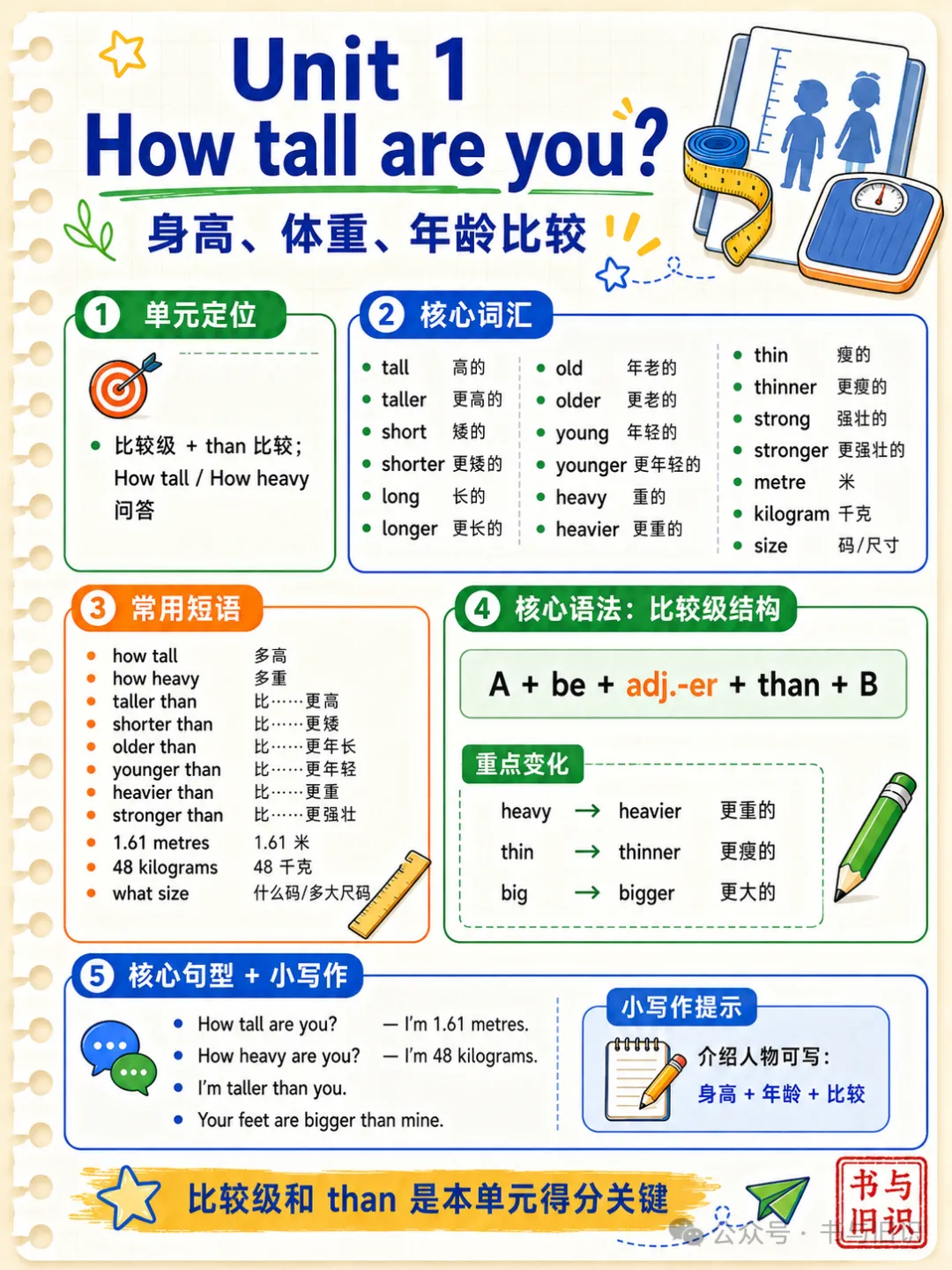
一、单元核心定位

期末核心分值占比估测: 词汇短语约 35%,语法句型约 45%,写作关联约 20%。
核心必抓内容: 本单元重点是形容词比较级 + 身高体重年龄问答。学生必须会用 taller, shorter, older, younger, heavier 等比较两个人或物,并能正确使用 than。
二、词汇核心考点

1. 必背核心单词

单词
音标
词性
精准中文释义
易错点
使用价值
例句
tall
/tɔːl/
adj.
高的
比较级 taller
身高比较核心词
I’m tall.
taller
/ˈtɔːlə®/
adj.
更高的
tall + er
比较级必考
I’m taller than you.
short
/ʃɔːt/
adj.
矮的;短的
可指身高或长度
比较表达
He is shorter than me.
shorter
/ˈʃɔːtə®/
adj.
更矮的;更短的
short + er
比较级
The ruler is shorter.
long
/lɒŋ/
adj.
长的
比较级 longer
长度比较
My hair is long.
longer
/ˈlɒŋɡə®/
adj.
更长的
long + er
比较级
Your hair is longer than mine.
old
/əʊld/
adj.
年龄大的;旧的
older
年龄比较
He is old.
older
/ˈəʊldə®/
adj.
年龄更大的;更旧的
old + er
年龄比较必考
I’m older than you.
young
/jʌŋ/
adj.
年轻的;年幼的
younger
年龄比较
She is young.
younger
/ˈjʌŋɡə®/
adj.
更年轻的
young + er
年龄比较
He is younger than me.
heavy
/ˈhevi/
adj.
重的
y 变 i 加 er
体重比较
The bag is heavy.
heavier
/ˈheviə®/
adj.
更重的
不是 heavyer
体重比较必考
I’m heavier than him.
thin
/θɪn/
adj.
瘦的;薄的
比较级 thinner
人物外貌
He is thin.
thinner
/ˈθɪnə®/
adj.
更瘦的;更薄的
双写 n
比较级易错
She is thinner than me.
strong
/strɒŋ/
adj.
强壮的
stronger
人物描述
He is strong.
stronger
/ˈstrɒŋɡə®/
adj.
更强壮的
strong + er
比较级
He is stronger than me.
metre
/ˈmiːtə®/
n.
米
英式拼写 metre
身高单位
I’m 1.61 metres.
kilogram
/ˈkɪləɡræm/
n.
千克;公斤
kilo + gram
体重单位
I’m 48 kilograms.
size
/saɪz/
n.
尺码;大小
shoe size
鞋码表达
What size are your shoes?
dinosaur
/ˈdaɪnəsɔː®/
n.
恐龙
长词,注意 dino-
阅读/情景词
The dinosaur is taller.

2. 必考固定短语 / 搭配

短语
中文释义
例句
标注
使用提醒
how tall
多高
How tall are you?
【★必考】
问身高
how heavy
多重
How heavy are you?
【★必考】
问体重
how old
多大;几岁
How old are you?
【★高频】
问年龄
1.61 metres
1.61 米
I’m 1.61 metres.
【★必考】
metres 用复数
48 kilograms
48 千克
I’m 48 kilograms.
【★必考】
kilograms 用复数
taller than
比……更高
I’m taller than you.
【★必考】
than 不能漏
shorter than
比……更矮/短
He is shorter than me.
【★必考】
比较对象前加 than
older than
比……年龄更大
I’m older than him.
【★高频】
年龄比较
younger than
比……更年轻
She is younger than me.
【★高频】
年龄比较
heavier than
比……更重
The elephant is heavier than the horse.
【★必考】
heavy → heavier
stronger than
比……更强壮
He is stronger than me.
【★高频】
strong + er
what size
什么尺码
What size are your shoes?
【★高频】
鞋码表达

3. 高频词形转换

原词
词性
转换词
词性
中文
使用提醒
tall
adj.
taller
adj.
更高的
直接加 -er
short
adj.
shorter
adj.
更矮的/更短的
直接加 -er
long
adj.
longer
adj.
更长的
直接加 -er
old
adj.
older
adj.
更年长的
直接加 -er
young
adj.
younger
adj.
更年轻的
直接加 -er
strong
adj.
stronger
adj.
更强壮的
直接加 -er
heavy
adj.
heavier
adj.
更重的
y 变 i 加 -er
thin
adj.
thinner
adj.
更瘦的
双写 n
big
adj.
bigger
adj.
更大的
双写 g
small
adj.
smaller
adj.
更小的
直接加 -er

4. 基础易混词辨析

易混词组
区分方法
例句
tall / high
tall 常形容人或直立物;high 常形容高度位置
He is tall. / The mountain is high.
heavy / heavier
heavy 原级;heavier 比较级
My bag is heavy. His bag is heavier.
older / old
older 用于比较;old 描述本身
I’m older than you.
than / then
than 用于比较;then 表然后
I’m taller than him.
metre / kilogram
metre 是长度单位;kilogram 是重量单位
1.61 metres / 48 kilograms

三、语法核心考点

【★必考】比较级 + than

规则说明: 比较两个人或物时,用:A + be + 形容词比较级 + than + B。

核心例句:

  • • I’m taller than you.
  • • You’re older than me.
  • • My shoes are bigger than yours.

核心考法: 根据表格写比较句;选择正确比较级;补全 than;比较身高、体重、年龄、鞋码。

高频易错点:

  • • I’m tall than you. ❌ → I’m taller than you. ✅
  • • My shoes are bigger yours. ❌ → My shoes are bigger than yours. ✅

【★必考】How tall / How heavy

How tall 问身高,How heavy 问体重。

  • • How tall are you? — I’m 1.61 metres.
  • • How heavy are you? — I’m 48 kilograms.

四、单元核心句型

句型
中文
使用价值
How tall are you?
你多高?
身高问答必考
I’m 1.61 metres.
我 1.61 米。
身高回答
How heavy are you?
你多重?
体重问答必考
I’m 48 kilograms.
我 48 千克。
体重回答
I’m taller than you.
我比你高。
比较级核心句
Your feet are bigger than mine.
你的脚比我的大。
比较级 + 物主代词

单元写作模板

I have a good friend. His name is Tom. He is 1.62 metres. I am 1.58 metres, so he is taller than me. He is also stronger than me. But I am younger than him. We often play together.


Unit 2 Last weekend

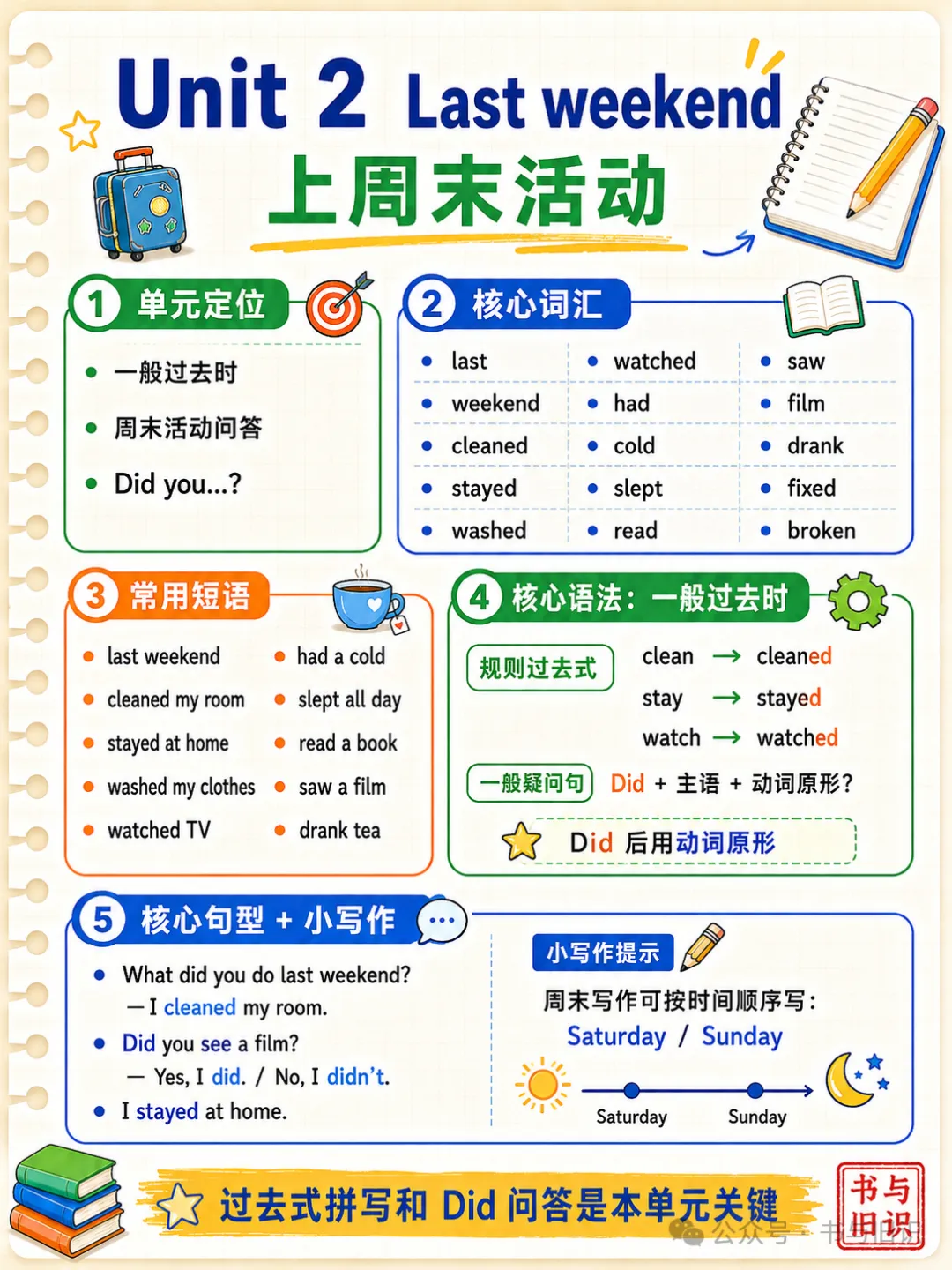
一、单元核心定位

期末核心分值占比估测: 词汇短语约 35%,语法句型约 45%,写作关联约 20%。
核心必抓内容: 本单元重点是一般过去时 + 上周末活动。学生必须掌握规则动词过去式,并会用 What did you do last weekend? / Did you…? 进行问答。
二、词汇核心考点

1. 必背核心单词

单词
音标
词性
精准中文释义
易错点
使用价值
例句
last
/lɑːst/
adj.
上一个的;最近过去的
last weekend
过去时间标志
I was busy last weekend.
weekend
/ˌwiːkˈend/
n.
周末
week + end
单元主题词
What did you do last weekend?
cleaned
/kliːnd/
v.
打扫了
clean + ed
规则过去式
I cleaned my room.
stayed
/steɪd/
v.
待;停留了
stay + ed
规则过去式
I stayed at home.
washed
/wɒʃt/
v.
洗了
wash + ed,读 /t/
家务活动
I washed my clothes.
watched
/wɒtʃt/
v.
看了
watch + ed,读 /t/
周末活动
I watched TV.
had
/hæd/
v.
有;吃;患病
have 的过去式
不规则过去式
I had a cold.
cold
/kəʊld/
n./adj.
感冒;冷的
have a cold
身体状况
I had a cold.
slept
/slept/
v.
睡觉
sleep 的过去式
不规则过去式
I slept all day.
read
/red/
v.
读了
过去式拼写同原形,发音变
阅读活动
I read a book yesterday.
saw
/sɔː/
v.
看见;看了
see 的过去式
不规则过去式
I saw a film.
film
/fɪlm/
n.
电影
see a film
周末活动
I saw a film.
better
/ˈbetə®/
adj./adv.
更好的;好些
good/well 的比较级
身体好转
I feel better now.
faster
/ˈfɑːstə®/
adv./adj.
更快地;更快的
fast + er
阅读中常见
It is faster.
hotel
/həʊˈtel/
n.
旅馆
ho-tel
旅行场景
We stayed in a hotel.
fixed
/fɪkst/
v.
修理了
fix + ed
故事情节
He fixed a broken chair.
broken
/ˈbrəʊkən/
adj.
破损的
break 的过去分词
阅读词
The chair was broken.

2. 必考固定短语 / 搭配

短语
中文释义
例句
标注
使用提醒
last weekend
上周末
What did you do last weekend?
【★必考】
过去时间标志
cleaned my room
打扫了我的房间
I cleaned my room.
【★必考】
cleaned 过去式
stayed at home
待在家
I stayed at home all weekend.
【★必考】
stayed 过去式
washed my clothes
洗了我的衣服
I washed my clothes.
【★必考】
clothes 常用复数
watched TV
看了电视
I watched TV.
【★必考】
watched 读 /t/
had a cold
感冒了
I had a cold.
【★必考】
have → had
slept all day
睡了一整天
I slept all day.
【★高频】
sleep → slept
read a book
读了一本书
I read a book.
【★高频】
read 过去式发 /red/
saw a film
看了电影
I saw a film.
【★必考】
see → saw
drank tea
喝了茶
I drank tea with my grandpa.
【★高频】
drink → drank
watched some children’s shows
看了一些儿童节目
I watched some children’s shows.
【★了解】
阅读中常见
fixed a broken chair
修理了一把坏椅子
He fixed a broken chair.
【★了解】
阅读词组

3. 高频词形转换

原词
词性
转换词
词性
中文
使用提醒
clean
v.
cleaned
v.
打扫了
规则过去式
stay
v.
stayed
v.
待了
规则过去式
wash
v.
washed
v.
洗了
规则过去式
watch
v.
watched
v.
看了
规则过去式
have
v.
had
v.
有;患病
不规则
sleep
v.
slept
v.
睡了
不规则
read
v.
read
v.
读了
拼写同原形,发音不同
see
v.
saw
v.
看见了
不规则
drink
v.
drank
v.
喝了
不规则
fix
v.
fixed
v.
修理了
规则过去式

4. 基础易混词辨析

易混词组
区分方法
例句
last weekend / this weekend
last weekend 是过去;this weekend 可指本周末
I stayed at home last weekend.
wash / washed
wash 原形;washed 过去式
I washed my clothes yesterday.
watch / watched
watch 原形;watched 过去式
Did you watch TV?
see / saw
see 原形;saw 过去式
I saw a film.
have / had
have 原形;had 过去式
I had a cold.

三、语法核心考点

【★必考】一般过去时:规则动词过去式

描述过去发生的动作时,动词要用过去式。

  • • I cleaned my room.
  • • I washed my clothes.
  • • I stayed at home.

高频易错:I clean my room last weekend. ❌ → I cleaned my room last weekend. ✅

【★必考】Did you…?

Did 开头的一般疑问句中,后面动词必须用原形。

  • • Did you see a film?
  • • Yes, I did.
  • • No, I didn’t.

高频易错:Did you saw a film? ❌ → Did you see a film? ✅

四、单元核心句型

句型
中文
使用价值
What did you do last weekend?
你上周末做了什么?
周末活动问答必考
I cleaned my room.
我打扫了房间。
规则过去式
I stayed at home.
我待在家。
周末活动
Did you see a film?
你看电影了吗?
Did 问句
No, I had a cold.
没有,我感冒了。
不规则过去式 had
I watched TV and drank tea.
我看电视并喝茶。
过去活动并列

单元写作模板

Last weekend, I was busy. On Saturday morning, I cleaned my room and washed my clothes. In the afternoon, I watched TV. On Sunday, I stayed at home and read a book. I was tired but happy.


Unit 3 Where did you go?

一、单元核心定位

期末核心分值占比估测: 词汇短语约 35%,语法句型约 45%,写作关联约 20%。
核心必抓内容: 本单元重点是假期旅行经历 + 不规则动词过去式 + 过去时特殊疑问句。学生必须会用 Where did you go? / How did you go there? / What did you do? 完整描述一次旅行。
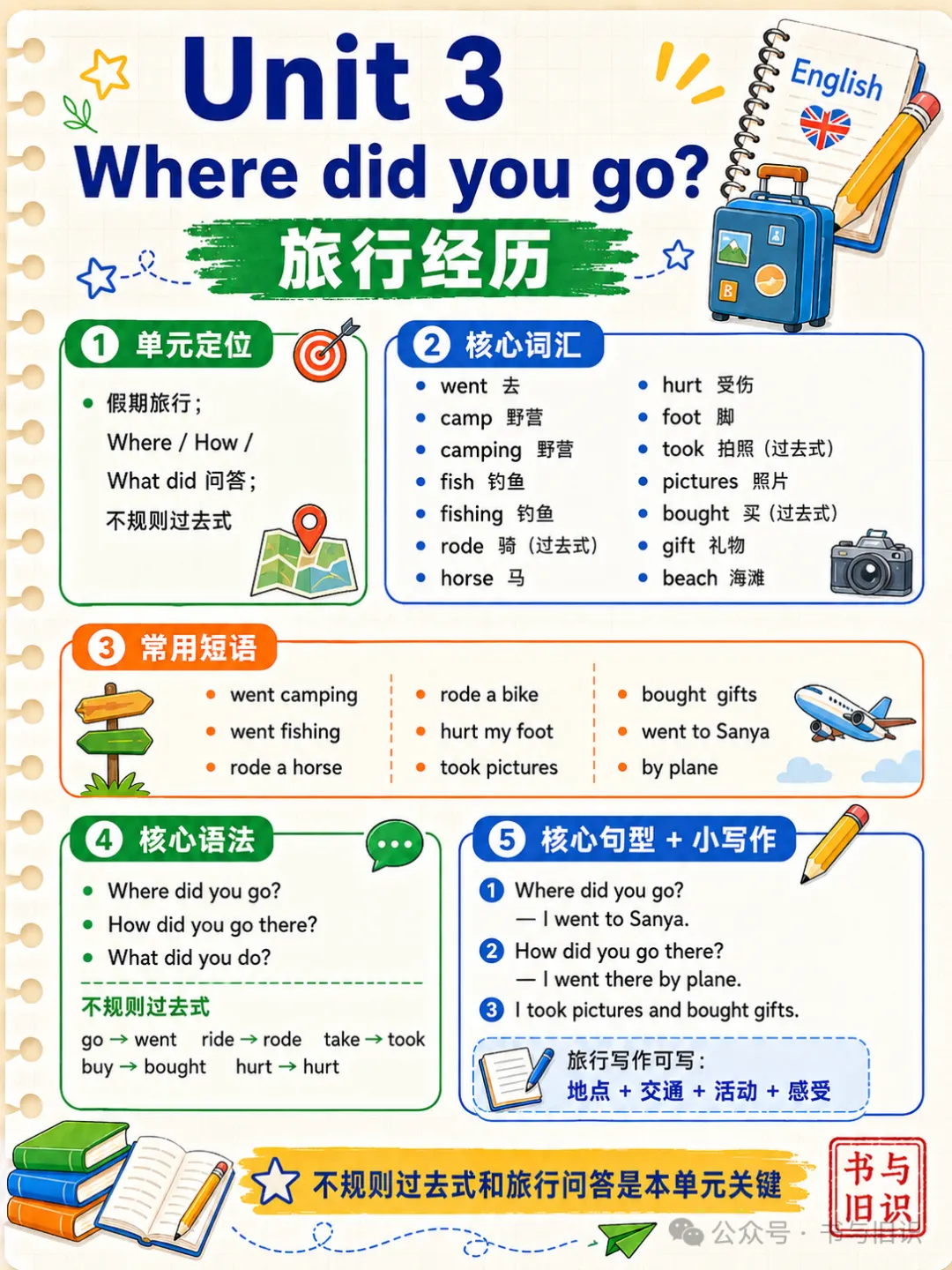
二、词汇核心考点

1. 必背核心单词

单词
音标
词性
精准中文释义
易错点
使用价值
例句
went
/went/
v.
去了
go 的过去式
旅行表达必考
I went to Sanya.
camp
/kæmp/
v./n.
野营;营地
camped 过去式
活动词
I went camping.
camping
/ˈkæmpɪŋ/
n./v-ing
野营
go camping
假期活动
I went camping last summer.
fish
/fɪʃ/
v./n.
钓鱼;鱼
fishing
活动词
I went fishing.
fishing
/ˈfɪʃɪŋ/
n./v-ing
钓鱼
go fishing
假期活动
We went fishing by the lake.
ride
/raɪd/
v.
骑
rode 过去式
交通/活动
I ride a bike.
rode
/rəʊd/
v.
骑了
ride 的过去式
不规则过去式
I rode a horse.
horse
/hɔːs/
n.
马
ride a horse
旅行活动
I rode a horse.
hurt
/hɜːt/
v.
受伤;弄伤
原形和过去式同形
事故表达
I hurt my foot.
foot
/fʊt/
n.
脚
复数 feet
身体部位
My foot hurts.
took
/tʊk/
v.
拍照;乘坐;拿了
take 的过去式
不规则过去式
I took pictures.
pictures
/ˈpɪktʃəz/
n.
图画;照片
take pictures
旅行活动
I took many pictures.
bought
/bɔːt/
v.
买了
buy 的过去式
不规则过去式
I bought gifts.
gift
/ɡɪft/
n.
礼物
gifts 复数
旅行购物
I bought gifts for my friends.
beach
/biːtʃ/
n.
海滩
ea 发 /iː/
旅行地点
I went to the beach.
basket
/ˈbɑːskɪt/
n.
篮;筐
basket + ball
阅读词
I put gifts in the basket.
part
/pɑːt/
n.
角色;部分
part in a play
阅读/表达
He played the part of a dog.

2. 必考固定短语 / 搭配

短语
中文释义
例句
标注
使用提醒
went camping
去野营了
I went camping.
【★必考】
go → went
went fishing
去钓鱼了
We went fishing.
【★必考】
go + v-ing
rode a horse
骑马了
I rode a horse.
【★必考】
ride → rode
rode a bike
骑自行车了
I rode a bike.
【★高频】
rode 不写 rided
hurt my foot
伤了脚
I hurt my foot.
【★必考】
hurt 过去式同形
took pictures
拍照了
I took pictures.
【★必考】
take → took
bought gifts
买礼物了
I bought gifts.
【★必考】
buy → bought
went to Sanya
去了三亚
I went to Sanya.
【★高频】
地名前用 to
by plane
乘飞机
I went there by plane.
【★高频】
交通方式
over the winter holiday
在寒假期间
I went to Harbin over the winter holiday.
【★高频】
holiday 旅行时间
dressed up
打扮;装扮
We dressed up and made a funny play.
【★了解】
阅读中常见
made a funny play
编了一个有趣的剧
We made a funny play.
【★了解】
make → made

3. 高频词形转换

原词
词性
转换词
词性
中文
使用提醒
go
v.
went
v.
去了
不规则
ride
v.
rode
v.
骑了
不规则
hurt
v.
hurt
v.
受伤了
原形过去式同形
take
v.
took
v.
拍;拿;乘坐
不规则
buy
v.
bought
v.
买了
不规则
eat
v.
ate
v.
吃了
不规则
make
v.
made
v.
制作了
不规则
dress
v.
dressed
v.
打扮了
规则
fall
v.
fell
v.
摔倒了;掉下
不规则
can
modal v.
could
modal v.
能够
过去能力

4. 基础易混词辨析

易混词组
区分方法
例句
went / go
went 是过去式;go 是原形
I went to Sanya.
rode / ride
rode 是过去式;ride 是原形
Did you ride a horse?
took / take
took 是过去式;take 是原形
I took pictures.
bought / brought
bought 买了;brought 带来了
I bought gifts.
Where / What / How
Where 问地点;What 问事情;How 问方式
Where did you go?

三、语法核心考点

【★必考】Where did you go?

询问过去去了哪里,用 Where did you go? 回答用 I went to + 地点。

  • • Where did you go?
  • • I went to Sanya.

高频易错:Where you went? ❌ → Where did you go? ✅

【★必考】How did you go there?

询问过去怎么去,用 How did you go there? 回答交通方式。

  • • How did you go there?
  • • I went there by plane.

高频易错:How did you went there? ❌ → How did you go there? ✅

四、单元核心句型

句型
中文
使用价值
Where did you go?
你去了哪里?
旅行地点问答
I went to Sanya.
我去了三亚。
went to + 地点
How did you go there?
你怎么去那里的?
交通方式问句
I went there by plane.
我乘飞机去那里。
交通方式回答
What did you do?
你做了什么?
旅行活动问句
I took pictures and bought gifts.
我拍照并买了礼物。
旅行写作句

单元写作模板

I went to Sanya over the summer holiday. I went there with my parents. We went there by plane. I went swimming and took many pictures. I also bought gifts for my friends. It was a wonderful trip.


Unit 4 Then and now

一、单元核心定位

期末核心分值占比估测: 词汇短语约 30%,语法句型约 45%,写作关联约 25%。
核心必抓内容: 本单元重点是过去与现在对比。学生必须会用 There was / There were 描述过去的环境,用 Now there is / are 描述现在的变化,也要会用 I couldn’t … before. Now I can … 描述个人能力变化。
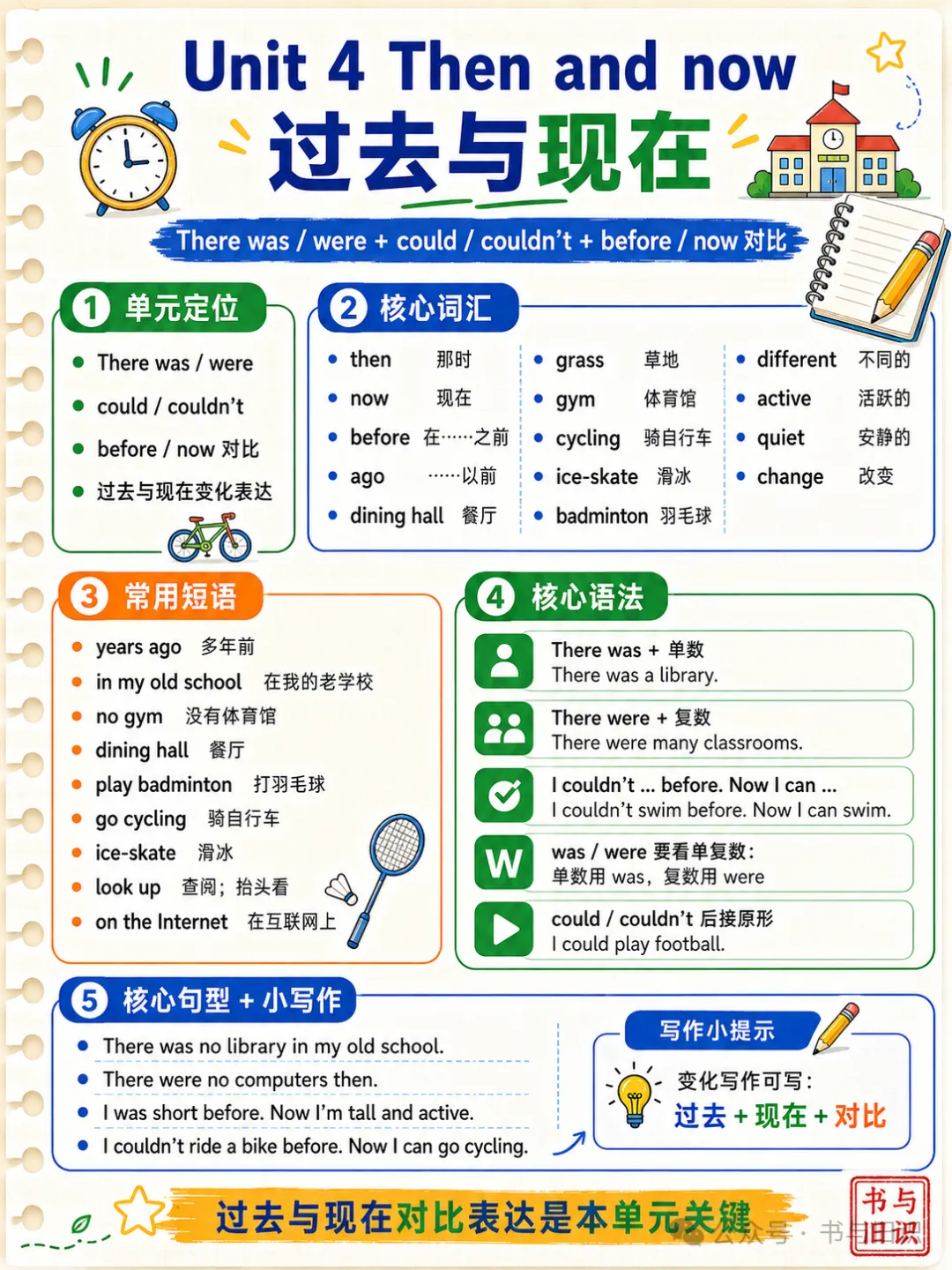
二、词汇核心考点

1. 必背核心单词

单词
音标
词性
精准中文释义
易错点
使用价值
例句
then
/ðen/
adv.
当时;那时
和 than 区分
过去对比
There was no gym then.
now
/naʊ/
adv.
现在
和 know 区分
现在对比
Now there is a new gym.
before
/bɪˈfɔː®/
adv./prep.
以前;在……之前
be-fore
变化表达
I couldn’t ride a bike before.
ago
/əˈɡəʊ/
adv.
以前
时间段 + ago
过去时间
Ten years ago, I was short.
dining hall
/ˈdaɪnɪŋ hɔːl/
n.
饭厅
dining 不写 dinning
学校设施
There was no dining hall.
grass
/ɡrɑːs/
n.
草坪;草
不可数
学校环境
There was no grass.
gym
/dʒɪm/
n.
体育馆
短词
学校设施
There is a gym now.
cycling
/ˈsaɪklɪŋ/
n./v-ing
骑自行车运动
cycle 去 e 加 ing
活动词
I like cycling.
ice-skate
/ˈaɪs skeɪt/
v.
滑冰
中间有连字符
运动活动
I can ice-skate.
badminton
/ˈbædmɪntən/
n.
羽毛球运动
长词
体育活动
I play badminton.
different
/ˈdɪfrənt/
adj.
不同的
differ + ent
对比表达
We are different now.
active
/ˈæktɪv/
adj.
活跃的;积极的
act + ive
人物变化
I’m very active now.
quiet
/ˈkwaɪət/
adj.
安静的
和 quite 区分
人物性格
I was quiet before.
change
/tʃeɪndʒ/
v./n.
改变;变化
change + d
主题词
We all change.
star
/stɑː®/
n.
星星;明星
ar 发 /ɑː/
阅读词
I looked it up on the Internet.
Internet
/ˈɪntənet/
n.
互联网
首字母常大写
阅读词
I looked it up on the Internet.

2. 必考固定短语 / 搭配

短语
中文释义
例句
标注
使用提醒
then and now
过去和现在
Then and now, we are different.
【★必考】
单元主题
years ago
……年前
Ten years ago, I was short.
【★必考】
时间段 + ago
last year
去年
I was quiet last year.
【★高频】
过去时间
in my old school
在我的旧学校
There was no gym in my old school.
【★高频】
old school
dining hall
饭厅
There was no dining hall.
【★必考】
学校设施
no gym
没有体育馆
There was no gym.
【★必考】
no + 名词
play badminton
打羽毛球
I play badminton every week.
【★高频】
体育活动
go cycling
去骑自行车
I go cycling every day.
【★高频】
go + v-ing
ice-skate
滑冰
I couldn’t ice-skate before.
【★高频】
情态动词后原形
look up
查阅
I looked it up on the Internet.
【★了解】
look up 信息
on the Internet
在互联网上
I looked it up on the Internet.
【★了解】
介词 on
all different now
现在完全不同
We are all different now.
【★高频】
写作总结句

3. 高频词形转换

原词
词性
转换词
词性
中文
使用提醒
is
v.
was
v.
是(过去)
单数过去
are
v.
were
v.
是(过去)
复数过去
can
modal v.
could
modal v.
能(过去)
后接原形
can’t
modal v.
couldn’t
modal v.
不能(过去)
后接原形
change
v.
changed
v.
改变了
规则过去式
look
v.
looked
v.
看;查阅了
look up
cycle
v.
cycling
v-ing/n.
骑自行车
去 e 加 ing
skate
v.
skating
v-ing
滑冰
去 e 加 ing
different
adj.
difference
n.
不同;差异
了解即可
active
adj.
activity
n.
活动
词形相关

4. 基础易混词辨析

易混词组
区分方法
例句
then / than
then 那时;than 用于比较
There was no gym then. / He is taller than me.
before / ago
before 可单独用;ago 常放在时间段后
I was short before. / Ten years ago…
was / were
单数用 was;复数用 were
There was no gym. / There were no computers.
can / could
can 表现在能;could 表过去能
Now I can swim. / Before I could not swim.
quiet / quite
quiet 安静的;quite 非常
I was quiet before.

三、语法核心考点

【★必考】There was / There were

描述过去某地“有”或“没有”某物时,用 There was / There were。

  • • There was no library in my old school.
  • • There were no computers or Internet in my time.

高频易错:There were no gym. ❌ → There was no gym. ✅

【★高频】I couldn’t … before. Now I can …

描述过去不能做但现在能做的事情,用 couldn’t 与 can 对比。

  • • I couldn’t ride my bike well before.
  • • Now I go cycling every day.

高频易错:I couldn’t rode a bike. ❌ → I couldn’t ride a bike. ✅

四、单元核心句型

句型
中文
使用价值
There was no library in my old school.
我以前的学校没有图书馆。
过去环境描述
There were no computers then.
那时没有电脑。
复数过去 there be
Now there is a new gym.
现在有一个新体育馆。
现在变化
I was short before.
我以前很矮。
人物过去
Now I’m tall and active.
现在我又高又活跃。
人物现在
I couldn’t ride a bike before.
我以前不会骑自行车。
过去能力
Now I go cycling every day.
现在我每天骑自行车。
现在能力

单元写作模板

My school was small before. There was no gym and there were no computers. Now my school is big and beautiful. There is a new library and a new dining hall. I was short and quiet before, but now I am tall and active. We are all different now.


Recycle Mike’s happy days

一、复习定位

Recycle 是六年级下册的综合复习部分,重点不在新语法,而在把小学阶段学过的人物介绍、学校生活、周末活动、旅行经历、过去与现在、毕业回忆整合起来。

二、核心复习内容

模块
必抓内容
高频表达
人物介绍
姓名、年龄、身高、性格、爱好
He is taller than me. / She likes reading.
学校生活
课程、活动、学校设施
We have a big library.
周末活动
一般过去时
I cleaned my room last weekend.
旅行经历
去了哪里、怎么去、做了什么
I went to Sanya by plane.
过去与现在
then and now
I was quiet before. Now I’m active.
毕业回忆
感受、感谢、计划
I will miss my teachers and friends.

三、综合写作模板

1. My happy school days

I had many happy days at school. I studied English, maths and Chinese. I played sports with my friends. My school was small before, but now it is big and beautiful. I will miss my teachers and classmates.

2. My last weekend

Last weekend, I was busy but happy. On Saturday, I cleaned my room and watched TV. On Sunday, I went to the park with my parents. We took pictures and had a good time.

3. My trip

I went to Beijing last summer holiday. I went there with my family by train. We visited many famous places and took lots of pictures. I bought gifts for my friends. It was a great trip.


Appendix 核心复习整合

Appendix 1: Songs in each unit【★了解】

歌曲部分主要帮助复习语音、节奏和核心句型。期末笔试一般不直接考歌词,但会通过句型和词汇间接出现。复习时熟悉主题句即可,不需要逐字默写歌词。
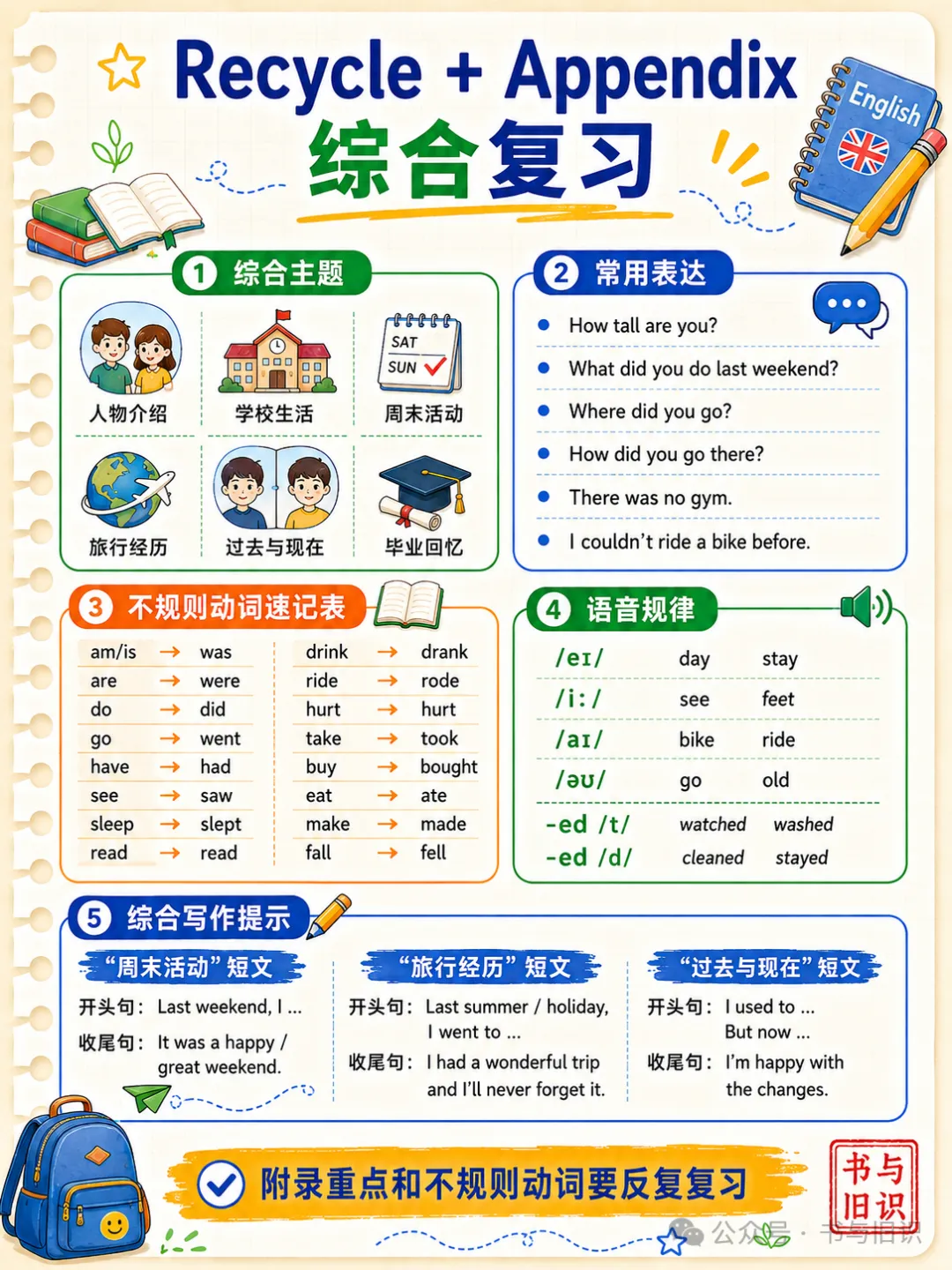
Appendix 2 / 3: Words in each unit & Vocabulary【★必考】

类型
高频词
比较级
taller, shorter, longer, older, younger, heavier, thinner, stronger
周末活动
cleaned, stayed, washed, watched, had, slept, read, saw
旅行活动
went, rode, hurt, took, bought, ate
学校变化
dining hall, grass, gym, Internet
时间词
yesterday, last weekend, last night, before, ago, now

Appendix 4: Useful expressions【★必考】

表达
中文
使用场景
How tall are you?
你多高?
Unit 1 身高
I’m taller than you.
我比你高。
Unit 1 比较
What did you do last weekend?
你上周末做了什么?
Unit 2 周末活动
Did you see a film?
你看电影了吗?
Unit 2 一般疑问句
Where did you go?
你去了哪里?
Unit 3 旅行
How did you go there?
你怎么去那里的?
Unit 3 交通方式
There was no gym in my school.
我学校以前没有体育馆。
Unit 4 过去环境
I couldn’t ride my bike well.
我以前骑不好自行车。
Unit 4 能力变化

Appendix 5: Proverbs【★了解】

谚语部分以理解为主,常用于阅读积累或作文点缀。复习时做到能看懂大意即可,不作为核心默写内容。

Appendix 6: Short plays【★了解】

短剧部分主要训练综合表达能力,期末可能通过阅读理解或情景交际间接出现。重点关注人物对话、场景理解、过去时和现在时混合表达,不需要逐句背诵。

Appendix 7: Irregular verbs【★必考】

原形
过去式
中文
易错提醒
am/is
was
是
单数过去
are
were
是
复数过去
do
did
做
Did 后原形
go
went
去
不写 goed
have
had
有;吃;患病
had a cold
see
saw
看见
saw a film
sleep
slept
睡觉
slept all day
read
read
读
拼写同原形,发音变
drink
drank
喝
drank tea
ride
rode
骑
rode a horse
hurt
hurt
受伤
原形过去式同形
take
took
拍;拿;乘坐
took pictures
buy
bought
买
bought gifts
eat
ate
吃
ate fresh food
make
made
制作
made a funny play
fall
fell
摔倒;落下
fell off

Appendix 8: English pronunciation patterns【★高频】

语音规律
例词
提醒
/eɪ/
day, stay, ate
ay / a-e 常发 /eɪ/
/iː/
see, feet, read
ee / ea 常发 /iː/
/aɪ/
bike, ride, size
i-e 常发 /aɪ/
/əʊ/
go, rode, old
o / o-e 常发 /əʊ/
/ɔː/
tall, saw
al / aw 常见
/ɜː/
hurt, turn, work
ur / or 在部分词中发 /ɜː/
-ed /t/
watched, washed
清辅音后读 /t/
-ed /d/
cleaned, stayed
浊辅音或元音后读 /d/
-ed /ɪd/
wanted, visited
t / d 后读 /ɪd/

第三部分:期末冲刺复习建议

一、学生每日复习顺序

  1. 1. 默写 10—15 个核心单词。
  2. 2. 背 8 个动词过去式。
  3. 3. 练 5 句比较级。
  4. 4. 练 5 句一般过去时问答。
  5. 5. 看图写 3—5 句过去活动。
  6. 6. 每两天仿写一篇小短文。

二、家长检查清单

  • • [ ] 会用 How tall / How heavy 问答。
  • • [ ] 会写 taller, shorter, older, younger, heavier, thinner。
  • • [ ] 会用 than 比较。
  • • [ ] 会写 cleaned, stayed, washed, watched。
  • • [ ] 会写 went, rode, hurt, took, bought。
  • • [ ] 知道 Did 后面接动词原形。
  • • [ ] 会用 Where did you go? / How did you go there?
  • • [ ] 会用 There was / There were。
  • • [ ] 会用 I couldn’t … before. Now I can …
  • • [ ] 会写周末、旅行、变化三类小作文。

免责声明
本公众号部分转载的文章、图文、视频来自网络,其版权和文责属原作者所有,若来源标注错误或侵犯到您的权益,烦请告知,我们将立即删除。
回首页,搜索你想要的文档

在首页搜索框输入关键词,快速定位资料

文库首页搜索指引 立即搜索

相关学习资料