2023-2024 学年八年级下期末考点大串讲(人教版)
专题 02 核心考点归纳
1.What’s the matter?
考点聚焦
1.What’s the matter? 怎么了?
【用法详解】“What’s the matter?”表示“怎么了?/出什么事了?”,常用于询问某人有什么病或某人遇到
什么麻烦、问题,其后跟询问对象时,与介词 with 连用。
【拓展延伸】
知识点1:重点:“What’ s the matter with sb? ”的同义句型:
►What’s the trouble with sb?
►What’ s wrong with sb?
►What’s up?
►What happens to sb.?
【注意】matter 和trouble 为名词, 其前可加the 或形容词性物主代词,wrong 是形容词,不能加the。
知识点2: matter还可作动词,意为“要紧;关系重大”。常用句型:It doesn’t matter. “没关系”,用来回
答对方的道歉。
Eg.—Sorry, I’m late. I got stuck in a traffic jam. 抱歉,我来晚了。路上堵车。
—It doesn’t matter. 没关系。
2. I have a cold. 我感冒了。
I have a stomachache. 我患胃痛。 I have a sore back. 我背痛。
【解析1】have a cold. 受凉;感冒★
have a/an + 疾病名词 “患……病” (cold/fever/cough)
have a sore throat 患喉咙痛 have a sore back 患背痛
have a fever 发烧 have a cold =catch a cold 患感冒
have a stomachache 患胃痛 have a toothache患牙痛
3. She talked too much yesterday and didn’t drink enough water.
她昨天说话太多了并且没有喝足够的水。
【解析1】too much/too many/much too
短语 含义 用法 例句
too much 太多 后接不可数名词 There is too much rain these days
修饰动词,放在动词之后 Watching TV too much is bad for your eyes.
too many 太多 后接可数名词复数 There are too many things for me to do every day.
much too 太 修饰形容词或副词 It’s much too cold in winter.
【解析2】enough 的用法★
(1) adj.足够的,充分的 修饰名词时,可放在名词之前或之后Ex. enough time(2) adv. “足够地, 十分,相当”修饰adj./adv,放在adj./adv 后 Ex. expensive enough
(3) be +adj. +enough to do sth. Ex. be strong enough to carry the box.
4. You need to take break away from the computer. 你需要远离电脑,休息休息。
【解析】need 在此处作实义动词,意为“需要”,后可接名词、代词、动名词及带to的动词不定式作宾语
need 作实义动词用法:
(1) need sth. 需要某物; Ex. I need your help.
(2) 人做主语: sb. need to do sth. 某人需要做某事
Do you need to drink more water?
(3) 物做主语: sth. need doing sth. = sth. need to be done . My TV set needs repairing.
1. I need to come (come) to the office quickly
because some work need finishing (finish) at once.
【拓展】need 作情态动词,意为“需要,必须”,无人称和数的变化,否定式为needn’t, 后面一般接动作
原形。
Need I finish the work today? 我需要今天完成这项工作吗?
Yes, you need./ No, you needn’t. 是的,你必须。/不,你不必。
5. At 9: 00 a.m. yesterday, bus No. 26 was going along Zhonghua Road when the driver saw an old man
lying on the side of the road. 昨天上午九点, 二十六路公交车正沿着中华路行驶; 突然司机看到一位老人躺
在路边。
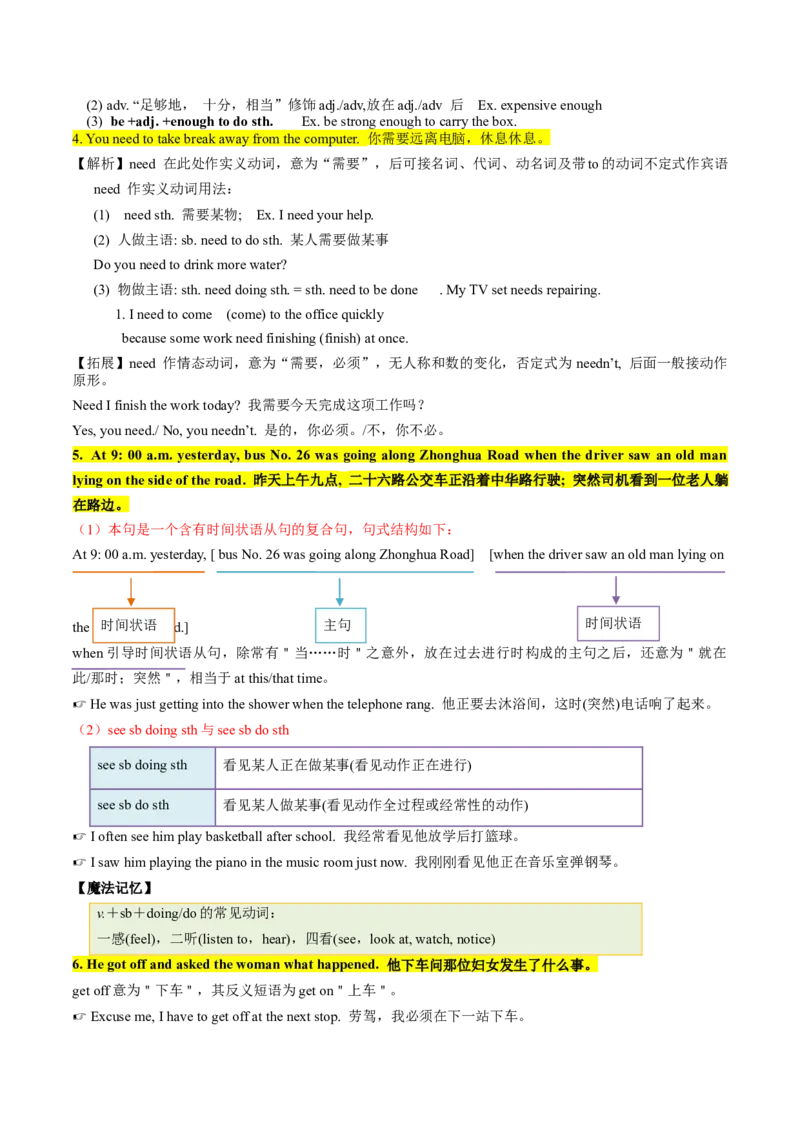
(1)本句是一个含有时间状语从句的复合句,句式结构如下:
At 9: 00 a.m. yesterday, [ bus No. 26 was going along Zhonghua Road] [when the driver saw an old man lying on
the si时de间 of状 th语e road.] 主句 时间状语
when引导时间状语从句,除常有"当……时"之意外,放在过去进行时构成的主句之后,还意为"就在
此/那时;突然",相当于at this/that time。
☞ He was just getting into the shower when the telephone rang. 他正要去沐浴间,这时(突然)电话响了起来。
(2)see sb doing sth与see sb do sth
see sb doing sth 看见某人正在做某事(看见动作正在进行)
see sb do sth 看见某人做某事(看见动作全过程或经常性的动作)
☞ I often see him play basketball after school. 我经常看见他放学后打篮球。
☞ I saw him playing the piano in the music room just now. 我刚刚看见他正在音乐室弹钢琴。
【魔法记忆】
v.+sb+doing/do的常见动词:
一感(feel),二听(listen to,hear),四看(see,look at, watch, notice)
6. He got off and asked the woman what happened. 他下车问那位妇女发生了什么事。
get off意为"下车",其反义短语为get on"上车"。
☞ Excuse me, I have to get off at the next stop. 劳驾,我必须在下一站下车。☞ He got off at Guangming Road. 他在光明路下车了。
☞ Don’t get on the No.8 bus. 不要上8路公交车
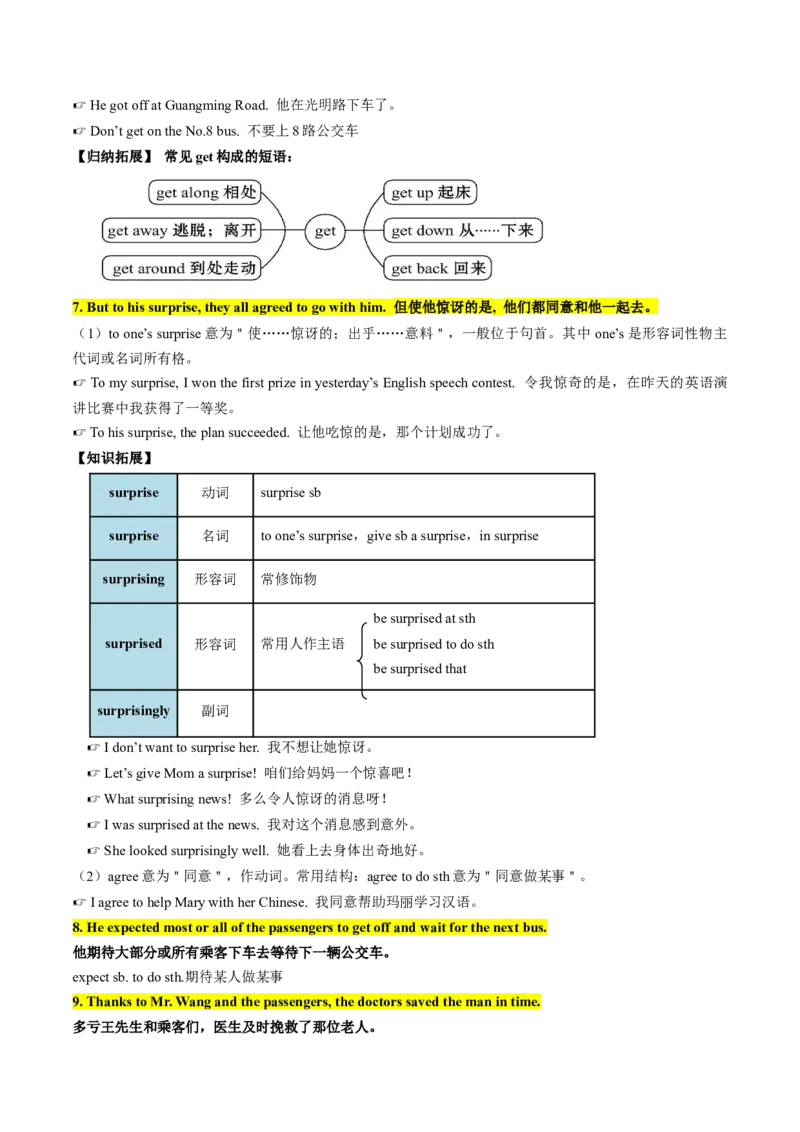
【归纳拓展】 常见get构成的短语:
7. But to his surprise, they all agreed to go with him. 但使他惊讶的是, 他们都同意和他一起去。
(1)to one’s surprise意为"使……惊讶的;出乎……意料",一般位于句首。其中 one’s是形容词性物主
代词或名词所有格。
☞ To my surprise, I won the first prize in yesterday’s English speech contest. 令我惊奇的是,在昨天的英语演
讲比赛中我获得了一等奖。
☞ To his surprise, the plan succeeded. 让他吃惊的是,那个计划成功了。
【知识拓展】
surprise 动词 surprise sb
surprise 名词 to one’s surprise,give sb a surprise,in surprise
surprising 形容词 常修饰物
be surprised at sth
surprised 形容词 常用人作主语 be surprised to do sth
be surprised that
surprisingly 副词
☞ I don’t want to surprise her. 我不想让她惊讶。
☞ Let’s give Mom a surprise! 咱们给妈妈一个惊喜吧!
☞ What surprising news! 多么令人惊讶的消息呀!
☞ I was surprised at the news. 我对这个消息感到意外。
☞ She looked surprisingly well. 她看上去身体出奇地好。
(2)agree意为"同意",作动词。常用结构:agree to do sth意为"同意做某事"。
☞ I agree to help Mary with her Chinese. 我同意帮助玛丽学习汉语。
8. He expected most or all of the passengers to get off and wait for the next bus.
他期待大部分或所有乘客下车去等待下一辆公交车。
expect sb. to do sth.期待某人做某事
9. Thanks to Mr. Wang and the passengers, the doctors saved the man in time.
多亏王先生和乘客们,医生及时挽救了那位老人。(1) thanks to…多亏…,由于…
Thanks to my English teacher, I got good grades.
多亏了我的英语老师,我取得了好成绩。
【拓展】thanks for…为…而感谢…
Thanks for you kindness.感谢你的善良。
10. lie v. 躺,平躺
lie的各种含义
You should lie down. 你应该躺下。
lie v. 躺,位于,平放 lay—lain—lying His school lies in the north of the city. 他的学校位于城
北。
lie v. 说谎 lied—lied—lying He often lies. 他经常说谎。
lie n. 谎言 lies(复数) He often tells lies. 他经常说谎。
【巧学妙记】
lie的用法口诀
规则是说谎(lieliedlied),
不规则是躺(lielaylain)。
【拓展】
lay v. 下蛋,放置
☞ The hens lay a lot of eggs every day. 母鸡每天下很多蛋。
☞ Please lay the table before dinner. 饭前请摆好餐具。
11. without prep. 没有,缺乏
(1)without后接名词、代词宾格或v-ing作宾语,其反义词为with。
☞ We got there without any trouble. 我们到了那儿,一路上没遇到任何麻烦。
☞ Can you finish your homework without him? 没有他你能完成你的家庭作业吗?
☞ She left the room without saying a word. 她一句话没有说就离开了房间。
(2)without用于否定句,还可以表示条件,意为"如果没有",相当于if引导的否定条件句。
☞ We couldn’t live without air.
=We couldn’t live if there weren’t air.
如果没有空气,我们就不能活。
知识点12:As a mountain climber, Aron is used to taking risks. 作为一名登山者, 阿伦习惯于冒险。
be used to意为"习惯于……;适应于……",其中to是介词,后跟名词、代词或动词-ing形式。
☞ He is used to taking cold showers even in winter. 他习惯了甚至在冬天也用冷水淋浴。
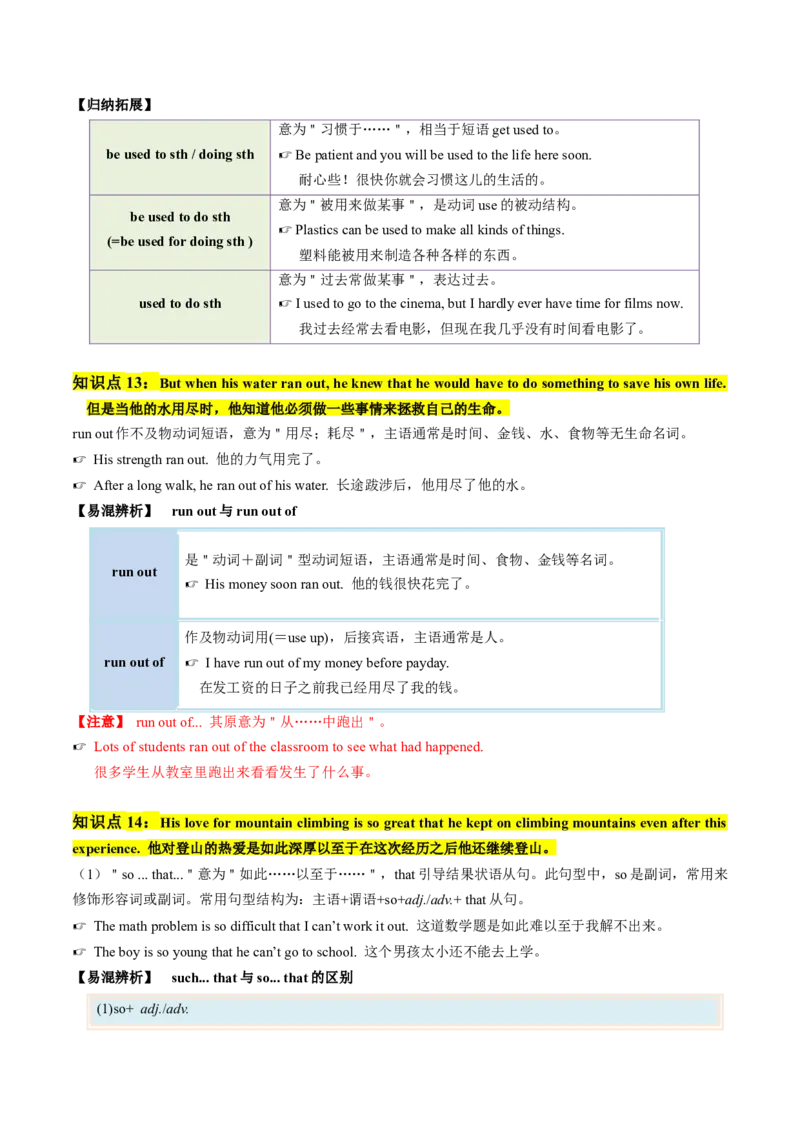
☞ He is used to getting up early. 他习惯于早起。学科*网【归纳拓展】
意为"习惯于……",相当于短语get used to。
be used to sth / doing sth ☞ Be patient and you will be used to the life here soon.
耐心些!很快你就会习惯这儿的生活的。
意为"被用来做某事",是动词use的被动结构。
be used to do sth
☞ Plastics can be used to make all kinds of things.
(=be used for doing sth )
塑料能被用来制造各种各样的东西。
意为"过去常做某事",表达过去。
used to do sth ☞ I used to go to the cinema, but I hardly ever have time for films now.
我过去经常去看电影,但现在我几乎没有时间看电影了。
知识点13:But when his water ran out, he knew that he would have to do something to save his own life.
但是当他的水用尽时,他知道他必须做一些事情来拯救自己的生命。
run out作不及物动词短语,意为"用尽;耗尽",主语通常是时间、金钱、水、食物等无生命名词。
☞ His strength ran out. 他的力气用完了。
☞ After a long walk, he ran out of his water. 长途跋涉后,他用尽了他的水。
【易混辨析】 run out与run out of
是"动词+副词"型动词短语,主语通常是时间、食物、金钱等名词。
run out
☞ His money soon ran out. 他的钱很快花完了。
作及物动词用(=use up),后接宾语,主语通常是人。
run out of ☞ I have run out of my money before payday.
在发工资的日子之前我已经用尽了我的钱。
【注意】 run out of... 其原意为"从……中跑出"。
☞ Lots of students ran out of the classroom to see what had happened.
很多学生从教室里跑出来看看发生了什么事。
知识点14:His love for mountain climbing is so great that he kept on climbing mountains even after this
experience. 他对登山的热爱是如此深厚以至于在这次经历之后他还继续登山。
(1)"so ... that..."意为"如此……以至于……",that引导结果状语从句。此句型中,so是副词,常用来
修饰形容词或副词。常用句型结构为:主语+谓语+so+adj./adv.+ that从句。
☞ The math problem is so difficult that I can’t work it out. 这道数学题是如此难以至于我解不出来。
☞ The boy is so young that he can’t go to school. 这个男孩太小还不能去上学。
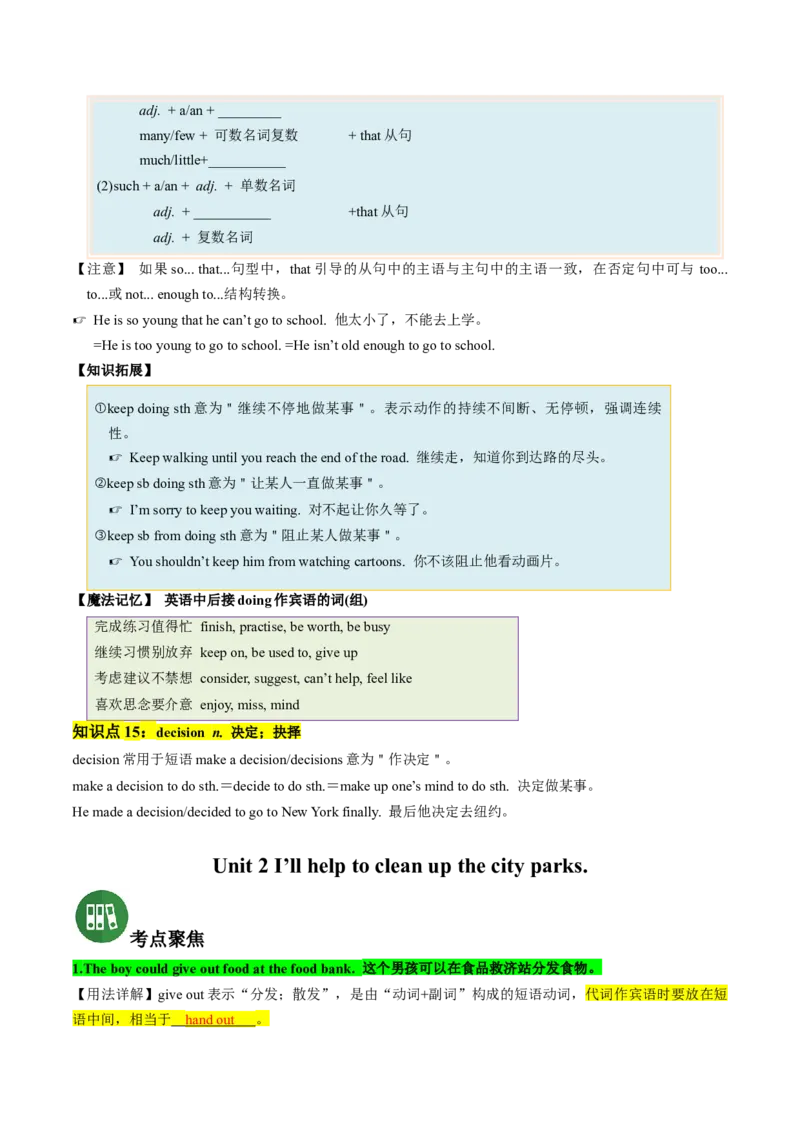
【易混辨析】 such... that与so... that的区别
(1)so+ adj./adv.adj. + a/an + _________
many/few + 可数名词复数 + that从句
much/little+___________
(2)such + a/an + adj. + 单数名词
adj. + ___________ +that从句
adj. + 复数名词
【注意】 如果so... that...句型中,that引导的从句中的主语与主句中的主语一致,在否定句中可与 too...
to...或not... enough to...结构转换。
☞ He is so young that he can’t go to school. 他太小了,不能去上学。
=He is too young to go to school. =He isn’t old enough to go to school.
【知识拓展】
①keep doing sth意为"继续不停地做某事"。表示动作的持续不间断、无停顿,强调连续
性。
☞ Keep walking until you reach the end of the road. 继续走,知道你到达路的尽头。
②keep sb doing sth意为"让某人一直做某事"。
☞ I’m sorry to keep you waiting. 对不起让你久等了。
③keep sb from doing sth意为"阻止某人做某事"。
☞ You shouldn’t keep him from watching cartoons. 你不该阻止他看动画片。
【魔法记忆】 英语中后接doing作宾语的词(组)
完成练习值得忙 finish, practise, be worth, be busy
继续习惯别放弃 keep on, be used to, give up
考虑建议不禁想 consider, suggest, can’t help, feel like
喜欢思念要介意 enjoy, miss, mind
知识点15:decision n. 决定;抉择
decision常用于短语make a decision/decisions意为"作决定"。
make a decision to do sth.=decide to do sth.=make up one’s mind to do sth. 决定做某事。
He made a decision/decided to go to New York finally. 最后他决定去纽约。
Unit 2 I’ll help to clean up the city parks.
考点聚焦
1.The boy could give out food at the food bank. 这个男孩可以在食品救济站分发食物。
【用法详解】give out表示“分发;散发”,是由“动词+副词”构成的短语动词,代词作宾语时要放在短
语中间,相当于 hand out 。Eg.Please help me give out these test papers. 请帮我分发这些测试卷。
They took a lot of food and gave it all out to the kids. 他们带了许多食物并全部分发给了孩子们。
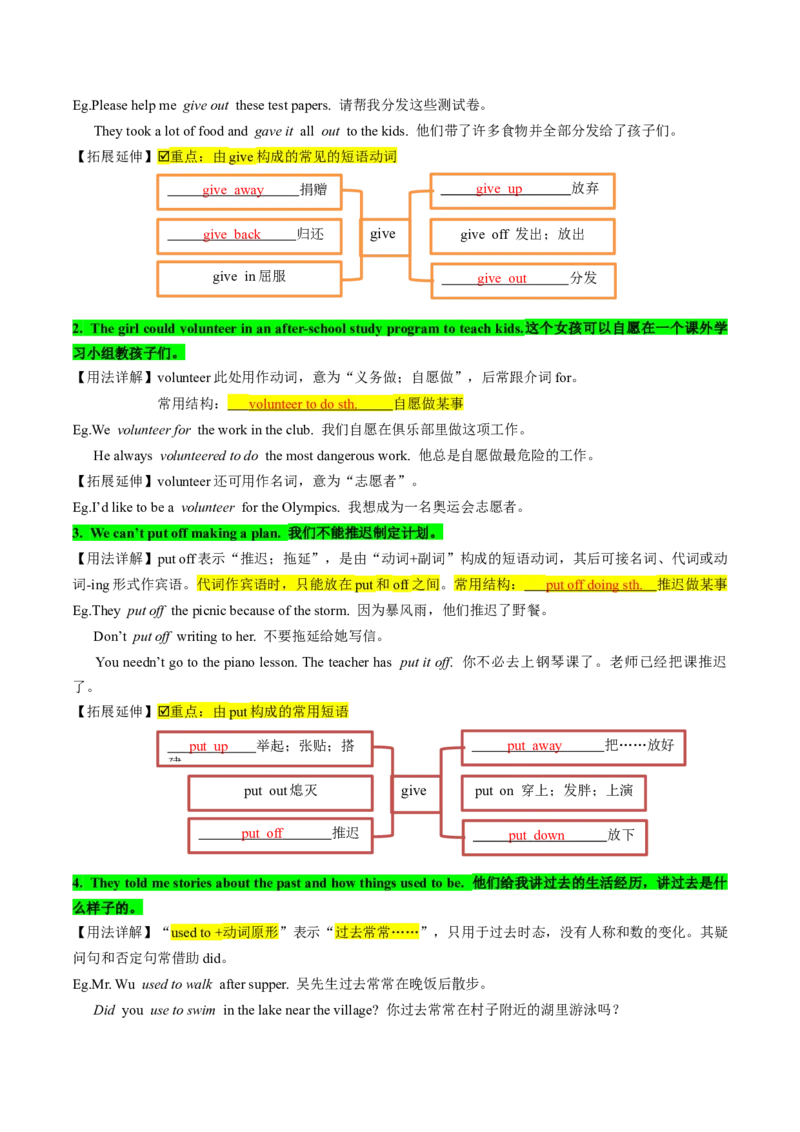
【拓展延伸】重点:由give构成的常见的短语动词
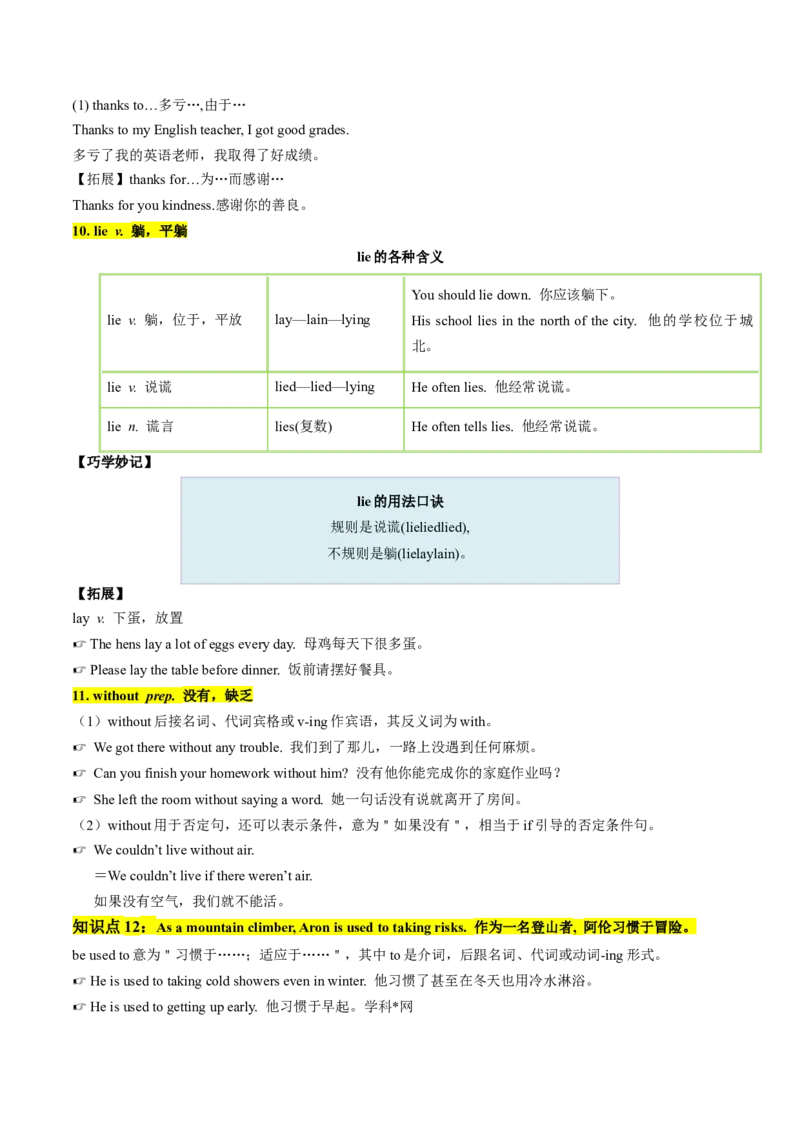
giv e awa y 捐赠 giv e u p 放弃
giv e bac k 归还 give give off 发出;放出
give in屈服 giv e ou t 分发
2. The girl could volunteer in an after-school study program to teach kids.这个女孩可以自愿在一个课外学
习小组教孩子们。
【用法详解】volunteer此处用作动词,意为“义务做;自愿做”,后常跟介词for。
常用结构: volunteer to do sth . 自愿做某事
Eg.We volunteer for the work in the club. 我们自愿在俱乐部里做这项工作。
He always volunteered to do the most dangerous work. 他总是自愿做最危险的工作。
【拓展延伸】volunteer还可用作名词,意为“志愿者”。
Eg.I’d like to be a volunteer for the Olympics. 我想成为一名奥运会志愿者。
3. We can’t put off making a plan. 我们不能推迟制定计划。
【用法详解】put off表示“推迟;拖延”,是由“动词+副词”构成的短语动词,其后可接名词、代词或动
词-ing形式作宾语。代词作宾语时,只能放在put和off之间。常用结构: put off doing sth . 推迟做某事
Eg.They put off the picnic because of the storm. 因为暴风雨,他们推迟了野餐。
Don’t put off writing to her. 不要拖延给她写信。
You needn’t go to the piano lesson. The teacher has put it off. 你不必去上钢琴课了。老师已经把课推迟
了。
【拓展延伸】重点:由put构成的常用短语
pu t u p 举起;张贴;搭 pu t awa y 把……放好
建
put out熄灭 give put on 穿上;发胖;上演
pu t of f 推迟 pu t dow n 放下
4. They told me stories about the past and how things used to be. 他们给我讲过去的生活经历,讲过去是什
么样子的。
【用法详解】“used to +动词原形”表示“过去常常……”,只用于过去时态,没有人称和数的变化。其疑
问句和否定句常借助did。
Eg.Mr. Wu used to walk after supper. 吴先生过去常常在晚饭后散步。
Did you use to swim in the lake near the village? 你过去常常在村子附近的湖里游泳吗?【拓展延伸】be used to doing sth. 表示“习惯于做某事”,其中to为介词。
Eg.My father is used to living in the countryside. 我父亲习惯生活在乡下。
5. We should listen to them and care for them. 我们应该倾听他们,关爱他们。
【用法详解】care for表示“照顾;照料”,相当于 look afte r 或take care of,其宾语常为表示人的名词
或代词。(“三个照顾”)
Eg.She cares for/takes care of/looks after her sick daughter patiently. 她耐心地照顾她生病的女儿。
6. Some people even stop doing their jobs for a few months to a year to move to another place...有些人甚至
停下他们的工作几个月到一年,移居到另一个地方……
【易混辨析】重点:stop doing sth.与stop to so sth.
stop doing sth. 意为“ 停止做某事 ”,指停止正在做的事情
stop to do sth 意为“ 停下来去做某事 ”,指停止正在做的事情而去做另外一件事情
Eg.They were very tired, but they didn’t stop working. 尽管很累,但是他们没有停止工作。
She stopped to look and smile at us. 她停下来微笑地看着我们。
7. I want to travel alone. 我想独自旅游。
【用法详解】alone副词,意为“独自;单独”,在句中作状语,相当于by oneself。
Eg.He likes living alone. = He likes living by himself. 他喜欢独自生活。
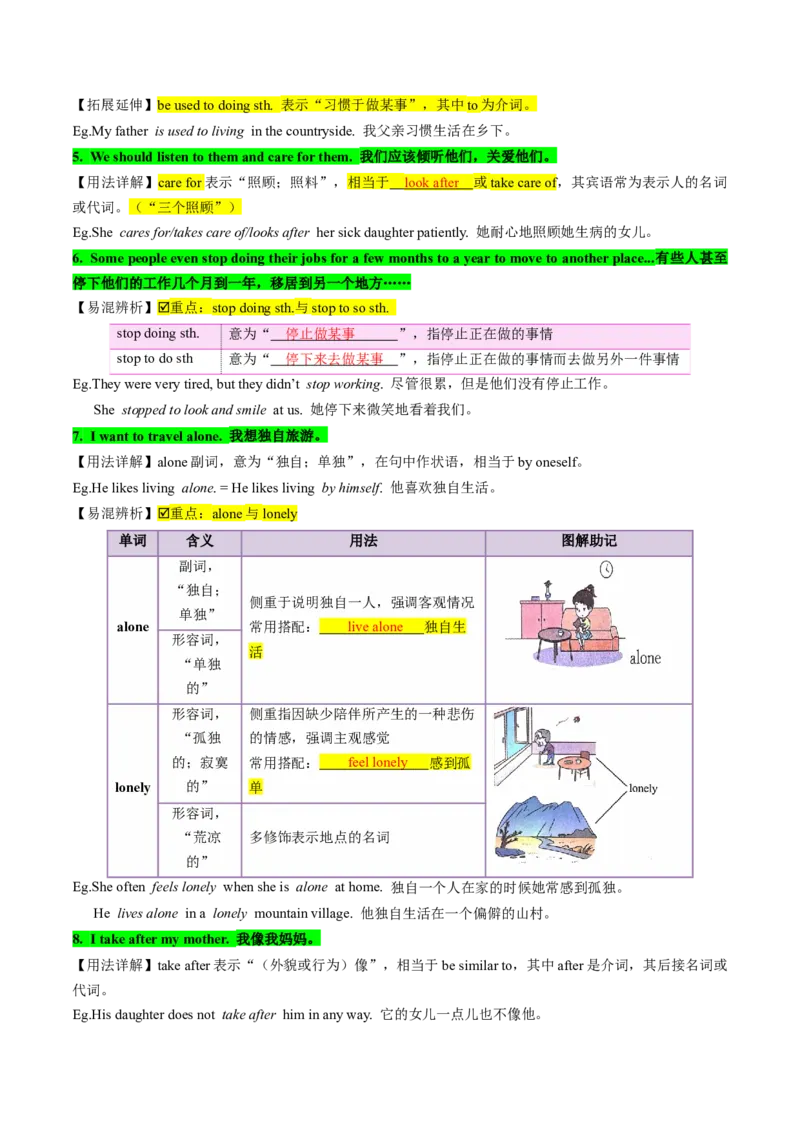
【易混辨析】重点:alone与lonely
单词 含义 用法 图解助记
副词,
“独自;
侧重于说明独自一人,强调客观情况
单独”
alone 常用搭配: live alon e 独自生
形容词,
活
“单独
的”
形容词, 侧重指因缺少陪伴所产生的一种悲伤
“孤独 的情感,强调主观感觉
的;寂寞 常用搭配: feel lonely 感到孤
lonely 的” 单
形容词,
“荒凉 多修饰表示地点的名词
的”
Eg.She often feels lonely when she is alone at home. 独自一个人在家的时候她常感到孤独。
He lives alone in a lonely mountain village. 他独自生活在一个偏僻的山村。
8. I take after my mother. 我像我妈妈。
【用法详解】take after表示“(外貌或行为)像”,相当于be similar to,其中after是介词,其后接名词或
代词。
Eg.His daughter does not take after him in any way. 它的女儿一点儿也不像他。【易混辨析】take after与look like
take after 指由于血缘关系而在外貌、性格等方面相似
look like 意为“看起来像……”,尤指外貌相像
Eg. Lucy is warm-hearted. She really takes after her mother very much. 露西为人热心,这点真是很像她妈
妈。
Eg. The girl looks like her aunt very much. 那个女孩长得很像她姑姑。
9. You helped to make it possible for me to have Lucky. 有了你的帮助,我才有可能拥有“幸运儿”(狗
名)。
【用法详解】“make it +形容词(+ for sb.)+动词不定式(短语)”是一个固定句型,其中it是形式宾
语,真正的宾语时后面的动词不定式短语,形容词作宾语补足语。
Eg.Sports can make it easier for people to unify. 体育可以让人们更容易地统一起来。
【拓展延伸】类似此用法的动词还有feel, find, consider, think等。
Eg. I feel it possible to get there before eight. 我觉得八点前到那里是有可能的。
I think it easy to make up a sentence with the word. 我认为用这个单词造句很简单。
10. ... I was excited about the idea of having a dog. ……我对于有一只狗的想法感到激动。
【用法详解】excited形容词,意为“激动的;兴奋的”,常用短语:be excited about“对……感到激动/兴
奋”。
Eg.I was very excited about the good news. 我对这个好消息感到非常兴奋。
【易混辨析】重点:excited与exciting
excited “激动的;兴奋的”,通常在句中作表语,一般修饰 人 (人/物)
exciting “令人激动的;令人兴奋的”,在句中既可作表语,也可作定语,一般修饰 物
(人/物)
Eg.We are excited about the exciting match. 这场令人兴奋的比赛让我们热血沸腾。
Unit 3 Could you please clean your room?
考点聚焦
1.Peter, could you please take out the rubbish? 彼得,请你把垃圾倒掉好吗?
【用法详解】知识点1: 重点:“Could you please ...?”表示“请你……好吗?”,后接动词 原形 ,
否定形式为 Could you please not do...? 。其中could表示委婉语气,不表示过去时态。
其答语如下:
肯定回答,如Yes, sure./Sure./Certainly./OK./No problem.等;
否定回答,如Sorry, I can’t./Sorry, I’m afraid not. Because ...等。
Eg.—Could you please pass me the spoon? 请你把勺子递给我好吗?
—Sure. Here you are. 当然可以,给你。
Could you please not play computer games? 请你不要玩电脑游戏了好吗?
知识点2: take out表示“取出;拿出”,是“动词+副词”构成的短语。当宾语是名词时,置于out前后均可;当宾语是代词时,只能放在take和out之间。
Eg.Please take a pen and paper out. = Please take out a pen and paper. 请把钢笔和纸拿出来。
The new book is in the box. Please take it out. 那本新书在箱子里,请把它拿出来。
2. I think two hours of TV is enough for you! 我觉得你看两个小时的电视已经足够了。
【用法详解】(1)这是一个含有宾语从句的复合句。主句是I think,其后为宾语从句,省略了引导词
that。
Eg.I think (that) it will rain tomorrow. 我认为明天会下雨。
(2)two hours of TV在从句中作主语,谓语动词用单数形式。在英语中,表示时间、距离、金额、度量等
词语作主语时,通常被视作整体,谓语动词用单数形式。
Eg.Thirty miles is a long way to walk. 三十英里路是要步行很远的一段路。
—How much are the shoes? 这双鞋多少钱?
—Fifteen dollars is enough. 十五美元足够了。
3. The minute I sat down in front of the TV, my mom came over. 我刚坐在电视机前,妈妈就走了过来。
【用法详解】the minute...表示“一……就……”,常用于引导时间状语从句,相当于as soon as。
Eg.The minute I got to school, I realized I had left my pen at home. 我刚到学校就意识到我把钢笔落在家里
了。
【易混辨析】in front of与in the front of
介词短语 用 法 举 例 图 解 记 忆
在 物 体 外 部 There is a girl in front of the
in front of (内部/外部)的 car. 轿车的前面有一个女
前面 孩。
在 物 体 内 部 Mike and Lucy sit in the front
in the front of (内部/外部)的 of the bus.迈克和露西坐在轿
前面 车前面。
4. I’m just as tired as you are! 我和你一样累。
【用法详解】重点:as ... as ...表示“和……一样……”,两个as之间用形容词或副词的 原 级,表
示同级比较。
Eg.The tree is as tall as the building. 这棵树和那栋楼一样高。
He runs as quickly as his father. 他跑得和他父亲一样快。
【拓展延伸】as ... as ...的否定形式not so/as ... as ...表示“……不如……”。
Eg.She doesn’t study so/as hard as her brother. 她不如她的哥哥学习努力。
5. For one week , she did not do any housework and neither did I. 一周的时间,她不做任何家务,我也不
做。
【用法详解】neither此处用作副词,意为“也不”。neither did I 是倒装结构,相当于me neither。
【易混辨析】重点:neither与so引导的倒装结构表示前者描述的否定情况也适用于后者,意为
neither + be动词/情态动词/助动词+主语
“……也一样”
倒装结构
表示前者描述的肯定情况也适用于后者,意为
so + be动词/情态动词/助动词+主语
“……也一样”
neither+主语+be动词/助动词/情态动词 陈述前面的否定情况,意为“确实如此”
正常语序
so+主语+be动词/助动词/情态动词 陈述前面的肯定情况,意为“确实如此”
Eg.She can’t swim and neither can her sister. 她不会游泳,她的妹妹也不会。
They went to the museum yesterday. So did we. 他们昨天去了博物馆。我们也去了。
—It was very cold yesterday. 昨天很冷。
—So it was. 确实如此。(昨天确实很冷。)
【做题技巧】①“so/neither后不是人/物”→倒装语序,指的不是同一人/物,“……也一样”;
“so/neither后是人/物”→正常语序,指的是同一人/物,“确实如此”。
②前句是肯定,谁谁谁也一样用so;前句是否定,谁谁谁也一样用neither。
③谓语动词由主语决定,时态与前句保持一致。
【拓展延伸】neither的其他常见用法:
(1)neither作副词时,常与nor搭配构成neither ... nor ...结构,表示“既不……也不……”。连接两个并
列主语时,谓语动词的形式遵循“ 就近 原则”,即与离其最近的主语形式保持一致。
Eg.Neither she nor I am a doctor. 她和我都不是医生。
(2)neither作代词,表示“两者都不;双方均不”。
【易混辨析】重点:不定代词both,neither,all,none与either的用法
6.
不定代词 用于几者中 含义 固定搭配 例句
My
both both...and... Both Tom and Mary are teachers.
两者都
…和…都 汤姆和玛丽都是老师
neither 两者 Neither you nor I am good at
neither...nor...
两者都不 math.
既不…也不…
我们俩都不擅长数学。
all All of us are from China.
三者或三者以上都 无
三者或三者 我们都来自中国。
none 以上 三者或三者以上都 I like none of the books.
无
不 这些书我都不喜欢。
either 两者中的任 either...or... Either you or he is right.
两者之一
何一个 要么…要么… 不是你对,就是他对。
mother came over as soon as I sat down in front of the TV. 我一在电视机前坐下,我妈妈就过来了。【用法详解】重点:as soon as表示“ 一……就…… ”,引导时间状语从句,强调两个动作在时
间上是接连发生的。时态规律是:主句用 一般将来 时(或主句含有情态动词,或者主句为祈使句),从
句用 一般现在 时态,即遵循“ 主将从现 ”原则。
Eg.I will tell him the news as soon as he comes back. 他一回来我就把这个消息告诉他。
7. Could you please pass me the salt? 请你把盐递给我好吗?
【用法详解】pass及物动词,意为“给;递”,后常接双宾语,即pass sb. sth.“把某物递给某人”,相当
于 pass sth. to sb. 。
间接宾语(人) 直接宾语(物)
Eg.Please pass me the book. = Please pass the book to me . 请把书递给我。
【注意】当pass的直接宾语为代词时,只能用pass sth. to sb.结构。
Eg.Please pass it to me. 请把它递给我。
8. Could I borrow that book? 我能借那本书吗?
Could you lend me some money? 你能借我一些钱吗?
【易混辨析】重点:borrow, lend与keep
单词 含义 用法 图解助记
借;借入
borrow borrow sth. from sb . “向某人借某物”
(主语借进)
lend
借给;借出 lend sb. sth. “借某物给某人”
(过去式
(主语借出) = lend sth. to sb . “把某物借给某人”
lent)
延续动词,表示借用的时间长度,与for +一
keep 保存;保留
段时间及how long连用(指借一段时间)
Eg.He borrowed a lot of money from me. 他从我这儿借了很多钱。
Could you lend me your bike? = Could you lend your bike to me? 你可以借给我你的自行车吗?
I wanted to borrow a bike from my friend but he didn’t lend it to me, because Jane kept it for two days.
我想借用朋友的自行车,但他没借给我,因为简已经借走它两天了。
9. I hate to do chores. 我讨厌做家务。
【用法详解】hate及物动词,意为“厌恶;讨厌”,其后可接名词、代词、不定式或动词-ing形式作宾
语。hate表示一种感情或心理状态,不能用于进行时。
Eg. I hate rainy days. 我讨厌下雨天。
【易混辨析】hate to do sth.与hate doing sth.
hate to do sth. 表示具体的行为,(偶尔)讨厌做某件事
hate doing sth. 表示泛指的行为,(经常或习惯性地)讨厌做某件事
Eg.I hate to trouble you. 我真不想麻烦你。
I hate watching television; I prefer to read. 我讨厌看电视,我更喜欢读书。
10. It is still a good idea to read the first sentence in each paragraph a little more carefully. 稍加细心地阅读
每段的第一个句子也是一个不错的主意。【用法详解】本句中it为形式主语,真正的主语为后面的动词不定式短语。当不定式短语较长时,通常用
it作形式主语放在句首,将真正的主语放在句子后面,构成句型:It’s + adj + (for/of) sb. to do sth.“做某事对
某人来说……”。
Eg. It’s very important for us to learn English well. 对我们来说,学好英语很重要。
It’s very kind of you to help me. 你来帮助我真是太好了。
【拓展延伸】a little more carefully表示“稍加细心地”。当强调比较的程度时,可在比较级前使用much,
even, far, a little, a bit, a lot等,表示程度进一步加深。
Eg.The experiment was much easier than we had expected. 这个实验比我们预想的要容易得多。
11. They should spend their time on schoolwork in order to get good grades and get into a good university.
为了取得好成绩并考入好大学,他们应该把时间花在学业上。
【用法详解】知识点1: “四个花费”(pay, cost, spend与take)
单词 用法 结构
pay 花钱,主语是人 某人花多少钱买某物
sb. pay +钱 for sth.
cost 花钱,主语是物 某物花了某人多少钱
sth. cost sb. +钱
spend 花钱/时间,主语是人 某人在某物上花费时间/金钱
sb. spend +钱/时间 on sth.
某人花费多少时间/金钱做某事
sb. spend +钱/时间(in)doing sth.
take 花时间,it作形式主语 做某事花费某人多长时间
It takes/took sb. +时间 to do sth.
►I spent 100 yuan on the present. 我花了100元买这件礼物。
►It took me 20 minutes to get to school. 我花了20分钟到达学校。
►We paid 150 yuan for the meal. 这顿饭我们花了150元。
►The schoolbag cost me 50 yuan. 这个书包花了我50元。
知识点2: in order to表示“目的是;为了”,后跟动词 原形 ,表示目的。其否定结构为in order not to
do。
Eg.People must eat in order to live. 为了生存,人必须吃东西。
In order not to wake the children, they spoke in a low voice. 为了不弄醒孩子们,他们小声说话。
【拓展延伸】如果后接目的状语从句,则可用in order that或so that。
so that +句子 = in order that +句子 = in order to + do,三者可互换。
Eg. He works hard in order that he may succeed. 他为求成功而努力工作。
= He works hard so that he may succeed . / He works hard in order to succeed .
12. It is the parents’ job to provide a clean and comfortable environment at home for their children. 在家中
给他们的孩子提供一个干净、舒适的环境是家长们的事情。
【用法详解】provide及物动词,意为“提供;供应”,其后常接名词或代词作宾语。
常用结构:provide sb. with (for/with) sth. / provide sth. for (for/with) sb.“为某人提供某物”
Eg.The parents provide their children with food and clothes.
= The parents provide food and clothes for their children. 父母供孩子吃穿。
13. It is the parents’ job to provide a clean and comfortable environment at home for their children. 在家中给他们的孩子提供一个干净、舒适的环境是家长们的事情。
【用法详解】该句为“the +比较级... , the +比较级...”句式结构,意为“ 越……,就越…… ”,表示一方
随另一方程度的变化而变化。
Eg.The healthier food we eat, the stronger we will be. 我们吃的食物越健康,我们就会越强壮。
Unit 4 Why don’t you talk to your parents?
考点聚焦
1.My parents don't allow me to hang out with my friends. 我父母不允许我和我的朋友们闲逛。
【用法详解】allow及物动词,意为“允许;准许”。常用搭配: allow sb. to do sth. “允许某人做某
事”;
allow doing sth.“允许做某事”。
allow后面可跟名词或动词-ing形式作宾语,但不能直接跟动词不定式
Eg.I can’t allow you to do that. 我不许你做那件事。
They allowed smoking in this room only. 他们只允许在这个房间里抽烟。
2. What’s wrong? 怎么了?
【用法详解】该句是口语中常用的一个句型,表示“怎么了?/哪儿不舒服?/出什么毛病了?”,相当于
“ What’s the matter ?”。后面可接with sb./sth.,用来询问“某人/某物怎么了”。
Eg.—What’s wrong with your bike? 你的自行车怎么了?
—It needs repairing. 它需要修理了。
3. Why don’t you go to sleep earlier this evening? 今天晚上你为什么不早点睡呢?
【用法详解】“Why don’t you...?”表示“为何不……呢?”,常用来提出建议或征求对方的意见,主语you
后面跟动词 原形 ,相当于“ Why not do sth. ?”。
Eg.Why don’t you have a cup of tea? = Why not have a cup of tea?
为何不来一杯茶呢?
4. Well, I found my sister looking through my things yesterday. 唉,昨天我发现我妹妹在翻看我的东西。
【用法详解】知识点1: find sb. doing sth. “发现某人正在做某事”,doing是宾语发出的动作,称
为宾语补足语,表示动作正在进行。
Eg.I found an old man lying on the ground on my way home. 在回家的路上我看见一位老人正躺在地上。
【拓展延伸】find sb. do sth.“发现某人做过某事”,强调发现动作经常发生或发现动作的全过程。类似用法
的动词还有hear/watch/see/feel等。
Eg.I find him enter the building. 我发现他走进了大楼里。
知识点2: look through 意为“快速查看;浏览”
Eg.It's a good habit to look through newspapers everyday.每天浏览报纸是个好习惯。
【拓展延伸】与look相关的短语还有:
look at 看 look for 寻找 look up 查阅;向上
看
look after 照料;照顾 look into调查 look forward to 盼望;期待look around环顾 look down on/upon看不起 look out 当心;小心
5. Also, my elder brother is not very nice to me. 还有,我哥哥对我不是很好。
【用法详解】elder形容词,意为“年纪较长的”,主要用于表示家庭成员之间的长幼关系。
Eg.His elder son has gone to Canada. 他的大儿子去了加拿大。
【易混辨析】elder与old
单词 用法 图解助记
elder 只修饰人,用来比较年龄大小,尤指兄弟姐妹的长幼关
系;在句中,通常只用作定语
older 是 old 的比较级形式,修饰人时,指实际年龄“较大
的”;修饰物时,意为“较旧的”;在句中,可作定语或
表语
Eg.My elder brother is two years older than me. 我的哥哥比我大两岁。
6. Instead he watches whatever he wants until late at night. 相反,他却可以看他想看的任何节目,一直看
到深夜。
知识点1: 【易混辨析】instead与instead of
单词 词性 用法
instead 副词 意为“代替;反而;却”,用来修饰整个句子,位于句末,也可位于句
首
instead of 副词短语 意为“代替;而不是”,后面可以接名词、代词或者动词-ing
Eg.He didn’t play basketball. He went swimming instead. 他去游泳了,而没有去打篮球。
= He went swimming instead of playing basketball.
知识点2: whatever代词,意为“任何;每一”,在此句中引导宾语从句。
Eg.Give them whatever they need. 他们需要什么就给他们什么。
【拓展延伸】whatever还可以引导让步状语从句,意为“无论什么”,相当于no matter what。有类似用法
的词还有:whoever = no matter who “无论谁”;whenever = no matter when “无论什么时
候”;wherever = no matter where “无论在哪儿”等。
Eg.Whatever/No matter what you say, I can’t agree with you. 无论你说什么,我都不会同意你的观点。
7. If your parents are having problems, you should offer to help. 如果你的父母遇到问题,你应该主动提供
帮助。
【易混辨析】重点:offer与provide
单词 含义 固定搭配
offer to do sth. “主动提出做某事”
主动提出;自愿给
offer offer sb. sth = offer sth. to sb. “为某人提供某
予
物”
provide 提供;供应 provide sb. with sth. = provide sth. for sb.“为某人提供某物”
Eg.He offered to help me wash my clothes. 他主动提出帮我洗衣服。
The restaurant offers foreign visitors all kinds of food. 这家饭店给外宾提供各种食物。= The restaurant offers all kinds of food to foreign visitors .
8. You should explain that you don’t mind him watching TV all the time. 你应该向他们解释你并不介意他
一直看电视。
【用法详解】mind意为“介意;在乎”,其后可直接接动词-ing形式作宾语
常用搭配: mind (sb.) doing sth. “介意(某人)做某事”
Eg.Would you mind me waiting here? 你介意我在这里等候吗?
Did you mind being away from home for so long? 你介意离家这么久吗?
9. You left your homework at home. 你把作业落在家里了。
【易混辨析】重点:leave与forget
单词 含义 用法 固定搭配
“遗 表示把什么东西落在什么地方
leave 留;落 了,侧重于说明地点 leave sth. + 地点状语 “把某物落在某地”
下”
表示忘记做什么事情,不强调地 forget to do sth. “忘记做某事”(未做)
“忘
forget 点状语 forget doing sth. “忘记做过某事”(已
记”
做)
Eg.I forget to take the umbrella. I left it at your home. 我忘了带伞,我把它忘在你家里了。
10. You are afraid of speaking in front of people. 你害怕在大家面前讲话。
【用法详解】afraid形容词,意为“害怕,畏惧”,其常见用法如下:
用法 含义 图解助记
be afraid of (doing) sth. 害怕(做)某事/某物
be afraid to do sth. 害怕/不敢做某事
be afraid + that从句 恐怕……,that可省略
Eg.The boy is afraid of falling into the river. 这个男孩害怕掉进河里。
The girl is afraid to walk alone on the street at night. 这个女孩害怕晚上独自在街上走。
I’m afraid (that) I can’t come tomorrow. 恐怕明天我不能来了。
11. Maybe I could cut out a few of their activities, but I believe these activities are important for my
children’s future. 或许我可以减掉他们几个活动,但我相信这些活动对我的孩子们的未来很重要。
【用法详解】cut out此处表示“删除;删去”,是由“动词+副词”构成的短语。名词作宾语时,放在out
的前后均可;代词作宾语时,必须放在cut和out中间。
Eg.You can cut out the last sentence. 你可以删去最后一句话。
These words are useless. Please cut them out. 这些词没用,请把它们删除。
【拓展延伸】cut构成的其他常用短语:
_ cut down _ 砍倒 _ cut up _ 切碎
_ cut out _ 删除 cut _ cut off _ 切断;切除12. In some families, competition starts very young and continue until the kids get older. 在一些家庭中,竞
争从孩子很小的时候就开始了,然后一直持续到孩子们长大。
【易混辨析】continue doing sth.与continue to do sth.
固定搭配 用法 图解助记
表示“继续做(某事)”,表示继续
continue doing sth.
做同一件事情
表示“继续做(某事)”,表示继续
continue to do sth. 做与目前所做的事情不同的另一件事
情
Eg.Don’t stop! Continue reading, please. 别停下!请继续读。
He continued to do his work after lunch. 午饭后他继续工作。
2.Let’s continue __practicing__ (practice) speaking English.
13. And they are always comparing them with other children. 而且她们总是拿自己的孩子与别人家的孩子
进行比较。
【用法详解】compare此处用作及物动词,意为“比较”,常与介词with/to搭配使用。
Eg.If you compare the two books, you’ll find which one is better. 如果你比较一下这两本书,你就会发现哪一
本更好。
【易混辨析】compare ... with ...与compare ... to ...
固定搭配 用法 图解助记
表示“把……与……比较”,常用于同
compare ... with ...
类事物之间的比较,侧重区分
表示“把……比作……”,常用于异类
事物之间的比较或比喻,侧重相同点或
相似点
compare ... to ...
也可表示“把……与……比较”,此时
可与compare ... with ...互换Unit 5 What were you doing when the rainstorm came?
考点聚焦
1.I was waiting for the bus when it began to rain heavily. 当开始下暴雨的时候,我正在等公交车。
【用法详解】知识点1: begin及物动词,意为“开始”,其后可接名词、代词、动词不定式或动词-ing形
式作宾语。begin的过去式为 began ,过去分词为begun。固定搭配:begin to do/doing sth.开始做某事
Eg.They began to work after a short rest. 短暂的休息过后,他们开始工作了。
知识点2: heavily副词,意为“在很大程度上;大量地”,常用来表示“(雨、雪)下得大”,相当于
hard。其形容词形式为 heavy 。
Eg.It is snowing heavily/hard outdoors. 外面雪下得正大。
2. I called at seven and you didn’t pick up. 我七点(给你)打电话,可你没接。
【用法详解】pick up此处意为“接电话;接收到(信号或声音)”,相当于answer。pick up为“动词+副
词”型短语,若代词作宾语,必须放在pick和up中间;若名词作宾语,放在up的前后均可。
Eg.—What did the radio say about the weather? 关于天气,收音机里是怎么说的?
—Sorry. My radio didn’t work. I didn’t pick it up. 对不起,我的收音机坏了,我没有收听到。
【拓展延伸】pick up的其他含义:
捡起;拾起 Please pick up the book on the ground. 请把地上的书捡
起来。
pick up
(开车)接 Can you pick me up at the airport? 你能到机场接我
人 吗?
3. With no light outside, it felt like midnight. 外面没有光亮,感觉就像半夜一样。
【用法详解】知识点1: light在此作不可数名词,意为“光;光线;光亮”。
Eg. The sun gives us light and heat. 太阳给我们光和热。
【拓展延伸】light的其他用法
单词 用法 例句 图解助记
This is a heavy box, and that is a light
adj.轻的;浅色
one.
的
这是一个重箱子,那是一个轻的。
Please turn on the lights.
light n.灯
请打开灯。
It’s too dark. The little girl lights a
v.点燃 candle.
太黑了,小女孩点燃了一支蜡烛。
知识点2: feel like意为“感觉像是……;想要……”,其后跟名词、代词或动词-ing形式作宾语。固定搭配:“想要做某事” feel like doing sth. = want to do sth. = would like to do sth.
Eg.I don’t feel like going to the movies. 我不想去看电影。
4. Ben was helping his mom make dinner when the rain began to beat heavily against the windows. 当雨开
始重重地敲打窗户的时候,本正在帮妈妈做晚饭。
【用法详解】beat的多种用法:
单词 含义 用法 例句
Somebody is beating at the door.
击打 主语是人,宾语可以是人或物
有人在敲门。
主语多为风、雨、海浪等名词。 The rain beats heavily against the windows.
拍打
beat on against“拍打在某地方” 雨水重重地敲打窗户。
beat He always beats me in tennis.
beat后常接人或由人组成的队伍(beat sb.)
他打网球总是赢我。
打败 win 表示赢得比赛、奖牌、奖杯等,通常 If we win the match, we will be the
match, competition, game, prize 等搭配(win champion.如果我们赢了比赛,我们就是冠
sth.) 军。
【拓展延伸】against介词,意为“倚;碰;撞”,还可表示“反对;对抗”,其反义词为for。常用搭配:
be against (doing) sth.“反对(做)某事”;play against sb. “与某人比赛”。
Eg.He stood against the door. 他倚着门站着。
Are you for or against the plan? 你是支出还是反对这个计划?
She is against smoking at home. 她反对在家抽烟。
5. He finally fell asleep when the wind was dying down at around 3:00 a.m.大约在凌晨三点风逐渐减弱的时
候,他总算睡着了。
【易混辨析】重点:asleep, sleeping与sleepy
单词 含义 用法 图解助记
常作表语,无比较级和最高级形式,
asleep 睡着 常用搭配: fall aslee p 入睡;进入
梦乡
sleepin 只作前置定语,修饰名词
睡着的
g
可作表语、定语或宾语补足语,常用
搭配: feel sleepy 感到困倦
sleepy 困倦的
Eg.The light music made him fall asleep soon. 轻柔的音乐让他很快睡着了。
A sleeping baby was lying in his mom’s arms. 一个睡着的婴儿正躺在他妈妈的怀里。
I am sleepy and I want to go to sleep. 我困了,想去睡觉。6. My parents were completely shocked! 我的父母完全震惊了!
【用法详解】completely副词,意为“彻底地;完全地”,用于修饰动词和形容词。其形容词形式为
complete ,
意为“完整的;完全的”。
Eg.In the end the wind went away completely. 最后,风彻底平息了。
You are both completely wrong. 你们俩完全错了。
【易混辨析】shocked与shocking
shocked “感到震惊的”,表示人对事物的感受,主语通常为人
shocking “令人震惊的”,表示事物的性质或状态,主语通常为物
Eg.We were all shocked at the shocking news. 我们都对这条惊人的消息感到震惊。
7. My parents did not talk after that, and we finished the rest of our dinner in silence. 之后我的父母没有说
话,我们就在沉默中吃完了剩下的晚餐。
【用法详解】知识点1: the rest of...意为“其余的……;剩下的”,作主语时,谓语动词的数要与the rest
of修饰的名词或代词的数保持一致。
Eg.The rest of the workers are still working hard. 其余的工人仍在努力地工作。
The rest of the meat has gone bad. 剩下的肉变质了。
知识点2: silence名词,意为“沉默;缄默;无声”,常用短语:in silence“沉默;无声”。其形容词形
式为 silent ,意为“寂静的;无声的”。keep silent“保持沉默”。
Eg.There was a long silence before she answered the question. 她在回答问题之前沉默了很长时间。
Why did you leave me in silence? 为何你一言不发离我而去?
The birds are silent in the trees. 鸟在树上悄然无声。
8. She remembers working in her office near the two towers. 她记得当时(自己)正在距两座塔楼不远的办
公室工作。
【易混辨析】重点:remember to do sth.与remember doing sth.
remember to do sth. “ 记得做过某事 ”,动作尚未发 Remember to call me up when you get
生 here.
remember doing “ 记得去做某事 ”,动作已经发 I remember seeing her in this city.
sth. 生
9. I had trouble thinking clearly after that because I was very afraid. 那之后我都难以清晰地思考,因为我
很害怕。
【用法详解】have trouble (in) doing sth.表示“做某事有困难或麻烦”,相当于have difficulty/problems (in)
doing sth.
Eg.I have trouble/difficulty/problems (in) working out the math problem. 我解这道数学题有困难。
【拓展延伸】trouble构成的其他搭配:get into trouble“陷入困境;遇到麻烦”;be in trouble“处于困境之
中”。
Eg.If you get into trouble, you can call me. 如果你遇到麻烦,可以给我打电话。
Please call 110 when you are in trouble. 当你有困难时请拨打110。Unit 6 An old man tried to move the mountains.
考点聚焦
1.Finally, a god was so moved by Yu Gong that he sent two gods to take the mountains away. 最后,一位神
仙被愚公(的精神)所感动,于是他派了两位神仙搬走了大山。
【用法详解】知识点1: move在此处用作及物动词,意为“感动”,句中was moved by为被动语态,表
示“被……感动”。
Eg.The speech moved them to tears. 那场演说把他们感动得落泪。
【拓展延伸】move的词性转换:
moved (adj.) “感动的”,常用来修饰 人
(人/物)
move
moving (adj.) “令人感动的;感人的”,常用来修饰 物
Eg. I was so moved that I couldn’t help crying. 我如此感动,以(至人于 / 忍物不)住哭了起来。
The movie is quite moving, so I will watch it once again. 这部电影相当感人,所以我会再看一次。
知识点2: take away意为“带走;拿走”,是“动词+副词”结构的短语。名词作宾语时,放在away前
后均可;代词作宾语时,只能放在take和away之间。
Eg.You can take away these books. = You can take these books away. 你可以把这些书带走。
I don’t like the clothes. Take them away. 我不喜欢这些衣服。把它们拿走吧。
2. This story reminds us that you can never know what's possible unless you try to make it
happen. 这个故事提醒我们:如果你不尽力使事情发生,你绝不会知道什么是可能的。
【用法详解】remind动词,意为“提醒;使想起”。其常用结构如下:
remind sb . to do sth . 提醒某人做某
事
重点: remind remind sb. of/about sth. 使某人想起某
事
Eg.Please remind me to call himre mbainckd. s请b.提 +醒 t我ha给t 从他句回 电提话醒。某人……;使某人想
起……
Please remind me of/about it if I forget. 要是我忘了,请提醒我。
Would you please remind him that our meeting has been put off? 请你提醒他我们的会议已经推迟了好
吗?
3. I think it’s a little bit silly. 我认为那有点儿愚蠢。
【用法详解】a little bit意为“有点儿;稍微”,修饰形容词、副词或动词,表示程度较弱,相当于a
little或a bit。其中bit用作名词,意为“一点;小块”,常用短语:a bit of“一点……”,其后接不可数
名词作宾语。Eg.After a day’s work, I’m a little bit tired. 工作一天之后,我有点儿累。
I’m afraid you speak a little bit fast. 恐怕你说得有点儿快。
He knows a bit of French. 他懂一点儿法语。
【拓展延伸】a little bit = a little/a bit/ kind of + 形容词/副词/比较级时,表示“一点儿”。
4. It doesn’t seem very possible to move a mountain. 搬走一座山似乎不是很可能。
【用法详解】句中seem possible为“seem + 形容 词”的系表结构,其中seem为 系动 词,意为“似
乎;好像”。
Eg.She seems lonely. Let’s talk with her. 她似乎很孤独,咱们和她说说话吧。
【拓展延伸】seem的常用结构:
seem (to be) + 名词 Li lei’s mother seems(to be)a teacher.
seem (to be) + 形容词 He seems (to be)very clever.
seem
seem + to do
I seemed to hear a voice outside.
It seems/seemed + that从句
It seems that he is happy.
5. But what could Yu Gong do instead of moving the mountains? 但是不把山移开,愚公还能做什么呢?
【易混辨析】instead of与instead
instead 短语介词,常置于句中,后面必须跟宾语,因此不能置于句末
of 代替;反而
instead 副词,可置于句首或句末,置于句首时常用逗号与后面的内容隔开
Eg.He asked me another question instead of answering me. 他没有回答我,反而问了我另外一个问题。
= He didn’t answer me. Instead, he asked me another question.
6. This is because he can make 72 changes to his shape and size, turning himself into different
animals and objects. 这是因为他能对自己的外形和大小进行七十二般变化,把自己变成不同的动物和物
体。
【用法详解】turn ... into ...意为“把……变成”,相当于change ... into ...。
Eg.The teacher asked us to turn/change the sentences into English. 老师让我们把这些句子译成英文。
【拓展延伸】turn构成的常用短语:
tur n u p 调高 turn down 调低;拒
绝
tur n o n 打开 turn tur n of f 关闭
turn back 折回;往回
turn away 扭头;转
走
身
7. As soon as the TV program came out more than 30 years ago , Western children becameinterested in reading this story because the clever Monkey king keeps fighting to help the weak and
never gives up. 并且30多年前这个电视节目刚一推出,西方国家的孩子就对读这个故事产生了兴趣,因
为聪明机智的美猴王一直坚持斗争去帮助弱智并且从不放弃。
【用法详解】知识点1: Western形容词,意为“西方国家的;西方的(w可以小写)”。
Eg.People in Western countries like this kind of sport. 西方国家的人喜欢这种运动。
【拓展延伸】在表示方向的名词的词尾加后缀-ern,可构成相应的形容词,如:
词性转换 图解助记
east (n.)东;东方→ easter n (adj.)东方的
west(n.)西;西方→ wester n (adj.)西方的
south (n.)南;南方→ souther n (adj.)南方
的
north (n.)北;北方→ norther n (adj.)北方
的
知识点2: weak形容词,意为“虚弱的;无力的”。the weak表示“弱者;弱势群体”,是指一类人,
在句中作主语时,谓语动词用复数(the+形容词,表示“一类人”)。weak还可意为“不善于;不擅
长”,常用短语:be weak in“不擅长;不善于”,可与be not good at/don’t do well in相互转换。
Eg.He is weak so he can’t walk long. 他身体虚弱,因此不能长时间走路。
We all think that the weak need special care. 我们都认为弱者需要特殊照顾。
8. The new couple were so happy that they couldn’t stop smiling when they got married. 这对新人结婚时如
此高兴以至于他们微笑不已。
【用法详解】知识点1: couple可数名词,此处意为“夫妻”,还可意为“两人;两件事物”。作主语
时,谓语动词用复数形式。常用短语:a couple of“一对;几个;一些”。
Eg.The couple seemed to be very happy. 那对夫妇看上去很幸福。
There are a couple of boys standing under the tree. 有两个男孩站在树下。
知识点2: marry动词,意为“结婚;嫁;娶”。常见搭配:
固定搭配 用法 图解助记
marry sb. 嫁给某人/与某人结婚
marry sb. to sb. 把某人嫁给某人/为某人娶某人
“与某人结婚”,get married
get married to
强调动作,不能与时间段连
sb.
用;而be married强调状态,
可以与时间段连用
be married to sb.
Eg.She married a doctor. 她和一位医生结了婚。She was determined to marry her daughter to a rich man. 她决定要把自己的女儿嫁给一个有钱人。
They got married last year.他们去年结婚了。
His parents have been married for twenty years.他的父母已经结婚20年了。
9. Nobody wanted to sound stupid. 没有人想听起来愚蠢。
【用法详解】重点:nobody复合不定代词,意为“没有人”,相当于 n o on e ,作主语时,谓语动
词用 单数 (单数/复数)形式;被形容词修饰时,形容词要放在nobody之 后 (前/后)。
Eg.Nobody goes to school on Sunday. 没有人在周日去上学。
【易混辨析】stupid, silly与foolish
stupid 侧重于“笨”,指人的智力差,反应迟钝,表示“愚蠢”的意味最强
silly 侧重于“傻”,指头脑简单或不懂事的,语气比foolish轻,常含有令人发笑之意
侧重于“蠢”,指没有头脑的,缺乏常识和判断力,而不指实际上的智力低下,
foolish
含有强烈的指责意味
Eg.The teacher thought John was stupid and was not worth teaching. 老师认为约翰太笨,不值得教。
Stop asking such silly questions! 别再问这样傻的问题了!
You are foolish to agree to the advice. 你同意那个建议是不明智的。
10. The wife told her husband that unless he left the children to die in the forest,the whole family
would die. 妻子告诉丈夫,如果他不把孩子们丢弃在森林里让他们自生自灭,全家都会死。
【用法详解】whole形容词,意味“全部的;整体的”,放在名词的前面,常和定冠词the连用。
Eg.She spent the whole day shopping in the mall. 她花了一整天在商场里购物。
【易混辨析】whole与all
单词 用法 图解助记
修饰名词时,放在冠词和其他限定词之后
whole
Eg.It rained the whole day.一整天都在下雨。
修饰名词时,放在冠词和其他限定词之前
Eg.The young woman spent all her money on
all
her clothes.这个年轻女子花光了所有的钱买衣
服。
11. What a long time you lost in the forest!你们在森林里睡了这么久!
【用法详解】此句是what引导的感叹句,其结构为“What (+ a/an) + 形容词+名词(+主语+谓语)!”。
Eg.What a hot day (it is)! 好热的天啊!
What nice music (it is)! 多好听的音乐啊!
What tall buildings (they are)! 多么高的楼啊!
【拓展延伸】how引导的感叹句:
How +主语+谓语!
how How +形容词/副词+主语+谓语!
How +形容词+ a/an +单数可数名词+主语+谓语!Eg.How time flies! 时光飞逝!
How beautiful your car is! 你的小汽车多漂亮啊!
How beautiful a park it is! 多么漂亮的公园啊!
【归纳总结】 wha t 修饰名词, how 修饰形容词和副词,永远没有 how a/a n !
【做题技巧】
1.永远没有How a/an;
2.形(形容词)名(名词)紧相连,what放句前。
►当形容词和名词中间没有任何其他词时,用What引导;
►当形容词和名词中间有其他词隔开时,用How引导。
注意:用What引导感叹句时,要注意名词的单复数问题,从而判断用What a/an还是What。
12. It's leading us to that wonderful house made of bread, cake and candy. 它在把我们引向那座由面
包、蛋糕和糖果做成的美妙房屋。
【用法详解】lead动词,意为“带路;领路”,其过去式是 le d 。常用短语:lead sb. to/into ...“把某
人带到或带进……”;lead to“(道路等)通往……;引起;导致”。
Eg.She led the boy into the large building. 她把那个男孩领进了大楼。
This path leads to the next village. 这条小路通往下个村子。
【易混辨析】be made of, be made from与be made in
be made of 意为“由……制成”,制成成品后仍可看出原材料 The chair is made of wood.
be made from 意为“由……制成”,制成成品后看不出原材料 The paper is made from
wood.
be made in 意为“在……制造”,in后面接地点 The chair is made in
Shanghai.
13. Then they hear an old woman’s voice from inside the house. 然后他们听到从屋内传出一位老妇人
的声音。
【用法详解】voice名词,意为“声音”,常用搭配:in a ... voice“用……声音”。
Eg.The girl has a beautiful voice. 那个女孩嗓音很美。
The man was talking with his daughter in a low voice. 那个人正低声和他的女儿说话。
【易混辨析】重点:voice与sound单词 用法 图解助记
主要指人的嗓音,如说话声、歌唱声等
voice Eg.They could hear voices in the next room.
他们能听到隔壁说话的声音。
泛指自然界中能够听到的各种声音
sound Eg.I like the sound of pianos.我喜欢钢琴的声
音。
主要指嘈杂的声音,“噪音”
noise Eg.I can’t stand the noise. 我不能忍受这种噪
音。
Unit 7 What’s the highest mountain in the world?
考点聚焦
1. 1,025 meters deep 1025 米深
【用法详解】“基数词+ meter(s) deep”是一种“深度”的表达法。其中meter为表示度量的单位名词,意
为“米;公尺”,类似的单位词还有foot(英尺)、inch(英寸)、kilogram(千克)等。
Eg.The hole is about 6 meters deep. 这个洞大约6米深。
【归纳总结】英语中长、宽、高等的表达方式:
基数词+单位词+形容词(long, wide, high, deep
等)
长、宽、高
等表达法
基数词+单位词+ in +名词(length, width, height, depth
等)
Eg. The rope is three meters long. = The rope is three meters in length. 这条绳子有三米长。
The lake is eight feet deep. = The lake is eight feet in depth. 这个湖有八英尺深。
2. Qomolangma is higher than any other mountain in the world. 珠穆朗玛峰比世界上其他任何山都
高。
【用法详解】any other意为“其他任何一个”,其后跟可数名词单数,常用于比较级句型,表达最高级含
义,相当于“any of the other +名词复数”。
Eg.The Yangtze River is longer than any other river in China. 长江比中国的其他任何一条河流都长。
= The Yangtze River is longer than any of the other rivers in China.= The Yangtze River is the longest river in China. (长江是中国最长的河流)
【拓展延伸】“比较级+ than + any other +单数可数名词”结构通常用于在同一范围内进行比较。如果相
互比较的人或物不在同一范围或不属于同一类别,则用“比较级+ than + any +单数可数名词”结构。
Eg.Tom runs faster than any other student in his class. 汤姆比他班里的其他任何学生跑得都快。
Shanghai is larger than any city in India. 上海比印度的任何城市都大。
3. China has the biggest population in the world. 中国在世界上人口数量最多。
【用法详解】population名词,意为“人口;人口数量”,作主语时谓语动词常用 单数 (单数/复数)形
式。
重点:population的用法
(1)"the population of...is +数词”,“……的人口数量是多少”,谓语动词用 单数 (单数/复
数)
(2)基数词+ percent of the population are….“百分之几的人口...”,谓语动词用 复数 (单数/复
数)
(3)询问人口数量时,用“What’s the population of ……?”=“How large is the population of...?”
(4)表示人口“多”时,常用 big 或 larg e ;表示人口“少”时,常用 smal l ,而不用
much/many或little/few
【注意】对population进行提问时,不能用how many或how much。
Eg.The population of China is much larger that that of the USA. 中国的人口比美国的人口多得多。
Three fifths of the population here are old people. 这里五分之三的人是老人。
—What is the population of your hometown? 你的家乡有多少人口?
—The population of my hometown is about 200,000. 我的家乡大约有二十万人口。
Hundreds of years ago, the world’s population was very small. 数百年前世界人口很少。
4. Did you know that China is one of the oldest countries in the world? 你知道中国是世界上最古老
的国家之一吗?
【用法详解】重点:“one of the +形容词的最高级+复数名词”表示在某一范围内“最……的……之
一”。
Eg.Mary is one of the tallest students in our class. 玛丽是我们班最高的学生之一。
【拓展延伸】“one of the +复数名词”意为“……中的一个”,作主语时,谓语动词用 单数 (单数/复
数)形式。
Eg.One of the girls is my sister. 这群女孩当中有一个是我妹妹。
5. Even more serious difficulties include freezing weather conditions and heavy storms. 更加严峻的困
难包括极冷的天气条件和巨大的风暴。
【用法详解】include及物动词,意为“包括;包含”,指整体中包含某部分内容。
Eg.A good British breakfast always includes sausages. 一顿丰盛的英式早餐总会包括香肠。
【易混辨析】including与included
including 介词 意为“包括……在内”,后跟名词或代词,常在句中作状语,用于对主句的补充说明
included 形容词 意为“包括在内的”,一般位于名词或代词之后,作后置定语
Eg.Many middle school students like reading Harry Potter, including me. 很多中学生喜欢读《哈利波特》,
包括我在内。
Everyone stood up, me included. 每个人都站起来了,包括我在内。
6. The spirit of these climbers shows us that we should never give up trying to achieve our dreams.
这些登山者的精神向我们表明:我们决不应该放弃实现梦想的尝试。
【用法详解】achieve动词,意为“达到;完成;成功”,其名词形式为 achievemen t ,意为“成就;成
绩”。
give up意为“放弃”。 giv e u p doin g sth . “放弃做某事”。
Eg.We try to celebrate the achievements of our students. 我们想要庆祝学生们取得的成绩。
【易混辨析】achieve与come true
achieve 动词,意为“达到;完成”,其主语一般是人,即sb. achieve(s) sth.
come 短语动词,意为“实现;成为现实”,其主语一般是事物(理想、愿望等),即 sth.
true come(s) true
Eg.He works so hard that he is sure to achieve his dream. 他工作如此努力,一定会实现他的梦想。
His dream of flying to the moon has come true. 他飞向月球的梦想实现了。
7.weigh 5,000 kilos 重达5000千克
【用法详解】weigh动词,意为“重量是……;称……的重量”。
Eg.How much did you weigh last time? 你上次体重是多少?
【拓展延伸】weigh的名词形式为 weigh t ,意为“重量”,是不可数名词。常用短语:put on weight“增
重”;lose weight“减肥”。
Eg.It is about 20 kilos in weight. 这东西重约20千克。
My mother is trying to lose weight. 我妈妈正在努力减肥。
8. This elephant weighs many times more than this panda. 这头大象比这只熊猫重许多倍。
【用法详解】英语中常用的倍数表达法:
A+谓语动词+倍数+形容词/副词的比较级+ than +B 表示“A比B……多少
倍”
倍数表达法 A+谓语动词+倍数+ as +形容词/副词的原级+ as +B 表示“A 是 B 的多少
倍……”
A+谓语动词+倍数+ the height/weight/length/size...+ of
+B
表示“A的高度/重量/长度/大小……是B的多少倍”
Eg.He runs three times faster than his brother. 他跑得比他弟弟快三倍。
His father is twice as tall as he. 他父亲的身高是他的两倍。
This hill is four times the height of that small one. 这座山的高度是那座小山的四倍。
9. At 9:00 a.m., they find that most of the babies are already awake and hungry. 上午9:00,他们发现大多数熊猫幼崽已经醒来并且饿了。
【用法详解】awake形容词,意为“醒着”,通常在句中作表语或后置定语,其反义词为 aslee p (睡着
的)。
Eg.Is he awake or asleep? 他是醒着还是睡着了?
Anyone awake heard the sound. 任何醒着的人都听到了那个声音。
【易混辨析】awake与wake
单词 用法 例句
形容词,意为“醒着”,作表语或后置定语,强调状 It’s late at night, but he is still awake.
awak 态
e 动词,意为“唤起;醒悟到” Nothing can awake her interest in this
trip.
动词,意为“弄醒;醒来”,常与副词up连用,强 Please wake me up at six o’clock
wake
调动作 tomorrow morning.
10. When the babies see the keepers, they run over to them with excitement and some of the young
pandas even walk into their friends and fall over! 当熊猫幼崽看到饲养员时,它们兴奋地跑向他们,
其中一些年幼的熊猫甚至撞上自己的伙伴而跌倒!
【易混辨析】fall over, fall down与fall off
短语 用法 图解助记
意为“绊倒”,强调“向前摔倒;跌倒”
fall over
Eg.My brother fell over and hurt his legs.
意为“倒下”强调“滑倒;倒下”
fall down
Eg.He was shot(中枪)and fell down.
意为“跌落”,强调“从某处跌落;从某处掉下
fall off 来”
Eg.The boy fell off the bike.
11. The babies often die from illnesses and do not live very long. 这些熊猫幼崽经常死于疾病并且活
不了多长时间。
【用法详解】die from意为“死于……”,其后所跟的宾语为死亡的原因。
Eg.Few people died from the earthquake because the government took action in time. 因为政府及时采取
行动,所以几乎没有人死于这次地震。
【易混辨析】die from与die of
短语 相同点 区别 图解助记
die 表示因病 侧重指外部原因,如事故、自然灾害等
from 而死时, Eg.She died from a traffic accident.
die of 可通用 侧重指自身原因,如衰老、饥饿等Eg.It’s said that the old man died of
sorrow(忧伤).
Unit 8 Have you read Treasure Island yet ?
考点聚焦
1. Have you read Little Women yet? 你读过《小妇人》吗?
【易混辨析】yet与already
yet 意为“还;已经”,一般用于 否定 句或 疑问 句中,通常放在句 末
(中/末)
already 意为“已经;早已”,通常用于 肯定 句中
Eg.Have you seen the film yet? 你已经看过那部电影了吗?
We have already got everything ready. 我们已经准备好了一切。
【拓展延伸】not yet意为“尚未;还没有”,常用作对现在完成时一般疑问句的否定回答。
Eg.—Have you finished reading the new book? 你读完这本新书了吗?
—Not yet. 还没有。
2. It was really good, so I couldn’t put it down. 它真的很好,因此我爱不释手。
【用法详解】put down意为“放下”,为“动词+副词”型短语,当宾语为代词时,必须放在put和down
之间;当宾语为名词时,放在down前后均可。
Eg.Put them down. They are too heavy. 把它们放下吧,它们太重了。
Put down your bag and have a rest. = Put your bag down and have a rest. 把包放下,休息一会吧。
【拓展延伸】put构成的其他常见短语:
put on 穿上;发胖;上演 pu t u p 举起;张贴;搭建
pu t of f 推迟
pu t awa y 把……收好 put ou t 扑灭;熄灭3. One of them died but the other ran towards my house. 其中一个人死了,但是另一个跑向了我的房
子。
【用法详解】One ... the other ...意为“(两者中的)一个……,另一个……”。
Eg.I have two brothers. One is a doctor, the other is a teacher. 我有两个哥哥。一个是医生,另一个是老
师。
【易混辨析】知识点1: 重点:other, others, the other, the others与another的用法
代词 用法 例句
意为“ 其他的 ”,不能单独使 We learn Chinese, English, math and other
other
用,后面必须跟可数名词复数 subjects.
意为“其他人”,相当于other+名
Some students are doing homework, but others
others 词复数,后 不能 (能/不能)跟名
are talking loudly.
词
常用于“one...the other...”结构中, He has two brothers, one is a teacher, the other
the other
表示“(两者中的)另一个” is a doctor.
相当于the other+名词复数,指剩余 There are 48 students in our class, some work
the others
的全部 hard, but the others don’t.
表示“(三者及三者以上)的另一
another 个”,只能代替或修饰可数名词单 I don’t like this one, please show me another.
数
知识点2: towards与to的用法
towards 只表示“向着某个方向”,没有“到达”之意
to 常跟在动词go、come、return、move等词之后,表示“向;往”,有“到达”之意
Eg.They drove towards the beach. 他们驾车朝海滩驶去。
He moved to Shanghai last year. 去年他搬去了上海。
4. The Toms must be popular. 汤姆乐队一定很受欢迎。
【用法详解】must情态动词,意为“一定;肯定”,表示有把握的、肯定的推测,后跟动词__原形__。
must be表示“一定是;必定是”。
Eg. He must live near here. 他一定住在这附近。
The light is still on, so he must be at home. 灯还亮着,所以他一定在家。
【拓展延伸】表示有把握的、否定的推测用can’t,意为“不可能”,而must的否定形式 must n ’ t ,则表示
禁止,不表示否定的推测。
Eg.It can’t be my book. Mine is a bit newer. 这不可能是我的书,我的稍微新一点。
Children mustn’t play with fire. 孩子们不能玩火。(强调禁止此行为)
6. Many songs these days are just about modern life in the US, such as the importance of money
and success, but not about belonging to a group. 如今的许多歌曲仅仅涉及美国的现代生活,例如金钱
和成功的重要性,而与群体归属无关。【用法详解】知识点1: success此处用作不可数名词,意为“成功;成就”,其动词形式为 succeed
,形容词形式为 successfu l ,副词形式为 successfull y 。
Eg.Failure is the mother of success. 失败是成功之母。
知识点2: belong不及物动词,意为“属于;归属”,常和介词to搭配使用,后接代词作宾语时,用宾
格;后接名词作宾语时,不能用所有格。
【译】这支新钢笔属于我。
The new pen belongs to mine.(×) The new pen belongs to me.(√)
【译】这是属于汤姆的座位。
The seat belongs to Tom’s.(×) The seat belongs to Tom.(√)
6. He’s sold more than 120 million records. 他已售出了超过 1.2
亿张唱片。
【易混辨析】重点:million与millions of
表示确数(意为“百万”):当其前面有具体
million one million 一百万
的基数词修饰时,million后不能加-s
表示概数(意为“数百万的”):million必须 Millions of people come to visit the town
millions
用复数形式,且前面不能再用具体的基数词修 every year. 每年有数百万人来参观这个城
of
饰 镇。
【记忆口诀】模糊数字“两有”(有-s有of),具体数字“两无”(无-s无of)
【拓展延伸】与million用法类似的还有hundred(百)、thousand(千)和billion(十亿)等。
7.I hope to see him sing live one day! 我希望有一天看到他现场演唱!
【用法详解】hope动词,意为“希望”,后面可接动词不定式或that从句,接that从句时that可省略。
Eg.We hope to see you again. = We hope (that) we can see you again. 我们希望能再次见到你。
【拓展延伸】hope后可接so或not,即“I hope so.(我希望如此)”或“I hope not.(我希望不会)”,
用来做简略回答。
Eg.—Will you be back before dark? 你天黑之前会回来吗?
—I hope so. 但愿吧。
【易混辨析】hope与wish
hope wish
____ hope to do sth . _ ____ 希望做某事 ____ wish to do sth . _ ____ 希望做某事
hope + that从句(可能实现的愿望) wish + that从句(难以实现的愿望)hope后面不能接sb.作宾语 __ _ wish sb . to do sth . _ ___ 希望某人做某事
Eg.Jim hopes to win the match. 吉姆希望赢得比赛。
I wish (that) I were a bird. 我希望我是一只鸟。
8. The number of records he has sold. 他已售出的唱片数量。
【易混辨析】重点:the number of与a number of
短语 用法 图解助记
表示“ ……的数量 ”,后接可数名词复数,
the number
作主语时谓语动词要用 单数 (单数/复数)
of
形式
表示“ 许多 ”,后接可数名词复数,
作主语时谓语动词要用 复数 (单数/复数)
a number of
形式,其中number可被large、small、great等形
容词修饰
Eg.The number of the students in the room is seventeen. 房间里学生的人数是17。
A number of problems need solving. 许多问题需要解决。
9. Have you introduced this singer/writers to others? 你把这位歌手/作家介绍给别人了吗?
【用法详解】introduce动词,意为“介绍;引见”,常用搭配:introduce A to B“把A介绍或引见给
B”;introduce oneself“自我介绍”。
Eg.She introduced me to her friend. 她把我介绍给她的朋友。
Let me introduce myself. 我来自我介绍一下。
【拓展延伸】introduce的名词形式为 introductio n ,意为“介绍;引言”。
Eg.Peter, are you going to make introductions? 彼得,你要做一下介绍吗?
Unit 9 Have you ever been to a museum ?
考点聚焦
2. Let’s go somewhere different today. 今天咱们去不同的地方吧。
【用法详解】somewhere different意为“不同的地方”。形容词修饰something、anything等不定代词或
somewhere、anywhere等不定副词时,应该放在这些不定代词或不定副词的 后面 (前面/后面)。
Eg.I want to go somewhere relaxing this summer. 今年夏天我想去个令人放松的地方。
Is there anything new in today’s newspaper? 今天的报纸有新的东西吗?
2. It’s really interesting, isn’t it? 它真的很有趣,不是吗?
【用法详解】重点:这是一个反意疑问句,反意疑问句的结构为:
肯定的陈述句 + 否定的附加问句(be动词/助动词/情态动词+主 “前 肯 后 否
语) ”
否定的陈述句 + 肯定的附加问句(be动词/助动词/情态动词+主 “前 否 后 肯
语) ”Eg.You are from Australia, aren't you?
肯定 否定
Jack doesn't live in Guilin, does he?
否定 肯定
【注意】反意疑问句前后两部分的主语在人称和数方面要保持一致,be动词、助动词或情态动词也要保持
一致。
Eg.She doesn’t like shopping, does she? 她不喜欢购物,是吗?
He can’t speak French, can he? 他不会说法语,对吗?
【拓展延伸】
(1)反意疑问句的回答: ① 答语都要与事实情况一致。
② 肯定回答:Yes, 主语+肯定结构.
否定回答:No, 主语+否定结构.
③ 当陈述部分是否定句时,答语中的Yes译为“不”,No译为“是”.
Eg. --- You don’t like classical music, do you ?
--- Yes, I do. / No, I don’t.
不,我喜欢。 / 是的,我不喜欢。
(2)陈述句部分含有nothing、never、hardly等表示否定意义的词时,附加疑问句用肯定形式。
Eg.You hardly understand me, do you? 你几乎不理解我,是吗?
3. We put up a tent and cooked outside. 我们搭起帐篷并在外面做饭。
【用法详解】put up意为“搭起;建造”,为“动词+副词”型短语。名词作宾语时,可放在动词和副词之
间或副词后面;代词作宾语时,只能置于动词和副词之间。
Eg.They are putting up several new buildings in that block. 他们正在那个街区建几幢新楼房。
【拓展延伸】put up的其他含义:
(1)张贴:We’d better put up a notice here. 我们最好在这儿贴一张通知。
(2)举起;拾起:Please put up your hand if you have any question. 如果你有任何问题,请举手。
4. They have information about different computers and who invented them. 它们有关于不同的计算
机及其发明者的信息。
【用法详解】invent动词,意为“发明;创造”。其名词形式是 inventio n ,意为“发明”; invento r
意为“发明家”。
Eg.Can you tell me who invented the telephone? 你能告诉我是谁发明了电话吗?
Edison was one of the great inventors in the world. During his lifetime, he had lots of inventions. 爱
迪生是世界上伟大的发明家之一。他一生中有很多发明。
【易混辨析】invent与discover单词 用法 图解助记
“发明”,指创造发明出新的、原来并不存在的东
西
invent
Eg.He has invented a new way of making silk.
他发明了一种制造丝绸的新方法。
“发现”,指发现或偶然发现原本存在的、但一直
未被认识或不为人知的东西
discover
Eg.Columbus discovered America.
哥伦布发现了美洲。
5. It also encourages governments and social groups to think about ways to improve toilets in the
future. 它还鼓励政府和社会团体思考将来改善厕所的方法。
【用法详解】知识点1: encourage及物动词,意为“鼓励;支持”,常用结构: encourag e sb . to do
sth . “鼓励某人做某事”。名词形式为encouragement“鼓励”。
Eg.His teacher encouraged him to study harder. 他的老师鼓励他要更加努力学习。
知识点2: social形容词,意为“社会的”,其名词形式为 societ y ,意为“社会”。
Eg.I hope to be a famous social worker. 我希望成为一名著名的社会工作者。
We’re working hard for the development of society. 我们在努力工作以促进社会的发展。
6. For thousands of tourists from China, this small island in Southeast Asia is a wonderful and safe
place to take a holiday.对于来自中国的数以千计的游客来说,东南亚的这个小岛是一个极好且安全的度假
的地方。
【易混辨析】重点:thousand与thousands of
表示确数(意为“千”):当其前面有具体
thousand one thousand 一千
的基数词修饰时,thousand后不能加-s
表示概数(意为“数以千计的”):thousand Thousands of people come to
必须用复数形式,且前面不能再用具体的基 visit the town every year. 每年
thousands of
数词修饰 有数以千计的人来参观这个城
镇。
【记忆口诀】模糊数字“两有”(有-s有of),具体数字“两无”(无-s无of)
【拓展延伸】与thousand用法类似的还有hundred(百)、million(百万)和billion(十亿)等。
7. On the one hand, more than three quarters of the population are Chinese...On the other hand,
Singapore is an English-speaking country...一方面,超过四分之三的人是华裔……另一方面,新加坡是一
个说英语的国家……
【用法详解】知识点1: on the one hand...on the other hand...意为“一方面……另一方面……”,引出不
同的,尤指对立的观点、思想等。
Eg.On the one hand this activity makes people happy. On the other hand people have to afford too muchmoney while doing it.一方面这个活动让人们快乐;另一方面做这个活动时人们不得不花掉太多的钱。
知识点2: three quarters意为“四分之三”。
重点:在英语中,分数的结构为:
分子 ( 基数 )词 分子大于1,分母用 复数 (单数/复
数)
【记忆口诀】“子 基 母 序
分母 ( 序数 )词
”
Eg. 五分之一 ____one fifth________ 三分之二 _____ two third s ______
四分之三 three fourths/three quarters 六分之一 _____one sixth_______
【注意】一些特殊的分数表达法:a half 二分之一 a quarter =one fourth 四分之一
three quarters=three fourths 四分之三
【拓展延伸】含有分数的短语做主语时,谓语动词的单复数形式要
与分数后的名词的数保持一致。若为可数名词复数,谓语动词也要
用复数形式;若为可数名词单数或不可数名词,谓语动词用单数形
式。
Eg.Three fifths of the students in our class are girls.
我们班里五分之三的学生是女生。
Two thirds of the water is used for farming.
三分之二的水被用于灌溉农田。
8. Whether you like Indian food, Western food or Japanese food, you’ll find it all in Singapore! 无
论你是喜欢印度食物、西方食物还是日本食物,在新加坡你都会找到!
【用法详解】whether连词,意为“不管……(还是);或者……(或者)”,可与or(not)连用,引导
让步状语从句。
Eg. Whether it is cloudy or rainy tomorrow, I’ll go camping.不管明天是阴天还是下雨天,我都要去野营。
Whether you like it or not, you’ll have to do it.不管你喜欢还是不喜欢,你将必须做这件事。
【拓展延伸】whether用作连词,还可意为“是否”,引导宾语从句,有时可与if互换。
Eg.He asked whether/if we wanted a drink. 他问我们是否想喝一杯。
9. So you can choose to go whenever you like—spring, summer, autumn or winter. 因此,你可以选
择你喜欢的任何时间去——春天、夏天、秋天或冬天。
【用法详解】知识点1: choose to do sth. 意为“选择做某事”,动词不定式做choose的宾语。
Eg.He chose to play chess with me. 他选择和我一起下国际象棋。
知识点2: whenever连词,意为“在任何……的时候;无论何时”,引导让步状语从句,相当于no
matter when。
Eg.You can ask for help whenever/no matter when you need it. 你如果需要帮助随时可以提出来。【拓展延伸】类似的由“特殊疑问词+-ever”构成的合成词还有:
无论谁 ___ _ whoever _ ________ = ___ no matter who _ ____
无论什么 ___ _ whatever _ ______ = __ _ no matter what _ ___
无论哪里 _____wherever______ = ___ no matter where ___
不管怎样 ______however______ = _ __ no matter how _ ___
10.—I have never been to a water park. 我从未去过水上公园。
—Me neither. 我也没去过。
【用法详解】Me neither. 意为“ 我也不…… ” 表示后者的情况和前者所述的否定情况一样。
Me too. 意为“ 我也一样 ” 表示后者的情况和前者所述的肯定情况一样。
Unit 10 I’ve had this bike for three years.
考点聚焦
3. We have decided to each sell five things that we no longer use. 我们决定每人出售五件不再使用的
物品。
【用法详解】知识点1: decide动词,意为“决定;下决心”,后常接动词不定式,
常用搭配: decid e (not ) t o d o sth . “决定(不)做某事”
Eg.Jim decided to buy a new bike. 吉姆决定买一辆新自行车。
知识点2: no longer意为“不再”,通常位于 be动词之后,行为动词之前。no longer可与not...any
longer互换,注意any longer放在句末。
Eg.She is no longer a music lover. 她不再是一个音乐爱好者了。
Her father died, and after that she no longer went to school/she didn’t go to school any longer. 她的
父亲去世了,那之后她就不再上学了。
【易混辨析】no longer与no more
no longer 相当于not...any longer,强调时间或状态上不再延续,通常和延续性动词连用
no more 相当于not...any more,强调数量或程度上不再变化,多与短暂性动词连用
Eg.He no longer lives in Shanghai. 他不再住在上海了。
There is no more bread. 没有面包了。
2. My daughter was more understanding, although she also felt sad to part with certain toys. 我的
女儿更善解人意,尽管放弃某些玩具她也感到悲伤。
【用法详解】知识点1: understanding形容词,意为“善解人意的;体谅人的”。其比较级和最高级形式分别是 mor e understandin g 、 mos t understandin g 。
Eg.My friend is a very understanding person. 我的朋友是一个非常善解人意的人。
知识点2: part作动词,意为“离开;分开;(使)散开”。常用短语: par t wit h “放弃、交出
(尤指不舍得的东西)”。
Eg.It’s not easy to part with one’s favorite things. 放弃自己最喜爱的东西是不容易的。
【拓展延伸】part还可以作名词,意为“部分”。
Eg.Parts of the book are quite good. 这本书有些部分相当不错。
知识点3: certain形容词,意为“某种;某事;某人”,表示“某一”时,常用“a certain +可数名词单
数”;表示“某些”时,常用“certain +复数名词”。
Eg.A certain Mr. Wang wants to see you. 有一位王先生想要见你。
Certain plants don’t grow well in this country. 在这个国家有些植物长不好。
【拓展延伸】certain的副词形式为 certainly ,意为“当然(可以)”,常用于口语中回答别人的请
求。
Eg.—Will you help me? 你会帮我吗?
—Certainly. 当然。
3. As for me, I did not want to give up my football shirts, but, to be honest, I have not played for
a while now. 至于我,我不想放弃我的足球衫,但是,说实在的,现在我已经有一段时间没踢(足球)
了。
【用法详解】知识点1: as for意为“至于;关于”,后接名词、代词或动词-ing形式,常置于句首或句
中。
Eg.He likes summer, but as for me, I like winter much better. 他喜欢夏天,但是对我来说,我则更喜欢冬
天。
知识点2: honest形容词,意为“诚实的;老实的”。honest以元音音素/ɒ/开头(h不发音),因此前面
加不定冠词时要用 a n 。to be honest意为“说实在的”,经常单独使用,作插入语放在句首,用逗号与
句子的其他部分隔开。
Eg.To be honest, she is not an honest girl. 说实话,她不是一个诚实的女孩。
4. Nowadays, millions of Chinese leave the countryside to search for work in the cities. 如今,数百
万中国人离开农村去城市找工作。
【用法详解】search作动词,意为“搜索;搜查”,其后可直接跟宾语。常用短语:search for“搜寻;寻
找”,相当于look for,后面的宾语是寻找的目标。
Eg.They searched the forest. 他们搜查了森林。
You can search for jobs online. 你可以在网上找工作。
【易混辨析】search与search for
单词 用法 图解助记强调搜寻的范围,后直接跟地方或人,
表示“在什么地方搜索或搜某人的身”
search
Eg.search the whole village 搜寻整个村
庄
强调搜寻的具体目标,后直接跟要寻找
search for 的人或事物
Eg.search for the girl 寻找那个女孩
5. Among these is Zhong Wei, a 46-year-old husband and father. 作为一位46岁的丈夫和父亲,钟伟
就是其中之一。
【用法详解】这是一个倒装句。正常语序应当是“Zhong Wei, a 46-year-old husband and father, is among
these.”英语中,表示地点的介词短语作状语置于句首时,主谓须倒装。
Eg.Under the tree stood two tables and four chairs. 树下有两张桌子和四把椅子。
【易混辨析】重点:among与between
单词 用法 图解助记
表示“在三者或三者以上的人或事物之间”,其宾语
通常是一个表示笼统数量或具有复数意义的名词或代
among 词
Eg.Tom sits among his family. 汤姆坐在他的家人中
间。
表示“在两者之间”,常和 an d 连用
Eg.Tom sits between his father and mother.
汤姆坐在父母之间。
between 表示在三者或三者以上的人或事物中的“每两个之
间”
Eg.The medicine should be taken between three meals.
这药应该在三餐之间服用。(每两餐之间)
6. It’s a shame, but I just don’t have the time ... 实在是惭愧,但我就是没有时间……
【用法详解】shame作名词,意为“羞耻;羞愧;惭愧”,可与不定冠词a连用,表示“一件令人惋惜的
事”。
Eg.It’s a shame that you have to go back to America tomorrow. 真遗憾你明天就得回美国了。
Better die with honor than live with shame. 宁愿光荣就义,不愿苟且偷生。
【拓展延伸】
That’s a shame/pity!
真遗憾/真可惜!
It’s a shame/pity!
What a shame/pity!Eg.—I’ve lost my new watch. 我的新手表丢了。
—That’s/It’s/What a shame! 真可惜!
7. Many people like Zhong Wei regard with great interest how their hometowns have changed. 许多
像钟伟一样的人都以浓厚的兴趣关注着他们的家乡发生了怎样的变化。
【用法详解】regard此处用作及物动词,意为“(以某种方式)注视;关注”。
Eg.Mary regarded the photo carefully. 玛丽专心地注视着那张照片。
【拓展延伸】regard作动词,还可以为“将……认为;把……视为;看待”。常用短语:regard ... as ...表
示“将……认为……;把……视为……”,as为介词,其后可接名词或代词。
Eg.How will the teachers regard us? 老师们会怎样看待我们?
Mr.White is regarded as the best doctor in town. 怀特先生被认为是镇里最好的医生。
8. Most of the children in my time liked to play together under that big tree, especially during the
summer holiday. 在我那个年代,大多数孩子喜欢在那棵大树底下一起玩,特别是在暑假期间。
【用法详解】especially副词,意为“尤其;特别;格外”。当陈述某一事实,并列举一个具有代表性的例
子做进一步的强调时,常用especially,其后可接名词、介词短语等。
Eg.Aunt Alice loves animals, especially dogs. 艾丽斯阿姨喜爱动物,尤其爱狗。
I love Rome, especially in the spring. 我喜欢罗马,尤其是春天的罗马。
【拓展延伸】especially还可用来修饰动词、形容词或副词,强调程度。
Eg.I especially want to see that film. 我特别想看那部电影。
We are especially busy today. 我们今天特别忙。
9. consider 注视;仔细考虑
【用法详解】(1)consider用作动词,意为“注视”。
Eg.The girl stood there, considering the painting. 那个女孩站在那里,凝视着那幅油画。
(2)consider用作动词,意为“仔细考虑”,后面通常跟名词、代词、动词-ing形式、“疑问词+不定
式”或wh-从句。常考搭配: conside r doin g sth . “考虑做某事”。
Eg.Please consider my suggestion. 请考虑一下我的建议。
I’ m considering changing my job. 我正在考虑换份工作。