 夜雨聆风
夜雨聆风26春三年级下册英语语法重难点突破
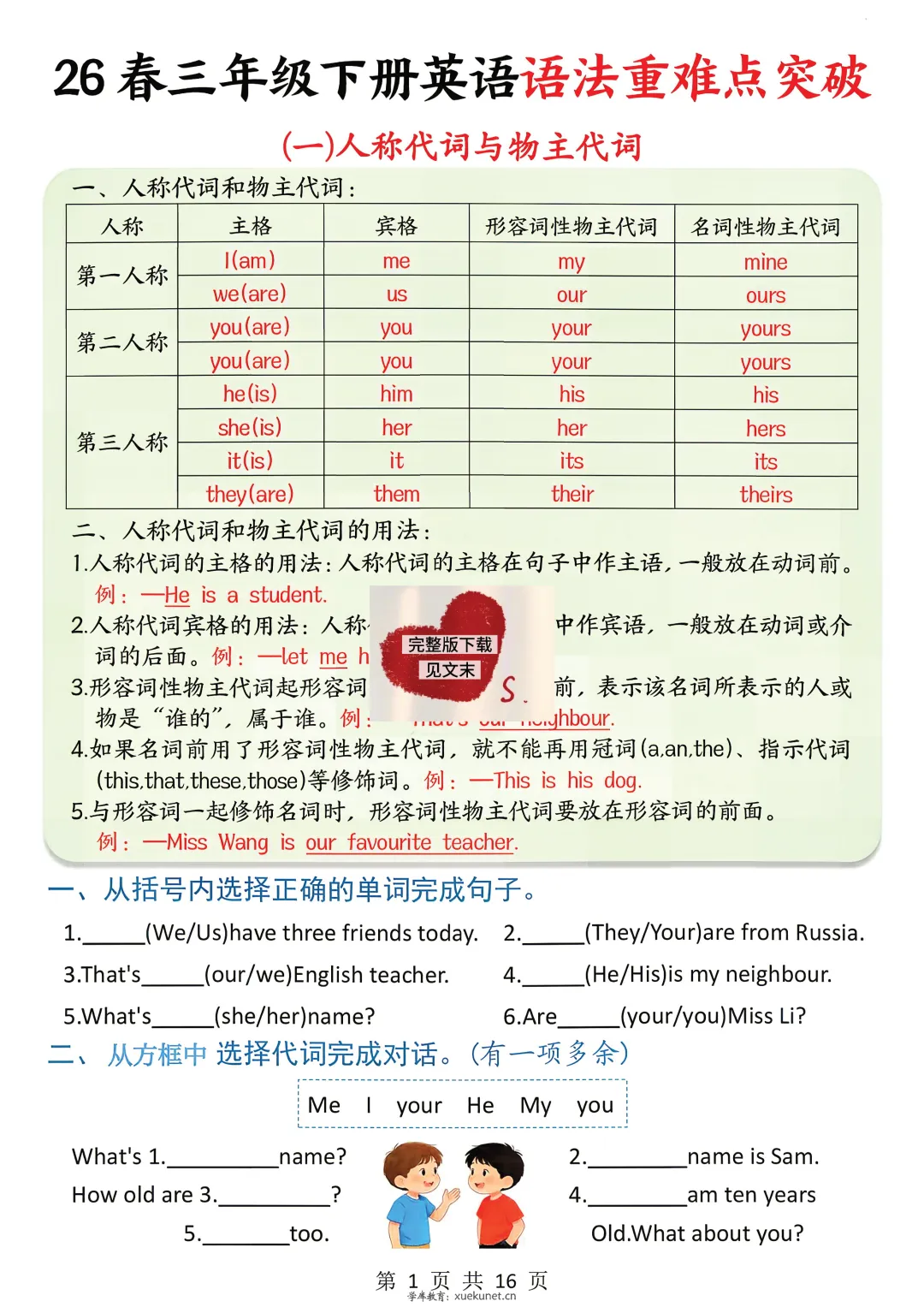
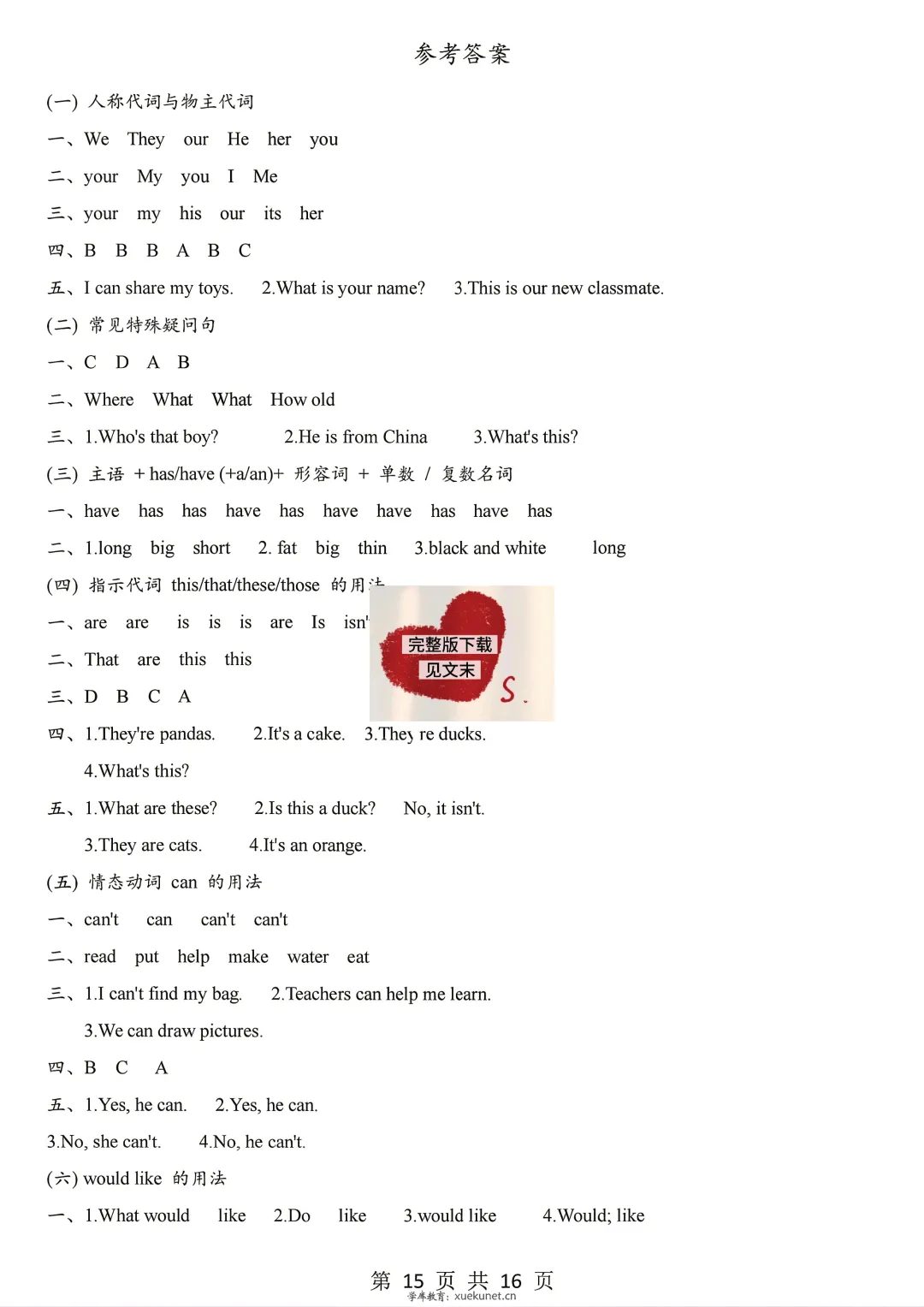
(一)人称代词与物主代词
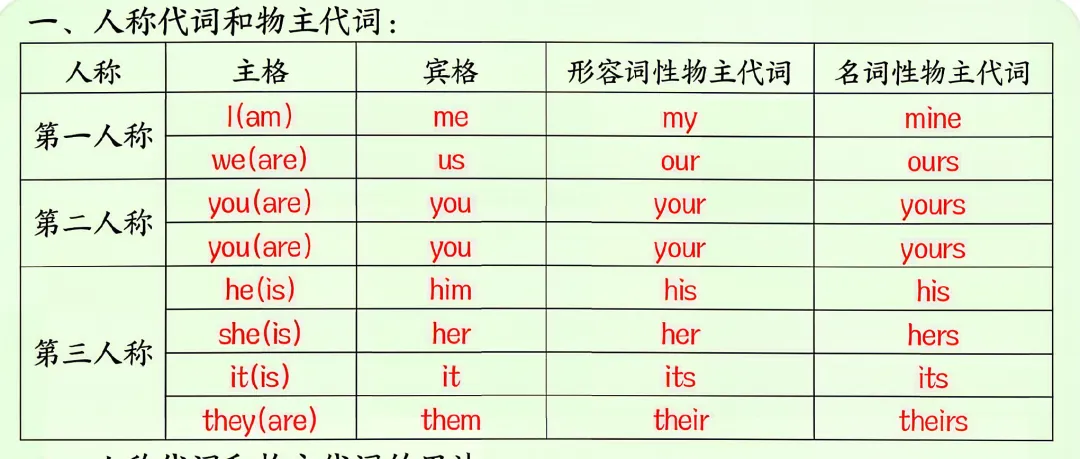
二、人称代词和物主代词的用法:
1.人称代词的主格的用法:人称代词的主格在句子中作主语,一般放在动词前。例:—He is a student.
2.人称代词宾格的用法:人称代词的宾格在句子中作宾语,一般放在动词或介词的后面。例:—let me help.
3.形容词性物主代词起形容词的作用,用在名词前,表示该名词所表示的人或物是“谁的”,属于谁。例:—That's our neighbour.
4.如果名词前用了形容词性物主代词,就不能再用冠词(a,an,the)、指示代词(this, that, these, those)等修饰词。例:—This is his dog.
5.与形容词一起修饰名词时,形容词性物主代词要放在形容词的前面。
例:—Miss Wang is our favourite teacher.
一、从括号内选择正确的单词完成句子。
1.__(We/Us) have three friends today. 2. __(They/Your) are from Russia.
3. That's__(our/we) English teacher. 4. __(He/ His) is my neighbour.
5. What's__(she/ her) name? 6. Are__(your/you) Miss Li?
二、从方框中 选择代词完成对话。(有一项多余)
Me I your He My you
What's 1. __name? 2. __ name is Sam.
How old are 3. __ ?
4. __ am ten years Old.What about you?
5. __ too.
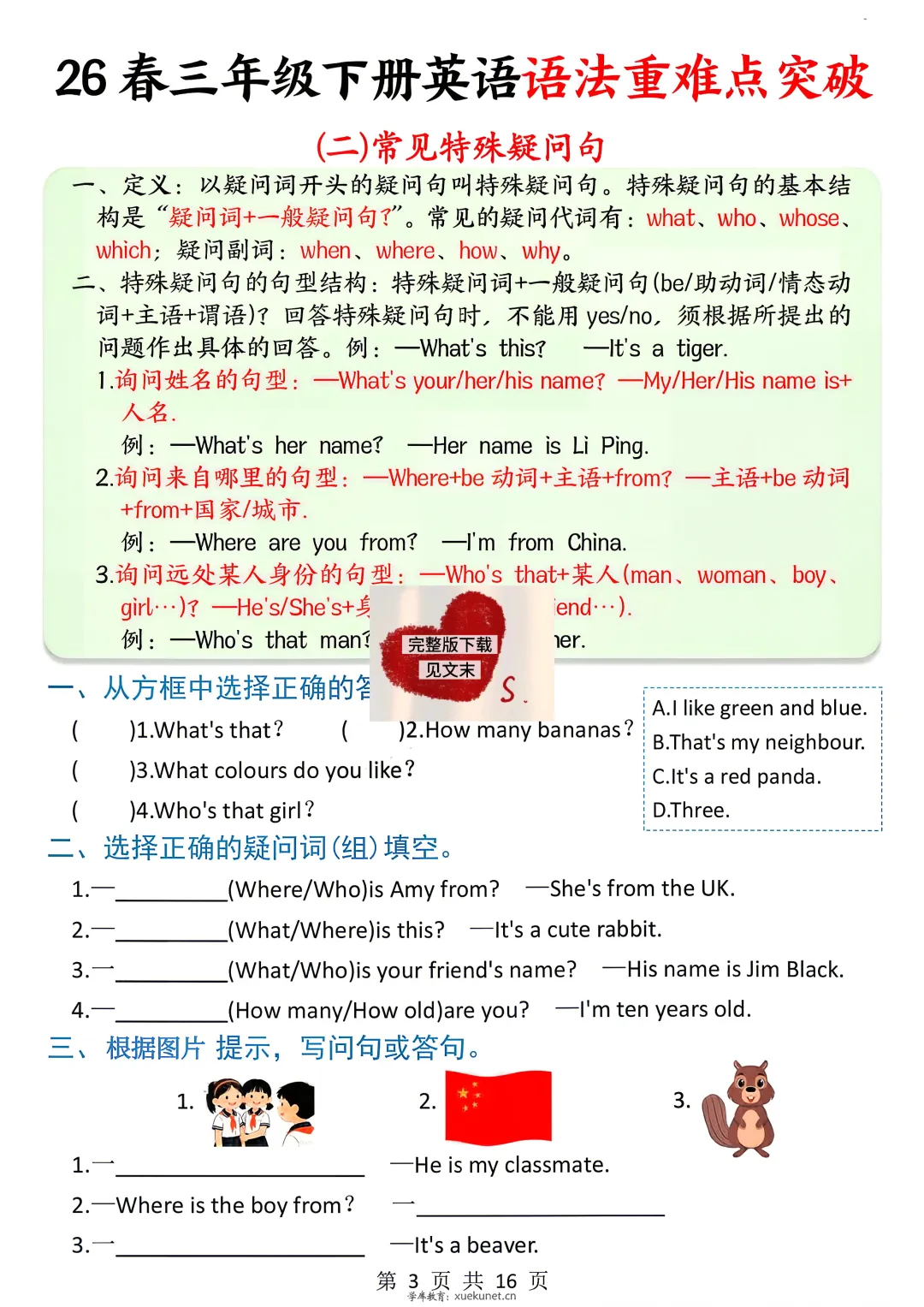
(二)常见特殊疑问句
一、定义:以疑问词开头的疑问句叫特殊疑问句。特殊疑问句的基本结构是“疑问词+一般疑问句?”。常见的疑问代词有:what、who、whose、which; 疑问副词:when、where、how、why.
二、特殊疑问句的句型结构:特殊疑问词+一般疑问句(be/助动词/情态动词+主语+谓语)?回答特殊疑问句时,不能用yes/no,须根据所提出的问题作出具体的回答。例:—What's this? —It's a tiger.
1.询问姓名的句型:—What's your/ her/ his name?—My/ Her/ His name is+人名。
例:—What's her name?—Her name is Li Ping.
2.询问来自哪里的句型:—Where+be动词+主语+from?—主语+be动词+from+国家/城市。
例:—Where are you from?—I'm from China.
3.询问远处某人身份的句型:—Who's that+某人(man、woman、boy、girl…)?—He's/ She's+身份(my mother/ friend…).
例:—Who's that man?—He's my father.
一、从方框中选择正确的答语。
( )1. What's that? ( )2. How many bananas?
A. I like green and blue.
B. That's my neighbour.
C. It's a red panda.
D. Three.
( )3. What colours do you like?
( )4. Who's that girl?
二、选择正确的疑问词(组)填空。
1.—__(Where/ Who) is Amy from?—She's from the UK.
2.—__(What/ Where) is this?—It's a cute rabbit.
3.一__(What/ Who) is your friend's name?—His name is Jim Black.
4.—__(How many/ How old) are you?—I'm ten years old.
三、根据图片 提示,写问句或答句。
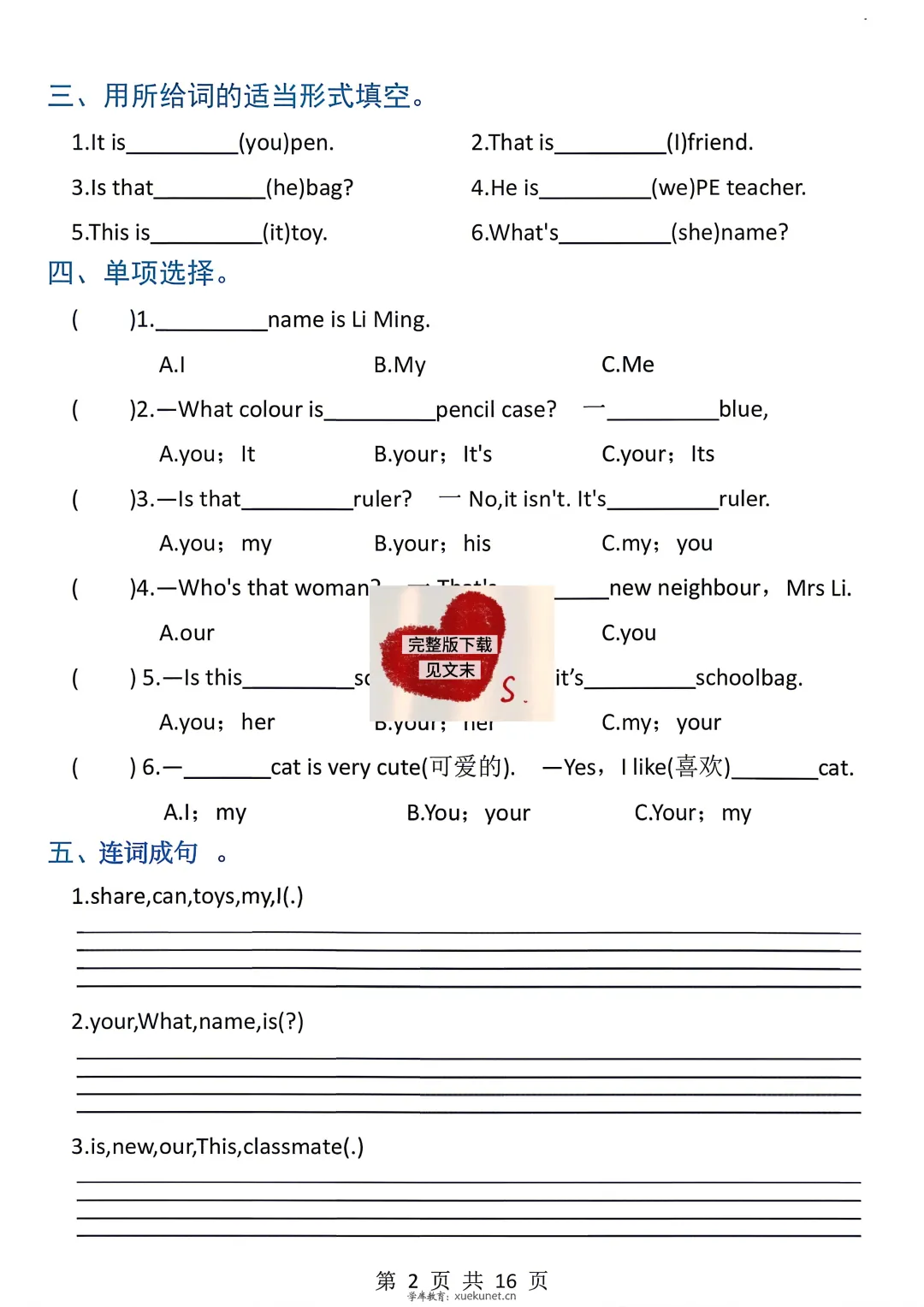
1.一__ —He is my classmate.
2.—Where is the boy from?一__
3.一__—It's a beaver.
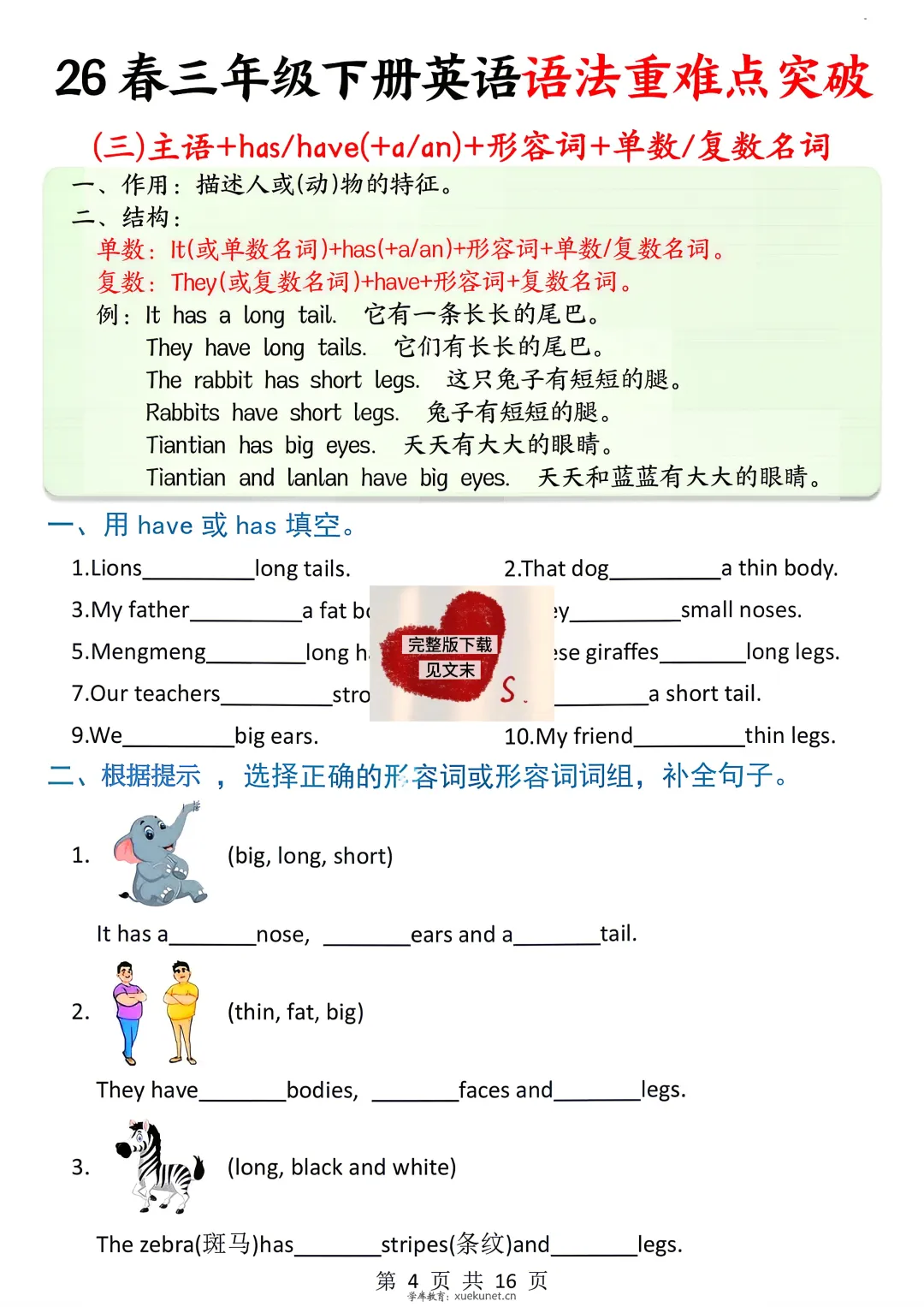
(三)主语+has/have(+a/an)+形容词+单数/复数名词
一、作用:描述人或(动)物的特征。
二、结构:
单数:It(或单数名词)+has(+a/an)+形容词+单数/复数名词。
复数:They(或复数名词)+have+形容词+复数名词。
例:It has a long tail. 它有一条长长的尾巴。
They have long tails. 它们有长长的尾巴。
The rabbit has short legs. 这只兔子有短短的腿。
Rabbits have short legs. 兔子有短短的腿。
Tiantian has big eyes. 天天有大大的眼睛。
Tiantian and lanlan have big eyes. 天天和蓝蓝有大大的眼睛。
一、用have或has填空。
1. Lions _ long tails. 2. That dog _a thin body.
3. My father _a fat body. 4. They _ small noses.
5. Mengmeng _ long hair(头发). 6. These giraffes _ long legs.
7. Our teachers _ strong arms. 8. It _a short tail.
9. We _ big ears. 10. My friend _ thin legs.
二、根据提示,选择正确的形容词或形容词词组,补全句子。
1.(big, long, short)
It has a_ nose, _ ears and a_ tail.
2.(thin, fat, big)
They have _ bodies, _ faces and _ legs.
3.(long, black and white)
The zebra(斑马) has _ stripes(条纹) and _ legs.
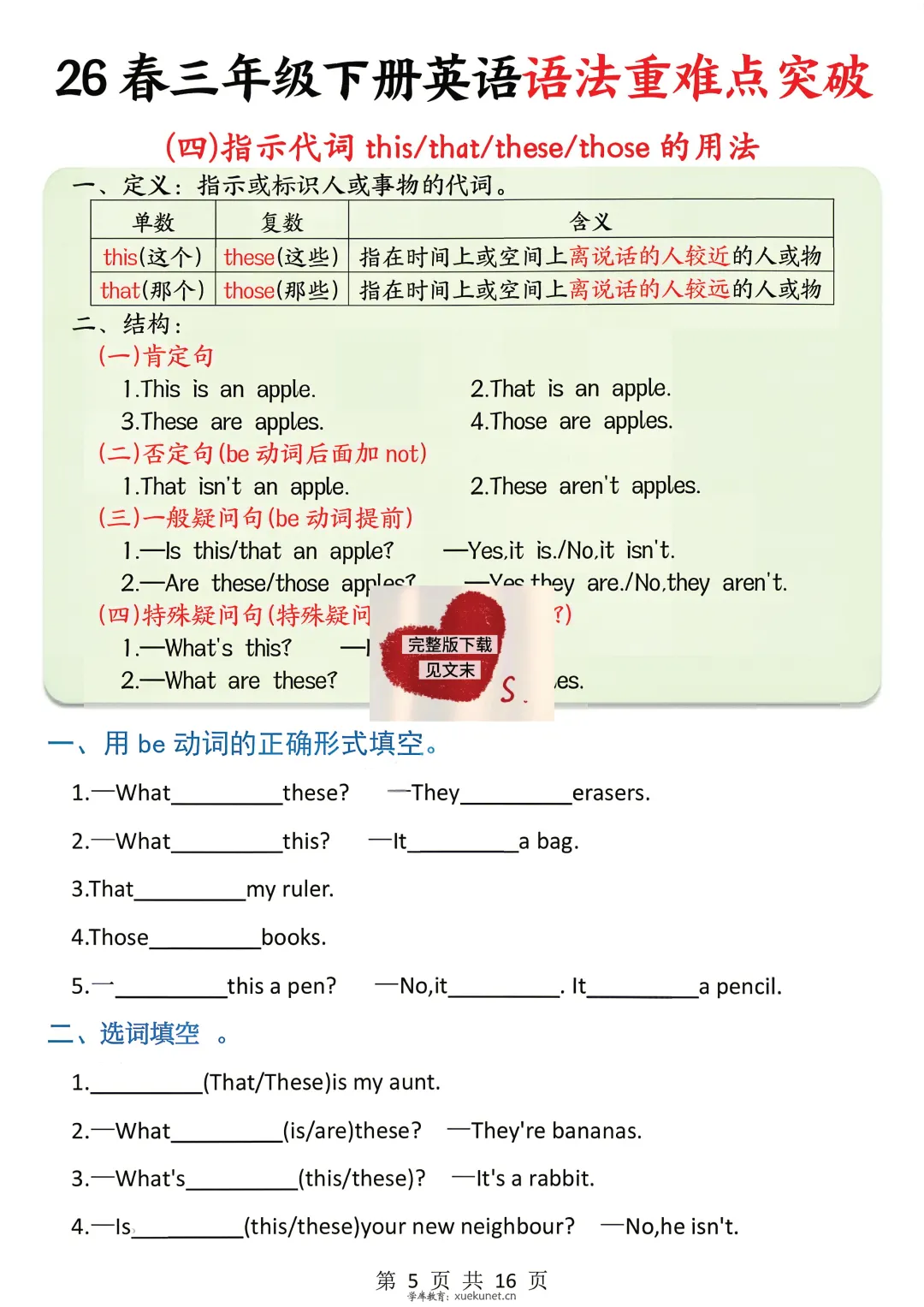
(四)指示代词this/ that/ these/ those的用法
一、定义:指示或标识人或事物的代词。
单数 复数 含义
this(这个) these(这些)指在时间上或空间上离说话的人较近的人或物
that(那个) those(那些) 指在时间上或空间上离说话的人较远的人或物
二、结构:
(一)肯定句
1. This is an apple. 2. That is an apple.
3. These are apples. 4. Those are apples.
(二)否定句(be动词后面加not)
1. That isn't an apple. 2. These aren't apples.
(三)一般疑问句(be动词提前)
1.—Is this/ that an apple? —Yes, it is./ No, it isn't.
2.—Are these/ those apples? —Yes, they are./ No, they aren't.
(四)特殊疑问句(特殊疑问词+be动词+主语?)
1.—What's this?—It's an apple.
2.—What are these? —They are apples.
一、用be动词的正确形式填空。
1.—What __these? —They__ erasers.
2.—What __ this?—It __a bag.
3. That __ my ruler.
4. Those __ books.
5. 一__this a pen? —No, it __ . It__a pencil.
二、选词填空。
1. __(That/ These) is my aunt.
2.—What __(is/ are) these?—They' re bananas.
3.—What's__(this/ these)?—It's a rabbit.
4.—Is __(this/ these) your new neighbour?—No, he isn't.
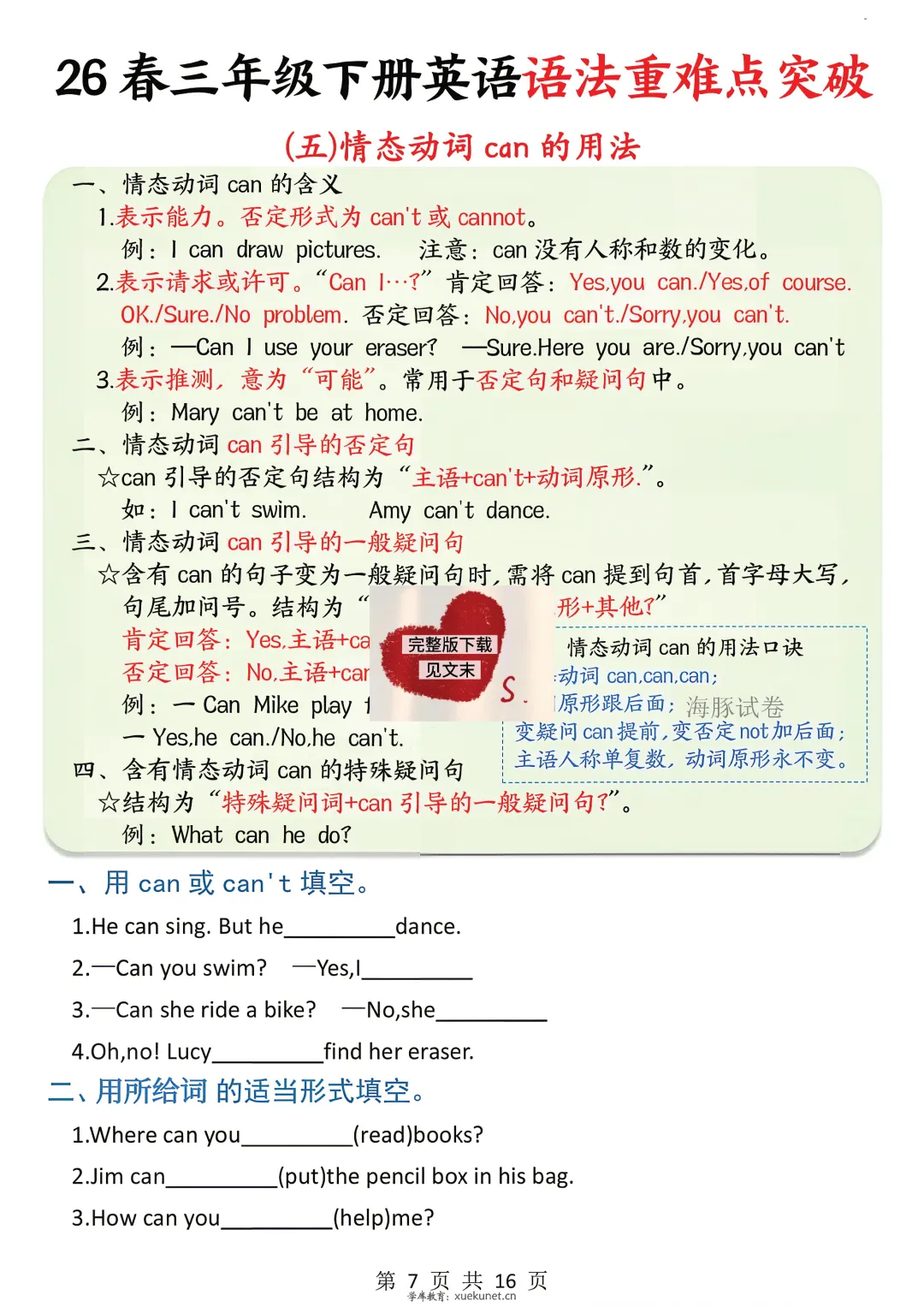
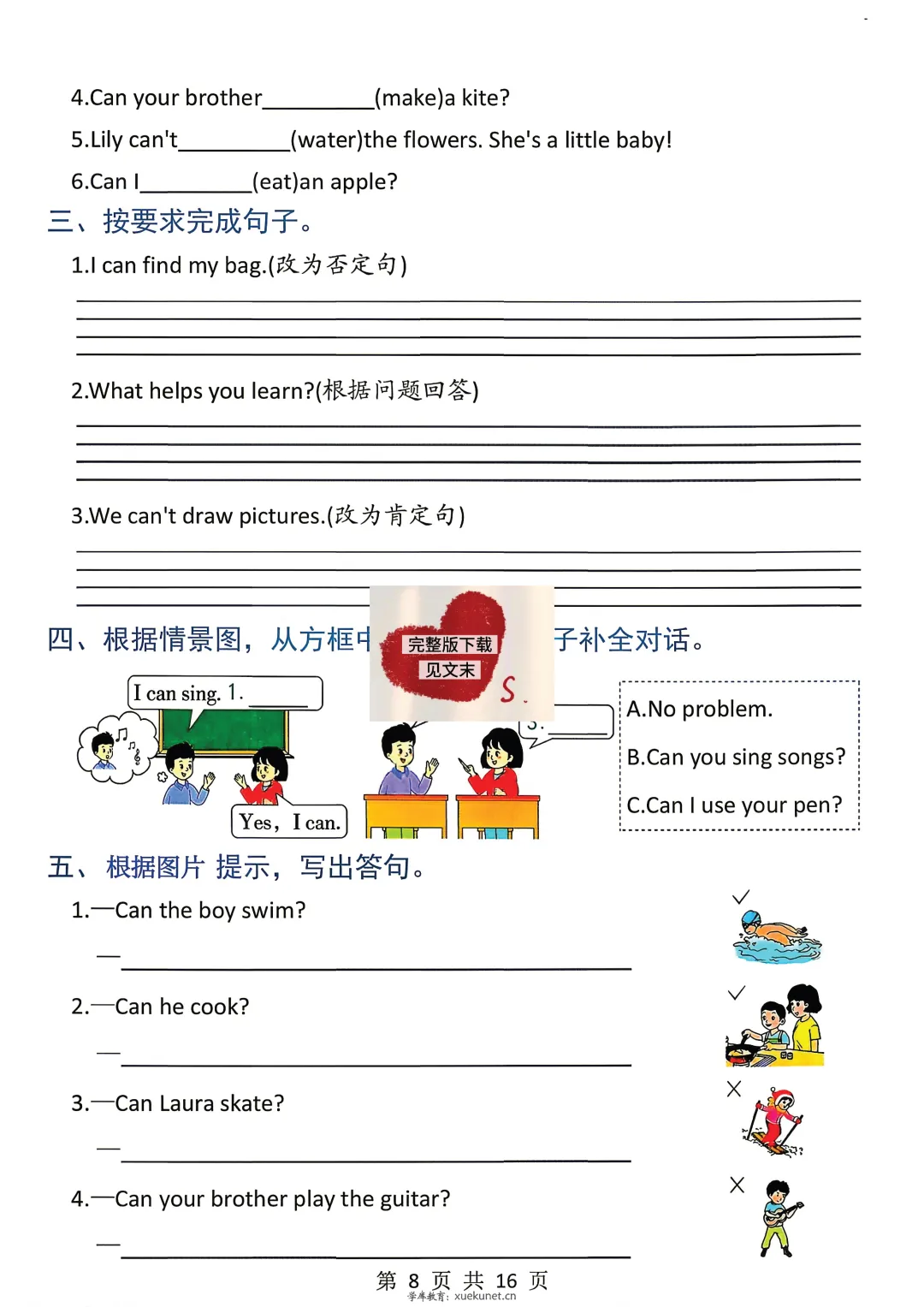
(五)情态动词can的用法
一、情态动词can的含义
1.表示能力。否定形式为can't或cannot.
例: I can draw pictures. 注意:can没有人称和数的变化。
2.表示请求或许可。“Can I…?”肯定回答:Yes,you can./ Yes,of course.
OK./ Sure./ No problem. 否定回答:No, you can't./ Sorry, you can't.
例:—Can I use your eraser?—Sure. Here you are./ Sorry, you can't
3.表示推测,意为“可能”。常用于否定句和疑问句中。
例: Mary can't be at home.
二、情态动词can引导的否定句
☆can引导的否定句结构为“主语+can't+动词原形。”。
如: I can't swim. Amy can't dance.
三、情态动词can引导的一般疑问句
☆含有can的句子变为一般疑问句时,需将can提到句首,首字母大写,句尾加问号。结构为“Can+主语+动词原形+其他?”
肯定回答:Yes,主语+can. 情态动词can的用法口诀
否定回答:No.主语+can't/ cannot. 情态动词can,can,can;
例:一Can Mike play football? 动词原形跟后面;
一Yes, he can./ No, he can't. 变疑问can提前,变否定not加后面;
四、含有情态动词can的特殊疑问句
主语人称单复数,动词原形永不变。
☆结构为“特殊疑问词+can引导的一般疑问句?”。
例: What can he do?
一、用can或can't填空。
1. He can sing. But he __ dance.
2.—Can you swim?—Yes,I__
3.—Can she ride a bike?—No, she __
4. Oh, no! Lucy __find her eraser.
二、用所给词的适当形式填空。
1. Where can you __(read) books?
2. Jim can __(put) the pencil box in his bag.
3. How can you __(help) me?
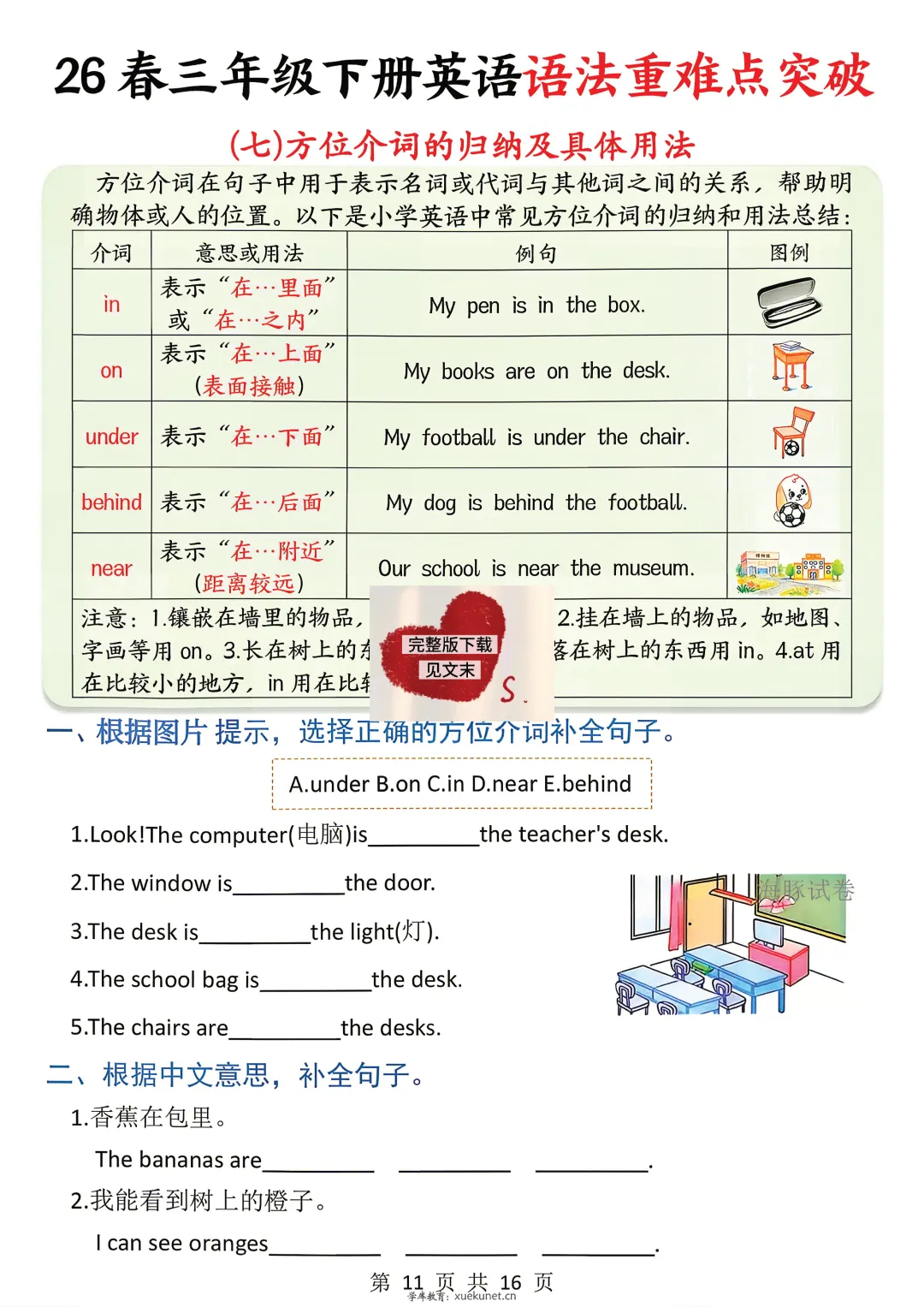
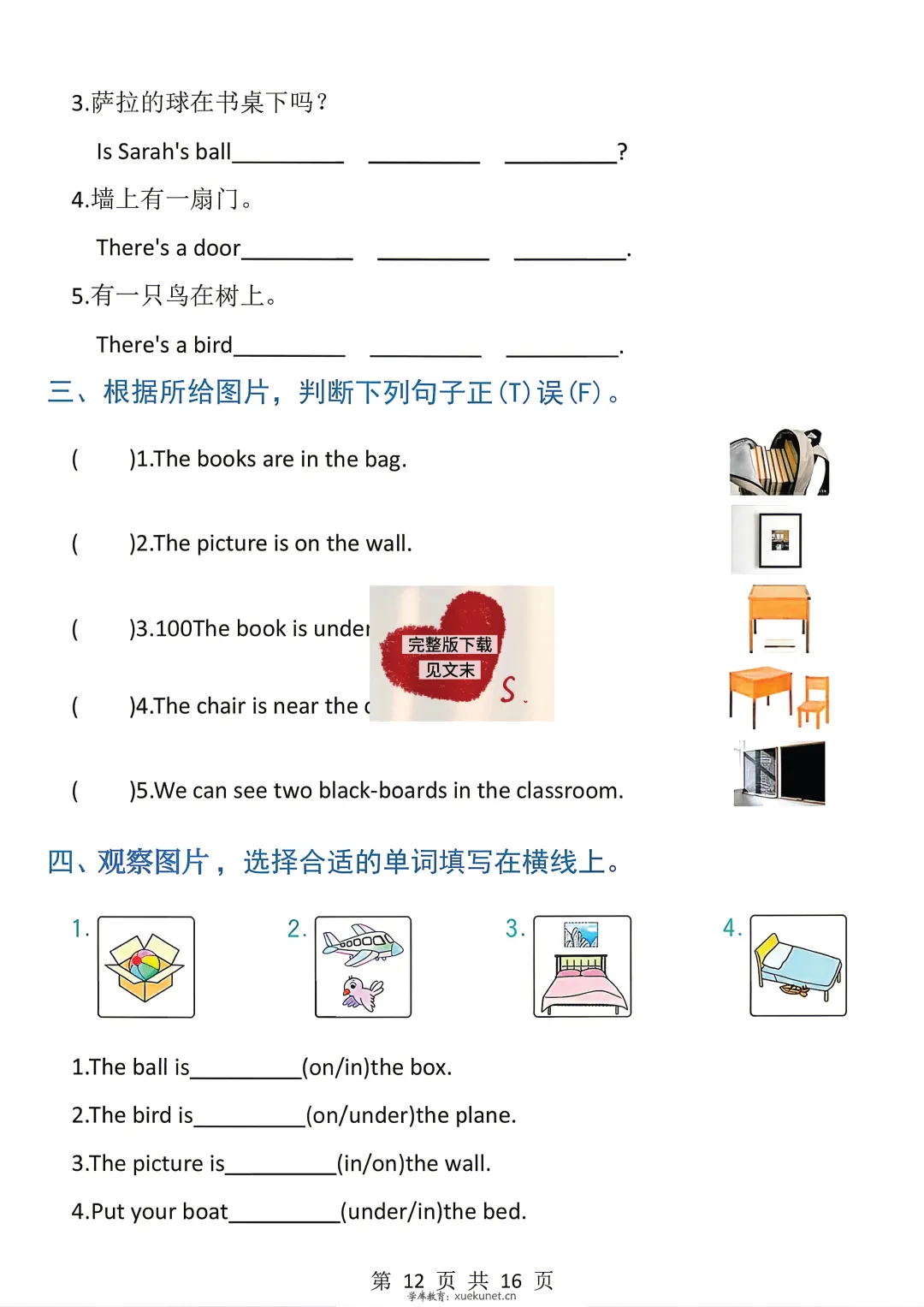
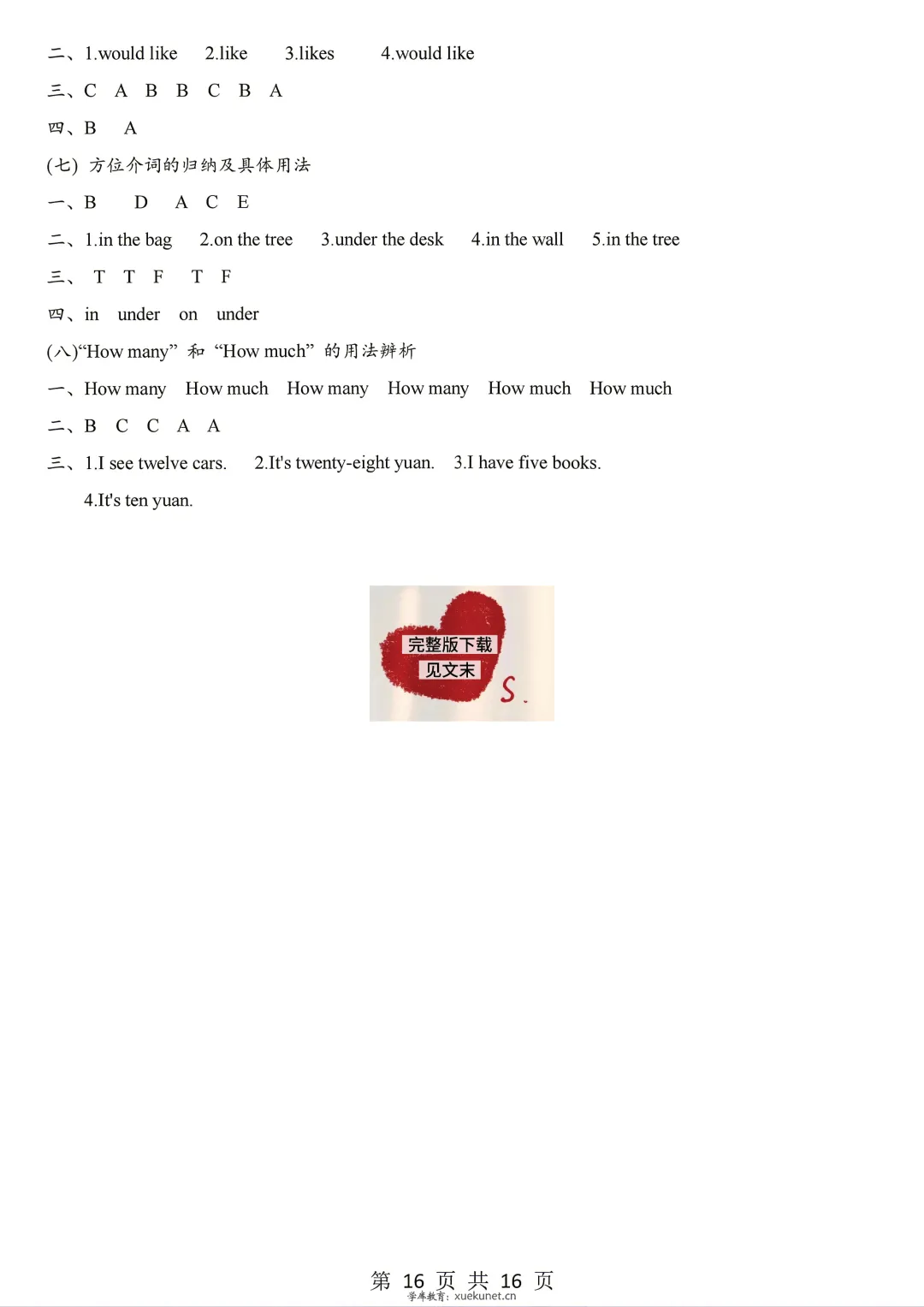
七)方位介词的归纳及具体用法
方位介词在句子中用于表示名词或代词与其他词之间的关系,帮助明确物体或人的位置。以下是小学英语中常见方位介词的归纳和用法总结:
介词 意思或用法 例句 图例
in 表示“在…里面”或“在…之内” My pen is in the box.
on 表示“在…上面”(表面接触) My books are on the desk.
under 表示“在…下面” My football is under the chair.
behind表示“在…后面” My dog is behind the football.
near 表示“在…附近”(距离较远) Our school is near the museum.
注意:1.镶嵌在墙里的物品,如门、窗等用 in 2.挂在墙上的物品,如地图、字画等用on。3.长在树上的东西用on,站在或落在树上的东西用in.4. at用在比较小的地方,in用在比较大的地方。
一、根据图片提示,选择正确的方位介词补全句子。
A. under B. on C. in D. near E. behind
1. Look! The computer(电脑)is __the teacher's desk.
2. The window is __ the door.
3. The desk is the light(灯)。
4. The school bag is __the desk.
5. The chairs are __ the desks.
二、根据中文意思,补全句子。
1.香蕉在包里。
The bananas are __ __ __ .
2.我能看到树上的橙子。
I can see oranges __ __ .
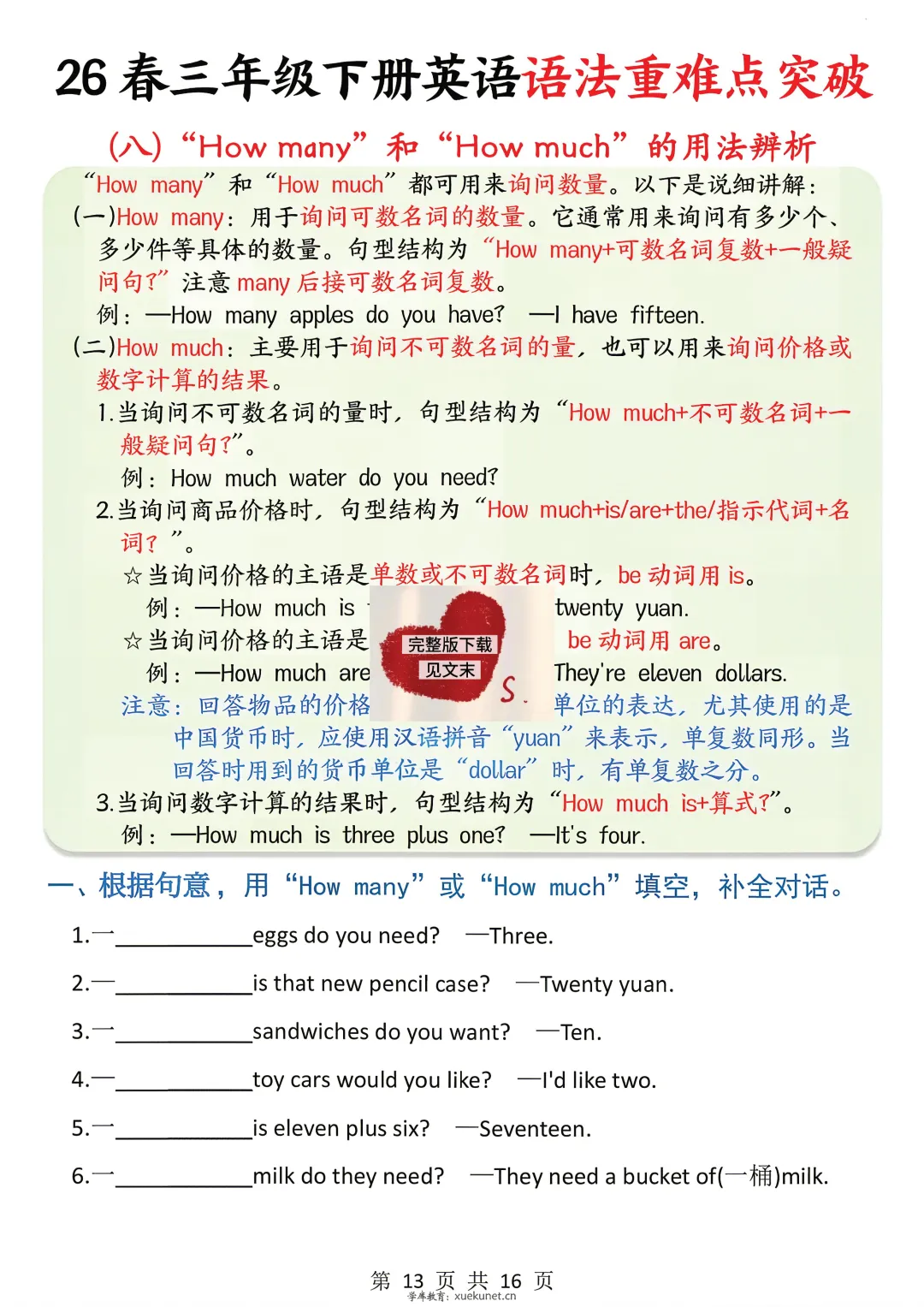
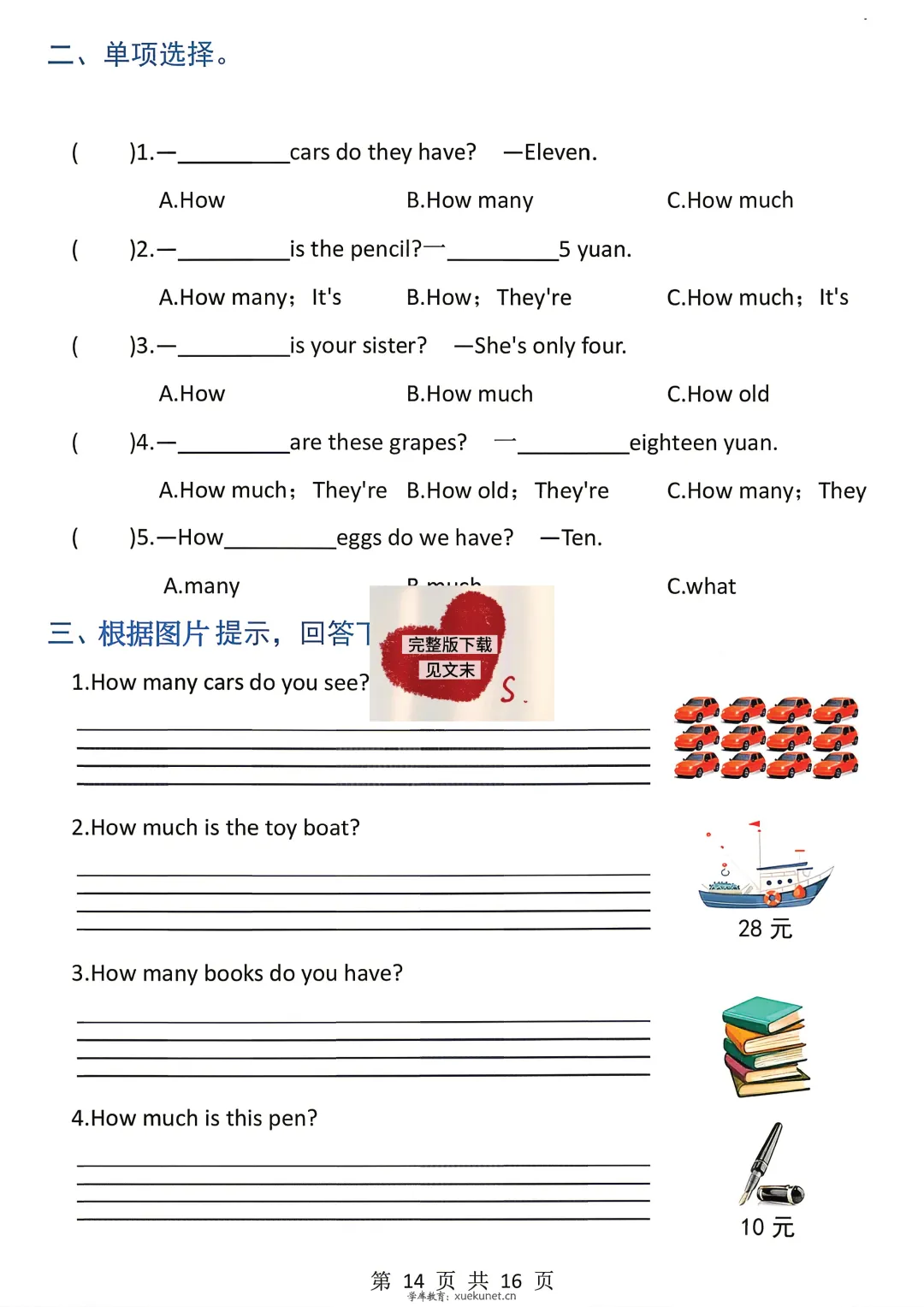
(八)“How many”和“How much”的用法辨析
“How many”和“How much”都可用来询问数量。以下是说细讲解:
(一)How many:用于询问可数名词的数量。它通常用来询问有多少个、多少件等具体的数量。句型结构为“How many+可数名词复数+一般疑问句?”注意many后接可数名词复数。
例:—How many apples do you have?—I have fifteen.
(二)How much:主要用于询问不可数名词的量,也可以用来询问价格或数字计算的结果。
1.当询问不可数名词的量时,句型结构为“How much+不可数名词+一般疑问句?”。
例:How much water do you need?
2.当询问商品价格时,句型结构为“How much+is/are+the/指示代词+名词?”。
☆当询问价格的主语是单数或不可数名词时,be动词用is。
例:—How much is this pen?—It's twenty yuan.
☆当询问价格的主语是可数名词复数时,be动词用are.
例:—How much are the apples?—They're eleven dollars.
注意:回答物品的价格时,要注意货币单位的表达,尤其使用的是中国货币时,应使用汉语拼音“yuan”来表示,单复数同形。当回答时用到的货币单位是“dollar”时,有单复数之分。
3.当询问数字计算的结果时,句型结构为“How much is+算式?”。
例:—How much is three plus one?—It's four.
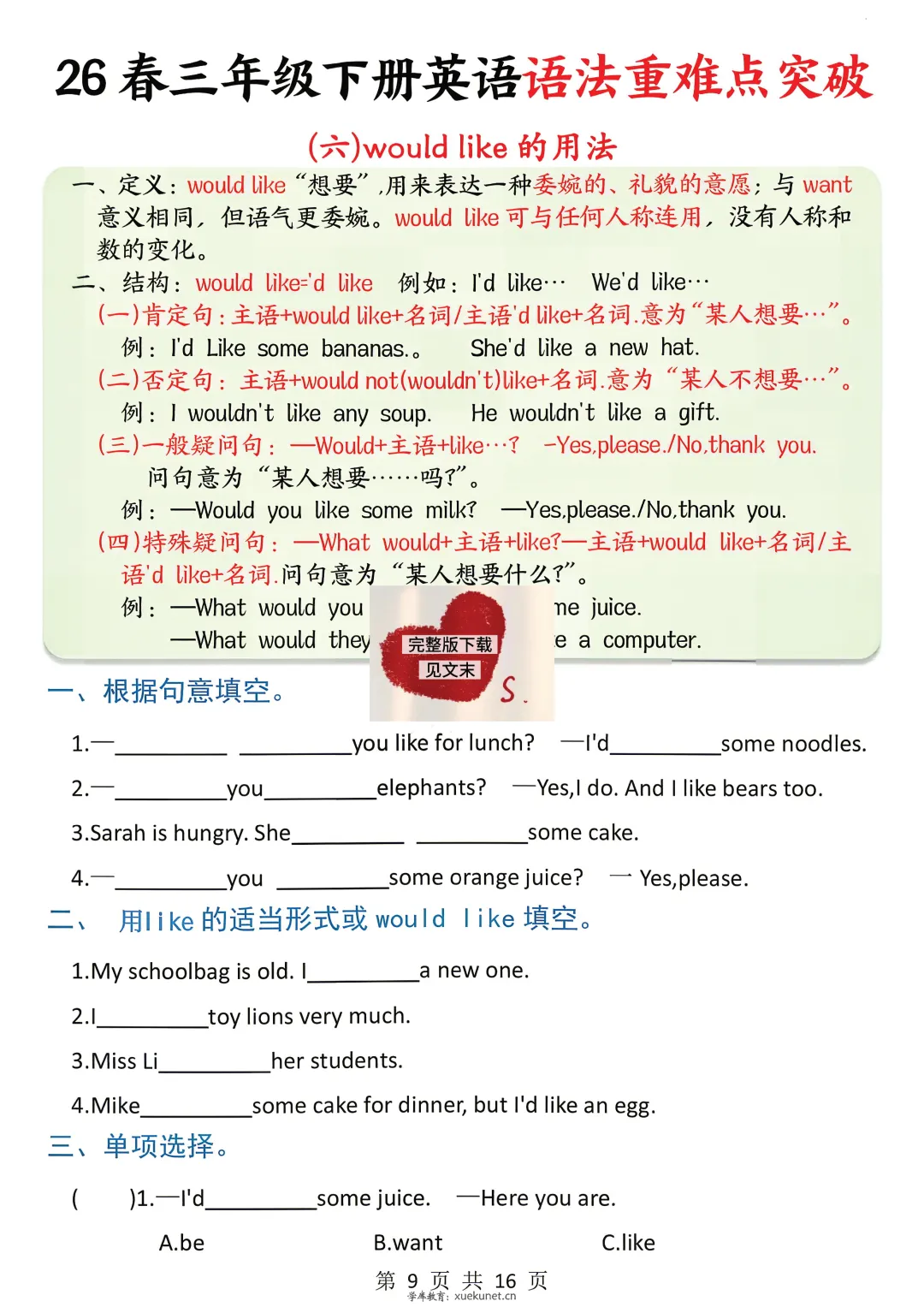
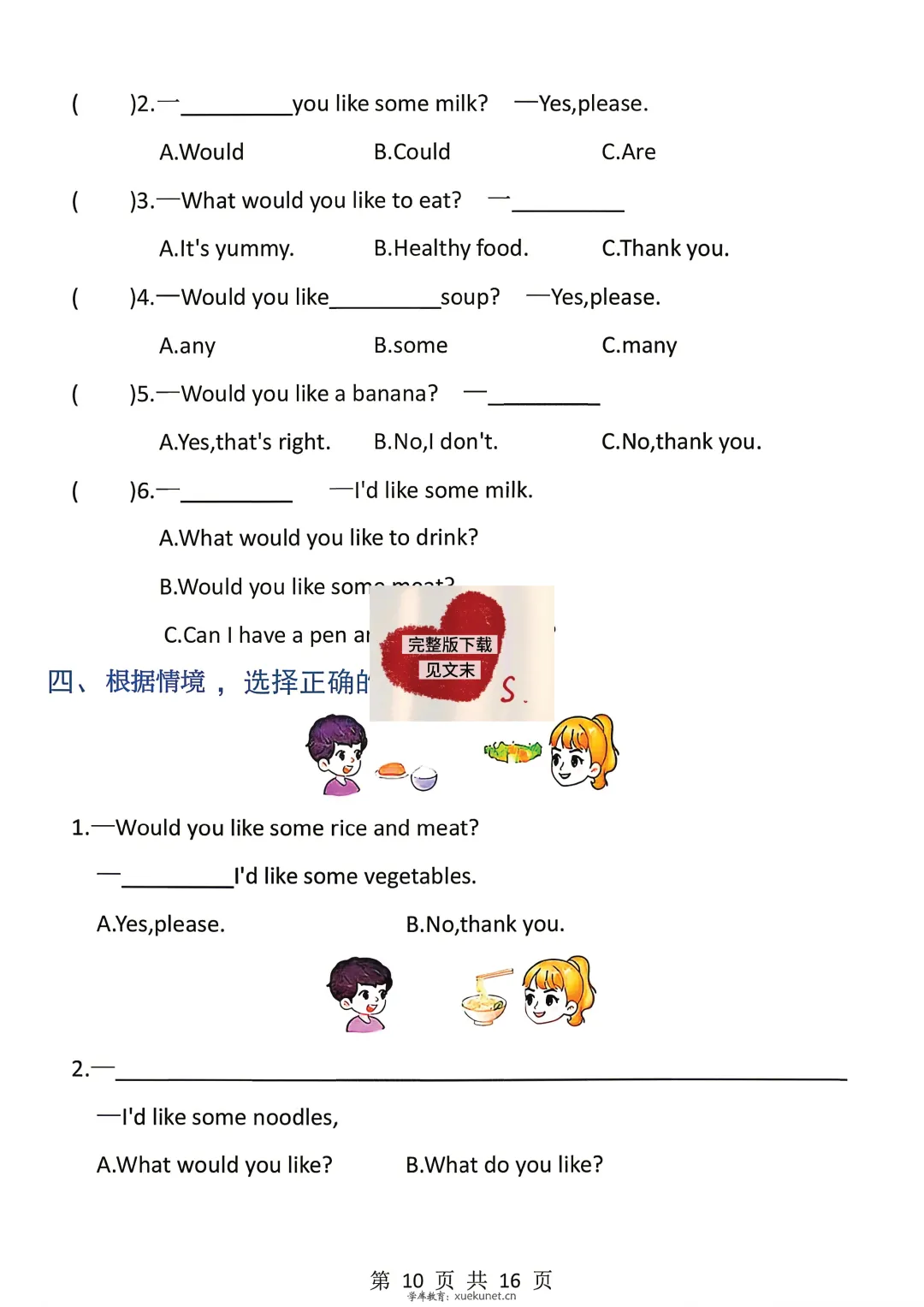
一、根据句意,用“How many”或“How much”填空,补全对话。
1.—_eggs do you need?—Three.
2.—_is that new pencil case?—Twenty yuan.
3.—_sandwiches do you want?—Ten.
4.—_toy cars would you like?—I'd like two.
5.—_is eleven plus six?—Seventeen.
6.—_milk do they need?—They need a bucket of(一桶)milk.
如需下载完整版

下载说明


 √独家优质资料整理,会员可享全站电子版资料下载
在公众号消息框后台 16392
核对好数字,错误不会自动跳转链接
点击““赞”和“♡”
--------------------------------
学库教育专注1-6年级学习资料库,同步教材更新优质资源,帮助老师、家长一站式为孩子下载学习资料。唯一官方网站:https://xuekunet.cn/
