文档文本内容
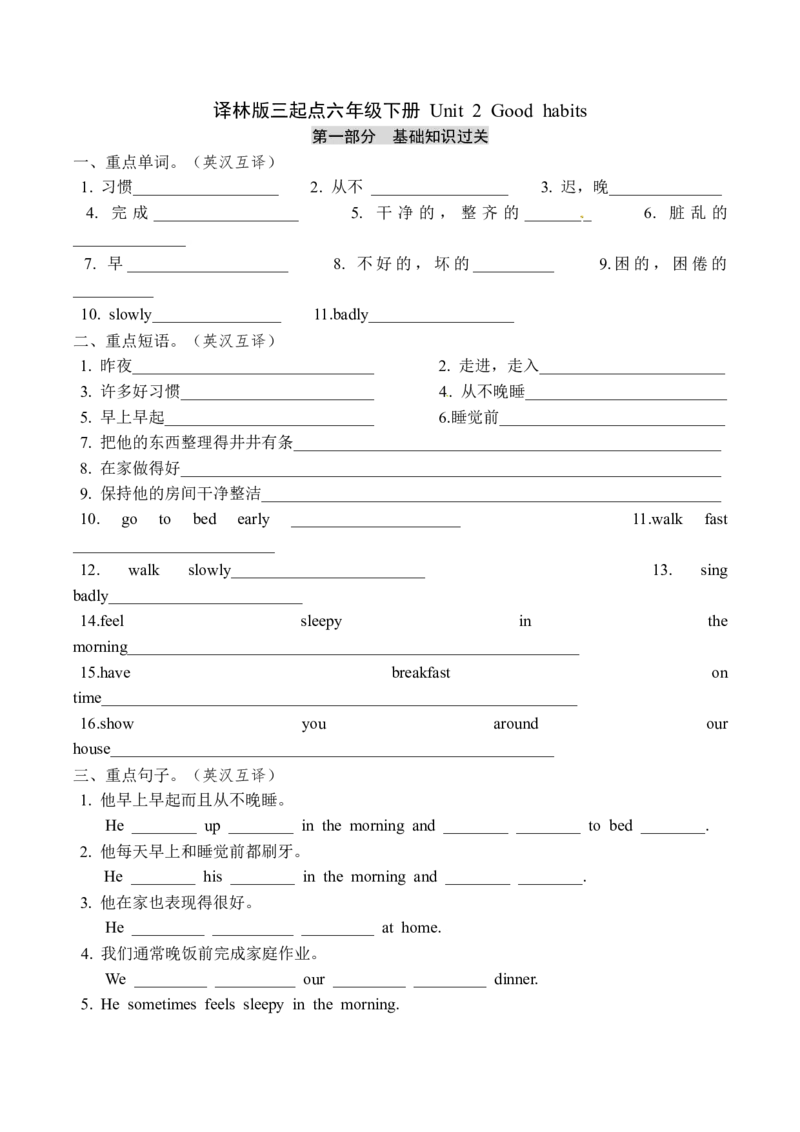
译林版三起点六年级下册 Unit 2 Good habits
第一部分 基础知识过关
一、重点单词。(英汉互译)
1. 习惯__________________ 2. 从不 _________________ 3. 迟,晚______________
4. 完 成 __________________ 5. 干 净 的 , 整 齐 的 ________ 6. 脏 乱 的
______________
[来源:学+科+网Z+X+X+K]
7. 早____________________ 8. 不好的,坏的__________ 9.困的,困倦的
__________
10. slowly________________ 11.badly__________________
二、重点短语。(英汉互译)
1. 昨夜______________________________ 2. 走进,走入_______________________
3. 许多好习惯________________________ 4. 从不晚睡_________________________
5. 早上早起__________________________ 6.睡觉前____________________________
7. 把他的东西整理得井井有条_____________________________________________________
8. 在家做得好___________________________________________________________________
9. 保持他的房间干净整洁_________________________________________________________
10. go to bed early _____________________ 11.walk fast
_________________________
[来源:Z.xx.k.Com]
12. walk slowly________________________ 13. sing
badly________________________
14.feel sleepy in the
morning________________________________________________________
15.have breakfast on
time___________________________________________________________
16.show you around our
house_______________________________________________________
三、重点句子。(英汉互译)
1. 他早上早起而且从不晚睡。
He ________ up ________ in the morning and ________ ________ to bed ________.
2. 他每天早上和睡觉前都刷牙。
He ________ his ________ in the morning and ________ ________.
3. 他在家也表现得很好。
He _________ __________ _________ at home.
[来源:学科网ZXXK]
4. 我们通常晚饭前完成家庭作业。
We _________ __________ our _________ _________ dinner.
5. He sometimes feels sleepy in the morning.
[来源:学科网]_____________________________________________________________________________
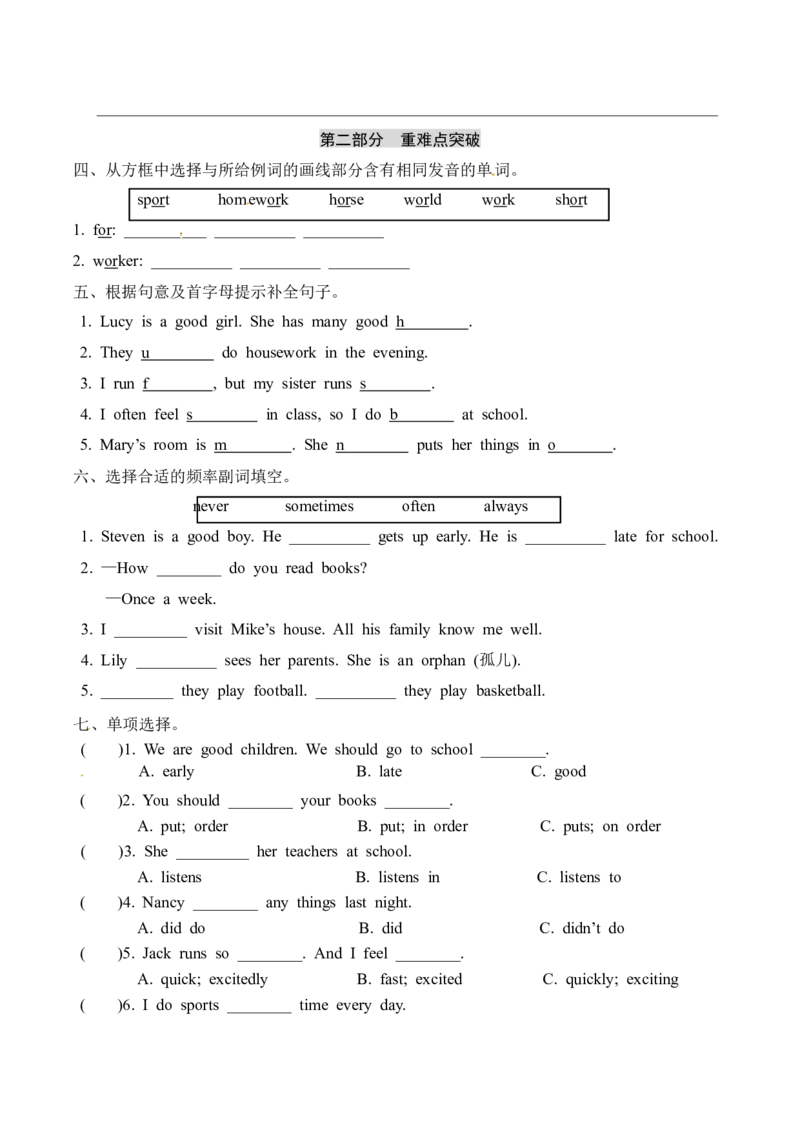
第二部分 重难点突破
四、从方框中选择与所给例词的画线部分含有相同发音的单词。
sport homework horse world work short
1. for: __________ __________ __________
2. worker: __________ __________ __________
五、根据句意及首字母提示补全句子。
1. Lucy is a good girl. She has many good h .
2. They u do housework in the evening.
3. I run f , but my sister runs s .
4. I often feel s in class, so I do b at school.
5. Mary’s room is m . She n puts her things in o .
六、选择合适的频率副词填空。
never sometimes often always
1. Steven is a good boy. He __________ gets up early. He is __________ late for school.
2. —How ________ do you read books?
—Once a week.
3. I _________ visit Mike’s house. All his family know me well.
4. Lily __________ sees her parents. She is an orphan (孤儿).
5. _________ they play football. __________ they play basketball.
七、单项选择。
( )1. We are good children. We should go to school ________.
A. early B. late C. good
( )2. You should ________ your books ________.
A. put; order B. put; in order C. puts; on order
( )3. She _________ her teachers at school.
A. listens B. listens in C. listens to
( )4. Nancy ________ any things last night.
A. did do B. did C. didn’t do
( )5. Jack runs so ________. And I feel ________.
A. quick; excitedly B. fast; excited C. quickly; exciting
( )6. I do sports ________ time every day.A. on B. for C. of
( )7. A housewife ________ many things at home, but she _______ work.
A. does; doesn’t B. doesn’t; does C. doesn’t do; doesn’t
( )8. Let me ________ you _________ my new office.
A. showing; to B. sent; to C. show; around
( )9. This is the way she ________ ________ hands.
A. washes; her B. wash; her C. sweep; his
( )10. ________ your father work ________?
A. Does; hardly B. Do; hard C. Did; hard
八、用所给词的适当形式填空。
[来源:学&科&网]
1. She does ________ (good) at school.
2. I feel ________ (sleep) now. I want ________ (go) to bed.
3. Look! He is running ________ (slow) in the playground.
4. You should ________ (do) more exercise.
5. My brother ________ (have) breakfast on time every day.
6. _________ (not go) to school late every day.
7. _________ (who) bedroom is this?
8. Peter is a ________ boy. He does ________ at school. (bad)
九、按要求完成句子。
1. My friend usually finishes his homework before dinner. (改为否定句)
My friend _________ usually _________ his homework before dinner.
2. He has a bad habit too. (改为同义句)
He _________ has a bad habit.
3. That’s Helen ’ s bedroom. (对画线部分提问)
_________ bedroom is that?
4. I went to bed late last night. (改为一般疑问句)
_________ _________ _________ to bed late last night?
5. school can show your me you around (?) (连词成句)
_____________________________________________________________________________
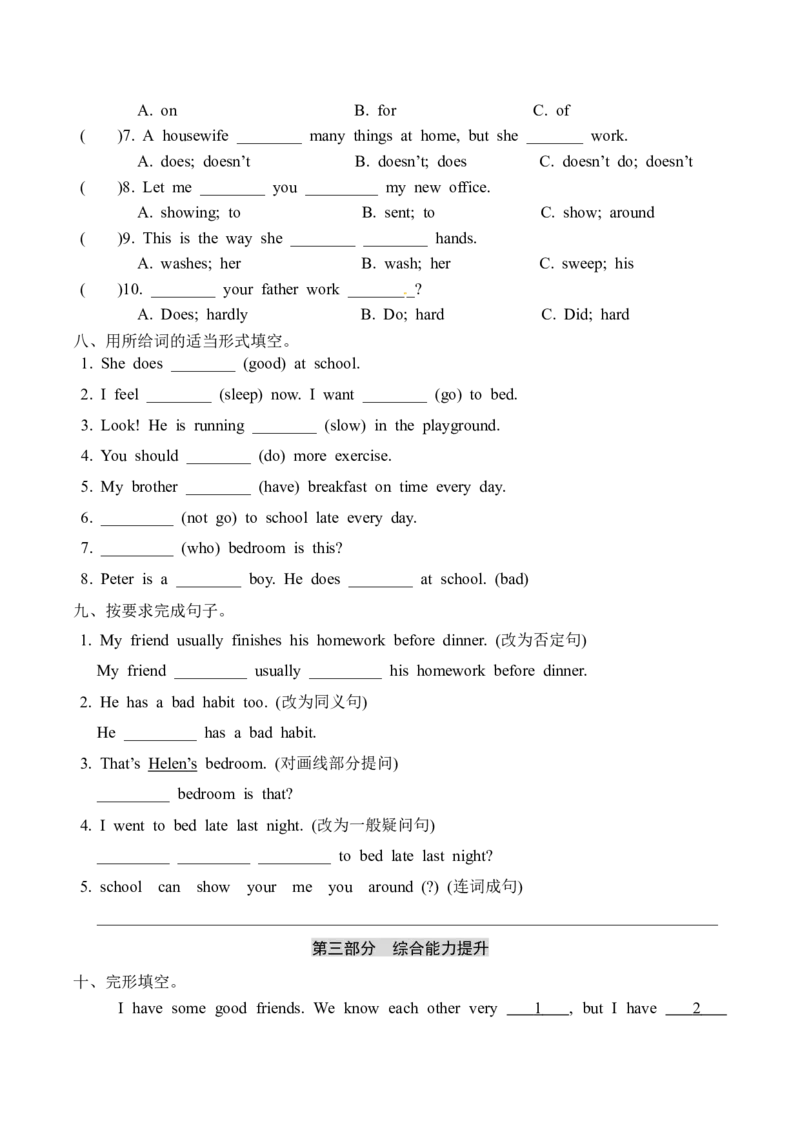
第三部分 综合能力提升
十、完形填空。
I have some good friends. We know each other very 1 , but I have 2met them. They are my 3 . Tom is from England. He always 4 his parents. He
is good at 5 . He goes to school 6 every morning. Edward is an American
boy. He likes 7 basketball. He always plays basketball after school. And he 8
his homework after dinner. He goes to bed late every day. Jack is 9 Australia. His
hobby is playing computer games. He cleans his room every day. He always cleans his
father’s car. He sends me an email every week. Do you have 1 0 penfriends?
( )1. A. good B. well C. OK
( )2. A. always B. sometimes C. never
( )3. A. brother B. classmates C. penfriends
( )4. A. help B. helping C. helps
( )5. A. draw B. draws C. drawing
( )6. A. early B. earlily C. slow
( )7. A. playing B. play C. plays
( )8. A. finish B. do C. finishes
( )9. A. to B. from C. an
( )10. A. some B. a C. any
十一、阅读短文,完成任务。
In Japan, parents always pay great attention to the manners of their children. They
think good manners are very important to a person. For example, when dinner is ready,
children shouldn’t eat first until their parents tell them to eat. Before eating, children must
say something thankful to their parents. In addition(另外), there are also some rules for
children when they leave or come back home. When children leave home, they should say
to their parents, “I’m leaving.” When they come back home, they should say, “I’m
back.” So you can see that Japanese children always have good manners.
(一)根据短文内容,判断正(T)误(F)。
( )1. When Japanese children leave home, they should say nothing to their parents.
( )2. Japanese children always have bad manners.
( )3. The underlined words “good manners” means “有礼貌”.
(二)根据短文内容,回答下列问题。
1. What do parents in Japan pay attention to?
____________________________________________________________________________
2. What shouldn’t children do when dinner is ready?
____________________________________________________________________________
3. Do Japanese children say something thankful to their parents before eating?____________________________________________________________________________
4. What do children say when they leave home?
____________________________________________________________________________
5. What do children say when they come back home?
____________________________________________________________________________
答案:
一、1.habit 2.never 3.late 4.finish 5.tidy 6.messy 7.early 8.bad
9.sleepy 10.慢速地 11.差地,不好
二、1.last night 2.go into 3.many good habits 4.never go to bed late
5.get up early in the morning 6.before bedtime 7.put his things in order
8.do well at home 9.keep his room clean and tidy 10.早睡觉
11.走得快 12.走得慢 13.唱得不好 14.早上觉得困 15.准时吃早饭
16.带你参观我们的房子
三、1.gets; early; never goes; late
2.brushes; teeth; before bedtime
3.also does well
4.usually finish; homework before
5.他有时候早上会觉得困。
四、1.sport horse short 2.homework world work
五、1.habits 2.usually 3.fast; slowly 4.sleepy; badly 5.messy; never; order
六、1.always; never 2.often 3.always 4.never 5.Sometimes; Sometimes
七、1.A 2.B 3.C 4.C 5.B 6.A 7.A 8.C 9.A 10.C
八、1.well 2.sleepy; to go 3.slowly 4.do 5.has 6.Don’t go
7.Whose 8.bad; badly
九、1.doesn’t; finish 2.also 3.Whose 4.Did you go
5.Can you show me around your school?
十、1.B 2.C 3.C 4.C 5.C 6.A 7.A 8.C 9.B 10.C
十一、(一)1.F 2.F 3.T
(二)1. Their children’s manners.
2. They shouldn’t eat first until their parents tell them to eat.
3. Yes, they do.
4. They say, “I’m leaving.”
5. They say, “I’m back.”