 夜雨聆风
夜雨聆风
本文基于“New Yorker”关于美国高等教育的专访,所有观点均针对美国教育体系,仅供参考,不构成任何建议。本公众号仅作语言学习与思辨训练之用,不代表任何立场。
特别说明:本文讨论的是美国高等教育体系:美国大学学费高昂、转学率高(近40%)、社会对“不上大学”容忍度较高。文中预测数据均基于美国特定语境,请读者注意区分。
本文只关注英语精读技巧,拆解其语言,写作与逻辑,至于对家庭教育的启示,留给每位读者独立思考。
最近New Yorker的一篇关于美国高等教育的专访,在美国教育圈引发了激烈讨论。面对AI浪潮,犹他大学教授Hollis Robbins抛出了一个扎心的问题:如果大学教的东西AI都能教,那大学的作用是什么?
罗宾斯教授的提出了一个值得思考的角度:教育不应是知识的批发,而应是灵魂的触碰。
关键词:AI & Education | Higher Education Reform | Edge Knowledge | Mentorship over Credential
文中涉及专有名词:University of Utah(犹他大学)、Sonoma State University(索诺马州立大学)、Brown University(布朗大学)、University of Chicago(芝加哥大学)、Vanderbilt University(范德堡大学)、Georgia Tech(佐治亚理工学院)、Yale University(耶鲁大学)、Alpha School(阿尔法学校)
文中人物:Hollis Robbins(霍利斯·罗宾斯)犹他大学英语教授、人文学科特别顾问
互动:在AI快速发展的时代,你认为哪些人类特质是无法被替代的?欢迎分享你的观察与思考。
📚目录
1. 语言点
2. 难句理解:深层含义
3. 雅思写作:开始段落与主题段落的逻辑推进
4. 写作练习题
5. 原文与翻译
词汇
1.anti-establishment 反对传统权力的(adj.)anti-establishment fervor, A.I., and a shifting economy
2.wrestle with苦苦思索;全力对付(v. phr.)after wrestling with that query
3.consensus 共识(n.)stood outside the polite consensus
4.bespoke定制的;个性化的(adj.)college should be more bespoke
5.interchangeable可互换的;同质化的(adj.)even élite schools are becoming interchangeable
6.fungibility代替性;同质性(n.)leads to more fungibility and commodification
7.winnowing选;淘汰(n.)a brutal winnowing
8.esoteric深奥的(adj.)encourage the esoteric sort of inquiry
9.culling 淘汰;筛选(n.)require a culling of sixty to seventy per cent
10.agita 焦虑;不安(n.)general agita on the part of the nation’s faculty
11.commodification 商品化(n.)leads to more fungibility and commodification
12.edge knowledge边缘(前沿)知识(n. phr.)teaching at the edges of knowledge
13.apprenticeship [əˈprentɪʃɪp]学徒制(n.)in a kind of apprenticeship model
14.contraction [kənˈtrækʃn]收缩;萎缩(n.)I think there’s contraction
理解句子深层含义(文化语境、讽刺语气和深层逻辑)
句子1:I don’t have a particularly good answer yet, at least not one good enough to inspire the purchase of a midlife-crisis car, my son’s and daughter’s futures be damned.
字面翻译:我还没有一个特别好的答案,至少没有一个好到足以促使我买一辆中年危机跑车,即使让我儿女的未来见鬼去。
深层含义:“中年危机跑车”是西方中产阶级男性的经典文化符号——当男人感到衰老、平庸、失去激情时,会买一辆跑车来证明自己“还活着”
作者在自嘲:给子女存大学基金是一种“负责任”的痛苦,而买跑车是一种“自私”的快乐。他在两者之间摇摆
my son’s and daughter’s futures be damned是一种黑色幽默的虚拟语气,意思是“就算我不管孩子了”。这种自嘲式的内疚感,需要理解西方中产阶级父母的焦虑才能体会
句子2: We tell the student, “You’re special,” and we tell the faculty, “You’re not special.”
字面翻译:我们告诉学生,“你很特别”,但我们告诉教师,“你并不特别”。
深层含义:这是一句极具讽刺意味的平行结构。表面上美国大学在“以学生为中心”,实际上是在把美国教育变成“顾客永远是对的”的服务业
当美国教师不再被当作“特殊的”人才来尊重,他们就变成了可替代的“知识工人”
这句话揭示了美国高等教育的根本矛盾:大学一边用“个性化教育”吸引学生,一边用“标准化课程”束缚教师
罗宾斯的潜台词是:如果你不觉得你的教授是特别的,那你为什么还要来这里上学?
句子3: Instead of OnlyFans, it’s like OnlyProfessors.
字面翻译:不是OnlyFans,而是OnlyProfessors。
深层含义:OnlyFans是一个美国内容订阅平台,以创作者(通常是成人内容创作者)直接向粉丝收费而闻名
这个类比非常大胆甚至冒犯:它将教授比作OnlyFans的创作者,将学生比作付费粉丝
潜台词是:未来的美国教育可能是一种“直接变现个人IP”的模式,教授不再依附于大学,而是像网红一样直接向美国大学生收费
这个比喻暗示了美国高等教育机构作为“中介”的消亡——就像OnlyFans绕过传统娱乐公司一样,OnlyProfessors将绕过传统美国大学
需要理解西方互联网文化中的“创作者经济”和“去中介化”趋势,才能体会这个比喻的力量
句子4If you start approaching education as portable, transferable to other institutions, then you’ve already not bought into what you’re buying.
字面翻译:如果你开始将教育视为可移植的、可转移到其他机构的,那么你就已经没有被你所购买的东西所说服。
A深层含义:bought into 是一个双关语:字面意思是“购买”,习语意思是“相信、接受”
这句话的逻辑悖论是:如果你在买东西的时候已经在想“这东西不行了我能不能换一个”,那你其实根本不相信这个东西的价值
罗宾斯在批判当代家长的“备选计划思维”——这种思维看似理性,实则消解了教育最宝贵的部分:全身心的投入和对独特性的信任
这就像婚姻:如果你在结婚时已经在想
“离婚方不方便”,那你其实没有真正结婚- 这句话触及了一个哲学问题:教育的价值究竟在于“可转移的证书”,还是在于“不可复制的体验”?
雅思写作· 段落精讲
一、Introduction 开头段:重构问题,展现思辨深度
原文第1段:
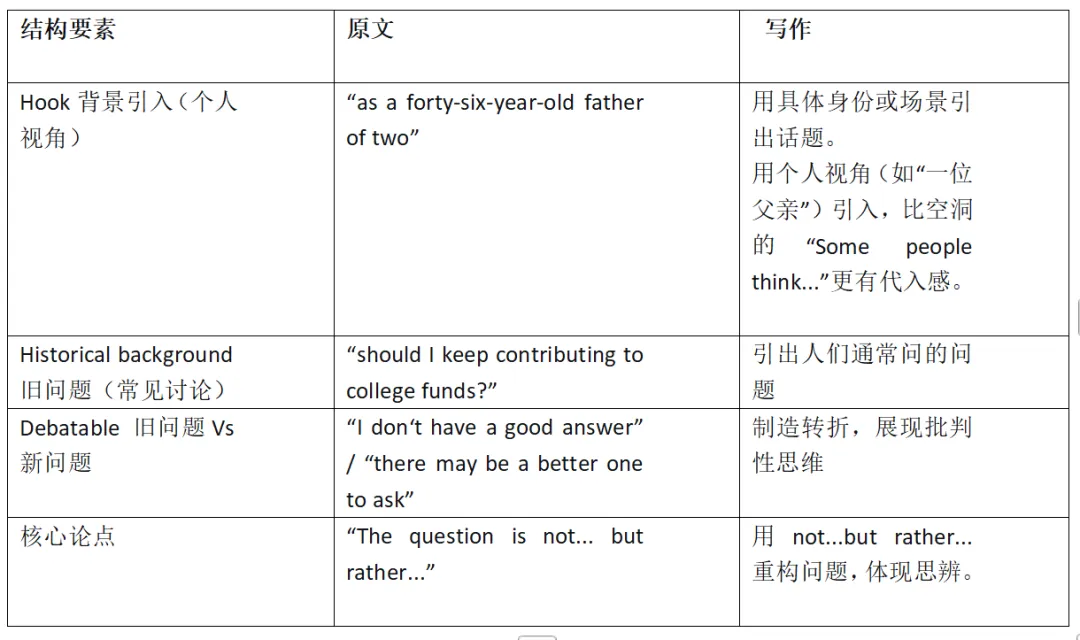
Last week, I asked whether, as a forty-six-year-old father of two, I should keep contributing to my children’s college funds, or if perhaps some combination of anti-establishment fervor, A.I., and a shifting economy could save me some money. I don’t have a particularly good answer yet... But, after wrestling with that query, I think there may be a better one to ask. The question is not, I think, “How will A.I. change higher education?” but rather “What irreversible changes have already taken place, and how will colleges and universities respond to them?”
雅思写作结构拆解:
写作高分句型仿写:
原文结构:The question is not X, but rather Y.
仿写示例1(教育类):The question is not whether technology should be used in classrooms, but rather how it can be integrated without undermining the role of teachers.
仿写示例2(环境类):The question is not whether we should pursue economic growth, but rather what kind of growth we are willing to sacrifice our environment for.
二、Body Paragraph 主题段落: 观点(Topic Sentence)→解释→论据→解释→回环(Wrap-up)
原文段落(第11段):
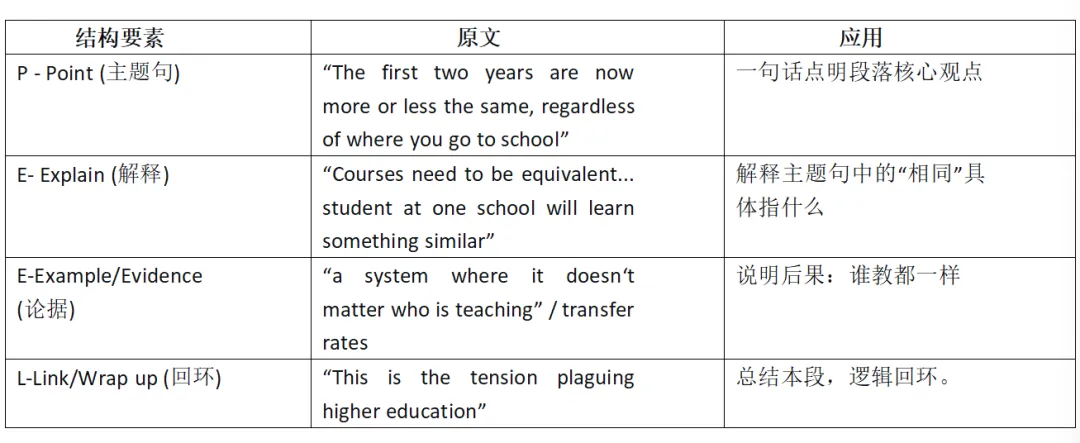
The first two years of a college education are now more or less the same, regardless of where you go to school. Courses now need to be equivalent to one another, so that a student at one school will be learning something similar to a student at a different school. What that has done over time is created a system where it doesn‘t really matter who is teaching the classes. We tell the student, “You’re special,” and we tell the faculty, “You‘re not special.” This is the tension and the problem that is plaguing higher education and what’s made it so vulnerable to A.I.
雅思写作结构拆解(PEEL模式):
段落精讲要点:
1.主题句(Point)要一句话说清楚,不要绕
2.解释(Explain)要展开概念,不是重复主题句
3.论据(Evidence)可以是后果推演,不一定是数据
4.回环(Wrap up)要呼应主题句,同时指向更大论点
练一练:雅思写作·头脑风暴
话题:In the age of AI, what is the purpose of education?
本文提供的角度:
1.Edge knowledge: 教育应该引领学生走向未知,而非重复已知
2.Mentorship: 教师的价值在于启发和引导,而非信息传递
3.Differentiation: 家长选择教育的本质是让孩子“与众不同”
你的观点是什么?试着用本文学到的词汇写一段英文。
话题:Do you think AI will replace teachers in the future?
本文观点借鉴:“AI might replace teachers who only deliver standardized information, but it cannot replace those who guide students to the edge of knowledge.”
1.standardized information(标准化信息)
2.the edge of knowledge(知识前沿)
3.mentorship and inspiration(指导和激励)
Why the Future of College Could Look Like OnlyFans
Universities have become generic, one professor and former dean argues. In the A.I. era, students may demand something they can’t get elsewhere. By Jay Caspian Kang
1 Last week, I asked whether, as a forty-six-year-old father of two, I should keep contributing to my children’s college funds, or if perhaps some combination of anti-establishment fervor, A.I., and a shifting economy could save me some money. I don’t have a particularly good answer yet, at least not one good enough to inspire the purchase of a midlife-crisis car, my son’s and daughter’s futures be damned. But, after wrestling with that query in Part 1 of what will be a series of articles, I think there may be a better one to ask. The question is not, I think, “How will A.I. change higher education?” but rather “What irreversible changes have already taken place, and how will colleges and universities respond to them?”
上周,我问了一个问题:作为一个四十六岁的两个孩子的父亲,我是否应该继续为孩子们的大学基金存钱,或者,也许反体制的热情、人工智能以及经济转型的某种结合,能帮我省下这笔钱。我还没有一个特别好的答案,至少没有一个好到足以促使我买一辆中年危机跑车——哪怕让我儿女的未来见鬼去。但是,在作为系列文章第一部分的文章中思考了这个问题之后,我认为可能有一个更好的问题需要提出。我认为,问题不在于“人工智能将如何改变高等教育?”,而在于“哪些不可逆转的变化已经发生,大学和学院将如何应对这些变化?”
2I wanted to talk with someone who stood outside the polite consensus which holds that college as we know it will survive, if only because, as I wrote last week, humans will always want to differentiate their children from other people’s children. Hollis Robbins, a professor of English and a special adviser in the humanities at the University of Utah, and the former dean of arts and humanities at Sonoma State University, has been writing about A.I. and higher education for years on her Substack, “Anecdotal Value.”
我想与一位站在礼貌共识之外的人交谈,这种共识认为我们所知的大学将会幸存,哪怕仅仅是因为,正如我上周所写,人类总会希望将自己的孩子与别人的孩子区分开来。犹他大学的英语教授、人文学科特别顾问、索诺马州立大学前艺术与人文学院院长霍利斯·罗宾斯,多年来一直在她的Substack博客“轶事价值”上撰文讨论人工智能与高等教育。
3Through her writing on the subject, her own experiments with A.I., and her experience at both élite private and regional public universities, she has hashed out a theory of sorts. In Robbins’s opinion, an excessively bureaucratic, increasingly generic, and poorly taught version of higher education has taken hold around the country, and that has made the modern university seriously vulnerable to an A.I. takeover.
通过她关于这个主题的写作、她自己对人工智能的实验,以及她在精英私立大学和地区公立大学的经历,她形成了某种理论。罗宾斯认为,一种过度官僚化、日益同质化、教学质量低下的高等教育版本已经在全国范围内扎根,这使得现代大学极易受到人工智能的冲击。
4What can academics do about this? College, Robbins believes, should be more bespoke; schools should cultivate their own character based on the charisma of professors, the novelty of their inquiries, and the quality of their instruction. Today, thanks in part to the Common Application and to the always increasing pressure for students to go simply to the most prestigious college they can, even élite schools are becoming interchangeable. Brown and the University of Chicago have roughly the same pool of students as, say, Vanderbilt, or Georgia Tech.
学者们能做些什么呢?罗宾斯认为,大学应该更加定制化;学校应该基于教授的个人魅力、他们研究的新颖性以及他们教学的质量来培养自己的特色。如今,部分由于通用申请系统和学生总是要进入他们能考上的最有声望的大学的压力,即使是精英大学也变得越来越可以相互替代。布朗大学、芝加哥大学与范德堡大学或佐治亚理工学院的生源大致相同。
5And, once the unique essence of a school has been lost, and the curricula have been standardized for maximum friendliness to students, who are treated as customer kings, A.I. may come to seem like a plausible alternative. In this view, rampant A.I.-assisted cheating, rapidly declining faith in the value of a college education, and general agita on the part of the nation’s faculty are all symptoms of a larger sickness: an academy that has been stripped of everything that once made it special.
一旦一所学校的独特精髓丢失,课程为了最大限度地迎合被当作帝王般对待的学生而标准化,人工智能就可能看起来像一个合理的替代方案。在这种观点下,猖獗的人工智能辅助作弊、对大学教育价值信任的迅速下降,以及全国教师的普遍焦虑,都是一种更大疾病的症状:一个被剥夺了所有曾经使其特别的东西的学术界。
6Robbins is not an A.I. doomer—she does not believe, for example, that all human inquiry has ended, and that the robots will now think for us, patiently typing out papers on Herman Melville, to be peer-reviewed by other Melville robots. But she has argued that, in the era of artificial general intelligence, “the only defensible reason for universities to remain in operation is to offer students an opportunity to learn from faculty whose expertise surpasses current AI.”
罗宾斯不是一个人工智能末日论者——例如,她不相信所有人类探究已经结束,机器人将为我们思考,耐心地打出关于赫尔曼·梅尔维尔的论文,供其他梅尔维尔机器人进行同行评议。但她认为,在通用人工智能时代,“大学继续运营的唯一站得住脚的理由,是为学生提供向那些专业知识超越当前人工智能的教师学习的机会。”
7In a widely discussed Substack post from last year, titled “It’s Later Than You Think,” Robbins argued that artificial general intelligence would require a culling of sixty to seventy per cent of the country’s professors, and that every professor who wanted to keep their job should write a memo answering the question “What specific knowledge do I possess that AGI does not?” Faculty members who could not produce a compelling memo “with concrete defensible answers,” she wrote, “have no place in the institution.”
在去年一篇题为《比你想象的更晚》的、被广泛讨论的Substack文章中,罗宾斯认为,通用人工智能将需要淘汰全国60%到70%的教授,每个想保住工作的教授都应该写一份备忘录,回答“我拥有哪些通用人工智能不具备的具体知识?”这个问题。她写道,那些无法写出“具有具体、可辩护答案的令人信服备忘录”的教员,“在机构中没有位置”。
8The university in the age of A.I. will be leaner, odder, and more differentiated from its peers, she maintains, because “students cannot be expected to continue paying for information transfer that AGI provides freely.” Instead, they will “pay to learn from faculty whose expertise surpasses AI, offering mentorship, inspiration, and meaningful access to AGI-era careers and networks.” Any institution that does not adapt will die. “This isn’t a mere transformation but a brutal winnowing,” Robbins writes. “Most institutions will fail, and those that remain will be unrecognizable by today’s standards.”
她主张,人工智能时代的大学将更精简、更奇特,并且与同行有更多差异,因为“不能指望学生继续为通用人工智能免费提供的信息传输付费。”相反,他们将“付费向那些专业知识超越人工智能、提供指导、激励以及进入通用人工智能时代职业和网络的有意义渠道的教师学习。”任何不适应的机构都将消亡。“这不仅仅是一场变革,而是一场残酷的筛选,”罗宾斯写道。“大多数机构将会失败,而那些幸存下来的机构,以今天的标准来看将面目全非。”
9I recently asked Robbins about how she came to this conclusion, and what, exactly, those surviving institutions might look like. This interview has been edited for length and clarity.
我最近问了罗宾斯她是如何得出这个结论的,以及那些幸存下来的机构究竟可能是什么样子。本次采访经过编辑,以保证篇幅和清晰度。
10Q: You’ve written a lot about how the modern university has primed itself for an A.I. takeover. How did that happen?
A: “Learning outcomes” in higher education refers to a list of what students are expected to have learned from completing a program or from taking a specific course. Professors and departments are urged to make these both general and specific. Department web pages list program outcomes—syllabi often will list the specific learning outcomes. At the University of Utah, where I teach, learning outcomes are defined by the Utah System of Higher Education. For example, learning outcomes for a general-education humanities course include the ability “to analyze humanities artifacts according to humanities methodologies, such as close analysis, questioning, reasoning, interpretation, and critical thinking.” The demonstration of this learning outcome might be a standard analytical paper on a poem.
问:您写了很多关于现代大学如何为人工智能的接管做好了准备。这是怎么发生的?
答:高等教育中的“学习成果”指的是一份清单,列出学生完成某个项目或特定课程后预期学到的东西。教授和院系被敦促使这些成果既笼统又具体。院系网页列出项目成果——教学大纲通常会列出具体的学习成果。在我任教的犹他大学,学习成果由犹他高等教育系统定义。例如,通识教育人文学科课程的学习成果包括“能够根据人文学科方法论分析人文产物,例如细读、提问、推理、解释和批判性思维。”证明这一学习成果的典型方式可能是写一篇关于一首诗的标准分析论文。
11 The first two years of a college education are now more or less the same, regardless of where you go to school. Courses now need to be equivalent to one another, so that a student at one school will be learning something similar to a student at a different school. What that has done over time is created a system where it doesn’t really matter who is teaching the classes. We tell the student, “You’re special,” and we tell the faculty, “You’re not special.” This is the tension and the problem that is plaguing higher education and what’s made it so vulnerable to A.I. Everything else—whether Trump, the enrollment cliff, or whatever—is secondary to this tension.
大学教育的前两年现在或多或少是相同的,无论你在哪里上学。课程现在需要彼此等效,这样一所学校的学生学习的内容与另一所学校的学生相似。随着时间的推移,这所造成的结果是建立了一个系统,在这个系统中,谁在授课并不重要。我们告诉学生,“你很特别”,但我们告诉教师,“你并不特别”。这是困扰高等教育并使其如此容易受到人工智能冲击的紧张关系和问题。其他一切——无论是特朗普、入学悬崖,还是其他什么——相对于这种紧张关系都是次要的。
12If it doesn’t matter who’s teaching your course—especially at public universities where the quality of teaching has gone way, way, way down over the past twenty years—then we have created an environment where many classes might as well be taught by A.I., and many of the students know it.
如果你教课的是谁并不重要——尤其是在公立大学,那里的教学质量在过去二十年里已经大幅下降——那么我们就已经创造了一个环境,在这个环境中,许多课程还不如由人工智能来教,而且许多学生也心知肚明。
13I’m not a car person, but I have friends who have fancy BMWs, and they have to go to their fancy BMW place to fix their car, because BMW parts are often very specific to BMWs. So what does it mean for higher ed when all the parts are interchangeable? Almost forty per cent of students transfer at least once from institution to institution, and that places additional pressure to make everything the same. What happens is that colleges make it easier for their students to transfer, because parents want to have some backup plan. The high number of transfers leads to more fungibility and commodification.
我不是一个爱车的人,但我有朋友拥有高档宝马车,他们必须去他们那高档的宝马专修店修车,因为宝马的零件通常是宝马专用的。那么,当高等教育中的所有部件都可以互换时,这意味着什么呢?近40%的学生至少转学一次,这带来了额外的压力,要求一切都相同。结果就是,大学让学生更容易转学,因为家长们希望有一些备选计划。高转学率导致了更多的可替代性和商品化。
14Q: In a Substack post from last year, you suggested that sixty to seventy per cent of faculty will ultimately lose their jobs once generative A.I. starts to hit the classroom, and that those who survive will need to explain why they’re still needed. How do you think they should be proving their worthiness?
A: Higher education and professors can differentiate themselves from all this sameness by teaching at the edges of knowledge. My expertise, for example, is in the African American sonnet tradition. There are probably three people on the entire planet who know as much as I do about this tiny little thing, and so I’ve spent a lot of my time experimenting with these large language models to just see what they know about my field, and where the edges are. Specialists are going to be key to selling education as something the A.I. can’t do.
问:在去年的一篇Substack文章中,您提出,一旦生成式人工智能开始进入课堂,最终将有60%到70%的教职员工失业,而那些幸存下来的教师需要解释为什么他们仍然被需要。您认为他们应该如何证明自己的价值?
答:高等教育和教授可以通过在知识的前沿进行教学,将自己与这一切的千篇一律区分开来。例如,我的专长是非裔美国十四行诗传统。关于这个小小的领域,地球上大概只有三个人像我一样了解得那么多,所以我花了很多时间实验这些大型语言模型,就是想看看它们对我的领域了解多少,以及边界在哪里。专家将是把教育作为人工智能无法做到的事情来销售的关键。
15Q: When your daughter is going to go to school, in eight years, you are not going to want, for any money, to have her learn standard educational product that A.I. knows—and A.I. will know so much, right?
A: I’m not sure about that, because I do think that there’s value in her learning things that a computer knows. Human beings still play chess, even though a human being hasn’t beaten the best chess computers in twenty years—and I would think there’s still value in her understanding the basic theories and foundations of, say, chemistry. Even if A.I. knows all of that, she should probably know it, too, if she wants to understand what those edges of knowledge are, no?
问:当你的女儿八年后要去上学时,你绝不会希望花任何钱让她去学习人工智能已经知道的标准教育产品——而到那时人工智能会知道得非常多,对吧?
答:我不太确定这一点,因为我确实认为她学习一些计算机知道的东西是有价值的。人类仍然下棋,尽管人类已经二十年没有击败过最好的象棋计算机了——而且我认为,她理解,比如说,化学的基本理论和基础,仍然是有价值的。即使人工智能知道所有这些,如果她想理解那些知识前沿是什么,她可能也应该知道这些,不是吗?
16So, in my ideal vision of the academy, you’re going to be in class with a mentor who isn’t going to have to teach you Chemistry 101 but will want to quickly move to where the edges are, to do something new. Maybe they would decide together to 3-D-print some new material that has never been printed before, or what have you. Whatever they decide together will not be something every university is going to be able to do. It will be what’s particular at this place.
所以,在我理想中的学术界,你将和一位导师在课堂上,这位导师不会教你《化学101》,而是会想快速进入前沿领域,去做一些新的事情。也许他们会一起决定3D打印一些从未被打印过的新材料,或者其他什么。无论他们一起决定做什么,都不会是每所大学都能做到的。这将是在这个地方特有的东西。
17When I was in the Cal State system, I was trying to get Native American studies to be a major at Sonoma State. I was trying to figure out what the curriculum would look like, and was having lunch with this really amazing faculty member from another university, and she said part of the problem with Native American studies is that we can’t standardize it. She was telling me about an important local Native American woman from a hundred years ago. And I said something about Harriet Tubman and told her that I didn’t know the Native American Harriet Tubman. She said that’s because there are a thousand Native Harriet Tubmans.
I bring this up as an example of that which cannot be scaled and commodified and transferred. This is the type of inquiry that will be possible in the university I’m envisioning.
我在加州州立大学系统时,曾试图在索诺马州立大学将“美国原住民研究”设为一个专业。我试图弄清楚课程会是什么样子,并与来自另一所大学的一位非常优秀的教员共进午餐。她说美国原住民研究的部分问题在于我们无法使其标准化。她告诉我一位一百年前重要的当地原住民女性的故事。我提到了一些关于哈丽特·塔布曼的事情,并告诉她我不认识那位“原住民的哈丽特·塔布曼”。她说,那是因为有一千个原住民的哈丽特·塔布曼。
我提出这个例子,是为了说明那些无法被规模化、商品化和转移的东西。这是在我设想的大学中可能进行的那种探究。
18Q: Does that lead to a kind of obscurity? It would seem to encourage the esoteric sort of inquiry that the public sometimes resists.
A: Well, I won’t use the word “obscurity.” I would say “specialization.”
Let me make a couple of predictions and distinctions. Social science is going to matter so much less when your daughter goes to college. It is already on its way out. A.I. can do it. And here’s an example of the type of inquiry I’m talking about: I have a weird, funny Twitter group about life on Mars. Someone will ask, for instance, if it’s true that you’re going to need kidney dialysis on the way back from Mars. Another person is theorizing about a 3-D printer that’s going to use Mars soil, which will allow people to build on Mars using its materials instead of shipping everything there. These sorts of inquiries are obscure, specialist, niche, at the edge.
问:这是否会导致某种晦涩难懂?这似乎在鼓励那种公众有时会抵触的深奥探究。
答:嗯,我不会用“晦涩难懂”这个词。我会说“专业化”。
让我做一些预测和区分。当你女儿上大学时,社会科学将变得不那么重要。它已经在走向消亡。人工智能可以做到。这就是我所说的那种探究的一个例子:我有一个关于火星生活的古怪有趣的推特群。有人会问,例如,从火星返回的途中是否需要肾透析。另一个人则在理论探讨一种将使用火星土壤的3D打印机,这将允许人们利用火星的材料在火星上建造,而不是把所有的东西都运过去。这类探究是晦涩的、专业化的、小众的、处于边缘的。
19If I’m teaching a Harlem Renaissance class, and I’m going to deal with a poet like Marcus Christian, whose poems are obscure but who influenced everybody in a hidden way, the student I’m working with will have to do some work and produce a paper that A.I. cannot write.
Another example: if A.I. can begin to translate the Lenape language, or Miwok, we can know a lot more about stuff that we don’t currently know. I think that is all to the good. Obscure social science will go away, and edge knowledge that is pushing the frontiers of things that we don’t yet know will be in, pushed by A.I.-specialist faculty members. I think that’s the future.
如果我在教哈莱姆文艺复兴的课程,要处理像马库斯·克里斯蒂安这样的诗人,他的诗虽然冷门,但却以一种隐秘的方式影响了所有人,那么与我合作的学生就必须做一些功课,写一篇人工智能无法写出的论文。
另一个例子:如果人工智能能够开始翻译勒纳普语或米沃克语,我们就可以更多地了解我们目前不知道的东西。我认为这完全是好事。晦涩的社会科学将会消失,而推动我们未知事物前沿的边缘知识将会流行起来,由人工智能专家型教师推动。我认为这就是未来。
20Q: Does that mean kids will be coming to college with a different baseline of knowledge because of A.I.? That a lot of the canon in whatever field they choose will already have been transferred to their brains? I can’t help but remember my own experience as a freshman in college, being completely unprepared for an upper-level religion course, much less any edge-of-knowledge inquiry.
A: They’re going to be coming in with a different baseline. Once upon a time, you walked into class and a hundred per cent of what was delivered to you was through your professor. Now, you go to a class, maybe you’ll do the reading, but you’ll also ask ChatGPT or Claude. And so your course content is already coming from somewhere else. This is a problem that higher ed has not addressed substantially. What does it mean for me to grade you on something where you got all your information from somewhere else and not from my reading list? That is a complicated question. The only thing that works is for us to get to the edge quickly.
问:这是否意味着,因为人工智能,孩子们上大学时的知识基线会不同?无论他们选择什么领域,很多经典知识已经转移到他们的大脑中了?我不禁回想起我自己作为大学新生的经历,当时我完全没有准备好上高级宗教课程,更不用说进行任何前沿知识的探究了。
答:他们会带着不同的基线进来。曾几何时,你走进课堂,百分之百传授给你的东西都来自你的教授。现在,你去上课,也许你会做阅读,但你也会问ChatGPT或Claude。所以你的课程内容已经来自其他地方。这是高等教育尚未实质解决的问题。我根据你从其他地方而不是从我的阅读清单上获得所有信息的东西来给你评分,这意味着什么?这是一个复杂的问题。唯一有效的方法就是我们快速到达前沿。
21Q: There’s a growing idea I’ve seen in some circles that college could be replaced by conversations between an A.I. tutor and a student. When I think about your model, I wonder why college even needs to exist. If I can just seek out a tutor, somebody that I like, and they just charge me a little bit, and we go through these edge-knowledge cases together, what’s the degree for? Couldn’t you, as Hollis Robbins—not only a specialist in African American sonnet traditions but also an idiosyncratic thinker on the subject of A.I. and the future of the academy—just set up your own shop?
A: I was in Austin, Texas, a couple of times in March with a bunch of twenty-five-year-old billionaires. This is what they’re looking at. Instead of having the credential from the institution, why not have the credential from the professor? If you have a Hollis Robbins education, what would that signal? What would that credential mean as opposed to a degree from a university? There was some conversation about what that would look like, and one guy at the end of the dinner said, “Instead of OnlyFans, it’s like OnlyProfessors.”
问:我看到在一些圈子里有一种日益流行的观点,认为大学可以被学生和人工智能导师之间的对话所取代。当我思考您的模式时,我想知道为什么大学还需要存在。如果我可以直接找一个导师,一个我喜欢的人,他们只收我一点钱,然后我们一起研究这些前沿案例,那学位有什么用?您——不仅是非裔美国十四行诗传统的专家,还是关于人工智能和未来学术界的特殊思想者——难道不能自己开个工作室吗?
答:我三月份在德克萨斯州的奥斯汀待过几次,和一些二十五岁的亿万富翁在一起。这正是他们在研究的。为什么不从教授那里获得证书,而不是从机构那里?如果你接受霍利斯·罗宾斯的教育,那意味着什么?与大学学位相比,这个证书意味着什么?有一些关于这会是什么样子的讨论,晚餐结束时一个人说:“不是OnlyFans,而是OnlyProfessors。”
22Q: Do you think an OnlyProfessors model would be good? That the dissolution of the vast majority of the higher-education infrastructure, with this replacing it, would be a good outcome?
A: I worry about where the great middle of America is going to go. I do think students are going to have to withdraw enrollment from schools unless things change. And I don’t think institutions are going to change themselves. They’re caught up in this bureaucratic system, this transfer system, these standardization agreements across state lines, so that anybody can move anywhere. The idea of delivering a standard education product is so embedded within the current structure that it will never change unless students say, “This is not what I want from going to college.” So, yes, OnlyProfessors is an alternative.
问:您认为OnlyProfessors模式会是好事吗?绝大多数高等教育基础设施的瓦解,由它取而代之,会是一个好结果吗?
答:我担心美国的中产阶级会去哪里。我确实认为,除非情况改变,否则学生们将不得不从学校退学。我不认为机构会自我改变。它们陷入了这个官僚系统、这个转学系统、这些跨州的标准化协议,以便任何人都可以搬到任何地方。提供标准教育产品的想法在当前结构中根深蒂固,除非学生说“这不是我想从上大学中得到的东西”,否则它永远不会改变。所以,是的,OnlyProfessors是一种替代方案。
23Q: What does the destruction of the current model look like?
A: Even right now, we’ve seen big institutions pivot to selling experience. The experience is still going to sell to a lot of people who can afford it—I’m getting the college experience, the frats, the football. You’ll get a lot of things that are very hollow. Maybe that will get you a job. But what I think will spring up are these small institutes. I spent some time with the Alpha School people in Austin—that’s pre-K through eight, two hours a day on A.I., and then enrichment. I think that can be scaled up for higher ed. I wrote a piece called “The Two-Minute Mile Problem” on what that would look like. Why does it have to be four years? Can you get through faster? Can you get student loans that are based on semesters, if you get through everything in eighteen months?
问:当前模式的瓦解会是什么样子?
答:即使是现在,我们也看到大型机构转向销售体验。这种体验仍然会卖给很多能负担得起的人——获得大学体验、参加兄弟会、看橄榄球比赛。但在罗宾斯看来,这些东西很大程度上是空洞的(这是她对美国大学的批评,请注意语境)。也许那能帮你找到一份工作。但我认为,真正会涌现出来的是这些小型的学院。我在奥斯汀花了一些时间与阿尔法学校的人在一起——那是从学前班到八年级,每天两小时用人工智能学习,然后是拓展活动。我认为这可以扩展到高等教育。我曾写过一篇名为《两分钟一英里的问题》的文章,探讨了这会是什么样子。为什么必须是四年?能不能更快地完成?如果能在十八个月内完成所有课程,能不能获得基于学期的学生贷款?
24I think there’s going to be some move-fast-and-break-things. Parents are going to have to stop asking, “If my kid starts here and it doesn’t work out, will they be able to transfer?” That question has to end. That question is the problem. If you start approaching education as portable, transferable to other institutions, then you’ve already not bought into what you’re buying. The kid needs to think, I want to study with this person who knows these things so that I can learn those things, in a kind of apprenticeship model.
我认为会有一些“快速行动,打破常规”的做法。家长们将不得不停止问:“如果我的孩子从这里开始,但效果不好,他们能转学吗?”这个问题必须终止。这个问题本身就是症结所在。如果你开始将教育视为可移植的、可转移到其他机构的,那么你就已经没有被你所购买的东西所说服。孩子需要这样想:我想和这个了解这些知识的人一起学习,这样我就能学会那些东西,以一种学徒制的模式。
25Q: And the death of our current universities? What does that look like?
A: I think there’s contraction. The big flagships are going to stay the same, because they have the football players and all the other things. I’m at the University of Utah—I think it’s going to be fine. We’re going to pick up the lifeboats from the places that crumble. But, ultimately, at the very top, presidents and provosts are going to have to understand that expertise is their mission. Yale, even, went back to making their mission statement about knowledge, not about making a better world. We’re not in the making-a-better-world game anymore. We’re in the knowledge game, and that means getting rid of some of the feel-good stuff.
问:那我们现在的大学的消亡呢?那会是什么样子?
答:我认为会是收缩。大型的旗舰大学会保持不变,因为它们有橄榄球运动员和其他一切。我在犹他大学——我认为它会没事。我们会从那些崩溃的地方救起救生艇。但最终,在最顶层,校长和教务长将不得不明白,专业知识是他们的使命。顶层管理者必须明白:在AI时代,大学的当务之急是守住“专业知识”这个核心使命——如果连这个都守不住,那些“让世界变得更美好”的口号就失去了根基。我们玩的是“知识”的游戏——这意味着要放下那些自我感动的东西,专注于真正重要的事。
全文Q & A问答环节
Q1: 现代大学是如何为AI接管做好准备的?
Robbins的回答
1.The “learning outcomes” system forces standardization across institutions“学习成果”体系迫使课程标准化,不同学校的课程变得等效
2.Faculty are told they are not special; students are told they are special教师不再被认为是特殊的,学生被认为是特殊的
3.Teaching quality at public universities has declined significantly over 20 years公立大学教学质量过去20年大幅下降
4.Nearly 40% of students transfer at least once, increasing fungibility近40%的学生至少转学一次,加剧了课程的可互换性和商品化
5.The result: it doesn’t matter who teaches, so AI might as well do it结果:谁教课已经不重要了,许多课程还不如由AI来教
Q2: 60-70%的教授会失业?幸存者如何证明自己的价值?
Robbins的回答
1.Faculty must teach at the edges of knowledge, specializing in niches AI cannot easily replicate教师必须在知识边缘教学,专攻AI无法轻易复制的小众领域
2.Example: the African American sonnet tradition – only three people in the world know it that well例如:非裔美国十四行诗传统,全球只有三个人同样精通
3.Survivors must demonstrate concrete, non-standardizable expertise幸存者应展示其具体的、非标准化的专业知识
4.AGI will force a “brutal winnowing” of faculty通用人工智能(AGI)将迫使大学进行“残酷的筛选”
Q3: 这是否会导致晦涩难懂的学术?
Robbins的回答:
1.Use “specialization” not “obscurity”不用“晦涩”一词,而用“专业化”
2.Scalable, standardizable fields like social science will decline社会科学等可规模化、可标准化的领域将衰落
3.Edge knowledge (e.g., life on Mars, Native language translation, obscure poets) will thrive边缘知识(如火星生活、本地原住民语言翻译、冷门诗人研究)将兴起
4.Example: AI translating Lenape or Miwok would reveal unknown knowledge – that is goodAI若能翻译勒纳普语或米沃克语,将揭示大量未知知识,这是好事
Q4: AI是否会改变学生入学的知识基线?大学还需要四年吗?
Robbins的回答:
1.Yes, students will have a different baseline. They already use ChatGPT for content是的,学生会带着不同的基线入学。他们已经在用ChatGPT等工具获取信息
2.Course content no longer comes only from the professor and reading list课堂内容不再只来自教授和阅读清单
3.The only solution is to get to the edge quickly唯一的解决办法是快速进入知识前沿
4.Four years may not be necessary; 18 months might suffice四年制不是必须的。可能18个月完成
5.Parents must stop asking about transferability – that question is the problem家长应停止问“能否转学”,那本身是问题所在
Q5: 为什么还需要大学?不能只找私人导师(OnlyProfessors)吗?
Robbins的回答:
1.Yes, some billionaires are exploring an “OnlyProfessors” model确实,一些25岁的亿万富翁正在探索“OnlyProfessors”模式
2.Students might pay for a professor‘s credential instead of a university degree学生可以为某个教授的认证付费,而不是为大学学位付费
3.But Robbins worries about where middle-American kids will go但罗宾斯担心中美洲(普通家庭)的孩子去哪里
4.The current system won’t change unless students withdraw enrollment除非学生用脚投票(退学),否则现有体制不会改变
5.Large flagship universities (with football, experiences) may survive; many others will collapse大型旗舰大学(有足球、有体验)可能幸存,但大量普通大学会崩溃
Q6: 当前大学消亡的具体过程会是什么样?
Robbins的回答(中文):
1.First, contraction先是收缩(contraction)
2.Large flagship universities (e.g., University of Utah) will pick up the lifeboats from crumbling institutions大型旗舰大学(如犹他大学)会吸收崩溃学校的“救生艇”
3.Top leaders must understand that expertise is their mission.顶层管理者必须明白:专业知识是核心使命。
4.Yale has already returned its mission to “knowledge”耶鲁大学已将使命回归到“知识”
5.Education will become more like apprenticeship: “I want to study with this person who knows these things”教育将更像学徒制:孩子说“我想跟这位老师学这些知识”