夜雨聆风
夜雨聆风公众号分三个目录:可持续培训、科普和行走的可持续
如感兴趣请点击上方“MM & Partners”关注我们,谢谢
很多品牌做AI 营销,还停留在“自动写文案、统计表格” 的工具思维。但德国汉堡工商管理学院知名营销教授Goetz Greve,在2025 欧洲顶级营销年会抛出颠覆性新理论,直接改写行业对AI 的定位。他也是我们推出的博士项目的导师。
Most brands still view AI marketing as nothing more than a handy utility for auto-generating copy and compiling spreadsheets. However, Prof. Dr. Goetz Greve, a distinguished marketing scholar from Hamburg School of Business Administration (HSBA), presented a groundbreaking new theory at Europe’s top marketing conference in 2025, completely reshaping the industry’s understanding of AI’s role. He is also a supervisor on the doctoral programme we have launched.
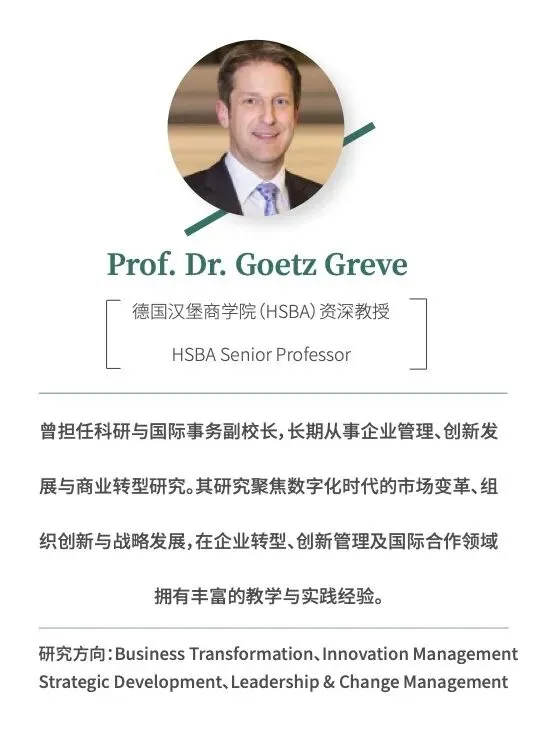
Prof. Dr. Goetz Greve拥有埃森哲、OC&C 两大国际咨询实战背景,深耕营销研究近20 年:早年主攻客户关系管理,中期深耕社交媒体与用户参与,近年聚焦AI 重塑营销底层逻辑,常年为企业、政府提供数字化与AI 伦理咨询。
Prof. Dr. Goetz Greve boasts hands-on consulting experience at two global firms, Accenture and OC&C, and has spent nearly 20 years researching marketing. His research trajectory spans customer relationship management in his early career, social media and customer engagement in the middle stage, and most recently, how AI reshapes the fundamental logic of marketing. He regularly advises enterprises and government bodies on digital transformation and AI ethics.
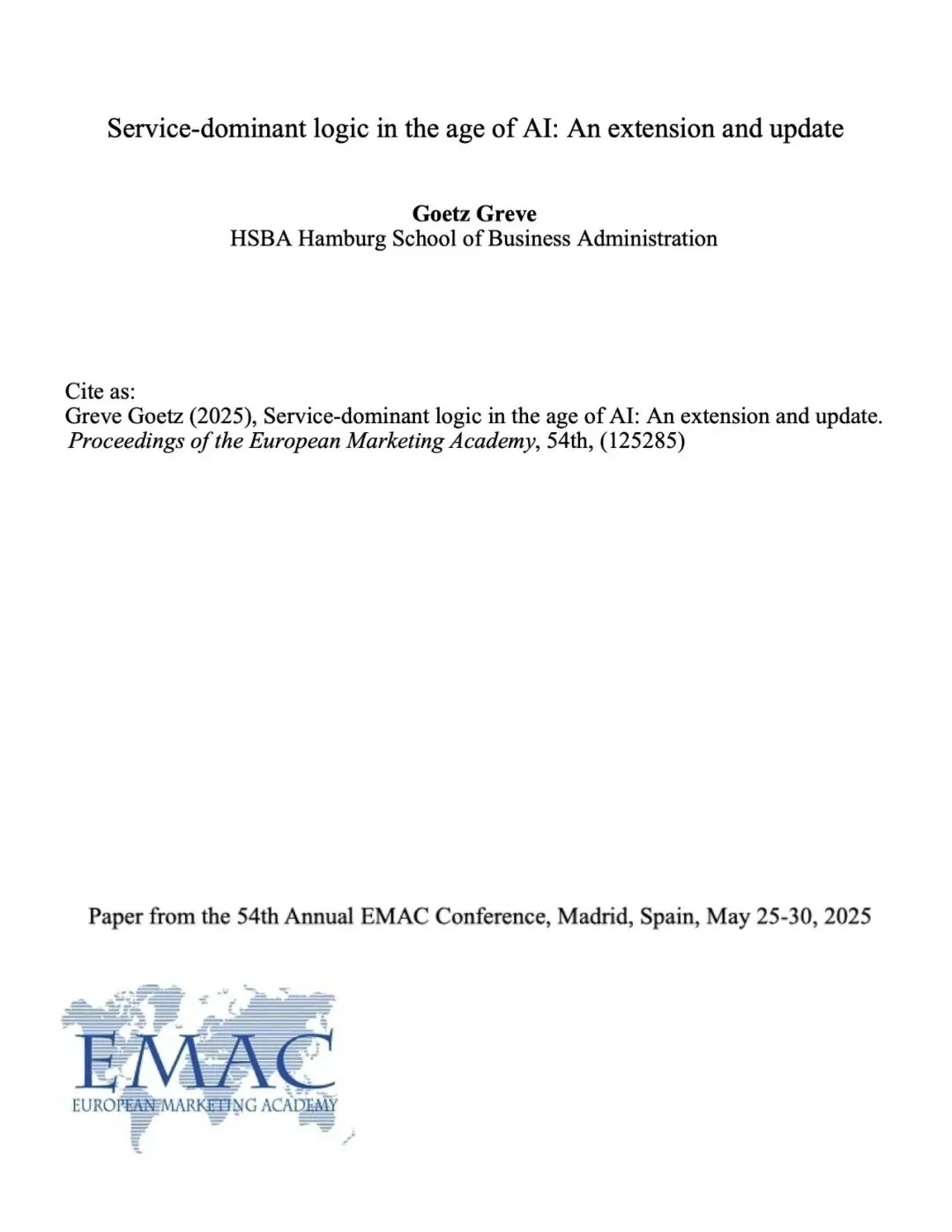
他的论文《人工智能时代的服务主导逻辑:拓展与更新》,刷新了经典营销理论框架。传统理论将创造价值的资源一分为二:被动等待加工的操作型资源;依靠人类经验主动产出价值的操作性资源。长久以来,行业默认AI 只属于前者,只是辅助提效的后台工具。
His paper, Service-dominant logic in the age of AI: An extension and update, revises the classic marketing theoretical framework. Traditional theories categorize value-generating resources into two types: operand resources, passive assets that require external processing, and operant resources, human expertise and experience that actively create value. For a long time, the industry assumed AI fell solely into the operand category, merely a backend tool to boost operational efficiency.
Greve教授直接推翻这一二分法:AI 是双属性混合资源,能根据场景动态切换身份,二者并非非黑即白,而是一条连续变化的光谱。
Professor Greve overturns this binary division: AI is a hybrid resource with dual attributes that dynamically shifts roles based on context. The two resource types are not rigid opposites, but a continuous spectrum.
当AI 负责数据录入、基础用户分层等机械工作,它只是被动工具,仅优化流程效率;可生成式AI、情绪识别算法、用户预测模型,能自主解析海量数据、捕捉用户情绪、批量打造千人千面内容,主动优化服务体验,此时AI 就成了主动创造价值的核心主体。
When AI handles mechanical tasks such as data entry and basic customer segmentation, it acts as a passive tool that only streamlines workflows. In contrast, generative AI, emotion recognition algorithms and predictive user models independently analyze massive datasets, capture user sentiment, and produce personalized content at scale to optimize service experiences. In these scenarios, AI evolves into an active core agent of value creation.
基于这一核心发现,教授搭建「AI 增强型服务主导逻辑」,5 个通俗核心观点,营销人一看就懂:
AI 是平等共创合伙人:价值不再由企业单向输出,企业、消费者、AI 三方协同创造,AI 是服务生态里独立参与者; 人机共生互补:AI 承接重复枯燥工作,释放人力深耕创意、用户共情、战略规划,二者结合才能实现价值最大化; 价值主张实时可变:依托实时数据算力,品牌可以秒级调整服务、内容、优惠,精准匹配每位用户当下需求; AI 身份随场景切换:同一款AI,做自动化报表是工具,定制个性化营销方案就是共创主体; 配套规则必须同步升级:算法偏见、数据隐私、决策透明度等问题亟待规范,缺少制度约束,AI 价值难以长久落地。
Building on this core insight, the professor developed the AI-augmented Service-Dominant Logic, summarized into five easy-to-grasp takeaways for marketers:
AI serves as an equal co-creation partner: Value is no longer delivered unilaterally by brands. It is jointly created by three stakeholders — enterprises, consumers and AI, with AI acting as an independent player within the service ecosystem. Humans and AI exist in symbiotic complementarity: AI takes over repetitive, tedious work, freeing human teams to focus on creative design, empathetic customer communication and strategic planning. Their collaboration maximizes overall value. Real-time adjustable value propositions: Powered by real-time data computing, brands can instantly tweak services, content and promotions to precisely match each customer’s instant demands. AI’s role shifts with scenarios: The same AI system functions as a simple tool for automated reports, yet transforms into a value co-creator when drafting personalized marketing solutions. Updated supporting regulations are indispensable: Issues including algorithmic bias, data privacy and opaque decision-making demand standardized rules. Without institutional safeguards, AI cannot sustain long-term value generation.
这套理论对品牌实操极具指导意义:做预算分配时,要区分AI 功能定位,基础自动化选用低成本机械AI;直面用户、打造品牌体验的场景,重点布局生成式、情感智能AI,搭建人机协同运营模式。同时企业要提前建立数据隐私、算法伦理规范,规避长期经营风险。
This theory delivers actionable guidance for brand operations. When allocating budgets, companies should classify AI tools by purpose: low-cost mechanical AI suffices for basic automation, while generative and emotion-aware AI should be prioritized for customer-facing brand experience projects to build a human-AI collaborative operation model. Enterprises must also establish internal protocols for data privacy and algorithm ethics to mitigate long-term operational risks.
目前这套理论仍处于概念推演阶段,缺少跨行业实证案例佐证,后续还需要大量企业落地数据完善体系。但它给全行业敲响警钟:智能营销时代,不要再把AI 当成单纯降本工具。未来营销的核心,是人类与人工智能并肩协作,共同为用户打造专属、有温度的使用价值。
It should be noted that this theoretical framework remains conceptual, lacking empirical evidence across diverse industries, and further real-world business cases are required to refine the system. Even so, it sends a vital reminder to the industry: in the era of intelligent marketing, AI should never be treated merely as a cost-cutting tool. The future of marketing hinges on human-AI collaboration to craft exclusive, heartfelt user experiences together.