ARTICLE · 998883
雅思阅读真题精读|Jean Piaget:一篇吃透 Passage 3 的词、句、篇、题
文章看懂了,为什么题目一换个说法就开始纠结?
今天我们一起精读一篇关于 Jean Piaget 的雅思阅读真题。
这次不只对答案,而是边读文章边看:
句子怎么读 | 重点词怎么理解 | 题目怎么从原文改写
建议先限时完成整篇,再回来跟着我们逐段精读。
Passage 3:Jean Piaget (1896–1980)
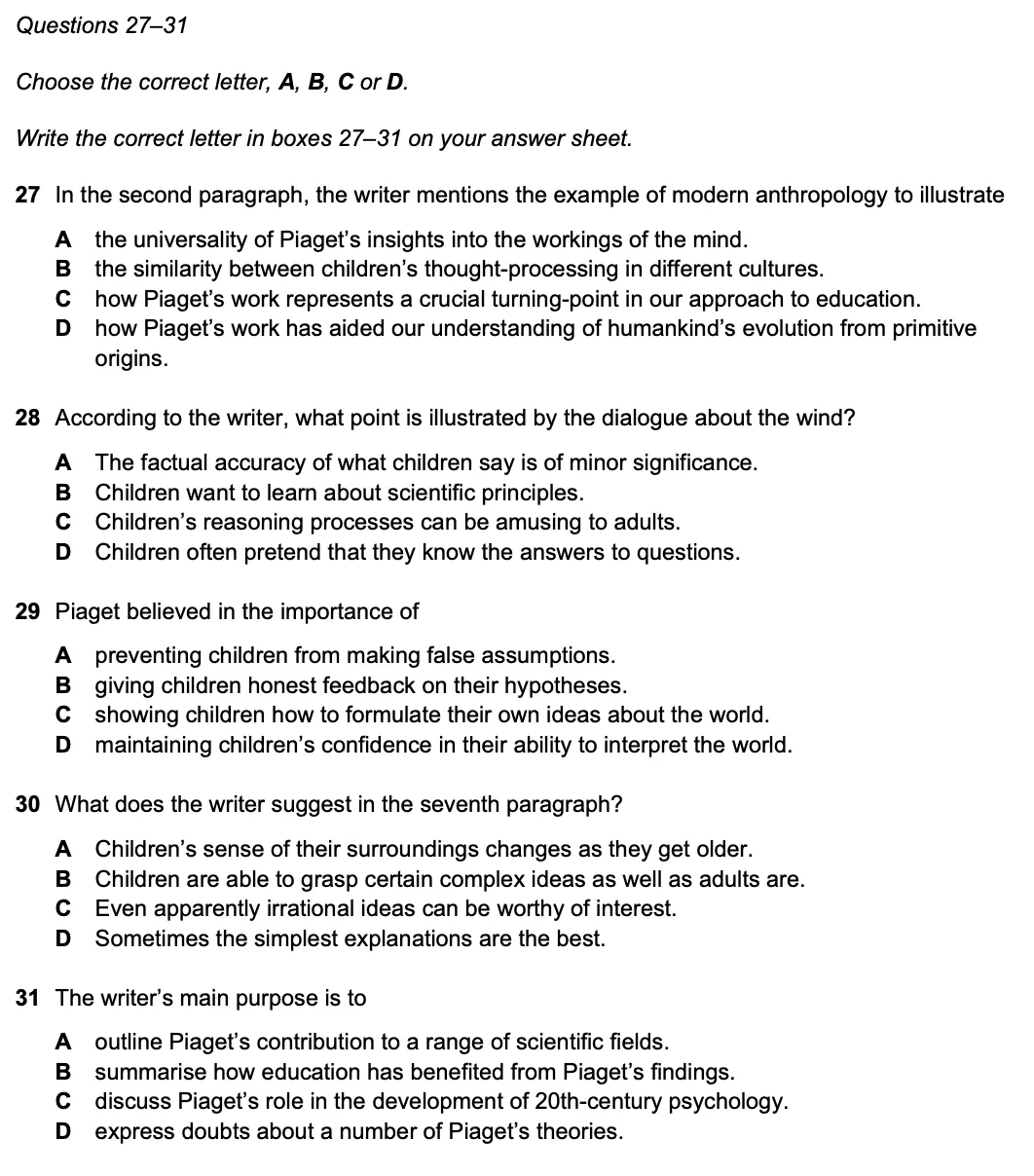
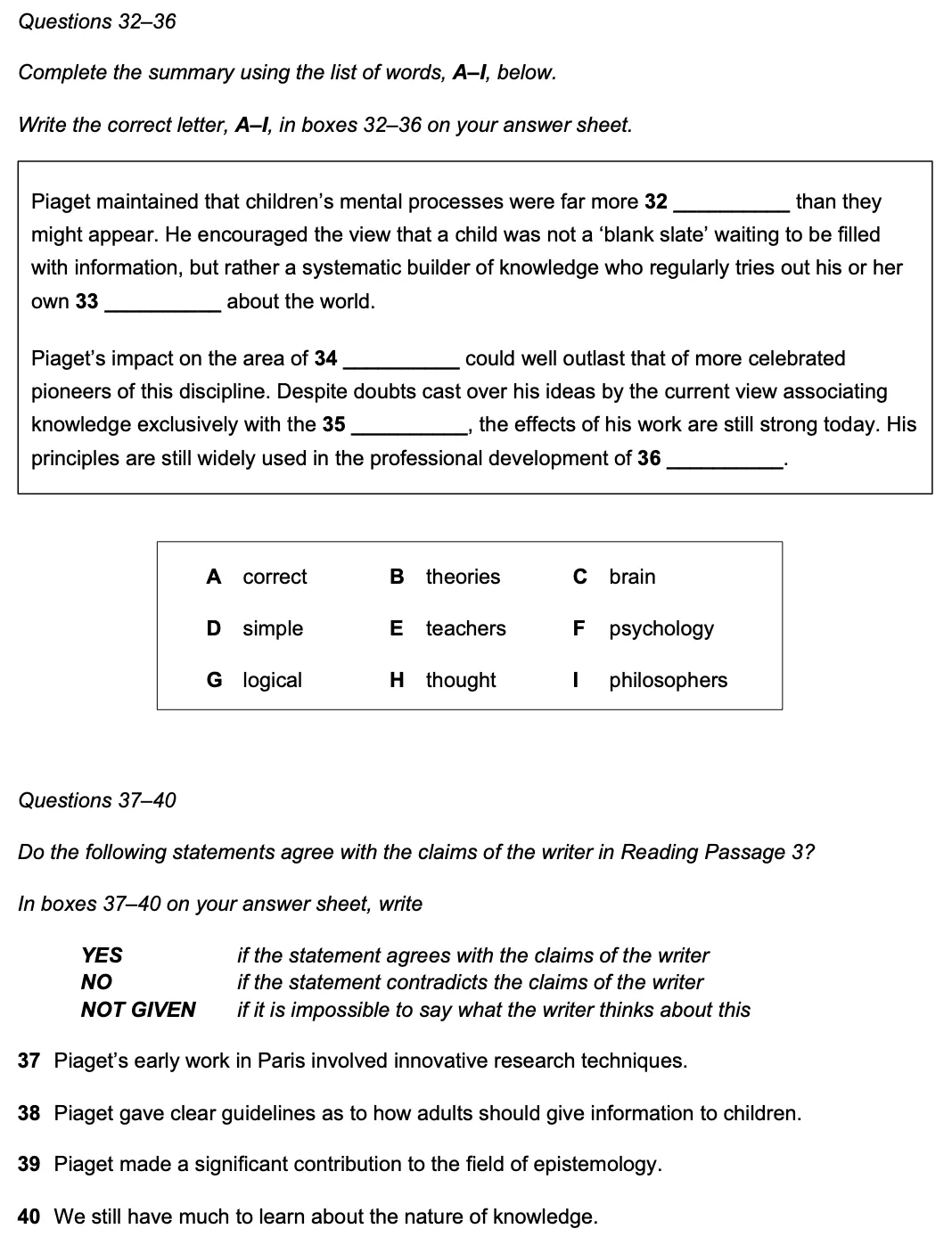
Questions 27–31:单选题Questions 32–36:Summary 选词Questions 37–40:YES / NO / NOT GIVEN
共 14 题
Jean Piaget 是瑞士心理学家和哲学家。
这篇文章的核心并不只是介绍他的生平,而是讨论:
儿童究竟如何认识世界,以及 Piaget 对教育、心理学和认识论等领域产生了什么影响。
下面开始逐段精读。
Jean Piaget (1896–1980)
Seymour Papert looks at the work of the pioneering Swiss philosopher and psychologist
段落大意
Piaget 长期观察儿童后发现:儿童看似不合理的表达背后,其实有属于他们自己的思维秩序和逻辑。
pore over仔细研读,认真研究
succinctly简洁地,简明地
seemingly看似,表面上看
irrational不合逻辑的,不理性的
utterance言语,说出的话
这一段最值得注意的是一个倒装结构。
正常思路其实是:
thought processes were behind ...
原文为了强调位置,把表示“在……背后”的部分放到了前面。
所以理解时不要被语序卡住,真正的意思是:
孩子那些看似不合理的话语背后,其实存在着一套思维过程。
后文继续说明:
orderlogic
也就是:
这种思维有自己的秩序,也有自己的逻辑。
🎯 Q32
题目需要概括儿童思维真正的特点。
原文表面先写:
irrational
但随后立刻转向:
logic
也就是说:
看起来不合理,但实际上有自己的逻辑。
✅ Q32:G logical
同义改写
seemingly irrational↓special logic↓more logical than they might appear
这里考的不是某一个词的机械替换,而是前后逻辑的整体概括。
Piaget 的职业生涯中,很大一部分时间都用于倾听和观察儿童,并研究世界各地其他研究人员的相关报告。简单来说,他发现儿童的思考方式和成年人并不相同。
经过大量与儿童的互动,他逐渐意识到,那些看似可爱却不合逻辑的话语背后,其实存在着一套具有自身秩序和特殊逻辑的思维过程。
段落大意
虽然 Piaget 本身不是教育改革者,但他的儿童观为后来的教育改革奠定了重要基础。
champion v.支持,提倡,拥护
provide the foundation for...为……奠定基础
shift n.转变,变化
be comparable to...可以与……相比
displace v.取代,替代
这一段开头先出现一个让步:
Although ...
意思是:
虽然 Piaget 并不是教育改革者……
但真正重点在后面的主句:
他的思想为现代教育改革奠定了基础。
阅读中看到:
Although / Although not / While / Despite
要习惯先判断:
让步后面的主句,往往才是作者真正想强调的信息。
🎯 Q27
题目问作者为什么提到现代人类学。
关键不是“anthropology”这个领域本身,而是:
a shift
作者是在拿现代人类学曾经带来的观念变化作类比,从而说明:
Piaget 对儿童认知方式的理解,也代表了一次重要的观念转变。
✅ Q27:C
同义改写
a shift↔ a crucial turning-point
以及:
为教育改革奠定基础↔改变我们看待教育和儿童的方式
所以做这种题时,不要被例子本身带跑,先问:
作者为什么举这个例子?
虽然 Piaget 并不是教育改革者,但他所倡导的一种全新的儿童观,为今天的教育改革运动奠定了基础。
这种转变可以与现代人类学所带来的观念变化相比。可以说,Piaget 是最早真正认真看待儿童思维的人之一。
段落大意
儿童不是等待被灌输知识的“空容器”,而是主动建立和检验自己对世界的理解。
revere v.尊敬,崇敬
empty vessel空容器;文中比喻被动接受知识的人
active builder of knowledge知识的主动构建者
hypothesis假设,假说
psychology心理学
这一段有一个非常清晰的观点对比:
传统观点:
children = empty vessels
Piaget 的观点:
children = active builders of knowledge
也就是说:
儿童不是被动地“装知识”,而是在主动理解、验证和构建世界。
这种“旧观点 → 新观点”的对比,是理解全文非常重要的一条主线。
🎯 Q33
原文强调儿童不断提出和检验自己的:
hypotheses
Summary 要填一个能够与之对应的词。
容易纠结的是:
theoriesthought
这里不能只看中文意思。
看搭配:
try out one’s own theories
自然。
而:
try out one’s own thought
不自然。
因此:
hypotheses ≈ theories
✅ Q33:B theories
选词题提示
两个词意思都觉得“差不多”时,按这个顺序检查:
词性 → 搭配 → 语义
不要只比较中文释义。
🎯 Q34
本段后半部分直接讨论 Piaget 对:
psychology
的长期影响。
✅ Q34:F psychology
许多教师一直十分推崇 Piaget,因为他们认同他的观点:儿童并不是等待被灌输知识的空容器,而是知识的主动构建者。
他们就像小科学家一样,不断提出并检验自己关于世界的假设。
虽然 Piaget 的知名度可能不及 Freud 或 Skinner,但他对心理学的影响可能更加持久。
Piaget: What makes the wind?
Julia: The trees.
Piaget: How do you know?
Julia: I saw them waving their arms.
Piaget: How does that make the wind?
Julia: (waving her hand in front of his face)
Like this. Only they are bigger. And there are lots of trees.
段落大意
Piaget 在巴黎研究儿童时,发现同龄儿童会出现相似错误,由此开始研究儿童思维发展的规律。
reasoning process推理过程
scrupulously非常仔细地,一丝不苟地
observe v.观察
experiment n.实验
Piaget 发现:
同年龄儿童 → 出现相似错误
他真正感兴趣的不是:
“为什么孩子都做错?”
而是:
“他们为什么会以相似的方式做错?”
于是研究重点转向:
children’s reasoning processes
也就是:
错误背后的思考过程。
🎯 Q37
题目额外加入了一个评价:
innovative
原文确实讲到:
research
但并没有评价这些研究方法:
是否创新。
所以:
有 research≠research techniques were innovative
✅ Q37:NOT GIVEN
判断题提醒
NOT GIVEN 最常见的坑之一就是:
原文提到了这个事情,但没有评价题目增加的那个限定词。
不能自己把信息补完整。
1920 年,Piaget 在巴黎的一家儿童心理实验室工作时发现,同龄儿童在智力测试中经常出现相似错误。
他开始对他们的推理过程产生兴趣,并逐渐认为,通过观察儿童心智的发展,也许能够理解人类知识形成的规律。
后来,他回到瑞士,继续仔细观察和记录儿童的言行。
段落大意
儿童的答案按照成人标准可能不正确,但这些想法在儿童自己的认知体系中仍可能合理、连贯。
criterion标准,准则
sensible合理的,有道理的
coherent连贯的,条理清晰的
framework框架,体系
miss the point没有抓住重点
本段核心在:
miss the point
如果我们只是判断儿童的解释:
对 / 错
就忽略了 Piaget 真正关心的问题:
孩子究竟是怎样一步步建立自己的解释体系的?
所以这段不是在讨论“答案有没有事实错误”,而是在讨论:
儿童思维内部是否具有合理性和连贯性。
🎯 Q28
题目强调:
儿童说的话在事实层面是否准确,并不是这里最重要的问题。
原文的逻辑也是:
简单划分 true / false 会 miss the point。
所以:
✅ Q28:A
同义改写
判断 true / false 会错过重点↓事实准确性的重要性较低
注意:
这里不是逐词替换,而是:
整个观点逻辑的改写。
Piaget 认为,五岁儿童的观点虽然按照成人标准并不正确,但也不能简单说它们就是“错误的”。
在儿童自己的认知框架内,这些解释可能非常合理而且前后连贯。
单纯把它们划分为“正确”或“错误”,反而没有抓住真正的重点。
(F) Piaget was not an educator and never laid down rules about how to intervene in such situations. But his work strongly suggests that the automatic reaction of putting the child right may well be counter-productive. If their theories are always greeted by ‘Nice try, but this is how it really is…’ they might give up after a while on making theories. As Piaget put it, ‘children have real understanding only of that which they invent themselves, and each time that we try to teach them something too quickly, we keep them from inventing it themselves.’
段落大意
成年人如果总是过快纠正儿童,可能削弱他们主动思考和建立自己理论的动力。
lay down rules制定规则
intervene干预
counter-productive适得其反的
put somebody right纠正某人
give up on...放弃……
这一段的逻辑链非常重要:
孩子提出自己的解释↓成年人立刻给出“正确答案”↓孩子的解释不断被否定↓孩子可能慢慢放弃主动建立自己的理论
所以 Piaget 强调的不是:
“永远不要纠正孩子。”
真正重点是:
不要过早打断儿童主动构建理解的过程。
🎯 Q29
答案:
✅ Q29:D
题目用了:
confidence
原文没有直接出现这个词。
但是原文说:
如果每一次理论都被迅速否定,孩子可能最终放弃继续建立理论。
逻辑上对应:
保护儿童主动解释世界的信心。
这属于非常典型的:
逻辑同义替换
不是词汇同义替换。
🎯 Q38
题目说:
Piaget 给成年人提供了清晰的指导原则。
但原文明确表达:
他从未制定这样的规则。
两者直接相反。
✅ Q38:NO
判断题提醒
NO 和 NOT GIVEN 的区别:
原文没有说 → NOT GIVEN原文明说相反 → NO
Piaget 并不是教育家,也从未规定成年人应该如何干预这类情况。
不过,他的研究强烈暗示,成年人习惯性地马上纠正儿童可能会适得其反。
如果孩子的每一个想法都被迅速否定,他们可能最终放弃自己建立理论。
Piaget 认为,儿童只有对自己主动构建的东西才会真正理解;如果我们太快把答案教给他们,反而会阻碍他们自行发现。
(G) Disciples of Piaget have a tolerance for—indeed a fascination with—children’s primitive laws of physics: that things disappear when they are out of sight; that the moon and the sun follow you around; that big things float and small things sink. Einstein was intrigued by Piaget’s findings, especially by the idea that seven-year-olds insist that going faster can take more time—perhaps because this, like Einstein’s own theories of relativity, runs so contrary to common sense.
段落大意
Piaget 的追随者甚至会对儿童那些看似违反常识的想法产生兴趣。
tolerance for...对……的包容
fascination with...对……着迷
intrigued感到好奇,被吸引
contrary to common sense违反常识
这一段列举了很多儿童“奇怪”的物理观念。
重点并不是证明:
孩子不会物理。
而是:
这些看起来荒谬的想法本身值得研究。
所以作者真正强调的是:
兴趣,而不是正确性。
🎯 Q30
原文出现:
fascinationintrigued
都在表达:
对这些儿童观点感兴趣。
题目把它概括成:
apparently irrational ideas can still be worthy of interest
✅ Q30:C
同义替换
fascination / intrigued↓worthy of interest
做选择题时,这种:
“两个情绪态度词 → 一个概括性表达”
非常常见。
Piaget 的追随者不仅能够容忍儿童那些原始的“物理定律”,有时甚至会对此非常着迷。
例如,儿童可能形成一些明显违反成人常识的解释。
Einstein 也对其中一些发现非常感兴趣,因为这些观点虽然违反常识,却具有独特的思维价值。
(H) Although every teacher in training still memorises Piaget’s successive stages of childhood development, the greater part of Piaget’s work is less well known, perhaps because schools of education regard it as ‘too deep’ for teachers. Piaget never thought of himself as a child psychologist. His real interest was epistemology—the theory of knowledge—which, like physics, was considered a branch of philosophy until Piaget came along and made it a science.
段落大意
Piaget 对教育的影响广为人知,但他真正关注的核心领域其实是 epistemology。
successive连续的,依次的
epistemology认识论,知识论
branch of philosophy哲学的一个分支
come along出现,到来
🎯 Q36
原文提到:
teacher in training
Summary 则换成:
professional development of ______
所以:
✅ Q36:E teachers
这里有一个特别值得注意的地方:
Summary 中 35 和 36 没有严格按照原文顺序出现。
36 的信息先出现在 H 段。
35 要到后面的 J 段才能定位。
所以如果某一空一直定位不到:
不要无限死守题号顺序。
可以先看下一题是否已经出现。
🎯 Q39
原文对 Piaget 在 epistemology 领域的评价非常强。
核心意思是:
这一领域过去更多被视为哲学的一部分,而 Piaget 推动了它的科学化研究。
✅ Q39:YES
虽然接受教师培训的人至今仍会学习 Piaget 关于儿童发展阶段的理论,但他更广泛的研究并没有那么为人熟知。
Piaget 从来不认为自己只是一个儿童心理学家。
他真正关心的是认识论,也就是关于“知识是什么、如何形成”的理论。
认识论过去主要被视为哲学的一部分,而 Piaget 对其进行了更加科学化的研究。
(I) Through epistemology, Piaget explored multiple ways of knowing. He acknowledged them and examined them non-judgementally, yet with a philosopher’s analytic rigour. Since Piaget, the territory has been widely colonised by those who write about women’s ways of knowing, Afrocentric ways of knowing, even the computer’s ways of knowing. Indeed, artificial intelligence and the information-processing model of the mind owe more to Piaget than its proponents may realise.
段落大意
Piaget 对“知识如何形成”的研究影响已经延伸到多个领域,包括人工智能和信息处理理论。
multiple ways of knowing多种认知方式
non-judgementally不带评判地
analytic rigour严谨的分析
owe ... to...把……归功于……
proponent支持者,倡导者
这一段开始把 Piaget 的影响范围继续向外扩展。
已经不只是:
educationpsychology
还包括:
epistemologyartificial intelligenceinformation-processing model
这个信息非常重要。
因为它会直接帮助我们判断最后的:
Q31 全文主旨题
看到这里,就应该开始意识到:
文章讨论的范围已经远远超过 psychology。
通过认识论研究,Piaget 探索了多种不同的认知方式。
他既能够不带偏见地承认这些方式,又保持哲学家的分析严谨性。
后来,人们对不同认知方式的研究不断扩展,甚至人工智能和心智信息处理模型的发展也在一定程度上受到 Piaget 思想的影响。
(J) The core of Piaget is his belief that looking carefully at how knowledge develops in children will elucidate the nature of knowledge in general. Whether this has in fact led to deeper understanding remains, like everything about Piaget, controversial. In the past decade, Piaget has been vigorously challenged by the current fashion of viewing knowledge as an intrinsic property of the brain. Ingenious experiments have demonstrated that newborn infants already have some of the knowledge that Piaget believed children constructed. But for those, like me, who still see Piaget as the giant in the field of cognitive theory, the difference between what the baby brings and what the adult has is so immense that the new discoveries do not significantly reduce the gap, but only increase the mystery.
段落大意
Piaget 的理论近年来受到挑战,但作者仍认为关于“知识究竟如何形成”这一问题远未得到彻底解释。
elucidate阐明,解释清楚
controversial有争议的
intrinsic内在固有的
vigorously challenge强烈质疑
immense巨大的
🎯 Q35
Summary 中有一个非常容易让人浪费时间的词:
exclusively
很多人会回原文一直寻找:
onlysolelyentirely
但这一段没有这样的“一词对一词”。
原文真正对应的是:
intrinsic property of the brain
题目改写成:
exclusively associated with the brain
整体逻辑完全一致。
✅ Q35:C brain
提示
同义替换不一定是:
一个词 ↔ 一个词
也可能是:
一个短语 ↔ 一个句式
如果整句话的逻辑已经完全对应,就不要为了某一个词继续死找。
🎯 Q40
文章结尾的核心态度是:
新发现并没有彻底解释知识的问题,反而让这个问题变得更加神秘。
也就是说:
关于知识的本质,我们仍然有很多不知道的东西。
✅ Q40:YES
🎯 最后完成 Q31|全文主旨
最容易纠结的是:
A和C
为什么选 A?
因为全文已经涉及:
educationpsychologyepistemologyphilosophyartificial intelligencecognitive theory
如果选 C:
范围太窄,只剩 psychology。
而 A:
a range of scientific fields
能够真正覆盖全文。
✅ Q31:A
主旨题解法
标题 / 引言定方向 + 看哪个选项能覆盖全文
不要因为某一个领域篇幅比较多,就把全文主旨缩得太窄。
Piaget 的核心思想是:仔细研究儿童知识的发展过程,可以帮助我们理解知识本身的性质。
不过,这是否真的带来了更深层次的理解仍存在争议。
近年来,一些新的研究倾向于把知识看成大脑本身固有的属性,并因此对 Piaget 的观点提出挑战。
然而作者仍然认为,从婴儿已有的知识到成年人复杂的认知之间仍存在巨大差距。这些新发现并没有消除谜团,反而让问题更加值得探索。
8 个值得记住的词 / 短语
pore over 仔细研读seemingly 看似irrational 不合逻辑的provide the foundation for... 为……奠定基础hypothesis 假设counter-productive 适得其反的epistemology 认识论intrinsic 内在固有的
4 组重点同义替换
今天最值得记住的两个做题点
① 同义替换不一定是一词换一词
如果找不到某个单词的直接替换,先看:整个短语、整个句子的逻辑是否已经对应。
② Summary 不要永远死守题号顺序
这篇中实际出现了:34 → 36 → 35。 如果某一空迟迟找不到,可以先用下一题自己的关键词独立定位。
今天从原文里带走一个非常实用的写作表达:
provide the foundation for...
为……奠定基础
轮到你啦:
用 provide the foundation for... 自己造一个句子。
发在评论区打卡。
明天的推送会放:参考答案 + 常见错误点评
这里是「将来时」
每天用真实雅思材料一起练:
阅读精读 | 听力精听 | 写作拆解 | 口语表达
不是只看懂答案。
而是把英语一点一点真正练会。
将来时,从现在开始。
免责声明:本文所涉练习材料整理自网络公开的雅思考试回忆资料,仅用于英语学习与考试方法交流。相关材料版权归原权利人所有,如有侵权,请联系删除。本文内容仅为学习解析,不代表相关考试机构立场。