2025 年全国硕士研究生招生考试英语(二) 试题
Section I Use of English
Directions: Read the following text. Choose the best word (s)for each
numbered blank and mark A, B, C or D on the ANSWER SHEET . (10
points)
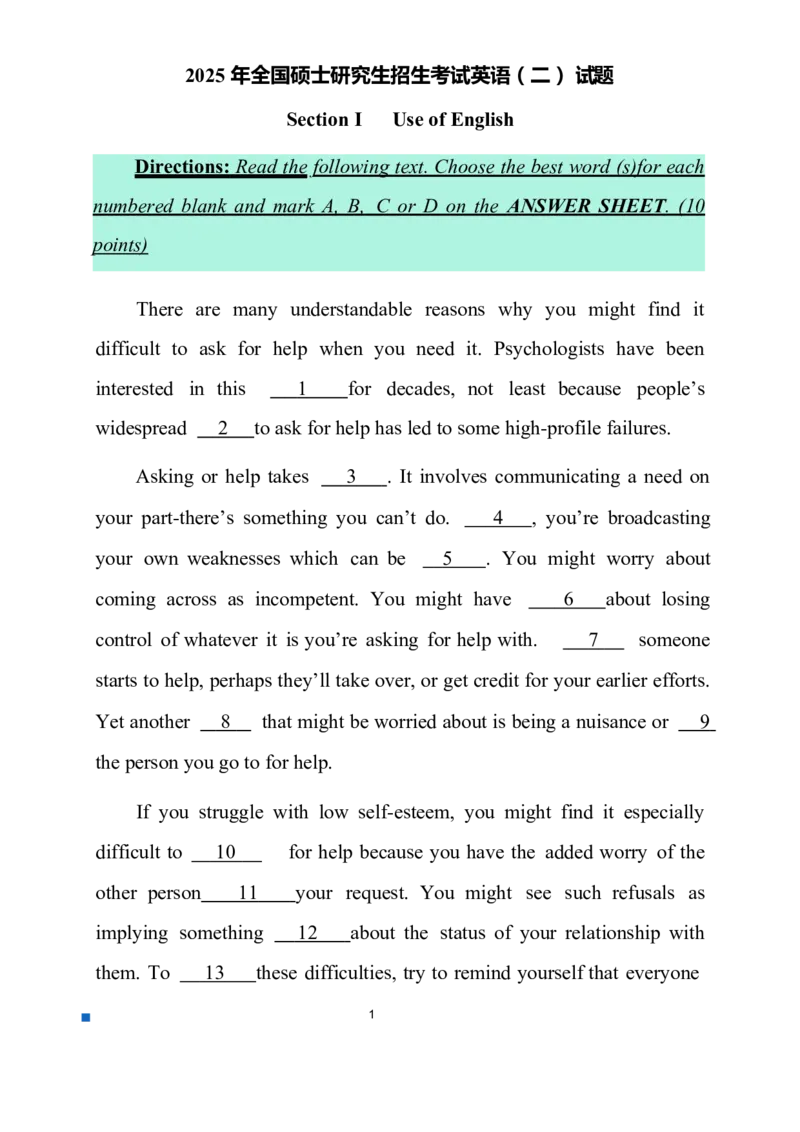
There are many understandable reasons why you might find it
difficult to ask for help when you need it. Psychologists have been
interested in this 1 for decades, not least because people’s
widespread 2 to ask for help has led to some high-profile failures.
Asking or help takes 3 . It involves communicating a need on
your part-there’s something you can’t do. 4 , you’re broadcasting
your own weaknesses which can be 5 . You might worry about
coming across as incompetent. You might have 6 about losing
control of whatever it is you’re asking for help with. 7 someone
starts to help, perhaps they’ll take over, or get credit for your earlier efforts.
Yet another 8 that might be worried about is being a nuisance or 9
the person you go to for help.
If you struggle with low self-esteem, you might find it especially
difficult to 10 for help because you have the added worry of the
other person 11 your request. You might see such refusals as
implying something 12 about the status of your relationship with
them. To 13 these difficulties, try to remind yourself that everyone
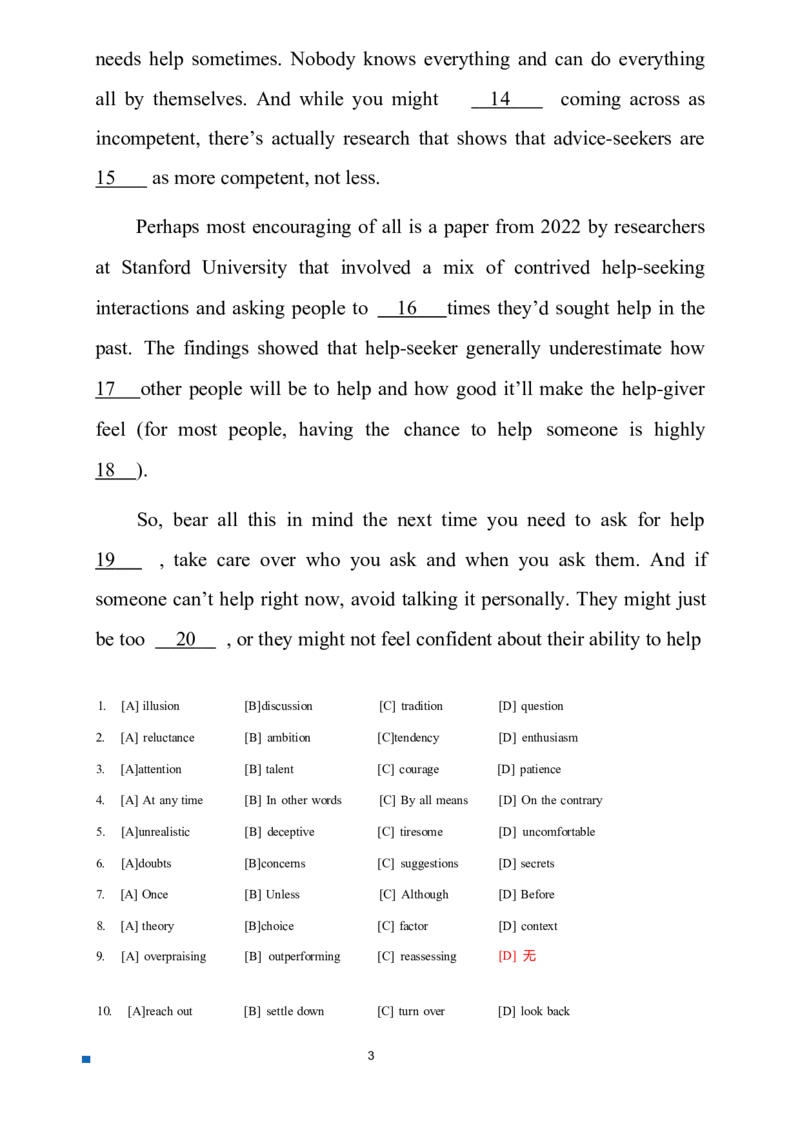
1needs help sometimes. Nobody knows everything and can do everything
all by themselves. And while you might 14 coming across as
incompetent, there’s actually research that shows that advice-seekers are
15 as more competent, not less.
Perhaps most encouraging of all is a paper from 2022 by researchers
at Stanford University that involved a mix of contrived help-seeking
interactions and asking people to 16 times they’d sought help in the
past. The findings showed that help-seeker generally underestimate how
17 other people will be to help and how good it’ll make the help-giver
feel (for most people, having the chance to help someone is highly
18 ).
So, bear all this in mind the next time you need to ask for help
19 , take care over who you ask and when you ask them. And if
someone can’t help right now, avoid talking it personally. They might just
be too 20 , or they might not feel confident about their ability to help
1. [A] illusion [B]discussion [C] tradition [D] question
2. [A] reluctance [B] ambition [C]tendency [D] enthusiasm
3. [A]attention [B] talent [C] courage [D] patience
4. [A] At any time [B] In other words [C] By all means [D] On the contrary
5. [A]unrealistic [B] deceptive [C] tiresome [D] uncomfortable
6. [A]doubts [B]concerns [C] suggestions [D] secrets
7. [A] Once [B] Unless [C] Although [D] Before
8. [A] theory [B]choice [C] factor [D] context
9. [A] overpraising [B] outperforming [C] reassessing [D] 无
10. [A]reach out [B] settle down [C] turn over [D] look back
311. [A] declining [B] considering [C] criticising [D] evaluating
12. [A] unnecessary [B] negative [C] strange [D] impractical
13. [A] explain [B] identify [C] predict [D] overcome
14. [A] deny [B] forget [C] miss [D] fear
15. [A] disguised [B] perceived [C] followed [D] introduced
16. [A] read [B] classify [C] analyse [D] compare
17. [A] brave [B] surprising [C] rewarding [D] demanding
18. [A] relaxing [B] disappointed [C] willing [D] hesitant
19. [A] Thus [B] Also [C] Finally [D] Instead
20. [A] polite [B] proud [C] busy [D] lazy
Section II Reading Comprehension
Part A
Directions: Read thefollowingfour texts. Answer the questions below
each text by choosing A, B, C or D. Mark your answers on the ANSWER
SHEET. (40 points)
Text 1
U.S. customers historically tipped people they assumed were earning
most of their income via tips, such as restaurant servers earning less than
the minimum wage. In the early 2010s, a wide range of businesses started
processing purchases with iPads and other digital payment systems. These
systems prompted customers to tip for services that were not previously
tipped.
Today's tip requests are often not connected to the salary and service
3norms that used to determine when oud how people tip. Customers in the
past nearly always paid tips after receiving a service, such as at the
conclusion of a restaurant meal, after getting a haircut or once a pizza was
delivered. That timing could reward high-quality service and give workers
an incentive to provide it.
It's becoming more common for tips to be requested beforehand. And
new tipping technology may even automatically add tips.
The prevalence of digital payment devices has made it easier to ask
customers for a tip. That helps explain why tip requests are creeping into
new kind of services. Customers now routinely see menus of suggested
default options-often well above 70% of what they owe. The amounts have
risen from 10% or less in the 1950s to 15% around the year 2000 to 20%
or higher today. This increase is sometimes called tipflation-the
expectation of ever-higher tip amounts.
Tipping has always been a vital source of income for workers in
historically tipped services, like restaurants, where the tipped minimum
wage can be as low as US $2.13 an hour. Tip creep and tip flation are now
further supplementing the income of many low-wage service workers.
Notably, tipping primarily benefits some of these workers, such as
cooks and dishwashers. To ensure that all employees were paid fair wages,
some restaurants banned tipping and increased prices, but this movement
toward no-tipping services has largely fizzled out.
421. According to paragraph 1, the practice of tips in the U.S. .
[A] was regarded by many customers as a sign of generosity
[B] was considered essential for
waiters [C]was a way of rewarding
diligence
[D] was optional in most businesses
22. Compared with tips in the past, today's tips .
[A] are paid much less frequently
[B] are less often requested in advance
[C] have less to do with service quality
[D] contributed less to workers' income
23. Tip requests are creeping into new kind of service as a result of
.
[A] the advancement of technology
[B] the desire for income increase
[C] the diversification of business
[D] the emergence of tipflation
24. The movement toward to no-tipping service was intended
to .
[A] promote consumption
5[B] enrich income sources
6[C] maintain reasonable prices
[D] guarantee income fairness
25. It can be learned from the last paragraph that tipping .
[A] is becoming a burden for customers
[B] helps encourage quality service
[C] is vital to business development
[D] reflects the need to reduce prices
Text 2
When it was established, the National Health service (NHS) was
visionary: offering high-quality, timely care to meet the dominant needs of
the population it served/Nearly 75 years on; with the UK facing very
different health challenges, it is clear that model is out of date.
From life expectancy to cancer and infant mortality rates, we are
lagging behind many of our peers/With more than 6.8 million on waitlists,
healthcare is becoming increasingly inaccessible for those who can not opt
to pay for private treatment; and the cost of providing healthcare is
increasingly squeezed out investment in other public services/ As demand
for healthcare continues to grow, pressures on the workforce-which is
already near breaking point-will only become more acute.
Many of the answers to the crisis in health and care are well
rehearsed./We need to be much better at reducing and diverting demand on
health services, rather than simply managing it./Much more needs to be
7invested in communities and primary care to reduce our reliance on
hospital's/And capacity in social care needs to be greater, to support the
growing number ofpeople living with long-term conditions.
26. According to the first two paragraphs, the NHS .
[A] is troubled by funding deficiencies
[B] can hardly satisfy people's needs
[C] can barely retain its current employees
[D] is rivalled by private medical services
27. One answer to the crisis in health and care is to .
[A] boost the efficiency of hospitals
[B] lighten the burden on social care
[C] increase resources for primary care
[D] reduce the pressure on communities
28. "Reimagining health" is aimed to .
[A] reinforce hospital management
[B] readjust healthcare regulations
[C] restructure the health system
[D] resume suspended health reforms
29.To maximise the nation's health, the author suggests .
[A] introducing relevant taxation policies
[B] paying due attention to social factors
8[C] reevaluating major health outcomes
[D] enhancing the quality of healthcare
30.It can be inferred that local leaders should .
[A] exercise their power more reasonably
[B] develop a stronger sense of responsibility
[C] play a bigger role in then health system
[D] understand people's health needs better
Text 3
Heat action plans, or HAPs, have been proliferating in India in the
past few years. In general, a HAP spells out when and how officials should
issue heat warnings and alert hospitals and other institutions. Nagpur's plan,
for instance, calls for hospitals to set aside "cold wards" in the summer for
treating heatstroke patients, and advises builders to give construction
laborers a break from work on very hot days.
But implementation of existing HAPs has been uneven, according to a
report from the Centre for Policy Research. Many lack adequate funding, it
found. And their triggering thresholds often are not customized to the local
climate. In some areas, high daytime temperatures alone might serve as an
adequate trigger for alerts. But in other places, nighttime temperatures or
humidity might be as important a gauge of risk as daytime highs.
Mumbai's April heatstroke deaths highlighted the need for more
nuanced and localized warnings, researchers say. That day's high
9temperature of roughly 36℃ was 1 ℃ shy of the heat wave alert threshold
for coastal cities set by national meteorological authorities. But the effects
of the heat were amplified by humidity—an often neglected factor in heat
alert systems -and the lack of shade at the late-morning outdoor ceremony.
To help improve HAPs, urban planner Rajashree Kotharkar's team is
working on a model plan that outlines best practices and could be adapted
to local conditions. Among other things, she says, all cities should create a
vulnerability map to help focus responses on the populations most at risk.
Such mapping doesn't need to be complex, Kotharkar says. "A useful
map can be created by looking at even a few key parameters." For example,
neighborhoods with a large elderly population or informal dwellings might
be poorer with heat could get special warnings or be bolstered with cooling
centers. The Nagpur project has already created a risk and vulnerability
map, which enabled Kotharkar to tell officials which neighborhoods to
focus on in the event of a heat wave this summer.
HAPs shouldn't just include short-term emergency responses,
researchers say, but also recommend medium-to long-term measures that
could make communities cooler. In Nagpur, for example, Kotharkar's team
has been able to advise city officials about where to plant trees to provide
shade. HAPs could also guide efforts to retrofit homes or modify building
regulations. "Reducing deaths in an emergency is good target to have, but
it's the lowest target," says climate researcher Chandri Singh.
1031.According to Paragraph 1, Nagpur's plan proposes measures to
.
[A] tackle extreme weather
[B] ensure construction quality
[C] monitor emergency warnings
[D] address excessive workloads
32.One problem with existing HAPs is that they .
[A] prove too costly to be implemented
[B] lack localized alert-issuing criteria
[C] give delayed responses to heat waves
[D] keep hospitals under great pressure
33.Mumbai's case shows that India's heat alert systems need to .
[A] include other factors besides temperature
[B] take subtle weather changes into account
[C] prioritize potentially disastrous heat waves
[D] draw further support from local authorities
34.Kotharkar holds that a vulnerability map can help .
[A] prevent the harm of high humidity
[B] target areas needing special attention
[C] expand the Nagpur project's coverage
[D] make reliefplans for heat-stricken people
1135. According to the last paragraph, researchers believe that HAPs should
.
[A] focus more on heatstroke treatment
[B] apply for more government grants
[C] invite wider public participation
[D] serve a broader range ofpurposes
Text 4
Navigating beyond the organised pavements and parts of our urban
spaces, desire paths are the unofficial footprints of a community, revealing
the unspoken preferences, shared shortcuts and collective choices of
humans. Often appearing as trodden dirt tracks through otherwise neat
green spaces, these routes of collective disobedience cut corners, bisect
lawns and cross hills, representing the natural capability of people cand,
animals, to go from point A to point B most effectively.
Urban planners interpret desire paths as more than just convenient
shortcuts; they offer valuable insights into the dynamics between planning
and behaviour.
Navigating beyond the organised pavements and parks of our urban
spaces, desire paths are the unofficial footprints of a community, revealing
the unspoken preferences, shared shortcuts and collective choices of
humans. Often appearing as trodden dirt tracks through otherwise neat
green spaces, these routes of collective disobedience cut corners, bisect
12lawns and cross hills, representing the natural capability of people (and
animals) to go from point A to point B most effectively.
Urban planners interpret desire paths as more than just convenient
shortcuts; they offer valuable insights into the dynamics between planning
and behaviour. Ohio State University allowed its students to navigate the
Oval, a lawn in the centre of campus, freely, then proceeded to pave the
desire paths, creating a web of effective routes students had established.
Yet, reluctance persists among other planners to integrate desire paths
into formal plans, citing concerns about safety, environmental impact, or
primarily, aesthetics. A Reddit webpage devoted to the phenomenon,
boasting nearly 50,000 members, showcases images of local desire paths
adorned with signs instructing pedestrians to adhere to designated
walkways, underscoring the rebellious nature inherent in these
human-made tracks. This clash highlights an ongoing struggle between the
organic, user-driven evolution of public spaces and the desire for a visually
curated and controlled urban environment.
The Wickquasgeck Trail is an example of a historical desire path,
created by Native Americans to cross the forests of Manhattan and move
between settlements quickly. This trail, when Dutch colonists arrived, was
widened and made into one of the main trade roads across the island,
known at the time as de Heere Straat, or Gentlemen’s Street. Following the
British assumption of control in New York, the street was renamed
13Broadway. Notably, Broadway stands out as one of the few areas in NYC
that defies the grid-based system applied to the rest of the city, cutting a
diagonal across parts of the city.
In online spaces, desire paths have sparked a fascination that can
approach obsession, with the Reddit page serving as a hub. Contributors
offer a wide array of stories, from little-known new shortcuts to
long-established alternate routes.
Animal desire paths, such as ducks forging trails through frozen
ponds or dogs carving direct routes in gardens, highlight the adaptability of
these trails in both human and animal experiences. As desire paths
criss-cross through both physical and virtual landscapes, they stand as a
proof of the collective insistence on forging unconventional routes and
embracing the spirit of communal choice.
36. According to Paragraph 1, desire paths are a result of .
[A] the curiosity to explore surrounding hills
[B] the necessity to preserve green spaces
[C] the tendency to pursue convenience
[D] the wish to find comfort in solitude
37. It can be inferred that Ohio State University .
[A] intends to improve its desire paths
14[B] leads in the research on desire paths
[C] guides the creation of its desire paths
[D] takes a positive view of desire paths
38. The images on the Reddit webpage reflect .
[A] conflicting opinions on the use of desire paths
[B] the call to upgrade the designing ofpublic spaces
[C] the demand for proper planning of desire paths
[D] growing concerns over the loss ofpublic spaces
39. The example of the Wickguasgeck Trail illustrates .
[A] the growth ofNew York City
[B] the Dutch origin of desire paths
[C] the importance of urban planning
[D] the recognition of desire paths
40. It can be learned from the last paragraph that desire paths .
[A] reveal humans’ deep respect for nature
[B] are crucial to humans ’ mental wellbeing
[C] are a human imitation of animal behaviour
[D] show a shared trait in humans and animals
Part B
Directions: Read the following text and answer the questions by
15choosing the most suitable subheading from the list A-G for each
numberedparagraphs (41-45). There are two extra subheadings which you
do need to use. Markyour answers on the ANSWER SHEET. (10 points)
[A] Stay positive
[B] Respect the past
[C] Use channels
[D] Give it time
[E] Invite resistance
[F] Be a salesman
[G] Be humble
Five Steps to Suggesting a Change at Work That'll Actually Get
Taken Seriously
Everyone wants to be that person—the one who looks at the same
information as everyone else, but who sees a fresh, innovative solution.
However, it takes more than simply having a good idea. How you share it
is as important as the suggestion itself. Why? Because writing a new
script-literally or figuratively-means that other team members will have to
adapt to something new. So whether you're suggesting a (seemingly)benign
change like streamlining outdated protocol, or a bigger change like adding
an hour to each workday so people can leave early on Fridays, you're
asking others to reimagine their workflow or schedule. Not to mention, if
16the process your scrapping is one someone else suggested, there's the
possibility of hurt feelings. To gain buy-in on an innovative, new idea,
follow these steps:
41 .
Great ideas don’t stand alone. In other words, you can’t mention your
suggestion once and expect it to be adopted. To see a change, you’ll need
to champion your plan and sell its merits. In addition, you need to be
willing to stand up to scrutiny and criticism and be prepared to explain
your innovation in different ways for various audiences.
42 .
Sometimes it makes sense to go to your boss first. But other times, it’s
useful to build a coalition among your co-workers or other stakeholders.
When it works, it works great—because you’re ready for your stubborn
supervisor’s pushback with answers like, “ Actually, I connected with a
few people in our tech department to discuss how much time these kinds of
website updates would take, and they suggested they have the bandwidth.
However, just be certain you can explain your end-around approach as
one that built your case, rather than simply circumvented your manager.
The last thing you want is for your boss to feel embarrassed he wasn’t
informed—which could lead him to quash the idea before it even takes off.
43 .
17One of the biggest barriers to gaining buy-in occurs when the owner
of an idea is viewed as argumentative, defensive, or close-minded. Because,
let ’s be honest: No one likes a know-it-all. So, ifpeople disagree with you,
don’t be indignant. Instead, listen to their concerns fully, try to understand
their perspective, and include their concerns (and possible remedies) in
future discussions.
So, instead of saying, “Martha, our current slogan is confusing and
should be updated,” you could try, “Martha raises a great point that our
current slogan has a long history for our stakeholders, but I wonder if we
might able to brainstorm a tagline that could build on that—and be clearer
for new customers.”
44 .
New ideas are the grandchildren of old ones. In other words, don’t
throw old solutions under the bus to make your improvement stand out.
Remember that in light of whatever the problem the old system solved—or,
maybe, has failed to solve in recent memory—it was a great idea at the
time. Appreciating the older contributions as you suggest future
innovations helps bolster the credibility of your idea.
45 .
When pitching a new idea, it’s important use the language of
abundance instead of the language of deficit. Instead of saying what is
wrong, broken, or suboptimal, talk about what is right, fixable, or ideal.
18For example, try, “I can see lots of applications for this new approach”
rather than, “This innovation is the only way.” Be optimistic but realistic,
and you will stand out.
Section III Translation
46. Directions: Translate the following text into Chinese. Write your
translation on the ANSWER SHEET. (15 points)
You know the moment - the conversation. Slows, then there's a pause.
It's awkward, and so awkward that some people will panic and say
anything. Do we all find such silences so stressful?
Researchers analysed the frequency and impact of gaps greater than 2
seconds daring conversations, including an overview of previous studies
which indicate that the fear of awkward silences can be so extreme that
people avoid taking to strangers, even though doing so is likely to be an
enjoyable experience.
During conversations with short gaps, people feel more connected to
their conversation partners. But such feeing of connection markedly dip
when entering a long gap. Long gaps between strangers are likely to be
followed by a change in topic.
But the opposite seems to be true for conversations between friends.
Long gaps there saw increased connection. Between friends, longer gaps
seem to provide natural moments for reflection and expression.
19Section IV Writing
Part A
47. Directions:
Suppose you are planning a short play based on a classic Chinese novel.
Write your friend John an e-mail to.
1) introduce the play and
2) invite him take part in it
You should write about 100 words on the ANSWER SHEET.
Do not use your own name. Use “Li Ming” instead.( 10 points)
Part B
48. Directions:
Write an essay based on the chart below. In your writing, you
should
1) interpret the chart, and
2) give your comments.
You should write about 150 words on the ANSWER SHEET. ( 15
points)
2021