义
务
教
育
教
义务教育教科书
科
书
English
英语
英
语
( 衔接三年级起点 )
(
衔
接
三
年
级
起
八年级下册
点
)
八
年
级
下
册
n!
u
It’s
f
asy!
It’s
e
定价:9.55元
全国价格举报电话:12315义务教育教科书
English
英语
( 衔接三年级起点 )
八年级下册
[中 国] 河 北 教 育 出 版 社
合作编写
[加拿大] DC加拿大国际交流中心致 同 学
亲爱的同学们,新的学期开始了,欢迎大家继续使用这套《英语》教材!
本册《英语》教材供八年级下学期使用。
上个学期我们接触了一些非常有意思的话题,也许你们还记忆犹新,除了
家庭节日、社区邻里、交通工具及相关职业表述外,我们还一起探索了自我
成长的心理过程。
这个学期,春天来了,万物复苏,在这个春意盎然的季节,让我们一起来
感受春天的气息。有哪些奇异的植物和动物我们还未曾见识过?哪些和春天
相关的节日与活动还未曾了解?除了这些,我们还会涉猎一些地理、历史、
风土人情和奥林匹克运动话题的内容。此外,我们还会和大家共同思考一些
问题:互联网能带给我们什么?怎样保护我们赖以生存的自然环境?
本册教材篇章阅读较多,旨在加大阅读技能方面的培养和训练。同学们一
定不要去过于关注词和句的细节而丢掉对文章整体结构的理解。我们在Let’s
Do It! 中专门安排了一些阅读后的活动,希望能对同学们有所帮助。
语言功底需要慢慢积累。每天进步一点,有一天你会突然发现:原来我的
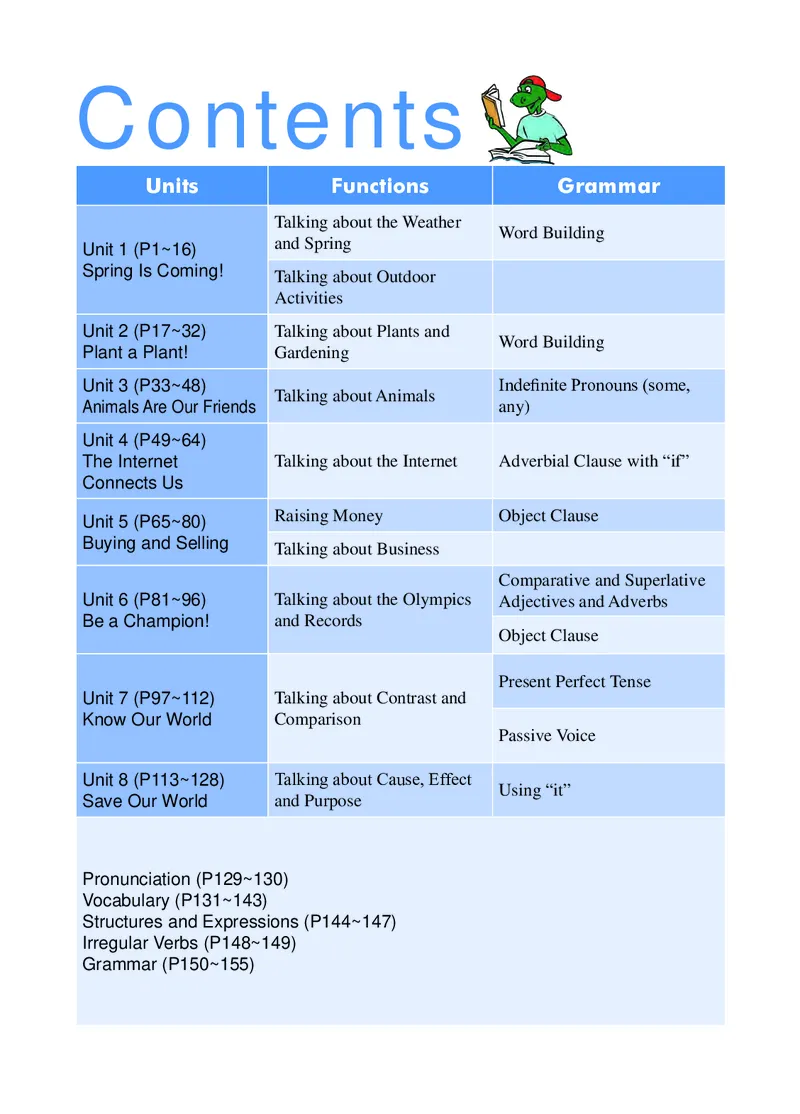
英语水平已经这么棒了!Contents
Units Functions Grammar
Talking about the Weather
Word Building
and Spring
Unit 1 (P1~16)
Spring Is Coming!
Talking about Outdoor
Activities
Unit 2 (P17~32) Talking about Plants and
Word Building
Plant a Plant! Gardening
Unit 3 (P33~48) Indefinite Pronouns (some,
Talking about Animals
Animals Are Our Friends any)
Unit 4 (P49~64)
The Internet Talking about the Internet Adverbial Clause with “if”
Connects Us
Raising Money Object Clause
Unit 5 (P65~80)
Buying and Selling
Talking about Business
Comparative and Superlative
Unit 6 (P81~96) Talking about the Olympics Adjectives and Adverbs
Be a Champion! and Records
Object Clause
Present Perfect Tense
Unit 7 (P97~112) Talking about Contrast and
Know Our World Comparison
Passive Voice
Unit 8 (P113~128) Talking about Cause, Effect
Using “it”
Save Our World and Purpose
Pronunciation (P129~130)
Vocabulary (P131~143)
Structures and Expressions (P144~147)
Irregular Verbs (P148~149)
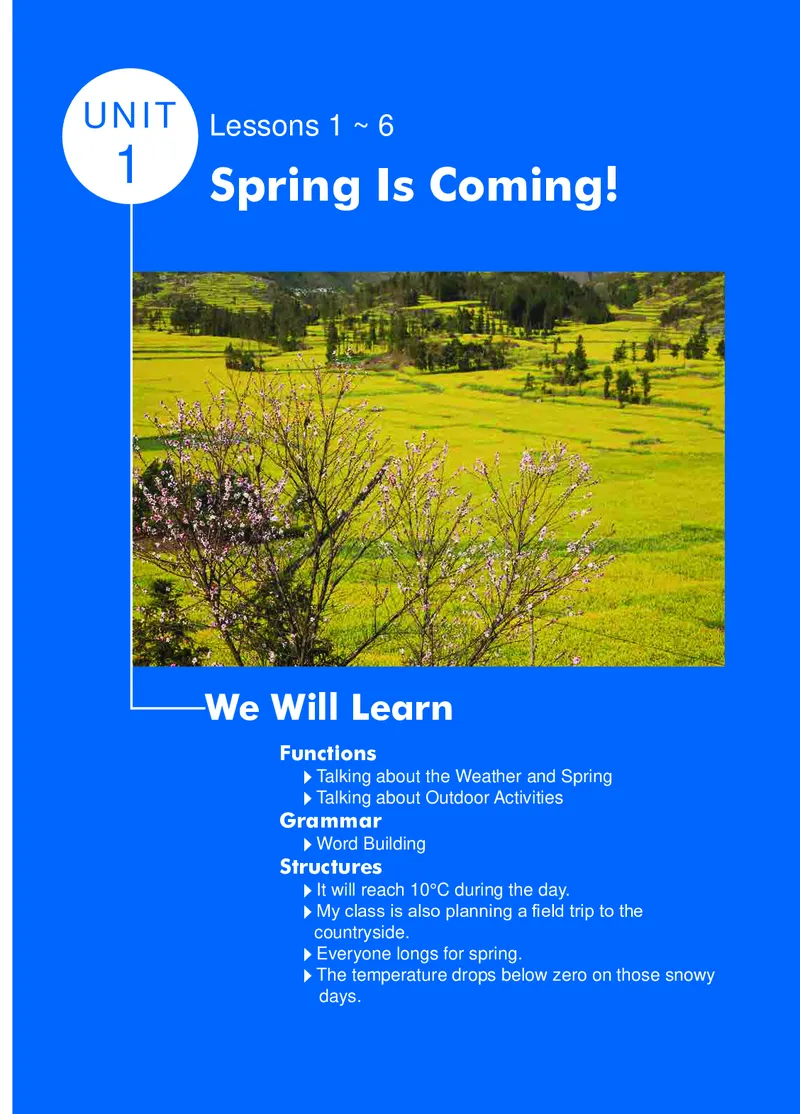
Grammar (P150~155)UNIT
Lessons 1 ~ 6
1
Spring Is Coming!
We Will Learn
Functions
Talking about the Weather and Spring
Talking about Outdoor Activities
Grammar
Word Building
Structures
It will reach 10°C during the day.
My class is also planning a field trip to the
countryside.
Everyone longs for spring.
The temperature drops below zero on those snowy
days.
1Lesson 1: How’s the Weather?
N K ABO U • How is the weather in your hometown in spring?
T
HI T
IT • Have you ever heard a weather report? What expressions do they
often use?
Danny: Good morning, everyone. I’m Danny Dinosaur on the radio. What’s the
weather like today? Here’s the weather report. Today is Friday, February 28. It
will be snowy and hot.
Jenny: (She laughs.) Danny! When it snows, it’s not hot. It’s cold.
Danny: OK, it’s not hot. It’s not snowing, but it is cloudy.
Jenny: What’s the temperature?
Danny: Let’s see. It will reach 10°C during the day.
Brian: It’s quite warm today. Spring is coming. Is it going to rain, Danny?
Danny: Yes! There will be a shower this afternoon. Maybe there will be a
thunderstorm. I hope not! I’m scared of thunder!
Jenny: Wow! What strange weather! Now
talk about the sunrise and the sunset.
Danny: This morning, the sun rose. This
evening, the sun will set.
Jenny: No, no! Tell us the exact time!
Danny: The sun rose at 7:25 this morning
and it will set at 6:09 this evening.
Dig In
Here are some weather icons:
sunny rainy cloudy
windy lightning thunderstorm
foggy snowy thunder shower
Do you know more?
2Let’s Do It!
1 Danny is writing a weather report. Help him complete it.
Hello everyone. Here’s my weather report. Today is Friday, ________
28. It is ________. The ________ will reach 10°C during the day. It’s quite
warm today. There will be a ________ this afternoon. Maybe there will be a
________. Today, the sun rose at 7:25 a.m., and it will set at 6:09 p.m.
2 Listen to the passage and fill in the table.
Date Weather Temperature Time
Day time ________ Sunrise ________
________ Night ________ ________ Sunset ________
3 Make new words by combining the words below. Complete the
sentences with the compound words.
may sun thunder basket
rise ball be storm
1. Can you hear the thunder? Maybe there will be a ________.
2. The days are getting longer. The ________ today is two minutes earlier than
yesterday.
3. A: Will Peter come to the party on Saturday?
B: I think so. ________ he will come with Jim.
4. Lin Tao’s dream is to be a ________ player. He wants to be like Yao Ming.
4 Work in pairs. Talk about the weather in your hometown. Then
write a short weather report and share it with the class.
Example:
It’s time for the weather report. Today is… The temperature is… The
weather will be… If you go out, please remember to… Today, the sun…, and
it will… Thank you.
3Lesson 2: It’s Getting Warmer!
N K ABO U
T
HI T
IT
• What do you know about spring?
• Which season is your favourite?
Dear Jenny,
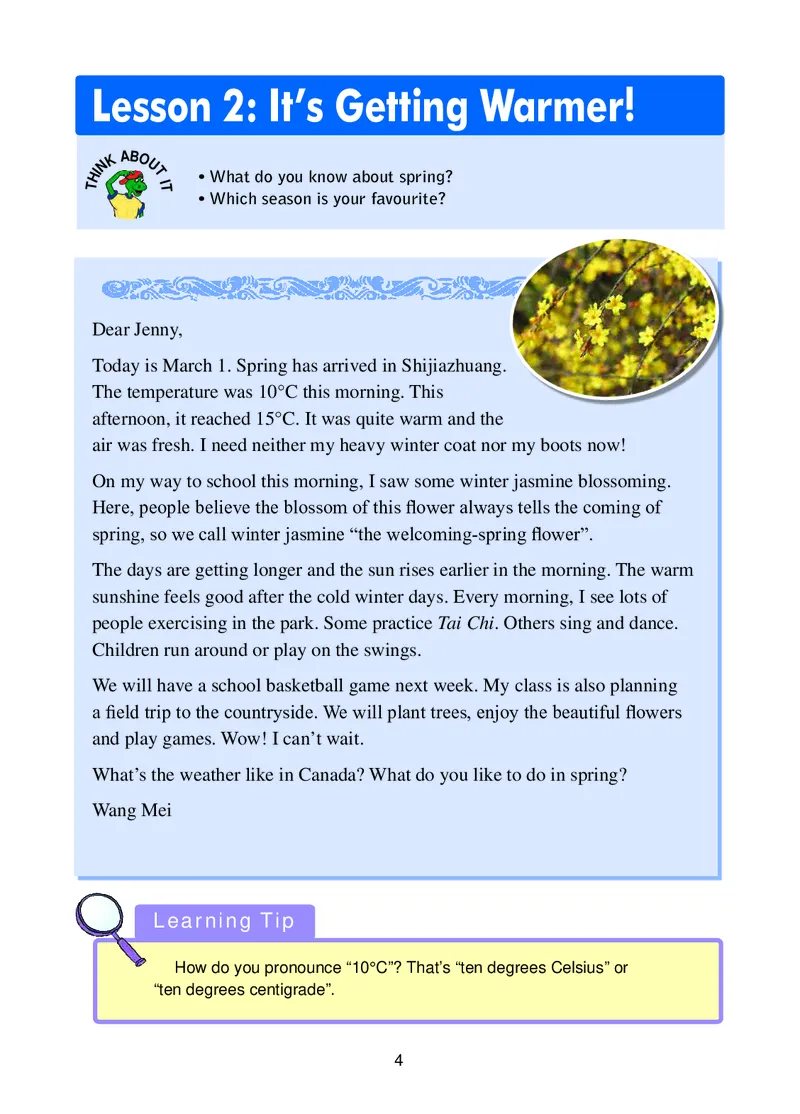
Today is March 1. Spring has arrived in Shijiazhuang.
The temperature was 10°C this morning. This
afternoon, it reached 15°C. It was quite warm and the
air was fresh. I need neither my heavy winter coat nor my boots now!
On my way to school this morning, I saw some winter jasmine blossoming.
Here, people believe the blossom of this flower always tells the coming of
spring, so we call winter jasmine “the welcoming-spring flower”.
The days are getting longer and the sun rises earlier in the morning. The warm
sunshine feels good after the cold winter days. Every morning, I see lots of
people exercising in the park. Some practice Tai Chi. Others sing and dance.
Children run around or play on the swings.
We will have a school basketball game next week. My class is also planning
a field trip to the countryside. We will plant trees, enjoy the beautiful flowers
and play games. Wow! I can’t wait.
What’s the weather like in Canada? What do you like to do in spring?
Wang Mei
Learning Tip
How do you pronounce “10°C”? That’s “ten degrees Celsius” or
“ten degrees centigrade”.
4Let’s Do It!
1 Read the lesson and write true (T) or false (F).
1. The temperature reached 15°C in the morning. ( )
2. Wang Mei is still wearing boots. ( )
3. Wang Mei saw some winter jasmine on her way to the park. ( )
4. Wang Mei’s class is planning a field trip to the countryside. ( )
2 Read the lesson again and tick all the scenes mentioned.
The grass grows.
The weather is warm.
The air is fresh.
The flowers blossom.
The trees begin to sprout.
The days get longer.
The sun rises earlier.
The birds fly back from the south.
3 What do people like to do in spring? Fill in the blanks with the
correct forms of the words in the box.
reach enjoy rise practice plant
1. When I ________ that village, it was dark.
2. It is getting warm. Many people like to ________ Tai Chi in the park.
3. The flowers in the park have blossomed. My grandparents go there to
________ the flowers every morning.
4. The sun ________ early now. Let’s get up early and play ping-pong together.
5. Many people go to the countryside to ________ trees in early spring.
4 Talk about spring and outdoor
activities. You can use the
sentences in Activities 2 and 3.
5Lesson 3: The Sun Is Rising
N K ABO U
T
HI T
IT
• How do you feel about the air, flowers and birds in spring?
• Do you know any songs or poems about spring?
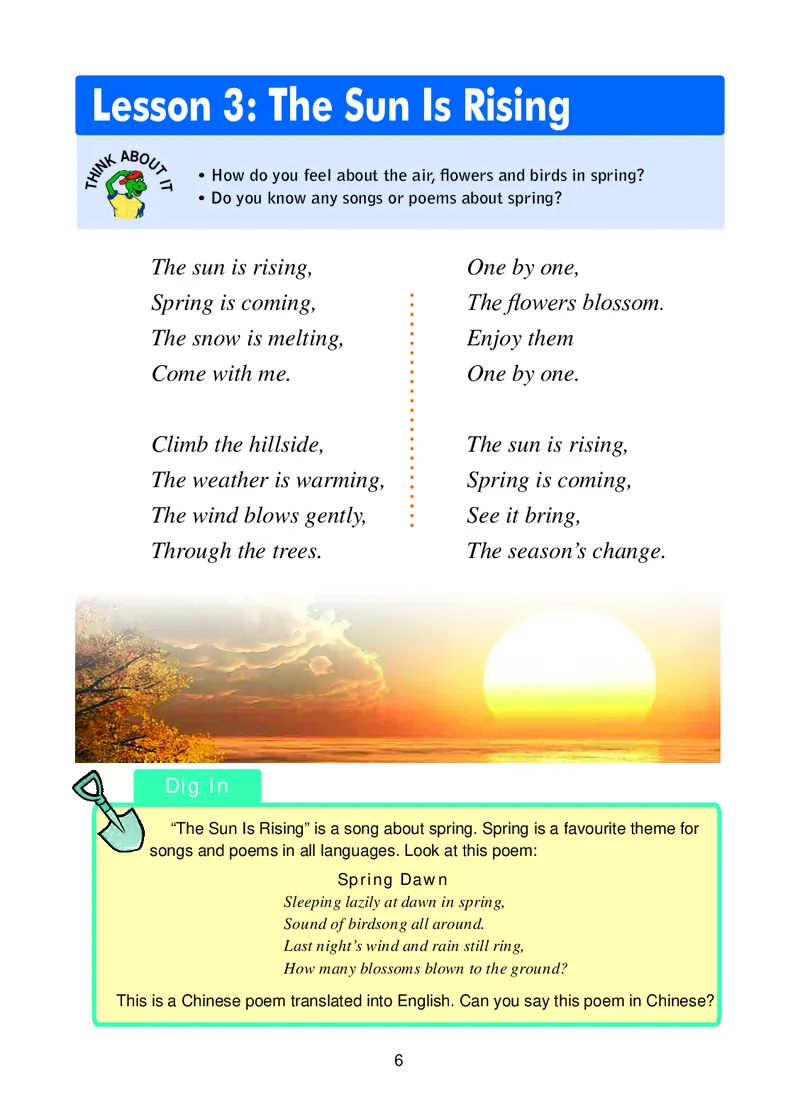
The sun is rising, One by one,
Spring is coming, The flowers blossom.
The snow is melting, Enjoy them
Come with me. One by one.
Climb the hillside, The sun is rising,
The weather is warming, Spring is coming,
The wind blows gently, See it bring,
Through the trees. The season’s change.
Dig In
“The Sun Is Rising” is a song about spring. Spring is a favourite theme for
songs and poems in all languages. Look at this poem:
Spring Dawn
Sleeping lazily at dawn in spring,
Sound of birdsong all around.
Last night’s wind and rain still ring,
How many blossoms blown to the ground?
This is a Chinese poem translated into English. Can you say this poem in Chinese?
6Let’s Do It!
1 Read the song and underline the phrases that describe spring.
Then listen and put the pictures in the correct order.
2 Pick a spring word. Then use each letter in the word to start a
sentence.
Example:
So many flowers blossom.
Pets come out and play.
Really big bears wake up from their dreams.
I enjoy going for walks with my friends.
No tree is left standing without any leaves.
Go ahead, jump for joy because spring is here.
PROJECT
WHAT DO YOU LIKE TO DO OUTSIDE IN SPRING?
The weather is warm in spring. Many people like to play outside and
have fun. What do you like to do in spring? Write down your ideas.
What do your friends like to do outdoors in spring? Interview a friend
in another school, another city or another country.
Write the
activities
your friend
likes to do.
Write the activities
you like to do.
Write the activities that you both like to do.
7Lesson 4: The Spring City
N K ABO U
T
HI T
IT
• Would you like to live in a place where there are no winters?
• What do you enjoy most about spring?
When we think of spring, we think of
a season of fine, warm weather and clear,
fresh air. We think of new life, green
plants and budding trees all around us.
Everyone longs for spring. Spring is a
short season in many places around the
world. But in my hometown, it feels like
spring nearly all year round.
The weather here is neither too hot nor
too cold. The average winter temperature
I love my
hometown.
is 15°C. In summer it never gets too hot.
The average temperature is 24°C. The city gets about 1 000 millimetres of rain
every year. There’s plenty of sunshine too, with about 2 250 hours of sunshine
every year. Because of the spring-like weather, you can find hundreds of
beautiful flowers and trees anytime of the year.
Can you guess my hometown? Yes, it’s Kunming — “the Spring City”.
8Let’s Do It!
1 Read the lesson and answer the questions.
1. What’s the average temperature in winter/summer in Kunming?
2. How much rain does the city get every year?
3. How many hours of sunshine does the city get every year?
4. Why are there many flowers all year round in Kunming?
2 Listen to people talking about their hometowns and match the
names with the sentences.
Spring begins in April and ends in June. The
Susan
temperature is between 4°C and 15°C.
Mike It is warm and wet. Spring begins in November.
The average spring temperature is 5°C. It is very
Zhang Jing
cold.
The weather is neither too hot nor too cold. The
Tom
average spring temperature is 20°C.
Dong Chao They celebrate the Festival of Colours to greet
the coming of spring.
3 Fill in the blanks with the correct forms of the phrases in the box.
long for think of feel like because of
1. She didn’t go to school ____________ her illness.
2. He always ____________ his friend when he is in trouble.
3. They ____________ sunshine during the long rainy days.
4. It’s so hot today. It ____________ summer.
4 Work in pairs. Talk about the spring in
your hometown.
Task tips: You can talk about the weather, the
temperature and your favourite activities.
9Lesson 5: Babysitting on a Spring Day
N K ABO U
T
HI T
IT
• What outdoor activities do you usually do in spring?
• Have you ever been a babysitter?
Danny is babysitting his cousin (She climbs down, runs to the swing
Debbie on the playground. Brian is with and climbs on.)
them. Debbie: Push me, Danny! Push me up
higher!
Danny: Thank you for helping
me, Brian. This is my first time
Danny: OK. (He gives her a push.)
babysitting.
Debbie: (She laughs.) Push harder!
Brian: You’re welcome, Danny. But
Brian: Can I give you a push?
where is Debbie?
Debbie: No, I want Danny to! Higher,
(Danny turns around. Debbie is on the
Danny!
monkey bars. She is climbing very high.)
Danny: (He is tired and hot.) It’s time to
Danny: Hold on, Debbie! Don’t fall off!
stop swinging, Debbie.
Debbie: (She gets off the swing.) Let’s
run! Let’s play catch. Or soccer?
What about basketball? Let’s play!
Danny: I know a good game. Let’s play
“Lie on the Grass”.
Brian: Shall we look at the clouds,
Debbie?
Debbie: OK! That one looks like a big,
white rabbit! It’s jumping up and
down! I want to jump, too! Come on,
Danny! Danny?
(Danny runs towards Debbie.)
Danny: Come down, please! Zzzzzz…
Debbie: I want to climb higher!
Brian: Come down, Debbie. You’re
too high up. Let’s play on the swings
instead, OK? Danny will push you.
Debbie: OK, I love swings!
10Let’s Do It!
11 Read the lesson and answer the questions.
1. Who is Danny taking care of?
2. Is it Danny’s second time babysitting?
3. What activities does Debbie like?
4. Why does Danny fall asleep on the grass?
21 Fill in the blanks with the correct forms of the phrases in the box.
thank… for hold on look like fall off
1. This dress fits you very well. You ___________ a movie star in it.
2. Be careful! ___________ to that bar! I’m coming to help you.
3. Jenny, ___________ you ___________ helping me practice my spoken
English.
4. Lily, look after your little sister. Don’t let her ___________ the bed.
31 Danny wrote in his diary about his day as a babysitter. Put the
paragraphs in the correct order.
Dear Diary,
( 1 ) I woke up before the sun rose this morning. Today I would be a
babysitter! I thought about it all day at school.
( ) Next, I pushed her on the swing. Brian wanted to give her a push, but
Debbie said no. She loves her big cousin!
( ) When the sun set, I took Debbie home. I helped her brush her teeth and
climb into bed. I read her a story. At 9:30 p.m., my aunt and uncle came
home.
( 2 ) After school, Brian came with me. We went to the playground. I thought
that it would be easy to babysit there. I was wrong!
( ) I wanted to lie on the grass, but Debbie wanted to play games. We ran,
we climbed, we played catch and we played soccer. Finally, we had
supper. Debbie ate hers in about one minute! Then
she was running again! So was I!
( ) First, Debbie climbed up very high. I was scared
that she would hurt herself, but she held on well.
( ) I can’t write any more tonight. I’m too tired.
Anyway, it was a good day.
11Lesson 6: Stories about Spring
N K ABO U
T
HI T
IT
• What clothes do you wear in spring?
• What interesting things do you see in spring?
Dear Wang Mei,
It isn’t snowing today, but there is still snow on the grass. In Edmonton,
the weather in March can be cold and snowy or warm and sunny. It’s a
little wild. The temperature can be as low as -15°C, but it can also reach
15°C. Still, sometimes it snows in April and May! The temperature drops
below zero on those snowy days. We probably won’t see any flowers until
May or June!
After school today, we played outside. We played “snow” soccer. We had
to wear our jackets and boots, but it was fun. Danny fell into the snow!
Maybe next month we will play in our shorts and T-shirts!
I like the Chinese name for winter jasmine. It’s interesting. Here, we have
Groundhog Day on February 2 for the coming of spring. In spring, many
families drive to the countryside on weekends. A popular place to go is a
sugar bush. It’s so much fun to make syrup.
I love spring because of all the fun activities. Also, summer follows it!
Talk to you soon!
Jenny
Culture Tip
Groundhog Day is on February 2. On that day, a small animal called a
groundhog comes out of a hole in the ground. If it sees its shadow, then
spring won’t come for another 6 weeks. But if the groundhog does not see
its shadow, then spring is very close. How does a groundhog know? It
doesn’t! It’s just a very old tradition in North America.
12Let’s Do It!
1 Read the lesson and answer the questions.
1. Why does Jenny think the weather in Edmonton is a little wild?
2. What activities do people in Canada do in spring?
3. Why does Jenny love spring?
2 Fill in the blanks with the words in the box.
low until zero drop
1. The boy didn’t stop running ________ he reached the finish line.
2. Water turns into ice at ________ degrees Celsius.
3. The temperature in Shijiazhuang can be as ________ as -3°C in spring.
4. In my hometown, the temperature can ________ below zero at night.
3 Read the passage and fill in the blanks with the sentences below.
Winter is long, cold and dark, so people stay
I like cycling!
inside most of the time. When spring arrives,
Oops!
people turn their thoughts to the outdoors.
________ They like to wear light shirts and
blouses on warm spring days.
________ There are lots of activities: cycling,
in-line skating and picnicking in the park. Many
schools have soccer teams and other clubs for
their students. Spring is a time to look forward
to flowers and fresh food from the garden. Many
people go outside and work in their gardens.
________ Everyone loves spring.
A. What fun outdoor activities do people like to do in spring?
B. Spring is a season of hope.
C. People don’t need to wear heavy clothes to keep warm.
4 Think about things you can do in spring and why you do them.
Write a short passage to share with your classmates.
13Unit Review
Building Your Vocabulary
I. Unscramble the words and discover the answer to the riddle.
Riddle:
i n s t e d a __ __ __ __ __ __
It is a season. People always
s h u p __ __ __
think of it as a time of rebirth,
l y n e a r __ __ __ __ __ renewal and regrowth.
d w i n __ __ __
Answer:
p l n t e y __ __ __ __ __
It’s ________.
g o n l __ __ __
II. Fill in the blanks with the correct forms of the words or phrases in the box.
push plenty of not… until neither… nor average activity
1. Don’t worry. We have ________ time to get ready for the trip.
2. ________ Lucy ________ her sister passed the English exam.
3. This year, our school organized lots of ________ to enrich our lives.
4. Brian ________ the door open and went into the room.
5. He did ________ watch TV ________ 10:00 p.m.
6. The ________ age of these workers is 20. They are really active.
Grammar in Use
Match the words to make compound words. Then make sentences using the new
words.
home thunder play sun
news country any hill week
storm paper end ground
side town set more side
14Listening and Speaking
I. Listen and repeat. Pay attention to the letters in red.
1. Tell us the exact time!
2. I know a good game.
3. When it snows, it’s not hot.
4. I love spring because of all the fun activities.
II. Listen to the dialogue and answer the questions.
1. What is Steven going to do this Saturday?
2. Who will go to the countryside together with Steven?
3. What time will they meet at the park gate?
III. What season do you enjoy most? What do you like about it? Talk about it
with your partner. You can use the ideas below.
The Weather Environment
It is too hot/cold/windy/snowy. Flowers blossom and trees turn green.
The weather is just right. There are many fresh fruits and vegetables.
It gets warmer/colder. It is cold and there is snow and ice everywhere.
Sunrise/Sunset Activities
The sun rises early/late. I love swimming in the sea.
The sun sets at about 6:00 p.m. I can go boating with my parents.
The days get longer/shorter. We go skiing during the winter holiday.
Putting It All Together
Read the passage and answer the questions.
Festivals in Spring
The Spring Festival: The Spring Festival, the Chinese New Year, falls on the
first day of the first lunar month, and ends on the fifteenth day. There are all kinds
of cultural activities during this festival. Firework shows, dragon dancing and
lion dancing are very common. It is a time for families to get together. No matter
where they are, people come home to celebrate the festival with their families.
Maslenitsa: Maslenitsa draws its roots from religious activities, but now it is
about the new birth of nature. Pancakes are an important part of the celebration
because they are round, yellow and hot, just like the sun. The festival lasts for a
week. There are special activities. It is perhaps the most cheerful holiday in Russia.
15The Festival of Colours: Every year, Indian people celebrate this festival
to greet the coming of spring. During the celebration, people pray, dance
and share special food. They throw bright, colourful powders at friends and
strangers. Hugs and smiles are also a part of the celebration. Everyone has fun.
1. How long does the Spring Festival last in China?
2. What are some common cultural activities during the Spring Festival?
3. Why are pancakes an important part of the celebration of Maslenitsa in Russia?
4. Who celebrates the Festival of Colours?
Self-Evaluation
Find more examples from this unit. Then mark your stars.
I. Talking about the Weather and II. Talking about Outdoor Activities
Spring Children run around or play on the
It’s quite warm today. Spring is swings.
coming.
I can describe outdoor activities in
I can describe the weather and spring English.
in English.
III. Word Building
maybe thunderstorm sunrise
I know a lot of English compound words.
Enjoyment
Hills, loud with new water, Trees, smelling fresh with life.
Running swiftly under ice Leaves opening slowly
As clear as glass. Under the pale blue sky.
Flowers, tiny, brave and The sun, warm and golden,
Bright in the old snow. Softly kissing the earth.
16UNIT
Lessons 7 ~ 12
2
Plant a Plant!
We Will Learn
Functions
Talking about Plants and Gardening
Grammar
Word Building
Structures
It’s fun and important to plant plants.
Gardening is a very enjoyable hobby.
That is the whole purpose of growing a garden.
17Lesson 7: Planting Trees
N K ABO U
T
HI T
IT
• When is Tree Planting Day in China?
• What are the basic steps for planting a tree?
It’s March 12. Li Ming and his classmates are on a hillside. They are planting
trees as a school project. A worker is there helping them.
Li Ming: Excuse me, sir. We are digging a hole. Is it big enough?
Worker: Maybe you should make the hole a little bigger. It must be large enough
to hold the roots of the seedling.
Li Ming: I see. Thank you.
Worker: Now, put the seedling inside, cover the roots and fill the hole with dirt.
Then pack the dirt around the new tree with your feet.
Wang Mei: OK. By the way, there is another group of people down the hill. Are
they also coming to plant trees?
Worker: Yes. Many people are worried because the environment is changing, and
they want to do something to help.
Li Ming: These changes are serious. When there is a dust storm in spring, it gets
windy and dirty everywhere.
Wang Mei: Ms. Liu told us the wind blows the dirt and the sand here from the
north. Nothing can stop the wind because there are not many trees left.
Worker: Exactly. A lot of rich lands
in the northern area have turned
into desert.
Li Ming: I suppose tree planting is
very important work.
Wang Mei: For sure. I really like
this project. It’s also a great way
to learn about nature.
Worker: Yes. It’s fun and important
to plant plants. Oh, and please
remember to put a little water in
the bottom of the hole.
18Let’s Do It!
1 Read the lesson and write true (T) or false (F).
1. Li Ming and Wang Mei were having a picnic on a farm. ( )
2. They asked a teacher for help. ( )
3. Li Ming saw another group of people on the hillside. ( )
4. Wang Mei really liked the project. ( )
2 Fill in the blanks with the words in the box. Then put the steps for
planting a tree in the correct order.
bottom hole around cover roots
Put the ________ of the seedling into the hole.
Put a little water in the ________ of the hole.
________ the roots and fill the hole with dirt.
Pack the dirt ________ the new tree with your feet.
Dig a ________ big enough to hold the roots of the seedling.
3 Complete the passage with the missing phrases.
The Green Great Wall was built across _________ of the country. What
is the Green Great Wall? It is made up of strips of human-planted forest.
Each year _________ blow a lot of soil off the land. Things are getting
more and more serious. About 3 600 square kilometres of grassland are
taken by the Gobi Desert every year.
The Green Great Wall project started in 1978. By _________, people
hold back the expansion of the desert and raise northern China’s forest
coverage by 5% to 15%. By the year 2050, _________
will be about 2 800 miles long.
A. the Green Great Wall B. planting more trees
C. dust storms D. the northern part
4 Work in pairs. Read the lesson and the passage above again. Why
should we plant trees? Talk about it and list at least three reasons.
19Lesson 8: Why Are Plants Important?
N K ABO U
T
HI T
IT
• What plants grow near your home?
• Why do we need trees?
Danny, Jenny and Brian are walking
in a forest.
Jenny: I love this forest. There are so
many trees and plants. The air is
always clean and fresh.
Brian: Yes. Trees and other plants help
clean the air.
Jenny: That’s true. It’s pleasant to walk
in the forest. When the weather is
sunny and hot, you can sit in the shade
under a tree. It’s nice and cool.
Danny: I’m hungry! Maybe I can eat a plant!
Brian: Sure, Danny! Look, there is an apple
tree over there!
Danny: Is there a donut tree?
Brian: Donuts don’t grow on trees!
Jenny: Trees and other plants are important
to people. They help us fulfill our basic
needs.
Brian: That’s for sure. People use trees and other plants in many ways. The
trees and plants take energy from the sun and turn it into food. Medicine and
clothing are also made from trees and plants.
Jenny: The forest is important to animals, too. Many animals live in the forest
and eat the fruit from the trees. They eat other plants, too.
Brian: And plants cover the soil. That way, the wind and water don’t carry the
soil away. Plants also make everything look beautiful.
Danny: In a word, we can’t live without plants!
20Let’s Do It!
1 Read the lesson and tick the items mentioned.
People can eat plants or use them as medicine.
Plants help make the air clean and fresh.
Many animals live in the forest.
Books, paper, pencils and erasers all come from plants.
Animals eat the fruit from the trees.
The plants cover the soil and can stop the dust.
When the weather is sunny and hot, people can sit in the shade under a tree.
The plants make everything look beautiful.
People use wood from trees to build houses and furniture.
2 Complete the passage with the correct forms of the words in the
box.
basic shade forest cover pleasant
There are many trees and plants. It’s ________ to walk in the forest. When
the weather is sunny and hot, you can sit in the ________ under a tree. Trees
and other plants are one of our ________ needs for life. Many things are made
from trees and plants. Most animals live in the ________ and eat the fruit from
the trees. And plants ________ the soil. That way, the wind and water don’t
carry the soil away.
3 Work in pairs. Think about why we need plants. Discuss it and fill
in the mind map. You can use some ideas from Activity 1.
Clothing and
Food or medicine:
school things:
_________________
Functions _________________
of trees
(plants)
Shelter: Environment:
_________________ _________________
21Lesson 9: Gardening with Mary
N K ABO U
T
HI T
IT
• What’s your favourite TV program?
• Have you ever watched a program about gardening on TV?
Show: Gardening with Mary
Time: Saturdays, 2:00 p.m.
TV channel: ABS (channel 53)
Do you like gardening? Don’t miss “Gardening with Mary” on Saturday
afternoons. Mary Green will show you the best way to grow all kinds of
plants. She has lots of good advice for every gardener!
What kinds of flowers will grow best in your garden? When is the best
time to plant vegetables? How much water do new trees need? Mary knows.
She has all the answers!
“Gardening is a very enjoyable hobby,” says Mary Green. “First, you
have fun working in your garden. I just love to dig in the soil! Then, you can
enjoy fresh flowers, vegetables and fruit from your own garden.”
Mary Green has written many popular books about gardening: Grow Your
Own Food, Green Is My Favourite Colour, Smell the Roses and more. Now
she has a TV show! Watch Mary at work in her own garden. She will plant
an apple tree. She will show you the best place to grow potatoes. She will
tell you about her favourite flowers: roses.
“I have a special show about roses,” says Mary Green. “I love roses!
Roses smell so wonderful. Are roses
difficult to grow? No! You just have to
choose the right kinds of roses for your
garden.”
Log onto our website and post your
questions there. In every show, she will
read the posts and answer your questions.
22Let’s Do It!
1 Read the lesson and choose the correct answers.
1. “Gardening with Mary” is on ________.
Saturday afternoons Saturday evenings
2. Mary Green will show us the best way to grow ________ on the show.
roses all kinds of plants
3. Mary Green thinks roses are ________ to grow.
easy difficult
2 Are the books below written by Mary? Listen to the names of the
books and tick the ones mentioned.
A P G l R a u t n o o id t s i e e n s g F G a I r s C v e o o M e u l n o y r u it r e Pl f a o n r t F in u g n
S F e a c t r r o m e t i s n g Yo G u r F r o o w O o w d n C a r G e F a a o t r r i d e n e s g n t Sm R e o ll s e th s e
3 Fill in the blanks with the correct forms of the words in the box.
answer plant water garden show
1. They especially like ________ flowers. They have a garden full of ________.
2. This flower needs lots of ________. You should ________ it every day.
3. Who can ________ this question? The ________ is very easy.
4. Mary likes ________ so much. She spends most of her time in the ________.
5. Yesterday, Mr. Cox ________ us the best way to make noodles on the TV
________.
The words in the box play different roles in each sentence above.
How are they different? Can you find more words like those?
4 Suppose you are writing to Mary, what questions would you like to
ask her about gardening?
23Lesson 10: Make Your Garden Grow!
N K ABO U
T
HI T
IT
• Do you like gardening?
• What is fun about growing a garden?
There are many ways to grow a garden. You must consider many things when
you decide to begin gardening.
Does your garden get enough sun? That’s important. Most plants need a lot of
sunlight to grow well.
Does your garden have good soil? You can test it to make sure. To make the
soil rich enough, you can put compost in your garden. It is the best food for plants.
Is it easy to water your garden? Plants need water to grow strong and stay
healthy. Usually, rain waters plants, but sometimes there is not enough rain, and
the garden gets dry. You need to keep water nearby.
What else do you need to consider for your
garden? Think about animals. Rabbits, squirrels
and many other animals will try to get into your
garden and eat your plants. You need to make a
fence. It can help keep these small animals away
from your garden.
Finally, don’t forget to have fun. That is the
whole purpose of growing a garden. You have
fun planting it. You have fun taking care of it.
And best of all, you have fun eating all the great
food from it.
Hands-on Activity
Plant your own seed in a pot. Just follow these steps:
• Dig a small hole. Put the seed in it.
• Cover your seed with soil.
• Water your seed every day. It can’t water itself!
• Put it in the sun. Plants need sunshine!
Soon, your seed will grow roots and a stem. Then it will grow a leaf and
then another leaf. Your seed will grow into a plant.
24Let’s Do It!
1 What do you need to consider to grow a good garden? Read the
lesson and tick the factors mentioned.
heat light space a fence temperature
climate water air soil sunlight
2 Read the lesson again and write true (T) or false (F).
1. Before we begin gardening, there are many things we need to consider. ( )
2. Few plants need a lot of sunlight to grow well. ( )
3. Sometimes there is not enough rain, and the garden gets dry. ( )
4. A fence can help keep small animals away from your garden. ( )
5. Getting exercise is the whole purpose of growing a garden. ( )
3 The words in italics are from this unit. Tick the correct answers to
complete the sentences.
1. If you put one thing ________ another thing to hide it or keep it safe and
warm, you cover it.
over under
2. Before you plant a garden, you should consider or ________ carefully about
something.
look think
3. The purpose means the ________ for something.
reason time
4. The engineer tests the machine to ________ if it works well.
check make
PROJECT
WHAT DO YOU WANT TO PLANT?
Suppose you have a garden, what do you want to plant? Write a
passage and present it to your classmates.
Example:
I want to plant vegetables in my
garden. I’d like to plant tomatoes
and eggplants. I will water them on
time. My grandpa is good at farming.
I will ask him for advice. I will have
fresh vegetables. Gardening is fun!
25Lesson 11: Amazing Plants
N K ABO U
T
HI T
IT
• How many plants can you name?
• Have you ever heard about any special plants?
A flying flower?
Look at this plant. Its flowers look like egrets. What
are egrets? They are a kind of bird. Because this plant’s
flowers look like flying egrets, people call it the egret
flower. It grows in eastern Asia. Isn’t it beautiful?
Can plants be shy?
We all know that people can be shy. But how can a
plant be shy? When something touches this plant’s leaves,
they close up tightly. After a few minutes, the leaves open
up again. This plant is fun for small children to play with.
What makes a tree laugh?
When it comes to laughing, this tree is really funny.
This is because the fruit of this tree has a hole in it.
If the wind blows, this amazing tree “laughs”. When
people first hear it laughing, they are usually quite
surprised and begin to laugh along with the tree. It
grows in the middle of Africa.
Can a fossil be alive?
Look at this plant. It grows in the southwest of
Africa. Like most plants, it has roots. But it has only
two leaves and a stem. Its two leaves continue to grow
for its whole life. Does it look old? This plant can live
as long as 1 500 years, so people call it a living fossil.
26Let’s Do It!
1 Listen and number the sentences.
When you touch this kind of plant, it closes up tightly.
This plant can live as long as 1 500 years. It really is a fossil.
Look at these flowers! They look like flying egrets!
This amazing tree laughs when the wind blows.
2 Read the lesson and fill in the table.
Plant Place Feature
When something touches its
South America, China and other
leaves, they close up tightly. After
countries.
a few minutes, they open up again.
3 Fill in the blanks with the correct words. The first letter is given.
1. Don’t t________ the dish! It’s very hot!
2. China is a country in e________ Asia.
3. He was too s________ to talk to others.
4. She cut her hair very short and everyone was s________ by her new look.
4 Look for more amazing plants and talk about one of them. You can
talk about the following aspects.
Task tips:
What is it? Where does it live? What does it look like?
Why do you think it is amazing?
27Lesson 12: Danny’s Plant
N K ABO U
T
HI T
IT
• What is agriculture?
• What kind of plants do you want to grow?
Date: March 28
Weather: Sunny and warm
Dear Diary,
I have a lot to write about this week!
I want to write a report about agriculture.
Agriculture is all about growing plants and
raising animals for food.
To learn more about plants, we planted some seeds. I planted
one in a small pot. I gave it plenty of water, and it sprouted a
few days later. Soon, it grew a stem and a leaf.
Now, something new is growing at the top of the stem. It’s a
flower bud. It will open up and turn into a flower. Later, the
flower will become a head, and the head will turn into seeds.
I’m going to look after my plant carefully. I’ll put the pot in
the yard. There, it can get some sunshine. I’ll cover it when the
weather is cold. I’ll send some seeds to Li Ming. I think he will
love them.
Now I’m going to draw a beautiful picture of my plant.
Danny
28Let’s Do It!
1 Read the lesson and answer the questions.
1. What did Danny and his classmates do to learn more about plants?
2. What happened after Danny watered the seed of his plant?
3. Why will Danny put the pot in the yard?
4. What does Danny want to send to Li Ming?
2 Complete the sentences and label the plant.
A. A bud opens up and becomes a ________.
B. A ________ grows under the ground and gets
water from the soil.
C. A ________ is the long thin part of a plant.
D. ________ are parts of a plant. They grow
from a stem, from a branch or directly from
the root.
3 What parts of plants do we usually eat? Group them into the
baskets.
Parts of Plants We Eat
leaves roots sugarcane
cabbage
celery
pea
carrot
fruits apple
onion
sunflower
peanut
seeds stems potato eggplant corn
lettuce
tomato watermelon
29Unit Review
Building Your Vocabulary
Complete the clues and do the crossword.
3
2 4
ACROSS
1. This project is challenging, but it’s
good for everyone. If you have time,
1 s d you should c________ it.
5. You should never judge a book by its
7
c________, but should you judge a
story by its title?
5
6. The stone is brown and round. It has a
h________ in the centre.
6
DOWN
2. The e________ sky turned pink as the sun rose.
3. A g________ is a place outside. You grow plants in it.
4. She was supposed to be on a trip. So when I saw her here, I was s________.
7. They have learned English in school. M________ of them understand English
well.
Grammar in Use
I. Fill in the blanks with the correct forms of the given words.
1. We had a ________ (please) journey to England this summer.
2. It is ________ (amaze) that this tree laughs when the wind blows.
3. The children are drawing with their ________ (colour) markers.
4. Be ________ (care) with your handwriting.
5. After the earthquake, they became ________ (home) people.
6. They are ________ (happy) about the bad news.
II. Write out the words according to the requirements.
1. hope ________(adj.) 2. water ________(v.)
3. useful ________(adv.) 4. dirt ________(adj.)
5. warm ________(v.) 6. book ________(v.)
307. sun ________(adj.) 8. danger ________(adj.)
9. cover ________(v.) 10. lazy ________(adv.)
Listening and Speaking
I. Listen and repeat.
1. I drew a picture of my plants.
2. Are they also coming to plant trees?
3. What makes a tree laugh?
4. When something touches this plant’s leaves, they close up tightly.
II. Listen to the sentences and circle the words or phrases you hear.
1. A. dust storm B. TV channel C. a flower bud
2. A. dry B. shy C. cry
3. A. eastern B. northern C. southern
4. A. at the top of B. in the bottom of C. in the middle of
5. A. by the way B. in a word C. best of all
III. Suppose you are Danny. Bring a photo of a plant to class and talk about it
with a partner. Answer the following questions:
1. What kind of plant is it?
2. What is it used for?
3. Is it important to us?
4. How can we protect this plant?
Putting It All Together
I. Read the passage and answer the questions.
Are Plants Important to All Animals?
Plants and animals are living things. All living things need food for energy.
Without a way to get energy, they would die. Plants and animals get their
food in different ways. A plant uses the energy in sunlight to make food for
itself. Without sun or oxygen, small plants would not be able to grow into
bigger plants. If you put a seed in the ground and give it water and energy
from the sun, it will grow. It will grow into good food for other living things,
mainly animals. Some animals, such as cows and pandas, eat plants. Some
animals eat other animals. We call these animals carnivores. Still, plants feed
all animals! How? Think of a tiger. The tiger eats animals that eat plants.
Without plants, the tiger would have nothing to eat.
311. What are living things?
2. Do plants and animals get their food in the same way?
3. How does a plant make food for itself?
4. What do animals eat?
II. How do you plant a plant? Write down your answer and discuss it with your
partner.
1. _______________________________
2. _______________________________
3. _______________________________
Self-Evaluation
Find more examples from this unit. Then mark your stars.
I. Talking about Plants and Gardening II. Word Building
Please remember to put a little water Plant a plant!
in the bottom of the hole. It gets windy and dirty everywhere.
I can discuss plants and gardening in I know a lot of English prefixes,
English. suffixes and conversion words.
Pretty Little Plant
There was a plant. And the plant in the hole,
There was a plant. And the plant in the hole,
A pretty little plant. And the hole in the ground,
A pretty little plant. And the hole in the ground,
The prettiest plant, And the green grass grew all around,
The prettiest plant, All around,
That you ever did see. And the green grass grew all around.
That you ever did see.
32UNIT
Lessons 13 ~ 18
3
Animals Are Our
Friends
We Will Learn
Functions
Talking about Animals
Grammar
Indefinite Pronouns (some, any)
Structures
Dogs are friendly and loyal.
When animals are scared, they can be
dangerous.
For this reason, tigers are important to the
environment.
33Lesson 13: Danny’s Big Scare
N K ABO U
T
HI T
IT
• Do you have a pet? What is its name?
• What kind of pets would you like to have?
The doorbell is ringing. Jenny goes to open the door.
Jenny: Hello Danny. Come in, please.
Danny: I ran all the way to your house.
Aieeeeee!
Would you and Brian like to go to the
zoo this Saturday? I hear there are
some new animals at the zoo.
Meow!
Jenny: Good idea. Brian isn’t at
home. He hasn’t been to the zoo in
Edmonton yet. I think he will be glad
to go.
(Danny screams!)
Jenny: Danny, what happened? Why did you scream?
Danny: I tried to sit down, but a tiny tiger jumped off the sofa!
Jenny: That’s my new friend — Zoe. She is Aunt Jane’s cat. Her family went on
a vacation and she asked me to take care of Zoe. You almost sat on her. She’s
afraid of you now.
Danny: Sorry, Zoe. Don’t be afraid of me. Come here! I have some donuts for
you.
Jenny: Danny! Zoe likes to eat fish. She doesn’t like donuts.
Danny: She’s gentle and quiet. I’d love
to have a pet, too.
Jenny: What pet would you like to
have?
Danny: I’d like to have a dog. Dogs are
friendly and loyal.
Jenny: Yeah. They even help people
sometimes.
34Let’s Do It!
1 Read the lesson and underline the sentences that describe pets.
Example:
Zoe likes to eat fish.
2 Read the lesson again and fill in the blanks.
One day, Danny ________ all the way to Jenny’s house. He ________ the
doorbell, and Jenny welcomed him. Danny asked Jenny and Brian to go to the
zoo on Saturday. Jenny thought it was a good idea. Suddenly, Danny screamed!
He told Jenny he saw a ________ tiger jump off the ________.
3 Look at the list of popular pets. Match each pet with the reasons
why people might have it as a pet. Finally, tick the pets you have or
would like to have.
The most popular pets in the world Reasons
quiet
cats
kind
dogs
loyal
fish
lovely
birds
cute
other small mammals (rabbits, ferrets…)
helpful
others
good companions
4 Work in groups. Interview your group members about their pets
and complete the survey.
Do you have a pet?
If yes, what is it?
If no, what pet would you like to have?
Can you describe your pet?
• What does it look like?
• What does it eat?
• What does it like/dislike doing?
• How do you look after it?
35Lesson 14: Amazing Animals
N K ABO U
T
HI T
IT
• Can you name some animals you have never seen before?
• What animals do you think are amazing? Why?
Long-eared jerboas look like mice. With their
long ears, they also remind people of rabbits. Their
ears are much longer than their heads. They live
in the deserts of Asia. On the sand, they jump like
kangaroos! What a cute animal!
Kiwis are birds, but they can’t fly. Kiwis can be as
big as chickens. Like all birds, they lay eggs — big
eggs. People call them Kiwis because they make the
sound: keee-weee. Kiwis live in New Zealand and are
a national animal of the country. Do you like them?
Long-nosed monkeys live in Southeast Asia.
They are famous for their large noses. Their noses
are as big as eggplants! When the monkeys are
happy or excited, they shake their noses. That’s
funny!
Can fish fly? Most people would say no. Look at
this fish. It looks like a bird with its large wings. It
can jump out of the water and flap its wings up to 70
times a second. You can see flying fish all over the
world. It flies out of the water to avoid enemies.
36Let’s Do It!
1 Listen to the passage and write true (T) or false (F).
1. Jerboas have long ears and look like mice. ( )
2. Jerboas’ front legs are longer than their back legs. ( )
3. Jerboas are good at jumping. ( )
4. They live all over Europe. ( )
2 Fill in the blanks with the words in the box.
lay wings enemy avoid mouse sand
1. The ________ didn’t see the cat nearby. It ran out the cave and was
caught by the cat.
2. In summer, he likes to go to the beach. He enjoys walking on the ________.
3. These days, more and more people are raising chickens, not only because
chickens are great pets, but also because they ________ eggs.
4. Birds use their ________ to fly.
5. The driver had to stop suddenly to ________ an accident.
6. Man has no greater ________ than himself.
3 Suppose you are a zoologist and fill out the animal information cards.
Name: Long-eared jerboas
Where do they live?
Name: Long-nosed monkeys
________________________
Where do they live?
What makes them amazing?
________________________
They look like ________. With their long
What makes them amazing?
ears, they also remind people of ________.
________________________
Name: Kiwis
Where do they live?
Name: Flying fish
________________________
Where do they live?
What makes them amazing?
________________________
They are birds, but they can’t fly. They
What makes them amazing?
________ big eggs.
________________________
37Lesson 15: The Zoo Is Open
N K ABO U
T
HI T
IT
• What animals do you think are dangerous? Why?
• What rules should we obey at the zoo?
It’s Saturday. Jenny, Danny and Brian Jenny: We don’t have any pandas at the
don’t have classes today. They go to the Edmonton Zoo, Danny.
zoo. Danny: Why not?
At a quarter to eleven, Brian, Jenny
Jenny: Pandas live mainly in China.
and Danny arrive at the zoo. They go They eat bamboo. We don’t have any
through the entrance and see a sign. bamboo here in Edmonton.
Danny: I see. But we have lots of grass
here. Look at those giraffes. They like
eating grass. Maybe the pandas could
eat some grass instead of bamboo.
Jenny: And maybe you could eat some
carrots instead of all those donuts.
Danny: You’re funny, Jenny. I’m a
dinosaur, not a rabbit.
Danny: (He points to the sign.) Why
can’t we take photos?
Brian: Maybe cameras scare the
animals. When animals are scared,
they can be dangerous.
Jenny: Look! There’s a bear. And he’s
sleeping.
Danny: It’s nearly noon. He’s very lazy!
Wake up, Mr. Bear! I have some
donuts for you!
Jenny: Danny, stop! You can’t feed
donuts to a bear!
Brian: Remember the sign? We can’t
feed the animals.
Danny: Oh, that’s right! Sorry, I forgot.
Let’s see the pandas. They’re so cute.
38Let’s Do It!
1 Listen and tick the correct answers.
1. What day is today?
Saturday. Sunday.
2. Where do they go?
The zoo. The park.
3. What time is it when they arrive?
11:15 a.m. 10:45 a.m.
4. What do they see at the entrance?
A photo. A sign.
5. What animals do they see?
A bear and a panda. A bear and some giraffes.
2 Fill in the blanks with the correct forms of the words or phrases in
the box.
danger nearly instead of go through take photos wake up
1. This box is too big. It can’t ____________ the door.
2. We took the plane ____________ the train to travel there.
3. Excuse me, can I ____________ here? It’s beautiful!
4. The boys are playing soccer on the street. It’s very ____________.
5. I never remember my dreams when I ____________.
6. It was ____________ 10:00 p.m. when he got home last night.
PROJECT
WE’RE GOING TO THE ZOO!
Have you ever visited a zoo? Write a story
about your trip to the zoo. Don’t forget to
answer these questions:
• When did you go to the zoo?
• Who went to the zoo with you?
• What animals did you see?
• What animals did you like best? Why?
• Did you feed any animals?
Zoos help stop animals
• Are zoos good for animals? Why or why
from going extinct.
not?
39Lesson 16: The Bear Escaped!
N K ABO U
T
HI T
IT
• What do you know about April Fools’ Day?
• Have you ever played a trick on a friend? What did you do?
Jenny and Brian are in the classroom. They are looking for Danny.
Jenny: (She whispers.) There’s Danny, Brian. And he is sleeping! Let’s do it now!
Brian: (He smiles.) OK.
(They quietly walk over to Danny.)
Brian: Danny! Danny! Wake up! The bear at
the zoo woke up! He escaped! We heard
about it on the radio!
Danny: (He is excited.) He escaped? That’s
great!
Jenny: No, Danny! What will happen if he
comes to our neighbourhood?
Brian: On Saturday, you asked the bear to wake up. You wanted to give him some
donuts. Do you remember? Maybe the bear is coming to get his donuts!
Jenny: (She laughs.) Maybe you will have a new pet, Danny — a pet bear!
Danny: Oh no! I don’t have any donuts today. He will be angry!
Brian: He might eat you instead, Danny!
(Danny jumps up and down.)
Danny: Run, everyone! There’s a fierce bear coming. Protect yourselves!
(Danny suddenly stops and thinks.)
Danny: Hey… Wait a minute. Why are you laughing? You’re joking, aren’t you?
Brian & Jenny: (They point at Danny.) Happy April Fools’ Day!
Culture Tip
April Fools’ Day is the first day of April. In most Western countries,
people like to play jokes on each other. When you play a joke on somebody,
you laugh and they laugh, too. But don’t play jokes that make other people
sad or mad. April Fools’ Day is meant to be fun for everyone.
40Lesson 16: The Bear Escaped!
Let’s Do It!
1 Read the lesson and fill in the blanks to complete the story.
Today was April Fools’ Day. Jenny and Brian wanted to play a trick on
Danny. Danny was sleeping. Jenny and Brian ________ him up. They told
Danny a bear ________ from the zoo. Danny was not scared when he first
heard the news. ________, he felt happy. Then he heard the bear was coming
for his donuts. He was scared and told everyone to run. But he soon realized
they were playing a ________ on him.
2 Listen to this introduction about bears. Then correct the following
passage.
Bears are gentle animals. A bear usually has a large body with long, strong
legs, a long nose and a short tail. While polar bears eat meat and giant pandas
feed on grass, other bears eat both meat and fruit. Bears can run faster than
tigers and lions. They are good swimmers. They are also good at climbing
trees. The number of bears is getting bigger and bigger.
There are only seven kinds of bears in the world
now. We should protect them and stop them from
disappearing.
3 Search for more information about April Fools’ Day on the Internet
or in books, then do the following things.
1. Write down the information on a piece of paper.
2. Exchange it with a partner or a group member.
3. Imagine today is April Fools’ Day. Work in groups and think about how you
can play a joke on your friends. Whose joke is the most interesting?
41Lesson 17: Save the Tigers
N K ABO U
T
HI T
IT
• Where can you usually see a tiger?
• Do you think tigers need our help? Why or why not?
“Save the tigers” is a group of
volunteers. These volunteers hope
to save the tigers of the world. At
the beginning of the 20th century,
the number of tigers in the wild
was around 100 000. But today
that number has dropped to a few
thousand. Save the Tigers group works to protect the tigers.
Tigers live in the forests of Asia.
They usually have orange fur and dark stripes. Tigers are symbols of strength and
courage. In many stories, they are brave. The tiger is at the top of the food chain.
It helps keep the number of other wild animals in balance. For this reason, tigers
are important to the environment.
In recent years, tigers have been in
danger of disappearing. Some people
hunt and kill tigers for money. People
have cut down a lot of trees as well.
As forests disappear, tigers lose their
homes. The number of tigers in the wild
is quickly decreasing and we must do
something about it.
These tigers live in a zoo.
Learning Tip
There are currently six types of tigers: the
Bengal tiger, the Siberian tiger, the Sumatran
tiger, the Malayan tiger, the Indochinese tiger
and the South China tiger.
42Let’s Do It!
11 Read the lesson and match each paragraph with its main idea.
Save the Tigers
Paragraph 1 Paragraph 2 Paragraph 3
A. Tigers are in danger of going extinct.
B. “Save the Tigers” is a volunteer group that hopes to stop the tigers from
disappearing.
C. Tigers are important to the environment.
12 Read the lesson again and find some sentences to support the
main idea of each paragraph.
Save the Tigers
Paragraph 1
Paragraph 2
Paragraph 3
13 Work in groups and discuss some ways we can
protect animals. Write down your ideas.
43Lesson 18: Friendship Between Animals
N K ABO U
T
HI T
IT
• Do you think there is friendship between animals?
• What different animals have you seen living well together?
Dear Li Ming,
This week we learned about some interesting animals.
I used to think only the same animals live together. But yesterday I learned that
sometimes different animals live together. Do you know about the rhino? It is
big and strong. But it always lets a small bird, an egret, sit on its back.
Are they having fun together? Maybe, but mainly they are helping each other.
The egret helps the rhino stay healthy by cleaning its skin. It also makes noise to
warn the rhino about coming danger. The rhino helps the
egret get food easily. How? It scares small insects hiding
in the grass, and the egret eats them.
Isn’t that interesting?
Danny
Dear Danny,
What a beautiful relationship they have! Sometimes different animals get together
not just to survive, but also for friendship. Have you heard the story of Owen and
Mzee? Last week we read that story in class.
It’s a very sad story, but it has a very happy ending. Owen, a baby hippo, lost his
parents in a big storm. Mzee is a 130-year-old tortoise. The two found each other
and became good friends. They ate, slept and swam together.
That’s a true story of friendship! It touched many people’s hearts.
“How do they understand each other?” I asked
Ms. Liu. She said, “Good friends can show
they care without words.”
She’s right. Friendship truly has no boundaries.
Li Ming
44Let’s Do It!
1 Listen and fill in the blanks.
This week Danny learned about ________. He learned about the relationship
between the egret and the rhino. The rhino is big and ________. But it lets a
small bird called an egret sit on its ________. They help each other. The egret
helps to ________ the rhino’s skin. It also makes noise to ________ the rhino
about coming danger. The rhino helps the egret get food more ________.
2 Read the lesson and answer the questions.
1. What is the relationship between the egret and the rhino?
2. Who is Owen? Who is Mzee?
3. How did people feel when they heard the story of friendship between
Owen and Mzee?
4. Do good friends need to say something to show they care?
3 Read the lesson again and fill in the blanks.
When Owen was a baby ________, he lost his parents in a big ________.
He felt very sad and lonely. But everything changed when he met Mzee, a
130-year-old ________. They built a good ________. They ate, slept and swam
________. Owen felt happy again.
4 Look at the two pictures below. What do you think the animals are
saying to each other? Fill in the bubbles and act out the dialogues.
45Unit Review
Building Your Vocabulary
Read the passage and fill in the blanks. The first letter is given.
You probably know that elephants are the
largest land a________. They are big and
s________. They live in groups. They have a
l________ life, just like human beings. They
are usually friendly to people. They eat grass,
and people can ride on their backs. But when
they feel scared or they get angry, they become
d________. They can knock down trees and
carry them out of the f________.
Grammar in Use
Complete the dialogue with “some” or “any”.
A: What are you doing, Jim?
B: I’m drawing ________ pictures. What about you?
A: Me too. But I don’t have ________ pink markers. Do you have ________?
B: Yes, I do.
A: May I borrow ________?
B: Sure. Here you are.
A: Thank you.
Listening and Speaking
I. Listen and repeat.
1. But there are only a few thousand tigers in the wild today.
2. Kiwis can be as big as chickens.
3. They ate, slept and swam together.
4. That’s a true story of friendship!
II. Listen to the passage and tick the correct answers.
1. What do bears mainly feed on?
Milk and insects. Roots, frogs and fish.
462. Where do bears live?
Only in Asia. In Asia, Africa and America.
3. When are bears dangerous?
When they feel scared. Any time.
4. In cold places, how long do bears sleep?
Nearly four months. Almost seven months.
III. Complete the dialogue with the sentences in the box. Then work in pairs
and talk about other animals.
Tera: ________________________
Bob: Yes. I know some interesting facts about monkeys.
Tera: ________________________
Bob: Some monkeys have long noses. Their noses can be as big as eggplants.
Tera: Ha! That’s really big! ___________
Bob: Some monkeys are clever. They are able to do simple maths.
Tera: Wow! Is that true?
Bob: Yeah! Some monkeys even have a better memory than humans. They can
remember colours and shapes.
Tera: Cool! __________________
A. What else do you know?
B. What do you know about them?
C. Have you heard of any amazing animals?
D. Monkeys really are amazing animals.
Putting It All Together
I. Read this introduction about pandas. Then fill out the table.
Pandas are mammals. They are black and
white. They can grow to be between 1.2 to
1.9 metres tall. Bamboo is their main source
of food. Wild pandas live in China. Their
average life span is about 20 years. The
average weight of a panda is about 80 to 130
kilograms. They are so cute that people all
over the world love them.
47Facts about Pandas
Type mammal Food Home
Life Span Size Weight
II. Writing
Share an interesting story about animals with your classmates. Then write it
down.
Self-Evaluation
Find more examples from this unit. Then mark your stars.
I. Talking about Animals II. Indefinite Pronouns: some, any
When animals are scared, they I have some donuts for you.
can be dangerous. I don’t have any donuts today.
I can talk about animals in English. I can use indefinite pronouns properly.
Stand So Still
I’m at the zoo watching all the animals,
I want to make friends with one today.
Throw some food to the ducks by the water,
Stand so still while they waddle my way.
I’m at the zoo watching all the animals,
I want to make friends with one today.
Toss a fish to the seal in his pool,
Stand so still while it swims my way.
I’m at the zoo watching all the animals,
I want to make friends with one today.
Hold some grass towards the camel,
Stand so still as it walks my way.
48UNIT
Lessons 19 ~ 24
4
The Internet Connects Us
We Will Learn
Functions
Talking about the Internet
Grammar
Adverbial Clause with “if”
Structures
How does the Internet help you?
If we want to have a meeting, I can send the
invitation online.
It is quite easy to find information on the web.
49Lesson 19: How Do You Use the Internet?
N K ABO U
T
HI T
IT
• What can you do on a computer?
• How do you use the Internet?
Ms. Cox: How does the Internet help you, class?
Jenny: I like to use the Internet to read about sports
and technology. With the Internet, we can learn
about almost anything. I used to have a desktop
computer, but now I have a tablet. It has no
keyboard or mouse, so it is easy to carry. Now I
can use the Internet anywhere!
Danny: I like chatting with my friends online. We
use video chat! I use the Internet to blog about
donuts. There are 500 people following my blog!
Some of us are planning to organize a Donut
Club. If we want to have a meeting, I can send
the invitation online. It’s quick and easy.
Brian: I like doing research for my homework on the
Internet. I’m collecting information about the coffee
industry. If I work hard this evening, I will complete
my research. Tomorrow I can begin to write my
report. Look at this. Coffee grows in more than 70
countries! Grandpa likes coffee very much. I will
send my research to him by e-mail.
Learning Tip
Can you name the parts of a computer?
3 1. keyboard
4
2. mouse
3. screen
1
4. monitor
2
50Lesson 19: How Do You Use the Internet?
Let’s Do It!
1 Read the lesson. Tick the things that Jenny and her classmates
like to do on the Internet.
watch movies shop
write blogs chat online
play games read
send or receive e-mails listen to music
do research for homework make friends
2 Fill in the blanks with the correct forms of the given verbs.
1. If you work hard, you’ll ________ (get) there in the end.
2. If you don’t stop him, he will ________ (play) games the whole day.
3. If it ________ (rain) tomorrow, Danny will not go to the supermarket to buy
donuts.
4. If you ________ (go) to bed now, I’ll read you a bedtime story.
3 Here is a search homepage. Can you find the information you
need? Fill in the blanks using the category headings.
News Health Computer & Internet
Newspapers, Diseases, Fitness… Internet, Software,
Magazines… Games…
Education
Arts College and University, Sports
Photography, History, Middle School… Basketball, Football,
Literature… Climbing…
Entertainment
Society & Culture Movies, Music, TV… Language
People, Environment, English, French,
Religion… German…
1. A game lover can click on “ ________ ” to play computer games.
2. If I want to improve my spoken English, I’ll go to “ ________ ”.
3. “ ________ ” has some excellent movies.
4. If John wants to know more about China, he will click on “ ________ ”.
5. “ ________ ” helps Jack get information about Oxford University.
51Lesson 20: A Computer Helps!
N K ABO U
T
HI T
IT
• What do you know about Easter?
• Do you often search for information on the Internet? How?
I just got a new laptop. It is very helpful. When Ms. Liu asked
us to write a report about Easter, I decided to do all of my research
on the Internet. I entered some key words into a search engine to
find information on this topic. Here is what I found.
What is Easter?
Easter is an important festival in Western culture.
It’s one of the biggest holidays in many countries.
When is Easter?
Easter does not fall on the same day each year. The
date depends on the moon, but it is always in March or
April.
How do people celebrate Easter?
People celebrate Easter with their family and
friends. They eat delicious food together. In this way, it
is like the Chinese Spring Festival. On Easter Day, many children have egg hunts
and eat chocolate rabbits. Rabbits and eggs are symbols of new life. Children
believe that the Easter Bunny comes and hides chocolate eggs for them to find.
Culture Tip
The celebration of Easter is all about new life.
Christians celebrate new life at Easter. Though the
meaning of Easter has changed over time, the rabbits
and eggs remain. Children use baskets to collect
coloured eggs when they go hunting for Easter eggs.
52Lesson 20: A Computer Helps!
Let’s Do It!
1 Danny is planning an Easter egg hunt for his cousin Debbie. Listen
to the passage and write true (T) or false (F).
1. Danny brings a basket with him. ( )
2. Debbie hides the eggs behind some trees. ( )
3. Debbie is happy to go on an Easter egg hunt. ( )
2 Read the lesson and fill in the blanks.
Easter is an important ________. It does not fall on the same day each year.
Children believe that the Easter Bunny comes and ________ chocolate eggs
for them to find. Rabbits and eggs are both ________ of new life. That means
Easter is a way to welcome spring. Most people ________ Easter with their
family and friends.
3 Read the lesson again and fill in the mind map.
It depends
on
the moon.
When is it?
with family and friends
Easter
How
is it celebrated?
What
is it?
in
Western culture
4 Do you know an important festival in spring in China? Search for
some information and make a mind map for it.
53Lesson 21: Books or Computers?
N K ABO U
T
HI T
IT
• How many books have you read this year?
• Do you read e-books? Do you like them?
The history of books is very interesting. In ancient times, there were no books,
and people passed on their knowledge by telling stories. Later, people learned how
to write and make paper. With paper, people began to write down their stories.
They wrote each word by hand. It took a long time to write just one book!
Then, the printing press appeared
and changed the world. With modern
technology, it was possible to print
books quickly. It was also possible for
common people to read books.
Recently, computers and the Internet
changed the world again. A new kind
of book appeared: the electronic book
(e-book). E-books are quickly changing
This is a modern printing press. It can
people’s reading habits. It is easier for
make thousands of books a day.
people to buy and sell books online.
Which invention do you think is
Information travels faster and farther. more important — the printing
press or the Internet?
Nowadays, people have many ways
to read books. No matter what you have,
a computer, a tablet, a laptop, an e-reader
or a real book, keep on reading!
Culture Tip
Did you know that China was the first to invent
paper? Paper was invented during the Han Dynasty.
Paper is one of the four great inventions of ancient Four
Great
China. The other three inventions are the compass, Inventions
printing press and gunpowder.
54Lesson 21: Books or Computers?
Let’s Do It!
1 Read the lesson and answer the questions.
1. How did people write books in ancient times?
2. What made it possible to print books quickly?
3. What kind of books quickly changed people’s reading habits?
2 Read the lesson and put the sentences in the correct order.
The History of the Book
It took a long time to write just one book.
It made it possible for common people to read books.
The e-book appeared.
People had no books, and they shared knowledge by telling stories.
The printing press appeared.
People download books from the Internet.
With paper, people began to write down stories.
3 Fill in the blanks. The first letter is given.
With paper, people began to write down their stories. People
Paper wrote each word by hand. It took a long time to write one book.
I________ couldn’t travel far.
When the printing press a________, it changed the world. The
Printing
m________ printing press can print books quickly, and makes it
press
possible for the c________ person to have easy access to books.
Computers and the Internet changed the world. They made
it possible for a new kind of book: the e________ book.
Internet
Traditionally books could only be bought and sold at a store, but
today you can buy and s________ books online.
4 Do you like reading paper books or electronic books (e-books)?
Why? Talk with your partner and make up a dialogue.
55Lesson 22: Travel on the Internet
N K ABO U • Does your grandma live with you?
T
HI T
IT • What is your grandma’s dream? What can you do to help her
realize it?
Jane grew up with her grandma. She
loves her grandma very much. One
day, Jane received some bad news. Her
grandma had a terrible type of cancer.
This made Jane very sad.
Jane’s grandma once had a dream of
travelling around the world. Jane wanted
to help her realize it, but her grandma
was very sick. One day, Jane had a great idea. If Grandma could not travel herself,
maybe there was another way.
The next day, Jane went online to tell people her grandma’s story. She posted
pictures of her grandma on a blog. She asked people if they could help her
grandma see the world through pictures. After a few days, many people began
to follow Jane’s blog. They began posting pictures of Grandma visiting places
all over the world. They also sent their blessings and warm wishes with every
picture.
Grandma was very surprised when Jane showed her the pictures. In one of
them, Grandma was visiting the Pyramids in Egypt. In another, Grandma was
standing by the Statue of Liberty in New York. In a third picture, Grandma was on
the Great Wall of China. She was even
at the Sydney Opera House in Australia.
In the last one, she was standing in front
of Big Ben in England.
Grandma took Jane’s hand and said,
“This is wonderful! Thank you and all
of those people. You have made my
dream come true.” Neither Jane nor her
grandma would ever forget that day.
56Let’s Do It!
1 Read the lesson and answer the questions.
1. What’s the bad news about Jane’s grandma?
2. What is Grandma’s dream?
3. What did Jane find on her blog?
4. What did Grandma say when Jane showed her the pictures?
2 Fill in the blanks with the correct forms of the words in the box.
realize receive grow follow blessing
1. The father walked into the house. His son ________ him.
2. I was on vacation last week and I didn’t ________ your letter.
3. The rain will be a ________ for the farmers.
4. He will never ________ his dream if he doesn’t work hard.
5. You will change your mind when you ________ up.
3 Look at Grandma’s pictures and write down the places under the
pictures.
The Pyramids, Egypt
PROJECT
TIME TO IMAGINE!
Suppose you see Jane’s blog on the Internet. You want to help Jane
realize her grandma’s dream. What would you do?
Work in a group of four. Write something or draw a picture in your reply.
• In what places would you like to put her grandma’s picture?
• What would you say to her grandma? Don’t forget to give your warm-
hearted blessings to her!
57Lesson 23: The Internet — Good or Bad?
T
HI N K ABO U T
IT
•
•
W
Do
h
e
y
s
a
t
r
h
e
e
s
I
o
n
m
te
e
r n
p
e
a
t
r e
m
n
a
ts
k e
w
l
o
i
r
fe
ri e
si
d
m
a
p
b
l
o
e
u
r?
t t
H
h
o
e
w
ir
?
kids using the Internet?
The Internet has changed the world.
People are able to connect and share
information in seconds. However,
the Internet has advantages and
disadvantages.
Some of the advantages are truly
wonderful. In many ways it makes
life easier and simpler. It helps us get
things done more quickly. It opens up
Where do you want to go? With the Internet,
the world to us. And if a friend lives
you could meet this student. She lives in Africa.
far away, the Internet makes it easy to
stay in touch.
But every coin has two sides. Some of the disadvantages can become real
problems if we don’t take care. Spending too much time online is harmful to
people’s health. It may even cause
them to be less social with family and
friends. Aside from that, some people
attack the web or use the Internet to
steal others’ personal information,
even banking information.
The Internet can be a useful tool,
but don’t let it take up all of your
time. Use the Internet properly and
How far do you want to go? The Internet can
carefully and it can make your life
even take you to the South Pole!
more colourful.
58Lesson 23: The Internet — Good or Bad?
Let’s Do It!
1 Read the lesson and fill in the table.
Good things about the Internet Bad things about the Internet
2 Listen to the dialogue and tick the correct answers.
1. What are Li Ming and Wang Mei talking about?
Their school project.
Their homework.
2. Why does Wang Mei think the Internet is good?
She can chat with her friends easily.
She can watch TV programs.
3. Li Ming thinks they should use the Internet ________.
carefully and freely
properly and carefully
3 The following are the things you can do on the Internet. Tick the
ones that you think are OK for junior high students and give your
reasons.
E-mail with friends and family.
Chat online with friends.
Download documents from strangers.
Write blogs.
E-mail with strangers.
Open attachments from strangers.
Send, receive or post photos with friends.
Play online games for a whole day.
Download programs.
Stay online after 10:00 p.m.
59Lesson 24: An E-mail to Grandpa
T
HI N K ABO U T
IT
•
•
D
H
o
o w
yo
o
u
f t
p
e
r
n
e f
d
e
o
r
y
w
o
r
u
i t
u
in
se
g
y
a
o
r
u
e
r
p
c
o
o
r
m
t o
p
n
u t
p
e
a
r
p
f
e
o
r
r
o
w
r
o
o
r
n
k ,
t
s
h
t
e
u d
c
y
o m
or
p u
fu
te
n
r
?
? Why?
Dear Grandpa,
How are you these days?
I am writing this e-mail on my new laptop. It is really nice and very fast. It
is so helpful. We can do so many great things on a computer and with the
Internet.
I have learned how to use a chat program. Let’s chat someday soon. My chat
program even has video. It would be a lot of fun to see each other as we talk!
Can we set up a time to go online together?
At school this week, I did a report about Easter. My new computer made it
fun and interesting. I did all of my research on the Internet. How did I do it?
I just typed the right questions into the search engine. It is quite easy to find
information on the web.
I know you like reading. I know how to download e-books online. I will send
some to you!
I even learned how to find my way around the city. I found a map program
on the Internet. It can give me directions to
anywhere I want to go. It’s amazing. If I want
to go to some new places, I can easily find my
way.
Talk to you soon,
Wang Mei
60Lesson 24: An E-mail to Grandpa
Let’s Do It!
1 Listen and write true (T) or false (F).
1. Wang Mei is writing an e-mail on her new computer. ( )
2. Wang Mei wants to set up a time to go online together with Danny. ( )
3. This week at school, Wang Mei wrote a report about Christmas. ( )
4. Wang Mei will download some e-books for her grandpa. ( )
2 Fill in the blanks with the correct forms of the words or phrases in
the box.
search chat program go online set up
1. If you spend too much time ____________ online, your parents will be
angry.
2. I don’t know how to ____________ a new computer. Can you help me?
3. People began to ____________ for the lost kid.
4. When I want to relax, I turn on the radio and listen to my favourite radio
____________.
5. Li Ming wants to ____________ and search the Internet for more
information about Easter.
3 The following are some common ways to communicate with your
friends. Check which ones you use most often and explain why.
write e-mails
write letters
chat online
make a phone call
visit his/her house
others
I like to communicate with my friends by __________________________
because ______________________________________________________.
4 What do your classmates often do on the Internet? Do a survey of
your class and write down the top two answers.
Example:
There are 64 students in my class. Of all the 64 students, 33 students like to
write e-mails and search for information on the Internet.
61Unit Review
Building Your Vocabulary
I. Fill in the blanks with the words from this unit. The first letter is given.
1. He is familiar with the computer. He can type without looking at the
k________.
2. The child h________ himself in the closet when he heard his parents come in.
3. After some awful rainy days, the sun finally a________.
4. Because of excellent engineers, our country’s electronic i________ has
developed a lot.
5. She wrote many letters to her old friend but didn’t r________ a reply.
II. Fill in the blanks with the phrases in the box.
set up depend on write down be afraid take up
1. Please ____________ your names on each page of the paper.
2. I don’t want to ____________ my parents for food and clothing.
3. She used to ____________ to go out alone at night.
4. I think these tables ____________ too much room.
5. How long will it take to ____________ that new machine?
Grammar in Use
Rewrite the sentences using “if”.
Example:
You know how to chat online. You can make friends with people from
every corner of the world.
If you know how to chat online, you can make friends with people from
every corner of the world.
1. You know how to use the computer. You can write your report on the computer.
_______________________________________________________________
2. You know another program. You can edit your passage more easily than before.
_______________________________________________________________
3. You are careful on the Internet. It will make your life richer and easier.
_______________________________________________________________
4. You spend too much time online. It will hurt your family and friendships.
_______________________________________________________________
62Listening and Speaking
I. Listen and repeat.
1. I often read English storybooks, magazines and newspapers.
2. Could you speak more loudly?
3. With a good education, you can make a difference.
4. They used to be very active together.
II. Listen to the passage and write true (T) or false (F).
1. I was hit by a car when I was five. ( )
2. I can’t walk but I can play basketball with my friends. ( )
3. Now I spend a lot of time reading every day. ( )
III. Group activity — a debate!
Everything has two sides — a good one and a bad one. Create a debate in your
group.
Step 1: Choose a topic (Of course, your topic must have two sides).
Step 2: Divide the students in your group into two teams.
Step 3: The leader of each team chooses one side of the topic.
Step 4: All of the members in each group search for more information to support
their side of the topic and prepare a good argument.
Putting It All Together
Read the passage and write true (T) or false (F).
Computers Are Useful Tools
Computers are fast and seldom make mistakes. They can do many
everyday jobs quickly and easily. They are widely used in factories, hospitals
and banks.
People, such as scientists, writers, teachers and students, use computers
to do all kinds of work. But years ago, computers couldn’t do what they do
today. They were very big and expensive. Very few people were interested in
them or knew how to use them. Today’s computers are smaller, cheaper and
much easier to use. People use them at home, at work and even when they
travel.
Computers and the Internet have changed the way we communicate and
allow us to connect in ways we didn’t think were possible in the past.
631. Computers can’t do everyday jobs. ( )
2. Only factories, hospitals and banks use computers. ( )
3. Years ago, few people were interested in computers. ( )
4. Today’s computers are smaller, cheaper and much easier to use. ( )
Self-Evaluation
Find more examples from this unit. Then mark your stars.
I. Talking about the Internet II. Adverbial Clause with “if”
How do you use the Internet? If I work hard this evening, I will
complete my research.
I can talk about the Internet and use it I can use adverbial clauses with “if”
freely.
properly.
Everybody! Hear This!
Everybody! Hear this! Everybody! Hear this!
Here’s a lesson you won’t want to miss! Here’s a lesson you won’t want to miss!
Connect yourself to the Internet. Distance does not matter
Your computer is the tool. When you search the Internet.
Type in where you want to go, You can search around the world
Even talk to another school! For information you won’t forget!
Everybody! Hear this!
Here’s a lesson you won’t want to miss!
Type the words you want to say.
Press “send” and you will see.
In a minute or two you may receive
An answer on the screen.
64UNIT
Lessons 25 ~ 30
5
Buying and Selling
We Will Learn
Functions
Raising Money
Talking about Business
Grammar
Object Clause
Structures
What is it for?
I’m afraid I can’t afford it.
I think that they will support the idea.
65Lesson 25: Raising Money
T
HI N K ABO U T
IT
•
•
H
H
a
a
v
v
e
e
y
y
o
o
u
u
e
e
v
v
e
e
r
r
h
ra
a
i
d
s e
a
d
b
m
ak
o
e
n e
s
y
a
?
le
W
?
hat did you do?
Brian: Hi Danny and Jenny. Do you know that our basketball team is going to
play in another city?
Jenny: Yes. But the trip costs a lot of money. Each player needs to pay $150. We
need to make some money for the team!
Danny: How can we make money? I don’t have a job.
Brian: Maybe we can work together to raise some money. Have you got any
ideas, Jenny?
Jenny: Maybe we can have a bake sale. We can sell snacks and other things at
lunch hour.
Brian: Good idea, Jenny! I’ll bake something delicious. I think everybody likes
cookies.
Danny: Yes! How much will they cost?
Brian: One dollar for four cookies.
Danny: I’m going to buy sixteen!
Jenny: We need some advertising. I’ll make a poster. What will you sell, Danny?
I’m going to invent
a new product!
Really?
Hmm…
66Lesson 25: Raising Money
Let’s Do It!
1 Read the lesson and answer the questions.
1. Why do they want to raise money?
2. When will they have a bake sale?
3. How much will Brian’s cookies cost?
4. What is Danny going to sell?
5. What does Jenny mean when she says, “Hmm…”?
2 Listen to the passage and fill in the blanks.
1. Each player needs to pay ____________ for the trip.
2. Li Ming, Wang Mei and Li Lin decide to work together to ____________.
3. Wang Mei wants to bake some ____________ to sell.
4. Li Ming wants to ____________ a new product to sell.
5. Li Lin will make some ____________ to help them.
3 Fill in the blanks with the correct forms of the words or phrases in
the box.
sell play dollar pay make money
1. There are usually eleven ____________ on a football team.
2. Mr. Han chose a shirt, ____________ for it and left the store.
3. That laptop cost you 2000 ____________?! That’s too expensive!
4. As an employee, I try to ____________ for my company.
5. I often go to that bakery. I think it ____________ the best cookies.
4 Work in pairs. Your class is going on a field trip. But first, you have
to raise money for it. Make up a dialogue and act it out.
Task tips:
• When and where will you go on
the field trip?
• How much will the trip cost?
• How much does each student need to pay?
• What will you do to raise money?
67Lesson 26: Cookies, Please!
N K ABO U • What do you do with your pocket money?
T
HI T
IT • Can you think of an invention that would make your life easier?
What is it?
It’s Thursday. Brian and Danny are
selling things to raise money for the
school basketball team. A girl comes
up to Brian’s table.
Girl: How much are the cookies?
Brian: They’re cheap! You can buy
four for only one dollar.
Girl: Great. I’ll take four, please.
Brian: Sure! One dollar, please.
Danny: It’s a Danny Desk-Cycle! Do
you want to buy one?
Girl: What is it for?
Danny: It’s a desk. You tie it onto your
bike. You can do your homework
while you ride your bike.
Girl: I don’t think it would be safe to do
my homework on a bicycle.
Danny: Try it for one week. If you don’t
(The girl takes a one-dollar coin
like it, I will give you your money
from her pocket and pays for her
back.
cookies. )
Girl: How much does it cost?
Girl: Do you have any other things for
Danny: It’s only five dollars. That’s
sale?
a very low price for such a great
Brian: Sorry, I only have cookies. But
product!
I guess my friend Danny is selling
Girl: No, that’s too expensive. I’m
something different.
afraid I can’t afford it. I only have a
(The girl goes over to Danny’s
few cents. I gave most of my money
table. She sees a piece of wood with a
to Brian for some cookies.
red flag.)
Danny: I’m hungry. May I have some
Girl: What’s that?
of your cookies? We can trade!
68Lesson 26: Cookies, Please!
Let’s Do It!
1 Read the lesson and write true (T) or false (F).
1. Brian’s cookies are expensive. ( )
2. The girl pays one dollar for four cookies. ( )
3. Danny is selling some wood, bags and red flags. ( )
4. Danny’s invention is for doing homework. ( )
5. The girl will buy the Danny Desk-Cycle. ( )
2 Fill in the blanks with the correct forms of the words in the box.
coin tie while afford cheap pocket
1. When David visits other countries, he likes to collect foreign ________.
2. Though it’s ________, it is of good quality.
3. He locked the door and put the key in his ________.
4. I’ll take care of your garden ________ you are away.
5. We can’t ________ to pay such a price. We don’t have enough money.
6. Bob ________ the dog to the tree before he left.
3 In the lesson, Danny uses some strategies to push his product.
Find Danny’s strategies and write them down.
Danny’s Strategies:
Function of the product: _____________________________________
Try out the product: ________________________________________
Attractive price: ___________________________________________
Imagine you are going to push a product. What will you say? Write some
sentences.
4 Work in pairs and make up a dialogue using the information from
Activity 3.
You can use the following expressions:
• How much… ?
• They’re cheap!
• That’s fine. I’ll take…, please.
• What is this for?
• That’s too expensive. I’m afraid I can’t afford it.
69Lesson 27: Business English
T
HI N K ABO U T
IT
•
•
D
Is
o
b
y
u
o
s
u
in
k
e
n
ss
o w
E n
a
g
n
l
y
is
b
h
u
d
s
i
i
f
n
f
e
e
s
r
s
e n
te
t
r
f
m
ro
s
m
in
e
E
ve
n
r
g
y
l
d
is
a
h
y
?
English?
English is the language of international business. Do you know that
business English can be different from everyday English? In business,
people sometimes speak English in interesting ways. You might not
always know what they mean. Can you guess the meanings of the
sentences below?
Look at this one: Buy low, sell high. It’s a short and simple sentence.
Buy something at a low price, and then sell it at a high price. It makes
sense, right?
What does We’re in the red this month mean? Does it mean
everyone is wearing red clothes? No! It means the business is losing
money. Business people usually write red numbers below zero and black
numbers above zero. Pretty simple, right?
I am moving up the ladder may be difficult to understand. It means
a person gets a better job or a better position at work. If someone tells you
he or she is moving up the ladder, you should congratulate this person.
How about I have to beef up my report? We know that beef is
meat from cows. If you “beef something up”, you make it big and strong
— like a cow! This sentence means “I have to make my report stronger”.
There are many more interesting business terms including: He’s a fat
cat (He’s a rich person); and They cook the books (They steal money
by making changes to the company’s accounts).
Have you heard of any other business terms or sayings?
70Lesson 27: Business English
Let’s Do It!
1 Read the lesson and find the meanings of these business terms.
Buy low, sell high. ______________________
We’re in the red this month. ______________________
I am moving up the ladder. ______________________
I have to beef up my report. ______________________
He’s a fat cat. ______________________
They cook the books. ______________________
2 Listen to the passage and write true (T) or false (F).
1. If people learn English, they can have more success in business. ( )
2. Business English is very easy to understand. ( )
3. “Don’t be a yes-man” means “Don’t always say ‘yes’ without thinking”.
( )
4. “I’ve made it” means “I have succeeded in business” . ( )
3 Fill in the blanks with the correct prepositions.
1. — Who’s the woman ________ red?
— Oh, she’s my English teacher, May!
2. My kite is in the tree. I must climb ________ the ladder and get it.
3. If you work hard ________ your job, you will succeed.
4. They learn English ________ watching TV programs.
5. Saying “yes” ________ thinking makes you a yes-man.
6. I don’t understand. Can you explain it to me ________ another way?
4 Search the Internet and find more examples of business language.
There are also many business terms and sayings in Chinese. Can
you make a list of them?
71Lesson 28: Ms. Liu’s Great Idea
N K ABO U • Do you know any mottos about honesty?
T
HI T
IT
• Would it be difficult to open a shop without a salesperson? Why or
why not?
One day, Ms. Liu received an e-mail from Rose, her
English friend. Rose just took a weekend trip with her
husband to the countryside. She said they had a wonderful
shopping experience.
…
Along a small road, we saw a sign on a
gate: “Fresh Eggs for Sale”. We parked
the car and walked into the shop. No one
was around. Then I saw another sign:
“Help Yourself!” On the table, there
was a note: “Please take eggs from the
baskets and leave your money in the box.
We appreciate your honesty!” We were
surprised to find that the farmer was so trusting. I took my eggs and put
some money in the box. On our way home, I wondered if everyone would
be honest.
…
When Ms. Liu read this story, she smiled. She had an idea. She would help her
students open this kind of shop at her school. Students could take things from the
shop and leave money in a box. The shop would raise money for school activities.
It was a great idea! Ms. Liu believed that most people want to be honest. This
shop would be a good way for students to learn the value of honesty. The perfect
motto for this shop would be, “Take what you need. Give what you can. We trust
you!”
72Lesson 28: Ms. Liu’s Great Idea
Let’s Do It!
1 Read the lesson and fill in the blanks.
Rose is Ms. Liu’s English friend. She went on a trip to the ________ on the
weekend with her ________. She bought some eggs in a special shop. There
was ________ in the shop. She just followed the signs and ________ herself.
She took the eggs and put the money in a box.
She was ________ that the farmer trusted
others. Ms. Liu learned from her story. She
decided to help her students ________ a shop
like this. Then they could ________ money for
school activities. Ms. Liu believes that most
people want to be ________ and that students
should know the ________ of honesty.
2 Fill in the blanks with the words in the box.
gate honest trust value believe
1. George says that he has tried to be an ________ man all his life.
2. She says that she will wait for me at the ________.
3. They think that no one knows the ________ of this book.
4. You should ________ that your dream will come true someday.
5. We know that we can ________ Xiao Zhang because he is a good guy.
3 Match the sentences.
1. I received a letter from Peter. It said that they can finish it on time.
2. We are lost. Do you know that she is a new student here.
how we can get to the
3. Jim failed this time, but we believe
Shanghai Hotel?
that he will try his best to
4. I haven’t seen that girl before. I think
do better next time.
that he would come to visit
5. It’s a difficult job. But everyone believes
me the next week.
4 Work in groups. Take turns telling a story about honesty.
73Lesson 29: How to Push a Product
N K ABO U
T
HI T
IT
• What is important for pushing a product?
• If you had your own product to sell, how would you push it?
After a lot of hard work, you finally have your product. But that’s only half the
battle. Now you have to get people to buy it.
Is your product easy to use? How can your product improve people’s lives?
Why should people buy YOUR product? Remember, you need to make your
product stand out. So tell people what is special about it. How can you do that?
Here are a few suggestions.
Create an ad. First, study your customers’ ages, interests and other
information. Second, choose a type of ad — TV, bus, magazine, newspaper or
Internet. Third, decide what your ad will tell people about your product. Find
ways to catch their eye.
Go to trade shows and present your product. People coming to trade shows
already have an interest in similar products. They can experience your product,
enjoy it and even come to love it.
Push your product using samples and good
deals. People get to know the advantages of your
product after they experience using it. Offering
samples and deals will get you more customers.
These suggestions can make your product
really shine. However, good quality is the most
important thing. With a good quality product and
excellent advertising, you will surely succeed.
May I help you? What would you
like to buy?
Learning Tip
If you “push” a product, what are you doing? Well,
if it’s a push-pin, you may be really pushing it. But if
you’re “pushing” a product, you are trying to sell it.
74Let’s Do It!
1 Read the lesson and write true (T) or false (F).
1. Making your product is just half the battle. ( )
2. There are only three ways to push a product. ( )
3. Customers learn the advantages of a product by using it. ( )
4. Only excellent advertising can help you succeed. ( )
2 Write down the topic sentences of paragraph 3, 4 and 5.
Topic Sentence
Paragraph 3
Paragraph 4
Paragraph 5
3 Complete the passage with the correct forms of the words or
phrases in the box.
customer similar offer excellent stand out catch one’s eye
It’s not easy to make your product succeed. Because there are always
____________ products on the market, you have to put in more effort.
You should choose specific ____________, then create a perfect ad to
____________. When they buy your product, ____________ them good
service. Remember, ____________ advertising will always make your product
____________.
PROJECT
ADS FOR NEW PRODUCTS!
A product is something that you sell. In small groups, think of a new
product. It can be a funny product or a product that helps people. Think hard
and have fun! Create an advertisement for your product. You can get useful
information from TV, newspapers or the Internet. Here are some ideas:
• What does your product do?
• Who would want to buy it?
• What kind of ad would sell your product best? A TV ad? A radio ad? A
newspaper ad?
• How much money would people pay for your product?
As a group, present your ad to the class.
75Lesson 30: A Cookie Sale
N K ABO U • What event or activity from this school term is most memorable
T
HI T
IT to you?
• What did you do before helping someone?
Dear Li Ming,
How are you doing? Things are OK here, but school life is very busy!
Recently Jenny, Danny and I raised some money for our school basketball
team. I baked cookies and sold them all! I’m happy that so many people liked
my cookies. Jenny did a good job, too. She made a poster for our cookie sale.
Everyone knew about it. I sold out of my cookies in less than an hour! Can
you believe it?!
Danny is always crazy! He invented a new product — the
Danny Desk-Cycle. Everyone thinks it’s too dangerous to do
homework on a bicycle, so nobody bought it. He really needs to
improve his invention!
Brian
Dear Brian,
Good for you!
Selling cookies is a great idea to help others! Every year our school sends books
to another school in a village. One day, Ms. Liu had a great idea. She wanted
to help us open a shop to raise money for school activities. Maybe we can sell
cookies in the store. We can make them ourselves and use the money to buy
more books.
I’ll talk with Ms. Liu and some of my classmates. I think that
they will support the idea. Are we good bakers? I’m not sure,
but we know we must work hard!
Li Ming
76Lesson 30: A Cookie Sale
Let’s Do It!
1 What did Jenny, Danny and Brian do to raise money? Read the first
e-mail and retell the story. You can use the information below to
help you.
Jenny make a poster
Raise
Danny sell the Danny Desk-Cycle too dangerous
money
Brian sell cookies sell out
2 Read the second e-mail and answer the questions.
1. How does Li Ming’s school help another school in a village every year?
2. How can they make money this year?
3. Do you think Li Ming’s classmates will support the idea? Why or why not?
3 The words or phrases in italics are from this lesson. Tick the
correct answers to make the sentences meaningful.
1. Thomas Edison was the ________ to make the electric bulb. It was his
invention.
first second
2. You speak ________ English than before. You really improved a lot.
poorer better
3. If a person or a thing ________ you, it is dangerous.
hurts touches
4. The students think Ms. Liu’s idea is ________, so they all support her.
boring great
5. Brian sold out of his cookies, so he ________.
doesn’t have any cookies now still has some cookies now
4 Work in groups. What can you do to help students in another
school? Talk about it with your group members.
Task tips:
You can use the following expressions: I think…, I
guess…, I hope…
For example, you can donate books to them or
volunteer to be a teacher there.
77Unit Review
Building Your Vocabulary
I. Fill in the blanks with the correct forms of the words. The first letter is given.
1. — Is this product expensive? — No, it’s very c________.
2. Doing the housework is an e________ task for my mum.
3. It is a sunny morning, and the sun is s________.
4. Good friends should t________ each other.
5. Mike came in with his hands in his p________.
II. Complete the passage with the correct words.
Zhang Wei loves music. He always dreamed of having a guitar. But
his family is poor. He always told himself that it was only a dream. Then
one day, it was his fourteenth birthday. His father ________ him a special
present. It was in a big box. When Zhang Wei ________ the box, he saw a
guitar in it. He was very excited. He thanked his father. Do you know how
much his father ________ for the guitar? It ________ him over 1 500 yuan!
Grammar in Use
Rewrite the sentences using “Simon says that…”
1. Will Danny improve his invention?
Simon says that Danny will improve his invention.
2. Will your product succeed?
Simon says that ____________________________________.
3. Does he work hard in school?
Simon says that ____________________________________.
4. Is the girl going to buy Brian’s cookies?
Simon says that ____________________________________.
5. Does Jenny have any ideas?
Simon says that ____________________________________.
Listening and Speaking
I. Listen to the passage and answer the questions.
1. What does the Bright Eyes Store sell?
2. What is on sale now?
3. When does the store close on Tuesdays?
784. How long is the store open on weekends?
5. What’s special on Sundays?
II. Complete the following dialogue. Then act it out.
A: Can I help you?
B: Yes. I’d like to buy a blackboard. Can you show me one?
A: Sure. ____________________
B: It looks nice, but it’s too big. ____________________
A: Sorry, the smaller ones are sold out. Look at this whiteboard.
B: Oh, it’s just right. ____________________
A: $50.
B: $50? ____________________
A: Well, I’m afraid it’s the cheapest one.
B: OK. I’ll take it.
A: Thank you.
Putting It All Together
I. Complete the passage by choosing the best answers from below.
Wendy Wang and Her Company
Have you heard of the 15-year-old girl who set up a company of her own?
Wendy Wang is that girl. She started the business two years ago. She has
already 1 several successful computer games. They are so 2 that over
half a million games are sold every year. Now her whole family works in her
business, and she is 3 in school.
She gets up early in the morning and talks with her family about the 4
over breakfast. Every weekday, she goes to school in her own car with a
driver, 5 she is not old enough to drive.
She enjoys school, but some of the work is too easy for her to feel 6 . She
usually gets A’s in all her 7 , so the other students often ask her for 8 .
She finishes her homework in half an hour after her driver takes her home.
After dinner, she goes to her office and 9 to work on her computer, writing
games until 2:00 a.m. Usually she doesn’t need as much 10 as other children.
( ) 1. A. worked B. played C. written D. bought
( ) 2. A. afraid B. popular C. expensive D. surprised
( ) 3. A. still B. hardly C. often D. sometimes
( ) 4. A. lessons B. friends C. exams D. business
( ) 5. A. and B. so C. because D. if
( ) 6. A. interesting B. interested C. different D. difficult
79( ) 7. A. games B. businesses C. friends D. subjects
( ) 8. A. money B. help C. grades D. results
( ) 9. A. gets B. finds C. stops D. hurries
( ) 10. A. food B. sleep C. fruit D. pleasure
II. Play Market Stall and write a short passage about it.
• Divide the class into three large groups.
• Two of the groups set up imaginary market stalls. The stalls can sell anything
the group members wish. The two stalls will compete for customers.
• The third group will be the customers. The customers take turns visiting the
stalls and deciding what to buy and where to buy it.
• Write a short passage about it.
Self-Evaluation
Find more examples from this unit. Then mark your stars.
I. Raising Money III. Object Clause
We can sell snacks and other I don’t think it would be safe to do
things at lunch hour. my homework on a bicycle.
I can talk about raising money in I can use object clauses properly.
English.
II. Talking about Business
You can buy four for only one dollar.
I can talk about selling in English.
I’ll Buy It!
How much does it cost? Many products,
How much does it cost? To choose from!
Not too expensive?
Let’s go shopping, I’ll buy some!
At the mall!
Take some money, How much does it cost?
Buy something small. How much does it cost?
80UNIT
Lessons 31 ~ 36
6
Be a Champion!
We Will Learn
Functions
Talking about the Olympics and Records
Grammar
Comparative and Superlative
Adjectives and Adverbs
Object Clause
Structures
Do you know what the record is?
Mine flew farther than Jenny’s airplane, but Brian’s
flew the farthest.
The modern Olympics began in 1896 and took
place every four years.
We used a watch to see who was the fastest.
81Lesson 31: Don’t Fall, Danny!
T
HI N K ABO U T
IT
•
•
W
Do
h a
y
t
o u
w
t
o
h
r
i
l
n
d
k
r e
yo
co
u
r
c
d
a
s
n
d
s
o
e
y
t
o
a
u
r
k
e
n
c
o
o
w
rd
o
i
f
n
?
your class? What is it?
Jenny: Danny, why are you standing on one
foot?
Danny: I want to set a new world record. I
will be the champion of standing on one
foot!
Jenny: And how do you feel?
Danny: I’m so tired! How long will I have to
do this?
Jenny: Brian is coming. We can ask him. He
has a book of world records.
Danny: Hi Brian. I have been standing on one foot for
more than three minutes. I want to break a world
record. Do you know what the record is?
Brian: (He looks in his book.) The record is eight hours.
Don’t stop, Danny. In seven hours and fifty-seven
minutes, you’ll be the champion!
Danny: That’s too long! I’ll be late for supper!
Jenny: We’re having pizza at our house. Don’t worry. I’ll
bring you a piece later.
Danny: That’s very kind of you, Jenny. But my family is going to have a
gathering tonight. Many relatives are coming, and my mum is cooking chicken.
I love chicken!
Brian: Well, you can’t walk there on one foot.
Danny: (He puts his foot down.) I’ll walk there on two feet. The gathering is more
important than a world record!
82Lesson 31: Don’t Fall, Danny!
Let’s Do It!
1 Read the lesson and write true (T) or false (F).
1. Danny dreams about breaking the record for standing on one foot. ( )
2. The world record for standing on one foot is eight minutes. ( )
3. Jenny will have chicken for supper. ( )
4. Danny doesn’t realize his dream. ( )
2 Read the lesson again and answer the questions.
1. How does Danny feel while standing on one foot?
2. Who has a book of world records?
3. What is Danny’s mother going to prepare for supper?
4. How long does Danny stand on one foot? Why does Danny give up?
3 Complete the passage with the correct forms of the words in the
box.
break set feel champion
At the London Olympic Games, Sun Yang became China’s first male
Olympic swimming ________ after winning the 400-metre freestyle. He also
________ a new record in the 1 500-metre freestyle. “I dreamed of winning
the gold medals, but I never expected to ________ a world record. I ________
excited,” said Sun Yang.
4 Have you heard of the Guinness World Records? Do you know who
can do the most hula-hoops? Do you know who can drink the most
beer in one minute? Find some interesting records and make a
chart.
Event Record
83Lesson 32: My Favourite Record
T
HI N K ABO U T
IT
•
•
H
H
a
o
v
w
e
d
y
o
o u
y o
e
u
v e
fe
r
e
w
l
o
w
n
h
a
e n
c o
y
m
ou
p e
g
t
e
i
t
t i
a
o n
p
?
r i
W
ze
h
?
at competition did you win?
Dear Li Ming,
This week in school, we made a list of records for our class.
My favourite record was for the best paper airplane. Mine flew farther than
Jenny’s airplane, but Brian’s flew the farthest. He was so proud.
My friend Sandra won the record for the largest book. How large
was it? It was 60 cm long, 40 cm wide and almost 21 cm thick! It
was full of her family’s photographs.
Brian has a book about world records. Some records are hard to
believe! One man lifted a bus. Another man pulled a train with his
teeth. Isn’t that amazing!
Danny
Hi Danny,
How could the man pull a train with his teeth! A train
Danny had fun with
must weigh more than 30 000 kilos! his class records. Did
you have fun with
I liked reading about your class records. Brian’s airplane
yours?
won? That’s great! By the way, our school held its spring
sports meet several days ago. I won first place in the
long jump and broke the school record! Now I have my
own record, too.
Well, it’s time for me to go to bed. I’ll brush my teeth
very well tonight. Someday, I might have to pull a train
with them!
Li Ming
84Lesson 32: My Favourite Record
Let’s Do It!
1 Read the lesson and answer the questions.
1. Whose paper airplane flew the farthest in Danny’s class?
2. What record did Sandra set?
3. How large was Sandra’s book? What was in it?
4. How did Li Ming feel when he heard that a man pulled a train with his teeth?
5. What record did Li Ming set in the spring sports meet?
2 Complete the passage with the correct forms of the words in
the boxes.
photograph photographer keep
Why do you think some people like taking ________ when
they visit another place? Pictures are the best way to ________
memories. Many people take a camera with them everywhere
they go. Do you think being a ________ is a good job?
several lift become
A 12-year-old British schoolboy broke the record for his age group during a
weightlifting event. He ________ a 90 kg weight in the competition. He hopes
to ________ an Olympic weightlifter and win ________ gold medals for his
country one day.
PROJECT
CLASSROOM CHAMPIONS!
It’s hard to break a world record. But you could be a
champion in your classroom!
As a class, brainstorm some different records. Who can
run the fastest? Who can spell the most English words?
With your classmates, choose and write down a list of
records. Then find out who holds each record in your class.
85Lesson 33: 2 800 Years of Sports
N K ABO U
T
HI T
IT
• Have you ever watched the Olympics on TV? What did you watch?
• Do you think the Olympics are important? Why or why not?
Ms. Liu: Yesterday I asked you to do some research on the history of the
Olympics. Did anyone find out when the Olympics began?
Wang Mei: Yes, I searched it on the Internet. The year was 776 BC. That was
about 2 800 years ago.
Ms. Liu: Excellent! Did anyone find out where the ancient Olympics began?
Li Ming: I know that! They started in Greece.
Ms. Liu: That’s right. The ancient Greeks wanted to have the best athletes
compete against each other. They held the event every four years in Olympia.
Wang Mei: But those first Olympics were very different from today’s. Women
couldn’t take part in the games.
Ms. Liu: Good point, Wang Mei. Married women couldn’t even watch the games!
Li Ming: Now both men and women can take part in the Olympics! I also found
out that the modern Olympics began in 1896 and took place every four years.
In 2008, China hosted the 29th Olympic Games. It was so exciting!
Wang Mei: The ancient Greeks would be amazed at how the Olympic Games
have grown to become a world event!
Ms. Liu: One thing has not changed about the games — athletes compete in a
spirit of fair play. They also represent their countries at the highest level.
86Lesson 33: 2 800 Years of Sports
Let’s Do It!
1 Read the lesson and match the questions with the answers.
1. When did the Olympics begin? In 1896.
2. Where did the ancient Olympics start? In 2008.
3. When did the first modern Olympics begin? Yes, it was.
4. When were the Beijing Olympics? In 776 BC.
5. Was this the first time for China to hold the Olympic Games? In Greece.
2 Listen to the passage and fill in the blanks.
The Olympic Games are ________ and ________. The ancient Olympics
started in ________ BC and lasted for more than a thousand years. They took
place every four years. ________ could not compete in the ancient Olympics. In
1896, a ________ started the modern Olympic Games. He believed the games
would help bring ________ and fair play to people all over the world. Now
there are ________ and ________ Olympics every four years.
3 Fill in the blanks with the correct forms of the words. The first letter
is given.
1. Although Guo Wenjun was m________ and had a baby, she still practiced
hard for the Olympics and finally won a gold medal.
2. Xu Haifeng won the first Olympic gold medal at the Los Angeles Olympics
in 1984. Since then, Chinese a________ have achieved excellent
performances throughout the world.
3. London is an old but m________ city. It was the h________ of the 30th
Olympic Games. Over two hundred countries and districts c________ in the
games.
4 Let’s do a quick quiz!
1. Who is the father of modern Olympics?
2. How many sports did the first ancient Olympics have?
3. How many countries took part in the first modern Olympics?
4. When were women allowed to compete in the Olympics?
5. Who was the first Chinese athlete to take part in the Olympics?
.nuhcgnahC uiL .5 .scipmylO nredom dnoces eht ,scipmylO siraP 0091 ehT .4
.neetrihT .3 .gninnur si tI .eno ylnO .2 .nitrebuoC ed erreiP .1
Now try to find more facts about the Olympics.
87Lesson 34: Modern Olympics
N K ABO U
T
HI T
IT
• Which mascot do you like best?
• What do you think is the same in every Olympics?
In the modern Olympics, some things are the same
no matter which country is hosting, and some things
change.
For example, the Olympic symbol is always the
same. The five rings stand for the five continents united
together. The blue ring stands for Europe, the red ring for America, the yellow
ring for Asia, the green ring for Australia and the black ring for Africa.
The Olympic motto, “Faster, Higher, Stronger”, stays the same for every
Olympics. And of course, the torch — a symbol of peace, light and friendship —
is always there.
However, some things are different. The Olympic slogan, for example, is
created by the host city, and it reflects the spirit of those Olympics. Do you
remember the slogan for the 2008 Beijing Olympic Games? It was “One world,
one dream”.
Each host country creates its own mascot and
song. The Olympic mascot is often an animal with
a national feature. The Olympic songs are always
popular around the world. Do you remember the song
“You and Me”? It touched many people’s hearts.
Some things have stayed the same, and some
things have changed over the years. But one thing
has always been the same — to do the best and to
compete fairly.
Dig In
There are also the Paralympic Games, which have been held alongside
every Olympics since 1988. It grew from a small gathering of British World
War II veterans in 1948 to one of the largest sporting events of the 21st
century. Did you know there are also Winter Olympics and Special Olympics?
88Lesson 34: Modern Olympics
Let’s Do It!
1 Look at the items below. Are they the same or different in every
Olympics? Read the lesson and write “S” for “same” or “D” for
“different”.
1. The Olympic slogan ( )
2. The Olympic torch ( )
3. The Olympic mascot ( )
4. The Olympic symbol ( )
5. The Olympic motto ( )
6. The Olympic song ( )
2 Underline the comparative and superlative adjectives and adverbs.
1. Danny says that supper is more important than a world record.
2. Mine flew farther than Jenny’s airplane, but Brian’s flew the farthest.
3. My friend Sandra won the record for the largest book.
4. The ancient Greeks wanted to have the best athletes compete against each other.
5. Fewer countries take part in the Winter Olympics than in the Summer
Olympics.
3 Since 1984, each host city of the Olympic Games has invented a
slogan to show the value of the Olympic spirit and express the
common wishes of people all over the world. Search the Internet
and fill in the chart.
Year 2012 2008 2004 2000 1996
London Beijing Sydney
Host
City
The
Inspire a Welcome
Slogan Celebration of
Generation Home
the Century
4 Can you find more things that are the same or different in the
modern Olympics? Talk with your partner.
89Lesson 35: The Dream Team
N K ABO U
T
HI T
IT
• Which sports team do you like best? Why?
• What is the most important part of a team?
At the 1992 Olympics, the U.S. basketball team defeated all the other teams
and won the gold medal. People called them the Dream Team. They had a great
influence on people everywhere — not just in the Olympic Games. A dream team
is considered to be the greatest team in its field. There are many dream teams in
the world of sports. Canada’s dream team plays on ice — it’s the country’s ice
hockey team. For Brazil, it might be the men’s volleyball or soccer team.
What is China’s dream team? Many people would say that it’s the diving team.
The team won the most gold medals for China in the most recent Olympics. China
also has dream teams in ping-pong and badminton. Time after time, these teams have
won gold medals for China.
However, there is more to a dream team than winning gold medals. A dream
team has not only the best players and the best coach, but also the best team spirit.
All of the players must work hard and do their best for the team. By working
together, they perform better, and they never give up. That’s what makes a dream
team!
Learning Tip
Other than the dream teams mentioned above, do you know of any other
dream teams?
running soccer gymnastics basketball swimming
90Lesson 35: The Dream Team
Let’s Do It!
1 Read the lesson and answer the questions.
1. What is the dream team of the U.S.?
2. Is the diving team China’s only dream team?
3. What does a dream team have?
4. How can the players perform better?
2 Complete the clues and do the crossword.
2
ACROSS
1. The weather has a big i________ on agriculture.
DOWN
2. Lin Dan, a famous Chinese player, started
5
playing b________ at the age of nine.
3
3. Her hair is so blond that it almost looks like
4
g________.
1 4. We have been practicing Snow White for over a
month. We are going to p________ it tomorrow.
5. The c________ held a team meeting to discuss
the reasons why they failed.
3 Complete the passage with the correct forms of the given words.
Not every famous athlete is the one who goes the ________ (fast) or
the ________ (high). Sometimes people win in other ways. In 1992, at the
Barcelona Olympics, Canadian rower Silken Laumann came third in a race.
But some people thought her bronze medal was as ________ (good) as the
gold medal. Just before the Olympic race, she was seriously injured. But she
didn’t want to miss the Olympics, so she practiced as soon as she got out of the
hospital. Taking part in the Olympics was ________ (important) than winning
for her.
4 Work in groups. Take turns acting out a sport. While one group
member acts, the others try to guess what sport it is.
You can ask the following questions: Is it played inside or outside?
Is it on land or in water? Is it a solo event or a team event?
91Lesson 36: Classroom Olympics
N K ABO U
T
HI T
IT
• Would you like to hold a classroom Olympics?
• What events would your classroom Olympics have?
Dear Li Ming,
This week in school, we had our own
classroom Olympics! Our class had
five different events — jump rope, long sit-ups push-ups
jump, sit-ups, push-ups and “Jump over the Dinosaur”. Everyone competed in
each event, one by one.
The events were fun! Sandra won first place in the jump rope event. She jumped
180 times in one minute without stopping. Lisa won second place in the long
jump. She jumped very far, but Kim jumped farther.
But my favourite event was Danny’s. He called it “Jump over the Dinosaur”.
It was a race. Each person walked on some paper pizzas, climbed through a
cardboard donut and then jumped over a toy dinosaur. We used a watch to see
who was the fastest.
What was the result? Danny won the race! None of us could catch him! But I
was close. I was only two seconds slower than Danny.
Brian was sad because he lost. He came in twentieth. He did his best, but he kept
falling off the pizzas!
Jenny
92Lesson 36: Classroom Olympics
Let’s Do It!
1 Read the lesson and answer the questions.
1. How many events did Jenny’s classmates invent for the classroom
Olympics? What are they?
2. What things did they need to prepare for Danny’s event?
3. Who was the champion of the “Jump over the Dinosaur” event?
4. How did Brian feel? Why?
5. What did Jenny think of the events?
2 Fill in the blanks with the words in the box.
none result rope event
1. A/An ________ is a race or a competition.
2. A/An ________ is a very thick strong string.
3. The accident was a/an ________ of bad driving.
4. He went to many bookstores, but ________ of them had the book he wanted.
3 Look at the table and make sentences following the examples.
Event Jump over the
Jump Rope Long Jump Sit-ups Push-ups
Name Dinosaur
Jenny 1.87 m 40/min 25 seconds
180/min
Sandra 45/min 28 seconds
(winner)
Lisa 1.97 m 39/min
Kim 169/min 2.01 m (winner) 30 seconds
23 seconds
Danny 135/min 42/min
(winner)
Brian 155/min 46/min 40 seconds
Example:
Lisa jumped farther than Jenny in the long jump.
Danny was the fastest in the “Jump over the Dinosaur” event.
4 Work in groups of four to design an event. What will you need?
What will the rules be? Talk about it with your group members.
93Unit Review
Building Your Vocabulary
I. Fill in the blanks with the correct forms of the words. The first letter is given.
1. Skipping is good exercise. R________ are cheap and light enough to carry
everywhere.
2. She kept running for half a year and lost ten k________ in weight.
3. China won 38 g________ medals in the 2012 London Olympic Games.
4. Brian thought of some great ideas for the classroom Olympics, but n________
of them were accepted.
5. My favourite book is War and P________.
II. Complete the passage with the correct words.
One day, the animals were holding a sports meet in the forest. There was a
100-metre ________ between a tortoise and a hare. At first, the hare was very
happy because he thought he could run ________ than the tortoise. A few
times during the race, he stopped to rest. The tortoise knew that he couldn’t
run as fast as the hare. But he didn’t ________ up. He did his ________ to
catch up with the hare. He ran and ran. In the end, the tortoise ________! All
the animals jumped up and down to cheer for the tortoise!
Grammar in Use
Fill in the blanks with the correct forms of the words.
1. Compare this new computer with the old one, you will see which is ________
(good).
2. Lesson 1 is much ________ (easy) than Lesson 2.
3. Danny jumps ________ (far) in my class.
4. There’s nothing ________ (bad) than going out with wet hair in the cold.
5. The doctor advises me to eat ________ (little) meat.
Listening and Speaking
I. Listen to the dialogues and tick the correct answers.
1. How many seconds did Zhuang Yong take?
54.48 seconds. 54.64 seconds. 54.46 seconds.
942. What kind of athlete is the special guest, Jeff Johnson?
He is a basketball player. He is a hockey player.
He is a volleyball player.
3. What does the man play while riding his bicycle backwards?
He plays the violin. He plays the piano. He plays the guitar.
II. Make up a dialogue with your partner.
Task tips:
Do you play any sports? What sports do you like to watch? What sports are
you good at? How often do you exercise? Are you a member of a sports team?
Example:
A: I see you are a regular runner. Have you taken part in any competitions?
B: Yes. Our school held a sports meet last week. I competed in the 800-metre
race.
A: What was the result?
B: I was the champion. I practice running every day. Which sports do you like
best?
A: I like watching basketball games, but I can’t play very well. My classmate,
Liu Lei, is the best player in our class. He is on our school team.
B: Sports are very important. We can’t do any work well without good health.
A: You are right. We can start exercising together.
B: OK.
Putting It All Together
I. Read the passage and answer the questions.
China Rising at the Winter Olympics
Fewer countries take part in the Winter Olympics than in the Summer
Olympics. It’s easy to understand why. In many countries, the weather is too
hot for sports such as skiing and skating.
China is a newcomer to the winter games. In 1980, China sent athletes
to the Winter Olympic Games for the first time. At the 1992 Winter Games,
Chinese speed skater Ye Qiaobo won China’s first Olympic medals — silver
in the 500-metre and in the 1 000-metre speed-skating events.
China is now a world power in speed skating. Yang Yang won China’s
first gold medal in the 2002 Winter Olympics. China is also strong in figure
skating. At the 2010 Games in Vancouver, Canada, China finally won gold and
silver medals in pair skating. This made China the undisputed champion of the
event.
951. Why do fewer countries take part in the Winter Olympics?
2. When did China first send athletes to the Winter Olympics?
3. Who won the first gold medal for China in the Winter Olympics?
II. Write, Draw and Guess.
Divide the class into two teams.
• Each team needs ten blank cards. On each card, the teams write a sentence using
comparative or superlative adjectives or adverbs. (For example: This tree is
bigger than the other one. This pencil is the longest.)
• The two teams trade their cards. One by one, the team members draw pictures
on the blackboard to represent their sentences. The teammates try to guess what
the sentence says.
• The team that gets the most correct answers wins!
Self-Evaluation
Find more examples from this unit. Then mark your stars.
I. Talking about the Olympics and
Records
China hosted the 29th Olympic I can use comparative and superlative
Games. adjectives and adverbs properly.
I can talk about the Olympics and
III. Object Clause
records in English.
Do you know what the record is?
II. Comparative and Superlative
Adjectives and Adverbs I can use object clauses properly.
Mine flew farther than Jenny’s
airplane, but Brian’s flew the farthest.
Good Luck to You!
Do your best! Do your best!
Don’t give up! Dive right in!
Swim as fast as you can! Up and down the pool you go!
Good luck to you! You’ve won the race!
Good luck to you! You’ve won the race!
Make your country proud! You have made us proud!
We believe in you! We believe in you!
96UNIT
Lessons 37 ~ 42
7
Know Our World
We Will Learn
Functions
Talking about Contrast and Comparison
Grammar
Present Perfect Tense
Passive Voice
Structures
These dry places are called deserts.
The Pacific Ocean is the largest one.
But body language is not the same in all cultures.
That is a large population, but smaller than that of
China.
97Lesson 37: Let’s Learn Geography!
N K ABO U
T
HI T
IT
• What places would you like to visit? Why?
• Do you like to study geography? Why or why not?
Jenny: I really like to study geography. In
geography class, we learn about rivers,
mountains and oceans. We also learn
about countries and cities. Recently,
we have learned about the population
of the world.
Brian: I think travelling is a good way to
learn geography. Have you ever been
abroad, Danny?
Danny: Yes. Jenny and I have been to China twice.
Brian: That’s great! Have you been to any other countries in Asia?
Danny: No, but maybe I will go to Japan one day. I could talk to the people
there. I speak a little Chinese.
Jenny: They speak Japanese in Japan, not Chinese.
Danny: Oh, I see! Have you ever been abroad, Brian?
Brian: I’m abroad now! I’m from the U.K., remember?
Danny: Oh, yes. Have you visited any other countries?
Brian: No, but my father has travelled a lot. He has been to every continent
except Antarctica.
Danny: Really? That’s cool!
Jenny: My mother has a friend from
an island in the Pacific. She has
gone to visit her.
Danny: It’s fun to travel. I can’t wait
to go!
98Let’s Do It!
1 Which countries have they been to? Listen and tick the country
that each person has visited.
China the U.K.
China Japan
the U.S. Canada
2 Read the lesson and write true (T) or false (F).
1. Brian wants to visit Japan someday. ( )
2. Jenny has never been to any Asian countries. ( )
3. Brian’s father has travelled to several different continents. ( )
4. Danny’s mother has a friend in Antarctica. ( )
3 Fill in the blanks with the words in this lesson. The first letter is
given.
1. A: Which country has the largest p________?
B: China, of course.
2. A: Is Taiwan an i________?
B: Yes. It is in the Pacific.
3. A: I like all fruits e________ bananas.
B: Really? I don’t like them, either.
4. Mr. Wang has gone a________, so I won’t see him this week.
5. The people in Japan speak J________.
4 What country or place are you most interested in? Search the
Internet and find some facts about it. Then share your information
with the class.
Task tips: Have you ever been there? What
language do people speak there? Describe
some places of interest.
99Lesson 38: The World Is a Big Place
N K ABO U
T
HI T
IT
• How many continents are there in the world? What are they?
• What do you know about the place where you live?
How many continents and
oceans does the world have?
Can you point them out?
The earth is a very special planet, and it faces a big problem. In the year 2010,
the world’s population was over 7 billion in total. It is increasing very quickly.
By 2025, the world may have about 8 billion people. And by 2050, the world’s
population may reach 9 billion.
There is another problem. People can’t live everywhere on the earth. We can’t
live in water, and only about one third of our planet is land. But parts of this
land are very dry. These dry places are called deserts. Some areas have very high
mountains. Others have a lot of snow and ice. It is not easy to live in those places.
There are seven continents: Asia, Africa, Australia, Antarctica, Europe, North
America and South America. Antarctica is covered with snow and ice all year
round. Luckily, people can live on the other six continents. On these continents,
there are green forests, fresh water and rich lands.
Oceans cover two thirds of the earth’s surface. The earth has only one big ocean,
but we use these names for its different parts: the Pacific Ocean, the Indian Ocean,
the Atlantic Ocean and the Arctic Ocean. The Pacific Ocean is the largest one.
The earth is our home now, and it will be our home in the future. It must be
treated well for our children and for our children’s children, too!
100Let’s Do It!
1 Read the lesson and match each paragraph with its main idea.
Paragraph 1 a. Six of the seven continents are good for people to live on.
Paragraph 2 b. We should treat the earth well.
Paragraph 3 c. An increasing population is a big problem for the earth.
Paragraph 4 d. Two thirds of the earth is covered with oceans.
Paragraph 5 e. People cannot live everywhere on the earth.
2 Fill in the blanks with the correct forms of the words in the box.
increase dry surface billion total
1. The number of swimmers here is ________ quickly because it’s very hot
these days.
2. The school has a ________ of 900 students.
3. I think it may be the ________ season of the year.
4. The ________ of our body is skin. It protects us.
5. How many ________ of people are there in the world now?
3 Match the seven continents with their correct descriptions.
It is the biggest continent. It has the highest point on the
Europe
earth in the Himalayas.
It is the second largest continent. Many elephants,
South
America giraffes, zebras and lions live there.
It is the third largest continent. Canada, Mexico and the
Asia
U.S. are the three major countries on this continent.
It is the fourth largest continent. There are 13 countries
Africa on this continent.
It is the fifth largest continent. The South Pole is on this
Australia continent.
It is the sixth largest continent. It is a good place for
people to travel to.
Antarctica
It is the smallest continent. You can find koalas and
kangaroos there.
North
America
101Lesson 39: Ring Up or Call?
N K ABO U • What are some of the differences in spoken Chinese in different
T
HI T
IT
parts of China?
• What are some of the differences in spoken English?
It’s evening. Brian is chatting online with David, a new friend from New York.
David: Hi Brian! How are you doing?
Brian: Good, thanks! We have been asked to write a report on Asia.
I would like to ask my Chinese friend some questions about
colours in China. Maybe I’ll ring him up tonight.
David: Ring up? What do you mean? Phones don’t go up when
they ring. They can’t fly!
Brian: “To ring up someone” is the British way of saying to call
someone on the phone.
David: That’s different. There are quite a few differences between
your English and my English.
Brian: That’s true. Sometimes we describe the same thing in
different ways or use different words. We say “in a team”, while
you say “on a team”. And you use “washroom” or “bathroom”
instead of “toilet”.
David: You have “autumn” instead of “fall”, and you spell color
“c-o-l-o-u-r”.
Brian: There are also some differences in pronunciation and even
in grammar. I remember asking my cousin to translate things
for me when I first came to Canada. “Are we speaking the same
language?” I asked myself.
David: Ha ha! Did you know that there is American English,
British English, Australian English and even African English?
They are different, but they are all English. By the way, some
Canadians use the word “eh” at the end of their sentences. It’s
pronounced like the letter “A”. What does it mean?
Brian: It is a friendly way of saying “Do you understand?” or “Do
you agree?”
David: Oh, I see. That’s interesting, eh?
102Let’s Do It!
1 Listen to the dialogue and choose the correct words.
A: Hello Tina! I don’t know how to (express/say/show) myself well. Any
advice?
B: Sure. Why not talk with others in public? I think that might help.
A: I know, but sometimes it’s hard for me to (pronounce/spell/say) the words
and sentences correctly. Instead, I need to (pronounce/spell/write) them,
which makes me feel embarrassed.
B: Oh! That’s the problem. Then try to improve your spoken English first.
A: Good idea! I’ll (phone/ring up/ask for) my foreign teacher to make a plan.
Thanks!
2 What differences between British English and American English
are mentioned in the lesson? Tick the correct answers.
In British English, people “ring up” someone, while in American English,
people “call” someone.
British people “post” things, while Americans “mail” things.
British people use the “toilet”, while Americans go to the “washroom” or
“bathroom”.
British people say “at the weekend” instead of “on the
weekend” like Americans.
In England, people use the word “lift” instead of “elevator”
like in America.
British people spell “centre” instead of “center”.
British people say “autumn”, while Americans say “fall”.
3 Work in groups. Talk about the differences between British English
and American English and then fill in the table.
British English American English
Vocabulary autumn, fall,
Spelling colour, color,
Expression ring up someone, call someone on the phone,
Other differences
103Lesson 40: Body Language
N K ABO U
T
HI T
IT
• What do you know about body language?
• Do you use body language? When and where?
In China and abroad, people sometimes
communicate without speaking. How do they do
this? They use body language. But body language
is not the same in all cultures.
In China and some other countries, friends
shake hands to greet each other. They may be
new friends or old, but they shake hands to show
friendship and trust. In some European countries,
people kiss each other on both cheeks. It’s another The world has many different
cultures.
way to show friendship and love.
In India, when people nod their heads, they mean “no”. And when people shake
their heads, they mean “yes”. But in most other countries, these things mean the
opposite.
A thumbs-up means “okay” or “well done” in most cultures. In Australia,
however, it is not polite. In Japan, it means “five”, and in Germany, it means “one”.
In most places, people point to things with their fingers. But in some places,
people point with their lips. They think it’s rude to point with a finger.
When Italians wave goodbye, it may look
like “Come here!” to Americans. But the
American goodbye wave looks like “no” in
many parts of Europe and South America.
One body language is the same all around
the world: a smile. Try it, and you’ll see!
Smiles are a universal language.
Culture Tip
Culture refers to the beliefs, way of life, art and customs that are shared
and accepted by people in a particular society. The world has many different
cultures. We should learn and respect different cultures.
104Let’s Do It!
1 Read the lesson and write true (T) or false (F).
1. In some European countries, people like to kiss each other to show
friendship and love. ( )
2. Nodding your head means “yes” and shaking your head means “no”
everywhere in the world. ( )
3. A thumbs-up means “well done” in Germany. ( )
4. When Americans wave goodbye, it looks like “no” in some European
countries. ( )
2 Read the lesson again and complete the table.
Gestures Meanings Countries
shake hands greeting, friendship and trust ________
________ friendship and love in some European countries
yes in most places
nod one’s head
________ in India
yes ________
shake one’s head
no in most places
okay and well done in many countries
not polite ________
thumbs-up
five in Japan
one ________
3 Fill in the blanks with the words in this lesson. The first letter is
given.
1. His mother k________ him goodbye every morning when she leaves for work.
2. A: What do you do when you meet new friends?
B: I say hello and s________ hands with them.
3. If you agree, please n________ your head.
4. Italy is a E________ country. It has a long history.
5. It’s p________ to say “thank you” when someone helps you.
4 Different cultures have different body language. Work in groups.
One student acts out a kind of body language while the others
guess the meaning.
105Lesson 41: A Class of the World
N K ABO U
T
HI T
IT
• Which country would you like to visit? Why?
• What do you know about that country?
Ms. Morin teaches English in Edmonton. The students in her class come from
all over the world. Last week, she asked her students to prepare presentations
about their home countries. Today is the time to “show and tell”.
Today I want to tell you about my home country — Brazil.
It’s the largest country in South America. It has a huge river
called the Amazon and a rainforest with more trees than you
can imagine. My people are known for our fun dances and
colourful culture.
Mariana
Ten years ago, my family came to Canada. We came from
Turkey. Do you know that Turkey is in both Europe and
Asia? There is a famous bridge called the Bosphorous Bridge.
It connects Europe and Asia. Turkey is modern and old, rich
and poor. Everything comes together to make it a great place
Akia
to discover.
I was born in Egypt. Many tourists know about the
pyramids, but there are other interesting things to see and
do in Egypt. You can relax on a boat tour of the Nile. You
can ride a camel in the Sahara Desert or walk in the ancient
markets in Cairo. Many things in Egypt will surprise you, not
just the pyramids. Ahmed
I’m from China. My country has a long history and rich
culture. It has the largest population in the world. It has
developed quickly in recent years. The Great Wall and the
Terra Cotta Warriors are famous all around the world.
Liu Yang
More students come to the front to talk about their countries
with pride. All of them are proud of their home countries.
106Let’s Do It!
11 Read the lesson and tick the correct answers.
1. Where does Ahmed come from?
Brazil. Turkey. Egypt.
2. Where’s the Amazon?
In Brazil. In Turkey. In Egypt.
3. What connects Europe and Asia?
The Amazon. The Bosphorous Bridge. The Nile.
4. What can you do in the Sahara Desert?
Walk in the markets. Ride a camel. Take a boat tour.
21 Read the lesson again and fill in the blanks.
Amazon River Bosphorous
Bridge
Pyramids
The
Great
Wall
Brazil is the ________ country in South America. It has a huge river
________ the Amazon.
Turkey is in both ________ and ________. The well-known Bosphorous
Bridge ________ Europe and Asia.
Besides the pyramids in Egypt, there are other things to see and do. Many
things in Egypt will ________ you.
China has a long history and rich culture. It has the largest ________. The
Great Wall is ________ around the world.
13 Fill in the blanks with the correct forms of the given words.
1. Lots of ________ (tour) come to visit that famous place.
2. That lazy bear always ________ (relax) 15 hours a day. That’s why he’s a
little bit heavy now.
3. The students are busy ________ (prepare) for the coming exams.
4. A bridge ________ (call) the Golden Gate Bridge ________ (surprise) us a
lot. We hope to travel back there again someday.
5. That lady took great ________ (proud) in her sons.
41 Write a passage about your home city or town.
Task tips: Where is it? How big is it? What is the
population? What is it famous for?
107Lesson 42: North America
N K ABO U
T
HI T
IT
• What do you know about North America?
• What do you know about other places around the world?
Li Ming wrote a report about North America.
North America is a large continent, but it has only three main countries.
Canada is the farthest north. To the south of Canada is the United States. The U.S.
is north of Mexico. Together, these three countries cover about 24 million square
kilometres.
About 550 million people live in North America. That is a large population,
but smaller than that of China. The Great Lakes are the largest bodies of fresh
water in the world. The Rocky Mountains are the biggest mountains in North
America.
Canada is the biggest of the three countries in area, but it has the smallest
population — about 35 million. People speak many languages in Canada. Most
speak English or French, but the third most common language is Chinese!
The U.S. is also a very large country, and its population is much larger than
any other country in North America. It has a population of more than 315 million.
The U.S. is often called America. People in the U.S. are called Americans. Most
Americans speak English, and many speak Spanish. Of course, there are a lot of
Chinese speakers in the U.S., too — more than 2 million!
Mexico is smaller than both Canada and the U.S. Most of the people there
speak Spanish. It has a population of more than 110 million. Mexican people
love their country, but many leave to live and work in the U.S. The capital city of
Mexico is Mexico City. It is a very big city.
This is a map of
North America.
108Let’s Do It!
1 Listen and answer the questions.
1. Which country has a larger population, Canada or Mexico?
2. What’s the third most common language in Canada?
3. Which country has the largest population in North America?
2 Match the statements with the countries according to the lesson.
Statements Countries
People there mainly speak Spanish.
Canada
It’s the third largest country in area in North America.
Over 2 million people speak Chinese there.
America
It’s the farthest north in North America.
It’s the largest country in population in North America. Mexico
3 Complete the passage with the correct forms of the words in the box.
large live square Spain speak common
There are three major countries in North America. They cover about 24
million ________ kilometres. Both in America and Canada, English is the
________ language, while in Mexico, people speak mostly ________. In the
U.S., over 2 million people ________ Chinese. The population of America is
much ________ than that of Canada. Some Mexican people leave their country
to ________ and work in America.
PROJECT
REPORT ABOUT CONTINENTS
Which continent of the world interests you? Write a report about it.
Don’t forget the following things:
• Name the continent’s main cities. What countries are these cities in?
• Name its main bodies of water.
• Describe the continent’s population.
• Describe other important facts about the continent. Does it have any
famous mountains? Does it have any big lakes or deserts?
109Unit Review
Building Your Vocabulary
I. Read the clues and complete the crossword using the words from this unit.
7
k 5 DOWN
6 t t 1. Please _______ for your exams, or you’ll fail.
5. If you put your _______ in me, I will not let
you down.
7. Do people in Britain _______ when they meet?
1
ACROSS
2 p t
2. It is _______ to arrive at a party on time.
3. We go to school every day ________
3 e weekends.
4. These plants float on the _______ of the lake.
6. There are many _______ that visit China
every year.
4 s
II. Fill in the blanks with the correct forms of the words in the box.
translate pronounce spell polite increase
1. The letter “k” in knife is not ________.
2. The population of that country is ________ at about 6% per year.
3. It is difficult for me to ________ this passage into Chinese.
4. Older people should be spoken to ________.
5. You’ve ________ my name wrong.
Grammar in Use
I. Fill in the blanks using “have/has been” or “have/has gone”.
1. I ________ ________ a middle school student for over two years.
2. He ________ ________ to school, so you can visit him there.
3. We ________ ________ in college for about three months.
4. She ________ ________ to see Xiao Hong. Please call her later.
5. A: Where’s Dad?
B: He ________ ________ to Britain. He ________ ________ abroad several times.
110II. Fill in the blanks using the correct voice.
1. What language ________ (speak) in Canada?
2. The stars can ________ (not see) in the daytime.
3. Planes, cars and trains ________ (use) by business people for travelling.
4. Many tall buildings ________ (build) in our city next year.
5. This medicine should _________ (shake) before you take it.
6. These words could ________ (translate) by that girl.
7. Geography can _________ (learn) by travelling.
8. Our earth must ________ (treat) well.
9. It ________ (say) that he has been to Antarctica.
10. Jim didn’t come to the party because he ________ (not invite).
Listening and Speaking
I. Listen to the passage and match.
Germans will probably be 15 minutes early.
Americans will be 15 minutes late.
Englishmen should be allowed up to an hour.
Italians will arrive on time.
II. Work in groups. Discuss what you know about different countries around
the world and the places you are most interested in.
Putting It All Together
I. Read the passage and answer the questions.
Asia
Asia is the largest continent in area and population. It covers more than 44
million square kilometres. There are more than forty countries in Asia. Some
of them are China, India and Japan. China is the biggest country in area and
population.
More than four billion people live in Asia. That’s more than half of
the world’s population! Mount Qomolangma (or Mount Everest) is in the
Himalayas. It is the highest mountain in the world. The Yangtze River (the
Changjiang River) in China is the third-longest river in the world.
1111. Which is the biggest country in Asia?
2. How many people live in Asia?
3. What is the highest mountain?
II. Suppose you have a two-week holiday to travel. Make a plan and write a
short passage.
Task tips: Where are you going? How are you going? Who are you going with?
What are you going to do there?
Self-Evaluation
Find more examples from this unit. Then mark your stars.
I. Talking about Contrast and II. Present Perfect Tense
Comparison He has been to every continent except
But body language is not the same in Antarctica.
all cultures. She has gone to visit her.
I can express contrast and comparison I know how to use the present perfect
in English. tense.
III. Passive Voice
These dry places are called deserts.
I know about the passive voice.
East We Go
Start at home. Ocean east to Europe to Russia,
East we go. America’s west. Then we are back home again.
Cross the ocean, Cross that country,
To Japan. To Atlantic’s coast.
112UNIT
Lessons 43 ~ 48
8
Save Our World
We Will Learn
Functions
Talking about Cause, Effect and Purpose
Grammar
Using “it”
Structures
It is a waste to use paper only on one side.
We should respect the earth and all the living
things on it.
I think it’s our duty to protect the environment.
113Lesson 43: Let’s Clean Up!
N K ABO U
T
HI T
IT
• When you see a lot of garbage in your schoolyard, how do you feel?
• Do you know about World Environment Day? What is it?
It’s noon. Jenny, Brian and Danny are outside in the schoolyard.
Jenny: Today’s June 5. It’s World Environment Day!
Brian: It’s a special day to draw people’s attention to the environment. What shall
we do today? Look at all of this rubbish!
Danny: What does “rubbish” mean? I don’t know that word.
Brian: It means “garbage” in American English.
Danny: Oh, I see. There’s a lot of rubbish in the schoolyard. We should pick up
the garbage!
Jenny: Let’s do it now.
Danny: It would take too long. There are only three of us!
Jenny: We’re studying pollution in class this week. Garbage is a type of pollution.
This could be a class project! We can ask our classmates to help us.
Brian: Good idea. Each student could clean up a bit of the schoolyard. We would
finish cleaning in an hour!
(Jenny explains the plan to the class. All the
students agree to help. They wear gloves and
carry brown bags. They begin to pick up the
garbage.)
Jenny: Danny, you lost your homework, right?
I think I found it! Look at this piece of paper!
Danny: Oh no!
Learning Tip
World Environment Day began in 1972. It’s organized by the U.N.
every year in different countries. Its aim is to remind people to protect the
environment.
114Lesson 43: Let’s Clean Up!
Let’s Do It!
1 Read the lesson and write true (T) or false (F).
1. Jenny, Brian and Danny are going to do something on World Environment
Day. ( )
2. They are studying geography this week. ( )
3. They are going to pick up the garbage on the street. ( )
4. Jenny found Danny’s homework. ( )
2 Listen to the dialogue and tick the correct answers.
1. Where are they talking?
In the market. In the schoolyard.
2. What are they talking about?
Picking up garbage. Playing soccer.
3. What is the class project about?
Environment. Pollution.
3 Complete the dialogue with the correct forms of the words in the box.
pollution rubbish schoolyard agree clean attention
Jeff: Look at the sky! It’s always grey. We can’t even see the sky clearly.
Marina: If this goes on, the birds will fly away and never come back.
Jeff: Our river used to be very clean. But now look at the water! There is too
much ________ left by the factories.
Marina: If this goes on, the fish will die. People should do something to
stop the ________.
Jeff: I ________. Let’s do something to draw people’s ________ to this
problem. How about putting up a poster?
Marina: Good idea. Jeff, I think our ________ is also quite dirty.
Let’s call our classmates to help clean it before the new term starts.
Jeff: OK. We would finish ________ in an hour!
4 Each World Environment Day has a theme. Here are some
examples. Can you think of your own theme for it?
1994 One Earth, One Family
1997 For Life on Earth
2002 Give Earth a Chance
2005 Green Cities — Plan for the Planet
2011 Forests: Nature at Your Service
2012 Green Economy: Does It Include You?
115Lesson 44: Environment Clubs
N K ABO U • What do you do when you see somebody throwing garbage on the
T
HI T
IT
ground?
• Does your school have an environment club?
In North America, many students join
environment clubs. In an environment
club, students work together to reduce
pollution and protect the environment.
The following is a list of their activities
and advice.
• No-garbage lunches: How much
I’m a member of an environment club. garbage do you throw away after lunch?
Environment clubs encourage students to bring their lunches in reusable bags and
dishes. The class with the least garbage gets a prize.
• No-car days: On a no-car day, nobody comes to school in a car — neither the
students nor the teachers! Cars pollute our air, so remember:
Walk, skip, bike or run.
Use your legs! It’s lots of fun!
• Bring your own shopping bag! Bring your own bag when you go shopping.
It’s a good way to reduce packaging.
• Save water! Did you know that a leaky toilet can waste 20 to 40 litres of water
an hour? In a year, that would fill a large swimming pool! In environment clubs,
students fix leaky toilets and sinks.
• Save electricity! Turn off the
lights when you leave a room.
Turn off the television and shut
down the computer when you are
not using them.
Let’s work together to make our environment clean.
Could your school do some of these things?
116Lesson 44: Environment Clubs
Let’s Do It!
1 Read the lesson and answer the questions.
1. Why do many students join environment clubs in North America?
2. Why do the students take their own bags when they go shopping?
3. How do the students in an environment club save water? How do they save
electricity?
2 Fill in the blanks with the correct forms of the words in the box.
waste least nobody shut pollute
1. The soap factory ________ the drinking water in this area.
2. Students should not ________ paper.
3. ________ knows when life on the earth started.
4. He who talks the most knows the ________.
5. I couldn’t ________ the window because it was stuck.
3 Read the passage and fill in the blanks.
In some countries of the world, people have started to reduce the amount
of garbage they make. How? First, they buy ________ things. They try to buy
only what they really need. When you buy fewer things, you ________ away
fewer things. Second, they reuse things. They use things, and then they use
them again! Third, they recycle things. They make old things into new things.
People call these the “three Rs”: reduce, ________ and ________. The three
Rs help us remember that ________ is a problem.
4 Suppose your school’s environment club wants to make a poster
about littering and recycling. Can you make one? Here’s an example.
Stop Pollution!
We have a nice, clean schoolyard. Let’s keep it this way.
Don’t litter!
Always put your garbage in a garbage can.
Never throw it on the ground.
Recycle!
Stop and think before you throw something out:
Can I use this again?
Can this be recycled?
Together, we can help keep our world clean!
117Lesson 45: Let’s Sort Garbage!
T
HI N K ABO U T
IT
•
•
W
W
h
h
a
a
t
t
d
k
o
in
y
d
o
s
u
o f
d o
th
w
in
i
g
th
s c
y
a
o
n
u r
b
g
e
a
r
r
e
b
c
a
y
g
c
e
le
?
d and reused?
Danny empties two bags of garbage onto the
floor.
Jenny: That’s a lot of garbage! Can I help you
sort it?
Danny: Yes, please. Let’s put the glass here, the
metal here, the plastic here and the paper here.
(After they sort the garbage, Danny and Jenny
are surprised. Almost all of it can be reused or
GLASS METAL PLASTIC PAPER OTHERS
recycled! They need to throw away only one
small bag of garbage!)
Jenny: People throw too much away. They shouldn’t waste so much!
Danny: That’s right. Look! There is more paper than plastic. And there is less
metal than plastic. There is the least amount of glass.
Jenny: And the most amount is paper. It is a waste to use paper only on one side.
Danny: Hey! I found a toy car. One of the wheels is broken. I’ll take this car
home and clean it. Then I’ll use some glue to fix the broken wheel. When I
finish fixing this car, I will give it to my little cousin, Debbie.
Jenny: Nobody should throw away a toy like
this. It can be fixed. It’s not right to waste
things. Look at all of the glass. It can all be
recycled and made into new glass.
Danny: A lot of glass is broken. It’s dangerous
to leave broken glass on the ground. Once, I
cut my foot on a piece of broken glass.
Jenny: Litter can hurt people!
118Lesson 45: Let’s Sort Garbage!
Let’s Do It!
1 Read the lesson and write true (T) or false (F).
1. There is a lot of garbage: glass, metal, plastic and paper. ( )
2. There is the most amount of glass and the least amount of paper. ( )
3. Danny found Debbie’s toy car in the garbage. ( )
4. Danny once cut his foot on a piece of broken glass. ( )
2 Circle the words that “it” refers to in each sentence.
Example:
It is a waste to use paper only on one side.
1. It is fun to travel!
2. It is not right to waste things.
3. It is quite easy to find information with this program.
4. They think it is rude to point with a finger.
5. It is dangerous to leave broken glass on the ground.
As we know, “it” can be used to refer to time, weather, distance
or something mentioned before. Study the sentences above. Can
you find other ways of using “it”?
PROJECT
SORT THE GARBAGE
Go for a walk around your neighbourhood. Take a bag with you
and pick up any garbage you see. Wear gloves because garbage is
dirty.
Bring the garbage to school. Don’t throw it away!
What kind of garbage did you find? Sort the garbage. Make a pile
for paper, plastic, metal, glass and other things.
• How much of each type of garbage do you have?
• What type do you have the least/most amount of?
Do you want to throw away the garbage now? Don’t! What else
could you do with it? Think! Could you use some of the garbage
again? How?
How could people make less garbage? Talk about this and write
down your ideas. Now you can take out the garbage!
119Lesson 46: Protect Our Environment
T
HI N K ABO U T
IT
•
•
I
D
s
o
y
y
o
o
u
u
r
h
ho
av
m
e
e
a
to
n
w
y
n
id
c
e
l
a
e
s
a n
fo
e
r
n
r
o
e
u
d
g
u
h
c
?
in g waste?
My name is Katie.
I think everybody should take care of
the environment. I live in Edmonton. It
is a city in Canada. The air and water
are clean in Edmonton, but sometimes
people waste a lot.
What do we waste the most? Paper,
I think. People waste water, too. I don’t
want to waste water. I try to save water
in many ways. I take short showers.
I often check to make sure there aren’t
Do you worry about pollution? any leaks, and I never forget to turn off
the tap.
Do we recycle at home? Yes! We sort our pop cans, beer bottles and waste
paper. A truck picks up our recycling every week. It is made into new things. We
reuse our plastic bags, too. We use them again and again, or we put other garbage
in them.
Cars and factories make the most pollution. I think there are too many cars in
Edmonton. More people should ride bikes or take buses. I ride my bike to school
every day. Unlike other types of transportation, a bike doesn’t make any pollution.
Buses make some pollution, but lots of
people can travel on a bus. Buses make
less pollution than cars.
In fact, if each of us makes a small
change in our life, we can make a big
difference to our environment. It’s not
too hard to protect the environment. We
just need to try.
We like to ride bikes. It’s good for the
environment.
120Lesson 46: Protect Our Environment
Let’s Do It!
1 Read and tick the points mentioned in the lesson.
sort garbage at home
reuse plastic bags
bring your own bag when you go shopping
ride bikes or take buses
pick up rubbish off the street
turn off the lights when you leave a room
turn off the television and shut down the computer when you are not using
them
take short showers
2 Compare the two pictures. Tick the words to describe the differences.
pollution clean garbage air car sky
transportation travel tree environment
3 What can we do to help the environment? Read and match.
open a window instead of turning on the air conditioning.
use both sides of the paper.
We should throw garbage on the ground.
We shouldn’t sort the waste before throwing it away.
cut down trees in forests.
turn off the tap when we are brushing our teeth.
121Lesson 47: Connected to Nature
N K ABO U
T
HI T
IT
• Do all the living things on the planet depend on one another?
• What can we do for nature?
The natural world is filled with living things. Living things start out weak
and small and slowly grow strong and big. You are a living thing. Each of your
classmates is a living thing. Flowers, grass and trees are living things, too. Bees,
ants, doves, dogs and cats — these are all living things.
All living things need food and water to grow. Think about yourself. When you
are hungry, you need to eat. You eat fruit, vegetables, meat and fish. They can help
you grow big and strong. You drink water when you are thirsty. Now think about
a tree. When a tree is hungry, it gets food from the soil. Trees drink water, too.
We are different in some ways, but all living things are connected. We all live
on the same planet, and we depend on each other. If we pollute the rivers and
oceans, fish may get sick or even die. Some birds live off fish. If the birds eat
the sick or dead fish, they may die off. Nature is a balance between all the living
things on the planet. If one species dies off, then another species may die off,
followed by another, and another…
We should respect the earth and all the living things on it.
122Lesson 47: Connected to Nature
Let’s Do It!
1 Read the lesson and put these sentences in the correct order.
All living things are connected.
We should protect the environment.
Living things live in the world.
All living things need water and food to grow.
2 Fill in the blanks with the correct forms of the words in the box.
respect connect die dead follow
1. His mother has been ________ for ten years.
2. People should ________ and understand each other.
3. Don’t always ________ others. You should have your own ideas.
4. We are ________ by the Internet.
5. The trees ________ out, and this place became a desert.
3 Read the passage and fill in the blanks with the sentences below.
Many years ago, there were more animal species than there are now. There
were many forests. The rivers were clean. The sky was blue. Birds sang from
morning until night. ________
But later, people cut down the trees in the forests, killed the animals and
built factories and buildings. ________ People’s houses were buried by soil in
floods. Some animals lost their homes, and they attacked people. Some factories
polluted the air, water and people’s food. The earth is getting warmer. Some
scientists say the sea level will rise by at least 1 metre in the next 100 years.
________
People are now living in a worse and worse environment. ________ We need
to reduce pollution and protect our environment.
A. Some houses beside the sea will disappear.
B. People lived together with many kinds of animals.
C. We should do something to save our world.
D. They changed the earth.
123Lesson 48: Garbage Is Interesting!
N K ABO U
T
HI T
IT
• Do you think garbage is interesting?
• What have you done in a schoolyard clean-up?
Jenny's blog
This week we learned about pollution. I never knew that garbage was so
interesting!
On Tuesday, it was World Environment Day. Danny, Brian and I cleaned up
the schoolyard. All of our classmates helped. We took bags and picked up the
garbage. It was great to see everyone working together!
Later that day, Brian, Danny and I went for a walk around our neighbourhood.
When we saw garbage, we picked it up. Danny found a used toy car with one
broken wheel. He took it home, cleaned it and fixed it.
On Wednesday, we sorted our school’s garbage. We put on gloves and divided the
garbage into different piles: glass, metal, plastic, paper and everything else. Most
of the garbage was paper. People wasted a lot of paper! There was less plastic than
paper and more plastic than metal. There was the least amount of glass.
Today, Danny made a car out of garbage! He used a big box for the body and
pieces of wood for the seats. He used a bit of glue to put the wheels on. The
wheels were plastic lids. It was great!
We throw garbage away. But where does it go? Later this month, we will go on a
class trip to the city recycling centre. Thousands of tons of garbage are sent there.
We will see the workers sort all of our garbage for recycling.
I think it’s our duty to protect the environment. I am only one
person, but if I do my part, the earth will be a cleaner and safer
place. If each of us does something for the environment, all of
us will have a better life.
Jenny
124Lesson 48: Garbage Is Interesting!
Let’s Do It!
1 Read the lesson and fill in the table.
This week
On Tuesday
Later on Tuesday
On Wednesday
Today
Later this month
2 Complete the dialogues using the phrases in brackets.
1. A: The schoolyard is dirty. (clean up)
B: ______________________________________________
2. A: There is too much garbage. (pick up)
B: ______________________________________________
3. A: What a sunny day! (go for a walk)
B: ______________________________________________
4. A: It’s cold outside! (put on)
B: ______________________________________________
3 Read the passage and answer the question.
“Hazardous” means dangerous. Some hazardous waste is poison — it makes
people sick. Some products explode or burn very easily. Hazardous things
usually have these labels: “poison”, “caution”, “warning” or “danger”. What
can we do about hazardous waste? Buy less of it! And when you take out the
garbage, don’t take out your hazardous waste. Hazardous waste in your garbage
is bad for the environment. Why? Because we usually bury or burn our garbage.
This can make people and the environment sick. Many countries have laws
about hazardous waste. The laws don’t allow people to bury or burn hazardous
waste with other garbage. Many cities in North America keep their hazardous
waste in special places. Some have ways to burn it at very high temperatures:
from 900 to 1 100 degrees centigrade. Hazardous waste is buried two kilometres
under the ground in some places. That’s deep!
Which of these is hazardous? Tick the correct ones.
Battery Paint Glass Box
125Unit Review
Building Your Vocabulary
I. Fill in the blanks with the words from this unit. The first letter is given.
1. A: What does r________ mean?
B: It means “garbage”.
2. Please talk slowly. I cannot f________ you.
3. Smoke and gas p________ the air.
4. We should value time, not w________ it.
5. Many students in environment clubs try to make less p________.
II. Fill in the blanks with the correct forms of the phrases in the box.
throw away turn… off pick up neither… nor… more than
1. We should ________ the garbage in the schoolyard and put it into the garbage bin.
2. The garbage bag is full. How much did you ________ after lunch?
3. ________ 70 percent of the earth is covered by water.
4. Don’t leave the lights on. Please ________ them ________.
5. ________ Hebei Province ________ Jilin Province is in the south of China.
Grammar in Use
Rewrite the sentences using “it”.
Example:
We went to Beijing. We left at 8 o’clock and arrived at 12 o’clock.
It took us four hours to travel to Beijing.
1. We should finish the project in an hour. It is hard.
2. We will go to the schoolyard to play. It will be fun.
3. People often waste paper. It is not right.
4. We should protect the environment. It is our duty.
Listening and Speaking
I. Listen to the passage and tick the correct answers.
1. Where were Li Ming, Wang Mei and Li Lin?
They were by the river. They were at the school.
2. Who collected the most garbage?
Li Ming. Wang Mei.
1263. What did they find in the garbage?
A toy bike. A toy truck.
II. Complete the following dialogue.
Jenny is sorting the garbage. She needs some help.
Jenny: Hi Danny! Come here.
Danny: I’m coming. What’s the matter?
Jenny: ____________
Danny: Of course. ____________
Jenny: I want you to help me sort the garbage.
Danny: No problem.
Jenny: I’ll put these plastic bottles in this bag. And you put the waste paper in
that bag.
Danny: OK.
Jenny: That’s done. ____________
Danny: With pleasure.
Putting It All Together
I. Read the passage and answer the questions.
Driving in Rubbish
Danny has been working all afternoon. First he fixed the broken car he
found. Then he washed the glue off his hands, face and legs.
Now he looks at the other garbage for recycling. “There are a lot of
interesting things here,” he says to himself. “I think I’ll make something out
of this garbage!”
Danny sees a very big cardboard box. “Somebody bought a new
television,” he says, “and they threw out this box. It’s so big that I can fit
inside it! Maybe I can make something with this.”
He looks for other things to use. He finds five big, round pieces of plastic.
They are the lids from ice cream pails. “I know,” says Danny. “I will make a
car. This cardboard box will be the car’s body. These ice cream lids will be
the wheels.”
Danny glues four wheels onto the cardboard box. “Hmm... I have one
more lid. I know! It will be the steering wheel. I can hold onto it and drive
the car.”
Danny finds many other things for the car. He uses old metal cans for the
headlights of the car. He finds pieces of wood to sit on.
Finally Danny phones Jenny and Brian. “Come over to my house,” he
says. “I’ll take you for a ride in my new car!”
1271. What does Danny use the cardboard for?
2. What does Danny use the lids of the ice cream pails for?
3. What does Danny use for the headlights of the car?
II. My City’s Future!
Does your city have pollution problems? If it does, think about ways to reduce
pollution. Make a plan about how to save your city. If it doesn’t, think about how
to make your city more beautiful. Write a letter to the government describing
your plan.
Self-Evaluation
Find more examples from this unit. Then mark your stars.
I. Talking about Cause, Effect and II. Using “it”
Purpose He took it home, cleaned it and fixed
I think it’s our duty to protect the it.
environment.
I know how to use “it”.
I can express cause, effect and
purpose in English.
Fix and Mend
Group A Group B
My bike wheel just broke. Well now, I have news for you.
My old pants have a tear. I know exactly what to do.
My shoes have a hole. Listen carefully,
I need something new for my hair! And you will soon agree.
My cassette deck has a buzz. You don’t just go and buy.
My backpack doesn’t fit! You first need to go and try,
I must go and get new things. To fix and mend and reuse again.
Or I might have a fit! Or the garbage will touch the sky!
128Pronunciation
Incomplete Explosion 不完全爆破
在朗读一些单词和句子时,如果爆破音(即/p/, /b/, /t/, /d/, /k/, /g/)后紧跟某些辅音,这些爆
破音只作出发音状,气流在口腔中稍作停顿,马上过渡到后面的辅音,不发生或不完全发生爆
破,这种现象称为不完全爆破或者失爆。不完全爆破不仅可以发生在某一单词内部的某一音节
内,还可以发生于两个相邻的音节之间或是相邻的单词之间。不完全爆破分为五种情况:
1. 爆破音+爆破音
任意两个爆破音相遇时,第一个爆破音不发生爆破,而第二个爆破音完全爆破。例如:
basketball activity September first time a good game
2. 爆破音+摩擦音
当爆破音后面出现九个摩擦音(/f/,
/v/, /s/, /z/, /θ/, /ð/, /ʃ/, /ʒ/,
/h/)中的任意一
个时,该爆破音发生不完全爆破。例如:
best friend loud voice plant vegetables big scare
a big zoo that thing look at this at home
3. 爆破音+破擦音
当爆破音遇到破擦音(/tʃ/,
/dʒ/, /tr/,
/dr/)中的任意一个时,该爆破音发生不完全爆
破。例如:
picture great changes good job
big tree a fast train cold drink
4. 爆破音+鼻音
当爆破音遇到鼻音(/m/ 或者 /n/)时,该爆破音发生不完全爆破。例如:
good morning lightning hope not
5. 爆破音+舌侧音
当爆破音遇到舌侧音(/l/)时,该爆破音发生不完全爆破。例如:
candle at last look like
Reduction 弱读
在用英语讲话或朗读句子时,为了节奏的需要,有些单词相对要弱读。这些单词大都是单
音节的限定词、助动词、be动词、介词、关联词和人称代词等,在句子中不能独立担当句子成
分。弱读单词中的元音多数会缩短音的长度或者弱化为 音。例如:
/ə/
an /ən/ but /bət/ or /ə/ than /ðən/ to /tə/
at /ət/ for /fə/ of /əv/ are /ə/ from /frəm/
Assimilation 同化
英语辅音同化现象指的是前一音节的结尾辅音与后一音节的开头辅音相邻时,前一个辅音
的发音受到影响而发生变化,或者两者相互影响发成了这两个音以外的第三个音。辅音的同化
1 12299使得音与音之间过渡更加自然。辅音同化属于较高级的读音技巧,在初中阶段我们可以大致了
解以下几种情况:
1. 在 /m/, /p/, /b/ 前, /n/, /t/, /d/ 分别被同化为 /m/, /p/, /b/ 。例如:
good morning/'gum'mɔ:n ŋ/ eight minutes/'em'mnts/
2. 在 /t/, /p/, /d/ 等前, /z/ 浊音清化为 /s/ 。例如:
What’s this? 中is中的s发成了 /s/ ,what’s 读作 /w ts/ 。
news一词本应读作
/nju:z/
,而在newspaper一词当中,
/z/
受到了paper中清辅音/p/的影
响,也浊音清化了,因而发成了 ,读作 。
/s/ /'nju:spe pə/
在used to中的used单独存在时读作
/ju:zd/
,但在used to这一词组中,先是
/d/
受到后面
清辅音
/t/
的影响而变成了
/t/
,而它前面的浊辅音/z/又受到了影响而被同化变成了清音
/s/
,
故used to读作
/ju:st tu/
。
3. 在非重读音节中, /tj/ 和 /dj/ 分别被同化成 /tʃ/ 和 /dʒ/ 。例如:
education /
1 13300
' edʒu'keʃn/ won’t you /wəun'tʃu/ could you /ku'dʒju/
英语语音同化现象属于语音音变,多发生在口语和方言中,和说话者的背景和个人风格有
很大关系。Vocabulary ( I )
Vocabulary 牗Ⅰ牘
【注】 本词汇表中的黑体词为要求掌握的词汇;其余单词为接触 几乎;差不多;将近 ( )
词汇。 nearly /nIlI/ adv. 4
毫米;千分之一米
millimetre /mIlImi∶t/ n.
( )
UUnnitit 11
4
丰富;大量 ( )
阵雨;淋浴 ( )
shower /a/ n. 1
plenty /plentI/ n.
在任何时候;
4
雷雨;雷暴
thunderstorm /ndst∶m/ n.
anytim
随
e
便
/
什
en
么
Ita
时
Im
候
/ adv.
( )
( )
4
1 ( )
雷(声) ( )
thunder /nd/ n. 1
babys
照
it
顾
/
婴
beI
儿
bI
;
s
当
It/
临
v.
时 保姆
babysat/babysat
( )
日出 ( )
5
sunrise /snraIz/ n. 1 黛比(人名) ( )
日落 ( )
sunset /snset/ n. 1
Debbie /debI/
栏 ;门闩;酒吧 (
5
)
( )升起;上升;
bar /b∶/ n. 5
rise 增 /ra 加 Iz/ v.& n. rose/risen ( ) 代替;更换 ( )
( )(日、月)落沉;放置;制 1 定 instead /Insted/ adv. 推 ;按下 ( 5 )
set /set/ v. set/set ( ) push /p/ v.& n. 足球;英式足球 ( 5 )
1 soccer /s?k/ n. 5
精确的;准确的 ( ) ; 将;会 ( )
exact /Izkt/ a
;
dj.
既不;
1 shall /l l/ v.aux
兔
.
子 (
5
)
neither /naI ni∶/ conj.& adv. rabbit /rbIt/ n.
低 的;浅的 (
5
)
也不;(二者)都不 ( )
2
low /l/ adj.
低于;在……下
6
面
也不;也没 ( )
nor /n∶/ conj.& adv. 2
below /bIl/ prep.& adv.
( )
靴,靴子 ( )
6
boot /bu∶t/ n. 2 零 ( )
茉莉 ( )
zero /zIr/ num. 6
jasmine /dzmIn/ n. 2 ( ) 直到……为止( )
开花
until =till /ntIl/ conj. 6
blossom /bl?sm/ v. 土拨鼠 ( )
花朵 ( )
groundhog /randh?/ n. 6
n. 2 灌木 ( )
阳光 ( )
bush /b/ n. 6
sunshine /snaIn/ n. 2
太极 ( )
Tai Chi /taI ti∶/
秋
n.
千
2 UUnniti t 22
swing /swI/ n. 洞 ( )
( )打秋千;摇摆
hole /hl/ n. 7
v swung/swung 大的;巨大的 ( )
( )
large /l∶d/ adj. 7
2 根 ( )
融化 ( )
melt /melt/ v. 3
root /ru∶t/ n. 7
小丘;山坡 ( ) 幼苗;秧苗 ( )
hillside /hIlsaId/ n
风
.
;气流 (
3
)
seedling /si∶dlI/ n
覆
.
盖
7
wind /wInd/ n. 3 cover /kv/ v.
温柔地;轻轻地 ( ) 盖子 ( )
gently /dentlI/ adv. 3 n. 7
正发芽的 ( ) 装满;充满 ( )
budding /bdI/ adj. 4 fill /fIl/ v. 7
131
1 31
书书书泥土;污物 ( ) 活着的 ( )
dirt /d∶t/ n. 7 living /lIvI/ adj. 11
堆积;压实;装(箱) ( ) 农业;农学 ( )
pack /pk/ v. 7 agriculture /rIklt/ n. 12
沙土;尘土;灰尘 ( ) 种子 ( )
dust /dst/ n. 7 seed /si∶d/ n. 12
暴风雨 ( ) 盆;壶;瓶 ( )
storm /st∶m/ n. 7 pot /p?t/ n. 12
不干净的;肮脏的 ( ) 发芽 ( )
dirty /d∶tI/ adj.
北方的;北部的(
7
)
sprout /sprat/ v.
茎 ;干 (
12
)
northern /n∶n/ adj. 7 stem /stem/ n.
芽;苞;花蕾
12
底部;最下部 ( )
bud /bd/ n.
bottom /b?tm/ n. 7 发芽 ( )
使人愉快的 ( )
v. 12
pleasant /pleznt/ adj. 8 仔细地;小心翼翼地
树阴;阴凉处 ( )
shade /eId/ n. 8
carefully /keflI/ adv.
( )
达到;执行 ( )
12
fulfill /flfIl/ v. 8 院子;场地 ( )
基本的;基础的 ( )
basic /beIsIk/ adj. 8
yard /j∶d/ n. 12
土;土壤 ( )
soil /sIl/ n. 8
频道 ( ) UUnniitt 33
channel /tnl/ n.
园艺家;花匠;园丁
9
惊吓;受惊 ( )
gardener /∶dn/ n. scare /ske/ v.& n.
门铃 (
13
)
( )
9
doorbell /d∶bel/ n. 13
登录;记录 ( ) 尖声喊叫 ( )
log /l?/ v. 9 scream /skri∶m/ v. 13
仔细考虑;认为; 微小的 ( )
consi
觉
de
得
r /knsId/ v.
( )
tiny /taInI/ adj.
长沙发 (
13
)
10 sofa /sf/ n. 13
阳光;日光 ( ) 佐伊(本课作动物名) ( )
sunlight /snlaIt/ n.
测 验;考查 (
10
)
Zoe /zI/
; 假期;休
13
假
test /test/ v.& n. 10 vacation /vkeIn veIkeIn/ n.
混合肥料 ( ) ( )
compost /k?mp?st/ n. 10 13
干的 温和的 ( )
dry /draI/ adj. gentle /dentl/ adj. 13
使干;变干 ( ) 忠诚的 ( )
v. 10 loyal /lIl/ adj. 13
在附近;不远 ( ) 长耳的 ( )
nearby /nIbaI/ adv. 10 longeared adj. 14
松鼠 ( ) 跳鼠 ( )
squirrel /skwIrl/ n. 10 jerboa /d∶b/ n. 14
栅栏;篱笆;围墙 ( ) ( )
fence /fens/ n.
目的;目标;意图 (
10
)
mous
老
e
鼠
/m
;
a
鼠
s
标
/ n. pl. mice /maIs/
( )
purpose /p∶ps/ n. 10 14
白鹭 ( ) 几维(产于新西兰的鸟) ( )
egret /i∶rIt/ n. 11 kiwi /ki∶wi∶/ n. 14
东方的;东部的 ( ) ( )产(卵);放置 ( )
eastern /i∶stn/ adj. 11 lay /leI/ v. laid/laid 14
害羞的 ( ) 长鼻子的 ( )
shy /aI/ adj.
紧紧地;牢固地 (
11
)
longnosed adj.
茄子 (
14
)
tightly /taItlI/ adv. 11 eggplant /epl∶nt/ n. 14
化石 ( ) ( )摇动;抖动
fossil /f?sl/ n.
西南(的)
11 shake /eIk/ v. shook/shaken
( )
southwest /sawest/ n.& adj. 14
( ) 鼓翼而飞;(使某物)拍打 ( )
11 flap /flp/ v. 14
132
1 32避开;躲避 ( ) 真正;正确地 ( )
avoid /vId/ v. 14 truly /tru∶lI/ adv. 18
危险;风险 ( ) 分界线;边界 ( )
danger /deInd/ n.
危险的 (
15
)
boundary /bandrI/ n. 18
dangerous /deIndrs/ adj. 15
主要地;首要地 ( )
UUnniti t 44
mainly /meInlI/ adv. 15
竹子 ( ) 技术 ( )
bamboo /bmbu∶/ n. 15 technology /tekn?ldI/ n. 19
长颈鹿 ( ) 台式电脑;桌面 ( )
giraffe /dIr∶f/ n. 15 desktop /deskt?p/ n. 19
逃脱;逃走 ( ) 平板电脑;牌;碑 ( )
escape /IskeIp/ v.
凶猛的;凶狠的 (
16
)
tablet /tblIt/ n.
键盘 (
19
)
fierce /fIs/ adj. 16 keyboard /ki∶b∶d/ n. 19
保护 ( ) 邀请 ( )
protect /prtekt/ v. 16 invitation /InvIteIn/ n. 19
愚人 ( ) 工业;企业;行业( )
fool /fu∶l/ n. 16 industry /IndstrI/ n. 19
世纪 ( ) 笔记本电脑 ( )
century /sent
(
r
兽
I/
类
n
的
.
)毛 (
17
)
laptop /lpt?p/ n.
复 活节 (
20
)
fur /f∶/ n. 17 Easter /i∶st/ n. 20
标志;象征 ( ) 输入;进入 ( )
symbol /sImbl/ n.
勇气;胆量 (
17
)
enter /ent/ v.
关 键;钥匙 (
20
)
courage /krId/ n. 17 key /ki∶/ n. 20
勇敢的;无畏的 ( ) 搜索;查找 ( )
brave /breIv/ adj. 17 search /s∶t/ n.& v. 20
链子;链条 ( ) 话题 ( )
chain /teIn/ n.
平衡;平稳 (
17
)
topic /t?pIk/ n.
依靠;取决于 (
20
)
balance /blns/ n.
原 因;动机;理由 (
17
)
depend /dIpend/ v
兔
.
子 (
20
)
reason /ri∶zn/ n. 17 bunny /bnI/ n. 20
消失;失踪 ( ) ( )隐藏;躲避 ( )
disappear /dIspI/ v. 17 hide /haId/ v. hid/hidden 20
杀死 ( ) 印刷机;新闻界 ( )
kill /kIl/ v. 17 press /pres/ n. 21
( )砍;切;剪;割 ( ) 出现;呈现;来到 ( )
cut /kt/ v. cut/cut 17 appear /pI/ v. 21
使……变小;减少 ( ) 现代的;新式的 ( )
decrease /dIkri∶s/ v. 17 modern /m?dn/ adj. 21
友情;友谊 ( ) 电子的 ( )
friendship /frendIp
犀
/ n
牛
.
(
18
)
electronic /Ilek
(
tr?nIk/ a
)
d
卖
j.
;出售 (
21
)
rhino /raIn/ n
皮
.
;皮肤 (
18
)
sell /sel/ v. sold/s
收
old
到;接到 (
21
)
skin /skIn/ n. 18 receive /rIsi∶v/ v. 22
警告;提醒 ( ) 癌症 ( )
warn /w∶n/ v. 18 cancer /kns/ n. 22
昆虫 ( ) 祝福;保佑;赞美 ( )
insect /Insekt/ n.
关系;关联(
18
)
blessing /blesI/ n.
金字塔 (
22
)
relationship /rIleIn
生
Ip
存
/ n
;
.
存 活 (
18
)
pyramid /pIrmId/ n
埃
.
及 (
22
)
survive /svaIv/ v. 18 Egypt /i∶dIpt/ 22
欧文(本课作动物名) ( ) 优势;有利条件;
Owen /In/ 18 advantage /dv∶ntId/ n.
老人;受尊敬的人 有利因素 ( )
mzee /mzi∶/ n. 23
(本课作动物名) ( ) 缺点;
18 disadvantage /dIsdv∶ntId/ n.
河马 ( ) 不利因素 ( )
hippo /hIp/ n. 18 23
龟 ( ) 简单的;简明的 ( )
tortoise /t∶ts/ n. 18 simple /sImpl/ adj. 23
11 3333硬币 ( ) 梯子 ( )
coin /kIn/ n.
造成;引起 (
23
)
ladder /ld/ n.
位置;方位 (
27
)
cause /k∶z/ v.
( 的比较级)
23 position /pzIn/ n.
祝贺 (
27
)
less 更 /le 少 s/ 的 a ( dj 地 & ); a 更 dv 小的 l ( it 地 tle ) congratulate /knrtleIt/ v 包 . 括;包含 ( 27 )
including /Inklu∶dI/ prep. 27
较少量;较小的部分 ( ) 账目 ( )
n. 除……之外;在旁边( 23 ) account /kant/ n. 丈夫 ( 27 )
aside /saId/ adv. 23 husband /hzbn 大 d/ 门 n. ( 28 )
袭击;损害 ( )
attack /tk/ v. 23
gate /eIt/ n.
感激;感谢 (
28
)
网络;网 ( )
web /web/ n. 23
appreciate /pri∶IeIt/
诚
v.
实 ;老实;正直 (
28
)
( )偷盗;窃取( )
steal /sti∶l/ v. stole/stolen 23
honesty /?nIstI/ n.
信任的 (
28
)
银行业 ( )
banking /bkI/ n. 23
trusting /trstI/ adj.
坦白的;诚实的 (
28
)
正确地 ( )
properly /pr?plI/ adv. 23
honest /?nIst/ adj.
价 值 (
28
)
value /vlju∶/ n. 28
座右铭;格言;箴言 ( )
UUnniti t 55
motto /m?t/ n. 28
相信;依赖 ( )
( )付(款) ( )
trust /trst/ v.& n. 28
pay /peI/ v. paid/paid 25 战斗;战役 ( )
烘;烤 ( )
battle /btl/ n. 29
bake /beIk/ v.& n. 25 创作;创造 ( )
元(美国、加拿大、澳大利亚
create /kri∶eIt/ v. 29
dollar /d?l/ n. 广告 ( )
等国的货币单位) ( )
ad /d/ n. 29
25 顾客;主顾;客户
十六 ( )
customer /kstm/ n.
sixteen /sIksti∶n/ num. 25 ( )
广告活动;
29
已经 ( )
advertising /dvtaIzI/ n.
广告业;做广告 ( ) already /∶lredI/ adv. 29
相像的;相仿的;类似的
25
招贴;海报 ( ) similar /sImIl/ adj.
( )
poster /pst/ n. 25
便宜的;廉价的 ( ) 29
样品;样本 ( )
cheap /ti∶p/ adj. 26
口袋;袋子 sample /smpl/ n. 29
提供;供给 ( )
pocket /p?kIt/ n.
挣;赚下;赢得 ( ) offer /?f/ v. 29
( )发光;反射
v 26
自行车桌 shine /aIn/ v. shone/shone
( )
desk
(
cy
本
cl
课
e
中
/d
丹
es
尼
ks
发
aI
明
kl/
的
n
产
.
品名) ( ) 29
质量;品质 ( )
26
(用线、绳等)系;拴;绑; quality /kw?lItI/ n.
当然;确信无疑 (
29
)
tie / 捆 ta ; I 束 / v. ( ) surely /lI/ adv. 成功;做成 ( 29 )
当……的时候; 26 succeed /sksi∶d/ v. 29
疯狂的;荒唐的 ( )
while
在
/
…
wa
…
Il
期
/ c
间
onj.
( ) crazy /kreIzI/ adj. 面 包(糕饼)师傅; 30
买得起;(有时间)做, 26 baker 面 / 包 be 店Ik 老 / 板 n. ( )
afford /f∶d/ v. 30
能做 ( )
26
分 ( ) UUnniti t 66
cent /sent/ n. 26
每天的;日常的( ) 冠军 ( )
everyday /evrIdeI/ adj. 27 champion /tmpIn/ n. 31
134
1 34
书书书亲戚;亲属 ( ) 奖牌;勋章 ( )
relative /reltIv/ n. 31 medal /medl/ n. 35
厚的 ( ) 影响;作用 ( )
thick /Ik/ adj.
照片 (
32
)
influence /Infln
巴
s/
西
n.
(
35
)
photograph /ftr∶f/ n. 32 Brazil /brzIl/ 35
举起;抬起 跳水 ( )
lift /lIft/ v.
电梯 ( )
diving /daIvI/ n.
羽毛球 (
35
)
n.
有……重;重 (
32
)
badminton /bdmIn
教
tn
练
/
;
n
辅
.
导教师 (
35
)
weigh /weI/ v. 32 coach /kt/ n. 35
( ) 绳 ( )
kilo /ki∶l/ =kilogram /kIlrm/ n. rope /rp/ n. 36
千克 ( ) 仰卧起坐 ( )
32 situp n. 36
三个以上;一些 ( ) 俯卧撑 ( )
several /sevrl/ pron. 32 pushup n. 36
( ) 公元前 ( ) 赛跑;速度竞赛 ( )
BC =before Christ
运动员 (
33
)
race /reIs/ n.
结果;成绩 (
36
)
athlete /li∶t/ n.
竞争;比赛 (
33
)
result /rIzlt/ n.
一个也没有;毫无 (
36
)
compete /kmpi∶t/ v. 33 none /nn/ pron. 36
奥林匹亚(地名)
Olympia /lImpI/
( )
twent
第
ie
二
th
十
/
(
tw
的
en
)
tI/ num.& adj.
( )
33 36
结婚的;已婚的 ( )
married /mrId/ adj. 33
主办;主持(活动)
UUnniti t 77
host /hst/ v.
主人 ( ) 人口 ( )
n. 奥林匹克运动会的 33 population /p?pjleIn/ n. 37
到国外;在国外 ( )
Olympic /lImpIk/ adj.
( ) abroad /br∶d/ adv. 37
日本 ( )
33
惊奇的;惊讶的 ( ) Japan /dpn/ 37
日语;日本人
amazed /meIzd/ adj. 33
精神;精灵 ( ) Japanese /dpni∶z/ n.
spirit /spIrIt/ n. 33 日语的;日本人的
代表;象征 ( )
adj.
represent /reprIzent/ v. 33 ( )
洲;大陆 ( )
37
continent /k?ntInnt/ n. 34 南极洲 ( )
美洲;美国 ( )
Antarctica /nt∶ktIk/ n. 37
America /merIk/ 34 岛;岛屿 ( )
火炬;火把 ( )
torch /t∶t/ n. 34
island /aIlnd/ n.
太平洋(的) (
37
)
和平 ( )
Pacific /psIfIk/ n.& adj. 37
peace /pi∶s/ n. 34 行星 ( )
标语;口号 ( )
planet /plnIt/ n. 38
slogan /sln/ n. 34 十亿;千兆 ( )
显示;表明;表达 ( )
billion /bIlIn/ n. 38
reflect /rIflekt/ v. 34 总计;总数
吉祥物 ( )
total /ttl/ n.
mascot /mskt/ n. 34 总的;总计的 ( )
特征;特点 ( )
adj. 38
feature /fi∶t/ n. 34 增加;增大 ( )
公平合理地;公正地 ( )
fairly /felI/ adv.
战胜;打败 (
34
)
increase /Inkri∶s/ v.
表面;表层 (
38
)
defeat /dIfi∶t/ v.& n. 35 surface /s∶fIs/ n. 38
金;黄金制品;金色 印度的
gold /ld/ n. Indian /IndIn/ adj.
金色的 ( ) 印度人 ( )
adj. 35 n. 38
11 3355大西洋(的) 玛丽安娜(人名)
Atlantic /tlntIk/ n.& adj. Mariana /merIn/
( ) ( )
38 41
北极的 ( ) 亚马逊河 ( )
Arctic /∶ktIk/ adj. 38 Amazon /mzn/
(热带)雨林 (
41
)
不列颠的;英国的;
British /brItI/ adj.
rainforest /reInf?rI
阿
st
卡
/ n
亚
.
(人名) (
41
)
英国人的;英国英语的
Akia /kI/ 41
土耳其 ( )
(总称)英国人;英国英语
Turkey /tз∶kI/ 41
n 博斯普鲁斯(地名)
( )
Bosphorous /b?sfrs/
39 ( )
盥洗室 ( )
41
washroom /w?rm/ n. 39 尼罗河 ( )
浴室;盥洗室 ( )
Nile /naIl/ 41
bathroom /b∶rm/ n. 39 撒哈拉沙漠 ( )
( 或
Sahara /sh∶r/ Desert 41
spell /spel/ v. spelled/spelled 开罗 ( )
)拼写 ( )
Cairo /kaIr/ 41
spelt/spelt 39 艾哈迈德(人名) ( )
发音;
Ahmed /md/ 41
pronunciation /prnnsIeIn/ n. 引以自豪的事物(或人);
读法 ( )
pride /praId/ n.
骄傲 ( )
39
语法 ( )
41
百万 ( )
grammar /rm/ n. 39
翻译 ( )
million /mIljn/ n. 42
平方;广场;正方形 ( )
translate /trnsleIt/ v. 39
美国的
square /skwe/ n. 42
落基山脉 ( )
American /merIkn/ adj.
美国人 ( ) Rocky /r?kI/ Mountains 42
西班牙(人)的
n. 39
澳大利亚(人)的 Spanish /spnI/ adj.
西班牙语 ( )
Australian /∶streIljn/ adj.
澳大利亚人( ) n. 42
墨西哥人;墨西哥语
n. 39
发音;读法 ( ) Mexican /meksIkn/ n.
墨西哥(人)的
pronounce /prnans/ v. 39
欢迎;迎接 ( ) adj.
( )
greet /ri∶t/ v. 40
42
欧洲人
European /jrpIn/ n.
欧洲(人)的( )
UUnniti t 88
adj. 40
吻 ( ) 校园 ( )
kiss /kIs/ v.& n 40 schoolyard /sku∶lj∶d/ n. 43
脸颊;脸蛋 ( ) 注意;留心 ( )
cheek /ti∶k/ n. 40 attention /tenn/ n. 43
点头 ( ) 垃圾;废物 ( )
nod /n?d/ v. 40 rubbish /rbI/ n. 43
翘拇指 ( ) 垃圾 ( )
thumbsup /msp/ n. 40 garbage /∶bId/ n. 43
有礼貌的 ( ) 污染 ( )
polite /plaIt/ adj. 40 pollution /plu∶n/ n. 43
嘴唇 ( ) 解释 ( )
lip /lIp/ n. 40 explain /IkspleIn/ v. 43
粗鲁的;粗野的 ( ) 减少 ( )
rude /ru∶d/ adj. 40 reduce /rIdju∶s/ v. 44
意大利人;意大利语 可重复使用的( )
Italian /ItlIn/ n.
意大利(人)的 ( )
reusable /ri∶ju∶zbl/ adj.
( 的最高级)
44
adj. 40 least /li∶st/ adj & adv little
准备;预备 ( ) 最少的(地);最小的(地)
prepare /prIpe/ v. 41
136
1 36最少量;最小物 ( ) 龙头;阀门 ( )
n 44 tap /tp/ n. 46
污染;弄脏 ( ) 啤酒 ( )
pollute /plu∶t/ v
跳
.
跃;跳绳 (
44
)
beer /bI/ n.
货最车少;量手;推最车小物 ((
46
)) 龙头;阀门 ( )
skip /skIp/ v. 包装 ( 44 ) truck /trk/ nn. 最最污最最少少染少少量回量;量量弄;收;;最;最脏最最利小小小小用物物物物 (( 4644 ()((() )))) tap /tp/ n. 啤龙酒龙龙龙头头头头;;;阀;阀阀阀门门门门 ( 46 (((() ))))
packaging /pkIdI 渗 / 漏 n. 的 ( 44 ) repcyocllluintge //pri∶lsua∶I tk/lnnInvn 跳 . / 跃 n 工 . ; 跳厂污污污绳污染染染染;;;弄;弄弄弄脏脏脏脏 (( 4644 ()((() 44444444 )))) beerttatatapap/ppb/I/t//ttt/pppnp//.//n nn.n.. . 货啤啤车啤啤酒酒;酒酒手推车 ( 46 (((() 44464666 ))))
leaky /li∶kI/ adj. 浪费 ( 44 ) fascktiopprppypooolo/llllslu/lulkuutftIetetpeek//t/p//pvprp. I l /lululu∶nu∶t∶t.∶t/t/ //vv 跳跳 .vv. 跳跳 . . 不跃 跃 跃跃像;;;跳;跳跳;跳包与绳绳绳绳装……不同 ( 4644 (((() 44444444 )))) trucbbkbebeeeeeerer/rrtr//b//bkbIbI/ II/n///.nn n.n.. . 货货货货车车车车;;;回手;手手手收推推推推利车车车车用 ( 46 (((() 44464666 ))))
waste /weIst/ v.& 公升 n. ( 44 ) unplaikcekssksakskikgi/pipiipnpgn//s/l/s/akskskIIkp IkpIp Ip/p//k//pIvvrd.vev..p . I . 渗 / 漏 n. 的 包包包包装装装装 (( 44 ()((() 44444444 )))) recyttcrtrtlruruiunucccgkckkk///rt//tritrt∶rrkskkak//I//knnln.nI.. . / n 工 . 厂 回回回回收收收收利利利利用用用用 ( 46 (((() 44464666 ))))
litre /li∶t/ n. 水槽;水池 ( 44 ) leakppypapaacacc/kckkaklaiagag∶gigkininiIngng/gg 蜜 a///d/p 蜂 pjpp. kkkIkIdIdIddIII 渗 I 渗 浪渗 渗 /// 漏 / 漏 n 费漏 n 漏 n.n. 的的 . . 的 的 (( 4644 ()((() 44444444 )))) factrroererrececycycyycycclcl/ililninifngngggk/t/r//rirrir∶iI∶i∶∶s/sasasnaIaIkI.kIklk lIlIlII// 不 //nnn 工 .n 工像 . 工 . 工 . 厂 厂;厂厂与……不同 46 (((( 44464666 ))))
sink /sIk/ n. 电 ( 44 )
beweas/lltebleeleaeiaa∶kakk//ykywyyne/./I// lsliltil∶i∶i/k∶k∶
蚂
kIkvII/.I/
蚁
//&a
公
aadaddjd
升
nj..jj.. .
浪浪浪浪费费费费 ((
4744
()((()
44444444
))))
unlifkfafafeacacctctot/otororryrynyyl//a//fIffkfkk/ktktpttrrrI erIrp I/I/.//nn n.n.. .
不不不不像像像像;;;与;与与与……………………不不不不(同同同同)
44464666
electricity /IlektrI ( stI/ n. )关上;合上 ( 44 ) anlittre/wwwwa/anasaslttstsi/et∶eteten/.//w//w wweneeIe. IsIsI tsts 鸽 t/t///v 水 v 子 .vv..&.& 槽公公 && 公公;升 n 升 n 升 n 水升 .n.. . 池 (( 4744 ()((() 44444444 )))) uuununnlnlililkikikekeee////nnnn 蜜 llalalaIaI蜂 kIkIkk////ppprprererpepep.p.. . ( 46 (((() ))))
shut /sht/ v. 分类 sh ; u 整 t/ 理 shut 44 dosvinekllililt/itirtrdte/rerseeIv/////kllilil∶/ni∶it ( ∶t∶.ttn 现 //.// 在 nnn.n.. 分 . 词水水水水为槽槽槽槽;;;水;水水水电池池池)池死 (( 4744 ()((() 44444444 )))) bee /bi∶/ n. 蚂蚁蜜蜜蜜蜜蜂蜂蜂蜂 ( 47 (((() 44464666 ))))
sort /s∶t/ v. 类;种类;类型 ( ) dieelec/sstdisrisnaiininckInkik/ktyv//.s//s/ IssIIIIlkkekkk////tnrnnI.n ( . 死 s. . t 的 I/ n.d yi ) n 关 g 上电电电电;合上(( 4744 ()((() 44444444 )))) antbbbeb/eeeeeeen/t/b//b/bibi∶ni∶i∶/∶/.// nnn.n.. . 鸽蚂蚂蚂蚂子蚁蚁蚁蚁 ( 47 (((() 44474777 ))))
n. 把……弄空 45 desahdueteelelel/elecde/cctscetrtrhtdirircici/cicittitiy/tyatyydv//j. I.//I I分 Illeleleke 类 kkksttrh ; trtIr ( I ur (整物 sI ( sI ( tss/t 理种 ts ItIth I/I/ ; u//n 种 tnn.n.. . 类 ))))关关关关上上上上;;;合;合合合(上上上上 4744 ()((( 44444444 )))) doveaaanannntt/ttd////vnn/ntntt/t/n/ ( /n.n 现 n.n .. . 在 分鸽鸽鸽词鸽子子子为子 )死 ( 47 (((() 44474777 ))))
empty /emptI/ v. 空的 ( ) spseocritesshsshs/hhusuu/uttt∶tstp///is/∶/svhshs.hhi∶ tztt/t//// 类 vnv.vv.. ; . . 分 分 种 分 分类类类尊类类 sshs ; hs ;;敬 h ; uh 整; u 整类 u 整 tu 整 t ; t/t/ 理理 s/ 型敬 /s 理理 hshshuhu 重 ututtt (( 47 )) 44444444 diedddo/dodovovveaveeIe///vd//d.ddvvvv////nn (( n.n ( . (现 . 现 . 现现 死 在在在在的分分分分词词词词 d 为为 y 为为 ing ))))死死死死 ( 47 (((() 44474777 ))))
ad 金 j. 属 ( 45 ) respecssostosorortrtrt/tr//Is//ssssp∶n∶t∶et∶.t/t/k //tvv/.vv.. . v 用 . 类 类过类类把;;的;种;种…种种;类类…旧类类;;弄的;类;类类类空;型型二型型手的 ( 4745 ()((( )))) deadddddiieieiee//d/d/e/ddaddaaIaI / I/I///avv.vdv..j.. 死物死死死的种的的的;种 dd 类 dydyyiyininingnggg ( 47 (((() 44474777 ))))
metal /metl/ n. 塑料(的) ( 45 ) useemdpt/yju∶/zte/mapdtIj.n/nn .n.v. . . 分空开把把把的把;……分…………割……弄弄弄弄空空空空 (( 48 )) 44454555 specddiddeeeeaseaadaddd/s//pd//dided∶eededdid/∶//z/a/aadadndjdj...jj. . 尊敬物物物物;种种敬种种;;重;种;种种种类类类类 ( 47 (((() 44474777 ))))
plastic /plstIk/ n.& a 回 dj. 收 再用;再循环 ( 45 ) divideeeememmmp/ppdpttytyItyyv/a//I/eedememm/m 堆 ppptpavtI ; tIt.d I/I 大 / 金 j//.vv 量 .vv. 属 . . 空空空空的的的的 (( 4845 ()((() )))) respssepspscpepetececcicieiei/esesrssI//s/p/sspespspkipi∶i∶ti∶∶/ii∶i∶izv∶z∶ 用 z./z// / 过 nnn.n.. 的 . ;尊尊旧尊尊敬敬的敬敬;;;;敬;敬二敬敬重重手重重的 ( 47 (((() 44474777 ))))
recycle /ri∶saIkl/ v.
量;数量 (
45
)
pimleeta/pla/ Ilm/ ent.l/ n.
座 位
aaadadd
金
jd
金
j.
金
.j
金
j. .
属属 属属 塑料(的) ((
4845
()((()
44454555
))))
usedrrereresesp/spsjpepeuecec∶ctctzttt///r/a/rIrIrdIIsjsp.spspe peekekktktt/t///v
分
v
用用
.vv.
用用
. .
开过 过 过过;的的的分的;;;割旧;旧旧旧的的的的;;;二;二二二手手手手的的(的的
48
(((()
44474777
))))
amount /mant/ 垃 n. 圾 45 sepaltasmmtmi/mecseetieta∶tat/atlall/lp//ln//mm.msm 盖 e teeItetlktl 子 tl/l////nnnn.n... . & a 回 dj. 收 再用塑塑;塑塑再料料料料循((((的环的的的())))( 4845 ()((() 44454555 )))) diviuuduusseesesededdd/d//j/I/jujujvu∶u∶az∶z∶tzItztd/t////a 堆 aadadvdjd ; j...jj 大 . . 量 分分分分开开开开;;;分;分分分割割割割 ( 48 (((() 44484888 ))))
litter /lIt/ n. 使乱七八糟;乱扔 ( ) lid rec / yplpc I plpld lalaelas/aststsitin /tcicic.cri /∶///psppalpl 吨 IllkssltstsI /tItkIkIkvk//.// nnn.n.. 量 &.&&& ; aa 回数 a 回 dad 回回 djdj. 收量 .j 收 j. 收 . 收 再再再再用用用用;;;再;再再再循循循(循环(环 4 环环 8 45 ()((() 44454555 )))) pileddddii/vivipvividaididIdeelee/ /n/d//d.dIdI IIvvvavaa 座IaIdIdIdd/ 位堆 / 堆 / 堆 / 堆 vv ;; .vv. ;大; . 大 . 大大 量量量量 ( 48 (((() 44484888 ))))
v.
凯蒂(人名) (
45
)
toanmo/rruetrernececnctycyycy/ccl/clelnelee.m/ //a/rririr∶i∶ni∶∶stsasas/aIaI
垃责
kInkIklk.l
圾
l/
任
l/ //vv
;
.vv..
义
.
量务量量量;;;数;数数数量量量量 (
4845
()(((
44454555
))))
seatpppipililie/lelesei/∶/p/t/pp/apaaIaIln IlIl/l.//
盖
/ nnn.n.
子
. .
座座座座位位位位 (
48
(((()
44484888
))))
Katie /keItI/
漏;渗漏 (
46
)
dulittyteaaram/ammmodo/oujouulununI∶ntnttttIt//////nnm.m.mm a aaa
使
nnntnt
乱
t/t//
垃
/
垃
n
垃
n
七垃
n.n.
圾圾
. .
圾 八圾 糟;乱扔 (
48
)
44454555 lid ss/esesleaeaIatdattt/ //ns//s.isis∶i ∶it∶t∶t/t///
吨
nnn.n.
盖
.
盖
.
盖盖 子子子子 (
48
(((()
44484888
))))
leak /li∶k/ n.& v. 46 llililtitittttetetererrr////llIlIltItI vtt.// //nnn.n.. .
凯 使使使蒂使乱乱乱(乱七人七七七八名八八八糟)糟糟糟;;;乱;乱乱乱扔扔扔扔 (
45
(((() ))))
tonllilild/ididtd/n/l//lI /lIldIdIdnd//.//n nn.n.. .
吨吨吨吨责任;义务 (
48
(((()
44484888
))))
Katie /keItI/ vv .vv.. . 46 44454555 dutyttototonon/nnd//jt//tutt∶nntnnI/////nnn.nn.. .. 48 44484888
漏凯凯;凯凯渗蒂蒂蒂蒂漏((((人人人人名名名名)))) ( (((() )))) 责责责责任任任任;;;义;义义义务务务务 (((( ))))
leakKKKKaa/atatiltiteiiei∶eek/////knkkek.eeIe& ItItIItItI/v I//./ 46 44464666 ddduduututytytyy ////dddjdjujuju∶u∶t∶t∶ItItI/I///nnn.n.. . 44484888
漏漏漏漏;;;渗;渗渗渗漏漏漏漏 (((( ))))
lleleleaeaakakkk//l//lilil∶i∶ik∶k∶kk////nnn.n..&.&&&vv.vv.. . 44464666
1 37
1 37
1 1 11 1 3333377777Vocabulary
( II )
Vocabulary
牗Ⅱ牘
【注】 本词汇表中的黑体词为要求掌握的词汇; 其余单词为接触 避开;躲避 ( )
词汇。 avoid /vId/ v. 14
BB
AA ( )
到国外;在国外 ( ) babys照it顾/婴beI儿bI;s当It/临v.时保b姆abysat/babysat ( )
abroad /br∶d/ adv.
账目 (
37
) 羽毛球 ( 5 )
account /ka广nt告/ n. ( 27 ) badminton /bdmInt烘n/;烤n. ( 35 )
ad /d/ n. 优势;有利条件29;
bake /beIk/ v.& n. 面包(糕饼)师傅; 25
adva
有
nta
利
ge
因素
/dv∶ntId/ n.
( ) baker面/包be店Ik老/板n. ( )
广告活动; 23 平衡;平稳 ( 30 )
adver广tis告ing业/;做d广v告taIzI/ n. ( ) balance /blns/ n. 竹子 ( 17 )
买得起;(有时间)做,能2做5 bamboo /bmbu∶/ n.
银行业 (
15
)
afford /f∶d/ v.
( ) banking /bk栏I;/门n闩. ;酒吧 ( 23 )
农业;农学 ( 26 ) bar /b∶/ n.
基本的;基础的 (
5
)
agriculture /rIklt艾/哈n迈. 德(人名) ( 12 ) basic /beIsIk/ adj. 浴室;盥洗室 ( 8 )
Ahmed /md/ 阿 卡亚(人名) ( 41 ) bathroom /b∶rm
战
/
斗
n
;
.
战 役 (
39
)
Akia /kI/ 已经 ( 41 ) battl(e /btl/ n. ) 公元前 ( 29 )
already /∶lredI/ adv.
惊奇的;惊讶的 (
29
) BC =before C蜜hri蜂st ( 33 )
amazed /meIzd/ adj.亚 马逊河 ( 33 ) bee /bi∶/ n.
啤酒 (
47
)
Amazon /mzn/ 美洲;美国 ( 41 ) beer /bI/ n. 低于;在……下46面
America /merIk/ 美国的 34 below /bIl/ prep.& adv. ( )
American /merIkn/ adj. 美国人 ( ) 十亿;千兆 ( 6 )
量n.; 数量 ( 39 ) billion /bIlIn/ n. 祝福;保佑;赞美 ( 38 )
amount /man蚂t/ 蚁n. ( 45 ) blessing /blesI/ n. 开花 22
ant /nt/ n. 南极洲 ( 47 ) blossom /bl?sm/ v. 花朵 ( )
Antarctica /nt∶ktIk/ n
在
.
任何时候;
37
靴n,.靴 子 ( 2 )
anytim随e便/什en么Ita时Im候/ adv. ( ) boot /bu∶t/ n.
博斯普鲁斯(地名
2
)
出现;呈现;来到 ( 4 ) Bosphorous /b?sfrs/ ( )
appear /pI/ v. 感激;感谢 ( 21 ) 底部;最下部 ( 41 )
appreciate /pri∶IeIt/
北
v.
极 的 (
28
) bottom /b?tm/ n. 分界线;边界 ( 7 )
Arctic /∶ktIk/ adj.
除……之外;在旁边(
38
) boundary /bandrI/巴n西. ( 18 )
aside /saId/ adv. 运动员 ( 23 ) Brazil /brzIl/ 勇敢的;无畏的 ( 35 )
athlete /li∶t/ n. 大西洋(的) 33 brave /breIv/ adj. 不列颠的;英国的; 17
Atlantic /tlntIk/ n.& adj. ( ) Britis英h国/人brI的tI;英/ a国dj.英 语的
袭击;损害 ( 38 ) (总称)英国人;英国英语
attack /tk/ v. 注意;留心 ( 23 ) n ( )
attention /tenn/ n. 澳大利亚(人4)3的 芽;苞;花蕾 39
Australian /∶streIljn/ adj. 澳大利亚人( ) bud /bd/ n. 发芽 ( )
n. 39 v. 12
138
1 38正发芽的 ( ) 依靠;取决于 ( )
budding /bdI/ ad兔j.子 ( 4 ) depend /dIpend/ v. 自行车桌 20
bunny /bnI/ n.灌 木 ( 20 ) desk(cy本cl课e 中/d丹es尼ks发aI明kl/的n产. 品名) ( )
bush /b/ n. 6 台式电脑;桌面 ( 26 )
desktop /desk(t现?p在/ 分n.词 为 )死 ( 19 )
CC
开罗 ( ) die /daI/ v. 泥土;污物 dying ( 47 )
Cairo /kaIr/ 癌症 ( 41 ) dirt /d∶t/ n. 不干净的;肮脏的 ( 7 )
cancer /kns/ n. 仔细地;小心翼翼地22 dirty /d∶tI/ adj.
缺点;
7
carefully /keflI/ adv. ( ) disad
不
van
利
ta
因
ge
素
/dIsdv∶ntId/ n.
( )
造成;引起 ( 12 ) 消失;失踪 ( 23 )
cause /k∶z/ v.
分 (
23
) disappear /dIspI/ v分. 开;分割 ( 17 )
cent /sent/ n. 世纪 ( 26 ) divide /dIvaId/ v. 跳水 ( 48 )
century /sentrI/链n子. ;链条 ( 17 ) diving /daIvI/ n. 元(美国、加拿大、澳大利35亚
chain /teIn/ n. 冠军 ( 17 ) dolla等r 国/的d?货l/币n单. 位) ( )
champion /tmpIn/频n.道 ( 31 ) 门铃 ( 25 )
channel /tnl/ n. 便宜的;廉价的 ( 9 ) doorbell /d∶bel/ 鸽 n. 子 ( 13 )
cheap /ti∶p/ adj. 脸颊;脸蛋 ( 26 ) dove /dv/ n. 干的 47
cheek /ti∶k/ n. 教练;辅导教师 ( 40 ) dry /draI/ adj. 使干;变干 ( )
coach /kt/ n.硬 币 ( 35 ) v. 沙土;尘土;灰尘 ( 10 )
coin /kIn/ n. 竞争;比赛 ( 23 ) dust /dst/ n. 责任;义务 ( 7 )
compete /kmpi∶t/ v.
混合肥料 (
33
)
duty /dju∶tI/ n. 48
compost /k?mp?st/ n. 祝贺 ( 10 ) EE
congratulate /knrtle仔It细/ v考. 虑;认为;觉得27 复活节 ( )
consider /knsId/ v. ( ) Easter /i∶st/ n. 东方的;东部的 ( 20 )
洲;大陆 ( 10 ) eastern /i∶stn/ adj. 茄子 ( 11 )
continent /k?ntInnt/ n.勇 气;胆量 ( 34 ) eggplant /epl∶nt/ 白 n 鹭 . ( 14 )
courage /krId/ n覆. 盖 17 egret /i∶rIt/ n.
埃及 (
11
)
cover /kv/ v. 盖子 ( ) Egypt /i∶dIpt/
电 (
22
)
n. 疯狂的;荒唐的 ( 7 ) electricity /IlektrIstI/ n. 电子的 ( 44 )
crazy /kreIzI/ adj. 创作;创造 ( 30 ) electronic /Ilektr?nI把k/…a…dj.弄 空 21
create /kri∶eIt/ v.
顾客;主顾;客户
29
empty /emptI/ v. 空的 ( )
customer /kstm/ n. ( ) ad输j. 入;进入 ( 45 )
( )砍;切;剪;割 ( 29 ) enter /ent/ v. 逃脱;逃走 ( 20 )
cut /kt/ v. cut/cut 17
escape /IskeIp/ v. 欧洲人 16
DD European /jrpIn/ n. 欧洲(人)的( )
危险;风险 ( ) adj每. 天的;日常的( 40 )
danger /deInd/ n. 危险的 ( 15 ) everyday /evrIdeI/ ad精j. 确的;准确的 ( 27 )
dangerous /deInd死r的s/ adj. ( 15 ) exact /Izkt/ adj. 解释 ( 1 )
dead /ded/ adj. 黛比(人名) ( 47 ) explain /IkspleIn/ v. 43
Debbie /debI/ 使……变小;减少 ( 5 )
FF
decrease /dIkri∶s/ v.
战胜;打败 (
17
) 工厂 ( )
defeat /dIfi∶t/ v.& n. 35 factory /fktrI/ n. 46
11 3399公平合理地;公正地 ( ) 印度人 ( )
fairly /felI/ adv. 特征;特点 ( 34 ) n. 工业;企业;行业( 38 )
feature /fi∶t/ n. 栅栏;篱笆;围墙 ( 34 ) industry /IndstrI/ n. 影响;作用 ( 19 )
fence /fens/ n. 凶猛的;凶狠的 ( 10 ) influence /Inflns/ 昆n.虫 ( 35 )
fierce /fIs/ a装dj.满 ;充满 ( 16 ) insect /Insekt/ n. 代替;更换 ( 18 )
fill /fIl/ v. 鼓翼而飞;(使某物)拍打 ( 7 ) instead /Insted/ adv. 邀请 ( 5 )
flap /flp/ v. 愚人 ( 14 ) invitation /InvIteIn岛/ n;.岛 屿 ( 19 )
fool /fu∶l/ n. 化石 ( 16 ) island /aIlnd/ n. 意大利人;意大利语 37
fossil /f?sl/ n. 友情;友谊 ( 11 ) Italian /ItlIn/ n. 意大利(人)的 ( )
friendship /frendIp达/到n.; 执行 ( 18 ) adj. 40
fulfill /flfIl/ (v.兽 类的)毛 ( 8 ) JJ
fur /f∶/ n. 17 日本 ( )
Japan /dpn/ 日语;日本人 37
GG
垃圾 ( )
Japanese /dpni∶z/ n.
日语的;日本人的
garbage /∶bId/ n.
园艺家;花匠;园丁
43 adj. ( )
gardener /∶dn/ n.
( )
茉莉 ( 37 )
jasmine /dzmIn/ n. 跳鼠 ( 2 )
大门 ( 9 )
jerboa /d∶b/ n. 14
gate /eIt/ n. 温和的 ( 28 )
gentle /dentl/ adj. 温柔地;轻轻地 ( 13 ) KK
gently /dentlI/ adv. 长颈鹿 ( 3 ) 凯蒂(人名) ( )
giraffe /dIr∶f/ n.
金 ;黄金制品;金色
15 Katie /keItI/ 关 键;钥匙 ( 46 )
gold /ld/ n. 金色的 ( )
key /ki∶/ n.
键盘 (
20
)
adj. 语法 ( 35 )
keyboard /ki∶杀 b死∶d/ n.
(
19
)
grammar /rm欢/ 迎n.; 迎接 ( 39 ) kill /kIl/ v. ( ) 17
greet /ri∶t/ v.
土拨鼠 (
40
)
kilo
千
/k
克
i∶l/ =kilogram /kIlrm/ n.
( )
groundhog /randh?/ n. 6 吻 ( 32 )
kiss /kIs/ v.& n 几维(产于新西兰的鸟) ( 40 )
HH
kiwi /ki∶wi∶/ n. 14
( )隐藏;躲避 ( )
hide /haId/ v. hid/hi小dd丘en;山坡 ( 20 ) LL
hillside /hIlsaId/ n.河 马 ( 3 ) 梯子 ( )
hippo /hIp/ n.洞 ( 18 ) ladder /ld/ n. 笔记本电脑 ( 27 )
hole /hl/ n. 坦白的;诚实的 ( 7 ) laptop /lpt?p/ n. 大的;巨大的 ( 20 )
honest /?nIst/ adj. 诚实;老实;正直 ( 28 ) large /l∶d/ a ( dj. )产(卵);放置 ( 7 )
honesty /?nIstI/ n主. 办;主持(活动) 28 lay /leI/ v. laid/漏lai;d渗漏 ( 14 )
host /hst/ v. 主人 ( ) leak /li∶k/ n.& v. 渗漏的 ( 46 )
n. 丈夫 ( 33 ) leaky /li∶kI/ adj. ( 的最高级) 44
husband /hzbnd/ n. 28 least
最
/l
少
i∶s
的
t/
(
a
地
dj
)
;
&
最
a
小
dv
的(地
lit
)
tle
II 最少量;最小物 ( )
包括;包含 ( ) n ( 的比较级)更少4的4
including /Inklu∶dI/ p 增 rep 加 . ;增大 ( 27 ) less (/l地es)/ ;a更dj小 &的a(d地v ) little
increase /Inkri∶s/ v.
印度的
38
较少量;较小的部分 ( )
Indian /IndIn/ adj. n. 23
140
1 40盖子 ( ) 尼罗河 ( )
lid /lId/ n. 举起;抬起 48 Nile /naIl/ 点头 ( 41 )
lift /lIft/ v. 电梯 ( ) nod /n?d/ v. 一个也没有;毫无 ( 40 )
n. 嘴唇 ( 32 ) none /nn/ pron. 也不;也没 ( 36 )
lip /lIp/ n. 公升 ( 40 ) nor /n∶/ conj.& adv. 北方的;北部的 ( 2 )
litre /li∶t/ n. 垃圾 44 northern /n∶n/ adj. 7
litter /lIt/ n. 使乱七八糟;乱扔 ( )
OO
v. 活着的 ( 45 ) 提供;供给 ( )
living /lIvI/ 登ad录j. ;记录 ( 11 ) offer /?f/ v. 奥林匹亚(地名) 29
log /l?/ v. 长耳的 ( 9 ) Olympia /lImpI/ ( )
longeared adj. 长鼻子的 ( 14 ) 奥林匹克运动会的33
longnosed adj. 低的;浅的 ( 14 ) Olympic /lImpIk/ adj. ( )
low /l/ adj. 忠诚的 ( 6 ) 欧文(本课作动物名) ( 33 )
loyal /lIl/ adj. 13 Owen /In/ 18
MM PP
主要地;首要地 ( ) 太平洋(的) ( )
mainly /meInlI/ adv. 玛丽安娜(人名)15 Pacific /psIfIk/ 堆n.积&;a压dj.实;装(箱) ( 37 )
Mariana /merIn/ ( ) pack /pk/ v. 包装 ( 7 )
结婚的;已婚的 ( 41 ) packaging /pk(IdI/ n. )付(款) ( 44 )
married /mrId/ adj. 吉祥物 ( 33 ) pay /peI/ v. pa和id平/paid ( 25 )
mascot /mskt/ n.奖 牌;勋章 ( 34 ) peace /pi∶s/ n. 照片 ( 34 )
medal /medl/ n. 融化 ( 35 ) photograph /f堆t ;大r量∶f/ n.
(
32
)
melt /melt/ v. 金属 ( 3 ) pile /paIl/ n. 行星 ( 48 )
metal /metl/ n. 墨西哥人;墨西哥4语5
planet /plnIt/ n. 塑料(的) ( 38 )
Mexican /meksIkn/ n. 墨西哥(人)的 plastic /plstIk/ n.& ad使j.人 愉快的 ( 45 )
adj. ( ) pleasant /pleznt/ adj.丰 富;大量 ( 8 )
毫米;千分之一米42 plenty /plentI/ n. 口袋;袋子 4
millimetre /mIlImi∶t/ n. ( ) pocket /p?kIt/ n. 挣;赚下;赢得 ( )
百万 ( 4 ) v 有礼貌的 ( 26 )
million /mIljn/ n. 现代的;新式的 ( 42 ) polite /plaIt/ adj. 污染;弄脏 ( 40 )
modern /m?dn/ adj座. 右铭;格言;箴言 ( 21 ) pollute /plu∶t/ v. 污染 ( 44 )
motto /m?t/ n. ( )老鼠2;8 pollution /plu∶n/ n.
人口 (
43
)
mous鼠e 标/mas/ n. pl mice /maIs/ ( ) population /p?pjleIn位/ 置n.; 方位 ( 37 )
老人;受尊敬的人 14 position /pzIn/ n. 招贴;海报 ( 27 )
mzee
(本
/m
课
zi 作∶/
动
n
物
.
名) ( ) poster /pst/盆n;.壶 ;瓶 ( 25 )
18 pot /p?t/ n. 准备;预备 ( 12 )
NN prepare /prIpe印/ v刷. 机;新闻界 ( 41 )
在附近;不远 ( ) press /pres/ n. 引以自豪的事物(或人);21
nearby /nIbaI/ adv. 几乎;差不多;将近 ( 10 ) pride骄傲/praId/ n. ( )
nearly /nIlI/ a;dv. 既不;4 发音;读法 ( 41 )
neith 也 er 不 / ; ( na 二I 者 ) n 都 i∶不 / conj.& adv. ( ) pronounce /prnans/ v. 发音;39
2 pronunciation /prnnsIeIn/ n.
11 4411读法 ( ) 尖声喊叫 ( )
正确地 ( 39 ) scream /skri∶m/ v. 搜索;查找 ( 13 )
properly /p最r? 少p 量lI/;最ad小v保.物 护 ( ) ( 23 ) search /s 龙 ∶ 头 t/ ;阀 n 座 . 门 & 位 v. ( ) ( 20 )
n 44 tap /tp/ n. 46
protect /prtekt污/ 染v. ;弄目脏的;目标;意(图 )( 16 ) seat /si∶t/啤n酒.
种子
( )
(
48
)
pollutepu/rpposleu∶t//pv
跳
.∶ p
跃
s
;
/
跳
n
绳
.
推;按下 (
44
)(
10
)
beer /
s
b
ee
I
d
/
/
n
s
.
i∶ d/ n货. 车;手推车 幼苗;秧苗 (
46
) ( 12 )
skip p/suks I hp//pv. / v.&俯卧n.撑 包装 ( 44 ) ( 5 )truck se / e tr d l k in / g n. / si∶dlI(最最/最n少少.少 量回量量;收;最;最)最利卖小小小用;物物出物售 ( 46 ()((( 7)))) 龙龙龙头头头;;阀;阀阀门门门 ((( )))
packag p i u n s g h / u p p k n Id . I 渗 / 漏 n. 的 金字塔 ( 44 ) ( 36 )recyclisnegll /r/is∶esla/Ikvln.nIn ( / ns 工 o.l d 厂污 / 污)s 污 o(染染 l 染 d日;;弄;、弄弄月脏脏脏)落沉(;放 46 置()(;( 44 制244414 定))) ttaatpapp//t/ttppp///nn.n. . 啤啤啤酒酒酒 ((( 446466 )))
pyramid /pIrmId/ n. 22
leaky /li∶kI/ adj. 浪费 ( 44 ) factoprpsypooeloltlllu/ulut/fteseteekt/t// p/prpv I .l/l uul∶nu∶tt.∶/t/ s/evv 跳跳 t.v. 跳 / . 不 s 跃跃 e 跃 t 像;;跳;跳;跳与绳绳绳……不同 46 (( ( ( 444444 )) ) ) bbebeeeererr//b/bIbII///nn.n. . 货货货车车车;;手;手手推推推车车车 ((( 446466 )))
waste /weIst/ v.& 公升 n. Q 质 Q 量;品质 ( 44 )( ) unlikessk s ks e iki/p v pip er n/ a /sl/s l akksIIkIkp / pI /p/ s / e /pv v vr. r ev. p . l . / p树ron阴. ;阴 三 包 凉 包 个 包装 处 装 以 装 上; ( 一些 ()( ( ( ( 44 3 444 1 2 4 )) ) ) ) ttrrturuucckckk//t/trrtrkkk///nn.n. . 回回回收收收利利利用用用 ((( 446466 )))
litre /qlui∶atlit/yn/. kw?
水
lIt
槽
I/
;
n
水
.
池 (
44
)
29 pp
s
apa
h
cac
a
kck
d
aka
e
gagiginnign
/
g
g
蜜e
//
I
/p
d蜂
pp
/
kk
n
IkI
.
ddI dI
(
I
渗
I
渗
渗
//
漏
/
漏
nn
漏
.n.
的的
.
的 )摇(动
4
;
6
抖 ()(( 动
44444
8
4
)))
rreercecycycyclcliilnnigngg//r/riir∶∶i∶ssaasIaIkkIlklIIlI///nn
工
.n
工
.
工
.
厂 厂厂 (((
446466
)))
sink /sIk/ n. R 电 R ( 44 ) bee /llebs ela h eia∶kak a/yky k yne /.// l / lii l∶∶ik e k∶ 蚂I IkIk /I/ 蚁 / /aa v dad . jdj. .j . shoo 浪浪 k 浪 / 费费 s 费 haken ( 47 ()((( 444444 )))) ffaafcactctootroryryy///fffkktkttrrIIr/I//nn.n. . 不不不像像像;;与;与与………………不不不同同同 446466
兔子 ( )
electric r i a t b y bi / t Il / e k r tr b I ( I s t / tI n / 赛. n . 跑 ;)速关度上竞;合赛上 ( 44 )( 5 ) ant /wwwaansasttts/eeten/./w/w weeIeI;ssItts 鸽 /t//vv 子 .v.&.& 公公 & 公升 n 升 n 升 .n. . 将;会 ( 47 ()( ( ( 44144444 )) ) ) uununlnliilkkiekee///nnnllaalIaIkkIk///pprpreerppe.p. . ((( )))
shut r/aschet//rev. Is 分/ 类ns.h ; u 整 t/ 理 shut (热带)雨林 44 ( 36 ) dovelli s ilt/t h irrdtee a re l v l ////ll / iil ∶n∶it ( t∶.t 现 l /// 在 nn .n. l 分 . / v 词 . 水水 a 水为 (u 槽槽 x 槽 . ;; 水;水水池池)池死 )发光 ( ;47反 ()( 射 ( 44444 5 4 ))) 蜜蜜蜜蜂蜂蜂 ((( 446466 )))
shine /aIn/ v. shone/shone ( )
sort /srai∶ntf/orve.s t / 类 re ; I 种 nf? 类 rI ; s 类 t原/ 型 n因. ;动机;理由 ( ) ( 41 )die /ssdiisnanikInk/kv//.s/sIsIIkkk///nn.n. 死 . 的 阵 dy 雨 ing ;淋 电电电 浴 ( 47 ()( ( ( 44 2 444 9 4 )) ) ) bbebeeeee//b/bibi∶∶i/∶//nn.n. . 蚂蚂蚂蚁蚁蚁 ((( 447477 )))
reason n. /ri∶zn/ 把 n. … …弄 收 空 到;接到 45 ( 17 )deadee s lele h /elcdec o tcet w rrtdiirc e ci/i r cittiyyaty / d //j I./Ia Il leel kekk /ttrr n tI ( Ir (物 s . s ( I ( s t 种 tIIt/I/ ; /n 种 n.n. . 类 ))))关关关关上上上上;;;合;合合合(上上上上 47 ()((( 44444 1 4 )))) aanannttt///nntnt/t//nn.n. . 鸽鸽鸽子子子 ((( 447477 )))
empty re / c e e i m ve ptI/ /r v I . s i∶v/ 空 v. 的 回收再用;再循 ( 环 ) ( 22 )speciesshsshshhuuu/uttttsp//is/∶/shshshhi∶tzt/tt////vnv.vv... . 分 分 分类类尊 害 类 sshs ; hs ;敬 h羞uh 整; u 整 utu 整 t ; /t的t/ 理理 s 敬 //s 理 hshshuhu 重 ututtt ( 47 ) (44444444) ddodovovevee //d/ddvvv///nn (( .n. (现现 . 现 在在在分分分词词词为为为 )))死死死 ((( 447477 )))
r r e e c c y y c c l l e ing /r / i a r ∶ i d s ∶ 金 j a . s I a k 属 I l k / lI v . / 减 n. 少 回收利用 ( 45 ) ( ( 4 4 5 6 ) ) respecsso s s tos h i ror m tt y r/t i r/ l /I a s/s / r ss p∶∶ a tet∶ / I/t/k / / s tvv I /.v. a m . d v I 用 j . l . 类 类 过类 / ;; a 的种;种 d 种 j ; . 类类旧 类;;的 相 类;类类; 像 型型二型 的 手 ; 的 相仿 ( 的47;类 ()( ( ( 似11的 )) ) ) dddiieeie//d/dadaIaI/I//vv.v.. 死死死的的的 ddydyiyinnigngg ((( 447477 )))
metal r / e d m u e c t e l/ / n r . I dju∶s/ v. 显示塑;料表(明的;)表达( 45 )( 44 ) used /ju∶zt/ adj.nn .n. . 分开把把把;……分 简 ………割 单 …弄弄 的 弄空空 ; 空 简明的 ( 48 ) ( 44 2 545 9 5 ) dddeeaeadadd //d/dedededd///aadadjdj..j . 物物物种种种;;种;种种类类类 ((( 447477 )))
plasticre/flepclt s/tIrk I /flenk.t&/ va.回 d j. 收 再用;再循关环系;(关 45 联)( 34 ) divideee s mem i m m p/pdpt p tyyIt l y e v/a/ /I/eed m s em/ I m 堆 p m ptpvtIp; It./Il大 / / /vv 量 . a v. . d 水 j.槽 空空;空水的的的池 ( 48 ()(((23)))) ssppsepececicieeisess///ssppsipi∶∶i∶ii∶∶izz∶/z//nn.n. . 尊尊尊敬敬敬;;敬;敬敬重重重 ((( 447477 )))
recyclerel/artiio∶nsashIkipl/ /vr.I le 量 I ; n 数 I 量 亲p/戚n.; 亲属 ( 45 ) ( 18 )pile /spianIkl/ n/s.I k 座 / 仰n 位 .卧 a adad 起金 jd 金 j.. 金 j 坐 . 属属 属 ( 48 ()((( 44454545 )))) rreersesppsepecectctt //r/rIIrIssppsepekektkt/t//vv 用用 .v. 用 . 过过 过的的的;;旧;旧旧的的的;;二;二二手手手的的的((( 447477 )))
amoun r t el / a t i m ve an / t r / el n . tI v/ n. 代表;象征45 ( 31 )seat mms/meisettieta∶atutlalp/l //n/mm.nme .etet llt/l//nn.n. . 十六 48 (44354565) uuusseesdedd//j/juuj∶u∶zz∶ttz/t//aadadjdj..j . 448488
垃圾 盖子 塑塑塑料料料(((的的的())) ()(( ))) 分分分开开开;;分;分分割割割 ((( )))
litter r r / e e p s l p I r t e e s c e / t n n t . /r I / s使 r p e e p 乱k rI t七 / ze 八v n . t 结 / 糟 v 果 尊 ; . 乱 ; 敬 成 扔 ; 绩 敬重 ( ) ( ( 3 4 3 7 ) ) lid /plp I s s lplda i k al x s i /as t n ttsi e intcc e i.c / n s // k /p / I pl n pl 吨 s l / I s k st n ts s IIt . kkI t i k/ ∶ / n /n皮n / 跳 .n.&. n ;& 跃 & u 皮 m aa 回 ; 回 d肤ad . 跳 回 jdj . 收 . 收 j . 绳 收 再再再用用用;;再;再再循循(循环环 4 环 8 ()( ( ( ( 44 2 1 545 5 8 5 )) ) ) ) dddiivviividdideee //d/dIdIIvvavaIaIddId/ 堆 / 堆 / 堆 vv ;; .v. 大;大 . 大 量量量 ((( 448488 )))
v. 45 ton /rretercecnycycy/clclenele./ //rriir∶∶i∶ssaasIaIkkIlkl/l//vv.v. . 48 445455 ppipillieele//p/papaIaIllI/l//nn.n. . 448488
result /rIzlt凯/ n蒂. (人名) 可重复使(用的)( 36 ) skip /skIp/ v责. 任;义量务量 标 量;; 语 数;数数 ; 量量 口 量 号 ( ()( ( (44)) ) ) 座座座位位位 ((( )))
Katie re/ukseabItlIe/ /ri ∶ju 漏 ∶z ; b 渗 l/ 犀漏 a 牛 dj. ( 46 )( 44 ) duty aa s m/am lm o odo g ujouua nun n∶tnttIt/ /// /snl mm .m a a an ntn n t/t/ /垃 / 垃 nn 垃n .n. 圾.圾 . 圾 足 球;英式足球 48 ( 44 3 545 4 5 ) sseesaeatatt //s/siis∶∶itt∶/t//nn.n. 盖 盖 . 盖 子子子 ((( 448488 )))
leak /rlhii∶nko/ n/.r&aInv. / n. ( )升起;4上6 升;18 llisilttoitttecetrcererr///llI/IlttIst?//k/nn.n./ . n. 长沙发 ( 5 ) lliilddid//l/lIIlddId///nn.n. . 448488
使使使乱乱乱七七七八八八糟糟糟;;乱;乱乱扔扔扔 ((( ))) 吨吨吨 ((( )))
rise 增/ra加Iz/ v.& n. rose/risen ( ) sofa /sfv / v.v. n . . 土 ;土壤 (44 1 545 3 5) ttootnonn//t/ttnnn///nn.n. . 448488
凯凯凯蒂蒂蒂(((人人人名名名))) ((( ))) 责责责任任任;;义;义义务务务 ((( )))
落基山脉 ( 1 ) soil /sIl/ n. 分类;整理 8
KKKaatatiiteeie ///kkekeIeIttIIIt/I// 446466 ddudututyyty ///ddjdjuuj∶u∶tt∶IIt/I//nn.n. . 448488
Rocky /r?kI/ M根ountains ( 42 ) sort /s∶t/ v. 类;种 漏漏漏 类 ;;渗;渗 ; 渗 类 漏漏漏 型 (( ( ( )) ) )
root /ru∶t/ n. 绳 ( 7 )
lleelaeakakk//l/liil∶∶ikk∶k///nn
n
.n.
.
&.& &vv.v. .
西南(的)
44
4
646
5
6
rope /rp/ n. 垃圾;废物 ( 36 ) southwest /sawest/ n.& adj. ( )
rubbish /rbI/ n.粗 鲁的;粗野的 ( 43 ) 西班牙(人)的 11
rude /ru∶d/ adj. 40 Spanish /spnI/ adj. 西班牙语 ( )
SS n. 物种;种类 ( 42 )
撒哈拉沙漠 ( ) species /spi∶i∶z ( / n. 或 47 )
Sahara /sh∶r/ Des 样 ert 品 ; 样本 ( 41 ) spell拼/写spel/ v. spelled/spelled spelt/sp(elt )
sample /smpl/ n. 惊吓;受惊 ( 29 ) 精神;精灵 ( 39 )
scare /ske/ v.& n. 校园 ( 13 ) spirit /spIrIt/ n. 发芽 ( 33 )
schoolyard /sku∶lj∶d/ n. 43 sprout /sprat/ v. 12
142
1 42
1 37
1 1 1 333777最少量;最小物 ( ) 龙头;阀门 ( )
n 44 tap /tp/ n. 46
污染;弄脏 ( ) 啤酒 ( )
pollute /plu∶t/ v. 44 beer /bI/ n. 46
跳跃;跳绳 ( ) 货车;手推车 ( )
skip /skIp/ v.
包装 (
44
)
truck /trk/ n.
回收利用 (
46
)
packaging /pkIdI/ n. 平方;广场;正方形 44 ( ) recycling /ri∶saIklI/ n. 翻译 46( )
渗漏的 ( ) 工厂 ( )
square /skwe/ n. 松鼠 ( 42 ) translate /trnsleI货t/车v.; 手推车 ( 39 )
leaky /li∶kI/ adj. 44 factory /fktrI/ n. 46
squirrel /skwIrl/(n.浪 费 )偷盗;窃(取()10 ) truck /trk/ n. 不真像正;;与正…确…地不同 ( 46 )
wastsetea/wleI/sstt/i∶lv/.& 公 v. 升 n . 茎 s ; to 干 le/stolen ( 44 () 23 ) unlikterul/y/n tlrauI∶ klI //paredpv.. 相信;依赖 ( ()18 )
litrest/elmi∶t/s/tenm. / n 水 . 槽;水 暴 池 风雨 ( 44( ) 12 ) trust /trs 蜜 t/ 蜂 v.& n. 信任的 ( 46() 28 )
sink sto /s r I m k/ /st n . ∶ m/ n. 成 电 功;做成 ( 44( ) 7 ) bee t/rbuis ∶ ti/ngn. /tr 蚂 st 蚁 I/ ad土j. 耳其 ( 47( ) 28 )
elect s s ri u u c n c i c t r y i e s e e d /I / l / e s s k n k tr r I a s ( s i I ∶ z d t / I / / n v . n . . 日 日 落 ) 出 关上;合上 ( 44 ( ( ) 2 1 9 ) ) ant T t / w u r e n k n t e t第 / y ie n 二th . / 十 tз / ∶ (t k w的 鸽 I e / n) 子 tI / num.& adj. ( 47 ( ) 41 )
shut /sht/ v. shut/shut 44 dove /dv/ n. 47
sunset /sn分se类t/ ;n整. 理 阳光;日光 ( 1 ) (现在分词为 太极)死 ( ()36 )
sort s/usnl∶itg/htv./ s 类 nl ; aI种 t/ 类 n. ; 类型阳光 ( () 10 ) die T/daaiIC/hvi. /taI ti死∶/的n. dying ( 47 )2
sunshinen. /snaI 把 n/ … n … . 当 弄 然 空 ;确信无疑 45( 2 ) dead /ded/ adj. 物种UU;种类 ( 47 )
empt s y ure / l y emp / t I / v l . I/ ad 空 v. 的 表面;表层 ( ( ) 29 ) species /spi∶i∶z/ n. 尊敬; 不 敬 像 重 ;与……不 ( 4同7 )
surface /s∶fIs/ n. 生存;存活 ( 38 ) unlike /nlaIk/ prep. ( )
adj. 45 respect /rIspekt/ v. 47
survive /svaI 金v/属v秋. 千 ( )18 ( ) 用过的;旧的; 直 二 到 手 … 的 …为 ( 止( )46 )
meta
s
l
w
/
in
m
g
et
/
l
s
/
w
n
I
.
/ n. ( 塑料(的))打秋(千
4
;
5
摇)摆
used
un
/
t
ju
il
∶zt
=
/
t
a
il
d
l
j.
/ntI分l用/开c过o;n的分j. ;割旧的;二手(的
48
()6 )
plastic /plstIk/ nv.& a 回 dswj. 收 u n 再 g/ 用 sw ; u 再 ng 循环 ( 45 () ) dividuesed/d/Ijvua∶zIdt// 堆 avd ; .j 大 . 量 ( 48 ) 48
recycle /ri∶saIkl/ v.
量;
标
数
志
量
;象征
(
45(
)
2 ) pile /paIl/ n.
座位 VV (
48
)
symbol /sImbl/ n. 17 ; 假期;休假
amount /mant/ n. 45 seat /si∶t/ n. 48
垃圾 盖子 ( )
vacation /vkeIn veIkeIn/ n. ( )
litter /lIt/ n. TT lid /lId/ n. 48
使乱七八平糟板;电乱脑扔;牌;碑( () ) 吨 价值 ( ()13 )
tablet /tv.b lIt/ 凯龙n. 蒂头 (;阀人门名) ( 45 () 19 ) ton v/atlune/ n/.v lju∶/ 责 n. 任 ;义务 ( 48 ) 28
Katietap/k/et Itp I// n. 技术 46( 46 ) duty /dju∶tI/ n. 48
漏;渗漏 ( ) WW
leak te / c l h i∶ n k o / lo n g . y & / v t . e kn?l测d验I/;n考. 查 46( 19 ) 警告;提醒 ( )
test /test/ v.& n. 厚的 ( 10 ) warn /w∶n/ v. 盥洗室 ( 18 )
thick /Ik/ adj. 翘拇指 ( 32 ) washroom /w?rm/ n.浪 费 ( 39 )
thumbsup /msp/ 雷n.( 声) ( 40 ) waste /weIst/ v.&网络n.; 网 ( 44 )
thunder /nd/ n. 雷雨;雷暴 1 web /web/ n. 有……重;重 ( 23 )
thunderstorm /ndst∶m/ n. ( ) weigh /weI/ v. 当……的时候;在……期32间
(用线、绳等)系;拴;绑;捆;束1 while /waIl/ conj. ( )
tie /taI/ v. ( ) 风;气流 ( 26 )
紧紧地;牢固地 ( 26 ) wind /wInd/ n. 3
tightly /taItlI/ adv. 微小的 ( 11 )
YY
tiny /taInI/ a吨dj. ( 13 ) 院子;场地 ( )
ton /tn/ n. 话题 ( 48 ) yard /j∶d/ n. 12
topic /t?pIk/ n. 火炬;火把 ( 20 )
ZZ
torch /t∶t/ n.
龟 (
34
) 零 ( )
tortoise /t∶ts/ n. 总 计;总数 18 zero /zIr/ nu佐m.伊 (本课作动物名) ( 6 )
total /ttl/ n. 总的;总计的 ( ) Zoe /zI/ 13
adj. 38
1 37
11 4433Structures and Expressions
Structures and Expressions
UUnniitt 11
天气预报 ( )
weather report 1
害怕;恐惧 ( )
be scared of 1
既不…… 也不…… ( )
neither爥 nor爥 2
迎春花 ( )
winter jasmine 2
荡秋千 ( )
play on the swing 2
野外旅游;远足;(学生)实地考察旅行 ( )
a field trip 2
一个接一个 ( )
one by one 3
渴望;向往;盼望 ( )
long for 4
一年到头;终年 ( )
all year round 4
许多;大量 ( )
plenty of 4
数百的 ( )
hundreds of 4
转身 ( )
turn around 5
攀爬架;猴架 ( )
monkey bar 5
抓住;抓紧 ( )
hold on 5
下来 ( )
come down 5
推……一下 ( )
give爥 a push 5
和……一样 ( )
as爥 as爥 6
零下 ( )
below zero 6
直到……才…… ( )
not爥 until爥 6
土拨鼠日(北美的一个传统节日。 根据传说,如果这一天土拨鼠
Groundhog Day
能看到它自己的影子,那么北美的冬天还有 个星期才会结束。
6
如果它看不到影子,春天不久就会来临。) ( )
6
枫糖林 ( )
sugar bush 6
UUnniitt 22
用……填满 ( )
fill爥 with爥 7
顺便说一下 ( )
by the way 7
沙尘暴 ( )
dust storm 7
变成 ( )
turn into 7
肯定地;确定地 ( )
for sure 7
在……底部 ( )
in the bottom of爥 7
做……很愉快。 ( )
Its pleasant to do爥 8
从……获取能量 ( )
take energy from爥 8
总之;一句话 ( )
in a word 8
144
1 44电视频道 ( )
TV channel 9
做……有趣 ( )
have fun doing 9
登录;登入 ( )
log onto 9
确信 ( )
make sure 10
使……远离 ( )
keep爥 away from 10
更好的是;更重要的是 ( )
best of all 10
东亚 ( )
eastern Asia 11
合起来;收起来 ( )
close up 11
张开;打开 ( )
open up 11
当提到;就……而论 ( )
When it comes to爥 11
和……一起 ( )
along with 11
在……中间;在……中部 ( )
in the middle of 11
一个活化石 ( )
a living fossil 11
在……顶端 ( )
at the top of爥 12
花骨朵 ( )
a flower bud 12
照顾;照看 ( )
look after 12
UUnniitt 33
度假 ( )
on a vacation 13
害怕 ( )
be afraid of 13
因……出名 ( )
be famous for 14
达到 ( )
up to 14
用……代替;是……而不是…… ( )
instead of 15
等一下;等一会儿 ( )
wait a minute 16
, ? 你们在开玩笑,不是吗? ( )
Youre joking arent you 16
愚人节 ( )
April Fools Day 16
在……之初 ( )
at the beginning of爥 17
下降到;跌至 ( )
drop to 17
食物链 ( )
food chain 17
保持平衡 ( )
in balance 17
处于危险状态 ( )
in danger 17
把……砍倒;减少 ( )
cut down 17
(除某事或某人外)还;也 ( )
as well 17
打动某人 ( )
touch ones heart 18
UUnniitt 44
搜索引擎 ( )
search engine 20
依靠;取决于;根据 ( )
depend on 20
复活节兔子 ( )
Easter Bunny 20
145
1 45传递;前进 ( )
pass on 21
用手;手工 ( )
by hand 21
印刷机 ( )
printing press 21
继续 ( )
keep on 21
在很短的时间内 ( )
in seconds 23
遥远 ( )
far away 23
每个硬币都有两面 每件事物都有两面性。 ( )
Every coin has two sides. / 23
除此之外 ( )
除……之外
aside from 23
占用,占据;开始从事;接受(提议) ( )
take up 23
约个时间 ( )
set up a time 24
UUnniitt 55
挣钱;赚钱 ( )
make money 25
(为攀谈而)走到跟前;走近 ( )
come up to 26
付款;支付 ( )
pay for 26
待售;供出售 ( )
for sale 26
从一处到另一处 ( )
go/walk over to 26
? 它是干什么用的? ( )
What is it for 26
我恐怕买不起。 ( )
Im afraid I cant afford it. 26
升级;提升;上升 ( )
move up 27
加强;补充 ( )
beef up 27
惊讶于……;对……感到惊讶 ( )
be surprised to爥 28
推销产品 ( )
push a product 29
出色;杰出;更为重要 ( )
stand out 29
吸引某人的目光 ( )
catch ones eye 29
在……方面有兴趣 ( )
have an interest in 29
售空;卖光;脱销 ( )
sell out of 30
少于 ( )
less than 30
UUnniitt 66
一只脚站立 ( )
stand on one foot 31
创造一项新的世界纪录 ( )
set a new world record 31
打破记录 ( )
break a record 31
与……竞争;对抗 ( )
compete against爥 33
每四年 ( )
every four years 33
说得好。 ( )
Good point. 33
发生;举行 ( )
take place 33
惊讶于…… ( )
be amazed at爥 33
代表 ( )
stand for 34
146
1 46梦之队 ( )
dream team 35
对……有影响 ( )
have an influence on 35
多次;反复;不断地 ( )
time after time 35
UUnniitt 77
总计;合计;总共 ( )
in total 38
三分之一 ( )
one third 38
被……覆盖 ( )
be covered with爥 38
三分之二 ( )
two thirds 38
给……打电话 ( )
ring up 39
上升;升起 ( )
go up 39
用不同的方式或方法 ( )
in different ways 39
握手 ( )
shake hands 40
因……而众所周知 ( )
be known for爥 41
在最近一些年里 ( )
in recent years 41
平方千米,平方公里 ( )
square kilometre 42
北美五大湖 ( )
The Great Lakes 42
UUnniitt 88
打扫;把……打扫干净 ( )
clean up 43
引起……的注意 ( )
draw ones attention 43
拣起;拿起 ( )
pick up 43
一点儿 ( )
a bit of 43
扔掉 ( )
throw away 44
关闭;停下 ( )
shut down 44
再三地;反复地 ( )
again and again 46
启程,出发;开始做 ( )
start out 47
以……为食;以……为生 ( )
live off 47
相继死去; 灭绝 ( )
die off 47
把……分成…… ( )
divide爥 into爥 48
……是某人的职责 义务。 ( )
Its ones duty to爥 / 48
147
1 47Irregular Verbs
Irregular Verbs
be was/were been go went gone
babysit babysat babysat grow grew grown
beat beat beaten hang hung/hanged hung/hanged
become became become have had had
begin began begun hear heard heard
blow blew blown hide hid hidden
break broke broken hit hit hit
bring brought brought hold held held
build built built hurt hurt hurt
burn burned/burnt burned/burnt keep kept kept
buy bought bought know knew known
catch caught caught lay laid laid
choose chose chosen lead led led
come came come leave left left
cost cost cost lend lent lent
cut cut cut let let let
deal dealt dealt lie lay lain
dig dug dug light lighted/lit lighted/lit
do did done lose lost lost
draw drew drawn make made made
dream dreamed/dreamt dreamed/dreamt meet met met
drink drank drunk mistake mistook mistaken
drive drove driven pay paid paid
eat ate eaten put put put
fall fell fallen read read read
feed fed fed ride rode ridden
feel felt felt ring rang rung
fight fought fought rise rose risen
find found found run ran run
fit fitted/fit fitted/fit say said said
fly flew flown see saw seen
forget forgot forgotten sell sold sold
freeze froze frozen send sent sent
get got got/gotten set set set
give gave given shake shook shaken
148
1 48shine shone shone swim swam swum
show showed shown swing swung swung
shut shut shut take took taken
sing sang sung teach taught taught
sink sank sunk tear tore torn
sit sat sat tell told told
sleep slept slept think thought thought
speak spoke spoken throw threw thrown
spell spelled/spelt spelled/spelt understand understood understood
spend spent spent wake woke woken
stand stood stood wear wore worn
steal stole stolen win won won
stick stuck stuck write wrote written
strive strove striven
149
1 49Grammar
构词法 (Word Building)
了解英语单词的构成规律,对我们记忆、使用单词都有帮助。英语构词的方法主要有三
种,即合成、派生(加前缀、后缀)和转化。
1. 合成词由两个或两个以上的词合并而成,又称为复合词。常见合成方式如下表:
常用合成方式
类 别 构 成 方 法 例 词
名词 + 名词 weekend basketball
形容词 + 名词 blackboard midnight
复合名词
副词 + 名词 outdoor outside
名词 + 动词 sunrise sunset
myself yourself
代词宾格或物主代词 himself herself
+ self (selves) ourselves themselves
复合代词
some (any, no) + one something somebody someone
(body, thing) anything anybody anyone
nothing nobody
2. 派生词是指在一个单词的前面或后面加一个词缀而形成的新词。常见的词汇前缀、后缀
如下表:
常见的词汇前缀
前 缀 构 成 方 法 例 词
加在某些形容词前, happy adj. (幸福的) — unhappy adj. (不幸福的)
un-
构成其反义词 important adj. (重要的) — unimportant adj. (不重要的)
加在某些动词、形容 appear v. (出现) — disappear v. (消失)
dis- 词或名词前,构成其 honest adj. (诚实的) — dishonest adj. (不诚实的)
反义词 order n. (秩序) — disorder n. (紊乱)
courage n. (勇气) — encourage v. (鼓励)
加在某些名词或形容
en- large adj. (大的) — enlarge v. (扩大)
词前构成及物动词
rich adj. (丰富的) — enrich v. (使丰富)
1 15500常见的词汇后缀
后 缀 构 成 方 法 例 词
-ment develop v. (发展) — development n. (发展)
-ing meet v. (遇见) — meeting n. (会议)
-er teach v. (讲授) — teacher n. (教师)
加在某些动词后,构成名词
-or act v. (表演) — actor n. (男演员)
-ion discuss v. (讨论) — discussion n. (讨论)
-tion explain v. (解释) — explanation n. (解释)
-ful care n. (小心) — careful adj. (小心的)
-y 加在某些名词后,构成形容词 wind n. (风) — windy adj. (有风的)
-ly friend n. (朋友) — friendly adj. (友好的)
week n. (星期) — weekly adj. (每周的)
加在某些名词后,构成词义相 care n. (谨慎) — careless adj. (粗心的)
-less
反的形容词 home n. (家) — homeless adj. (无家可归的)
dark adj. (黑暗的) — darkness n. (黑暗)
-ness 加在某些形容词后,构成名词
happy adj. (幸福的) — happiness n. (幸福)
加在某些形容词后,构成副词 busy adj. (忙的) — busily adv. (忙地)
-ly
clear adj. (清楚的) — clearly adv. (清楚地)
3. 转化。英语中,有的词可能具有几种词性,而词性的确定取决于该词在句子中的作用。
例如:
That way, the wind and water don’t carry the soil away. (water “水”为名词)
Please remember to water your plants. (water “浇水”为动词)
The show starts on March 21. (show “节目”为名词)
Mary will show you the best way to grow roses. (show “展示”为动词)
Let me have a try. (try “尝试”为名词)
I will try to improve myself. (try “努力”为动词)
Marco Polo wrote a famous book about his travels to China. (book “书”为名词)
I will book tickets online. (book “预定”为动词)
不定代词some, any (Indefinite Pronouns: some, any)
some与any是表示不定数量的代词,意思是“一些”,具有名词和形容词的性质。
1. some在句中可作主语、宾语和定语。作定语时,后接可数名词复数形式,也可以接不可
数名词,多用于肯定句。例如:
Some want to be policemen, and some want to be artists. (作主语)
151
151Some of the little ones are chasing each other. (作主语)
I have seen some of your paintings. (作宾语)
I’ll send some to Li Ming. (作宾语)
I heard some new animals arrived at the zoo. (作定语)
Danny would like some water. (作定语)
注意:
some也用在征询对方意见、建议的一般疑问句中,表示委婉、礼貌。例如:
Would you like some tea, please?
Do you need some help?
2. any常用于疑问句、否定句和条件从句中,在句中作定语或宾语。例如:
The grocery had many traditional foods, but I didn’t know any of them. (作宾语)
Sorry, I don’t have any crayons. (作定语)
Did you have any trouble finding your way here? (作定语)
Are there any pandas here? (作定语)
You can take any of these books. (作宾语)
We probably won’t see any flowers until May or June! (作定语)
If you have any news about that, tell me right away. (作定语)
注意:
any 用于肯定句中表示“任何”的意思。例如:
You can choose any book you like.
if引导的条件状语从句 (Adverbial Clause with “if”)
从属连词if引导的条件状语从句和时间状语从句一样,用现在时表示将来。if的意思是“如
果,假如”。从句位于句首时,从句与主句间用逗号隔开。例如:
If we have a meeting for our club, I’ll book tickets online.
If I work hard this evening, I’ll complete my research.
If all of us make a small change in our life, it will make a big difference to our environment.
I’ll go with you tomorrow if I have time.
What will happen if he comes to our neighbourhood?
常见的引导条件状语从句的连词或词组还有unless (除非),as long as (只要)等。例如:
One can’t learn a foreign language unless he studies hard.
As long as you drive carefully, you will be very safe.
152
152宾语从句 (Object Clause)
在复合句中作宾语的从句叫作宾语从句。在某些动词、形容词和介词之后都可以带有宾语
从句。
1. 及物动词后由连接代词引导的宾语从句
常用的连接代词有:that, what, who, which, whose等等。例如:
I never knew that garbage was so interesting.
Take what you need. Give what you can.
Do you know who he is?
I can’t remember whose coat it was.
常跟连接代词that引导宾语从句的动词有:agree, believe, decide, hear, hope, imagine, know,
notice, say, see, think, wish等等。在口语和非正式文体中,连接代词that可以省略。例如:
Do you know (that) our basketball team is going to play in another city?
Ms. Liu believes (that) most people want to be honest.
2. 及物动词后由连接副词引导的宾语从句
常用的连接副词有:how, when, where, why等等。例如:
Could you tell me how we can get there?
Did anyone find out when the Olympics began?
3. 某些形容词后的宾语从句
常用的形容词有:sure, glad, sorry, happy, afraid等等。例如:
I’m afraid I can’t afford it.
I’m sure you’ll like this experiment!
注意:
宾语从句中,主句的谓语动词是现在时或将来时,从句的谓语动词按句子意思可用任
何时态;主句的谓语动词是过去时,从句的谓语动词多用过去时态,若从句表示的是客观
真理或永久性情况,通常用现在时态。
副词的比较级和最高级 (Comparative and Superlative Adverbs)
八年级上册归纳总结了形容词的比较级和最高级的构成及用法。副词比较级和最高级的构
成及用法与形容词基本相同,只是在副词最高级前的定冠词the可以省略。其构成和用法举例如
下:
1. 在单音节词和少数双音节词 (如:early) 词尾,比较级加-er,最高级加-est。例如:
hard — harder — hardest;slow — slower — slowest;early — earlier — earliest
Push harder!
The days are getting longer and the sun rises earlier in the morning.
2. 在两个及两个以上音节词的前面,比较级加more,最高级加most。例如:
carefully — more carefully — most carefully;happily — more happily — most happily
153
153It lets us get things done more quickly.
3. 下列副词的比较级和最高级的变化不规则,需特殊记忆。
well — better — best;much — more — most
little — less — least;far — farther — farthest
By working together, they perform better.
Mine flew farther than Jenny’s airplane, but Brian’s flew (the) farthest.
现在完成时态 (Present Perfect Tense)
现在完成时由助动词have (has) + 过去分词构成,表示动作发生在过去,但仍然和现在有联
系。在八年级上册,我们学习了现在完成时的两种基本用法:
1. 表示到现在为止动作已经完成或刚刚完成,但结果影响到现在。例如:
They have mastered all the bakery skills.
(学习烘烤的动作已经完成,这项技能的掌握影响到现在。)
2. 表示开始于过去、并延续到现在(或将继续进行或刚停止)的动作或状态,常跟表示一
段时间的状语连用。例如:
I have been in Canada for two weeks.
We have lived here since 2000.
另外,英语中的动词按其动作发生的方式、过程的长短分为延续性动词和瞬间动词。瞬
间动词往往是不能用现在完成时表持续性的,但这些动词的否定结构则可以用在现在完成时。
例如:
I haven’t seen you for ages.
My mum hasn’t bought anything for three months.
被动语态 (Passive Voice)
语态是表示主语和动词之间关系的动词形式。英语动词分为主动和被动两种语态。主动语
态表示主语是动作的发出者,被动语态表示主语是动作的承受者。例如:
People named the first passenger train the Rocket. (主动语态)
The first passenger train was named the Rocket. (被动语态)
They called this dance the pow-wow. (主动语态)
This dance was called the pow-wow. (被动语态)
被动语态由“助动词be +及物动词的过去分词”构成(be有人称和数的变化),被动语态强
调动作的承受者,其执行者有时不必提及,如要提及,用“by+动作执行者”短语。例如:
The Olympic slogan is created by the host city.
I am not so easily cheated.
These dry places are called deserts.
A girl was hit by a car at 15 Park Road.
Were these words written last week?
The date of the All-Star Game will be announced next Thursday.
154
154it 的用法 (Using “it”)
在七年级上册,我们已学习总结了代词it的七种用法。除了指代作用外,it还可以作为引导
词,具体用法如下:
1. 在句首作形式主语,将真实主语(通常是动词不定式短语、Verb-ing 或主语从句)移到句
子后面。例如:
It is not right to waste things. (代替不定式短语作形式主语)
It is no use talking without doing. (代替Verb-ing作形式主语)
It is lucky that the boy hasn’t fallen from the tree. (代替主语从句作形式主语)
2. 作形式宾语,代替真实宾语(通常是不定式短语、Verb-ing 或宾语从句)。 例如:
My father makes it a habit to take a walk after supper. (代替不定式短语作形式宾语)
They all consider it important protecting the environment. (代替Verb-ing作形式宾语)
Our teacher thinks it a pity that he didn’t pass the exam. (代替宾语从句作形式宾语)
155
155