(cid:31)(cid:30)(cid:31)(cid:31)(cid:30)(cid:29)(cid:28)(cid:29)
(cid:28)(cid:27)(cid:26)(cid:31) (cid:25)(cid:24)(cid:23)(cid:30)(cid:27)(cid:26)(cid:25)(cid:24)(cid:22)(cid:21)(cid:20)(cid:29)(cid:19)(cid:26)(cid:26)(cid:31)(cid:23)(cid:26) (cid:18)(cid:17)(cid:16)(cid:15)(cid:31)(cid:31)(cid:30)(cid:29)(cid:28)(cid:27)G*)H)$I((2DJKL()MN%ODL2DPQR"*ODS$)T%*M)-2DU*%MMDVWN)$IXDY)4)-%OD
WDGQR"*ODS$)T%*M)-2DU*%MMD866Z
[N)MD%O)-)"$DWD\*)-)$HD]*"KJD"RD!"#$%&’=DGQR"*ODS$)T%*M)-2DU*%MMDVWN)$IXDY)4)-%ODI$OD^)()$DU*%MMD8F.5
"GQR"*O# )MDID*%H)M-%*%OD-*IO%4I*_D"RDGQR"*ODS$)T%*M)-2DU*%MM
*+,-./0$12&3456£/
WDGQR"*ODS$)T%*M)-2DU*%MMD8FF.
(cid:149)/W ⁄%7¥ ):ƒ§ *+,-./0$12&3456¤cd./08F.5
GQR"*OD'*+,-./0“«‹›(cid:157)fi
/fl(cid:176)3– †‡/fl(cid:176)3·(cid:159)(cid:181)¶•‚ „”»YAr…‰YA(cid:190)¿§ YA(cid:137)(cid:192)§ YAj`
´(cid:131)§ ˆ˜¯˘˙(cid:149)(cid:159)“¨(cid:201)§ j`¯h˚–
!"#$%&’()
! " # !"#$$%&’(#)*%+,%$-$& %&
%’() *+,-./0$12&3456%789):;<=
1’() >?@ A B
C ( ) DEF
) : GHI J K LMN O P Q R S T U V W2N
XY)Z GHI [\]
^_‘a *+,-./0$12&3456 ‘ab
cd./0 e f
g h ijk lmn opq
. / cd./0
r s tuvwtx.y/z
{ | 0)#"1#)!2)()$31"4
}~(cid:127)(cid:128) 566(cid:129)789(cid:129)76:7
89(cid:127)(cid:128) 68;(cid:129)9<:;9<57=+9<:>8997
(cid:130) (cid:131) (cid:132)(cid:133)(cid:134)(cid:135)./(cid:136)(cid:137)(cid:138)(cid:139)3456
(cid:140) (cid:141) (cid:132)(cid:133)(cid:134)(cid:135)./(cid:136)(cid:137)(cid:138)(cid:139)3456
(cid:131) (cid:142) (cid:132)(cid:133)(cid:134)(cid:135)(cid:143)(cid:144)(cid:131)(cid:145)(cid:146)(cid:147)3456
(cid:148) (cid:149) >9>(cid:150)(cid:151)!.678(cid:150)(cid:151) .?.:
(cid:131) (cid:152) ;3;
/ (cid:153) 86.5(cid:154) :(cid:155)(cid:156) 8/
(cid:131) (cid:153) 868.(cid:154) ..(cid:155)(cid:156) 9(cid:153)(cid:131)(cid:142)
(cid:157)(cid:158)(cid:159)y @ABCD7>9(cid:129)>(cid:129);55>(cid:129)85;6(cid:129)6
(cid:160) ¡ ;E>:¢
!"#$!%"&’
()*+, -./012 3456789:; <=> 5FF?989@..<8Eddie Hobo
Comic
strip
Welcome to the unit
Reading
Grammar
Integrated
skills
Study skills
Task
Self-assessment
Projectdlrow
eht
dnuora
serutluC
1
eludoM
erutuf
ehT
2
eludoM
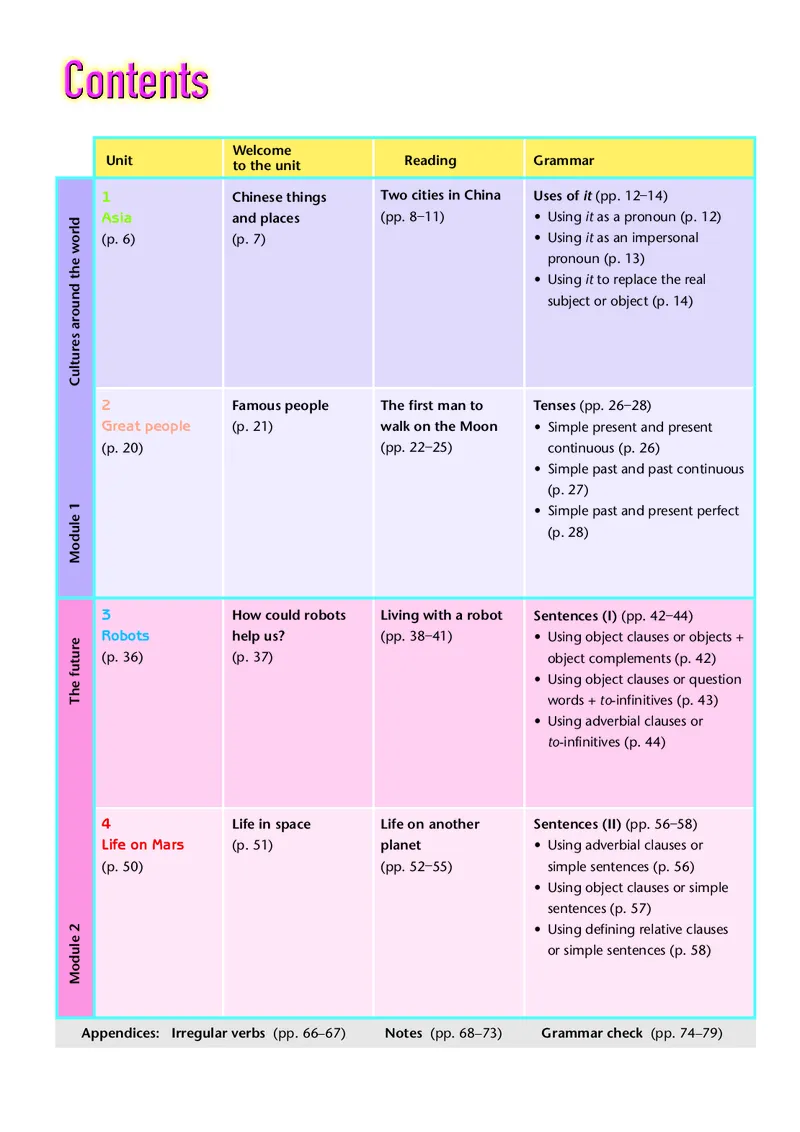
Welcome
Unit Reading Grammar
to the unit
1 Chinese things Two cities in China Uses of it(pp. 12–14)
Asia and places (pp. 8–11) • Using itas a pronoun (p. 12)
(p. 6) (p. 7) • Using itas an impersonal
pronoun (p. 13)
• Using itto replace the real
subject or object (p. 14)
2 Famous people The first man to Tenses (pp. 26–28)
Great people (p. 21) walk on the Moon • Simple present and present
(p. 20) (pp. 22–25) continuous (p. 26)
• Simple past and past continuous
(p. 27)
• Simple past and present perfect
(p. 28)
3 How could robots Living with a robot Sentences (I) (pp. 42–44)
Robots help us? (pp. 38–41) • Using object clauses or objects +
(p. 36) (p. 37) object complements (p. 42)
• Using object clauses or question
words + to-infinitives (p. 43)
• Using adverbial clauses or
to-infinitives (p. 44)
4 Life in space Life on another Sentences (II) (pp. 56–58)
Life on Mars (p. 51) planet • Using adverbial clauses or
(p. 50) (pp. 52–55) simple sentences (p. 56)
• Using object clauses or simple
sentences (p. 57)
• Using defining relative clauses
or simple sentences (p. 58)
Appendices: Irregular verbs (pp. 66–67) Notes (pp. 68–73) Grammar check (pp. 74–79)tcejorP
)53–43
.pp(
dlrow
eht
dnuora
serutluc
fo
yalpsid
A
1
tcejorP
)56–46
.pp(
erutuf
eht
ni
efil
tuoba
telkoob
A
2
tcejorP
Integrated skills Study skills Task Self-assessment
A A trip to Japan (pp. 15–16) Understanding My favourite Asian (p. 19)
B Speak up: Where’s body language country (pp. 18–19)
Singapore? (p. 16) (p. 17)
A Marie Curie (pp. 29–30) Formal and A great person (p. 33)
B Speak up: Why do you informal language (pp. 32–33)
admire her? (p. 30) (p. 31)
A The robot show (pp. 45–46) British English and A complaint letter (p. 49)
B Speak up: My robot has American English (pp. 48–49)
caught a virus.(p. 46) (p. 47)
A Living on Mars (pp. 59–60) Self-assessment A guide to living on (p. 63)
B Speak up: Earth or Mars? (p. 61) Mars (pp. 62–63)
(p. 60)
Wordlists (pp. 80–85) Proper nouns (pp. 86–87)Unit 1
1 2
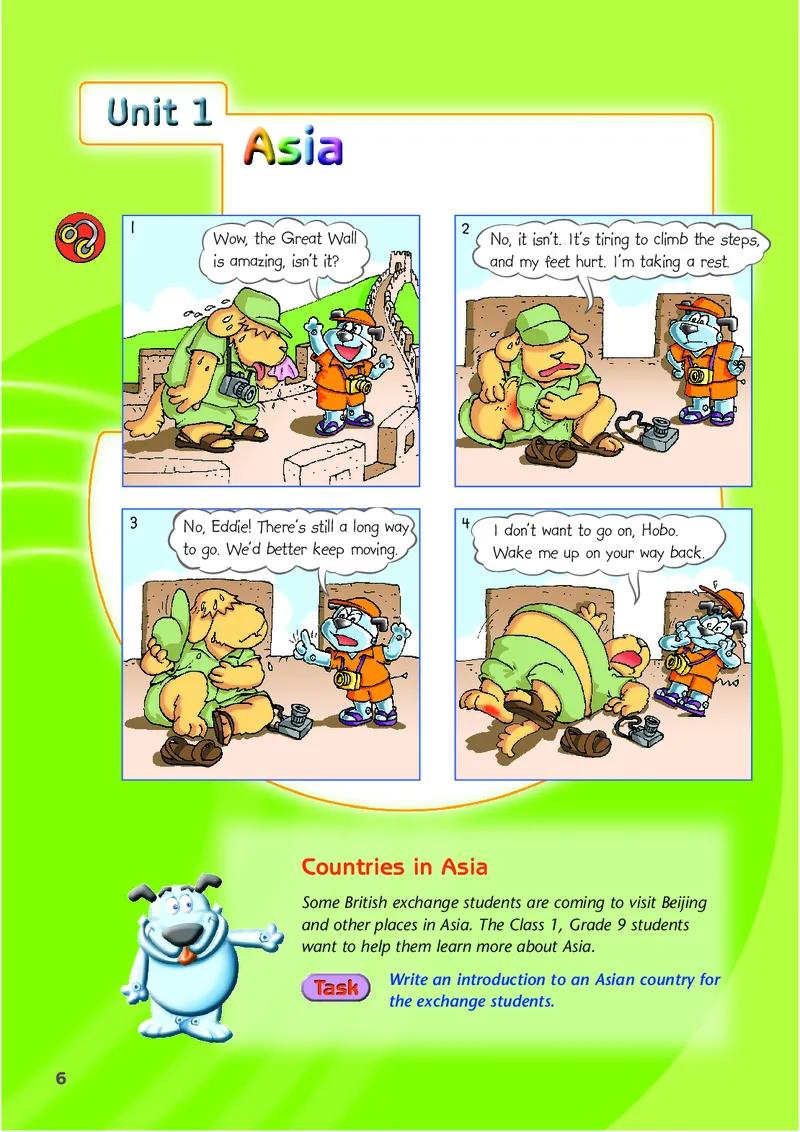
Wow, the Great Wall No, it isn’t. It’s tiring to climb the steps,
is amazing, isn’t it? and my feet hurt. I’m taking a rest.
3 N o , E d d i e ! T h e r e ’ s s t i ll a l o n g w a y 4 I don’t want to go on, Hobo.
to go. We’d better keep moving. Wake me up on your way back.
Countries in Asia
Some British exchange students are coming to visit Beijing
and other places in Asia. The Class 1, Grade 9 students
want to help them learn more about Asia.
Write an introduction to an Asian country for
the exchange students.
6Unit 1
Chinese things and places
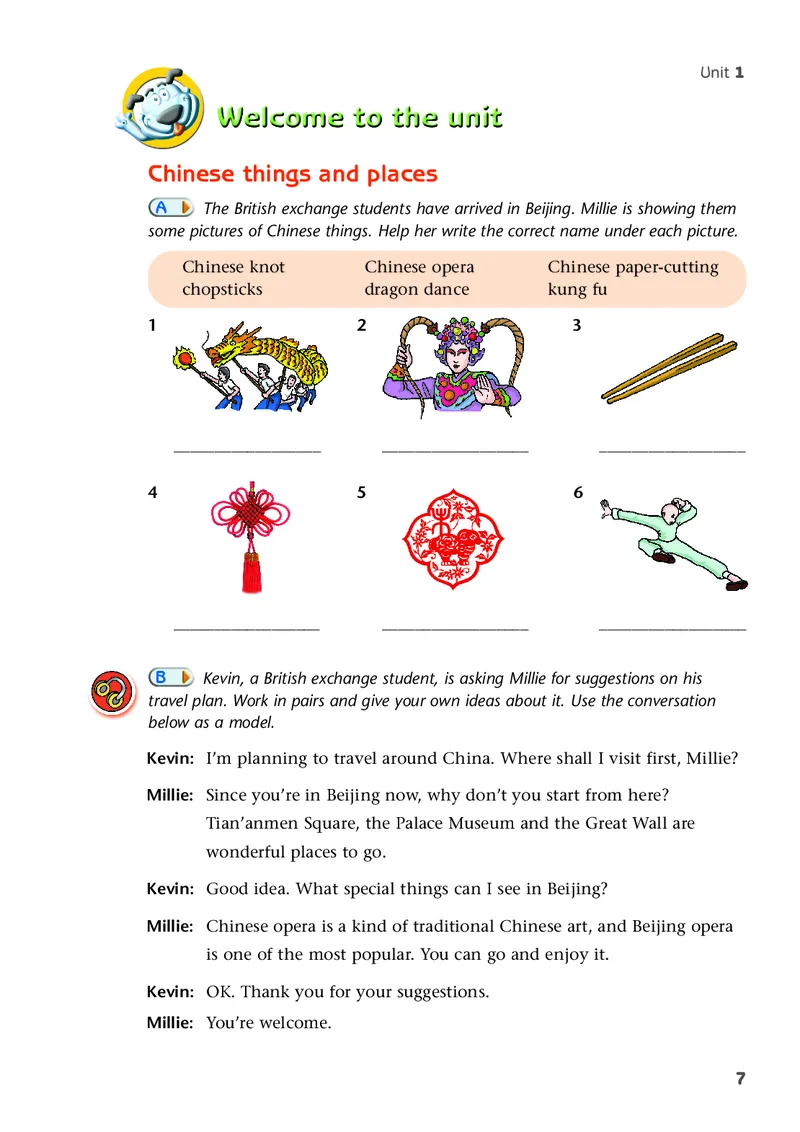
The British exchange students have arrived in Beijing. Millie is showing them
some pictures of Chinese things. Help her write the correct name under each picture.
Chinese knot Chinese opera Chinese paper-cutting
chopsticks dragon dance kung fu
1 2 3
__________________ __________________ __________________
4 5 6
__________________ __________________ __________________
Kevin, a British exchange student, is asking Millie for suggestions on his
travel plan. Work in pairs and give your own ideas about it. Use the conversation
below as a model.
Kevin: I’m planning to travel around China. Where shall I visit first, Millie?
Millie: Since you’re in Beijing now, why don’t you start from here?
Tian’anmen Square, the Palace Museum and the Great Wall are
wonderful places to go.
Kevin: Good idea. What special things can I see in Beijing?
Millie: Chinese opera is a kind of traditional Chinese art, and Beijing opera
is one of the most popular. You can go and enjoy it.
Kevin: OK. Thank you for your suggestions.
Millie: You’re welcome.
7Unit 1
A Two cities in China
Millie wants to help the exchange students learn more about different cities
in China. She has found two articles written by two students. Here are the articles.
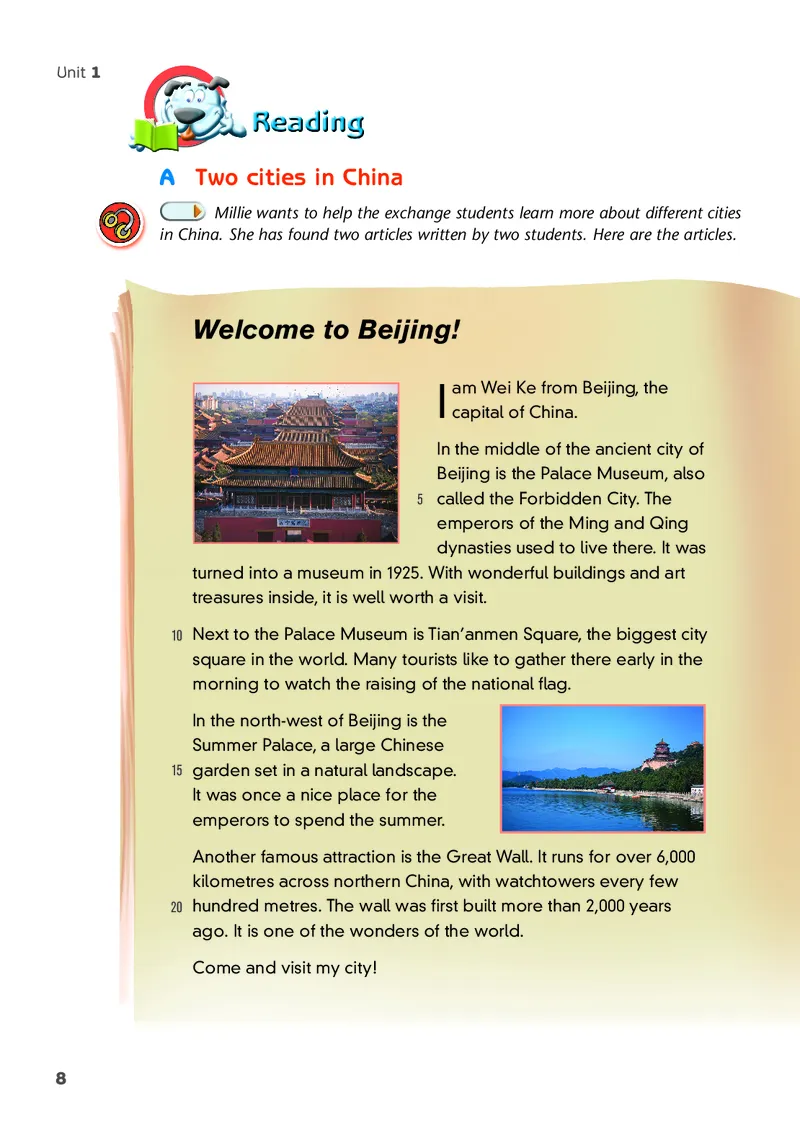
Welcome to Beijing!
I am Wei Ke from Beijing,the
capital of China.
In the middle of the ancient city of
Beijing is the Palace Museum,also
5 called the Forbidden City. The
emperors of the Ming and Qing
dynasties used to live there. It was
turned into a museum in 1925. With wonderful buildings and art
treasures inside,it is well worth a visit.
10 Next to the Palace Museum is Tian’anmen Square,the biggest city
square in the world. Many tourists like to gather there early in the
morning to watch the raising of the national flag.
In the north-west of Beijing is the
Summer Palace,a large Chinese
15 garden set in a natural landscape.
It was once a nice place for the
emperors to spend the summer.
Another famous attraction is the Great Wall. It runs for over 6,000
kilometres across northern China,with watchtowers every few
20 hundred metres. The wall was first built more than 2,000 years
ago. It is one of the wonders of the world.
Come and visit my city!
8Unit 1
All about Guilin
Hello. My name is Mei Fang.
My home is in Guilin.
25 “East or west,Guilin landscape is
best.”Guilin is really a beautiful city
in southern China. It lies on the two
sides of the Lijiang River. All around
the city,mountains stand in different
30 shapes. Many visitors come and
visit Guilin because of its fantastic
landscape.
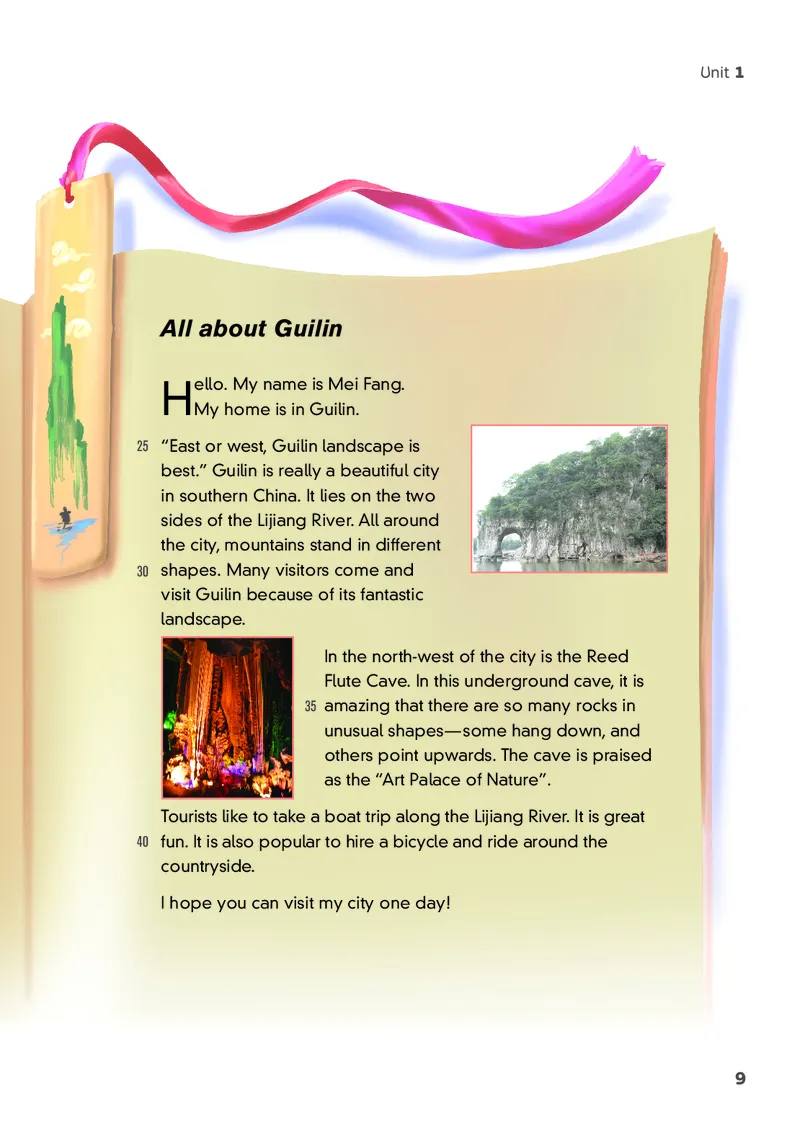
In the north-west of the city is the Reed
Flute Cave. In this underground cave,it is
35 amazing that there are so many rocks in
unusual shapes—some hang down,and
others point upwards. The cave is praised
as the “Art Palace of Nature”.
Tourists like to take a boat trip along the Lijiang River. It is great
40 fun. It is also popular to hire a bicycle and ride around the
countryside.
I hope you can visit my city one day!
9Unit 1
B Learning more about China
Millie does not know some of the words in the articles. Help her match the
words on the left with the meanings on the right. Write the correct letters in the blanks.
1 emperor (line 6) _________ a pay some money to use something for
a short time
2 attraction (line 18) _________ b the ruler of a country or several
countries
3 wonder (line 21) _________ c a large hole in the side of a hill or
under the ground
4 lie (line 27) _________ d something that fills you with surprise
5 cave (line 34) _________ e an interesting place to go
6 hire (line 40) _________ f be in a place
Kevin is asking Daniel about Beijing. Complete their conversation with the words
in the box.
dynasties gather museum palace raising summer wonders
Kevin: Have you ever visited the Palace Museum, Daniel?
Daniel: Yes, of course. It was a (1) _______________ for two (2) _______________.
Twenty-four Chinese emperors once lived there.
Kevin: Can we go inside the Palace Museum?
Daniel: Certainly. It’s now open to the public as a (3) _______________.
Kevin: The Summer Palace was also a palace for the emperors in the past,
wasn’t it?
Daniel: Yes. It was a nice place for the emperors to spend the
(4) _______________.
Kevin: Have you ever seen the (5) _______________ of the national flag,
then?
Daniel: Yes, I have. A lot of tourists like to (6) _______________ in
Tian’anmen Square early in the morning to watch it.
Kevin: What about the Great Wall? Have you ever been there?
Daniel: Sure. As an old saying goes, “He who has never been to the Great
Wall is not a true man.” It’s one of the (7) _______________ of the
world.
10Unit 1
The next day, Kevin is telling his friend Chris about Guilin. However, some of
the details are wrong. Write a T if a sentence is true or an F if it is false.
1 Guilin is in eastern China. ________
2 Guilin is famous for its beautiful landscape. ________
3 The Reed Flute Cave is in the south-east of Guilin. ________
4 You can find amazing rocks inside the Reed Flute Cave. ________
5 You can take a boat trip along the Lijiang River. ________
6 You need to buy a bicycle to ride around the countryside. ________
Kevin wants to make notes of the two cities. Help him complete his notes.
Beijing
The Palace Museum: in the (1) ________________ of the ancient city,
wonderful buildings and (2) ________________
Tian’anmen Square: the (3) ________________ city square in the world,
the raising of the (4) ________________
The Summer Palace: in the (5) ________________of Beijing, a large Chinese
(6) ________________ set in a natural landscape
The Great Wall: over (7) ________________across northern China, was
first built more than (8) ________________years ago
Guilin
Location: on the two sides of the (9) ________________
What to see: (10) ________________ stand in different shapes;
the Reed Flute Cave, an (11) ________________ cave with
(12) ________________ in unusual shapes
What to do: take a (13) ________________ along the Lijiang River;
hire a bicycle and ride around the (14) ________________
11Unit 1
Uses of it
A Using itas a pronoun
We use it for animals and lifeless things.
Look at the panda. It is so small.
Another famous attraction is the Great Wall. It runs for over 6,000 kilometres
across northern China.
We use it for a young child when we do not know whether it is a girl or
a boy.
My aunt will have a baby soon. She hopes it will be a girl.
Look at that cute baby over there! It’s a boy, isn’t it?
We use it for an unknown person.
—Who was calling you on the phone just now?
—It was my cousin.
We use it for an action, a situation or an idea mentioned in a previous
statement.
Riding around the countryside is popular in Guilin, isn’t it?
Tourists like to take a boat trip along the Lijiang River. It is great fun.
A visit to the Summer Palace
The exchange students visited the Summer Palace yesterday. Kevin is writing
about it. Read the passage below and find out what each it refers to. Write your
answers in the blanks.
Yesterday we visited the Summer Palace and spent about
three hours in it. The palace is a Chinese garden and 1 ________
mainly includes a hill and a lake. The lake is very big—it 2 ________
takes up three quarters of the area. It was frozen, so we 3 ________
could not row a boat there. It was really a pity. Across 4 ________
the lake is a 17-hole bridge. There are many stone lions
on either side of it. The lions are all different from each 5 ________
other. Isn’t it amazing? While I was walking along the 6 ________
bridge, my mobile phone rang. It was my mum. I told 7 ________
her that the Summer Palace was well worth visiting.
12
PIT If an animal •
is a pet, we
usually use
heor shefor
it.
My cat is
very friendly. •
Sheis a
happy cat.
•
•Unit 1
B Using itas an impersonal pronoun
We also use it for the time, the date, the weather, the distance, etc.
It is 6:30 p.m. It is raining heavily outside.
It is 1 January today. It is New Year’s Day.
In Beijing, it is cold and windy in winter.
It is two kilometres from my school to my home.
Leaving for Shanghai
The exchange students left for Shanghai. Kevin has made some notes in
his diary. Rewrite his sentences with it.
1 Today is 22 February. We left Beijing for Shanghai early in the
morning.
_______________________________. We left Beijing for Shanghai
early in the morning.
2 Shanghai is about 1,300 kilometres from Beijing.
_______________________________ from Beijing to Shanghai.
3 I woke up at 5 a.m. this morning.
_______________________________ when I woke up this morning.
4 I felt a little cold when we went out. The temperature was only 2°C.
I felt a little cold when we went out. _______________________________.
5 Winter is very cold and dry in Beijing.
In winter, _______________________________________________________.
6 We arrived in Shanghai on a sunny day.
_______________________________ when we arrived in Shanghai.
7 We got to our hotel at noon.
_______________________________ when we got to our hotel.
8 Our hotel is not far from the Bund.
_______________________________ from the Bund to our hotel.
13Unit 1
C Using itto replace the real subject or object
Sometimes we use it to replace the real subject or object in a sentence. In
this situation, we put the real subject or object later in the sentence in the
form of a to-infinitive or a clause.
It is very tiring to climb the steps.
It is popular to hire a bicycle and ride around the countryside.
It is amazing that there are so many rocks in unusual shapes in the cave.
Many people find it pleasant to travel around.
Useful structures with it
It is + adjective + (of/for ...) + to ....
It takes ... some time to ....
It is said/reported/... that ....
... think(s)/find(s) it easy/difficult/... to ....
About Shanghai
Miss Thompson, a British teacher travelling with the exchange students, is
writing down what she thinks about Shanghai. Help her complete her notes with it.
Traffic: The traffic is often busy, but public transport here is quite good,
so (1) __________ (easy) for people to get around.
Weather: (2) __________ (sunny) and warm. We like (3) _______ here.
Environment: (4) __________ (said) that the air is not clean here, but I do not
think the pollution is as serious as I imagined.
Sights: Shanghai is beautiful. (5) __________ (fun) to ride around the city
and visit the interesting places.
Food: Chinese food is delicious. I will ask my family to go to a Chinese
restaurant and try (6) _______ when I get back.
Hotel: We all think (7) __________ (comfortable) to stay in this hotel.
They provide a high level of service.
People: The local people are friendly. (8) __________ (kind) of them
to answer all our questions.
14Unit 1
A A trip to Japan
The exchange students are going to Japan after visiting Shanghai. Listen to
Millie introducing their itinerary. Match the days on the left with their activities on
the right.
A tour of Japan
Day 1 leave Japan for another Asian country
Day 2 visit Kyoto, an ancient city of culture
Day 3 take a tour of Tokyo, the capital city
Day 4 visit Mount Fuji, Japan’s highest mountain
Miss Thompson is telling the exchange students about their trip to Japan.
Kevin is making notes. Listen carefully and help Kevin complete his notes.
• leave Shanghai at (1) ____________ on (2) ____________
• arrive in (3)____________ around (4) ____________
• see the main (5)____________ and go (6) ____________;
visit the Tokyo (7)__________________ to see some
Japanese (8)_______________
• travel to (9)____________ by (10)____________ on the
second day; can go (11)____________ there
• visit the ancient city Kyoto on the third day and learn
about Japanese (12) ____________
• try all kinds of Japanese (13) ____________ during our
stay in Japan
15Unit 1
Kevin is writing about the exchange students’ trip to Japan. Help him
complete it. Use the information in Parts A1 and A2 to help you.
The trip to Japan
We are leaving for Japan soon. Japan is the second country we are going
to visit in Asia. Our flight will be (1) _______________ on 25 February, and
we plan to stay there for (2) _______________.
First, we are going to visit (3) _______________. It is Japan’s capital
city. We can see the main (4) _______________ and go (5) _______________
there. Our teacher, Miss Thompson, is also going to take us to the
(6) _______________________ to see some Japanese (7) _______________.
On the second day, we are going to take a (8) _______________ to
(9) _______________. It is Japan’s (10) _______________ mountain. We can
go (11) _______________ there.
On the third day, we are going to visit an ancient city called
(12) _______________ and learn about Japanese (13) _____________.
During our stay in Japan, we can also try all kinds of Japanese
(14) ______________.
I hope we will have a very nice trip.
B Speak up: Where’s Singapore?
The exchange students will also visit Singapore. Simon’s cousin Annie is
asking Simon about the country. Work in pairs and talk about an Asian country.
Use the conversation below as a model.
Annie: Where’s Singapore, Simon?
Simon: It’s in South East Asia.
Annie: It’s very small, isn’t it?
Simon: Yes, it is. It’s a city state.
Annie: How many people are there in Singapore?
Simon: There are about five million people there.
Annie: What languages do they speak?
Simon: Most people can speak both English and Chinese.
16Unit 1
Understanding body language
Body language, as a form of communication, is different from culture to
culture. For example, nodding one’s head means “agreement” and shaking
one’s head means “disagreement” in most countries, but in some countries
of South Asia, it is just the opposite.
Look at the gesture below. What does it mean? In different places, it means
different things.
In most cultures, it means “OK”; in Russia, Brazil and Turkey, it is
an insult; in France and Belgium, it means “zero” or “worthless”;
in Japan, it means “money”.
Here are the meanings of some common kinds of body language in the West:
Body language Possible meaning
head held down shy, ashamed
head raised confident
looking down dishonest
looking away bored, uninterested
looking in the eyes friendly, interested, honest
crossed arms not open, unfriendly, angry
open arms open, friendly
hands on the sides impatient, angry
Sometimes the words a person uses do not match his or her body language.
When this happens, it is often more important to look at their body language.
Match the pictures with the meanings. Write the correct letter in each box.
a Glad to see you. b I can do it! c I did something wrong.
1 2 3
17Unit 1
My favourite Asian country
Miss Thompson asked the Class 1, Grade 9 students to suggest a country
in Asia for them to visit. Millie would like to suggest India, and she has prepared
some notes of it. Read her notes.
Country: India
Location: in South Asia,next to Pakistan,China
and Nepal
Capital city: New Delhi
Languages: mainly Hindi,English as a second language Taj Mahal
Population: over one billion,the second largest population
in the world
Crops: rice and wheat
Main industries: large iron and steel industry
famous for IT (informationtechnology) industry
Customs: many festivals and fairs
saris—traditional clothes for women
Attraction: Taj Mahal
Millie is writing an introduction to India. Help her complete her article with
the information in Part A.
I think (1) _________________is a great country to visit.It lies in
(2) _________________,next to (3) _________________,China and Nepal.Its
capital city is (4) _________________.
People in India mainly speak (5) _________________,but their second language
is (6) _________________,so it is not too difficult to communicate with the local
people.India has the (7) _________________largest population in the world.
There are over (8) _________________people there.Rice and
(9) _________________are their main crops. India has a large iron and
(10) _________________industry.It is also famous for its IT industry.
India has many (11) _________________ and fairs.A festival is celebrated in
some part of the country every day of the year.Traditional clothes for Indian
women are (12) _________________. You may have seen them in Indian films.
There are some famous attractions in India.The (13) _________________is well
worth a visit.It is one of the wonders of the world.
18Unit 1
You also want to write an introduction to an Asian country for the exchange
students. Think of a country and make some notes of it. Then write the introduction.
Use Millie’s notes and article as a model.
... is a great country/wonderful place to visit.
It lies in ....
It is next to/near ....
Its capital city is ....
People in ... speak ....
There are over ... people there.
It is famous for ....
... is well worth a visit/worth visiting.
... is one of the wonders of the world.
I have learnt Details Result
1 about two cities in China.
2 to use the new words to
talk about different
countries.
3 to use iitt as a pronoun and
an impersonal pronoun.
to use iitt to replace the
real subject or object.
4 about body language.
Result: Perfect! Good! Not bad!
I need to spend more time on ___________________________________.
192
1
Who do you think is the greatest
I think it’s Paul Yum.
person in history, Eddie?
3 4
Paul Yum? I’ve never heard He’s an inventor. He invented
of him. Who’s he? my favourite food.
Great people
Many people have changed the way we live. Mr Wu
is asking his students to write about a famous
person they admire.
Write an article about a famous
person you admire. Describe how he
or she has changed the world.
20Unit 2
Famous people
Mr Wu is showing the Class 1, Grade 9 students the pictures of some famous
people. Help the students write the correct word under each picture.
composer explorer inventor president scientist writer
1 2 3
________________ ________________ ________________
4 5 6
________________ ________________ ________________
Mr Wu is telling the students about the famous people in Part A. Help the
students match the names on the left with the correct information on the right.
Write the letters in the blanks.
1 Christopher Columbus ________ a Chinese, the pioneer of China’s
space technology programme
2 William Shakespeare ________ b South African, a fighter for the
rights of black Africans all his life
3 Qian Xuesen ________ c American, created over 1,000
inventions
4 Thomas Edison ________ d Italian, one of the first Europeans
to discover America
5 Nelson Mandela ________ e Russian, a composer of classical
music
6 Peter Tchaikovsky ________ f English, a great writer of English
literature
21Unit 2
A The first man to walk on the Moon
Neil Armstrong (1930–2012) was the first man to walk on the Moon.
Simon is now reading an article about the astronaut and his space travel. Here
is the article.
NEIL ARMSTRONG
Neil Armstrong was born on 5 August 1930
in Ohio, the USA. He became interested in
flying when he took his first flight at the age
of six. He received his student pilot’s licence
5 when he was 16.
Armstrong joined the navy in 1949 and served as a pilot for
three years. In 1955, he became a test pilot. He flew over 1,100
hours and tested all types of aircraft.
In 1962, he was chosen to become an astronaut. In 1966, he
10 went into space as command pilot of Gemini 8. He and David
Scott managed to join two spacecraft together for the first time
in space. However, on their way back to the Earth, the spacecraft
began spinning out of control. Armstrong received the order to
cut the flight short. He successfully brought the spacecraft down
15 into the western Pacific Ocean.
22Unit 2
On 20 July 1969, Armstrong became the first man to walk on
the Moon. Together with Buzz Aldrin, he landed the spacecraft
Apollo 11on the Moon. He said the famous words “one small
step for (a) man, one giant leap for mankind” as he stepped out
20 onto the Moon’s surface.
Armstrong and Aldrin walked on the Moon for about two and a
half hours. They collected Moon rocks to take back to the Earth
for further research. When Apollo 11returned, the whole world
was waiting to greet them. They were heroes.
25 Because of his excellent service, Neil Armstrong was presented
with the Medal of Freedom, the highest award that a US citizen
can receive. He was the pride of the whole world.
23Unit 2
B The most famous astronaut
Simon has read the article about Neil Armstrong, but he does not know some
of the words. Help him find out the meanings of the words. Circle the correct letters.
1 A licence is _______. 4 A leap is _______.
a some money a a new place
b a type of power b a long or high jump
c a piece of paper that shows you c a walk
are allowed to do something
5 A surface is _______.
2 An astronaut _______. a the inside of something
a draws maps b the bottom of something
b travels to space c the outside or top part of
c travels to different countries something
3 Something that is spinning is 6 A citizen is a person who _______.
_______. a lives in a country and enjoys
a turning round and round rights there
quickly b is kind and helpful
b going very slowly c does something important
c making a lot of noise
Simon is working out a timeline for Neil Armstrong. Help him complete it.
Neil Armstrong
1930: born in (1) , the USA
1936: took his (2)
1946: received his student (3)
1949: joined (4)
1955: became (5)
1962: became (6)
1966: went into (7) with David Scott
1969: became the first man to walk on (8)
24Unit 2
Simon is telling Millie about Neil Armstrong. Check if Simon remembers
everything correctly. Write a T if a sentence is true or an F if it is false.
1 The Gemini 8 flight was a great success. _________
2 Gemini 8 landed in the western Pacific Ocean. _________
3 Three men from Apollo 11 walked on the Moon together. _________
4 The astronauts took some Moon plants back to the Earth. _________
5 Neil Armstrong received the Medal of Citizen. _________
Millie is asking Simon some questions about Neil Armstrong. Help Simon
answer her questions. Use the information on pages 22 and 23 to help you.
1 When did Armstrong become interested in flying?
_____________________________________________________________________
2 How old was Armstrong when he became an astronaut?
_____________________________________________________________________
3 What did Armstrong do when the spacecraft was out of control during
his first trip into space?
_____________________________________________________________________
4 What was the first spacecraft to land on the Moon?
_____________________________________________________________________
5 How long did Armstrong and Aldrin walk on the Moon?
_____________________________________________________________________
6 What did Armstrong mean by his famous words “one small step for (a)
man, one giant leap for mankind”?
_____________________________________________________________________
25Unit 2
Tenses
A Simple present and present continuous
26
PIT We often use
these words
with the simple
present tense.
always
often
usually
sometimes
seldom
never
every...
PIT
Tense Used for Example
a present state John lives in New York.
daily routine and habits I always go to bed at 10 p.m.
Simple
present actions that happen School is over and the students
present one after another go home.
actions set by a timetable or
The talk show starts at 7 p.m.
schedule
actions that happen right Look! The reporter is
now interviewing the astronaut.
We often use
these words Mum is doing the housework
with the present actions that happen at the
and Dad is working on the
continuous
Present same time
tense. computer.
continuous
at the moment
actions in a limited period I am working on a history
today
now of time project this week.
right now
Listen! arrangements for the near I am leaving for Shanghai
Look! future tonight.
We enjoy the modern life!
Millie is writing about what her family members are doing. Help her complete
her article with the correct tenses of the verbs in brackets.
I (1) ____________ (have) a day out with my classmates this Saturday,
so I (2) ____________ (need) a pair of trainers. Mum (3) ____________
(shop) online for me now. She often (4) ____________ (shop) online.
Dad (5) ____________ (search) for information on the Internet.
He (6) ____________ (visit) Japan next week. Grandpa (7) ____________
(read) the newspaper and Grandma (8) ____________ (watch) TV.
I (9) ____________ (want) to write an email to Wendy before I
(10) ____________ (go) to bed.Unit 2
What did you do last night?
Simon and his friends are talking about what they did after dinner last night.
Complete their conversation with the correct tenses of the verbs in brackets.
Simon: I (1) __________________ (watch) a wonderful football match from
7 p.m. to 8:30 p.m. yesterday. My favourite team (2) __________________
(win) the match.
Millie: I (3) __________________ (write) an email to Wendy at 7 p.m. yesterday.
She (4) __________________ (send) me an email last week.
Sandy: I (5) __________________ (practise) playing the piano the whole night.
I (6) __________________ (take) part in a competition this morning.
Peter: Last night, I (7) __________________ (find) a website about travelling
in space. I (8) __________________ (read) passages on the website
while you (9) __________________ (play) the piano, Sandy.
Daniel: I (10) __________________ (talk) to Aunt Jane on the phone at 7:30
yesterday evening. She (11) __________________ (call) me the day
before yesterday, but I (12) __________________ (be not) at home then.
27
PIT
B Simple past and past continuous
Tense Used for Example
actions that happened
Simon played football yesterday.
in the past
Simple past actions that happened
Simon came home, turned on the
one after another in
computer and checked his email.
the past
actions that were in
Yesterday at 4 p.m., Simon was
progress at a certain
playing football.
time in the past
We often use
these words
Past actions that happened
with the past Simon was playing computer games
continuous continuous at the same time in
while Millie was watching TV.
tense. the past
at this time
yesterday actions that lasted for We were having a meeting from
from ... to ... some time in the past 9 a.m. to 11 a.m. yesterday.
last night
PIT We often use
these words
with the
simple past
tense.
yesterday
... ago
in 1999
the other day
last ...Unit 2
C Simple past and present perfect
Tense Used for Example
actions that happened I bought a new bicycle
in the past yesterday.
Simple past actions that happened
Kitty wrote an email to
at a certain time in the
Linda an hour ago.
past
I have bought a new
emphasizing the result
bicycle, so I can ride to
of a past action
Present school now.
perfect telling how many times
She has been to the
an action has happened
USA twice.
till now
Great inventions
Millie is writing about some modern inventions that have changed the way
we live. Help her choose the correct words in brackets to complete her article.
Many modern inventions (1) __________________ (made/have made) a
great difference in our life. They (2) __________________ (changed/have
changed) the way we live.
In ancient times, people (3) __________________ (used/have used) salt
to help them keep fish or meat for a longer time. Fresh food would
go bad in summer in a few hours. The invention of the fridge
(4) __________________ (solved/has solved) this problem.
In the past, people (5) __________________ (washed/have washed) their
clothes by hand. It (6) __________________ (was/has been) tiring, and
it (7) __________________ (took/has taken) a lot of time. With the
invention of the washing machine, people (8) __________________
(had/have had) more time to relax.
In the old days, people (9) __________________ (travelled/have
travelled) by ship. Now planes (10) __________________ (made/have
made) journeys more comfortable.
28
PIT We often use
these words
with the
present
perfect tense.
just
already
up to now
until/till now
ever
(not) yet
so far
recentlyUnit 2
A Marie Curie
Millie wants to give a presentation on Marie Curie. Look at the following
information on this great scientist. Help Millie complete her notes with as much
information as you can.
Marie Curie (1867–1934)
• born in the city of Warsaw, Poland
• moved to Paris, France when she was 24
• studied Mathematics and Physics at a university
• married a French scientist called Pierre Curie in 1895
• discovered radium in their laboratory in 1898
• won the Nobel Prize twice during her lifetime
• died at the age of 67
Marie Curie—a great scientist
Name: Marie Curie
Date of birth: 7 November (1)
Place of birth: (2) ,Poland
Family: she was (3) of five children
Parents: father was a (4) professor;
mother was a (5) teacher
High school: finished at the age of (6)
Work: worked as a (7)
Moved to: (8) , France in 1891
At university: studied (9) and (10)
Married to: Pierre Curie, a (11) scientist,in 1895
Famous for: the discovery of(12)
Won the Nobel Prize for: (13) in 1903
Husband’s death: Pierre Curie died in a (14) in
(15)
Won the Nobel Prize for: (16) in 1911
Date of death: (17) 1934, aged (18)
Millie has found a recording about Marie Curie. Listen to it carefully and
help her complete the rest of her notes in Part A1.
29Unit 2
Millie is practising her presentation. However, she has forgotten some of the
information. Help Millie complete her sentences. Use the information in Part A1 to
help you.
I think Marie Curie is one of the greatest scientists in history! She was from
(1) _________________. When she was 24, she went to (2) _________________
to study (3) _________________ and (4) _________________ at a university.
There she met Pierre Curie, a (5) _________________ scientist. They got married
in (6) _________________. The couple won the (7) _________________ in 1903 for
the discovery of (8) _________________. That was not the end of the story.
In (9) _________________, Marie Curie won her second Nobel Prize, but sadly,
Pierre was not there to share the joy with her—he died in a traffic accident in
(10) _________________.
B Speak up: Why do you admire her?
Millie and Simon are talking about some famous people. Work in pairs and
talk about the famous people you admire. Use the conversation below as a model.
Millie: Who do you think is the greatest person in history?
You may use
the information Simon: Neil Armstrong! I admire him the most.
about different
famous people Millie: Oh, he was the first man to walk on the Moon.
in this unit.
Simon: Yes. It was brave of him to go to a place that was unknown to
You can also
search for more
humans at that time. What about you? Do you admire anybody?
information on
the Internet or Millie: Yes. I admire Marie Curie.
in the library.
Simon: Why do you admire her?
Millie: Because she won the Nobel Prize twice. She also pushed for the use
of X-ray machines, which are now widely used in hospitals.
30
PITUnit 2
Formal and informal language
When we speak or write, we can use formal or informal language. We use
formal language with our teachers or unfamiliar people. However, when we
speak or write to our friends, we use informal language.
Greetings such as Hi and Hello are informal language. Other greetings like
Dear Mr/Mrs/Ms ..., Ladies and gentlemen are formal language.
Endings such as Lots of love and Yours can be used only in informal letters
or emails.
Idioms such as have a big mouth and in the soup are informal language.
Abbreviations such as esp. and Dec. are often used in informal writing.
Contractions such as we’ll, he’d and can’t are often used in informal
writing or when we talk to our friends.
Kitty is writing to J. K. Rowling, the British writer, to tell her something about
Harry Potter. Help Kitty check the language she is using and improve it if necessary.
Hi!
I think you’ll laugh when you read this letter. Believe it or not,
there’s a real Harry Potter in the world. It’s said that it’s a lot of
trouble being Harry Potter, esp. when you’re a 78-yr-old man and
you happen to share the name of a world-famous boy with magic
powers.
The real Harry Potter often gets phone calls from both children and
TV stations. “The kids want to know if I’m Harry Potter,” he says
with a smile. “I tell them I’ve been Harry Potter for nearly 80 years!”
However, the real Harry Potter says the Harry Potter series isn’t his
cup of tea, and he doesn’t care if he’s famous or not.
Love,
Kitty
31Unit 2
A great person
Amy wants to write about Yuan Longping, a rice scientist. Here is the
information she has found.
Yuan Longping—Father of Hybrid Rice
Name: Yuan Longping
Title: a rice scientist, a member of the Chinese
Academy of Engineering
Date of birth: 7 September 1930
Major events: 1953: worked as a teacher in an agriculture school after
graduating from college
1960: saw people die of hunger, so began research into
hybrid rice
1964: happened to find a natural hybrid rice plant that
had many advantages over others
1975: developed a new type of hybrid rice plant, which
produced 20% more rice per unit than other
common kinds
1979: this new type of hybrid rice was introduced into
the USA
At present: over 100 countries in Asia, Africa and America have grown
hybrid rice
Contribution: his achievements have increased rice production by
20%–30%, and in some places even more
Why I admire him: has spent all his life on the research and development
of better rice plants;
has solved the problem of hunger for many people
32Unit 2
Amy is writing her article. Help her complete it. Use the information in
Part A on page 32 to help you.
I think Yuan Longping, a rice scientist and a member of the Chinese Academy of
Engineering, is one of the greatest people that have ever lived.
He was born on . In 1953, he began working as a
(1) ________________
in an agriculture school after he graduated from college. In 1960,
(2) ________________
he saw people die of , so he began research into hybrid rice. In 1964,
(3) ________________
he happened to find a natural hybrid rice plant that had many
(4) ________________
over others. After nearly ten years of hard work, he and his team finally developed a
of hybrid rice plant, which produced
(5) ________________
per unit than other common kinds. In 1979, this new
(6) ________________________
type of hybrid rice was introduced into . At present, over 100
(7) ________________
countries in Asia, Africa and America have grown hybrid rice. Because of his
achievements, has been increased by 20%–30%, and
(8) ________________________
in some places even more. He is considered the “ ”.
(9) ________________________
Yuan Longping has spent all his life on the research and development of
. He has solved for
(10) ________________________ (11) ________________________
many people. That is why I admire him so much.
Now prepare your own article. Look for information using the Internet,
books or magazines. Remember to make some notes before writing your article.
I have learnt Details Result
1 about a famous astronaut.
2 to use the new words to
talk about great people.
3 to use the different tenses
correctly.
4 about formal and informal
language.
Result: Perfect! Good! Not bad!
I need to spend more time on ___________________________________.
33A display of cultures around the world
The Class 1, Grade 9 students have made a wall display to show different cultures
around the world. They made information sheets about the culture of each
country. Then they put the sheets around a world map on the wall and gave
group presentations. Your class wants to do the same thing.
A Planning and preparing
1 Put a world map on the display wall in the classroom. The whole class should
work together to draw the map, or you can buy one.
2 Work in groups of four. Each group must make an information sheet about a
different country.
3 Think about what you can include in the information sheet to show the
culture of the country you have chosen. Exchange ideas with your group
members and write them down on a piece of paper.
4 Find some information about the things your group would like to include in
the information sheet. Look for information on the Internet or in the library.
5 If you need help, the following questions may give you some ideas.
• What is the capital city of the country?
• What does the country’s national flag look like?
• What languages are spoken in the country?
• What is the country famous for?
• What kind of crops does the country grow?
• What are the customs and beliefs in the country?
• Are there any famous people in the history of the country?
• What are the people famous for? What have they achieved?
34B Tips for making your wall display
How to make the map
• If you draw the map, just draw the outline of the continents and some major
countries with a pencil first so that it is easy to make corrections later on. Do
not draw anything too detailed.
• Stick or draw flags of the countries on the map.
• Draw a compass at the bottom of your map and label the directions.
How to make the information sheet
• Read through your ideas and information carefully.
• Make a plan before you start writing—the information sheet must be large
enough for the whole class to see during your presentation.
• After writing the draft, check for spelling mistakes, especially the names of the
countries, places and famous people.
• Stick the pictures of the places and people you are going to talk about on your
information sheet.
• Draw graphs and charts to show interesting facts and to make comparisons.
C Tips for your presentation
• The groups take turns to present their work.
• Use the map to show where the countries are.
• After the presentation, display all the information sheets on the wall around
the map. Draw lines to join the sheets with the countries on the map.
351 2 You’re too lazy. I’m
What are you doing, Eddie?
complaining about you
to the robot shop.
Oh dear! I can
I’m writing a letter. explain!
3 4
No, Hobo. It’s too late. Eddie, I don’t know
Post this for me. when I’ll post the
letter for you.
All right, Eddie.
Complaining about your robot
In the future, people would have their own robots.
However, robots might have problems. If your robot
had problems, what would you do?
Write a letter to complain about your
robot or a reply to a complaint letter.
36Unit 3
How could robots help us?
Do you know how robots could help us? Match each phrase with the correct
picture.
1 2
a help with homework
b explore outer space
c do dangerous jobs
3 4
d help with housework
Amy is asking Daniel how robots could help us in our daily lives. Work in
pairs and talk about your ideas. Use the conversation below as a model.
Amy: Would robots have brains in the future, Daniel?
Daniel: Yes, they would. So they could do whatever they’re asked to.
Amy: That sounds useful. How could robots help us?
Daniel: They could do dangerous jobs like putting out fires or working on
high buildings.
Amy: That’s great! Could robots help you and me in any way?
Daniel: Of course. They could help us with our homework.
Amy: Wow! I’d like to have one!
37Unit 3
A Living with a robot
Daniel is very interested in robots. He found an interesting story in this
month’s Robot magazine. Here is the story.
The home robot
Mr Jiang is a manager of a big company in Sunshine Town. He is
always too busy to have any time to relax. “I have to buy a robot
so that I can have more free time,” Mr Jiang thought. So he ordered
one from a robot shop.
5 The robot made Mr Jiang’s life much easier. When he got up in
the morning, breakfast was made, his business suit was smoothly
ironed, and his lunch box was already prepared. That made him
very happy.
While Mr Jiang was at work, the robot would do all the housework.
10 It would go shopping at the supermarket as well.
When Mr Jiang returned home from work,
his flat would look as good as new, and a
delicious dinner would be ready for him.
After dinner, the robot would tidy up. That
15 allowed Mr Jiang to do whatever he liked.
He would watch TV or do some reading.
38Unit 3
It seemed that in general the robot satisfied Mr Jiang’s needs.
After a few comfortable weeks, however, things started to go
wrong. The robot caught a virus and no longer worked properly.
20 It began to make stupid mistakes. Sometimes it woke Mr Jiang
up at four o’clock in the morning. When Mr Jiang got home, he
would find his flat in a complete mess: food was laid on the bed;
milk was stored in the rubbish bin; coins, bills and his private
papers were spread all over the floor. Moreover, the robot moved
25 too fast on its wheels and often knocked things over. Mr Jiang
did not know what to do with it.
In the end, Mr Jiang decided to return the robot to the robot
shop. Robots can help people a lot, but they can also be too
much trouble!
39Unit 3
B Buying a robot
After reading the story, Daniel wrote down some words he does not know.
Help him match the words on the left with the meanings on the right. Write the
correct letters in the blanks.
1 as good as (line 12) _________ a very untidy or dirty
2 satisfy (line 17) _________ b in a correct way
3 virus (line 19) _________ c keep something somewhere
4 properly (line 19) _________ d very nearly
5 in a complete mess _________ e instructions that are designed
(line 22) to cause computer problems
6 store (line 23) _________ f provide what is needed
Daniel is thinking of the good and bad points of having a robot. Help him
complete the lists below using the information in the story on pages 38 and 39.
Good points Bad points
1 With the robot’s help, I will have a 1 If the robot catches
lot more time to ____________. ___________, it will cause a lot
of problems.
2 It can make ____________ for
me in the morning. 2 It might ____________ early in
the morning.
3 It can ____________ my
clothes. 3 It might lay my food on the
____________.
4 It can ____________ at the
supermarket if I am busy. 4 It might store milk in the
____________.
5 It can ____________ after
dinner. 5 It might spread coins, bills and my
____________ all over the floor.
6 My flat will look ____________.
6 It might move too fast and
____________.
40Unit 3
Daniel and Millie are talking on the phone. Daniel wants to buy a robot.
Millie is asking him what it would be like to live with a robot. Write a T if Daniel’s
answer is true or an F if it is false.
Millie: Would a robot bring any changes to your life?
Daniel: (1) Yes. Some changes might be good, but some might not. _________
Millie: How could a robot help you in the morning?
Daniel: (2) It could eat breakfast for me. _________
Millie: Could it do some shopping for you?
Daniel: (3) Yes. It could do some shopping at the supermarket. _________
Millie: What would the robot do while you are at school?
Daniel: (4) It would do the housework. _________
Millie: Could the robot cook?
Daniel: (5) I’m afraid it couldn’t. _________
Millie: Does a robot sometimes go wrong?
Daniel: (6) Yes, a robot sometimes goes wrong. _________
Millie: What might cause a robot not to work properly?
Daniel: (7) For example, it could catch a virus. _________
Millie: What would happen then?
Daniel: (8) It would make stupid mistakes. _________
Millie: Could you fix your robot by yourself?
Daniel: (9) No. I wouldn’t know what to do with it. _________
Millie: So what could you do if you find the robot too
much trouble?
Daniel: (10) I could return it to the factory. _________
41Unit 3
Sentences (I)
A Using object clauses or objects + object complements
Sometimes we use objects + object complements to replace object clauses.
He saw that the robot was making breakfast.
➜
He saw the robot making breakfast.
He found that his flat was in a complete mess.
➜
He found his flat in a complete mess.
He thinks that it is too much trouble to own a robot.
➜
He thinks it too much trouble to own a robot.
Talking about the robot
Before the robot went wrong, Mr Jiang was talking on the phone with his
mother about it. Use an object clause to rewrite each of his sentences.
1 Every day, I notice the robot busy with all kinds of housework.
2 When I get up, I find my breakfast ready.
3 When I come back from work, I find my flat as good as new.
4 I consider the robot a great help in my daily life.
5 I feel it comfortable to live with a robot.
42Unit 3
B Using object clauses or question words + to-infinitives
Sometimes we use question words + to-infinitives to replace object clauses.
The robot no longer knew when it should cook breakfast.
➜
The robot no longer knew when to cook breakfast.
Mr Jiang did not know what he should do with the robot.
➜
Mr Jiang did not know what to do with the robot.
Helping Mr Jiang look after his mother
Mr Jiang wrote a letter to his mother before going on a business trip. Use
a question word + to-infinitive to replace each object clause. Write them above
the clauses.
Dear Mum,
I am going on a business trip to Shenzhen tomorrow. I have asked my robot
to look after you while I am away.
You have a serious heart problem and have to take medicine every day.
However, you have a poor memory and often forgetwhen you should take your
pills. My robot will remind you to take them at the right time. If you want to
go out, my robot will help you find your coat—you are always unsure where
you could find your clothes. My robot will go to the supermarket to buy some
fruit and vegetables for you, as you often cannot decide which you should
choose at the supermarket. You often feel lonely because you do not know
who you can talk to, and my robot will try to do something to make you
happy.
Take care and I will see you soon!
Yours,
Jiang Shan
43Unit 3
C Using adverbial clauses or to-infinitives
We can also use to-infinitives to replace some adverbial clauses expressing
results or purposes.
Mr Jiang is always so busy that he does not have any time for hobbies.
➜Mr Jiang is always too busy to have any time for hobbies.
The robot is so smart that it can do a lot of things for Mr Jiang.
➜The robot is smart enough to do a lot of things for Mr Jiang.
Mr Jiang plans to buy a robot so that he can have more free time.
➜Mr Jiang plans to buy a robot in order to have more free time.
The robot was great!
Mr Jiang’s mother was very pleased with the robot. She is telling Mr Jiang
on the phone about her life with the robot. Rewrite her sentences with to-infinitives.
1 I was so forgetful that I didn’t lock the door last night.
I was too forgetful __________________________________________________.
2 The robot was so careful that it reminded me of this.
The robot was careful enough _______________________________________.
3 I was so weak that I couldn’t go up and down the stairs often.
I was too weak ______________________________________________________.
4 The robot was so kind that it bought me everything I needed.
The robot was kind enough __________________________________________.
5 Sometimes I took a walk with it so that I could have a better sleep.
Sometimes I took a walk with it in order _____________________________.
44Unit 3
A The robot show
There is going to be a robot show in Sunshine Town. Daniel has found a
poster about the event. Look at the poster. Help him complete his notes with as
much information as you can.
International Robot Show
Place: the town hall
Dates: 14—22 March
Time: 9 a.m.—4:30 p.m.
Ticket: ¥20 (free for children under 12)
Special gift!
Come to the robot show on 14 March and receive a
copy of Robot magazine for free!
• There is going to be a (1)____r_ob__ot_ _s_h_ow_____ soon.
• Robots from China,(2)________________and South Korea will be
displayed.
• The show will be held at the (3)________________.
• It is from (4)________________ to (5)________________ March.
• It begins at (6)________________ and finishes at (7)________________.
• The price of a ticket is (8)________________ for people 12 years and above.
• One of the robots is designed to help students with their
(9)________________. It can read a book in (10)________________ and tell
you about it in (11)________________. It has a (12)________________
memory. It never gets anything (13)________________. It does not get
(14)________________.You need to give it some oil (15)________________
and change the batteries every (16)________________.
There is a radio programme about the robot show. Listen to the programme
carefully and help Daniel complete his notes in Part A1.
45Unit 3
Daniel wants to invite Simon to go to the robot show. Help Daniel complete
his email. Use the information in Part A1 to help you.
Hi Simon,
I know you are interested in robots. There is going to be a (1) ________________
this week. The show is held at the (2) ________________. We can see robots
from (3) ____________________________. I have just learnt that one of the
robots is designed to (4) __________________________________. It can read
a book (5) ______________________. That is really exciting news! I think we
should go and find out more.
The robot show starts from this Saturday, 14 March. We will receive a
(6) ______________________ for free if we go there on the first day of the
show. Since we are over (7) ___________, we need to pay (8) ___________
each for the tickets. The show begins at (9) ____________. Maybe we need to
leave home earlier in order to get there on time.
Would you like to go with me this Saturday morning? Please let me know.
Yours,
Daniel
B Speak up: My robot has caught a virus.
Mr Jiang is calling the robot shop. Work in groups of three and make a
phone call talking about what kind of service you need. Use the conversation
below as a model.
Woman 1: Hello! Can I help you?
Mr Jiang: Hello! I’d like to speak to the Customer Service Department.
Woman 1: Please hold and I’ll put you through.
(5 seconds later)
Woman 2: Hello! This is the Customer Service Department. What can I do
for you?
Mr Jiang: My robot has caught a virus and it has gone wrong.
Woman 2: I’m sorry to hear that. Would you like us to have it checked?
Mr Jiang: Yes, please. Thanks.
Woman 2: OK. Our robot engineer will contact you soon.
46Unit 3
British English and American English
There are some differences between British English and American English.
There are also some differences in pronunciation. One of the most obvious is
that, in British English, the consonant /r/ is pronounced only before a vowel,
e.g. classroom. In other cases, the /r/ is silent, e.g. car. In American English,
the /r/ is always pronounced.
Daniel is writing about Mr Jiang and his robot. Change his sentences into
American English, using the information above to help you.
1 He has already bought a robot.
____________________________________________________________________
2 This new robot comes in his favourite colours—red, blue and white.
____________________________________________________________________
3 The robot can help a lot in the garden.
____________________________________________________________________
4 When he goes travelling, the robot can help look after his mother.
____________________________________________________________________
5 It is a pity that the robot never goes to see a film with him.
____________________________________________________________________
47
PIT
Spelling Vocabulary
British American British American
-mme/-m programme program bookshop bookstore
-ll-/-l- travelling traveling garden yard
-gue/-g dialogue dialog autumn fall
-our/-or colour color film movie
-re/-er theatre theater holiday vacation
Grammar
British American
I have already given the I already gave the present
have done/did
present to her. to her.
have got/have Have you got a radio? Do you have a radio?
You can consult
a dictionary to
find out more
about the
differences.Unit 3
A complaint letter
Daniel has filled in a questionnaire at a robot shop. Do you agree with his
answers? Discuss with your partner.
What do you look for in a robot? Complete this questionnaire and return it to us.
You will receive a special gift!
1 How long do you expect your robot’s batteries to last?
2 days 1 week ✓ 2 months
2 How long do you think your robot should work?
8 hours a day 12 hours a day ✓ 24 hours a day
3 What do you want your robot to help you with?
✓ homework cooking cleaning
4 How often do you think your robot should be checked?
never every 3 months ✓ every 6 months
Daniel’s robot has stopped working. He decided to write a complaint letter to
the shop. Help Daniel complete his letter.
Dear Sir/Madam,
Robot model number HUGO123BB
Two weeks ago, I bought a robot from your shop.
However, I am not satisfied with it at all.
First of all, I am unhappy with its batteries.They last for one week at most, so I
have to change them often. I think they should last for at least (1)____________.
I think a robot should work (2)__________________, and I want my robot
(3)_____________________________. However, this robot is very lazy. I need
to give it instructions all the time. Otherwise, I need to do everything myself.
The quality of this robot is not up to standard either. A good robot should only
need checking (4)__________________. My robot has already stopped working
completely. I do not know what is wrong with it.
I regret having bought a robot like this. I would like to get my money back.
Yours faithfully,
Chen Dan
48Unit 3
The robot shop sent a reply to Daniel. Read the reply with Daniel.
Dear Mr Chen,
We are sorry to hear that you are not satisfied with your robot. We understand
why you are so angry. We would like to send you a new robot. You will only need
to put the batteries in to make it work.
Of course, you can have your money back if you would not accept our new
product. However, we hope that you will give it a try. We are sure that you will like
it. You are welcome to let us know whenever you are not satisfied with it.
Please tell us your decision. If the new robot is your choice, please let us know
when we can send it to you.
We look forward to hearing from you soon.
Yours sincerely,
Lin Fang
Manager
Suppose you are not satisfied with the robot you bought. You also want to
write a complaint letter. You may use Daniel’s complaint letter as a model.
I have learnt Details Result
1 about a home robot.
2 to use the new words to talk
about how robots could help us.
3 to use object clauses or simple
sentences to express the same
idea.
4 some differences between British
English and American English.
Result: Perfect! Good! Not bad!
I need to spend more time on ___________________________________.
491 2
Wow, I’ve never thought How do you like I hate it.
about travelling into space. life on Mars?
Me neither.
3 4
I can’t get to my food.
Why do you hate it? I
It’s this helmet.
thought you liked Mars.
The future
Daniel is thinking about life in the future. Maybe people
will live on other planets. Daniel wants to find out more
about living on Mars.
Make a spidergram and then write a
guide to living on Mars.
50Unit 4
Life in space
Daniel is dreaming about visiting another planet. What should he take with
him? Write the name of the item under each picture.
air tank computer dried food power pack
sleeping bag space helmet special boots tent
1 2 3 4
________________ ________________ ________________ ________________
5 6 7 8
________________ ________________ ________________ ________________
Daniel is talking to Amy about living on Mars. What would it be like? Work
in pairs and discuss with your partner. Use the conversation below as a model.
Daniel: What would it be like to live on Mars?
Amy: There’s less gravity on Mars. We’d probably need to wear special
boots.
Daniel: Yes. And we might need sleeping bags too.
Amy: I agree. Also, there’s no fruit or vegetables, so we
would have to eat dried food.
Daniel: Well ... that sounds quite boring! But there would
be no pollution on Mars.
Amy: I hope so.
51Unit 4
A Life on another planet
Daniel wants to find out more about life in space in the future. He has
found the following article by a famous scientist who thinks humans could live
on Mars by the next century.
Moving to Mars
Some people believe that humans could live on the planet
Mars by the year 2100. Our own planet, the Earth, is
becoming more and more crowded and polluted because of the
rapid increase in population. It is hoped that people could start
5 all over again and build a better world on Mars. Here is what life
there could be like.
At present, our spacecraft are too slow to carry large numbers
of passengers to Mars—it would take months. With the
development of technology, by the year 2100, the journey
10 might only take about 20 minutes in spacecraft that travel at
the speed of light! However, the spacecraft would travel so
fast that the journey to Mars might be quite uncomfortable.
Many people would feel ill.
Humans cannot survive without water, oxygen or food. So far,
15 nobody knows whether there would be enough water or
oxygen on Mars for people there. Moreover, scientists are not
sure whether plants could grow on Mars. Food would most
probably be in the form of pills and would not be so tasty.
52Unit 4
Gravity could be another problem. The gravity on Mars is only about
20 three-eighths of that on the Earth. People would have to wear boots
that are specially designed to prevent themselves from floating off
into space.
Compared with life on the Earth, life on Mars
would be better in some ways. People would have
25 more space. They might live in houses with huge
comfortable rooms. Also, robots would do most
of their work so that they could have more time
to relax.
There would probably be no schools on Mars. Every student would
30 have a computer at home connected to an interplanetary network.
They would study at online schools with “e-teachers”.
Life on Mars would be interesting as well as challenging.
53Unit 4
B Life in the future
Daniel needs to check the meanings of some words in the article. Help him
match the words on the left with the meanings on the right. Write the correct letters
in the blanks.
1 crowded (line 3) _________ a for one purpose
2 rapid (line 4) _________ b a second time from the beginning
3 population (line 4) _________ c decide in what way things are
similar or different
4 all over again (line 5)_________ d having a nice taste
5 passenger (line 8) _________ e full of people
6 tasty (line 18) _________ f happening in a short period of time
7 specially (line 21) _________ g a person who rides in a car, bus,
train, etc. but does not drive it
8 compare (line 23) _________ h the total number of people in an
area, a country, etc.
Daniel is looking for more information on the Internet. Below are the
keywords he used and the links he got from the search engine. Match the keywords
with the links. Write the correct letters in the blanks.
f
1 crowded planet _________ 4 space houses _________
2 spacecraft _________ 5 robot on Mars _________
3 speed boots _________ 6 online teacher _________
a Need someone to teach you any time, any place?
b Living in a space house is fun ....
c All about the newest spacecraft that travel in space ....
d Our shoes can make you walk faster!
e Robots could be of great help to people on Mars ....
f The population on the Earth is still increasing rapidly ....
54Unit 4
Daniel is telling Simon about the article. Simon is very interested and is asking
many questions. Help Daniel answer Simon’s questions. Circle the correct letters.
1 Why would people move to Mars? 5 Would gravity be a problem on
a The Earth is crowded and Mars?
polluted. a No, it’s not a problem.
b People want to make friends b Yes. Many people would get lost.
with those from another planet. c Yes, and people would wear
c Flying to Mars would be fun. special boots.
2 How long does it take to fly to 6 Where might people live on Mars?
Mars at present? a In houses with huge rooms.
a Hours. b On spacecraft.
b Months. c In sleeping bags.
c Years.
7 What would schools be like on
3 What would the flight to Mars Mars?
be like by the year 2100? a Very small.
a Fast and comfortable. b Online schools.
b Fast but uncomfortable. c Like those on the Earth.
c Slow but comfortable.
8 What does the writer think of life
4 What would food on Mars be like? on Mars?
a Very tasty. a Better than life on the Earth.
b Very sweet. b Worse than life on the Earth.
c Not very tasty. c There would be good and bad
points.
Daniel is making a list of the differences between life on the Earth today and
life on Mars in 2100. Help him complete his list. Use the information from the article
on pages 52 and 53.
Life on the Earth today Life on Mars in 2100
It is polluted and crowded. It would be clean and have lots of space.
Spacecraft are slow.
There is enough water and oxygen.
There are many kinds of tasty food.
Gravity is not a problem for us.
Many people live in small flats.
People have little time to relax.
Students study at real schools.
55Unit 4
Sentences (II)
A Using adverbial clauses or simple sentences
We can rewrite some adverbial clauses in simple sentences with prepositional
phrases beginning with at the age of, because of and without.
Neil Armstrong received his student pilot’s licence when he was 16.
➜ Neil Armstrong received his student pilot’s licence at the age of 16.
People might float in space because the gravity is low.
➜ People might float in space because of the low gravity.
Humans cannot survive if there is no food, water or oxygen.
➜ Humans cannot survive without food, water or oxygen.
Learning about outer space
Daniel is writing about visiting another planet. Help him rewrite the
sentences using the words in brackets.
1 Neil Armstrong took his first flight when he was only six. (at the age of)
_____________________________________________________________________
2 Yuri Gagarin became the first man to go into outer space at the age of 27.
(when)
_____________________________________________________________________
3 People might move to another planet in the future because the
population on the Earth is increasing rapidly. (because of)
_____________________________________________________________________
4 If there is no fresh food, meals will not be as tasty as they are today.
(without)
_____________________________________________________________________
5 It would be funny to play football on Mars because of the low gravity.
(because)
_____________________________________________________________________
6 Without special boots, you cannot walk on Mars. (if ... not)
_____________________________________________________________________
56Unit 4
B Using object clauses or simple sentences
We can rewrite some object clauses in simple sentences with prepositions
like of and about.
The smell of the pills reminds them that food on the Earth is tasty.
➜
The smell of the pills reminds them of the tasty food on the Earth.
Are they sure that space travel will be very fast?
➜Are they sure about the fast speed of space travel?
About the planet Mars
Millie knows little about the planet Mars. She is asking Daniel for more
information. Rewrite Millie’s sentences using the words in brackets.
Millie: (1) Are you aware how far Mars is away from the Sun?
Daniel: Yes. Mars is about 142,000,000 miles away from the Sun. It takes
Mars about two Earth years to circle around the Sun once.
Millie: (2) Are scientists in agreement that living on Mars would be possible
for humans in the future?
Daniel: No. But they’re working hard to learn more about Mars.
Millie: (3) Do they think that the low gravity on Mars might be a problem?
Daniel: Yes, they do.
Millie: (4) Are you aware what transport could be like on Mars?
Daniel: It could be much better than that on the Earth. However, scientists
aren’t sure whether people could grow plants on Mars.
Millie: (5) I wonder how many people would like to move to Mars.
(6) I think people should know that life on Mars would be different
from that on the Earth.
1 Are you aware _____________________________________________ (distance)?
2 Do scientists agree _______________________________________ (possibility)?
3 Have they thought _________________________________________ (problem)?
4 Are you aware ___________________________________________ (transport)?
5 I wonder ___________________________________________________ (number).
6 I think people should know ________________________________ (differences).
57Unit 4
C Using defining relative clauses or simple sentences
We can rewrite some defining relative clauses in simple sentences with
prepositions like with and in.
People might live in houses which have huge comfortable rooms.
➜
People might live in houses with huge comfortable rooms.
On Mars you might see people who wear special boots.
➜
On Mars you might see people in special boots.
Curious about Mars
Simon is writing about Mars. Rewrite the defining relative clauses in simple
sentences with the preposition with or in.
Mars is a planet that has an environment similar to that of the Earth.
1
Astronauts who wear space suits and helmets might stay on Mars for
2
hours.
It is difficult to breathe on a planet that has much thinner air than that
3
on the Earth.
On Mars there might be people who carry air tanks on their backs.
4
Simon is interested in stories about aliens. He even writes to aliens. Replace
each of the underlined parts in his letter with another expression.
Dear aliens,
Humans are thinking about moving to another planet
because the pollution on the Earth is very serious. Many people
(1)
are in no doubt that life on Mars would be very interesting, but I am
(2)
not sure. We could not play football on Mars because of the low
(3)
gravity. Life would be boring for me if I could not play football. Maybe
(4)
this problem could be solved by building indoor playgrounds which
(5)
have the same football fields as those on the Earth.
By the way, would strangers be welcome? I hope to hear from you soon.
Simon
58Unit 4
A Living on Mars
Daniel wants to live on Mars in the future. However, Sandy is still not sure if
she would like to. This week, there is a TV programme on this topic. Listen to the
preview. Help Sandy make notes of it.
Survey carried out in: (1) _ S _ c _ h _ oo _ l _ s _ i _ n _ S _ u _ n _ s _ h _ in __ e _ T _ o _ w _ n _
Day: (2) _____________________
Channel: (3) _____________________
Name of programme: (4) _____________________
Time: (5) _____________________
Percentage of students who would
like to move away from the Earth: (6) _____________________
Sandy is watching the TV programme. She wants to write down the
important points. Listen to the discussion and help her complete her lists.
Advantages Disadvantages
1 It would be very __in_te_r_es_t_in_g_. 1 We do not know if it is __re_a_lly_ _sa_f_e_.
2 We could study at _________. 2 We might _________from living
there.
3 It is not so crowded, with much more
_________. 3 It is _________from the Earth.
4 Travelling in space would be 4 There is not enough food, _________
_________. or oxygen.
5 There might be _________ aliens.
59Unit 4
Daniel and Sandy are talking about the TV programme. Complete their
conversation with the information in Parts A1 and A2.
Sandy: Did you watch the programme called (1)_____________ on
(2)_____________ TV last (3)_____________ evening?
Daniel: Yes, I did. But I missed the first part of it. When did the programme
begin?
Sandy: It began at (4)_____________. It started with a discussion about a
(5)_____________. It showed that (6)_____________ of the students
would like to (7)_____________ the Earth and live on
(8)_____________.
Daniel: Oh yes. Some students said living on another planet such as Mars
would be very (9)_____________. They could study at
(10)_____________, and travelling in (11)_____________ would be fun.
Sandy: There might also be much more (12)_____________ for everyone
on Mars. It’s too crowded here.
Daniel: However, some other students were worried about living there.
They said they didn’t know if it would be (13)_____________. They
thought they might (14)_____________ because there’s not enough
food, (15)_____________ or oxygen on Mars.
Sandy: They were even afraid of aliens there. They thought aliens were
(16) _____________ and would harm people.
B Speak up: Earth or Mars?
Daniel and Sandy are talking about living on Mars. Work in pairs and
discuss whether you would like to live on Mars. Use the conversation below as
a model.
Daniel: Would you like to live on Mars, Sandy?
Sandy: I’m not sure if it’s worth the risk. It worries me.
Daniel: Why? It would be quite safe. After all, humans have already been
to the Moon.
Sandy: Maybe you’re right, but we might get ill from living there.
Daniel: I don’t think so, Sandy. It’s just a different kind of life. It would
be great to live on another planet.
Sandy: What about all your friends here on the Earth if you go to Mars?
Daniel: I want you all to come too.
Sandy: OK. If we all go together, it should be fun.
60Unit 4
Self-assessment
To do self-assessment means to think about your studies in order to find out
your strengths and weaknesses. This can help you make a plan to improve
the way you study.
Kitty is completing a self-assessment form to find out how she is doing with
her English study. Read her results in the table below.
always often sometimes almost never
Do you speak English ✓
in class?
Can you remember
✓
new words easily?
Do you make spelling ✓
mistakes?
Can you learn new ✓
grammar rules well?
Can you answer ✓
listening questions
correctly?
Do you get good
✓
results in tests?
After doing the self-assessment, Kitty is making a plan for studying English.
Read her plan. Do you think she has some good ideas?
I often speak English well in class, but I still need to practise more.
I need to work harder to learn new words and grammar rules. I plan to
copy the new words in my notebook and read them every morning. I
plan to remember five new words every day. Grammar rules are difficult,
so I will keep an English diary and try to use the new grammar rules I
have learnt. I plan to watch English TV programmes every weekend in
order to improve my listening skills.
Now complete the self-assessment form in Part A yourself. Then write
your own plan for studying English.
61Unit 4
A guide to living on Mars
Daniel is making a guide to living on Mars in the future. First, help him complete
the spidergram below to organize his ideas. Write the correct letters in the blanks.
a Cars float in the air e Many online theatres
b Low-gravity basketball games f Planet Mars Bank
c Traffic with no air pollution g Goodsfrom the Earth are hard to find
d Space clothes and food h Visit the two moons
Online games
are very
Electronic
Stored in the popular
(1)________
(2)_________
¥1 is worth
around M$10
Money Entertainment
(3)_________
Lots of
Life on Mars
shopping (4)_________
malls
Shopping Transport
(5)_________
Comfortable
(6)_________ (7)_________ (8)_________
62Unit 4
Daniel is writing his draft. Help him complete it. Use the information on
page 62 to help you.
Here is a guide to living on Mars in the future.
On Mars, we use Mars dollars. We get about M$10 for every ¥1, but we never see
any of it! Mars dollars are electronic and are stored in the (1) __________________.
A very popular form of entertainment is online games. They make us feel like
we are really inside the games! There are also many (2) _____________ theatres.
There are (3) _____________ to visit, but most people may prefer to watch the
amazing low-gravity (4) _____________________ instead.
There are lots of (5) _______________ on Mars. They sell
(6) _______________ and food. Most things are cheap on
Mars. Goods from the Earth are (7) _____________________.
The public transport system is (8) _______________, and it
produces (9) _______________________. If you want to drive,
you can buy a car which (10) ________________________!
Life on Mars is interesting, isn’t it?
You also want to write a guide to living on Mars. First, make a spidergram
like Daniel’s on page 62. Then write the guide and include some drawings.
I have learnt Details Result
1 about life on Mars.
2 to use the new words to talk
about life on Mars.
3 to use adverbial clauses, object
clauses, defining relative clauses
or simple sentences.
4 how to do a self-assessment.
Result: Perfect! Good! Not bad!
I need to spend more time on ___________________________________.
63Unit 4
A booklet about life in the future
What kind of world would you like to live in? Make a booklet about your life in
the future.
A Planning and preparing
1 Work in pairs. Talk about where you would like to live. You could live:
• on the Earth
• on Mars
• on the Moon
• in space
• somewhere else
2 Write a heading called “Things I would need”. Under the heading, list the five
most important things you would like to have in your future world.
3 You have a robot in your future world. What
kind of robot do you want? You can choose
one of these:
• a home robot
• a schoolwork robot
• a hobby robot
• a sports robot
• a teacher robot
What would your robot be able to do? What characteristics should your robot
have? Write down your answers.
4 Think of at least three advantages and three disadvantages of living in your
future world. Then fill in the table below.
Advantages Disadvantages
1 1
2 2
3 3
4 4
5 5
64Unit 4
eulG
B Tips for making your booklet
Writing
• Use a different page for each topic. Write the headings clearly at the top
of each page.
➢ Page 1: Life in/on _________
➢ Page 2: Things I would need
➢ Page 3: My robot
➢ Page 4: Advantages and disadvantages
➢ Page 5: Map of ___________
• Prepare an outline first. Then write the details.
Using pictures and photos
• Try to find some pictures that relate to your writing in newspapers or
magazines or on the Internet. Add them to your booklet.
• Draw a map of the area where you would like to live and put it on page 5
of your booklet.
• Design an attractive cover showing some of the topics you have written
about in your booklet.
Putting your booklet together
• Before you write in your booklet, write a draft.
• Then check the draft carefully for grammar and spelling mistakes.
• Next, decide how you want to arrange the pictures for each section.
• Finally, copy the revised draft into your booklet.
Presentation
• Use all kinds of materials to make your booklet colourful and interesting.
• Use bright colours for your drawings and writing. You can also use a
computer to help you set the text and the pictures.
65Irregular verbs
Base form Simple past Past participle Base form Simple past Past participle
be was/were been feel felt felt
bear bore born fight fought fought
beat beat beaten find found found
become became become fly flew flown
begin began begun forget forgot forgotten
blow blew blown get got got
break broke broken give gave given
bring brought brought go went gone
build built built grow grew grown
burn burnt burnt hang hung hung
burned burned have had had
buy bought bought hear heard heard
catch caught caught hide hid hidden
choose chose chosen hit hit hit
come came come hold held held
cost cost cost hurt hurt hurt
cut cut cut keep kept kept
deal dealt dealt know knew known
dig dug dug lay laid laid
do did done lead led led
draw drew drawn learn learnt learnt
dream dreamt dreamt learned learned
dreamed dreamed leave left left
drink drank drunk lend lent lent
drive drove driven let let let
eat ate eaten lie lay lain
fall fell fallen light lit lit
feed fed fed lighted lighted
66
sbrev
ralugerrIBase form Simple past Past participle Base form Simple past Past participle
lose lost lost sleep slept slept
make made made smell smelt smelt
mean meant meant smelled smelled
meet met met speak spoke spoken
mistake mistook mistaken speed speeded speeded
pay paid paid sped sped
put put put spell spelt spelt
read /ri(cid:2)d/ read /red/ read /red/ spelled spelled
ride rode ridden spend spent spent
ring rang rung spread spread spread
rise rose risen stand stood stood
run ran run steal stole stolen
say said said stick stuck stuck
see saw seen swim swam swum
sell sold sold take took taken
send sent sent teach taught taught
set set set tell told told
shake shook shaken think thought thought
shine shone shone throw threw thrown
show showed shown understand understood understood
showed showed wake woke woken
shut shut shut wear wore worn
sing sang sung win won won
sit sat sat write wrote written
67
Irregular
verbsNotes
Unit 1
1 Hobo: Wow, the Great wall is amazing, isn’t it?
Eddie: No, it isn’t. It’s tiring to climb the steps, and my feet hurt. I’m taking a rest.
(page 6, Pictures 1 & 2)
I’m taking a rest.
come go stay leave arrive fly walk drive ride
take
I am arriving in Beijing at 1 p.m.
We are leaving for Japan soon.
2 With wonderful buildings and art treasures inside, it is well worth a visit.
(page 8, lines 8–9)
with
With the development of modern medicine, more and more diseases can be cured.
3 Many tourists like to gather there early in the morning to watch the raising of the
national flag. (page 8, lines 11–12)
raising raise raise rise raise
rise
He raised his hand to get my attention.
Prices are rising all the time.
4 It runs for over 6,000 kilometres across northern China, with watchtowers every few
hundred metres. (page 8, lines 18–20)
6 000
5 It is one of the wonders of the world. (page 8, line 21)
wonder
Mount Qomolangma is a natural wonder of the world.
wonder
I was wondering who would be the next US president.
6 East or west, Guilin landscape is best. (page 9, lines 25–26)
East or west, home is best.
68
setoN7 It lies on the two sides of the Lijiang River. (page 9, lines 27–28)
lie
The town lies on the coast.
lie
His books are lying all over the desk.
lie
She always lies about her age.
You can trust him because he never tells lies.
8 In this underground cave, it is amazing that there are so many rocks in unusual
shapes—some hang down, and others point upwards. The cave is praised as the
“Art Palace of Nature”. (page 9, lines 34–38)
underground
There is an underground car park here.
underground
I always go to school by underground.
9 As an old saying goes, “He who has never been to the Great Wall is not a true man.”
(page 10, Part B2)
who has never been to the Great Wall he
10 The lake is very big—it takes up three quarters of the area. (page 12, Part A)
take up
The table takes up too much space.
11 Across the lake is a 17-hole bridge. There are many stone lions on either side of it.
(page 12, Part A)
on either side of = on both sides of
A 17-hole bridge is across the lake.
12 Japan is the second country we are going to visit in Asia. (page 16, Part A3)
we are going to visit in Asia country
which that
Unit 2
1 Who do you think is the greatest person in history, Eddie? (page 20, Picture 1)
do you think
69
Notes70
setoN
2 In 1966, he went into space as command pilot of Gemini 8. He and David Scott
managed to join two spacecraft together for the first time in space.
(page 22, lines 9–12)
1966 8
3 However, on their way back to the Earth, the spacecraft began spinning out of
control. (page 22, lines 12–13)
out of control
The car went out of control and hit a tree by the road.
4 Armstrong received the order to cut the flight short. He successfully brought the
spacecraft down into the western Pacific Ocean. (page 22, lines 13–15)
5 On 20 July 1969, Armstrong became the first man to walk on the Moon.
(page 23, lines 16–17)
1969 7 20
to walk on the Moon the first man
6 They collected Moon rocks to take back to the Earth for further research.
(page 23, lines 22–23)
7 Because of his excellent service, Neil Armstrong was presented with the Medal of
Freedom, the highest award that a US citizen can receive. (page 23, lines 25–27)
that a US citizen can receive award
that
8 It was brave of him to go to a place that was unknown to humans at that time.
(page 30, Part B)
that was unknown to humans at that time place
9 She also pushed for the use of X-ray machines, which are now widely used in
hospitals. (page 30, Part B)
X
which are now widely used in hospitals
X-ray machines
10 I think Yuan Longping, a rice scientist and a member of the Chinese Academy of
Engineering, is one of the greatest people that have ever lived. (page 33, Part B)
that have ever lived people
that has ever lived71
Notes
11 That is why I admire him so much. (page 33, Part B)
Unit 3
1 I’m complaining about you to the robot shop. (page 36, Picture 2)
2 Would robots have brains in the future, Daniel? (page 37, Part B)
would would could
Unit 4 Reading
3 It seemed that in general the robot satisfied Mr Jiang’s needs. (page 39, line 17)
satisfy be satisfied with
The big cake was not enough to satisfy his hunger.
Daniel is not satisfied with his robot at all.
4 After a few comfortable weeks, however, things started to go wrong.
(page 39, lines 18–19)
after a few weeks = a few weeks later
go wrong
Things started to go wrong when they moved to the city centre.
go wrong
Something has gone wrong with the watch.
5 When Mr Jiang got home, he would find his flat in a complete mess: food was laid on
the bed; milk was stored in the rubbish bin; coins, bills and his private papers were
spread all over the floor. (page 39, lines 21–24)
mess be in
a mess make a mess
spread
Seeds are often spread by the wind.
6 Come to the robot show on 14 March and receive a copy of Robot magazine for free!
(page 45, Part A1)
3 14
for free
If you are lucky enough, you will get a concert ticket for free.7 How long do you expect your robot’s batteries to last? (page 48, Part A)
expect
Parents expect their children to be successful.
We are expecting him to arrive.
8 The quality of this robot is not up to standard either. (page 48, Part B)
up to standard
The product is up to standard.
9 I regret having bought a robot like this. (page 48, Part B)
regret regret having done something
She regrets not having bought that book.
Unit 4
1 Hobo: Wow, I’ve never thought about travelling into space.
Eddie: Me neither. (page 50, Picture 1)
Me neither Me either Neither have I
2 It is hoped that people could start all over again and build a better world on Mars.
(page 52, lines 4–5)
It is hoped that ...
It is hoped that we can finish the project before this weekend.
3 Here is what life there could be like. (page 52, lines 5–6)
what life there could be like is
4 At present, our spacecraft are too slow to carry large numbers of passengers to Mars—
it would take months. (page 52, lines 7–8)
large numbers of a large number of
Large numbers of/A large number of people go travelling during the National Day holiday.
5 With the development of technology, by the year 2100, the journey might only take
about 20 minutes in spacecraft that travel at the speed of light!
(page 52, lines 8–11)
2100 20
at a/the speed of
72
setoN73
Notes
The car is moving at a speed of 100 kilometres per hour.
6 Food would most probably be in the form of pills and would not be so tasty.
(page 52, lines 17–18)
in the form of
Help in the form of money will be welcome.
7 The gravity on Mars is only about three-eighths of that on the Earth.
(page 53, lines 19–20)
that/those that
those that gravity
The air on Mars is much thinner than that on the Earth.
8 Compared with life on the Earth, life on Mars would be better in some ways.
(page 53, lines 23–24)
compared with life on the Earth compare
We carefully compared the results of the two experiments.
9 Every student would have a computer at home connected to an interplanetary
network. (page 53, lines 29–30)
connected to an interplanetary network
computer
10 Life on Mars would be interesting as well as challenging. (page 53, line 32)
as well as
as well as
They visited the museum as well as the zoo.74
kcehc
rammarG
Grammar check
Unit 1
it
it
—Who’s that?
—It’s my uncle.
—What’s this?
—It’s a book.
• it
Look at the monkey. It is so clever.
This is the Summer Palace. It is really beautiful.
it he she it
My cat is five years old. He likes sleeping on my bed.
I have a dog. She is my best friend.
• it
My sister will have a baby soon. We guess it will be a boy.
There is a baby over there. It is so cute!
• it
Who is that over there? Maybe it is your friend Jack.
Someone is knocking at the door. Please go and see who it is.
• it
This is not my book. It is Jim’s.
Many people have been to Guilin. It is a wonderful place.
it
—What’s the time now ?
—It’s ten o’clock.
—When is the Teachers’ Day?
—It’s on 10 September.
—What’s the weather like today?
—It’s nice.
—How far is it from your home to school?
—It’s a one-hour ride.75
Grammar
check
it
It is so nice to go climbing with him!
It is good that we have many friends!
I find it easy to solve the problem.
• it
It is + adjective + (of/for ...) + to ....
It takes ... some time to ....
It is said/reported/... that ....
• it
... think(s)/find(s) it easy/difficult/hard/... to ....
Unit 2
1
2
3 will/shall/be going to +
4 am/is/are +
5 have/has +
6 was/were +
write – writes – writing – wrote – written
I often go to school at 7 a.m.
He is watching TV now.
•
I like collecting stamps.
She is looking after her baby now.
•
The bell rings and the students come into class.
He is doing his homework and his father is cooking.
•
He always goes home at 6 p.m.
This month he is preparing for the exam.76
kcehc
rammarG
1 always usually often sometimes seldom
never on Sunday every day every year once a month three times a year
2 at the moment now right now
look listen
•
The class begins at 2 p.m.
I am meeting some old friends after school.
Two months ago, I flew to London with my mother.
I was watching TV from 7 p.m. to 8 p.m. last night.
•
He went home by car yesterday.
He was shopping at 10 a.m. yesterday.
•
He had dinner and then did his homework.
She was reading while her mother was talking on the phone.
•
We were playing games the whole afternoon yesterday.
1 yesterday the day before yesterday last year two
months ago at this time yesterday from ... to ...
last night
2 while when
He was sleeping when his father came back.
While his mother was doing housework, his sister was playing a game.
3
I was on my way to the sports centre. I was having a swimming lesson there.77
Grammar
check
4 always
He was always playing computer games when he was in Grade 7.
She was born in America.
I have stayed here for 12 years.
•
He came back home late.
He has already bought two cars.
•
He came here two years ago.
He has been here many times.
1 just
ever
never before before
2 since for
It has been two weeks since I came here.
I have been here for two weeks.
3
buy have
borrow keep
open be open
close be closed
begin be on
come be here
go be there
finish be over
die be dead
yesterday last week two days ago
since ...78
kcehc
rammarG
Unit 3
+ +
I saw that he was reading the book carefully.
I saw him reading the book carefully.
I know how I should drive a car.
I know how to drive a car.
He got up early so that he would not miss the train.
He got up early in order not to miss the train.
• +
I found that he was very happy.
I found him very happy.
I noticed that he was entering the room.
I noticed him entering the room.
find notice hear see think watch
• +
I do not know what I will do tomorrow.
I do not know what to do tomorrow.
I wonder how I should go to the airport.
I wonder how to go to the airport.
1 why
2 +
know remember forget learn
•
He is so young that he cannot go to school.
He is too young to go to school.
She is so clever that she can work out this difficult maths question.
She is clever enough to work out this difficult maths question.
He exercises every day so that he can keep fit.
He exercises every day in order to keep fit.
1
2 so ... that ... too ... to ... (not) ... enough to ...
in order to79
Grammar
check
Unit 4
She started to learn drawing when she was seven.
She started to learn drawing at the age of seven.
I am sure that the concert tickets will be expensive.
I am sure about the high price for the concert tickets.
I prefer to stay in a hotel room which has a sea view.
I prefer to stay in a hotel room with a sea view.
•
He learnt to swim when he was eight years old.
He learnt to swim at the age of eight.
He could not go to the party because he had too much homework.
He could not go to the party because of too much homework.
He cannot solve this problem if he has no help.
He cannot solve this problem without help.
•
The photos remind me that I travelled to the UK five years ago.
The photos remind me of my trip to the UK five years ago.
Are you certain that Tom is satisfied with the plan?
Are you certain about Tom’s satisfaction with the plan?
remind somebody of ...
be sure/certain about ...
•
Do you know the girl who is holding two books in her hand?
Do you know the girl with two books in her hand?
The man who wears a blue shirt is our English teacher.
The man in a blue shirt is our English teacher.80
tsildroW
Wordlist (by unit)
(Project)
Oxford Advanced Learner’s Dictionary (7th Edition) /I/ /W/ /IR/ /WR/
/i/ /u/ /iR/ /uR/
Unit 1
billion /3bIljRn/ num. (18)
tiring /3taIRrIN/ adj (6) population /4pBpju3leISn/ n. (18)
step /step/ n. (6) iron /3aIRn/ n. (18)
Chinese knot /nBt/ n. (7) IT /4aI 3ti(cid:2)/ abbr. = information technology
Chinese opera n. (7) (18)
Chinese paper-cutting n. (7) technology /tek3nBlRJi/ n. (18)
chopsticks /3TBpstIks/ n. (7) custom /3kVstRm/ n. (18)
dragon dance n. (7) fair /feR(r)/ n. (18)
middle /3mIdl/ n. (8) sari /3sA(cid:2)ri/ n. (18)
in the middle of (8) Indian /3IndiRn/ adj. (18)
emperor /3empRrR(r)/ n. (8)
Unit 2
raising /3reIzIN/ n. (8)
flag /flCG/ n. (8) inventor /In3ventR(r)/ n. (20)
landscape /3lCndskeIp/ n. (8) invent /In3vent/ vt. (20)
attraction /R3trCkSn/ n. (8) explorer /Ik3splO(cid:2)rR(r)/ n. (21)
watchtower /3wBTtaWR(r)/ n. (8) South African /4saWP 3CfrIkRn/ n. (21)
wonder /3wVndR(r)/ n. (8) fighter /3faItR(r)/ n. (21)
lie /laI/ vi. (9) invention /In3venSn/ n. (21)
shape /SeIp/ n. (9) Italian /I3tCliRn/ n. (21)
underground /4VndR3GraWnd/ adj. (9) European /jWRrR3pi(cid:2)Rn/ n. (21)
cave /keIv/ n. (9) Russian /3rVSn/ n. (21)
hang /hCN/ vi.& vt. (9) pilot /3paIlRt/ n. (22)
point /pOInt/ vi. (9) licence /3laIsns/ n. < > (22)
upwards /3VpwRdz/ adv. (9) =< >license
hire /3haIR(r)/ vt. (9) navy /3neIvi/ n. (22)
eastern /3i(cid:2)stRn/ adj. (11) serve /sF(cid:2)v/ vi.& vt. (22)
south-east n., adj. & adv. (11) test /test/ vt. (22)
location /lRW3keISn/ n. (11) aircraft /3eRkrA(cid:2)ft/ n. (22)
take up (12) astronaut /3CstrRnO(cid:2)t/ n. (22)
quarter /3kwO(cid:2)tR(r)/ n. (12) spacecraft /3speIskrA(cid:2)ft/ n.
either /3aIQR(r); 3i(cid:2)QR(r)/ det. & pron. (12) (22)
level /3levl/ n. (14) spin /spIn/ vi. (22)
service /3sF(cid:2)vIs/ n. (14) control /kRn3trRWl/ n. (22)
Japanese /4JCpR3ni(cid:2)z/ adj. (15) out of control (22)
state /steIt/ n. (16) order /3O(cid:2)dR(r)/ n. (22)
Hindi /3hIndi/ n. (18) cut ... short (22)81
Wordlist
Pacific /pR3sIfIk/ adj. (22) order /3O(cid:2)dR(r)/ vt. (38)
ocean /3RWSn/ n. (22) suit /su(cid:2)t; sju(cid:2)t/ n. (38)
land /lCnd/ vt. &vi. (23) smoothly /3smu(cid:2)Qli/ adv. (38)
step /step/ n. (23) iron /3aIRn/ vt. (38)
giant /3JaIRnt/ adj. (23) in general (39)
leap /li(cid:2)p/ n. (23) satisfy /3sCtIsfaI/ vt. (39)
mankind /mCn3kaInd/ n. (23) need /ni(cid:2)d/ n. (39)
step /step/ vi. (23) virus /3vaIrRs/ n. (39)
surface /3sF(cid:2)fIs/ n. (23) no longer (39)
further /3fF(cid:2)QR(r)/ adj. (23) properly /3prBpRli/ adv. (39)
citizen /3sItIzn/ n. (23) complete /kRm3pli(cid:2)t/ adj. (39)
pride /praId/ n. (23) mess /mes/ n. (39)
passage /3pCsIJ/ n. (27) lay /leI/ vt. (39)
by hand (28) store /stO(cid:2)(r)/ vt. (39)
mathematics /4mCPR3mCtIks/ n. = maths coin /kOIn/ n. (39)
(29) bill /bIl/ n. (39)
scientist /3saIRntIst/ n. (29) private /3praIvRt/ adj. (39)
radium /3reIdiRm/ n. (29) paper /3peIpR(r)/ n. (39)
laboratory /lR3bBrRtri/ n. = lab (29) spread /spred/ vt. & vi. (39)
professor /prR3fesR(r)/ n. (29) wheel /wi(cid:2)l/ n. (39)
discovery /dI3skVvRri/ n. (29) pill /pIl/ n. (43)
unknown /4Vn3nRWn/ adj. (30) unsure /4Vn3SWR(r); 4Vn3SO(cid:2)(r)/ adj.
widely /3waIdli/ adv. (30) (43)
hybrid /3haIbrId/ adj. (32) forgetful /fR3Getfl/ adj. (44)
title /3taItl/ n. (32) stair /steR(r)/ n. (44)
agriculture /3CGrIkVlTR(r)/ n. (32) battery /3bCtri; 3bCtRri/ n. (45)
hunger /3hVNGR(r)/ n. (32) customer /3kVstRmR(r)/ n. (46)
happen to (32) hold /hRWld/ vi. (46)
advantage /Rd3vA(cid:2)ntIJ/ n. (32) through /Pru(cid:2)/ adv. (46)
at present (32) put through (46)
contribution /4kBntrI3bju(cid:2)Sn/ n. (32) satisfied /3sCtIsfaId/ adj. (48)
increase /In3kri(cid:2)s/ vt. (32) be satisfied with (48)
production /prR3dVkSn/ n. (32) first of all (48)
development /dI3velRpmRnt/ n. (32) quality /3kwBlRti/ n. (48)
up to standard (48)
Unit 3 completely /kRm3pli(cid:2)tli/ adv. (48)
robot /3rRWbBt/ n. (36) regret /rI3Gret/ vt. & vi. (48)
post /pRWst/ vt.< > (36) product /3prBdVkt/ n. (49)
=< >mail
explore /Ik3splO(cid:2)(r)/ vt. (37) Unit 4
outer /3aWtR(r)/ space n. (37) Mars /mA(cid:2)z/ n. (50)
brain /breIn/ n. (37) helmet /3helmIt/ n. (50)
whatever /wBt3evR(r)/ pron. (37) air tank /tCNk/ n. (51)82
tsildroW
dried food n. (51) interplanetary /4IntR3plCnItri/ adj. (53)
power pack /pCk/ n. (51) network /3netwF(cid:2)k/ n. (53)
sleeping bag n. (51) challenging /3TClInJIN/ adj. (53)
gravity /3GrCvRti/ n. (51) rapidly /3rCpIdli/ adv. (54)
planet /3plCnIt/ n. (52) aware /R3weR(r)/ adj. (57)
crowded /3kraWdId/ adj. (52) circle /3sF(cid:2)kl/ vi. & vt. (57)
polluted /pR3lu(cid:2)tId/ adj. (52) agreement /R3Gri(cid:2)mRnt/ n. (57)
rapid /3rCpId/ adj. (52) distance /3dIstRns/ n. (57)
increase /3INkri(cid:2)s/ n. (52) possibility /4pBsR3bIlRti/ n. (57)
(all) over again (52) alien /3eIliRn/ n. (58)
passenger /3pCsInJR(r)/ n. (52) doubt /daWt/ n. (58)
at a/the speed of (52) stranger /3streInJR(r)/ n. (58)
uncomfortable /Vn3kVmftRbl/ adj. carry out (59)
(52) percentage /pR3sentIJ/ n. (59)
oxygen /3BksIJRn/ n. (52) disadvantage /4dIsRd3vA(cid:2)ntIJ/n. (59)
in the form of (52) risk /rIsk/ n. (60)
tasty /3teIsti/ adj. (52) after all (60)
specially /3speSRli/ adv. (53) goods /GWdz/ n. (62)
float /flRWt/ vi. (53) electronic /I4lek3trBnIk/ adj. (62)
compare /kRm3peR(r)/ vt. &vi. (53) entertainment /4entR3teInmRnt/ n. (62)
compare to/with (53)A complete /kRm3pli(cid:2)t/ adj. (39)
completely /kRm3pli(cid:2)tli/ adv. (48)
advantage /Rd3vA(cid:2)ntIJ/ n. (32)
contribution /4kBntrI3bju(cid:2)Sn/ n. (32)
after all (60)
control /kRn3trRWl/ n. (22)
agreement /R3Gri(cid:2)mRnt/ n. (57)
out of control (22)
agriculture /3CGrIkVlTR(r)/ n. (32)
crowded /3kraWdId/ adj. (52)
aircraft /3eRkrA(cid:2)ft/ n. (22)
custom /3kVstRm/ n. (18)
air tank /tCNk/ n. (51)
customer /3kVstRmR(r)/ n. (46)
alien /3eIliRn/ n. (58)
cut ... short (22)
(all) over again (52)
astronaut /3CstrRnO(cid:2)t/ n. (22) D
at present (32)
development /dI3velRpmRnt/ n. (32)
at a/the speed of (52)
disadvantage /4dIsRd3vA(cid:2)ntIJ/n. (59)
attraction /R3trCkSn/ n. (8)
discovery /dI3skVvRri/ n. (29)
aware /R3weR(r)/ adj. (57)
distance /3dIstRns/ n. (57)
B doubt /daWt/ n. (58)
dragon dance n. (7)
battery /3bCtri; 3bCtRri/ n. (45)
dried food n. (51)
bill /bIl/ n. (39)
billion /3bIljRn/ num. (18) E
brain /breIn/ n. (37)
eastern /3i(cid:2)stRn/ adj. (11)
by hand (28)
either /3aIQR(r); 3i(cid:2)QR(r)/ det. & pron. (12)
C electronic /I4lek3trBnIk/ adj. (62)
emperor /3empRrR(r)/ n. (8)
carry out (59)
entertainment /4entR3teInmRnt/ n. (62)
cave /keIv/ n. (9)
European /jWRrR3pi(cid:2)Rn/ n. (21)
challenging /3TClInJIN/ adj. (53)
explore /Ik3splO(cid:2)(r)/ vt. (37)
Chinese knot /nBt/ n. (7)
explorer /Ik3splO(cid:2)rR(r)/ n. (21)
Chinese opera n. (7)
Chinese paper-cutting n. (7) F
citizen /3sItIzn/ n. (23)
fair /feR(r)/ n. (18)
chopsticks /3TBpstIks/ n. (7)
circle /3sF(cid:2)kl/ vi. & vt. (57) fighter /3faItR(r)/ n. (21)
first of all (48)
coin /kOIn/ n. (39)
flag /flCG/ n. (8)
compare /kRm3peR(r)/ vt. &vi. (53)
float /flRWt/ vi. (53)
compare to/with (53)
83
Wordlist
Wordlist (in alphabetical order)
(Project)
Oxford Advanced Learner’s Dictionary (7th Edition) /I/ /W/ /IR/ /WR/
/i/ /u/ /iR/ /uR/84
tsildroW
forgetful /fR3Getfl/ adj. (44) lay /leI/ vt. (39)
further /3fF(cid:2)QR(r)/ adj. (23) leap /li(cid:2)p/ n. (23)
level /3levl/ n. (14)
G
licence /3laIsns/ n. < > (22)
=< >license
giant /3JaIRnt/ adj. (23)
lie /laI/ vi. (9)
goods /GWdz/ n. (62)
location /lRW3keISn/ n. (11)
gravity /3GrCvRti/ n. (51)
M
H
mankind /mCn3kaInd/ n. (23)
hang /hCN/ vi.&vt. (9)
Mars /mA(cid:2)z/ n. (50)
happen to (32)
mathematics /4mCPR3mCtIks/ n. = maths
helmet /3helmIt/ n. (50)
(29)
Hindi /3hIndi/ n. (18)
mess /mes/ n. (39)
hire /3haIR(r)/ vt. (9)
middle /3mIdl/ n. (8)
hold /hRWld/ vi. (46)
in the middle of (8)
hunger /3hVNGR(r)/ n. (32)
hybrid /3haIbrId/ adj. (32)
N
I
navy /3neIvi/ n. (22)
need /ni(cid:2)d/ n. (39)
in general (39)
network /3netwF(cid:2)k/ n. (53)
in the form of (52)
no longer (39)
increase /In3kri(cid:2)s/ vt. (32)
/3INkri(cid:2)s/ n. (52)
O
Indian /3IndiRn/ adj. (18)
interplanetary /4IntR3plCnItri/ adj. (53) ocean /3RWSn/ n. (22)
invent /In3vent/ vt. (20) order /3O(cid:2)dR(r)/ n. (22)
invention /In3venSn/ n. (21) vt. (38)
inventor /In3ventR(r)/ n. (20) outer /3aWtR(r)/ space n. (37)
iron /3aIRn/ n. (18) oxygen /3BksIJRn/ n. (52)
vt. (38)
P
IT /4aI 3ti(cid:2)/ abbr. = information technology
(18)
Pacific /pR3sIfIk/ adj. (22)
Italian /I3tCliRn/ n. (21)
paper /3peIpR(r)/ n. (39)
passage /3pCsIJ/ n. (27)
J
passenger /3pCsInJR(r)/ n. (52)
Japanese /4JCpR3ni(cid:2)z/ adj. (15) percentage /pR3sentIJ/ n. (59)
pill /pIl/ n. (43)
L
pilot /3paIlRt/ n. (22)
planet /3plCnIt/ n. (52)
laboratory /lR3bBrRtri/ n. = lab (29)
point /pOInt/ vi. (9)
land /lCnd/ vt. &vi. (23)
polluted /pR3lu(cid:2)tId/ adj. (52)
landscape /3lCndskeIp/ n. (8)85
Wordlist
population /4pBpju3leISn/ n. (18)
spin /spIn/ vi. (22)
possibility /4pBsR3bIlRti/ n. (57)
spread /spred/ vt. & vi. (39)
post /pRWst/ vt.< > (36)
stair /steR(r)/ n. (44)
=< >mail
state /steIt/ n. (16)
power pack /pCk/ n. (51)
step /step/ n. (6)
pride /praId/ n. (23)
n. (23)
private /3praIvRt/ adj. (39)
vi. (23)
product /3prBdVkt/ n. (49) store /stO(cid:2)(r)/ vt. (39)
production /prR3dVkSn/ n. (32)
stranger /3streInJR(r)/ n. (58)
professor /prR3fesR(r)/ n. (29) suit /su(cid:2)t; sju(cid:2)t/ n. (38)
properly /3prBpRli/ adv. (39) surface /3sF(cid:2)fIs/ n. (23)
Q
T
quality /3kwBlRti/ n. (48)
take up (12)
quarter /3kwO(cid:2)tR(r)/ n. (12)
tasty /3teIsti/ adj. (52)
technology /tek3nBlRJi/ n. (18)
R
test /test/ vt. (22)
radium /3reIdiRm/ n. (29) through /Pru(cid:2)/ adv. (46)
raising /3reIzIN/ n. (8) put through (46)
rapid /3rCpId/ adj. (52) tiring /3taIRrIN/ adj (6)
rapidly /3rCpIdli/ adv. (54) title /3taItl/ n. (32)
regret /rI3Gret/ vt. & vi. (48)
U
risk /rIsk/ n. (60)
robot /3rRWbBt/ n. (36)
uncomfortable /Vn3kVmftRbl/ adj.
Russian /3rVSn/ n. (21)
(52)
underground /4VndR3GraWnd/ adj. (9)
S
unknown /4Vn3nRWn/ adj. (30)
sari /3sA(cid:2)ri/ n. (18) unsure /4Vn3SWR(r); 4Vn3SO(cid:2)(r)/ adj.
satisfied /3sCtIsfaId/ adj. (48) (43)
be satisfied with (48) up to standard (48)
satisfy /3sCtIsfaI/ vt. (39) upwards /3VpwRdz/ adv. (9)
scientist /3saIRntIst/ n. (29)
V
serve /sF(cid:2)v/ vi.& vt. (22)
service /3sF(cid:2)vIs/ n. (14)
virus /3vaIrRs/ n. (39)
shape /SeIp/ n. (9)
sleeping bag n. (51) W
smoothly /3smu(cid:2)Qli/ adv. (38)
watchtower /3wBTtaWR(r)/ n. (8)
South African /4saWP 3CfrIkRn/ n. (21)
whatever /wBt3evR(r)/ pron. (37)
south-east n., adj. & adv. (11)
wheel /wi(cid:2)l/ n. (39)
spacecraft /3speIskrA(cid:2)ft/ n.
widely /3waIdli/ adv. (30)
(22)
wonder /3wVndR(r)/ n. (8)
specially /3speSRli/ adv. (53)86
snuon
reporP
Proper nouns
Kevin /3kevIn/ (7)
Thompson /3tBmpsRn/ (14)
Paul Yum /4pO(cid:2)l 3jVm/ (20)
Christopher Columbus /4krIstRfR(r) kR3lVmbRs/ (21)
William Shakespeare /4wIljRm 3SeIkspIR(r)/ (21)
Thomas Edison /4tBmRs 3edIsRn/ (21)
Nelson Mandela /4nelsn mCn3delR/ (21)
Peter Tchaikovsky /4pi(cid:2)tR(r) tSaI3kBfski/ (21)
Neil Armstrong /4ni(cid:2)l 3A(cid:2)mstrBN/ (22)
David Scott /4deIvId 3skBt/ (22)
Buzz Aldrin /4bVz 3O(cid:2)ldrIn/ (23)
Marie Curie /mR4ri(cid:2)3kjWRri/ (29)
Pierre Curie /pi4eR 3kjWRri/ (29)
Yuri Gagarin /4jWRri GR3GA(cid:2)rIn/ (56)
Forbidden /fR3bIdn/City (8)
Lijiang River (9)
Reed Flute Cave /3ri(cid:2)d flu(cid:2)t keIv/ (9)
the Bund /bVnd/ (13)
Kyoto /kI3RWtRW/ (15)
Singapore /4sINR3pO(cid:2)(r)/ (16)
South East Asia (16)
South Asia (17)
Brazil /brR3zIl/ (17)
Turkey /3tF(cid:2)ki/ (17)
Pakistan /4pCkI3stCn; 4pA(cid:2)kI3stCn; 4pCkI3stA(cid:2)n/ (18)
Nepal /nR3pO(cid:2)l/ (18)
New Delhi /4nju(cid:2)3deli/ (18)
Taj Mahal /4tA(cid:2)J mR3hA(cid:2)l/ (18)
Ohio /RW3haIRW/ (22)
command /kR3mA(cid:2)nd/pilot (22)
Gemini/3JemInaI; 3JemIni/8 8 (22)
Pacific Ocean (22)
Apollo/R3pBlRW/11 11 (23)
Medal of Freedom /3fri(cid:2)dRm/ (23)
Warsaw /3wO(cid:2)sO(cid:2)/ (29)
Poland /3pRWlRnd/ (29)
Nobel Prize /nRW4bel 3praIz/ (29)87
Proper
nouns
Chinese Academy of Engineering (32)
South Korea/kR3riR/ (45)
Customer Service Department (46)(cid:31)(cid:30)(cid:31)(cid:31)(cid:30)(cid:29)(cid:28)(cid:29)
(cid:28)(cid:27)(cid:26)(cid:31) (cid:25)(cid:24)(cid:23)(cid:30)(cid:27)(cid:26)(cid:25)(cid:24)(cid:22)(cid:21)(cid:20)(cid:29)(cid:19)(cid:26)(cid:26)(cid:31)(cid:23)(cid:26) (cid:18)(cid:17)(cid:16)(cid:15)(cid:31)(cid:31)(cid:30)(cid:29)(cid:28)(cid:27)