物 流 码 定价:9.40元
批准文号:渝发改价格 〔2021〕1573号 举报电话:12315副主编 黄学军 郑加明
参 编 张 翼 熊紫薇 张云建
普通高中教科书
英 语
(必修第三册)
主编 杨晓钰
责任编辑:罗 亚 版式设计:罗 亚
责任校对:谢 芳 责任印制:赵 晟
*
重庆大学出版社出版发行
出版人:饶帮华
社址:重庆市沙坪坝区大学城西路21号
邮编:401331
电话:(023)88617190 88617185(中小学)
传真:(023)88617186 88617166
网址:http://www.cqup.com.cn
邮箱:fxk@cqup.com.cn(营销中心)
全国新华书店经销
重庆俊蒲印务有限公司印刷
*
开本:890mm×1240mm 1/16 印张:8.5 字数:367千
2021年1月第1版 2021年12月第2次印刷
ISBN 978-7-5689-2114-5 定价:9.40元
本书如有印刷、装订等质量问题,本社负责调换
版权所有,请勿擅自翻印和用本书
制作各类出版物及配套用书,违者必究To the student
To the student
亲爱的同学,欢迎你随本书一起继续高中阶段的英语学习。我们希望充
满求知欲的你,能喜欢书中所提供的学习材料,喜欢各种鼓励探究和发展思
维、注重学习能力和学习习惯培养的教学设计。
高中英语学习是初中英语学习的延伸,同时也是新的英语学习生活的开
始。在这一阶段,提高基本语言运用能力极其重要,但提高用英语获取信
息、处理信息、分析和解决问题的能力,用英语进行思考和表达的能力,以
及跨文化交际的意识和基本的跨文化交际能力也必不可少;而掌握有效的英
语学习策略,提高自主学习能力,会帮助你更有效地学习,形成具有个性的
学习方法和风格,为将来进一步学习英语和终身发展打下良好基础。
关于本教材的使用,我们有以下建议:
1. 请仔细阅读每个主题前的学习导页,它会帮助你熟悉该部分的主要学
习内容,激发你思考与之相关的问题,为本主题的学习做好必要的准备。
2. 只有充分了解了学习目标,你才能在学习中处于主动地位,发挥主体
作用,才能使自己的“学”与教师的“教”形成协调发展的合力,从而取得
最佳的学习效果。因此,各单元的学习从研读 Looking Ahead 开始,并在每
个单元学习后根据 Self-assessing 帮助自己反思学习效果,调整自己的学习目
标、学习方式和学习进程。
3. Activating and Predicting 旨在最大限度地激活你与所学内容相关的背景
知识,激发你学习的兴趣和动机,为进入下一步学习做好准备。在本板块的
学习中一定要勤于思考,积极参与,勇于表达。
4.“学而不思则罔,思而不学则殆”,没有思考、缺乏创造性的学习收
获甚少。建议你在进行Reading,Thinking and Analysing部分课文的学习时,
不要忽略了页边注释和TIP,一定要边学边思,学思结合,掌握策略,举一反
三,这样你才能真正提高阅读能力,逐渐成长为高效的英语阅读者。
5. Exploring and Using 将为你轻松化解阅读课文中的语言知识,引导你通
过观察和分析,了解语法形式,理解语法意义,发现语法规则。这将帮助你
1在真实语境中运用所学语言知识来理解和表达意义,加强准确、得体地使用语言的
意识,深化对语言的理解。
6. 在进行了大量的听说和阅读后,你一定记住了许多优美的词句、漂亮的段
落,一定发现了英语文章与汉语文章在风格和组织结构上的异同,也一定跃跃欲试
地想用英语表达自己的所感所想。这的确是一件值得高兴的事!那么,请一定经常
读一读、听一听、说一说、记一记一些好的句子和美文,并认真完成每课的写作任
务,这样,你的英语写作就会不断进步,逐步达到“行文如流水,落笔如有神”的
境界。
7. 亲爱的同学,你注意到每个主题后的 Challenging Yourself 了吗?其中的
Recycling Time 帮助你归纳学习策略,进行词汇的分类复习;Word Builder 则提供不
同的猜词策略;Reading Land 鼓励你积极应用学习策略进行阅读课的自主学习。该
板块旨在培养你独立思考与合作学习的能力,养成积极反思的习惯,为终身学习和
发展奠定良好的基础。
8. 每个主题的Learning Reflectively 板块,鼓励你主动进行自我评价,积极参与同
伴评价,同时虚心听取教师的评价。请相信,不断的反思会帮助你不断进步,不断
走向成熟,逐步成为一个成功的语言学习者。
9. 附录中的 Word Learning Booster 会引导你在学习新词汇的同时,注重对已学
词汇的定期复习,逐步养成良好的词汇学习习惯,记忆词汇也将不再是一件难事。
“学而时习之,不亦说乎?”古人告诉我们,学习要采取积极的态度,既要时
时、处处、事事地“学”,又要时时、处处、事事地“习”;于“学”中积累、丰
富、提高,于“习”中求巩固、受启发、得效益;争取日有所新,日有所获。这样
你的内心就能充满掌握英语学习真谛的愉悦。
我们衷心希望通过本教材的学习,能进一步激发你学习英语的热情和用英语
交流的欲望,最终能用英语了解、学习他国优秀文化,同时向世界介绍祖国灿烂
的文化。
作为学习者,获取知识是一种乐趣,不断克服困难、不断创新也是一种乐趣。
记住永远对自己说:“I can do it!”。
愿你快乐地度过英语学习的每一阶段,享受克服困难的快乐,享受创新的快
乐,享受成功的快乐!
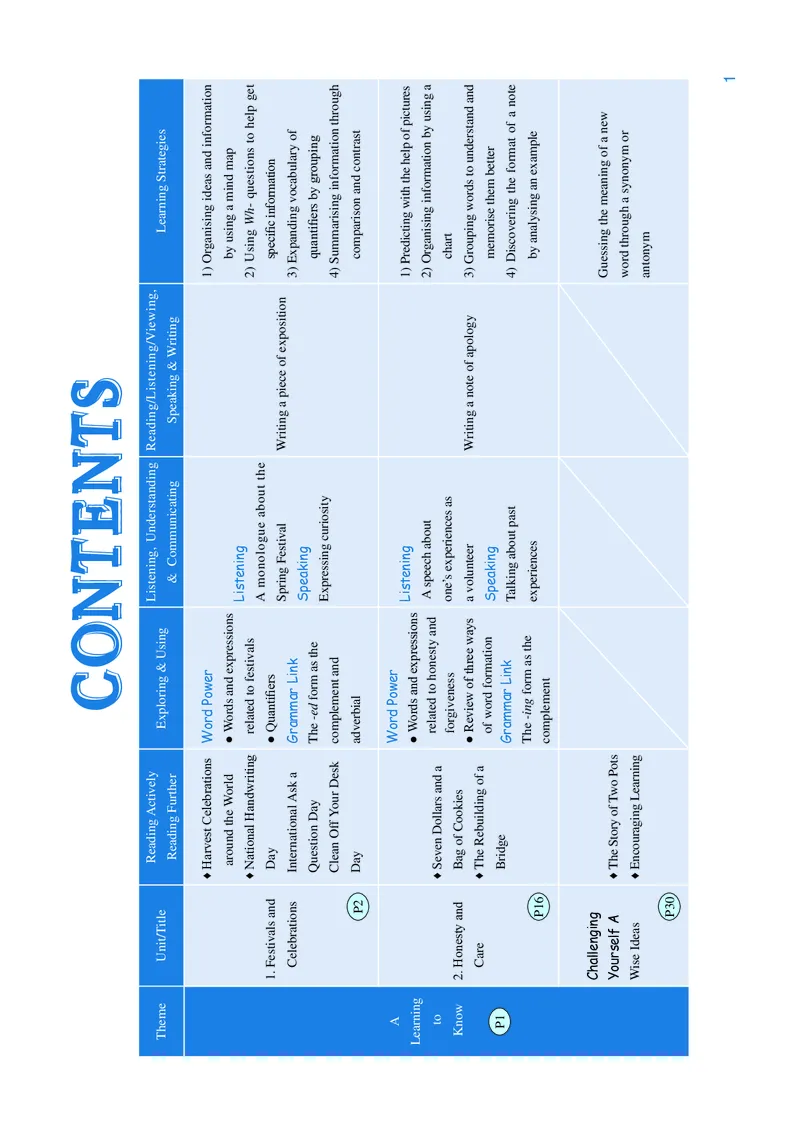
2STNETNOC
,gniweiV/gninetsiL/gnidaeR
gnidnatsrednU
,gninetsiL
ylevitcA
gnidaeR
seigetartS
gninraeL
gnisU
&
gnirolpxE
eltiT/tinU
emehT
gnitirW
&
gnikaepS
gnitacinummoC
&
rehtruF
gnidaeR
noitamrofni
dna
saedi
gnisinagrO
)1
rewoP
droW
snoitarbeleC
tsevraH
♦
pam
dnim
a gnisu
yb
snoisserpxe
dna
sdroW
●
dlroW
eht
dnuora
gninetsiL
teg
pleh
ot snoitseuq
-hW
gnisU
)2
slavitsef
ot detaler
gnitirwdnaH
lanoitaN
♦
eht
tuoba
eugolonom
A
noitamrofni
cfiiceps
srefiitnauQ
●
yaD
dna
slavitseF
.1
noitisopxe
fo
eceip
a
gnitirW
lavitseF
gnirpS
fo yralubacov
gnidnapxE
)3
kniL
rammarG
a
ksA
lanoitanretnI
snoitarbeleC
gnikaepS
gnipuorg
yb
srefiitnauq
eht
sa
mrof
de-
ehT
yaD
noitseuQ
ytisoiruc
gnisserpxE
hguorht
noitamrofni
gnisirammuS
)4
dna
tnemelpmoc
kseD
ruoY
ffO
naelC
tsartnoc
dna
nosirapmoc
laibrevda
yaD
2P
rewoP
droW
A
serutcip
fo pleh
eht
htiw
gnitciderP
)1
gninetsiL
snoisserpxe
dna
sdroW
●
gninraeL
a
gnisu
yb noitamrofni
gnisinagrO
)2
tuoba
hceeps
A
dna
ytsenoh
ot detaler
a
dna
sralloD
neveS
♦
ot
trahc
sa
secneirepxe
s’eno
ssenevigrof
seikooC
fo
gaB
dna
ytsenoH
.2
wonK
dna
dnatsrednu
ot
sdrow
gnipuorG
)3
ygolopa
fo
eton
a
gnitirW
reetnulov
a
syaw
eerht
fo
weiveR
●
a
fo
gnidliubeR
ehT
♦
eraC
retteb
meht
esiromem
gnikaepS
noitamrof
drow
fo
egdirB
11PP
kniL
rammarG
eton
a
fo tamrof
eht
gnirevocsiD
)4
tsap
tuoba
gniklaT
eht
sa
mrof
gni-
ehT
elpmaxe
na
gnisylana
yb
secneirepxe
61P
tnemelpmoc
gnignellahC
wen
a fo
gninaem
eht
gnisseuG
stoP
owT
fo
yrotS
ehT
♦
A
flesruoY
ro mynonys
a
hguorht
drow
gninraeL
gnigaruocnE
♦
saedI
esiW
mynotna
03P
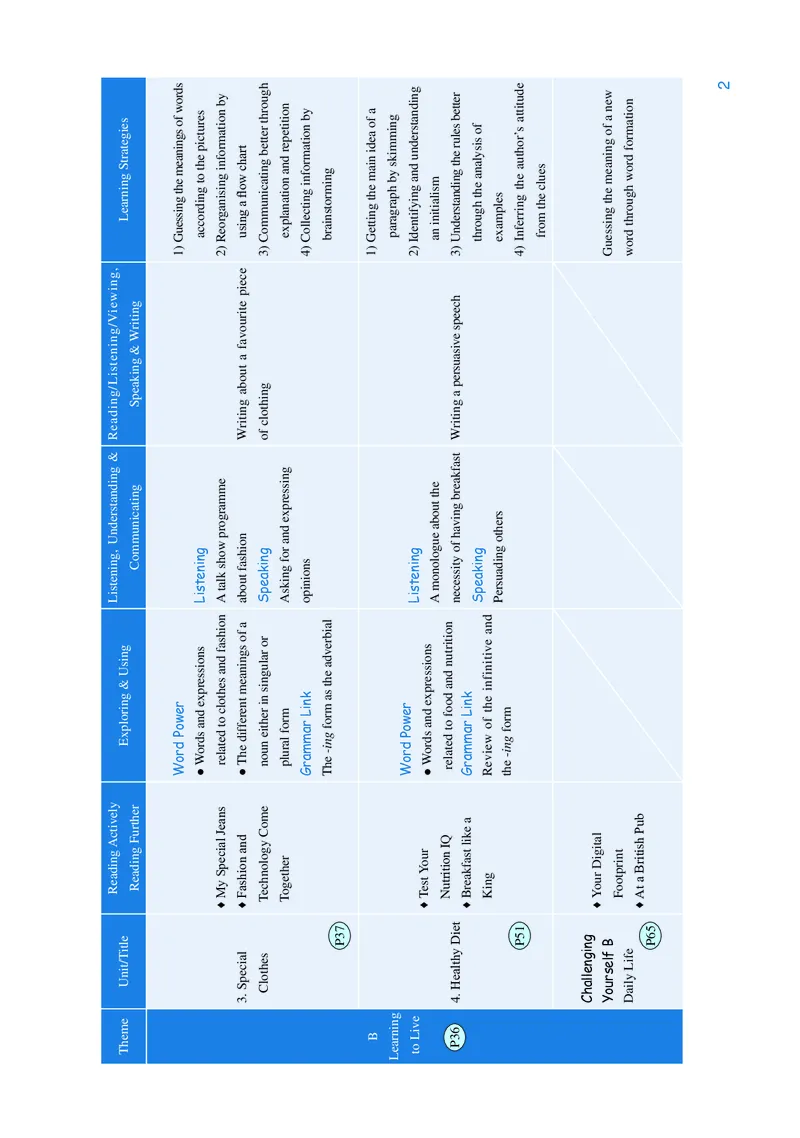
1,gniweiV/gninetsiL/gnidaeR
&
gnidnatsrednU
,gninetsiL
ylevitcA
gnidaeR
seigetartS
gninraeL
gnisU
&
gnirolpxE
eltiT/tinU
emehT
gnitirW
&
gnikaepS
gnitacinummoC
rehtruF
gnidaeR
sdrow
fo
sgninaem
eht gnisseuG
)1
rewoP
droW
serutcip
eht
ot gnidrocca
gninetsiL
snoisserpxe
dna
sdroW
●
yb
noitamrofni
gnisinagroeR
)2
emmargorp
wohs
klat
A
noihsaf
dna
sehtolc
ot
detaler
snaeJ
laicepS
yM
♦
trahc
wofl
a gnisu
eceip
etiruovaf
a
tuoba
gnitirW
noihsaf
tuoba
a
fo
sgninaem
tnereffid
ehT
●
dna
noihsaF
♦
laicepS
.3
hguorht
retteb
gnitacinummoC
)3
gnihtolc
fo
gnikaepS
ro
ralugnis
ni rehtie
nuon
emoC
ygolonhceT
sehtolC
noititeper
dna
noitanalpxe
gnisserpxe
dna
rof
gniksA
mrof
larulp
rehtegoT
yb
noitamrofni
gnitcelloC
)4
snoinipo
kniL
rammarG
gnimrotsniarb
laibrevda
eht
sa mrof
gni-
ehT
73P
a
fo
aedi
niam
eht
gnitteG
)1
B
gnimmiks
yb hpargarap
gninraeL
rewoP
droW
gnidnatsrednu
dna
gniyfitnedI
)2
gninetsiL
eviL
ot
snoisserpxe
dna
sdroW
●
ruoY
tseT
♦
msilaitini
na
eht
tuoba
eugolonom
A
noitirtun
dna
doof
ot
detaler
QI
noitirtuN
retteb
selur
eht
gnidnatsrednU
)3
hceeps
evisausrep
a
gnitirW
tsafkaerb
gnivah
fo
ytissecen
teiD
yhtlaeH
.4
5633PP
kniL
rammarG
a
ekil
tsafkaerB
♦
fo
sisylana
eht
hguorht
gnikaepS
dna
evitinifni
eht
fo
weiveR
gniK
selpmaxe
srehto
gnidausreP
mrof
gni-
eht
edutitta
s’rohtua
eht gnirrefnI
)4
15P
seulc
eht
morf
gnignellahC
latigiD
ruoY
♦
wen
a
fo
gninaem
eht
gnisseuG
B
flesruoY
tnirptooF
noitamrof
drow
hguorht
drow
efiL
yliaD
buP
hsitirB
a
tA
♦
56P
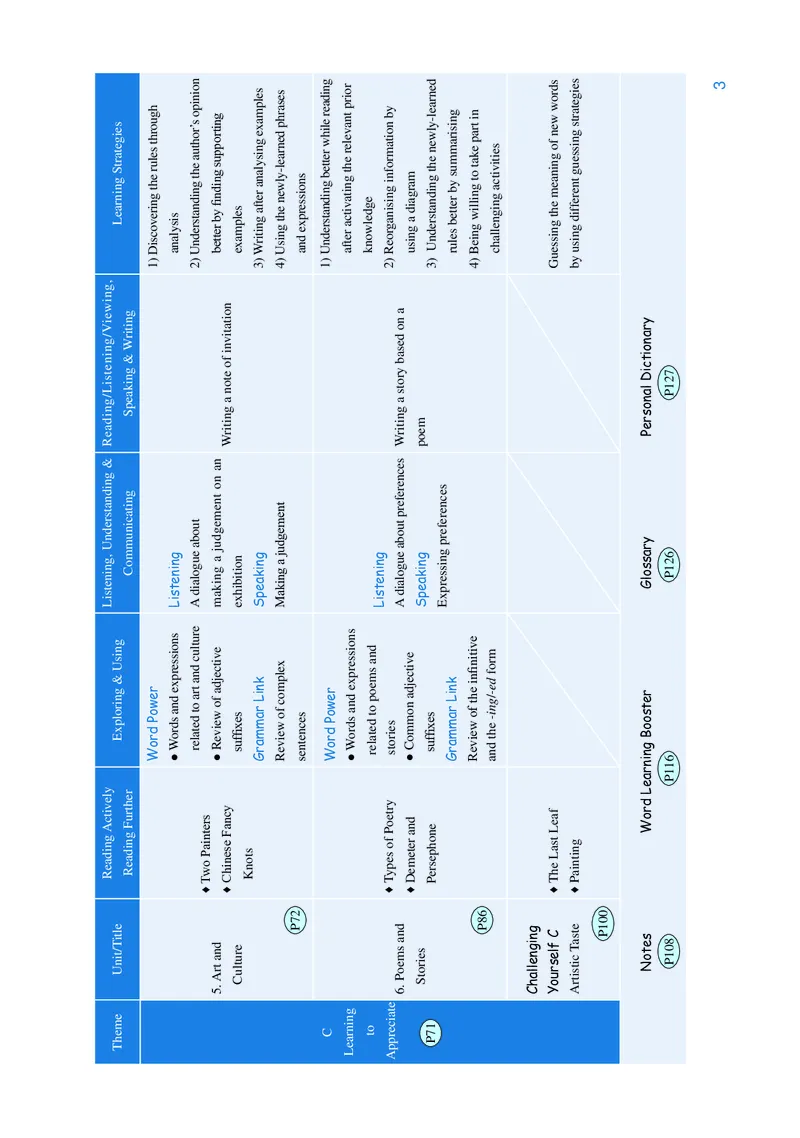
2,gniweiV/gninetsiL/gnidaeR
&
gnidnatsrednU
,gninetsiL
ylevitcA
gnidaeR
seigetartS
gninraeL
gnisU
&
gnirolpxE
eltiT/tinU
emehT
gnitirW
&
gnikaepS
gnitacinummoC
rehtruF
gnidaeR
hguorht
selur
eht
gnirevocsiD
)1
rewoP
droW
sisylana
gninetsiL
snoisserpxe
dna
sdroW
●
noinipo
s’rohtua
eht
gnidnatsrednU
)2
tuoba
eugolaid
A
erutluc
dna
tra
ot detaler
sretniaP
owT
♦
gnitroppus
gnidnfi
yb retteb
na
no
tnemegduj
a
gnikam
evitcejda
fo
weiveR
●
dna
trA
.5
noitativni
fo
eton
a
gnitirW
ycnaF
esenihC
♦
selpmaxe
noitibihxe
sexfifus
erutluC
stonK
selpmaxe
gnisylana
retfa
gnitirW
)3
gnikaepS
kniL
rammarG
sesarhp
denrael-ylwen
eht gnisU
)4
tnemegduj
a
gnikaM
xelpmoc
fo weiveR
27P
snoisserpxe
dna
secnetnes
gnidaer
elihw
retteb
gnidnatsrednU
)1
rewoP
droW
C
roirp
tnaveler
eht
gnitavitca
retfa
snoisserpxe
dna
sdroW
●
gninraeL
egdelwonk
dna
smeop
ot detaler
ot
gninetsiL
yb
noitamrofni
gnisinagroeR
)2
seirots
yrteoP
fo
sepyT
♦
etaicerppA
a
no
desab
yrots
a
gnitirW
secnereferp
tuoba
eugolaid
A
dna
smeoP
.6
margaid
a gnisu
evitcejda
nommoC
●
dna
retemeD
♦
meop
gnikaepS
seirotS
denrael-ylwen
eht
gnidnatsrednU
)3
sexfifus
enohpesreP
9167PP
secnereferp
gnisserpxE
gnisirammus
yb
retteb
selur
kniL
rammarG
ni
trap
ekat
ot gnilliw
gnieB
)4
evitinfini
eht
fo weiveR
68P
seitivitca
gnignellahc
mrof
de-/gni-
eht
dna
gnignellahC
sdrow
wen
fo gninaem
eht
gnisseuG
faeL
tsaL
ehT
♦
C
flesruoY
seigetarts
gnisseug
tnereffid
gnisu
yb
gnitniaP
♦
etsaT
citsitrA
001P
yranoitciD
lanosreP
yrassolG
retsooB
gninraeL
droW
setoN
721P
621P
611P
801P
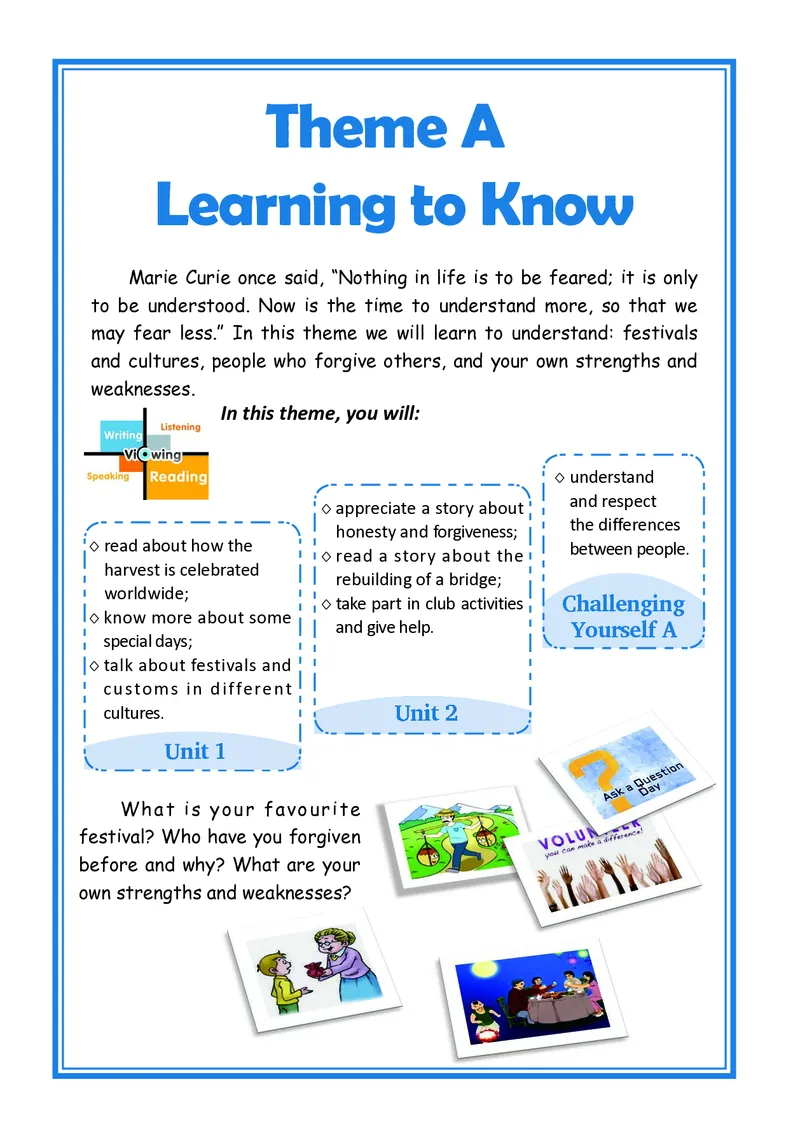
3Theme A
Learning to Know
Marie Curie once said, “Nothing in life is to be feared; it is only
to be understood. Now is the time to understand more, so that we
may fear less.” In this theme we will learn to understand: festivals
and cultures, people who forgive others, and your own strengths and
weaknesses.
In this theme, you will:
◊ understand
and respect
◊ appreciate a story about
the differences
honesty and forgiveness;
◊ read about how the between people.
◊ read a story about the
harvest is celebrated
rebuilding of a bridge;
worldwide;
◊ take part in club activities Challenging
◊ know more about some
and give help.
Yourself A
special days;
◊ talk about festivals and
customs in different
cultures.
UUnniitt 22
UUUnnniiittt 111
What is your favourite
festival? Who have you forgiven
before and why? What are your
own strengths and weaknesses?Theme A Learning to Know
Unit 1
Festivals and Celebrations
Harvest festivals are the seasons for enjoying the fullness of life.
—Anonymous
Lo���n� A�ea�
By the end of this unit, you will be able to:
compare and contrast festivals in different cultures;
enrich vocabulary about quantifi ers and festivals;
introduce festivals by using the -ed form as the complement and adverbial;
express curiosity about festivals;
write a piece of exposition about a festival by arranging information logically;
create and introduce a special day for a special purpose.
Reading Actively
► Activating and Predicting
Complete the mind map by writing down the reasons why people around the world
celebrate festivals. Then share your ideas in groups and add more reasons.
For a harvest
Why
More reasons:
22Unit 1 Festivals and Celebrations
Look at the following pictures about three harvest festivals around the world. Ask yourself
questions and try to answer them. Then read the text to check your answers.
pumpkins, ears of corn, bunches lanterns, lantern riddles, rice, milk, cattle
of grapes, turkeys moon cakes, reunion dinners
P
I
T
What is the festival for? Who celebrates Asking questions can help
it? When and where…? How…? develop your thinking skills.
► Reading, Thinking and Analysing
Harvest Celebrations around the World
A harvest festival is an annual celebration that occurs around
the time of the main harvest in a given region. People from different
cultures throughout the world celebrate the gathering of the harvest
with different names and unique customs.
In the United States, the celebration is held on the fourth
Thursday of November with a feast tradition, while people in Canada
feast (n.): a large meal
(the country of maple leaves) have the same national holiday on
the second Monday in October. Turkeys, pumpkins, ears of corn,
bunches of grapes and other kinds of food are displayed to symbolise
a maple leaf
Thanksgiving Day.
Guess the meaning of
In the United Kingdom, Harvest Thanksgiving is observed by
ear from the context
churches and schools in late September or early October with singing,
and the picture.
prayers, the decoration of school or church halls with baskets of food
and fruit and the collection of money for charity.
Harvest festivals in Asia include the Chinese Mid-Autumn
Festival, one of the most widely celebrated harvest festivals in the
world. The festival falls on the 15th day of the 8th month of the lunar
calendar with a full moon at night. It is the second most important
festival in China. For the Chinese, the festival indicates family reunion
and peace. Chinese people celebrate the Mid-Autumn Festival with
many traditional activities, such as hanging lanterns, guessing lantern
3Unit 1 Festivals and Celebrations
● Name: ● Name:
● Time and place: ● Time and place:
● Celebrations: ● Celebrations:
● Name: ● Name:
● Time and place: ● Time and place:
● Celebrations: ● Celebrations:
Read the text again and try to summarise the similarities and differences between the fi ve
harvest festivals. Examples are given below.
Similarities Differences
① annual celebration ① different kinds of food
Work in groups to discuss the following questions.
1) Among the harvest festivals mentioned in the text, which impresses you most? Why?
2) Do you know any customs in China that are somewhat similar to the one of throwing
the old yams away? What do these customs suggest?
3) Do you enjoy Chinese traditional festivals? Why or why not?
4) Should we celebrate Western festivals? Why or why not?
Match each of the following traditional Chinese festivals with its meaning. Then work in
groups to select one and introduce it to the class.
1) the Qingming Festival A. to celebrate the beginning of the Chinese New Year
2) the Dragon Boat Festival B. to show respect for the elderly
5Theme A Learning to Know
3) the Spring Festival C. to remember and honour our ancestors
4) the Mid-Autumn Festival D. to give thanks for the harvest
5) the Chongyang Festival E. to remember the great person, Qu Yuan
P
I
T
Look for information about a festival from different sources such as books
and the Internet. Check whether you have covered the following things:
name, time, place, nationality, origin, celebrations, customs, interesting
stories and similar festivals in other countries.
Exploring and Using
► Word Power
Reread the text to fi nd the corresponding words and write them on the lines below. Then
use their proper forms to complete the following paragraph.
A. occurring once every year
B. to point out; to show
C. having happened or existed before
D. having an important effect or infl uence
E. to continue; to keep
F. enough; adequate
G. to talk in a friendly and informal way
H. a typical aspect of something
The Spring Festival, a/an festival, is the most festival
for the Chinese, and also one of the world’s most celebrated festivals. During the Spring
Festival, every family cleans up the house. The custom that all the bad
luck in the year will be swept away in order to make way for the
incoming good luck. People also prepare foods for the coming festival,
especially for the dinner on the eve of the Chinese Lunar New Year. While having the
reunion dinner, Chinese people watch performances on TV and with family
members. Some people, however, complain that the of the Spring Festival
are becoming less and less distinct, though many customs are still . For
example, setting off fi recrackers is now banned in a lot of cities in the country for the
sake of environmental protection.
Study the examples from the text to know what a quantifi er is. Then complete the phrases
on Page 7 with the quantifi ers in the box.
6Unit 1 Festivals and Celebrations
·Example·
● ears of corn ● bunches of grapes
bar piece drop stick bunch bundle
packet band board series team bowl
1) a of chocolate 2) a of bread 3) a of blood
4) a of keys 5) a of clothes 6) a of cigarettes
7) a of directors 8) a of players 9) a of rice
10) a of chalk 11) a of musicians 12) a of stamps
P
I
T
A quantifier is a word or phrase that is used before a noun to indicate the
amount or quantity. The most common quantifiers are “some”, “many”, “a
large number of”, etc.
Analyse the words in the box by following the example. Then give more examples of your own.
fourth national symbolise decoration widely reunion
traditional activity tasty probably freedom festival
·Example·
collection (n.) = collect (v.) + -ion My example: communication, …
► Grammar Link
The -ed Form as the Complement and Adverbial
Understanding the meaning
Read the riddles below and guess what festivals are being described, paying special
attention to the coloured parts.
I see the streets decorated with colourful lights.
I hear cheerful songs repeated everywhere.
I notice the Chinese character “Fu” put on almost every door.
I fi nd the trees hung with red lanterns.
Which festival is it?
Given a day off, people are happy.
Put on the centre of the table, it smells good.
Displayed everywhere, food and stuff make the day bright.
Held on Thursday, it celebrates the harvest.
Which festival is it?
7Theme A Learning to Know
Discovering the rule
Study the following two examples and tick the correct choices in the box.
·Example·
The streets have been decorated with lights.
The -ed form
Form: vt./vi. + -ed
1) I see the streets decorated with colourful lights.
↑ Meaning:
object complement 1) a/an (completed/ongoing) action
2) a/an (active/passive) sense
People are given a day off.
2) Given a day off, people are happy.
↑
adverbial
Underline the -ed forms in the examples in the left column and then match them with their
functions in the right column.
Example The adverbial of
1) Held on Thursday, it celebrates harvest. condition
2) The train seems to be a hundred years old, pulled by a steam cause
engine.
3) The girl had an accident, wounded in the head. manner
4) United, we stand. Divided, we fall. concession
5) Tired after the busy holiday, I still enjoyed it. result
6) Seated at the table, my father and I were talking about my job. time
Applying the rule
Rewrite each of the following sentences from the text by using the -ed form as object
complement or adverbial.
1) In the United States, the celebration is held on the fourth Thursday of November with
a feast tradition.
2) Turkeys, pumpkins, ears of corn, bunches of grapes and other kinds of food are
displayed to symbolise Thanksgiving Day.
3) In the United Kingdom, Harvest Thanksgiving is observed by churches and schools
in late September or early October with singing, prayers, the decoration of school or
church halls with baskets of food and fruit and the collection of money for charity.
4) On the evening before the day of the festival, all old yams are consumed or thrown
8Unit 1 Festivals and Celebrations
away.
5) Rice is boiled in milk and offered fi rst to the gods.
Combine the following pairs of sentences by using the -ed form as adverbial. Then use
some of the sentences you have made to make up a story, and share your story in groups.
1) The baby was frightened by the loud noise. She burst into tears.
2) Tony was laughed at by many people. He continued his performance.
3) The children were given many candies. They smiled a big smile.
4) The school was decorated with flags and lighting. The school celebrated its 100th
birthday.
5) She was surprised by the big bunch of fl owers. She kissed her sweet daughter.
6) The old man was surrounded by his family members. He felt happy.
Describe one of the following festivals, using the -ed form as adverbial or object
complement. Then read it aloud to let your group members guess which festival it is.
Listening, Understanding and Communicating
Expressing Curiosity
Work in pairs to tell each other how much you know about the monster, Nian, with the
help of the picture and the given expressions.
the Chinese Lunar New Year keep off the monster
stay deep in the mountains a strong bull
a bright fl ame stay up all night
beat on things crackling bamboo
set off fi recrackers establish a tradition
9Theme A Learning to Know
Listen to a monologue about the Spring Festival and check your ideas.
Listen to the monologue again to complete the answers.
1) What does the Spring Festival mark?
It marks the of the Chinese Lunar New Year.
2) What does Guonian mean?
It means the monster, Nian.
3) What did Nian look like?
Nian looked like a strong with a/an like that of a lion.
4) Why did Nian enter the villages during the winter?
It entered the villages to whatever it could .
5) Which three things was Nian afraid of?
The colour red, bright , and loud noises.
6) What did people do to prevent Nian from entering the village?
They their doors red, burned a f ire in front of their and
stayed up all night beating on things to make a loud .
Read the following sentences and underline the structures used to express curiosity.
1) Do you happen to know how Americans celebrate their Thanksgiving Day?
2) I wonder if you could tell me what a harvest festival is.
3) It would be very interesting to know how people around the world celebrate their
harvest festivals.
4) What I’d really like to fi nd out is why Chinese people have moon cakes when they are
celebrating the Mid-Autumn Festival.
5) I’m rather curious/keen to know about the festival called Pongal.
6) I wish someone would tell me something about the New Yam Festival in West Africa.
Work in pairs to make up a dialogue by using some of the sentence structures you have
underlined.
Situation: A is a Chinese student in a senior high school. B, A’s classmate, is an exchange
student from Canada. B is very curious about why the Spring Festival is called
Guonian in China.
Viewing, Speaking and Writing
Writing a Piece of Exposition
Read the given example and tick (√) the elements it covers.
10Unit 1 Festivals and Celebrations
·Example·
The Chongyang Festival, also called the Double □ name
Ninth Festival, is celebrated on the ninth day of the ninth □ date
lunar month. It is a special day on which people pay their □ meaning
respects to the elderly. So it is also known as Seniors’ □ origin
Day. On this day, people customarily climb mountains, □ development
enjoy the chrysanthemums, drink chrysanthemum wine, □ celebration
and eat double-ninth cakes. □ customs
□ infl uence
Put the following basic steps for writing a piece of exposition in the right order.
A. Decide on the elements you will cover.
B. Select a topic that interests you.
C. Collect detailed information about these elements.
D. Choose the type of exposition you want to use: description, introduction, comparison,
cause and effect, problem and solution or sequence.
E. Recall your theme and main points in the conclusion.
F. Include specifi c examples.
G. Write and keep your readers’ interest from the very beginning.
The correct order is:
Match each of the following traditional Chinese festivals with its corresponding picture.
A the Spring Festival B the Lantern Festival
C the Qingming Festival D the Dragon Boat Festival
E the Mid-Autumn Festival F the Chongyang Festival
1 2 3
4 5 6
Choose the festival that you are most interested in. Then follow the above given steps in
Activity 2 and the instructions on Page 12 to write a composition about it.
11Theme A Learning to Know
Part I Introduction
Write one or two sentences that introduce
your topic.
Part II Body List the main ideas about the topic that you
will include. These can be important facts
Idea 1 Idea 2 Idea 3
you’d like to describe, points you’d like to
explain, or elements you’d like to defi ne.
Part III Conclusion
In the end you can add one or two sentences
that will sum up your main ideas and
emphasise what is important about the topic.
Work in groups to mark your compositions and complete the following table.
Organisation Content Language Handwriting Total
Name Comments
(3 points) (3 points) (3 points) (1 point) score
Reading Further
► Getting Ready
How much do you know about the following festivals? Guess what each festival is for
based on its name, and what people might do to celebrate it. Then share your ideas with
your partner.
International Ask a Question Day National Handwriting Day
Clean Off Your Desk Day International Day of Happiness
Skim the following three passages to check your ideas. Then write a proper heading on
the line for each passage.
► Reading
A.
The aim of National Handwriting Day is to highlight the
importance of the skill of handwriting. It is an important day
in today’s world where people use a computer keyboard more
than a pen or pencil. Some people are even worried that, in the
future, handwriting might become a lost art.
12Unit 1 Festivals and Celebrations
National Handwriting Day is on January 23rd because this day is the birthday of John
Hancock, who was the fi rst person to sign the American Declaration of Independence—one of
the most important documents in the history of the United States of America.
Handwriting is like an art. We can use it to express ourselves and be creative. Everyone’s
handwriting is unique. Experts can even analyse our handwriting and tell what kind of
personality we have. Some handwriting can be almost impossible to read, however. Doctors are
said to be famous for writing prescriptions that look like ancient hieroglyphics.
What does your handwriting say about you?
B.
International Ask a Question Day is on March 13th. Its
goal is to improve our knowledge and lives by asking more
and better questions. Researchers tell us that “A question not
asked is a door not opened.” The best question askers know
how to open many doors, even locked ones!
We can build our “curiosity muscle” to make us more
successful in life by asking the right questions. Researchers
have a list of the top twelve questions that will bring you success. Besides asking yourself
exactly what you want, such questions as “What else can I think about this?” and “What is the
other person thinking, feeling and wanting?” can make you look at a situation from a different
angle and give you new and better ideas. The fi nal question on their list is: “What is possible?”
This is a great question to ask. Ask it today.
C.
Are you a messy person? Is your desk a mountain of books
and paper? If yes, January 14th, Clean Off Your Desk Day
is for you. This is also a day for you to clean your computer
desktop too. A neat desk means you are organised. You won’t
have to spend hours looking for things under piles of paper. For
many people, a tidy desk makes them feel good. They can sit
down and get to work straight away. A well-organised computer desktop is the same. They can
quickly fi nd any document they want.
It only takes two minutes at the end of the day to tidy up and put things in the right place.
Make use of your wastepaper basket (that’s trash can for Americans). Do that, and life will be
simpler.
► Comprehending
Decide whether each of the following statements is true (T) or false (F) based on your
understanding of the passages.
1) National Handwriting Day is on January 23rd because the American Declaration
of Independence was signed on this day.
13Theme A Learning to Know
2) Everyone has unique handwriting and it can reveal his or her personality.
3) The aim of International Ask a Question Day is to encourage us to become good
question askers.
4) A metaphor is used in the sentence “A question not asked is a door not opened”.
5) The aim of Clean Off Your Desk Day is to remind us to keep our desk and computer
desktop clean.
6) A tidy desk and a well-organised computer desktop will help us to work more
effi ciently.
Read to understand the following sentences from the passages and select the better choice
to replace the underlined parts in each sentence.
1) The aim of National Handwriting Day is to highlight the importance of the skill of
handwriting.
A. intention; make more visible B. purpose; emphasise
2) Doctors are famous for writing prescriptions that look like ancient hieroglyphics.
A. instructions written by doctors; writing consisting of pictures to represent words
B. medicine prescribed by doctors; a writing system from ancient times
3) We can build our “curiosity muscle” to make us more successful in life by asking the
right questions.
A. build up our strength to awaken our curiosity
B. develop our ability to arouse our curiosity
4) Such questions can make you look at a situation from a different angle and give you
new and better ideas.
A. the space between two crossing lines
B. a position from which something is viewed
5) Are you a messy person?
A. an untidy B. an unpleasant
Complete the following passage about the International Day of Happiness according to
your own understanding.
The International Day of Happiness
What is the International Day of Happiness? It’s a day ,
of course! Since 2013, it has been celebrated annually on the 20th of March as a way to
happiness in the lives of people around the world.
Research fi ndings show that people who are happier tend to
in work and relationships when compared to those who are less happy.
The day then becomes a great opportunity to explore what we generally consider
happiness to be and how to .
Individually, we all have different defi nitions of happiness. For many, that might
mean video games, sports, reading books, art, family, friends, fi ne foods, a nice house,
14Unit 1 Festivals and Celebrations
lots of money, etc.
For me, happiness means , and I will
to become happier.
Work in groups to create a speical day of your own. Then complete the table and write a
passage based on it. Introduce your speical day to your class.
Name
Why
Celebration When
How
Signif icance
Logo
S�l�-a� es��n�
Refl ect on your learning process in this unit. Tick (√) the following statements to assess
your own progress and decide what you still need to work on.
You are able to: Agree Somewhat Need more
agree work
◊◊ aapppprreecciiaattee ffeessttiivvaallss aarroouunndd tthhee wwoorrlldd bbyy □ □ □
summarising their similarities and differences;
◊ enrich vocabulary about quantifiers and use □ □ □
them correctly;
◊ understand the -ed form as complement and □ □ □
adverbial and use it to describe pictures and
festivals;
◊ express curiosity about festivals in other □ □ □
cultures and get information about them by
asking proper questions;
◊ write a piece of exposition to introduce a □ □ □
Chinese festival and assess classmates’ work;
◊ create and introduce a special day for a special □ □ □
purpose.
15Unit 2
Honesty and Care
Honesty is the best policy.
—Anonymous
Lo���n� A�ea�
By the end of this unit, you will be able to:
appreciate a story by locating its plot and analysing the personalities of its characters;
classify words according to their formation and use them to complete the summary of the text;
use the -ing form as the complement through role-play and passage completion;
talk about past experiences by using proper tenses;
write a note of apology with an appropriate format and proper expressions;
retell a story about the rebuilding of a bridge and value the good quality of helping others.
Reading Actively
► Activating and Predicting
What is “honesty”? What is “forgiveness”? Give some examples in the following circles.
Honesty Forgiveness
• To tell the truth • To understand others
• •
• •
• •
Were you forgiven when you did something wrong? If yes, share your experience with a
partner.
16Unit 2 Honesty and Care
Look at the following fi ve pictures and predict what the coming story is like by putting
them in order. Then read the text to check your prediction.
A B C D E
The proper order: □→□→□→□→□
► Reading, Thinking and Analysing
Seven Dollars and a Bag of Cookies
Forty years seems like a long time to remember the name of an
acquaintance. I have forgotten the name of an old lady who was a acquaintance (n.):
customer on my paper route when I was a twelve-year-old boy, back someone you know
slightly
in 1959. Yet it seems like just yesterday that she gave me a lesson in
forgiveness that I can only hope to pass on to someone else someday.
On a Saturday afternoon, a friend and I were throwing rocks onto
Object here means
the roof of the old lady’s house from a hidden place in her backyard.
___.
The object of our play was to observe how the rocks changed to
A. thing B. purpose
missiles as they rolled to the roof’s edge and shot out into the yard like
comets falling from the sky.
I found myself a perfectly smooth rock and sent it for a ride.
However, the stone was too smooth. It slipped from my hand as I let it
go and headed straight for a small window in the old lady’s house. At missile[]
the sound of broken glass, we took off from the old lady’s yard faster n. 导弹, 飞弹
than any of our missiles that had flown off her roof. I was too scared of
getting caught that first night to be concerned about the old lady with
the broken window. A few days later, however, when I was sure that I
hadn’t been discovered, I started to feel guilty for her misfortune. She
still greeted me with a smile each day when I gave her the paper, but I
comet [ ]
was no longer able to feel comfortable in her presence.
n. 彗星
I made up my mind that I would save my paper delivery money,
Take off here means
and three weeks later I had the
_____.
seven dollars that I calculated would
A. stop
cover the cost of her window. I put
B. rush away
the money in an envelope with a
fortunate (adj.) →
note explaining that I was sorry for
fortune (n.)
breaking her window and hoped that Misfortune here means
the seven dollars would cover the cost _____ in Chinese.
17Theme A Learning to Know
of repairing it. I waited until dark, went to the old lady’s house, and put
the envelope through the letter slot in her door. Then, I couldn’t wait
for the freedom of, once again, looking straight into the old lady’s eyes.
The next day, I handed the old lady her paper and was able to
return the warm smile that I was receiving from her. She thanked me
A slot is in a wall or
for the paper and said, “Here, I have something for you.” It was a bag of door, through which
cookies. I thanked her and ate the cookies as I continued on my route. mail is delivered.
After several cookies, I felt an envelope and pulled it out of the
bag. When I opened the envelope, I was surprised. Inside was the
seven dollars and a short note that said, “I’m proud of you.”
► Comprehending, Integrating and Creating
Complete the following mind map by noting down some key words.
The story about seven dollars and a bag of cookies
characters when where point of view theme
Put the letters for the pictures in Activity 2 on Page 17 on the corresponding lines and
then complete the part headed “Main events” below.
Plot Picture Main events Feeling
The boy and his friend were
Beginning
in an old lady’s garden by
the roof of her house.
Rising A smooth rock and they
action immediately .
The boy dared not the
Climax lady’s eyes when she .
The boy three weeks later,
Falling and put the envelope with the money
action and a note through the letter slot in the
lady’s door.
Ending The next day, the boy from
the old lady and found .
18Unit 2 Honesty and Care
Work in pairs to complete the “Feeling” column in the diagram in Activity 2 by writing
down some adjectives. Then analyse the personality of the boy and the old lady based on
the evidence from the story.
Character Personality Evidence
Work in pairs to play the roles of the boy and his classmate. Ask and answer the following
questions.
1) What made you make up your mind to save money to cover the cost of the window?
2) Why do you think the lady was proud of you?
3) If the lady didn’t forgive you, what would you do?
4) Do you think you will forget about the accident? Why or why not?
5) Do you think you are an honest boy? Why do you think so?
Work in groups to discuss what mutual understanding suggests based on the behaviour of
the characters in the story. Then work out how to increase mutual understanding between
you and people around you.
The boy’s behaviour The old lady’s behaviour
Mutual understanding
suggests
.
How to increase mutual understanding between you and your
parents teachers friends
19Theme A Learning to Know
Exploring and Using
► Word Power
Find the following words in the text and work out their meanings. Then use their proper
forms to replace the underlined parts in the following sentences.
scared misfortune cover delivery forgiveness calculate
1) William is the sort of man who is easy to excuse and forget.
2) I was late getting to the train station but, luckily for me, the train was late too.
3) One advantage of shopping online is that the things you buy will be sent direct to your
door.
4) I can’t work out when we’ll arrive at our destination because of the traffi c jam.
5) The teacher’s sudden question frightened the little girl into not being able to say anything.
6) If you don’t have enough cash to pay the cost, you can pay by credit card.
Read the text carefully and tick the language features of a child that can be found in it.
Then fi nd more examples from the text.
( ) 1) Using phrasal verbs like “take off” instead of single verbs.
( ) 2) Using child’s vocabulary like “Mamma”.
( ) 3) Emphasising by using adverbs like “perfectly” in “perfectly smooth”.
( ) 4) Using very short sentences.
( ) 5) Using similes as in the sentence “... shot out into the yard like comets falling from
the sky.”
Classify the following words from the text and use ten of them to complete the summary of
the text. Change the forms if necessary.
twelve-year-old forgiveness someday hidden backyard
play perfectly ride head scared
guilty misfortune comfortable presence delivery
deliver cost cover freedom smile
A. Adding affi xes
B. Putting words together
C. Using it as a different part of speech
The main character of the story was a/an boy who newspapers
in the neighbourhood. One day, he with a friend in the of an old lady
by throwing rocks onto the roof of her house. Because one rock was smooth, it
20Unit 2 Honesty and Care
slipped from his hand and broke a window in the house. He escaped because he was too
. Several days later, however, he started to feel . He decided to make
up for his mistake. After three weeks, he saved up seven dollars which, he thought, might
the of the window and then secretly put the money into the old
lady’s home. The next day, the old lady gave him a bag of cookies, with the money in it.
The old lady gave the boy a good lesson in .
► Grammar Link
The -ing Form as the Complement
Understanding the meaning
Read to understand the following note, paying special attention to the coloured parts.
May 6
Dear Mrs. Bush,
I’m writing to apologise for breaking a window of your house.
One day three weeks ago, Jerry and I were playing in your backyard. We threw rocks
on the roof because we wanted to see them changing into missiles as they fell down from
the roof. One of the rocks was too smooth and I let it go by accident. Then the rock was
seen heading for a small window… It made me feel so scared that I took off immediately.
In the following days, I saw you still smiling at me when I delivered the paper to your
door. You know, your smile made me feel so guilty. So I made up my mind to save up
money to cover the cost of your window.
I am so sorry for breaking your window and hope that seven dollars will cover the
cost of repairing it. Please forgive me.
Yours sincerely,
Bob
Discovering the rule
Compare the blue parts and the red parts in the above note and work out their basic
forms.
The blue parts: verb + object +
The red parts: + +
Study the following examples and then work in groups to share the rules you have found
out.
·Example·
causative verb
1) It made me feel so scared that I took off immediately.
object
I felt so scared at that moment.
21Theme A Learning to Know
sense verb
2)Then the rock was seen heading for a small window…
The rock was heading for the window at that moment.
subject
You may start to share your fi ndings in this way:
A: I think there are two kinds of complements: complements of subjects and complements
of objects.
B: I have found that when the -ing form is used as the complement of the subject, the
sentence is usually in the passive voice.
C: ...
Applying the rule
Work in pairs to have a dialogue by playing the roles of the boy (Bob) and his classmate
(Cathy). Use the -ing form as the complement.
Cathy: Bob, I heard that you had broken one of the windows of
Mrs. Bush’s house.
Bob: Yes. I was so sorry for that.
Cathy: How did it happen?
Bob: Jerry and I were playing in her backyard and we were throwing
rocks onto the roof to...
...
Complete the following short story by using the proper forms of the given words. Each
word may be used more than once.
answer hire confuse send drive
hear understand shake get start
Sometimes, it is not so easy to understand others and also make others you.
One day, Mr. Black, an American businessman, went to India. He had his assistant
a car for him. When the car arrived, he told the driver him to his
offi ce. But he saw the driver his head at once. The driver was a somewhat old
guy, so Mr. Black thought the driver hadn’t heard what he had said. He raised his voice to
repeat his order in order to make himself . The driver still shook his head with a
smile. The smile of the driver, somehow, made Mr. Black angry.
“How dare you refuse my order?” Mr. Black shouted. “I let you me to my
offi ce immediately!”
Then he heard the driver in a very loud voice, “Yes, sir.”
But to Mr. Black’s surprise, he saw the driver his head at the same time.
At last, the driver got the car , and Mr. Black became totally . He
thought about it for a while and then said to himself, “No means Yes here!”
22Unit 2 Honesty and Care
Describe what was happening when you walked into the classroom this morning, using
the -ing form as the complement. Then share your writing with your group members.
Listening, Understanding and Communicating
Talking about Past Experiences
Read the following sentences from a monologue you will listen to, and guess the meanings
of the words in bold. Then predict what “something both meaningful and fun” is.
Some people think what you do in your spare time is your own affair. Some argue
that we must do something profi table. For me, I really recommend that we do something
both meaningful and fun.
Listen to the monologue and check your prediction. Then choose the best answers.
1) The main topic of the monologue is .
A. meaningful and fun volunteer work
B. the speaker’s experiences as a volunteer
C. the speaker’s attitude towards volunteer work
2) This monologue is .
A. a story B. a report C. a speech
3) The nationality of the speaker is most probably .
A. French B. British C. unclear
4) The speaker is most probably a .
A. university student B. high school student C. farmer
Listen to the monologue again and complete the table with the missing information.
Experiences as a Volunteer
What she did What she got
organised a/an for charity at
raised for a cause she believed in
the university
got cupcakes from a/an London bakery from
volunteered at a charity
the organisers for her
volunteered in a/an shop found many nice clothes to her wardrobe
had a/an holiday with food and accommodation
worked on a farm in France to
provided, made some great and her
look after horses
French
23Theme A Learning to Know
Listen for a third time and complete the following sentences.
1) I organised a concert for charity with my friends at our university.
2) fi nding bands and raising funds for a cause we believed in.
3) , I volunteered in a charity shop so I found loads of nice cheap clothes
to update my wardrobe.
4) as a volunteer, however, was working on a farm in France.
5) I had to admit that experience for me.
6) though, since I had to look after fi fteen horses and sleep at the top
of a tower in an odd castle!
Study the above sentences to fi nd out the structures that can be used to talk about past
experiences. Then work in pairs to talk about your unforgettable experiences by using
some of them.
P
I
T
While you are talking about your past experiences, the past tense should be
the basic tense.
Reading, Speaking and Writing
Writing a Note of Apology
What elements should a note of apology contain? Tick (√) the ideas listed below that you
agree with.
□ expression of regret □ explanation of what went wrong
□ acknowledgement of responsibility □ an offer of a solution
□ request for forgiveness
Read the following note of apology to fi nd which elements listed above have been included
and then match each part of the note with its explanation by putting the letter on the
corresponding line.
A
May 15
Dear Frank,
B
I’m writing to apologise for having lost the book you were so kind to
C
lend me last week.
You know, I liked the book so much that I brought it along with me
every day. Whenever I had free time I took it out to read. I had finished
D
four chapters, but when I came back home last night, it wasn’t found
anywhere in my backpack.
24Unit 2 Honesty and Care
I know old books are like your old friends; they can never be replaced.
E
I will try my best to get it back. Otherwise, I will get a new copy for you.
Many apologies again. Do please forgive me. F
Yours truly, G
Zhang Fei
H
Date Greeting
Closing Signature
Saying sorry at the very beginning to tell the purpose of writing the note
Explaining why you are apologising
Offering a solution
Expressing your apology again and hoping for forgiveness
Read the following sentence structures and classify them.
C D E F
1) I am writing to express my apology for...
2) I hope you will pardon me.
3) I’m extremely/terribly sorry for...
4) Here’s my deepest apology for...
5) Unfortunately, I didn’t realise that...
6) In order to make up for my fault...
7) Please forgive me. I really didn’t mean that.
8) Please accept my apology. I hope...
9) I am afraid what I have done has caused much inconvenience for you.
10) I promise I will...
Is there anything that you want to apologise for? To whom? Write a note of apology to the
person(s) by following the steps below.
Step 1 Choose some sentence structures in
Activity 3 to finish the four main
parts of C, D, E and F.
Step 2 Add the other parts of A, B, G and H.
Step 3 Link all the parts together and add
more details.
Step 4 Check and correct the errors.
Step 5 Write down the complete note here and
share it with a partner.
25Theme A Learning to Know
Reading Further
► Getting Ready
Brainstorm and complete the following diagram. Then share your ideas in your group.
helping others
Understanding
Others
Look at the title of the passage below and predict what it is mainly about with the help of
the following questions. Share your ideas with a partner. Then read the passage to check
your prediction.
● What happened to the bridge?
● What was needed to rebuild the bridge?
● How was the bridge rebuilt?
● What might be the theme of the story?
► Reading
The Rebuilding of a Bridge
David and Roy decided to go for a bicycle ride with three other students: Robert, Helen
and Betty. Since Robert’s father couldn’t afford to buy a bike for him, they borrowed one for
him.
The students had planned to meet at 8 o’clock, but Robert, Helen and Betty were half an
hour late, since they had to come a long way once they discovered that the bridge over the
stream had been washed away.
When they told the bad news to David and Roy,
David said nothing and kept silent for a moment.
After a while, an idea came into his mind. “Do you
think we could rebuild it?”
All of them agreed and started to consider this
idea seriously. They decided to rebuild the bridge
before they went for the bicycle ride. Betty said she
could ask her brother to make a plan for them.
The biggest problem was how to get enough
26Unit 2 Honesty and Care
wood. The next day they visited nearly every house in the village. Mr. Robinson agreed to
supply the wood so long as they did the work. Several people promised to give money if the
students could build a new bridge because it was a short cut for the villagers.
The students worked for nearly a week under Mr. Robinson’s guidance. At the end of a
week’s hard work, the bridge was completed. They all agreed to ask Mr. Robinson to offi cially
open the bridge. “He has helped us the most,” David said.
“And tomorrow morning we can go around to all the houses,” added Roy, “and tell the
people that the bridge will be offi cially opened at six o’clock. Then we can remind them of
their promises about money,” Roy added.
“But we don’t really want that, do we?” said Robert.
“Yes,” said Helen. “We need it and I think we should collect it.” She glanced quickly at the
others, who nodded.
The next day, the students visited all the houses again. They were surprised when they
saw how pleased the people were with them. By two o’clock they had collected over a hundred
dollars. By fi ve o’clock, unknown to Robert, they had spent it.
At six the students gathered at the bridge. Mr. Robinson appeared with nearly forty of the
people of their district. In a short speech he praised the students for their efforts.
“And now I announce that the new bridge is open,” he said, “and I have a small surprise
for you.” He turned to his son and received a small metal sign from him. Climbing down the
bank, he nailed it on the side of the bridge. “Students’ Bridge”, it said. The neighbours clapped,
and the students felt even more pleased with their work.
David turned to Robert. “And now,” he said, “we have a surprise for you. Look!” Helen
pushed a new bike through the crowd and gave it to the astonished Robert. “Now you see why
we wanted the money,” she said.
► Comprehending
Put the following statements in the correct order according to the story.
1) The students worked for nearly a week under the guidance of Mr. Robinson.
2) The students decided to rebuild the bridge before going for the bicycle ride.
3) Mr. Robinson praised the students for their efforts in his speech.
4) Five students decided to go for a bicycle ride.
5) The students decided to ask Mr. Robinson to officially open the bridge after it was
completed.
6) Three students were late for their appointment because the bridge, a short cut for them,
was broken.
7) Mr. Robinson supplied the wood for building the bridge.
8) The bridge was named “Students’ Bridge”.
The correct order: □→□→□→□→□→□→□→□
27Theme A Learning to Know
Read the passage carefully and complete “The students’ decision” column. Then write
down your ideas about what you would do in this situation.
Situations The students’ decision Your ideas
Robert had no bicycle for the ride. They for him.
They found that the bridge had been
They decided to rebuild the
washed away before they began their
bridge before .
ride.
How can they rebuild the bridge? They sought help .
The new bridge was completed one They invited Mr. Robinson
week later. to .
They went around to all the villagers’ They the villagers
houses to tell them about the opening of of their promises to collect
the bridge. money.
They for Robert
They collected over a hundred dollars.
with the money.
Work in groups to answer the following questions.
1) Who contributed to the rebuilding of the bridge and how?
Betty’s brother:
make the plan
The rebuilding
of the bridge
2) What did the following people get respectively after the event?
Robert:
The students:
Mr. Robinson and the villagers:
Everyone:
28Unit 2 Honesty and Care
3) Who helped whom in the story? Draw a mind map to illustrate it.
4) What can you learn from the story?
We think that the story is not only about rebuilding a bridge, but also
.
5) Can you give another creative name for the bridge based on your understanding of the
story?
Our name for the bridge:
S�l�-a� es��n�
Refl ect on your learning process in this unit. Tick (√) the following statements to assess
your own progress and decide what you still need to work on.
You are able to: Agree Somewhat Need more
agree work
◊ appreciate a story about honesty and forgiveness □ □ □
by locating its main plot and analysing the
personalities of the characters;
◊ classify words according to their formation and □ □ □
use them to complete the summary of the text;
◊ use the -ing form as the complement through □ □ □
role-playing and passage completion;
◊ talk about past experiences by using proper □ □ □
tenses;
◊ write a note of apology with an appropriate □ □ □
format and proper expressions;
◊ retell the story about the rebuilding of a bridge □ □ □
and value the good quality of helping others.
29Theme A Learning to Know
d
e t
t c
c e
e j
r o
d i r
P
-
f g
e l n Challenging Yourself A
S n i
r
a
e
L Wise Ideas
HHHeee wwwhhhooo hhhaaasss cccooonnnfififi dddeeennnccceee iiinnn hhhiiimmmssseeelllfff wwwiiillllll gggaaaiiinnn ttthhheee cccooonnnfififi dddeeennnccceee ooofff ooottthhheeerrrsss...
—Leib Lazarow
Lo���n� A�ea�
We learned to understand cultures behind festivals in Unit 1 and understand other people
in Unit 2. Now let‛s try to understand ourselves and complete this self-directed learning
project. In this project, you should be able to:
sum up the learning strategies learned in Unit 1 and Unit 2;
guess the meaning of a word by its synonym or antonym;
fi nd out the moral of a fable by exploring the facts and opinions in it;
propose your own opinions appropriately;
assess your own weaknesses in learning and try to turn your weaknesses into strengths;
monitor your own learning by referring to the learning objectives in Looking Ahead.
Learning Individually
► Recycling Time
Note down the words about festivals you have learned before, and the strategies you have
learned in the previous two units.
Vocabulary about
Learning Strategies
Festivals
30Challenging Yourself A Wise Ideas
► Word Builder
Learn to guess the meaning of a new word based on contextual clues by studying the
example.
·Example·
Of course, the perfect pot was proud of itself. But the poor cracked pot was ashamed of
its imperfection.
Guessing through synonym or antonym
the perfect pot the cracked pot ashamed (adj.):
ashamed? but
proud ashamed feeling shame
antonym
P
I
T
Expressions like “instead of”, “rather than”, “but” and “however” in context
may help you find a synonym or antonym of a new word. Then make use of the
synonym or antonym to guess the meaning of the word you don’t understand.
► Reading Land
Study the picture below and fi nd out the differences between the two sides of the path.
Then fi ll in the blanks.
On the left side:
pole
water bearer
stream On the right side:
cracked pot
perfect pot leak
path
Predict what the story is about based on the picture and then read the article to check
your prediction.
The Story of Two Pots
A water bearer had two large pots, hung on either end of a pole
which he carried across his neck. One pot had a crack in it while the
other was perfect. The perfect pot was always full of water at the end
of a long walk from the stream to the house; the cracked pot only
arrived half full.
For two years the bearer had only been able to take one and a half
pots of water to his house at a time.
Of course, the perfect pot was proud of itself. But the poor cracked imperfection (n.) =
pot was ashamed of its own imperfection. It spoke to the water bearer + perfect (adj.) +
31Theme A Learning to Know
one day by the stream, “I am ashamed of myself, and I want to apologise
to you.” “Why?” asked the bearer, “What are you ashamed of ?”
load (n.): something
“I have been able to take only half of my load because this crack
that is being carried
in my side causes water to leak out all the way back to your house.
Because of my fl aw, you don’t get the full value of your efforts.” The Do you think flaw and
imperfection mean the
pot said.
same?
The water bearer felt sorry for the cracked pot and said, “As we
return to the house, I want you to pay attention to all of the beautiful
fl owers along the path.”
Indeed, as they went up the hill, the old cracked pot took notice of
the sun warming the beautiful wild fl owers on the side of the path, and
this cheered it up a little. But at the end of the walk, the cracked pot
still felt bad because half of its load had leaked out, and so again the
pot apologised to the bearer for its failure.
The bearer said to the pot, “Did you notice that there were fl owers
only on your side of the path, but not on the other pot’s side? That’s
because I have always known about your fl aw, and I took advantage
of it. I planted fl ower seeds on your side of the path, and every day as
we walked back from the stream you watered them. For two years, I
have been able to pick these beautiful flowers to decorate my table. Decorate means
Without you being just the way you are, I would not have the beautiful in English.
fl owers.”
Everyone has flaws. We’re all cracked pots in some aspect. But Why is aspect in
singular form?
if we allow ourselves to take advantage of our fl aws, nothing goes to
waste. Don’t be afraid of your fl aws. Get to know your fl aws and you
too can be successful. In our weaknesses we fi nd our strengths.
Choose the best answers after reading the article.
1) The reading passage is a .
A. short story B. fable C. novel
2) The passage suggests that .
A. we shouldn’t be ashamed of ourselves in spite of our weaknesses
B. we should know ourselves well and make good use of our weaknesses
C. we should be proud of both our strengths and weaknesses
3) The author uses in the conversations between the cracked pot and the water
bearer.
A. exaggeration B. metaphor C. personifi cation
Complete the following mind map with facts from the article and the ideas of your own.
32Challenging Yourself A Wise Ideas
features of this pot: features of this pot:
How did the water bearer use this pot? How did the water bearer use this pot?
What do you think the pot would Do you think this pot was really “perfect”?
feel after noticing the flowers? What Why or why not?
caused the change of its feelings?
If you were the water bearer, what would you do with the cracked pot?
Read the following conversation between the water bearer and the cracked pot, and put
them in the right order.
2)
1)
4)
3)
6)
5)
7)
A. As we return to the house, pay attention to all of the beautiful fl owers along the path.
B. Because of my fl aw, you don’t get the full value of your efforts.
C. Did you notice that the fl owers were only on your side of the path? I planted fl ower
seeds along the path, and as we walked back you watered them every day.
D. I am ashamed of myself, and I want to apologise to you.
E. I still feel bad and want to apologise to you since half of my water leaked out.
F. Why? And what are you ashamed of?
G. So don’t be afraid of your fl aws.
P
I
T
While an author is creating characters in a story or novel, he/she may
describe their appearances and actions. But sometimes their dialogues also
help a lot.
► Question Corner
Read the article closely and note down anything that you are still confused about for group
discussion.
33Theme A Learning to Know
Learning Cooperatively
Discuss with your group members the questions you have prepared in Question Corner.
Ask your teacher for help if necessary.
Work in groups to discuss the following questions. Take notes and write down the main
points. Then report to the class.
1) Do you think the water bearer is a wise man? Give your reasons.
2) Which pot do you like better, the perfect one or the cracked one? Why?
3) What do you understand by the moral “In our weaknesses we fi nd our strengths”?
Work in groups to share one of your typical weaknesses and discuss how you can turn it
into strength.
Learning Creatively
Brainstorm what you know about Xun Zi and his main ideas about learning. Then read
the following article to check your ideas.
Encouraging Learning
The gentleman says: Learning should never cease. Blue comes from the indigo plant but is
bluer than the plant itself. Ice is made of water but is colder than water ever is… If the gentleman
studies widely and each day examines himself, his wisdom will become clear and his conduct be
without fault.
If you do not climb a high mountain, you will not comprehend the highness of the heavens;
if you do not look down into a deep valley, you will not know the depth of the earth; and if you
do not hear the words handed down from the ancient kings, you will
not understand the greatness of learning. Children born among the
Han or Yüeh people of the south and among the Mo barbarians of
the north cry with the same voice at birth, but as they grow older
they follow different customs. Education causes them to differ. The
Odes says: Oh, you gentlemen, do not be constantly at ease and
rest! Quietly respectful in your posts, love those who are correct and
upright. And the gods will hearken to you and aid you with great
blessing. There is no greater godliness than to transform yourself
Xun Zi
313 B.C.E.—238 B.C.E. with the way, no greater blessing than to escape misfortune.
34Challenging Yourself A Wise Ideas
I once tried to spend the whole day in thinking, but I found it of less value than a moment of
study. I once tried standing on tiptoes and gazing into the distance, but I found I could see much
farther by climbing to a high place. If you climb to a high place and wave to someone, it is not as
though your arm were any longer than usual, and yet people can see you from much farther away.
If you shout down the wind, it is not as though your voice were any stronger than usual, and yet
people can hear you much more clearly. Those who make use of carriages or horses may not be
any faster walkers than anyone else, and yet they are able to travel a thousand li. Those who make
use of boats may not know how to swim, and yet they manage to get across rivers. The gentleman
is by birth no different from any other man; it is just that he is good at making use of things.
Do the following activities.
1) Discuss in groups what Xun Zi’s purpose is in writing this article. List your ideas and compare
yours with those of your classmates.
2) Search for other famous sayings by Xun Zi and share your understanding of them with your
classmates.
Learning Reflectively
► Self-reflecting
Refer back to Guiding Page and Looking Ahead in this theme to refl ect on your learning.
The targets I have achieved in this theme are:…
I am confi dent in… because I can…
I need further efforts on… because…
My next moves include… because I want to be able to…
► Peer-sharing
Work with a partner and fi nish the peer assessment. Then listen to and learn from each
other.
You really worked hard at… for example…
Perhaps you could make more progress if you…
Next time you should pay more attention to…
► Teacher-responding
Now listen to your teacher for his/her comments and suggestions.
Utilising Resources
Read the article entitled “How to Turn Your Weaknesses into Strengths” in Reading Box.
35Theme B
Learning to Live
What do you regard as the best way to live? Dressing fashionably?
Eating expensively? Or surfing online freely? A good life should be
guided by knowledge. Learn to live as you learn to dress, to eat, and to
surf online wisely in this theme.
In this theme, you will:
◊ know about digital
footprint and take
◊ test your knowledge about
action to avoid
food and nutrition;
danger online.
◊ read about the story of a ◊ know more about how
girl and her jeans;
to eat healthily;
◊ know more about the ◊ discuss the importance CChhaalllleennggiinngg
development of fashion of developing a healthy YYoouurrsseellff BB
with technology;
diet.
◊ share your understanding
UUnniitt 44
of fashion.
UUnniitt 33
How do you understand
fashion? What do you consider
as a healthy diet? How can you
keep yourself safe online?Unit 3
Special Clothes
We can learn about ourselves by examining how we think and feel about clothing.
—Anonymous
Lo���n� A�ea�
By the end of this unit, you will be able to:
analyse the narrator’s personality and feelings for her jeans;
recognise a noun’s different meanings in its singular and plural forms;
use the -ing form as the adverbial properly;
ask for and express opinions on fashion;
write a story about your favourite clothing;
explain some applications of technology in fashion.
Reading Actively
► Activating and Predicting
Tick the items which may make a piece of clothing special to you. Then share your ideas
with a partner and add more items.
□ a high price □ your favourite colour □ a famous brand
□ a popular style □ comfortable material □ the time you shared together
More items:
Look at the picture and the given words and predict why the author thinks her jeans are
special. Then read the text to check your prediction.
patch
slightly faded a bit expensive
over-wear wear through
accident get Mum’s money’s worth
37Theme B Learning to Live
► Reading, Thinking and Analysing
My Special Jeans
We shared the best of times together—my old jeans and I. I
Guess the meaning
remember the day I got them. It was sometime in the April of 2007. of times. Why is it in
My mum took me shopping for jeans, and I picked out fi ve or six pairs plural form?
to try on. I tried on a couple of pairs that fi tted okay, but they were
nothing special. Then I tried on a pair of blue jeans which were slightly
faded. I, however, fell in love with them the moment I put them on. I
didn’t even bother to try on the other three pairs I had picked out. I just
got that pair. They were a bit more expensive than the other jeans, but
I assured my mum that I would get her money’s worth. And that was
no lie!
If there was one thing in my wardrobe that I “over-wore”, it
would have to be those jeans. Each time I took them out of the washer,
I noticed that they looked more and more faded and had worn thin, wardrobe
especially in the left knee and on the back pockets. However, that [] (n.)
It means in
didn’t matter to me and I still wore them. Sun or rain, wind or snow—
Chinese.
it didn’t matter—they were still my favourite!
By that time the next year they were wearing through right under
How do you understand
the right back pocket, so I had mum repair them, because I couldn’t over-wore? Why is it in
wear them like that. Mum did a really good job on the patch, and I quotation marks?
wore them for another six months or so. One day, I decided to invite
a few friends to my garden for a bonfi re until midnight. There was an
old shed out there and it was easy to climb up onto it, but it was a bit
harder to get down. You had to jump. I was the only girl who dared
bonf ire [ɒ] n.
to jump—I felt confident because I had done it before when I was
younger. I sat right on the edge and then I jumped. But a nail which I
hadn’t seen caught the patch under the right back pocket of my jeans.
So when I jumped all I heard was a sharp r-i-p. Then I felt a bit of air nail [] n.
as I hit the ground despite the fact that I didn’t
Guess the meaning of
feel an ache. Not only did the accident leave me
the word r-i-p from
feeling awkward in front of my merry friends, but
the context. Why is it
it also killed my favourite jeans. spelled in this way?
When I told my mum what had happened, she
said they were beyond repair. I was sad because
they had been my special jeans. But at least I
could tell my mum that I had got her money’s
worth!
38Unit 3 Special Clothes
► Comprehending, Integrating and Creating
Match each paragraph of the text with its main idea.
Paragraph 1 A. How I killed my favourite jeans.
Paragraph 2 B. They are still my favourite jeans, although old and faded.
Paragraph 3 C. I kept my promise to get my mum’s money’s worth.
Paragraph 4 D. How I bought my favourite jeans.
Read the text again and complete the following diagram. Then retell the story with a
partner.
My jeans My feelings
The new jeans: slightly I them as soon as
, a little I put them on.
over-wearing
The more faded jeans: more
and more and worn
They were still my .
, especially in the
and on the
The broken jeans:
I kept wearing them for
right under the right back pocket,
.
repaired well with a/an
a sharp
The killed jeans: I was , but proud for
repair I had .
39Theme B Learning to Live
Work in groups to analyse the personality of the narrator “I” in the story based on the
facts from the text. Then state whether you like her or not and give your reasons.
Personality Your opinion
independent, Like or dislike?
Facts Reasons
Everyone has something precious in his/her process of growing up. Note down the key
words about your most precious thing and then tell your partner about it.
What it is:
Why it is precious to you:
What happened between you and it:
How it infl uences you:
Hold a class debate on “Should we buy famous-brand clothes?” based on the given
information.
Some students think that they should buy clothes of famous brands, even though
they are expensive. Others think they should buy inexpensive but comfortable
clothes that are not of famous brands. Which opinion do you agree with?
Now work in groups to design a questionnaire about the attitudes of middle school
students towards buying clothing. Do a survey in your school, write a survey report and
report to the class.
40Unit 3 Special Clothes
P
I
T
While writing a survey report, you should include the purpose, the subjects,
the questions, the results and the implications of the survey. You can also
draw some charts and tables to help illustrate your fi ndings.
Exploring and Using
► Word Power
Read the explanations and fi nd out the corresponding words in the text. Then write the
words down on the lines.
A. at a time that you do not know exactly (Para. 1)
B. not ordinary or usual (Para. 1)
C. to lose or cause something to lose colour or brightness (Para. 1)
D. to take the trouble to do something (Para. 1)
E. feeling sure about one’s own ability to do things (Para. 3)
F. exactly; directly (Para. 3)
G. the outside limit of an object, area or surface (Para. 3)
H. passing a certain point or degree (Para. 4)
Now use the proper forms of the words you have written down to replace the underlined
parts in the sentences below.
1) Jimmy has become a particularly valued friend of mine since that accident.
2) Your white short-sleeved blouse is just under the yellow sweater.
3) I am not doubtful about the result that I can win in the f inal match.
4) The china vase is too badly damaged to repair.
5) I told mum that she needn’t trouble herself by coming upstairs to wake me up tomorrow
morning since I had set my alarm clock.
6) He attended his former English teacher’s wedding ceremony on a certain day last
month.
7) Don’t put the glass so near to the outside limit of the table.
8) The sunlight has made the colour of the curtains lighter and lighter.
Study the examples from the text to understand the meanings of the word “time” and then
complete the table by referring to your dictionary. Then add more.
·Example·
1) We shared the best of times together—my old jeans and I. (days)
2) By that time the next year they were wearing through right under the right back
41Theme B Learning to Live
pocket, so I had mum repair them. (a certain time)
Singular form Plural form
Word Meaning Word Meaning
sand a substance sands a broad area along a shore
iron
good
air
force
arm
cloth
...
Now make sentences with some of the words and let your partner decide whether you
have used them correctly.
Study the example and read the tip about “hyphen”. Then use the words in the two boxes to
form compound words with hyphens.
·Example·
hyphen
over + wear over-wear ( a compound word)
P
T
I
A hyphen is the punctuation sign used to join words together to make a
compound which has a combined meaning.
peace style
hand looking
dark developed
old working
hard loving
snow cut
highly made
funny white
clear green
1) adj. + n.: 2) n. + -ing/-ed:
3) n.+ adj.: 4) adv. + -ing/-ed:
5) adj. + adj.: 6) adj. + -ing/-ed:
42Unit 3 Special Clothes
Now write down more words formed by using hyphens and work together with a partner
to use them to make sentences.
► Grammar Link
The -ing Form as the Adverbial
Understanding the meaning
Read the following passage about the birth of jeans, paying special attention to the
coloured parts.
How Were Jeans Born?
Jeans are a type of pants. They are often called “blue jeans”, made from a kind of
blue hard-wearing cloth.
Jeans were invented by Jacob Davis and Levi Strauss in 1873. Levi Strauss came
from Germany to New York in 1851, wanting to join his elder brother who had a dry
goods store. In 1853, when he heard about the Gold Rush in the West, he decided to move
to San Francisco. After arriving there, he established the western branch of the family
dry goods business. Because he sold, among other things, cotton cloth, Jacob W. Davis, a
tailor, became his regular customer. Having ordered a pair of pants that could withstand
hard work, Davis made them from denim that he bought from Levi Strauss & Co. When
he later wanted to obtain the government authority giving a right to them, he wrote to
Levi Strauss, and they became partners. They opened a bigger factory, and that is how
jeans were born.
Discovering the rule
Study the following example and then fi ll in the blanks below.
·Example·
because he wanted to join his elder brother who had a dry goods store
Levi Strauss came from Germany to New York in 1851, wanting to join his elder brother
who had a dry goods store.
• The red part functions as .
• The basic form is .
Study more examples and find out the meanings of the -ing form as adverbial. Put the
corresponding letters in brackets.
A. accompanying B. cause C. result D. time
E. manner F. concession G. condition
43Theme B Learning to Live
( ) 1) Hearing the news, Jimmy jumped with joy.
( ) 2) Being ill, Jimmy didn’t go to school.
( ) 3) Working hard, Jimmy will become more successful.
( ) 4) Having tried his best, Jimmy couldn’t work out the math problem.
( ) 5) Jimmy sat in the classroom, (as though) waiting for someone.
( ) 6) Jimmy fell, striking his head against the door.
( ) 7) Jimmy walked into the classroom, waving his hands to his classmates.
Now share your ideas in groups and fi nd out when the -ing form comes before or after the
clauses.
Applying the rule
Rewrite the sentences with blue parts in Understanding the meaning by using the -ing
form, and the sentences with red parts by using adverbial clauses.
Complete the following paragraph about the author’s special jeans by using the proper
forms of the given words.
In 2007, (take) by my mum to go shopping, I decided to buy a pair
of jeans. (try) a couple of pairs, I still found they were nothing special.
However, (try) on a pair of blue jeans, I fell in love with them immediately.
(be) more expensive than the other jeans, I assured my mum I would get her
money’s worth. (buy) them, I “over-wore” them. One day, I invited a few friends
to my garden for a bonfi re. There was an old shed out there and it was easy to climb
up onto it, but it was a bit harder to get down. (be) the only girl who dared
to jump, I felt pretty confi dent. I jumped, (hear) a big r-i-p under the right
back pocket. Thus, I killed my special jeans. However, (spend) the best time
together with them, I will never forget them.
Read the following short story and then write as many sentences as possible by using the
-ing or -ed form as adverbial.
Second-hand Clothes
One day, Tom went shopping. When he saw a sign which said “Second-hand clothes
bought and sold”, he walked into the shop. He was carrying an old pair of trousers and
asked the owner of the shop, “How much will you give me for these?” After the man
looked at them carefully, he said, “Two dollars.”
“What?” Tom said, “I had guessed they cost at least fi ve.”
“No,” said the man, “Although they don’t look so old and worn, they aren’t worth a
cent more than two dollars.”
44Unit 3 Special Clothes
“Well,” said Tom, and took two dollars out of his pocket, “here’s your money. These
trousers were hanging outside your shop and the price was six dollars. Because I thought
that was too much money, I wanted to fi nd out how much they are really worth.”
Then Tom took the pair of trousers, walked out of the shop and disappeared. The
shop owner stood there and could think of nothing to say.
Listening, Understanding and Communicating
Asking for and Expressing Opinions
Read the following statements about fashion and decide which you agree (A) or disagree
with (D). Then share your ideas with a partner.
( ) Fashion is a means of self-expression that allows people to try many roles in life.
( ) Fashion is your own style that no one else has.
( ) Fashion is a language that tells a story about the person who wears it.
( ) Fashion is a style in clothes, make-up and behaviour.
( ) Fashion is something that refl ects the way we are and the times in which we live.
( ) Fashion is an endless popularity contest.
( ) Fashion can mean the latest or most admirable style.
( ) Fashion is something in fashion today that may be out of fashion tomorrow.
Listen to an interview about fashion and complete its summary.
You are listening to a programme called “School Talk”. The topic of this week is
. The host is and three guests have been invited. They are
Cathy from Class , Grade , Della from Class ,
Grade and Eric from Class , Grade . They are
talking about their on fashion. thinks fashion is one’s own
style and is also . Della thinks always reveal what groups
people are in. thinks fashion is a language that tells a story about the person
who wears it.
Listen again and fi ll in the blanks with the specifi c information.
Name Like/Dislike Reason
Cathy wearing the The school uniform is not at all.
Cathy
school uniform. There’s no in it.
Della wearing the The school uniform is than those
Della
school uniform. fashionable clothes, and .
45Theme B Learning to Live
Name Like/Dislike Reason
Eric fashionable Wearing and is not
Eric
clothes. appropriate for a high school student.
Listen for a third time and complete the following sentences.
Asking for opinions:
1) your opinion about it, Cathy?
2) So, think of fashion, Eric?
Expressing opinions:
1) , I think fashion is your own style that no one else has.
2) a high school student, we should keep to the school
uniform.
3) , I don’t like fashionable clothes.
4) , fashion is also big business.
Look at the following items of clothing and talk in pairs about whether they are
fashionable or not in your opinion. You may also talk about your own clothes.
a pair of golden a pair of dark an orange down coat a blue T-shirt
high heels purple trousers
a white silk dress a fl owered scarf a grey sweater
Asking for opinions Expressing opinions
1) What do you think of... 1) If you ask me, I think...
2) How do you like... 2) As far as I am concerned, ...
3) What’s your view on... 3) From my point of view, ...
4) What about... 4) I’d just like to say...
46Unit 3 Special Clothes
Viewing, Speaking and Writing
Writing about a Favourite Piece of Clothing
Choose your favourite item of clothing and stick its picture or draw it here.
Work in pairs to talk about your favourite clothing based on the picture or the drawing.
You may begin like this:
A: Look at this scarf. It is my favourite. What do you think of it?
B: It’s beautiful. ...
Complete the following table with the information about your favourite clothing. Then
share yours with a partner.
Language used
Content Word and expression Sentence structure
covered
What it looks like fashionable, comfortable... It looks..., but...
How you got it ... It was a gift from...
When you wear it ... I usually wear it when...
Each time I wear it, I
Why you like it best ...
feel...
What special stories about it ... ...
Write a story about your favourite item of clothing. Then share your story with your group
members and let them draw a picture of it.
47Theme B Learning to Live
Reading Further
► Getting Ready
Write down the words related to “fashion” and “technology”. Find the connection
between them and then read the passage to check.
Fashion Technology
The connection between “fashion” and “technology” is .
P
I
T
1) Brainstorming is helpful for you to collect information about a particular subject.
2) A network makes vocabulary learning more effective.
► Reading
Fashion and Technology Come Together
Fashion is moving into the twenty-f irst
century. A coat can change its colour with the
weather; the stripes on a shirt can disappear
while you are wearing it; a blouse can be
worn for days and days without a bad smell…
These are not dreams of scientists, but the
most recent developments in the fashion
world, made possible by advances in f ibre
technology.
A jacket by Stone Island changes its colour in warm weather and costs between $40 and
$5,000. Peter White, a customer, says, “There’s not much more that designers can do with the
old cloth. They need to make new cloth to keep fashion interesting.”
Massimo Osti is the man who has brought this unusual cloth to the shops. Another of
Osti’s inventions is a sweatshirt with the company’s trademark on the chest, which disappears
when you breathe on it. Now there is a special kind of leisure wear for golfers who like to
practise in all weathers. As golfers leave the warm club house, their sweaters will change from
48Unit 3 Special Clothes
white to a rainbow of colours.
Unika, a Japanese f irm, has developed a man-made f ibre which changes sunlight into
thermal energy and keeps the wearer up to 10℃ warmer than ordinary f ibres. A kind of new
cloth for ski-wear can turn black to absorb sunlight when the temperature drops below zero,
and change to white at above 5℃ to refl ect the sun.
Producers of tights in the Far East and Europe have sold many tights which have a pleasing
smell. A department store in Britain reports good sales for this kind of tights. The sweet smell
lasts up to three hand-washes.
► Comprehending
Read the passage and f ill in the table with the missing information.
Items Features
A jacket by Stone Island
A sweatshirt by Osti
Leisure wear for golfers
Ski-wear
Tights
These features suggest that .
Work in groups to look for information about Qipao on the Internet and report your
fi ndings to the class.
P
I
T
You may describe it, and report on its
development, its culture, its influence,
etc.
49Theme B Learning to Live
Work in groups to design a new kind of Qipao with high-tech features and select a
reporter to introduce your design to the class. Or you can select any type of clothing with
traditional Chinese features and improve it with technology.
Before designing, think about the following aspects:
1) its appearance;
2) its unique features;
3) what has been improved;
4) what needs to be improved;
5) its potential infl uence;
...
S�l�-a� es��n�
Refl ect on your learning process in this unit. Tick (√) the following statements to assess
your own progress and decide what you still need to work on.
You are able to: Agree Somewhat Need more
agree work
◊◊ mmaakkee aann aannaallyyssiiss ooff tthhee nnaarrrraattoorr’’ss ppeerrssoonnaalliittyy □ □ □
and feelings for her jeans;
◊ recognise different meanings of some nouns □ □ □
in their singular and plural forms;
◊ use the -ing form as the adverbial properly; □ □ □
◊ ask for and express opinions on fashion; □ □ □
◊ write a short passage about your favourite □ □ □
clothing;
◊ explain some applications of technology in □ □ □
fashion.
50Unit 4
Healthy Diet
Tell me what you eat, and I’ll tell you who you are.
—Jean Anthelme Brillat-Savarin
Lo���n� A�ea�
By the end of this unit, you will be able to:
fi nd out your Nutrition IQ and judge whether you have a healthy diet or not;
identify and understand some common initialisms;
distinguish the differences between the -ing form and the infi nitive, and use them correctly;
persuade people to give up the wrong ideas or take up the right ones in discussion;
write a persuasive speech;
talk about daily eating habits in some countries.
Reading Actively
► Activating and Predicting
Tick (√) the ones you like and cross (×) the ones you dislike among the following foods.
You may add more.
A. lemon B. potato C. beer
D. yoghurt E. wine F. cabbage
G. sugar H. mushroom I. corn
J. pancake K. chicken L. butter
M. grape N. milk O. carrot
P. snack Q. bean curd R. honey
S. bread T. pudding U. hotdog
V. beef W. ice cream X. sandwich
Y. noodle Z. salad Others: cookie, nut, onion, toast...
51Theme B Learning to Live
More foods I like:
Reasons:
More foods I dislike:
Reasons:
Work in groups to put the letters standing for the foods listed in Activity 1 into the proper
baskets.
proteins carbohydrates fats minerals & vitamins
蛋白质 碳水化合物 脂肪 矿物质和维生素
How much do you know about nutrition? Are the following statements true (T) or false (F)?
Share your ideas with your partner.
( ) 1) You’ll get proper nutrition if you eat a variety of foods.
( ) 2) Food eaten between meals can be just as good for health as food eaten at regular
meals.
( ) 3) If you weigh what you should, you’re getting proper nutrition.
( ) 4) When dieting, avoid starchy foods such as bread or potatoes.
( ) 5) Taking extra vitamins won’t give you more energy.
( ) 6) People who don’t eat meat or fi sh can’t get proteins or keep healthy.
► Reading, Thinking and Analysing
Test Your Nutrition IQ
IQ = intelligence
quotient
1.
It means in
Variety is not a guarantee of good nutrition, but in order to keep
Chinese.
healthy, adults can get a balanced diet by including several meals daily
from the following main groups: proteins, carbohydrates, fats, minerals
Why are these words in
and vitamins. Proteins are very important for building our bodies; they
plural forms?
help us to build new cells as old ones die. Meat, f ish, nuts and cheese
are the main sources of protein, but not the only ones—we can also get
en- + able → enable (vt.)
protein from eggs and beans. Carbohydrates are important to enable
It means
us to store energy—they provide fuel for the body. Carbohydrates are
in English.
found in sugar, rice, corn and wheat. Fats give us energy, too. Some
foods high in fat are ice cream, sausage, butter and potato chips. We
also need minerals and vitamins to help our body work properly. Fish,
52Unit 4 Healthy Diet
vegetables and milk contain most of the minerals we need. Vitamins
are found in fresh vegetables and fruits.
2.
As long as people eat enough dairy foods, eggs and meat, they
can get basic proteins.
3.
Nutritional value depends on what types of food you eat, not
when you eat them. Eating a hard-boiled egg or an orange as a snack nutritional (adj.) =
can contribute to a well-balanced diet. nutrition (n.) + -al
It means in
4.
Chinese.
It is widely believed that extra vitamins provide more energy. But
taking more than what the body needs does not make it function better,
just as overf illing your gas tank will not make your car run better.
5.
An appropriate weight alone
does not show whether a diet is
lacking in vitamins and minerals.
The scales make no difference
between the similar numbers of scale
calories provided by a can of soda calorie [] n.
and two eggs. Pronounce the word
6. and guess its meaning
according to its sound.
If you cut out starchy foods, such as peas, potatoes, bread
and rice, you cut out very good sources of several vitamins, such
as Vitamin B and Vitamin C, as well as other nutritional benefits.
a can of soda
Furthermore, there is nothing magical about protein. The simple truth
is that you have to either eat fewer calories or use up more in order to Guess the meaning of
starchy according to
lose weight.
the examples followed.
Now you can say you know something about food and nutrition
by today’s standards. But remember that nutrition is a complex and
growing science and that today’s beliefs may be changed as new
information becomes available.
► Comprehending, Integrating and Creating
Read the text as quickly as you can and decide which paragraph gives the information
about each statement in Activity 3 of Activating and Predicting. Correct the false one(s)
fi rst and then write the proper statement on the line before each paragraph.
Read Paragraph 1 again and complete the following table.
53Theme B Learning to Live
Nutrient group Function Source food
Proteins
Carbohydrates sugar, rice, corn, wheat
Fats
Minerals
helping our body work properly
Vitamins
Read to understand the following sentences from the text. Rewrite them in your own words
and then check them with a partner.
1) Variety is not a guarantee of good nutrition.
2) Meat, fi sh, nuts and cheese are main sources of protein, but not the only ones—we can
also get protein from eggs and beans.
3) Some foods high in fat are ice cream, sausage, butter and potato chips.
4) Eating a hard-boiled egg or an orange as a snack can contribute to a well-balanced diet.
5) It is widely believed that extra vitamins provide more energy.
6) But remember that nutrition is a complex and growing science and that today’s beliefs
may be changed as new information becomes available.
List what you ate yesterday, and then work together with a partner to decide whether your
diet is healthy or not and why you think so. Give each other suggestions if necessary.
1) My diet yesterday
Breakfast:
Lunch:
Supper:
Snacks:
54Unit 4 Healthy Diet
2) My diet is .
A. a healthy one B. an unhealthy one
3) Reasons:
4) My partner’s suggestions:
Do a survey in your class about the nutrition IQ of your classmates. Then draw a pie chart
and report your fi ndings in groups.
Your report should include:
1) what the purpose of your survey is;
2) how many classmates you have interviewed;
3) what questions you have asked;
4) how you have collected the data;
5) which tool you have used to analyse the data;
6) illustration of your fi ndings and analysis of the possible
reasons;
Draw your pie chart
here. 7) what implications your fi ndings have.
Exploring and Using
► Word Power
Read the explanations and fi nd out the corresponding words in the text. Then write them
down on the lines.
A. the process of obtaining the food necessary for health and growth (Para. 1)
B. to keep somebody or something in a steady position without falling (Para. 1)
C. to hold or have something within itself (Para. 1)
D. to cook food in boiling water (Para. 3)
E. a small amount of food eaten between meals (Para. 3)
F. to work or operate in a proper or particular way (Para. 4)
G. additional; beyond what is expected (Para. 4)
H. to have none or not enough of something (Para. 5)
Now complete the following sentences according to the given Chinese meanings, using
the proper forms of the above words.
55Theme B Learning to Live
1) I (无法用言语) to express my thanks.
2) Secondly, (把土豆放在水中煮) until well done.
3) The machine will not (顺利地运转) if it is not kept well-oiled.
4) When you learn to ride a bicycle, it is very important for you to
(学会保持平衡).
5) Could you please lend me the newly-published edition of the book because it
(里面有我需要的资料).
6) It’s healthier to have fruit rather than chocolate (当零食).
7) Many children at the remote village schools were found to be suffering from
(营养不良).
8) The boss promised his employees that they will (加班有加班费).
Complete each of the following sentences by using the proper forms of the given
expressions.
cut out such as have to either... or...
lose weight help sb. to do sth. in order to enable sb. to do sth.
People once had some incorrect ideas about food. They thought that food
ginger roots, eggs, tomatoes and fi sh had magical powers. They thought that they
have much ginger roots improve their memory. Eggs were thought to
people have a pretty voice. Tomatoes were believed to the person
who had the tomatoes fall in love. And if someone wanted to , he
should have more fi sh starchy food like potatoes and
bread.
Study the following example to understand what an initialism is and how it is formed.
Then guess the meanings of the following initialisms and write down their full forms.
·Example·
P
I
T
initialism An initialism is formed
from the initial letters
of several words. It is
Test Your Nutrition IQ (intelligence quotient)
pronounced letter by
letter.
[]
VIP: BBC: EQ:
NBA: WTO: UN:
UFO: IOC: IT:
Now add more initialisms by searching different resources.
More initialisms:
56Unit 4 Healthy Diet
► Grammar Link
Review of the Infi nitive and the -ing Form
Understanding the meaning
Read the following dialogue, paying attention to the use of the infinitive and the -ing
form.
A: What’s up, Brian? Just now I saw Dick running out
of the classroom in a hurry.
B: Oh! He must be hurrying to the playground. Having
fi nished his assignment, Dick usually plays soccer
together with his friends. In the past two months, I
have seen him play soccer in the playground almost
every Saturday afternoon.
A: Yes. Dick is so crazy about it. It seems that the most interesting thing in the world is
playing soccer.
B: Yes. Last Saturday, Dick got me to join them. I learned a lot of soccer techniques from
him. It made me feel so awesome.
A: Really?
B: Sure. It also got me thinking a lot about myself and I have decided to play soccer
every day so as to make myself healthier and more energetic.
A: That’s a good idea. But for me, I prefer to have a balanced diet in order to keep healthy.
That’s a better way for me.
Discovering the rule
Underline the infi nitive and the -ing form used in the above dialogue. Then decide which
sentence elements they are by labelling them with the corresponding letters.
A. object B. object complement C. adverbial D. attribute
Study the following examples and then fi ll in the blanks to complete the similarities and
differences.
·Example·
sense verb Dick was running out of the classroom when I saw him.
Just now I saw Dick running out of the classroom in a hurry.
Dick played soccer almost every Saturday
1)
afternoon in the past two months. I saw it.
In the past two months, I have seen him play soccer in the playground almost every
Saturday afternoon.
57Theme B Learning to Live
causative verb I joined them because Dick asked me to join them.
Last Saturday, Dick got me to join them.
2) I was thinking a lot about myself because of it.
It also got me thinking a lot about myself.
Similarities:
♦ The verbs are usually sense verbs such as “see”, and
causative verbs such as “get”, .
♦ The infi nitives and -ing forms both function as in the sentences.
Differences:
♦ When functioning as object complements after sense verbs, the -ing forms usually
suggest that the action , but the infi nitives usually suggest
that the action .
♦ When functioning as object complements after causative verbs, the -ing forms usually
suggest that the action , but the infi nitives usually suggest
that the action .
Applying the rule
Complete the following passage by using the infi nitive and the -ing form based on the text.
As we know, a balanced diet may make us . For example, proteins make
our bodies as old ones die. Carbohydrates get our bodies . Fats
may make us be . However, don’t forget minerals and vitamins. They help our
bodies . Sometimes, you may hear someone that extra vitamins
provide more energy. Don’t believe it. Extra vitamins will not make our bodies .
Complete the following sentences by using the proper forms of the given words.
1) When I caught the café owner (cheat), I decided to stop going there.
2) At last, they found the lost child (play) by the river.
3) I’ll try my best to get Daisy (see) a doctor. She must have caught the fl u.
4) I seldom hear Jean (sing), but I heard her (sing) an English
song yesterday when I walked into the classroom.
5) At that moment, I felt the little girl (touch) my hand.
6) Yesterday, Paul’s father made him (paint) the house.
Look at the given picture and make up a story. You should use the infi nitive and the -ing
form as the object complement of a causative verb or a sense verb.
58Unit 4 Healthy Diet
Listening, Understanding and Communicating
Persuading Others
Listen to a mini-dialogue and complete the sentences in the speech bubbles. Discuss
whether the girl or the boy has a good eating habit for breakfast. Then predict what the
coming monologue is probably about.
No, I have
breakfast, because it will
Angela, do you make me .
usually have
breakfast?
I often have ,
eggs, bread and for
breakfast because it can make
What about you, me
Thomas? all day.
Listen to the monologue to check your prediction and then tick its main idea.
A. It is important to have different kinds of food for breakfast.
B. It is necessary to have a good breakfast.
C. It is helpful for those who want to lose weight to have no breakfast.
D. It is good to have more than one breakfast each day.
Listen to the monologue again and complete the table with the missing information.
A Test on the Necessity of Having Breakfast
Time
Place
Subjects people of different ages, from to
How well people’s bodies worked when they had eaten for
Purpose
breakfast.
59Theme B Learning to Live
If a person has a good breakfast, he will .
If a student has a good breakfast, he will and in
Results
class.
If a person has no breakfast, it will not help him .
Instead, he will .
Write out your own conclusion according to the results of the test, and then share your
ideas with a partner.
My conclusion:
Read to understand the following sentence structures in blue. Suppose Angela in Activity
1 is one of your classmates. Try to persuade her to give up her wrong ideas about having
breakfast.
1) Are you really sure that having no breakfast will help you to lose weight?
2) Please let me tell you the reasons.
3) To be honest, you will gain weight if you don’t have breakfast.
4) But everybody knows that it’s harmful not to have breakfast.
5) I really don’t think so, because you will have more at lunch if you don’t have breakfast.
You may begin your dialogue like this:
A: Angela, I’ve heard that you seldom have breakfast, right?
B: No. Because it may make me gain weight.
A: Are you really sure about that?
...
Reading, Speaking and Writing
Writing a Persuasive Speech
Skim the following speech and answer the questions below it.
Good evening, everyone. Greeting
My name’s Jimmy Tang from Class 4, Grade 1. I feel very
honoured to have this chance to speak to you. Recently, we have
done a survey in our school. Of the 200 students surveyed, 45 %
Opening
don’t care much about whether they have breakfast and what they
have for it. And as many as 17% of them seldom have breakfast.
The percentages show that students don’t consider having
60Unit 4 Healthy Diet
breakfast important and necessary. Breakfast does matter a lot to
secondary school students, however.
First, scientists have found that our bodies work differently,
depending upon whether we have breakfast or not. The body of a
person who eats a good breakfast works better than one who has
no breakfast. If a student eats such food as eggs, milk, bread and
fruit for breakfast before going to school, he or she will learn more
quickly and listen more carefully in class.
Body
Next, a large number of studies show that a good meal in the
morning can help your body prepare for the day to come and lower
your risk of getting such diseases like heart disease and obesity.
Finally, contrary to what you have expected, having no breakfast
won’t help you lose weight. This is because you may become so
hungry at noon that you eat too much for lunch.
To sum up, having breakfast is very important and necessary for us
Conclusion
middle school students. Let’s not skip any breakfast from now on.
Thank you for listening. Closing
1) Who is the speaker?
2) Who are the audience?
3) What’s the purpose of the speaker?
4) How many key points are covered in the speech?
Read the speech again and match the following explanations with its different parts to
know the format of a persuasive speech.
A. Introducing the speaker and the topic of the speech
B. Thanking the audience for listening
C. Persuading by giving reasons
D. Addressing and welcoming the audience
E. Summarising the topic and often calling for action
Match the examples from the sample speech with the language features of a persuasive
speech. Then work in pairs to fi nd more examples in the speech.
( ) 1) My name’s Jimmy Tang from Class 4, Grade 1.
( ) 2) I feel very honoured to have this chance to speak to you.
( ) 3) And as many as 17% of them seldom have breakfast.
( ) 4) Next, a large number of studies show that a good meal in the morning can help
your body prepare for the day to come...
61Theme B Learning to Live
( ) 5) First, scientists have found that our bodies work differently, depending upon
whether we have breakfast or not.
A. Using a style that is more formal than ordinary conversation
B. Using contractions which are common in spoken language
C. Using connectives of sequence to list the main reasons
D. Using fi gures to be more precise
E. Using data, quotations and the results from other studies to support the speaker’s
opinions
Now suppose you are holding a class meeting to talk about the importance of “having
a balanced diet”. Write a speech fi rst, improve it after rehearsal and give the speech in
class.
Reading Further
► Getting Ready
Discuss with a partner what the word “breakfast” means to you and how we should have
our breakfast. Then read the fi rst two paragraphs of the following passage to check your
ideas.
breakfast = break + fast
In my opinion, it means .
We should have our breakfast like/as if .
► Reading
There is a saying: Breakfast like a king, lunch like
a prince, and dinner like a pauper—a very poor person.
This means that breakfast should be the largest meal of
your day. In many countries, the biggest meal of the day
is dinner. So why does this saying advise us to eat a large
breakfast instead?
The answer is in the word “breakfast” itself, which
means the “breaking” of a “fast”, or a long period without
eating. The gap between dinner and breakfast can be up to
twelve hours, so the meal that breaks your fast should be healthy and wholesome. Also, unlike
your evening meal, the food you consume for breakfast will give you energy to use while
62Unit 4 Healthy Diet
you are active during the day. There is evidence that eating a big breakfast, particularly one
containing whole grains and fruit, can improve your concentration and mood.
Although health experts stress the importance of eating a good breakfast and having one’s
main meal earlier in the day, not many people are changing their daily eating habits. In the U.S.,
for example, about two-thirds of the population still has its main meal in the evening. Many
of the most popular types of American food, such as steak and potatoes, are full of fat and
carbohydrates, which make them slow to digest.
In Mexico, the most important meal for many families is usually eaten at 2:00 p.m. The
meal normally includes an appetiser, soup, pasta, fi sh, meat with a salad, dessert, and fi nally
tea or coffee. In Switzerland, the main meal is also eaten in the middle of the day, and usually
contains a lot of fresh vegetables and fruits.
Many nutritionists suggest that people eat small, low-fat meals fi ve or six times a day.
Most agree, however, that good nutrition and what you eat are more important than when you
eat it. Keeping to a balanced diet of nutritious, low-calorie foods like vegetables, whole grains,
fi sh and fresh fruits is the best way to enjoy a healthy life.
► Comprehending
Write a proper title for the passage. Then share it in groups, explaining your reasons.
Read the passage again and decide whether each of the following statements is true (T)
or false (F). Correct the false one(s).
1) According to the author, the biggest meal of the day should be breakfast.
2) The word “breakfast” means a long period without eating.
3) According to the passage, both breakfast and supper will give you energy to use
during the day.
4) A small number of people are following the experts’ advice and changing their
eating habits.
5) The most popular types of American food are full of fat and carbohydrates.
6) In Mexico, the most important meal normally includes seven parts.
7) According to the passage, the best way to enjoy a healthy life is to have meals
fi ve or six times a day.
Guess the meanings of the coloured words in the following sentences and then decide
which guessing methods you have used by putting the corresponding letters in brackets.
( ) 1) There is a saying: Breakfast like a king, lunch like a prince, and dinner like a
pauper—a very poor person.
( ) 2) The answer is in the word “breakfast” itself, which means the “breaking” of a “fast”,
or a long period without eating.
( ) 3) The gap between dinner and breakfast can be up to twelve hours, so the meal that
breaks your fast should be healthy and wholesome.
63Theme B Learning to Live
( ) 4) There is evidence that eating a big breakfast, particularly one containing whole
grains and fruit, can improve your concentration and mood.
( ) 5) Many nutritionists suggest that people eat small, low-fat meals fi ve or six times a
day.
A. Analysing the formation of a word
B. Using a word with a similar meaning shown by such words as “and” and “or”
C. Using punctuation like a dash to give information
D. Giving example(s)
E. Using another way to explain
F. Using the context
Tick the statements that are opinions stated in the passage, and then discuss in groups
whether you agree with them or not.
1) Breakfast like a king, lunch like a prince, and dinner like a pauper.
2) Breakfast should be the largest meal of your day.
3) Eating a big breakfast can improve your concentration and mood.
4) One should have one’s main meal earlier in the day.
5) Many of the most popular types of American food are full of fats and carbohydrates.
6) People should eat small and low-fat meals fi ve or six times a day.
7) What you eat is more important than when you eat it.
S�l�-a� es��n�
Refl ect on your learning process in this unit. Tick (√) the following statements to assess
your own progress and decide what you still need to work on.
You are able to: Agree Somewhat Need more
agree work
◊◊ iiddeennttiiffyy yyoouurr NNuuttrriittiioonn IIQQ aanndd jjuuddggee wwhheetthheerr □ □ □
you have a healthy diet;
◊ identify and understand some common □ □ □
initialisms;
◊ use the -ing form and the infinitive to express □ □ □
oneself correctly;
◊ persuade people to give up the wrong ideas □ □ □
or take up the right ones in discussion;
◊ find out the format and language features of □ □ □
a persuasive speech;
◊ introduce daily eating habits in your own □ □ □
and other countries.
64d
e t
t c
c e
e j
r o
d i r
P
-
f g
e l n
S n i Challenging Yourself B
r
a
e
L
Daily Life
TTThhhrrrooouuuggghhh ttthhheee IIInnnttteeerrrnnneeettt,,, pppeeeooopppllleee aaarrreee dddiiissscccooovvveeerrriiinnnggg aaannnddd iiinnnvvveeennntttiiinnnggg nnneeewww wwwaaayyysss tttooo
share things.
—Anonymous
Lo���n� A�ea�
After you have learned some strategies in the previous two units, it is time to challenge
yourself. With the help of these strategies, you can learn by yourself more effectively. In
this self-directed learning project, you should be able to:
sum up the strategies learned in Unit 3 and Unit 4;
guess the meaning of compound words with the knowledge of their separate parts;
be aware of your digital footprint and know how to protect your privacy online;
identify the headings of paragraphs by summarising;
hold a talk show about web safety;
share your understanding of digital safety with personal experience.
Learning Individually
► Recycling Time
List the words and expressions related to the Internet and the learning strategies that you
hhaavvee lleeaarrnneedd iinn tthhee pprreevviioouuss ttwwoo uunniittss..
Vocabulary Related to the Internet:
Learning Strategies:
65Theme B Learning to Live
► Word Builder
Learn to guess the meaning of a compound word based on its formation.
·Example·
Don’t tell anyone your passwords and don’t write them down in an obvious place.
Guessing through word formation
password (n.):
password? pass + word a secret word used to
gain admission
P
I
T
If a new word is formed on the basis of other words which you are familiar
with, you can guess its meaning by combining the meanings of those words.
► Reading Land
Tick (√) the things you have ever done online. Then you may add more.
□ surf websites □ download music □ watch movies □ send emails
□ read novels □ do online shopping □ chat on QQ □ keep a web blog
□ play online games □ upload photos □ share with friends on Wechat
More:
List what you should do to avoid danger while you are doing the above things online.
Then read the article to check your ideas.
Your Digital Footprint
Every time you go online you leave a digital digital (adj.) = digit (n.)
footprint. It reveals where you’ve been, how long + -al
you stayed and what you’ve been doing there. Every Digit (n.) refers to any
of the numerals from 0
time you surf the Internet, send an email, play games,
to 9.
download a video or upload a photo, the information can
Guess the meaning of
be accessed. This shouldn’t necessarily be worrying, but
digital.
it is advisable to be aware of your digital footprint and to be careful to
avoid danger when you are online. advisable (adj.) =
(v.) + -able
Here are some top tips for taking care of your digital footprint.
Remember to log off when you leave a
website, especially if you are using a shared computer. If you don’t,
someone else can easily pretend to be you! When using Wi-Fi hotspots in
coffee shops, libraries and other public places, avoid logging in apps
66Challenging Yourself B Daily Life
that require personal or fi nancial information.
Don’t tell anyone your passwords and
don’t write them down in an obvious place. Make them more
complex by using a combination of letters, numbers and combination (n.) =
punctuation marks. (v.) +
Make sure that your blogs or posts are seen It means _______ here.
only within your circle of friends. Just a click on your apps and
Guess the meaning of
software can make your fi les private and safe. Remember to do
post from the sentence
this, especially after updating them.
structure.
Think twice before sharing details like your
email, home address, WeChat ID, school or phone number with
someone. If you want to post comments online, don’t use your real
name. Instead, you can invent a nickname. You can also use a picture
instead of a real photo.
As teenagers, if you come across anything
online that makes you upset, anxious or concerned, don’t keep
it to yourself. Tell an adult you trust. There are also ways to report
inappropriate or abusive content online. Abusive here means
Think about the future. _____.
Remember your favourite websites by using A. extremely offensive
the history button and the bookmark function on your computer B. involving injustice
or mobile devices. This is a way that your digital footprint can work in
your favour, but remember to clear your browser history regularly. Browse means read or
All kinds of people are interested in survey data or fi les via a
your digital footprint. It’s now quite common for colleges, network.
universities and employers to check out the online profi les of possible Guess the meaning of
candidates. There are cases of people having missed out on jobs and browser.
places in college because their digital footprint didn’t impress people.
So, remember: take good care of your digital footprint with the
future in your mind!
Scan the fi rst paragraph and complete the following diagram.
Your activities Your information
the Internet; where ;
cause to reveal
send a/an ; how long ;
→ Your digital footprint →
; .
;
.
refers to the information that should be paid special attention to in
when we are surfi ng the Internet. order to .
67Theme B Learning to Live
Read the rest of the article and match the following headings to each point. Then think
about it and add more points.
P
I
T
You can fi nd the corresponding paragraphs by underlining the topic sentence and
key words of each paragraph.
A. Protect your identity online B. Find help
C. Remember to log off D. Make use of your footprint
E. Keep your passwords safe F. Get opportunities from what you share
G. Check your privacy settings on your mobile phone and laptop
Tips for taking care of your digital footprint Thinking about the future
Others: Others:
Read the whole article again and answer the following questions.
1) Think about how your digital footprint matters. Give an example of your own
experience to support your view.
2) Do you think the given tips in the article are really useful? Why or why not?
3) According to the article, how can your digital footprint infl uence your future?
4) Do you think network security issues are very serious nowadays? Why or why not?
5) Should everybody in our society do his/her duty to help to create a secure network
environment? How?
Check your behaviour while surfi ng online with the given tips in the article and then fi ll in
the boxes and the blanks.
1) My behaviour online:
Password
Identity
Privacy
2) My web life is .
A. a safe one B. an unsafe one
3) Reasons:
► Question Corner
Write down any questions you have in learning the article. They may be about the theme,
the structure, the language, etc.
68Challenging Yourself B Daily Life
Learning Cooperatively
Discuss in groups to solve the problems in Question Corner. Ask your teacher for help if
necessary.
Hold a talk show in class by following the steps below.
Step 1 Assign the roles of a host/hostess, net-users and experts among group members.
Step 2 Search more information about digital footprints on the Internet and prepare for
the talk show.
Step 3 Work in groups to practise the talk show, focusing on how to become aware of
your digital footprints and avoid danger online.
Step 4 Present your talk show in class.
Learning Creatively
Think what a menu may include, and then read the following menu to check your ideas.
At a British Pub
Li Hua, a Chinese student, and his parents are travelling in Britain. They walk into a traditional
English pub. A waitress comes up to them and offers service.
Waitress: Good evening. Welcome to our pub.
Li Hua: Do you have a table free?
Waitress: Yes. Follow me, please.
Li Hua: Can I have the menu?
Waitress: Here it is.
Li Hua: Would you please recommend the
most typical food here?
Waitress: S ure. You may try Fish and Chips.
They are fi sh fi llets coated with batter
and deep-fried, eaten with French
fries. The dish is one of our national
dishes.
Li Hua: Hmm… It sounds like a good idea.
Three portions, please.
69Theme B Learning to Live
Do the following activities.
1) Study the above menu and discuss in groups how the dishes refl ect the English culture. Give
examples to illustrate your opinion.
2) Suppose you are opening a Chinese restaurant in Britain. Work in groups to create your own
menu and then share it in class.
Learning Reflectively
► Self-reflecting
Refer back to Guiding Page and Looking Ahead in this theme to refl ect on your learning.
I am confi dent in… because I can…
I need more time and practice to improve… so that I can…
My learning targets are… because they could enable myself to…
My further efforts are to… so that I am able to…
► Peer-sharing
Work with a partner and fi nish the peer assessment. Then listen to and learn from each
other.
I would like to give you a thumbs-up in…
If I were you, I would…
The next steps you could work on are…
► Teacher-responding
Now listen to your teacher for his/her comments and suggestions.
Utilising Resources
Read more about how to be safe online. You can refer to the article “How to Be Safe on
the Internet” in Reading Box.
70Theme C
Learning to Appreciate
Have you ever been touched, inspired or awakened by a piece
of art or literature? The key to understanding paintings, poems and
stories, as well as other works of art and literature is to appreciate
their signifi cance, because they never just refl ect the appearance of
things.
In this theme, you will:
◊ enjoy and get
inspired by the
◊ know more about poem short story: The
◊ read about the story of types; Last Leaf.
two painters; ◊ read the Greek myth of
◊ know more about Demeter and Persephone;
Challenging
Chinese fancy knots and ◊ explain the reasons why
Yourself C
other cultural symbols; you like a certain type of
◊ talk about how to literature.
appreciate different
Unit 6
styles of art.
Unit 5
Why is it important for
us to appreciate works of art
and literature in our life?Theme C Learning to Appreciate
Unit 5
Art and Culture
Painting is silent poetry, and poetry is painting that speaks.
—Plutarch
Lo���n� A�ea�
By the end of this unit, you will be able to:
share your understanding of what art is;
change nouns into adjectives by adding suffi xes;
analyse and use different types of complex sentences;
make a judgement on works of art;
write a note of invitation;
introduce Chinese folk art like Chinese fancy knots.
Reading Actively
► Activating and Predicting
Read the following statements and tick (√) the ones that you agree with. Then share your
ideas with a partner and note down his/her opinion.
You Your partner
A. The colours used in a painting should make each
other stronger.
B. The object(s) in a painting should be the focus of our
attention.
C. A painting should only represent the object itself.
Any deep meaning should not be included.
D. A painter can make a good painting by copying the
works of others.
E. The objects or fi gures in a painting should look like
the real ones in our life.
7722Unit 5 Art and Culture
Read the text quickly and tick (√) the statements in Activity 1 which the author agrees with.
► Reading, Thinking and Analysing
Two Painters
The people of Greece loved beauty in all its forms and tried to Greece (n.): a country
fi nd the best in all things. They held the Olympic Games to fi nd out in southeast Europe. Its
capital is Athens.
who was the best in every sport, and they held competitions in poetry,
music, painting and sculpture. Many years ago in Greece, they held
a competition to fi nd out the best painter. This is a story about that
competition. Does the first decide
Nobody could decide which of the two top painters was the better have the same meaning
artist. Some people preferred one artist; some preferred the other. So as the second one?
they decided to ask an old man who had once been the best painter of
his day to judge between them. The old man set the painters a task— Set the painters a task
means _______.
each was to paint a picture that was to be as true to life as they could
A. give somebody a
make it. In three months they were to return, and show their paintings.
job to do
The old man would then judge which was the better.
B. succeed in doing
The two artists went away, and after three months passed they
something
returned, each bringing with him a finished picture. The crowd
gathered in the market place, eager to see which painter would be the
winner. The old man who was to judge stood there in front of the two
paintings. Each painting was covered with a curtain. When a signal
was given, the fi rst painter came forward and pulled down the curtain
which covered his picture. The crowd cheered since the painting was Cheer here means .
beautiful and very lifelike. It showed a bowl of grapes which looked A. shout for joy or in
so ripe and juicy that people could hardly believe that they were not praise
real. Suddenly some birds that had been fl ying nearby swooped down B. make sb. become
happy
and began pecking at the picture. They were trying to eat the grapes!
The crowd clapped and cheered. If the painting was good enough to Imagine and guess the
fool the birds, it must surely be meanings of swoop and
the winner. peck from the context.
Now it was the turn of the
other painter. The old man gave
the signal for the curtain to be
pulled down so that all might see
for themselves what picture the
73Theme C Learning to Appreciate
artist had painted. The young painter smiled but did not move.
“It’s your turn,” said the judge. “Let us see your painting so that
we can judge which is better.” But still the painter did not move.
What was the meaning of this? The old man was getting impatient. He
stepped forward to pull the curtain down for himself. His hand went to
the curtain, but he did not seem able to get a grip on it.
“There is no curtain here,” he said to the crowd. “The curtain is
the painting. It is a painting of a curtain. It looks just like a real one!”
The crowd gasped with surprise.
Act out gasp with
When he recovered, the old man knew he must choose a winner.
surprise.
Who would he choose? He turned to the fi rst painter and said, “Your
painting was good enough to deceive the birds.” Then to the second Deceive here means
he said, “But your picture is better, for it deceived the eyes of humans! .
You are therefore the winner.” The crowd cheered and the second A. fool and cheat
painter went forward to collect his prize as winner of the competition. B. attract
They had found out who the best painter was. Or had they?
► Comprehending, Integrating and Creating
Read the text and put the following statements in the correct order.
1) An old artist was asked to choose the best painter in the world.
2) People held a competition to fi nd out the best painter.
3) The two painters returned with their fi nished works.
4) The old artist asked the two painters to make a picture as true to life as possible.
5) The old artist judged who was the better painter.
6) The painter who won the competition went to collect his prize.
7) The old artist tried to pull the curtain down and then found out the truth.
8) Some birds began pecking at the picture.
The correct order is: .
Read the following statements and decide whether each of them is true (T) or false (F).
Correct the false one(s).
1) The people of Greece held various competitions because they wanted to fi nd the
most beautiful things.
2) The old man was selected as the judge because he was once the best painter.
3) The crowd gathered in the market place because they were eager to see the fi nished
pictures.
74Unit 5 Art and Culture
4) When the curtain covering the fi rst picture was pulled down, the crowd cheered
since the painting was so lifelike.
5) Some birds came to eat the grapes in the bowl because they mistook them for
the real ones.
6) The old man stepped forward to pull down the curtain of the second picture because
the painter himself refused to do it.
7) The old man chose the second painter as the winner of the competition because
he himself was deceived.
Find out four sentences from the text which illustrate the following phenomena. Then
work in groups to check your answers.
Common phenomenon Example from the text
1) We always tend to pick out the best one
or the one at the top.
2) Human beings are always cleverer than
animals.
3) It’s easy for us to jump to conclusions.
4) We like to blindly worship someone who
is considered an expert.
Now work in groups to select one phenomenon that you are most interested in. Illustrate
it and give your comments.
The phenomenon: .
Comments: .
Read to understand the following quotations and defi ne “art”. Then share your ideas in
groups.
♦ All art is but imitation of nature.
♦ Art is long and time is fl eeting.
♦ Art is the daughter of freedom.
♦ Art is the lie that enables us to realise the truth.
♦ Art is not a handicraft; it is the transmission of feelings the artist has experienced.
In my opinion:
In our opinion:
Match the types of art to the corresponding pictures. Select one type you like best and fi nd out
more information about it. Then illustrate how to appreciate it to the class.
75Theme C Learning to Appreciate
A. papercutting
B. calligraphy
C. photography
D. sculpture
E. oil painting
F. Chinese ink painting
The type I choose:
Why I am interested in it:
The features of this type:
How to appreciate it:
Exploring and Using
► Word Power
Find the following words in the text and work out their meanings. Then use their proper
forms to complete the sentences below.
decide clap judge signal recover curtain cheer
1) The teacher to attract the children’s attention.
2) The BBC has decided to bring the down on this old television programme.
3) It is well-known that a red light is usually a/an of danger.
4) Brian hasn’t whether to postpone the appointment with Susan or not.
5) To some extent, we can people according to their taste in clothes.
6) Every passenger was by the news that the delayed fl ight would take off soon.
7) You won’t feel the tension in your shoulders soon and will be fully before
you know it.
Match the descriptions in the box with the sentences taken from the text, paying special
attention to the coloured parts. Then write your own sentences by using the blue parts.
1) Some people preferred one artist; some preferred the other.
76Unit 5 Art and Culture
2) The crowd gathered in the market place, eager to see which painter would be the
winner.
3) The crowd cheered since the painting was beautiful and very lifelike.
4) It showed a bowl of grapes which looked so ripe and juicy that people could hardly
believe that they were not real.
5) If the painting was good enough to fool the birds, it must surely be the winner.
A. Using an adjective phrase at the end of a sentence to reveal more information
about the subject
B. Comparing people’s attitude towards two things or persons
C. Expressing an opinion about something that is very likely
D. Expressing affi rmative meaning by using the double negative structure
E. Expressing causes in a complex sentence
Write down the adjective forms of the following nouns by adding suffi xes. Then use their
proper forms to complete the paragraph below.
juice beauty poetry competition
artist crowd cheer impatience
For me, the of a painting does not have
anything to do with looking “ ”. The value
of a good painting is not about beauty in the normal sense
of the word. For example, a/an apple doesn’t look
like an apple any more. Look at this picture by Picasso.
Some people think it’s disturbing while some people like
its colour. I think it’s a great example of a great . It is meant to make the
of viewers in front of the painting think. Good art is about the message, or what
the artist is trying to communicate or to convey.
► Grammar Link
Review of Complex Sentences
Understanding the meaning
Read an excerpt from the text and underline each of the subordinate clauses, and then
decide which kind of subordinate clause it is.
A. Object clause B. Attributive clause C. Adverbial clause
77Theme C Learning to Appreciate
Nobody could decide which of the two top painters was the better artist. Some
people preferred one artist; some preferred the other. So they decided to ask an old man
who had once been the best painter of his day to judge between them. The old man set
the painters a task—each was to paint a picture that was to be as true to life as they could
make it. Three months later, they were to return, and show their paintings. The old man
would then judge which was the better.
The two artists went away, and after three months passed they returned, each
bringing with him a fi nished picture. The crowds gathered in the market place, eager to
see which painter would be the winner. The old man who was to judge stood there in
front of the two paintings. Each painting was covered with a curtain.
Discovering the rule
Study the above excerpt and tick (√) the correct choices to complete the following
statements.
1) There are (two/three) kinds of subordinate clauses in it.
2) You can fi nd (object/attributive/adverbial) clauses.
3) The word order in these clauses is like the order of a (statement/question).
Work in pairs to answer the following questions.
1) What words are usually used to introduce object clauses? Which of them can be
omitted and when? List them here.
2) How many kinds of attributive clauses are there according to the different relative
words? What are they respectively? Does a relative word function as an element of the
clause?
3) How many kinds of adverbial clauses have you learned? What are they? List them
here.
Applying the rule
Underline the mistake in each sentence and then correct it.
( ) 1) The foolish man sold the painting which value is one million plus for only one
hundred dollars.
( ) 2) The only word which had been deleted from your composition was “my”.
( ) 3) I’ll never forget the hours when we spent together.
( ) 4) No sooner I had entered my room than the telephone rang.
( ) 5) Do you know the way how he peacefully settled the confl ict?
( ) 6) They began to talk about the people and the village which they remembered.
78Unit 5 Art and Culture
( ) 7) Try although he might, he is likely to fail a second time.
( ) 8) He is the only student who has been praised by the headmaster.
( ) 9) This is the school in that I studied for three years.
( ) 10) He said he was very angry with the decision and he would make a protest against it.
Combine each pair of simple sentences together by using object, attributive or adverbial
clauses.
1) I don’t know. These cars are made for export.
2) I had finished my work. The electricity was cut off.
3) There are a few books in this book store. You can read them.
4) The Great Wall is the first place. I visited it in Beijing.
5) We can learn English well. We are certain about it.
6) Jane understood me. Only she understood me.
7) She asked about the schools and teachers. She once visited them.
Look at the following paintings and describe or introduce them by using some complex
sentences with object, attributive and adverbial clauses.
Starry Night A Sunday Afternoon on the Island of La
by Vincent van Gogh, a Dutch Post- Grande Jatte
Impressionist painter, one of the most by French painter Georges Seurat, noted
famous pieces of art in the world, painted in for inventing a unique technique creating a
1889 from the painter’s memory complete image by using tiny dots of various
pure colours
Listening, Understanding and Communicating
Making a Judgement
Match the following expressions to the pictures on Page 80 and talk about the pictures in
pairs. Then predict what the dialogue you will listen to is mainly about.
A. a portrait B. a still life C. an abstract painting D. a landscape
79Theme C Learning to Appreciate
Listen to the dialogue to check your prediction and then choose the best answers.
1) What is the most probable relationship between the two speakers?
A. Teacher and student. B. Two friends. C. Two painters.
2) Where are they now?
A. At the entrance of an exhibition hall.
B. At the exit of an exhibition hall.
C. In an exhibition hall.
3) What are they mainly talking about?
A. Which painting is the best one.
B. How to appreciate a painting.
C. Judging the paintings on exhibition.
Listen again and judge whether each of the following statements is true (T) or false (F).
Correct the false one(s).
( ) 1) Shirley likes traditional paintings better than modern ones.
( ) 2) The second painting they are talking about was painted by Picasso.
( ) 3) In Shirley’s opinion, Picasso’s painting is too abstract to understand.
( ) 4) Shirley thinks a still life painting is so boring because there is only a bowl of fruit
or an individual apple on a table in it.
( ) 5) Both Shirley and Bob assume it would be more interesting to watch the process
of painting.
( ) 6) There is another art exhibition on the next fl oor.
Listen for a third time and complete the following sentences about making a judgement.
1) belong to modern art.
80Unit 5 Art and Culture
2) To be frank, judge it.
3) I you’re right.
4) To judge , this painting
be a typical example of a traditional painting.
5) I I can appreciate art like this.
6) You fi nd it more interesting
you can watch how the painting has been applied in careful and regular strokes.
7)
interesting.
8)
something more striking.
Work in pairs to practise making a
judgement on the following two pictures,
using some of the above sentence
structures.
Reading, Speaking and Writing
Writing a Note of Invitation
Read the note of invitation on the left, paying special attention to the underlined parts.
Then complete the format on the right.
Oct. 15th (The of writing)
Dear Helen, (Salutation),
I am so glad to tell you that 1) The chief reason for invitation
there will be a 1) party at 2) my home 2) The
at 3) seven o’clock this Saturday 3) The
evening. My cousin 4) Jane just 4) People who are to be present (if
came back from the United States necessary)
and we decided to have a party so as
to let her share with us what she had
experienced. We would appreciate it
if you could come and join us.
5) Looking forward to seeing 5) (The wish to meet the receiver)
you.
Yours, (Complimentary closing)
Richard (The )
81Theme C Learning to Appreciate
Look at the picture and talk about it with a partner.
A: Look at the painting. Do you know it?
B: Sure. It’s The Mona Lisa by da Vinci.
A: But I don’t know why this painting is so famous. Do you think
the woman in the painting is really that beautiful?
B: ...
Suppose you are going to invite your friends to appreciate the
painting. How will you introduce it? Fill in the blanks with the
information you have got by noting down some key words.
The painter’s achievements:
The painting’s popularity:
Anything special about the painting:
The secrets behind the painting:
Write a note of invitation based on the following poster, stating why you’d like to invite
him/her.
Leonardo da Vinci Exhibition
Highlight: The Mona Lisa
Place: National Art Gallery
Time: Oct. 20th—30th
Fee: $15 per person
Tickets available at the Box Offi ce
P
I
T
You may improve your writing by
1) checking whether the format is correct;
2) confi rming that the basic elements of an invitation have been included;
3) avoiding any mistake in spelling, punctuation, vocabulary and grammar.
Reading Further
► Getting Ready
Look at the picture and decide whether each of the following statements about the knots is
true (T) or false (F), guessing the meanings of the coloured words. Then read the passage
quickly to check your ideas.
82Unit 5 Art and Culture
1) They are a very popular form of folk art in China.
2) Each knot is made up of a single piece of string by hand.
3) They are mainly used to decorate our clothes, homes and so on.
4) They are associated with a wide range of cultural concepts.
5) They come in varied sizes, patterns and colours.
6) They symbolise that life on earth will continue and multiply forever.
► Reading
Chinese Fancy Knots
Chinese fancy knots, also called Chinese knots, refer to the
traditional decorative knots in Chinese culture. They began as a form of
folk art in the Tang and Song Dynasties in China, and became popular
in the Ming Dynasty. Long ago, they found their way to Japan and other
Southeast Asian countries, and were well received there. Now they are
taken as one of the most representative symbols of Chinese culture.
As for the name itself, it is definitely meaningful. The Chinese
character for “knot”, jie, means “connection” or “combination”. It is
associated with a wide range of cultural concepts—marriage, brotherhood, friendship, unity,
reunion, etc. Meanwhile, the pronunciation of the Chinese character jie is very close to that of
ji, “good luck”. As a result, Chinese knots perfectly serve as a way to express people’s strong
wishes for good things like joy, love and good luck.
Besides, the knots, widely existing in the everyday life of the Chinese, come in various
sizes. Small ones are attached to jewellery, clothes, gift-wrapping and furniture in order to
attract people’s attention, while large ones are applied like fi ne paintings or photographs to
decorate a living room or study. Whether large or small, there are over a dozen basic knot
patterns, named according to their typical shapes, usages
or origins. For example, Double Coin Knots are called
Shuangqian Jie because they are in the shape of two ancient
Chinese coins, meaning “good things coming in pairs”.
However, almost all the main styles of Chinese fancy knots
are made up of two exactly similar parts, and the patterns on
the front and the back sides are also similar in every detail.
83Theme C Learning to Appreciate
In addition to their varied sizes and patterns, Chinese knots are famous for their bright
colours. Each of the Chinese knots is made of a single string of cotton, silk, gold or silver.
But the colours of the strings are rich and have various traditional cultural meanings. Among
the most commonly used base colours, red symbolises good luck and happiness, green means
health and harmony, and yellow, which was once known as the emperor’s colour, may represent
wealth and honour.
In brief, the famous Chinese fancy knots fully refl ect the depth of Chinese culture. These
brightly coloured knots of various patterns, with their endless chains of knots, symbolise that
life on earth will continue and multiply forever.
► Comprehending
Read the passage again and complete the diagram about its structure.
Chinese Fancy Knots
A brief
of the name
: They fully refl ect the depth of Chinese culture.
Read the passage carefully and fi ll in each blank with no more than three words.
1) The name is associated with various .
2) People use Chinese knots to express their strong wishes for because
the of the Chinese character jie is very much like the sound of another
Chinese character ji which means .
3) Both small Chinese knots and large ones are used for purposes.
4) The patterns of Chinese knots are according to their typical shapes,
usages or origins. However, the basic patterns consist of two exactly , the
front and the back sides looking in their details.
5) The colours of the strings also have various meanings.
6) Chinese people think that red symbolises good luck and , green means
, and yellow may represent .
Work in pairs to role-play based on the following situation.
Situation: A (an international student from the UK) is very interested in Chinese fancy
knots. A asks as many questions as possible about them.
B (a Chinese student) tries to answer the questions with the help of the
expressions provided and the information he/she has got from the passage.
84Unit 5 Art and Culture
Sample questions:
P
I
T
What are Chinese fancy knots made up of?
Try your best to use the phrases and
What do they symbolise?
expressions which you have just learned.
...
refer to begin as take... as... be associated with
apply as be made up of in addition to in brief
Search for other forms of Chinese folk art and write a passage to introduce it to the class.
·Example·
Sugar fi gures Weifang kites Chinese papercutting
S�l�-a� es��n�
Refl ect on your learning process in this unit. Tick (√) the following statements to assess
your own progress and decide what you still need to work on.
You are able to: Agree Somewhat Need more
agree work
◊◊ ttaallkk aabboouutt hhooww ttoo aapppprreecciiaattee ddiiffffeerreenntt ssttyylleess □ □ □
of art;
◊ guess the meaning of words from their □ □ □
context;
◊ learn new words by adding adjective suffixes; □ □ □
◊ make judgements on works of art; □ □ □
◊ write a note of invitation; □ □ □
◊ introduce Chinese folk art such as fancy □ □ □
knots.
85Unit 6
Poems and Stories
Poems are images in your mind. They let you go beyond the surface and discover
your deepest feelings.
—Anonymous
Lo���n� A�ea�
By the end of this unit, you will be able to:
identify the features of different types of poems;
enlarge your vocabulary by adding adjective suffi xes: -ed, -ful, -ive, -y and -ic;
use the infi nitive and the -ing/-ed form comprehensively;
express preferences with reasons in a dialogue;
complete a poem and write a story based on it;
tell a myth based on a mind map.
Reading Actively
► Activating and Predicting
Read the following defi nitions of poetry, and then give your own defi nition.
1) Poetry is an art form that expresses one’s feelings in many different forms of writing.
2) Poetry is you. It’s your experiences, your memories, your thoughts and your emotions.
3) Poetry is the music of the soul, and, above all, of the great and feeling souls.
4) Poetry is the natural overfl ow of powerful feelings.
5) Poetry is the opening and closing of a door, leaving those who look through to guess
about what is seen during a moment.
Your defi nition:
Work in groups to share the various kinds of poems you have read. Then skim the text to
check whether you know the mentioned types.
86Unit 6 Poems and Stories
► Reading, Thinking and Analysing
Types of Poetry
Being one of the most loved forms of literature, poetry is often
used to express thoughts, ideas, emotions or experiences.
We often read a poem but do not know what particular kind it
belongs to. In fact, the appearance of the poem is often a clue to its type,
meanwhile the type is usually determined by the number and the length
of the lines, the rhythmic pattern, and/or the rhyming arrangement.
rhythmic (adj.) =
Let’s have a look at some simple types. You may fi nd them quite rhythm (n.) + -ic
interesting. It means having regular
repeated patterns of
A shape poem is a type of poetry that describes an object and is
sounds.
shaped the same as the object which the
A
Lightning is
dangerous poem is describing. You could write your rhyming (adj.) = rhyme
destructive
explosive shape poem on anything, such as a circle- (v.) + -ing
blinding It means having the
deadly shaped poem describing a cookie, or a poem
similar sounds at the
a killer
about love shaped like a heart. Here are
bright ends of the lines in a
scary
examples of shape poems. poem.
as it
hits
An acrostic poem is a kind of poem
t
h
e where the fi rst or the last letters of the lines,
g
r
o or certain other letters, taken in order, form a
u
n motto (n.): a short
d
name, word, phrase, or motto.
sentence or phrase that
expresses a belief or
A
purpose
B volcano.
It means in
A huge rock,
Chinese.
shooting lava up into
the air! Everyone runs for
cover. Lots of thick, black smoke
pours out of the top, giving you a warning
before the explosions start. Nothing can stand in its
way. Sometimes they don’t blow up for hundreds of years.
Still thousands in the world but they don’t all work, some are even underwater
Haiku is a Japanese poetry form which can be written on many
themes, ranging from love to nature. A Haiku uses just a few words
to create a picture in the reader’s mind. It is like a tiny window into a
scene much larger than itself.
Poetry forms in different languages can influence one another.
For example, Cinquain is inspired by Japanese Haiku. Cinquains are
8877Theme C Learning to Appreciate
C D
KATIE Fancy Writing A poem?
Pi C k a topic of your choice
Kind
You can w R ite about anything
Amazing Let y O ur imagination run wild
Choo S e the right words
Talented
Writing your T houghts on paper
Intelligent
Nothing is I mpossible
Energetic Be C reative!
E F
Summer Toast
The sky is so blue. I really like toast.
The sun is so warm up high. It is yummy when it’s hot.
I love the summer. I like it best cold.
G
H
My mum There was an old man with a beard
Is so caring Who said, it is just as I feared,
She is always helpful Two owls and a hen
She is so beautiful and kind A lark and a wren
Love you. Have all built their nests in my beard!
particularly rich in their imagery and are meant to express a certain mood imagery (n.)=image
(n.) + - (e) ry
or emotion.
Some poems, like limericks, follow a strict rhyming arrangement.
A limerick is a short, humourous and almost musical poem with a
strong beat. The fi rst line usually begins with “There was a...” and ends Beat is used as a .
A. verb B. noun
with a name, person or place. The last line is normally a little unusual.
It means in
Besides the types mentioned above, there are many more types
Chinese.
of poetry, and poetry is also developing, just as any other form of
literature is. No matter how poetry has been developing, however, “A
poet is”, as W. H. Auden said, “before anything else, passionately in
love with language”. Time permitting, read more and try one! With a
bit of practice, before long, you’ll be addicted to coming up with these
witty rhymes. It’ll be fun!
► Comprehending, Integrating and Creating
Read the text again and complete the following diagram.
88Unit 6 Poems and Stories
♦ describing a/an
a/an , word, phrase or formed
♦ shaped the object
by the letters or other certain letters
Acrostic
Types of Poems
♦ following a/an
rhyming arrangement
Cinquain ♦ being short,
and
♦ a/an poetry ♦ with “There
♦ by Haiku
♦ ranging from to in was a/an...” and
♦ being rich in their
themes with a name, person
♦ expressing a certain
♦ creating a picture with words or place
or
Complete the following table. Then share your ideas with your partner.
Example
Type Writing purpose Decisive factor
(A-H)
Shape to describe a/an
♦ the and the of
Acrostic to illustrate a/an
Haiku to create a/an the lines
Cinquain to express ♦ the pattern
to describe in a
♦ the arrangement
Limerick
humorous way
Read the Haiku poems again and study the following example. Then analyse the example
of Cinquain poems in the text.
·Example·
Haiku: 3 lines, 17 syllables.
Line 1: 5 syllables Line 2: 7 syllables Line 3: 5 syllables
Cinquain: lines, syllables
Line 1: syllables Line 2: syllables Line 3: syllables
Line 4: syllables Line 5: syllables
Now mark out the stressed syllables of the two poems and then read aloud, paying
attention to the rhythm and rhyme.
8899Theme C Learning to Appreciate
Answer the following questions and note down the key words. Then introduce the poem to
your partner in your own words.
1) Which poem in the text do you like best?
2) What is its type?
3) What is its theme and purpose?
4) What impresses you most while you are reading it?
5) How do you feel when and after reading it?
Do the activity by following the steps below.
Step 1 Read the following poems and decide their types.
Penguins
Black, white
Swimming, jumping, fi shing It would melt
All the penguins jump down in my hand—
1) I n t o t h e w a t e r . 2) the autumn frost.
Type: Type:
Trees
There was an old man called Greg
are old friends.
Who tried to break open an egg.
They have so many jobs.
He kicked it around,
Homes for animals, shelters
But fell on the ground,
from the cold and the rain,
3) A n d f o u n d t h a t h e ’ d b r o k e n a le g . 4) oxygen producers, and are
providers of shade.
Type:
So big, so alive.
Fun Times
Returning hopefully again
Important to one another
Enjoying each other
New friends forever
Doing fun things together. Roots Roots
5) Stay in touch! Soil, soil, soil, soil, soil, soil, soil, soil
Type: Type:
Step 2 Choose a poetic form from them: I will write a/an .
Step 3 Pick a specifi c theme or idea: I want to write about .
Step 4 Write the draft.
Step 5 Read your poem out aloud, paying attention to the rhythm and rhyme.
Step 6 Read your poem to your classmates and get feedback from them to revise it.
Step 7 Improve your poem.
90
sehcnarb
,krab
,stooR
P
I
T
When you are writing a poem, use language that produces pictures in your
mind, and details related to the senses—be a painter in words.Unit 6 Poems and Stories
Exploring and Using
► Word Power
Find the following words in the text and work out their meanings. Then match them with
their explanations.
1) literature A. to fi rmly decide
2) particular B. a regular form or order
3) clue C. putting in order
4) determine D. written works, especially those with lasting artistic value
5) pattern E. enthusiastically devoted to a particular thing or activity
6) passion F. a fact or idea that serves as a guide
7) addicted G. special; this and not any other
8) arrangement H. strong and almost uncontrollable emotion
Now use the proper forms of the above words to complete the sentences below.
1) Jane Eyre is one of the classics of English .
2) Shirley is very fond of reading poems—Chinese traditional ones in .
3) This research might provide some about why the committee has dismissed
him.
4) Many people are having a battle against their smartphones because they are so
to the games on them.
5) To tell you the truth, I don’t believe in or love at fi rst sight.
6) In a sonnet poem, fourteen lines are carefully .
7) Do you think we should follow a set while we are writing a composition?
8) David is to adapt himself to the new environment as soon as possible.
Study the example below. Then reread the text to underline the other four expressions
about giving examples. Write the typical indicators on the lines and add more.
·Example·
Poetry forms in different languages can infl uence one another. For example, Cinquain
is inspired by Japanese Haiku.
Introducing something as a typical case
1) For example 2)
3) 4)
5)
More indicators to give examples:
Now illustrate the following statements by using some of the indicators to give examples.
Then share your writing in groups.
9911Theme C Learning to Appreciate
• Poetry is one of the most loved forms in literature.
• There are different kinds of poems.
• The shape of some poems is very interesting.
Study the formation of the following adjectives from the text and group them. Then
complete the passage below with some of them.
destructive scary yummy beautiful talented
creative determined rhythmic helpful explosive
poetic energetic
-ed: -ful: -ive:
-y: -ic:
There is a common view that poetry is somehow difficult for students to read.
Many people, even intelligent and cultured people, fear poetry. It’s , reading
something without understanding it. In fact, reading words is much like going
to the gym. You need continuous training to make yourself a more person
in your mind. The more you read, the more you become. The more talented
you are, the more capable you will be. The lines that once seemed to be to
your enjoyment in reading will become a/an cake. And one day, you may also
enjoy the process of writing some beautiful poems.
► Grammar Link
Review of the Infinitive and the -ing/-ed Form
Understanding the meaning
Read the following passage, paying special attention to the use of the infi nitive and the
-ing/-ed form.
If a storyteller wants to gain the attention of the audience, he usually arranges
the events skillfully to let the characters be life-like. In order to keep the audience
interested, the arranged action of a story is often presented around meeting some human
needs. While feeling loved, being in control of one’s life and fate, or discovering and
understanding the meaning and purpose of life, the audience may fi nd it interesting to
go on with the story. Through experiencing a story’s arrangement of its events, a story’s
audience, through their own similar experiences, will find that the “life” in the story
is more powerful and “truer” than real life. Reading the story, the audience may find
themselves entering a life with meaning and purpose, where people get what they want if
they really believe.
Discovering the rule
Underline each of the infi nitives and the -ing/-ed forms in the above passage. Then decide
which sentence element it is by labelling it with a corresponding letter given below.
92Unit 6 Poems and Stories
The infi nitive as
A1= Attribute A2= Adverbial A3= Complement A4= Object
The -ing or -ed form as
B1= Attribute B2= Adverbial B3= Complement B4= Object
Study the following sentences, paying special attention to the coloured parts. Then
complete the table below and check your ideas with a partner.
1) They fi nally decided not to use any military force.
2) It’s not easy for them to decide the site for the new factory.
3) Not interested in the speech, he left earlier than others.
4) Do you mind him smoking in the car?
5) The victims are said to have been sent to hospital.
6) He could not bear being made fun of like that.
The infi nitive The -ing/-ed form
Examples
The basic form Example The basic form Example
The negative form not + to-v. 1)
The passive voice
The logic subject
Applying the rule
Use the infi nitive or the -ing/-ed form to paraphrase the following sentences from the text.
1) We often read a poem but do not know what particular kind it belongs to.
→ We often read a poem, what particular kind it belongs to.
2) Haiku is a Japanese poetry form which can be written on many themes, ranging from
love to nature.
→ on many themes, Haiku, a Japanese poetry, can range from love to
nature.
3) A Haiku uses just a few words to create a picture in the reader’s mind.
→ a few words, it is easy create a picture in the
reader’s mind.
4) Poetry forms in different languages can infl uence one another.
→ Though , poetry forms can infl uence one another.
5) Cinquain is inspired by Japanese Haiku. Cinquains are particularly rich in their
imagery and are meant to express a certain mood or emotion.
→ by Japanese Haiku, Cinquains are particularly rich in their imagery
and are meant to express a certain mood or emotion.
9933Theme C Learning to Appreciate
Complete the following sentences by using the proper forms of the given words.
1) I think there is nothing we can do but (wait) now.
2) I am sorry. I don’t mean (hurt) your feelings.
3) Faced with diffi culties, we must try (overcome) them.
4) I will never forget (meet) you this time in such a beautiful town.
5) The little rabbit was lucky that it just missed (catch).
6) I hoped (see) you yesterday, but I didn’t have time.
7) (fi nish) her homework, the little girl didn’t dare (go)
to school.
Complete the following passage by using the proper forms of the given words.
O. Henry
O. Henry was a pen name 1) (use) by an American writer of short
stories. His real name was William Sydney Porter. He was born in North Carolina in
1862. As a young boy, he lived an 2) (excite) life. Because he did not go to
school for very long, he did his best 3) (teach) himself everything he needed
4) (know).
When he was about twenty years old, he went to Texas 5) (seek) his
fortune. It was not so easy for him 6) (fi nd) a 7) (satisfy) job. He
tried 8) (fi nd) different jobs. He fi rst worked on a newspaper, and then he
had a job in a bank. When some money went 9) (miss) from the bank, he was
believed 10) (steal) it. Because of that, he was sent to prison. While he stayed
in prison for three years, he learned 11) (write) short stories.
After he came out of prison, he went to New York and continued 12) (write).
He wrote mostly about New York and the life of the poor there. People liked 13)
(read) his stories. Though the plots were simple, these stories would fi nish with a sudden
change at the end in order to 14) (let) readers 15) (enjoy) a
16) (surprise) ending.
Listening, Understanding and Communicating
Expressing Preferences
Predict what the two speakers Rebecca and Lisa in the coming dialogue would like to do
on a snowy evening based on the given words. Then share your ideas with a partner.
favourite walk comfortable poem preference
Langston Hughes dream dorm campus
94Unit 6 Poems and Stories
Listen to the dialogue to check your prediction and then complete the following sentences.
1) The dialogue is mainly about .
2) The dialogue most probably took place .
3) The relationship between Lisa and Rebecca is probably .
Listen again and judge whether each of the following statements is true (T) or false (F).
Correct the false one(s).
( ) 1) Rebecca and Lisa are having a dialogue on the phone.
( ) 2) Rebecca thinks this is a beautiful snowy evening.
( ) 3) Rebecca doesn’t want to go for a walk because it is snowy outside.
( ) 4) Rebecca and Lisa have the same favourite lines in the poem—“Dreams”.
( ) 5) Rebecca’s last choice is reading a poem in the dorm.
( ) 6) In the end, Jerry will go for a walk together with Lisa.
Listen for a third time and complete the following sentences. Then fi nd out the sentence
structures for expressing preference.
1) You know, for me, to stay in the dorm.
2) stay in the dorm and read my favourite poetry.
3) I it very much.
4) spending time reading poems, take a walk on
campus.
5) But as far as I’m concerned, reading a poem inside is than going for
a walk outside.
6) But I must say, you have a strong poetry.
Choose some of the following topics and talk about your preferences with a partner, using
some of the sentence structures in Activity 4.
Topic 1 Reading poems or novels.
Topic 2 Appreciating oil paintings or traditional Chinese watercolours.
Topic 3 Listening to pop songs or classical music.
Topic 4 Playing sports such as jogging or running.
Topic 5 Travelling by public transport like the subway or using private cars.
Listening, Speaking and Writing
Writing a Story Based on a Poem
Listen to a part of a poem and fill in the blanks. Then ask and answer the following
questions in pairs.
9955Theme C Learning to Appreciate
Mum, I Don’t Cry
—in memory of the child victims
Mum, I am a little Mum, I want to go home
And a little hungry But I have lost my way
It is so dark here Not because I am playing
I am Just that I cannot fi nd the way home
But I don’t cry No
No lights
I cannot move And no familiar kitchen smoke
I cannot breathe
It is so painful All my friends are here
So painful all over In class we
But I don’t cry just laughed together
I hear your call But now it is so
I am a/an child I wonder if we can play tomorrow or not
(to be continued)
1) What is the author’s purpose in writing this poem?
2) Who is the main character in the poem?
3) Can you guess what may have happened?
4) How do you feel when you are listening to the poem?
Read the paragraph written based on the fi rst section of the above poem. Then tick (√)
the differences between a poem and a story and add more.
Poem Story
Mum, I am a little cold The boy has been buried under the ruins for 10
And a little hungry hours now, and he feels both cold and hungry. It is
It is so dark here so dark down there and he cannot see anything. The
I am fearful darkness makes him feel quite fearful. But he doesn’t
But I don’t cry cry when he thinks about his dear mum.
□ punctuation □ diction □ word order □ details
More:
Add two more stanzas to the poem in Activity 1 and read them aloud to your group
members. Then improve them by asking your group members for advice.
96Unit 6 Poems and Stories
Write a whole story based on the completed poem. Share it in groups.
Surf the Internet to fi nd out the original poem of “Mum, I Don’t Cry” and compare it with
yours. Then write another story based on it.
Reading Further
► Getting Ready
Pronounce the names by yourself and then look them up in a dictionary to check. Match
them with their explanations.
1) Demeter A. the god of the sun
2) Persephone B. the messenger of the gods
3) Hades C. Demeter’s beautiful and beloved daughter
4) Apollo D. the ruler of the dead
5) Zeus E. the Goddess of harvest and agriculture
6) Hermes F. the ruler of all the gods
Now predict which Greek myth they may come from and what the story is mainly about.
Then read the passage quickly and check.
► Reading
Demeter and Persephone
Do you know why the earth is cold in winter and warm in the rest of the year? Here is a
story from a Greek myth.
Demeter was known as the Goddess of harvest and agriculture. People loved Demeter
because she was kind and generous and gave them plenty of food.
Demeter had a daughter named Persephone. After she grew
up and became a young woman, Persephone’s beauty caught the eye
of Hades, the ruler of the Underworld. Hades fell in love at the very
fi rst sight of her. He asked her to marry him and be the queen in the
Underworld. Persephone didn’t want to go with him because she
loved her mother and the beautiful earth she lived on. Hades didn’t
care and carried her down into the Underworld.
When Persephone was taken away, Demeter began to search
for her everywhere, but she failed. Demeter loved her daughter
9977Theme C Learning to Appreciate
more than anything else in the world, and she couldn’t bear to be without her. She asked other
gods if they had seen her daughter. Apollo, the god of the sun, told her that Hades had carried
Persephone off to the Underworld.
Demeter became very sad because of the loss of her daughter. She no longer cared for her
beautiful earth or the bright yellow grains that were her treasure. Soon the earth became cold and
fruitless. The people everywhere became hungry, because they had no grain or fruit to eat.
Zeus, the ruler of all the gods, told Demeter that he could help to get Persephone back
from the Underworld. He also requested that Hades let Persephone go, so that the earth could
be warm and fruitful again.
Zeus sent Hermes, the offi cial messenger, down to Hades to ask him to send Persephone
back to the earth. Seeing Hermes, Hades knew that he had no choice but to obey Zeus and
let Persephone go home to her mother. But before she left, Hades gave Persephone four
pomegranate seeds to eat because he knew that if she ate anything from the Underworld, she
would have to return to his kingdom someday.
Having eaten the seeds, Persephone rode happily out of the Underworld with Hermes.
The mother and the daughter reunited happily. But due to the four seeds she had eaten, Zeus
ordered that Persephone live in the Underworld for four months out of the year, one month for
each pomegranate seed.
From that time on, the mother and the daughter spent two-thirds of the year together.
During their time together, spring came and fl owers bloomed. But when Persephone went each
year to spend four months with Hades in the Underworld, the earth got cold, and the winter
came.
► Comprehending
Put the following statements in order according to the myth.
1) Demeter looked for her daughter everywhere but she couldn’t fi nd her.
2) People on the earth loved Demeter since she gave them plenty of food.
3) Demeter and Persephone reunited happily and lived together for two-thirds of the year.
4) Hades carried Persephone down into the Underworld because he fell in love with her at
fi rst sight.
5) Hades gave Persephone four pomegranate seeds to eat before letting her go.
6) Demeter no longer cared for her beautiful earth after she knew the truth about her
daughter from Apollo.
7) Persephone had to return each year to stay together with Hades in the Underworld for
four months.
8) Demeter had a beautiful grown-up daughter, Persephone.
9) Zeus, the ruler of all the gods, decided to help Demeter to get Persephone back.
10) Zeus sent Hermes down to the Underworld to ask Hades to send Persephone back to
the earth.
The correct order:
98Unit 6 Poems and Stories
Discuss the following questions in groups.
1) What is the signifi cance of the four seeds?
2) What compromise did Zeus make for Demeter and Persephone, and why did he make it?
3) How does this myth help to explain the seasons?
4) What do you think about the motherly love of Demeter to Persephone?
5) What is the theme of this myth?
6) Do you think myths have infl uenced us a lot? If yes, how?
Draw a mind map to show the relationship between the important facts and characters
from the passage, and then retell the Greek myth based on it.
Then tell the Chinese myth “Lotus Lantern” after watching the movie and drawing a
similar mind map.
Main characters
Lotus Lantern
Chen Xiang
Goddess of Mt. Hua
Liu Yanchang
Monkey King
God Er-lang
S�l�-a� es��n�
Refl ect on your learning process in this unit. Tick (√) the following statements to assess
your own progress and decide what you still need to work on.
You are able to: Agree Somewhat Need more
agree work
◊◊ iiddeennttiiffyy tthhee ffeeaattuurreess ooff ddiiffffeerreenntt ttyyppeess ooff ppooeemmss;; □ □ □
◊ enlarge your vocabulary by adding adjective □ □ □
suffi xes: -ed, -ful, -ive, -y and -ic;
◊ review and use the infinitive and the -ing/-ed □ □ □
form comprehensively;
◊ express preferences with reasons in a dialogue; □ □ □
◊ complete a poem and write a story based on it; □ □ □
◊ tell a myth based on a mind map. □ □ □
9999d
e t
t c
c e
e j
r o
d i r
P
-
f g
e l n
S n i Challenging Yourself C
r
a
e
L
Artistic Taste
GGGrrreeeaaattt hhhooopppeeesss mmmaaakkkeee gggrrreeeaaattt mmmeeennn...
—Thomas Fuller
Lo���n� A�ea�
In Units 5 and 6, you learned some useful strategies. Now, it is high time to use them to
complete this self-directed learning project. In this project, you should be able to:
sum up the learning strategies learned in Unit 5 and Unit 6;
identify contextual clues to guess the meaning of a word;
summarise the plot and the theme of a story;
use examples to support your opinions;
role-play the story in groups.
Learning Individually
► Recycling Time
Summarise the vocabulary about
stories and learning strategies you
Learning
Strategies
have learned in Unit 5 and Unit 6.
Vocabulary
about
► Word Builder
Stories
Guess the meaning of each of the
underlined words and then decide
which technique(s) you have used
by putting the corresponding
letter(s) in the “Context clues”
column.
100Challenging Yourself C Artistic Taste
A. cause and effect B. explanation C. collocation D. examples
E. word formation F. common sense G. contrast or comparison
Word meaning
Word in context Context clue
(in English or Chinese)
1) It was so silly of you to give up such a
good chance.
2) —Has she recovered from the lung disease?
—No, she’s getting worse.
3) Where there is a will, there is a way. In
other words, if you are determined to
do something, you will always find the
method to do it.
4) You will find a lot in the woods: trees,
bridges, lakes, plants, animals, insects,
etc.
5) No matter how it grows, to my thinking
the vine is a lovely thing.
P
I
T
Guessing the meaning of a new word in context is a useful vocabulary learning
strategy. There are some guidelines for using this strategy: 1) not every word’s
meaning can be guessed in context; 2) just get the general meaning; 3) different types
of clues may be combined to help you get the meaning of a word.
► Reading Land
If someone is facing death because of serious illness, what do you think matters most to
him or her? Write your ideas in the mind map.
treatment
What matters
most?
Read the article and compare your ideas with the author’s.
The Last Leaf
Many artists live in a certain part of New York City. Most of the
buildings in this area are very old and cheap and it is easy for poor
artists to fi nd rooms that they like.
101Theme C Learning to Appreciate
Sue was a young woman who was studying art. One day in May,
she met another young woman artist named Johnsy at a restaurant.
They found that they liked the same kind of art, the same kind of
food, and the same kind of clothes. So they started to live and work
together. They loved each other just like two sisters.
In November, pneumonia came to that part of the city. Many pneumonia
people caught it, and Johnsy was among them. She lay in her bed all [] (n.):
day, and looked from time to time through the window at the wall of a kind of lung disease
the next house.
One morning, the doctor spoke to Sue when they were alone in
the hall. He told her that Johnsy had a very poor chance of recovering.
“She will have a chance only if she has a strong will to live,” said
the doctor. “But she has decided that she isn’t going to get well.” What does decide mean
The doctor said to Sue, “I’ll do all I can. But you will also have here?
to do your best to give her a strong will to live. Talk to her about
new winter clothes, or picnics in the woods next spring. If she gets
interested in the future, her chances will be better.”
The doctor left. Then Sue went into Johnsy’s room and began
drawing a picture.
While Sue was drawing, Johnsy said something in a faint voice. Try to say something in
Sue went quickly to the side of her bed. Johnsy’s eyes were wide open. a faint voice.
She was looking out of the window and was counting something.
“Twelve,” said Johnsy. A little later she said, “Eleven, ... ten, ...
nine, ... eight, ... seven.”
Sue looked out. There was a wall covered with an old vine
growing half way up it.
“Six,” said Johnsy after a little while. “They are falling faster
now. During the past three days almost a hundred have fallen. And
now there are only six. There goes another. Only fi ve are left now.”
“Five what, dear? Tell me, Johnsy.”
vine
“Five leaves,” said Johnsy. “When the last leaf falls, I must go,
too. The doctor told you that I would die soon, didn’t he?”
“Don’t be silly!” said Sue. “He said that you would soon get
well.”
“There goes another,” said Johnsy. “I know the last leaf will fall
before dark. I want to see it when it falls.”
“Johnsy,” said Sue, “shut your eyes and go to sleep. I’ll go and
ask Behrman to come up and sit here as my model.”
Behrman was a poor artist who was over sixty years old. He
always said that some day he would paint a great masterpiece. When
masterpiece (n.) =
Sue went into his room, he was alone, drinking. She told him about master (n.) + piece (n.)
Johnsy and the leaves on the vine. It means an artist’s best
“What!” shouted the old man. “Do people die because leaves fall piece of work.
102Challenging Yourself C Artistic Taste
from a tree? I’ve never heard such a silly thing. Just take me to her
room.”
Johnsy was sleeping when they went in. A cold rain was falling,
mixed in the rain was snow.
The next morning Johnsy wanted Sue to pull up the shade.
“It’s the last leaf,” said Johnsy. “It will fall today, and I’ll go with it.”
When the night came, the rain began to fall again with a strong wind.
Another morning came. Sue pulled up the shade. The lonely leaf
was still there! Johnsy looked at it for a long time. Then she said to
Sue, “I’ve been a bad girl, Sue. I’ve learned from that leaf that it’s
shade
wrong to decide to die. Now I want to get well and paint again.”
The doctor came to see Johnsy in the afternoon. Sue followed him
into the hall and asked him, “Does Johnsy have any chance?”
“Yes, she does. She’ll get well before long if you give her good
care,” said the doctor. “And now I must see another case downstairs.
His name is Behrman. He’s an artist. Pneumonia, too. He’s very ill.
There’s little hope for him. We’re going to take him to the hospital.”
When Sue met the doctor the next morning, he said to her, “Your
friend is safe now. All she needs is food and care. You’ve done it!” What does it refer to?
In the evening Sue came to Johnsy’s bed.
“I’ve something to tell you,” said Sue. “Mr. Behrman died of
pneumonia in the hospital today. He was ill for only two days.
When someone went into his room on the morning of the first
day, Behrman was lying there with his shoes on. His shoes and
clothes were all wet and as cold as ice.
Nobody knew why.”
“Oh, poor Behrman!” cried
Johnsy.
“Look out of the window at the
last leaf on the wall,” said Sue. “It
looks like a real leaf, doesn’t it?”
“A real leaf?”
“It’s Behrman’s great masterpiece.
When the last leaf fell that night, he
painted another one there in its place.”
Fill in the blanks based on the story.
Background:
Rising action:
Climax:
Falling action:
Ending:
103Theme C Learning to Appreciate
Read the story again and complete the following table.
Character Personality Example from the story
Johnsy
Sue
Behrman
P
I
T
What someone has said and done may suggest what kind of person he/she is.
Complete the table and answer the question about “the last leaf”.
The time when “the leaf”
The plot of the story
appears
The fi rst time Johnsy thought that she would die when the last leaf fell.
... …
What may “the last leaf” symbolise?
Work in groups to discuss the following questions.
1) If you were Sue, what would you do to help Johnsy to recover?
2) What do you think of Behrman’s masterpiece?
3) In your opinion, what is the theme of the story?
► Question Corner
Write down any questions you have in learning the article. They may be about the theme,
the structure, the language, etc.
104Challenging Yourself C Artistic Taste
Learning Cooperatively
Share your learning of new words and sentences and discuss with your group members
the questions you have prepared. Ask your teacher for help if necessary.
Now work in groups of fi ve to act out the story, with one being the narrator and the other
four being the doctor, Johnsy, Sue and Behrman.
P
I
T
When role-playing with classmates, you should focus on the key points to
ensure a smooth performance.
Suppose you are Johnsy and you will attend the funeral of Behrman who has sacrifi ced
his life to save yours. Write down a few words to say at his funeral.
Learning Creatively
Look at the Chinese paintings inserted in the article written by Lin Yutang and share your
general impression of them with a partner. Then talk about the techniques of Chinese
painting and read the article to check your ideas.
Painting
Chinese painting, the flower of Chinese culture, is
distinguished by a spirit and an atmosphere all of its own, entirely
different from Western painting. It is as different from Western
painting as Chinese poetry is different from Western poetry. That
difference is hard to grasp and express. It has a certain tone and
atmosphere, visible in Western painting, but essentially different
and achieved by different means. It shows a certain economy of
material, marked by the many blank spaces, an idea of composition
determined by its own harmony and marked by a certain “rhythmic
vitality” and a boldness and freedom of the brush which impresses
the onlooker in an unforgettable manner.
Somehow the picture before us has undergone an inner process of transformation in
the artist’s mind, shorn of its irrelevancies, its disharmonies, and giving us only a completely
satisfying whole, so true to life and yet so different from it. The design is more obvious. The
artist has interfered with the material reality and presented it to us only as it appears to him,
without losing its essential likeness or intelligibility to others. It does not try to paint all before
one’s eyes, and it leaves a great deal to the onlooker’s imagination, without developing into
105Theme C Learning to Appreciate
a geometric puzzle. Sometimes the concentration on the immediate object is so intensive that
only the tip of a plum branch is given in the whole picture and left there as perfect.
This artistic tradition did not come by chance or by an accidental discovery. Its
characteristics may be most conveniently summed up, I think, in the word lyricism, and this
lyricism came from a certain type of human spirit and culture. For we must remember that
Chinese painting is closely related, in spirit and technique, to Chinese calligraphy and Chinese
poetry. Calligraphy gave it its technique, and Chinese poetry lent it its spirit. Poetry, painting
and calligraphy are closely related arts in China.
It was Wang Wei, born in 699, a first-class landscape painter
himself, who fi rst introduced into painting the spirit and technique of
Chinese poetry, with its impressionism, its lyricism, and its emphasis
on atmosphere. Thus the “father of the southern school,” which makes
Chinese painting deservedly famous, was a man nurtured in the
Chinese poetic spirit.
Later on, in the eleventh century, under the influence of Song
scholars like Su Dongpo (1035-1101), Chinese painting reached still
greater simplicity and subjectivity. Su Dongpo even painted a bamboo
tree without its joints, and when someone protested, he replied by
asking, “Did the bamboo grow by adding one joint to another?” Su,
who was a great writer and poet, specialised in painting bamboos, and
he was so fond of them that he once said, “I would rather go without
meat in my meals than go without bamboos in my house.” His bamboo
was like his “running script,” a splash of ink without colours.
The best way of understanding Chinese painting is to study these
infl uences which went into the building of that peculiar tradition.
Do the following activities.
1) Discuss in groups what the peculiar tradition of Chinese painting is and what the basic
differences between Western and Chinese painting are.
2) Look at the following paintings and find out their peculiar features. Then search more
information about them and share your understanding about them with your classmates.
Guernica (Picasso)
106Challenging Yourself C Artistic Taste
The Yellow Mountain (Li Keran) Lotuses in Five Colours (Zhang Daqian)
Learning Reflectively
► Self-reflecting
Refer back to Guiding Page and Looking Ahead in this theme to refl ect on your learning.
The improvements I have made in Theme C are… because I…
I would grade myself (A, B, C, D or E) because I…
My further learning targets are… so that I can…
My next steps in learning are… to achieve… because I want to be able to…
► Peer-sharing
Work with a partner and fi nish the peer assessment. Then listen to and learn from each
other.
You did good jobs in these particular aspects:…
You could have…
Next time you need to try hard on…
► Teacher-responding
Now listen to your teacher for his/her comments and suggestions.
Utilising Resources
Read the short story “The Gift of the Magi” by O. Henry in Reading Box.
107Notes
Unit 1 Festivals and Celebrations
Reading Actively
1. Thanksgiving Day: 感恩节是美国人民独创的一个古老节日,也是美国人合家欢聚的节日。初时
感恩节没有固定日期。1941年,美国国会正式将每年11月第四个星期四定为“感恩节”。1957
年1月31日,加拿大议会宣布每年十月的第二个星期一为感恩节。除了美国、加拿大,世界上还
有埃及、希腊等国家有自己独特的感恩节。
2. The festival falls on the 15th day of the 8th month of the lunar calendar with a full moon at
night. 节日定在农历的八月十五月圆之夜。
lunar calendar 指农历或者阴历。
full moon 满月
3. In West Africa, people celebrate the New Yam Festival.
在西非,人们在收获之季庆祝番薯节。
New Yam Festival: 番薯节,是西非,特别是加纳(Ghana)和尼日利亚(Nigeria)人民生活中
最重要的节日之一,标志着季节的交替。一般在八月初雨季结束的时候,而节日则因这时是新的
番薯收获时节而得名。
4. The people of South India celebrate a festival called Pongal.
南印度的人们会庆祝叫Pongal的丰收节。
Pongal:泰米尔语,又称之为彭歌节。有如当地人的新年,通常举行祭典的时间在元月中旬,主
要的意义是庆祝丰收,每年节庆期间约是4天。第一天要祭拜雷雨神因帝拉(Indra),因为没有
足够的雨量,农作物就不能有好的收成。这一天家中必须大扫除,象征除旧布新,门口地面上也
会加上吉祥画,并在图案上撒入新收成的米粒。第二天要祭拜的是太阳神。没有日照,作物也不
会丰收。要在盛满水的金属圆盘中观看太阳的反影;另外,这一天妇女会烹煮特制的甜八宝饭,
这是一种加入牛奶、红糖、印度奶油的香浓米饭,并且缀饰当地原产的腰果与香料。第三天祭拜
的是牛神,感谢辛苦犁田的牛。牛儿会被沐浴,画上彩绘,其牛角也要上色。印度绝无仅有的斗
牛赛是节庆的压轴戏。彩绘过的牛只,颈部缠上钱包。牛群被放置于特定的公开场合,任何参赛
者只要能够驯服牛儿、骑到牛儿身上,就可以把钱包带回家。第四天是休息日。
Reading Further
1. National Handwriting Day is on January 23rd because this day is the birthday of John
Hancock, who was the fi rst person to sign The American Declaration of Independence—one of
108Notes
the most important documents in the history of the United States of America. 1月23日是美国
书法日,因为这一天是第一位在美国历史上最重要的文件之一的《独立宣言》上签字的约翰·汉
考克的生日。
《 独立宣言》:1776年7月4日,大陆会议通过了《独立宣言》,代表北美13州殖民地宣告脱离英
国,独立了。7月4日成为美国的国庆日。《独立宣言》在历史上第一次用宣言的形式,提出了资
产阶级的革命原则。北美地区的56位代表在《独立宣言》上签了字。
John Hancock是当时56名代表中第一个签字的人。现在 John Hancock 被用来指“亲笔签名”的
意思。
2. Doctors are said to be famous for writing prescriptions that look like ancient hieroglyphics.
医生以其开出的处方像古代的象形文字而出名。
象形文字由图画文字演化而来,是一种最原始的字体。世界上主要的象形文字有中国甲骨文、古埃
及象形文字、苏美尔文等。中国所采用的汉字是世界上现存为数不多的仍在使用的象形文字系统。
Unit 2 Honesty and Care
Reading Actively
1. route 划定的递送线路或地区。paper route就是“划定的送报线路或地区”。
2. I found myself a perfectly smooth rock and sent it for a ride.
我给自己挑了块特别光滑的石块,把它投射了出去。
3. ... we took off from the old lady’s yard faster than any of our missiles that had fl own off her roof.
我们以比屋顶上飞下的任何一颗石块都要快的速度逃离了老太太家的院子。
4. I was too scared of getting caught that fi rst night to be concerned about the old lady with the
broken window.
那天晚上我太害怕自己会被抓住,都顾不上担心那位窗户被砸破了的可怜的老太太了。
be concerned about 为……感到不安; 担心。例如:
We are all concerned about her safety. 我们都为她的安全担忧。
5. ... but I was no longer able to feel comfortable in her presence.
在她面前我再也不能表现得很自在了。
comfortable在此句中是主语补足语,补充说明主语,因此不用副词形式。
in one’s presence 在某人面前;有某人在场。例如:
He admitted his mistakes in the presence of his parents. 当着父母的面,他承认了自己的错误。
6. paper delivery money 送报纸所挣的钱
7. Then, I couldn’t wait for the freedom of, once again, looking straight into the old lady’s eyes.
我迫切地期望能够再一次毫无愧意地直视老太太的眼睛。
Reading Further
1. The biggest problem was how to get enough wood. 最大的问题是如何获得足够的木材。
how to get enough wood 是特殊疑问词加不定式做表语。
2. Mr. Robinson agreed to supply the wood so long as they did the work.
罗宾逊先生答应只要他们愿意做这件事,他就提供木材。
so long as 意为“只要”,用来引导条件状语从句。例如:
You will pass the exam so long as you study hard. 只要努力学习,你就能通过考试。
109Notes
Challenging Yourself A Wise Ideas
1. One pot had a crack in it while the other was perfect.
一只罐子有裂缝,而另一只罐子则完好无损。
while在此句中表示对比或相反的情况。例如:
I have no money to spend, while you have nothing to spend money on.
我无钱可花,而你的钱却无处可花。
2. ... you don’t get full value of your efforts. 你的劳作没有得到充分的回报。
3. Without you being just the way you are, I would not have the beautiful fl owers.
如果你不是现在这个样子,我就不会有这些美丽的鲜花。
第 一个you是动词-ing形式being just the way you are的动作施行者,也可用your being just the
way you are。
4. In our weaknesses we fi nd our strengths. 我们从我们的弱点中发现我们的长处。
Unit 3 Special Clothes
Reading Actively
1. Then I tried on a pair of blue jeans which were slightly faded. I, however, fell in love with
them the moment I put them on. 然后我试穿了一条有些泛白的蓝色牛仔裤。然而,我在穿上的
那一刻就喜欢上了它。
the moment I put them on是由名词the moment引导的时间状语从句,表示“刚一……,就
……”。例如:
The moment I stepped into the room, the telephone rang. 我刚一进屋,电话铃就响了。
2. If there was one thing in my wardrobe that I “over-wore” , it would have to be those jeans.
如果说在我的衣柜里有哪件衣物穿得过于频繁的话,当属那条牛仔裤了。
that I “over-wore”是定语从句,被in the wardrobe分隔开了,它的先行词是one thing。
3. Each time I took them out of the washer, I noticed that they looked more and more faded and
had worn thin, especially in the left knee and on the back pockets. 每次从洗衣机里拿出这条
牛仔裤,我都会发现它的颜色越来越浅,而且变得越来越薄,特别是左膝和后口袋。
4. Sun or rain, wind or snow—it didn’t matter—they were still my favourite!
无论阳光灿烂还是阴雨绵绵,无论刮风还是下雪 ,它始终都是我的至爱!
5. By that time the next year they were wearing through right under the right back pocket, ...
第二年那个时候,裤子的右后袋正下方破了个洞……
6. There was an old shed out there and it was easy to climb up onto it, but it was a bit harder to
get down. 花园里有间旧棚屋,爬到屋顶很容易,但下来就没那么容易了。
Reading Further
1. A coat can change its colour with the weather; the stripes on a shirt can disappear while you
are wearing it; a blouse can be worn for days and days without a bad smell... 外套的颜色会随
天气变化而变化;衬衫的条纹会在你穿上时消失;衬衣可以穿很多天而没有怪味 ……
stripe [strap] n. 条纹;线条
110Notes
2. These are not dreams of scientists, but the most recent developments in the fashion world,
made possible by advances in f ibre technology.
这些不是科学家的梦想,而是时装界的最新成果。这些都是由于纤维技术的进步才成为可能。
made possible by advances in fi bre technology是-ed分词短语作定语,修饰的是developments.
相当于一个定语从句which are made possible by advances in fi bre technology。
3. There’s not much more that designers can do with the old cloth. They need to make new cloth
to keep fashion interesting.
设计师们对传统布料已无计可施。他们需要生产新型的布料来使时装更具吸引力。
4. Another of Osti’s inventions is a sweatshirt with the company’s trademark on the chest, which
disappears when you breathe on it.
奥斯提的另一项发明是胸口处有公司商标的圆领长袖运动衫。你一对着商标吹气,它就消失了。
5. thermal [] adj. 热的
6. A kind of new cloth for ski-wear can turn black to absorb sunlight when the temperature drops
below zero, and change to white at above 5℃ to refl ect the sun.
一种新型的用来做滑雪服的布料可以在温度降到零下时变成黑色以吸收太阳光,然后当温度达到
5℃ 以上时,又变成白色以反射太阳光。
7. The sweet smell lasts up to three hand-washes. 这种清香的味道,手洗三次之后还能闻到。
Unit 4 Healthy Diet
Reading Actively
1. IQ: intelligence quotient,表示“智商,智力商数”。Test Your Nutrition IQ意为“测测你的营养
知识”。
2. Proteins are very important for building our bodies; they help us to build new cells as old ones
die. 蛋白质对于我们身体的生长是非常重要的,它们有助于在老细胞死亡的同时造出新细胞。
3. Nutritional value depends on what types of food you eat, not when you eat them.
营养价值取决于你吃什么类型的食物,而不是取决于你什么时候吃。
4. Eating a hard-boiled egg or an orange as a snack can contribute to a well-balanced diet.
作为零食,吃一个煮鸡蛋或橘子都有利于均衡饮食。
5. It is widely believed that extra vitamins provide more energy.
人们普遍相信额外的维生素会提供更多能量。
6. But taking more than what the body needs does not make it function better, just as overf illing
your gas tank will not make your car run better. 但如果摄入超过身体所需,并不会使身体更健
康,就像给汽车油箱超额加油并不会使你的车行驶得更好一样。
7. An appropriate weight alone does not show whether a diet is lacking in vitamins and minerals.
The scales make no difference between the similar numbers of calories provided by a can of
soda and two eggs. 仅凭适当的体重并不能说明饮食中是否缺乏维生素和矿物质。磅秤显示不出
热量相近的一罐汽水和两个鸡蛋间的差别。
Reading Further
1. There is a saying: Breakfast like a king, lunch like a prince, and dinner like a pauper...
俗话说:“早吃好;午吃饱;晚吃少。”……此处也可以说:Eat breakfast like a king, lunch like a
111Notes
prince, and dinner like a beggar.
pauper [pp] n. 穷人 beggar [be] n. 乞丐
2. The answer is in the word “breakfast” itself, which means the “breaking” of a “fast”, or a
long period without eating.
答案就在breakfast这个词本身。这个词本意是指解除斋戒或长期禁食。
3. There is evidence that eating a big breakfast, particularly one containing whole grains and
fruit, can improve your concentration and mood.
事实表明,吃一顿丰盛的早餐,尤其是含有谷物、水果的早餐,有助于改善你的注意力和情绪。
4. Many of the most popular types of American food, such as steak and potatoes, are full of fat
and carbohydrates, which make them slow to digest. 许多美国人最喜欢吃的食物,如牛排、
土豆,都含有大量的脂肪和碳水化合物,使得这些食物不易消化。
5. fast [f] n. 斋戒;禁食(期)
6. appetizer [ptaz] n. 开胃之食物
7. pasta [st] n. 意大利面食
Challenging Yourself B Daily Life
1. Every time you surf the Internet, send an email, play games, download a video or upload a
photo, the information can be accessed. 每一次你上网、发邮件、玩游戏、下载视频或者上传
照片的时候,这些信息都能被(别人)获取。
Every time引导时间状语,类似的用法还有each time, the moment/second/minute, by the time
等,起连词作用。例如:
I hope her health will have improved greatly by the time we come back next year.
The old man’s face brightened the moment he saw his son who hadn’t come home for two
months.
2. This shouldn’t necessarily be worrying, but it is advisable to be aware of your digital footprint
and to be careful to avoid danger when you are online.
这并不需要特别担心,但是仍然建议你在上网的时候关注自己的数字足迹并注意避免危险。
worrying adj. 指某事是令人担忧的,与之对应的worried指某人很担忧。
It is advisable to... and to... 中两个动词不定式的to do结构才是真正的主语,it是形式主语。
3. Remember to log off when you leave a website, especially if you are using a shared computer.
当你离开网站的时候记得要退出(你的账户),特别是在使用公共电脑时。
log off 退出,反义短语log in/on 登录。
a shared computer 公共电脑 a private computer 个人电脑
4. Make them more complex by using a combination of letters, numbers and punctuation marks.
通过使用字母、数字和标点符号的组合使密码更复杂。
combination n. 联合;组合 combine v.(使)结合;组合
punctuation marks 标点符号
5. Think twice before sharing details like your email, home address, WeChat ID, school or phone
number with someone.
在你告诉别人你的邮箱、家庭住址、微信号、学校名字或电话号码等详细信息之前一定要三思。
think twice 慎重考虑。例如:
Think twice before you leap. 三思而后行。
6. Remember your favourite websites by using the history button and the bookmark function on
112Notes
your computer or mobile devices.
通过电脑或移动设备上的历史记录或书签功能来记住你最喜欢的网站。
Unit 5 Art and Culture
Reading Actively
1. They held the Olympic Games to find out who was the best in every sport, and they held
competition in poetry, music, painting and sculpture. 他们举行奥运会的目的在于找出每项运
动的佼佼者。同时,他们也举行诗歌、音乐、绘画和雕刻比赛。
who引导的是宾语从句, who was the best in every sport 作动词短语fi nd out的宾语。例如:
Do you know who has won the talent show? 你知道谁赢得了才艺展示吗?
2. The old man set the painters a task—each was to paint a picture that was to be as true to life as
they could make it. 这位老人给两位画家设定了一项任务,即每人都要画一幅最为真实的画。
该句中each was... it是对task的补充说明。that引导定语从句修饰先行项a picture。定语从句中包
含as... as结构,意为“与……一样”。
1) be to do表示事先安排或准备要做某事
The students are to meet at the school gate tomorrow. 明天学生们将在学校大门口集合。
2) be true to life 逼真;栩栩如生
The picture is true to life. 这幅画栩栩如生。
3. The two artists went away, and after three months they returned, each bringing with him a
fi nished picture. 两位艺术家离开了。三个月后,他们分别带着自己完成的作品回到比赛地点。
... each bringing with him a finished picture为独立主格结构。bring与each是逻辑上的主谓关
系,故bring用动词的-ing形式。改为完整的句子则为:and each brought with him a finished
picture。fi nished 为-ed分词修饰picture,-ed分词作定语表示完成或被动。
4. The old man who was to judge stood there in front of the two paintings. Each painting was
covered with a curtain. 即将做出评判的老人站在两幅画前面。两幅画都被幕布遮盖住了。
who was to judge为定语从句修饰先行词man,此处的关系代词who可以用that代替;因为关系代
词在从句中作主语,故不能省略。
Reading Further
Long ago, they found their way to... 它们(中国结)很早就被传到了……
long: 副词。长时间地;长久地;长期地
fi nd one’s way (to... ): 发现(到某处的)途径
Unit 6 Poems and Stories
Reading Actively
1. ... meanwhile the type is usually determined by the number and the length of the lines, the
rhythmic pattern, and/or the rhyming arrangement.
同时,(诗歌的)类型也由诗句的行数和长短、节奏类型以及/或者韵律的分布所决定。
rhythm:(音乐或词语的)节奏,一句诗中长短音的安排。
113Notes
rhyme:韵, (尤指)韵脚(如day和away, visit和is it, puff和rough)。
2. An acrostic poem is a kind of poem where the fi rst or the last letters of the lines, or certain
other letters, taken in order, form a name, word, phrase, or motto.
离合诗是指诗句的首字母或者尾字母,也可能是其他字母,按照顺序排列组成某个名字、单词、
短语或者格言。
3. Haiku is a Japanese poetry form which can be written on many themes, ranging from love to
nature. 俳句,是日本的一种诗歌,其主题多样,可以是爱情,也可以是自然。
Haiku:日本古典短诗,由17字音组成。原称俳谐(也写为诽谐)。同中国近体诗联句相仿。它
的第1句为5、7、5句式的17音,称为发句(起句),胁句(配句)为7、7句式,第3、第4句以
后为前两种句式轮流反复,最后一句以7、7句式结束,称为结句。俳句,即取其发句(起句),
加上“季题”(表现写作俳句季节的词语)和“切字”(一定的断句助词或助动词),使之成为
独立的17字音的短诗。
4. Cinquains are particularly rich in their imagery and are meant to express a certain mood or
emotion. 五行诗的意象特别强烈,常用来表达某种情绪或者感情。
Cinquain:五行诗(来自法文的五cinq),是指每段由五个诗行组成的诗歌。美国诗人Adelaide
Crapsey(1878–1914)受俳句等日本诗歌的启发,创造了一种无韵的简单五行诗体,每行分别
有2-4-6-8-2个音节,一共22个音节。此称为传统五行诗,后来通过卡尔·桑德堡等其他美国诗人
的作品而得到推广。例如Crapsey的五行诗“Triad”:
These be
Three silent things:
The falling snow... the hour
Before the dawn... the mouth of one
Just dead.
后来又有人发展出一种更简单的五行诗体,称为现代五行诗:
1个名词 = 诗的题目
2个与题目有关的形容词
3个与题目有关的动词
4个词组成的短句
进一步阐述题目1个词,回归题目
如:
Brother
Beautiful, athletic
Teasing, shouting, laughing
Friend and enemy too
Mine
5. Some poems, like limericks, follow a strict rhyming arrangement.
有些诗歌,比如五行幽默诗,遵循严格的韵式。
limerick:五行打油诗是一种通俗幽默短诗,有五行组成,韵式为aabba。
Reading Further
1. Demeter was known as the Goddess of harvest and agriculture.
德墨忒尔是丰收与农业之神。
Demeter:德墨忒尔,希腊神话中主管农业、婚姻、社会秩序的女神,为奥林匹斯十二主神之
114Notes
一; 相当于罗马神话中的塞丽斯(Ceres)。她是第二代众神之王克洛诺斯与众神之王后瑞亚的女
儿,赫拉、哈迪斯、波塞冬和宙斯的姐姐。德墨忒尔通常表现为一个高贵的女性,高挑、庄重、
威严。一头漂亮的金发,像波浪一样落在肩膀上,金黄的发绺象征着成熟的玉米穗。
2. Demeter had a daughter named Persephone. 德墨忒尔有个女儿叫珀尔塞福涅。
Persephone:珀尔塞福涅,也译作贝瑟芬妮,是希腊神话中冥界的王后,她是众神之王宙斯和农
业女神德墨忒尔的女儿,被哈迪斯(Hades)绑架到冥界与其结婚,成为冥后。相当于罗马神话
中的普萝塞比娜(Proserpina)。
3. ..., Persephone’s beauty caught the eye of Hades, the ruler of the Underworld.
珀尔塞福涅的美貌吸引了哈迪斯,他是冥界的统治者。
Hades:哈迪斯,又译作哈得斯、哈帝斯、哈德斯等,是希腊神话中统治冥界的冥帝,在部分
十二神版本中也算是十二神之一。他通常是坐在四匹黑马拉的战车里,手持双叉戟,无论前面有
任何障碍他都将铲除。
4. He also requested that Hades let Persephone go, so that the earth could be warm and fruitful
again. 他同时要求哈迪斯放了珀尔塞福涅,这样大地才能再次温暖,充满生机。
request, order, command等表示命令、要求的谓语动词其宾语从句中的谓语部分要用“should +动
词原形”的结构,should可以省略。
so that 此处引导结果状语从句。
5. Seeing Hermes, Hades knew that he had no choice but to obey Zeus and let Persephone go
home to her mother.
看到赫耳墨斯,哈迪斯知道他别无选择,必须遵从宙斯的指令,让珀尔塞福涅回到她母亲身边。
Hermes:赫耳墨斯,是神界与人界之间的信使,还是亡灵的接引神,他帮助死去的灵魂到达冥
界。在许多希腊神话故事里,赫耳墨斯是除了哈迪斯和珀尔塞福涅之外唯一可以在冥界自由出入
的神。
Challenging Yourself C Artistic Taste
1. Many artists live in a certain part of New York City. 许多艺术家居住在纽约市的某个地区。
certain adj. “某个/些”(不指明的或不说出的),用作定语,限定 part。
2. He told her that Johnsy had a very poor chance of recovering.
他告诉她琼西恢复的可能性很小。
chance 这里指“可能性”。
3. Talk to her about new winter clothes, or picnics in the woods next spring.
给她讲讲新的冬装,或者说说明年春天去林中野餐。
医生的意思是要苏通过给琼西讲述新衣服或野餐一类的事情以激发琼西生的希望。
4. The next morning Johnsy wanted Sue to pull up the shade. 第二天早上,琼西要苏拉起遮阳窗帘。
shade 指“遮挡光线的东西”,可以理解为“百叶窗”。
115Word Learning Booster
Word Learning Booster
中的词汇为课标要求掌握的词汇 中及带有 的词汇为只需要理解的词
Words for Production ;Words for Recognition ∗
汇 蓝色的词汇为根据构词法复习初中所学词汇
; 。
adj. 足够的 充分的
sufficient [səˈfIʃnt] ; (4)
Unit 1 n. 特色 特征
feature [ˈfiːtʃə] ; (4)
n. 报纸
newspaper [ˈnjuːzpeIpə] (4)
Reading Actively
Words for Recognition
Ⅱ
Words for Production
n. 宴会 节日
Ⅰ
feast [fiːst] ; (3)
n. 思想 思维 n. 南瓜
thinking [ˈIkI] ; (3) pumpkin [ˈpʌmpkIn] (3)
prep. 遍及 n. 重聚
throughout [ruːˈaʊt] (3) reunion [ˌriːˈjuːniən] (3)
n. 聚会 n. 番薯 山药
gathering [ˈæðərI] (3) yam [jæm] ; (4)
n. 火鸡
turkey [ˈtɜːki] (3) Phrases and Expressions
vt. 庆祝 Ⅲ
observe [əbˈzɜːv] (3)
规划未来
n. 祈祷 look ahead (2)
prayer [preə] (3)
在夜里
vt 祈祷 at night (3)
pray [preI] .
比如
n 收集 采集 such as (3)
collection [kəˈlekʃn] . ; (3)
与 一起 连同
n. 慈善 along with …… ; (4)
charity [ˈtʃærəti] (3)
在 的时候
adj. 阴历的 月球的 at the time of …… (4)
lunar [ˈluːnə] ; (3)
在 结束时
vt. 表明 象征 at the end of …… (4)
indicate [ˈIndIkeIt] ; (3)
扔掉 丢弃
n. 灯笼 throw away ; (4)
lantern [ˈlæntən] (3)
据说
n. 谜语 it is believed (that) (4)
riddle [ˈrIdl] (4)
以 开始
vi 闲谈 聊天 begin with …… (4)
chat [tʃæt] . ; (4)
代替 而不是
adj. 重要的 意义 instead of ; (4)
significant [sIˈnIfIkənt] ;
只要
重大的
as long as (4)
(4)
与 不同
n. 农作物 庄稼
differ from …… (4)
crop [krɒp] ; (4)
adj. 美味的 Exploring &Using
tasty [ˈteIsti] (4)
vt./vi. 尝 起来
taste [teIst] ( ) n. 系列 连续
adj. 以前的 先前的 series [ˈsIəriːz] ; (7)
previous [ˈpriːviəs] ; (4) n. 量 数量
vt. 庆贺 纪念 amount [əˈmaʊnt] ; (7)
mark [mːk] ; (4) n. 材料 东西
n. 牛 stuff [stʌf] ; (7)
cattle [ˈkætl] (4) n. 收获
vt 耕种 harvest [ˈhːvIst] (7)
farm [fːm] . (4) n. 发动机 机车
vt. 维持 保持 engine [ˈendʒIn] ; (8)
maintain [meInˈteIn] ; (4) n. 事故
vi. 相异 不同于 accident [ˈæksIdənt] (8)
differ [ˈdIfə] ; (4) vt./vi. 联合 团结
unite [juˈnaIt] ; (8)
116
116Word Learning Booster
n. 运气 命运 Exploring &Using
fortune [ˈfɔːtʃuːn] ;
adj. 幸运的
fortunate [ˈfɔːtʃənət] n. 列 纵队
adv 幸运地 column [ˈkɒləm] ; (19)
fortunately [ˈfɔːtʃənətli] . n. 信用
n 出席 到场 存在 credit [ˈkredIt] (20)
presence [ˈprezns] . ; ; (17) vi. 道歉
adj 现在的 出席的 n. 礼物 apologise [əˈpɒlədʒaIz] (21)
present [ˈpreznt] . ; n. 助手 助理
n. 投递 送交 assistant [əˈsIstənt] ; (22)
delivery [dIˈlIvəri] ; (17) adv. 以某种方法
vt 投递 递送 somehow [ˈsʌmhaʊ] (22)
deliver [dIˈlIvə] . ;
Listening Understanding &Communicating
vt. 计算 估计 核算
calculate [ˈkælkjuleIt] ; ; ,
(17) n. 校园 校区
campus [ˈkæmpəs] ; (23)
n. 邮件
mail [meIl] (18) vt./vi. 主张 争论
argue [ˈːjuː] ; (23)
Words for Recognition adj. 有益的
Ⅱ profitable [ˈprɒfItəbl] (23)
n. 利润
n. 认识的人
profit [ˈprɒfIt]
acquaintance [əˈkweIntəns] ;
泛泛之交 vt 推荐
(17) recommend [ˌrekəˈmend] . (23)
n. 后院 后花园 n. 住处
backyard [ˌbækˈjːd] ; (17) accommodation [əˌkɒməˈdeIʃn] (23)
n. 投放或插入东西的 窄缝 扁口 n. 基金
slot [slɒt] ( ) ; fund [fʌnd] (24)
adj. 古怪的
(18) odd [ɒd] (24)
Phrases and Expressions Reading Speaking &Writing
Ⅲ ,
给某人一次教训 n. 章 回
give sb. a lesson (17) chapter [ˈtʃæptə] ; (24)
传递给 vt. 取代 替换
pass on to (17) replace [rIˈpleIs] ; (25)
射出 adv. 否则 另外
shoot out (17) otherwise [ˈʌðəwaIz] ; (25)
从 落下 n. 麻烦
fall from …… (17)
inconvenience [ˌInkənˈviːniəns] ;
放开某物 某人 不方便
let sth./sb. go / (17) (25)
径直 朝 而去 n. 错误
head (straight) for ( ) …… error [ˈerə] (25)
(17) Reading Further
一听到 的声音就
at the sound of …… ……
Words for Production
(17)
Ⅰ
从 起飞 快速离开
take off from …… ; (17) vt 再建 重建
飞出 飞跑 飞离 rebuild [ˌriːˈbIld] . ; (26)
fly off ; ; (17) vt 建立 建筑
担心 害怕 build [bIld] . ;
be scared of ; (17) vt 供给 提供 补充
被抓住 被逮住 supply [səˈplaI] . ; ; (27)
get caught ; (17) n 向导 指导 导航
关心 挂念 guidance [ˈaIdns] . ; ; (27)
be concerned about ; (17) adv 官方地 法定地
对 感到内疚 对 感到 officially [əˈfIʃəli] . ; (27)
feel guilty for …… ; …… adj. 官方的 n. 官员
羞愧 official [əˈfIʃl]
(17) adj 对 高兴的 对
微笑着问候 pleased [pliːzd] . …… ; ……
greet sb. with a smile (17) 满意的
在某人面前 (27)
in one’s presence (17) n 区 地区 区域
下决心 打定主意 district [ˈdIstrIkt] . ; ; (27)
make up one’s mind ; (17) n. 努力 尝试
支付 的开销 effort [ˈefət] ; (27)
cover the cost of …… (17) vt. 钉牢 钉住
直视某人 nail [neIl] ; (27)
look straight into one’s eyes vt. 鼓掌 拍 手 轻拍
clap [klæp] ; ( ); (27)
(18)
把 从 中取出 Words for Recognition
pull out of …… …… (18) Ⅱ
因 而自豪
be proud of …… (18) vi. 扫视 匆匆一看 n. 一瞥
glance [lːns] ;
(27)
118
118Word Learning Booster
Phrases and Expressions Words for Recognition
Ⅲ Ⅱ
骑自行车兜风 n. 搬运者
go for a bicycle ride (26) bearer [ˈbeərə] (31)
迟到半小时 n. 裂缝 缝隙
half an hour late (26) crack [kræk] ; (31)
从远处来 走了相当长的路 adj. 有裂缝的
come a long way ; cracked [krækt] (31)
n. 缺陷 裂痕 瑕疵
(26) flaw [flɔː] ; ; (32)
冲走 冲垮
wash away ; (26) Phrases and Expressions
保持安静 Ⅲ
keep silent (26)
充满
一会儿 full of (31)
for a moment (26) 一 桶 半
一会儿 稍后 one and a half (pots) ( ……) (31)
after a while ; (26) 感到羞愧 惭愧
想到 某事 be ashamed of ; (31)
come into one’s mind ( ) (26) 漏出 渗出 泄露
为 制定计划 leak out ; ; (32)
make a plan for …… (26) 一路上 一直 完全
只要 all the way ; ; (32)
so long as (27) 为某人难过 替某人感到
捷径 小路 feel sorry for sb. ;
a short cut ; (27) 惋惜 对某人感到抱歉
在某人的指导下 ; (32)
under one’s guidance 注意 注意到
take notice of ; (32)
(27) 在 的边上 站在 一边
提醒某人某事 某人 on the side of …… ; ……
remind sb. of sth./sb. /
(32)
(27) 知道 了解
看 瞥 know about ; (32)
glance at ; (27) 利用 占 的便宜
在 集合 take advantage of ; …… (32)
gather at …… (27) 在某方面
对 感到高兴 愉悦 in some aspect (32)
be/feel pleased with …… / 被 浪费掉
go to waste ( ) (32)
(27) 害怕 担忧
转向某人 向某人寻求帮助 be afraid of ; (32)
turn to sb. ; (27)
Unit 3
Challenging Yourself A
Reading Actively
Words for Production Words for Production
Ⅰ Ⅰ
n. 罐 锅 壶 n. 应用
pot [pɒt] ; ; (31) application [ˌæplIˈkeIʃn] (37)
n. 柱 杆 n. 牛仔裤
pole [pəʊl] ; (31) jeans [dʒiːnz] (38)
n. 小溪 adv. 在某时
stream [striːm] (31) sometime [ˈsʌmtaIm] (38)
adj. 惭愧的 难为情的 vi. 费心 麻烦
ashamed [əˈʃeImd] ; bother [ˈbɒðə] ; (38)
n. 午夜
(31) midnight [ˈmIdnaIt] (38)
vt. 使羞愧 丢脸 prep. 在 之上
shame [ʃeIm] / onto [ˈɒntə] …… (38)
n. 不完美 缺点 vi 敢 敢于
imperfection [ˌImpəˈfekʃn] ; dare [deə] . ; (38)
n. 钉子
(31) nail [neIl] (38)
n. 完善 完美 adj. 刺耳的 强烈的
perfection [pəˈfekʃn] ; sharp [ʃːp] ; (38)
adj. 完美的 完好无损的 prep 尽管
perfect [ˈpɜːfIkt] ; despite [dIˈspaIt] . (38)
n. 负荷 负担 n. 疼痛
load [ləʊd] ; (32) ache [eIk] (38)
vt./vi. 漏 渗 泄露出去 adj. 尴尬的
leak [liːk] ; ; (32) awkward [ˈɔːkwəd] (38)
vt./vi. 使 变暖 加热 adj. 愉快的
warm [wɔːm] ( ) ; (32) merry [ˈmeri] (38)
n. 种子 prep. 超过
seed [siːd] (32) beyond [bIˈjɒnd] (38)
n. 作者 n. 花瓶
author [ˈɔːə] (33) vase [vːz] (41)
111919Word Learning Booster
n. 婚礼 高跟鞋
wedding [ˈwedI] (41) high heels (45)
adj. 宽阔的 ∗ n. 假发
broad [brɔːd] (42) wig [wI] (45)
适合
Words for Recognition be appropriate for …… (45)
Ⅱ 依我看来
vt./vi. 褪色 凋谢 in my opinion (45)
fade [feId] ; (38) n. 演播室
vt. 使确信 studio [ˈstjuːdiəʊ] (45)
assure [əˈʃʊə] (38)
Reading Further
n. 衣橱
wardrobe [ˈwɔːdrəʊb] (38)
vt. 使过度磨损 Words for Production
over⁃wear [ˌəʊvəˈweə] (38) Ⅰ
n. 洗衣机
washer [ˈwɒʃə] (38) n. 纤维
fibre [ˈfaIbə] (48)
n. 补丁
patch [pætʃ] (38) n. 布 衣料
cloth [klɒ] ; (48)
n. 篝火 营火
bonfire [ˈbɒnfaIə] ; (38) n. 公司
company [ˈkʌmpəni] (48)
n. 棚 小屋
n. 胸膛 胸腔
shed [ʃed] ; (38)
chest [tʃest] ; (48)
n. 撕裂 处
n. 空闲 业余时间
rip [rIp] ( ) (38)
leisure [ˈleʒə] ; (48)
Phrases and Expressions n. 打高尔夫球的人
golfer [ˈɒlfə] (48)
Ⅲ
n. 高尔夫球
挑选出 golf [ɒlf]
pick out (38) n. 虹 彩虹
试穿 rainbow [ˈreInbəʊ] ; (49)
try on …… (38) n. 商行 公司
一对 三两条 firm [fɜːm] ; (49)
a couple of ……; …… (38) n. 阳光
爱上 喜欢上 sunlight [ˈsʌnlaIt] (49)
fall in love with ……; ……(38) vi. 滑雪
大约 左右 ski [skiː] (49)
or so ; (38) 滑雪衣
爬到 上 ski⁃wear (49)
climb up onto …… (38) vt. 吸收 水 热 光等
有点儿 absorb [əbˈsɔːb] ( 、 、 )
a bit (38)
从 下来 (49)
get down …… (38) n. 紧身衣 内衣
少量的 一点 tights [taIts] ; (49)
a bit of ; (38) adj. 紧的
无法再缝补 tight [taIt]
beyond repair (38) adj. 令人愉快的 讨人
至少 pleasing [ˈpliːzI] ;
at least (38) 喜欢的
(49)
Exploring &Using n. 部分
department [dIˈpːtmənt] (49)
n. 手洗
∗ n. 裤子 hand⁃wash [ˈhændwɒʃ] (49)
pants [pænts] (43)
n. 分支 Words for Recognition
branch [brːntʃ] (43) Ⅱ
n. 裁缝 n. 条纹 线条
tailor [ˈteIlə] (43) stripe [straIp] ; (48)
∗ vt. 承受 抵御 n. 短上衣
withstand [wIðˈstænd] ; (43) blouse [blaʊz] (48)
n. 伙伴 合伙人 n. 无领长袖运动衫
partner [ˈpːtnə] ; (43) sweatshirt [ˈswetʃɜːt]
n. 物主 主人
owner [ˈəʊnə] ; (44) (48)
n. 商标
Listening Understanding &Communicating
trademark [ˈtreIdmːk] (48)
,
adj 热的
n. 时髦 流行式样 thermal [ˈɜːml] . (49)
fashion [ˈfæʃn] ; (45) n. 穿戴者
wearer [ˈweərə] (49)
adj. 时髦的 流行的
fashionable [ˈfæʃnəbl] ; n. 摄氏度
centigrade [ˈsentIreId] (℃)
你对 有
What’s your opinion about? …… adj. 分为百度的 摄氏的
何看法 ; (49)
? (45)
Phrases and Expressions
n. 制服 统一的服装
Ⅲ
uniform [ˈjuːnIfɔːm] ;
保持 达到
(45) keep up to …… …… (49)
遵守 坚持 百货商店
keep to ; (45) department store (49)
n. 皮 皮革 数量上 多达
leather [ˈleðə] ; (45) up to ( ) (49)
120
120Word Learning Booster
adj 复杂的
complex [ˈkɒmpleks] . (53)
Unit 4 adj. 可利用的 可得到的
available [əˈveIləbl] ;
(53)
Reading Actively
Words for Recognition
Ⅱ
Words for Production n. 智商
Ⅰ IQ (intelligence quotient) (52)
n. 啤酒 n. 碳水化
beer [bIə] (51) carbohydrate [ˌkːbəʊˈhaIdreIt]
合物
n 酸奶 (52)
yoghurt [ˈjɒət] . (51)
n. 维生素 维他命
n. 红酒 vitamin [ˈvItəmIn;ˈvaIt⁃] ;
wine [waIn] (51)
n. 甘蓝 卷心菜 (52)
cabbage [ˈkæbIdʒ] ; (51) 炸土豆片
n. 蘑菇 potato chip (52)
mushroom [ˈmʌʃrʊm] (51) adj. 牛奶的 奶制的
n. 豆腐 dairy [ˈdeəri] ; (53)
bean curd [biːn kɜːd] (51) vt. 过量加注 过满
n. 蜂蜜 overfill [ˌəʊvəˈfIl] ; (53)
honey [ˈhʌni] (51) adj. 含有淀粉的
n. 甜点 布丁 starchy [ˈstːtʃi] (53)
pudding [ˈpʊdI] ; (51) adv. 此外 而且
n. 奶油 furthermore [ˌfɜːðəˈmɔː] ;
cream [kriːm] (51)
n. 坚果 (53)
nut [nʌt] (51)
Phrases and Expressions
n. 洋葱
Ⅲ
onion [ˈʌnjən] (51)
n. 吐司 从 获得
toast [təʊst] (51) get from …… …… (52)
n. 营养 使某人能做某事
nutrition [njuˈtrIʃn] (52) enable sb. to do sth. (52)
adj. 营养的 为 提供
nutritional [njuˈtrIʃənl] provide for …… …… (52)
n. 多样 性 取决于 依赖
variety [vəˈraIəti] ( ) (52) depend on ……; …… (53)
n. 保证 人 物 有助于
guarantee [ˌærənˈtiː] ( / ) (52) contribute to …… (53)
n. 矿物质 人们 普
mineral [ˈmInərəl] (52) It’s (widely) believed that (
遍 认为
n. 细胞
) …… (53)
cell [sel] (52)
不足 不够
n. 奶酪 be lacking in sth. ; (53)
cheese [tʃiːz] (52)
一听汽水
n 来源 原始资料 a can of soda (53)
source [sɔːs] . ; (52)
剪掉 删掉 放弃
vt. 使能够 cut out ; ; (53)
enable [IˈneIbl] (52)
n. 小麦 Exploring &Using
wheat [wiːt] (52)
n. 香肠 腊肠
sausage [ˈsɒsIdʒ] ; (52) vt./vi. 出版 发行
n. 黄油 奶油 publish [ˈpʌblIʃ] ; (56)
butter [ˈbʌtə] ; (52) n. 作业 功课
adj. 煮得老的 assignment [əˈsaInmənt] ;
hard⁃boiled [ˌhːdˈbɔIld]
(57)
(53) vt. 分配 指派
assign [əˈsaIn] ;
vi. 煮沸 烧开
boil [bɔIl] ; n. 美 足球
soccer [ˈsɒkə] < > (57)
vi. 贡献 出力
adj. 极好的
contribute [kənˈtrIbjuːt] ;
awesome [ˈɔːsəm] (57)
(53) n. 咖啡馆
n. 贡献 café [ˈkæfeI] (58)
contribution [ˌkɒntrIˈbjuːʃn] Listening Understanding &Communicating
vi. 起作用 ,
function [ˈfʌkʃn] (53)
n. 汽油 气体 各种类型的
gas [æs] ; (53) all kinds of (59)
n. 储存气体或液体的 箱 不同种类的
tank [tæk] ( ) ; different kinds of (59)
坦克 不吃早饭
(53) have no breakfast (59)
adj. 适当的 体重减轻
appropriate [əˈprəʊpriət] (53) lose weight (59)
adj. 缺乏的 不足的 在中午
lacking [ˈlækI] ; (53) at noon (59)
vt. 缺乏 不足 体重增加
lack [læk] ; gain weight (59)
121121Word Learning Booster
Reading Speaking &Writing 有证据表明
, There is evidence that (63)
强调 的重
vt./n. 尊敬 尊重 stress the importance of ……
honour [ˈɒnə] ; (60) 要性
n. 百分比 (63)
percentage [pəˈsentIdʒ] (60) 例如
adj. 中等的 for example (63)
secondary [ˈsekəndri] (61)
n. 疾病
disease [dIˈziːz] (61) Challenging Yourself B
vt. 跳过 遗漏
skip [skIp] ; (61)
Reading Further Words for Production
Ⅰ
Words for Production adj. 数字的
digital [ˈdIdʒItl] (66)
Ⅰ
vt. 显示
n. 间歇 reveal [rIˈviːl] (66)
gap [æp] (62) vt. 互联网上 冲浪 漫游
vt. 吃 喝 surf [sɜːf] ( ) ; (66)
consume [kənˈsjuːm] ; (62) vt. 下载
n. 证据 download [ˌdaʊnˈləʊd] (66)
evidence [ˈevIdəns] (63) vt. 上传
n. 谷物 谷粒 upload [ˌʌpˈləʊd]
grain [reIn] ; (63) vt. 使用
n. 集中 专心 access [ˈækses] (66)
concentration [ˌkɒnsnˈtreIʃn] ; adj. 明智的 可取的
advisable [ədˈvaIzəbl] ;
(63)
vt./vi. 专心 于 (66)
concentrate [ˈkɒnsntreIt] ( ); vt 建议 劝告
集中注意力 advise [ədˈvaIz] . ;
n 建议 忠告
n. 心情 情绪 advice [ədˈvaIs] . ;
mood [muːd] ; (63) vi. 假装 伪装
vt./n. 强调 着重 pretend [prIˈtend] ; (66)
stress [stres] ; (63) abbr. 无线局域网
n. 重要 性 Wi⁃Fi (66)
importance [Imˈpɔːtns] ( ) (63) n. 便携式电脑
adj. 重要的 laptop [ˈlæptɒp] (67)
important [Imˈpɔːtnt] n. 坐着时的 大腿部分 跑道等
n. 牛排 lap [læp] ( ) ;(
steak [steIk] (63) 的 一圈
vt./vi. 消化 )
digest [daIˈdʒest] (63) n. 博客 网络日志
n. 墨西哥 blog [blɒ] ; (67)
Mexico [ˈmeksIkəʊ] (63) prep. 在 之内
n. 墨西哥人 within [wIˈðIn] …… (67)
Mexican [ˈmeksIkən] n. 单击 滴答声 vt. 点击
abbr. 下午 click [klIk] ; (67)
p.m. (63) n. 应用程序
n. 餐后 甜食 甜点 app [æp] (67)
dessert [dIˈzɜːt] ( ) ; (63) n. 软件
n. 瑞士 software [ˈsɒftweə] (67)
Switzerland [ˈswItsələnd] (63) n. 文件 档案
file [faIl] ; (67)
Words for Recognition vt. 更新
Ⅱ update [ˌʌpˈdeIt] (67)
n. 穷人 n. 身份
pauper [ˈpɔːpə] (62) identity [aIˈdentəti] (67)
n. 斋戒 禁食 期 n. 细节
fast [fːst] ; ( ) (62) detail [ˈdiːteIl] (67)
adj. 有益的 健全的 n. 青少年
wholesome [ˈhəʊlsəm] ; teenager [ˈtiːneIdʒə] (67)
adj. 难过的 失望的
(62) upset [ˌʌpˈset] ; (67)
n. 开胃之食物 adj. 担心的 忧虑的
appetizer [ˈæpItaIzə] (63) concerned [kənˈsɜːnd] ;
n 意大利面食
pasta [ˈpæstə] . (63) (67)
n. 营养学家 adj. 不适当
nutritionist [njuːˈtrIʃənIst] (63) inappropriate [ˌInəˈprəʊpriət]
的 不相称的
adj. 有营养的
; (67)
nutritious [njuːˈtrIʃəs] (63)
adj. 辱骂的 恶语的
abusive [əˈbjuːsIv] ;
Phrases and Expressions
Ⅲ (67)
建议某人做某事 vt. 滥用
advise sb. to do sth. (62) abuse [əˈbjuːs]
一顿丰盛的早餐 n. 按钮 纽扣
a large breakfast (62) button [ˈbʌtn] ; (67)
长达 n. 装置
be up to …… (62) device [dIˈvaIs] (67)
122
122Word Learning Booster
Listening Understanding &Communicating Phrases and Expressions
, Ⅲ
adj. 抽象的 深奥的 很久以前
abstract [ˈæbstrækt] ; (79) long ago (83)
∗ portrait [ˈpɔːtreIt] n. 肖像 (79) find one’s way to 发现 …… 的路 / 方法
∗ n. 一笔 笔画 (83)
stroke [strəʊk] ; (79)
与 有关
n. 展览 be associated with …… (83)
exhibition [ˌeksIˈbIʃn] (79)
结果 因此
n 入口 as a result ; (83)
entrance [ˈentrəns] . (80)
充当
n. 出口 vi. 退出 serve as (83)
exit [ˈeksIt] (80)
固定在 喜爱 附属于
vt./vi. 假定 认为 be attached to ; ; (83)
assume [əˈsjuːm] ; (80)
由 组成
Reading Speaking &Writing be made up of …… (83)
,
n. 形式 格式 Unit 6
format [ˈfɔːmæt] ; (81)
adj. 主要的
chief [tʃiːf] (81)
vt. 确认 批准 Reading Actively
confirm [kənˈfɜːm] ; (82)
Reading Further Words for Production
Ⅰ
n 文学
Words for Production literature [ˈlItrətʃə] . (87)
Ⅰ n. 线索
adj. 有装饰的 精美的 clue [kluː] (87)
fancy [ˈfænsi] ; (83) vt 决定
adj 装饰性的 determine [dIˈtɜːmIn] . (87)
decorative [ˈdekərətIv] . (83) adj 有节奏的
adj 民间的 rhythmic [ˈrIðmIk] . (87)
folk [fəʊk] . (83) n 韵律 vt 使押韵
adj 代表性 rhyme [raIm] . .
representative [ˌreprIˈzentətIv] . adj 可怕的
的 典型的 scary [ˈskeəri] . (87)
; (83) n. 形象的描述
n 连接 联系 imagery [ˈImIdʒəri] (88)
connection [kəˈnekʃn] . ; (83) n. 形象
vt 连接 image [ˈImIdʒ]
connect [kəˈnekt] . n. 节奏
n. 观念 概念 beat [biːt] (88)
concept [ˈkɒnsept] ; (83) adv. 激情地
n 手足情谊 passionately [ˈpæʃənətli] (88)
brotherhood [ˈbrʌðəhʊd] . (83) n. 激情
vi 存在 生存 passion [ˈpæʃn]
exist [IˈzIst] . ; (83) adj 上瘾的 入迷的
vt 把 固定 addicted [əˈdIktId] . ; (88)
attach [əˈtætʃ] . …… (83) n 上瘾
vt. 装饰 布置 addict [ˈædIkt] .
decorate [ˈdekəreIt] ; (83) n. 瘾 嗜好
n. 装饰 装潢 装 addiction [əˈdIkʃn] ;
decoration [ˌdekəˈreIʃn] ; ; n. 氧气
饰品 oxygen [ˈɒksIdʒən] (90)
adj 活着的 活的 Words for Recognition
living [ˈlIvI] . ; (83) Ⅱ
adj 典型的 特有的 形状诗
typical [ˈtIpIkl] . ; (83) a shape poem (87)
adj 各式各样的 圆形的
varied [ˈveərid] . (84) circle⁃shaped (87)
vt 使多样化 n 饼干
vary [ˈveəri] . cookie [ˈkʊki] . (87)
n 棉线 棉布 棉花 n. 离合诗
cotton [ˈkɒtn] . ; ; (84) acrostic [əˈkrɒstIk] (87)
n 底部 基础 n. 俳句 日本三行诗
base [beIs] . ; (84) haiku [ˈhaIkuː] ; (87)
adj. 简洁的 n. 五行诗
brief [briːf] (84) cinquain [sIˈkeIn] (87)
n. 链子 链条 n. 五行幽默诗
chain [tʃeIn] ; (84) limerick [ˈlImərIk] (88)
adj. 聪明的
Words for Recognition witty [ˈwIti] (88)
Ⅱ
n. 结 疙瘩 Phrases and Expressions
knot [nɒt] ; (83) Ⅲ
n. 团结 一致 属于
unity [ˈjuːnəti] ; (83) belong to (87)
n 珠宝 事实上
jewellery [ˈdʒuːəlri] . (83) in fact (87)
124
124Word Learning Booster
由 决定 Words for Recognition
be determined by …… (87) Ⅱ
与 相同 n. 神话
the same as …… (87)
myth [mI] (97)
阻碍 n. 女神
(stand) in one’s way (87)
goddess [ˈɒdes] (97)
在 方面很充分 n. 神
be rich in …… (88)
god [ɒd]
意图 打算做 n. 送信者
mean to do / …… (88)
messenger [ˈmesIndʒə] (98)
以 结束 n. 石榴
end with …… (88)
pomegranate [ˈpɒmIrænIt] (98)
爱上
be in love with …… (88) Phrases and Expressions
不久 很快 Ⅲ
before long ; (88)
大量 许多
对 上瘾
plenty of ; (97)
be addicted (to sth.) …… (88)
成长
想出
grow up (97)
come up with (88)
引起 的注意
Exploring &Using catch the eye of …… (97)
对
fall in love at the very first sight of ……
vi. 解雇 开除 一见钟情
dismiss [dIsˈmIs] ; (91) (97)
n. 战争 不再
battle [ˈbætl] (91) no longer (98)
vt. 适应 照料 关心
adapt [əˈdæpt] (91) care for ; (98)
n. 体操 从那时起
gym [dʒIm] (92) from that time on (98)
n. 角色
character [ˈkærəktə] (92)
adj. 军事的 军用的 Challenging Yourself C
military [ˈmIlətri] ;
n. 军队 军人 武装力量
; ; (93)
n. 遗址 地点 Words for Production
site [saIt] ; (93) Ⅰ
n. 监狱 n. 指导方针
prison [ˈprIzn] (94) guideline [ˈaIdlaIn] (101)
vt. 感染上 传染上 疾病
Listening Understanding &Communicating
catch [kætʃ] / ( )(102)
,
n. 强烈的愿望 决心
n. informal 宿舍 will [wIl] ; (102)
dormitory [ˈdɔːmətri] ( dorm) n. 林地 树林
woods [wʊdz] ; (102)
(95) n. 杰作
折断翅膀的 masterpiece [ˈmːstəpiːs] (102)
broken⁃winged (95) n. 患者 病例 案件
坚守 紧紧抓住 case [keIs] ; ; (103)
hold fast to ; (95)
∗ 不毛之地 Words for Recognition
a barren field (95) Ⅱ
更加 多得多 n. 肺炎
much more ; (95) pneumonia [njuːˈməʊniə] (102)
n. 地铁 vi. 昏迷 失去知觉
subway [ˈsʌbweI] (95) faint [feInt] ; (102)
n. 葡萄藤
Listening Speaking &Writing
vine [vaIn] (102)
,
Phrases and Expressions
vt. 埋葬
Ⅲ
bury [ˈberi] (96)
做
Reading Further have a very poor chance of doing ……
没多大希望
(102)
Words for Production 只要 只有
Ⅰ only if ; (102)
n. 农业 对 感兴趣
agriculture [ˈærIkʌltʃə] (97) get interested in …… (102)
adj. 慷慨的 大方的 往外望
generous [ˈdʒenərəs] ; look out (102)
往 外望
(97) look out of …… (102)
n. 损失 减少 覆盖
loss [lɒs] ; (98) (be) covered with (102)
vt. 要求 请求 向上拉 拉起
request [rIˈkwest] ; (98) pull up ; (103)
vi. 重聚
reunite [ˌriːjuːˈnaIt] (98)
125
125Glossary
The following list of special words from the tips, directions and Grammar Link are helpful
for your learning. They are arranged in alphabetic order and their Chinese meanings are given
for your reference.
address 向……致辞 mutual 相互的
adverbial clause 状语从句 object clause 宾语从句
affi x 词缀 organisation 结构
causative verb 使役动词 paraphrase 改述;释义
climax (故事的)高潮 plural 复数;复数的
closing 结尾辞 quantifi er 量词
comprehensively 全面地 questionnaire 调查问卷
concession 让步 quotation 引文;语录
connective 连接词 rehearsal 排演;练习
content 内容 replace 替换
contents 目录 rhyme 韵律
contraction 缩略语 rhythm 节奏
dash 破折号 sense verb 感官动词
debate 辩论 sequence 顺序;排序
diction 措辞 signature 签名;署名
excerpt 节选 simile 比喻;明喻
fl ow chart 流程图 singular 单数;单数的
hyphen 连字符 stylistic 文体的
ilitialism 首字母缩略词 suppose 假设
indicator 标志词 tone 语气;语调
manner 方式
126Personal Dictionary
127后 记
根据教育部制订的《普通高中英语课程标准》(2017版)、由重庆大学出版
社组织编写的普通高中教科书《英语》,得到了教育界诸多前辈、专家和学
者的热情帮助和大力支持。在高中英语教科书出版之际,我们衷心感谢从教
材修订工作伊始就一直支持我们的各位前辈、专家和学者,感谢各省市的高
中英语教研员及一线教师,感谢所有对本套教材提出修改意见、提供帮助和
支持的朋友们。
希望教师和同学们在使用本套教材的过程中与我们保持联系,及时反馈
在使用中发现的问题,提出宝贵的意见和建议,以利我们更好地完善教材。
让我们携手同行,为我国高中英语教材建设做出积极的贡献。
联系方式:
电话: 023-88617134
023-88617133
版权所有。未经许可,本书的任何部分
不得以任何方式在世界任何地区以任何
文字翻印、拷贝、仿制或转载。