责任编辑:钱 锋
王 希
封面设计:武 斌
王 琦
丽 子
绿色印刷产品
义务教育教科书(五·四学制) 英语 八年级 下册
价格批准文号:鲁发改价格核(2022)008503
定价:7.19元
举报电话:12345YIWU JIAOYU JIAOKESHU (WU-SI XUEZHI)
YINGYU
BA NIANJI XIA CE
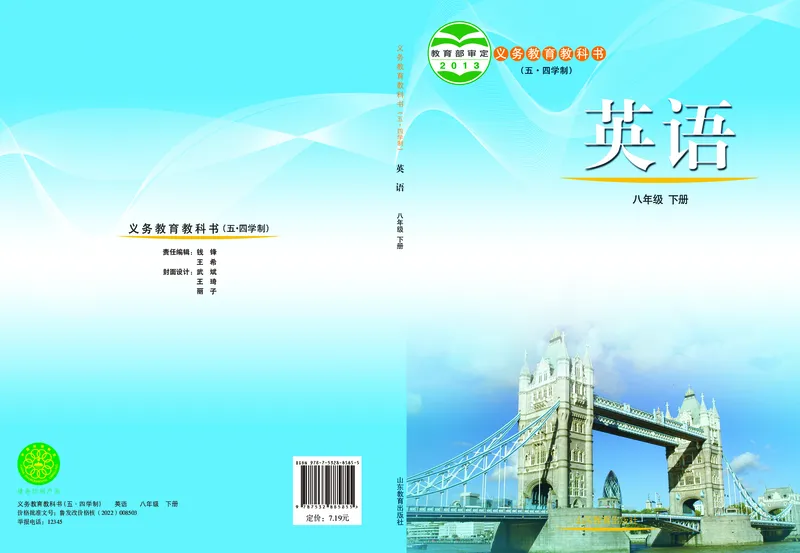
义务教育教科书(五·四学制)
英语
八年级 下册
人民教育出版社
圣智学习出版公司 编著
山东教育出版社
*
山东出版传媒股份有限公司
山东教育出版社出版
(济南市市中区二环南路 2066 号 4 区 1 号)
山东新华书店集团有限公司发行
山东泰安新华印务有限责任公司印装
*
开本:787 毫米×1092 毫米 1/16
印张:7. 5 字数:120 千
定价:7. 19 元(上光)
ISBN 978 - 7 - 5328 - 8585 - 5
2015 年 1 月第 1 版 2020 年 1 月第 2 版 2022 年 1 月第 8 次印刷
著 作 权 所 有 · 请 勿 擅 用 本 书 制 作 各 类 出 版 物 · 违 者 必 究
山东出版传媒股份有限公司教材中心售后服务电话:(0531)82098188致同学
亲爱的同学:
你好!欢迎学习我们精心为你编写的这套英语教材,希望它能成为你初中阶段
英语学习的好帮手。
作为中学生的你,一定希望进一步提高你的英语运用能力——能阅读英语读
物,能看懂英语电影,能用英语跟外国人交流⋯⋯那么你需要怎样做呢?让我们给
你一些建议吧。
● 首先要有信心,相信自己一定能学好英语。其次还要有热情,积极参与语言
实践。教材中设计了各种各样的练习活动,目的就是帮助你培养英语表达能力。只
要你带着热情去练习、去实践,你就会感受到成功的喜悦。
● 要养成良好的英语学习习惯,多听、多说、多读、多写。听的时候除了捕
捉信息,还要善于模仿。如果语音语调不正确,就不能有效地表达思想和情感。要
大胆地说,不要怕犯错误。要养成爱读英文的习惯,因为阅读是获取信息的主要渠
道。写能够巩固和强化你的语言知识,所以你还要重视写。
● 你是否发现,英语是有规律可循的?语音与拼法之间是有联系的。看到新单
词时,如果知道哪些字母发什么音,你就会比较容易地读出这个单词。并且,听到
某个单词的发音你就能比较容易地拼写出这个单词。所以,学英语一定要善于发现
规律。教材中的拼读规则练习你可不要忽视啊。
● 词汇学习非常重要,没有词汇的积累就无法进行言语表达。学单词时,要知
道它的意义,观察它的拼写,看它由哪些字母组成,试着按规则拼读出来,更重要
的是要看它是怎样使用的。
● 学习语法规则能帮助你说出和写出正确的句子。除了听老师讲解和看课本附
录中的语法说明外,你还要尝试自己归纳语法规则。但是,只知道语法规则是远远
不够的,只有在听说读写中练习运用这些规则,才能真正掌握语法。
● 学习语言离不开学习文化。从教材中你可以看到,不同国家的人们有着不同
的生活方式和行为习惯,有着不同的文化成就和遗产。了解中外文化知识会开阔你
的视野,会提高你跟外国人交际的能力。
● 英语学习不仅仅限于课堂,也不仅仅限于教材。如果你能把电视、报刊、图
书、互联网都当做英语学习的渠道,你的英语世界将是多么丰富多彩啊!
● 学习英语是一项艰辛的劳动,是与无数困难作斗争的过程,这好比攀登险
峰,无坦途可循,失败和挫折常与成功伴行。这就要求你具有良好的心理素质,善
于自我调控、改善学法、自我激励、磨练意志、树立信心。这样,你一定会成功!
祝你在英语学习中不断取得进步!
编 者
2014年12月Contents
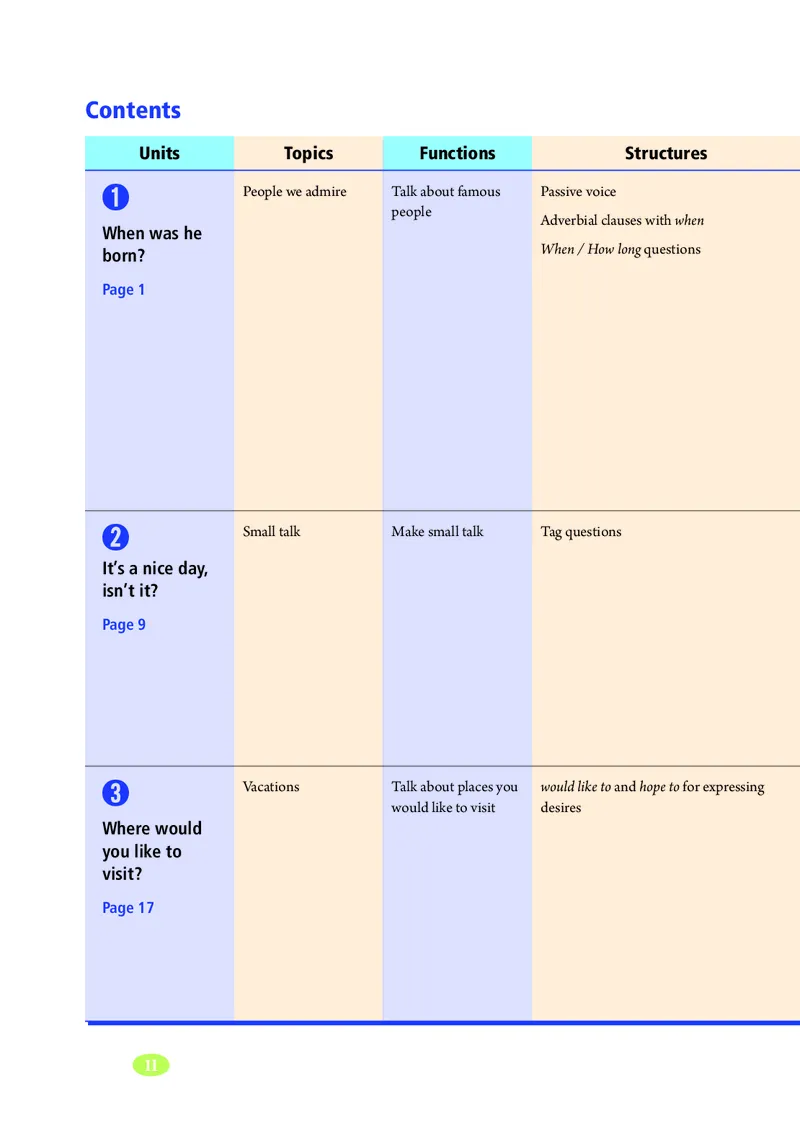
Units Topics Functions Structures Target Language Vocabulary Recycling
People we admire Talk about famous Passive voice Who’s that? swimmer, born, ice, admire, means, basketball player, music, musician,
➊
people That’s Ye Shiwen. She is a swimmer. novel, director, works, grandson, violinist, minute, photo, tower
Adverbial clauses with when
When was he skating, lover, listener
When was she born? play, stay, start, travel
born? When / How long questions
She was born in 1996. stop, paint, publish, perform, enter
dangerous, brave, high, kind,
Page 1 When did he start standing in the tower, besides, national, kind, famous
box? loving
When questions
How long did he stand on the tower? get in trouble, drop out of school,
try every means to do, at hand,
When he was 12, he dropped out of
break up
school.
How old was he when he started
doing this?
Small talk Make small talk Tag questions It’s a nice day, isn’t it? noon, chemistry, rest, conversation, bus, train, weather, rain, umbrella,
➋
stranger, secret, corner, community, party, music, culture
It always rains on the weekend,
It’s a nice day,
introduction, dialog, period, form,
doesn’t it? really, always, friendly, strict,
isn’t it? business, worker, customer, subject,
nervous
You just started yesterday, didn’t you? chance
Page 9
everyday, empty, helpful, light,
humorous, private, general
next to, wait in line, small talk,
break the ice
Vacations Talk about places you would like to and hope to for expressing Where would you like to do on fall, capital, church, survey, choice, Brazil, vacation, mountain, shopping,
➌
would like to visit desires vacation? company weather
Where would I’d love to visit Mexico.
convenient, underground dangerous, fun, relaxing, friendly
you like to
I hope to go to France some day.
translate, suppose, receive visit, travel, hope
visit?
take it easy, in general, as soon as
Page 17
possible, dream of, be willing to,
hold on to
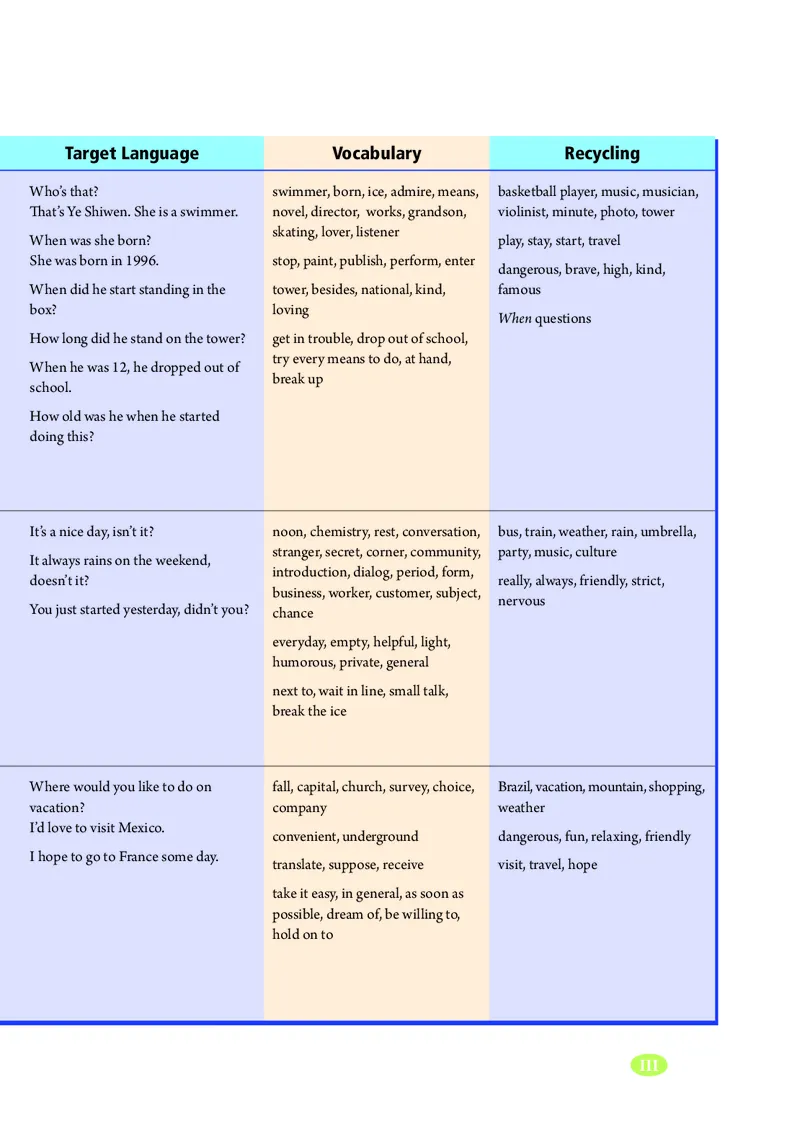
IIUnits Topics Functions Structures Target Language Vocabulary Recycling
People we admire Talk about famous Passive voice Who’s that? swimmer, born, ice, admire, means, basketball player, music, musician,
➊
people That’s Ye Shiwen. She is a swimmer. novel, director, works, grandson, violinist, minute, photo, tower
Adverbial clauses with when
When was he skating, lover, listener
When was she born? play, stay, start, travel
born? When / How long questions
She was born in 1996. stop, paint, publish, perform, enter
dangerous, brave, high, kind,
Page 1 When did he start standing in the tower, besides, national, kind, famous
box? loving
When questions
How long did he stand on the tower? get in trouble, drop out of school,
try every means to do, at hand,
When he was 12, he dropped out of
break up
school.
How old was he when he started
doing this?
Small talk Make small talk Tag questions It’s a nice day, isn’t it? noon, chemistry, rest, conversation, bus, train, weather, rain, umbrella,
➋
stranger, secret, corner, community, party, music, culture
It always rains on the weekend,
It’s a nice day,
introduction, dialog, period, form,
doesn’t it? really, always, friendly, strict,
isn’t it? business, worker, customer, subject,
nervous
You just started yesterday, didn’t you? chance
Page 9
everyday, empty, helpful, light,
humorous, private, general
next to, wait in line, small talk,
break the ice
Vacations Talk about places you would like to and hope to for expressing Where would you like to do on fall, capital, church, survey, choice, Brazil, vacation, mountain, shopping,
➌
would like to visit desires vacation? company weather
Where would I’d love to visit Mexico.
convenient, underground dangerous, fun, relaxing, friendly
you like to
I hope to go to France some day.
translate, suppose, receive visit, travel, hope
visit?
take it easy, in general, as soon as
Page 17
possible, dream of, be willing to,
hold on to
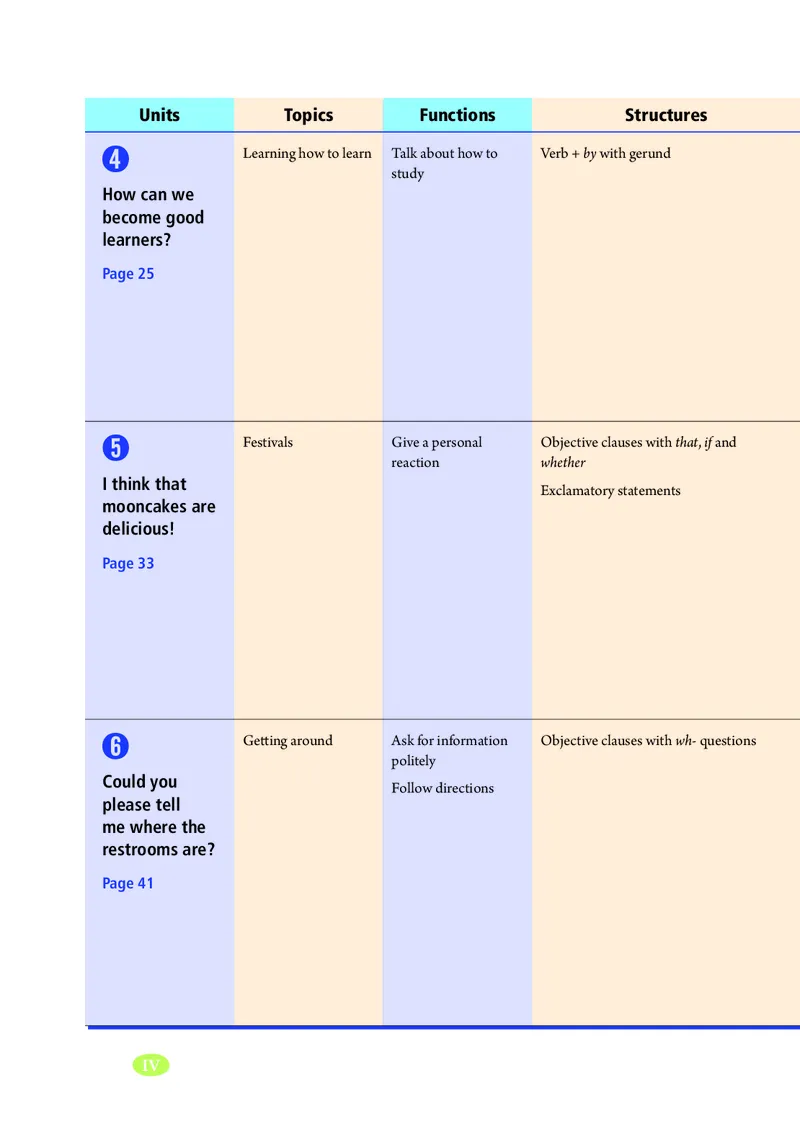
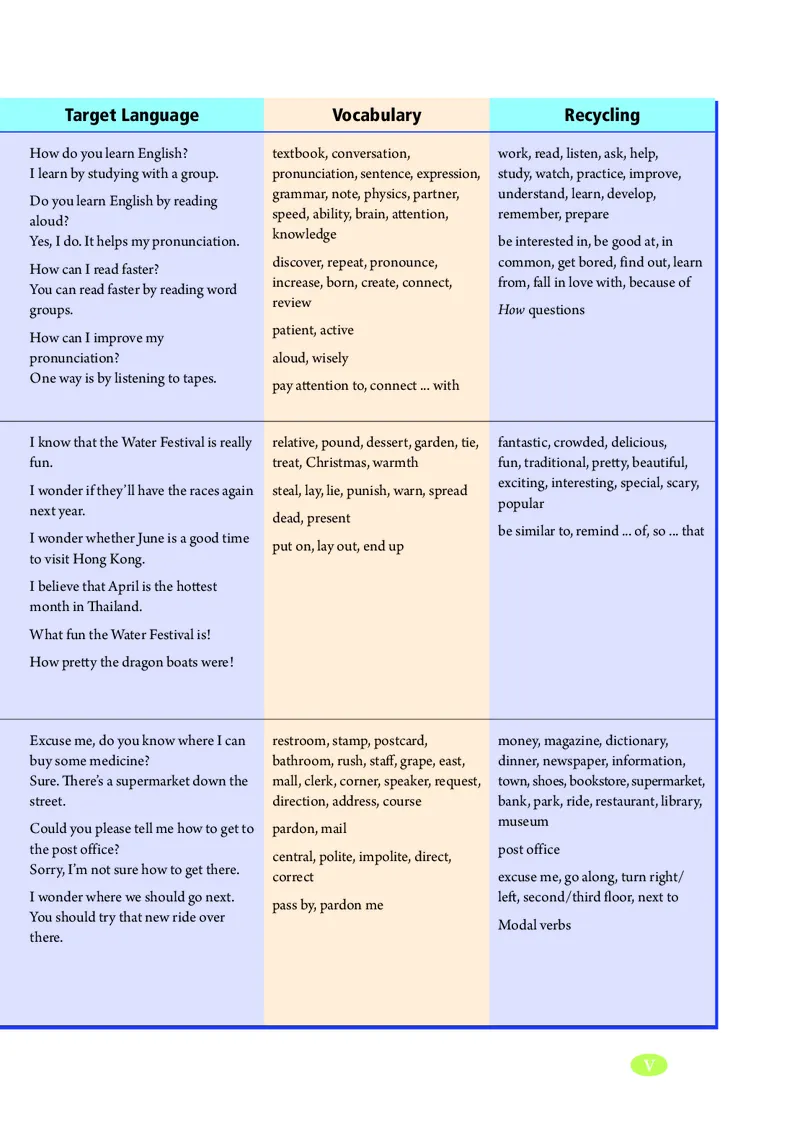
IIIUnits Topics Functions Structures Target Language Vocabulary Recycling
Learning how to learn Talk about how to Verb + by with gerund How do you learn English? textbook, conversation, work, read, listen, ask, help,
➍
study I learn by studying with a group. pronunciation, sentence, expression, study, watch, practice, improve,
How can we grammar, note, physics, partner, understand, learn, develop,
Do you learn English by reading
become good speed, ability, brain, attention, remember, prepare
aloud?
learners? Yes, I do. It helps my pronunciation. knowledge be interested in, be good at, in
discover, repeat, pronounce, common, get bored, find out, learn
Page 25 How can I read faster?
increase, born, create, connect, from, fall in love with, because of
You can read faster by reading word
review
groups. How questions
patient, active
How can I improve my
pronunciation? aloud, wisely
One way is by listening to tapes.
pay attention to, connect ... with
Festivals Give a personal Objective clauses with that, if and I know that the Water Festival is really relative, pound, dessert, garden, tie, fantastic, crowded, delicious,
➎
reaction whether fun. treat, Christmas, warmth fun, traditional, pretty, beautiful,
I think that exciting, interesting, special, scary,
Exclamatory statements I wonder if they’ll have the races again steal, lay, lie, punish, warn, spread
mooncakes are popular
next year.
dead, present
delicious! be similar to, remind ... of, so ... that
I wonder whether June is a good time
put on, lay out, end up
Page 33 to visit Hong Kong.
I believe that April is the hottest
month in Thailand.
What fun the Water Festival is!
How pretty the dragon boats were!
Getting around Ask for information Objective clauses with wh- questions Excuse me, do you know where I can restroom, stamp, postcard, money, magazine, dictionary,
➏
politely buy some medicine? bathroom, rush, staff, grape, east, dinner, newspaper, information,
Could you Sure. There’s a supermarket down the mall, clerk, corner, speaker, request, town, shoes, bookstore, supermarket,
Follow directions
please tell street. direction, address, course bank, park, ride, restaurant, library,
me where the Could you please tell me how to get to pardon, mail museum
restrooms are? the post office? post office
central, polite, impolite, direct,
Sorry, I’m not sure how to get there.
correct excuse me, go along, turn right/
Page 41
I wonder where we should go next. left, second/third floor, next to
pass by, pardon me
You should try that new ride over
Modal verbs
there.
IVUnits Topics Functions Structures Target Language Vocabulary Recycling
Learning how to learn Talk about how to Verb + by with gerund How do you learn English? textbook, conversation, work, read, listen, ask, help,
➍
study I learn by studying with a group. pronunciation, sentence, expression, study, watch, practice, improve,
How can we grammar, note, physics, partner, understand, learn, develop,
Do you learn English by reading
become good speed, ability, brain, attention, remember, prepare
aloud?
learners? Yes, I do. It helps my pronunciation. knowledge be interested in, be good at, in
discover, repeat, pronounce, common, get bored, find out, learn
Page 25 How can I read faster?
increase, born, create, connect, from, fall in love with, because of
You can read faster by reading word
review
groups. How questions
patient, active
How can I improve my
pronunciation? aloud, wisely
One way is by listening to tapes.
pay attention to, connect ... with
Festivals Give a personal Objective clauses with that, if and I know that the Water Festival is really relative, pound, dessert, garden, tie, fantastic, crowded, delicious,
➎
reaction whether fun. treat, Christmas, warmth fun, traditional, pretty, beautiful,
I think that exciting, interesting, special, scary,
Exclamatory statements I wonder if they’ll have the races again steal, lay, lie, punish, warn, spread
mooncakes are popular
next year.
dead, present
delicious! be similar to, remind ... of, so ... that
I wonder whether June is a good time
put on, lay out, end up
Page 33 to visit Hong Kong.
I believe that April is the hottest
month in Thailand.
What fun the Water Festival is!
How pretty the dragon boats were!
Getting around Ask for information Objective clauses with wh- questions Excuse me, do you know where I can restroom, stamp, postcard, money, magazine, dictionary,
➏
politely buy some medicine? bathroom, rush, staff, grape, east, dinner, newspaper, information,
Could you Sure. There’s a supermarket down the mall, clerk, corner, speaker, request, town, shoes, bookstore, supermarket,
Follow directions
please tell street. direction, address, course bank, park, ride, restaurant, library,
me where the Could you please tell me how to get to pardon, mail museum
restrooms are? the post office? post office
central, polite, impolite, direct,
Sorry, I’m not sure how to get there.
correct excuse me, go along, turn right/
Page 41
I wonder where we should go next. left, second/third floor, next to
pass by, pardon me
You should try that new ride over
Modal verbs
there.
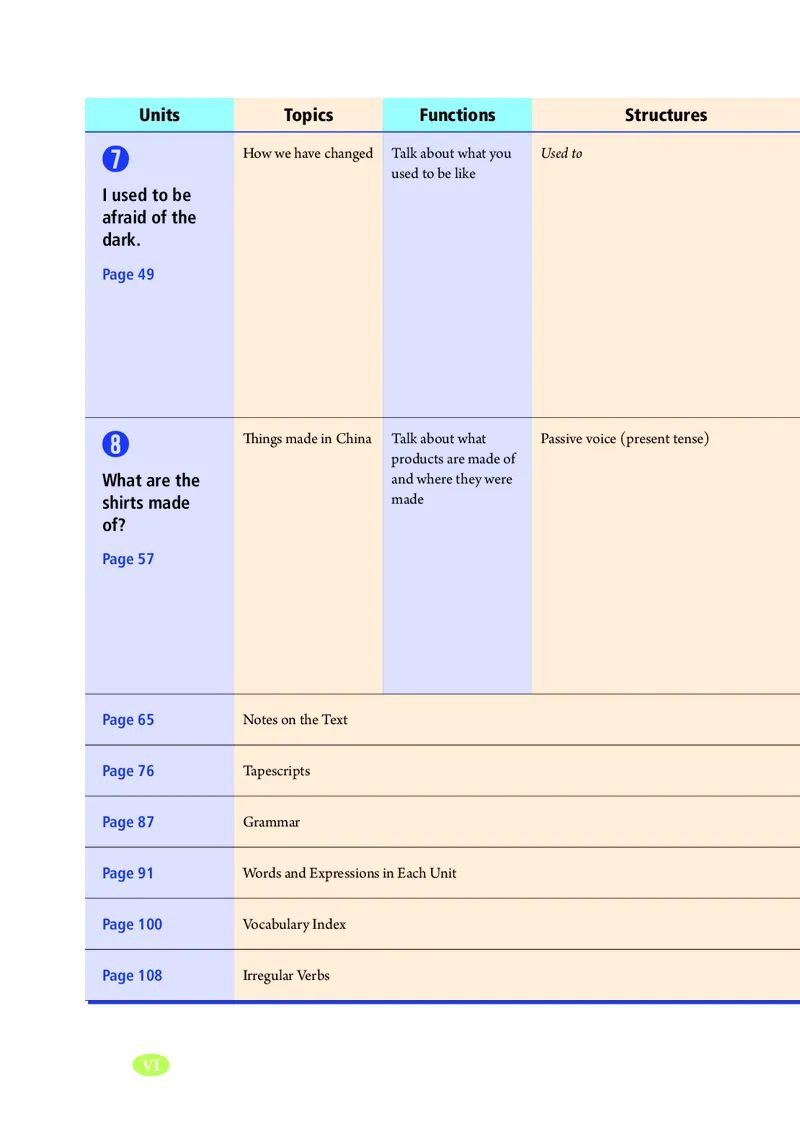
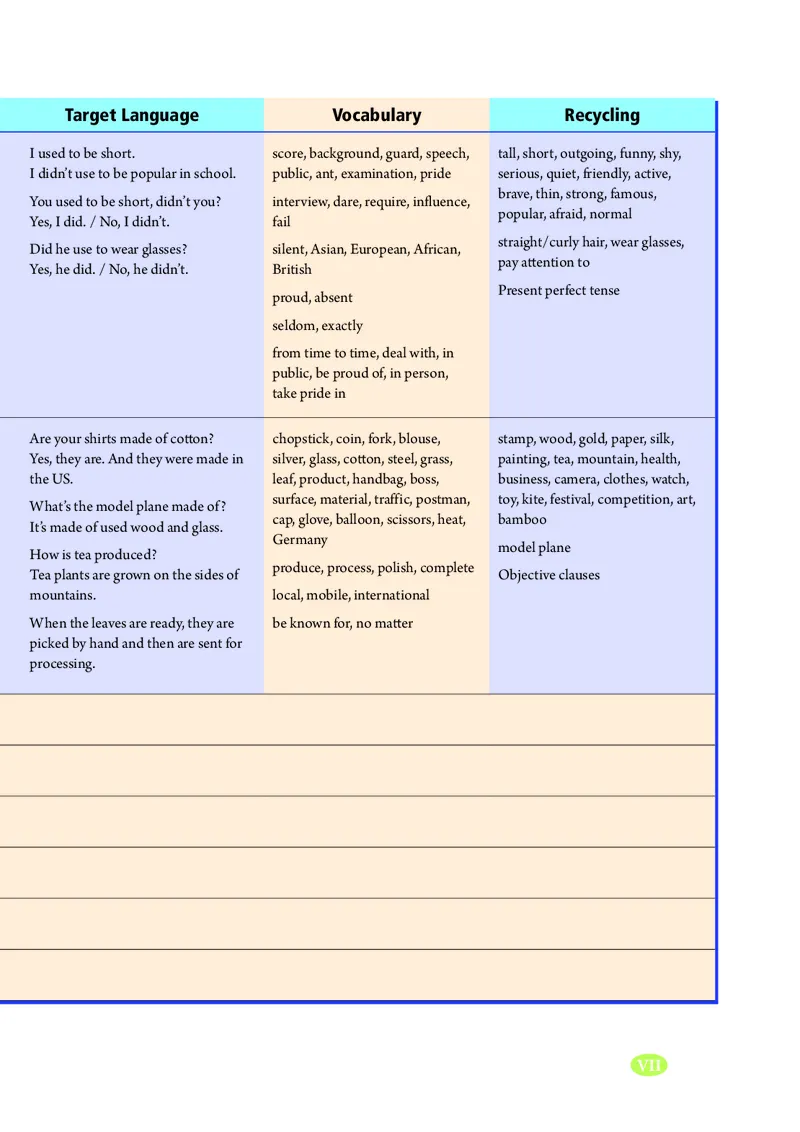
VUnits Topics Functions Structures Target Language Vocabulary Recycling
How we have changed Talk about what you Used to I used to be short. score, background, guard, speech, tall, short, outgoing, funny, shy,
➐
used to be like I didn’t use to be popular in school. public, ant, examination, pride serious, quiet, friendly, active,
I used to be brave, thin, strong, famous,
You used to be short, didn’t you? interview, dare, require, influence,
afraid of the popular, afraid, normal
Yes, I did. / No, I didn’t. fail
dark. straight/curly hair, wear glasses,
Did he use to wear glasses? silent, Asian, European, African,
pay attention to
Page 49 Yes, he did. / No, he didn’t. British
Present perfect tense
proud, absent
seldom, exactly
from time to time, deal with, in
public, be proud of, in person,
take pride in
Things made in China Talk about what Passive voice (present tense) Are your shirts made of cotton? chopstick, coin, fork, blouse, stamp, wood, gold, paper, silk,
➑
products are made of Yes, they are. And they were made in silver, glass, cotton, steel, grass, painting, tea, mountain, health,
What are the and where they were the US. leaf, product, handbag, boss, business, camera, clothes, watch,
shirts made made surface, material, traffic, postman, toy, kite, festival, competition, art,
What’s the model plane made of?
of? It’s made of used wood and glass. cap, glove, balloon, scissors, heat, bamboo
Germany
model plane
Page 57 How is tea produced?
produce, process, polish, complete
Tea plants are grown on the sides of Objective clauses
mountains. local, mobile, international
When the leaves are ready, they are be known for, no matter
picked by hand and then are sent for
processing.
Page 65 Notes on the Text
Page 76 Tapescripts
Page 87 Grammar
Page 91 Words and Expressions in Each Unit
Page 100 Vocabulary Index
Page 108 Irregular Verbs
VIUnits Topics Functions Structures Target Language Vocabulary Recycling
How we have changed Talk about what you Used to I used to be short. score, background, guard, speech, tall, short, outgoing, funny, shy,
➐
used to be like I didn’t use to be popular in school. public, ant, examination, pride serious, quiet, friendly, active,
I used to be brave, thin, strong, famous,
You used to be short, didn’t you? interview, dare, require, influence,
afraid of the popular, afraid, normal
Yes, I did. / No, I didn’t. fail
dark. straight/curly hair, wear glasses,
Did he use to wear glasses? silent, Asian, European, African,
pay attention to
Page 49 Yes, he did. / No, he didn’t. British
Present perfect tense
proud, absent
seldom, exactly
from time to time, deal with, in
public, be proud of, in person,
take pride in
Things made in China Talk about what Passive voice (present tense) Are your shirts made of cotton? chopstick, coin, fork, blouse, stamp, wood, gold, paper, silk,
➑
products are made of Yes, they are. And they were made in silver, glass, cotton, steel, grass, painting, tea, mountain, health,
What are the and where they were the US. leaf, product, handbag, boss, business, camera, clothes, watch,
shirts made made surface, material, traffic, postman, toy, kite, festival, competition, art,
What’s the model plane made of?
of? It’s made of used wood and glass. cap, glove, balloon, scissors, heat, bamboo
Germany
model plane
Page 57 How is tea produced?
produce, process, polish, complete
Tea plants are grown on the sides of Objective clauses
mountains. local, mobile, international
When the leaves are ready, they are be known for, no matter
picked by hand and then are sent for
processing.
Page 65 Notes on the Text
Page 76 Tapescripts
Page 87 Grammar
Page 91 Words and Expressions in Each Unit
Page 100 Vocabulary Index
Page 108 Irregular Verbs
VIIU 1
NIT
When was he born? UNIT 1
Section
A When was he born?
Language
Goal:
Talk about
famous
people
1. He / She can play football very well.
1a Think about the Messi
international sports stars
2. He / She can swim very fast.
you know. Add more
Ye Shiwen
names to the list.
3. He / She can hit the ball very fast.
Li Na
4. He / She can play basketball well.
Kobe
1b Listen and write the year the sports star was born under each photo.
Kobe Li Na Ye Shiwen Messi
basketball player tennis player swimmer football player
Born: Born: Born: Born:
1c Practice the conversation.
A: Who’s that?
Then make conversations
B: That’s Ye Shiwen. She’s a swimmer.
about other sports stars.
A: Is she good?
B: Oh, yes. She swims really fast.
A: When was she born?
B: She was born in 1996.
1UNIT 1
2a Listen and fill in the “How
long” column in the chart.
Who Activities How long Started Stopped
standing in a 2 days, 15 hours,
box of ice and 42 minutes
standing on a
high tower
2b Listen again and fill in the “Started” and “Stopped” columns in the
chart in 2a.
2c Fill in the blanks with
A: How long did David Blaine stand in a box of ice?
the information in the
B: He stood in a box of ice for 2 days,
chart in 2a. Practice
hours and minutes.
the conversation with
A: When did he start standing in the box?
a partner. Then have
B: He started on .
the same kind of
A: When did he stop?
conversation about
B: He stopped on .
David Blaine’s other
activity.
2d Role-play the conversation.
Tony: Hey, Andy. What are you watching?
Andy: Oh, it’s a show about people with great
talents. I really admire this guy.
Tony: Oh, who is he?
Andy: He’s a street artist. He paints pictures on
the ground or on buildings.
Tony: The pictures look so real and 3D!
Andy: Yes, the pictures are flat, but they look like they’re 3D.
Tony: When did he start painting these pictures?
Andy: I think he started about f ive years ago.
Tony: How old was he when he started doing this?
Andy: Hmm…I guess he was about 20 years old when he started. He was still
a college student. He sometimes got in trouble for painting the buildings
at school!
Tony: I wonder if I can learn to paint like that. It’s so cool!
Andy: Well, I’m sure you can.
2When was he born? UNIT 1
3a Discuss the questions with your partner.
1. Do you know anything about the Nobel Prize?
2. Do you know of any famous writers?
3b Read the article and answer the questions below.
Mo Yan
Chinese writer Mo Yan has won the 2012 Nobel
Prize in Literature! Mo is the first Chinese who won
the prize. When he heard the news, Mo said he never
expected to win the prize, as there were so many
good writers all over the world.
Mo Yan is the writer’s pen name. His real name is
Guan Moye. He was born into a farmer’s family in Gaomi, Shandong, in
February 1955. When he was 12, he dropped out of school and started to
work, first in his village and later in a factory.
Little Moye enjoyed reading. But at that time, there were only a few books
available in his village. He had to try every means to find books to read.
With no more books at hand, he started reading a Chinese dictionary. He
read it so many times that he found several mistakes in it.
In 1976, he joined the army. During that time, he began to study literature
and write stories. His first short story was published in
1981. He became famous in 1987 when his novel Red
Sorghum was made into a film by the famous director
Zhang Yimou. He also won the 8th Mao Dun Literature
Prize in 2011 for his novel Frog.
Mo Yan is a famous writer in the world now. More and
more people are becoming interested in his works.
1. What did Mo Yan say when he heard the news that he won the Nobel Prize?
2. What did little Moye read when he couldn’t find any more books?
3. When did Mo Yan become a famous writer?
4. What other prize in literature did Mo Yan win besides the Nobel Prize?
3c Read the article and complete the chart below.
When What he did
1955
dropped out of school
1976
1981
2012
3UNIT 1
Grammar
Focus
When were you born? I was born in 1997.
How long did David Blaine stand in a box He stood in it for 2 days,15 hours and
of ice? 42 minutes.
When did he start standing on the tower? He started standing on it on May
22nd.
How old was Mo Yan when he left school He was 12 years old.
and started to work?
4a Write questions for these answers. Use the names in the box to help you.
Kobe Messi Li Na Ye Shiwen
1.
She was born in 1996 and is a very good swimmer.
2.
He was born in 1978 and he can play basketball well.
3.
He started playing football in a football club when he was seven.
4.
She started her life as a tennis player when she was 17 years old.
4b Fill in the blanks Names Achievements Ages
using the information
Shirley Temple became a movie star 3 years old
in the chart.
Mozart wrote music 4 years old
Mei Lanfang performed Beijing Opera 10 years old
You are never too
Ronaldo played for a national team 17 years old
young to start doing
things. For example, Shirley Temple was a movie star .
Mozart started writing music . And Mei Lanfang first
performed Beijing Opera . And Ronaldo, the great Brazilian
soccer player, played for his first national team .
4c How old were you when you
A: How old were you when
started doing the things below?
you learned to ride a bike?
Interview your classmates and
B: I was 10 years old.
f ind out who did each thing f irst.
A: Oh, that’s early. How about
you, Li Tong?
learned to ride a bike f irst went to a movie
B: I was eight when I learned
started learning English f irst had a birthday party
to ride a bike.
4When was he born? UNIT 1
1a Look at these people. Under each picture, write
Section
one or two words to describe the person.
B
loving kind famous friendly
creative hard-working shy talented
Arthur Tony Sarah Vivian
1b Imagine you know the people in
A: Arthur is a loving grandfather.
the pictures in 1a. Tell your group
He spends all his free time
about the people.
with his grandson.
1c Listen. Two people are talking about people they admire. Circle the
words on the list in 1a that you hear.
1d Listen again. Are these sentences about Midori or Laura? Write
M (for Midori) or L (for Laura) on the lines.
1. M She’s a famous violinist.
2. She was born in Osaka in 1971.
3. She started ice-skating when she was four.
4. I saw her play when I was eight.
5. She’s a kind and loving grandmother.
6. She was born in Russia in 1932.
7. She won a skating competition when she was 10.
8. She traveled around the United States when she was 14.
1e Look at 1d. Ask and
A: Who’s Midori?
answer questions about
B: She’s a famous violinist.
Midori and Laura.
A: When was she born?
B: She was born in 1971.
A: What did she do when she was 14?
B: ...
5UNIT 1
2a Do you know of any famous pianists? What do you know about Chopin?
Share what you know with your partner.
2b Skim the following paragraphs
FINDING THE ORDER OF EVENTS
and put them in order by
numbering them 1 to 3. Writers describe events in a
certain order. Finding the order
of the events will help you
understand what you are reading.
Fryderyk Chopin
In his later years, he enjoyed playing at his apartment for a few friends
more than giving big concerts. Chopin became seriously ill when he was
only 25 and continued to have bad health into his old age. In his last years, he
was very weak but kept on writing music until he died in 1849. The world lost a
musical talent, but his spirit continues to live in his works today.
Fryderyk Chopin was a famous pianist and music writer.
Today many piano music lovers still listen to his famous
works such as Minute Waltz. He was born on March 1,
1810 in a small village in Poland. Everyone in Chopin’s
family was a musician. His father played the violin, and his
mother and sister played the piano. His family moved to
Warsaw when Chopin was seven months old.
When he was six years old, he started to take piano lessons. Soon he played
even better than his teacher. At that time, he also started to write music,
and began to give concerts when he was only seven! In 1825, when he was 15
years old, people said he was the best pianist in Warsaw. They called him the
poet of the piano because his music could touch the hearts of his listeners.
2c Read the article and sum up the key information about Fryderyk
Chopin by completing the chart below.
When What he did
In 1810
When he was seven months old
When he was six years old
A year later
In 1825
When he was 25 years old
In 1849
6When was he born? UNIT 1
2d Write a short
Who’s Chopin?
summary of
When was he born?
Chopin’s life by Where was he born?
answering the How old was he when he started playing the piano?
following When did he start writing music?
questions. How long did he play the piano and write music?
Why was he famous?
When did he die?
2e Talk about a famous
Who is he / she?
star or an important
What is he / she?
person in your group,
When and where was he / born?
using the structures in
How old was he / she when he / she started ... ?
the box. How long did he / she (do) ... ?
What made him / her famous?
3a Read the information about John Lennon, a famous pop musician.
Then write an article about him.
Name: John Lennon
Year of birth: 1941
Place of birth: Liverpool in the UK
Childhood: Lived with aunt and uncle
Age 12: Began to play music
Teenage years: Started first music group, The Quarrymen
1960: The Quarrymen became The Beatles, one of the
most famous groups in music history. This group
included his friend, Paul McCartney.
October 1962: The group’s first song, Love Me Do, got to number 17 on the
music charts in the UK.
1970: The Beatles broke up
1975: The famous song, Imagine, by John Lennon got to number 6 on
the UK music charts.
December 8, 1980: Died in New York
Not long after his death: Imagine entered the UK charts again and got to number 1.
John Lennon was born in 1941 in …
7UNIT 1
3b Make notes about a famous or important person you know. Use the
following topics to help you. Then write a short article about him / her.
Personal information — name, age, place of birth, …
Reasons for being famous / important
Information about his / her family / friends
Important things that happened in his / her life
Self Check
1 Answer the questions about these people. Use the information
in the chart below.
Jenny Zhang — Billy Anders Tony Yu — Helen Barth
ice-skating —football baseball —ping-pong
Start when she was five 1998 when he was 15 1988
Stop when she was 35 2011 when he was 38 2009
1. Q: How long did Jenny Zhang ice-skate?
A:
2. Q: When did Billy Anders start playing football?
A:
3. Q: How old was Tony Yu when he stopped playing baseball?
A:
4. Q: How long did Helen Barth play ping-pong?
A:
2 Match the question words and the rest of the question.
1. Who is… a. you when you started speaking English?
2. When was … b. Li Na?
3. When did… c. The Beatles play together?
4. How long did… d. Midori start ice-skating?
5. How old were… e. Chopin born?
3 Use information in this unit or information that you know to
answer the questions in activity 2.
1.
2.
3.
4.
5.
8U 2
NIT
It’s a nice day, isn’t it? UNIT 2
Section
A It’s a nice day, isn’t it?
a b
Language
Goals:
Make
small talk;
Introduce
people
c d
He’s really
good, isn’t
he? He sure is!
1a Do you sometimes talk with people you don’t know? This kind of
conversation is called small talk. Circle the situations above where you
would start a conversation. Make a list of other places where you would
talk to people you don’t know.
on a bus
1b Listen and number the pictures above in the order you hear them.
1c Look at the pictures above and make other conversations. You can use
the expressions in the box.
The train is always late, isn’t it?
A: It looks like rain, doesn’t it?
You love violin music, don’t you?
B: Yes, it does. And I forgot my
It looks like rain, doesn’t it?
umbrella.
You’re Tim’s cousin, aren’t you?
9UNIT 2
2a To have successful small talk, both people U Conversation 1
need to ask questions. Listen to the three
Conversation 2
conversations. Are they examples of
Conversation 3
successful (S) or unsuccessful (U)
conversations?
2b Listen to Conversation 3 again. Put the
sentences and questions below in order.
a. I hope so. I want to go swimming. A. (Opening Question) f
b. Yes. It rains every Saturday! (1)
B. (Answer) (Question)
c. At Franklin Lake.
(2) (3)
d. Oh? Where do you swim? A. (Answer)
e. Do you think it’ll stop by noon? (4)
B. (Question)
f. It always rains on the weekend, doesn’t it?
(5)
g. Do you ever go there? A. (Answer) (Question)
(6) (7)
2c Imagine you are at a bus stop. Make your own small talk. You can use
the expressions in the box.
It’s really cold today, isn’t it? A: It’s really cold today, isn’t it?
The No. 15 bus stops here, doesn’t it? B: Yes, it is. I hope the bus comes soon.
2d Role-play the conversation.
Peter: Hello. My name’s Peter.
Mike: Hi, Peter. Nice to meet you. I’m Mike.
Peter: Oh. You’re Mike. You just started yesterday, didn’t you?
Mike: Yes, that’s right. Today’s my second day.
Peter: So, what do you think of our school?
Mike: Mmm. It’s very nice, isn’t it?
Peter: Yes. The students are very friendly. But you haven’t met your teachers yet,
have you?
Mike: No, I haven’t. Are they strict?
Peter: Well, the chemistry teacher Miss Wu is kind of strict, but the rest are OK.
Mike: That’s good. And the school’s very big, isn’t it?
Peter: Yes. This is the biggest school in town. You have an elder sister, don’t you?
Mike: No, my sister’s younger than me.
Peter: Oh, I see. Anyway, I have a class now, so see you later!
Mike: Sure. See you later!
10It’s a nice day, isn’t it? UNIT 2
3a Number the paragraphs of the article in
the correct order.
Alone among strangers:
Dealing with a difficult situation
Ben isn’t the only person that has
experienced this situation. Something similar has probably happened to most
of us before. It’s natural to feel unsure of ourselves when starting conversations
with strangers. A good starting point is to ask the person questions about
himself or herself, or talk about something you both like such as football or
pop music. This can make social situations more relaxed. Then you’ll be glad
you went to the party.
Finally, I turned to the person next to me and introduced myself. “Hi,”
I said. “My name’s Ben.” “Hi, I’m Tania,” the person replied shyly. Then there
was a long silence as I kept trying to think about what to say next. I felt more
and more nervous and the other person was looking uncomfortable, too. In
the end, all I could say was, “Well, it was nice meeting you,” and I quickly
walked away. I felt so embarrassed that I left the party.
It was Friday night and I could hear loud music and people talking
as I walked through the door. My friend saw me and came over. “Hey, Ben!
Thanks for coming to my party!” he said. “Thanks for inviting me. It looks
like a great party,” I replied. But I had a secret feeling of fear. I realized that I
didn’t know anyone there. I moved towards the drinks table and got a drink.
Then I nervously stood in a corner, not quite sure what to do.
3b Read the passage again and answer the questions.
1. Where was Ben?
2. Why was he scared and nervous?
3. What happened when Ben tried to talk to Tania?
4. What does the writer suggest for Ben’s situation?
3c Help Ben and Tania. Complete the questions below. Then write three
more conversation starters. Use the topics in brackets.
This is a really good party, ?
You are a friend of David’s, ?
(weather) ?
(food at the party) ?
(a music group) ?
11UNIT 2
Grammar
Focus
It’s a nice day, isn’t it? Yes, it is.
You weren’t at the party, were you? Yes, I was. / No, I wasn’t.
The No. 15 bus stops here, doesn’t it? Yes, it does.
You don’t live here, do you? Yes, I do. / No, I don’t.
Yes, that’s right. / No, I’ve been
You just started yesterday, didn’t you?
in this school for two years.
You haven’t met your teachers yet, have you? Yes, I have. / No, I haven’t.
4a Fill in the blanks with the appropriate tag questions. Then match the
questions and answers by writing the correct letter after each question.
1. You attended the community event on Friday, a. Yes, it was. I was going to go out,
? but decided to stay home.
2. You’re on the school basketball team, b. Yes, I do. It’s quite different from
? my last school.
3. You like our school, ? c. No, I didn’t. Was it good?
4. It was really cold last night, ? d. No, we haven’t. I just moved
here two weeks ago.
5. We haven’t met before, ? e. Yes, I am. I’m on the tennis team, too.
4b Write the sentences in the correct Which beach do you usually go to?
places in the conversation. You, too. Goodbye.
I’m going to the beach today.
A: This is great weather, isn’t it?
Oh, it’s crowded there, isn’t it?
B: It sure is. But it’s a little hot for me.
A: Oh, I love hot weather. (1) .
B: Which beach are you going to?
A: I’m going to Today Beach. (2) ?
B: I usually go to Sandy Beach.
A: (3) ?
B: No, it’s never crowded. Oh, my bus is here. Well, have a good day!
A: (4) .
B: Goodbye.
4c Make up a conversation for two of the situations.
• Playing in the park A: It’s hot today, isn’t it?
• Meeting a group of friends at the B: Yes, I’m glad we’re inside.
shopping center A: It’s a perfect day for
• Waiting in line at the movie theater shopping in a cool
• Meeting at a dining hall shopping center.
12It’s a nice day, isn’t it? UNIT 2
1a Check (✔) the questions you think are good for
Section
polite small talk with people you don’t know well.
c
B
a b d
You’re Anna’s
Do you like How much did brother, aren’t How big is
action that shirt cost? you? your flat?
movies?
1b Make up a conversation using one of the
A: Do you like action movies?
questions in 1a. Then practice the
B: No, but I love comedies.
conversation with your partner.
1c Listen to the three
Names Where?
conversations. Where are
Conversation 1 at a party
the people in each
conversation? Write the Conversation 2
places in the chart. Conversation 3
1d Listen again. Match each question with the correct answer.
Questions Answers
1. You’re Jenny’s friend, aren’t you? d a. Yes, it is. Are you a ball game fan?
2. So, tell me about yourself, Rita. Do you b. No, I haven’t. I started here last
play any sports? year.
3. What do you think of the school? c. It’s great.
4. You’ve always been in this school, haven’t d. Yes, I am. My name is Rita.
you? e. Yes, I did. It was really exciting,
5. It’s really crowded, isn’t it? wasn’t it?
6. Did you see Friday night’s game on TV? f. Yeah! I play tennis and ping-pong.
1e Role-play a small talk conversation. You can choose one of the openers
below.
1. Hi! You’re new here, aren’t you?
A: This is a great party,
2. This is a great party, isn’t it?
isn’t it?
3. Hi! My name’s Andy. I’m Karen’s brother.
B: Yes, it is.
4. You love baseball games, don’t you?
13UNIT 2
2a When Chinese people meet each other for the first time, what do they
usually talk about? Discuss it with a partner.
2b Read the first sentence of each paragraph from an article about small
talk. What do you think the paragraphs will be about? Match each
paragraph [A-E] with a heading below [1-5].
PREDICTING USING TOPIC SENTENCES 1. Cultural differences
2. Cultural similarities
The first sentence of each paragraph is usually the
3. What is small talk?
topic sentence. Reading the topic sentence can give us
4. What should we talk about?
an idea of what the paragraph will be about. When we
5. An everyday activity
read we should try to anticipate what will come next.
This means we should always be thinking ahead about
what will be next in the reading passage.
Introduction to “small talk”
A.
Small talk is relaxed dialog that helps people pass the time when they meet others.
Empty silences often make us feel nervous so this is a way of filling those periods. In
English, people often say it “breaks the ice”. You can make small talk when waiting in
line at an airport or bus stop. Though the things we talk about are not usually
important, small talk itself is. It makes others feel relaxed and it passes time nicely.
B.
For some, small talk is a common form of communication. Business travelers, for
example, always meet new people and usually make small talk before discussing
serious business. They might be asked about how they got to the meeting or if
their hotel is comfortable. Workers in shops or restaurants also find small talk
helpful when they are serving customers.
C.
People make small talk in almost every country. What they say may be very
different, but the basic rules of small talk are often the same. In most cultures, it is
important to smile and keep the conversation light and humorous. Making other
people smile can make them feel relaxed.
D.
Things we should not discuss can also depend on culture. In China, we can ask
people if they are married or whether they have children. However, many Western
people think these are private subjects, so they should be avoided. Also, the
common Chinese greeting “Have you eaten yet?” would seem strange to an
English-speaking person.
E.
Therefore, we should usually discuss “safe” subjects like the weather, which is
common in many cultures. People in England often talk about the weather, probably
because it changes so much. However, the most important thing is to give the
other person a chance to speak and listen to what they have to say.
14It’s a nice day, isn’t it? UNIT 2
2c Look again at the topic sentences. In which paragraph do you expect to
find the answer to the following questions?
Paragraph : What do people often talk about in England? Why?
Paragraph : How does small talk make other people feel?
Paragraph : What kind of people use small talk in their jobs?
Paragraph : Which common questions in China might not be right for
other countries?
Paragraph : Which rules of small talk are the same in most cultures?
Paragraph : Where do people often make small talk?
2d Now read the whole article to answer the questions in 2c.
2e Look at the list of subjects. What questions could you ask to start some
small talk about each subject?
travel pets television sports work
weather general news music hobbies food
holidays films books studies
3a Think of situations where you have to make small talk. What are good
things to talk about? What things should you not talk about? Put the
phrases in the correct box.
weather family problems
in a bookstore with a stranger a first meeting for a school club
in the school hall with a classmate jobs
at a party money
someone you like/hate favorite things
TV shows or movies
Situations Safe subjects Subjects to avoid
15UNIT 2
3b Write a short article for a school magazine giving advice about small talk.
Useful language:
1. Describe the
Do you know how to make successful small talk?
different situations
Here are some tips and advice.
for small talk.
You may need to make small talk when .
2. Give advice about
It is a good idea to .
what to talk about.
You should / shouldn’t talk about because .
3. Write a short sample
When / If you , you could talk about .
dialog.
Small talk is easy if .
Self Check
1 Write the answers.
Three things you can talk about during small talk:
Three things you shouldn’t talk about during small talk:
2 Complete the tag questions.
1. It’s cold today, ?
2. This dish doesn’t taste very good, ?
3. You’re Mike’s cousin, ?
4. You haven’t seen this exhibition yet, ?
5. Our English lesson was fun today, ?
6. You’re not from here, ?
7. This bus stops near the museum, ?
8. You want to go to the movie tonight, ?
3 For each question above, write a possible situation in which you
would use it for small talk. Then write one more conversation
starter for each situation and a response.
1. At a park: The flowers are so beautiful, aren’t they? Yes, they are.
2.
3.
4.
5.
6.
7.
8.
16U 3
NIT
Where would you like to visit? UNIT 3
Section
A Where would you like to visit?
1a Write adjectives to describe the vacations in the
Language
picture below. Use adjectives from the box and
Goal:
other adjectives you know.
Talk about
places you beautiful relaxing Vacation 1 Vacation 2
would like
tiring dangerous
relaxing
to visit
educational peaceful
fascinating interesting
fun boring
thrilling exciting
Where would I’d like to trek through the jungle,
you like to go on because I like exciting vacations.
vacation, Sam?
1b Listen. Where would Sam and Gina like to go on vacation? Why?
Fill in the chart.
Persons Places Why
Sam Brazil likes exciting vacations
Gina
1c Look at the vacation posters in 1a. Practice conversations with your
partner. Then tell which place you would like to visit and why.
17UNIT 3
2a Listen and number these statements in the order you hear them.
I love places where the people
are really friendly.
I hope to see Niagara Falls
some day.
I like places where the weather
is always warm.
1 I hope to visit Hawaii one day.
2b Listen again. Why do the people decide not to visit these places?
Match each place with a reason.
Places Reasons not to visit the places
1. Hawaii a. We don’t know the language.
2. Mexico b. It’s too touristy.
3. Niagara Falls c. There’s not much to do there.
2c Make conversations using the information in 2a and 2b.
A: I hope to visit Hawaii some day.
B: I do, too. I like places where the weather is always warm.
2d Role-play the conversation.
Sam: Hey, Meili. What would you like to do
this vacation?
Meili: I’d like to go traveling with my parents.
Sam: Where would you like to visit?
Meili: I’d like to visit Taiwan.
Sam: Wow, sounds like fun! So why do you
want to go to Taiwan?
Meili: I think Taiwan is very beautiful and the people there are very friendly.
Sam: That’s true. But do you know there are too many tourists there in this season?
Meili: Really?
Sam: Yes, and the weather in Taiwan is too hot at this time of year. It would be
better to visit it in winter.
Meili: Ah, maybe that’s a better idea.
18Where would you like to visit? UNIT 3
3a What do you like best? Make a list of things you like and things you
don’t like about the city. Then talk with your partner about it.
(city name)
Things you like Things you don’t like
3b Read this newspaper article.
Circle the things you like about Paris.
Underline the things you don’t like.
Travel Spotlight: Paris
For your next vacation, churches in the world.
why not consider visiting
Traveling around Paris
Paris? Paris is the capital
by taxi can cost a lot of
of France and is one of
money, but it’s usually
the liveliest cities in
convenient to take the
Europe. It doesn’t have Most people in France
underground train to
any beaches or mountains, have learned English. But
most places. In general,
but there are still many many people don’t like to
though, France is quite
things to do there. For speak English, especially
an expensive place. One
example, it has some in Paris. So unless you
thing that is not expensive
fantastic sights, including speak French yourself, it’s
in France, however, is the
the Eiffel Tower and the best to travel with someone
wine!
Notre Dame Cathedral, who can translate things
one of the most famous for you.
3c Imagine you will visit a foreign country this summer. Fill in the chart
with your ideas and then discuss them with your partner.
Plans Reasons
Where to visit
How to go
What to do
19UNIT 3
Grammar
Focus
Where would you like to visit? I’d like to visit Hawaii.
Where would you like to go on vacation? I’d like to go somewhere relaxing.
What would you like to do this vacation? I’d love to go traveling with my parents.
Would you like to travel? Yes. I hope to go to France some day.
4a Fill in the blanks with the words in the box.
through hope take where visit
1. The train is going a beautiful forest on the way to the city.
2. A: would you like to go for vacation?
B: Hawaii.
3. I’d like to the underground train to the airport.
4. I to go to Shanghai some day.
5. I’d love to Hong Kong as it is one of the liveliest cities
in the world.
4b Practice the conversation in the box. Then make new conversations
with the given information.
A: Where would you like to go, Hong Kong / very crowded / interesting /
Kathy? great entertainment
B: I’d like to visit Kunming.
A: Isn’t it supposed to be very Mexico City / relaxing / exciting / lots to do
hot?
B: Yes, it is. I’m only going to New York / touristy / fascinating /
pack light clothes. wonderful galleries
Kunming is also beautiful,
and it has lots of wonderful Sydney / expensive / beautiful / fantastic beaches
sights.
4c What would your partners like to do on vacation? Do a survey and then
report your findings to the class.
Names What to do Reasons
20Where would you like to visit? UNIT 3
1a Brainstorm a list of things that are important to you
Section
when you choose where to go on vacation.
B
Places Weather Transportation
near the ocean not too hot by plane
1b Jeff has a summer job at a travel agency. Listen to the conversations and
number the pictures [1-3] in the order you hear them.
1c Listen to the conversations again and complete the chart.
Wants Doesn’t want
Customer 1 to go somewhere warm
Customer 2
Customer 3
1d Make up conversations using the information in 1c. You may begin like
the following.
A: Where would you like to go?
B: I’d like to go somewhere warm.
A: What else can you tell me?
B: I don’t want ...
21UNIT 3
2a Think of an example of a hope and a dream. Do you think hopes and
dreams are the same?
A HOPE A DREAM
2b Read slowly. Underline the
READING WITH FOCUS
information that you think is
important to remember. 1. Adjust the speed you read according to
the amount of detail you need to take in.
2. Underline key points as you read to
I’d love to sail across the Pacific.
remember what you read.
We all dream about things that we would 3. Read faster the second time you read.
like to do and things we hope to achieve
in the future. But are everybody’s dreams the same? Here are some of the findings
of a survey about hopes and dreams, in which thousands of students across China
took part.
What are the hopes of teenagers?
I hope to do We received several different answers to the
well in my school question: What would you like to do after
studies.
finishing your education? It seems some
students would like to start work as soon as
possible, so that they can help provide better
My dream is to
lives for their parents. Other students hope
meet a famous
to continue studying after finishing school
person.
and to go to university. Although money is
important, many teenagers said they want to do jobs they enjoy. According to
the survey, the most popular choice of job is computer programming.
What are the dreams of teenagers?
Teenagers have all kinds of dreams. Some are more realistic than others. For
example, many students said they would like to be volunteers for Hope Project.
And quite a few said they dream of going to the moon one day.
According to the survey, less realistic dreams are also common, but many students
reported that they were willing to work hard to achieve their dreams. Quite a few
dream of becoming famous, perhaps famous sportspeople or singers. Some said
they’d love to go on exciting trips; one student said she’d love to sail across the
Pacific Ocean. And then there are dreams that are impossible; three students said
they’d like to be able to fly!
Conclusion
It was clear from the survey that teenagers have similar hopes. It seems that most
students hope to have a good education and find a good job. On the other hand,
students dream of very different things: good things, and even crazy things. It is very
important to dream, so hold on to your dreams; one day they may just come true.
22Where would you like to visit? UNIT 3
2c Read only the parts you underlined. Do you get a clear picture of the
content? If not, read it again slowly and underline more key points.
2d Read faster for the second time. How many of the questions can you
answer without looking back at the passage?
Questions Answers
1. Why do some students want to
start work as soon as possible?
2. What is important to students
about the work they do?
3. What example is given of an
impossible dream?
2e Look at the passage and check your answers.
2f Discuss the following questions in small groups with reference to the
passage.
1. Is there anyone in the world who does not hope or dream?
2. Might the dreams of Chinese teenagers be different from Western teenagers’?
3. Can dreams come true?
3a Write down a dream you have. Share your thoughts with a friend who
might help you see how you could achieve this dream. Together list the
small steps you could take to do so.
EXAMPLE:
Dream: I’d love to have my own company one day.
I can achieve that
1. by working hard at school to learn as much as I can
2. by finding out how successful people did it
3. by choosing to study the right subjects at university
4. by having a “winner’s” attitude: I can do this!
23UNIT 3
3b Complete the survey using words from the box and other words. Then
survey three students. Agree on the best place to go.
relaxing exciting educational beautiful cold hot crowded expensive
An ideal place for
You
a school trip (student’s name) (student’s name) (student’s name)
Qufu in Shandong educational
The Great Wall in Beijing
The Stone Forest in Yunnan
Self Check
1 Fill in the blanks with the correct forms of the words in the box.
hope pack save provide cook
1. Could you me with information about student exchange
programs?
2. My mother is going to Beijing Duck tonight. Would you like
to come for dinner?
3. I’m my money so I can buy a new bicycle.
4. Shanghai is cold at this time of year. You need to warm clothes
if you go there.
5. We’re going to Africa on vacation. We to see some elephants.
2 Which of these places would you like to visit most? Write an
article about why you would like to go there.
I’d like to go to Paris. I think it is the most beautiful place in the
world. I hope to visit …
24U 4
NIT
Section
A How can we become good
learners?
Language Goal:
1a Check (4) the ways you study English. Then add
Talk about how
other ways you sometimes study.
to study
a. by working with friends e. by asking the teacher for help
b. by making word cards
c. by reading the textbook
d. by listening to tapes
I study by making
word cards.
1b Listen. How do these students study for a test? Write letters from 1a above.
1. Meiping 2. Peter 3. Tony
1c Make conversations about how you study for a test.
A: How do you study for a test?
B: I study by working with a group.
25UNIT 4
2a Listen and check Questions Answers
(4) the questions
1. Does anyone learn English by watching
you hear. videos?
2. Do you have conversations with friends
in English?
3. What about listening to tapes?
4. What about reading aloud to practice
pronunciation?
5. Have you ever studied with a group?
2b Listen again. Match each answer below with a question above.
a. Yes, I have. I’ve learned a lot that way.
b. Oh, yes. It really improves my speaking skills.
c. I do that sometimes. I think it helps.
d. No. It’s too hard to understand spoken English.
2c Make conversations using the information in 2a and 2b.
A: Have you ever studied with a group?
B: Yes, I have. I’ve learned a lot that way.
2d Role-play the conversation.
Jack: Annie, I’m a little nervous. I have
to finish reading a book and give a
report next Monday.
Annie: That doesn’t sound too bad.
Jack: But I’m a very slow reader.
Annie: Just read quickly to get the main ideas
at first. Don’t read word by word. Read word groups.
Jack: But I don’t understand many of the words. I have to use a dictionary.
Annie: Try to guess a word’s meaning by reading the sentences before and after
it. You probably understand more than you think.
Jack: That sounds difficult!
Annie: Well, be patient. It takes time. You can become better by reading
something you enjoy every day. The more you read, the faster you’ll be.
26How can we become good learners? UNIT 4
3a Read the passage about Wei Fen and answer the questions.
1. Why did Wei Fen find it difficult to learn English?
2. What did she do in English class?
3. What is the secret to language learning?
How I Learned to Learn English
Last year, I did not like my English class. Every class was like a bad dream. The teacher
spoke so quickly that I did not understand her most of the time. I was afraid to ask
questions because of my poor pronunciation. I just hid behind my textbook and
never said anything.
Then one day I watched an English movie called Toy Story. I fell in love with this
exciting and funny movie! So I began to watch other English movies, too. Although
I could not understand everything the characters said, their body language and the
expressions on their faces helped me to get the meaning. I also realized I could get
the meaning by listening for just the key words. My pronunciation improved as
well by listening to the conversations in English movies. I discovered that listening
to something interesting is the secret to language learning. I also
learned useful sentences like “It’s a piece of cake” or “It serves you
right”. I did not understand these sentences at first. But because I
wanted to understand the story, I looked them up in a dictionary.
Now I really enjoy my English class. I want to learn new words
and more grammar so that I can have a better understanding of
English movies.
3b Complete the sentences with what Wei Fen learned from watching
movies. Use words and phrases from the passage.
1. I can understand the meaning by watching their and the
on their faces.
2. I can get the meaning by listening for just the .
3. My pronunciation improved by listening to the in English
movies.
4. I learned sentences like “It’s a piece of cake” or “It serves
you right” .
5. I can find the meaning of new words by looking them up in a
.
27
Page PBUNIT 4
Grammar
Focus
How do you learn English? I learn by studying with a group.
Do you learn English by reading aloud? Yes, I do. It helps my pronunciation.
How can I read faster? You can read faster by reading word groups.
How can I improve my pronunciation? One way is by listening to tapes.
4a Match the questions and answers.
1. How do you practice speaking? a. By watching English programs.
2. How do you learn new words? b. By listening to a tape and repeating out loud.
3. How do you improve your writing? c. By having conversations with friends.
4. How do you practice listening? d. By taking notes, doing exercises and reading a lot.
5. How do you improve your pronunciation? e. By making word cards.
6. How do you learn grammar? f. By writing e-mails to my pen pals.
4b Make sentences using the structure “do sth. by doing” with the subjects
in the box and information that is true for you.
math physics chemistry Chinese history geography
e.g. I usually practice my English by taking notes / reading books and newspapers /
speaking English with my classmates / memorizing sentence patterns.
4c Check (4) what you A: Do you learn English by doing grammar exercises?
do to learn English. B: Yes, I do.
Then interview your A: How often do you do them?
partner. B: ...
My partner
I learn English by ...
learns English by ...
yes no how often yes no how often
doing grammar exercises
taking notes in English
reading English books/magazines
keeping a diary in English
using an English dictionary
...
28How can we become good learners? UNIT 4
1a Learning English can be difficult. What things
Section are difficult for you? Read the list. Check (4) the
statements that are true for you.
B
I can’t pronounce some of the words.
I can’t always understand spoken English.
I don’t know how to increase my reading speed.
I can’t spell some English words.
I often make mistakes in grammar.
1b What other things are difficult for you? Make a list.
1. I don’t know enough words to write well.
2.
3.
1c Paul finds it difficult to learn English. Listen and complete the
learning challenges he talks about.
Challenges
1. He can’t get the right.
2. He a lot of new words.
3. He can’t always when people talk to him.
4. He doesn’t get much practice.
1d Listen again. Complete the solutions.
Solutions
1. can help.
2. He can always in his notebook and study them at home.
3. He can to practice speaking.
4. He should find a to practice writing.
1e Role-play conversations using the information in 1c and 1d.
A: I don’t have a partner to practice English with.
B: Maybe you should join an English club.
29
Page PBUNIT 4
2a What good learning habits can you think of? Make a list and discuss
them with your partner.
2b Read the passage quickly and check if any of the habits you listed in 2a
are mentioned. Which four habits of successful learners can you find
from the passage?
USING DICTIONARIES
This can help you find the
How Can You Become
definition that matches the
a Successful Learner?
context of the word in the text.
Everyone is born with the ability to learn.
But whether or not you can do this well depends on your learning habits. Research
shows that successful learners have some good habits in common.
Creating an interest in what they learn
Studies show that if you are interested in something, your brain is more active
and it is also easier for you to pay attention to it for a long time. Good learners
often connect what they need to learn with something interesting. For example, if
they need to learn English and they like music or sports, they can listen to English
songs or watch sports programs in English. This way they will not get bored.
Practicing and learning from mistakes
Good learners think about what they are good at and what they need to practice more.
Remember, “Use it or lose it.” Even if you learn something well, you will forget it
unless you use it. “Practice makes perfect.” Good learners will keep practicing what
they have learned, and they are not afraid of making mistakes. Alexander Graham Bell
did not invent the telephone overnight. He succeeded by trying many times and learning
from his mistakes.
Developing their study skills
It is not enough to just study hard. Good learners know the best way they can study.
For example, they may take notes by writing down key words or by drawing mind
maps. They also look for ways to review what they have learned. They may do this by
reading their notes every day or by explaining the information to another student.
Asking questions
Good learners often ask questions during or after class.
They even ask each other and try to find out the answers.
Knowledge comes from questioning.
Learning is a lifelong journey because every day brings
something new. Everything that you learn becomes a
part of you and changes you, so learn wisely and learn
well.
30How can we become good learners? UNIT 4
2c Read the passage again and answer the questions.
1. Does the writer think that everyone is born with the ability to learn well?
Do you agree? Why or why not?
2. Why is it a good idea to connect something you need to learn with
something you are interested in?
3. What do the sayings “Use it or lose it” and “Practice makes perfect” mean?
Do you agree with them?
4. Do good learners learn from mistakes, or are they afraid of making
mistakes?
5. What study skills does the writer talk about? Do you have those study
skills?
6. Do you agree that learning is a lifelong journey? Why or why not?
2d Look up the following words from the passage in the dictionary. Then
write a sentence for each word.
brain n. connect v. overnight adv.
attention n. review v. knowledge n.
ability n. active adj. wisely adv.
e.g. brain: A good way to train the brain is to do some math exercises every day.
2e Do you think you are a good learner? What learning habits do you think
are useful? Discuss with your group and share your ideas with the class.
3a Your friend wants to improve his/her English and asks you for help. What
are the three best ways to learn and why? Make some notes in the chart.
Best ways to learn Reasons Examples
1. Being interested in what If you are interested in If you like music, you can
you do something, your brain will learn English by listening to
be more active and ... English songs.
2.
3.
31
Page PBUNIT 4
3b Write a letter to your
Use the following expressions to help
friend. Give him/her
you:
some advice about the
There are three good ways to ...
best ways to learn
I think you should ...
English. Use your notes
If you do this, you will ...
in 3a.
It is also a good idea to ... because ...
You could try to improve your English by ...
This will help you to ...
Self Check
1 Fill in the blanks with the words in the box.
practice develop remember prepare
take notes until worry about everything
Are you stressed out each time you have a test? You don’t have to be
if you smart study skills. Remember to in
class and review them on your own or with friends after class. Then
what you learned by doing exercises. Try to study and
information bit by bit instead of waiting the
last minute to study at once. If you well for a
test, then there’s nothing to !
2 Number these sentences in order to make a conversation.
What’s the matter?
Well, I practice my listening by listening to the tape over and over
again until I can understand everything.
So you want to practice your listening?
Hi, Jake. I need your help.
Uh-huh. Do you have any advice?
OK, I’ll try that.
I have a listening test next week.
3 Give advice to these people.
1. Jane is a very slow reader.
She should improve her reading speed .
2. Li Ming wants to improve his listening.
He could practice his listening .
3. Meiping doesn’t know many English words.
She could learn more words .
32U 5
NIT
Section
A I think that mooncakes are
delicious!
Language Goal:
1a Match the pictures with the descriptions.
Give a personal
reaction 1. The Water Festival in Thailand
2. The Dragon Boat Festival in Hong Kong
3. The Chinese Spring Festival in Beijing
4. The Lantern Festival in Jiangxi
a
c
d
b
What a great
day! What did you
I loved the races!
like best?
But I guess it was a
little too crowded.
1b Listen and circle T for true or F for false.
1. Bill thinks that the races were not that interesting to watch. T F
2. Mary thinks that the teams were fantastic. T F
3. Bill wonders whether they’ll have zongzi again next year. T F
4. Bill and Mary believe that they’ll be back next year to watch the races. T F
1c Talk about the festivals in 1a.
A: What do you like best about the Dragon Boat Festival?
B: I love the races. I think that they’re fun to watch.
33UNIT 5
2a Listen to the conversation between Wu Ming and Harry and circle the
correct words in the sentences.
1. Wu Ming and Harry are cousins / strangers / friends.
2. Wu Ming went to Singapore / Hong Kong / Macao for his vacation.
3. Wu Ming visited his relatives / friends / classmates.
4. Wu Ming liked eating out / shopping / the Dragon Boat Festival best.
2b Wu Ming did a lot of fun activities, but there were also downsides.
Listen again and fill in the chart.
Fun activities Downsides
Eating out
Shopping
Dragon Boat Festival in June
2c Role-play conversations between Wu Ming and Harry. Use the
information in 2a and 2b or make your own conversations.
A: What did you do on your vacation?
B: I visited my cousins. I think that we ate five meals a day!
I’ve put on five pounds!
A: I guess the food was delicious, right?
2d Role-play the conversation.
Clara: Guess what? I’m going to Chiang
Mai in two weeks.
Ben: Wow, sounds like fun! But I believe
that April is the hottest month of the
year there.
Clara: Yes, that’s true. But there’s a water
festival there from April 13th to 15th.
Ben: I wonder if it’s similar to the Water
Festival of the Dai people in Yunnan Province.
Clara: Yes, I think so. This is the time of the Thai New Year. People go on the
streets to throw water at each other.
Ben: Cool! But why do they do that?
Clara: Because the new year is a time for cleaning and washing away bad
things. Then you’ll have good luck in the new year.
34I think that mooncakes are delicious! UNIT 5
3a Read the passage about the Mid-Autumn Festival and answer the
questions.
1. How do people celebrate the Mid-Autumn Festival?
2. What story is the reading about?
Full Moon, Full Feelings
Chinese people have been celebrating the Mid-Autumn Festival and enjoying
mooncakes for centuries. Mooncakes are in the shape of a full moon on the
Mid-Autumn night. They carry people’s wishes to the families they love and miss.
There are many traditional folk stories about this festival. However, most people
think that the story of Chang’e is the most touching. Chang’e was Hou Yi’s beautiful
wife. After Hou Yi shot down the nine suns, a goddess gave him magic medicine
to thank him. Whoever drank this could live forever, and Hou Yi planned to drink
it with Chang’e. However, a bad man, Pang Meng, tried to steal the medicine when
Hou Yi was not home. Chang’e refused to give it to him and drank it all. She became
very light and flew up to the moon. Hou Yi was so sad
that he called out her name to the moon every night.
One night, he found that the moon was so bright and
round that he could see his wife there. He quickly laid
out her favorite fruits and desserts in the garden. How
he wished that Chang’e could come back!
After this, people started the tradition of admiring the
moon and sharing mooncakes with their families.
3b Read the passage again. Put the events in the correct order.
Pang Meng tried to steal the medicine.
A goddess thanked Hou Yi by giving him magic medicine.
Chang’e refused to give Pang Meng the medicine and drank it all.
1 Hou Yi shot down the nine suns and saved the people on the earth.
Hou Yi was very sad and watched the moon at night, and wished his
wife could come back.
As a result, Chang’e became light and flew up to the sky.
Hou Yi planned to drink the medicine with his wife.
3c Without looking at the passage, try to complete the sentences with the
correct words.
1. People like to a the full moon on the Mid-Autumn night.
2. The story of Chang’e is one of many t folk stories.
3. Hou Yi got m medicine for shooting down the nine suns.
4. Pang Meng wanted to s the medicine.
5. Hou Yi l out fruits and desserts in the garden.
35
Page PBUNIT 5
Grammar
Focus
I know that the Water Festival is really fun. What fun the Water Festival is!
I wonder if they’ll have the races again How fantastic the dragon boat teams
next year. were!
I wonder whether June is a good time to How pretty the dragon boats were!
visit Hong Kong.
I believe that April is the hottest month in How delicious the food is in Hong
Thailand. Kong!
4a Write sentences using the words given.
1. think / Lantern Festival / beautiful
I think that the Lantern Festival is beautiful.
2. don’t know / whether / he / come home / for the festival
3. believe / Water Festival / most / fun
4. wonder / if / mooncakes / delicious
5. how / exciting / races
6. what / interesting / city
4b Read the passage below and underline the objective clauses. If possible,
write your own sentences about Mother’s Day and Father’s Day using
objective clauses.
Dear Xia Yu,
Do you know that there are two special days for parents in America? One is
Mother’s Day on the second Sunday of May, and the other is Father’s Day on
the third Sunday of June. On these two days, American children often give gifts
to their parents or take them out for lunch or dinner. Common gifts are flowers
and cards for mothers and shirts or ties for fathers. I heard that it is becoming
more and more popular to celebrate Mother’s Day and Father’s Day in China. I
wonder if children over there also give similar gifts to their parents. I believe that
there are many ways to show our love. Actually, we don’t have to spend a lot of
money. It is also a good idea to help parents to do something instead.
June
4c Which festival do you like best? Ask your group and report to the class.
e.g. In our group, David’s favorite festival is ... He thinks that ...
36I think that mooncakes are delicious! UNIT 5
1a Look at the pictures and words related to Halloween.
Section
What do you think this festival is about?
B
scary dress up haunted house black cat candy
ghost trick or treat October spider
1b Listen and answer the questions.
1. Where is Halloween popular?
2. When do people celebrate Halloween?
3. What does Wu Yu think of this festival?
1c Listen again and fill in the blanks.
1. Many people make their look scary. They may
the lights and light candles. They sometimes also put
things like spiders and ghosts around the doors and .
2. Little kids and even parents as ghosts or black cats. They
can also dress up as fun things like characters.
3. Parents take their children around the neighborhood to ask for
and treats.
4. “Trick or treat” means kids will a trick on you if you
don’t them a treat.
1d Think about the Halloween activities that interest you most. Discuss
what you have learned with a partner.
A: What have you learned about Halloween?
B: Oh, I know it’s a popular festival in North
America and it’s on October 31st.
A: What do you like most about this festival?
B: I think it’s fun to dress up as cartoon characters!
37
Page PBUNIT 5
2a What do you know about
Christmas? Discuss in Date Activities
groups and create a mind
map.
Christmas
2b Read the passage about Symbols Stories
Christmas and answer
the questions.
1. What are the common things that people think of for Christmas?
2. Who wrote A Christmas Carol?
3. What is the true meaning of Christmas?
INFERRING
A Christmas Carol
This means you have to
Many would agree that when we think of
“read between the lines” to
Christmas, we probably think of gifts,
get the meanings that are
Christmas trees and Santa Claus. But behind
not clearly stated in a text.
all these things lies the true meaning of
Christmas: the importance of sharing and
giving love and joy to people around us. The story in A Christmas Carol is perhaps
the best example of this.
A Christmas Carol is a famous short novel written by Charles Dickens. It is about an
old man named Scrooge who never laughs or smiles. He is mean and only thinks
about himself. He doesn’t treat others nicely. He just cares about whether he can make
more money and he hates Christmas. One Christmas Eve, Scrooge sees the ghost of
Jacob Marley, his dead business partner. Marley used to be just like Scrooge, so he was
punished after he died. He warns Scrooge to change his ways if he doesn’t want to end
up like him. He also tells Scrooge to expect three spirits to visit him.
That night, three ghosts visit Scrooge. First, the Ghost of Christmas Past takes
him back to his childhood and reminds Scrooge of his happier days as a child.
Then the second spirit, the Ghost of Christmas Present, takes him to see how
others are spending Christmas this year. Everyone
is happy, even poor people. The last one, the Ghost
of Christmas Yet to Come, takes him to the future.
Scrooge sees that he is dead, but nobody cares. He is
so scared that he wakes up in his bed and finds out it
is only the next morning — Christmas Day!
He decides to change his life and promises to be a
better person. He happily celebrates Christmas with
his relatives. He also gives gifts to people in need.
He now treats everyone with kindness and warmth,
spreading love and joy everywhere he goes. And that
is the true spirit of Christmas!
38I think that mooncakes are delicious! UNIT 5
2c Read the passage again and complete the chart.
What does Scrooge see when he’s with ...
the Ghost of Christmas Past?
the Ghost of Christmas Present?
the Ghost of Christmas Yet to Come?
2d Answer the questions. Some answers need to be inferred.
1. Why does Scrooge hate Christmas?
2. Does Scrooge have a lot of friends? Why or why not?
3. Why was Jacob Marley punished after he died?
4. Does Jacob Marley want to help Scrooge? How do you know?
5. How does Scrooge feel when he wakes up on Christmas Day?
6. What does Scrooge do after seeing the three spirits?
2e What do you think the three ghosts say to Scrooge when they visit him?
In groups of four, make a conversation between the three ghosts and
Scrooge. Role-play the conversation in front of the class.
3a Your English-speaking pen pal wants to know about your favorite
Chinese festival. Make some notes about the festival.
What is the name of the festival?
When is it?
What do people eat?
What do people do?
Why do you like it so much?
39
Page PBUNIT 5
3b Write a letter to your pen pal and tell
In your letter:
him/her about your favorite Chinese
First, introduce the festival and
festival. Use your notes in 3a.
when it is celebrated.
Use the following expressions to Then talk about what people
help you: do and eat.
My favorite Chinese festival is ... Finally, explain why you like it
It is celebrated in/on ...
best and how it makes you feel.
During this festival, people ...
It’s my favorite festival because ...
It makes me feel ...
Self Check
1 Complete the passage with the words in the box.
Many Western countries celebrate Easter. This holiday is always on a
Sunday March 22nd April 25th. It celebrates
spread ... around
the beginning of new life. Hens eggs, giving birth to life,
between ... and
so an egg is a symbol of new life. A popular activity during Easter is
give out to hide eggs around your home or garden for friends or
business to find. These can be real eggs, but they are more often chocolate
eggs. Not only do people them in different
lay
hiding places for an egg hunt, but they also these treats
relatives
as gifts. So just like Christmas, Easter creates good for
supermarkets and chocolate stores.
2 Rewrite these sentences as exclamations.
1. The mooncakes are delicious. ➠ !
2. The festival will be fun. ➠ !
3. This concert is boring. ➠ !
4. I’m really excited. ➠ !
5. The band played really loud music. ➠ !
3 Make sentences about a festival/festivals you like using these
words + that/whether/if.
I think .
I know .
I believe .
I wonder .
40U 6
NIT
Section
A Could you please tell me
where the restrooms are?
Language Goals:
1a Where can you do the things below? Match each
Ask for
thing with a place in the picture. Many different
information
answers are possible.
politely;
f
Follow directions
c
a
b
Sure. There’s
a
Excuse me,
(5)
do you know where I
on .
can ?
(6)
(4)
d
Yes. There’s
a
e (2)
Excuse me, could
on .
you tell me where
(3)
I can ?
(1)
b get some money get some information about the town
get some magazines buy a newspaper
have dinner buy some stamps
get a dictionary get a pair of shoes
1b Listen and complete the conversations in the picture in 1a.
1c Make conversations using the information in 1a. Then talk about your
own town/city.
A: Excuse me, could you please tell me how to get to the bookstore?
B: Sure, just go along Main Street until you pass Center Street. The
bookstore is on your right, beside the bank.
A: Thanks. Do you know when the bookstore closes today?
B: It closes at 7:00 p.m. today.
41UNIT 6
2a Listen. You will hear some of the
directions below. Number the directions
in the order you hear them.
Go to the third floor.
Turn left.
1 Go to the second floor.
Turn right.
The supermarket is between the
flower store and the bookstore.
Go past the bookstore.
2b Listen again. Draw a line in the picture above to show how the boy
walks to the supermarket.
2c Make conversations about the other places in the picture in 2a.
A: Excuse me, do you know where I can get some postcards?
B: Sure. Go to the second floor. There’s a bookstore between the bank
and the supermarket.
2d Role-play the conversation.
He Wei: This is Fun Times Park, the biggest
amusement park in our city!
Alice: I’m excited to try the rides!
He Wei: What should we start with?
There’s Space World, Water
World, Animal World ...
Alice: Before we decide, could you first
tell me where the restrooms are?
He Wei: Pardon? Restroom? You want to rest? But we haven’t even started yet!
Alice: Oh no, I don’t mean that. I mean ... you know, a washroom or bathroom.
He Wei: Hmm ... so you mean ... the toilet?
Alice: Yes! Sorry, maybe people in China don’t often use the word “restroom”
when they speak English.
He Wei: That’s right. In China, we normally say “toilet” or “washroom” in English.
Anyway, they’re over there.
Alice: OK. I’ll be quick!
He Wei: No problem. You don’t need to rush!
42Could you please tell me where the restrooms are? UNIT 6
3a Read the conversation and answer the questions below.
1. Why did Alice not want to go on the new ride? How did she feel
after the ride?
2. What is special about Uncle Bob’s restaurant? Should Alice and
He Wei get there early for dinner? Why?
Fun Times Park — Always a Fun Time!
[Alice and He Wei are in Space World.]
Alice: I wonder where we should go next.
He Wei: How about that new ride over there?
Alice: Well ... it looks scary.
He Wei: Come on! I promise it’ll be exciting! If you’re scared, just shout or hold
my hand.
[After the ride …]
Alice: You were right! That was fun! I was scared at first, but shouting did help.
He Wei: See, that wasn’t so bad, right? You never know until you try something.
Alice: Yes, I’m so glad I tried it!
He Wei: Do you want to go to Water World now?
Alice: Sure, but I’m getting hungry. Do you know where we can get some good
food quickly?
He Wei: Of course! I suggest Water City Restaurant in Water World. It serves
delicious food.
Alice: Great! Let’s go!
[On their way to Water City Restaurant, Alice and He Wei pass by Uncle Bob’s.]
Alice: Look! This restaurant looks interesting. The sign says a rock band plays
here every evening.
He Wei: Why don’t we come back here for dinner later? Let’s ask what time the
band starts playing.
[Alice and He Wei walk up to a staff person at the door.]
He Wei: Excuse me, could you tell us when the band starts playing this evening?
Staff: Eight o’clock. The restaurant is always busy at that time, so come a little
earlier to get a table.
He Wei: OK. Thank you!
3b Underline the questions or statements in the conversation that ask for
information. Rewrite them in a different way.
e.g. I wonder where we should go next.
Could you tell me where we could go next?
43
Page PBUNIT 6
Grammar
Focus
Excuse me, do you know where I can buy Sure. There’s a supermarket down the
some medicine? street.
Could you please tell me how to get to Sorry, I’m not sure how to get there.
the post office?
Could you tell us when the band starts It starts at 8:00 p.m.
playing this evening?
I wonder where we should go next. You should try that new ride over there.
4a Rewrite the questions to make them more polite.
1. Where can I buy some grapes or other fruit?
2. How does this CD player work?
3. How do I get to the Central Library?
4. Is the Italian restaurant nearby open on Mondays?
4b What should each person ask in the following situations?
1. Tim is very hungry.
Could you tell me where I can get something to eat?
Excuse me, can you tell me how I can get to a nearby restaurant?
Pardon me, do you know if there’s a restaurant around here?
2. Sally needs to mail a letter.
3. Helen needs to know when the bike shop closes.
4. Ben is wondering if there’s a bank in the shopping center.
4c Write four questions that a tourist might ask about your town/city.
Then role-play conversations with your partner.
A: Excuse me, could you please 1. ?
tell me where the nearest
2. ?
bank is?
3. ?
B: Sure. You go east along this
street ... 4. ?
44Could you please tell me where the restrooms are? UNIT 6
1a What qualities are important for each place? Write
Section
the words from the box next to each place below.
Write the most important words first.
B
Places Qualities
1. restroom clean,
interesting fascinating 2. museum
inexpensive quiet 3. restaurant
uncrowded big 4. park
beautiful convenient
5. subway
safe clean
6. mall
A: The Fine Arts Museum is
1b Talk about places in your city using the
really interesting.
words in 1a.
B: Yes, and it’s beautiful, too.
1c Listen to the conversations and complete the sentences.
Conversation 1
The boy asks about , and the clerk tells him to go to Green Land.
Conversation 2
The girl asks about , and the clerk tells her to go to the corner of Market
and Middle Streets.
Conversation 3
The mother asks about . The father wants to go to a museum.
The younger girl wants to go to a museum. The boy wants to go to a
museum. The older girl wants to go to an museum. The
clerk suggests they go to the museum.
1d Listen again. Check your answers in 1c.
1e Role-play the
A: Can you tell me where there’s a good
conversations
place to eat?
between the clerk
B: Of course. What kind of food do you like?
and the tourists.
A: ...
45
Page PBUNIT 6
2a Where do you need to make polite requests? Think of some possible
situations. Discuss them with your partner.
2b Read the article and underline the topic sentence for each paragraph.
USING SUITABLE LANGUAGE
In different situations, you
Could You Please ...?
need to choose and use
When you visit a foreign country, it is suitable language based on
important to know how to ask for help cultural knowledge.
politely. For example, you may ask “Where
are the restrooms?” or “Could you please tell me where the restrooms are?” These
are similar requests for directions. Both are correct, but the first one sounds less
polite. That is because it is a very direct question. It is not enough to just ask a
question correctly. We also need to learn how to be polite when we ask for help.
Good speakers change the way they speak in different situations. The expressions
they use might depend on whom they are speaking to or how well they know each
other. It is all right to ask direct questions to your classmates because you know
them well. However, if you say to your teacher, “When is the school trip?”, this
might sound impolite. But if you say, “Excuse me, Mr. West. Do you know when
the school trip is?”, this will sound much more polite.
Usually polite questions are longer. They include expressions such as “Could you
please ...?” or “May I ask ...?” It sounds more polite to say, “Peter, could you please
tell me your e-mail address?” than “Peter, tell me your e-mail address.” Sometimes
we even need to spend time leading into a request. For example, we might first say
to a stranger, “Excuse me, I wonder if you can help me” or “I’m sorry to trouble you,
but ...” before asking for help.
It might seem more difficult to speak politely than directly. However, it is important
to learn how to use the right language in different situations. This will help you
communicate better with other people.
Pardon me, could you Where’s the post office?
please tell me where to
park my car?
Sure. There’s an underground
parking lot over there. Sorry. I can’t help you.
46Could you please tell me where the restrooms are? UNIT 6
2c Find all the direct questions and polite requests from the passage.
Direct questions Polite requests
1. 1.
2. 2.
3. 3.
2d Read the requests below. In the second column, write A if you would
say it to someone you know and B if you would say it to a stranger. In
the last column, write where you think these people are.
Request Person Place
1. Will you pass the salt?
2. Do you know where I can change some money, please?
3. Could you tell me what just happened?
4. Can you please tell me where the nearest station is?
5. Excuse me, do you know what time it begins, please?
6. Let me know when you’re ready, OK?
7. Could you possibly tell me the way to the village school?
3a Imagine you are going on a short study vacation at a school in an
English-speaking country. What would you like to know before you go?
Write some polite, indirect questions about the following topics.
Topic Question
The course you will study
The time of the course
Where and what you can eat
Where you will stay
What activities you can do
Travel to the school
Other
47
Page PBUNIT 6
3b Write a polite letter to the school In your letter, you should:
asking for the information you • introduce yourself
want to know. Use your notes in 3a. • say when you are coming
• politely ask for information
• thank the person for helping you
Use the following expressions to help you:
My name is ... and I’m from ...
I’ll be coming to your school for ...
I’d like to know about ...
I would like to thank you for ...
I’m looking forward to your reply.
Self Check
1 Fill in the blanks with the words in the box.
1. A: Could you tell me where the library is?
B: It’s on the of Main and Center Streets.
corner 2. A: I wonder why you don’t wake up earlier in the morning. You’re always
in a to get to school on time.
direct
B: Yes, you’re right. I need to my time better.
polite
3. A: I want to buy some winter clothes. Could you tell me which place
rush
would be a good choice for me to go to?
suggest
B: I Jenny’s Clothes Store in Century Shopping Mall. It’s
plan
convenient to get to.
4. In many countries, it is often not to ask very
questions when you meet someone for the first time.
2 Write questions and answers using the words given.
1. buy a magazine / bookstore on the third floor
Q: Could you please tell me where I can buy a magazine?
A: There’s a bookstore on the third floor.
2. get some stamps / post office on Green Street
Q:
A:
3. shopping center opens / 10:00 a.m.
Q:
A:
4. get to the Japanese restaurant / go along Main Street and turn right on
Lake Street
Q:
A:
48U 7
NIT
Section
A I used to be afraid of the dark.
1a Fill in the chart with words to describe people.
Language Goal: Appearance Personality
Talk about what tall outgoing
you used to be straight hair funny
like
Mario, you used to
be short, didn’t you?
Yes,
I did.
1b Listen. Bob is seeing some friends for the first time in four years. What
did his friends use to look like?
1. Mario used to be . He used to wear .
2. Amy used to be . She used to have hair.
3. Tina used to have and hair.
A: Did Mario use to be short?
1c Look at the picture in 1a B: Yes, he did. He used to be really short.
and make conversations. A: What’s he like now?
B: He’s tall now.
49UNIT 7
2a Listen and check (4) the words you hear.
friendly outgoing serious
humorous silent active
brave quiet helpful
2b Listen again and complete the chart about how Paula has changed.
In the past Now
1. Paula used to be really . She 1. Now she’s more interested in
was always silent in class. She wasn’t . She plays
very . She was never brave almost every day. She’s also on a
enough to ask questions. team.
2. She got good grades in . 2. She still plays the from
She was also good in . She time to time.
used to play the .
2c Make conversations about
A: Paula used to be really quiet.
Paula using the information
B: I know. She was always silent in class.
in 2b.
2d Role-play the conversation.
Alfred: This party is such a great idea!
Gina: I agree. It’s been three years since we last
saw our primary school classmates.
Alfred: It’s interesting to see how people have
changed.
Gina: Billy has changed so much! He used to be
so shy and quiet.
Alfred: Yeah, his face always turned red when he talked to girls!
Gina: I used to see him reading in the library every day.
Alfred: That’s because he was a really good student. He studied hard and got
good scores on his exams.
Gina: Did he use to wear glasses?
Alfred: Yes, and he used to be thin, too. But look how big and strong he is now!
Gina: He’s so popular now. Look at all the girls around him!
50I used to be afraid of the dark. UNIT 7
3a Read the article and identify
how Candy’s life has changed
the paragraphs in which the
following information Candy’s advice to young people
appears. Number the Candy’s background
information [1–3].
From Shy Girl to Pop Star
1 For this month’s Young World magazine, I interviewed 19-year-old Asian pop
star Candy Wang. Candy told me that she used to be really shy and took up singing
to deal with her shyness. As she got better, she dared to sing in front of her class,
and then for the whole school. Now she’s not shy anymore and loves singing in
front of crowds.
2 I asked Candy how life was different after she became famous. She explained
that there are many good things, like being able to travel and meet new people
all the time. “I didn’t use to be popular in school, but now I get tons of attention
everywhere I go.” However, too much attention can also be a bad thing. “I
always have to worry about how I appear to others, and I have to be very careful
about what I say or do. And I don’t have much private time anymore. Hanging
out with friends is almost impossible for me now because
there are always guards around me.”
3 What does Candy have to say to all those young people
who want to become famous? “Well,” she begins slowly,
“you have to be prepared to give up your normal life. You
can never imagine how difficult the road to success is.
Many times I thought about giving up, but I fought on.
You really require a lot of talent and hard work to succeed.
Only a very small number of people make it to the top.”
3b Read the article again and complete the sentences about Candy.
1. She used to be shy, but now she’s not shy .
2. She didn’t use to be in school, but now she gets lots of attention.
3. She used to with friends, but it is almost impossible now.
4. She didn’t use to how she appears to others, but now she
does.
3c Suppose you are the interviewer and your partner is Candy. Ask and
answer questions.
51
Page PBUNIT 7
Grammar
Focus
I used to be short. I didn’t use to be popular in school.
Paula used to be really quiet. She didn’t use to like tests.
You used to be short, didn’t you? Yes, I did. / No, I didn’t.
Did he use to wear glasses? Yes, he did. / No, he didn’t.
4a Write sentences about the past using used to.
1. Grace / watch a lot of TV / watch a lot of movies
Grace used to watch a lot of TV. She didn’t use to watch a lot of movies.
2. my mom / have curly hair / have straight hair
3. Jerry / read books on European history / read books on African culture
4. Sandy / teach British English / teach American English
4b Look at the Five years ago Now
information didn’t eat a lot of vegetables loves carrots and tomatoes
and write listened to pop music enjoys country music
sentences
watched scary movies hates scary movies
about Emily.
didn’t read a lot of books reads at least six books a year
e.g. Emily didn’t use to eat a lot of vegetables, but now
she loves carrots and tomatoes.
4c Which of these things did you use to be afraid of? Which ones are you
still afraid of? Check the boxes and then ask your partner.
Me My partner
My partner My partner is
I used to be I’m still
used to be still afraid of
afraid of ... afraid of ...
afraid of ... ...
the dark
being alone
flying
high places
giving a speech in public
52I used to be afraid of the dark. UNIT 7
1a Check (4) the things you used to like when you
Section
were a child.
B
P.E. class painting pictures music class
ants and other insects
1b What other things did you use to like when you were a child? Write
sentences in the box above. Then discuss them with a partner.
1c Listen and check (4) the sentences you hear.
1. I didn’t use to like tests. 3. I used to hate P.E. class.
2. We used to walk to school. 4. I used to be on the soccer team.
1d Listen again. What do the girl and the boy say about things in the past
and now? Fill in the chart.
In the past Now
I didn’t use to like . I don’t worry about .
Girl
We used to wear to We can wear to school.
school.
We used to every day We all the time.
Boy after school.
I used to hate . I P.E. class.
A: I used to be nervous about
tests all the time. What about
1e Compare yourself with your partner. you?
B: Yes, me too. And I used to ...
53
Page PBUNIT 7
2a Li Wen is a 15-year-old boy from the countryside. His parents are
working in the city. Look at the title of the passage and the picture
below. What problems do you think he might have?
2b Read the passage and put the sentences [A-D] in the correct places.
USING CONTEXT
Using the sentence context
He Studies Harder Than He Used to may help you guess and learn
the meanings of new words
Li Wen is a normal 15-year-old boy from
and phrases.
the countryside. He works very hard and
does well in school. It is hard to believe that he used to have difficulties in school.
When he was a little boy, he seldom caused any problems, and his family spent a
lot of time together. . His parents moved to the city to look for
jobs, and his grandparents came to take care of him. But he missed his parents so
much and he often felt lonely and unhappy.
Li Wen’s unhappiness began to influence his schoolwork. He became less interested
in studying. Sometimes he was absent from classes and failed his examinations.
Finally, Li Wen’s parents made the decision to send him to a boarding school.
However, Li Wen was shy and was not able to make friends quickly in school. He
found life there difficult. One day he told his teacher that he wanted to leave the
school. and she called his parents. She advised them to talk with
their son in person. So his parents took a 24-hour train and a 5-hour bus ride to get
to Li Wen’s school.
. “It was exactly what I needed,” he said. “Now I understand
that even though they are busy, they are always thinking of me. They take pride in
everything good that I do.”
After that, Li Wen’s parents had much more communication with their son than they
used to. . He became more
outgoing and made some good friends in
school. He even joined the school basketball
team and became active in many other
activities. “I’m much happier now, and I
work even harder than I used to. I know my
parents love me and they’re always proud
of me,” says Li Wen. “It’s very important for
parents to be there for their children.”
54I used to be afraid of the dark. UNIT 7
Missing language
A. They had a long talk
B. Now Li Wen has really changed
C. However, things began to change a few years ago
D. His teacher was worried about him
2c Read the passage again and underline the problems that Li Wen used to
have.
2d Use clues from the passage to help you guess the meanings of the words
in the box.
influence absent boarding school in person
2e Complete the passage with the proper forms of the words and phrases
in the box.
be proud of / take pride in make a decision / decide miss / be absent from
change / influence look after / take care of
Li Wen is a 15-year-old boy. He works hard and does well in school. It is hard to
believe that he used to have difficulties in school. When his parents moved to
the city to work, they could not be at home to him. So
he became less interested in studying and classes. Then
his parents to send him to a boarding school. He found
life there difficult. One day he told his teacher he wanted to leave the school. His
teacher advised his parents to talk with their son in person. This conversation
his life. He realized that his parents would always love
him, and they would everything good that he did. Now
he is much happier and more outgoing than he used to be.
2f What do you think Li Wen and his parents talked about in their
conversation? Write a conversation and role-play it with your group.
Think of the following things:
• Possible questions Li Wen might ask his parents
• Questions his parents might ask Li Wen
• Possible answers from Li Wen and his parents
3a Write notes about how you have changed in your appearance,
personality and hobbies. Then talk with a partner about your changes.
55
Page PBUNIT 7
3b Write about how you have changed. What did you use to be like? Which
change is the most important one, and why?
Try to write two paragraphs.
Paragraph 1: General introduction about the changes in your life
Paragraph 2: The most important change and how it happened
How I’ve Changed!
My life has changed a lot in the last few years. I used to
.
Now I’m .
The biggest change in my life was .
This is the most important change because
.
Self Check
1 Fill in the blanks with the correct forms of the words in the box.
silent require absent fail interview take pride in
be proud of in person influence humorous seldom
1. The mother traveled for many hours to return home to talk to her child
.
2. He used to be a very quiet teenager. He remained most of the
time and talked to other people.
3. If you are always from class, you will the
examinations.
4. The teacher helping his students win the English competition.
5. Kate’s grandparents have had a great on her.
6. That British teacher is very . He always tells us interesting jokes.
7. People are usually to give a general self-introduction in a job
.
8. Tina played very well in the basketball game and her parents
her.
2 What did you use to be like when you were in primary school?
Complete these statements.
I used to wear .
My hair used to be .
I used to watch .
I used to play .
I used to be .
56U 8
NIT
Section
A What are the shirts made of?
1a What are these things usually made of? Match them
with the materials. More than one answer is possible.
Language Goal:
Things Materials
Talk about what
1. chopsticks 4. stamp a. wood e. paper
products are
2. window 5. fork b. gold f. silk
made of and
3. coin 6. blouse c. silver g. glass
where they were
made
Hey, do you think Hmm ... yes,
this ring looks OK? I think it’s quite pretty.
Is it made of silver?
Yes, and
it was made in
Thailand.
Things Made of Made in
1b Listen and match the products
with what they are made of shirts cotton Korea
and where they were made. chopsticks silver Thailand
ring steel America
1c Practice the conversation in 1a. Then make conversations using the
information in 1b.
A: This ring looks nice. Is it made of silver?
B: Yes, and it was made in Thailand.
57UNIT 8
2a Listen and check (4) the main topic of Nick and Marcus’ conversation.
the science museum
the art and science fair
environmental protection
a model plane
a beautiful painting
grass and leaves
2b Listen again. Write short answers to the questions.
1. Where is the art and science fair?
2. Do Nick and Marcus have to pay to go?
3. What is the model plane made of?
4. What is the painting made from?
A: What did you see at the
art and science fair?
2c Make conversations using the
B: I saw ...
information in 2a and 2b.
A: What is it made of/from?
B: ...
2d Role-play the conversation.
Pam: China is famous for tea, right?
Liu Jun: Yes, both in the past and now.
Pam: Where is tea produced in China?
Liu Jun: Well, in many different areas. For
example, Anxi and Hangzhou are
widely known for their tea.
Pam: How is tea produced?
Liu Jun: Well, as far as I know, tea plants are grown on the sides of mountains.
When the leaves are ready, they are picked by hand and then are sent
for processing.
Pam: What happens next?
Liu Jun: The tea is packed and sent to many different countries and places
around China.
Pam: It seems that many people all over the world drink Chinese tea.
Liu Jun: Yes, people say that tea is good for both health and business!
58What are the shirts made of? UNIT 8
3a Read the passage. What two things did
Kang Jian want to buy in America? Where
were they made?
The Difficult Search for
American Products in the US
If you go to another country, what kinds of things would you buy? Would you buy
a camera in Japan, some beautiful clothes in France, or a watch in Switzerland? No
matter what you may buy, you might think those products were made in those
countries. However, you could be wrong. Kang Jian is a 17-year-old student from
Shanghai. Last year he went to visit his aunt and uncle in San Francisco. He found it
interesting that so many products in the local shops were made in China. “I wanted
to buy a toy car for my cousin, but even though most of the toys were American
brands, they were made in China.”
Toys are not the only things made in China. “I wanted to buy a pair of basketball
shoes,” he explains. “But I had to visit five or six stores before finding a pair made
in America!” He realized that Americans can hardly avoid buying products made
in China. “In fact,” he continues, “there were many other things there made in
China — footballs, handbags, pet food, mobile phones. Even American flags are
made in China!” Kang Jian thinks it’s great that China is so good at making these
everyday things. However, he wishes that in the future China will also get better
at making high-technology products that people can buy in all parts of the world.
3b Read the passage and answer the questions.
1. Where did Kang Jian go to visit his aunt and uncle?
2. What did he discover in the toy stores?
3. Why did he have to visit many stores before buying a pair of basketball shoes?
4. What did he realize after his shopping experiences?
5. Why do you think so many products in America are made in China? How
do you feel about this?
3c Read the passage again and write what the words in bold refer to.
those (products):
those (countries):
it:
they:
59
Page PBUNIT 8
Grammar
Focus
Are your shirts made of cotton? Yes, they are. And they were made in the US.
What’s the model plane made of? It’s made of used wood and glass.
Where is tea produced in China? It’s produced in many different areas.
Tea plants are grown on the sides of
mountains. When the leaves are ready, they
How is tea produced?
are picked by hand and then are sent for
processing.
Active Voice: People grow tea in Hangzhou.
Passive Voice: Tea is grown (by people) in Hangzhou.
4a Complete the sentences with the correct forms of the verbs in brackets.
1. Children under 18 (not allow) to watch this show without
their parents.
2. We (pay) by the boss on the last Friday of each month.
3. A: What language (speak) in Germany?
B: Most people speak German, but many can speak English, too.
4. Most of the earth’s surface (cover) by water.
5. The classroom (clean) by the students every day.
4b Rewrite the sentences using the passive voice.
1. Farmers plant the tea on the sides of mountains.
The tea is planted on the sides of mountains by farmers.
2. This shop uses the best materials to make dresses.
3. Careless driving causes many traffic accidents.
4. The postman brings letters and postcards to people’s homes.
5. Our family does not use this silver plate very often.
4c Ask five classmates about something they are wearing or have in their
schoolbags. The list of words below may help you.
A: What’s your pencil made of?
pencil, jacket, sweater,
B: It’s made of wood.
T-shirt, shoes, cap,
A: Where was it made?
gloves, ring ...
B: It was made in Shanghai.
60What are the shirts made of? UNIT 8
1a Do you know how to fly a kite? What are kites made
Section
of? Write down some materials used in making kites.
B
1b Listen to a conversation between Laura and Zheng Yun and circle
the correct answers.
1. Laura is trying to find out more about 2. Zheng Yun tells Laura
. about .
A. what Zheng Yun did on his vacation A. a kite festival
B. what Zheng Yun thinks about Weifang B. how to make a kite
1c Listen and write L for Laura or Z for Zheng Yun.
1. went on a vacation to Weifang.
2. wants to know more about the kite festival.
3. saw many different kinds of kites at the festival.
4. didn’t know that kite flying could be so exciting.
5. wants to learn to fly a kite.
1d Listen again. Fill in the blanks with what you hear.
1. Weifang is a city in Shandong. It is famous for .
2. The international kite festival is held in every year.
3. The competitors at the festival are from .
4. There are for the best kites.
5. Some of the kites Zheng Yun saw were made of . Some were
painted with colorful .
A: Where did you go on vacation?
1e Role-play a conversation
B: I went to an international kite festival.
between Laura and Zheng
A: That sounds interesting. What did
Yun using the information
you see there?
in 1b–1d.
B: ...
61
Page PBUNIT 8
2a What do you know about folk or traditional art, like paper cutting? Tell
your partner about it.
2b Read the passage and complete the chart below.
MOVING FROM GENERAL TO SPECIFIC
A general introduction of the topic is
Beauty in Common Things
usually followed by specific details and
examples.
Each different part of China has its
own special forms of traditional art.
These usually try to show the things that are important in life, such as love, beauty
and family. The most common things, from paper to clay to bamboo, are turned
into objects of beauty.
According to Chinese history, sky lanterns were first used by
Zhuge Kongming. He sent them out to ask for help when in
trouble. Today, sky lanterns are used at festivals and other
celebrations. They are made of bamboo and covered with
paper. When the lanterns are lit, they slowly rise into the air
like small hot-air balloons for all to see. They are seen as bright
symbols of happiness and good wishes.
Paper cutting has been around for over
1,500 years. Paper cutting sounds very easy but it can be difficult
to do. The paper, usually red, is folded before it is cut with scissors.
The most common pictures are flowers, animals, and things
about Chinese history. During the Spring Festival, they are put
on windows, doors and walls as symbols of wishes for good
luck and a happy new year.
Chinese clay art is famous because
the clay pieces are so small but they look very real. The
pieces are usually cute children or lively characters from
a Chinese fairy tale or historical story. The pieces are
carefully shaped by hand from a very special kind of clay
and then allowed to air-dry. After drying, they are fired
at a very high heat. They are then polished and painted. It takes several weeks to
complete everything. These small pieces of clay art show the love that all Chinese
people have for life and beauty.
Traditional art form Materials used
1.
2.
3.
62What are the shirts made of? UNIT 8
2c Read the passage again and answer the questions.
1. What do traditional Chinese art forms try to show?
2. What were sky lanterns used for before and what are they used for now?
3. What kinds of pictures are usually found on paper cuttings?
4. How do people use paper cuttings during the Spring Festival?
5. What are the steps for making clay art pieces?
6. Which art form do you think is the most interesting? Why?
2d Complete the sentences using the correct forms of the phrases in the
box.
such as turn ... into send out cover with rise into put ... on
1. People used to sky lanterns when they were in
trouble. But today, people light the lanterns and watch them
the sky with their wishes.
2. The art of paper cutting a simple thing like a piece
of paper a beautiful piece of art. People often
these art pieces the doors, windows
and walls of their homes to celebrate the Spring Festival.
3. To make Chinese clay art, the clay is shaped by hand into things
cute children or characters from Chinese fairy tales
and stories. They are then paint.
2e Discuss the questions in your group.
1. Which art form do you think is the easiest? Which is the most difficult? Why?
2. Which art form would you like to learn? Why?
3a What are some special things that your town/city is famous for?
These can be food, artwork or any other products. Discuss them with
a partner and take notes.
What the product is
What it is made of/from
Who it is made by
Where it is made
What it can do
Why it is special
63
Page PBUNIT 8
3b Write a paragraph about the product. Use your notes in 3a.
Use the following expressions to help you:
My town/city is famous for ...
... is famous in my town/city.
... is/are made of/from/with/by/in ...
... is/are used for ...
... is/are known for ...
... is/are special because ...
Self Check
1 List some things you use every day. Write down what they are
made of/from and where they were made.
Things Made of/from ... Made in ...
2 Use the information above to write full sentences.
1.
2.
3.
4.
5.
3 Complete the sentences using the correct forms of the words in
brackets.
1. Cheese (make) from milk.
2. Parents and students (invite) to the school concert last
night.
3. The underground parking lot (close) at midnight every day.
4. There is a lot of research on how languages (learn).
5. Some classic films (show) at that cinema last week.
64Notes on the Text
Notes on the Text
Unit 1 When was he born?
1. Nobel Prize in Literature 诺贝尔文学奖
诺贝尔(Alfred Bernhard Nobel, 1833—1896)是瑞典化学家、工程师和炸药的发明者。
根据他的遗嘱规定,将其遗产一部分共920万美元作为基金,以其利息分设物理学、化学、
生理学或医学、文学、和平五种奖金。1968年起,又增设诺贝尔经济学奖金。
2. Mo is the first Chinese who won the prize. 莫言是首位获得该奖项的中国人。
who won the prize是定语从句,修饰Chinese。
who用来引导一个定语从句,修饰前面那个指人的名词。who在从句中作主语。又如:
He is the teacher who teaches us English. 他是教我们英语的老师。
3. When he heard the news, Mo said he never expected to win the prize, as there
were so many good writers all over the world. 当莫言听到这一消息时,他说他从来也没
期望能获奖,因为全世界有那么多优秀的作家。
as 在这里是连词,连接一个原因状语从句,意思是“因为;由于”。又如:
You had better stay at home, as it is raining. 下雨了,你最好待在家里。
As I’m ill, I won’t go. 我生病了,不去了。
4. With no more books at hand, he started to read a Chinese dictionary. 手头上再
没有书了,他就开始读一本汉语字典。
介词with在这儿表示原因,意思是“因为;由于”。又如:
With Tom away, there’s more room in the house. 因为汤姆不在,家里宽敞了一些。
5. He read it so many times that he found several mistakes in it. 他读字典读了很
多遍,结果他发现里面竟有几处错误。
that 在这里是连词,连接一个结果状语从句,经常与主句中的so相呼应,构成so ...
that ...句式。又如:
I’m so tired that I can’t walk. 我累得都走不动了。
6. He also won the 8th Mao Dun Literature Prize in 2011 for his novel Frog. 2011
年,他还因为他的小说《蛙》而获得了第8届茅盾文学奖。
茅盾文学奖是中国长篇小说大奖。该奖以茅盾生前捐款为基金,故名。1981年4月20
日中国作家协会主席团扩大会议决定成立茅盾文学奖金委员会,巴金任主任委员。评选活
动定为三年进行一次。首届评选于1982年进行。
65Notes on the Text
介词for在这里表示原因,意思是“因为;由于”。又如:
We jumped for joy. 我们高兴得跳了起来。
7. ... still listen to his famous works such as Minute Waltz. ⋯⋯仍然还听他的名曲,
例如《一分钟华尔兹》。
such as 意思是“像⋯⋯这样;诸如⋯⋯之类;例如(用来举例)”。又如:
He likes sports, such as running and swimming. 他喜欢体育运动,像跑步和游泳。
8. Everyone in Chopin’s family was a musician. 肖邦家人人都是音乐家。
everyone是单数,当它作主语时,后面的动词要按照第三人称单数变化。又如:
If everyone is ready, I’ll begin. 如果大家都准备好了,我就开始。
9. In his later years, he enjoyed playing at his apartment for a few friends more
than giving big concerts. 晚年,他更喜欢在家里给几个朋友演奏,而不是举办大型音乐
会。
1) in one’s later years意思是“在某人晚年”。 later在这里是形容词,意思是“接近
末期的;晚年的”。例如:
She found happiness in her later years. 她在晚年才找到幸福。
2) enjoy doing sth意为“喜欢做某事”。enjoy可以跟动名词作宾语,不可以跟不定
式。又如:
Little Moye enjoyed reading. 小谟业喜欢读书。
Unit 2 It’s a nice day, isn’t it?
1. A good starting point is to ask the person questions about himself or herself,
or talk about something you both like such as football or pop music.谈话的开头最好是
问关于对方的问题,或是谈论双方都喜欢的话题,比如足球或流行音乐。
该句的主要结构是动词不定式短语作表语, 用来说明主语的内容。再如:
The first thing now is to get something to eat. 当前首先是要找到吃的东西。
My job is to look after the baby. 我的工作是照看这个婴儿。
2. In English, people often say it “breaks the ice”. 在英语中,人们常常说它是“打
破沉默”。
此句中 it “breaks the ice”是say的宾语从句。break the ice是一个习语,表达的意思
是“打破隔阂;打头说话”,即所谓的“打破僵局”。例如:
To break the ice, he spoke of his interest in football, and they soon had a fluent
conversation. 为了打破僵局,他谈起了自己对足球的兴趣,这样谈话就很快顺利地进行了下去。
3. They might be asked about how they got to the meeting or if their
hotel is comfortable. 他们可能会被问及是怎样到会的,或者宾馆是否舒适。
66Notes on the Text
本句中的how they got to the meeting 和if their hotel is comfortable是两个并列的宾
语从句,由连词or连接,同是ask about 的宾语。注意宾语从句要用陈述句语序。例如:
The teacher wanted to know why they were late. 老师想知道他们为什么迟到了。
4. Therefore, we should usually discuss “safe” subjects like the weather, which is
common in many cultures. 所以,通常我们应该谈论一些“安全的”话题,比如天气。
这一点在许多文化中是共同的。
本句中which引导的是非限制性定语从句,所指代的是前面的整个主句,通常翻译为
“这;那;这一点”。例如:
He succeeded in the competition, which made his parents very happy. 他赢得了比
赛,这使他的父母很高兴。
Unit 3 Where would you like to visit?
1. Where would you like to visit? 你想到哪里去旅游?
句中would like to do …表示“愿意做⋯⋯”。例如:
I would like to go somewhere interesting. 我想去好玩的地方。
Why would you like to go to Hong Kong? 你为什么想去香港?
would还可以表示“客气地请求、建议、邀请等”。例如:
Would you open the door for me, please? 请你给我开门好吗?
Would you like a sandwich? 你来一个三明治好吗?
Would you have dinner with me on Friday? 请你星期五和我一起用餐好吗?
2. Travel Spotlight: Paris 旅游胜地:巴黎
spotlight意思是“聚光灯;公众的注意中心”。travel spotlight可理解为“旅游胜
地”。例如:
Paris is really a travel spotlight in Europe. 在欧洲,巴黎真是个旅游胜地。
She was in the spotlight after she won the Marathon. 她赢得马拉松赛后,就成了公众
注意的人物。
3. We all dream about things that we would like to do and things we hope to
achieve in the future. 我们都梦想一些我们想要做的事情和我们希望将来能实现的事情。
1) dream about / of(doing…)意为“梦想;向往”。例如:
He dreams about / of success. 他梦想成功。
They dream about / of going to college. 他们梦想着上大学。
She dreams about / of running her own business. 她梦想自己开公司。
2) 句中that we would like to do和we hope to achieve是两个定语从句。
4. Other students hope to continue studying after finishing school… 其他的学生
67Notes on the Text
希望毕业后继续学习⋯⋯
continue doing…意思是“继续做⋯⋯;不停地做⋯⋯”。例如:
I was allowed to continue using the library. 我被允许继续使用该图书馆。
5. It is very important to dream, so hold on to your dream; one day they may just
come true. 有梦想很重要,所以坚持你的梦想,将来有一天,它们可能会实现。
1) hold on to… 在句中表示“坚持”。例如:
Although he is rich now,he holds on to his simple life. 尽管他现在很富有,他还是
过着简朴的生活。
2) come true意为“实现;成为现实”。例如:
His wish to visit China has come true at last. 他要访华的愿望终于实现了。
His dream of being a doctor has come true. 他当医生的愿望实现了。
Unit 4 How can we become good learners?
1. Don’t read word by word. Read word groups. 不要一个字一个字地读,要按意群读。
1) 此句中介词by表示连续或反复,意为“(一个)接着(一个);(一个)又(一
个)”。例如:
one by one 一个接一个 little by little 一点一点
year by year 年复一年 step by step 一步一步
They went out of the classroom one by one. 他们一个接着一个走出了教室。
2) word group表示“词组;意群”,指语言使用中表达意思相对完整的一组词语。
在口语中,说话者应将其连贯说出,表达一个完整的意思。在阅读时,也应按意群读,以
便更好地理解文章意思,加快阅读速度。
2. It takes time. 这得慢慢来。
动词take可用来表示“花费;消耗”时间。但在It takes time.和Please take your
time.这样的句子中,它们所表达的意思是“不着急;慢慢来”。例如:
You can take your time. 你慢慢来。
A: These dresses are really nice and I can’t decide which one to buy. 这几条裙子都很
漂亮,我不知道该买哪一条。
B: Well, try them on and see how they look on you. Take your time. There’s no hurry.
嗯,把它们都试试,看看穿上怎么样。你慢慢来,不着急。
3. I also learned useful sentences like “It’s a piece of cake” or “It serves you
right”. 我还学会了像“这简直是小菜一碟”和“你活该”这样的有用的句子。
a piece of cake和serve somebody right是英语中的两个习惯用语,也可称作习语
(idiom)。同汉语中的成语类似,习语是人们在长期的语言运用中确定或形成的一种固定
68Notes on the Text
表达方式,其意思往往不是字面所表达的含义。如:a piece of cake 表示事情非常简单、
易于解决,相当于汉语的“小菜一碟;小事一桩”;serve somebody right则相当于汉语说
某人“活该”。再如:
It’s a piece of cake to you, but for me it’s quite different. 那对你来说是小菜一碟,但对
我而言却完全不同。
A: Tommy came late again and was punished by Mr. Morton. 汤米又迟到了,被莫顿
老师罚了。
B: Serves him right. I told him yesterday to arrive early. 他活该,我昨天还告诉他要早
到呢。
4. I can’t pronounce some of the words. 有些单词我不会读。
I can’t spell some English words. 有些英语单词我拼不出来。
以上两个否定句中,只能用some而不用any,因为some表示其中“一些”(单词),
并非“全部”单词;若用any,那么I can’t pronounce/spell any of the words.则表示“所
有的单词都不会读(拼写)”。any强调的是“任何的;所有的”。some和 any的运用要看
具体的语境和句子所要表达的意义,而不是简单认为否定句和疑问句中不可使用some。
在疑问句中,特别是在表示请求、建议和反问时,也往往使用some,因为some在这些语
句中体现的是说话者肯定的含义。例如:
Can I have some of your cake? 我可以吃些你的蛋糕吗?
Shall we try some local food? 我们尝试一下当地的食物如何?
Why can’t we just build some more parks? 为什么我们就不能修建更多的公园呢?
5. But whether or not you can do this well depends on your learning habits. 但
是你能否做好取决于你的学习习惯。
1) 此句中whether or not you can do it well是一个从句,用作整个句子的主语。这
种从句叫作“主语从句”。又如:
Whether you did it right or wrong isn’t so important. What’s important is the experience
you gained. 你做对做错都不重要,重要的是你从中获得了经验。
2) whether or not是英语从句的一个连词结构,意思和功能均相当于whether,表示
“是否”,常出现在宾语从句、主语从句中。使用时,也可把whether和or not分开,or
not 放到句尾。例如:
I can’t tell whether or not the teacher likes me. 我不知道老师喜不喜欢我。
此句也可以写成:I can’t tell whether the teacher likes me or not.
6. Alexander Graham Bell 亚历山大·格雷厄姆·贝尔
亚历山大·格雷厄姆·贝尔(1847-1922)是出生于苏格兰的美国电气工程学家、
发明家、企业家和聋哑教育家。贝尔以发明电话闻名于世。他在1876年申请并获得电话
69Notes on the Text
专利权时仅29岁。贝尔电话公司(AT&T公司的前身)于1877年成立。贝尔一生致力于
科技发明和聋哑人教育领域,他还为创办美国“国家地理学会”(National Geographic
Society)和科普期刊《科学》(Science)杂志做出了贡献。
7. Knowledge comes from questioning. 知识源于质疑。
question 作动词,放在介词from后面要用它的-ing形式,在本句中是“质疑;质问”
的意思。例如:
I just accepted what he told me. I never thought to question it. 我只是相信了他告诉
我的话,从来没有质疑过。
People would question whether we are telling them the truth. 人们会质问我们是否向
他们说了实话。
question用作动词还有“提问;讯问;审问”的意思。例如:
The police questioned him for three hours before letting him go. 警察询问了他三个
小时方让他离开。
Unit 5 I think that mooncakes are delicious!
1. People go on the streets to throw water at each other. 人们走上街头互相泼水。
本句中throw ... at ...意为“抛向;泼向;洒向”,动词throw后接所投掷的物体,用
介词at引入泼洒或抛的对象。又如:
On our way here, someone threw a stone at our car, but fortunately we were not hit.
在我们来的路上,有人向我们的车投掷石块,所幸的是我们没被砸中。
It’s the first snow of the year, and the children are happily throwing snowballs at each
other. 这是今年的第一场雪,孩子们高兴地互相扔雪球。
2. Christmas, Easter and Halloween 圣诞节、复活节和万圣节前夕
圣诞节、复活节和万圣节前夕是西方英语国家三个十分重要的节日,均与宗教有一定
的联系。
1) Christmas 圣诞节
圣诞节是为纪念基督耶稣诞生而在12月25日举行庆祝活动的节日。12月24日晚上
被称为圣诞夜(Christmas Eve),是家庭团聚、共进晚餐、互赠礼品的时间。多年以来,
世界各地以自己特有的方式庆祝圣诞节,这使得庆祝这个节日的习俗和传统变得丰富多
彩。圣诞树多为节日的必需之物,一般是松树,树枝上挂满各种装饰物和彩灯,树顶上
通常有一颗明亮的星星。孩子们还会期待着圣诞老人(Santa Claus)在圣诞夜送来礼物。
现代的圣诞节已经不仅仅是宗教节日了,它已成为全世界流传最为广泛、庆祝最为隆重
的节日之一。
70Notes on the Text
2) Easter 复活节
复活节是基督教纪念耶稣死后复活的重大节日。据《圣经·新约》记载,由于叛徒犹
大(Judas)的告密,耶稣被钉在十字架上,死亡三日后复活。复活节通常为北半球春分
满月后的第一个星期日(通常在3月22日至4月25日之间)。复活节象征着重生与希望。
除了举行宗教仪式之外,各国还有形式不同的庆祝活动。对孩子们而言,寻找被复活节小
兔(Easter Bunny)藏起来的复活节彩蛋(Easter eggs)是复活节的传统活动。
3) Halloween 万圣节前夕
万圣节的名字来源于基督教,是纪念所有圣徒的日子。在中世纪的英格兰,万圣节
叫作All Hallows,所以,万圣节前夕就成了Halloween,即Hallow和evening (eve) 的连
读。万圣节还源于古代凯尔特人的秋天祭奠。凯尔特人认为10月31日秋天正式结束,亡
魂会重新造访人世。出于害怕,人们也扮作各种鬼怪,以避免被鬼怪骚扰。人们至今还保
留着这些早年的习俗,不过如今的万圣节充满了喜庆意味,已成为西方很普通的季节性节
日,它的宗教色彩已十分淡薄。万圣节前夜,人们往往会在房屋四周的墙上悬挂用纸糊的
巫婆、黑猫、鬼怪或尸骨等装饰品,窗前和门口则悬挂或放置着龇牙咧嘴的南瓜灯笼。当
晚,成人们还喜欢举办化装舞会,孩子们也会打扮一番并在社区挨家挨户索要糖果,以
Trick or treat!(不招待就捣乱!)等方式尽享快乐。
3. He also tells Scrooge to expect three spirits to visit him. 他还让斯克鲁奇等待
三个幽灵的造访。
以上两个例子中的名词spirit的意思完全不一样:第一个短语中spirit指与肉体相对而
言的“精神;心灵”;第二个句子中spirit是“灵魂;鬼怪;幽灵”之意。试比较:
I shall be with you in spirit. 我在精神上与你们同在。
In the story, it is said that the area is haunted by evil spirits. 在故事里,据说那片地区闹鬼。
4. Charles Dickens and his novel A Christmas Carol 查尔斯·狄更斯和他的小说
《圣诞欢歌》
Charles Dickens(1812-1870)查尔斯·狄更斯是英国最受欢迎的作家之一。他的
代表作有《圣诞欢歌》《双城记》《远大前程》《大卫·科波菲尔》《艰难时世》《匹克威克
外传》和《奥列佛·特维斯特》(又译为《雾都孤儿》)等。这些作品是世界文学宝库中的
瑰宝,时至今日仍脍炙人口。除了作家之外,狄更斯还是著名的朗诵者、编辑、主编,并
且他还总是乐于为各种慈善事业奔忙。
A Christmas Carol《圣诞欢歌》创作于1843年,是狄更斯以圣诞题材创作的一部著名
小说。作品讲述了一个名叫斯克鲁奇(Scrooge)的商人,他为人吝啬、待人刻薄。三个
幽灵在圣诞前夜登门造访了他,让他看到了自己的过去、现在和未来。翌日,斯克鲁奇洗
心革面,痛改前非,转变成为一个慷慨大方、富有爱心的人。这部作品奠定了现代圣诞节
的寓意和内涵,同时也告诫人们要拥有一颗善良、仁慈、怜悯、包容之心。善良仁慈、乐
71Notes on the Text
善好施才是幸福的源泉。
狄更斯这部作品对英语世界的影响深远,当代英语语汇中Scrooge(或scrooge)已成为
一个普通名词,意为“吝啬鬼”。这一语义就是源自《圣诞欢歌》中斯克鲁奇这一人物形象。
5. He is mean and only thinks about himself. He doesn’t treat others nicely. 他
十分吝啬,只想着自己。他对待其他人也不友善。
mean在句中作形容词,意思是“吝啬的;小气的”。例如:
Mr. Smith is a mean old man. 史密斯先生是一个小气的老头。
He was mean to those who worked for him. 他对那些为他工作的人刻薄小气。
Some people around us are mean with money. 我们周围有些人在金钱方面十分吝啬。
Unit 6 Could you please tell me where the restrooms are?
1. I’m excited to try the rides! 要尝试些乘骑项目,我好兴奋呀!
英语名词ride有多种用法和意思。涉及游乐园主题时,往往笼统地指园中各种各样
“供玩乐的乘骑装置”,如:旋转木马、疯狂老鼠、过山车等。其具体的汉语译文要视情境
而定。例如:
a roller coaster ride 坐过山车
How about that new ride over there? 去玩玩那个新开的乘骑项目怎样?
My favorite ride is the Ferris Wheel. 我最喜欢的乘骑项目是“大转轮”。
The rides are free today. 今天这些乘骑项目免费。
2. Alice: ... could you first tell me where the restrooms are?艾丽斯:⋯⋯你能先
告诉我哪儿有洗手间吗?
He Wei: Pardon? Restroom? You want to rest?何伟:什么?休息室?你想
要休息吗?
上面对话中何伟误解了艾丽斯,认为restroom是休息室,但实际上,restroom
在此处指的是“厕所;洗手间”。英语中常见的表达“厕所;洗手间”的词还有toilet,
washroom,bathroom等。
3. I was scared at first, but shouting did help. 起初我好害怕,但大声喊还很管用。
此句相当于 I was scared at first, but shouting really helped. 原句是一种表示强调的句
式,英语中,可用助动词do对谓语动词进行强调,构成强调句。例如:
Please do be careful. 请一定小心呦。
I do agree with you. 我完全同意你的意见。
He did warn you the other day, remember? 他前两天就告诫过你,还记得吗?
4. Both are correct, but the first one sounds less polite. 两种说法都正确,但是第
一个听起来没那么礼貌。
72Notes on the Text
“less + 形容词或副词”构成降级比较形式,相当于汉语“不那么;稍许不⋯⋯”之
意。例如:
His second movie is less interesting, I think. 我认为他的第二部影片就不那么有趣。
less后面常常接than,引入比较的对象。例如:
Some kinds of dogs are less friendly than others. 有些品种的狗不如其他品种那么友善。
5. It might seem more difficult to speak politely than directly. 看起来说得客气
要比说得直白更难一点。
1) 句中it虽然是主语,但并没有意义。句子的真正主语是动词不定式短语to speak
politely。it是“形式主语”,代替真实主语,放在句首,以免使句子有头重脚轻之感。
又如:
It is very helpful to be able to speak a foreign language. 能说一门外语是非常有用的。
It took me three days to finish the project. 完成这个项目花了我三天时间。
2) 情态动词might表达一种可能性及推测的不确定性,意思与表达可能性的may相
当,表示“有可能;也许会”,但语气却更加委婉、含蓄,更不确定。例如:
The train might be a few hours late. 火车也许会晚点几个小时。
Gina might not be able to go. 吉娜可能去不了。
6. There’s an underground parking lot over there. 那边有一个地下停车场。
parking lot意为“停车场”,属美语用法,其中lot为“土地”的意思。在英国,人们
将停车场称作car park。
Unit 7 I used to be afraid of the dark.
1. I get tons of attention everywhere I go. 无论我到哪里,总是被人关注。
get tons of attention在句中表示“被众人所关注;吸引无数目光”之意。其中tons of
something是一种非正式的表达法,相当于lots of something,但带有一定夸张和感情色
彩,表示“很多;极多”,具体翻译用词要根据上下文语境而定。再如:
They have tons of work to do every day. 他们每天有大量的工作要做。
The sports stars in America can make tons of money. 美国的体育明星能挣非常多的钱。
2. Hanging out with friends is almost impossible for me now because there are always
guards around me. 现在与朋友们外出对我来说几乎不再可能,因为老有保安守在我的周围。
hanging out with friends在本句中是动词-ing形式作主语。又如:
Working together with them helped me know much more about their life. 与他们一
同劳动帮我更好地了解了他们的生活。
Walking in the park is one of my favorite activities. 在公园散步是我最喜欢的活动之一。
3. Many times I thought about giving up, but I fought on. 许多次我都想放弃,
73Notes on the Text
但我奋力坚持了下来。
本句中的fight为“努力去做;尽力尝试”之意,副词on表示“继续(地);持续
(地)”。因此,fight on表示“奋力坚持下去”的意思。例如:
We must fight on until the end of the battle. 我们必须坚持到战斗结束。
4. She advised them to talk with their son in person. 她建议他们亲自与自己的
儿子谈谈。
in person为介词短语,表示“亲自;亲身”。例如:
I called him but he didn’t answer. So I decided to talk to him in person. 我给他打电
话,但他没接,所以我决定亲自去跟他谈谈。
You have to sign for it in person. 你必须亲自签收。
Unit 8 What are the shirts made of?
1. Where is tea produced in China? 中国哪里产茶?
英语中produce,grow和plant三个动词均可用来描述农作物及植物的“种植;生产;
生长”,但有所区别。produce指农作物成产量化地“出产”,或自然地“生长出;长出;
结出(果实)”。例如:
This region produces over 50% of the country’s rice. 这个地区出产整个国家50%以上
的大米。
These trees can produce very good apples. 这些树能结出优质的苹果。
grow 表示“种植;使生长”,着重指种植以后的栽培、生长过程。例如:
These plants grow from seeds. 这些植物从种子生长而来。
The villagers grow coffee and corn to sell in the market. 村民们种植咖啡和玉米好拿
到市场上去卖。
plant侧重“栽种;播种”这一行为,指把种子或秧苗栽种到土壤里使之生长。例如:
How many trees have you planted this year? 今年你们种了多少棵树?
They planted tomatoes and carrots in their backyard. 他们在后院栽种了西红柿和胡萝卜。
2. He realized that Americans can hardly avoid buying products made in
China. 他意识到美国人几乎无法避免购买中国制造的产品。
动词avoid的意思是“回避;逃避;躲避”,其后可接名词、代词及动词-ing形式等
作宾语,但不可接动词不定式。例如:
I can see she’s trying hard to avoid meeting my eyes. 我看得出来她极力回避我的目光。
avoid另有“避免;阻止发生(不好的事情)”的意思。例如:
Young children are taught road safety to avoid road accidents. 对孩子们进行道路安全
教育以避免交通事故的发生。
74Notes on the Text
It’s not a bad idea to keep quiet to avoid a quarrel.保持沉默以避免吵架不是个坏主意。
3. Kang Jian thinks it’s great that China is so good at making these everyday
things. 康健认为中国擅长制造这些日常商品是很了不起的。
everyday 是every和day构成的一个合成词,意为“每日的;每天的;日常的;平日
的”。everyday是形容词,仅用在名词之前作定语,不能单独使用。例如:
everyday life 日常生活 everyday English 日常英语
everyday activities 日常活动 everyday clothes 平日里穿的服装
注意:everyday 与every day有区别,every day是副词短语,意为“每天”,相当于
each day,通常用作句子的时间状语。例如:
We see each other every day. 我们俩每天见面。
The teacher asked us to read English books every day. 老师让我们每天都要读英语书。
4. The most common things, from paper to clay to bamboo, are turned into
objects of beauty. 最为普通的东西,从纸张到陶土再到竹子,都变成了精美的物品。
1) turn ... into ...表示“把⋯⋯变成⋯⋯;使⋯⋯变成”,而turn into表示“转变;
变成”等意思。例如:
Can you turn an egg into a flower? 你能够把鸡蛋变成花朵吗?
In recent years, spring has quickly turned into hot summer in our area. 近年来,在我
们这个地区,春天很快就变成了炎热的夏天。
The sunny morning turned into a rainy day. 晴朗的早晨变成了雨天。
2) objects of beauty在此为“精美之物;精美物品”的意思。其中object指具体、实
际的“物品;东西”。例如:
an everyday object such as a spoon诸如勺子这样的日常物品
Look, there’s a strange object in the sky! 快瞧,天上有一个奇怪的东西!
5. The pieces are carefully shaped by hand from a very special kind of clay
and then allowed to air-dry. 这些作品通过手工用一种特殊的陶土精心塑型,然后再自
然晾干。
1) 此句中名词piece意为“作品”,指由艺人、作家等创作出来的艺术品或文学作品。
例如:
Just take a look at this lovely clay piece. Doesn’t this boy look real! 看看这个可爱的小
陶人,这男孩看上去多么逼真啊!
Did you read that piece in today’s newspaper? 你看过今天报纸上的那篇文章了吗?
Liszt wrote lots of piano pieces. 李斯特写了许多钢琴曲。
2) air-dry是由air和dry复合而成的一个合成动词,意为“晾干”,类似的词还有
blow-dry吹干。
75Tapescripts
Tapescripts
Unit 1 When was he born? Boy: David Blaine. He’s from the United
Section A, 1b States. He can stay under water for 17
Conversation 1 minutes.
Boy: Who’s that? Girl: Wow! What’s he doing in this picture?
Girl: That’s Kobe. He’s a great basketball Boy: He’s standing in a box of ice in New York.
player. He plays basketball well. Girl: Wow. That must be very cold. Hmm ...
Boy: When was he born? when did he start standing in the box?
Girl: He was born in 1978. Boy: Errr ... let me look in my book. Oh, yes.
Conversation 2 He started on November 27th, 2000.
Girl: Who’s that? Girl: And when did he stop?
Boy: That’s Li Na. She’s a great tennis player. Boy: He stopped on November 29th. That’s
She can hit the ball very fast. two days, fifteen hours, and forty-two
Girl: When was she born? minutes. In this photo, he’s standing very
Boy: She was born in 1982. carefully on a tower.
Conversation 3 Girl: Right. How long did he stand on the
Boy: Who’s that? tower?
Girl: That’s Ye Shiwen. She’s a great swimmer. Boy: He started standing on it on May 22nd,
She swims really fast. 2002 and he stopped on May 23rd. He
Boy: When was she born? was on the tower for one day and eleven
Girl: She was born in 1996. hours.
Conversation 4 Girl: Oh, wow! Was it dangerous?
Girl: Who’s that? Boy: Yes, it was. The tower was really high.
Boy: That’s Messi. He’s a great football Girl: He must be very brave.
player. He plays football very well. Boy: Yes. I don’t think I can do what he did.
Girl: When was he born? Girl: So, how old was he when he did this?
Boy: He was born in 1987. Boy: He was 29 years old.
Section A, 2a, 2b Section B, 1c, 1d
Girl: Who’s that? Boy: Who do you admire?
76Tapescripts
Girl: I admire Midori. minutes already.
Boy: Midori? Who’s that? Girl 3: I hope the movie is good.
Girl: She’s a famous violinist. Woman: So do I. Do you think it’s going to
Boy: Oh, yeah! She’s Japanese, isn’t she? rain?
Girl: Yes, she was born in Osaka in 1971. Girl 3: I hope not!
When she was eight, she was already a Woman: Me, too.
talented violinist. When she was 14, Conversation 3
she traveled around the United States. Boy: The train is late, isn’t it?
I saw her play when I was eight. Man: No, today is Sunday. The trains only
Boy: Wow. Do you have any of her CDs? run twice an hour on Sunday.
Girl: Yes, I do. I play them all the time. But Boy: Oh, I didn’t know that. I usually
how about you? Who do you admire? take the train on the weekdays.
Boy: I admire my grandmother, Laura. Man: Oh, do you take the train to school?
Girl: Really? Why? Boy: Yes, I do.
Boy: Well, she was born in Russia in 1932. Conversation 4
She started ice-skating when she Boy: Take a seat, please!
was four, and she won a skating Girl: Thank you.
competition when she was 10. Boy: I’m Jack.
Girl: A skating competition? Did she have Girl: You’re Tim’s cousin, aren’t you?
to work hard? Boy: Yes, I am.
Boy: Yes, very hard. But that was a long Girl: I’m Lily. Nice to meet you, Jack.
time ago. Now she’s a kind and loving Section A,2a, 2b
grandmother. Conversation 1
Boy 1: I hate waiting for the bus.
Unit 2 It’s a nice day, isn’t it? Girl 1: So do I.
Section A, 1b Boy 1: I’m going to be late for school.
Conversation 1 Girl 1: So am I.
Girl 1: He’s really good, isn’t he? Conversation 2
Girl 2: He sure is! I come to all his concerts. Man 1: These shirts are really expensive,
Girl 1: Do you have his new CD? aren’t they?
Girl 2: Yes, I do. Woman 1: Yes, they are.
Conversation 2 Man 1: The prices in this store are too high.
Girl 3: This line is moving slowly, isn’t it? Woman 1: Yes, they are.
Woman: Yes, it is. We’ve been here for 20
77Tapescripts
Conversation 3 Boy 3: Yes, I am. Did you see Friday night’s
Girl 2: It always rains on the weekend, game on TV?
doesn’t it? Boy 4: Yes, I did. It was really exciting,
Boy 2: Yes. It rains every Saturday! Do you wasn’t it?
think it’ll stop by noon?
Girl 2: I hope so. I want to go swimming. Unit 3 Where would you like to visit?
Boy 2: Oh? Where do you swim? Section A, 1b
Girl 2: At Franklin Lake. Do you ever go Sam: Look at those travel posters. I’d love
there? to go on a vacation.
Section B, 1c, 1d Gina: Where would you like to go, Sam?
Conversation 1 Sam: I’d love to go trekking in the
Woman 1: You’re Jenny’s friend, aren’t you? Amazon jungle in Brazil.
Girl 1: Yes, I am. My name is Rita. And Gina: You would?
you’re Jenny’s mom, aren’t you? Sam: Sure. I like exciting vacations.
Woman 1: That’s right. So, tell me about Gina: Wouldn’t that be dangerous?
yourself, Rita. Do you play any Sam: No, not really. How about you,
sports? Gina? Where would you like to go?
Girl 1: Yeah! I play tennis and ping-pong. Gina: Oh, I’m stressed out. I’d just like
And I love swimming. to relax on a beach ... You know, a
Woman 1: That’s great. Would you like beautiful beach in Florida.
something to drink? Sam: That sounds peaceful.
Girl 1: Yes, please. I’d love some lemonade. Section A, 2a, 2b
Conversation 2 Boy 1: Wouldn’t it be great if we could go
Boy 1: You’re new here, aren’t you? on a vacation together?
Boy 2: Yes, I am. My name’s Bill. You’re Girl 1: Yeah. That would be wonderful!
Tony, aren’t you? Boy 1: Where would we go?
Boy 1: That’s right. What do you think of Girl 1: Well, I hope to visit Hawaii one day.
the school? Would you be interested in going
Boy 2: It’s great. You’ve always been in this there?
school, haven’t you? Boy 2: Sure! I like places where the weather
Boy 1: No, I haven’t. I started here last year. is always warm.
Conversation 3 Boy 1: But Hawaii is too touristy. Maybe
Boy 3: It’s really crowded, isn’t it? we could go to Mexico. I love places
Boy 4: Yes, it is. Are you a ball game fan? where the people are really friendly.
78Tapescripts
Boy 2: Well, Mexico would be nice, but we Jeff: OK. Well, there’s always ...
don’t know the language. I hope to Jeff: Hi, Ace Travel. Jeff Marino speaking.
see Niagara Falls some day. What Man: Hello. I’d like to find out about
about going there? your vacation packages.
Girl 1: Niagara Falls would be beautiful, Jeff: Sure. What kind of vacation are you
but there’s not much to do looking for?
there. Why don’t we all go to Man: Well, I hope to go on a nature tour.
San Francisco together? It has Jeff: Well, we have a great whale watch
everything—beautiful views, tour. You might like that.
friendly people, exciting things to Man: Hmm ... it depends on where it is.
do ... I don’t want to go anywhere cold.
Boy 2: That’s not a bad idea ... if you pay Jeff: Hmm ... let’s see. Yes, we have a
for it! summer whale watch tour ...
Section B, 1b, 1c Jeff: Hi, Ace Travel. May I help you?
Wowan 1: Jeff, I have to go out for half an Wowan 3 : I hope so. I saw your advertisement
hour. Could you please answer the for vacations in California. We’d
phone? Just take messages and I’ll like to go somewhere that’s fun for
call people back. kids.
Jeff: Sure. Hello, Ace Travel. Jeff Marino Jeff: Fun for kids ... How about Los
speaking. How may I help you? Angeles? Kids love visiting
Wowan 2: I’d like some information on vacation Hollywood.
packages, please. Wowan 3 : Oh, but we don’t really like big cities.
Jeff: My boss is out of the office for half Jeff: I see. Then maybe you’d enjoy ...
an hour. Could she call you back?
Wowan 2: Actually, I’d like to get some Unit 4 How can we become good
information now, if you wouldn’t learners?
mind ... Section A, 1b
Jeff: Oh. Well, I guess it would be OK. Boy: Hey, everybody. There’s a big test
So, where would you like to go? on Tuesday. I really need some
Wowan 2: Oh, I don’t know. Somewhere help. Can you tell me how you
warm. study for a big test?
Jeff: Somewhere warm ... How about Voices: Sure! Yes. Sure we will.
Hawaii? Boy: You did really well on the last
Wowan 2: Oh ... no ... I ... I don’t like flying. English test, didn’t you, Meiping?
79Tapescripts
Meiping: Yeah, I did OK. Boy 1: I do that sometimes. I think it helps.
Boy: Well, how did you study for it? Girl 2: I do, too. And I often look up new
Meiping: By making word cards. words in a dictionary.
Boy: Maybe I’ll try that. So, how do you Boy 2: That’s a great idea!
study for a test, Peter? Section B, 1c, 1d
Peter: By asking the teacher for help. Ms. Manson: You look worried, Paul.
She’s always happy to answer my Paul: I am, Ms. Manson. I’m having
questions. trouble learning English.
Boy: That’s interesting. How do you Ms. Manson: You said you liked English.
study, Tony? What’s the problem?
Tony: I like to study by listening to tapes. Paul: I can’t get the pronunciation
But sometimes my mother thinks right.
I’m listening to music. And then she Ms. Manson: Well, listening can help. Why
gets mad. don’t you listen to English songs
Boy: Oh, maybe I won’t do that then. on the radio and repeat the
Section A, 2a, 2b difficult words?
Man: Welcome to the English club. Today Paul: That’s a good idea. But what
we’re going to talk about the best ways about all the new words? I forget
to learn English. Does anyone learn a lot of the new words.
English by watching videos? Ms. Manson: You can always write the new
Girl 1: No. It’s too hard to understand spoken words in your notebook and
English. review them from time to time.
Boy 1: What about keeping a diary in English? You can even study on the
Do you learn English that way? subway on the way to school.
Girl 1: Yes, I do. It helps to write English every Paul: That might really help! Thanks.
day. Ms. Manson: Can you understand when
Boy 2: Have you ever studied with a group? people talk to you?
Girl 2: Yes, I have! I’ve learned a lot that way. Paul: Well, not always. Sometimes
Boy 2: Do you have conversations with friends I just don’t understand what
in English? people are saying.
Girl 2: Oh, yes. It really improves my Ms. Manson: Why don’t you join an English
speaking skills. language club to practice
Girl 1: What about reading aloud to practice speaking English? The English
pronunciation? club meets after school on
80Tapescripts
Tuesdays and Thursdays. Bill: Then I believe that I’ll be back again
Paul: Maybe I’ll go. The only other next year to watch the races!
problem is that I don’t get much Mary: Me, too!
writing practice. Section A, 2a, 2b
Ms. Manson: Maybe you should find a pen Harry: What did you do on your
pal. vacation, Wu Ming?
Paul: That sounds like a fun way to Wu Ming: I visited my aunt and uncle in
practice writing. Thanks, Ms. Hong Kong.
Manson. Harry: Wow! So what did you do?
Wu Ming: Well, we ate out a lot. I believe
Unit 5 I think that mooncakes are that we ate at least five meals a
delicious! day! How delicious the food is!
Section A, 1b I’ve put on five pounds!
Mary: What a great day! Harry: Haha! Yes, the food in Hong
Bill: Yes, it was really fun! Kong is delicious. What else did
Mary: What did you like best? you do?
Bill: I loved the races! They were really Wu Ming: Shopping, of course. Hong Kong
interesting to watch. How fantastic is a great place for shopping! I
the dragon boat teams were! spent so much money.
Mary: Yes! And look at the colors of the Harry: So what was the best part of the
boats. How pretty they were! trip?
Bill: I agree! But I guess it was a little too Wu Ming: Oh, the Dragon Boat Festival for
crowded. sure. They had teams from all over
Mary: I don’t know ... I kind of like to have the world!
more people around. It makes things Harry: I’m planning a trip to Hong Kong
more exciting. next year. I wonder whether June
Bill: That’s true. Oh, and I really liked is a good time.
eating zongzi. Wu Ming: Yes, if you want to see the boat
Mary: Oh, me too! The sweet ones are my races. But it’s quite hot in June.
favorite. That’s one thing I didn’t like.
Bill: I wonder if they’ll have the races Harry: Oh, I don’t mind hot weather.
again next year. Wu Ming: OK, then I think that June would
Mary : Of course! They have them every be a perfect time for you to visit.
year.
81Tapescripts
Section B, 1b, 1c Unit 6 Could you please tell me where the
Wu Yu: Hey Jane, what do you know about restrooms are?
Halloween? Section A, 1b
Jane: Oh, it’s a popular festival in North Conversation 1
America. Girl: Excuse me, could you tell me where I
Wu Yu: We don’t really celebrate it in China. I can buy some stamps?
know that it’s in October, right? Boy: Yes. There’s a post office on Center
Jane: Yes, October 31st. It’s a scary festival, Street.
but I think it’s fun! Girl: Oh, could you tell me how to get to
Wu Yu: What do people do on that day? Center Street?
Jane: Many people make their houses look Boy: Sure. You see that bank there?
scary. They may turn off the lights Girl: Hmm ... oh, yes.
and light candles. They sometimes Boy: Just go past the bank and then turn right.
also put things like spiders and ghosts The post office is on the right, next to
around the doors and windows. the library.
Wu Yu: Wow, that sounds quite scary! Girl: Thanks a lot!
Jane: It’s not that bad. Even little kids Conversation 2
dress up as ghosts or black cats. They Boy: Excuse me, do you know where I can get
can also dress up as fun things like a dictionary?
cartoon characters. Some parents join Girl: Sure. There’s a bookstore on Main Street.
in the fun by dressing up, too! Boy: Oh, could you please tell me how to get
Wu Yu: Do parents take their children around there?
the neighborhood to ask for candies Girl: Yes. Go along Center Street and then
and treats? turn left on Main Street. Then you will
Jane: Yeah. Kids say “Trick or treat!” at see the bookstore on the other side of
every house. This means that if you the street.
don’t give them a treat, they’ll play a Boy: Thanks! Do you know when the
trick on you! bookstore closes today?
Wu Yu: It sounds like a really fun festival! I Girl: I think it closes at 7:00 p.m. today.
wonder if it’ll ever become popular in Section A, 2a, 2b
China. Boy 1: Excuse me, can you tell me where I can
buy some medicine?
Boy 2: Yes, there’s a supermarket in this shop-
ping center.
82Tapescripts
Boy 1: Do you know how to go there? Clerk: Well, we have several. What kind of
Boy 2: Yes. Go to the second floor and then ... museums do you like - History?
then turn left. Let’s see ... Then go Science? A children’s museum?
past the bookstore. And umm ... the Father: What about history? I like history
supermarket is between the flower museums. They’re fascinating.
store and the bookstore. You should Girl 1: Oh, Dad! History museums are
be able to get medicine there. boring. Let’s go to a science museum.
Boy 1: OK, great. Oh, and one more thing. Do Boy: Science? We always go to science
you know when this shopping center museums. I want to go to a children’s
closes tonight? museum. They’re more fun.
Boy 2: I’m not sure, but you can ask for Girl 2: Well, I’m too old for a children’s
information over there. museum. Why don’t we go to an art
Boy 1: OK, thanks a lot. museum?
Boy 2: You’re welcome. Clerk: Why don’t you go to the computer
Section B, 1c, 1d museum? There are a lot of fun
Conversation 1 things for children there. You can
Boy: Could you tell me where there’s a good learn all about the history of
place to eat? computers, as well as learn about
Clerk: Of course. There are a lot of good science.
restaurants in Sunville. What kind of Mother: That’s a great idea! Let’s go to the
food are you looking for? computer museum.
Boy: I’d like fresh vegetables.
Clerk: I’d try Green Land. They have delicious Unit 7 I used to be afraid of the dark.
salads. Section A, 1b
Conversation 2 Conversation 1
Girl: Do you know if there are any public Bob: Mario, is that you?
restrooms around here? Mario: Yeah, it is. It’s Bob! Hey guys, it’s Bob!
Clerk: Yes. You’ll find some at the corner of I haven’t seen you for four years!
Market and Middle Streets. Bob: Yeah. I’m here with my parents. We’re
Girl: Umm ... are they clean? visiting for a couple of days. Wow,
Clerk: Oh, yes. They’re very clean. Mario, you look different! You used to
Conversation 3 be short, didn’t you?
Mother: Could you tell me if there is a good Mario: Yes, I did. Now I’m tall. And so are
museum in Sunville? you!
83Tapescripts
Bob: That’s true. And you used to wear than I did, haha. And I remember you
glasses. were really good in music class, too.
Conversation 2 Wait a minute! Did you use to play the
Bob: Hey, Amy, it’s great to see you. piano?
Amy: Hi, Bob. How are you? Paula: Yes, I did. But now I’m more interested
Bob: Fine. Wow, you’ve changed! in sports. I play soccer almost every
Amy: Really? How? day, and I’m on a swim team. But I still
Bob: You used to have short hair. play the piano from time to time.
Amy: You remember that? Yes, I did. Steve: Wow, you’re so active! People sure
Bob: And you used to be really tall! change.
Amy: Not anymore. You’re taller than me Section B, 1c, 1d
now, Bob. Girl: My six-year-old brother started school
Conversation 3 this week.
Tina: Hiya, Bob. Boy: Oh, that’s good. Life was great when I
Bob: Hi, Tina. You’ve changed, too. was six.
Tina: Oh, yeah? Girl: Really? Why?
Bob: You have blonde hair! Boy: Oh, school was really easy.
Tina: Yeah, it used to be red, didn’t it? Girl: Not for me. I didn’t use to like tests. Now
Bob: And it’s straight! I don’t worry about tests, but I really
Tina: Yeah, it used to be curly. used to be very nervous about them.
Section A, 2a, 2b Boy: But the tests in primary school were
Paula: Hey, Steve! Over here! Don’t you easy!
remember me? Girl: Well, yes, they weren’t too difficult. But I
Steve: Oh, wow! You’re Paula, aren’t you? guess I wasn’t used to them yet. I think I
Paula: That’s right. We were in the same still like high school more than primary
science class during Grade 8. school.
Steve: Yes, now I remember. You used to be Boy: But we used to play every day after
really quiet, didn’t you? I remember school. Now we just study all the time.
you were always silent in class. Girl: Yeah, but we used to have to wear the
Paula: Yeah. I wasn’t very outgoing. I was school uniform. Now we can wear
never brave enough to ask the teachers whatever we like.
any questions! Boy: I don’t mind wearing a school uniform.
Steve: Well, but you were always friendly. I don’t like thinking about what to wear
And you got a better grade in science every day! I do remember one bad thing
84Tapescripts
about primary school though. I used to Marcus: You mean the one just outside the
hate P.E. class. Now I love it. science museum?
Girl: Oh, me, too! Nick: Yeah, that’s the one. The school
notice board says that all students are
Unit 8 What are the shirts made of? invited to attend for free! Our school
Section A, 1b is paying for it!
Susan: Hi, Anita. I bought three shirts for 29 Marcus: Wow, that’s great!
dollars yesterday! Nick: I went there yesterday.
Anita: Oh, really? What are they made of Marcus: Did you see anything cool?
though? Sometimes the cheap ones Nick: Of course! All the works there were
are made of materials that don’t feel made by university students.
very good. Marcus: What did you see?
Susan: A hundred percent cotton. They’re Nick: I saw a huge model plane. It’s made
nice and soft, and they were made in of used wood and glass. I also saw a
America. really beautiful painting. It’s made
Anita: Oh, OK. By the way, where did you from grass, leaves and flowers.
buy those chopsticks? They’re really Marcus: Oh, yeah, the fair is about
cool! environmental protection and
Susan: Oh, I got them in Korea. They’re nice, recycling, right?
aren’t they? Nick: Yes, and the students came up with
Anita: Yeah. Chopsticks are usually made of some really interesting and creative
wood. I’ve never seen steel ones before. ideas.
Susan: Oh, steel chopsticks are popular in Section B, 1b, 1c, 1d
Korea. Hey, do you think this ring Laura: Hey, Zheng Yun!
looks OK? Zheng Yun: Hi, Laura.
Anita: Hmm ... yes, I think it’s quite pretty. Is Laura: How was your vacation?
it made of silver? Zheng Yun: It was great! I went to Weifang in
Susan: Yes, and it was made in Thailand. Shandong.
I’ll give it to my best friend for her Laura: That’s the city famous for kites,
birthday. right?
Anita: Oh, I’m sure she’ll love it. Zheng Yun: Yes. There’s an international kite
Section A, 2a, 2b festival there every April. That’s
Nick: Hey Marcus, have you heard about why I went there.
the art and science fair? Laura: How interesting! What happens
85Tapescripts
at the festival? colorful drawings.
Zheng Yun: People from all over the world Laura: Sounds like you really enjoyed it.
compete in kite flying. There are I never thought that something as
also competitions for the best simple as kite flying could be so
kites. exciting.
Laura: Were the kites nice? Zheng Yun: Yes, it was really fun to see which
Zheng Yun: They were beautiful. They were kite could fly the highest.
made of different things like silk Laura: I think I want to learn to fly a kite,
or paper. Some were painted with too!
86Grammar
Grammar
I. 动词(Verbs)(VI)
被动语态(Passive Voice)
1) 主动语态和被动语态
英语动词有两种语态,即主动语态(Active Voice)和被动语态(Passive Voice)。
当主语为动作的执行者时,谓语的形式为主动语态;当主语为动作的承受者时,
谓语要用被动语态。例如:
Many people speak English(. 主动语态,句子的主语many people是动作speak的
执行者)
English is spoken by many people(. 被动语态,句子的主语English是动作speak的
承受者)
Bell invented the telephone in 1876(. 主动语态)
The telephone was invented by Bell in 1876(. 被动语态)
2) 被动语态的构成
被动语态由“助动词be +及物动词的过去分词”构成。助动词be 有人称、数和时
态的变化,其变化规则与be 作为连系动词时完全一样。现以动词ask为例,将一
般现在时和一般过去时被动语态的肯定式、否定式及疑问式列表如下:
肯定式 否定式 疑问式
I am asked … I am not asked … Am I asked …?
He/She is asked … He/She is not asked … Is he/she asked …?
一般现在时
We/You are asked … We/You are not asked … Are we/you asked …?
They are asked … They are not asked … Are they asked …?
I was asked … I was not asked … Was I asked …?
He/She was asked … He/She was not asked … Was he/she asked …?
一般过去时
We/You were asked … We/You were not asked … Were we/you asked …?
They were asked … They were not asked … Were they asked …?
3) 含有情态动词的被动语态
含有情态动词的被动语态由“情态动词+be+及物动词的过去分词”构成。例如:
Teenagers should be allowed to make their own decisions.
87Grammar
Your room must be cleaned every day.
The trees may be planted behind the house.
This game can be played in the winter.
4) 被动语态的用法
当我们不知道谁是动作的执行者,或者没有必要说明谁是动作的执行者, 或者只需
强调动作的承受者时,要用被动语态。例如:
The blouse is made of silk.
The zipper is often used in our daily lives.
I think the TV was invented after the car.
被动语态常用于陈述事实,一般用在科技文章或新闻报道中。
II. 宾语从句(Objective Clauses)
在复合句中,由一个句子充当宾语,这个句子叫做宾语从句。宾语从句由“关联词+主
语+谓语”构成。引导宾语从句的常见关联词有that, if, whether, what, who, where, why和
how等。
关联词 例句
I think (that) Halloween is a fun festival.
that(在口语或非正式 Mary thinks (that) the teams were just fantastic.
文体中常省略) Many think (that) sharks are too strong to be
endangered.
I wonder if/whether they’ll have the races again
whether, if(在口语中 next year.
常用if) Ben wonders if/whether April is a good time to
visit Thailand.
Could you please tell me where the restrooms are?
Do you know when the bookstore closes today?
who, what, which,
I asked Candy how life was different after she
when, where, how, why
became famous.
Can you tell me who she is?
III. 构词法(Word Formation)
英语中很多单词的构成形式是有规律的,掌握单词的构成规律有助于理解和记忆词汇。
英语的常见构词法有合成(Compounding)、派生(Derivation)和转化(Conversion)。
缩写和简写(Abbreviation and Simplification)也是构词法的一种。
88Grammar
1. 合成法(Compounding)
由两个或两个以上的词合成一个新词,这种构词法叫做合成法。例如:
复合名词 classroom(名词+名词) blackboard(形容词+名词)
复合形容词 worldwide(名词+形容词) good-looking(形容词+分词)
复合动词 overcome(副词+动词)
复合数词 fifty-four(数词+数词)
复合代词 everything, somebody, anything, nobody(不定代词+名词)
复合副词 downstairs(副词+名词) whole-heartedly(形容词+副词)
2. 派生法(Derivation)
在一个单词前面或后面加上一个词缀构成新词,这种构词法叫做派生法。加在单词
前的词缀叫前缀,加在后面的词缀叫后缀。
前 缀 示 例
un- ( 不、非,表示否定) unfriendly, unpleasant, uncomfortable
dis- ( 不、非,表示否定) disadvantage, dishonest, disagree
bi- ( 两个、双边的) bicycle
inter- (相互、交互、在一起) interview, international, Internet
re- ( 又、再、重新) review, return, rewrite
tele- ( 远) telephone, television
后 缀 示 例
-or / -er ( 从事某种职业的人,名词后 actor, visitor, director, singer, runner, worker,
缀) driver
-ist ( 人,名词后缀) artist, scientist, tourist, terrorist
-ese ( 民族、语言,名词后缀) Chinese, Japanese
-tion ( 表示动作、状态,名词后缀) invitation, attraction, population, pronunciation
-ful ( 充满,形容词后缀) successful, beautiful, colorful, wonderful
-y ( 表性质,形容词后缀) funny, healthy, cloudy, windy
-ing ( 形容词后缀) boring, exciting, interesting, outstanding
-ed ( 形容词后缀) surprised, balanced, relaxed, talented
-al ( ⋯⋯的,形容词后缀) traditional, international, natural
-able ( 能够,形容词后缀) comfortable, unforgettable
-less ( 没有、无,形容词后缀) homeless, helpless, careless
-ly ( 副词或形容词后缀) really, usually, finally, friendly
89Grammar
3. 转化法(Conversion)
一个单词由一种词类转换为另一种词类,这种构词法叫转化法。单词转化后的意义
往往与之前的意义联系密切。
名词转化为动词 show n. 展览;展示 → show v. 表演;展出
water n. 水 → water v. 浇水
形容词转化为动词 slow adj. 慢的 → slow v. 放慢
动词转化为名词 walk v. 散步;走 → take a walk n. 散步
look v. 看 → have a look n. 看一下,看一看
4. 缩写和简写(Abbreviation and Simplification)
缩写和简写(也被称为截断法或缩短法)主要采取“截头”、“去尾”或者“既截
头又去尾”的方法来生成新词。例如:
telephone → phone airplane → plane laboratory → lab
mathematics → math advertisement → ad examination → exam
influenza → flu
另外还有很多缩写词是由各个单词的首字母组成,例如:
CD (compact disk)
CCTV (China Central Television)
kg (kilogram)
NBA (National Basketball Association)
UFO (unidentified flying object)
UN (United Nations)
ID (identification)
USA (United States of America)
WWF (World Wide Fund for Nature or World Wildlife Fund)
90Words and Expressions in Each Unit
Words and Expressions in Each Unit
(注:在本词表中,重点词汇用黑体标出。
在英式发音和美式发音有区别时,英式发音在前,美式发音在后。)
Unit 1 works /k/ n. 著作,作品 p.3
swimmer // n. 游泳者; besides /d/ prep. 除⋯⋯之外 p.3
游泳运动员 p.1 perform /p/ v. 表演;演出 p.4
born/(r)/ v. 出生 p.1 opera /Qpr/ n. 歌剧 p.4
be born 出生;出世 p.1 Brazilian /r/ adj. 巴西的
ice // n. 冰 p.2 n. 巴西人 p.4
tower/(r)/ n. 塔;塔楼 p.2 national // adj. 国家的;
admire/d(r)/ v. 欣赏;仰慕 p.2 民族的 p.4
guy/g/ n. 家伙;男人;小伙子 p.2 loving /v/ adj. 爱的;充满爱的 p.5
paint /pe/ v. 用颜料画;刷漆 p.2 grandson /gr/ n. 孙子;外孙 p.5
flat // adj. 水平的;平坦的 p.2 skating /ke/n. 滑冰 p.5
get in trouble 遇到麻烦 p.2 kind /kd/ adj. 亲切的;和蔼的 p.5
Nobel /e/ Prize 诺贝尔奖 p.3 lover /v/ n. 爱好者;热爱者 p.6
literature /r/ n. 文学 p.3 waltz // n. 华尔兹舞;圆舞曲 p.6
as //, // conj. 因为;由于 p.3 poet /p/ n. 诗人 p.6
drop out of school 辍学 p.3 listener // n. 听者 p.6
means // n. 方式;方法; chart /A/ n. 图;图表 p.6
途径 p.3 the music charts 音乐排行榜 p.7
try every means to do 想方设法 break up 破裂;解散 p.7
(做某事) p.3 enter /e/ v. 进来;进去 p.7
at hand( 时间或空间上)接近的,
不远的 p.3 Minute Waltz《 一分钟圆舞曲》 p.6
publish /p/ v. 出版;发行 p.3 Love Me Do《 爱我吧》 p.7
novel /Qv/, /Av/ n.( 长篇)小说 p.3 Imagine《 想象》 p.7
sorghum /g/ n. 高粱 p.3 The Quarrymen /kQr/
director /drek(r)/, /drek(r)/ “采矿人”乐队 p.7
n. 导演;部门负责人 p.3 The Beatles //“ 披头士”乐队 p.7
frog /rQg/ n. 蛙 p.3
91Words and Expressions in Each Unit
Kobe/k/ 科比(美国职业篮球 chemistry /ker/ n. 化学 p.10
运动员) p.1 rest /re/ n. 剩余部分;其余 p.10
Messi /e/ 梅西( 阿根廷足球 unsure /(r)/ adj. 无把握;
运动员) p.1 不确知 p.11
David /devd/ Blaine /e/ conversation /kQve/,
大卫·布莱恩( 美国魔术师) p.2 / kAvre/ n. 交谈;谈话 p.11
Shirley /3/Temple /ep/ stranger /red(r)/ n. 陌生人 p.11
秀兰·邓波儿( 美国电影演员) p.4 relaxed /rk/ adj. 放松的 p.11
Mozart /A/ 莫扎特 next to 紧挨着的 p.11
( 奥地利作曲家) p.4 shyly // adv. 害羞地;羞怯地;
Ronaldo/rQd/ 罗纳尔多 胆怯地 p.11
(巴西足球运动员) p.4 uncomfortable /k/
Arthur /A/ 亚瑟( 男名) p.5 adj. 不舒服的;不安的 p.11
Vivian /vv/ 维维安( 女名) p.5 embarrassed /r/
Midori /dr/ 宓多里 adj. 尴尬的;窘迫的 p.11
( 日本小提琴家) p.5 secret /kr/ n. 秘密;秘诀
Laura /r/ 劳拉( 女名) p.5 adj. 秘密的;保密的 p.11
Fryderyk /rdrk/ Chopin /p/ nervously /3v/ adv. 神经质地;
弗里德里克· 肖邦(波兰作曲家、 焦急地;提心吊胆地 p.11
钢琴家) p.6 corner /k(r)(r)/ n. 拐角;
John Lennon /e/ 约翰· 列侬 角落 p.11
(英 国著名摇滚乐队“披头士” suggest /de/ v. 建议;提议 p.11
成员) p.7 attend /ed/ v. 出席;参加 p.12
community /k/ n. 社区;
Osaka /Ak/ 大阪 p.5 群落;共同体;团体 p.12
Russia /r/ 俄罗斯 p.5 wait in line 排队等候 p.12
Poland /pd/ 波兰 p.6 cost /kQ/ v. 花费 n. 花费; 价钱 p.13
Warsaw // 华沙 p.6 cultural /kr/ adj. 文化的;
Liverpool /vp/ 利物浦 p.7 与文化有关的 p.14
similarity /r/ n. 相似点 p.14
Unit 2 small talk 闲谈;闲聊 p.14
by // prep. 在⋯⋯之前 p.10 everyday /evrde/ adj. 每天的;
noon // n. 正午 p.10 日常的 p.14
92Words and Expressions in Each Unit
introduction /rdk/ tip /p/ n. 建议;提示 p.16
n. 介绍 p.14 exhibition /ek/ n. 展览 p.16
dialog /dQg/, /dAg/
n. (=dialogue) 对话;对白 p.14 Sandy Beach // n. 桑迪海滩 p.12
empty /ep/ adj. 空的 p.14
period /prd/ n. 一段时间;
时期 p.14 Unit 3
break the ice 打破沉默;打破僵局 p.14 tiring /r/ adj. 引发疲劳的;
nicely // adv. 漂亮地;很好地 p.14 累人的 p.17
form /(r)/ n. 形式;类型 p.14 fascinating /e/
business // n. 商业;生意 p.14 adj. 迷人的;有极大吸引力的 p.17
worker /3(r)k(r)/ n. 工作者; thrilling /r/ adj. 令人激动的;
工人 p.14 令人震颤的 p.17
helpful /hep/adj. 有用的; take it easy 从容;轻松;不紧张 p.17
有帮助的 p.14 trek /rek/ v(. 缓慢或艰难地)旅行;
customer /k(r)/ n. 顾客 p.14 长途跋涉 p.17
basic /ek/ adj. 基本的 p.14 jungle /dg/ n(. 热带)丛林 p.17
light // adj. 轻的 p.14 fall // n(. 常 pl.) 瀑布 p.18
humorous /hr/ adj. touristy /r/
有幽默感的;滑稽有趣的 p.14 adj. 游客很多的;游客常去的;
private /prv/ adj. 私人的; 适合游览的 p.18
私密的 p.14 spotlight /pQ/ n. 聚光灯;
subject /dk/ n. 主题;话题 p.14 公众注意的中心 p.19
avoid /vd/ v. 避免;回避 p.14 capital /kp/n. 首都 p.19
greeting /gr/ n. 问候 p.14 France /rA/, /r/ 法国 p.19
therefore /e(r)/ adv. 因此 p.14 lively /v/ adj. 生气勃勃的;
chance /A/, // n. 机会; (色彩)鲜艳的 p.19
可能性 p.14 sight // n(. 常pl.)名胜;风景 p.19
general /der/ including /kd/
adj. 总的;普遍的;常规的 prep. 包含;包括 p.19
n. 将军 p.15 cathedral /kdr/ n. 总教堂;
sample /Ap/, / p/ n. 样本; 主教座堂;大教堂 p.19
例子 p.16 church /3(r)/ n. 教堂 p.19
93Words and Expressions in Each Unit
convenient /kv/ attitude /d/ n. 态度 p.23
adj. 便利的;方便的 p.19 ideal /d/ adj. 完美的;理想的;
underground /d(r)grd/ 最合适的 p.24
adj. 地下的 n. 地铁 p.19
in general 通常;大体上;一般而言 p.19 Florida /Qrd/
wine // n. 葡萄酒;酒 p.19 (美国)佛罗里达州 p.17
translate /re/ v. 翻译 p.19 Amazon //( 南美洲大河)
suppose /p/ v. 推断;料想 p.20 亚马孙河 p.17
pack /pk/ v. 包装;装箱 p.20 Niagara /gr/ Falls( 北美洲)
entertainment /ee/ 尼亚加拉大瀑布 p.18
n. 乐趣;欢乐 p.20 Hawaii /h/ n.( 美国)夏威夷 p.18
gallery /gr/ n. 画廊,美术 Mexico /ekk/ n. 墨西哥 p.18
陈列室,美术馆;(美术馆等 Eiffel // Tower( 法国巴黎)
展出或收藏的全部)美术品 p.20 埃菲尔铁塔 p.19
sail /e/ v. 航行;在⋯⋯上航行 p.22 Notre Dame /rde/
finding /d/ n. 发现;发现物; Cathedral(法国)巴黎圣母院 p.19
调查(或研究)的结果 p.22 Sydney /d/ n.( 澳大利亚)悉尼市 p.20
survey /3ve/ n.调查;测验 p.22
receive /rv/ v. 接受;收到 p.22 Unit 4
as soon as possible 尽快地 p.22 textbook /ekk/ n. 教科书;
choice /Q/ n. 选择;挑选 p.22 课本 p.25
programming /prgr/ n. 编程 p.22 aloud /d/ adv. 大声地;出声地 p.26
dream of 梦想;幻想;向往 p.22 pronunciation /pre/
realistic /rk/ adj. 现实的; n. 发音;读音 p.26
实际的 p.22 sentence /e/ n.句子 p.26
willing // adj. 乐意的; patient /pe/ adj.有耐心的
自愿的;心甘情愿的 p.22 n.病人 p.26
be willing to 乐意(做某事) p.22 expression /kpre/
sportspeople /p(r)pp/ n. 表情;表示;表达方式 p.27
n. 爱好运动的人;运动员 p.22 discover /dkv(r)/ v. 发现;
conclusion /kk/ n. 结论 p.22 发觉 p.27
hold on to 继续; 坚持; 保持 p.22 look up( 在词典、参考书中或通过
company /kp/ n. 公司;商号 p.23 电脑)查阅;抬头看 p.27
94Words and Expressions in Each Unit
grammar /gr(r)/ n.语法 p.27 wisely //
repeat /rp/ v.重复;重做 p.28 adv. 明智地;聪明地 p.30
note // n.笔记;记录
v. 注意;指出 p.28 Annie //安妮(女名) p.26
pal /p/ n. 朋友;伙伴 p.28 Alexander /gd(r)/ Graham
physics /k/ n. 物理;物理学 p.28 /gre/ Bell /e/
memorize /er/ 亚历山大·格雷厄姆·贝尔 p.30
v. 记忆;记住 p.28
pattern /p/, /pr/ Unit 5
n. 模式;方式 p.28 mooncake /kek/ n. 月饼 p.33
pronounce /pr/ v.发音 p.29 lantern /(r)/ n. 灯笼 p.33
increase /kr/ v. 增加;增长 p.29 relative /rev/ n.亲属;亲戚 p.34
speed /pd/ n. 速度 p.29 put on 增加(体重);发胖 p.34
partner /pA(r)(r)/ n. 搭档;同伴 p.29 pound /pd/ n.磅(重量单位);
born /(r)/ adj. 天生的 p.30 英镑(英国货币单位) p.34
be born with 天生具有 p.30 folk /k/ adj.民间的;民俗的 p.35
ability // n. 能力;才能 p.30 goddess /gQde/, /gAd/ n. 女神 p.35
create /kre/ v. 创造;创建 p.30 whoever /hev(r)/ pron. 无论谁;
brain /re/ n. 大脑 p.30 不管什么人 p.35
active /kv/ adj. 活跃的;积极的 p.30 steal // v. ( stole //,
attention /e/ n. 注意;关注 p.30 stolen // ) 偷;窃取 p.35
pay attention to 注意;关注 p.30 lay /e/ v. (laid /ed/, laid)
connect /kek/ 放置;安放;产(卵);下(蛋) p.35
v(. 使)连接;与⋯⋯有联系 p.30 lay out 摆开;布置 p.35
connect ... with dessert /d"3(r)/ n(. 饭后)甜点;
把⋯⋯和⋯⋯连接或联系起来 p.30 甜食 p.35
overnight /v(r)/ garden /gA(r)d/ n. 花园;园子 p.35
adv. 一夜之间;在夜间 p.30 tradition /rd/ n. 传统 p.35
review /rv/ v. & n. 回顾;复习 p.30 tie // n. 领带 v. 捆;束 p.36
knowledge /Qd/, /Ad/ haunted /hd/ adj.有鬼魂出没的;
n. 知识;学问 p.30 闹鬼的 p.37
lifelong /Q/ ghost /g/ n. 鬼;鬼魂 p.37
adj. 终身的;毕生的 p.30 trick /rk/ n. 花招;把戏 p.37
95Words and Expressions in Each Unit
treat /r/ n. 款待;招待 Clara /kAr/, /ker/
v.招待;请(客) p.37 克拉拉(女名) p.34
spider /pd(r)/ n. 蜘蛛 p.37 Santa // Claus /k/
Christmas /kr/n. 圣诞节 p.38 圣诞老人 p.38
lie // v. (lay /e/, lain /e/) Charles /A(r)/ Dickens /dk/
存在;平躺;处于 p.38 查尔斯·狄更斯( 英国作家) p.38
eve /v/ n. 前夕;前夜 p.38 Scrooge /krd/ 斯克鲁奇
dead /ded/ adj. 死的; n.( 非正式)吝啬鬼 p.38
失去生命的 p.38 Jacob /dek/ Marley /A(r)/
punish /p/ v. 处罚;惩罚 p.38 雅各布·马利 p.38
warn /(r)/ v. 警告;告诫 p.38
end up 最终成为;最后处于 p.38 Unit 6
present /pre/ restroom /rer/
n. 现在;礼物 n(. 美)洗手间;公共厕所 p.41
adj. 现在的 p.38 stamp /p/ n. 邮票;印章 p.41
warmth /(r)/ n. 温暖;暖和 p.38 bookstore /k(r)/ n. 书店 p.41
spread /pred/ v.( spread, spread) beside /d/ prep. 在旁边;
传播;展开 n.蔓延;传播 p.38 在附近 p.41
postcard /pkA(r)d/
Macao /k/ 澳门 p.34 n. 明信片 p.42
Chiang Mai // pardon /pA(r)d/ v. 原谅
清迈(泰国城市) p.34 interj. 请再说一遍 p.42
washroom /Qr/, /Ar/
Water Festival 泼水节 p.33 n. 洗手间;厕所 p.42
Mid-Autumn /d/ Festival bathroom /Ar/, /r/
中秋节 p.35 n. 浴室;洗手间 p.42
Mother’s Day 母亲节 p.36 normally /(r)/ adv. 通常;
Father’s Day 父亲节 p.36 正常情况下 p.42
Halloween /h/ 万圣节前夕 p.37 rush /r/ v. & n. 仓促;急促 p.42
A Christmas Carol /kr/ pass by 路过;经过 p.43
《圣诞欢歌》(小说名) p.38 staff /A/, // n. 管理人员;
Easter /(r)/ 复活节 p.40 职工 p.43
grape /grep/ n.葡萄 p.44
96Words and Expressions in Each Unit
central /er/ adj.中心的; impolite /p/
中央的 p.44 adj. 不礼貌的;粗鲁的 p.46
nearby // address /dre/, /dre/ n. 住址;
adj. 附近的;邻近的 地址;通讯处 p.46
adv. 在附近;附近 p.44 parking lot 停车场;停车区 p.46
pardon me 抱歉,对不起;什么, course /k(r)/ n. 课程;学科 p.47
请再说一遍 p.44
mail /e/ v. 邮寄;发电子邮件 Italian // adj. 意大利(人)的
n. 邮件;信件 p.44 n. 意大利人;意大利语 p.44
east // adj. 东方的;东部的
adv. 向东;朝东 n. 东;东方 p.44 Tim //蒂姆(男名) p.44
inexpensive /kpev/
adj. 不昂贵的 p.45 Unit 7
uncrowded /krdd/ silent // adj.不说话的;
adj. 不拥挤的;人少的 p.45 沉默的 p.50
mall // n. 商场;购物中心 p.45 from time to time 时常;有时 p.50
clerk /kAk/, /k3rk/ n. 职员 p.45 score /k(r)/ n. & v. 得分;进球 p.50
corner /k(r)(r)/ n. 拐角;角落 p.45 background /kgrd/ n. 背景 p.51
politely /p/ adv. 礼貌地; interview /(r)v/
客气地 p.46 v. 采访;面试
request /rke/ n. 面试;访谈 p.51
n. & v. 要求;请求 p.46 Asian /e/, /e/
direction /drek/, /drek/ adj. 亚洲(人)的
n. 方向;方位 p.46 n. 亚洲人 p.51
correct /krek/ adj. 正确的; deal /d/ v.( dealt /de/, dealt)
恰当的 p.46 对付;对待 p.51
polite /p/ adj. 有礼貌的; deal with 应对;处理 p.51
客气的 p.46 shyness // n. 害羞;腼腆 p.51
direct /drek/, /drek/ adj. 直接的; dare /de/, /der/ v. 敢于;胆敢 p.51
直率的 p.46 crowd /krd/ n. 人群;观众 p.51
speaker /pk(r)/ ton // n. 吨;(pl.) 大量;许多 p.51
n. 讲(某种语言)的人;发言者 p.46 guard /gA(r)d/ n. 警卫;看守
whom /h/ pron. 谁;什么人 p.46 v. 守卫;保卫 p.51
97Words and Expressions in Each Unit
require /rk(r)/ v. 需要;要求 p.51 Candy /kd/ 坎迪( 女名) p.51
European /()rp/ Jerry /der/ 杰里(男名);
adj. 欧洲(人)的 n. 欧洲人 p.52 杰丽 ( 女名) p.52
African /rk/ adj. 非洲(人)的 Emily /e/ 埃米莉(女名) p.52
n. 非洲人 p.52
British /r/ adj. 英国(人)的 p.52 Unit 8
speech /p/ n. 讲话;发言 p.52 chopstick /Qpk/, /Apk/
public /pk/ n. 民众 n. 筷子 p.57
adj. 公开的;公众的 p.52 coin /k/ n. 硬币 p.57
in public 公开地;在别人(尤指生人) fork /(r)k/ n. 餐叉;叉子 p.57
面前 p.52 blouse //, //
ant // n. 蚂蚁 p.53 n(. 女式)短上衣;衬衫 p.57
insect /ek/ n. 昆虫 p.53 silver /v(r)/ n. 银;银器
seldom /ed/ adv. 不常;很少 p.54 adj. 银色的 p.57
influence // v. & n. 影响 p.54 glass /gA/, /g/ n. 玻璃 p.57
absent // adj. 缺席;不在 p.54 cotton /kQ/, /"kA/ n. 棉;棉花 p.57
fail /e/ v. 不及格;失败; steel // n. 钢;钢铁 p.57
未能(做到) p.54 fair /e(r)/, /er/ n. 展览会;
examination /ge/ 交易会 p.58
n. 考试;审查 p.54 environmental /vre/
boarding /(r)d/ school adj. 自然环境的;有关环境的 p.58
寄宿学校 p.54 grass /grA/, /gr/ n. 草;草地 p.58
in person 亲身;亲自 p.54 leaf // n(. pl. leaves /v/)
exactly /gk/ adv. 确切地; 叶;叶子 p.58
精确地 p.54 produce /prd/, /prd/
pride /prd/ n. 自豪;骄傲 p.54 v. 生产;制造;出产 p.58
take pride in 为⋯⋯感到自豪 p.54 widely /d/ adv. 广泛地;
proud /prd/ adj. 自豪的;骄傲的 p.54 普遍地 p.58
be proud of 为⋯⋯骄傲;感到自豪 p.54 be known for 以⋯⋯闻名;
为人知晓 p.58
Paula /p/ 葆拉 (女名) p.50 process /pre/
Alfred /rd/艾尔弗雷德(男名) p.50 v. 加工;处理
Billy // 比利(男名) p.50 n. 过程 p.58
98Words and Expressions in Each Unit
product /prQdk/, /prAdk/ celebration /ere/ n. 庆典;
n. 产品;制品 p.59 庆祝活动 p.62
no matter 不论;无论 p.59 balloon // n. 气球 p.62
local /k/ adj. 当地的;本地的 p.59 paper cutting 剪纸 p.62
brand /rd/ n. 品牌;牌子 p.59 scissors /(r)/ n. (pl.) 剪刀 p.62
handbag /hdg/ n. 小手提包 p.59 fairy /er/, /er/ tale /e/
mobile //, // 童话故事 p.62
adj. 可移动的;非固定的 p.59 historical /hQrk/, /hrk/
boss /Q/, // n. 老板;上司 p.60 adj(. 有关)历史的 p.62
Germany /d3(r)/德国 p.60 heat /h/ n. 热;高温
surface /3(r)/ n. 表面;表层 p.60 v. 加热;变热 p.62
material /r/ n. 材料;原料 p.60 polish /pQ/, /pA/
traffic /rk/ n. 交通;路上行驶的 v. 磨光;修改;润色 p.62
车辆 p.60 complete /kp/ v. 完成 p.62
postman /p/ n. 邮递员 p.60
cap /kp/ n(. 尤指有帽舌的)帽子 p.60 Korea /kr/ 朝鲜;韩国 p.57
glove /gv/ n(. 分手指的)手套 p.60 Switzerland /(r)d/ 瑞士 p.59
international /(r)/ San Francisco / rk/
adj. 国际的 p.61 圣弗朗西斯科
competitor /kpe(r)/ (旧金山,美国城市) p.35
n. 参赛者;竞争者 p.61
its // adj. 它的 p.62 Marcus /A(r)k/ 马库斯(男名) p.34
clay /ke/ n. 黏土;陶土 p.62 Pam /p/ 帕姆( 女名) p.34
99Vocabulary Index
Vocabulary Index
(注:在本词表中,重点词汇用黑体标出。
在英式发音和美式发音有区别时,英式发音在前,美式发音在后。)
A be born 出生;出世 p.1
ability // n.能力;才能 p.30 be born with 天生具有 p.30
absent // adj. 缺席;不在 p.54 be known for 以⋯⋯闻名;
active /kv/ adj. 活跃的;积极的 p.30 为人知晓 p.58
address /dre/, /dre/ n. 住址; be proud of 为⋯⋯骄傲;
地址;通讯处 p.46 感到自豪 p.54
admire /d(r)/ v. 欣赏;仰慕 p.5 be willing to 乐意(做某事) p.22
African /rk/ adj. 非洲(人)的 beside /d/ prep. 在旁边;
n. 非洲人 p.52 在附近 p.41
aloud /d/ adv. 大声地;出声地 p.26 besides /d/ prep. 除⋯⋯之外 p.3
ant // n. 蚂蚁 p.53 blouse //, //
as //, // conj. 因为;由于 p.3 n(. 女式)短上衣;衬衫 p.57
as soon as possible 尽快地 p.22 boarding /(r)d/ school
Asian /e/, / e/ adj. 亚洲的; 寄宿学校 p.54
亚洲人的 n. 亚洲人 p.51 bookstore /k(r)/ n. 书店 p.41
at hand( 时间或空间上)接近的, born /(r)/ v. 出生 p.1
不远的 p.3 born /(r)/ adj. 天生的 p.30
attend /ed/ v. 出席;参加 p.12 boss /Q/, // n. 老板;上司 p.60
attention /e/ n. 注意;关注 p.30 brain /re/ n. 大脑 p.30
attitude /d/ n. 态度 p.23 brand /rd/ n. 品牌;牌子 p.59
avoid /vd/ v. 避免;回避 p.14 Brazilian /r/ adj. 巴西的
n. 巴西人 p.4
B break the ice 打破沉默;打破僵局 p.14
background /kgrd/ n. 背景 p.51 break up 破裂;解散 p.7
balloon // n. 气球 p.62 British /r/ adj. 英国的;
basic /ek/ adj. 基本的;基础的 p.14 英国人的 p.52
bathroom /Ar/, business // n. 生意;商业 p.14
/ r/ n. 浴室;洗手间 p.42 by // prep. 在⋯⋯之前 p.10
100Vocabulary Index
C convenient /kv/ adj.
cap /kp/ n(. 尤指有帽舌的)帽子 p.60 便利的;方便的 p.19
capital /kp/n. 首都 p.19 conversation /kQve/,
cathedral /kdr/ n. 总教堂; / kAvre/ n. 交谈;谈话 p.11
主教座堂;大教堂 p.19 corner /k(r)(r)/ n. 拐角;角落 p.11
celebration /ere/ n. 庆典; correct /krek/ adj. 正确的;
庆祝活动 p.62 恰当的 p.46
central /er/ adj. 中心的; cost /kQ/ v. 花费 n. 花费;价钱 p.13
中央的 p.44 cotton /kQ/, /"kA/ n. 棉;棉花
chance /A/, // n. 机会; p.57
可能性 p.14 course /k(r)/ n. 课程;学科 p.47
chart /A/ n. 图;图表 p.6 create /kre/ v. 创造;创建 p.30
chemistry /ker/ n.化学 p.10 crowd /krd/ n. 人群;观众 p.51
choice /Q/ n. 选择;挑选 p.22 cultural /kr/ adj. 文化的;
chopstick /Qpk/, /Apk/ 与文化有关的 p.14
n. 筷子 p.57 customer /k(r)/ n. 顾客 p.14
Christmas /kr/n. 圣诞节 p.38
church /3(r)/ n. 教堂 p.19 D
clay /ke/ n. 黏土;陶土 p.62 dare /de/, /der/ v. 敢于;胆敢 p.51
clerk /kAk/, /k3rk/ n. 职员 p.45 dead /ded/ adj. 死的;失去生命的 p.38
coin /k/ n. 硬币 p.57 deal /d/ v.( dealt /de/, dealt)
community /k/ n. 社区; 对付;对待 p.51
群落;共同体;团体 p.12 deal with 对付;应付 p.51
company /kp/ n. 公司; dessert /d"3(r)/ n(. 饭后)甜点;
商号 p.23 甜食 p.35
competitor /kpe(r)/ dialog /dQg/, /dAg/
n. 参赛者;竞争者 p.61 n. (=dialogue) 对话;对白 p.14
complete /kp/ v. 完成 p.62 direct /drek/, /drek/
conclusion /kk/ n. 结论 p.22 adj. 直接的;直率的 p.46
connect /kek/ v(. 使)连接; direction /drek/, /drek/
与⋯⋯有联系 p.30 n. 方向;方位 p.46
connect … with director /drek(r)/, /drek(r)/
把⋯⋯和⋯⋯连接或联系起来 p.30 n. 导演;部门负责人 p.3
101Vocabulary Index
discover /dkv(r)/ fair /e(r)/, /er/ n. 展览会;
v. 发现;发觉 p.27 交易会 p.58
dream of 梦想;幻想;向往 p.22 fairy /er/, /er/ tale /e/
drop out of school 辍学 p.3 童话故事 p.62
E faithfully /e/ adv. 忠实地;
east // adj. 东方的;东部的 忠诚地 p.48
adv. 向东;朝东 n. 东;东方 p.44 fall // n(. 常 pl.) 瀑布 p.18
embarrassed /r/ fall in love with 爱上;与⋯⋯相爱 p.27
adj. 尴尬的,窘迫的 p.11 fascinating /e/
empty /ep/ adj. 空的 p.14 adj. 迷人的;极有吸引力的 p.17
end up 最终成为;最后处于 p.38 finding /d/ n. 发现;发现物;
enter /e/ v. 进来;进去 p.7 调查(或研究)的结果 p.22
entertainment /ee/ flat // adj. 水平的;平坦的 p.2
n. 乐趣;欢乐 p.20 folk /k/ adj.民间的;民俗的 p.35
environmental /vre/ fool // n. 蠢人;傻瓜
adj. 自然环境的;有关环境的 p.58 v. 愚弄
European /()rp/ adj. 愚蠢的 p.38
adj. 欧洲的;欧洲人的 p.52 fork /(r)k/ n. 餐叉;叉子 p.57
eve /v/ n(. 尤指宗教节假日的) form /(r)/ n. 形式;类型 p.14
前夕;前夜 p.38 France /rA/, /r/ 法国 p.19
even though 虽然;即使 p.59 frog /rQg/ n. 蛙 p.3
everyday /evrde/ adj. 每天的; from time to time 时常;有时 p.50
日常的 p.14
exactly /gk/ adv. 确切地; G
精确地 p.54 gallery /gr/ n. 画廊,美术
examination /ge/ 陈列室,美术馆;(美术馆等
n. 考试;审查 p.54 展出或收藏的全部)美术品 p.20
exhibition /ek/ n. 展览 p.16 garden /gA(r)d/ n. 花园;园子 p.35
expression /kpre/ general /der/
n. 表达(方式);表示 p.27 adj. 总的;普遍的;常规的
n. 将军 p.15
F Germany /d3(r)/德国 p.60
fail /e/ v. 失败;未能(做到) p.54 get in trouble 遇到麻烦 p.2
102Vocabulary Index
ghost /g/ n. 鬼;鬼魂 p.37 in general 通常;大体上;一般而言 p.19
glass /gA/, /g/ n. 玻璃 p.57 in person 亲身;亲自 p.54
glove /gv/ n(. 分手指的)手套 p.60 in public 公开地;在别人(尤指生人)
goddess /gQde/, /gAd/ n. 女神 p.35 面前 p.52
grammar /gr(r)/ n.语法 p.27 including /kd/
grandson /gr/ prep. 包含;包括 p.19
n. 孙子;外孙 p.5 increase /kr/ v. 增加;增长 p.29
grape /grep/ n.葡萄 p.44 inexpensive /kpev/
grass /grA/, /gr/ n. 草;草地 p.58 adj. 不昂贵的 p.45
greeting /gr/ n. 问候 p.14 influence // v. & n. 影响 p.54
guard /gA(r)d/ n. 警卫;看守 insect /ek/ n. 昆虫 p.53
v. 守卫;保卫 p.51 international /(r)/
guy/g/n. 家伙;男人;小伙子 p.2 adj. 国际的 p.61
interview /(r)v/ v. 采访;
H 面试 n. 面试;访谈 p.51
handbag /hdg/ n. 小手提包 p.59 introduction /rdk/ n. 介绍 p.14
haunted /hd/ its // adj. 它的 p.62
adj. 有鬼魂出没的;闹鬼的 p.37
heat /h/ n. 热;高温 p.62 J
helpful /hep/adj. 有用的; jungle /dg/ n(. 热带)丛林 p.17
有帮助的 p.14
historical /hQrk/, /hrk/ K
adj(. 有关)历史的 p.62 kind /kd/ adj. 亲切的;和蔼的 p.5
hold on to 继续; 坚持; 保持 p.22 knowledge /Qd/, /Ad/
humorous /hr/ adj. n. 知识;学问 p.30
有幽默感的;滑稽有趣的 p.14
L
I lantern /(r)/ n. 灯笼 p.33
ice // n. 冰 p.2 lay /e/ v. (laid /ed/, laid)
ideal /d/ adj. 完美的;理想的; 放置;安放;产(卵);下(蛋) p.35
最合适的 p.24 lay out 摆开;布置 p.35
impolite /p/ leaf // n(. pl. leaves /v/)
adj. 不礼貌的;粗鲁的 p.46 叶;叶子 p.58
103Vocabulary Index
lie // v. (lay /e/, lain /e/) nervously /3v/ adv. 神经质地;
平躺;处于 p.38 焦急地;提心吊胆地 p.11
lifelong /Q/ next to 紧挨着的 p.11
adj. 终身的;毕生的 p.30 nicely // adv. 漂亮地;很好地 p.14
light // adj. 轻的 p.14 no matter 不论;无论 p.59
listener // n. 听者 p.6 Nobel /e/ Prize 诺贝尔奖 p.3
literature /r/ n. 文学 p.3 nobody /d/, /Ad/
lively /v/ adj. 生气勃勃的; pron. 没有人 p.38
(色彩)鲜艳的 p.19 noon // n. 正午 p.10
local /k/ adj. 当地的;本地的 p.59 normally /(r)/ adv. 通常;
look up( 在词典、参考书中或通过 正常情况下 p.42
电脑)查阅;抬头看 p.27 note // n.笔记;记录
lover /v/ n. 爱好者;热爱者 p.6 v. 注意;指出 p.28
loving /v/ adj. 爱的;充满爱的 p.5 novel /Qv/, /Av/
n.( 长篇)小说 p.3
M
mail /e/ v. 邮寄;发电子邮件 O
n. 邮件;信件 p.44 opera /Qpr/ n. 歌剧 p.4
mall // n. 商场;购物中心 p.45 overnight /v(r)/
material /r/ n. 材料;原料 p.60 adv. 一夜之间;在夜间 p.30
means // n. 方式;方法;途径 p.3
memorize /er/ P
v. 记忆;记住 p.28 pack /pk/ v. 包装;装箱 p.20
mobile //, // paint /pe/ v. 用颜料画;刷漆 p.2
adj. 可移动的;非固定的 p.59 pal /p/ n. 朋友;伙伴 p.28
mooncake /kek/ n. 月饼 p.33 paper cutting 剪纸 p.62
pardon /pA(r)d/ interj.
N 请再说一遍;抱歉,对不起 p.42
national // adj. 国家的; pardon me 抱歉,对不起;什么,
民族的 p.4 请再说一遍 p.44
nearby // parking lot 停车场;停车区 p.46
adj. 附近的;邻近的 partner /pA(r)(r)/
adv. 在附近;附近 p.44 n. 搭档;同伴 p.29
104Vocabulary Index
pass by 路过;经过 p.43 pronunciation /pre/
patient /pe/ adj. 有耐心的 n. 发音;读音 p.26
n.病人 p.26 proud /prd/ adj. 自豪的;骄傲的 p.54
pattern /p/, /pr/ public /pk/ n. 民众
n. 模式;方式 p.28 adj. 公开的;公众的 p.52
pay attention to 注意;关注 p.30 publish /p/ v. 出版;发行 p.3
perform /p/ v. 表演;演出 p.4 punish /p/ v. 处罚;惩罚 p.38
period /prd/ n. 一段时间;时期 p.14 put on 增加(体重);发胖 p.34
physics /k/ n. 物理;物理学 p.28
poet /p/ n. 诗人 p.6 R
polish /pQ/, /pA/ v. 磨光; realistic /rk/ adj. 现实的;
修改;润色 p.62 实际的 p.22
polite /p/ adj. 有礼貌的; receive /rv/ v. 接受;收到 p.22
客气的 p.46 relative /rev/ n.亲属;亲戚 p.34
politely /p/ adv. 礼貌地; relaxed /rk/ adj. 放松的 p.11
客气地 p.46 repeat /rp/ v.重复;重做 p.28
postcard /pkA(r)d/ n. 明信片 p.42 request /rke/ n. 要求;请求 p.46
postman /p/ n. 邮递员 p.60 require /rk(r)/
pound /pd/ n.磅(重量单位); v. 需要;要求 p.51
英镑(英国货币单位) p.34 rest /re/ n. 剩余部分;其余 p.10
present /pre/ n. 现在;礼物 restroom /rer/ n.
adj. 现在的 p.38 (美)洗手间;公共厕所 p.41
pride /prd/ n. 自豪;骄傲 p.54 review /rv/ v. & n. 回顾;
private /prv/ adj. 私人的; 复习 p.30
私密的 p.14 rush /r/ v. & n. 仓促;急促 p.42
process /pre/ v. 加工;处理 Russia /r/ 俄罗斯 p.5
n. 过程 p.58
produce /prd/, /prd/ S
v. 生产;制造;出产 p.58 sample /Ap/, / p/ n. 样本;
product /prQdk/, /prAdk/ 例子 p.16
n. 产品;制品 p.59 sail /e/ v. 航行;在⋯⋯上航行 p.22
programming /prgr/ n. 编程 p.22 scissors /(r)/ n. (pl.) 剪刀 p.62
pronounce /pr/ v.发音 p.29 score /k(r)/ n. & v. 得分;打分 p.50
105Vocabulary Index
secret /kr/ n. 秘密;秘诀 stranger /red(r)/ n. 陌生人 p.11
adj. 秘密的;保密的 p.11 subject /dk/ n. 主题;话题 p.14
seldom /ed/ adv. 不常;很少 p.54 suggest /de/ v. 建议;提议 p.11
sentence /e/ n.句子 p.26 suppose /p/ v. 推断;料想 p.20
shyly // adv. 害羞地;羞怯地; surface /3(r)/ n. 表面;表层 p.60
胆怯地; p.11 survey /3ve/ n.调查;测验 p.22
shyness // n. 害羞;腼腆 p.51 swimmer // n. 游泳者;
sight // n(. 常pl.)名胜;风景 p.19 游泳运动员 p.1
silent // adj. 不说话的;
沉默的 p.50 T
silver /v(r)/ n. 银;银器 take it easy 从容;轻松;不紧张 p.17
adj. 银色的 p.57 take pride in 为⋯⋯感到自豪 p.54
similarity /r/ n. 相似点 p.14 textbook /ekk/ n. 教科书;
skating /ke/n. 滑冰 p.5 课本 p.25
small talk 闲谈;闲聊 p.14 the music charts 音乐排行榜 p.7
sorghum /g/ n. 高粱 p.3 therefore /e(r)/ adv. 因此 p.14
speaker /pk(r)/ n. 讲(某种 thrilling /r/ adj. 令人激动的;
语言)的人;发言者 p.46 令人震颤的 p.17
speech /p/ n. 讲话;发言 p.52 tie // n. 领带 v. 捆;束 p.36
speed /pd/ n. 速度 p.29 tip /p/ n. 建议;提示 p.16
spider /pd(r)/ n. 蜘蛛 p.37 tiring /r/ adj. 引发疲劳的;
sportspeople /p(r)pp/ 累人的 p.17
n. 爱好运动的人;运动员 p.22 ton // n. 吨;(pl.) 大量;
spotlight /pQ/ n. 聚光灯; 许多 p.51
公众注意的中心 p.19 touristy /r/ adj. 游客很多的;
spread /pred/ v. 传播;展开 游客常去的;适合游览的 p.18
n.蔓延;传播 p.38 tower/(r)/n. 塔;塔楼 p.2
staff /A/, // n. 管理人员; tradition /rd/ n. 传统 p.35
职工 p.43 traffic /rk/ n. 交通;路上行驶的
stamp /p/ n. 邮票;印章 p.41 车辆 p.60
steal // v. (stole //, translate /re/ v. 翻译 p.19
stolen //)偷;窃取 p.35 treat /r/ n. 款待;招待
steel // n. 钢;钢铁 p.57 v. 招待;请(客) p.37
106Vocabulary Index
trek /rek/ v(. 缓慢或艰难地)旅行; waltz // n. 华尔兹舞;
长途跋涉 p.17 圆舞曲 p.6
trick /rk/ n. 花招;把戏 p.37 warmth /(r)/ n. 温暖;暖和 p.38
try every means to do 想方设法 warn /(r)/ v. 警告;告诫 p.38
(做某事) p.3 washroom /Qr/, /Ar/
n. 洗手间;厕所 p.42
U whoever /hev(r)/ pron. 无论谁;
uncomfortable /k/ 不管什么人 p.35
adj. 不舒服的;不安的 p.11 whom /h/ pron. 谁;什么人 p.46
uncrowded /krdd/ widely /d/ adv. 广泛地;
adj. 不拥挤的;人少的 p.45 普遍地 p.58
underground /d(r)grd/ willing // adj. 乐意的;
adj. 地下的 自愿的;心甘情愿的 p.22
n. 地铁 p.19 wine // n. 葡萄酒;酒 p.19
unsure /(r)/ adj. 无把握; wisely // adv. 明智地;
不确知 p.11 聪明地 p.30
worker /3(r)k(r)/ n. 工作者;
W 工人 p.14
wait in line 排队等候 p.12 works /k/ n. 著作,作品 p.3
107Irregular Verbs
Irregular Verbs
Verb Past tense Past participle Verb Past tense Past participle
be (am, feed fed fed
was, were been
is, are) feel felt felt
bear bore born fight fought fought
beat beat beaten find found found
become became become fly flew flown
begin began begun forget forgot forgotten
blow blew blown get got got / gotten
break broke broken give gave given
bring brought brought go went gone
build built built grow grew grown
burnt / hang
burn burnt / burned hung hung
burned (悬挂)
buy bought bought have
had had
(has)
catch caught caught
choose chose chosen hear heard heard
come came come hide hid hidden
cost cost cost hit hit hit
cut cut cut hold held held
deal dealt dealt hurt hurt hurt
dig dug dug keep kept kept
do did done know knew known
draw drew drawn lay laid laid
lead led led
dreamt /
dream dreamt / dreamed
dreamed learnt /
learn learnt / learned
learned
drink drank drunk
drive drove driven leave left left
eat ate eaten lend lent lent
fall fell fallen let let let
108Irregular Verbs
Verb Past tense Past participle Verb Past tense Past participle
lie (躺) lay lain sleep slept slept
light lit / lighted lit / lighted smelt /
smell smelt / smelled
lose lost lost smelled
make made made speak spoke spoken
mean meant meant sped /
speed sped / speeded
meet met met speeded
mistake mistook mistaken spelt /
spell spelt / spelled
pay paid paid spelled
put put put spend spent spent
read spread spread spread
read /red/ read /red/
/rd/ stand stood stood
ride rode ridden steal stole stolen
ring rang rung stick stuck stuck
rise rose risen swim swam swum
run ran run take took taken
say said said teach taught taught
see saw seen tell told told
sell sold sold think thought thought
send sent sent throw threw thrown
set set set under-
understood understood
shake shook shaken stand
shine shone shone wake woke woken
show showed shown wear wore worn
shut shut shut win won won
sing sang sung write wrote written
sit sat sat
109出 版 说 明
为了更好地满足五四学制实验区义务教育教学的需要,2003年山东省教
育厅决定以全国中小学教材审定委员会初审通过的义务教育课程标准实验教科
书为基础,委托山东教育出版社等单位改编、出版一套五四学制的义务教育课
程标准实验教科书。该套实验教科书经全国中小学教材审定委员会初审通过后
供山东省的烟台、威海、淄博、莱芜等五四学制实验区选用,受到了广大师生
的欢迎和肯定。
2011年7月,教育部启动了义务教育课程标准实验教科书的修订送审工
作,为了做好五四学制实验教科书的修订送审工作,山东出版集团与人民教育
出版社签署了合作协议。五四学制教科书的修订、编写依据教育部制定的义务
教育课程标准(2011年版),以人教版六三学制教科书为基础,吸取了五四学
制实验区多年来在教学实践中探索、积累的丰硕成果。
义务教育教科书(五·四学制)《英语》(6〜9年级)是在刘道义、郑旺
全、David Nunan主编的人教版六三学制《英语(新目标)》(7〜9年级)的基
础上改编而成的,参加此次改编的人员有刘道义、吴欣、刘倩、高钧、宋纯
杰、曹凤华、肖宁、周飞宇、林常青、常晶晶、岳建梅,由刘道义任主编、刘
倩任副主编。本套教科书经教育部审定通过,供五四学制地区选用。
本书的改编、出版得到了山东省教育厅、山东出版集团、山东省教学研
究室、烟台市教育科学研究院、威海市教育教学研究中心、淄博市教研室、莱
芜市教研室以及泰安、青岛、济宁等教研单位,特别是人民教育出版社的领导
和学科专家的大力帮助和支持,在此表示由衷的感谢。
欢迎广大师生在使用过程中提出修改意见和建议,以利于教科书的不断
改进和完善。
山东教育出版社
2014年12月