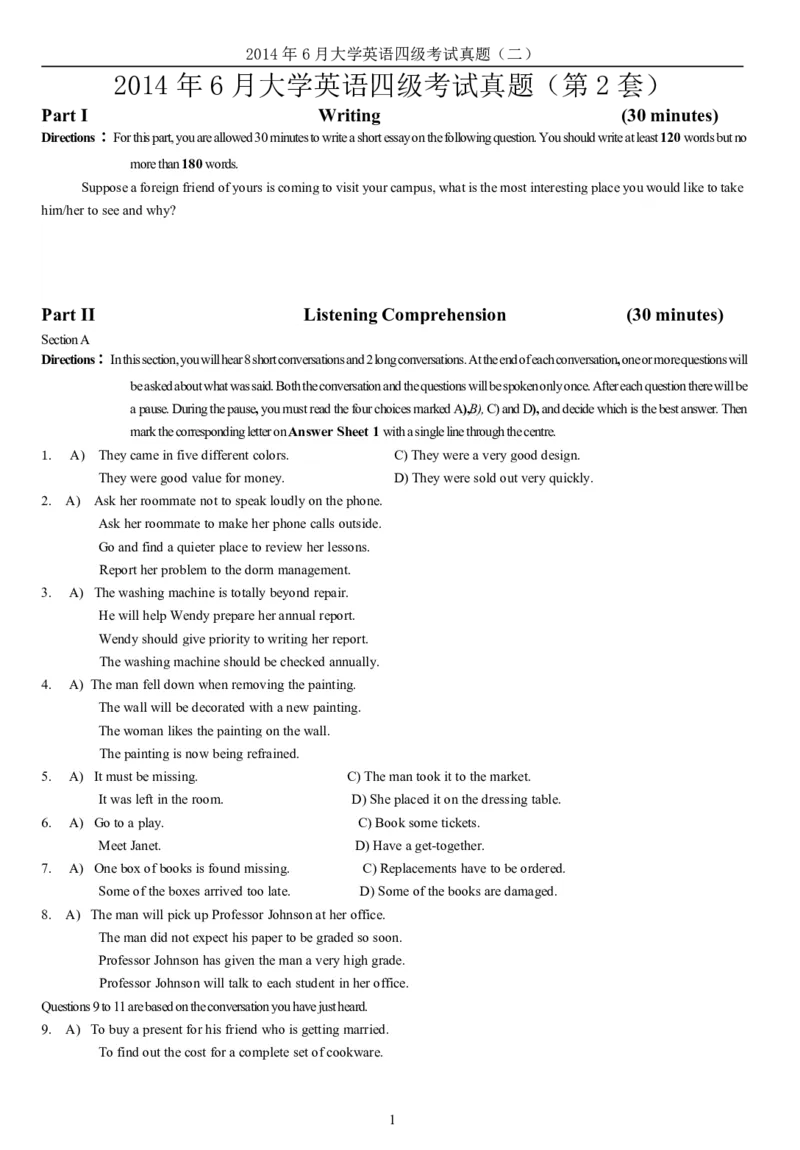
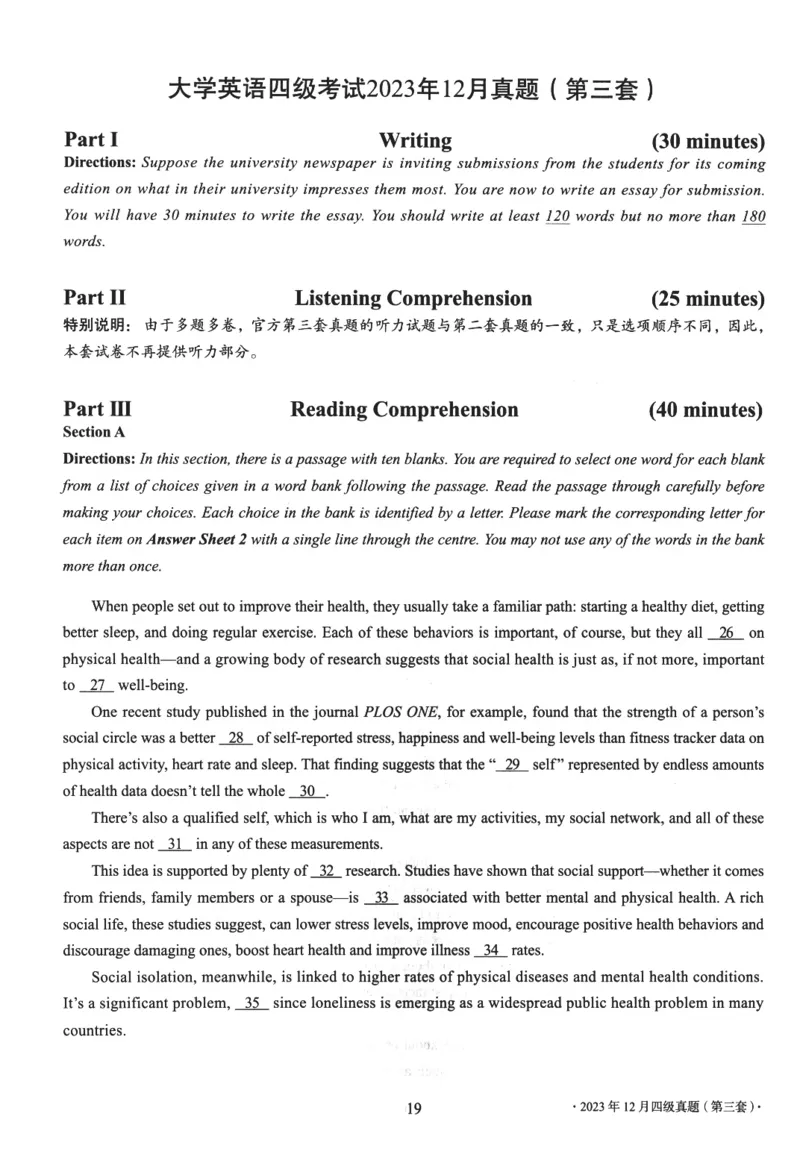
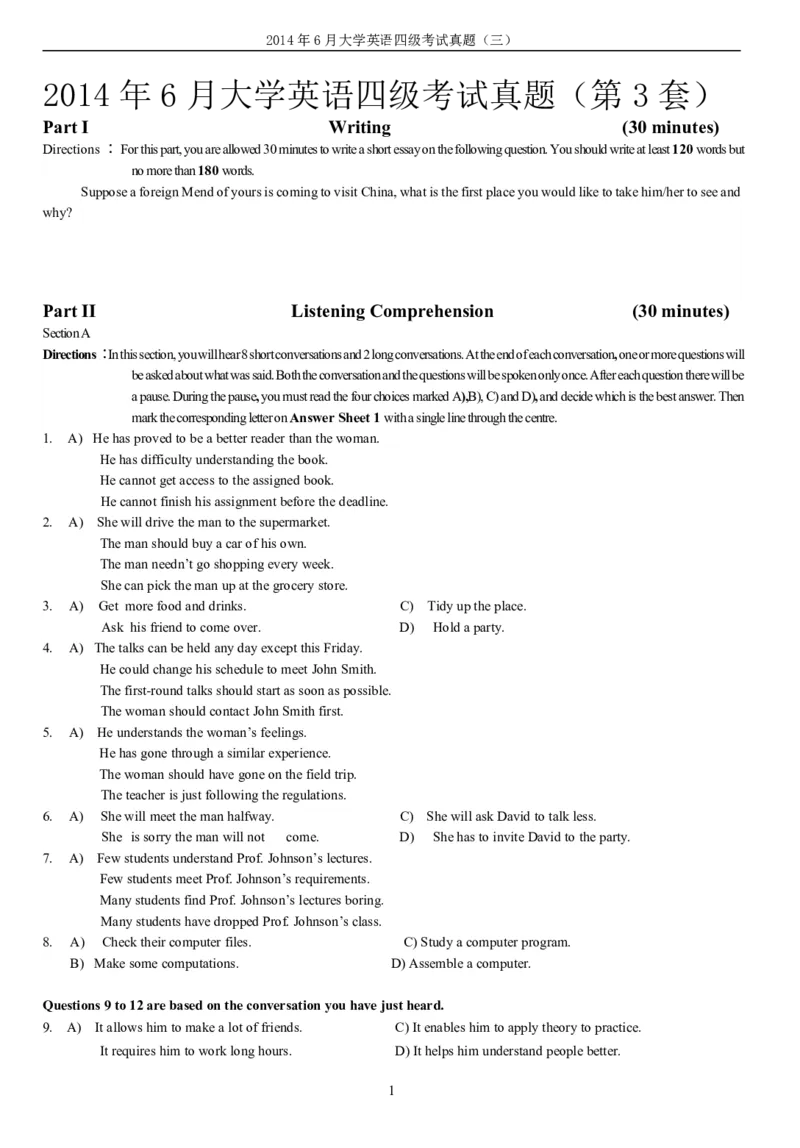
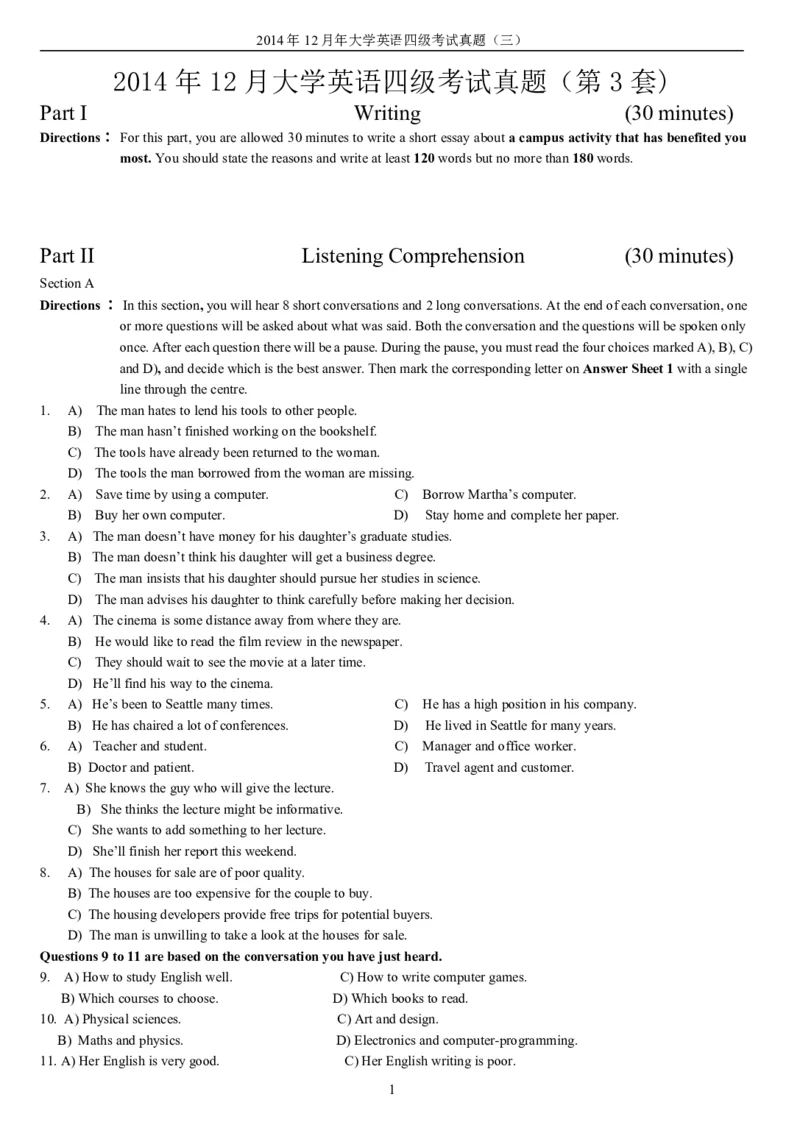
年 月英语四级考试真题与答案
2009 6
PartIWriting (30 minutes)
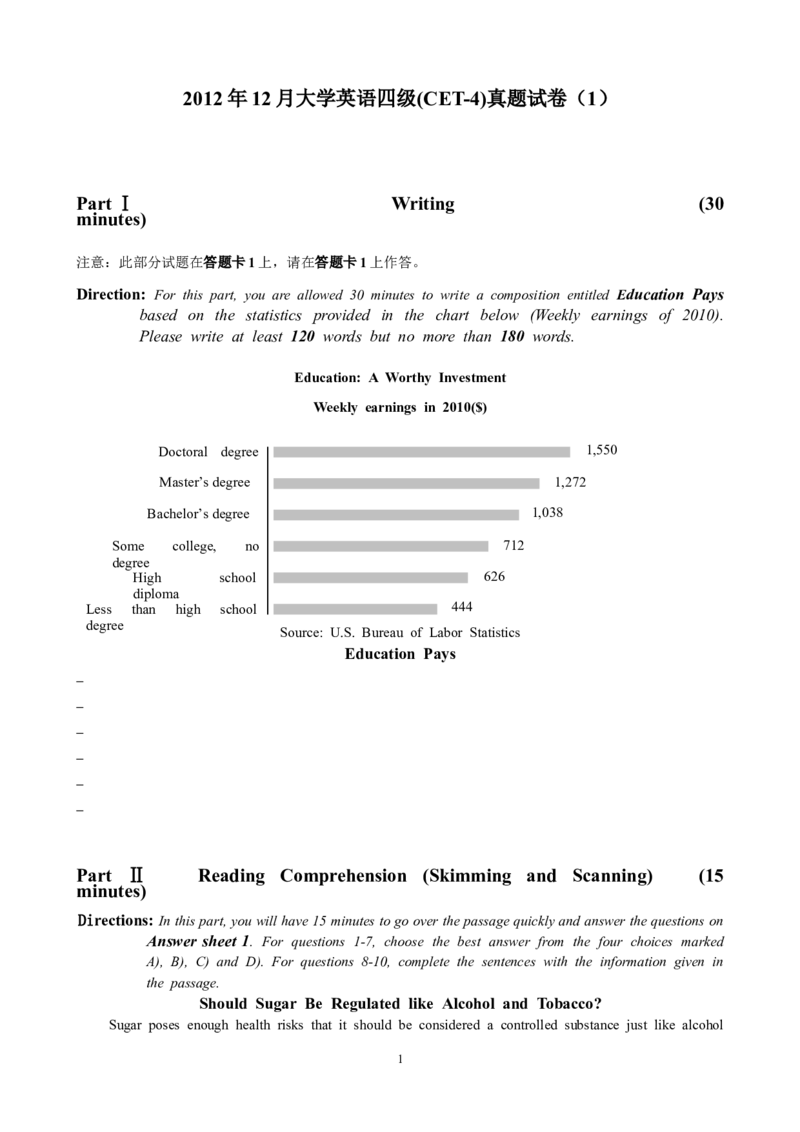
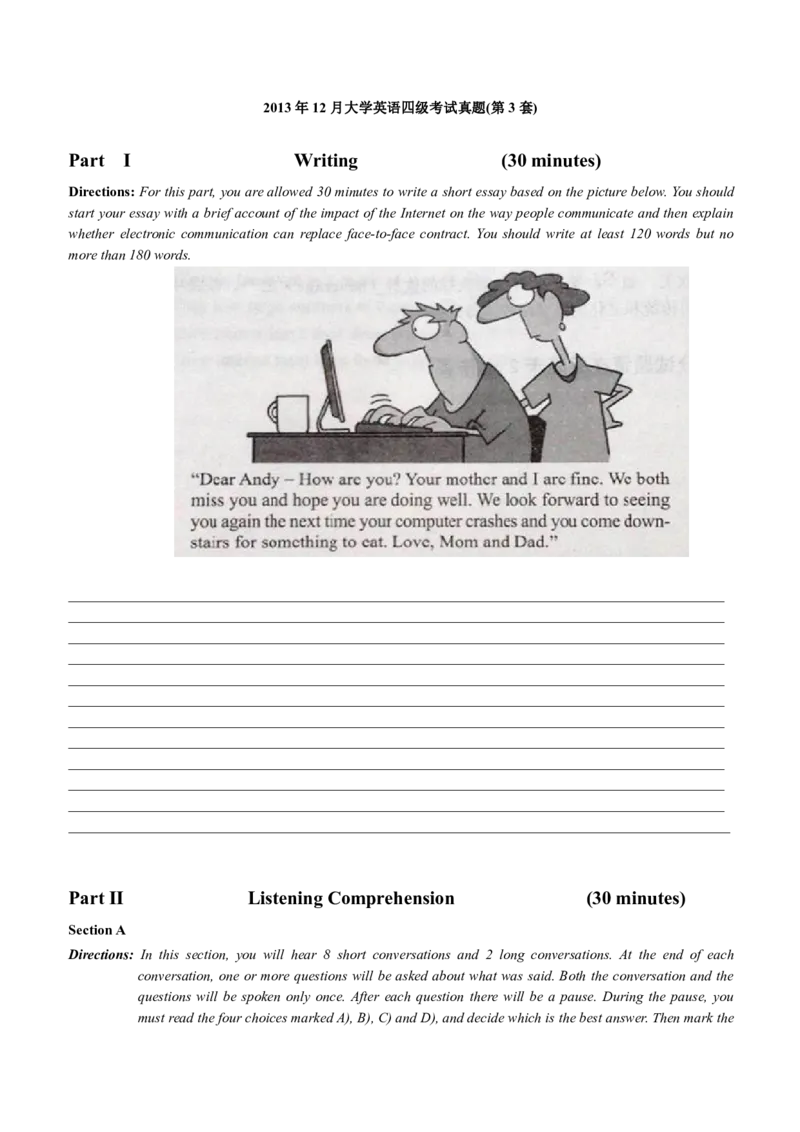
Directions: For this part, you are allowed 30 minute to write a short essay on the
topic of students selecting their lectures. You should write at least 120
wordsfollowing theoutlinegiven bellow:
1. 越来越多的博物馆免费对外开放的目的是什么?
2. 也会带来一些问题
3. 你的看法?
Freeadmissiontomuseums
Part II ReadingComprehension(Skimming andScanning)(15 minutes)
Directions: In this part, you will have 15 minutes to go over the passage quickly and
answer the questions on Answer Sheet 1. For questions 1-7, choose the
best answer from the four choices marked A),B),C) and D). For questions
8-10,completethesentenceswiththeinformationgiveninthepassage.
HowDoYouSeeDiversity?
As a manager,Tiffany is responsible for interviewing applicants for some of the
positions with her company .During one interview, she noticed that the candidate
never made direct eye contact. She was puzzled and somewhat disappointed because
sheliked theindividual otherwise.
He had a perfect resume and gave good responses to her questions, but the fact
that he never looked her in the eye said “untrustworthy,” so she decided to offer the
jobto her second choice.
“It wasn’t until I attended a diversity workshop that I realized the person we
passed over was the perfect person,” Tiffany confesses. What she hadn’t known at the
time of the interview was that the candidate’s “different” behavior was simply a
cultural misunderstanding . He was an Asian-American raised in a household where
respect for thoseinauthority was shown byaverting(避开)your eyes.
“I was just thrown off by the lack of ye contact; not realizing it was cultural,”Tiffanysays. “Imissed out ,butwill not missthat opportunity again.”
Many of us have had similar encounters with behaviors we perceive as different.
As the world becomes smaller and our workplaces more diverse, it is becoming
essential to expand our under-standing of others and to reexamine some of our false
assumptions.
HireAdvantage
At a time when hiring qualified people is becoming more difficult ,employers
who can eliminate invalid biases( 偏 爱 ) from the process have a distinct
advantage .My company, Mindsets LLC ,helps organizations and individuals see their
own blind spots . A real estate recruiter we worked with illustrates the positive
differencesuch trainingcan make .
“During my Mindsets coaching session ,I was taught how to recruit a
diversified workforce. I recruited people from different cultures and skill sets .The
agents were able to utilize their full potential and experiences to build up the
company .When the real estate market began to change, it was because we had a
diverse agent pool that we were able to stay in the real estate market much longer than
others in thesame profession.”
Blindedby Gender
Dale is an account executive who attended one of my workshops on supervising
a diverse workforce . “Through one of the sessions ,I discovered my personal bias ,”
he recalls . “I learned I had not been looking at a person as a whole person , and being
open to differences .” In his case , the blindness was not about culture but rather
gender .
“I had a management position open in my department ;and the two finalists were
a man and a woman . Had I not attended this workshop , I would have automatically
assumed the man was the best candidate because the position required quite a bit of
extensive travel . My reasoning would have been that even though both candidates
were great and could have been successful in the position , I assumed the woman
would have wanted to be home with her children and not travel .”Dale’s assumptions
are another example of the well-intentioned but incorrect thinking that limits an
organization’s abilitytotap intothefull potential ofadiverse workforce .
“I learned from the class that instead of imposing my gender biases into the
situation , I needed to present the full range of duties, responsibilities and expectations
to all candidates and allow them to make an informed decision .” Dale credits the
workshop ,“because it helped memake decisions based onfairness .”
Yearofthe Know-It-All
Doug is another supervisor who attended one of my workshops .He recalls a
majorlesson learned from hisown employee.
“One of my most embarrassing moments was when I had a Chinese-American
employee put in a request to take time off to celebrate Chinese New Year . In my
ignorance , I assumed he had his dates wrong , as the first of January had just passed .When I advised him of this , I gave him a long talking-to about turning in requests
early withthe properdates .
“He patiently waited , then when Iwas done ,he said he would like Chinese New
Year did not begin January first , and that Chinese New Year ,which is tied to the
lunar cycle ,is one of the most celebrated holidays on the Chinese calendar . Needless
to say , I felt very embarrassed in assuming he had his dates mixed up . But I learned
a great deal about assumptions , and that the timing of holidays varies considerably
from culture to culture.
“Attending the diversity workshop helped me realize how much I could learn by
simply asking questions and creating dialogues with my employees , rather than
making assumptions and trying to be a know-it-all ,” Doug admits . “The biggest
thing I took away from the workshop is learning how to be more ‘inclusive’ to
differences.”
AbetterBottom Line
An open mind about diversity not only improves organizations internally , it is
profitable as well .These comments from a customer service representative show how
an inclusive attitude can improve sales .”Most of my customers speak English as a
second language . One of the best things my company has done is to contract with a
language service that offers translations over the phone . It wasn’t until my boss
received Mindsets’ training that she was able to understand how important
inclusiveness was tocustomer service .As result ,ourcustomer basehas increased .”
Once we start to see people as individuals . and discard the stereotypes , we can
move positively toward inclusiveness for everyone . Diversity is about coming
together and taking advantage of our differences and similarities . It is about building
better communities and organizations that enhance us as individuals and reinforce our
shared humanity.
When we begin to question our assumptions and challenge what we think we
have learned from our past , from the media, peers , family , friends , etc , we begin to
realize that some of our conclusions are flawed( 有缺陷的 ) or contrary to our
fundamental values . We need to train our-selves to think differently , shift our
mindsets and realize that diversity opens doors for all of us ,creating opportunities in
organizations and communitiesthat benefit everyone .
1. Whatbothered Tiffany during an interviewwith hercandidate?
A) Hejust wouldn’t lookherintheeye.
B) Hewas slowin answering herquestions.
C) His answers to someofher questionswere irrelevant.
D) His answers to someofher questionswere irrelevant .
2.Tiffany’s misjudgment about thecandidate stemmed from .A) Racial stereotypes. C)Racial stereotypes.
B) Invalid personal bias . D)Emphasis onphysical appearance
3. What is becoming essential in the course of economic globalization according
tothe author?
A) Hiring qualified technical and management personnel.
B) Increasing understanding ofpeopleof othercultures.
C)Constantlyupdating knowledge and equipment.
D)Expanding domesticand international markets.
4.What kindoforganization isMindsets LLC?
A)Areal estateagency. C)Acultural exchange organization.
B)Apersonnel training company. D)Ahi-tech company
5.After one oftheworkshops ,account executiveDale realizedthat .
A) Hehad hired thewrong person.
B) Hecould havedone morefor hiscompany.
C)Hehad not managed hisworkforce well.
D)He mustget rid ofhis gender bias.
6.What didDale think ofMindsets LLC’s workshop?
A) It was well-intentioned but poorly conducted.
B) It tapped into theexecutives’full potential.
C)It helped him make fairdecisions.
D)It met participants’diverseneeds.
7. How did Doug, a supervisor, respond to a Chinese-American employee’s
request forleave?
A) Hetold himto get the dates right. C)Heflatly turned itdown
B) Hedemanded an explanation. D)He readily approved it.
8.Doug felt when herealizedthat his assumption was wrong.
9. After attending Mindsets’ workshops, the participants came to know the
importance of to theirbusiness.
10. When we view people as individuals and get rid of stereotypes , we can
achieve diversity and benefit from the between us.Part III ListeningComprehension (35 Minutes)
SectionA
Directions: In this section, you will hear 8 short conversations and 2 long
conversations. At the end of each conversation, one or more questions
will be asked about what was said .Both the conversation and the
questions will be spoken only once .After each question there will be a
pause . During the pause, you must read the four choices marked A),B),C)
and D), and decide which is the best answer. Then mark the
corresponding letter on Answer sheet 2 with a single line through the
centre.
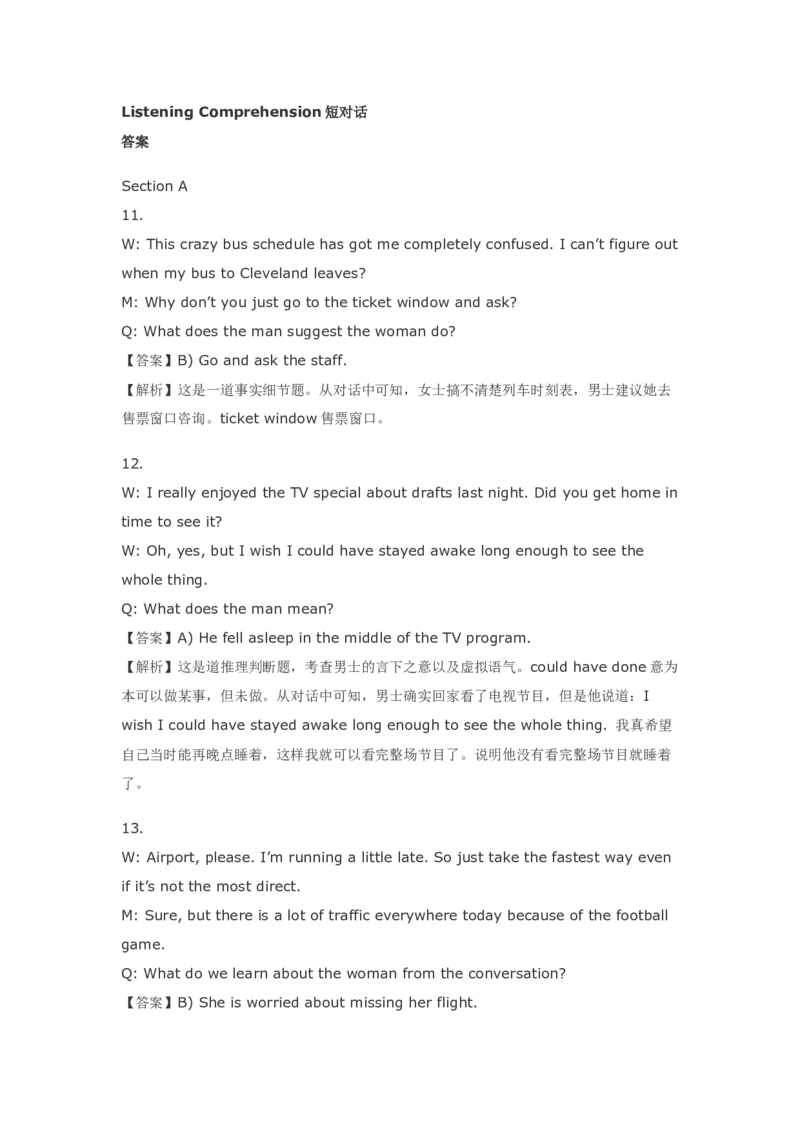
11.A) Sheexpected more peopleat her party.
B) Sheenjoys entertaining small children.
C)Shethrewa surpriseparty forher friend
D)Shehas always enjoyed great popularity.
12.A)They are not used to living ina cold place.
B)They feel lucky tolivein Florida.
C)They are going to have aholiday.
D)They have notbooked theirair tickets yet.
13.A) Hewas pleased to get themedal. C)He usedto bea firefighter.
B) Hewas very courageous. D)He was accused ofcausing afire.
14.A) Makea profitableinvestment. C)Get parts for themachine from Japan.
B) Buy anewwashing machine D)Have theold washing machine fixed.
15.A) Heis pleased with hisexciting newjob.
B) Hefinds the huge workload unbearable.
C)Hefinds his office much too bigfor him.
D)He is notso excited about his new position.
16.A)Thewoman is going to holdabig party tomorrow.
B)Theman has noideawhat theright thing todois.
C)Thewoman doesn’t knowhow toget tothe party.
D)The man offers to drive thewoman to theparty.
17.A) Drawing upabusiness plan. C)Finalizing acontract.B) Discussing aterm paper. D)Reviewing aco-authored article.
18.A) Sheordered somepaper. C)Shechatted onlinewith a friend
B) Shehad theprinter repaired. D)Shefilled in anapplication form
Questions19to 22arebased onthe conversation you havejustheard.
19.A) His health is getting worse. C)His past life upsets hima good deal.
B) Hecan nolonger work at sea. D) Hehas not got theexpected pension.
20.A) Shepassed away years ago. C)Shehas been working at a clinic.
B) Sheusedto work as amodel. D) Shehas been seriouslyill foryears.
21.A) Shehas made lotsofmoney as adoctor.
B) Sheis going to take care ofher old dad.
C)Shehas never got onwith herfather.
D)Sheis kind and generous bynature.
22.A) Hedines out with his wifeevery weekend.
B) Heis excellent but lookshad-tempered.
C)Hedoes notcare about his appearance.
D)He is notquitepopular with hispatients.
Questions23to 25arebased onthe conversation you havejustheard.
23.A)Theman has sent theorder to thewoman bymistake
B) Someof thetelephone systems don’t work properly
C)Someof thepacks donotcontain any manuals.
D)The quality ofthegoods is notuptothestandard.
24.A) Send aservice engineer todothe repairs.
B) Consulther boss about thebest solution.
C)Passthe man’s order tothe right person.
D)The quality ofthegoods is notuptothestandard.
25.A) Ideal. C)Partial
B)Temporary D) Creative
Section B
Directions: In this section, you will hear 3 short passages .At the end of each
passage .You will hear some questions. Boss the passage and thequestions will be spoken only once. After you hear a question, you must
choose the best answer from the four choices marked A),B),C) and D).
Then the corresponding letter on Answer Sheet 2 with a single line
through thecentre.
PassageOne
Questions26to 28arebased onthe passageyouhavejustheard.
26.A) It isentertaining. C)It takes lotsof time.
B) It isa costly hobby. D) It requires training.
27.A)They can harm nearby plants. C)They fight each other forfood.
B)They may catch somedisease. D)They may pollutetheenvironment.
28.A) Placethefood onwarmer spots. C)Avoid using any contaminated food.
B) Useprepared feed mixtures only. D) Continuethe feeding till itgets warm.
PassageTwo
Questions29to 32arebased onthe passageyouhavejustheard.
29.A) Hewill betray even his best friends.
B) Heis able tomake upgood excuses.
C)Hewill liewheneverhe wants.
D)He tries to achieve his goal at any cost
30.A) Shemadehim apologize C)Shebrokeupwith him.
B) Shereadilyforgave him D)Sherefused to answer his calls.
31.A) Buy hera newset of tires. C)Lend her his batteries.
B) Help clean her apartment. D) Movefurniture for her.
PassageThree
Questions32to 35arebased onthe passageyouhavejustheard.
32.A)Theatmosphere they liveinis rather unreal.
B)Their parents put too much pressure onthem.
C)It’shard for them to get along with otherkids.
D)They have toliveintheshadow oftheirparents.
33.A) Healways boasts about his rich father.
B) Hewill growupto be good fornothing.
C)Hehas toomuch toknow thevalueof things.D)He is tooyoung to manage his inherited property.
34.A) ShewantsAmanda to get professional care.
B) Shehas noexperience in raising children.
C)Shewants to showoffher wealth.
D)Shehas notimeto doit herself.
35.A)Thelifestyle depicted in Hollywood movies.
B)Theworship ofmoney,beauty and pleasure.
C)Theattention themedia focuses onthem.
D)The pursuing ofperfection in performance.
Section C
Directions : In this section , you will hear a passage three times .When the passage is
read for the first time, you should listen carefully for its general idea .
When the passage is read for the second time, you are required to fill in
the blanks numbered from 36 to 43 with the exact words you have just
heard. For blanks numbered from 44 to 46 you are required to fill in the
missing information. For these blanks, you can either use the exact words
you have just heard or write down the main points in your own words.
Finally, when the passage is read for the third time, you should check
whatyou havewritten .
Around 120 years ago, Ebbinghaus began his study of memory.
He(36) .on studying how quickly the human mind can remember (37) .
One result of his research is known as the total time hypothesis(假设), which simply
means the amount you learn (38) on the time you spend trying to learn it .
Thiscan be taken as our first ruleof learning.
Although it is usually true that studying for four hours is better than studying for
one, there is still the question of how we should use the four hours. For example, is it
better to study for four hours (39) or to study for one hour a day for four days
in a (40) ?. The answer, as you may have (41) , is that it is better to
spread out the study times. This (42) , through which we can learn more
(43) .by dividing our practice time, is known as the distribution of practice
effect.Thus,(44)
.
But we’re not finished yet. We haven’t considered how we should study over
very short periods oftime. (45)
.Should you look at the same
word in rapid succession, or look at the word and then have some delay before you
lookat itagain ?(46).
Part IVReadingComprehension(reading indepth)(25 minutes)
Section A
Directions: In this section, there is a passage with ten blanks. You are required to
select one word for each blank from a list of choices given in a word
bank following the passage. Read the passage through carefully before
making your choices. Each choice in bank is identified by a letter.
Please mark the corresponding letter for each item on Answer Sheet 2
with a single line through the centre. You may not use any of the words
inthe bankmorethan once.
Questions47to 56arebased onthe followingpassage.
Every year in the first week of my English class, some students inform me that
writhing is too hard. They never write, unless assignments 47 it . They fine the
writing process 48 anddifficult.
How awful to be able to speak in a language but not to write in it- 49
English , with its rich vocabulary . Being able to speak but not write is like living in
an 50 mansion(豪宅) and never leaving one small room . When I meet students
who think they can’t write, I know as a teacher my 51 is to show them the rest of
the rooms . My task is to build fluency while providing the opportunity inherent in
any writing activity to 52 the moral and emotional development of my students .
Onegreat way to dothisis byhaving students writein a journalin class every day.
Writing ability is like strength training. Writing needs to be done 53 , just
like exercise ; just as muscles grow stronger with exercise , writing skills improve
quickly with writing practice. I often see a rise in student confidence and 54 after
onlya few weeks ofjournal writing .
Expressing oneself in writing is one of the most important skills I teach to
strengthen the whole student. When my students practice journal writing, they are
practicing for their future academic, political, and 55 lives . They build skills so
that some day they might write a great novel, a piece of sorely needed legislation, or
the perfect love letter. Every day that they write in their journals puts them a step
56 tofluency ,eloquence (雄辩), and command oflanguage .A) closer I) painful
B) daily J)performance
C) emotional K) profession
D) enhance L) remarkably
E) enormous M)require
F) especially N)sensitive
G) hinder O)urge
H) mission
Section B
Directions: There are 2 passages in this section. Each passage is followed by some
questions or unfinished statements. For each of them there are four
choices marked A), B), C) and D). You should decide on the best choice
and mark the corresponding letter on Answer Sheet 2 with a single line
through thecentre.
Passage One
Questions57to 61arebased onthe followingpassage.
The January fashion show, called FutureFashion , exemplified how far green
design has come. Organized by the NewYork-based nonprofit Earth Pledge, the show
inspired many top designers to work with sustainable fabrics for the first time. Several
have sincemadepledges to includeorganic fabrics in theirlines.
The designers who undertake green fashion still face many challenges. Scott
Hahn, cofounder with Gregory of Rogan and Loomstate, which uses all-organic
cotton, says high-quality sustainable materials can still be tough to fine . “Most
designers with existing labels are finding there aren’t comparable fabrics that can just
replace what you’re doing and shat your customers are used to,” he says. For example,
organic cotton and non-organic cotton are virtually indistinguishable once woven into
a dress. But some popular synthetics, like stretch nylon, still have few eco-friendly
equivalents.
Those who do make the switch are finding they have more support. Last year
the influential trade show Designers & Agents stopped charging its participation fee
for young green entrepreneurs(企业家) who attend its two springtime shows in Los
Angeles and New York and gave special recognition to designers whose collections
are at least 25% sustainable . It now counts more than 50 green designers, up from
fewer than a dozen two years ago. This week Wal-Mart is set to announce a majorinitiative aimed at helping cotton farmers go organic: it will buy transitional(过渡型
的) cotton at higher prices , thus helping to expand the supply of a key sustainable
material .“Mainstream isabout to occur,”says Hahn.
Some analysts(分析师) are less sure . Among consumers, only 18%are even
aware that ecofashion exists, up from 6% four years ago. Natalie Hormilla, a fashion
writer, is an example of the unconverted consumer, when asked if she owned any
sustainable clothes, she replied: “Not that I’m aware of.” Like most consumers, she
finds little time to shop, and when she does, she’s on the hunt for “cute stuff that isn’t
too expensive.” By her own admission, green just isn’t yet on her mind. But –thanks
tothe combined efforts of designers, retailers and suppliers –oneday it will be.
57.What issaid about FutureFashion?
A)It inspired many leading designers tostart going green.
B) It showed that designers using organic fabrics would go far.
C)It served as an exampleof howfashion shows should beorganized.
D)It convinced the publicthat fashionableclothes shouldbe madedurable.
58. According to Scott Hahn, one big challenge to designers who will go organic is
that .
A) much moretimeis needed tofinisha dress using sustainable materials .
B) they have tocreate new brands for clothes made oforganic materials .
C)customers have difficultytelling organic from non-organic materials .
D)quality organic replacements forsynthetics are not readilyavailable .
59.Welearn from Paragraph 3that designers whoundertake green fashion .
A) can attend various trade shows free .
B) are readily recognized bythefashion world
C)can buyorganic cotton at favorableprices .
D)are gaining more and moresupport .
60.What isNatalie Hormilla’sattitudetoward ecofashion?
A) Shedoesn’tseem tocare about it. C)Sheis doubtfulof itspractical value.
B) She doesn’t think it is sustainable D) She is very much opposed to the
idea
61.What does theauthorthink ofgreen fashion?
A) Green products will soongo mainstream.B) It has a very promising future.
C)Consumers have thefinal say.
D)It will appeal moreto young people.
PassageTwo
Questions62to 66arebased onthe followingpassage.
Scientists have devised a way to determine roughly where a person has lived
using a strand(缕) of hair , a technique that could help track the movements of
criminal suspects or unidentified murder victims.
The method relies on measuring how chemical variations in drinking water show
upinpeople’s hair.
“You’re what you eat and drink, and that’s recorded in you hair,” said Thure
Cerling, ageologist at theUniversity ofUtah.
While U.S diet is relatively identical, water supplies vary. The differences result
from weather patterns. The chemical composition of rainfall changes slightly as raid
clouds move.
Most hydrogen and oxygen atoms in water are stable , but traces of both
elements are also present as heavier isotopes (同位素) . The heaviest raid falls
first .As a result, storms that form over the Pacific deliver heavier water to California
than to Utah.
Similar patterns exist throughout the U.S. By measuring the proportion of
heavier hydrogen and oxygen isotopes along a strand of hair, scientists can construct a
geographictimeline. Each inch ofhaircorresponds toabout two months.
Cerling’s team collected tap water samples from 600 cities and constructed a
mop of the regional differences. They checked the accuracy of the map by testing 200
hairsamples collected from 65barber shops.
They were able to accurately place the hair samples in broad regions roughly
corresponding to themovement ofraid systems.
“It’s not good for pinpointing ( 精确 定位 ),” Cerling said . “It’s good for
eliminatingmany possibilities.”
Todd Park, a local detective, said the method has helped him learn more about an
unidentified woman whose skeleton was found near Great Salt Lake.
The woman was 5 feet tall. Police recovered 26 bones, a T-shirt and several
strands ofhair.
When Park heard about the research, he gave the hair samples to the researchers.
Chemical testing showed that over the two years before her death, she moved about
every two months.She stayed in the Northwest, although the test could not be more specific than
somewhere between eastern Oregon and westernWyoming.
“It’s stillasubstantial area,” Park said “But it narrows it waydown for me.”
62.What isthescientists’newdiscovery?
A)One’s hairgrowth has todo with theamount of water theydrink.
B)Aperson’s hair may reveal where they have lived.
C)Hairanalysis accurately identifies criminal suspects.
D)The chemical compositionofhair varies from person toperson.
63.What does theauthormean by “You’re what you eat and drink”(Line 1,Para.3)?
A)Food and drink affect one’s personality development.
B) Foodand drink preferences vary with individuals.
C)Foodand drink leave traces inone’s bodytissues.
D)Food and drink are indispensable toone’s existence.
64.What issaid about therainfall inAmerica’sWest?
A)There ismuch more rainfall inCalifornia than inUtah.
B)Thewater it delivers becomes lighter when it moves inland.
C)Its chemical compositionis less stablethan in otherareas.
D)It gathers more light isotopes as it moves eastward.
65.What didCerling’s team produce intheirresearch?
A)Amap showingthe regional differences oftap water.
B)Acollection of hairsamples from various barbershops.
C)Amethod to measure theamount ofwater in human hair.
D)Achart illustrating themovement ofthe rain system.
66.What isthepractical value ofCerling’s research?
A)It helps analyze thequalityof water in different regions.
B) It helps thepolicedetermine where a crime iscommitted.
C)It helps thepolicenarrow down possibilities in detectivework.
D)It helps identify the drinking habitsof theperson under investigation.PartVCloze (15 minutes)
Kimiyuki Suda should be a perfect
67.A)profit C)income
customer for Japan’s car-makers. He’s a young,
B)payment D)budget
successful executive at an Internet-services
68.A)mostly C)occasionally
company in Tokyo and has plenty of disposable
B)partially D)rarely
67 . He used to own Toyota’s Hilux Surf, a
69.A)Therefore C)Otherwise
sport utility vehicle. But now he uses 68
B)Besides D)Consequently
subways and grains . “It’s not inconvenient at
70.A)drift C)current
all ,” he says 69 , “having a car is so 20th
B)tide D)trend
century.”
71.A)remarkably C)specially
Suda reflects a worrisome 70 in Japan;
B)essentially D)particularly
the automobile is losing its emotional appeal,
72.A)While C)When
71 among the young ,who prefer to spend their
B)Because D)Since
money on the latest electronic devices. 72
73.A)surging C)slipping
mini-cars and luxury foreign brands are still
B)stretching D)shaking
popular ,everything in between is 73 .Last
74.A)unless C)as
years sales fell 6.7 percent, 7.6 percent 74
B)if D)after
you don’t count the mini-car market . There have
75.A)lower C)broader
been 75 one-year drops in other
B)slighter D)larger
nations :sales in Germany fell 9 percent in 2007
76.A)liableto C)thanksto
76atax increase .But experts say Japan is
B)intermsof D)inviewof
77 in that sales have been decreasing steadily
77.A)unique C)mysterious
78 time. Since 1990, yearly new-car sales have
B)similar D)strange
fallen from 7.8 million to 5.4 million units in
78.A)over C)on
2007.
B)against D)behind
Alarmed by this state of 79 , the Japan
79.A)mess C)growth
B)boom D)decay
AutomobileManufacturersAssociation (JAMA)
80.A)proceeded C)launched
80 a comprehensive study of the market in
B)relieved D)revised
81.A)quickening C)strengthening
2006. It found that a 81 wealth gap,
B)widening D)lengthening
demographic(人口结构的) changes and 82
82.A)average C)abundant
B)massive D)general
lack of interest in cars led Japanesetohold their
83.A)labels C)vehicles
83 longer , replace their cars with smaller
B)cycles D)devices
84.A)or C)but
ones 84give upcar ownership altogether .JAMA
B)until D)then
85 a further sales decline of 1.2 percent this
85.A)concludes C)reckons
B)predicts D)prescribes
year. Some experts believe that if the trend
86.A)distant C)temporary
continues for much longer , further consolidation
B)likely D)immediate
(合并)in theautomotivesector is 86 .
PartVITranslation (5minutes)Directions: Complete the sentences by translating into English the Chinese given in
brackets. Pleasewriteyour translation onAnswer Sheet 2.
87. Soon after he transferred to the new school ,Ali found that he had (很
难跟上班里的同学)in math and English.
88.If she had returned an hourearlier,Mary (就不会被大雨淋湿了).
89. It is said that those who are stressed or working overtime are (更
有可能增加体重).
90. (很多人所没有意识到的) is that Simon is a lover of sports.
and football inparticular.
91.The study shows that the poor functioning of the human body is (与
缺乏锻炼密切相关)