2013年12月大学英语四级考试真题(第3套)
Part I Writing (30 minutes)
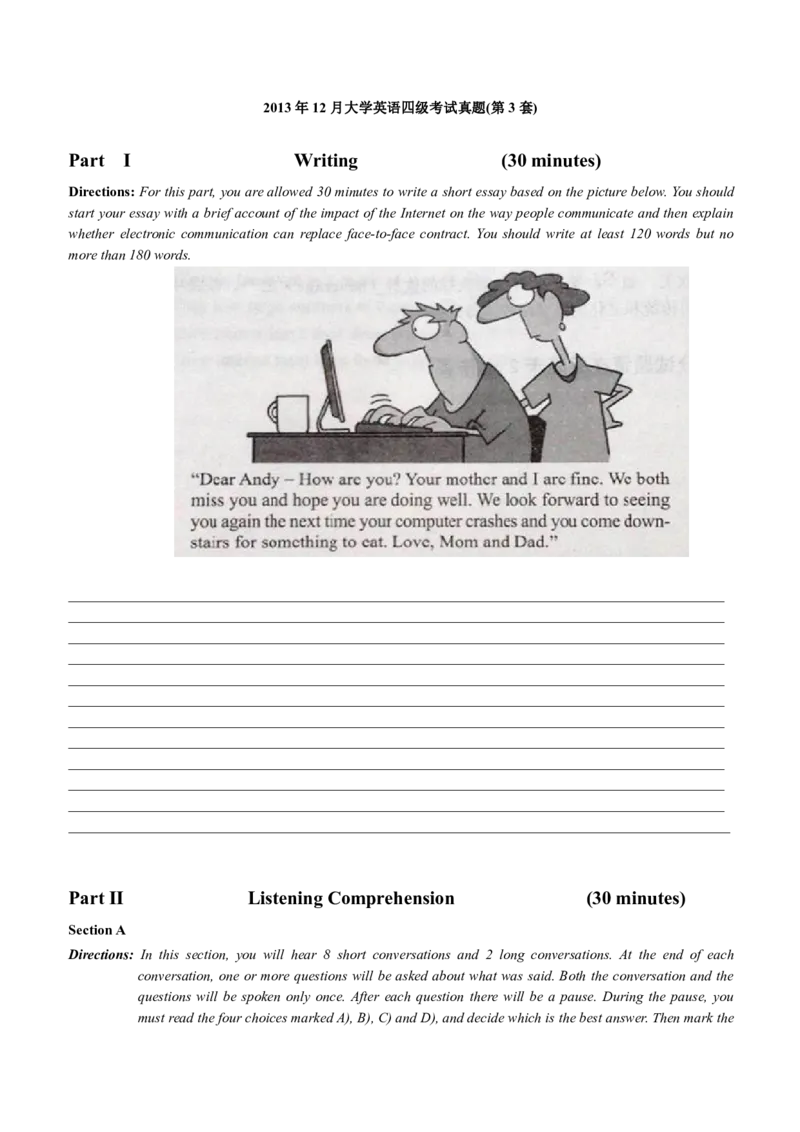
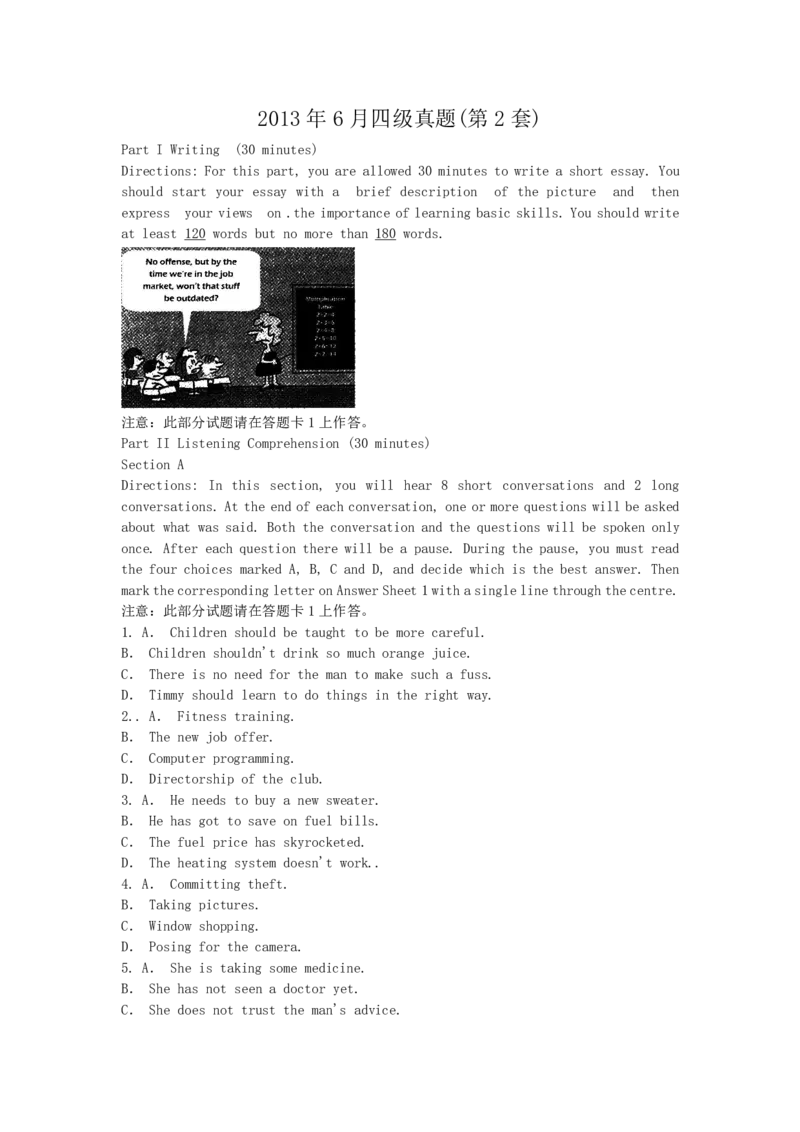
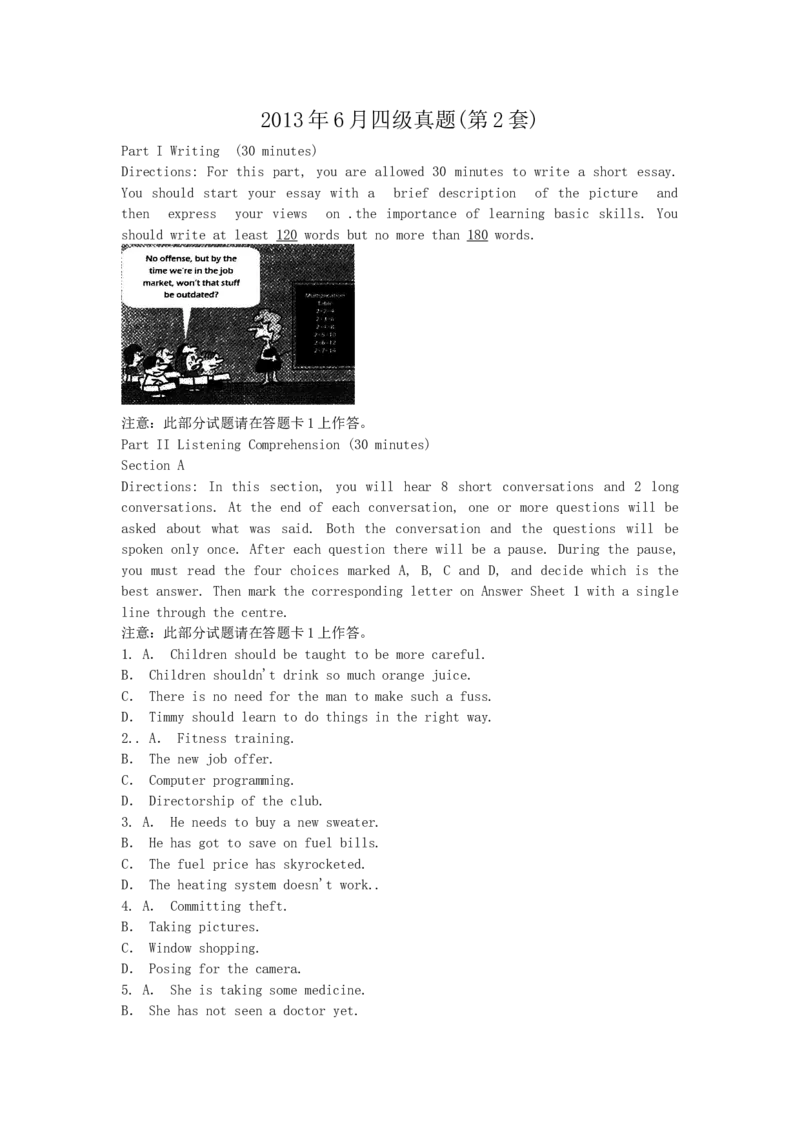
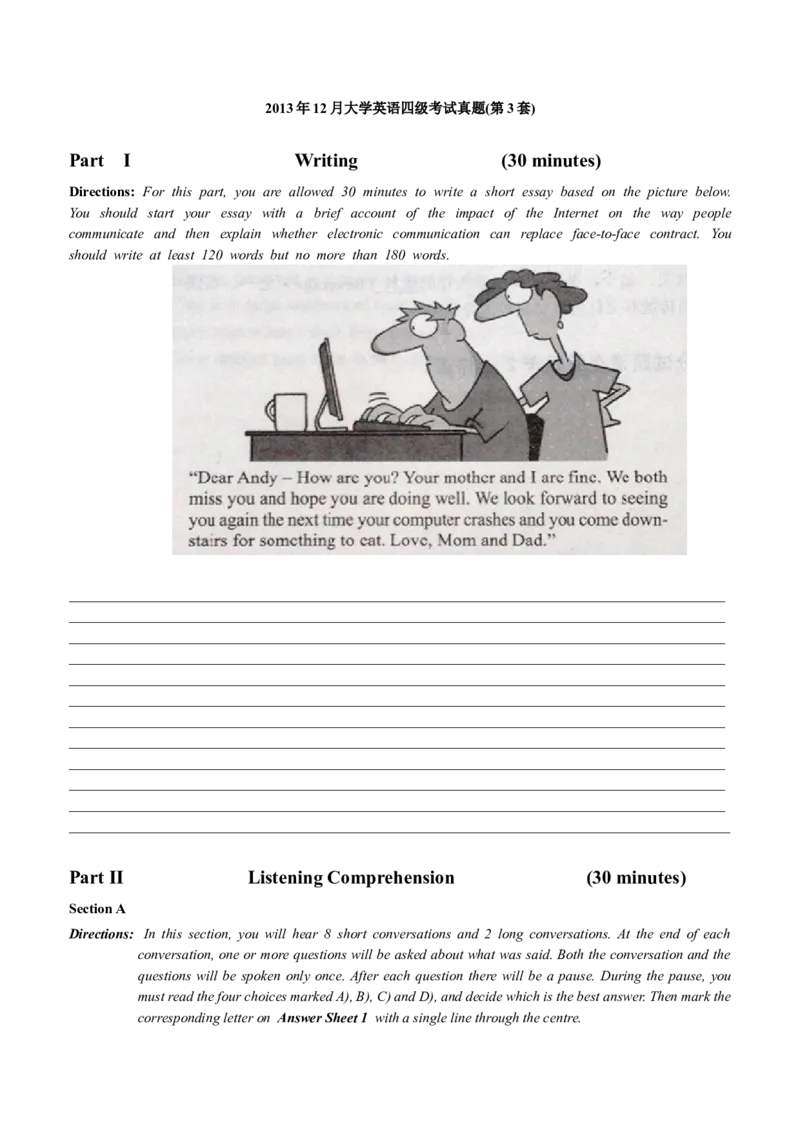
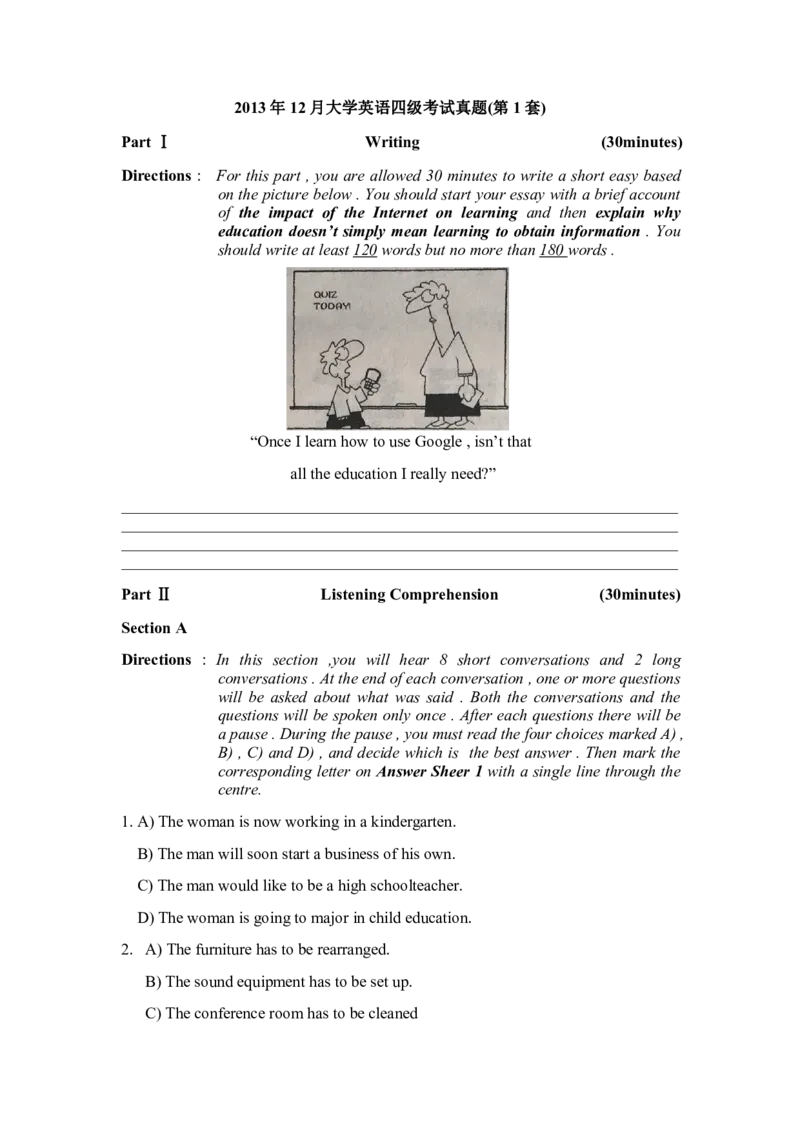
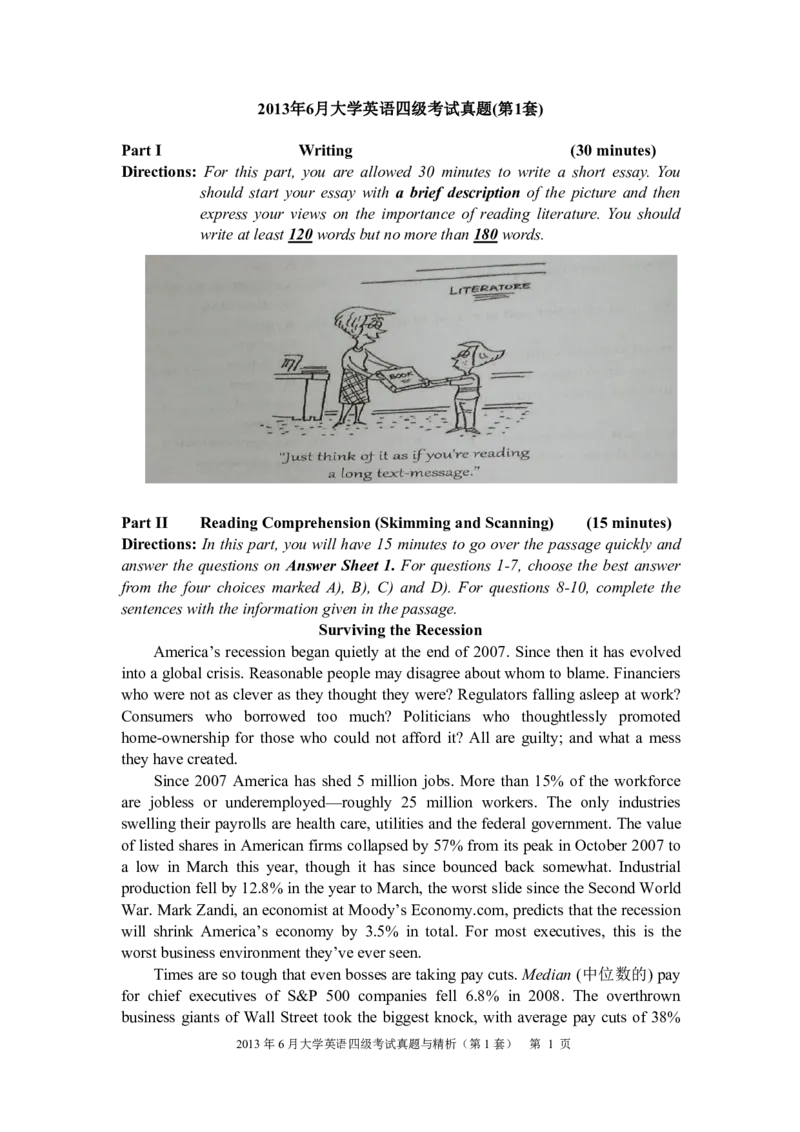
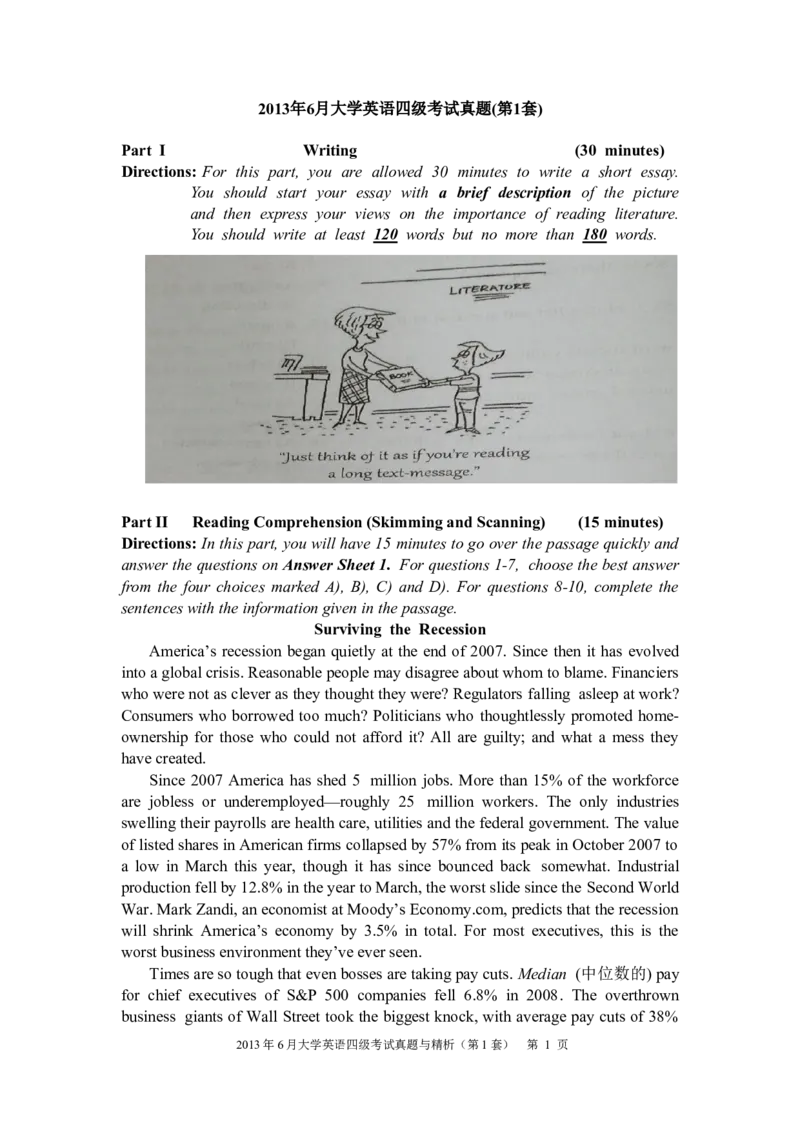
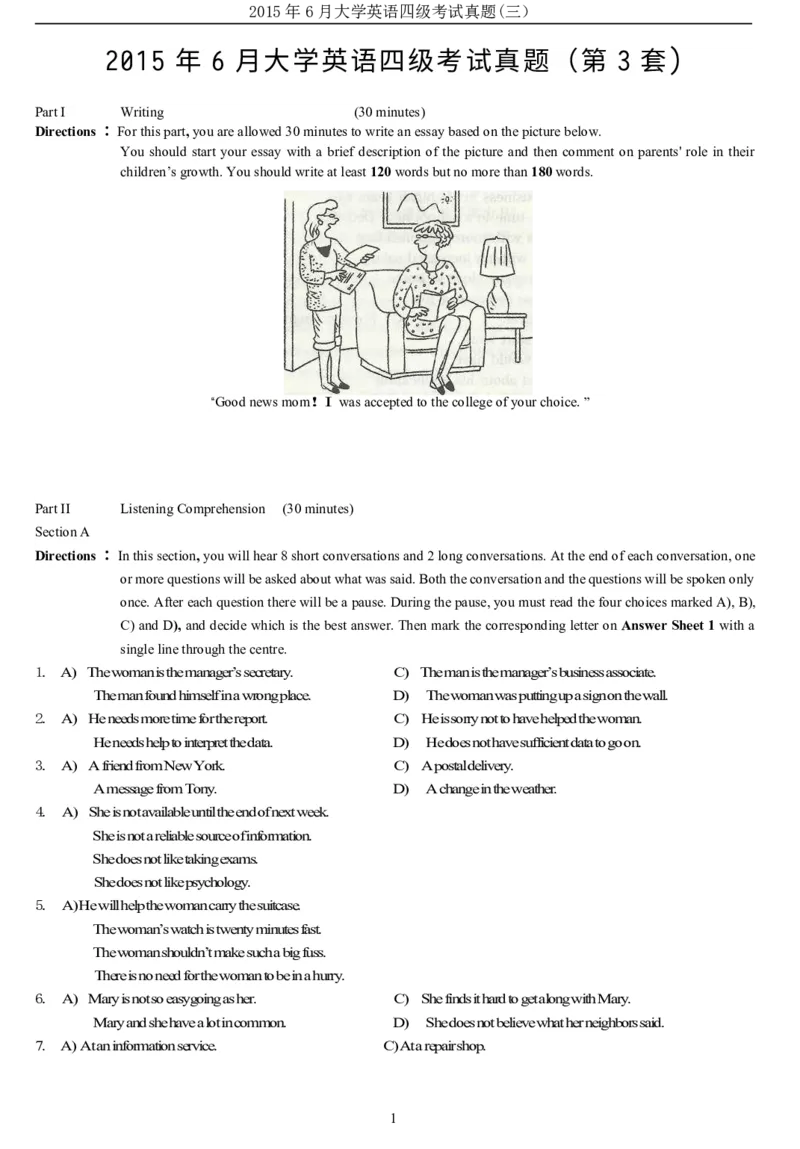
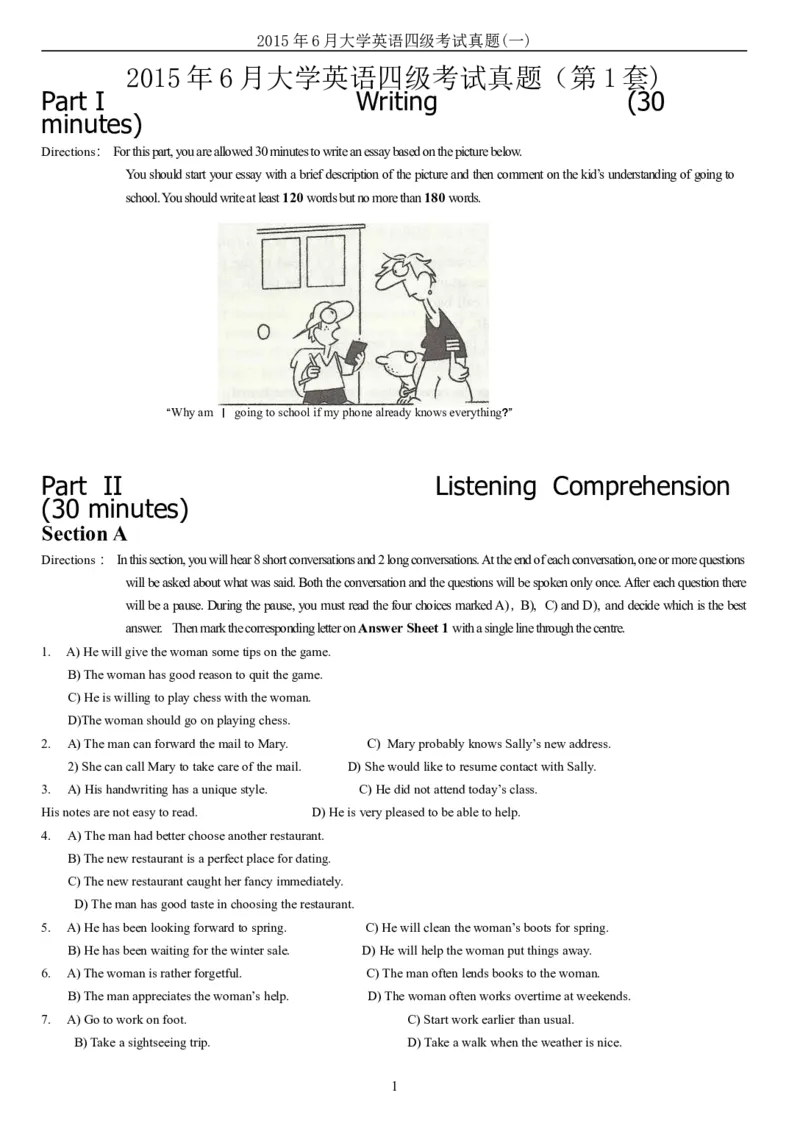
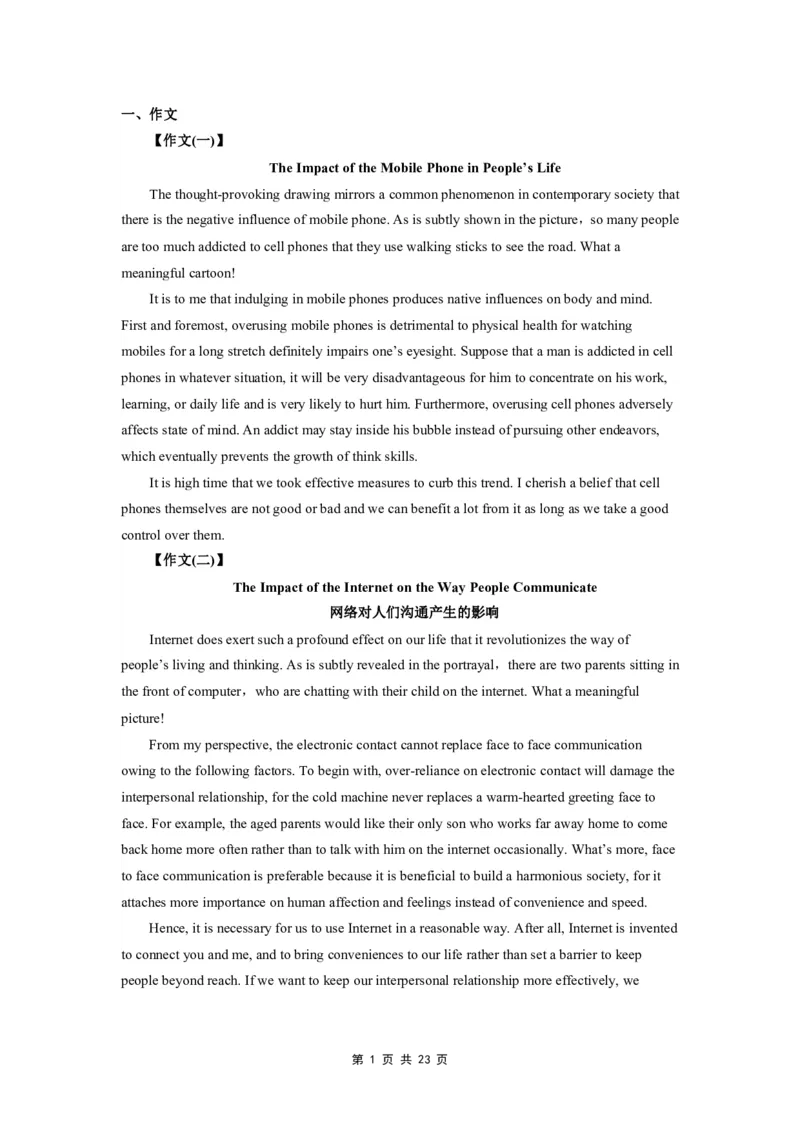
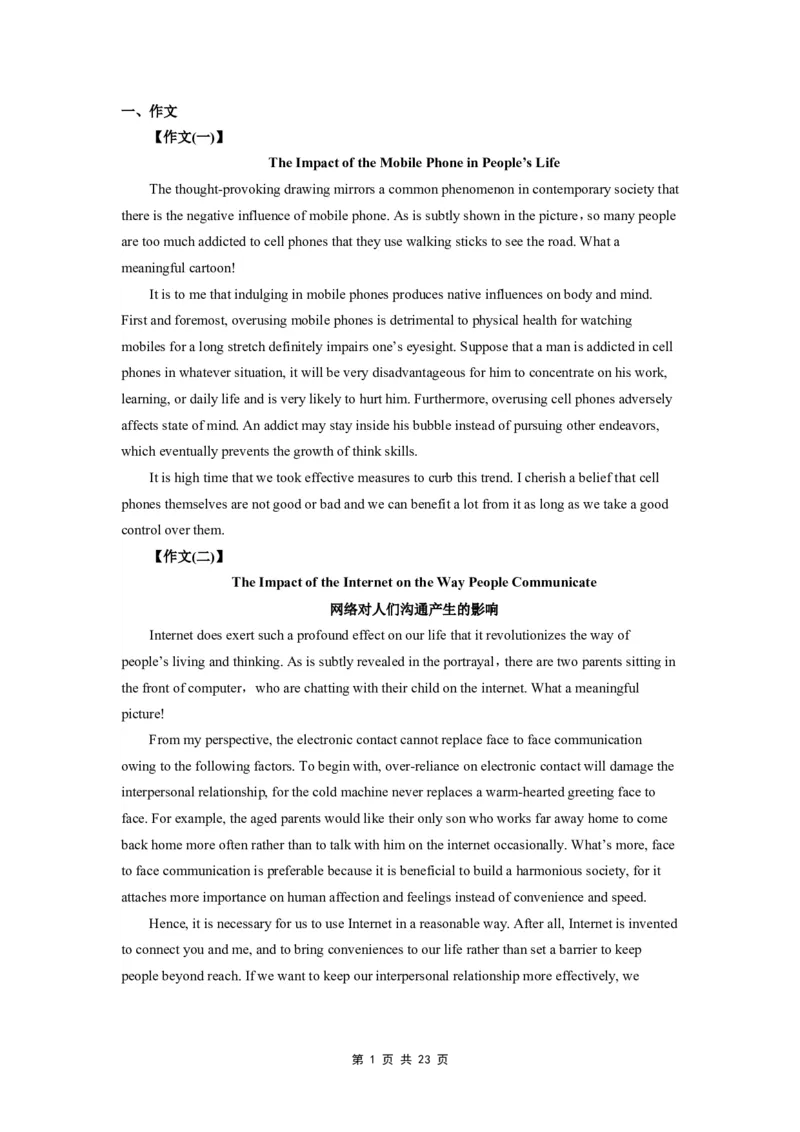
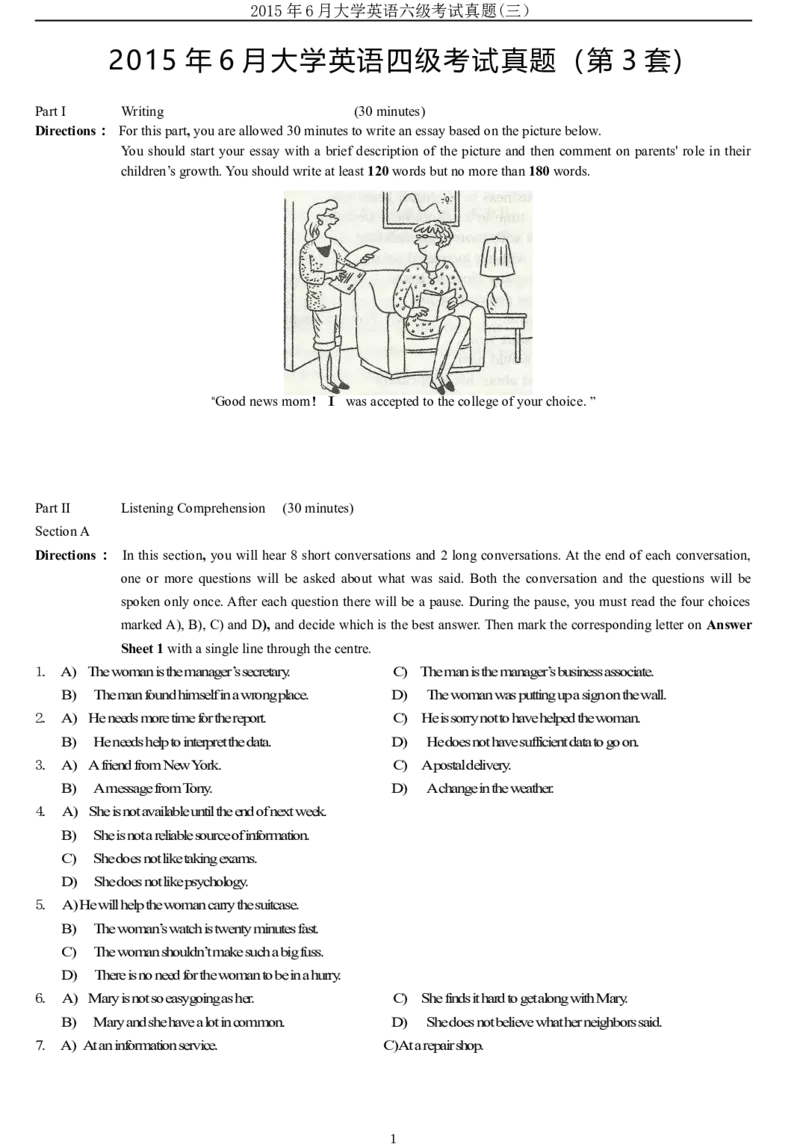
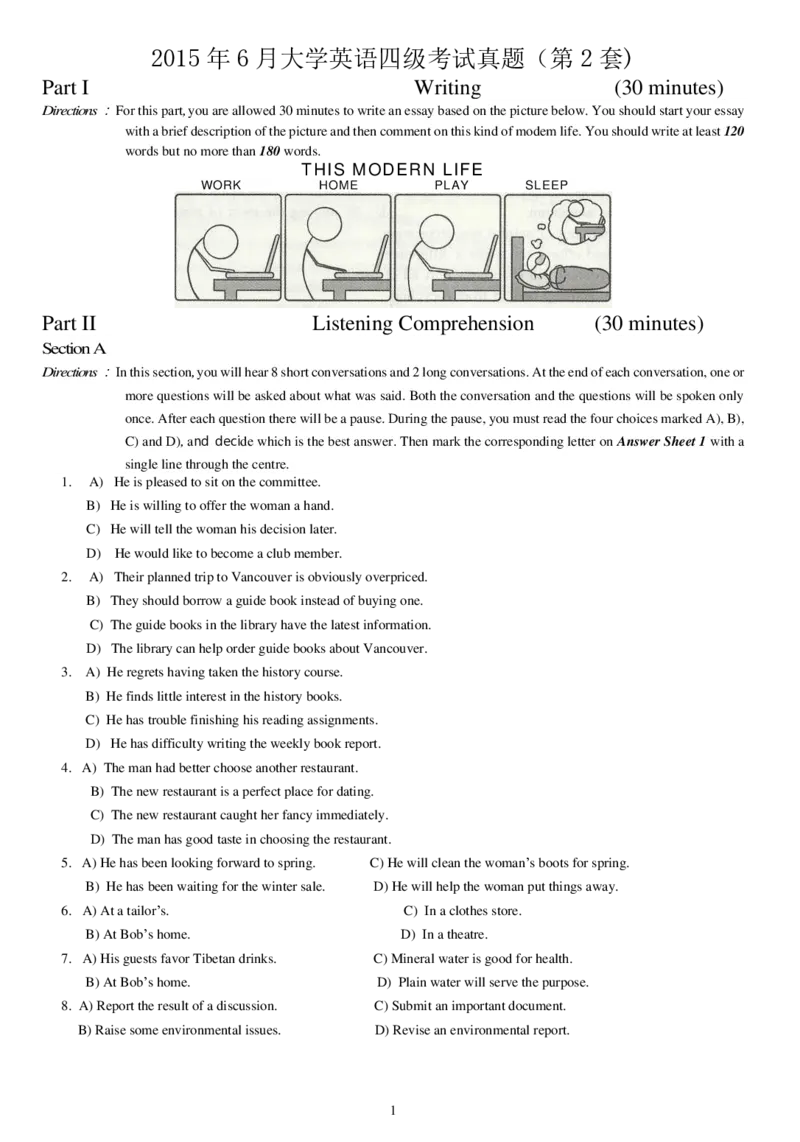
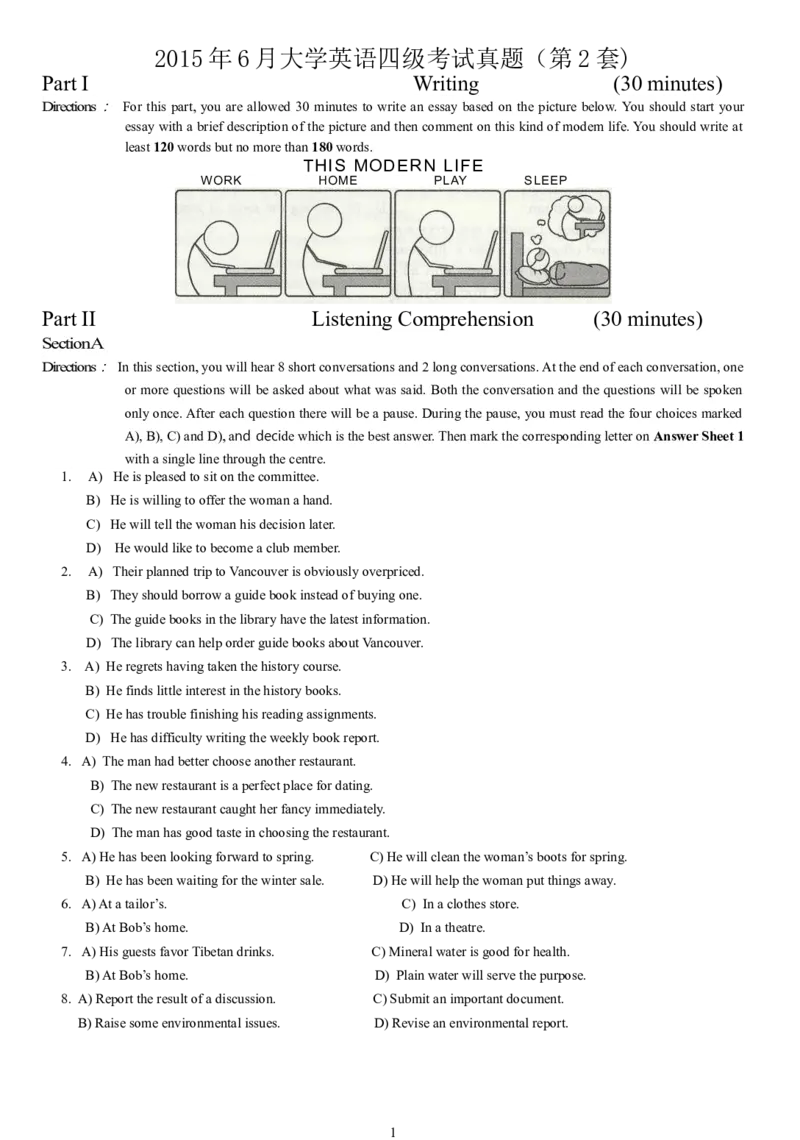
Directions: For this part, you areallowed 30 minutes to write a short essay based on the picturebelow. You should
start your essay with a brief account of the impact of the Internet on the way people communicate and then explain
whether electronic communication can replace face-to-face contract. You should write at least 120 words but no
morethan180words.
_____________________________________________________________________________________________
_____________________________________________________________________________________________
_____________________________________________________________________________________________
_____________________________________________________________________________________________
_____________________________________________________________________________________________
_____________________________________________________________________________________________
_____________________________________________________________________________________________
_____________________________________________________________________________________________
_____________________________________________________________________________________________
_____________________________________________________________________________________________
_____________________________________________________________________________________________
__________________________________________________________________________________
Part II Listening Comprehension (30 minutes)
SectionA
Directions: In this section, you will hear 8 short conversations and 2 long conversations. At the end of each
conversation, one or more questions will be asked about what was said. Both the conversation and the
questions will be spoken only once. After each question there will be a pause. During the pause, you
mustreadthefourchoicesmarkedA),B),C)andD),anddecidewhichisthebestanswer.ThenmarkthecorrespondingletteronAnswerSheet1withasinglelinethroughthecentre.
1.A)Gotoaplacehehasvisited. C)Consultatravelagent.
B)Makeherownarrangements. D)Joininapackagetour.
2.A)Theyareonalongtripbycar. C)Theyareusedtogettingupearly.
B)Theyarestuckinatrafficjam. D)Theyaretiredofeatingoutatnight.
3.A)Heisapersondifficulttodealwith. C)Heisunwillingtospeakinpublic.
B)Hedislikesanyformalgathering. D)Heoftenkeepsadistancefromothers.
4.A)Workinanotherdepartment. C)Recruitgraduatestudents.
B)Pursuefurthereducation. D)Takeanadministrativejob.
5.A)Hewouldnotbeavailabletostartthejobintime.
B)Heisnotquitequalifiedfortheartdirectorposition.
C)Hewouldliketoleavesomemoretimeforhimself.
D)HewillgethisapplicationletterreadybeforeMay1.
6.A)Cleaner. B)Mechanic. C)Porter. D)Salesman.
7.A)Requestoneortworoommatestodothecleaning.
B)HelpLaurawithhertermpaperduethisweekend.
C)GetLauratocleanthedepartmentherselfthistime.
D)AskLauratoputoffthecleaninguntilanotherweek.
8.A)Aproblemcausedbytheconstruction. C)Thebuildingprojecttheyareworkingon.
B)Anaccidentthatoccurredonthebridge. D)Thepublictransportationconditions.
Questions9to11arebasedontheconversationyouhavejustheard.
9.A)Tolookajobasasalesperson. C)Toplaceanorderforsomeproducts.
B)To haveatalkwithMissThompson. D)Tocomplainaboutafaultyappliance.
10.A)Thepersoninchargeisnotintheoffice. C)Theyfailedtoreachanagreementontheprice.
B)Thesuppliesareoutofstockforthemoment. D)Thecompanyisre-cataloguingtheitems.
11.A)0743,12536extension15. C)0734,38750extension15.
B)0734,21653extension51. D)0743,62135extension51.
Questions12to15arebasedontheconversationyouhavejustheard.
12.A)Sincehefoundagirlfriend. C)Sincehebegantoexerciseregularly.
B)Sincehetooktoheavysmoking. D)Sincehestartedtoliveonhisown.
13.A)Heisgettingtofat. C)Hedoesn’teatvegetables.
B)Hesmokestoomuch. D)Hedoesn’tlookwellatall.
14.A)Theyareoverweightfortheirage. C)Theyarestillintheirearlytwenties.
B)Theyarerespectfultotheirparents. D)Theydislikedoingphysicalexercise.
15.A)Toquitsmoking. C)Tofindagirlfriend.
B)Toreducehisweight. D)Tofollowheradvice.
SectionB
Directions: Inthissection,youwillhear3shortpassages.Attheendofeachpassage,youwillhearsomequestions.
Boththepassageandthequestionswillbespokenonlyonce.Afteryouhearaquestion,youmustchoose
the best answer from the four choices marked A), B), C) and D). Then mark the corresponding letter on
AnswerSheet1withasinglelinethroughthecentre.PassageOne
Questions16to19arebasedonthepassageyouhavejustheard.
16.A)Theyhavedestroyedseveralsmalltowns. C)Theyhaveinjuredmanyresidents.
B)TheywillsoonspreadtoSanFrancisco. D)Theyareburningoutofcontrol.
17.A)Theyhavebeenhospitalized. C)Theywerechokedbythethicksmoke.
B)Theyhavegotskinproblems. D)Theywerepoisonedbytheburningchemicals.
18.A)Itfailedbecauseofasuddenrocketexplosion.
B)Ithasbeenre-scheduledforamiddaytakeoff.
C)Ithasbeencanceledduetotechnicalproblems.
D)Itwasdelayedforelevenhoursandthirtyminutes.
19.A)Theymadefrequentlong-distancecallstoeachother.
B)TheyillegallyusedgovernmentcomputersinNewJersey.
C)Theywerefoundtobesmarterthancomputerspecialists.
D)Theywerearrestedforstealinggovernmentinformation.
PassageTwo
Questions20to22arebasedonthepassageyouhavejustheard.
20.A)Peaceful. B)Considerate. C)Generous. D)Cooperative.
21.A)Someonedumpedtheclothesleftinthewasheranddryer.
B)Someonebrokethewasheranddryerbyoverloadingthem.
C)MindyLance’slaundryblockedthewaytothelaundryroom.
D)MindyLancethreatenedtotakerevengeonherneighbors.
22.A)Askingtheneighborhoodcommitteeforhelp.
B)Limitingtheamountoflaundryforeachwash.
C)Informingthebuildingmanagerofthematter.
D)Installingafewmorewashersanddryers.
PassageThree
Questions23to25arebasedonthepassageyouhavejustheard.
23.A)Sheisbothapopularandahighlyrespectedauthor.
B)SheisthemostlovedAfricannovelistalltimes.
C)Sheisthemostinfluentialauthorsincethe1930’s.
D)Sheisthefirstwritertofocusonthefateoftheslaves.
24.A)TheBookCriticsCircleAward. C)ThePulitzerPrizeforfiction.
B)TheNobelPrizeforliterature. D)TheNationalBookAward.
25.A)SheisarelativeofMorrison’s. C)Sheisaskilledstoryteller.
B)SheisaslavefromAfrica. D)Sheisablackwoman.
SectionC
Directions: In this section, you will hear a passage three times. When the passage is read for the first time, you
should listen carefully for its general idea. When the passage is read for the second time, you are
requiredtofillin theblankswith theexactwordsyouhavejustheard.Finally, whenthepassageisread
forthethirdtime,youshouldcheckwhatyouhavewritten.Many college students today own personal computers that cost anywhere from $1,000 to perhaps $5,000 or
more. (26) ________, it is not uncommon for them to purchase (27) ________ costing another several hundred
dollars. Twenty years ago, computers were (28) ________, but they were very large and extremely expensive. Few,
ifany,(29)________purchasedcomputersforhomeuse.Overtheyears,thepriceofthe“guts”ofacomputer—its
memory — has declined to less than a thousandth of the price per unit of memory that prevailed twenty years ago.
This is the main reason why computers cost so much less today than they used to. Moreover, (30) ________
improvements have made it possible to (31) ________ memory circuitry that is small enough to fit into the portable
personal computers that many of us own and use. (32) ________, as the price of computation has declined the
averageconsumerandbusinesshavespentmoreonpurchasingcomputers.
(33) ________, improved agricultural technology, hybrid (杂交) seed, (34) ________ animal breeding, and so
on have vastly increased the amount of output a typical farmer can produce. The prices of goods such as meats and
grains have fallen sharply relative to the prices of most other goods and services. As agricultural prices have fallen,
manyhouseholdshavedecreasedtheirtotalexpenseonfood.Eventhoughthe(35)________ofaproductpurchased
generallyincreaseswhenitspricefalls,totalexpensesonitmaydecline.
Part III Reading Comprehension (40 minutes)
SectionA
Directions:Inthissection,thereisapassagewithtenblanks.Youarerequiredtoselectonewordforeachblank
fromalistofchoicesgiveninawordbankfollowingthepassage.Readthepassagethroughcarefully
beforemakingyourchoices.Eachchoiceinthebankisidentifiedbyaletter.Pleasemarkthe
correspondingletterforeachitemonAnswerSheet2withasinglelinethroughthecentre.Youmay
notuseanyofthewordsinthebankmorethanonce.
Questions36to45arebasedonthefollowingpassage.
To get a sense of how women have progressed in science, take a quick tour of the physics department at the
University of California, Berkeley.This is astoried place, the 36 ofsome ofthe mostimportant discoveries in
modern science — starting with Ernest Lawrence’s invention of the cyclotron (回旋加速器) in 1931.Ageneration
ago, female faces were 37 and, even today, visitors walking through the first floor of LeConte Hall will see a
full corridor of exhibits 38 the many distinguished physicists who made history here, 39 all of them
whitemales.
But clime up to the third floor and you’ll see a 40 display. There, among the photos of current faculty
members andstudents,areportraits ofthe 41 headofthedepartment,MarjorieShapiro,andfourotherwomen
whose research 42 everything from the mechanics of the universe to the smallest particles of matter.Asixth
woman washired justtwo weeks ago.Althoughthey’restill onlyabout10percentofthe physicsfaculty,women are
clearly a presencehere.Andthe real 43 may be in the smaller photosto the right: graduate and undergraduate
students, about20percentof them female. Every year Berkeley sends its fresh female physics PhDs to the country’s
topuniversities.Thatmakes Shapirooptimistic,butalso 44 .“Ibelieve things aregettingbetter,”shesays, “but
they’renotgettingbetteras 45 asIwouldlike.”A)circumstance I)honoring
B)confidence J)hope
C)covers K)presently
D)current L)rare
E)deals M)realistic
F)different N)site
G)exposing O)virtually
H)fast
SectionB
Directions: In this section, you are going to read a passage with ten statements attached to it. Each statement
contains information given in one of the paragraphs. Identify the paragraph from which the information is derived.
You may choose a paragraph more than once. Each paragraph is marked with a letter. Answer the questions by
markingthecorrespondingletteronAnswerSheet2.
IsCollegeaWorthyInvestment?
A) Why are we spending so much money on college? And why are we so unhappy about it? We all seem to agree
thatacollege educationiswonderful,andyetstrangely weworrywhenweseefamiliesinvestingsomuchinthis
supposedly essential good. Maybe it’s time to ask a question that seems almost sacrilegious (大不敬的): is all
thisinvestmentincollegeeducationreallyworthit?
B) The answer, I fear, is no. For an increasing number of kids, the extra time and money spent pursuing a college
diplomawillleavethemworseoffthantheywerebeforetheysetfootoncampus.
C) For my entire adult life, a good education has been the most important thing for middle-class households. My
parents spent more educating my sister and me than they spent on their house, and they’re not the only ones…
and, of course, for an increasing number of families, most of the cost of their house is actually the cost of living
in a good school district. Questioning the value of a college education seems a bit like questioning the value of
happiness,orfun.
D) The average price of all goods and services has risen about 50 percent. But the price of a college education has
nearly doubled in that time. Is the education that today’s students are getting twice as good? Are new workers
twiceassmart?Havetheybecomesomehowmassivelymoreexpensivetoeducate?
E) Perhapsabit.RichardVedder,anOhioUniversityeconomicsprofessor,says,“Ilookatthedata,andIseecollege
costs rising faster than inflation up to the mid-1980s by 1 percent a year. Now I see them rising 3 to 4 percent a
year over inflation. What has happened? The federal government has started dropping money out of airplanes.”
Aid has increased, subsidized (补贴的) loans have become available, and “the universities have gotten the
money.”EconomistBryanCaplan,whoiswritingabookabouteducation,agrees:“It’sagiantwasteofresources
thatwillcontinueaslongasthesubsidiescontinue.”
F) Promotional literature for colleges and student loans often speaks of debt as an “investment in yourself.” But an
investment is supposed to generate income to pay off the loans. More than half of all recent graduates are
unemployed or in jobs that do not require a degree, and the amount of student-loan debt carried by households
has increased more than five times since 1999. These graduates were told that a diploma was all they needed to
succeed, but it won’t even get them out of the spare bedroom at Mom and Dad’s. For many, the most visible
result of their four years is the loan payments, which now average hundreds of dollars a month on loan balances
inthetensofthousands.
G) It’s true about the money — sort of. College graduates now make 80 percent more than people who have only ahigh-school diploma, and though there are no precise estimates, the wage premium (高出的部分) for an
outstandingschoolseemstobeevenhigher.Butthat’snottrueofeverystudent.It’sveryeasytospendfouryears
majoringinEnglishliteratureandcome outnomoreemployable thanyourwerebeforeyouwentin.Conversely,
chemical engineers straight out of school can easily make almost four times the wages of an entry-level
high-schoolgraduate.
H) James Heckman,theNobelPrize-winningeconomist, hasexaminedhowthereturns oneducationbreakdownfor
individuals with different backgrounds and levels of ability. “Even with these high prices, you’re still finding a
high return for individuals who are bright and motivated,” he says. On the other hand, “if you’re not college
ready, then the answer is no, it’s not with it.” Experts tend to agree that for the average student, college is still
worth it today, but they also agree that the rapid increase in price is eating up more and more of the potential
return.Forborderlinestudents,tuition(学费)risecanpushthosereturnsintonegativeterritory.
I) Everyone seems to agree that the government, and parents, should be rethinking how we invest in higher
education— andthatemployersneedtorethinktheincreasinguseofcollegedegreesascrudescreeningtoolsfor
jobs that don’t really require college skills. “Employers seeing a surplus of college gradates and looking to fill
jobs are just adding that requirement,” says Vedder. “In fact, a college degree becomes a job requirement for
becomingabar-tender.”
J) We have started to see some change on the finance side.Alaw passed in 2007 allows many students to cap their
loan payment at 10 percent of their income and forgives any balance after 25 years. But of course, that doesn’t
control the cost of education; it just shifts it to taxpayers. It also encourages graduates to choose lower-paying
careers,whichreducesthefinancialreturntoeducationstillfurther.“You’resubsidizingpeopletobecomepriests
and poets and so forth,” says Heckman. “You may think that’s a good thing, or you may not.” Either way it will
beexpensiveforthegovernment.
K) What might be a lot cheaper is putting more kids to work. Caplan notes that work also builds valuable skills —
probablymorevaluableforkidswhodon’tnaturallylovesittinginaclassroom.Heckmanagreeswholeheartedly:
“People are different, and those abilities can be shaped. That’s what we’ve learned, and public policy should
recognizethat.”
L) Heckmanwouldliketoseemoreapprenticeship-style(学徒式) programs,wherekidscanlearnintheworkplace —
learnnotjustspecificjobskills,butthekindof“softskills,”likegettingtoworkontimeandgettingalongwithateam,
thatare crucial for career success. “It’s abouthaving mentors (指导者) andhaving workplace-based education,” he
says.“TimeandagainI’veseenexamplesofthiskindofprogramworking.”
M)Ah,buthowdowegettherefromhere?Withbetterpublicpolicy,hopefully,butalsobymakingbetterindividual
decisions.“ Historically markets have beento handlethese things,” saysVedder,“andIthink eventually markets
will handle this one. If it doesn’t improve soon, people are going to wake up and ask, ‘why am I going to
college?’”
46.Caplansuggeststhatkidswhodon’tloveschoolgotowork.
47.Anincreasingnumberoffamiliesspendmoremoneyonhousesinagoodschooldistrict.
48.Subsidizedloanstocollegestudentsareahugewasteofmoney,accordingtooneeconomist.
49.Moreandmorekidsfindtheyfareworsewithacollegediploma.
50.Forthosewhoarenotpreparedforhighereducation,goingtocollegeisnotworthit.
51.Overtheyearsthecostofacollegeeducationhasincreasedalmostby100%.
52.Alawpassedrecentlyallowsmanystudentstopaynomorethanonetenthoftheirincomefortheircollegeloans.
53.Middle-classAmericanshavehighlyvaluedagoodeducation.54. More kids should be encouraged to participate in programs where they can learn not only job skills but also
socialskills.
55.Overfiftypercentofrecentcollegegraduatesremainunemployedorunabletofindasuitablejob.
SectionC
Directions: There are 2 passages in this section. Each passage is followed by some questions or unfinished
statements. For each of them thereare four choices markedA), B), C) and D). You should decide on the best choice
andmarkthecorrespondingletteronAnswerSheet2withasinglelinethroughthecentre.
PassageOne
Questions56to60arebasedonthefollowingpassage.
A recentglobalsurvey of2,000high-net-worth individuals foundabout60% were notplanning on atraditional
retirement. Among U.S. participants, 75% expected to continue working in some capacity even after stepping away
from full-time jobs. “Many of these people made their wealth by doing something they’re passionate (有激情的)
about,” says Daniel Egan, head of behavioral finance for Barclays Wealth Americas. “Given the choice, they prefer
tocontinueworking.”Barclayscallsthesepeople“nevertirees”.
Unlike many Americans compelled into early retirement by company restrictions, the average nevertiree often
has no one forcing his hand. If 106-year-old investor Irving Kahn, head of his own family firm, wants to keep
coming to work every day, who’s going to stop him? Seventy-eight-year-old Supreme Court Justice Ruth Bader
Ginsburg’sjobsecurityisguaranteedintheConstitution.
It may seem that these elderly people are trying to cheat death. In fact, they are. And it’s working. Howard
Friedman, a professorat UC Riverside, found in his researchthatthose who work hardestandare successfulin their
careers often live the longest lives. “People are generally being given bad advice to slow down, take it easy, stop
worrying,andretiretoFlorida,”hesays.Hedescribedonestudyparticipant,stillworkingattheageof100,whowas
recentlydisappointedtoseehissonretire.
“We’re beginning to see a change in how people view retirement,” says George Leeson, co-director of the
Institute of Population Ageing at Oxford. Where once retirement was seen as a brief reward after a long struggle
throughsomemiserablejob,itisnowakin(近似)tobeingcastaside.WhatLeesonterms“theWarrenBuffetteffect”
isbecomingmorebroadlyappealingasindividualscometo“view retirementasnotsimplybeinglinkedtoeconomic
productivitybutalsoaboutcontribution.”
Observers are split on whether this is a wholly good thing. On the one hand, companies and financialfirms can
benefit from the wisdom of a resilient (坚韧的) chief. On the other, the new generation can find it more difficult to
advance—anargumentthattypicallyholdslittleswaytoanevertiree.
56.Whatdowelearnabouttheso-called“nevertirees”?
A)Theyarepassionateaboutmakingafortune.
B)Theyhavenochoicebuttocontinueworking.
C)Theylovewhattheydoandchoosenottoretire.
D)Theywillnotretireunlesstheyarecompelledto.
57.WhatdoIrvingKahnandRuthBaderGinsburghaveincommon?
A)Neitherofthemissubjecttoforcedretirement.
B)Neitherofthemdesiresrewardfortheirwork.
C)Bothclingtotheirpositionsdespiteopposition.
D)Botharecapableofcopingwithheavyworkloads.58.WhatisthefindingofHowardFriedman’sresearch?
A)Theharderyouwork,thebiggeryourfortunewillbe.
B)Theearlieryouretire,thehealthieryouwillbe.
C)Elderlypeoplehavetoslowdowntolivelonger.
D)Workingatanadvancedagelengthenspeople’slife.
59.Whatisthetraditionalviewofretirementaccordingtothepassage?
A)Itmeansaburdentotheyoungergeneration.
B)Itisasymbolofamatureandcivilizedsociety.
C)Itisacompensationforone’slife-longhardwork.
D)Ithelpsincreaseanation’seconomicproductivity.
60.Whatdocriticssayabout“nevertirees”?
A)Theyareanobstacletoacompany’sdevelopment.
B)Theylackthecreativityoftheyoungergeneration.
C)Theycannotworkasefficientlyastheyusedto.
D)Theypreventyoungpeoplefromgettingahead.
PassageTwo
Questions61to65arebasedonthefollowingpassage.
When we talk about Americans barely into adulthood who are saddled with unbearable levels of debt, the
conversation is almost always about student loan debt. But there’s a growing body of evidence suggesting that
today’s young adults are also drowning in credit-card debt — and that many of them will take this debt to their
graves.
More than20%overspenttheirincome bymorethan$100everysinglemonth.Since theyhaven’tbuiltuptheir
credit histories yet, it’s a safe bet that these young adults are paying relatively high interest rates on the resulting
creditcarddebt.
Although many young people blame “socializing” as a barrier to saving money, most of them aren’t knocking
back$20drinksintrendy(时尚的)lounges.They’restrugglingwithmuchmoredailyfinancialdemands.
To a disturbingly large extent, the young and the broke are relying on credit cards to make it until their next
payday. This obviously isn’t sustainable in the long run, and it’s going to put a huge drag on their spending power
evenafter theyreachtheirpeakearningyears, becausethey’llstillbepayinginterestonthatbottleoforangejuiceor
boxofspaghetti(意式面条)theyboughtadecadeearlier.
A new study out of Ohio State University found that young adults are accumulating credit card debt at a more
rapidratethanotheragegroups,andthatthey’resloweratpayingitoff.“Ifwhatwefoundcontinuestoholdtrue,we
may have more elderly people with substantial financial problems in the future,” warns Lucia Dunn, professor of
economics at Ohio State. “If ourfindings persist, we may be faced with a financial crisis among elderly people who
can’tpayofftheircreditcards.”
Dunn says a lot of these young people are never going to get out from under their credit card debt. “Many
people are borrowing on credit cards so heavily that payoff rates at these levels are not sufficient to recover their
creditcarddebtbytheendoftheirlife,whichcouldhavelossimplicationsforthecreditcardissuingbanks.”
61.Whatisthemainideaofthefirstparagraph?
A)ManyyoungAmericanswillneverbeabletopayofftheirdebts.
B)Creditcardsplayanincreasinglyimportantroleincollegelife.
C)Creditcardsaredoingmoreharmthanstudentsloans.D)TheAmericancreditcardsystemisundercriticism.
62.Whydoyoungpeoplehavetopayahigherinterestontheircreditcarddebt?
A)Theytendtoforgetaboutthedeadlines.
B)Theyhaven’tdevelopedacredithistory.
C)Theyareoftenunabletopaybackintime.
D)Theyareinexperiencedinmanagingmoney.
63.Whatissaidtobetheconsequenceofyoungadultsrelyingoncreditcardstomakeendsmeet?
A)Itwillplaceanunnecessaryburdenonsociety.
B)Itwillgivethemnomotivationtoworkhard.
C)Itwillexertpsychologicalpressureonthem.
D)Itwillaffecttheirfuturespendingpower.
64.WhatwillhappentoyoungadultsiftheircreditcarddebtkeepsaccumulatingaccordingtoLuciaDunn?
A)Theywillhavetopayanincreasinglyhigherinterestrate.
B)Theymayexperienceafinancialcrisisintheiroldage.
C)Theirqualityoflifewillbeaffected.
D)Theircreditcardsmaybecancelled.
65.WhatdoesLuciaDunnthinkmightbeariskforthecreditcardissuingbanks?
A)Theygobankruptasaresultofover-lending.
B)Theyloselargenumbersoftheirregularclients.
C)Theirclientsleavetheirdebtsunpaidupondeath.
D)Theirinterestrateshavetobereducednowandthen.
Part IV Translation (30 minutes)
Directions: For this part, you are allowed 30 minutes to translate a passage from Chinese into English. You should
writeyouransweronAnswerSheet2.
“要茶还是要咖啡?”是用餐人常被问到的问题。许多西方人会选咖啡,而中国人则会选茶。相传,中
国的一位帝王于五千多年前发现了茶,并用来治病。在明清(theMingandQingDynasties)期间,茶馆遍布
全国。饮茶在六世纪传到日本,但直到十七、十八世纪才传到欧美。如今,茶是世界上最流行的饮料(beverage)
之一。茶是中国的民族饮品,也是中国传统和文化的重要组成部分。