2023-2024 学年度高三年级第一次调研测试
英语试题
2023. 09
本试卷共 10 页, 满分 150 分。考试用时 120分钟。
注意事项:
1. 答卷前, 考生务必将自己的姓名、考生号、考场号、座位号填写在答题卡上。
2. 作答选择题时, 选出每小题答案后, 用2B 铅笔把答题卡上对应题目选项的答案标号
涂黑。如需改动, 用橡皮擦干净后, 再选涂其他答案标号。回答非选择题时, 将答案写在答题
卡上, 写在本试卷上无效。
3. 考试结束后, 将试卷和答题卡一并交回。
第一部分 听力(共两节, 满分 30 分)
做题时, 先将答案标在试卷上。录音内容结束后, 你将有两分钟的时间将试卷上的答案
转涂到答题卡上。
第一节(共 5 小题;每小题 1. 5 分, 满分 7. 5 分)
听下面5段对话。每段对话后有一个小题, 从题中所给的A、B、C三个选项中选出最佳
选项。听完每段对话后, 你都有10秒钟的时间来回答有关小题和阅读下一小题。每段对话仅
读一遍。
1. How did the woman win the award?
A. By sending a story to the newspaper.
B. By participating in a contest.
C. By volunteering to work in the library.
2. When did the man’s train arrive?
A. At 4:10 p. m. B. At 4:38 p. m. C. At 5:09 p. m.
3. Which restaurant will the speakers get their lunch from?
A. Burger King. B. Mr. Qu’s Chinese. C. Alvin’s Pizza.
4. Why is the man rereading the novel?
A. He has to finish a book report.
B. It is his favorite book.
学科网(北京)股份有限公司C. He didn’t finish it the first time.
5. Who might the woman be?
A. A sound engineer. B. A club manager. C. A musician.
第二节(共 15 小题;每小题 1. 5 分, 满分 22. 5分)
听下面 5 段对话或独白。每段对话或独白后有几个小题, 从题中所给的 A、B、C三个
选项中选出最佳选项。听每段对话或独白前, 你将有时间阅读各个小题, 每小题5秒钟;听完
后, 各小题将给出5秒钟的作答时间。每段对话或独白读两遍。
听第6 段材料, 回答第6、7题。
6. Where does the conversation take place?
A. At a store. B. At home. C. At a restaurant.
7. What kind of soup will the man have?
A. Chicken soup. B. Beef soup. C. Fish soup.
听第 7 段材料, 回答第 8、9题。
8. What do we know about the woman?
A. She hasn't found a job yet.
B. She'll finish college next Monday.
C. She majors in Math.
9. What will the woman do tomorrow morning?
A. See a dentist.
B. Have breakfast with the man.
C. Visit an American company.
听第 8 段材料, 回答第 10 至 13 题。
10. What does the woman major in?
A. Chemistry. B. Environmental science. C. Engineering.
11. What does the woman hope to do after graduation?
A. Design environment-friendly buildings.
B. Learn more about clean energy.
C. Study modern buildings.
12. What issue does the woman most want to solve?
A. Supplying water. B. Using the electricity. C. Keeping the heat.
13. How does the man feel about the woman's ideas?
学科网(北京)股份有限公司A. Satisfied. B. Worried. C. Disappointed.
听第 9 段材料, 回答第 14 至 17 题。
14. How does the man sound?
A. Puzzled. B. Encouraging. C. Grateful.
15. Who praises the woman for her drawings?
A. Her parents. B. Her brothers. C. Her friends.
16. What is the man's opinion about art?
A. One needs to make a living with it.
B. It takes some talent to learn it.
C. It adds color to one's life.
17. What does the woman want the man to do?
A. Teach her more about drawing.
B. Meet with her family.
C. Show her more paintings.
听第10段材料, 回答第18至20题。
18. When will the meeting begin?
A. At 3:00 p. m. B. At 2:30 p. m. C. At 2:00 p. m.
19. What should students do if they want to leave the classroom?
A. Turn to the people in the hallway.
B. Go to the staff office directly.
C. Talk to the class leaders in the classroom.
20. What can we learn from the talk?
A. Someone caused trouble during the second meeting.
B. The meeting will last for half an hour.
C. All students may go home late today.
第二部分阅读(共两节, 满分50分)
第一节(共 15小题:每小题 2. 5 分, 满分 37. 5分)
阅读下列短文, 从每题所给的A、B、C、D四个选项中选出最佳选项。
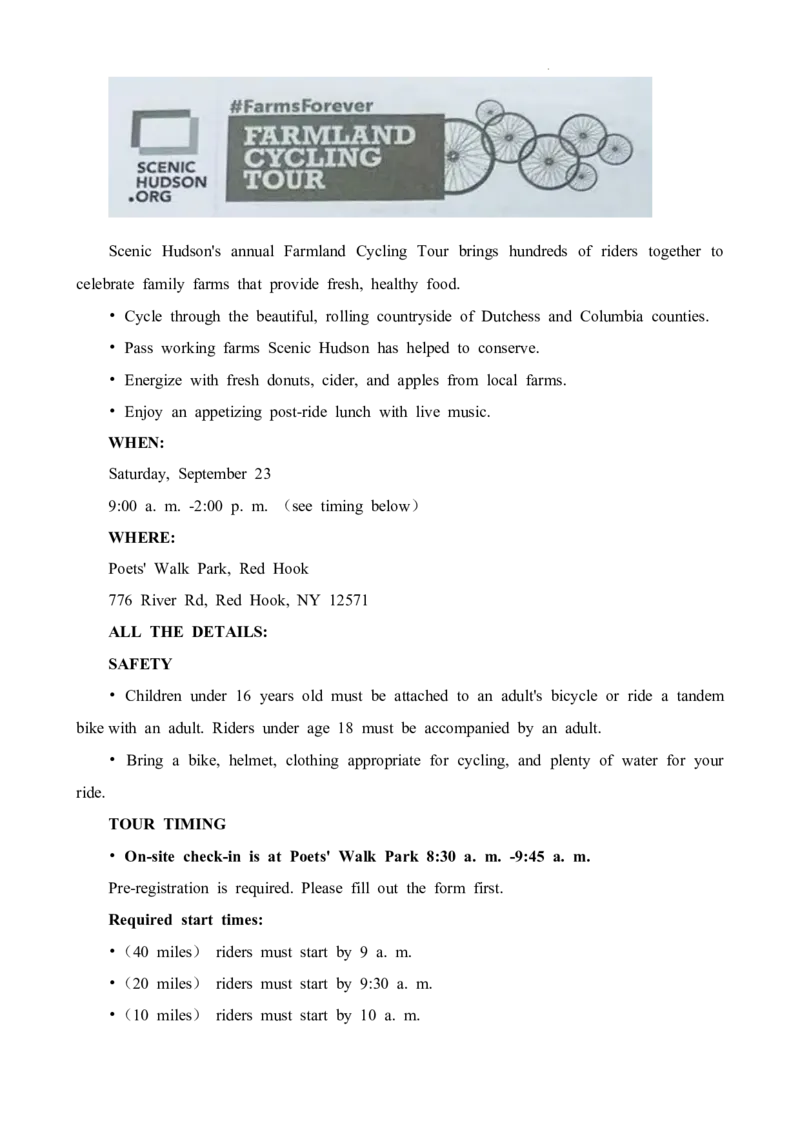
学科网(北京)股份有限公司Scenic Hudson's annual Farmland Cycling Tour brings hundreds of riders together to
celebrate family farms that provide fresh, healthy food.
• Cycle through the beautiful, rolling countryside of Dutchess and Columbia counties.
• Pass working farms Scenic Hudson has helped to conserve.
• Energize with fresh donuts, cider, and apples from local farms.
• Enjoy an appetizing post-ride lunch with live music.
WHEN:
Saturday, September 23
9:00 a. m. -2:00 p. m. (see timing below)
WHERE:
Poets' Walk Park, Red Hook
776 River Rd, Red Hook, NY 12571
ALL THE DETAILS:
SAFETY
• Children under 16 years old must be attached to an adult's bicycle or ride a tandem
bike with an adult. Riders under age 18 must be accompanied by an adult.
• Bring a bike, helmet, clothing appropriate for cycling, and plenty of water for your
ride.
TOUR TIMING
• On-site check-in is at Poets' Walk Park 8:30 a. m. -9:45 a. m.
Pre-registration is required. Please fill out the form first.
Required start times:
•(40 miles) riders must start by 9 a. m.
•(20 miles) riders must start by 9:30 a. m.
•(10 miles) riders must start by 10 a. m.
学科网(北京)股份有限公司• Lunch is 12 noon-2 p. m.
CONTACT
For more information contact Anthony Coneski at aconeski@scenichudson.org.
21. What is an advantage of Farmland Cycling Tour?
A. You can own your own ideal farm.
B. You can sample fresh farm produce.
C. You are given volunteer jobs on the farm.
D. You are entitled to a live music competition.
22. Which of the following meets safety requirements?
A. Riders should wear uniforms to ride.
B. One can not ride if not renting bikes.
C. Parents must accompany riders under 18.
D. Nobody under 16 is allowed to ride alone.
23. What time is proper to sign up on the scene?
A. 9 a. m. B. 10 a. m. C. 12 noon. D. 2 p. m.
B
As a teenager, Will Allen was a natural at basketball, and that's where he saw his fu-
ture. After graduating from Miami University, he turned professional. Later, he married, had
children, and joined a European basketball team. In his spare time, he found himself hang-
ing out with local farmers. A few seasons later, Will brought his family back to the United
States.
Then one day in 1993, while he was driving home from work, Will spotted a For
Sale sign on the last remaining farm in the city of Milwaukee. Ideas flashed through Will's
head. He could grow food here. He could farm full-time. He saw an opportunity, and
grabbed it.
With funding from a local church, Will hired some neighborhood teenagers to help
him get started. Their first job was to "grow" new soil, because the soil in the old green-
houses was heavily polluted. They create soil by composting (堆肥), which means col-
lecting different kinds of food waste and piling it up until it rots and turns into soil.
学科网(北京)股份有限公司Will brought in quantities of worms to help fertilize his new plants. In a process
called vermiculture, he spread layers of worms between layers of compost. The worms ate
up the compost and got out what's called "worm castings. " Amazingly, this worm poop
doesn't smell bad at all, and it makes the best fertilizer in the world.
After making good natural soil and the best possible fertilizer for plants, Will and his
teenage helpers, along with volunteers from the neighborhood, started growing food.
Today, Growing Power Community Food Center is a miraculously productive model
farm, growing enough food to feed two thousand people on just two acres in the middle of
a city.
Over the years, Growing Power has continued to expand. In 2002, he opened an office
in nearby Chicago, Illinois, to manage three city farms. And his vision for the city farm of
the future is a multi-storied building based on the idea "vertical farming". Such a building
could feed thousands of people.
"Growing food can change the world!" says Will.
24. What fueled Will's desire to grow food?
A. Having to feed a large family. B. Retiring from football seasons.
C. Identifying a city farm for sale. D. Living with European farmers.
25. What is special about new soil?
A. It is made up of all kinds of food waste.
B. It is a mixture of rotten organic materials.
C. It isn't taken from the polluted greenhouses.
D. It needs piling up before being brought into use.
26. What can we learn about "worm castings"?
A. They give off terrible smell. B. They are what worms consumed.
C. They are piled layers of compost. D. They make the best plant fertilizer.
27. What is Will's idea of future city farms?
A. To build high-rise housing for more farmers.
B. To provide sufficient farming space in the city.
C. To build buildings suitable for vertical farming.
D. To open more branches of city farms in big cities.
学科网(北京)股份有限公司C
Throughout much of the world, there are limited or no services available to help sup-
port neurodiverse (神经多样的) populations, including those diagnosed with ADHD (多
动症) and anxiety, and those limited services are often only available if a family can ac-
cess and afford them. Finding ways to provide increased service access is essential.
Telehealth services, which enable practitioners to continue their work with patients
without being physically located in the same place, made their way into the public aware-
ness during the 2019-2022 pandemic.
As many clients and families grew comfortable with video or chat-enabled therapy
(治疗) sessions, telehealth as a mode of delivering services has continued to grow. Even
as the world has reopened, telehealth remains a vital option for providing access to more
individuals, especially those in rural and underserved communities. Floreo, a virtual reality
platform, started working on telehealth capability well before the 2019-2022 pandemic. It
has seen success working with state Medicaid programmes to bring technology into families'
homes. In Wisconsin, families can access a subscription and needed equipment for Floreo
and optional telehealth services from in-house Floreo clinicians located outside of the US
state.
Adding the virtual reality aspect to a teletherapy session, as Floreo does, allows for
practice with virtual peer (地位相同的) characters in social situations, navigating environ-
ments such as a supermarket or street crossing, and difficult-to-copy situations like interact-
ing with police officers, all from the comfort and convenience of the family home.
For some families, this has been a game changer. And it is not just families who can
benefit from the convenience of telehealth and more accessible services. Telehealth has ben-
efits for practitioners as well. Large ADHD therapy companies like the Center for Social
Dynamics are using telehealth to help manage staff time more efficiently. In some tradi-
tional therapy situations, therapists may need to travel from house to house to visit clients for
home-based services, contributing to staff burnout and turnover.
28. What is the problem facing neurodiverse people?
A. They cannot pay the high medical bills.
B. Hospitals fail to lend a helping hand.
学科网(北京)股份有限公司C. They are suffering from the incurable diseases.
D. Medical services aren't easily accessible to them.
29. What does the underlined word "practitioners" in paragraph 2 probably refer to?
A. Workers. B. Doctors. C. Politicians. D. Servants.
30. What is mainly talked about in paragraph 3?
A. How telehealth services are applied.
B. How medical staff practice medicine.
C. What health benefits telehealth provides.
D. What consequences the deadly pandemic has.
31. What is a suitable title for the text?
A. Why is telehealth a must in treating illnesses in future?
B. How does telehealth make medical care more accessible?
C. How can patients get better access to healthcare services?
D. Why do patients fail to get healthcare services right away?
D
With the WHO no longer considering COVID-19 a global health emergency, it seems
that the virus and its large number of deaths will soon fade from memory, along with N95
masks and PCR tests.
Our ability to forget a pandemic is partly a coping mechanism, reflecting the emotional
immune system that enables us to move on with our daily lives. Every day, we receive
massive information that our brains struggle to keep. Moreover, the process by which our
brains assess risk is deeply personal and influenced by our own needs.
We are reminded why so many people were eager to forget the 1918 influenza pan-
demic and embrace the joys of the Roaring Twenties. But collective forgetting threatens to
leave us unprepared for future airborne disease outbreaks, forcing us to re-learn fundamental
lessons about the importance of masking and shifting activities outdoors to prevent transmis-
sion.
People often have a more positive view of the future than the past as a way of build-
ing psychological resilience (韧性). This is because, unlike the unchangeable past, the
future offers endless possibilities. But our tendency to look forward also arrests progress on
学科网(北京)股份有限公司issues like pandemic preparedness, as it leads us to believe we are better equipped than we
are.
Today, there's still no comprehensive effort to carry out the detailed recommendations
on how to improve pandemic preparedness. Today, we still lack clear explanations for why
our public-health agencies are understaffed and underfunded, why supply chains failed, why
COVID-19 misinformation was allowed to overflow on media platforms, and why our public-
health responses remain passive.
It has taken Ireland more than 150 years to build memorials and museums marking the
impact of the disaster—the Great Famine of the 1840s. We cannot afford to let the same
happen with COVID-19. Our ability to remember the past could affect billions of lives in
the future.
32. What is paragraph 2 mainly about?
A. The pandemic coping system.
C. The reasons for forgetting a pandemic.
B. The struggle of data memory.
D. The personal pandemic assessment.
33. Why are the 1918 influenza pandemic and the Roaring Twenties mentioned in
paragraph 3?
A. To outline the astonishing parallel found in history.
B. To reveal the harmful effect of collective forgetting.
C. To uncover people's collective loss of memory.
D. To reflect people's interest in future possibilities.
34. It can be inferred that during the post-pandemic time,
A. good preparations for the next pandemic have been made
B. people's ability to cope with a pandemic is underestimated
C. the suggestions on pandemic prevention are well adopted
D. a list of questions concerning the pandemic remain to be answered
35. What does the author intend people to do in the passage?
A. Remember the pandemic. B. Embrace the pandemic-free life.
C. Invest in the pandemic research. D. Build memorials to the pandemic.
学科网(北京)股份有限公司第二节(共5小题;每小题 2. 5分, 满分12. 5分)
阅读下面短文, 从短文后的选项中选出可以填入空白处的最佳选项。选项中有两项为多
余选项。
The degree to which you leave traces (or data) of your online activities is referred
to as your digital footprint. _36_What you usually leave behind include the remains of a
campfire, your dinner scraps, and the path you carved in the woods while hiking.
In some cases, there's a legal use for your digital footprint, such as website owners
and advertisers collecting information about your online habits and purchasing preferences to
better accommodate your needs. _37_Perhaps the biggest risk people face online is having
their identity stolen. Besides identity theft, criminals can gather enough information about a
person to target him for fraud (欺诈).
_38_ Here are some steps you can take to minimize it.
Don't use your primary email address when creating online accounts. You can create
one-off email addresses to make it harder for someone to develop a picture of all the sites
and services you use. Another step for you is not to over-share. _39_So you can restrict
your social media posts to friends or close contacts only. Finally, don't let websites sell
your data. Increasingly, websites are adding privacy tools that prevent you from having
your personal information sold to advertisers or shared with partners. _40_
A. You're leaving an "active” digital footprint or a "passive” one.
B. You'll need to look for these controls right now, if they exist at all.
C. You probably don't need your personal life to be completely public.
D. It's similar to the evidence you might leave behind after going camping.
E. In the case of your digital footprint, the evidence you leave behind is data.
F. It's inescapable to leave some sort of digital footprint after your online activity.
G. But the data can also be used by hackers, criminals and other immoral actors.
第三部分 语言运用(共两节, 满分30分)
第一节(共15小题;每小题1分, 满分15分)
阅读下面短文, 从每题所给的A、B、C、D四个选项中选出可以填入空白处的最佳选项。
学科网(北京)股份有限公司Born prematurely, Nasya was given little chance of survival. But she kept _41_. After
her open-heart surgery at two weeks old, doctors made a _42_ that she'd be in hospital for
five months, but she came home in nine weeks!
Nasya was quickly proved that her talents were as big as her will to_43_. By six,
she'd been _4_4by an acting coach, who encouraged her parents to enter her in drama
classes. Then her spirit came _45_for something about being onstage. But the enthusiasm
didn't find _46_ with some of her schoolmates. When she told them her dream of an ac-
tress, they laughed. "You? You're_47_. You're not even pretty. No one will ever know who
you are. "
Nasya came home in tears. Mom hugged her. "_48_for yourself! You can be whatever
you want to be. " She took Nasya's mind off the_49_.
Nasya kept being bullied (霸凌) for her _50_, but because performing on stage ev-
ery time made her more confident, she tried to _51_it. One day, a popular girl told her,
"You're not better than me. How can you be a(n) _52_? Give. It. Up. " This time
Nasya kept her _53_. She replied, "I love to act. I'm going to make it. " In the end, she
won.
Entering university, Nasya found her_54_—teaching drama to some homeless children
at a shelter. "I tell them their current circumstance doesn't have to be their fortune. If they
are _55_, they can do anything they want, " she said.
41. A. waiting B. begging C. fighting D. smiling
42. A. calculation B. prediction C. description D. regulation
43. A. survive B. refresh C. succeed D. possess
44. A. inquired B. admitted C. recorded D. spotted
45. A. true B. right C. close D. alive
46. A. favour B. fault C. relief D. harmony
47. A. everybody B. anybody C. nobody D. somebody
48. A. Stay up B. Stand up C. Put up D. Hang up
49. A. envy B. fright C. dream D. problem
50. A. toleration B. competence C. passion D. temper
51. A. remember B. ignore C. investigate D. absorb
学科网(北京)股份有限公司52. A. actress B. coach C. director D. screenwriter
53. A. care B. cool C. anger D. suffering
54. A. cause B. result C. hobby D. major
55. A. skilled B. defensive C. determined D. sensitive
第二节(共 10 小题;每小题 1. 5 分, 满分15分)
阅读下面短文, 在空白处填入1个适当的单词或括号内单词的正确形式。
The earliest _56_ (confirm ) use of chopsticks in China was in 1200 B. C. during
the Shang dynasty. These chopsticks made of bronze (青铜), able to reach deep into pots
of boiling oil, _57_ (use) mainly for cooking.
It wasn't until 400 A. D. that chopsticks were shortened and used for eating. Around
this time, _58_ (cook) started cutting meat into small pieces to conserve cooking oil.
Then, consumers quickly realized that chopsticks were perfect for moving these bite-sized
pieces from bowl to mouth.
Long before this, however, none other than Confucius_59_(him) had already sup-
ported this kind of chopsticks. _60_ philosopher believed that sharp tools like knives would
remind eaters of the terrible way the meat came to be in the bowl. Chopsticks, on the
other hand, had dull ends, _61_ (spare) their users from images of the slaughterhouse (屠
宰场).
By 500 A. D, chopstick use_62_ (spread) from China to Japan, where the design
was adapted to local tastes. In Japan, chopsticks were made_63_ different sizes for men,
women, and children respectively.
_64_Japan eventually invented the one-use chopsticks in 1878, China was the_65_(ori-
gin) source of the delicate design bringing anxiety to many a takeout eater worldwide.
第四部分 写作(共两节, 满分 40 分)
第一节(满分 15 分)
假定你是李华, 想邀请外教 David参加你校交换生汉语学习作品展。请你给他写封邮件,
内容包括:
1. 展览时间、地点:
2. 展览内容。
学科网(北京)股份有限公司注意:
1, 写作词数应为80个左右;
2, 请按如下格式在答题卡的相应位置作答。
Dear David,
I'm Li Hua from Class 3.
Yours sincerely,
Li Hua
第二节(满分 25 分)
阅读下面材料, 根据其内容和所给段落开头语续写两段, 使之构成一篇完整的短文。
We sat on the bus waiting while other passengers piled on. A blond-haired girl, about
nineteen years old, took the seat in front of us. The bus driver followed behind her. He
demanded her fare.
"You pay $40 or get off the bus!" the driver said.
"I paid already. Yesterday, online, " the girl insisted.
"No, no record of it!" the bus driver pointed to the paper in his hand and waved it in
her face. "See. No pay! You pay, or you must get off. " He angrily pointed to the exit
door.
"But I don't have money. And I paid already. Please. ”
The bus driver picked up his mobile phone and made a call to find out if there had
been an error with the paperwork. After failing to get through, he was getting angrier with
the girl. So he cut the call and didn't try.
"No, you have not paid. You must pay. ”
"But please, I don't have any money on me. I must get to LA today. Please. "
Tears streamed down her face.
I had boarded a bus headed to Los Angeles. I was very excited about experiencing
LA. My dream of visiting Disney Land was about to come true. But while I sat there
comfortably in my seat, thinking about my next adventure, this young girl was in tears,
with a man standing over her, demanding money.
学科网(北京)股份有限公司I wasn't sure what I should do. Was she telling the truth? It wouldn't be the first time
someone had extracted money by telling a sad story that turned out untrue. Did she really
not have any money? Maybe the bus driver would show some sympathy and allow her to
sort the payment out later?
But no, the bus driver continued to demand she pay $40 or get off the bus. The
young girl insisted that she didn't have enough money for the fare and had no one she
could contact for help. It seemed the driver would throw her off the bus.
注意:
1. 续写词数应为150 个左右;
2. 请按如下格式在答题卡的相应位置作答。
Suddenly, a messy grey-haired woman with a weathered face stood up.
At the next rest stop, I noticed that woman had no money for food.
学科网(北京)股份有限公司