
































































文档内容
n
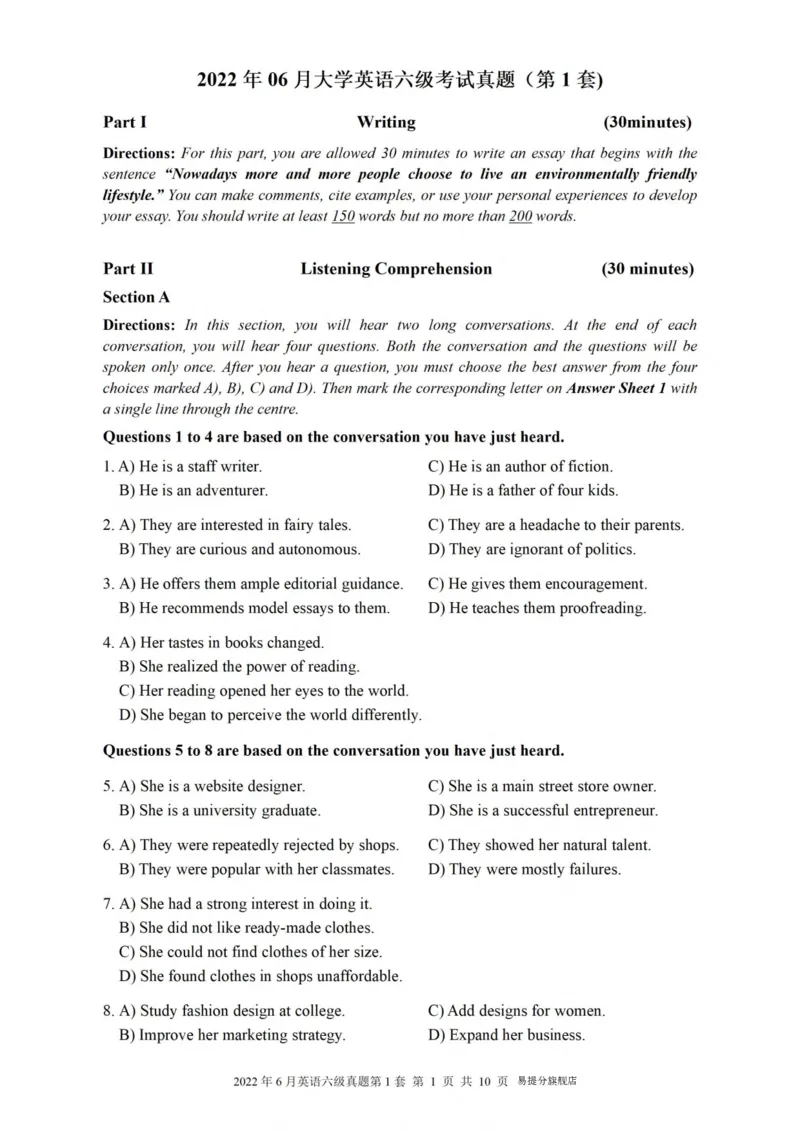
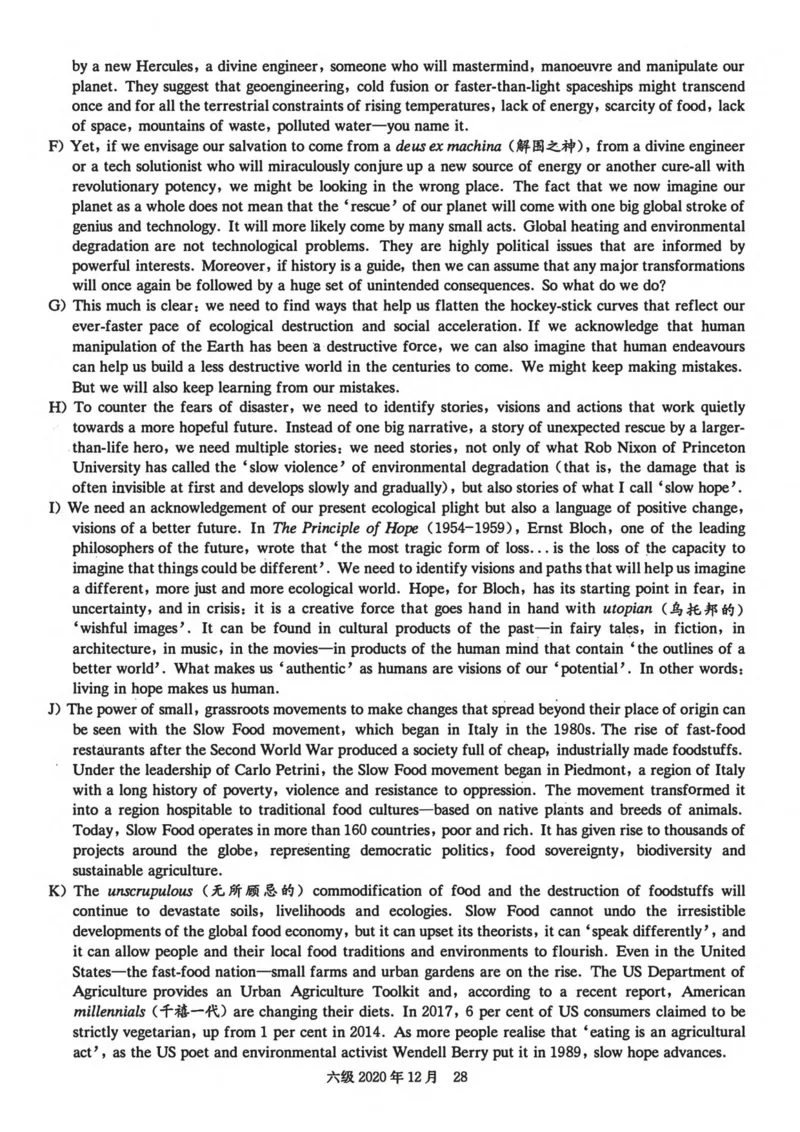
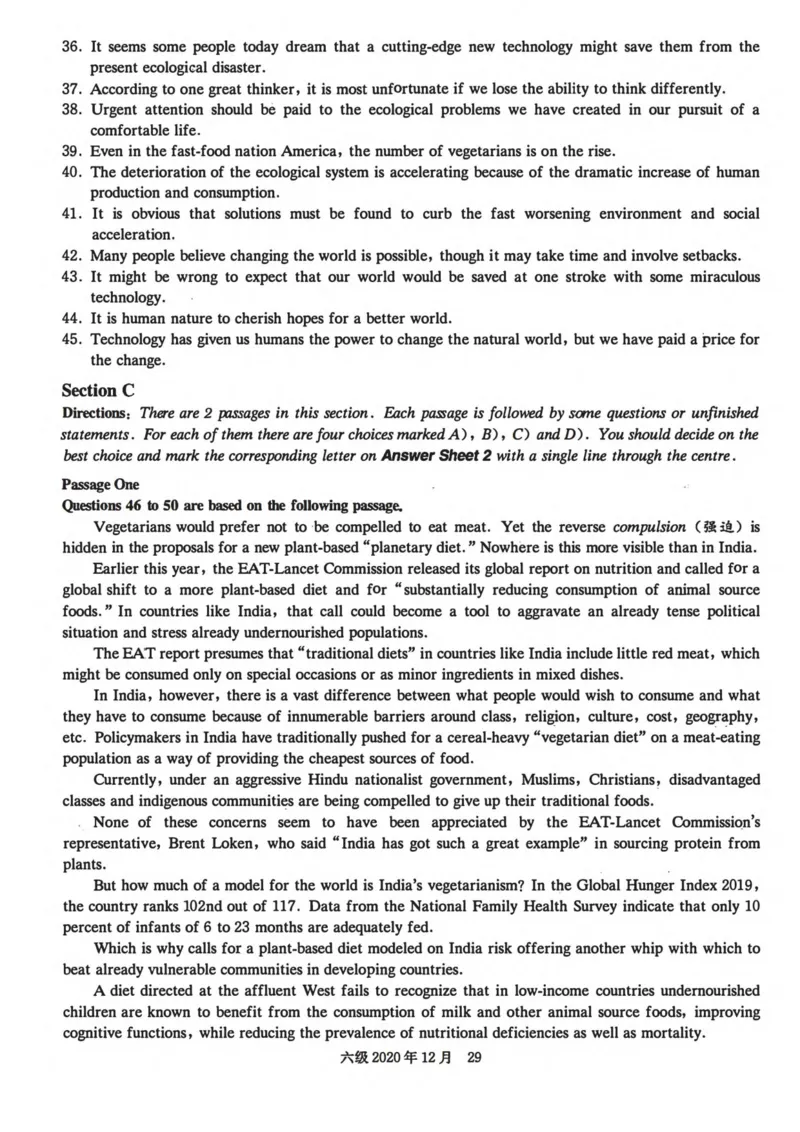
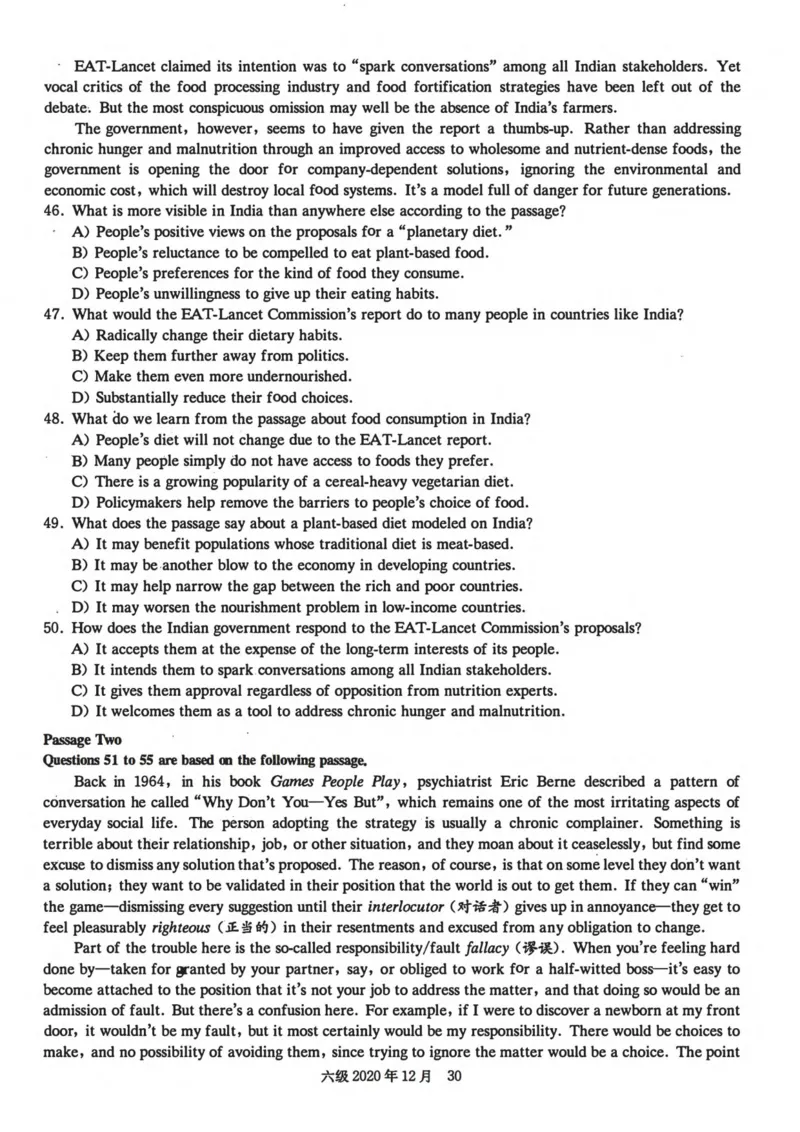
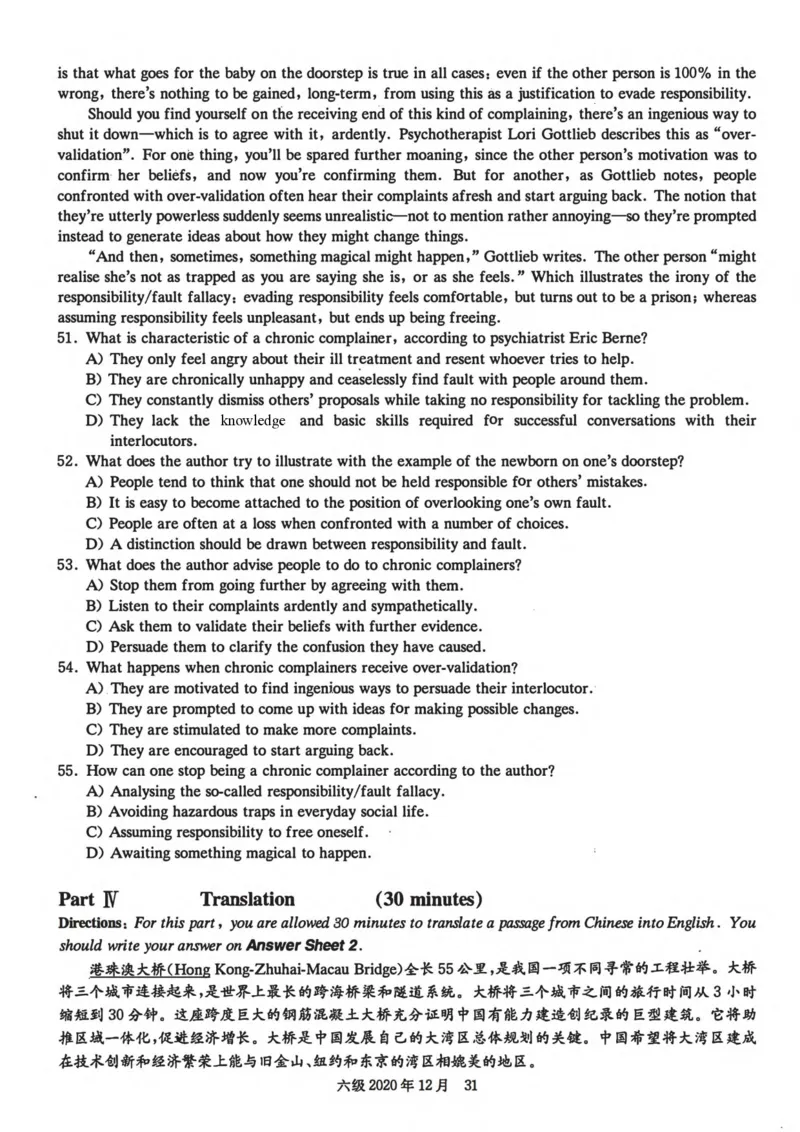
2022 if 06 (f If )
Part I Writing (30minutes)
Directions: For this part, you are allowed 30 minutes to write an essay that begins with the
sentence “Nowadays more and more people choose to live an environmentally friendly
lifestyle.”You can make comments, cite examples, or use your personal experiences to develop
your essay.Youshoiddwriteatleast 150words butnomorethan200words.
Part II Listening Comprehension (30 minutes)
SectionA
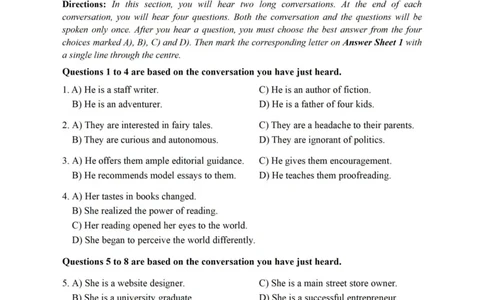
Directions: In this section, you will hear two long conversations. At the end of each
conversation, you will hear four questions. Both the conversation and the questions will be
spoken only once. After you hear a question, you must choose the best answer from the four
choices marked A), B), C)and D). Then mark the correspondingletter on Answer Sheet 1 with
asinglelinethrough the centre.
Questions 1 to4 are based on the conversation you have just heard.
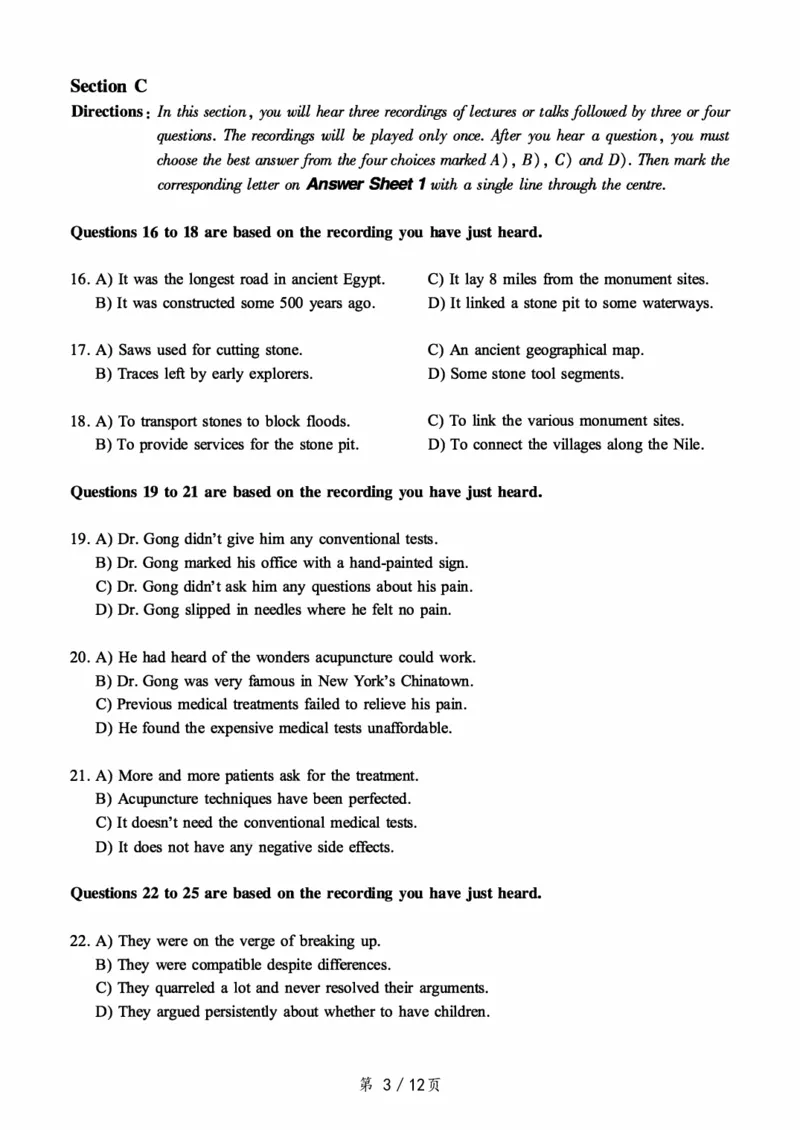
1.A) He is a staff writer. C)He is an author of fiction.
B) He is an adventurer. D) He is a fatherof four kids.
2. A) They are interested in fairy tales. C)They area headacheto their parents.
B)They arecurious and autonomous. D) They areignorant of politics.
3. A) Heoffers them ample editorial guidance. C)Hegives them encouragement.
B)Herecommends model essays to them. D) Heteaches them proofreading.
4. A) Her tastes in books changed.
B)She realized the power of reading.
C)Her reading opened her eyes to the world.
D)She began to perceive the world differently.
Questions5to8 are based on the conversation you have just heard.
5. A) She is a website designer. C)She isa main street storeowner.
B)She isa university graduate. D) She isasuccessful entrepreneur.
6. A) They wererepeatedly rejected by shops. C)They showed her natural talent.
B)They were popular with her classmates. D) They were mostly failures.
7. A) She had a strong interest in doing it.
B)She did not like ready-made clothes.
C)She could not find clothesof her size.
D)She found clothes in shops unaffordable.
8. A) Study fashion design at college. C)Add designsfor women.
B)Improve her marketing strategy. D) Expand her business.
n
2022if 6 1* M 1 M A 10 JB , 易提分旗舰店Section B
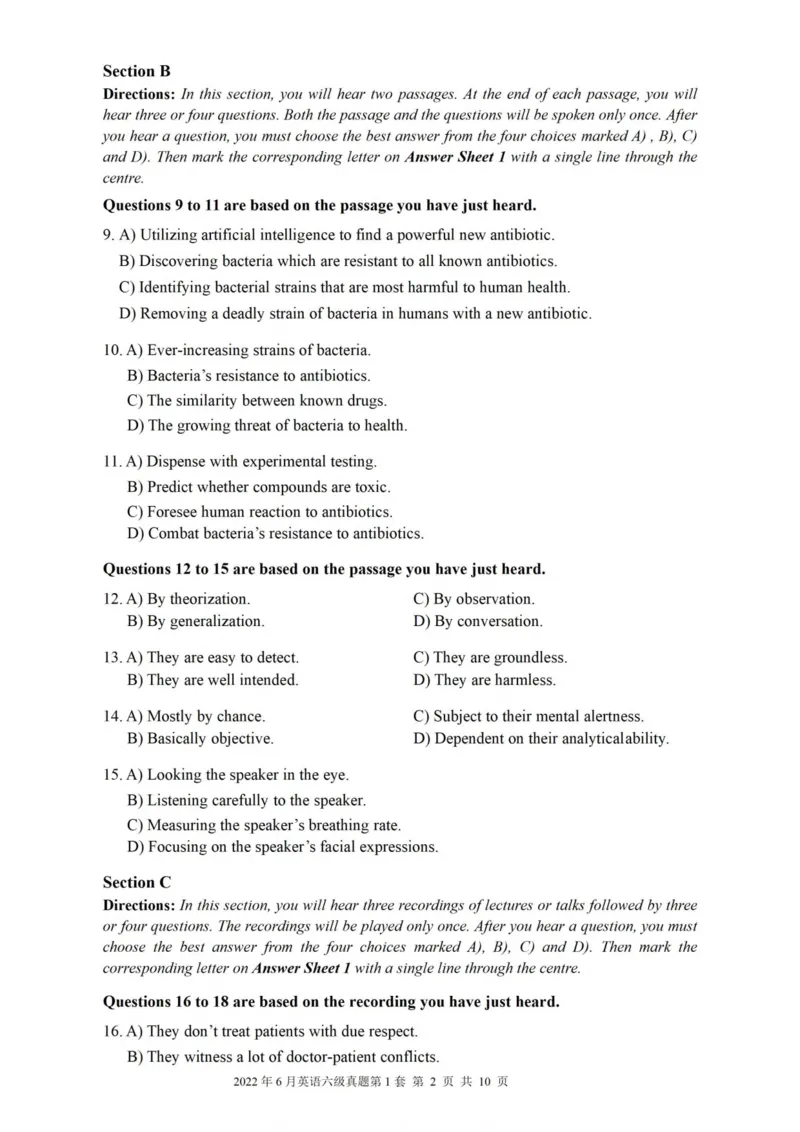
Directions: In this section, you will hear two passages. At the end of each passage, you will
hear threeor fourquestions. Boththepassageandthequestions will bespoken onlyonce. After
you hear aquestion, you must choose the best answer from the four choices markedA) , B), C)
and D). Then mark the corresponding letter on Answer Sheet 1 with a single line through the
centre.
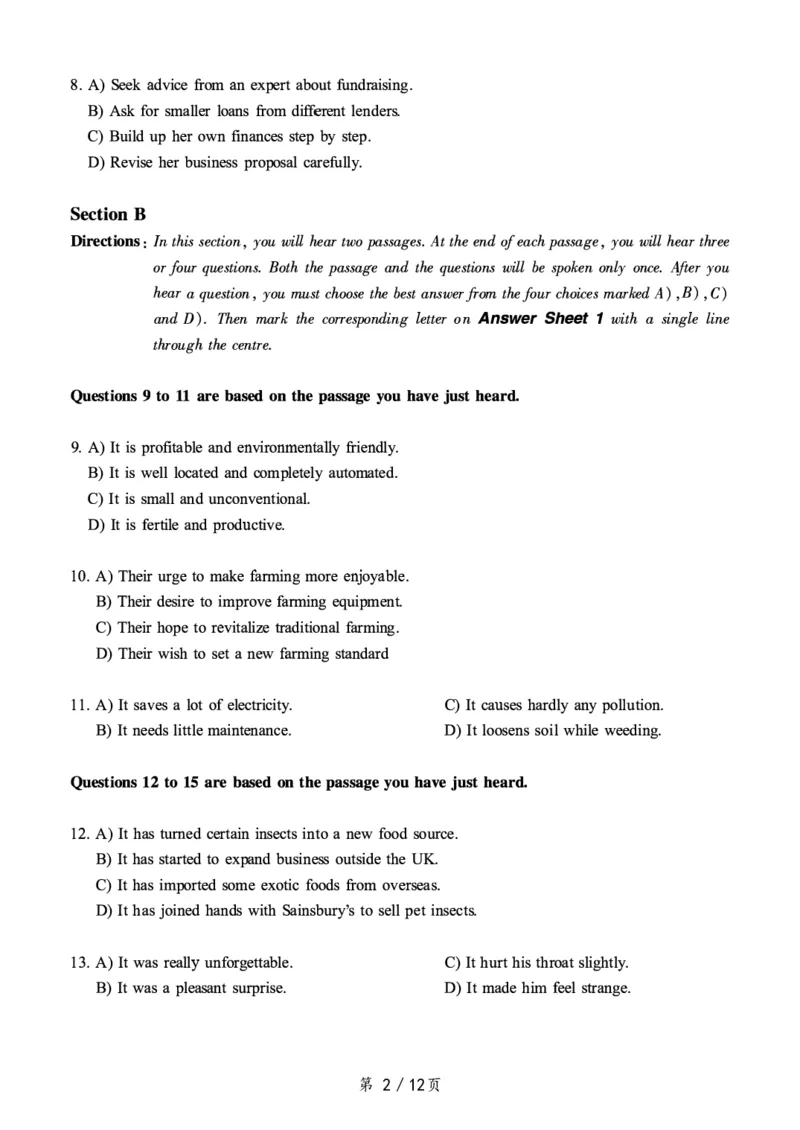
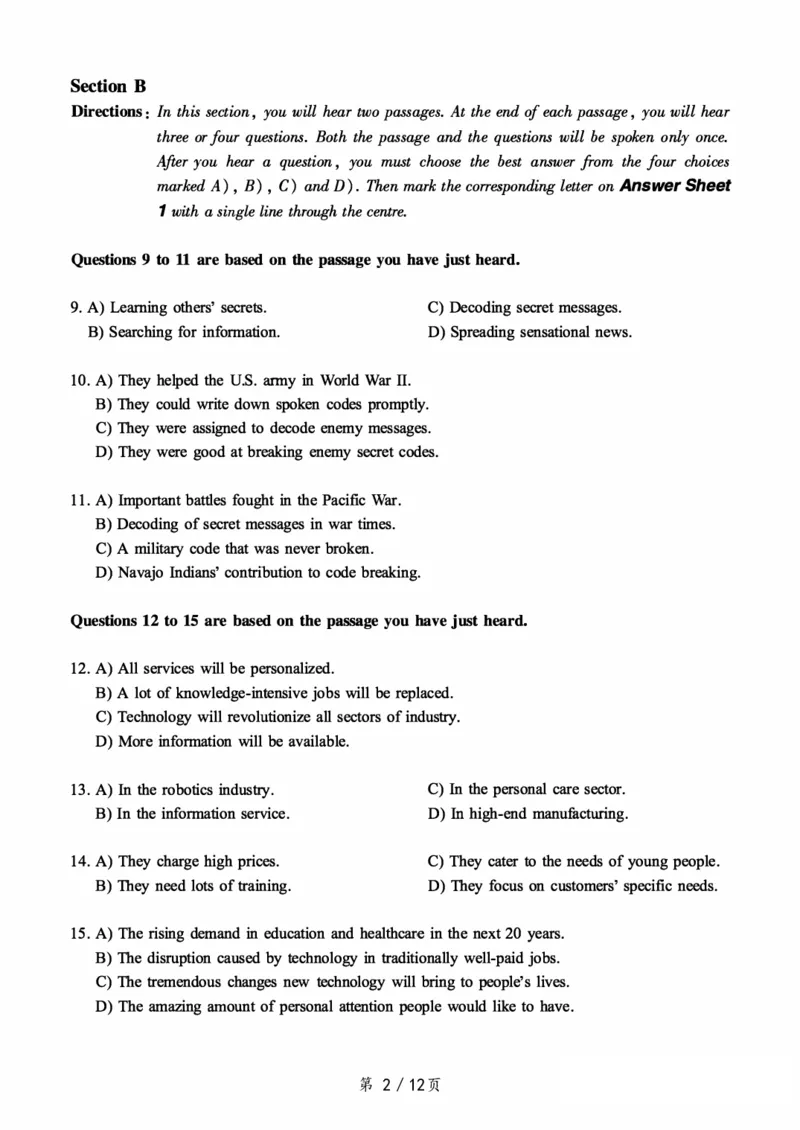
Questions 9 to 11are based on the passageyou have just heard.
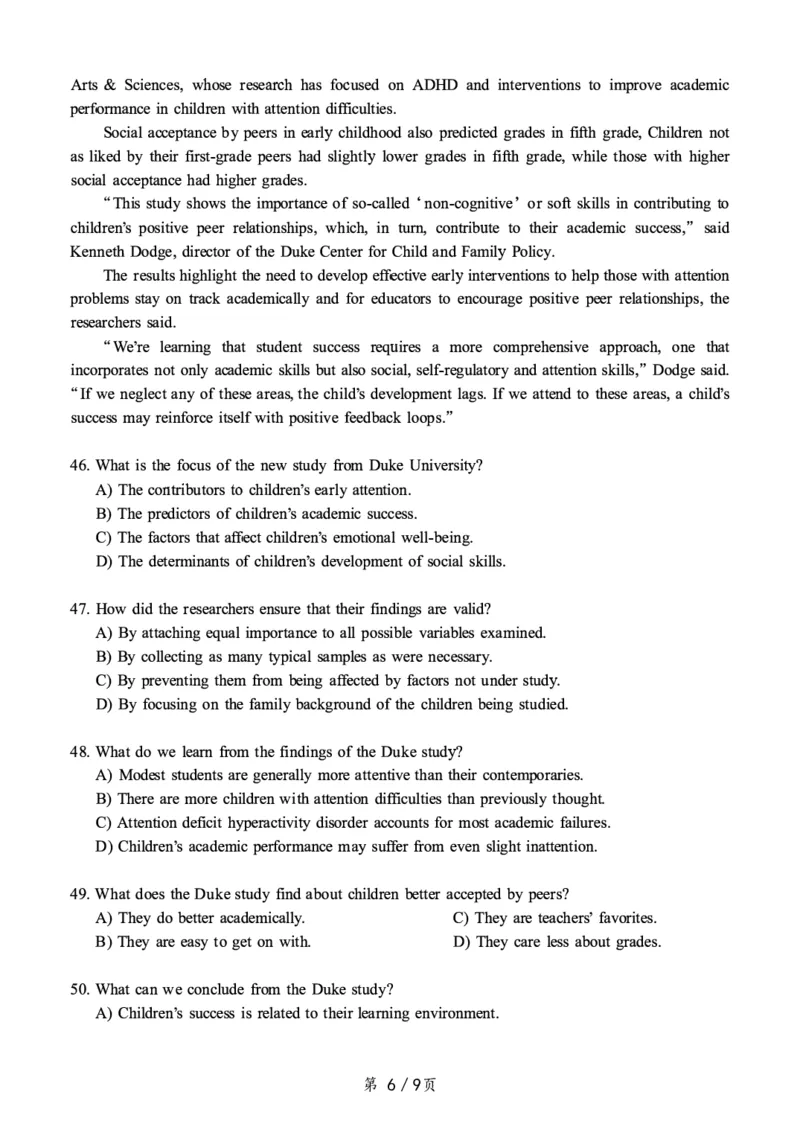
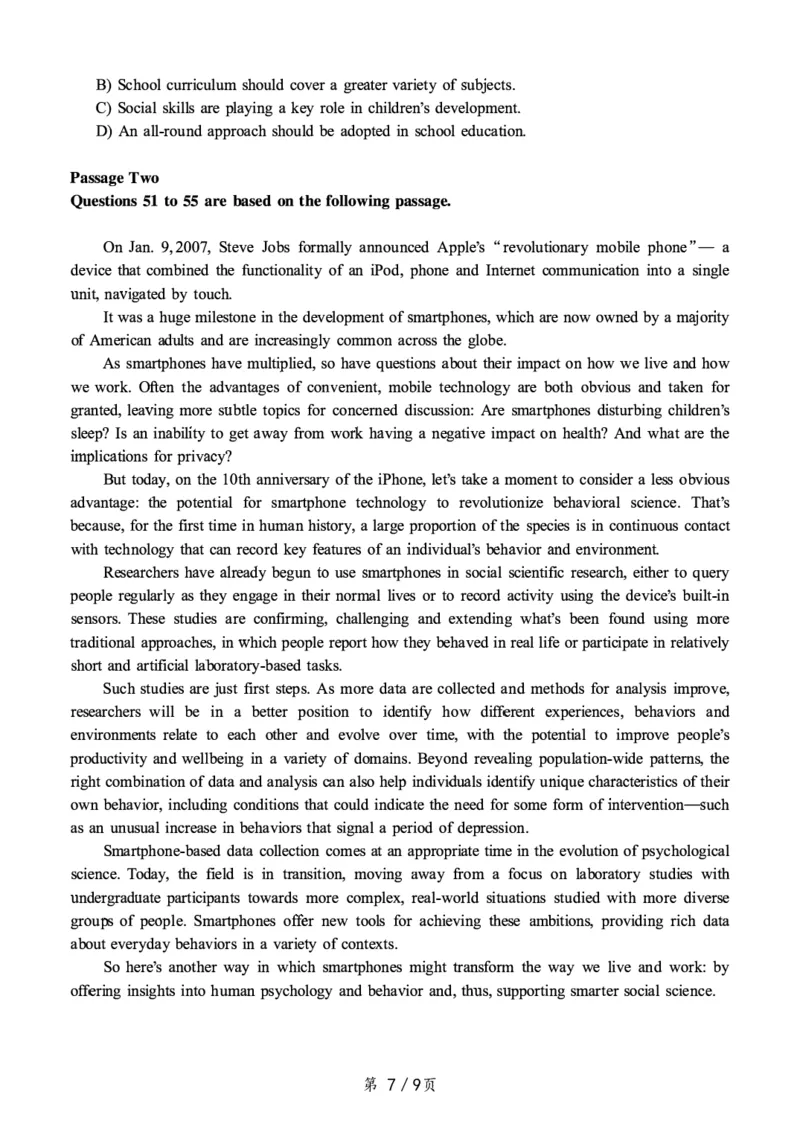
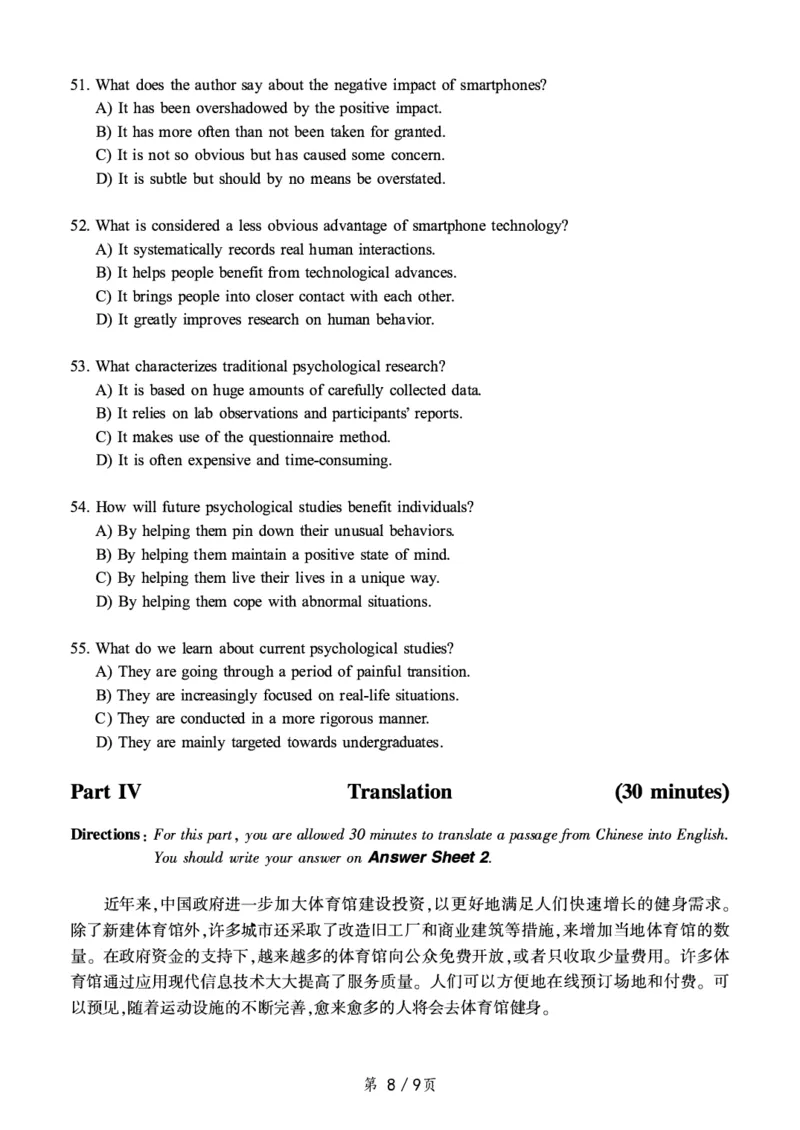
9. A) Utilizing artificial intelligence to find a powerful new antibiotic.
B)Discovering bacteria which are resistant to all known antibiotics.
C)Identifying bacterial strains that are most harmful to human health.
D)Removing a deadly strain of bacteria in humans with a new antibiotic.
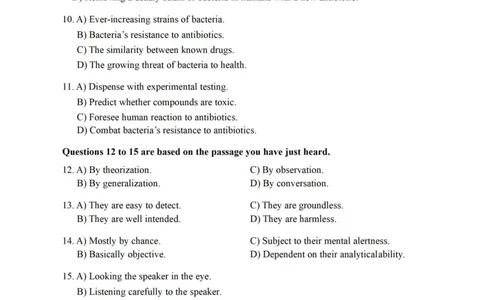
10.A) Ever-increasing strainsof bacteria.
B) Bacteria’s resistance to antibiotics.
C)The similarity between known drugs.
D)The growing threat of bacteria to health.
11.A)Dispense with experimental testing.
B) Predict whether compounds are toxic.
C)Foresee human reaction toantibiotics.
D)Combat bacteria’s resistance toantibiotics.
Questions 12 to 15 are based on the passageyou have just heard.
12.A) By theorization. C)By observation.
B) By generalization. D) By conversation.
13.A) They are easy to detect. C)They aregroundless.
B) They arewell intended. D)They are harmless.
14.A) Mostly by chance. C)Subject to their mental alertness.
B) Basically objective. D) Dependent on their analyticalability.
15.A) Looking the speaker in the eye.
B) Listening carefully to the speaker.
C)Measuring the speaker’s breathing rate.
D)Focusing on thespeaker’sfacial expressions.
Section C
Directions: In this section, you will hear three recordings oflectures or talks followed by three
or four questions. The recordings will be playedonly once. After you hear aquestion, you must
choose the best answer from the four choices marked A), B), C) and D). Then mark the
correspondingletter onAnswerSheet1 withasinglelinethroughthecentre.
Questions 16 to 18 are based on the recording you have just heard.
16.A) They don’t treat patients with due respect.
B) They witnessa lot of doctor-patient conflicts.
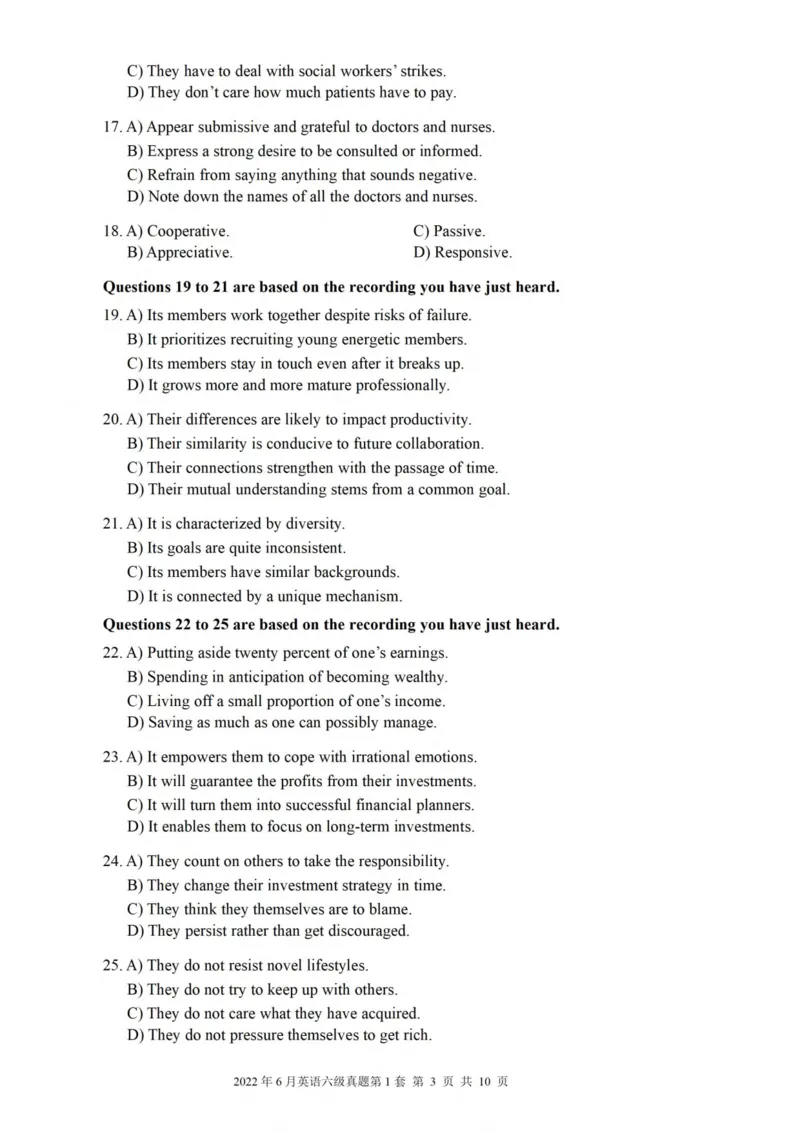
2022tp6M AaKSH1*% 2 M * 10 51C)They haveto deal with social workers’strikes.
D)They don’tcare how much patients have to pay.
17.A)Appear submissive and grateful to doctorsand nurses.
B) Express astrongdesire to be consulted or informed.
C)Refrain from saying anything that sounds negative.
D) Note down thenames of all the doctors and nurses.
18.A) Cooperative. C)Passive.
B)Appreciative. D)Responsive.
Questions 19 to 21 are based on the recording you have just heard.
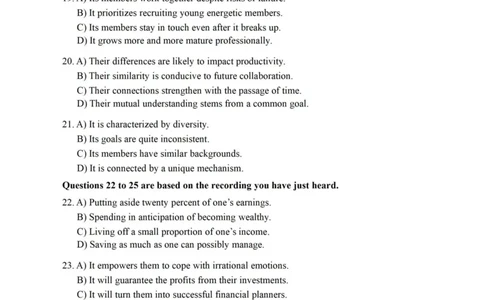
19.A) Its members work together despite risksof failure.
B) It prioritizes recruiting young energetic members.
C) Its members stay in touch even after it breaks up.
D)It grows more and more mature professionally.
20.A) Their differencesare likely to impact productivity.
B) Their similarity is conducive to futurecollaboration.
C)Their connectionsstrengthen with the passage of time.
D)Their mutual understanding stems from acommon goal.
21.A) It is characterized by diversity.
B) Its goalsare quite inconsistent.
C) Its members have similar backgrounds.
D) It is connected by a unique mechanism.
Questions 22 to 25 are based on the recording you have just heard.
22.A) Putting asidetwenty percent ofone’s earnings.
B) Spending in anticipation of becoming wealthy.
C)Living off a small proportion of one’s income.
D)Saving as much as one can possibly manage.
23.A) It empowers them to cope with irrational emotions.
B) It will guarantee the profits from their investments.
C)It will turn them into successful financial planners.
D) It enables them to focus on long-term investments.
24.A) They count on others to take the responsibility.
B) They change their investment strategy in time.
C)They think they themselvesare to blame.
D)They persist rather than get discouraged.
25.A) They do not resist novel lifestyles.
B) They do not try to keepupwith others.
C)They do not care what they have acquired.
D)They do not pressurethemselvesto get rich.
n m
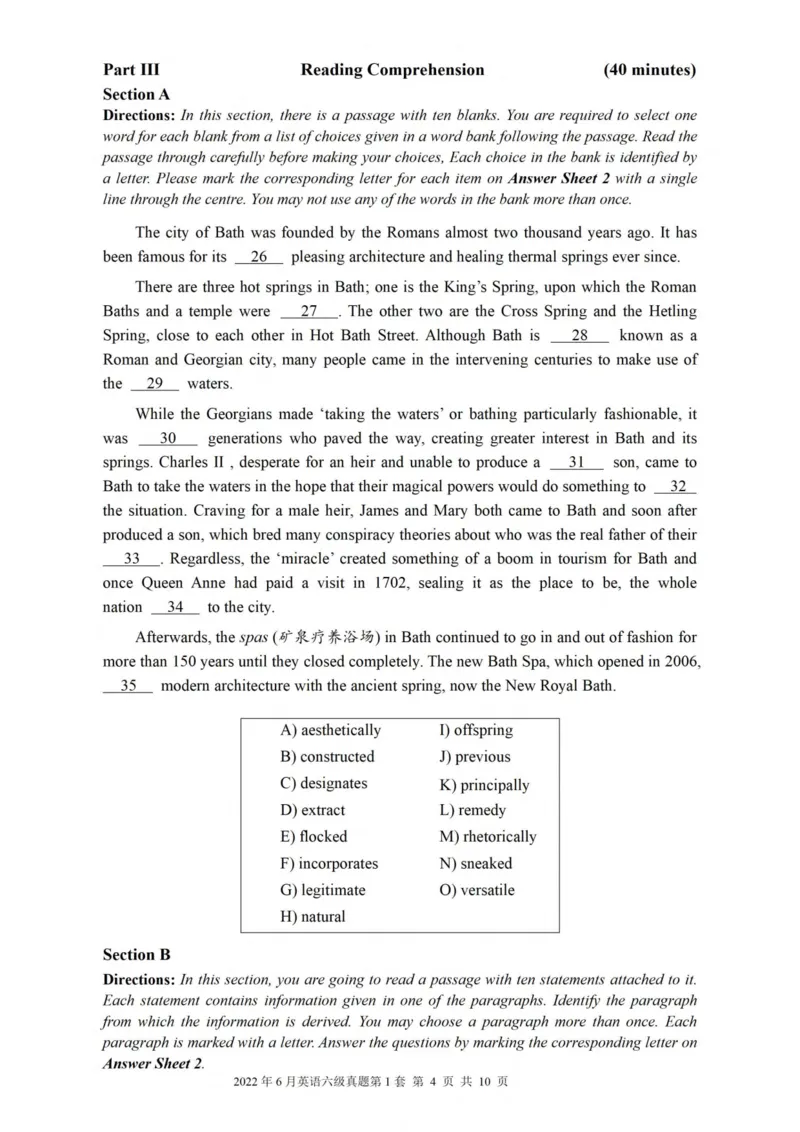
2022if 6 1* M 3 fr 10 %Part III Reading Comprehension (40 minutes)
SectionA
Directions: In this section, there is a passage with ten blanks. You are required to select one
wordforeach blank fromalistofchoices given inawordbankfollowing thepassage.Readthe
passage through carefully before making your choices, Each choice in the bank is identified by
a letter. Please mark the corresponding letter for each item on Answer Sheet 2 with a single
linethroughthecentre. Youmay notuseanyofthewords inthebank morethan once.
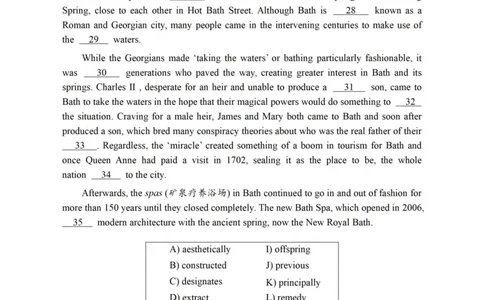
The city of Bath was founded by the Romans almost two thousand years ago. It has
been famousfor its 26 pleasing architecture and healing thermal springsever since.
There are three hot springs in Bath; one is the King’s Spring, upon which the Roman
Baths and a temple were 27 The other two are the Cross Spring and the Hetling
Spring, close to each other in Hot Bath Street. Although Bath is 28 known as a
Roman and Georgian city, many people came in the intervening centuries to make use of
the 29 waters.
While the Georgians made ‘taking the waters’ or bathing particularly fashionable, it
was 30 generations who paved the way, creating greater interest in Bath and its
springs. Charles II , desperate for an heir and unable to produce a 31 son, came to
Bath to take the waters in the hopethat their magical powers would do something to 32
the situation. Craving for a male heir, James and Mary both came to Bath and soon after
produced a son, which bred many conspiracy theories about who was the real father of their
33 Regardless, the ‘miracle’ created something of a boom in tourism for Bath and
once Queen Anne had paid a visit in 1702, sealing it as the place to be, the whole
nation 34 to the city.
Afterwards, the spas (ft- fffi#-77 ft) in Bath continued to go in and out of fashion for
morethan 150 yearsuntil they closed completely.The new Bath Spa,which opened in 2006,
35 modem architecture with the ancient spring, nowthe New Royal Bath.
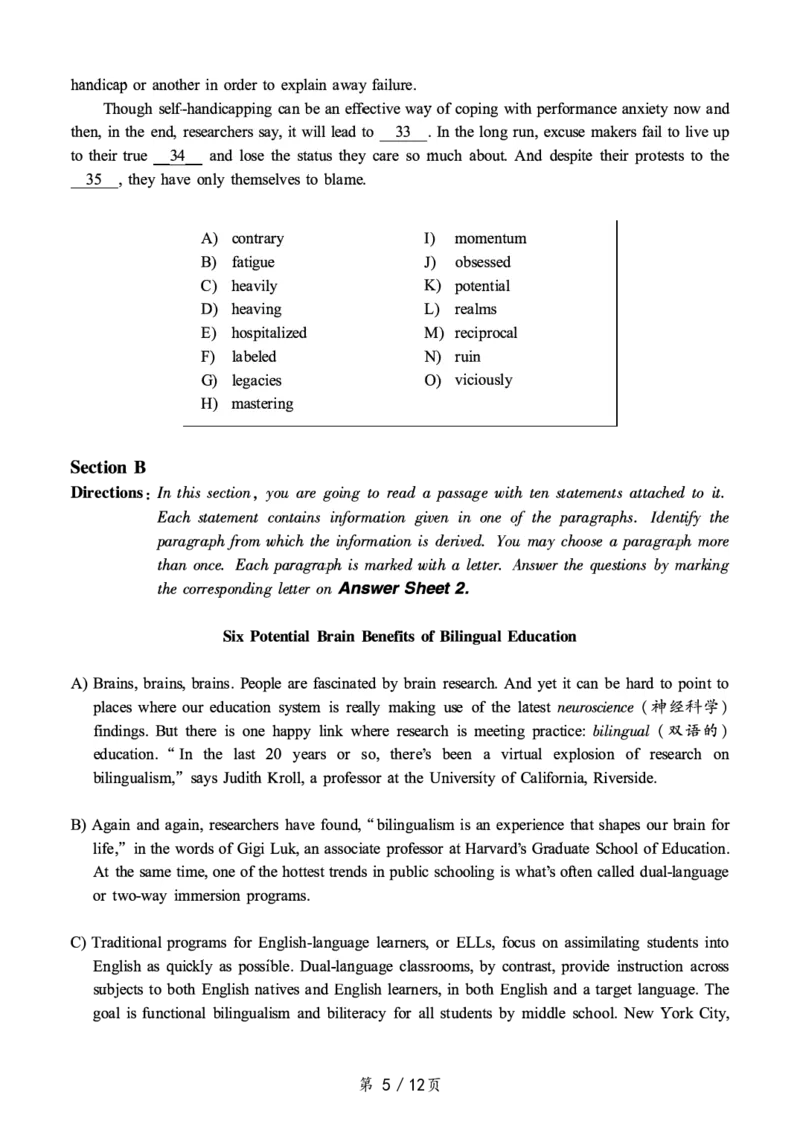
A) aesthetically I) offspring
B) constructed J) previous
C) designates K) principally
D) extract L)remedy
E) flocked M) rhetorically
F) incorporates N) sneaked
G) legitimate O) versatile
H) natural
Section B
Directions: In this section, you are going to read a passage with ten statements attached to it.
Each statement contains information given in one of the paragraphs. Identify the paragraph
from which the information is derived. You may choose a paragraph more than once. Each
paragraph is markedwith aletter.Answer the questions by marking thecorrespondingletter on
AnswerSheet 2
.
n
2022if 6 1* Jg 4 * 10 %The DoctorWillSkypeYou Now
A) Fazila is a young woman that has been dealing with
eczema(S^
), a common skin
condition, for the past five years, but never got it treated. The nearest hospital is an hour
away, by boat and bus, and her skin condition didn’t seem serious enough to make the
trek, so she ignored it—until a newtechnology brought the doctor to her.Fazila lives on
one of the remote river islands in northern Bangladesh. These islands are low-lying,
temporary sand islands that are continuously formed and destroyed through sand
buildup and erosion. They are home to over six million people, who face repeated
displacement from flooding and erosion—which may be getting worse because of
climate change-anda range of health risks, including poor nutrition, malaria(J& jk) and
other water-borne diseases.
B) The most dangerous thing for these remote island dwellers is land erosion. The second
is lack of access to medical supplies and doctors. There are no doctors within miles, and
while child mortality and maternal death have gone down in the rest of the country, this
is not the case for the islands. The medical situation is so bad that it really takes away
from the quality of their life. Yet for many island inhabitants—some of Bangladesh’s
poorest—paying for health care is a costly ordeal. Victims of erosion lose their houses,
agricultural land and jobs as farmers, fishermen and day laborers. Though government
hospitals are free, many people hesitate to go, citing long commutes, endless lines and
questionable diagnoses. For convenience’s sake
,
one-third of rural households visit
unqualified village doctors, who rely on unscientific methods of treatment, according to
a 2016 study in thepeer-reviewed journal Global HealthAction.
C) On the islands, there’s even a colloquial ( o tk tfj ) expression for the idea of making
medical care your lowest priority: It’s known as “rog pushai rakha” in Bengali, which
roughly translates to “stockpiling their diseases”—waiting to seek medical attention
until a condition becomes extremely serious. Now,a new virtual medical service called
Teledaktar (TD) is trying to make health care more easily accessible. Every week, TD’s
medical operators travel to the islands by boat, carrying a laptop, a portable printer for
prescriptions and tools to run basic medical screenings such as blood pressure, blood
sugar, body temperature and weight. They choose an area of the island with the best
-
Internet reception and set up a makeshift ('l& Bfr^&6J) medical center which consists
of plastic stools and small tables borrowed from the locals’homes, a tent in case of rain
and a sheetthat is strung upto give the patients privacy during their session.
D) Laimched in October 2018, TD has eight centers in towns and villages across rural
Bangladesh and on three islands. It is funded by a nonprofit organization founded by
Bangladeshi entrepreneurs, finance and technology professionals. Inside the center, the
-
laptop screen lights up to reveal Dr. Tina Mustahid, TD’s head physician, live streamed
( Is! iL#) from the capital city of Dhaka for free remote medical consultations.
Affectionately called Doctor Apa— “older sister” in Bengali—by her patients, she is
oneof three volunteer doctors at TD.
E) “I diagnose them through conversation,” says Dr. Mustahid. “Sometimes it’s really
obvious things that local doctors don’t have the patience to talk through with their
patients. For example, a common complaint mothers come in with is that their children
refuse to eat their meals. The mothers are concerned they are dealing with indigestion,
n m
2022if 6 1* M 5 fr 10 Vibut it’s because they are feeding the children packaged chips which are cheap and
convenient. I tell them it is ruining their appetite and ask them to cut back on unhealthy
snacks.” Dr. Mustahid says building awareness about health and nutrition is important
for island patients who are cut off from mainland resources.
F) Even off the islands, Bangladesh faces a critical deficit of health services. The country
has half the doctors-per-person ratio recommended by the World Health Organization:
roughly one doctor per 2,000 people, instead of one doctor per 1,000 people. And of
those physicians, many are concentrated in cities: 70% of the country’s population live
in rural areas, yet less than 20% of health workers practice there. Over 70% of TD’s
3,000 patients are female, in part because many are not comfortable speaking with local
doctors who tend to be male. The rural women are mostly not literate or confident
enough to travel on their own to the nearest town to visit medical facilities. Many have
spent their entire lives rebuilding their homes when the islands flood. Early marriage
and young motherhood , which are prevalent in these parts of Bangladesh, also
contribute to the early onset of health problems.
G) For most TD patients on the islands, Dr. Mustahid is the first big-city doctor that
they’ve ever consulted. TD doctors are not meant to treat serious illnessesor conditions
that require a doctor to be physically present, such as pregnancy. But they can write
prescriptions, diagnose common ailments—including digestive issues, joint pain, skin
diseases, fever and the common cold—and refer patients to doctors at local hospitals.
The visit is also an opportunity for the patients, especially women, to air their concerns
about aging, motherhood and reproductive health according to Dr. Mustahid. The
doctors also offer health, dietary and lifestyle advice where necessary, including insight
on everything from recognizing postnatal depression to daily exercise. Dr.
Mustahid regularly recommends her patients to take a daily thirty-minute morning walk
before the sun getstoo intense.
H) After a few sessions about general health issues Fazila finally opened up about
something else that was bothering her: her persistent skin condition. It can get
expensive to travel to the doctor, so usually the women living on the islands describe
their illness to their husbands.The husbands then go to the pharmacy, try to describe the
issue and return home with some random medicines. Nothing worked for Fazila until
she started seeing Dr.Apa.
I) Other nonprofits are also starting to provide health services on the islands. A local
non-governmental organization called Friendship operates floating boat hospitals that
provide health services to islands all over Bangladesh, docking at each for two months
at a time. Friendship also runs satellite clinics in which one doctor and one clinic aide
who are residentsof the community disperse health and hygiene information.
J) TD still has a few major challenges. Many residents complain the medicines they are
prescribed are sometimes unaffordable, but the government isn’tdoing enough for them.
Patients often ask why the medicine isn’t free along with the consultation from the
doctors. The organizations are linked to local pharmacies and offer discounts to the
patients and make sure to prescribe the most cost-effective brands, but still many
residents can’t afford even that.
K) Nevertheless, TD’s remote consultations seem to be popular: Of 3,000 patients, at least
n
2022if 6 1* M 6 M * 10 %200 have returned for follow-ups, according to TD. The reason, explains one resident,
might be the simple gesture of treating the island inhabitants with respect. “Dr.Apa is
patient,” he says, “At government hospitals, the doctors treat us very badly, but here
they listen to us,I can repeat myself many timesand no onegets annoyed.”
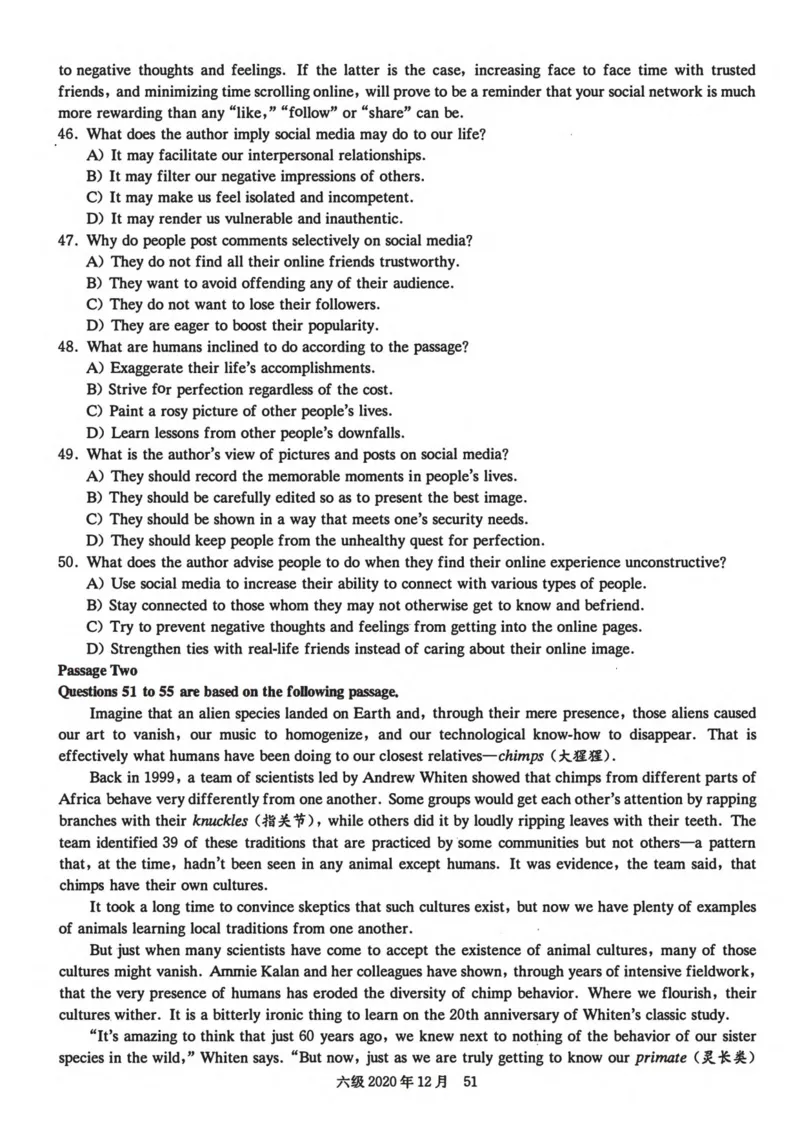
36. Some children on the remote islands won’t eat their meals because they are fed cheap
junk food.
37. Unlike other parts of Bangladesh, the number of women who die from giving birth
remains high on the river islands.
38. One big problem many islanders have is that they can’t afford the prescribed medicines,
even with discountsoffered.
39. TD is a virtual medical service financially supported by one of the nation’s nonprofit
organizations.
40. TD doctors are welcome to the islanders because they treat the sick with respect and
patience.
41. Women islanders tend to have health problems early partly because they get married
and give birth early.
42. TD doctors make weekly visits to the remote islands to provide services at a temporary
medical center.
43. TD doctors provide the islanders with online diagnoses and treatments for common
diseases.
44. The residents of the river islands have to keep moving their homes because of floods
and land erosions.
45.Women islanders usually rely on their husbands to get some medicines for them without
diagnoses and prescriptions.
Section C
Directions: There are 2 passages in this section. Each passage is followed by some questions
or unfinished statements. For each of them there are four choices marked A), B), C) and D).
You should decide on the best choice and mark the corresponding letter on Answer Sheet 2
withasinglelinethrough thecentre.
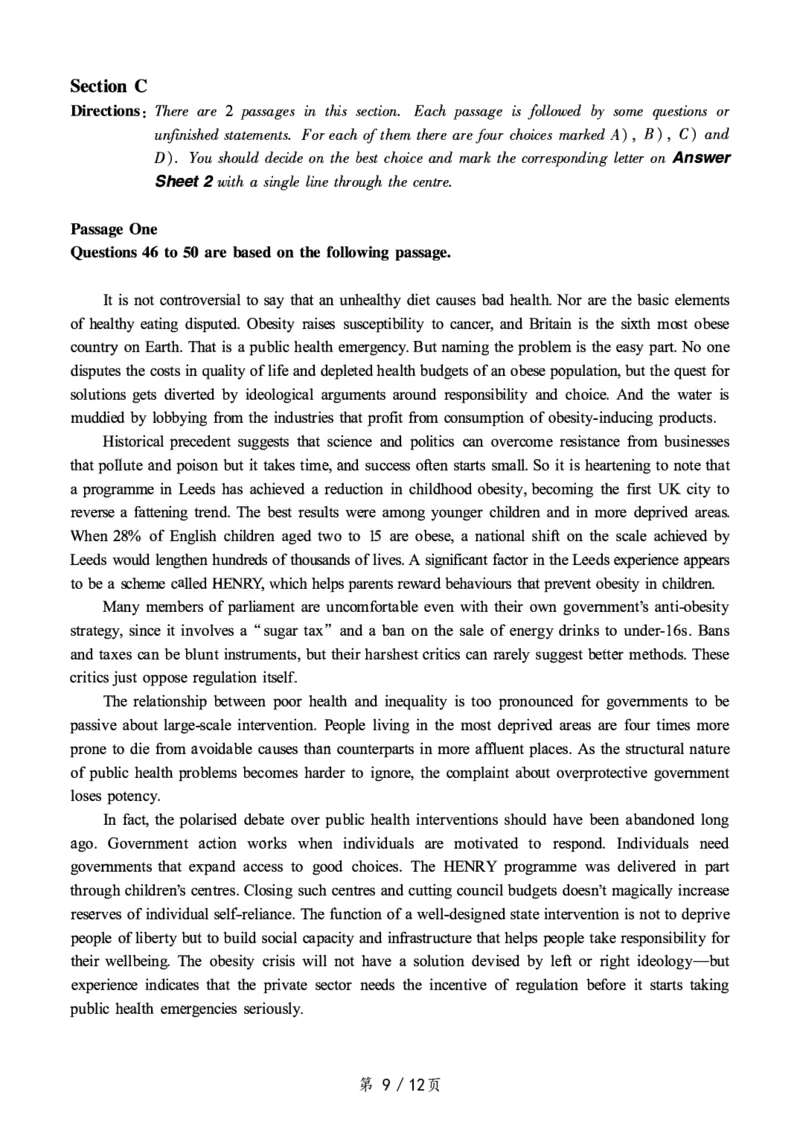
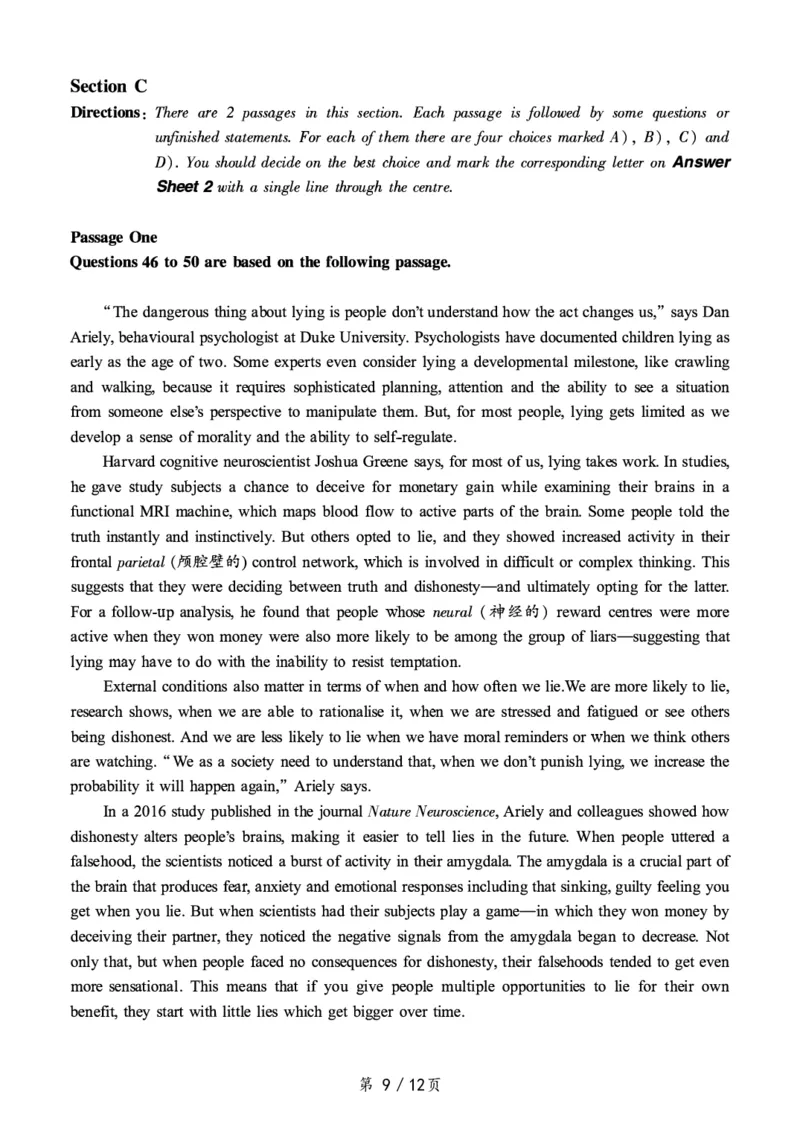
Passage One
Questions 46 to 50 are based on the following passage.
Selective colleges and universities in the U.S. are under fire for being too elite and too
expensive, and for not training graduates for the world of work. Such charges ignore the
fact that these institutions continue to prepare students for success in their work, for
thoughtful engagement in civic life, for lifelong learning, and for understanding the world
and those with whom they live.
These colleges and universities must be doing something right. Applications are at
record highs, and their financial aid programs make them more accessible than ever. This
model of education has long played a central role in creating opportunity, driving economic
n
2022if 6 1* M 7 M it 10 %growth, and spurring innovation.
Yet, there is growing skepticism about the value of this model. The recent tax reform
bill is a wake-up call that our strongest colleges and universities are under assault by some
in government. The initial proposals would have made education unaffordable for many by
taxing tuition waivers for graduate students and ending deductions for student loan interest.
Thankfully, these provisions were ultimately stripped from the bill, but lawmakers let stand
a new tax on the investment income of some collegesand universities.
While these attacks are motivated by misguided ideas, we need to do a better job of
explaining why these claims are false and why what we do is valuable. We cannot take for
granted that any of this is obvious.
It is often said that elite colleges and universities do not train students, particularly
those who study the liberal arts, for the workforce. But this can be refuted by scholarly
research. The data are clear: a liberal arts education is great career preparation, both for
excellent lifetime earnings and for satisfaction with the work. This education develops the
skills of critical thinking, rigorous analysis of data and facts, communication with the
written and spoken word, understanding of cultural differences and issues, and the ability to
keep learning. In fact, liberal arts graduatesdo extremely well in every imaginablefield.
Access to an education at selective colleges and universities is now more available
than ever to low-and middle-income families. We have built endowments from donations
by alumni (#c&) and parents who understand and appreciate our mission to provide access
.
and opportunity, and a significant portion of the returns from these endowments is used to
fund financial aid.
Ironically, the new tax on endowments drains financial aid fundsfrom the very schools
most able to offer opportunity to those who have earned a spot but cannot otherwise afford
this education. Beyond the virtue of access to those who have earned a place at these
schools, the diversity of economic backgrounds enhances the education and experience of
all ofour students.
46. What fact does the authoremphasize concerning selective colleges and universities?
A) They have been ignoring thetraining of graduatesfor the world of work.
B) They have been doing well in ensuring their studentsasuccessful future.
C)They have been constantly attacked for being too elite and too expensive.
D)They have been actively engaged in civic life beyond the school campus.
47. What does the author say in arguing for the model of education in the U.S.?
A) It has contributed substantially to the nation’soverall development.
B) It has succeeded in maintaining sustainable financial aid programs.
C) It has given priority to innovative programsfor graduate studies.
D) It hasplayed a central role in attracting international applicants.
48.What do we leam about the initial proposals concerning the recent tax reform bill?
A) They would have stripped many studentsof life’s chances.
B) They would havededucted graduate student loan interest.
C)They would haveadded to many students’financial burden.
D)They would have increased the number of tuition waivers.
n
2022tp6 1* % 8 M ft 10 Vl49.What do the data show about elite colleges and universities?
A) Their graduates lack the rigor required for doing statistical analysis.
B) Their students prove to beinadequately prepared for theirfuture careers.
C)Their focus on research is conducive to developing students’critical thinking.
D)Their liberal arts education enables graduates to excel in whatever field they are in.
50. What isan advantage of providing financial aid for students?
A) Every student can choosethe institution they wish toattend.
B)All studentscan benefit from a diversified student population.
C)All studentswill be able to earn a place on university campus.
D)Less privileged students will be more competitive at elite schools.
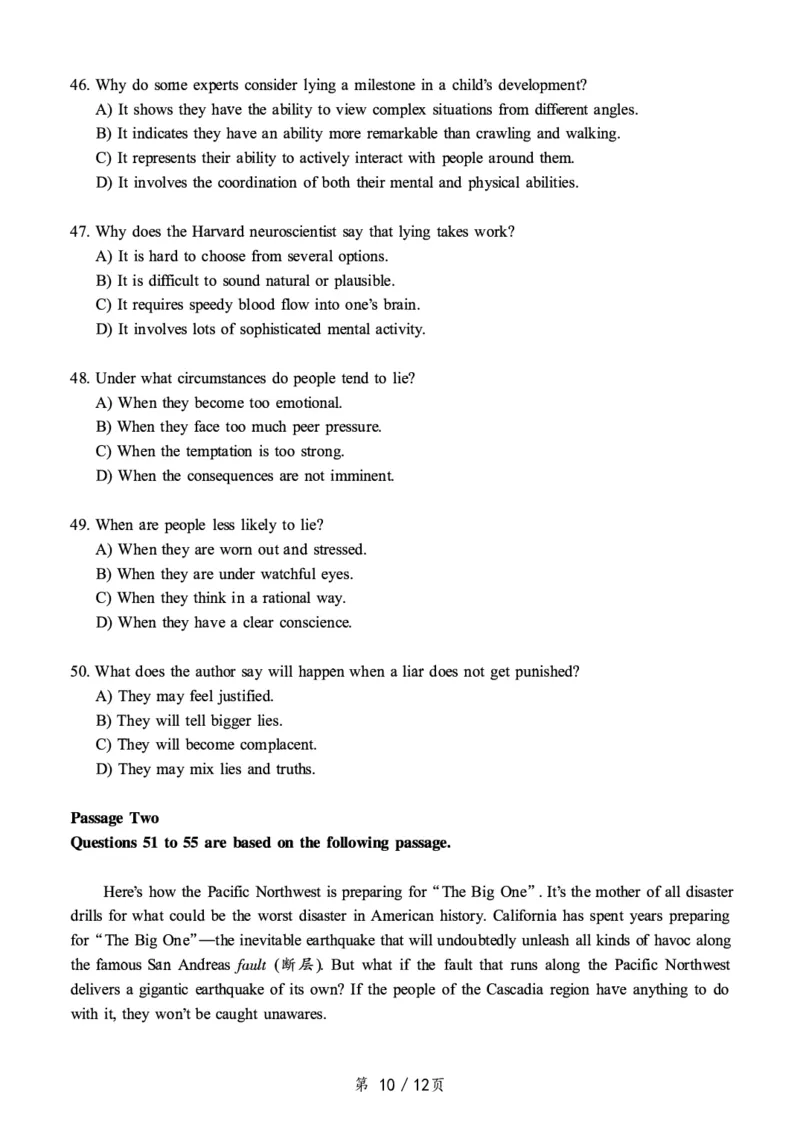
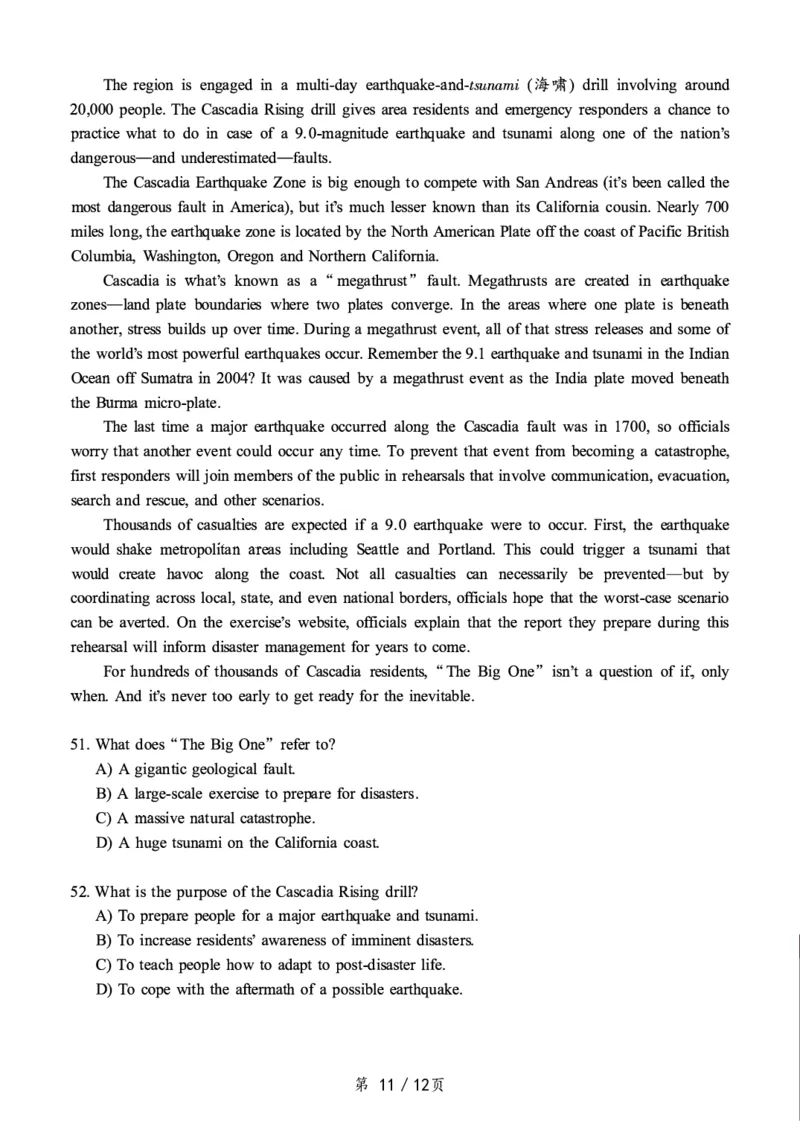
PassageTwo
Questions51 to 55 are based on the following passage.
When a group of Australians was asked why they believed climate change was not
happening, about 36% said it was “common sense”, according to a report published last
year by the Commonwealth Scientific and Industrial Research Organization. This was the
most popular reason for theiropinion, with only 11% saying their belief that climate change
was not happening was based on scientific research.
But what do we mean by an appeal to common sense? Presumably it’s an appeal to
rationality of some sort that forms the basis of more complex reasoning. The appeal to
common sense, however, is usually nothing more than an appeal to thinking that just feels
right , but what feels right to one person may not feel right to another. Whether it feels right
is usually a reflection of the world view and ideologies we have internalised, and that
frames how we interact with new ideas. When new ideas are in accord with what we
already believe, they are more readily accepted. When they are not, they, and the arguments
that lead to them , are more readily rejected.
Weoften mistake this automatic compatibility testing of new ideas with existing beliefs
as an application of common sense, but, in reality
,
it is more about judging than thinking.
As Nobelist Daniel Kahneman notes in Thinking, Fast and Slow, when we arrive at
conclusions in this way, the outcomes also feel true, regardless of whether they are. We are
not psychologically well equipped to judgeour own thinking.
We are also highly susceptible to a range of cognitive biases such as giving preference
to the first things that come to mind when making decisionsor giving weight to evidence.
One way we can check our internal biases and inconsistencies is through the social
verification of knowledge, in which we test our ideas in a rigorous and systematic way to
see if they make sense not just to us, but to other people. The outstanding example of this
socially shared cognition is science.
That does not mean that individuals are not capable of excellent thinking, nor does it
mean no individual is rational. But the extent to which individuals can do this on their own
is a function of how well integrated they are with communities of systematic inquiry in the
first place. You can’t learn to think well by yourself.
In mattersof science at least, those who value their common senseover methodological,
collaborative investigation imagine themselves to be more free in their thinking, unbound
n
2022 6M l* M 9 3t ft toby involvement with the group, but in reality they aretightly bound by their capabilities and
perspectives. We are smarter together than we are individually, and perhaps that’s just
common sense.
51. What does the author intend to show by citing the findings from the report published
last year?
A) People seldom appeal to rationality in their thinking.
B) It is often the casethat truth lies in the hands of a few.
C)Common sense and science are thetwo sides of a coin.
D)Fewpeople know if climate change is really happening.
52.What is the appeal to common sense according to the author?
A) It is the basisfor the internalisation of individuals’ideologies.
B) It is a seriesof conceptions formulated from complex reasoning.
C)It is collective wisdom that helps people interact with new ideas.
D) It is something subjective basedon what one perceivesto beright.
53. WhatdoesDanielKahnemanthinkistheproblemoftestingnewideaswithexistingbeliefs?
A) It may lead to incorrect judgment.
B) It makes no useof common sense.
C)It fails to correct mistakes through serious reasoning.
D)It can produce psychologically unacceptable outcomes.
54.What can we do to be less susceptible to cognitive biases?
A) Give equal weight to evidence of both sides in a conflict.
B) Provide convincing examples in developing an argument.
C)Establish socially shared cognition via scientific methods.
D)Avoid inconsistencies when addressingcontroversial issues.
55.What message does the author try to convey at the end of the passage?
A) Multiple perspectivesstimulate people’sinterest in exploring the unknown.
B) Individuals can enhance their overall capabilities by interacting with others.
C) Individuals should think freely to break from the restrictions of common sense.
D)Collaborative efforts can overcome individuals limitations in scientific inquiry.
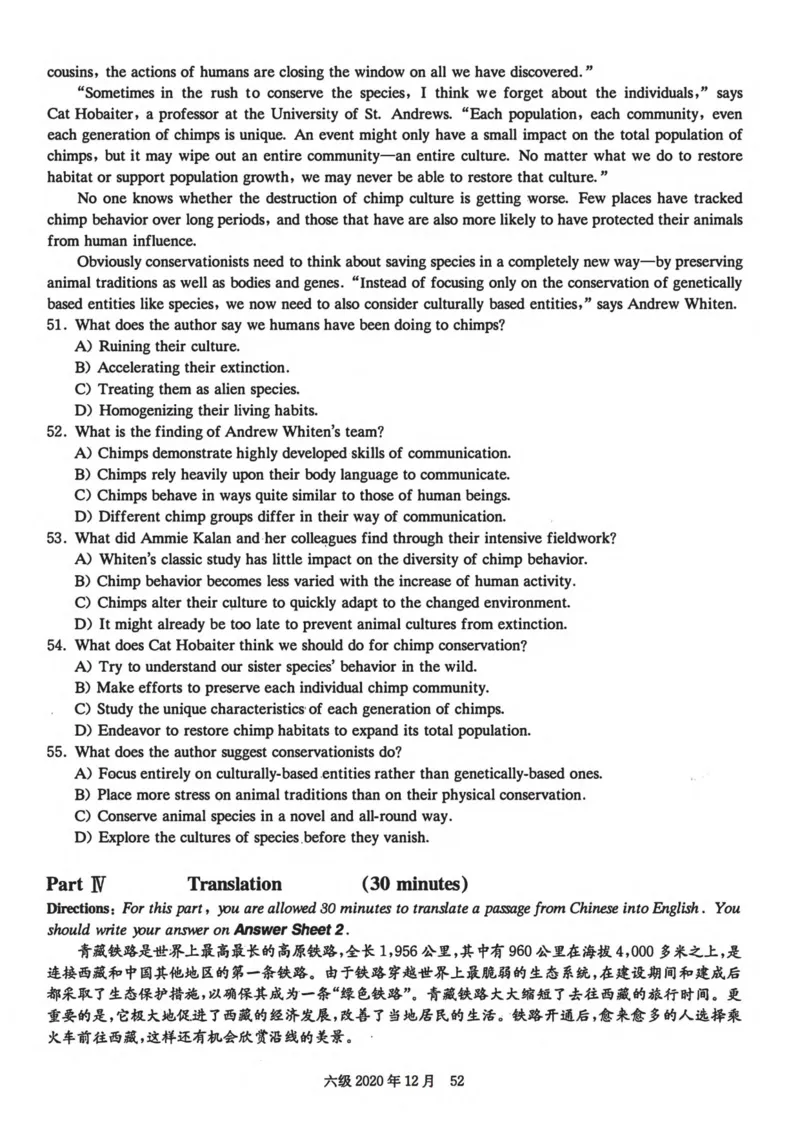
Part IV Translation (30 minutes)
Directions:For this part, you areallowed 30 minutes to translatea passage from Chinese into
English.Youshouldwriteyour answer onAnswerSheet2.
—
1192 4, 1698 -EM IkJ&Wo
_ _ A
m
ttao # L#£ ,13 ft ft t AfcKit#A“P ## t Z -J-
n
2022if 6 1* M 10 5t * 10 M«
2022 if 06 n ( 2 t )
Part I Writing (30minutes)
Directions: For this part, you are allowed 30 minutes to write an essay that begins with the
sentence “Nowadays more and more people keep learning new skills to adapt to a
fast-changing world.”Youcan makecomments, cite examples, or use your personalexperiences
todevelopyouressay.Youshouldwriteatleast150wordsbutnomorethan200words.
Part II Listening Comprehension (30 minutes)
2022 46 # 1 /] 1*3 % 1 #
Part III Reading Comprehension (40 minutes)
SectionA
Directions: In this section, there is a passage with ten blanks. You are required to select one
wordforeach blankfromalistofchoices given inawordbankfollowing the passage.Readthe
passage through carefully before making your choices, Each choice in the bank is identified
by a letter. Please mark the correspondingletter for each item on Answer Sheet 2 witha single
linethroughthecentre. Youmay not useanyofthewords inthebank morethan once.
Thinking kind thoughts about yourself and your loved ones can prove beneficial for
your overall wellbeing, empirical evidence has shown. Researchers carried out an
investigation to explore the 26 between having kind thoughts and a person’s
psychological state.
For the study, five groups of participants were presented with a different set of audio
instructions, some of which encouraged the participants to think 27 about themselves
and others which persuaded them to think in a self-critical manner. After listening to the
audio instructions, the participants were asked to answer a series of questions. These
included whether they felt agitated, how likely they were to show kindness to themselves
and how 28 they felt to other individuals.
The participants who were instructed to think kindly about themselves were more
likely to exhibit a bodily response associated with being relaxed and feeling safe. Their
heart rates also dropped, which is a healthy sign of a heart that can respond flexibly to
situations. Yet, 29
,
those who listened to the critical audio clips were noted as having
a higher heart rate and sweat response afterwards, both of which 30 feelings of threat
and distress.
Having the ability to switch off the body’s naturalthreatresponse can 31 a person’s
immune system. This, in turn, gives them a greater likelihood of recovering quickly from
illness. These findings help us to further understand some of our clinical trials research
findings, where weshow that individuals with 32 depression benefit particularly from
self-awareness-based 33 therapy. They essentially learn to become more sympathetic
to themselves.
n
202246 2 I 1 I fi8 5The sense is that for people 34 to depression, meeting their negative thoughts
and feelings with 35 is a radically different way; that these thoughts are not facts. It
introduces a different way of being and knowing that is quite transformative for many
people.
A) adversely I) indignantly
B) amiably J) insulation
C) boost K) lavish
D) cognitive L)prone
E)compassion M) recurrent
F)connected N) signify
G) correlation O) surpass
H) fascinated
Section B
Directions:In this section, you are going to read a passage with ten statements attached to it.
Each statement contains information given in one of the paragraphs. Identify the paragraph
from which the information is derived. You may choose a paragraph more than once. Each
paragraph is markedwith aletter.Answer the questions by marking thecorresponding letter on
Answer Sheet 2
.
Saving Our Planet
A) In the long view, the human relationship with forests has been one of brutal destruction,
but even it carries elements of slow hope. In the Middle Ages, there was no shortage of
timber in most partsof the world, and few saw cutting down forests asa problem. Yet in
1548 the people of Venice estimated that an important timber supply would last only 30
years at their current rate of usage—but different forest management would make it
possible to meet the demand for many centuries to come. The idea of preserving
resources came out of a concern for the future: a fear of using up resources faster than
they could be replenished(#lL).
B) Economic interests were at the core of this understanding of trees and forests. It would
take more than three centuries before scientists began to understand that timber
production is not the only, and possibly not the most important, function of forests. The
late 19th and early 20th century saw an increasing recognition that forests serve as
habitats for countless animal and plant species that all rely on each other. They take
over protective functions against soil erosion and landslides (fS 71); they make a
significant contribution to the water balance as they prevent surface runoff; they filter
dirt particles, greenhouse gases and radioactive substances from the air; they produce
oxygen; they provide spaces for recreation and they preserve historic and prehistoric
remains.As a result, forestsaround the world have been set aside as parks or wilderness
areas.
C) Recent years have seen a big change in our view of forests. Peter Wohlleben’s book The
Hidden Life of Trees (2015), an international bestseller, suggests that trees can warn
each other of danger through a “wood wide web” of roots and fungi ( % It ). They
2022 6 n 2 I 2 M8 Hsupport each other through sharing of nutrients and information, and they even keep
ancient stumps alive by feeding them solutions of sugars. Such insights have made us
aware of deep ecological relationships between humans and the more-than-human
world.
D) Awareness of ecologies is a recent phenomenon. It was not until the 1940s that the
concept of the “environment” embracing all living and nonliving things developed. In
the 1970s, the term “environment” gained currency, becoming widely adopted in the
English and Romance languages, and as“Umwelt” (“surrounding world”) in German.
The emergence of the idea led to the rise of environmental agencies, regulations and
environmental studies, and to environmental science as new, integrated academic
disciplines. It was in 1956 that the very first bachelor of science in environmental
studies was awarded, at the State University of New York College of Forestry at
—
Syracuse. Since the 1970s—with the rise of “environmentalism” environmental
studies programmes have sprung up at hundreds of universities. There is (slow) hope in
the fact that scholars from many different disciplines have adopted the term
“environment” over the past decades. They are exploring intricate connections within
and between complex ecologies, as well as the impact that human environment-making
(through techno-industrial, economic and other manipulative developments) has had on
the biosphere.
E) The rise of the idea of the environment and a scholarly understanding of ecological
processes has influenced new technologies and also politics. We have come to ask
questions about vulnerability and risk, world ecologies, and the relationship between
nature and power. The search for an adequate response to climate change occupies
centre stage in international diplomacy.
F) Social and environmental activists, scientists and indigenous groups have called the
Paris Agreement of the United Nations Climate Change Conference in December 2015
insufficient, weak, or compromised. To some extent, they are right: climate change has
already destroyed tens of thousands of livelihoods, and the situation will worsen in the
near future for millions of mostly poorer people, who will join the ranks of those who
have already been displaced by climate change and extreme weather events But the
.
Paris Conference nevertheless marked a historic step toward the recognition of the need
for action on climate change, the cutting of carbon emissions, and world cooperation.
There were 195 nations that came to the table in Paris and agreed to limitson emissions.
Historically, nothing comparable had happened prior to this. Before the 20th century, a
handful of scientists had been interested in the theoretical relationship between
greenhouse gases and climate change, but only the empirical evidence accumulated
since the late 20th century established a clear connection between the burning of fossil
fuels and a vastly accelerated rise in global temperatures.
G) The current crisis is not the first that humans have encountered, and a look at the
struggles with pollution in recent history reveals transformations that once seemed
unimaginable. The “London fog” that came to define the capital through British novels
and thrillers is in reality smog or smoke, a legacy of industrialisation. After a century of
ignorance, London was hit by the Great Smog of December 1952—the worst
air-pollution event in the history of the United Kingdom which caused the deaths of
approximately 12,000 people. Shortly thereafter, public initiatives and political
campaigns led to strict regulations and new laws, including the Clean Air Act (1956).
Today, London has effectively reduced traffic emissions through the introduction of a
2022 6 3SSA&ItSJS2 1 3 1*8 5Congestion ChargeZone in 2003,and an Ultra LowEmission Zone in 2019.
H) Scientific evidence that we are living in an era of climate change, resource exhaustion
and potential ecological disaster is overwhelming. How do we motivate a public
exhausted by never-ending scenariosof doom and disaster,when the challenges seemso
huge and so impossible to solve? Statistics about extinction and the gloom of decline
will not in themselves get us out of our often self-created ecological traps: instead, they
are more likely to result in paralysis and inaction.
I) Weneed stories and historiesof change and transformation: ecological stories that make
us confront the fact that human power is potentially destructive, and that the survival of
our specieson this planet dependson the preservation of soil and water, and the habitats
and ecological systems.
J) It is time that we showed successes and accelerations in ecological awareness, action
and restoration: stories that include past successes and future visions about the rise of
urban gardening and of renaturalised riverscapes, of successful protests against polluted
air and water, of the rise of regional markets and slow food, and the planting of trees
around the globe, of initiatives and enterprises that work towards ecological restoration.
The reality of ecological curses seems far greater than the power of the hopes left at the
bottom of Pandora’s box. But if we believe that nothing can be changed, then we are
giving up our opportunity toact.
K) Today’s saving powers will not come from a dens ex machina ( If - H ). In an
ever-more complex and synthetic world, our saving powers won’t come from a single
source, and certainly not from a too-big- to-fail approach or from those who have been
drawn into the whirlpool of our age of speed. Hope can work as a wakeup call. It
acknowledges setbacks. The concept of slow hope suggests that we can’t expect things
to change overnight. If the ever-faster exhaustion of natural resources (in ecological
terms) and the “shrinking of the present” (in social terms) are urgent problems of
humans, then cutting down on exhaustive practices and working towards a “stretching
of the present” will be ways to move forward.
36. Climate change has wrought havoc on the lives of tensof thousandsof people.
37.It took scientists a long time to realise that the function of forests goes far beyond
providing humans with timber.
38. There isabundant evidence that weare now facing a possible ecological disaster.
39.Environmental science became academic disciplines only somesixty yearsago.
40. Things cannot change overnight, but reducing the consumption of natural resources will
help solve the ecological crisis.
41. Human perception of forests has undergone a tremendous change in the past years.
42.Recent history shows reduction of pollution, once seemingly impossible, can actually
be accomplished.
43. People began to consider preserving natural resources when they feared they would
have nothing to usein the future.
44. If we doubt our ability to reverse ecological deterioration, we are throwing away the
chance to take action.
45. How to respond effectively to climate change has become the focus of international
diplomacy.
2022 6 n 2 I 4 I *8 ISectionC
Directions: There are 2 passages in this section. Each passage is followed by some questions
or unfinished statements. For each of them there are four choices marked A), B), C) and D).
You should decide on the best choice and mark the corresponding letter on Answer Sheet 2
withasinglelinethrough thecentre.
Passage One
Questions 46 to 50 are based on the following passage.
Since American idol star Taryn Southern started composing music with AI in 2017,
musicians all over the world have begun wondering about the implications of AI and
modem technology where music production is concerned. UsingAI in the creation of music
is perceived by some as a helpful tool and by others asalmost “the beginningof the end”.
In Taryn’s case,AI software enabled her to communicate melodies and chords that she
didn’t know how to put together herself. The end product was therefore a collaborative
effort, rather than a piece entirely produced by technology. Taryn’s story has a distinctly
positive feel that highlights the advantages of using AI in music production. It can serve as
a source of inspiration, and as an ideal jumping-off point should a musician be hit with
writer’s block (XL
Contrary to seeing AI as a tool, some musicians consider it to be hugely detrimental to
the music scene. At the moment, because such technology is still so young, the music it’s
producing is not necessarily what we want to hear. In short, it’s not of great quality. Those
who have produced their own music, or even fans of authentic, artistic music, will also
arguethat acomputercould never emulate the work (and human touch) of a true musician.
Music has been an integral part of the story of humansfor ages; in fact, the firstknown
piece of music is believed to be around 3,400 years old. Songs have long been used as a
means of communicating messages and folk stories, covering everything from societal
ethics to world history. Since many people see music as such an inherently human
expression, it is often considered as too precious to impart to technology. The thought of a
computer generating a “random” piece of music that hasn’t been painstakingly created by
an artist isalmost seen as sacrilegious
Regardlessof which side of the argument you fall on, it seems likely that the useofAI
in music production will only become more frequent. Our modem world is preoccupied
with technological advancements. Instead of shying away from the idea of this bleak future,
the best approach to take is one of optimism and curiosity.While there are always bound to
be stubborn old-school musicians who refuse to use tech, music producers should consider
AI as something to be embraced. AI music software is still very much in its infancy, but
with more investors interested in the development and outcomes of such technology, and
considering the rapid growth rate of other tech advances in recent years, it’s only a matter
of time beforeAl-produced music is seen asthe new norm.
n m
2022 6 issAaKas2 % 5 *8 M46. How do some musicians perceive usingAI in creating music?
A) It would help to produce more music idols.
B) It would be detrimental to music production.
C)It would hinder the understandingof authentic music.
D) It would be the beginning of a new era in music creation.
47.What does Taryn Southern’s story illustrate?
A)AI technology is conducive to music composition.
B) Musicians will be unable to create music without high tech.
C)Musicians are often at their wits,end in their creative effort.
D)AI technology is indispensable to creating melodies and chords.
48.Why aresome musiciansopposed to the useofAI in creating music?
A) Music produced withAI technology lacks humanness.
B) Music created with AI technology iseasily emulated.
C)It will depreciate humans’role in music composition.
D)It will depleteyoung musicians, creative inspiration.
49.Why do many people think music is too precious to impart toAI technology?
A) It cannot be created without pains.
B) It cannot be produced at random.
C) It is part of human life.
D)It is human specific.
50.What does the author think of the future ofAI music?
A) It will continue to arouse the interest of music investors.
B) It has the prospect of becoming the norm in the future.
C)It will begradually accepted by old-school musicians.
D)It may eventually lose itsfreshnessand appeal.
PassageTwo
Questions 51 to 55 are based on the following passage.
A few weeks ago, a well-meaning professor tried to explain the physiological process
behind viruses and the human body in a tweet and was immediately criticized for a mistake
in his information. Hethen issued an apology and deleted his erroneous tweet.
Communicating science beyond the academic bubble is necessary to augmenting
public understanding of health and environmental issues and helping individuals make
well-informed personal decisions.
However, scientists who engage in science communication must acknowledge that
even in their area, their expertise is deep but narrow.They need to recognize the constraints
in their own knowledge. That is not to suggest that they only write or present on their own
research, but rather,that they consult with an expert if the topic isoutside of their discipline.
Fact-checking with a scientist who works in the specialty will prevent the unintentional
n » m
2022 6 £@A|[jaSS2 % 6 A s Mspread of misinformation, and the process of doing so may yield tiny pieces of interesting
new information that can be incorporated.
Some have argued that the public is not educated enough to understand scientific
information, especially for any complex phenomena, but this is absurd. Science instruction
can be found at all levels of public education with most secondary schools offering classes
on biology, physics, and chemistry. If anything, social media has shown that the public
craves knowledge based on a solid scientific foundation. Even the public discourse that
follows most scientific articles shows that online readers can understand even the most
baffling of scientific principles.
It is equally imperative to emphasize that being an expert on a topic does not
automatically make a scholar qualified to communicate it to a nonscientific audience. A
number of scientists recently have been offering public-aimed explanations of scientific
phenomena. Even though they have appropriate credentials, they often do very little in the
way of explaining. One biologist shared an intricate analogy involving a library, books,
paper, a recipe, ingredients, and a cake to explain the process behind vaccines. Any
explanation that requires a written key to keep track of what each item represents is not a
clear example for public consumption.
Science communication is a science in and of itself. It requires rigorous training and
instruction. A scientist should take communication courses that can teach a person how to
identify and eliminate jargon and how to develop effective analogies to explain complex
concepts. One cannot assume communication expertise-imagine if someone just decided
that they were a physicist and started trying to contribute to the field without the necessary
background. Doing a poor job communicating science to the public will only create
confusion and widen the gap between science and society, a gap that scientists are trying to
close.
51.What does the author say about communicating science to the general public?
A) It will help them to keepabreast of the latestscientific developments.
B) It is a necessary means to improve their understanding of scientific issues.
C) It will get them moreinvolved in academic debateson environmental problems.
D) It is an effective way to augment scientists’influence beyond the academic circle.
52.What doesthe author advise scientists do to deal with topics outside of their specialty?
A)Write or present on them from new angles.
B) Utilize information from diversesources.
C)Turn to a specialist for professional help.
D)Fact-check with colleagues in their field.
53.What does the author say wecan learn from social media?
A)Asolidacademicfoundationisessentialtounderstandingbafflingscientificprinciples.
B) Modem technology hasfacilitated communication between scientistsand the public.
2022 6 n 2 % 7 m fr8 MC)Scientific articles have gained increasing popularity among the general public.
D)The public’sunderstanding of science is much better than some have claimed.
54.What does the example of the biologist who shared an intricate analogy show?
A) It is helpful to useillustrations in explaining scientific phenomena.
B) It is imperative to have appropriatetitles to explain scientific issues.
C)Alearned scholar is not necessarily a qualified science communicator.
D)Anonscientific audience cannot duly understand principlesof science.
55.What does the author suggestscientists do to close the gap between science and society?
A) Explain complex concepts scientifically.
B) Make appropriate useof scientific terms.
C)Take courses in public speaking.
D)Developcommunication skills.
Part IV Translation (30 minutes)
Directions: For this part, you areallowed 30 minutes to translatea passage from Chinese into
English.Youshouldwriteyour answer on Answer Sheet2
.
4 4589 7 k, 6772 o
_
xii§AfntJj-fEAa,
- °
7 Estifle
2022^6£ 2 H 8 5t *8 M2022年 06月大学英语六级考试真题(第 3 套)
淘宝店铺:【新一文化】温馨提示:2022年英语六级考试第3 套试题,除翻译写作外,其余题目与第2
套完全一致,故而未重复给出。
Part I Writing (30 minutes)
Directions: For this part, you are allowed 30 minutes to write an essay that begins with the
sentence “Nowadays more and more people take delight in offering help to the needy.w You
can make comments, cite examples, or use your personal experiences to develop your essay.
You should write at least 150 words but no more than 200 words.
Part IV Translation (30 minutes)
Directions: For this part, you are allowed 30 minutes to translate a passage from Chinese into
English. You should write your answer on Answer Sheet 2.
赵州桥建于隋朝,公元605年左右,长 50.82米,宽9.6米,跨度37.37米。天才建筑
师李春设计并监督了桥的建设。赵州桥结构新颖、造型优美。桥有一个大拱,在大拱的两
端有两个小拱,帮助排泄洪水、减轻桥梁重量并节省石材。建成以来,该桥经受了多次洪
水和地震,但其主体结构仍然完好无损,至今仍在使用。
赵州桥是世界桥梁建筑史上的一次创举,是中国古代文明史上的一项杰出成就。类似
设计的桥梁直到14世纪才在欧洲出现,比赵州桥晚了 700多年。
2022年6月英语六级真题第3套 第 1 页 共 1 页^ *
2021 ( 1 )
Part I Writing (30 minutes)
Directions: For this part, you are allowed 30 minutes to write an essay related to the short
passage given below. In your essay, you are to comment on the phenomenon described in the
passage andsuggest measures to address the issue. You shouldwrite at least 150 words but no
morethan200 words.
Young people spend a lot of time on the Internet. However, they are sometimes unable to
recognize false information on the Internet, judge the reliability of online information sources,
or tell real news storiesfrom fake ones.
Part II Listening Comprehension (30 minutes)
SectionA
Directions: In this section, you will hear two long conversations. At the end of each
conversation, you will hear four questions. Both the conversation and the questions will be
spoken only once. After you hear a question, you must choose the best answer from the four
choices marked A), B), C)and D). Then mark the corresponding letter on Answer Sheet 1 with
asinglelinethroughthecentre.
Questionsl to 4are based on the conversation you have just heard.
1. A) Hewasenjoying his holiday. C) Hewas busy writing hisessays.
B) He was recovering in hospital. D) He wasfighting a throat infection.
2.A) He broke hiswrist. C)Heslipped on ice and fell.
B)He lost hisantibiotics. D) He waslaughed at by somegirls.
3. A) Turn to her fatherfor help. C) Ask the manufacturer for repairs.
B) Call the repair shop to fix it. D) Replace it with a brand-new one.
4. A) Help David retrieve hisessays. C)Offer David some refreshments.
B) Introduce David to her parents. D)Accompany David to his home.
Questions5 to 8 are based on the conversation you have just heard.
5. A) She isacritic of workson military affairs.
B)She is an acclaimed hostessof Book Talk.
C)She is a researcherof literary genres.
D)She isa historian of military history.
6. A) It isabout the military history of Europe.
B) It isset in the 18th and 19th centuries.
C) It is her fifth book of military history.
D) It isa war novel set in the future.
7. A) She visited soldiers’wivesand mothers.
B)She conducted surveys of many soldiers.
C)She met a large number of soldiers in person.
D)She looked into the personal livesof soldiers.
2021 ^ 12 1# » 1 E # n JK8. A) She doesn’t have much freedom for imagination.
B) It is not easy to make her readers believe in her.
C) It isdifficult to attract young readers.
D)She has to combine fact with fiction.
Section B
Directions: In(his section,you willhear(wo passages. At the endofeach passage,you willhear
three or four questions. Both the passage and the questions will be spoken only once. After you
hearaquestion,youmust choosethebest answer fromthefourchoicesmarkedA), B),C)andD).
ThenmarkthecorrespondingletteronAnswerSheet l withasinglelinethroughthecentre.
Questions 9 to 11 are based on the passageyou have just heard.
9. A) Santa Claus. C)Cocoa seeds.
B)A polar bear. D)Aglass bottle.
10. A) To attract customer attention. C) To combat counterfeits.
B)Tokeep upwith the times. D)To promote its sales.
11. A) It resemblesa picture in the encyclopedia.
B) It appears in the shape of a cocoa seed.
C) It has the drink’s logo in the middle.
D) It displays the imageof Santa Claus.
Questions 12 to 15 are based on the passage you have just heard.
12. A) It often occursamong commuters. C) It improves their mood considerably.
B) It promotes mutual understanding. D) It takes a great deal of effort to sustain.
13. A) Social anxiety. C) Lack of social skills.
B) Excessive caution. D) Preferencefor solitude.
14. A) Peopleusually regard it asan unforgettable lesson.
B) Human brains tend to dwell on negative events.
C) Negative eventsoften hurt people deeply.
D) People generally resent being rejected.
15. A) Contagious. B) Temporary. C) Unpredictable. D)Measurable.
Section C
Directions: In this section, you will hear three recordings of lectures or talks followed by three
or four questions. The recordings will be playedonlyonce. Afteryou hear aquestion, you must
choose the best answer from the four choices marked A), B), C) and D). Then mark the
correspondingletteronAnswerSheet 1 withasinglelinethroughthecentre.
Questions 16 to 18 are based on the recording you have just heard.
16. A) It dependsheavily on tourism. C) It is mainly based on agriculture.
B) It is flourishing in foreign trade. D) It relieschiefly on mineral export.
17. AjTobacco. B) Bananas. C)Coffee. D)Sugar.
18.A) They toil on farms. C) They live in Spanish-style houses.
2021iy12 SASmailB|i i 2 S S n IB) They live a poor life. D) They hire people to do housework.
Questions 19to 21 are based on the recording you have just heard.
19. A) They will be more demandingof their next generation.
B) They will end up lonely, dependent and dissatisfied.
C) They will experience more setbacks than successes.
D)They will find it difficult to get along with others.
20. A) Failure to pay due attention to their behavior.
B) Unwillingness to allow them to play with toys.
C) Unwillingness to satisfy their wishes immediately.
D) Failure to spend sufficient quality time with them.
21. A) It will enable them to learn from mistakes.
B) It will help them to handle disappointment.
C) It will do much good to their mental health.
D) It will build their ability toendure hardships
Questions 22 to 25 are based on the recording you have just heard.
22. A) Failing to make sufficient preparations.
B) Looking away from the hiring manager.
C)Saying the wrong thingat the wrong time.
D) Making a wrong judgment of the interview.
23. A) Complaining about their previousjob.
B) Inquiring about their salary to be paid.
C) Exaggerating their academic background.
D) Understating their previousachievements.
24. AjThose who have both skill and experience.
B) Those who get along well with colleagues.
C) Thosewho take initiative in their work.
D) Thosewho areloyal to their managers.
25.A) Ability to shoulder new responsibilities.
B) Experienceof performing multiple roles.
C) Readinessto work to flexible schedules.
D)Skills to communicate with colleagues.
Part III Reading Comprehension (40 minutes)
SectionA
Directions: In this section, there is a passage with ten blanks. You are required to select one
word foreach blank fromalistofchoices given inawordbank following the passage. Readthe
passage through carefully before making your choices. Each choice in the bank is identifiedby
a letter. Please mark the corresponding letter for each item on Answer Sheet 2 with a single
linethroughthecentre.Youmay>not useanyofthewordsinthebank morethanonce.
m
2021tp12 SAaJtHIBl* % 3 5t 11If you think life is wonderful and expect it to stay that way, then you may have a good
chance of living to a ripe old age, at least that is what the findings of a new study suggest.
That study found that participants who reported the highest levels of optimism were far
more likely to live to age 85or 26 .This was compared to those participants who
reported the lowest levelsof optimism. It is 27 that the findings held even after the
researchersconsidered factors that could 28 the link including whether participants
,
had health conditions such as heart disease or cancer, or whether they experienced
depression. The results add to a growing body of evidence that certain psychological
factors may predict a longer life 29 For example, previous studies have found that
more optimistic people have a lower risk of developing chronic diseases, and a lower
risk of 30 death. However,the new study appears to be the first to 31 look at the
relationship between optimism and longevity.The researchers 32 that the link found
in the new study was not as strong when they factored in the effects of certain health
behaviors, including exercise levels, sleep habits and diet. This suggests that these
behaviors may,at least in part, explain the link. In other words,optimism may 33 good
habits that bolster health. It is also important to note that the study found only a 34 as
researchers did not prove for certain that optimism leads to a longer life. However,
if the findingsare true, they suggest that optimism could serve asa psychological 35 that
promotes health and a longer life.
A)affect I) plausibly
B) beyond J)premature
C)conceded K) reconciled
D)correlation L)span
E)foster M)specifically
F) henceforth N)spiral
G)lofty O)trait
H)noteworthy
Section B
Directions: In this section, you are going to read a passage with ten statements attached to it.
Each statement contains information given in one of the paragraphs. Identify the paragraph
from which the information is derived. You may choose a paragraph more than once. Each
paragraph is marked with aletter.Answer the questions by marking the corresponding letter on
AnswerSheet2
.
2021iy12 SASmHSBl* % 4 11 RNoone in fashion issurprised that Burberry burnt £28 million of stock
A) Last week, Burberry’s annual report revealed that £28.6 million worth of stock was
burnt last year. The news has left investors and consumers outraged but comes as little
surprise to those in the fashion industry.
B) The practice of destroying unsold stock, and even rolls of unused fabric, is
commonplace for luxury labels. Becoming too widely available at a cheaper price
through discount stores discourages full-price sales. Sending products for recycling
leaves them vulnerable to being stolen and sold on the black market. Jasmine Bina ,
CEO of brand strategy agency Concept Bureau explains, “Typically, luxury brands
rally around exclusivity to protect their business interests, namely intellectual property
and preservation of brand equity(] £ >*).” She stated she had heard rumors of stock
burning but not specific cases until this week.
C) Another reason for the commonplace practice is a financial incentive for brands
exporting goods to America. United States Customs states that if imported
merchandise is unused and destroyed under their supervision, 99% of the duties,
taxes or fees paid on the merchandise may be recovered. It is incredibly difficult to
calculate how much dead stock currently goes to waste. While there are incentives to do
it, there’s no legal obligation to report it.
D) A source, who chose to remain anonymous, shared her experience working in a
Burberry store in New York in October 2016. “My job was to toss items in boxes so
they could be sent to be burned. It was killing me inside because all that leather and
fur went to waste and animals had died for nothing. I couldn’t stay there any longer,
their business practices threw me off the roof.” In May this year, Burberry announced
it was taking fur out of its catwalk shows and reviewing its use elsewhere in the
business. “Even though we asked the management, they refused to give us detailed
answers as to why they would do this with their collection,” continued the source,
who left her role within two weeks. She has since worked with another high-profile,
luxury label.
E) In an online forum post, which asked if it’s true that Louis Vuitton burned its bags,
Ahmed Bouchfaa, who claimed to work for Louis Vuitton, responded that the brand
holds sales of old stock for staff members twice a year. Items which have still not sold
after several sales are destroyed. “Louis Vuitton doesn’t have public sales. They either
sell a product at a given price or discontinue it. This is to make sure that everybody
pays the same price for an item ,” he says. He goes on to disclose the strict guidelines
around the employee sales: “You may buy gifts for someone
,
but they track each item
,
and if your gift ends up online they know who toask.” One investor commenting on the
Burberry figures was reportedly outraged that the unsold goods were not even offered to
investors before they weredestroyed.
F) Richemont, who owns several luxury brands, hit the headlines in May for taking back
£437 million of watches for destruction in the last two years to avoid marked-down
2021if 12 SASmHSBl# % 5 3t & n 5iprices. It’s not just luxury brands either. In October last year, a Danish TV show
exposed H&M for burning 12 tonnes of unsold clothing since 2013. In a statement,
the high street retailer defended itself by saying that the burnt clothing had failed
safety tests: “The products to which the media are referring have been tested in external
laboratories. The test results show that one of the products is mold infested and
the other product contains levels of lead that are too high. Those products have
rightly been stopped in accordance with our safety routines.” In March, a report
revealed that H&M was struggling with $4.3 billion worth of unsold stock.
The brand told The New York Times that the plan was to reduce prices to move thestock ,
arguably encouraging consumers to buy and throw away with little thought.
G) Over-production is perhaps the biggest concern for Burberry. While there has been
much outrage at the elitist connotation of burning goods rather than making them
affordable , executives at the British fashion house are no doubt struggling to defend
how they miscalculated production. The waste has been put down to burning old
cosmetic stock to make way for their new beauty range. However, while the value of
destroyed stock is up from £26.9 million last year, it’s an even more significant
increase from 2016’sfigure of £18.8 million , highlighting that this is an ongoing issue.
H) In September 2016, Burberry switched to a “see now , buy now” catwalk show format.
The move was a switch to leverage on the coverage of their fashion week show
to make stock available immediately to consumers. This is opposed to the traditional
format of presenting to the industry , taking orders for production and becoming
available in six months, time. While Burberry announced “record-breaking”
online reach and engagement, there has been little evidence to suggest that the strategy
has had a significant effect on sales, particularly as the hype( fy' ft )slows across
the season. In February they made adjustments to the format , dropping some catwalk
items immediately and promising that others would launch in the coming months.
I) In a statement, Burberry denied that switching to “see now, buy now” has had an impact
on waste. A Burberry spokesperson further said , “On the occasions when disposal of
products is necessary , we do so in a responsible manner. We are always seeking ways to
reduce and revalue our waste. This is a core part of our strategy and we have forged
partnershipsand committed support to innovativeorganizations to help reach this goal.”
J) One such partnership is with Elvis & Kresse, an accessories brand working with
reclaimed materials. Co-founder Kresse Wesling said, “Late last year we launched
an ambitious five-year partnership with the Burberry Foundation. The main aim of
this is to scale our leather rescue project, starting with off- cuts from the production
of Burberry leather goods. Weare working tirelessly to expand our solutions and would
love to welcome anyone to our workshop to come and see what we are doing.”
At the moment, the partnership only addresses waste at the production stage and not
unsold goods.
K) While these are honorable schemes, it makes it harder for Burberry to defend these
2021 ^ 12 sAsmasBiii 6 s s n s.
latest figures. Fifteen years ago Burberry was at crisis point as their signature check
pattern was widely imitated by cheap, imitation brands. It deterred luxury consumers
who found their expensive clothing more closely associated with working-class youth
culture than a prestigious heritage fashion house. In the year 2004, at the height
of over-exposure of the Burberry check, the brand’s turnover was £715.5 million.
Under Christopher Bailey ascreative director they turned the brand around and this past
year revenue hit £2.73 billion.
L) Bina believes that brands need to readdress their exclusivity tactic. “Exclusivity
is starting to be challenged,” she says, “I think that goes hand in hand with how
luxury itself is being challenged. Access to fashion , and the brands who police it,
are becoming less and less relevant. Things like health, enlightenment, and social and
environmental responsibility are the new luxuries. These all come from within,
not without. That’s the challenge that traditional luxury brands will have to contend
with in the mid-to long-term future.”
36. Burberry’s executives are trying hard to attribute their practice of destroying old
products to miscalculated production.
37. Selling products at a discount will do greater harm to luxury brands than destroying
them.
38. Imitated Burberry products discouraged luxury consumers from buying its genuine
products.
39. Staff members of a luxury brand may buy its old stock at cheaper prices, but they are
not allowed to resell them.
40. In future traditional luxury brands will have to adapt their business strategies to the
changing conceptsof luxury.
41. One luxury brand employee quit her job because she simply couldn’t bear to see the
destruction of unsold products.
42. Destroying old stock is a practice not just of luxury brands but of less prestigious
fashion brands.
43. Burberry is working with a partner to make full useof leather materials to reduce waste.
44. Burberry’s plan to destroy its unsold products worth millions of dollars aroused public
indignation.
45. Burberry’s change of marketing strategy to make a product available as soon as
consumerssee it on the fashion show did not turn out to be aseffective asexpected.
Section C
Directions: There are 2 passages in this section. Each passage is followed by some questions
or unfinished statements. For each of them there are four choices marked A), B), C) and D).
You should decide on the best choice and mark the corresponding letter on Answer Sheet 2
withasinglelinethroughthecentre.
seamans s s n s
2021iy12 iii 7Passage One
Questions 46 to 50 are based on the following passage.
Social media is absolutely everywhere. Billions of people use social media on a daily
basis to create, share, and exchange ideas , messages , and information. Both individuals and
businesses post regularly to engage and interact with people from around the world. It is
a powerful communication medium that simultaneously provides immediate, frequent,
permanent, and wide-reaching information across the globe.
People post their lives on social media for the world to see. Facebook, Twitter,
Linkedln, and countless other social channels provide a quick and simple way to glimpse
—
into a job candidate’s personal life both the positive and negative sides of it. Social media
screening is tempting to use as part of the hiring process, but should employers make use of
it when researching a potential candidate’s background?
Incorporating the use of social media to screen job candidates is not an uncommon
practice. A 2018 survey found that almost 70% of employers use social media to screen
candidates before hiring them. But there are consequences and potential legal risks involved
too. When done inappropriately, social media screening can be considered Unethical or
even illegal.
Social media screening is essentially scrutinising a job candidate’s private life. It can
reveal information about protected characteristics like age, race, nationality, disability,
gender , religion, etc., and that could bias a hiring decision. Pictures or comments on
a private page that are taken out of context could ruin a perfectly good candidate’s chances
of getting hired. This process could potentially give an unfair advantage to one candidate
over another. It creates an unequal playing field and potentially provides hiring managers
with information that can impact their hiring decision in a negative way.
It’s hard to ignore social media as a screening tool. While there are things that you
—
shouldn’t see, there are some things that can be lawfully considered making it a valuable
source of relevant information too. Using social media screening appropriately can help
ensure that you don’t hire a toxic employee who will cost you money or stain your
company’s reputation. Consider the lawful side of this process and you may be able to hire
the best employee ever.There is a delicate balance.
Screening job candidates on social media must be done professionally and responsibly.
Companies should stipulate that they will never ask for passwords be consistent document
, ,
decisions, consider the source used and be aware that other laws may apply. In light of this
it is probably best to look later in the process and ask human resources for help in
navigating it. Social media is here to stay. But before using social media to screen job
candidates , consulting with management and legal teams beforehand is essential in order to
comply with all laws.
2021if 12flgiSAamfflSB l* % 8 5t li m46.What does the author mainly discuss in the passage?
A) The advantageof usingsocial media in screening job candidates.
B)The potentially invasive natureof social media in everyday life.
C)Whether the benefitsof social media outweigh the drawbacks.
D) Whether social media should be used toscreen job candidates.
47. What might happen when social media isused to screen job candidates?
A) Moral or legal issues might arise.
B)Company reputation might suffer.
C)Sensational information might surface.
D) Hiring decisions might becomplicated.
48.When could online personal information bedetrimental to candidates?
A) When it isseparated from context.
B) When it is scrutinised by an employer.
C)When it is magnified to a ruinous degree.
D) When it is revealed to the human resources.
49. How can employers use social media information to their advantage while avoiding
unnecessary risks?
A) By tipping thedelicate balance.
B) By using it in a legitimate way.
C) By keeping personal information on record.
D) By separating relevant from irrelevant data.
50.What doesthe author suggest doing beforescreening job candidateson social media?
A) Hiring professionals to navigate the whole process.
B)Anticipating potential risks involved in the process.
C)Seeking advice from management and legal experts.
D)Stipulatinga setof rulesfor asking specific questions.
PassageTwo
Questions51 to 55 are based on the following passage.
In recent years, the food industry has increased its use of labels. Whether the labels say
‘non - GMO ( # # & El )’ or ‘no sugar,’ or ‘zero carbohydrates’, consumers are
increasingly demanding more information about what’s in their food. One report found that
39 percent of consumers would switch from the brands they currently buy to others that
provide clearer , more accurate product information. Food manufacturers are responding to
the report with new labels to meet that demand , and they’re doing so with an eye towards
giving their productsan advantageover the competition,and bolstering profits.
This strategy makes intuitive sense. If consumers say they want transparency,tell them
exactly what is in your product. That is simply supplying a certain demand. But the
marketing strategy in response to this consumer demand has gone beyond articulating what
is in a product, to labeling what is NOT in the food. These labels are known as “absence
2021%12 i* m 9 35 » n mclaims” labels , and they represent an emerging labeling trend that is detrimental both to the
consumers who purchase the products and the industry that supplies them.
For example, Hunt’s put a “non-GMO” label on its canned crushed tomatoes a few
—
years ago despite the fact that at the time there was no such thing as a GMO tomato on
the market. Some dairy companies are using the “non-GMO” label on their milk, despite
the fact that all milk is naturally GMO-free, another label that creates unnecessary fear
around food.
While creating labels that play on consumer fearsand misconceptions about their food
may give a company a temporary marketing advantage over competing products on the
grocery aisle, in the long term this strategy will have just the opposite effect: by injecting
fear into the discourse about our food, we run the risk of eroding consumer trust in not just
a single product
,
but the entire food business.
Eventually, it becomes a question in consumers, minds: Were these foods ever safe?
By purchasing and consuming these types of products, have I already done some kind of
harm to my family or the planet?
For food manufacturers, it will mean damaged consumer trust and lower sales for
everyone. And this isn’t just supposition. A recent study found that absence claims labels
can create a stigma around foods even when there is no scientific evidence that they cause
harm.
It’s clear that food manufacturers must tread carefully when it comes to using absence
claims. In addition to the likely negative long-term impact on sales, this verbal trick sends a
message that innovations in farming and food processing are unwelcome, eventually
leading to less efficiency, fewer choices for consumers, and ultimately, more costly food
products.If we allow this kind of labeling to continue, wewill all lose.
51.What trend has been observed in a report?
A) Food manufacturers, risingawareness of product safety.
B) Food manufacturers,changing strategies to bolster profits.
C)Consumers,growing demand for eye-catching food labels.
D)Consumers, increasingdesire for clear product information.
52.What doesthe authorsay is manufacturers new marketingstrategy?
A) Stressing the absence of certain elements in their products.
B)Articulating the unique nutritional valueof their products.
C)Supplying detailed information of their products.
D) Designing transparent labels for their products.
53.What point does theauthor make about non-GMO labels?
A)They are increasingly attracting customers’attention.
B)They create lots of trouble for GMO food producers.
2021 ^ 12 lS % io M £ li ^C)They should be used more for vegetablesand milk.
D)They causeanxiety about food among consumers.
54.What doesthe authorsay absence claims labels will do to food manufacturers?
A) Causechanges in their marketingstrategies.
B) Helpremove stigma around their products.
C) Erode consumer trust and reduce sales.
D) Decrease support from food scientists.
55.What doesthe author suggestfood manufacturers do?
A)Take measures to lower the cost of food products.
B) Exercise caution about the useof absence claims.
C) Welcome new innovations in food processing.
D)Promoteefficiency and increase food variety.
Part IV Translation (30 minutes)
Directions: For this part, you areallowed30 minutes to translate a passage from Chinese into
English. YoushouldwriteyouransweronAnsw
_
erSheet2.
+a
*A*%
m
ft* f
-
L**#&** 76 -f ,
«
jLi*iUit,
441920 -f ^ 1921 47 J\ 23 9 , t
o —
.
i 1952 49 )3 , + &
2021412H * I 11 ^ It n I2021年12月大学英语六级考试真题(第2套)
Part I Writing (30 minutes)
Directions: For this part, you are allowed 30 minutes to write an essay related to the short
passage given below. In your essay, you are to comment on the phenomenon described in the
passage and suggest measures to address the issue. You should write at least 15..Q words but no
more than虚words
Nowadays star chasing is prevalent among many teenagers. They take pop stars as their
idols,血itating their way of talking, following their style of dressing, and seeking every chance
to meet them in person at great expenses.
Part II Listening Comprehension (30 minutes)
Section A
Directions: In this section, you will hear two long conversations. At the end of each
conversation, you will hear four questions. Both the conversation and the questions will be
spoken only once. After you hear a question, you must choose the best answer from the four
C)
choices marked A), B), and D). Then mark the corresponding letter on Answer Sheet 1 with
a single line through the centre.
Questions 1 to 4 are based on the conversation you have just heard.
1.A) It has given rise to much controversy. C) It was primarily written for vegetarians
B) It has been very favorably received D) It offends many environmentalists.
2.A) She neglects people's efforts in animal protection.
B) She tries to force people to accept her radical ideas.
C) She ignores the various benefits of public transport.
D) She insists vegetarians are ham血g the environment.
3.A) They are significant C)They are rational.
B) They are revolutionary. D) They are modest.
4.A) It would help to protect the environment.
B) It would generate money for public health
C) It would need support from the general public
D) It would force poor people to change their diet
Questions 5 to 8 are based on the conversation you have just heard.
5.A) Where successful people's strengths come from
B) Why many people fight so hard for success.
C) How she achieved her life's goal.
D) What makes people successful.
6.A) Having someone who has confidence in them.
B) Having someone who is ready to help them.
C) Having a firm belief in their own ability.
D) Having a realistic attitude towards life.
7.A) They adjust their goals accordingly. C)They stay positive.
2021年12月真题第2套 第 1 页 共 11 页B)They try hard to appear optimistic D) They remain calm.
8. A)A n understanding leadership C) Mutual respect among colleagues.
B)A nurturmg environment. D) Highly cooperative teammates.
Section B
Directions: In this section, you will hear two passages. At the end of each passage, you will hear
three or four questions. Both the passage and the questions will be spoken only once. After you
hear a question, you must choose the best answer from the four choices marked A), BJ, C) and D)
Then mark the corresponding letter on Answer Sheet 1 with a single line through the centre.
Questions 9 to 11 are based on the passage you have just heard.
9. A) They use their sense of hearing to capture their prey
B)Their food mainly consists of small animals and fish.
C)They have big eyes and distinctive visual centers.
D)Their ancestor is different from that of micro bats.
10. A) With the help of moonlight C) With the aid of daylight vision.
B)By means of echolocation. D) By means of vision and smell.
11. A) To make up for their natural absence of vision.
B)To adapt themselves to a particular lifestyle
C)To facilitate their travel over long distances.
D)To survive in the ever-changing weather.
Questions 12 to 15 are based on the passage you have just heard.
12. A) They acquire knowledge not found in books.
B)They learn how to interact with their peers.
C)They become more emotionally aggressive.
D)They get much better prepared for school.
13. A) They are far from emotionally prepared.
B)They tend to be more attracted by images.
C)They can't follow the conflicts in the show.
D)They lack the cogn巾ve and memory skills
14. A) Choose appropriate programs for their children.
B)Help their children understand the program's plot.
C)Outline the program's plot for their children first.
D)Monitor their children's watching of TV programs
15. A) Explain its message to their children.
B)Check if their children have enjoyed it.
C)Encourage their children to retell the story.
D) Ask their children to describe its characters.
Section C
Directions: In this section, you will hear three recordings of lectures or talks followed by three
or four questions. The recordings will be played only once. After you hear a question, you must
choose the best answer from the four choices marked AJ, BJ, CJ and DJ. Then mark the
corresponding letter on Answer Sheet 1 with a single line through the centre.
2021年12月真题第2套 第 2 页 共 11 页Questions 16 to 18 are based on the recording you have just heard.
16. A) They are afraid of injuring their feet. C) They believe a little dirt harms no one.
B) They have never developed the habit. D) They find it rather troublesome to do so.
17. A) Different types of bacteria existed on public-toilet floors.
B) There were more bacteria on sidewalks than in the home.
C) Office carpets collected more bacteria than elsewhere.
D) A large number of bacteria collected on a single shoe.
18. A) The chemicals on shoes can deteriorate air quality.
B) Shoes can upset family members with their noise.
C) The marks left by shoes are hard to erase.
D) Shoes can leave scratches on the floor.
Questions 19 to 21 are based on the recording you have just heard.
19. A) It is sinful and immoral. C) It is an uncontrollable behavior.
B) It is deemed uncivilized. D) It is a violation of faith and trust.
20. A) Assess their consequences. C) Accept them as normal.
B) Guard against their harm. D)Find out their causes.
21. A) Try to understand what messages they convey.
B) Pay attention to their possible consequences.
C) Consider them from different perspectives.
D) Make sure they are brought under control.
Questions 22 to 25 are based on the recording you have just heard.
22. A) Cultivation of new varieties of crops.
B) Measures to cope with climate change
C) Development of more effective pesticides.
D) Application of more nitrogen-rich fertilizers.
23. A) The expansion of fam仆andin developing countries.
B) The research on crop rotation in developing countries
C) The cooperation of the world's agricultural scientists.
D) The improvement of agricultural infrastructure.
24. A) For encouraging farmers to embrace new farming techniques
B) For aligning their research with advances in farming technology.
C) For turning their focus to the needs of farmers in poorer countries.
D) For cooperating closely with policymakers in developing countries
25. A) Rapid transition to become a food exporter.
B) Substantial funding in agricultural research.
C) Quick rise to become a leading grain producer
D) Assumption of humanitarian responsibilities.
2021年12月真题第2套 第 3 页 共 11 页Part III Reading Comprehension (40 minutes)
Section A
Directions: In this section, there is a passage with ten blanks. You are required to select one
word for each blank from a list of choices given in a word bank following the passage. Read the
passage through carefully before making your choices. Each choice in the bank is ident访ed by
a letter. Please mark the corresponding letter for each item on Answer Sheet 2 with a single
line through the centre. You may not use any of the words in the bank more than once
According to psychologist Sharon Draper, our clothing choices can absolutely affect
our well-being. When we wear ill-fitting clothes, or feel over-or under-dressed for an event,
it's natural to feel self-conscious or even stressed. Conversely, she says, opting for clothes
that fit well and ___1L with your sense of style can improve your confidence.
But can you improve your health through your _I]__ clothing, without having to
dash out and buy a whole new ____lL_? "Absolutely," says Draper. If your goal is to
improve your thinking, she recommends picking clothes that fit well and are unlikely to
encourage restlessness, so, avoid bows, ties and unnecessary _____2_2__. It also helps to opt for
clothes you_lQ__as tying in with your goals, so, if you want to perform better at work,
select pieces you view as professional. Draper says this fits in with the concept of
behavioral activation, whereby ____lL_in a behavior (in this case, selecting clothes) can
set you on the path to then achieving your goals (working harder)
Another way to improve your_____lLof mind is to mix things up. Draper says we
—
often feel stuck in a rut (常规)if we wear the same clothes even if they're our
favorites—thus opting for an item you don't wear often, or adding something different to an
outfit, such as a hat, can ____l1__ sh巾your mood. On days when you're really___l_±__ to
brave the world, Draper suggests selecting sentimental items of clothing, such as ones you
wore on a special day, or given to you by a loved one, as clothes with ___lL associations
can help you tap into constructive emotions.
A) accessones I) perceive
B) align J)positively
C) concurrently K) profile
D)current L) prospenng
E) engaging M)reluctant
F) fond N)showcase
G) frame 0) wardrobe
H)locations
2021年12月真题第2套 第 4 页 共 11 页Section B
Directions: In this section, you are going to read a passage with ten statements attached to it.
Each statement contains information given in one of the paragraphs. Identify the paragraph
from which the information is derived. You may choose a paragraph more than once. Each
paragraph is marked with a letter. Answer the questions by marking the corresponding letter on
Answer Sheet 2.
Do music lessons really make children smarter?
A) A recent analysis found that most research mischaracterizes the relationship between
music and skills enhancement.
B) In 2004, a paper appeared in the journal Psychological Science, titled "Music Lessons
Enhance IQ." The author, composer and psychologist Glenn Schellenberg had
conducted an experiment with 144 children randomly assigned to four groups: one
learned the keyboard for a year, one took singing lessons, one joined an acting class,
and a control group had no extracurricular training. The IQ of the children in the two
musical groups rose by an average of seven points in the course of a year; those in the
other two groups gained an average of 4.3 points
C) Schellenberg had long been skeptical of the science supporting claims that music
education e咄ances children's abstract reasoning, math, or language sk仆ls. If children
who play the piano are smarter, he says, it doesn't necessarily mean they are smarter
because they play the piano. It could be that the youngsters who play the piano also
happen to be more ambitious or better at focusing on a task. Correlation, after all, does
not prove causation.
D) The 2004 paper was specifically designed to address those concerns. And as a
passionate musician, Schellenberg was delighted when he turned up credible evidence
that music has transfer effects on general intelligence. But nearly a decade later, in 2013,
the Education Endowment Foundation funded a bigger study with more than 900
students. That study failed to confirm Schellenberg's findings, producing no evidence
that music lessons improved math and literacy skills.
E) Schellenberg took that news in stride while continuing to cast a skeptical eye on the
research in his field. Recently, he decided to formally investigate just how often his
fellow researchers in psychology and neuroscience make what he believes are erroneous
一orat least premature—causal connections between music and intelligence. His results,
published in May, suggest that many of his peers do just that
F) For his recent study, Schellenberg asked two research assistants to look for correlational
studies on the effects of music education. They found a total of 114 papers published
since 2000. To assess whether the authors claimed any causation, researchers then
looked for telltale verbs in each paper's title and abstract, verbs like "enhance,"
"promote," "facilitate," and "strengthen." The papers were categorized as neuroscience
if the study employed a brain imaging method like magnetic resonance, or if the study
appeared in a journal that had "brain," "neuroscience," or a related term in its title.
Otherwise the papers were categorized as psychology. Schellenberg didn't tell his
assistants what exactly he was trying to prove.
2021年12月真题第2套 第 5 页 共 11 页G) After computing their assessments, Schellenberg concluded that the majority of the
articles erroneously claimed that music training had a causal effect. The overselling,
he also found, was more prevalent among neuroscience stud比s, three quarters of which
mischaracterized a mere association between music training and skills enhancement
as a cause-and-effect relationship. This may come as a surprise to some. Psychologists
—
have been battling charges that they don't do "real" science for some time in large
part because many findings from classic experiments have proved unreproducible
Neuroscientists, on the other hand, armed with brain scans and EEGs (脑电图), have
not been subject to the same degree of critique.
H) To argue for a cause-and-effect relationship, scientists must attempt to explain why and
how a connection could occur. When it comes to transfer effects of music,
scientists frequently point to brain plasticity-一the fact that the brain changes according
to how we use it. When a child learns to play the violin, for example, several studies
have shown that the brain region responsible for the fine motor skills of the left
hand's fingers is likely to grow. And many experiments have shown that musical
training improves certain hearing capabilities, like filtering voices from background
'
noise or distinguishing the difference between the consonants (辅音) b'and'g'.
I) But Schellenberg remains highly critical of how the concept of plasticity has been
applied in his field. "Plasticity has become an industry of its own," he wrote in his May
paper. Practice does change the brain, he allows, but what is questionable is the
assertion that these changes affect other brain regions, such as those responsible for
spatial reasoning or math problems
J) Neuropsychologist Lutz Jancke agrees. "Most of these studies don't allow for causal
inferences," he said. For over two decades, Jancke has researched the effects of music
lessons, and like Schellenberg, he believes that the only way to truly understand the订
effects is to run longitudinal studies. In such studies, researchers would need to follow
—
groups of children with and without music lessons over a long period of time even if
the assignments are not completely random. Then they could compare outcomes for
each group.
K) Some researchers are starting to do just that. The neuroscientist Peter Schneider from
Heidelberg University in Germany, for example, has been following a group of children
for ten years now. Some of them were handed musical instruments and given lessons
through a school-based program in the Ruhr region of Germany called Jedem Kind ein
Instrument, or "an instrument for every child," which was carried out with government
funding. Among these children, Schneider has found that those who were enthusiastic
about music and who practiced voluntarily showed improvements in hearing ability,
as well as in more general competencies, such as the ab山ty to concentrate
L) To establish whether effects such as improved concentration are caused by music
participation itself, and not by investing time in an extracurricular activity of any kind,
Assal Hab加, a psychology professor at the University of Southern California,
is conducting a five-year longitudinal study with children from low-income
communities in Los Angeles. The youngsters fall into three groups: those who take
after-school music, those who do after-school sports, and those with no structured
2021年12月真题第2套 第 6 页 共 11 页after-school program at all. After two years, Habibi and her colleagues reported seeing
structural changes in the brains of the musically trained children, both locally and in the
pathways connecting different parts of the brain.
M) That may seem compelling, but Hab佃s children were not selected randomly. Did the
children who were drawn to music perhaps have something in them from the start that
made them different but eluded the brain scanners? "As somebody who started taking
piano lessons at the age of five and got up every morning at seven to practice, that
experience changed me and made me part of who I am today," Schellenberg said
"The question is whether those kinds of experiences do so systematically across
individuals and create exactly the same changes. And I think that is that huge leap of
faith."
N) Did he have a hidden talent that others didn't have? Or more endurance than his peers?
Music researchers tend, like Schellenberg, to be musicians themselves, and as he noted
in his recent paper, "the idea of positive cognitive and neural side effects from music
training (and other pleasurable activities) is inherently appealing." He also admits that if
he had children of his own, he would encourage them to take music lessons and go to
university. "I would think that it makes them better people, more critical, just wiser in
general," he said.
0) But those convictions should be checked at the entrance to the lab, he added. Otherwise,
the work becomes religion or faith. "You have to let go of your faith if you want to be a
SClennst.
36. Glenn Schellenberg's latest research suggests many psychologists and neuroscientists
wrongly believe in the causal relationship between music and IQ
3 7. The belief in the positive effects of music training appeals to many researchers who are
musicians themselves.
38. Glenn Schellenberg was doubtful about the claim that music education helps enhance
啦ldren's intelligence.
39. Glenn Schellenberg came to the conclusion that most of the papers assessed made the
wrong claim regarding music's effect on intelligence.
40.You must abandon your unverified beliefs before you become a scientist.
41. Lots of experiments have demonstrated that people with music training can better
differentiate certain sounds.
42. Glenn Schellenberg's findings at the beginning of this century were not supported by a
larger study carried out some ten years later.
43. One researcher shares Glenn Schellenberg' view that it is necessary to conduct
long-term developmental studies to understand the effects of music training.
44. Glenn Schellenberg's research assistants had no idea what he was trying to prove in his
new study.
45. Glenn Schellenberg admits that practice can change certain areas of the brain but doubts
that the change can affect other areas.
2021年12月真题第2套 第 7 页 共 11 页Section C
Directions: There are 2 passages in this section. Each passage is followed by some questions
or unfinished statements. For each of them there are four choices marked A), B), C) and D)
You should decide on the best choice and mark the corresponding letter on Answer Sheet 2
with a single line through the centre.
Passage One
Questions 46 to 50 are based on the following passage.
The trend toward rationality and enlightenment was endangered long before the advent
of the World Wide Web. As Neil Postman noted in his 1985 book Amusing Ourselves to
Death, the rise of television introduced not just a new medium but a new discourse:
a gradual shift from a typographic (印刷的)culture to a photographic one, which in
tum meant a shift from rationality to emotions, exposition to entertainment. In an
image-centered and pleasure-driven world, Postman noted, there is no place for rational
thinking, because you simply cannot think with images. It is text that enables us to
"uncover lies, confusions and overgeneralizations, and to detect abuses of logic and
common sense. It also means to weigh ideas, to compare and contrast assertions, to connect
one generalization to another."
The dominance of television was not confined to our living rooms. It overturned all of
those habits of mind, fundamentally changing our experience of the world, affecting the
conduct of politics, religion, business, and culture. It reduced many aspects of modem life
to entertainment, sensationalism, and commerce. "Americans don't talk to each other,
we entertain each other," Postman wrote. "They don't exchange ideas, they exchange
images. They do not argue with propositions, they argue with good looks, celebrities and
commercials."
At first, the web seemed to push against this trend. When it emerged towards the end
of the 1980s as a purely text-based medium, it was seen as a tool to pursue knowledge,
not pleasure. Reason and thought were most valued in this garden— all derived from the
project of the Enlightenment. Universities around the world were among the first to connect
to this new medium, which hosted discussion groups, informative personal or group blogs,
electronic magazines, and academic mailing lists and forums. It was an intellectual project,
not about commerce or control, created in a scientific research center in Switzerland.
And for more than a decade, the web created an alternative space that threatened
television's grip on society.
Social networks, though, have since colonized the web for television's values.
From Facebook to Instagram, the medium refocuses our attention on videos and images,
— —
rewarding emotional appeals 'like' buttons over rational ones. Instead of a quest
for knowledge, it engages us in an endless zest (热情) for instant approval from an audience,
for which we are constantly but unconsciously performing. (It's telling that, while Google
began life as a PhD thesis, Facebook started as a tool to judge classmates, appearances.)
It reduces our curiosity by showing us exactly what we already want and think, based on
our profiles and preferences. The Enlightenment's motto (座右铭) of'Dare to know' has
become'Dare not to care to know.'
2021年12月真题第2套 第 8 页 共 11 页46. What did Neil Postman say about the rise of television?
A) It initiated a change from dominance of reason to supremacy of pleasure.
B) It brought about a gradual shift from cinema going to home entertainment
C) It started a revolution in photographic technology
D) It marked a new age in the entertainment industry
4 7. According to the passage, what is the advantage of text reading?
A) It gives one access to huge amounts of information.
B) It allows more information to be processed quickly
C) It is capable of enriching one's life.
D) It is conducive to critical thinking.
48. How has television impacted Americans?
A) It has given them a lot more to argue about.
B) It has brought celebrities closer to their lives.
C) It has made them care more about what they say.
D) It has rendered their interactions more superficial.
49. What does the passage say about the World Wide Web?
A) It was developed primarily for universities worldwide.
B) It was created to connect people in different countries.
C) It was viewed as a means to quest for knowledge
D) It was designed as a discussion forum for university students.
50. What do we learn about users of social media?
A) They are bent on looking for an alternative space for escape.
B) They are constantly seeking approval from their audience.
C) They are forever engaged in hunting for new information.
D) They are unable to focus their attention on tasks for long.
Passage Two
Questions 51 to 55 are based on the following passage.
According to a recent study, a small but growing proportion of the workforce is
affected to some degree by a sense of entitlement. Work is less about what they can
contribute but more about what they can take. It can lead to workplace dysfunction and
diminish their own job satisfaction. Fm not referring to employees who are legitimately
小ssatisfied with their employment conditions due to, say, being denied fair pay or flexible
work practices. I'm talking about those who consistently believe they deserve special
treatment and generous rewards. It's an expectation that exists irrespective of their abilities
or levels of performance.
As a result of that discrepancy between the privileges they feel they're owed and the订
inflated sense of self-worth, they don't work as hard for their employer. They prefer instead
to slack off. It's a tendency which many scholars believe begins in childhood due to parents
who overindulge their kids. This thereby leads them to expect the same kind of spoilt
treatment throughout their adult lives. And yet despite how these employees feel,
it's obviously important for their manager to nonetheless find out how to keep them
2021年12月真题第2套 第 9 页 共 11 页motivated. And, by virtue of that heightened motivation, to perform well.
The research team from several American universities surveyed more than 240
individuals. They sampled managers as well as team members. Employee entitlement was
measured by statements such as "I honestly feel I'm just more deserving than others."
The respondents had to rate the extent of their agreement. Employee engagement,
meanwhile, was assessed with statements like "I really throw myself into my work."
The findings revealed ethical leadersh is precisely what alleviates the negative effects of
甲
employee entitlement. That's because rather than indulging employees or neglecting them,
ethical leaders communicate very direct and clear expectations. They also hold employees
accountable for their behaviors and are genuinely committed to doing the right thing.
Additionally, these leaders are consistent in their standards. They're also less likely to
deviate in how they treat employees.
This means, when confronted by an entitled team member, an ethical leader is
significantly disinclined to accommodate their demands. He or she will instead point out,
constructively and tactfully, exactly how the订inflated sense of deservingness is somewhat
邮torted. They'd then go further to explain the specific, and objective, criteria the
employee must meet to receive their desired rewards. This shift away from unrealistic
expectations is successful because entitled employees feel more confident that ethical
leaders will deliver on their promises. This occurs because they're perceived to be fair and
trustworthy.
The researchers, however, exercise caution by warning no one single response is the
perfect remedy. But there's no denying ethical leadership is at least a critical step in the
right direction.
51.What does a recent study find about a growing number of workers?
A) They attempt to make more contributions.
B) They feel they deserve more than they get
C) They attach importance to job satisfaction.
D) They try to diminish workplace dysfunction
52.Why don't some employees work hard according to many scholars?
A) They lack a strong sense of self-worth.
B) They were spoiled when growing up
C) They have received unfair treatment.
D) They are overindulged by their boss
53.What is a manager supposed to do to enable workers to do a better job?
A) Be aware of their emotions.
B) Give them timely promotions.
C) Keep a record of their performance
D) Seek ways to sustain their motivation.
54. What do the research findings reveal about ethical leaders?
A) They are held accountable by their employees
B) They are always transparent in their likes and dislikes.
2021年12月真题第2套 第 10 页 共 11 页C) They convey their requirements in a straightforward way
D) They make it a point to be on good terms with their employees
55. What kind of leaders are viewed as ethical by entitled employees?
A) Those who can be counted on to fulfill commitments.
B) Those who can do things beyond normal expectations
C) Those who exercise caution in making major decisions.
D) Those who know how to satisfy their employees, needs
Part IV Translation (30 minutes)
Directions: For this part, you are allowed 30 minutes to translate a passage from Chinese into
English. You should write your answer on Answer Sheet 2.
延安位于陕西省北部,地处黄河中叶,是中国革命的圣地。毛泽东等老一辈革命家曾在这
里生活战斗了十三个春秋,领导了抗日战争和解放战争,培育了延安精神,为中国革命做出了
巨大贡献。延安的革命旧址全国数量最大、 分布最广,级别最高。延安是全国爱国主义、 革命
传统和延安精神教育基地。延安有9个革命纪念馆,珍藏着中共中央和老一辈革命家在延安时
“ ”
期留存下来的大量重要物品, 因此享有 中国革命博物馆城 的美誉。
2021年12月真题第2套 第 11 页 共 11 页2021年12月大学英语六级考试真题(第3套)
Part I Writing (30 minutes)
Directions: For this part, you are allowed 30 minutes to write an essay related to the short
passage given below. In your essay, you are to comment on the phenomenon described in the
passage and suggest measures to address the issue. You should write at least 15..Q words but no
more than虚words
Some parents in China are overprotective of their children. They plan everything for their
children, make all the decisions for them, and do not allow them to explore on their own in case
they make mistakes or get hurt.
Part II Listening Comprehension (30 minutes)
淘宝店铺(光速考研工作室)温馨提示: 历年全国六级考试共考2套听力, 第3套套真题听
力与第2套内容完全相同, 只是题目选项顺序不同, 因此不再重复出现。
Part III Reading Comprehension (40 minutes)
Section A
光速考研温馨提示:2021年12月六级考试共考了2套阅读词汇理解, 本套阅读词汇理解与
第2套内容完全一样, 因此在本套真题中不再重复出现。
Section B
Directions: In this section, you are going to read a passage with ten statements attached to it.
Each statement contains information given in one of the paragraphs. Identify the paragraph
from which the information is derived. You may choose a paragraph more than once. Each
paragraph is marked with a letter. Answer the questions by marking the corresponding letter on
Answer sheet 2.
Why facts don't change our minds
A) The economist J. K. Galbraith once wrote, "Faced with a choice between changing
one's mind and proving there is no need to do so, almost everyone gets busy with the
proof."
B) Leo Tolstoy was even bolder: "The most difficult subjects can be explained to the most
slow-witted man if he has not formed any idea of them already; but the simplest thing
cannot be made clear to the most intelligent man if he is firmly persuaded that he knows
already, without a shadow of a doubt, what is laid before him."
C) What's going on here? Why don't facts change our minds? And why would someone
continue to believe a false or inaccurate idea anyway? How do such behaviors serve us?
Humans need a reasonably accurate view of the world in order to survive. If your model
of reality is wildly different from the actual world, then you struggle to take effective
actions each day. However, truth and accuracy are not the only things that matter to the
human mind. Humans also seem to have a deep desire to belong.
D) In Atomic Habits, I wrote, "Humans are herd animals. We want to fit in, to bond with
2021年12月真题第 3 套 第 1 页 共 7 页others, and to earn the respect and approval of our peers. Such inclinations are essential
to our survival. For most of our evolutionary history, our ancestors lived in tribes.
Becoming separated from the tribe — or worse, being cast out 一was a death sentence."
E) Understanding the truth of a situation is important, but so is remaining part of a tribe
While these two desires often work well together, they occasionally come into conflict.
In many circumstances, social connection is actually more helpful to your daily life than
understanding the truth of a particular fact or idea. The Harvard psychologist Steven
Pinker put it this way, "People are embraced or condemned according to their beliefs, so
one function of the mind may be to hold beliefs that bring the belief- holder the greatest
number of allies, protectors, or disciples (信徒), rather than beliefs that are most likely
to be true."
F) We don't always believe things because they are correct. Sometimes we believe things
because they make us look good to the people we care about. I thought Kevin Simler
put it well when he wrote, "If a brain anticipates that it will be rewarded for adopting a
particular belief, it's perfectly happy to do so, and doesn't much care where the reward
comes from- whether it's pragmatic (实用主义的) (better outcomes resulting from
better decisions), social (better treatment from one's peers), or some mix of the two."
G) False beliefs can be useful in a social sense even if they are not useful in a factual sense.
For lack of a better phrase, we might call this approach "factually false, but socially
accurate." When we have to choose between the two, people often select friends and
family over facts. This insight not only explains why we might hold our tongue at a
dinner party or look the other way when our parents say something offensive, but also
reveals a better way to change the minds of others.
H) Convincing someone to change their mind is really the process of convincing them to
change their tribe. If they abandon their beliefs, they run the risk of losing social ties
You can't expect someone to change their mind if you take away their community too
You have to give them somewhere to go. Nobody wants their worldview tom apart if
loneliness is the outcome.
I) The way to change people's minds is to become friends with them, to integrate them
into your tribe, to bring them into your circle. Now, they can change their beliefs
without the risk of being abandoned socially.
J) Perhaps it is not difference, but distance, that breeds tribalism and hostility. As
proximity increases, so does understanding. l am reminded of Abraham Lincoln's quote,
"I don't like that man. I must get to know him better."
K) Facts don't change our minds. Friendship does. Years ago, Ben Casnocha mentioned an
idea to me that I haven't been able to shake: The people who are most likely to change
our minds are the ones we agree with on 98 percent of topics. If someone you know,
2021年12月真题第 3 套 第 2 页 共 7 页like, and trust believes a radical idea, you are more likely to give it merit, weight, or
consideration. You already agree with them in most areas of life. Maybe you should
change your mind on this one too. But if someone wildly different than you proposes
the same radical idea, well, it's easy to dismiss them as nuts.
L) One way to visualize this小stinction is by mapping beliefs on a spectrum. If you divide
this spectrum into 10 units and you find yourself at Position 7, then there is little sense
in trying to convince someone at Position 1. The gap is too wide. When you're at
Position 7, your time is better spent connecting with people who are at Positions 6 and 8,
gradually pulling them in your direction.
M) The most heated arguments often occur between people on opposite ends of the
spectrum, but the most frequent learning occurs from people who are nearby. The closer
you are to someone, the more likely it becomes that the one or two beliefs you don't
share will bleed over into your own mind and shape your thinking. The further away an
idea is from your current position, the more likely you are to reject it outright. When it
comes to changing people's minds, it is very difficult to jump from one side to another.
You can't jump down the spectrum. You have to slide down it.
N) Any idea that is sufficiently different from your current worldview will feel threatening
And the best place to ponder a threatening idea is in a non-threatening environment
As a result, books are often a better vehicle for transforming beliefs than conversations
or debates. In conversation, people have to carefully consider their status and
appearance. They want to save face and avoid looking stupid. When confronted with an
uncomfortable set of facts, the tendency is often to double down on their current
position rather than publicly admit to being wrong. Books resolve this tension. With a
book, the conversation takes place inside someone's head and without the risk of being
judged by others. It's easier to be open-minded when you aren't feeling defensive
0) There is another reason bad ideas continue to live on, which is that people continue to
talk about them.Silence is death for any idea. An idea that is never spoken or written
down dies with the person who conceived it. Ideas can only be remembered when they
are repeated. They can only be believed when they are repeated. I have already pointed
out that people repeat ideas to signal they are part of the same social group. But here's a
crucial point most people miss: People also repeat bad ideas when they complain about
them. Before you can criticize an idea, you have to reference that idea. You end up
repeating the ideas you're hoping people will forget—but, of course, people can't forget
them because you keep talking about them. The more you repeat a bad idea, the more
likely people are to believe it.
P) Let's call this phenomenon Clear's Law of Recurrence: The number of people who
believe an idea is directly proportional to the number of times it has been repeated
during the last year— even if the idea is false.
2021年12月真题第 3 套 第 3 页 共 7 页36. According to the author, humans can hardly survive if separated from the订
community.
37. People often accept false beliefs because they prioritize social bonds rather than facts.
38. Most often people learn from those close to them.
39. Sometimes people adopt certain beliefs in order to leave a favorable impression on
those dear to them.
40. Compared with face-to-face communication, books often provide a better medium for
changing people's beliefs.
41. On many occasions in daily life, people benefit more from their social bonds than from
knowing the truth.
42. If you want to change somebody's beliefs, you should first establish social connection
with them.
43. Humans cannot survive without a fair knowledge of the actual world.
44. Repetition of bad ideas increases their chances of being accepted.
45. Nobody is willing to give up their beliefs at the risk of getting isolated
Section C
Directions: There are 2 passages in this section. Each passage is followed by some questions
or unfinished statements. For each of them there are four choices marked A), BJ, C) and D)
You should decide on the best choice and mark the corresponding letter on Answer Sheet 2
with a single line through the centre.
Passage One
Questions 46 to 50 are based on the following passage.
The subject of automation and its role in our economy has taken hold in American
public discourse. Technology broadly and automation specifically are dramatically
reshaping the way we work. And we need to have a plan for what's still to come.
We don't have to look further than our own communities to see the devastating impact
of automation. From automated warehouses to cashierless grocery stores to neighborhood
libraries that offer self-checkout lanes instead of employing real people—automation is
increasingly replacing jobs and leaving too few good new jobs behind.
The statistics in manufacturing are staggering. Despite the widespread fears about
trade, a recent report showed that just 13 percent of jobs lost in manufacturing are due to
trade--the rest of the losses have been due to advances in technology.
That is why more people are criticizing the ever-increasing role of technology in our
economy. Our country is manufacturing more than ever before, but we are doing it with
fewer workers. However, it's not just factories that are seeing losses—software and
infom间ion technology are also having a dramatic impact on jobs most people think are
secure from the forces of a rapidly-changing economy. Something transformative is
happening in America that is having an adverse effect on American families. Whether
policymakers and politicians admit it or not, workers have made clear their feelings about
2021年12月真题第 3 套 第 4 页 共 7 页their economic insecurity and desire to keep good jobs in America.
So why are people so insistent on ignoring the perils of automation? They are failing
to look ahead at a time when planning for the future is more important than ever.
Resisting automation is futile: it is as inevitable as industrialization was before it.
I sincerely hope that those who assert that automation will make us more effective and pave
the way for new occupations are right, but the reality of automation's detrimental effects on
workers makes me skeptical. No one can currently say where the new jobs are coming from
or when, and any sensible company or country should prepare for all alternatives
I'm not overstating the danger: look at what's happened to the labor force.
According to economic research, one in six working-age men, 25—54, doesn't have a job
Fifty years ago, nearly 100 percent of men that age were working. Women's labor force
participation, meanwhile, has slipped back to the level it was at in the late 1980s.
American families and prominent business leaders are aware that there's a big problem
with automation. The value of a college degree is diminishing, and our upward mobility is
declining. If we want an economy that allows everyone to be economically secure, we need
to start thinking about how we can rightfully address automation
46. What can we observe from the author's description of our communities?
A) The growing passion for automation.
B) The shift from manual jobs to IT ones.
C) Their changing views on employment
D) Their fading employment opportunities.
4 7. What do we learn from a recent report?
A) The manufacturing sector is declining at a fast rate
B) The concerns about the effect of trade are exaggerated.
C) The fears about trade have been spreading far and wide.
D) The impact of trade on employment has been staggering
48. What does the passage tell us about American workers in an era of transformation?
A) They feel ignored by politicians
B) They feel increasingly vulnerable.
C) They keep adapting to the changes.
D) They keep complaining but to no avail.
49. What does the author think of automation?
A) It will have the same impact as industrialization.
B) It provides sensible companies with alternatives.
C) Its alleged positive effects are doubtful.
D) Its detrimental effects are unavoidable.
50. What should we attach importance to when dealing with automation?
A) College graduates'job prospects. C) Peoplee''s economic secunty.
B)Women's access to employment. D) People's social mobility
2021年12月真题第 3 套 第 5 页 共 7 页Passage Two
Questions 51 to 55 are based on the following passage.
Look at the people around you. Some are passive, others more aggressive. Some work
best alone, others crave companionship. We easily recognize that there is great variation
among the individuals who live near us. Yet, when we speak of people from elsewhere, we
seem to inevitably characterize them based on their country of origin.
Statistics specialists, when they speak of national averages, often make the same
mistake.
Newly published research shows how erroneous such overviews are. Three researchers
analyzed decades of values-based surveys and found that only between 16% and 21 % of the
variation in cultural values could be explained by differences between countries. In other
words, the vast majority of what makes us culturally distinct from one another has nothing
to do with our homeland.
To determine what factors really are associated with culture, the authors combined
data from 558 prior surveys that each measured one or more of Hofstede's cultural
dimensions. These are traits, such as individualism and masculinity, that describe
work-related cultural values. (They are not a measure of visible cultural traits, such as food
or dress.) Though the validity of Hofstede's dimensions has been questioned, they have the
singular benefit of having been in use for decades, which allows for historical and
international comparisons.
The researchers found that both demographic factors, such as age, and environmental
factors, such as long-term unemployment rates, were more correlated with cultural values
than nationality. Occupation and social economic status were the most strongly correlated,
suggesting that our values are more economically driven than we usually give them credit
for.
The evidence implies that people with similar jobs and incomes are more culturally
alike, regardless of where they live. Vas Taras, the lead author of the study, puts it this way:
"Tell me how much you make and I will make a pretty accurate prediction about your
cultural values. Tell me what your nationality is and I probably will make a wrong
prediction."
Taras says our erroneous belief that countries are cultures has caused businesses to
teach their employees useless or even harmful ways of interacting with their international
peers. Chinese and American lawyers might be trained to interact based on the assumption
that the Chinese person is less individualistic, even though their similar social economic
situations make it probable they are actually quite alike in that regard
The country, as the unit of authority, is often a convenient way of generalizing about a
population.
However, our focus on countries can mask broad variations within them. In the
2021年12月真题第 3 套 第 6 页 共 7 页majority of cases we would be better off identifying people by the factors that constrain
their lives, like income, rather than by the lines surrounding them on a map.
51. What error do experts often make when describing people from other places?
A) They tend to overly rely on nationality
B) They often exaggerate their differences.
C) They often misunderstand their cultures.
D) They tend to dwell on national averages.
52. What do we learn about Hofstede's cultural dimensions?
A) They are useful in comparing cultural values across time and space
B) They have brought unusual benefits to people of different cultures.
C) They are widely used to identify people's individual traits.
D) They provide valuable questions for researchers to study
53.What did researchers find about previous studies on factors determining people's values?
A) Environmental factors were prioritized over other factors.
B)An individual's financial status was often underestimated.
C) Too much emphasis had been placed on one's occupation
D) The impact of social progress on one's values was ignored
54. What is the impact on employees when cultures are identified with countries?
A) They may fail to see the cultural biases of their business partners.
B) They may fail to attach sufficient importance to cultural diversity
C) They may not be taught how to properly interact with overseas partners
D) They may not be able to learn the legal procedures for business transactions.
55. What does the author suggest at the end of the passage?
A) There is sufficient reason to generalize about a country's population.
B) The majority of people are still constrained by their national identity.
C) It is arguable that the country should be regarded as the unit of authority
D) Nationality is less useful than socio-economic status as an indicator of one's values.
Part IV Translation (30 minutes)
Directions: For this part, you are allowed 30 minutes to translate a passage from Chinese into
English. You should write your answer on Answer Sheet 2
"
井冈山地处湖南、江西两省交界处, 因其辉煌的革命历史被誉为 中国革命红色摇篮
1927
年 月,毛泽东、朱德等老一辈革命家率领中国工农红军来到这里,开展了艰苦卓绝的斗争,
10
创建了第一个农村革命根据地, 点燃了中国革命的星星之火,开辟了 “ 农村旦旦_ 城
(besiege)
市, 武装夺取政权 ” 这一具有中国特色的革命道路, 中国革命从这里迈向胜利。 井冈山现有
多处革命旧址,成为 一个 “ 没有围墙的革命历史博物馆 ”,是爱国主义和革命传统教育的重
100
要基地。
2021年12月真题第 3 套 第 7 页 共 7 页2021 � 6 JJ *�#fitf:T\��ist:JU!< �).
I
Part Writing (30 minutes)
Directions: For this part, you are allowed 30 minutes to write an essay based on the graph below. You
should start your essay with a brief description of the graph and comment on China's achievements in
urbanization. You should write at least 150 words but no more than200 words.
Degree of urbanization in China from 1980 to 2019
70%
60%
.J
'a 50%
40%
1
J
30%
10%
1980 1985 1990 1995 2000 2005 2010 2011 2012 2013 2014 2015 2016 2017 2018 2019
n:
Part Listening Comprehension ( 30 minutes)
Section A
Directions: In this section, you will hear two long conversations. At the end of each conversation, you will
hear four questions. Both the conversation and the questions will be spoken only once. After you hear a
question, you must choose the best (Jnswer from the four choices marked A), B), C) and D). Then mark
the corresponding letter on Answer Sheet 1 with a single line through the centre.
Questions 1 to 4 are based on the conversation you have just heard.
1. A) He is going to leave his present job.
B) He is going to attend a job interview.
C) He will meet his new manager in two weeks.
D) He will tell the management how he really feels.
2. A) It should be carefully analyzed. C) It can be quite useful to senior managers.
B) It should be kept private. D) It can improve interviewees' job prospects.
3. A) It may do harm to his fellow employees.
B) It may displease his immediate .superiors.
C) It may adversely affect his future career prospects.
D) It may leave a negative impression on the interviewer.
/\� 2021 � 6 A 14. A) Pour out his frustrations on a rate-your-employer website.
B) Network with his close friends to find a better employer.
C) Do some practice for the exit interview.
D) Prepare a comprehensive exit report.
Questions 5 to 8 are based on the conversation you have just heard.
5. A) Her career as a botanist. C) Her month-long expedition.
B) Her latest documentary. D) Her unsuccessful journey.
6. A) She was caught in a hurricane. C) She suffered from water shortage.
B) She had to live like a vegetarian. D) She had to endure many hardships.
7. A) They could no longer bear the humidity. C) A flood was approaching.
B) They had no more food in the canoe. D) A hurricane was coming.
8. A) It was memorable. C) It was fruitful.
B) It was unbearable. '. D) It was uneventful.
Section B
Directions: In this section, you will hear two passages. At the end of each passage , you will hear three or
four questions. Both the passage and the questions will be spoken only once. After you hear a question , you
must choose the best answer from the four choices marked A), B), C) and D). Then mark the
corresponding letter on Answer Sheet 1 with a single line through the centre.
Questions 9 to 11 are based on the passage you have just heard.
9. A) It ensures the accuracy of their arguments. C) It hurts laymen's dignity and self-esteem.
B) It diminishes laymen's interest in science. D) It makes their expressions more explicit.
10. A) They will see the complexity of science. C) They tend to disbelieve the actual science.
B) They feel great respect towards scientists. D) They can learn to communicate with scientists.
11. A) Explain all the jargon terms. C) Find appropriate topics.
B) Do away with jargon terms. D) Stimulate their interest.
Questions 12 to 15 are based on the passage you have just heard.
12. A) There were oil deposits below a local gassy hill.
B) The erupting gas might endanger local children.
C) There was oiHeakage-along the Gulf Coast.
D) The local gassy hill might start a huge fire.
13. A) The massive gas underground. C) Their lack of suitable tools.
B) Their lack of the needed skill. D) The sand under the hill.
14. A) It was not as effective as he claimed. C) It gave birth to the oil drilling industry.
B) It rendered many oil workers jobless. D) It was not popularized until years later.
15. A) It ruined the state's cotton and beef industries. C) It resulted in an oil surplus all over the world.
B) It totally destroyed the state's rural landscape. D) It radically transformed the state's economy.
Section C
Directions: In this section , you will hear three recordings of lectures or talks followed by three or four
questions. The recordings will be played only once . After you hear a question , you must choose the best
answer from the four choices marked A), B), C) and D). Then mark the corresponding letter on Answer
Sheet 1 with a single line through the centre.
Questions 16 to 18 are based on the recording you have just heard.
16. A) Insufficient motivation. C) Unsuitable jobs.
B) Tough regulations. D) Bad managers.
17. A) Ineffective training. C) Overburdening of managers.
B) Toxic company culture. D) Lack of regular evaluation.
/'\� 2021 6 J:J 218. A) It was based only on the perspective of employees.
B) It provided meaningful clues to solving the problem.
C) It was conducted from frontline managers' point of view.
D) It collected feedback from both employers and employees.
Questions 19 to 21 are based on the recording you have just heard.
19. A) It is expanding at an accelerating speed. C) It is yielding an unprecedented profit.
B) It is bringing prosperity to the region. D) It is seeing an automation revolution.
20. A) It creates a lot of new jobs.
B) It exhausts res<;mrces sooner.
C) It causes conflicts between employers and employees.
D) It calls for the retraining of unskilled mining workers.
21. A) They will wait to see its effect. C) They accept it with reservations.
B) They welcome it with open arms. D) They are strongly opposed to it.
Questions 22 to 25 are based on the recording you have just heard.
22. A) They have experienced a gradual decline since the year of 2017.
B) Their annual death rate is about twice that of the global average.
C) They kill more people than any infectious disease.
D) Their cost to the nation's economy is incalculable.
23. A) They are not as reliable as claimed.
B) They rise and fall from year to year.
C) They don't reflect the changes in individual countries.
D) They show a difference between rich and poor nations.
24. A) Many of them are investing heavily in infrastructure.
B) Many of them have seen a decline in road-death rates.
C) Many of them are following the example set by Thailand.
D) Many of them have increasing numbers of cars on the road.
25. A) Foster better driving behavior. C) Provide better training for drivers.
B) Abolish all outdated traffic rules. D) Impose heavier penalties on speeding.
Part JI[ Reading Comprehension ( 40 minutes)
Section A
Directions: In this section, there is a passage with ten blanks. You are required to select one word for each
blank from a list of choices given in a word bank following the passage. Read the passage through carefully
before making your choices. Each choice in the bank is identified by a letter. Please mark the corresponding
letter for each item on Answer Sheet 2 with a single line through the centre. You may not use any of the
words in the bank more than once .
A new study has drawn a bleak picture of cultural inclusiveness reflected in the children's literature
available in Australia. Dr. Helen Adam from Edith Cowan University's School of Education 26 the
cultural diversity of children's books. She examined the books 27 in the kindergarten rooms of four
day-'care centers in Western Australia. Just 18 percent of 2,413 books in the total collection contained any
28 of non�white people. Minority cultures were often featured in stereotypical or tokenistic ways, for
example, by 29 Asian culture with chopsticks and traditional dress. Characters that did represent a
minority culture usually had 30 roles in the books. The main characters were mostly Caucasian. This
causes concern as it can lead to an impression that whiteness is of greater value.
Dr. Adam said children formed impressions about 'difference' and identity from a very young age.
Evidence has shown they develop own-race . 31 from as young as three months of age. The books we
/\f& 2021 ¥ 6 Jj 3share with young children can be a valuable opportunity to develop children's understanding of themselves
and others. Books can also allow children to see diversity. They discover both similarities and differences
between themselves and others. This can help develop understanding, acceptance and� of diversity.
Census data has shown Australians come from more than 200 countries. They speak over 300
languages at home. Additionally, Australians belong to more than 100 different religious groups. They
also work in more than 1, OOO different occupations. "Australia is a multicultural society. The current
--1!_ promotion of white middle-class ideas and lifestyles risks _li__ children from minority groups.
This can give white middle-class children a sense of 35 or privilege," Dr. Adam said.
A) alienating F) investigated K)' secondary
B) appreciation G) overwhelming L) superiority
C) bias H) portraying M) temperament
D) fraud I) representation N) tentative
E) housed · J) safeguarded 0) threshold
Section B
Directions: In this section, you are going to read a passage with ten statements attached to it. Each
statement contains information given in one of the paragraphs. Identify the paragraph from which the
information is derived. You may choose a paragraph more than once. Each paragraph is marked with a
letter . Answer the questions by marking the corresponding letter on Answer Sheet 2.
How Marconi Gave Us the Wireless World
A) A hundred years before iconic figures like Bill Gates and Steve Jobs permeated our lives, an Irish
Italian inventor laid the foundation of the communication explosion of the 21st century. Guglielmo
Marconi was arguably the first truly global figure in modern communication. Not only was he the first
to communicate globally, he was the first to think globally about communication. Marconi may not
have been the greatest inventor of his time, but more than anyone else, he brought about a
fundamental shift in the way we communicate.
B) Today's globally networked media and conimunication system has its origins in the 19th century, when,
for the first time, messages were sent electronically across great distances. The telegraph, the
-telephone, and radio were the obvious predecessors of the-Internet, -iPotls, and-mobile phones. What
made the link from then to now was the development of wireless communication. Marconi was the first
to develop and perfect this system, using the recently-discovered "air waves" that make up the
electromagnetic spectrum.
C) Between 1896, when he applied for his first patent in England at the age of 22, and his death in Italy
in 1937, Marconi was at the center of every major innovation in electronic communication. He was
also a skilled and sophisticated organizer, an entrepreneurial innovator, who mastered the use of
corporate strategy, media relations, government lobbying, international diplomacy, patents, and
prosecution. Marconi was really interested in only one thing: the extension of mobile, personal, long
distance communication to the ends of the earth ( and beyond, if we can believe some reports) . Some
like to refer to him as a genius, but if there was any genius to Marconi it was this vision.
D) In 1901 he succeeded in signaling across the Atlantic, from the west coast of England to Newfoundland
in the USA, despite the claims of science that it could not be done. In 1924 he convinced the British
government to encircle the world with a chain of wireless stations using the latest technology that he
had devised, shortwave radio. There are some who say Marconi lost his edge when commercial
broadcasting came along; he didn't see that radio could or should be used to frivolous (::JGJMJ(ID) ends.
In one of his last public speeches, a radio broadcast to the United States in March 1937, he deplored
that broadcasting had become a one-way means of communication and foresaw it moving in another
'*�
2021 � 6 J=1 4direction, toward communication as a means of exchange. That was visionary genius.
E) Marconi's career was devoted to making wireless communication happen cheaply, efficiently,
smoothly, and with an elegance that would appear to be intuitive and uncomplicated to the user-user
friendly, if you will. There is a direct connection from Marconi to today's social media, search
engines, and program streaming that can best be summed up by an admittedly provocative
exclamation: the 20th century did not exist. In a sense, Marconi's vision jumped from his time to our
own.
F) Marconi invented the idea of global communication-or, more straightforwardly, globally networked,
mobile, wireless communication. Initially, this was wireless Morse code telegraphy ( It �fiBm. i-tU , the
principal communication technology of his day. Marconi was the first to develop a practical method for
wireless telegraphy using radio waves. He borrowed technical details from many sources, but what set
him apart was a self-confident vision of the power of communication technology on the one hand, and,
on the other, of the steps that needed to be taken to consolidate his own position as a player in that
field. Tracing Marconi's lifeline leads us into the story of modern communication itself. There were
other important figures, but Marconi towered over them all in reach, power, and influence, as well as
in the grip he had on the popular imagination of his time. Marconi was quite simply the central figure
in the emergence of a modern understanding of communication.
G) In his lifetime, Marconi foresaw the development of television and the fax machine, GPS, radar, and
the portable hand-held telephone. Two months before he died, newspapers were reporting that he was
working on a "death ray," and that he had "killed a rat with an intricate device at a distance of three
feet." By then, anything Marconi said or did was newsworthy. Stock prices rose or sank according to
his pronouncements. If Marconi said he thought it might rain, there was likely to be a run on
umbrellas.
H) Marconi's biography is also a story about choices and the motivations behind them. At one level,
Marconi could be fiercely autonomous and independent of the constraints of his own social class. On
another scale, he was a perpetual outsider. Wherever he went, he was never "of" the group; he. was
always the "other," considered foreign in Britain, British in Italy, and "not American" in the United
States. At the same time, he also suffered tremendously from a need for acceptance that drove, and
sometimes stained, every one of his relationships.
I) Marconi placed a permanent stamp on the way we live. He was the first person to imagine a practical
application for the wireless spectrum, and to develop it successfully into a global communication
system-in both terms of the word; that is, worldwide and all-inclusive. He was able to do this because
of a combination of factors-most important, timing and opportunity-but the single-mindedness and
determination with which he carried out his self-imposed mission was fundamentally character-based;
millions of Marconi's contemporaries had the same class, gender, race, and colonial privilege as he,
but only a handful did anything with it. Marconi needed to achieve the goal that was set in his mind as
an adolescent; by the time he reached adulthood, he understood, intuitively, that in order to have an
impact he had to both develop an independent economic base and align himself with political power.
Disciplined, uncritical loyalty to political power became his compass. for the choices he had to make.
J) At the same time, Marconi was uncompromisingly independent intellectually. Shortly after Marconi's
death, the nuclear physicist Enrico Fermi-soon to be the developer of the Manhattan Project-wrote
that Marconi proved that theory and experimentation were complementary features of progress.
"Experience can rarely, unless guided by a theoretical concept, arrive at results of any great
significance. .. on the other hand, an excessive ·trust in theoretical conviction would have prevented
Marconi from persisting in experiments which were destined t0 bring about a revolution in the
technique of radio-communications." In other words, Marconi had the advantage of not being
burdened by preconceived assumptions.
/\� 2021 6 Jl 5K) The most controversial aspect of Marconi's life-and the reason why there has been no satisfying
biography of Marconi until now-was his uncritical embrace of Benito Mussolini. At first this was not
problematic for him. But as the regressive ( fftliJH1g) nature of Mussolini's ·regime became clear, he
began to suffer a crisis of conscience. However, after a lifetime of moving within the circles of power,
he was unable to break with authority, and served Mussolini faithfully ( as president of Italy's national
research council and royal academy, as well as a member of the Fascist Grand Council) until the day
he died-conveniently-in 1937, shortly before he would have had to take a stand in the conflict that
consumed a world that he had, in part, created.
36. Marconi was central to our present-day understanding of communication.
37. As an adult, Marconi had an intuition that he had to be loyal to politicians in order to be influential.
38. Marconi disapproved of the use of wireless communication for commercial broadcasting.
39. Marconi's example demonstrates that theoretical concepts and experiments complement each other in
making progress in science and technology.
40. Marconi's real interest lay in the development of worldwide wireless communication:
41. Marconi spent his whole life making wireless communication simple to use.
42. Because of his long-time connection with people in power, Marconi was unable to cut himself off from
the fascist regime in Italy.
43. In his later years, Marconi exerted a tremendous influence on all aspects of people's life.
44. What connected the 19th century and our present time was the development of wireless
communication.
45. Despite his autonomy, Marconi felt alienated and suffered from a lack of acceptance.
Section C
Directions: There are 2 passages in this section. Each passage is followed by some questions or unfinished
statements. For each of them there are four choices marked A), B), C) and D). You should decide on the
best choice and mark the corresponding letter on Answer Sheet 2 with a single line through the centre.
Passage One
Questions 46 to 50 are based on the following passage.
Humans are fascinated by the source of their failings and virtues. This preoccupation inevitably leads
to an old debate: whether nature or nurture moulds us more. A revolution in genetics has poised this as a
modern political question about the character of our society: if personalities are hard-wired into our genes'
what can governments do to help us? It feels morally questionable, yet claims of genetic selection by
intelligence are making headlines.
This is down to" hereditarian" CilH�itag) science and a recent paper claimed "differences in exam
performance between pupils attending selective and non-selective schools mirror the genetic differences
between them". With such an assertion, the work was predictably greeted by a lot of absurd claims about
"genetics determining academic success". What the research revealed was the rather less surprising result:
the educational benefits of selective schools largely disappear once pupils' inborn ability and socio
economic background were taken into account. It is a glimpse of the blindingly obvious-and there's
nothing to back strongly either a hereditary or environmental argument.
Yet the paper does say children are "unintentionally genetically selected" by the school system.
Central to hereditarian science is a tall claim: that identifiable variations in genetic sequences can predict
an individual's aptness to learn, reason and solve problems. This is problematic on many levels. A teacher
could not seriously tell a parent their child has a low genetic tendency to study when external factors
clearly exist. Unlike-minded academics say the inheritability of human traits is scientifically unsound. At
best there is a weak statistical association and not a causal link between DNA and intelligence. Yet
sophisticated statistics are used to create an intimidatory atmosphere of scientific certainty.
While there's an undoubted genetic basis to individual difference, it is wrong to think that socially
*�
2021 6 J=i 6defined groups can be genetically accounted for. The fixation on genes as destiny is surely false too.
Medical predictability can rarely be based on DNA alone; the environment matters too. Something as
complex as intellect is likely to be affected by many factors beyond genes. If hereditarians want to advance
their cause it will require more balanced interpretation and not just acts. of advocacy.
Genetic selection is a way of exerting influence over others, "the ultimate collective control of human
destinies," as writer H. G. Wells put it. Knowledge becomes power and power requires a sense of
responsibility. In understanding cognitive ability, we must not elevate discrimination to a science; allowing
people to climb the ladder of life only as far as their cells might suggest. This will need a more sceptical
eye on the science. As technology progresses, we all have a duty to make sure that we shape a future that
we would want to find ourselves in.
46. What did a recent research paper claim?
A) The type of school students attend makes a difference to their future.
B) Genetic differences between students are far greater than supposed.
C) The advantages of selective schools are too obvious to ignore.
D) Students' academic performance is determined by their genes.
4 7. What does the author think of the recent research?
A) Its result was questionable. C) Its influence was rather negligible.
B) Its implication was positive. D) Its conclusions were enlightening.
48. What does the author say about the relationship between DNA and intelligence?
A) It is one of scientific certainty. C) It is subject to interpretation of statistics.
B) It is not one of cause and effect. D) It is not fully examined by gene scientists.
*
49. What do hereditarians need to do to make their claims convincing?
(cid:127).
A) Take all relevant factors into account in interpreting their data.
B) Conduct their research using more sophisticated technology.
C) Gather gene data from people of all social classes.
D) Cooperate with social scientists in their research.
50. What does the author warn against in the passage?
A) Exaggerating the power of technology in shaping the world.
B) Losing sight of professional ethics in conducting research.
C) Misunderstanding the findings of human cognition research.
D) Promoting discrimination in the name of science.
Passage Two
Questions 51 to SS are based on the following passage.
Nicola Sturgeon's speech last Tuesday setting out the Scottish government's legislative programme for
the year ahead confirmed what was already pretty clear. Scottish councils are set to be the first in the UK
with the power to levy charges on visitors, with Edinburgh likely to lead the way.
Tourist taxes are not new. The Himayalan kingdom of Bhutan has a longstanding policy of charging
visitors a daily fee. France's tax on overnight stays was introduced to assist thermal spa (t'lffi.jjl) towns to
develop, and around half of French local authorities use it today.
"
But such levies are on the rise. Moves by Barcelona and Venice to deal with the phenomenon of
"over-tourism" through the use of charges have recently gained prominence. Japan and Greece are among
the countries to have recently introduced tourist taxes.
That the UK lags behind �s due to our weak, by international standards, local government, as well as
the opposition to taxes and regulation of our aggressively pro-market ruling party. Some UK cities have
lobbied without success for the power to levy a charge on visitors. Such levies are no universal remedy as
the amounts raised would be tiny compared with what has been taken away by central government since
2010. Still, it is to be hoped that the Scott*ish� g overnment's bold move will prompt others to act. There is
¥
2021 6 }3 7no reason why visitors to the UK, or domestic tourists on holiday in hotspots such as Cornwall, should be
exempt from taxation-particularly when vital local services including waste collection, park maintenance
and arts and culture spending are under unprecedented strain.
On the contrary, compelling tourists to make a financial contribution to the places they visit beyond
their personal consumption should be part of a wider cultural shift. Westerners with disposable incomes
have often behaved as if they have a right to go wherever they choose with little regard for the
consequences. Just as the environmental harm caused by aviation and other transport must come under far
greater scrutiny, the social cost of tourism must also be confronted. This includes the impact of short-term
lets on housing costs and quality of life for residents. Several European capitals, including Paris and
Berlin, are leading a campaign for tougher regulation by the European Union. It also includes the impact
of overcrowding, litter and the kinds of behaviour associated with noisy parties.
There is no "one size fits all" solution to this problem. The existence of new revenue streams for some
but not all councils is complicated, and businesses are often opposed, fearing higher costs will make them
uncompetitive. But those places that want them must be given the chance to make tourist taxes work.
51. What do we learn from Nicola Sturgeon's speech?
A) The UK is set to adjust its policy on taxation.
B) Tourists will have to pay a tax to visit Scotland.
C) The UK will take new measures to boost tourism.
D) Edinburgh contributes most to Scotland's tourism.
52. How come the UK has been slow in imposing the tourist tax?
A) Its government wants to attract more tourists.
B) The tax is unlikely to add much to its revenue.
C) Its ruling party is opposed to taxes and regulation.
D) It takes time for local governments to reach consensus.
53. Both international and domestic visitors in the UK should pay tourist tax so as to ____
A) elevate its tourism to international standards
B) improve the welfare of its maintenance workers
C) promote its cultural exchange with other nations
D) ease its financial burden of providing local services
54, What does the author say- about Western tourists?
A) They don't seem to care about the social cost of tourism.
B) They don't seem to mind paying for additional services.
C) They deem travel an important part of their life.
D) They subject the effects of tourism to scrutiny.
55. What are UK people's opinions about the levy of tourist tax?
A) Supportive. B) Skeptical. C) Divided. D) Unclear.
Part N Translation ( 30 minutes)
Directions: For this part, you are allowed 30 minutes to translate a passage from Chinese into English. You
should write your answer on Answer Sheet 2 .
--�«�����*�•-*•'�&�*�·--��filo ··· ,m
JE,���¥-r ,ffl.*�1Ji' ,m7.J� re� ,1ik1i1:k$� El B , JJ m.� iim!!k � El ?&it 1%� ^-. � re
o
�x1t1!J!Jt$;::fe.Ji:j=t 00:til��:ill!�:l*Wf. 13 �Jtl!.Z.-,m:1¥$�131�:k�r@pgj,J-Wf.�frrtl:�16:l*Wf.o
/\� 2021 ¥ 6 Jj 52)
Part I Writing (30 minutes)
,
Directions: For thispart youareallowed30minutesto write anessayonwhy studentsshould be encouraged
.
.
todevelop the ability to meet challenges You should write at least 150 words but no more than200 words
Part I Listening Comprehension (30 minutes)
Section A
Directions. - In thissection , you will hear two long conversations . At theend of eachconversation , you will
hear four questions . Both the conversation and the questions will be spoken only once. After you hear a
question , you must choose the best answer from the four choicesmarked A) , B) , C) and D) . Then mark
.
the corresponding letteronAnswerSheet 1 with a single line through the centre
.
Questions1 to4 are based on the conversation you have just heard
1 . A) She has not received any letter from the man. C) Shehas failed to reach the manager again .
B) Her claim has been completely disregarded. D) Her house has not been repaired in time .
2 . A) Their caravan was washed away by the flood .
B) The ground floor of their cottage was flooded.
C) Their entire house was destroyed by the flood.
.
D) The roof of their cottage collapsed in the flood
3 . A) The woman’s failure to pay her house insurance in time .
B) The woman’s inaccuratedescription of the whole incident.
C) The woman’s ignorance of the insurance company’s policy .
.
D) The woman’s misreading of theinsurance company’s letter
4.
A) Revise the terms and conditions of the contract
.
B) Consult her lawyer about the insurance policy.
C) Talk to the manager of Safe House Insurance.
.
D) File a lawsuit against the insurance company
.
Questions5 to8 are based on theconversation you have just heard
.
5 A) They are both worried about the negative impact of technology.
B) Theydiffer greatly in their knowledge of modem technology .
C) Theydisagree about thefuture of AI technology.
D) They work in different fields of AI technology .
.
6 A) Stimulatingand motivating.
.
B) Simply writing AI software
C) More demanding and requiring special training.
D) Less time - consuming and focusing on creation .
.
7 A) Old people would be taken care of solely by unfeeling robots.
B) Humans would be tired of communicating with one another .
C) Digital life could replace human civilization.
.
D) There could be jobs nobody wants to do
8 . A) It will be smarter than human beings. C) It will take away humans’ jobsaltogether.
B) Chips will be inserted in human brains . D) Life will become like a science fiction film .
7 2 0 2 0^ 12 ft 1Section B
, . ,
Directions In this section you will hear two passages At the end of each passage you will hear three or
;
. . ,
four questions Both the passage and the questions will be spokenonlyonce After you heara question you
must choose the best answer from the four choices marked A) , B) , C) and D) . Then mark the
.
corresponding letter on Answer Sheet 1 witha single line through the centre
.
Questions9 to11 are based on the passage you have just heard
9.
A) Try to earn as much money as possible
.
C) Save one
-
fifth of their net monthly income
.
B) Invest shrewdly in lucrative businesses . D) Restrainthemselvesfromhigh-risk investments .
10 . A) Cut 20% of their daily spending . C) Try to stick to their initial plan .
B) Ask a close friend for advice. D) Start by doing something small.
11 . A) A proper mindset . C) An optimistic attitude .
B) An ambitious plan . D) A keen interest.
.
Questions12 to15 are based on the passage you have just heard
12. A) She found her outfit inappropriate. C) She often checked herself in a mirror .
B) She was uninterested in advertising . D) She was unhappy with fashion trends .
13. A) To save the expenseson clothing.
B) To keep up with the current trends .
C) To meet the expectationsof fashion - conscious clients .
.
D) To save the trouble of choosing a unique outfit every day
14. A) It boostsone’s confidence when looking for employment .
B) It matters a lot in jobs involving interaction with others .
C) It helps people succeed in whatever they are doing.
D) It enhances people’s ability to work independently.
15. A) Design their own uniform to appear unique . C) Do whatever is possible to look smart .
B) Fight the ever-changing trends in fashion. D) Wear classic pieces to impress their clients.
Section C
,
Directions: In this section you will hear three recordings of lectures or talks followed by three or four
questions . The recordings will be played only once. After you hear a question , you must choose the best
, , .
answer from the four choicesmarked A) B) C) and D) Then mark the corresponding letter onAnswer
.
Sheet 1 with a single line through the centre
.
Questions16 to18 are based on the recording you havejust heard
16. A) Their failure toaccumulate wealth . C) The deterioration of the environment .
B) Their obsession with consumption . D) The ever - increasing costs of housing .
17. A) Things that we cherish most . C) Things that cost less money.
B) Things that boost efficiency . D) Things that are rare tofind .
. .
18. A) They are mostly durable C) They serve multiple purposes
B) They are easily disposable. D) They benefit the environment .
.
Questions19 to21 are based on the recording you have just heard
19. A) All respondents were afraid of making a high expense claim .
B) A number of respondents gave an average answer of 400 miles .
C) Most of the respondents got compensated for driving384 miles .
D) Over 10% of the respondents lied about the distance they drove .
20. A) They endeavored to actually be honest . C) They cared about other people’s claims .
B) They wanted to protect their reputation . D) They responded tocolleagues’suspicion .
21 . A) They seem positive . C) They seem intuitive .
B) They are illustrative . D) They are conclusive .
n
A&2020^12 2.
Questions22 to25 are based on the recording you have just heard
. . .
22 A) Older people’s aversion to new music C) Insights into the features of good music
B) Older people’s changing musical tastes . D) Deterioration in the quality of new music.
23. A) They seldom listen to songs released in their teens.
B) They can make subtle distinctions about music.
C) They find all music sounds the same.
D) They no longer listen to new music .
24. A) The more you experience something , the better you’ll appreciate it .
B) The more you experience something , the longer you’ll remember it .
C) The more you are exposed to something , the deeper you’ll understand it .
D) The more you are exposed to something, the more familiar it’ll be to you.
25 . A) Teenagersare much more sensitive . C) Teenagers’ memories are more lasting .
B) Teenagers are much more sentimental . D) Teenagers’emotions are more intense.
n
Part Reading Comprehension (40 minutes)
Section A
, .
Directions In thissection there isa passage with ten blanks You are required toselect one word for each
;
.
blank from a list of choices given in a word bank following the passage Read the passage through carefully
.
before making your choices Each choice in the bank isidentified bya letter. Please mark thecorresponding
.
letter foreach itemon Answer Sheet2 witha single line through the centre You may not use anyof the
.
wordsin the bank more thanonce
.
The idea of taxing things that are bad for society has a powerful allure It offers the possibility of a
—
double benefit 26 harmful activities, while also providing the government with revenue .
Take sin taxes . Taxes on alcohol make it more expensive to get drunk , which reduces excessive
drinking and 27 driving. At the same time, they provide state and local governments with billions
of dollarsof revenue. Tobacco taxes , which generate more than twice as much, have proven 28 in
, .
the decline of smoking which has saved millionsof lives
,
Taxes can also be an important tool for environmental protection and many economists say taxing
carbon would be the best way to reduce greenhousegasemissions. Economic theorysays that unlikeincome
or sales taxes, carbon taxes can actually increase economic efficiency; because companies that 29
carbon dioxide into the sky don’t pay the costs of the climate change they cause, carbon taxes would
.
restore the proper 30 to the market
In reality, carbon taxesalonewon’t be enough tohalt global warming, but they would bea useful part
of any climate plan . What’s more, the revenue from this tax , which would 31 be hundreds of
billions of dollars per year, could be handed out to citizens as a 32 or used to fund green
infrastructure projects.
Similarly, a wealth tax has been put forward asa way to reduce inequality while raising revenue. The
revenue from this tax , which some experts 33 will be over $4 trillion per decade, would be
designated for housing , child care, health care and other government benefits . If you believe, as many
do , that wealth inequality is 34 bad, then these taxes improve society while also 35
government coffers (.&$- ) .
A) discouraging F) imprisoned K) merging
B) dividend G) incentives L) predict
C) emotional H)inherently M) probably
D) fragments I) initially N) pump
E) impaired J) instrumental O) swelling
A&2020 12 ft 3Section B
, .
Directions: In this section you are going to read a passage with ten statements attached to it Each
.
statement contains information given in one of the paragraphs Identify the paragraph from which the
. .
information is derived You may choose a paragraph more than once Each paragraph is marked with a
letter . Answer the questionsby marking the corresponding letter on Answer Sheet2.
The Challenges for Artificial Intelligence in Agriculture
A) A group of com farmersstands huddled around an agronomist (#.
=££)
and his computer on the side
of an irrigation machine in central South Africa. The agronomist has just flown over the field with a
hybrid unmanned aerial vehicle (UAV) that takesoff and landsusing propellers yet maintainsdistance
and speed for scanning vast hectares of land through the use of its fixed wings .
B) The UAV is fitted with a four spectral band precision sensor that conducts onboard processing
immediately after theflight, allowingfarmersand field staff to address , almost immediately, any crop
abnormalities that the sensor may have recorded, making the data collection truly real - time.
C) In this instance , the farmers and agronomist are looking to specialized software to give them an
.
accurate plant population count It’s been 10 days since the com emerged and the farmer wants to
determine if there areany partsof the field that require replantingdue toa lack of emergence or wind
damage, which can be severe in the early stages of thesummer rainy season.
D) At this growth stage of the plant’s development , the farmer has another 10 days to conduct any
replanting before the majority of his fertilizer and chemical applications need to occur. Once these
have been applied , it becomes economically unviable to take corrective action, making any further
collected data historical and useful only to inform future practicesfor the season tocome.
.
E) The softwarecompletesitsprocessingin under15minutesproducinga plant populationcount map It’s
difficult to grasp just how impressive this is, without understanding that just over a year ago it would
have taken three to five days to process the exact same data set , illustrating the advancements that
.
have been achieved in precision agriculture and remote sensing in recent years With the software
having been developed in the United States on the same variety of crops in seemingly similar
conditions, the agronomist feels confident that the software will produce a near accurate result .
F) As the map appears on the screen , the agronomist’s face begins to drop . Having walked through the
planted rows before the flight to gain a physical understanding of the situation on the ground, he
knows the instant he sees the data on his screen that the plant count is not correct , and so do the
farmers, even with their limited understanding of how to read remote sensing maps.
G) Hypothetically, it is possible for machines to learn to solve any problem on earth relating to the
physical interaction of all things within a defined or contained environment by using artificial
.
intelligence and machine learning
H) Remote sensors enable algorithms to interpret a field’senvironment as statistical data that can
be understood and useful to farmers for decision-making. Algorithms process the data , adapting and
learning based on the data received . The more inputs and statistical information collected, the better
the algorithm will be at predicting a range of outcomes. And the aim is that farmers can use this
artificial intelligence to achieve their goal of a better harvest through making better decisions in the
field.
I) In 2011 , IBM, through its R&D Headquarters in Haifa, Israel, launched an agricultural cloud -
computing project. The project, in collaboration with a number of specialized IT and agricultural
—
,
partners had one goal in mind to take a variety of academic and physical data sources from an
agricultural environment and turn these intoautomatic predictivesolutionsfor farmersthat would assist
them in making real - time decisions in the field.
J) Interviews with some of the IBM project team members at the time revealed that the team believed it
was entirely possible to “algorithm” agriculture , meaning that algorithms could solve any problem in
n
AS*2020^12 4the world . Earlier that year, IBM’s cognitive learning system , Watson , competed in the game
Jeopardy against former winners Brad Rutter and Ken Jennings with astonishing results . Several years
later, Watson went on to produce ground-breaking achievements in the field of medicine.
K) So why did the project have such success in medicine but not agriculture? Because it is one of the most
difficult fields to contain for the purpose of statistical quantification . Even within a single field ,
conditions are alwayschangingfrom one section to the next . There’s unpredictable weather , changes
, - .
in soil quality and the ever present possibility that pests and diseases may pay a visit Growers may
feel their prospects are good for an upcoming harvest , but until that day arrives , the outcome will
.
always be uncertain
L) By comparison, our bodies are a contained environment. Agriculture takes place in nature , among
ecosystems of interacting organisms and activity, and crop production takes place within that
ecosystem environment. But these ecosystems are not contained. They are subject to climatic
occurrencessuch as weather systems, which impact upon hemispheres as a whole , and from continent
to continent. Therefore , understanding how to manage an agricultural environment means taking
.
literally many hundreds if not thousands of factors into account
M)What may occur with the same seed and fertilizer program in the United States’ Midwest region is
almost certainly unrelated to what may occur with the same seed and fertilizer program in Australiaor
South Africa. Afew factors that could impact on variation would typically include the measurement of
rain per unitof a cropplanted, soil type , patternsof soildegradation, daylight hours, temperatureand
so forth .
N) So the problem with deploying machine learning and artificial intelligence in agriculture is not that
scientists lack the capacity to develop programs and protocols to begin to address the biggest of
growers’ concerns; the problem isthat in most cases , no twoenvironments will beexactly alike , which
makes the testing, validation and successful rollout of such technologies much more laborious than in
most other
industries.
,
O) Practically tosay that AI and Machine Learningcan bedeveloped tosolve all problems related toour
physical environment is to basically say that we have a complete understanding of all aspects of the
interaction of physical or material activity on theplanet . Afterall, it isonly through ourunderstanding
of ‘the nature of things’ that protocols and processes are designed for the rational capabilities of
cognitive systems to take place . And , although AI and Machine Learning are teaching us many things
about how to understand our environment , wearestill far from beingable to predict critical outcomes
in fields like agriculture purely through the cognitive ability of machines . .
P) Backed by theventurecapitalcommunity , which is now investing billionsof dollars in thesector , most
agricultural technology startups today are pushed to complete development as quickly as possible and
.
then encouraged toflood the market as quickly as possible with their products
Q) This usually results in a failureof a product , which leads toskepticism from the market and deliversa
blow to the integrity of Machine Learning technology . In most cases, the problem is not that the
technology does not work , the problem is that industry has not taken the time to respect that
agriculture is one of the most uncontained environments to manage. For technology to truly make an
impact on agriculture , more effort , skills , and funding is needed to test these technologies in farmers’
.
fields
R) There is huge potential for artificial intelligence and machine learning to revolutionize agriculture by
.
integrating these technologies into critical markets on a global scale Only then can it make a
difference to the grower , where it really counts .
36. Farmers will not profit from replanting once they have applied most of the fertilizer and other
chemicals to their fields.
.
37 Agriculture differs from the medical science of the human body in that its environment is not a
.
contained one
TAS*.2020 12 R 538. The agronomist issure that he willobtain a near accuratecountof plant population with hissoftware .
39. The application of artificial intelligence to agriculture is much more challenging than to most other
industries.
40. Even the farmers know the data provided by the UAV is not correct .
41 . The pressure for quick results leads to product failure, which, in turn , arouses doubts about the
.
applicability of AI technology to agriculture
42. Remote sensorsareaimed to help farmers improve decision - making to increase yields .
43. The farmer expects the software to tell him whether he will have to replant any parts of his farm
fields.
44. Agricultureproves verydifficult toquantify because of the constantly changingconditionsinvolved.
45. The same seed and fertilizer program may yield completely different outcomes in different places .
Section C
.
Directions: There are2 passages in this section Each passage is followed by some questions or unfinished
statements . For each of them thereare four choicesmarked A) , B) , C) and D) . You should decideon the
.
best choice and mark the corresponding letteron Answer Sheet2 witha single line through the centre
PassageOne
.
Questions46 to50 arc based on the following passage
What is the place of art in a culture of inattention? Recent visitors to the Louvre report that tourists
can now spend only a minutein frontof theMona Lisa before beingasked tomoveon. Muchof that time,
for someof them, isspent takingphotographs not evenof the painting but of themselves with the painting
.
in the background
-
One view is that we have democratised tourism and gallery going so much that we have made it
effectively impossible toappreciatewhat we’ve travelled tosee. In thisoversubscribedsociety , experience
. .
becomesa commodity like any other There are queues to climb Mt Jolmo Lungma as well as to see
-
famouspaintings. Leisure, thus conceived, is hard labour, and returning to work becomes a well earned
.
break from the ordeal
What gets lost in this industrialised haste is the quality of looking . Consider an extreme example , the
.
late philosopher Richard Wollheim When he visited the Louvre he could spend as much as four hours
sitting beforea painting . Thefirst hour, heclaimed, wasnecessaryfor misperceptionstobeeliminated. It
. ,
was only then that the picture would begin to disclose itself This seems unthinkable today but it is still
possible toorganise . Even in the busiest museums thereare many roomsand many pictures worth hoursof
contemplation which the crowds largely ignore. Sometimes the largest crowds are partly the products of
bad management; the Mona Lisa is such a hurried experience today partly because the museum is being
reorganised . The Uffizi in Florence , another site of cultural pilgrimage, has cut its entry queues down to
seven minutes by clever management . And therearesomeformsof art , thosedesigned to bespectaclesas
well asobjects of contemplation , whichcan work perfectly well in the faceof hugecrowds .
Olafur Eliasson’s current Tate Modem show , for instance , might seem nothing more than an
.
entertainment , overrun asit iswith kids romping -® - ) in fog roomsand spray mist installations.
But it’s more than that: whereEliasson is at his most entertaining, he is at his most serious too , an—d his
disorienting installations bringhome the reality of thedestructiveeffectsweare havingon the planet not
least what we are doing to the glaciersof Eliasson’s beloved Iceland .
Marcel Proust, another lover of the Louvre , wrote: “It is only through art that we can escape from
ourselves and know how another person sees the universe, whose landscapes would otherwise have
remained as unknown as any on the moon.” If any art remains worth seeing , it must lead us to such
. .
escapes But a minute in front of a painting in a hurried crowd won’t do that
46. What does the scene at the Louvre demonstrate according to the author?
A) The enormous appeal of a great pieceof artistic work to tourists .
B) The near impossibility of appreciating art in an age of mass tourism .
n
A&2020 12 6C) The ever - growing commercial value of long - cherished artistic works .
.
D) The real difficulty in getting a glimpse at a masterpiece amid a crowd
47. Why did the late philosopher Richard Wollheim spend four hours before a picture?
.
A) It takes time toappreciate a piece of art fully
B) It is quite common to misinterpret artistic works .
C) The longer people contemplate a picture , the more likely they will enjoy it .
, .
D) The more time onespends before a painting the more valuable one finds it
48. What does the caseof the Uffizi in Florence show?
A) Art works in museums should be better taken care of.
.
B) Sites of cultural pilgrimage are always flooded with visitors
C) Good management is key to handling large crowds of visitors .
D) Largecrowds of visitorscause management problems for museums.
49. What do we learn from Olafur Eliasson’s current Tate Modern show?
A) Children learn to appreciate art works most effectively while they are playing .
B) It is possible tocombine entertainment with appreciation of serious art .
.
C) Art worksabout the environment appeal most to young children
.
D) Some forms of art can accommodate huge crowds of visitors
50. What can art do according to Marcel Proust?
A) Enable us to live a much fuller life .
.
B) Allow us to escape the harsh reality
C) Help us tosee the world from a different perspective .
.
D) Urge us toexplore the unknown domain of the universe
PassageTwo #
.
Questions51 to55 are based on the following passage
Every five years , the government tries to tell Americans what to put in their bellies . Eat more
vegetables . Dial back thefats . It’sall basedon the best availablesciencefor leadinga healthylife . But the
,
best available science also has a lot to say about what those food choicesdo to theenvironment and some
researchers are annoyed that new dietary recommendations of the USDA (United States Department of
Agriculture) released yesterday seem to utterly ignore that fact.
Broadly , the2016 - 2020 dietary recommendations aim for balance: More vegetables, leaner meats
and far less sugar.
But Americans consume more calories per capita than almost any other country in the world . So the
things Americans eat have a huge impact on climate change . Soil tilling releases carbon dioxide, and
delivery vehicles emit exhaust . The government’s dietary guidelines could have done a lot to lower that
climate cost . Not just becauseof their positionof authority: Theguidelinesdrive billionsof dollarsof food
production through federal programslikeschool lunchesand nutrition assistance for the needy .
On its own, plant and animal agriculture contributes 9 percent of all the country’s greenhouse gas
emissions . That’s not counting the fuel burned in transportation, processing, refrigeration , and other
waypoints between farm and belly . Red meats are among the biggest and most notorious emitters, but
.
trucking a salad from California to Minnesota inJanuary alsocarriesa significant burden And greenhouse
gas emissionsaren’t thewholestory. Food production is the largest user of fresh water , largest contributor
to the loss of biodiversity , and a major contributor to using up natural resources.
All of these points and more showed up in the Dietary Guidelines Advisory Committee’s scientific
report , released fast February . Miriam Nelson chaired thesubcommittee in chargeof sustainability for the
report , and is disappointed that eating less meat and buying local food aren’t in the final product .
“Especially if you consider that eating less meat , especially red and processed , has health benefits ,” she
says.
n
2020^12 7So what happened? The official response is that sustainability falls too far outside the guidelines’
official scope, which is to provide “nutritional and dietary information .”
Possibly the agencies in charge of drafting the decisions are too close to the industries they are
.
supposed to regulate On one hand, the USDAiscompilingdietary advice. On theother, their clientsare
.
US agriculture companies
The line about keeping the guidelines’ scope to nutrition and diet doesn’t ring quite right with
researchers . David Wallinga,
—
for example , says , “In previous guidelines, they’ve always been concerned
with things like food security which is presumably the mission of the USDA . You absolutely need to be
worriedabout climate impacts and futuresustainability if you want secure food in the future .”
51. Why are some researchers irritated at the USDA’s2016 - 2020 Dietary Guidelines?
A) It ignores the harmful effect of red meat and processed food on health .
B) Too much emphasis is given toeating less meat and buying local food.
C) The dietary recommendations are not based on medicalscience .
D) It takes no notice of the potential impact on the environment .
.
52 Why does the author say the USDAcould have contributed a lot to lowering the climate cost through
its dietary guidelines?
A) It has the capacity and the financial resources todo so.
B) Its researchers have already submitted relevant proposals.
.
C) Its agencies in charge of drafting the guidelines have the expertise
D) It can raise students’environmental awareness through its programs.
53. What do we learn from the Dietary Guidelines Advisory Committee’s scientific report?
.
A) Food is easily contaminated from farm to belly
.
B) Greenhouse effect is an issue still under debate
.
C) Modern agriculture has increased food diversity
.
D) Farming consumes most of our natural resources
54. What may account for the neglect of sustainability in the USDA’sDietary Guidelinesaccording to the
author?
.
A) Its exclusive concern with Americans’food safety
.
B) Its sole responsibility for providing dietary advice
.
C) Its close ties with the agriculture companies
D) Its alleged failure to regulate the industries .
55. What should the USDAdo to achievefood security according to David Wallinga?
A) Give top priority to things like nutrition and food security .
B) Endeavor to ensure the sustainabledevelopment of agriculture .
.
C) Fulfill its mission by closely cooperating with the industries
- .
D) Study the long term impact of climate change on food production
Part F Translation (30 minutes)
Directions: For this part, you areallowed 30 minutesto translatea passage fromChineseintoEnglish. You
should write your answeronAnswer Sheet2.
464S.£*t,-
F 2019 4 9 ft 30
iifj1
20204128 8(H)
Part I Writing (30 minutes)
,
Directions Forthispart you areallowed30 minutestowriteanessayonwhystudents should beencouraged
; . .
todevelop effectivecommunicationskills You should writeat least 150 words but nomore than200 words
Part I Listening Comprehension (30 minutes)
Section A
, . ,
Directions: Inthissection you will hear twolongconversations At theend of eachconversation you will
. .
hear four questions Both the conversation and the questions will be spoken only once After you hear a
question , you must choose the best answer from the four choicesmarked A) , B) , C) and D). Then mark
.
thecorresponding letter on Answer Sheet 1 witha single line through the centre
.
Questions1 to4 are based on theconversation you have just heard
. . .
1 A) A driving test C) Traffic routes
B) A video game . D) Cargo logistics .
.
2 A) He found it instructive and realistic.
B) He bought it when touringEurope .
C) He was really drawn to itsother versions.
D) He introduced it to his brother last year.
3 . A) Traveling all over the country . C) The details in the driving simulator .
. .
B) Drivingfrom one city to another D) The key role of the logistics industry
.
4 A) Clearer road signs.
B) More people driving safely .
.
C) Stricter traffic rules
D) Moreself - driving truckson the road .
.
Questions5 to8 are basedon the conversation you have just heard
5 . A) It isn’t so enjoyable as he expected .
.
B) It isn’t so motivating as he believed
.
C) It doesn’t enable him to earn as much money as he used to
D) It doesn’t seem tooffer as much freedom as he anticipated .
. .
6 A) Not all of them care about their employees’ behaviors
.
B) Few of them are aware of their employees’feelings
C) Few of them offer praise and reward to their employees .
D) Not all of them know how to motivate their employees .
7 . A) Jobsatisfaction . B) Self-awareness. C) Autonomy . D) Money .
8 . A) The importance of cultivatingclose relationships with clients .
B) The need for getting recommendationsfrom their managers.
C) The advantagesof permanent full - time employment .
D) The way toexplore employees’interests and talents .
Section B
, . ,
Directions In this section you will hear two passages At the end of each passage you will hear three or
;
. . ,
four questions Both the passageand thequestions will be spokenonlyonce After you hearaquestion you
must choose the best answer from the four choices marked A ) , B) , C) and D) . Then mark the
.
corresponding letter on Answer Sheet 1 witha singleline through the centre
n
2020 12 24Questions9 to11 are based on thepassageyou havejust heard.
.
9 A) Consumers visualize their activities in different weather.
.
B) Good weather triggers consumers’ desire to goshopping
.
C) Weather conditions influence consumers’ buying behavior
D) Consumers’ mental states change with the prices of goods .
10.
A) Active consumption
.
C) Individual association
.
B) Direct correlation . D) Mental visualization .
. .
11 A) Enabling them tosimplify their mathematical formulas
B) Helping them determine what to sell and at what price .
C) Enabling them to sell their products at a higher price .
.
D) Helping them advertise a greater variety of products
Questions12 to15 are based on the passage you havejust heard.
12. A) A naturally ventilated office is more comfortable .
.
B) A cool office will boost employees’ productivity
C) Office air-conditioningshould follow guidebooks .
- .
D) Air conditioning improves ventilation in theoffice
13. A) People in their comfort zone of temperature are more satisfied with their productivity.
B) People in different countries vary in their tolerance to uncomfortable temperatures.
C) Twenty-two degrees is the optimal temperature for office workers.
.
D) There is a range of temperatures for people to feel comfortable
. . .
14 A) It will have no negative impact on work C) It will sharply decrease work efficiency
B) It will be immediately noticeable . D) It will cause a lot of discomfort .
15. A) They tend to favor lower temperatures .
B) They suffer from rapid temperature changes.
C) They are not bothered by temperature extremes .
.
D) They become less sensitive to high temperatures
Section C
,
Directions In this section you will hear three recordings of lectures or talks followed by three or four
:
. . ,
questions The recordings will be played only once After you hear a question you must choose the best
, ,
answer from the four choices marked A) B) C) and D) . Then mark the corresponding letteronAnswer
.
Sheet 1 witha single line through the centre
Questions16 to18 are based on the recording you havejust heard.
16. A) It overlooked the possibility that emotions may be controlled .
.
B) It ignored the fact that emotions are personal and subjective
C) It classified emotionssimply as either positive or negative .
D) It measured positive and negative emotions independently .
17.
A) Sitting alone without doing anythingseemed really distressing
.
B) Solitude adversely affected the participants’ mental well-being .
C) Sitting alone for 15 minutes made the participants restless .
- .
D) Solitude had a reductive effect on high arousal emotions
18. A) It proved hard to depict objectively . C) It helped increase low - arousal emotions .
B) It went hand in hand with sadness . D) It tended to intensify negative emotions .
Questions19 to21 are based on therecording you havejust heard.
19. A) It uses up much less energy than it does in deep thinking.
.
B) It remains inactive without burning calories noticeably
C) It continues to burn up calories to help us stay in shape.
.
D) It consumes almost a quarter of the body’s total energy
2020 12 M 2520.
A) Much of the consumption has nothing to do with conscious activities
.
B) It has something to do with the difficulty of the activities in question .
.
C) Energy usage devoted to active learning accounts for a big part of it
D) Asignificant amount of it is for performing difficult cognitive tasks .
. .
21 A) It is believed to remain basically constant
.
B) It is a prerequisite for any mental activity
C) It is conducive to relieving mental exhaustion.
D) It is thought to be related to food consumption .
.
Questions22 to25 are based on the recording you have just heard
22. A) Jobcandidates rarely take it seriously.
B) Job seekers tend to have a ready answer.
.
C) Jobseekers often feel at a loss where tostart in answering it
D) Jobcandidates can respond freely due to itsopen - ended nature .
23. A) Follow their career coaches’guidelines .
B) Strive to take control of their narrative.
C) Do their best to impress the interviewer.
D) Repeat the information on their resume.
24. A) To reflect on their past achievements as well as failures .
B) To produce examples for different interview questions.
.
C) To discuss important details they are going to present
.
D) To identify a broad general strength toelaborate on
25 . A) Getting acquainted with the human resources personnel .
.
B) Findingout why the company provides the job opening
.
C) Figuringout what benefits the company is able tooffer them
D) Tailoring their expectations to thecompany’slong-term goal .
Part E Reading Comprehension (40 minutes)
Section A
Directions: In this section , there is a passage with ten blanks . Youare required toselect one word for each
.
blank froma list of choicesgiven in a word bank following the passage Read the passage through carefully
. .
before making your choices Each choice in the bank isidentified bya letter Please mark the corresponding
.
letter for each item on Answer Sheet2 with a single line through the centre You may not use any of the
.
wordsin the bank more than once
-
Virtually every activity that entailsor facilitates in person human interaction seems to bein the midst
of a total meltdown as the coronavirus outbreak erases Americans’ desire to travel. Amtrak
says bookings are down 50 precent and cancelations are up 300 percent . Hotels in San Francisco are
experiencing 26 rates between 70 and 80 percent . Broadway goes dark on Thursday night.
Universities
,
nowemptying their
campuses,
have never tried online learning on this 27
.
White
-
collar companies like Amazon, Apple , and the New York Times are asking employees to work from home
.
for the 28 future
But what happensafter the coronavirus?
In some ways, the answer is: All the old normal stuff . The pandemic (£.>& - fr - &) will take lives ,
29 economies and destroy routines, but it will pass . Americans will never stop going to basketball
games. They won’t stop going on vacation . They’ll meet—to do business . No decentralizing technology so
—
far not telephones , not television, and not the internet has dented that human desire toshake hands ,
.
despite technologists’ 30 to the contrary
.
Yet there are real reasons to think that things will not return to the way they were last week Small
31 createsmall societal shifts; big ones change things for good . The New York transit strike of
2020^12 M 261980 is 32 with promptingseveral long-term changes in the city, including bus and bike lanes , and
women wearing sports shoes to work . The Spanish flu pandemic of 1918 prompted the development of
.
national health care in Europe
Here and now, this might not even be a question of 33 . It’s not clear that the cruise industry
.
will 34 Or that public transit won’t go broke without 35 assistance. The infrastructure
might not even be in place to do what we were doing in 2019.
A) credentials F) foreseeable K) subtle
B) credited G) predictions L) summoned
C) cumulative H) preference M)survive
D) disruptions I) scale N) vacancy
E) federal J) strangle O) wedge
Section B
.
Directions In this section, you are going to read a passage with ten statements attached to it Each
;
.
statement contains information given in one of the paragraphs Identify the paragraph from which the
.
information is derived. You may choose a paragraph more than once Each paragraph is marked with a
.
letter Answer the questionsby marking the corresponding letter on Answer Sheet2.
Slow Hope
— —
A) Our world is full of mostly untold stories of slow hope, driven by the idea that change is possible .
They are‘slow’ in their unfolding, and they are slow because they come with setbacks .
— —
B) At the beginningof time so goes the myth humanssuffered, shivering in the co—ld and dark until the
titan (6A . ) Prometheusstolefirefrom thegods . Just asin the myth , technology first fireand ston—e
tools, and later farming, the steam engine and industry, fossil fuels, chemicals and nuclear power
has allowed us to alter and control the natural world . The myth also reminds us that these advances
havecomeat a price: asa punishmentfor Prometheus’crime, the godscreated Pandora, and they gave
her a boxfilled with evilsand curses. When Pandora’s box wasopened , it unleashedswarmsof diseases
.
and disasters upon humankind
C) Today wecan nolonger ignore theecologicalcurses that we have released inoursearchfor warmth and
comfort . In engineering and exploiting and transforming our habitat, we have opened tens of
thousands of Pandora’s boxes. In recent decades , environmental threats have expanded beyond
regional boundaries to have global reach and, most hauntingly, are multiplying at a dizzying rate . On
a regular basis, we are reminded that we are runningout of time. Year after year, faster and faster ,
. .
consumption outpacesthe biologicalcapacityof our planet Storiesof acceleratedcatastrophemultiply
We fear the breakdown of the electric grid, the end of non-renewable resources, the expansion of
deserts, the loss of islands, and the pollution of our air and water.
D) Acceleration is the signature of our time. Populations and economic activity grew slowly for much of
human history . For thousands of years and well into early modern times , world economies saw no
growth at all , but from around the mid - 19th century and again, in particular , since the mid-20th , the
real GDP has increased at an enormous speed, and so has human consumption. In the Middle Ages,
households in Central Europe might have owned fewer than 30 objects on average in 1900 , this
*
number had increased to 400, and in 2020 to 15,000 . The acceleration of human production,
consumption and travel haschanged the animate and inanimate spheres . It hasechoed through natural
processeson which humans depend. Species extinction , deforestation, damming of rivers , occurrence
of floods , the depletion of ozone, the degradation of ocean systems and many other areas are all
experiencingacceleration . If represented graphically, the curve for all these changes looks rather like
-
that well known hockey stick: with littlechangeover millennia and a dramatic upswingover
.
the past decades
E) Some of today’snarrativesabout thefutureseem tosuggest that we too , like Prometheus , will besaved
2020^12^ 27by a new Hercules, a divine engineer, someone who will mastermind, manoeuvre and manipulate our
planet. They suggest that geoengineering, cold fusion or faster-than-light spaceships might transcend
once andforall theterrestrialconstraintsof risingtemperatures, lack of energy, scarcityof food, lack
of space, mountains of waste, polluted water — you name it.
F) Yet, if we envisage our salvation tocomefrom a deusex machina (IfS- si #), from a divine engineer
or a tech solutionist who will miraculously conjureup a new source of energy or another cure-all with
revolutionary potency, we might be looking in the wrong place. The fact that we now imagine our
planetasa wholedoes not mean that the *rescue’ of ourplanet will comewithone bigglobal strokeof
genius and technology. It will more likely come by many small acts. Global heatingandenvironmental
degradation are not technological problems. They are highly political issues that are informed by
powerful interests. Moreover, if history isa guide, then wecanassume thatanymajortransformations
will once again be followed by a huge set of unintended consequences. So what do we do?
G) This much is clear : we need to find ways that help us flatten the hockey-stick curves that reflect our
ever-faster pace of ecological destruction and social acceleration. If we acknowledge that human
manipulation of the Earth has been a destructive force, we can also imagine that human endeavours
can helpus build a less destructive world in the centuries to come. We might keep making mistakes.
But we will also keep learning from our mistakes.
H) To counter the fears of disaster, we need to identify stories, visions and actions that work quietly
towards a more hopeful future. Instead of one bignarrative, a story of unexpected rescue by a larger-
than-life hero, we need multiple stories : we need stories, not only of what Rob Nixon of Princeton
University has called the ‘slow violence’ of environmental degradation (that is, the damage that is
often invisible at first and develops slowly and gradually), but alsostoriesof what I call ‘slow hope’.
I) We need an acknowledgement of our present ecological plight but also a language of positive change,
visions of a better future. In The Principle of Hope (1954-1959), Ernst Bloch, one of the leading
philosophersof the future, wrote that ‘the most tragic form of loss... is the loss of the capacity to
imagine thatthingscouldbedifferent’. Weneed toidentify visionsandpathsthatwillhelpus imagine
a different, more just and more ecological world. Hope, for Bloch, has its starting point in fear, in
uncertainty, and in crisis
:
it is a creative force that goes hand in hand with utopian (^^t^ t^)
—
‘wishful images’. It can be found in cultural products of the past in fairy tales, in fiction, in
architecture, in music, in the movies—in products of the human mind that contain ‘the outlines of a
better world’. What makes us ‘authentic’ as humans are visions of our ‘potential’. In other words :
living in hope makes us human.
J) The powerof small, grassrootsmovementstomakechanges that spread beyond theirplaceof origincan
be seen with the Slow Food movement, which began in Italy in the 1980s. The rise of fast-food
restaurants after theSecond World War produced a society full of cheap, industrially made foodstuffs.
Under the leadershipof Carlo Petrini, the Slow Food movement began in Piedmont, a region of Italy
with a long history of poverty, violence and resistance to oppression. The movement transformed it
into a region hospitable to traditional food cultures—based on native plants and breeds of animals.
Today, Slow Foodoperatesinmore than160countries, poorand rich. It hasgivenrise to thousandsof
projects around the globe, representing democratic politics, food sovereignty, biodiversity and
sustainable agriculture.
K) The unscrupulous J3i&6$) commodification of food and the destruction of foodstuffs will
continue to devastate soils, livelihoods and ecologies. Slow Food cannot undo the irresistible
developmentsof theglobal foodeconomy, but it canupset itstheorists, it can ‘speak differently’, and
it can allow people and their local food traditions and environments to flourish. Even in the United
States — the fast-food nation —small farms and urban gardens are on the rise. The US Department of
Agriculture provid—es an Urban Agriculture Toolkit and, according to a recent report, American
millennials ( -f-# ft) are changing their diets. In 2017, 6 per cent of US consumers claimed to be
strictly vegetarian, up from 1 per cent in 2014. As more people realise that ‘eating is an agricultural
act’, as the US poet and environmental activist Wendell Berry put it in1989, slow hope advances.
n
2020 12 28. -
36 It seems some people today dream that a cuttingedge new technology might save them from the
.
present ecological disaster
37. According toone great thinker , it is most unfortunate if we lose the ability to think differently .
.
38 Urgent attention should be paid to the ecological problems we have created in our pursuit of a
comfortable life.
. - , .
39 Even in thefast food nation America the number of vegetarians is on the rise
40.
The deterioration of the ecological system is accelerating because of the dramatic increase of human
.
production and consumption
.
41 It is obvious that solutions must be found to curb the fast worsening environment and social
.
acceleration
42 . Many people believe changing the world is possible, though it may take time and involvesetbacks .
43. It might be wrong to expect that our world would be saved at one stroke with some miraculous
.
technology
. .
44 It is human nature to cherish hopes for a better world
45. Technology has given us humans the power tochange the natural world, but we have paid a price for
.
the change
Section C
.
Directions: There are 2 passages in this section Each passage is followed by seme questions or unfinished
statements . For eachof them thereare fourchoicesmarked A), B), C) and D) . You should decideon the
.
best choice and mark the corresponding letter on Answer Sheet2 with a single line through the centre
PassageOne
.
Questions46 to50 are based on the following passage
.
Vegetarians would prefer not to be compelled to eat meat Yet the reverse compulsion is
hidden in the proposalsfor a new plant-based “planetary diet . ” Nowhereis this more visible thanin India .
Earlier this year, the EAT - Lancet Commission released its global report on nutrition and called for a
global shift to a more plant-based diet and for “substantially reducing consumption of animal source
foods .” In countries like India, that call could become a tool to aggravate an already tense political
.
situation and stress already undernourished populations
TheEATreport presumes that “traditionaldiets” in countries like India includelittle red meat , which
might be consumed only on special occasions or as minor ingredients in mixed dishes .
, ,
In India however there is a vast difference between what people would wish to consume and what
they have to consume because of innumerable barriers around class, religion , culture, cost , geography ,
- -
etc. Policymakersin India have traditionally pushed for a cereal heavy “vegetarian diet” on a meat eating
population as a way of providing the cheapest sources of food .
Currently, under an aggressive Hindu nationalist government, Muslims , Christians, disadvantaged
classes and indigenouscommunities are being compelled to give up their traditional foods.
None of these concerns seem to have been appreciated by the EAT - Lancet Commission’s
representative, Brent Loken, who said “India has got such a great example” in sourcing protein from
.
plants
But how much of a model for the world is India’s vegetarianism? In the Global Hunger Index 2019 ,
the country ranks102nd out of 117. Data from the National Family Health Survey indicate that only 10
percent of infantsof 6 to23 months are adequately fed .
-
Which is why calls for a plant based diet modeled on India risk offering another whip with which to
.
beat already vulnerable communities in developingcountries
-
A diet directed at the affluent West fails to recognize that in low income countries undernourished
children are known to benefit from the consumption of milk and other animal source foods, improving
cognitive functions , while reducing the prevalence of nutritional deficiencies as well as mortality .
n
2020 12 29EAT - Lancet claimed its intention was to “spark conversations” among all Indian stakeholders . Yet
vocal critics of the food processing industry and food fortification strategies have been left out of the
debate . But the most conspicuous omission may well be the absence of India’s farmers.
The government, however , seems to have given the report a thumbs - up. Rather than addressing
chronic hunger and malnutrition through an improved access to wholesome and nutrient - dense foods, the
government is opening the door for company-dependent solutions , ignoring the environmental and
economic cost, which will destroy local food systems . It’s a model full of danger for future generations .
46. What is more visible in India than anywhere else according to the passage?
.
(cid:127) A) People’s positive viewson the proposalsfor a “planetary diet ”
B) People’s reluctance to be compelled toeat plant-based food .
.
C) People’s preferences for the kind of food they consume
.
D) People’s unwillingness togive up their eating habits
. -
47 What would theEAT Lancet Commission’s report do to many people in countries like India?
.
A) Radically change their dietary habits
.
B) Keep them further away from politics
C) Make them even more undernourished .
.
D) Substantially reduce their food choices
48. What do we learn from the passage about food consumption in India?
-
A) People’s diet will not change due to theEAT Lancet report.
B) Many people simply do not have access to foods they prefer.
- .
C) There isa growing popularity of a cereal heavy vegetarian diet
.
D) Policymakers help remove the barriers to people’schoice of food
49. What does the passage say about a plant-based diet modeled on India?
A) It may benefit populations whose traditional diet is meat - based .
B) It may be another blow to the economy in developing countries .
.
C) It may help narrow the gap between the rich and poor countries
D) It may worsen the nourishment problem in low-income countries .
. -
50 How does the Indian government respond to theEAT Lancet Commission’s proposals?
A) It accepts them at the expense of the long-term interests of its people.
.
B) It intends them to spark conversations among all Indian stakeholders
C) It gives them approval regardless of opposition from nutrition experts .
D) It welcomes them as a tool to address chronic hunger and malnutrition.
Passage Two
.
Questions51 to55 are based on the following passage
Back in 1964 , in his book Games People Play , psychiatrist Eric Berne described a pattern of
—
conversation he called “Why Don’t You Yes But”, which remains one of the most irritating aspects of
. .
everyday social life The person adopting the strategy is usually a chronic complainer Something is
terrible about their relationship, job, orothersituation, and they moan about itceaselessly , but find some
excuse todismissanysolutionthat’sproposed . The reason, of course, is thatonsomelevel theydon’t want
a solution they want to be validated in their position that the world isout to get them . If theycan “win”
—? —
the game dismissing every suggestion until their interlocutor givesupinannoyance theyget to
.
feel pleasurably righteous in their resentments and excused from any obligation tochange
Part of the trouble here is the so - called responsibility/fault fallacy ($&) . When you’refeeling hard
— —
done by taken for granted by your partner , say, or obliged to work for a half - witted boss it’s easy to
become attached to the position that it’s not your job toaddress the matter , and that doingsowould be an
admission of fault . But there’sa confusion here . Forexample , if I were todiscover a newborn at my front
door , it wouldn’t be my fault , but it most certainly would be my responsibility . Therewould bechoices to
make, and nopossibilityof avoiding them , since tryingto ignore the matter would be a choice . The point
A&2020 12M 30is that what goes for the baby on thedoorstep is true in all cases : even if theother person is100% in the
wrong, there’s nothing to be gained, long - term , from using this as a justification to evade responsibility .
Should y—ou find yourself on the receivingend of this kindof complaining , there’san ingenious way to
shut it down which is to agree with it , ardently . Psychotherapist Lori Gottlieb describes this as “over-
validation”. For one thing, you’ll be spared further moaning , since the other person’s motivation was to
confirm her beliefs , and now you’re confirming them . But for another , as Gottlieb notes , people
confronted withover - validation often hear their com—plaintsafresh andstart arguing back . The notion that
—
they’re utterly powerlesssuddenlyseemsunrealistic not tomention ratherannoying so they’re prompted
.
instead to generate ideas about how they might change things
“And then , sometimes, something magical might happen,” Gottlieb writes . The other person “might
realise she’s not as trapped as you are saying she is, or as she feels . ” Which illustrates the irony of the
responsibility/fault fallacy: evading responsibility feelscomfortable , but turnsout to be a prison; whereas
assuming responsibility feels unpleasant , but ends up being freeing .
51 . What is characteristicof a chronic complainer , according to psychiatrist Eric Berne?
.
A) They only feel angry about their ill treatment and resent whoever tries to help
.
B) They are chronically unhappy and ceaselessly find fault with people around them
C) They constantly dismissothers’ proposals while taking no responsibility for tackling the problem .
D) They lack the knowledge and basic skills required for successful conversations with their
.
interlocutors
52. What does the author try to illustrate with the example of the newborn on one’sdoorstep?
.
A) People tend to think that oneshould not be held responsible for others’ mistakes
B) It is easy to become attached to the position of overlooking one’s own fault .
.
C) People are often at a loss when confronted with a number of choices
.
D) A distinction should be drawn between responsibility and fault
.
53 What does the author advise people todo tochronic complainers?
.
A) Stop them from going further by agreeing with them
B) Listen to their complaints ardently and sympathetically.
.
C) Ask them to validate their beliefs withfurther evidence
.
D) Persuade them to clarify the confusion they have caused
. -
54 What happens when chronic complainers receive over validation?
A) They are motivated to find ingenious ways to persuade their interlocutor .
B) They are prompted to come up with ideas for making possible changes .
C) They are stimulated to make more complaints .
D) They are encouraged to start arguing back .
55. How can one stop being a chronic complainer according to the author?
A) Analysing the so-called responsibility/fault fallacy .
B) Avoiding hazardous traps in everyday social life.
.
C) Assuming responsibility to freeoneself
D) Awaitingsomething magical to happen.
Part F Translation (30 minutes)
Directions: For this part, youareallowed 30 minutestotranslatea passage fromChinese intoEnglish. You
should write youranswer on Answer Sheet2.
- - -
Hong Kong Zhuhai Macau Bridge)£ (cid:127) £ 55
2020 12M 31(H)
Part I Writing (30 minutes)
Directions: For this part, youareallowed30 minutestowriteanessayonwhy students should beencouraged
. .
todevelop creativity You should write at least 150 wordsbut nomore than200 words
Part I Listening Comprehension (30 minutes)
n
vtw EJJ j 2020^12
: ""
Part M Reading Comprehension (40 minutes)
Section A
Directions .- In this section , there isa passage withtenblanks . You are required toselect one word foreach
.
blank froma list of choices given in a word bank following the passage Read the passage through carefully
. .
before making yourchoices Each choice in the bank isidentified bya letter Pleasemark the corresponding
.
letter for each item on Answer Sheet2 witha single line through the centre You may not use anyof the
wordsin the bank more than once.
Social distancingis putting peopleout of work , cancelingschool and tanking the stock market . It has
been 26 by fear , and it is creating even more fear as money problems and uncertainty grow.
However , at its core is love , and a sacrifice to protect those most 27 to the coronavirus’
—
-$)
effects theelderly
,
people with compromised immunesystems
,
and thosewhose life
-
savingresources
.
would be used up by a 28 epidemic
Americans make life - saving decisions every day as a matter of course. We cut food into bite - sized
, , .
pieces we wear seatbelts and we take care not to exceed the speed limit But social distancing is
29 in that it is completely self - sacrificing . Those who will benefit may be the elderly relativesof
the 30 person we didn’t pass in Starbucks, on the subway, or in the elevator.
Social distancing is millions of people making hundreds of sacrifices to keep the elderly alive. It
—
doesn’t include the 31 to run from society or make an excuse to avoid one’s obligations such as
life - saving medical work or the parental obligation to buy groceries . What it does include is applying love
through caution. And in doingso, it offers an 32 opportunity for those whocare about theelderly
tofind new ways to love them .
If we’re not 33 as much in our normal work or school, we have extra time tocall parents and
.
grandparents We can also ask elderly relatives how to best support them 34 and useour sacrifices
as an opportunity to bring us, our community and the world 35 .
A) amazing F) oppressing K) temptations
B) closer G) premises L) thriftier
C) driven H) random M) tickled
D) engaged I) sentimentally N) unique
E) malignant J) spiritually O) vulnerable
n
AS*2020^12 47Section B
, .
Directions: In this section you are going to read a passage with ten statements attached to it Each
.
statement contains information given in one of the paragraphs Identify the paragraph from which the
. .
information is derived You may choose a paragraph more than once Each paragraph is marked with a
. .
letter Answer the questions by marking the corresponding letter on Answer Sheet 2
—
Why lifelong learningis the international passport tosuccess
A) Picture yourself at a collegegraduation day , with a fresh cohort ( #) of students about toset sail for
new horizons . What are they thinking while they throw their caps in the air? What is it with this thin
sheet of paper that makesit so precious? It’s not only the proof of acquired knowledge but plays into
the reputation game of where you were trained . Being a graduate from Harvard Law School carries
that extra glamour, doesn’t it? Yet take a closer look, and the diploma is the perfect ending to the
.
modem tragedy of education
B) Why? Because universities and curricula are designed along the three unities of French classical
tragedy: time , action , and place . Students meet at the university campus (unity of place) for classes
.
(unity of action) during their 20s (unity of time) This classical model has traditionally produced
—
prestigious universities , but it is now challenged by the digitalisation of society which allows
—
everybody who isconnected to the internet toaccess learning and by the need toacquireskillsin step
with a fast-changing world . Universities must realise that learning in your 20s won’t be enough . If
,
technological diffusion and implementation develop faster workers will have to constantly refresh
their skills.
.
C) The university model needs to evolve It must equip students with the right skills and knowledge to
compete in a world ‘where value will be derived largely from human interaction and the ability to
invent and interpret things that machines
cannot’,
as theEnglish futurist Richard Watson puts it
.
By
teaching foundational knowledge and up - to -date skills , universities will provide students with the
future-proof skillsof lifelong learning , not just get them ‘job-ready’ .
D) Some universities already play a critical role in lifelonglearningas they want to keep thevalueof their
diplomas. This new role comes with a huge set of challenges , and needs largely to be invented . One
-
way tostart this transformation process could be to go beyond the ‘five year diploma model’ to adapt
. .
curricula to lifelong learning We call this model the lifelong passport
E) The Bachelor’s degree could be your passport to lifelong learning . For the first few years , students
would ‘learn to learn’ and get endowed with reasoning skills that remain with them for the rest of
their lives . For instance , physicsallowsyou toobserve and rationalise the world , but also to integrate
observations into models and , sometimes , models into theories or laws that can be used to make
predictions . Mathematics is the language used to formulate the laws of physics or economy , and to
.
make rigorous computations that turn into predictions These two disciplines naturally form the
.
foundational pillars of education in technical universities
F) Recent advances in computational methods and data science push us into rethinking science and
engineering. Computers increasingly become principalactors in leveragingdata toformulatequestions ,
which requires radically new ways of reasoning . Therefore, a new discipline blending computer
science, programming, statistics and machine learning should be added to the traditional foundational
topics of mathematics and physics . These three pillars would allow you to keep learning complex
technical subjectsall your lifebecause numeracy (i +#) is the foundation upon which everythingelse is
.
eventually built
,
G) According to this new model the Master of Science (MSc) would become the first stamp in the
lifelong learning journey. The MSc curriculum should prepare students for their professional career by
.
allowing them to focus on acquiring practical skills through projects
H) Those projectsare then interwoven with fast - paced technical modules (4H#0 learned ‘on - the-fly’ and
fsWt . 2020^12 n 48‘at will* depending on the nature of the project. If , for instance , your project is developing an
integrated circuit , you will have to take a module on advanced concepts in microelectronics . The most
critical skills will be developed before the project even starts , in the form of boot camps
i&), while the rest can be fostered along with the project, putting them to immediate use and thus
providing a rich learningcontext .
I) In addition to technical capabilities, the very nature of projects develops social and entrepreneurial
skills , such asdesign thinking , initiative taking , team leading , activity reportingor resource planning .
Not only will those skills be actually integrated into the curriculum but they will be very important to
have in the future because they are difficult to automate .
J) After the MSc diploma is earned , there would be many more stamps of lifelong learning over the
years. If universities decide to engage in this learning model , they will have to cope with many
. ,
organisational challenges that might shake their unity of place and action First the number of
students would be unpredictable . If all of a university’s alumni ik. 4.) were to becomestudents
again , the student body would be much bigger thanit is now, and it could become unsustainablefor the
. ,
campus in terms of both size and resources Second freshly graduated students would mix with
professionallyexperienced
ones.
This would change the classroom dynamics
,
perhaps for the best
.
-
Project based learning with a mixed team reflects the reality of the professional world and could
therefore be a better preparation for it.
K) Sound like science fiction? In many countries, part - time studying is not exceptional: on average across
OECD countries, part - time students in 2016 represented 20 per cent of enrolment in tertiary
education . In many countries, this share is higher and can exceed 40 per cent in Australia,
New Zealand and Sweden.
L) If lifelong learning were to become a priority and the new norm , diplomas , just like passports , could
be revalidated periodically . A time - determined revalidation would ease administration for everybody .
Universities as well asemployersand employees would know when they have to retrain . For instance ,
.
graduates from the year 2000 would have tocome back in 2005
, ,
M)This could fix the main organisational challenges for the university but not for the learners due to
lack of time, family obligationsor funds. Here, online learning might be an option because it allows
you to save your ‘travel time’, but it has its limits . So far , none of the major employers associated
with online learning platforms such as Coursera and Udacity has committed to hire or even interview
.
graduates of their new online programmes
N) Even if time were not an issue , who will pay for lifelonglearning? That’s theeternal debate: should it
be the learner’s responsibility , that of his employer , or of thestate? For example , in Massachusetts ,
the healthcare professions require continuing education credits, which are carefully evidenced and
documented . Yet the same state’s lawyers don’t require continuing legal education, although most
lawyersdo participate in it informally. Oneexplanation is that technology islessof a factor in law than
.
it is in healthcare
O) Europe has many scenarios, but the French and Swiss ones are interesting to compare. In France,
every individual has a right to lifelong learning organised via a personal learning account that is
credited as you work . In Switzerland, lifelong learning is a personal responsibility and not a
government one . However, employers and the state encourage continuing education either by funding
parts of it or by allowing employees to attend it .
P) Universities have a fundamental role to play in this journey, and higher education is in for a change.
Just like classical theatre, the old university model produced talent and value for society . We are not
advocating its abolition but rathercallingfor the adaptation of its characteristics to meet the needsof
today.
36. Students should develop the key skills before they start a project.
n
2020if 12 4937. Byacquiringreasoningskillsin thefirst few yearsof college , studentscan lay afoundation forlifelong
.
learning
38. The easy access to learning and rapid technological changes have brought the traditional model of
.
education under challenge
39 . Unbelievable as it may seem, part - time students constitute a considerable portion of the student body
in many universities across the world .
40. Some social and managerial skills , which are not easily automated , will be of great importance to
.
students’futurecareers
41. A new modelof collegeeducationshould providestudentswith the knowledgeand skills that will make
.
them more inventive and capable of lifelong learning
42. A mixed student body may change the classroom dynamicsand benefit learning.
. .
43 The question of who will bear the cost of lifelong learning is a topic of constant debate
44. To the traditional subjects of math and physics should be added a new discipline which combines
.
computer science with statistics and other components
45 . Students who are burdened with family duties might choose to takeonline courses.
Section C
.
Directions: There are 2 passages in this section Each passage is followed by some questions or unfinished
statements . For each of themthereare fourchoicesmarked A) , B) , C) and D) . Youshould decideon the
.
best choice and mark the corresponding letter on Answer Sheet2 with a single line through the centre
PassageOne
.
Questions46 to50 are based on the following passage
Why does social media trigger feelings of loneliness and inadequacy? Because instead of being real
life , it is , for themost part , impression management , a wayof marketing yourself , carefullychoosingand
filtering the pictures and words to put your best face forward .
Online “friends” made through social media do not follow the normal psychological progressionof an
interpersonal relationship. Youshare neither physical time nor emotionalconversationsover the Internet .
You simply communicate photographs and catchy posts to a diverse group of people whom you have
.
“friended” or “followed” based on an accidental interaction This is not to say that your social media
friends can’t be real friends . They absolutely can, but the two are not synonymous. Generally speaking,
there are nounfiltered commentsor casually taken photoson our social media pages. And, rightfully so,
because it wouldn’t feel safe to be completely authentic and vulnerable with some of our “friends” whom
.
we don’t actually know or with whom trust has yet to be built
Social media can certainly be an escape from the daily grind, but we must be cautioned against the
negativeeffects , such as addiction , on a person’soverall psychological well - being.
As humans, we yearn for socialconnection . Scrolling through pagesof picturesandcomments ,
however, does not provide thesamedegreeof fulfillment asface toface interactionsdo. Also , we tend to
idealize others’ lives and compare our downfalls to their greatest accomplishments, ending in feelings of
loneliness and inadequacy.
Social media can lead people on the unhealthy quest for perfection . Some people begin to attend
certain eventsor travel todifferent places so that they can snap that “perfect” photo . They begin toseek
.
validation through the number of people who “like” their posts In order for it to play a psychologically
healthy role in your social life, social media should supplement an already healthysocial network . Pictures
and posts should be byproductsof life’s treasured moments and fun times , not the planned and calculated
image that oneis puttingout into cyberspace in an attempt tofill insecuritiesor unmet needs.
,
Ultimately social media hasincreased our ability toconnect with various typesof people all over the
globe . It hasopened doors for businesses and allowed us to stay connected to people whom we may not
otherwise get tofollow . However, social mediashould feel like a fun experience, notone that contributes
AS2020tf - 12 ft 50to negative thoughts and feelings
.
If the latter is the
case,
increasing face to face time with trusted
friends, and minimizingtimescrollingonline , will prove to bea reminder that yoursocial network ismuch
more rewarding than any “like ,” “follow” or “share” can be .
46. What does the author imply social media may do toour life?
A) It may facilitateour interpersonal relationships .
.
B) It may filter our negative impressions of others
.
C) It may make us feel isolated and incompetent
.
D) It may render us vulnerable and inauthentic
47. Why do people post comments selectively on social media?
.
A) They do not find all their online friends trustworthy
B) They want toavoid offending any of their audience.
.
C) They do not want to lose their followers
.
D) They are eager to boost their popularity
48. What are humans inclined to do according to the passage?
.
A) Exaggerate their life’s accomplishments
B) Strive for perfection regardless of the cost .
C) Paint a rosy picture of other people’s lives .
D) Learn lessons from other people’s downfalls.
.
49 What is the author’s view of pictures and posts on social media?
A) They should record the memorable moments in people’s lives.
B) They should be carefully edited so as to present the best image .
C) They should be shown in a way that meetsone’ssecurity needs .
.
D) They should keep people from the unhealthy quest for perfection
.
50 What does the author advise people to do when they find their online experience unconstructive?
.
A) Use social media to increase their ability toconnect with various typesof people
B) Stay connected to those whom they may not otherwise get to know and befriend.
.
C) Try to prevent negative thoughts and feelings from getting into the online pages
-
D) Strengthen ties with real life friends instead of caring about their online image .
PassageTwo
.
Questions51 to55 are based on thefollowing passage
Imagine that an alien species landed on Earth and , through their mere presence, those aliens caused
our art to vanish, our music to homogenize, and our technological know-how to disappear . That is
—
effectively what humans have been doing toour closest relatives chimps
Back in 1999, a team of scientists led by Andrew Whiten showed that chimps from different parts of
.
Africa behave verydifferentlyfrom oneanother Somegroupswould get eachother’sattention by rapping
.
branches with their knuckles while others did it by loudly ripping leaves with their teeth The
—
team identified 39 of these traditions that are practiced by some communities but not others a pattern
that , at the time , hadn’t been seen in any animal except humans . It was evidence , the team said , that
chimps have their own cultures .
It took a long time toconvinceskeptics that such cultures exist, but now we have plenty of examples
of animals learning local traditions from one another .
But just when many scientists have come to accept the existence of animal cultures, many of those
cultures might vanish . Ammie Kalan and her colleagues haveshown , through yearsof intensivefieldwork,
that the very presence of humans has eroded the diversity of chimp behavior. Where we flourish, their
cultures wither. It is a bitterly ironic thing to learn on the 20th anniversary of Whiten’s classic study .
“It’s amazing to think that just 60 years ago , we knew next to nothing of the behavior of our sister
species in the wild ,” Whiten says. “But now , just as we are truly getting to know our primate (& - £.-£)
2020*£ 128 51cousins, the actionsof humans are closing the window on all we have discovered .”
“Sometimes in the rush to conserve the species , I think we forget about the individuals ,” says
Cat Hobaiter, a professor at the University of St. Andrews. “Each population, each community , even
each generation of chimps is unique. An event might only have a small impact on the total population of
—
chimps, but it may wipe out an entire community an entire culture . No matter what we do to restore
habitat or support population growth, we may never be able to restore that culture .”
.
No one knows whether the destruction of chimp culture is getting worse Few places have tracked
chimp behaviorover long periods, and those that haveare also more likely to have protected their animals
.
from human influence —
Obviouslyconservationists need to think about saving speciesin a completely new way by preserving
animal traditions as well as bodiesand genes. “Instead of focusing only on the conservation of genetically
based entities like species, we now need to also consider culturally based entities,” says Andrew Whiten.
51. What does the author say we humans have been doing to chimps?
.
A) Ruining their culture
B) Accelerating their extinction .
C) Treating them as alien species.
D) Homogenizing their living habits.
52. What is thefindingof Andrew Whiten’s team?
A) Chimpsdemonstrate highly developed skillsof
communication.
.
B) Chimps rely heavily upon their body language tocommunicate
C) Chimps behave in waysquitesimilar to those of human beings.
.
D) Different chimp groups differ in their way of communication
53. What did Ammie Kalan and her colleagues find through their intensive fieldwork?
A) Whiten’s classic study has little impact on the diversity of chimp behavior .
.
B) Chimp behavior becomes less varied with the increase of human activity
.
C) Chimps alter their culture to quickly adapt to the changed environment
D) It might already be too late to prevent animal cultures from extinction.
.
54 What doesCat Hobaiter think we should do for chimp conservation?
A) Try to understand our sister species’ behavior in the wild.
B) Makeefforts to preserveeach individual chimpcommunity .
.
C) Study the uniquecharacteristicsof each generation of chimps
D) Endeavor to restore chimp habitats to expand its total population.
.
55 What does the author suggest conservationists do?
A) Focusentirely on culturally - based entities rather than genetically-based ones.
.
B) Place more stress on animal traditions than on their physical conservation
- .
C) Conserve animal species in a novel and all round way
D) Explore the culturesof species before they vanish .
Part F Translation (30 minutes)
,
Directions: For this part you areallowed 30 minutes totranslatea passage fromChinese intoEnglish. You
should write your answer on Answer Sheet2.
J i&&&—-£#& 1,9 5 6 ,& ft 9 6 0 4,000 £iMlJI,A
tm &-4sU&.
i«1
2020 12£ 522020年9月英语六级考试试题第1套
Part II Listening Comprehension (30 minutes)
Section A
Directions: In this section, you will hear two long conversations. At the end of each conversation,
you will hear four questions. Both the conversation and the questions will be spoken
only once. After you hear a question, you must choose the best answer from the four
C)
choices marked A) , B) , and D) . Then mark the corresponding letter on Answer
Sheet 1 with a single line through the centre.
Questions 1 to 4 are based on the conversation you have just heard.
1. A) She can devote all her life to pursuing her passion.
B) Her accumulated expertise helps her to achieve her goals.
C) She can spread her academic ideas on a weekly TV show.
D) Her research findings are widely acclaimed in the world.
2. A) Provision of guidance for nuclear labs in Europe.
B) Touring the globe to attend science TV shows.
C) Overseeing two research groups at Oxford.
D) Science education and scientific research.
3. A) A better understanding of a subject. C) A broader knowledge of related fields.
B) A stronger will to meet challenges. D) A closer relationship with young people.
4. A) By applying the latest research methods. C) By building upon previous discoveries.
B) By making full use of the existing data. D) By utilizing more powerful computers.
Questions 5 to 8 are based on the conversation you have just heard.
5. A) They can predict future events. C) They have cultural connotations.
B) They have no special meanings. D) They cannot be easily explained.
6. A) It was canceled due to bad weather. C) She dreamed of a plane crash.
B) She overslept and missed the flight. D) It was postponed to the following day.
7. A) They can be affected by people's childhood experiences.
B) They may sometimes seem ridiculous to a rational mind.
C) They usually result from people's unpleasant memories.
D) They can have an impact as great as rational thinking.
第 1/12页8. A) They call for scientific methods to interpret.
B) They mirror their long-cherished wishes.
C) They reflect their complicated emotions.
D) They are often related to irrational feelings.
Section B
Directions : In this section , you will hear two passages. At the end of each passage , you will hear three
or four questions. Both the passage and the questions will be spoken only once. After you
hear a question , you must choose the best answer from the four choices marked A ) , B ) ,
C) and D). Th -- en mark the corresponding letter on Answer Sheet 1 with a single line
through the centre.
Questions 9 to 11 are based on the passage you have just heard.
9. A) Radio waves. C) Robots.
B) Sound waves. D) Satellites.
10. A) It may be freezing fast beneath the glacier.
B) It may have micro-organisms living in it.
C) It may have certain rare minerals in it.
D) It may be as deep as four kilometers.
11. A) Help understand life in freezing conditions.
B) Help fmd new sources of fresh water.
C) Provide information about other planets.
D) Shed light on possible life in outer space.
Questions 12 to 15 are based on the passage you have just heard.
12. A) He found there had been little research on their language.
B) He was trying to preserve the languages of the Indian tribes.
C) His contact with a social worker had greatly aroused his interest in the tribe.
D) His meeting with Gonzalez had made him eager to learn more about the tribe.
13. A) He taught Copeland to speak the Tarahumaras language.
B) He persuaded the Tarahumaras to accept Copeland's gifts.
C) He recommended one of his best friends as an interpreter.
D) He acted as an intermediary between Copeland and the villagers.
14. A) Unpredictable. C) Laborious.
B) Unjustifiable. D) Tedious.
第 2/12页15. A) Their appreciation of help from the outsiders.
B) Their sense of sharing and caring.
C) Their readiness to adapt to technology.
D) Their belief in creating wealth for themselves.
Section C
Directions : In this section , you will hear three recordings of lectures or talks followed by three or
four questions. The recordi will be played only once. After you hear a question, you
ngs
must choose the best answer from the four choices marked A) , B) , C) and D) . Then
mark the corresponding letter on Answer Sheet 1 with a single line through the
centre.
Questions 16 to 18 are based on the recording you have just heard.
16. A) They tend to be silenced into submission.
B) They find it hard to defend themselves.
C) They will feel proud of being pioneers.
D) They will feel somewhat encouraged.
17. A) One who advocates violence in effecting change.
B) One who craves for relentless transformations.
C) One who acts in the interests of the oppressed.
D) One who rebels against the existing social order.
18. A) They tried to effect social change by force.
B) They disrupted the nation's social stability.
C) They served as a driving force for progress.
D) They did more harm than good to humanity.
Questions 19 to 21 are based on the recording you have just heard.
19. A) Few of us can ignore changes in our immediate environment.
B) It is impossible for us to be immune from outside influence.
C) Few of us can remain unaware of what happens around us.
D) It is important for us to keep in touch with our own world.
20. A) Make up his mind to start all over again.
B) Stop making unfair judgments of others.
C) Try to find a more exciting job somewhere else.
D) Recognise the negative impact of his coworkers.
第 3/12页21. A) They are quite susceptible to suicide.
B) They improve people's quality of life.
C) They suffer a great deal from ill health.
D) They help people solve mental problems.
Questions 22 to 25 are based on the recording you have just heard.
22. A) Few people can identify its texture. C) Its real value is open to interpretation.
B) Few people can describe it precisely. D) Its importance is often over-estimated.
23. A) It has never seen any change. C) It is a well-protected government secret.
B) It has much to do with color. D) It is a subject of study by many forgers.
24. A) People had little faith in paper money. C) It predicted their value would increase.
B) They could last longer in circulation. D) They were more difficult to counterfeit.
25. A) The stabilization of the dollar value. C) A gold standard for American currency.
B) The issuing of government securities. D) A steady appreciation of the U.S. dollar.
Part III Reading Comprehension (4 0 minutes)
Section A
Directions : In this section, there is a passage with ten blanks. You are required to select one word for
each blank from a list of choices given in a word bank following the passage. Read the
passage through carefully before making your choices. Each choice in the bank is identified
by a letter. Please mark the corresponding letter for each item on Answer Sheet 2 with a
single line through the centre. You may not use any of the words in the bank more than once.
Overall, men are more likely than women to make excuses. Several studies suggest that men feel
the need to appear competent in all 26 , while women worry only about the skills in which
they've invested 27 . Ask a man and a woman to go diving for the first time, and the woman is
likely to jump in, while the man is likely to say he's not feeling too well.
Ironically, it is often success that leads people to flirt with failure. Praise won for 28 a skill
suddenly puts one in the position of having everything to lose. Rather than putting their reputation on
the line again, many successful people develop a handicap-drinking, 29 , depression-that
allows them to keep their status no matter what the future brings. An advertising executive 30
for depression shortly after winning an award put it this way: "Without my depression, I'd be a
failure now; with it, I'm a success ' on hold. ' "
In fact, the people most likely to become chronic excuse makers are those 31 with success.
Such people are so afraid of being 32 a failure at anything that they constantly develop one
第 4/12页handicap or another in order to explain away failure.
Though self-handicapping can be an effective way of coping with performance anxiety now and
then, in the end, researchers say, it will lead to 33 . In the long run, excuse makers fail to live up
to their true 34 and lose the status they care so much about. And despite their protests to the
35 , they have only themselves to blame.
A) contrary I) momentum
B) fatigue J) obsessed
C) heavily K) potential
D) heaving L) reahns
E) hospitalized M) reciprocal
F) labeled N) rum
G) legacies 0) viciously
H) mastering
Section B
Directions : In this section, you are going to read a passage with ten statements attached to it.
Each statement contains information given in one of the paragraphs. Identify the
paragraph from which the information is derived. You may choose a paragraph more
than once. Each paragraph is marked with a letter. Answer the questions by marking
the corresponding letter on Answer Sheet 2.
Six Potential Brain Benefits of Bilingual Education
A) Brains, brains, brains. People are fascinated by brain research. And yet it can be hard to point to
places where our education system is really making use of the latest neuroscience ( # � :ff -!fr )
findings. But there is one happy link where research is meeting practice: bilingual ( � i½ �)
education. " In the last 20 years or so, there's been a virtual explosion of research on
bilingualism," says Judith Kroll, a professor at the University of California, Riverside.
B) Again and again, researchers have found, "bilingualism is an experience that shapes our brain for
life," in the words of Gigi Luk, an associate professor at Harvard's Graduate School of Education.
At the same time, one of the hottest trends in public schooling is what's often called dual-language
or two-way immersion programs.
C) Traditional programs for English-language learners, or ELLs, focus on assimilating students into
English as quickly as possible. Dual-language classrooms, by contrast, provide instruction across
subjects to both English natives and English learners, in both English and a target language. The
goal is functional bilingualism and biliteracy for all students by middle school. New York City,
第 5/12页North Carolina, Delaware, Utah, Oregon and Washington state are among the places expanding
dual-language classrooms.
D) The trend flies in the face of some of the culture wars of two decades ago, when advocates
insisted on "English first" education. Most famously, California passed Proposition 227 in 1998.
It was intended to sharply reduce the amount of time that English-language learners spent in
bilingual settings. Proposition 58, passed by California voters on November 8, largely reversed
that decision, paving the way for a huge expansion of bilingual education in the state that has the
largest population of English-language learners.
E) Some of the insistence on English-first was founded on research produced decades ago, in which
bilingual students underperformed monolingual ( if i¼ � ) English speakers and had lower IQ
scores. Today's scholars, like Ellen Bialystok at York University in Toronto, say that research was
"deeply flawed." "Earlier research looked at socially disadvantaged groups," agrees Antonella
Sorace at the University of Edinburgh in Scotland. " This has been completely contradicted by
recent research" that compares groups more similar to each other.
F) So what does recent research say about the potential benefits of bilingual education? It turns out
that, in many ways, the real trick to speaking two languages consists in managing not to speak one
of those languages at a given moment - which is fundamentally a feat of paying attention.
Saying "Goodbye" to morn and then " Guten tag" to your teacher, or managing to ask for a
crayola roja instead of a red crayon ( � � ) , requires skills called " inhibition" and " task
switching." These skills are subsets of an ability called executive function.
G) People who speak two languages often outperform monolinguals on general measures of executive
function. "Bilinguals can pay focused attention without being distracted and also improve in the
ability to switch from one task to another," says Sorace.
H) Do these same advantages benefit a child who begins learning a second language in kindergarten
instead of as a baby? We don't yet know. Patterns of language learning and language use are
complex. But Gigi Luk at Harvard cites at least one brain-imaging study on adolescents that
shows similar changes in brain structure when compared with those who are bilingual from birth,
even when they didn't begin practicing a second language in earnest before late childhood.
I) Young children being raised bilingual have to follow social cues to fi re out which language to
gu
use with which person and in what setting. As a result, says Sorace, bilingual children as young as
age 3 have demonstrated a head start on tests of perspective-taking and theory of mind -both of
which are fundamental social and emotional skills.
J) About 10 percent of students in the Portland, Oregon public schools are assigned by lottery to dual-
6 · 6
第 6/12页language classrooms that offer instruction in Spanish, Japanese or Mandarin, alongside English.
Jennifer Steele at American University conducted a four-year, randomized trial and found that
these dual-language students outperformed their peers in English-reading skills by a full school
year's worth of learning by the end of middle school. Because the effects are found in reading, not
in math or science where there were few differences, Steele suggests that learning two languages
makes students more aware of how language works in general.
K) The research of Gigi Luk at Harvard offers a slightly different explanation. She has recently done
a small study looking at a group of 100 fourth-graders in Massachusetts who had similar reading
scores on a standard test, but very different language experiences. Some were foreign-language
dominant and others were English natives. Here's what's interesting. The students who were
dominant in a foreign language weren't yet comfortably bilingual; they were just starting to learn
English. Therefore, by definition, they had a much weaker English vocabulary than the native
speakers. Yet they were just as good at interpreting a text. "This is very surprising," Luk says.
"You would expect the reading comprehension performance to mirror the vocabulary - it's a
cornerstone of comprehension."
L) How did the foreign-language dominant speakers manage this feat? Well, Luk found, they also
scored higher on tests of executive functioning. So, even though they didn't have huge mental
dictionaries to draw on, they may have been great puzzle-solvers, taking into account higher-level
concepts such as whether a single sentence made sense within an overall story line. They got to
the same results as the monolinguals, by a different path.
M) American public school classrooms as a whole are becoming more segregated by race and class.
Dual-language programs can be an exception. Because they are composed of native English
speakers deliberately placed together with recent immigrants, they tend to be more ethnically and
economically balanced. And there is some evidence that this helps kids of all backgrounds gain
comfort with diversity and different cultures.
N) Several of the researchers also pointed out that, in bilingual education, non-English-dominant
students and their families tend to feel that their home language is heard and valued, compared
with a classroom where the home language is left at the door in favor of English. This can
improve students' sense of belonging and increase parents' involvement in their children's
education, including behaviors like reading to children. " Many parents fear their language is an
obstacle, a problem, and if they abandon it their child will integrate better," says Antonella Sorace
of the University of Edinburgh. "We tell them they're not doing their child a favor by giving up
their language."
0) One theme that was striking in speaking to all these researchers was just how strongly they
advocated for dual-language classrooms. Thomas and Collier have advised many school systems
第 7/12页on how to expand their dual-language programs, and Sorace runs "Bilingualism Matters," an
international network of researchers who promote bilingual education projects. This type of
advocacy among scientists is unusual; even more so because the "bilingual advantage hypothesis"
is being challenged once again.
P) A review of studies published last year found that cognitive advantages failed to appear in 83
percent of published studies, though in a separate analysis, the sum of effects was still significantly
positive. One potential explanation offered by the researchers is that advantages that are
measurable in the very young and very old tend to fade when testing young adults at the peak of
their cognitive powers. And, they countered that no negative effects of bilingual education have
been found. So, even if the advantages are small, they are still worth it. Not to mention one
obvious, outstanding fact: "Bilingual children can speak two languages!"
36. A study found that there are similar changes in brain structure between those who are bilingual
from birth and those who start learning a second language later.
37. Unlike traditional monolingual programs, bilingual classrooms aim at developing students' ability
to use two languages by middle school.
38. A study showed that dual-language students did significantly better than their peers in reading
English texts.
39. About twenty years ago, bilingual practice was strongly discouraged, especially in California.
40. Ethnically and economically balanced bilingual classrooms are found to be helpful for kids to get
used to social and cultural diversity.
41. Researchers now claim that earlier research on bilingual education was seriously flawed.
42. According to a researcher, dual-language experiences exert a lifelong influence on one's brain.
43. Advocates of bilingual education argued that it produces positive effects though they may be
limited.
44. Bilingual speakers often do better than monolinguals in completing certain tasks because they can
concentrate better on what they are doing.
45. When their native language is used, parents can become more involved m their children's
education.
第 8/12页Section C
Directions : There are 2 passages in this section. Each passage is followed by some questions or
unfinished statements. For each of them there are four choices marked A) , B) , C) and
D). You should decide on the best choice and mark the corresponding letter on Answer
Sheet 2 with a single line through the centre.
Passage One
Questions 46 to 50 are based on the following passage.
It is not controversial to say that an unhealthy diet causes bad health. Nor are the basic elements
of healthy eating disputed. Obesity raises susceptibility to cancer, and Britain is the sixth most obese
country on Earth. That is a public health emergency. But naming the problem is the easy part. No one
disputes the costs in quality of life and depleted health budgets of an obese population, but the quest for
solutions gets diverted by ideological arguments around responsibility and choice. And the water is
muddied by lobbying from the industries that profit from consumption of obesity-inducing products.
Historical precedent suggests that science and politics can overcome resistance from businesses
that pollute and poison but it takes time, and success often starts small. So it is heartening to note that
a programme in Leeds has achieved a reduction in childhood obesity, becoming the first UK city to
reverse a fattening trend. The best results were among younger children and in more deprived areas.
When 28% of English children aged two to 15 are obese, a national shift on the scale achieved by
Leeds would lengthen hundreds of thousands of lives. A significant factor in the Leeds experience appears
to be a scheme called -HEN--R-Y,- which helps parents reward behaviours that prevent obesity in children.
Many members of parliament are uncomfortable even with their own government's anti-obesity
strategy, since it involves a "sugar tax" and a ban on the sale of energy drinks to under-16s. Bans
and taxes can be blunt instruments, but their harshest critics can rarely suggest better methods. These
critics just oppose regulation itself.
The relationship between poor health and inequality is too pronounced for governments to be
passive about large-scale intervention. People living in the most deprived areas are four times more
prone to die from avoidable causes than counterparts in more affluent places. As the structural nature
of public health problems becomes harder to ignore, the complaint about overprotective government
loses potency.
In fact, the polarised debate over public health interventions should have been abandoned long
ago. Government action works when individuals are motivated to respond. Individuals need
governments that expand access to good choices. The HENRY programme was delivered in part
through children's centres. Closing such centres and cutting council budgets doesn't magically increase
reserves of individual self-reliance. The function of a well-designed state intervention is not to deprive
people of liberty but to build social capacity and infrastructure that helps people take responsibility for
their wellbeing. The obesity crisis will not have a solution devised by left or right ideology-but
experience indicates that the private sector needs the incentive of regulation before it starts taking
public health emergencies seriously.
第 9/12页46. Why is the obesity problem in Britain so difficult to solve?
A) Government health budgets are depleted.
B) People disagree as to who should do what.
C) Individuals are not ready to take their responsibilities.
D) Industry lobbying makes it hard to get healthy foods.
47. What can we learn from the past experience in tackling public health emergencies?
A) Governments have a role to play.
B) Public health is a scientific issue.
C) Priority should be given to deprived regions.
D) Businesses' responsibility should be stressed.
48. What does the author imply about some critics of bans and taxes concerning unhealthy drinks?
A) They are not aware of the consequences of obesity.
B) They have not come up with anything more constructive.
C) They are uncomfortable with parliament's anti-obesity debate.
D) They have their own motives in opposing government regulation.
49. Why does the author stress the relationship between poor health and inequality?
A) To demonstrate the dilemma of people living in deprived areas.
B) To bring to light the root cause of widespread obesity in Britain.
C) To highlight the area deserving the most attention from the public.
D) To justify government intervention in solving the obesity problem.
50. When will government action be effective?
A) When the polarised debate is abandoned.
B) When ideological differences are resolved.
C) When individuals have the incentive to act accordingly.
D) When the private sector realises the severity of the crisis.
Passage Two
Questions 51 to 55 are based on the following passage.
Home to virgin reefs, rare sharks and vast numbers of exotic fish, the Coral Sea is a unique
haven of biodiversity off the northeastem coast of Australia. If a proposal by the Australian
government goes ahead, the region will also become the world's largest marine protected area, with
restrictions or bans on fishing, mining and marine farming.
The Coral Sea reserve would cover almost 990,000 square kilometres and stretch as far as 1,100
kilometres from the coast. Unveiled recently by environment minister Tony Burke, the proposal would
be the last in a series of proposed marine reserves around Australia's coast.
第 10/12页But the scheme is attracting criticism from scientists and conservation groups, who argue that the
government hasn't gone far enough in protecting the Coral Sea, or in other marine reserves in the
coastal network.
Hugh Possingham, director of the Centre of Excellence for Environmental Decisions at the
University of Queensland, points out that little more than half of the Coral Sea reserve is proposed as
a ' no take' area, in which all fishing would be banned. The world's largest existing marine reserve,
established last year by the British government in the Indian Ocean, spans 544,000 km2 and is a no
take zone throughout. An alliance of campaigning conservation groups argues that more of the Coral
Sea should receive this level of protection.
"I would like to have seen more protection for coral reefs," says Terry Hughes, director of the
Centre of Excellence for Coral Reef Studies at James Cook University in Queensland. "More than 20
of them would be outside the no-take area and vulnerable to catch-and-release fishing".
As Nature went to press, the Australian government had not responded to specific criticisms of
the plan. But Robin Beaman, a marine geologist at James Cook University, says that the reserve does
"broadly protect the range of habitats" in the sea. " I can testify to the huge effort that government
agencies and other organisations have put into trying to understand the ecological values of this vast
area," he says.
Reserves proposed earlier this year for Australia's southwestem and northwestem coastal regions
have also been criticised for failing to give habitats adequate protection. In August, 173 marine
scientists signed an open letter to the government saying they were " greatly concerned" that the
proposals for the southwestem region had not been based on the " core science principles " of
reserves-the protected regions were not, for instance, representative of all the habitats in the region,
they said.
Critics say that the southwestem reserve offers the greatest protection to the offshore areas where
commercial opportunities are fewest and where there is little threat to the environment, a contention
also levelled at the Coral Sea plan.
51. What do we learn from the passage about the Coral Sea?
A) It is exceptionally rich in marine life.
B) It is the biggest marine protected area.
C) It remains largely undisturbed by humans.
D) It is a unique haven of endangered species.
52. What does the Australian government plan to do according to Tony Burke?
A) Make a new proposal to protect the Coral Sea.
B) Revise its conservation plan owing to criticisms.
C) Upgrade the established reserves to protect marine life.
D) Complete the series of marine reserves around its coast.
第 11/12页53. What is scientists' argument about the Coral Sea proposal?
A) The government has not done enough for marine protection.
B) It will not improve the marine reserves along Australia's coast.
C) The government has not consulted them in drawing up the proposal.
D) It is not based on sufficient investigations into the ecological system.
54. What does marine geologist Robin Beaman say about the Coral Sea plan?
A) It can compare with the British government's effort in the Indian Ocean.
B) It will result in the establishment of the world's largest marine reserve.
C) It will ensure the sustainability of the fishing industry around the coast.
D) It is a tremendous joint effort to protect the range of marine habitats.
55. What do critics think of the Coral Sea plan?
A) It will do more harm than good to the environment.
B) It will adversely affect Australia's fishing industry.
C) It will protect regions that actually require little protection.
D) It will win little support from environmental organisations.
Part IV Translation (30 minutes)
Directions: For this part, you are allowed 30 minutes to translate a passage from Chinese into
English. You should write your answer on Answer Sheet 2.
f
-
iffi
-
�
-
i
-
c} ( Journey to the West) fil i"f¾ 9" 00 )(� Im 7Ctf�;J\iJt i=f::rJIJ'l.� ��jJ 1¥)-$, :'M�
-tl:!¾�oo*•r�A�1¥J-$��0 �-��-�T*�-ffl�OO����Ml¥J����-
9" OOW$f-tl!!RfiJ1.±fPOC.lt'Z� ( Buddhist scripture) 1¥Jxl!x!El33Wa 1il�ii'Jlif 1¥J .:tm!l�r1,l}W:, {E:J.�
m
ifj)lj\ iJl.*ffl T :k-S: 9" 001%f a] t& if fnilf!i! 1¥J�ifJ ',g,J T �fij:t *5JN f] :tutl:f::.1¥1 A !fwln $J 4w �� 0 jt 9"
·*� s{J¾:PM!� '1t!?.!5�fi!:t�fF:!1K!t:1t4$1¥Jii'JcifJ V¥�4ij�i=p OO�rFJrlm� 0
Part I Writing (30 minutes)
c-iiT.iE it7f:;ljs -$1J,a1 l*1 �.61�$,t, zs�ntfr�Jr:n:;lj"iit)
Directions: For this part, you are allowed 30 minutes to write an essay on the saying "Beauty of
the soul is the essential beauty. " You should write at least 150 words but no more
than 200 words.
第 12/12页2020年9月英语六级考试试题第2、3套
Part II Listening Comprehension (30 minutes)
��<<<<<<<<<<<<<<<<<<<<<<<<<<<<<<<<<<<<<<>>>>>>>>>>>>>>>>>>>>>>>>>>>>>>>>>>>>>>>>>>>>>>>>>>>>>>>>>>>>>>>>>>>,�
Part III Reading Comprehension (4 0 minutes)
Section A
Directions : In this section, there is a passage with ten blanks. You are required to select one word for
each blank from a list of choices given in a word bank following the passage. Read the
passage through carefully before making your choices. Each choice in the bank is identified
by a letter. Please mark the corresponding letter for each item on Answer Sheet 2 with a
single line through the centre. You may not use any of the words in the bank more than once.
It was perhaps when my parents-who also happen to be my housemates-left to go travelling
for a couple of months recently that it 26 on me why I had not yet left the family home.
It wasn't that I relied on them for 27 reasons, or to keep my life in order, or to ease the
chaos of the home. These days, I rely on them for their company.
I missed coming home and talking about my day at work, and I missed being able to read their
faces and sense how their day was. I missed having unique 28 into tiny details that make a life.
While the conversation about young adults staying longer at home is 29 by talk of laziness,
of dependence, of an inability for young people to pull themselves together, 30 do we talk of the
way, in my case at least, my relationship with my parents has 31 strengthened the longer we
have lived together.
Over the years the power dynamic has changed and is no longer defined by one being the giver
and another, the taker. So, what does this say for our relationships within the family home?
According to psychologist Sabina Read, there are "some very positive possible 32 when
adult children share the family home", noting the "parent-child relationship may indeed strengthen
and mature" in the process.
But, she notes, a strong 33 doesn't simply come with time. "The many changing factors of
the relationship need to be acknowledged, rather than hoping that the mere passage of time will 34
connect parents to their adult children. It's important to acknowledge that the relationship parameters
have changed to avoid falling back into 35 from the teen years."
A) bond I) magically
B) contemplated J) outcomes
C) dawned patterns
K)
D) hierarchy L) rarely
E) insight M) saturated
F) legislative N) stereotypes
G) leverage 0) undoubtedly
H) logisticalSection B
Directions : In this section , you are going to read a passage with ten statements attached to it. Each
statement contains information given in one of the paragraphs. Identify the paragraph from
which the information is derived. You may choose a paragraph more than once. Each
paragraph is marked with a letter. Answer the questions by marking the corresponding letter
on Answer Sheet 2.
How Telemedicine Is Transforming Healthcare
A) After years of big promises, telemedicine is finally living up to its potential. Driven by faster
internet connections, ubiquitous ( J"G 51-1:. � ;(£ aJ.i) smartphones and changing insurance standards,
more health providers are turning to electronic communications to do their jobs-and it's
dramatically changing the delivery of healthcare.
B) Doctors are linking up with patients by phone, email and webcam ( Wl M}. .fl.1� �). They're also
consulting with each other electronically-sometimes to make split-second decisions on heart attacks
and strokes. Patients, meanwhile, are using new devices to relay their blood pressure, heart rate and
other vital signs to their doctors so they can manage chronic conditions at home. Telemedicine also
allows for better care in places where medical expertise is hard to come by. Five to 10 times a day,
Doctors Without Borders relays questions about tough cases from its physicians in Niger, South Sudan
and elsewhere to its network of 280 experts around the world, and back again via internet.
C) As a measure of how rapidly telemedicine is spreading, consider: More than 15 million Americans
received some kind of medical care remotely last year, according to the American Telemedicine
Association, a trade group, which expects those numbers to grow by 30% this year.
D) None of this is to say that telemedicine has found its way into all comers of medicine. A recent
survey of 500 tech-savvy( tk:iiAi� aJ.i) consumers found that 39% hadn't heard of telemedicine,
and of those who haven't used it, 42% said they preferred in-person doctor visits. In a poll of
1,500 family physicians, only 15% had used it in their practices-but 90% said they would if it
were appropriately reimbursed ( ;f, H4£ ) .
E) What's more, for all the rapid growth, significant questions and challenges remain. Rules defining
and regulating telemedicine differ widely from state to state. Physicians groups are issuing
different guidelines about what care they consider appropriate to deliver and in what form.
F) Some critics also question whether the quality of care is keeping up with the rapid expansion of
telemedicine. And there's the question of what services physicians should be paid for: Insurance
coverage varies from health plan to health plan, and a big federal plan covers only a narrow range
of services. Telemedicine's future will depend on how-and whether-regulators, providers, payers
and patients can address these challenges. Here's a closer look at some of these issues:
G) Do patients trade quality for convenience? The fastest-growing services in telemedicine connect
consumers with clinicians they've never met for a phone, video or email visit-on-demand, 24/7.
Typically, these are for nonemergency issues such as colds, flu, ear-aches and skin rashes, and
they cost around $45, compared with approximately $100 at a doctor's office, $160 at an
urgent-care clinic or $ 750 and up at an emergency room.H) Many health plans and employers have rushed to offer the services and promote them as a
convenient way for plan members to get medical care without leaving home or work. Nearly
three-quarters of large employers will offer virtual doctor visits as a benefit to employees this year,
up from 48% last year. Web companies such as Teladoc and American Well are expected to host
some 1.2 million such virtual doctor visits this year, up 20% from last year, according to the
American Telemedicine Association.
I) But critics worry that such services may be sacrificing quality for convenience. Consulting a
random doctor patients will never meet, they say, further fragments the health-care system, and
even minor issues such as upper respiratory (J:.'1'-?&..il�) infections can't be thoroughly evaluated
by a doctor who can't listen to your heart or feel your swollen glands. In a recent study, researchers
posing as patients with skin problems sought help from 16 telemedicine sites-with unsettling
results. In 62 encounters, fewer than one-third disclosed clinicians' credential or let patients choose;
only 32% discussed potential side effects of prescribed medications. Several sites misdiagnosed
serious conditions, largely because they failed to ask basic follow-up questions, the researchers
said. "Telemedicine holds enormous promise, but these sites are just not ready for prime time,"
says Jack Resneck, the study's lead author.
J) The American Telemedicine Association and other organizations have started accreditation (�ft:)
programs to identify top-quality telemedicine sites. The American Medical Association this month
approved new ethical guidelines for telemedicine, calling for participating doctors to recognize the
limitations of such services and ensure that they have sufficient information to make clinical
recommendations.
K) Who pays for the services? While employers and health plans have been eager to cover virtual urgent
care visits, insurers have been far less willing to pay for telemedicine when doctors use phone, email or
video to consult with existing patients about continuing issues. "It's very hard to get paid unless
you physically see the patient," says Peter Rasmussen, medical director of distance health at the
Cleveland Clinic. Some 32 states have passed "parity" (� � �) laws requiring private insurers to
reimburse doctors for services delivered remotely if the same service would be covered in person,
though not necessarily at the same rate or frequency. Medicare lags further behind. The federal
health plan for the elderly covers a small number of telemedicine services-only for beneficiaries
in rural areas and only when the services are received in a hospital, doctor's office or clinic.
L) Bills to expand Medicare coverage of telemedicine have bipartisan( i1fJ ,Jt �) support in Congress.
Opponents worry that such expansion would be costly for taxpayers, but advocates say it would
save money in the long run.
M) Experts say more hospitals are likely to invest in telemedicine systems as they move away from
fee-for-service payments and into managed-care-type contracts that give them a set fee to provide
care for patients and allow them to keep any savings they achieve.
N) Is the state-by-state regulatory system outdated? Historically, regulation of medicine has been left
to individual states. But some industry members contend that having 50 different sets of rules,
licensing fees and even definitions of " medical practice " makes less sense in the era of
telemedicine and is hampering its growth. Currently, doctors must have a valid license in the statewhere the patient is located to provide medical care, which means virtual-visit companies can
match users only with locally licensed clinicians. It also causes administrative hassles (fef..;l:�i) for
world-class medical centers that attract patients from across the country. At the Mayo Clinic,
doctors who treat out-of-state patients can follow up with them via phone, email or web chats
when they return home, but they can only discuss the conditions they treated in person. " If the
patient wants to talk about a new problem, the doctor has to be licensed in that state to discuss it.
If not, the patient should talk to his primary-care physician about it," says Steve Ommen, who
runs Mayo's Connected Care program.
0) To date, 17 states have joined a compact that will allow a doctor licensed in one member state to
quickly obtain a license in another. While welcoming the move, some telemedicine advocates
would prefer states to automatically honor one another's licenses, as they do with drivers' licenses.
But states aren't likely to surrender control of medical practice, and most are considering new
regulations. This year, more than 200 telemedicine-related bills have been introduced in 42 states,
many regarding what services Medicaid will cover and whether payers should reimburse for
remote patient monitoring. "A lot of states are still trying to define telemedicine," says Lisa
Robbin, chief advocacy officer for the Federation of State Medical Boards.
36. An overwhehning majority of family physicians are willing to use telemedicine if they are duly paid.
3 7. Many employers are eager to provide telemedicine service as a benefit to their employees because
of its convenience.
38. Different states have markedly different regulations for telemedicine.
39. With telemedicine, patients in regions short of professional medical service are able to receive
better medical care.
40. Unlike employers and health plans, insurers have been rather reluctant to pay for some
telemedicine services.
41. Some supporters of telemedicine hope states will accept each other's medical practice licenses as -v-a-lid.
42. The fastest growing area for telemedicine services is for lesser health problems.
43. As telemedicine spreads quickly, some of its opponents doubt whether its service quality can be
guaranteed.
44. The results obtained by researchers who pretended to be patients seeking help from telemedicine
providers are disturbing.
45. Some people argue that the fact that different states have different regulations concerning medical
services hinders the development of telemedicine.
Section C
Directions : There are 2 passages in this section. Each passage is followed by some questions or
unfinished statements. For each of them there are four choices marked A ) , B ) , C) and
D) . You should decide on the best choice and mark the corresponding letter on Answer
Sheet 2 with a single line through the centre.Passage One
Questions 46 to 50 are based on the following passage.
Danielle Steel, the 71-year-old romance novelist is notoriously productive, having published 179
books at a rate of up to seven a year. But a passing reference in a recent profile by Glamour magazine
to her 20-hour workdays prompted an outpouring of admiration.
Steel has given that 20-hour figure when describing her "exhausting" process in the past: "I start
the book and don't leave my desk until the first draft is finished." She goes from bed, to desk, to bath, to
bed, avoiding all contact aside from phone calls with her nine children. "I don't comb my hair for weeks,"
she says. Meals are brought to her desk, where she types until her fingers swell and her nails bleed.
The business news website Quartz held Steel up as an inspiration, writing that if only we all
followed her "actually extremely liberating" example of industrious sleeplessness, we would be quick
to see results.
Well, indeed. With research results showing the cumulative effects of sleep loss and its impact on
productivity, doubt has been voiced about the accuracy of Steel's self-assessment. Her output may be
undeniable, but sceptics have suggested that she is guilty of erasing the role of ghostwriters ( 1-\.flA.)
at worst, gross exaggeration at best.
Steel says working 20 hours a day is "pretty brutal physically." But is it even possible? "No,"
says Maryanne Taylor of the Sleep Works. While you could work that long, the impact on
productivity would make it hardly worthwhile. If Steel was routinely sleeping for four hours a night,
she would be drastically underestimating the negative impact, says Alison Gardiner, founder of the
sleep improvement programme Sleepstation. "It's akin to being drunk."
It's possible that Steel is exaggerating the demands of her schedule. Self-imposed sleeplessness
has "become a bit of a status symbol", says Taylor, a misguided measure to prove how powerful and
productive you are. Margaret Thatcher was also said to get by on four hours a night, while the 130-
hour work weeks endured by tech heads has been held up as key to their success.
That is starting to change with increased awareness of the importance of sleep for mental health.
"People are starting to realise that sleep should not be something that you fit in between everything
else," says Taylor.
But it is possible-if statistically extremely unlikely-that Steel could be born a "short sleeper"
with an unusual body clock, says sleep expert Dr. Sophie Bostock. " It's probably present in fewer
than 1 % of the population."
Even if Steel does happen to be among that tiny minority, says Bostock, it's " pretty
irresponsible" to suggest that 20-hour days are simply a question of discipline for the rest of us.
46. What do we learn from the passage about Glamour magazine readers?
A) They are intrigued by the exotic romance in Danielle Steel's novels.
B) They are amazed by the number of books written by Danielle Steel.
C) They are deeply impressed by Danielle Steel's daily work schedule.
D) They are highly motivated by Danielle Steel's unusual productivity.
47. What did the business news website Quartz say about Danielle Steel?
A) She could serve as an example of industriousness.
B) She proved we could liberate ourselves from sleep.
C) She could be an inspiration to novelists all over the world.
D) She showed we could get all our work done without sleep.48. What do sceptics think of Danielle Steel's work schedule claims?
A) They are questionable. C) They are irresistible.
B) They are alterable. D) They are verifiable.
49. What does Maryanne Taylor think of self-imposed sleeplessness?
A) It may turn out to be key to a successful career.
B) It may be practiced only by certain tech heads.
C) It may symbolise one's importance and success.
D) It may well serve as a measure of self-discipline.
50. How does Dr. Sophie Bostock look at the 20-hour daily work schedule?
A) One should not adopt it without consulting a sleep expert.
B) The general public should not be encouraged to follow it.
C) One must be duly self-disciplined to adhere to it.
D) The majority must adjust their body clock for it.
Passage Two
Questions 51 to 55 are based on the following passage.
Organic agriculture is a relatively untapped resource for feeding the Earth's population, especially
in the face of climate change and other global challenges. That's the conclusion I reached in reviewing
40 years of science comparing the long-term prospects of organic and conventional farming.
The review study, "Organic Agriculture in the 21 st Century," is featured as the cover story for
the February issue of the journal Nature Plants. It is the first to compare organic and conventional
agriculture across the main goals of sustainability identified by the National Academy of Sciences:
productivity, economics and environment.
Critics have long argued that organic agriculture is inefficient, requiring more land to yield the
same amount of food. It's true that organic farming produces lower yields, averaging 10 to 20 percent
less than conventional. Advocates contend that the environmental advantages of organic agriculture
far outweigh the lower yields, and that increasing research and breeding resources for organic systems
would reduce the yield gap. Sometimes excluded from these arguments is the fact that we already
produce enough food to more than feed the world's 7.4 billion people but do not provide adequate
access to all individuals.
In some cases, organic yields can be higher than conventional. For example, in severe drought
conditions, which are expected to increase with climate change in many areas, organic farms can produce
as good, if not better, yields because of the higher water-holding capacity of organically farmed soils.
What science does tell us is that mainstream conventional farming systems have provided
growing supplies of food and other products but often at the expense of other sustainability goals.
Conventional agriculture may produce more food, but it often comes at a cost to the environment.
Biodiversity loss, environmental degradation, and severe impacts on ecosystem services have not only
accompanied conventional farming systems but have often extended well beyond their field boundaries.
With organic agriculture, environmental costs tend to be lower and the benefits greater.
Overall, organic farms tend to store more soil carbon, have better soil quality and reduce soil
erosion compared to their conventional counterparts. Organic agriculture also creates less soil and
water pollution and lower greenhouse gas emissions. And it's more energy-efficient because it doesn'trely on synthetic fertilizers or pesticides.
Organic agriculture is also associated with greater biodiversity of plants, animals, insects and
microorganisms as well as genetic diversity. Biodiversity increases the services that nature provides
and improves the ability of farming systems to adapt to changing conditions.
Despite lower yields, organic agriculture is more profitable for farmers because consumers are
willing to pay more. Higher prices, called price premiums, can be justified as a way to compensate
farmers for providing ecosystem services and avoiding environmental damage or external costs.
51. What do we learn from the conclusion of the author's review study?
A) More resources should be tapped for feeding the world's population.
B) Organic farming may be exploited to solve the global food problem.
C) The long-term prospects of organic farming are yet to be explored.
D) Organic farming is at least as promising as conventional farming.
52. What is the critics' argument against organic farming?
A) It cannot meet the need for food. C) It is not really practical.
B) It cannot increase farm yields. D) It is not that productive.
53. What does the author think should be taken into account in arguing about organic farming?
A) Growth in world population. C) Inequality in food distribution.
B) Deterioration in soil fertility. D) Advance in farming technology.
54. What does science tell us about conventional farming?
A) It will not be able to meet global food demand.
B) It is not conducive to sustainable development.
C) It will eventually give way to organic farming.
D) It is going mainstream throughout the world.
55. Why does the author think higher prices of organic farm produce are justifiable?
A) They give farmers going organic a big competitive edge.
B) They motivate farmers to upgrade farming technology.
C) Organic farming costs more than conventional farming.
D) Organic farming does long-term good to the ecosystem.
Part IV Translation (30 minutes)
Directions: For this part, you are allowed 30 minutes to translate a passage from Chinese into English.
You should write your answer on Answer Sheet 2.
(£I-�) (Dream of the Red Chamber)¾ 18 tlt£21f�Jr�Llfl=:s{J��;Jvl,Jto lf�JHir §
----
am���A�m.��Tm��ffl#2�z����tt�ffl$$0 ���*� 3o ���A
!lmffl 400 ��*-�A!lm, 4lt�A !lmf��tl[lllJ1�tltl�O�, A�Wf aJJ ��-tio 1J,-i,Jti,$,&.f-!!!tti�T gg
���tttiO\Hfs{JfilW,&�Tif@:t±��-���ftttJLfflffi���s{J:t±�1*�o
(il-�)M½T����fflffi���.A�ffl��£*��ho �--���¾�OOM
1t :1c � 1J, iJt , -!E.¾ tit J'l!. _tM1t :1c � ::t $ �Ll fF z � oPart I Writing (30 minutes)
.iE�*�
(ilT s�1J,a-tl*l�.6Jt�$,t, zs�iit:fr�Jrn�ttt)
Directions: For this part, you are allowed 30 minutes to write an essay on the saying "What is
worth doing is worth doing well." You should write at least 150 words but no more
than 200 words.
温馨提示:
第3套除写作和翻译题目之外,其余题目和第2套完全相同,故而未再重复。
Part I Writing (30 minutes)
(il T .iE � 7f � Js-$1J, fM l*J � .61 � ff!Ht , z ls�iz HT llJr :h �lit)
Directions: For this part, you are allowed 30 minutes to write an essay on the saying "Wealth
of the mind is the only true wealth." You should write at least 150 words but no
more than 200 words.
Part IV Translation (30 minutes)
Directions: For this part, you are allowed 30 minutes to translate a passage from Chinese into
English. You should write your answer on Answer Sheet 2.
{7.KWF1tJ (Water Margin)¾'f' OOX�IIY:kt�:!Jl!.;Jvi,Jtz- o J!$1Jvi,Jl.�-=f Bi 51::A�5Ktr.lit
Jt1k 1-t &ttiHli;;,W 1: s{;tiJ • , �a 1¥*-lt�s)l: If' oo if 1'f s{; :g�
o
-��*-�.��&�9"00Afi•���i:ps{;-®��A� :i!$��i:ps{;M��·�
o
*ffi ,�itl•-& ,itlrt!.�,rt�M-*°5c�*J1!i:p &�ijf:1£0 ¥�J:,:J!$1J\iJts{;�offtJB�:®
:®�tf:l T 00:W �*��s{;��OOw;1'f-tfL�¥U:i!W1Jvi,Jt!I!s{;�¥!i:��A t��f'&
o J o2020年7月六级考试试题全1套
Part II Listening Comprehension (30 minutes)
Section A
Directions : In this section , you will hear two long conversations. At the end of each conversation, you
will hear four questions. Both the conversation and the questions will be spoken only once.
After you hear a question, you must choose the best answer from the four choices marked
A) , B) , C) and D) . Then mark the corresponding letter on Answer Sheet 1 with a
single line through the centre.
Questions 1 to 4 are based on the conversation you have just heard.
1. A) She is a great athlete. C) She is a famous scientist.
B) She is a famed speaker. D) She is a noted inventor.
2. A) How knowledge of human biochemistry has been evolving.
B) How nutrition helps athletes' performance in competitions.
C) How scientific training enables athletes to set new records.
D) How technology has helped athletes to scale new heights.
3. A) Our physical structures. C) Our biochemical process.
B) Our scientific knowledge. D) Our concept of nutrition.
4. A) It may increase the expenses of sports competitions.
B) It may lead to athletes' over-reliance on equipment.
C) It may give an unfair advantage to some athletes.
D) It may change the nature of sports competitions.
Questions 5 to 8 are based on the conversation you have just heard.
5. A) Experience. C) Family background.
B) Flexibility. D) Business connections.
6. A) Buying directly from factories.
B) Shipping goods in bulk by sea.
C) Having partners in many parts of the world.
D) Using the same container back and forth.
7. A) Warehouses. C) Investors.
B) Factories. D) Retailers.
第 1/13页8. A) Trendy style. C) Lower import duties.
B) Unique design. D) Lower shipping costs.
Section B
Directions : In this section , you will hear two passages. At the end of each passage , you will hear three
or four questions. Both the passage and the questions will be spoken only once. After you
hear a question, you must choose the best answer from the four choices marked A) , B) ,
C) and D). Then mark the corresponding letter on Answer Sheet 1 with a single line
through the centre.
Questions 9 to 11 are based on the passage you have just heard.
9. A) It helps employees to reduce their stress.
B) It prevents employees from feeling bored.
C) It strengthens harmony among employees.
D) It helps employees to view things positively.
10. A) Weekends are conducive to reducing stress.
B) Humor is vital to interpersonal relationships.
C) All workers experience some emotional stress.
D) Humor can help workers excel at routine tasks.
11. A) Smash the toys to release their bottled-up resentments.
B) Take the boss doll apart as long as they reassemble it.
C) Design and install stress-reducing gadgets.
D) Strike at the boss doll as hard as they like.
Questions 12 to 15 are based on the passage you have just heard.
12. A) The recent finding of a changed gene in obese mice.
B) A breakthrough in understanding gene modification.
C) A newly discovered way for people to lose weight.
D) The self-repairing ability of a gene in obese mice.
13. A) It renders an organism unable to fight diseases.
B) It prevents the mice's fatty tissues from growing.
C) It helps organisms adapt to environmental changes.
D) It renders mice unable to sense when to stop eating.
第 2/13页14. A) Human beings have more obesity genes than most mice do.
B) Half of a person's total weight variation can be controlled.
C) People are born with a tendency to have a certain weight.
D) The function of the obesity genes is yet to be explored.
15. A) The worsening of natural environment.
B) The abundant provision of rich foods.
C) The accelerated pace of present-day life.
D) The adverse impact of the food industry.
Section C
Directions : In this section , you will hear three recordings of lectures or talks followed by three or four
questions. The recordings will be played only once. After you hear a question, you must
) C)
choose the best answer from the four choices marked A , B) , and D) . Then mark the
corresponding letter on Answer Sheet 1 with a single line through the centre.
Questions 16 to 18 are based on the recording you have just heard.
16. A) Similarity in interests. C) Openness.
B) Mental stimulation. D) Compassion.
17. A) The willingness to offer timely help. C) Personal bonds.
B) The joy found in each other's company. D) Emotional factors.
18. A) Failure to keep a promise. C) Feelings of betrayal.
B) Lack of frankness. D) Loss of contact.
Questions 19 to 21 are based on the recording you have just heard.
19. A) Along the low-lying Colorado River.
B) At the Dinosaur National Monument.
C) Along the border of the U.S. and Canada.
D) At museums of natural history in large cities.
20. A) Volcanic explosions could bring whole animal species to extinction.
B) Some natural disaster killed a whole herd of dinosaurs in the area.
C) The pit should be carefully preserved for the study of dinosaurs.
D) The whole region must have been struck by a devastating flood.
第 3/13页21. A) They floated down an eastward flowing river.
B) They lay buried deep in the sand for millions of years.
C) They were skeletons of dinosaurs inhabiting the locality.
D) They were remains of dinosaurs killed in a volcanic explosion.
Questions 22 to 25 are based on the recording you have just heard.
22. A) Indulging in seeking leisure and material comfort.
B) Attaching too much importance to independence.
C) Failing to care for parents in the traditional way.
D) Leaving their parents on the verge of starvation.
23. A) They have great difficulty living by themselves.
B) They have little hope of getting any family care.
C) They have fond memories of their good old days.
D) They have a sense of independence and autonomy.
24. A) People in many parts of the world preferred small-sized families.
B) There have been extended families in most parts of the world.
C) Many elderly people were unwilling to take care of their grandchildren.
D) So many young Americans refused to live together with their parents.
25. A) Leave their younger generations alone.
B) Avoid being a burden to their children.
C) Stay healthy by engaging in joyful activities.
D) View things from their children' s perspective.
Part III Reading Comprehension (4 0 minutes)
Section A
Directions: In this section, there is a passage with ten blanks. You are required to select one word for
each blank from a list of choices given in a word bank following the passage. Read the
passage through carefully before making your choices. Each choice in the bank is identified
by a letter. Please mark the corresponding letter for each item on Answer Sheet 2 with a
single line through the centre. You may not use any of the words in the bank more than
once.
The United Nations issued a report last week warning that humans are destroying nature at such
a rate that life on Earth is at risk. When the report came out, it naturally 26 headlines. But
-----
obviously it didn't hijack the news agenda in the manner of a major terrorist attack or 27 of war.
第 4/13页The report from the Intergovernmental Science-Policy Platform on Biodiversity and Ecosystem
Services (IPBES) is clear on what's at ___1L and what needs to change. IPBES chair Robert Watson
says the " 29 evidence" presents an "ominous ( � �Is fr-J) picture". "The health of ecosystems on
which we and all other species depend is 30 more rapidly than ever," Robert Watson said. "We
are 31 the very foundations of our economies, livelihoods, food security, health and quality of
life worldwide." The report says it's not too late if we make "transformative change"- fundamental,
system-wide reorganization-at every level from local to global, and we need to focus on how to
make that happen.
First, don't indulge in despair, because despair leads to inertia and doing nothing means certain
32 . Every action to save nature will improve our collective and personal futures and the only
way to respond to a threat of this scale is with 33 action rooted in headstrong optimism. Second,
we need relentless focus, just like when paramedics ( ttAi' A. ffi: ) arrive on a scene and use the concept
of "triage ( 1Ji ffi: � Ji1] 7)--� )" to ensure the most 34 cases get treated first. Saving the natural
world needs that kind of thinking. We don't have the 35 to do everything at once. We need to
make hard choices.
A) capacity I) junction
B) declaration J) monotonous
C) deteriorating K) overwhelming
D) determined L) stagnation
E) disaster M) stake
F) eroding N) stifled
G) grabbed 0) urgent
H) inventory
Section B
Directions : In this section , you are going to read a passage with ten statements attached to it. Each
statement contains information given in one of the paragraphs. Identify the paragraph from
which the information is derived. You may choose a paragraph more than once. Each
paragraph is marked with a letter. Answer the questions by marking the corresponding letter
on Answer Sheet 2.
Children Understand Far More About Other Minds Than Long Believed
A) Until a few decades ago, scholars believed that young children know very little, if anything, about
what others are thinking. Swiss psychologist Jean Piaget, who is credited with founding the
scientific study of children's thinking, was convinced that preschool children cannot consider what
goes on in the minds of others. The interviews and experiments he conducted with kids in the
middle of the 20th century suggested that they were trapped in their subjective viewpoints,
第 5/13页incapable of imagining what others think, feel or believe.
B) Much of the subsequent research on early childhood thinking was highly influenced by Piaget's
ideas. Scholars sought to refine his theory and empirically confirm his views. But it became
increasingly clear that Piaget seemed to have gravely underestimated the intellectual powers of
very young kids before they can make themselves understood by speech. Researchers began to
devise ever more ingenious ways of figuring out what goes on in the minds of babies, and the
resulting picture of their abilities shows subtle variations. Consequently, the old view of children's
m �
egocentric ( 'f ,..:; a!;) nature and intellectual weaknesses has increasingly fallen out of favor
and become replaced by a more generous position that sees a budding sense not only of the
physical world but also of other minds, even in the "youngest young."
C) Historically, children didn't receive much respect for their mental powers. Piaget not only believed
that children were " egocentric" in the sense that they were unable to differentiate between their
own viewpoint and that of others; he was also convinced that their thinking was characterized by
systematic errors and confusions. When playing with others, they don't cooperate because they do
not realize there are different roles and perspectives. He was convinced that children literally
cannot "get their act together" : instead of playing cooperatively and truly together, they play side
by side, with little regard for others. And when speaking with others, a young child supposedly
cannot consider the listener's viewpoint but "talks to himself without listening to others."
D) Piaget and his followers maintained that children go through something like a dark age of
intellectual development before slowly and gradually becoming enlightened by reason and
rationality as they reach school age. Alongside this enlightenment develops an ever growing
understanding of other persons, including their attitudes and views of the world.
E) Today, a very different picture of children's mental development emerges. Psychologists
continually reveal new insights into the depth of young children's knowledge of the world,
including their understanding of other minds. Recent studies suggest that even infants are
sensitive to others' perspectives and beliefs.
F) Part of the motivation to revise some of Piaget's conclusions stemmed from an ideological shift
about the origin of human knowledge that occurred in the second half of the 20th century. It
became increasingly unpopular to assume that a basic understanding of the world can be built
entirely from experience. This was in part prompted by theorist Noam Chomsky, who argued that
something as complex as the rules of grammar cannot be picked up from exposure to speech, but
is supplied by an inborn "language faculty." Others followed suit and defined further "core areas"
in which knowledge allegedly cannot be pieced together from experience but must be possessed at
birth. One such area is our knowledge of others' minds. Some even argue that a basic knowledge
of others' minds is not only possessed by human infants, but must be evolutionarily old and hence
第 6/13页shared by our nearest living relatives, the great apes.
G) To prove that infants know more in this realm than had been acknowledged, researchers needed to
come up with innovative ways of showing it. A big part of why we now recognize so much more
of kids' intellectual capacities is the development of much more sensitive research tools than
Piaget had at his disposal.
H) Instead of engaging babies in dialog or having them execute complex motor tasks, the newer
methods capitalize on behaviors that have a firm place in infants' natural behavior repertoire:
looking, listening, sucking, making facial expressions, gestures and simple manual actions. The
idea of focusing on these "small behaviors" is that they give kids the chance to demonstrate their
knowledge implicitly and spontaneously without having to respond to questions or instructions.
For example, children might look longer at an event that they did not expect to happen, or they
might show facial expressions indicating that they have sympathetic concern for others. When
researchers measure these less demanding, and often involuntary, behaviors, they can detect a
sensitivity to others' mental states at a much younger age than with the more taxing methods that
Piaget and his followers deployed.
I) In the 1980s, these kinds of implicit measures became customary in developmental psychology. But
it took a while longer before these tools were employed to measure children's grasp of the mental
lives of others.
J) In a set of experiments, my colleagues at the University of Southern California and I found
evidence that babies can even anticipate how others will feel when their expectations are
disappointed. We acted out several puppet (,t-1�) shows in front of two-year-old children. In these
puppet shows, a protagonist (Cookie Monster) left his precious belongings (cookies) on stage and
later returned to fetch them. What the protagonist did not know was that an antagonist had come
and messed with his possessions. The children had witnessed these acts and attentively watched the
protagonist return. We recorded children's facial and bodily expressions. Children bit their lips,
wrinkled their nose or wiggled ( .:t.R i}J) in their chair when the protagonist came back, as if they
anticipated the bewilderment and disappointment he was about to experience. Importantly, children
showed no such reactions and remained calm when the protagonist had seen the events himself and
thus knew what to expect. Our study reveals that by the tender age of two, kids not only track
what others believe or expect; they can even foresee how others will feel when they discover
reality.
K) Studies like this reveal that there is much more going on in small kids' and even infants' minds
than was previously believed. With the explicit measures used by Piaget and successors, these
deeper layers of kids' understanding cannot be accessed. The new investigative tools demonstrate
that kids know more than they can say: when we scratch beneath the surface, we find an emerging
第 7/13页understanding of relations and perspectives that Piaget probably did not dream of.
L) Despite these obvious advances in the study of young children's thinking, it would be a grave
mistake to dismiss the careful and systematic analyses compiled by Piaget and others before the
new tests dominated the scene because the original methods revealed essential facts about how
children think that the new methods cannot uncover.
M) There's no consensus in today's science community about how much we can infer from a look, a
facial expression or a hand gesture. These behaviors clearly indicate a curiosity about what goes
on in the mind of others, and probably a set of early intuitions coupled with a willingness to learn
more. They pave the way to richer and more explicit forms of understanding of the minds of
others. But they can in no way replace the child's growing ability to articulate and refine her
understanding of how people behave and why.
36. Piaget believed that small children could not collaborate with others while playing.
37. The author and his colleagues' study shows two-year-olds may be able to predict other people's
feelings.
38. In the latter half of the last century, fewer and fewer people believed the basis for our
understanding of the world is wholly empirical.
39. Research conducted by Jean Piaget in the last century suggested babies were insensitive to others'
thinking.
40. Our improved understanding of babies' intellectual power is attributable to better research tools.
41. It has been found in recent research that even small babies are sensitive to other people's points of view.
42. Scientists are still debating what inference can be drawn from certain physical expressions of a
child.
43. The newer research methods focus on infants' simple behaviors instead of requiring them to
answer questions.
44. With the progress in psychology, the traditional view of children's self-centered nature and limited
thinking abilities has become less and less influential.
45. Even though marked advances have been made, it 1s wrong to dismiss Piaget's fundamental
contributions to the study of kids' cognitive abilities.
第 8/13页Section C
Directions : There are 2 passages in this section. Each passage is followed by some questions or
C)
unfinished statements. For each of them there are four choices marked A) , B) , and
D). You should decide on the best choice and mark the corresponding letter on Answer
Sheet 2 with a single line through the centre.
Passage One
Questions 46 to 50 are based on the following passage.
People often discuss the dangers of too much stress, but lately a very different view of stress is
gaining popularity: this view of stress, held by members of the positive stress movement, argues that
stress might actually be beneficial. The positive stress movement is made up of people such as
Zachary Rapp who are looking for an edge in a competitive world, and Rapp's routine is a good
example of followers of the movement. He wakes up most mornings at dawn, goes for a run, sips
black coffee while ripping through emails, and then steps into a freezing cold shower. This is a
routine designed to reduce the stress of running simultaneously three different health and
biotechnology companies for 18 hours a day.
Although Rapp's practices may sound extreme, he is part of a growing movement, consisting
largely of tech industry workers who claim that such radical tactics will help them live better and
longer. Inspired by influential figures in different fields, including entertainers, athletes, entrepreneurs
and scientists, positive stress practitioners seek out some combination of extreme temperatures,
restrictive diets, punishing exercise routines and general discomfort.
Rapp argues that positive stress keeps him balanced. In addition to running and freezing
showers, Rapp uses ice baths, hot yoga, and unconventional eating practices such as eliminating dairy,
sugar, alcohol and various other foods high in carbohydrates. He believes that these practices, which
put stress on his body, actually make him feel less stress from work. However, Rapp does not credit
anyone in particular for his choices: he said he started using these methods in college, where he got
into the habit of taking ice baths to recover from sports. He got back into it while trying to get his
three companies off the ground.
Rapp works long hours and sleeps only five to seven hours a night but he said he only gets sick
once a year. For him, the difference between day-to-day stress, like the kind we feel when moving
apartments, and positive stress is that the latter involves pushing the body to extremes and forcing it
to build up a tolerance.
One thought leader in the positive stress world is Dutch extreme athlete Wim Hof, who earned
the name "ice man" for his ability to withstand severe cold using deep breathing exercises. Hofs
ideas have become popular among tech industry elites and, thanks to Hof, cold showers are now a
trend; indeed, some even call it a form of therapy.
But it is important to note that not everyone agrees with these practitioners; indeed, some
第 9/13页medical professionals argue that positive stress is not for everyone, and that it might even be
dangerous for people who are unhealthy or older.
46. What do we learn about followers of the positive stress movement?
A) They are usually quite sensitive to different types of stress.
B) They hold a different view on stress from the popular one.
C) They derive much pleasure from living a very hectic life.
D) They gain a competitive edge by enjoying good health.
47. What do followers of the positive stress movement usually do to put their ideas into practice?
A) They keep changing their living habits.
B) They network with influential figures.
C) They seek jobs in tech industries.
D) They apply extreme tactics.
48. What does Zachary Rapp say about his unconventional practices?
A) They help him combat stress from work.
B) They enable him to cut down living expenses.
C) They enable him to recover from injuries and illnesses.
D) They help him get three companies enlisted all at once.
49. What can be inferred from the passage about day-to-day stress?
A) It is harmful to one's physical and mental health.
B) It does not differ in essence from positive stress.
C) It is something everybody has to live with.
D) It does not help build up one's tolerance.
50. What do some medical professionals think of positive stress?
A) Its true effect remains to be verified.
B) Its side effect should not be ignored.
C) Its effect varies considerably from person to person.
D) Its practitioners should not take it as a form of therapy.
Passage Two
Questions 51 to 55 are based on the following passage.
Is hunting good or bad for the environment? Like so many hot button issues, the answer to this
question depends upon who you ask. On the one hand, some say, nothing could be more natural than
6 · 10
第 10/13页hunting, and indeed just about every animal species-including humans-has been either predator or
prey at some point in its evolution. And, ironic as it sounds, since humans have wiped out many
animal predators, some see hunting as a natural way to reduce the herds of prey animals that now
reproduce beyond the environment's carrying capacity.
On the other hand, many environmental and animal advocates see hunting as savage, arguing
that it is morally wrong to kill animals, regardless of practical considerations. According to Glenn
Kirk of the California-based The Animals' Voice, hunting "causes immense suffering to individual wild
animals ..." and is " irrationally cruel because unlike natural predation ( � �) , hunters kill for
pleasure ... " He adds that, despite hunters' claims that hunting keeps wildlife populations in balance,
hunters' license fees are used to "manipulate a few game species into overpopulation at the expense
of a much larger number of non-game species, resulting in the loss of biological diversity, genetic
integrity and ecological balance."
Beyond moral issues, others contend that hunting is not practical. According to the Humane
Society of the United States, the vast majority of hunted species-such as waterfowl, rabbits, upland
birds and mourning doves-"provide minimal nutrition and do not require population control."
Author Gary E. Varner suggests in his book, In Nature's Interests, that some types of hunting may
be morally justifiable while others may not be. Hunting "designed to secure the aggregate welfare of
the target species, the integrity of its ecosystem, or both "-what Varner terms " therapeutic
hunting" -is defensible, while subsistence and sport hunting-both of which only benefit human
beings-is not.
Regardless of one's individual stance, fewer Americans hunt today than in recent history. Data
gathered by the U.S. Fish & Wildlife Service in 2006 show that only five percent of Americans
some 12.5 million individuals-consider themselves hunters today, down from nine percent in 2001
and 15 percent in 1996.
Public support for hunting, however, is on the rise. A 2007 survey by Responsive Management
Inc. found that eighty percent of respondents agreed that "hunting has a legitimate place in modem
society," and the percentage of Americans indicating disapproval of hunting declined from 22 percent
in 1995 to 16 percent in 2007.
Perhaps matching the trend among the public, green leaders are increasingly advocating
cooperation between hunters and environmental groups: After all, both deplore urban sprawl and
habitat destruction.
51. What does the author say sounds ironic?
A) Some predators may often tum out to be prey of other predators.
B) Hunting may also be a solution to the problem caused by hunting.
C) The species of prey animals continue to vary despite humans' hunting.
D) The number of prey animals keeps rising despite environmental change.
第 11/13页52. What does Glenn Kirk think of charging hunters license fees?
A) It keeps game population under control.
B) It turns hunting into a sport of the rich.
C) It leads to ecological imbalance.
D) It helps stop killing for pleasure.
53. What is the argument of the Humane Society of the United States against hunting?
A) Overpopulation is not an issue for most hunted animals.
B) Hunting deprives animal populations of their food sources.
C) Many birds and small animals are being irrationally killed.
D) Hunting is universally acknowledged as a savage behavior.
54. When is hunting morally justifiable according to Gary E. Varner?
A) When it benefits animals and their ecosystem.
B) When it serves both human and animal interests.
C) When it is indispensable to humans' subsistence.
D) When it stabilizes the population of animal species.
55. What concept are green leaders trying to promote?
A) Effective protection of animal habitats.
B) Strict control over urban development.
C) Coordinated efforts of hunters and environmentalists.
D) A compromise between development and animal protection.
Part IV Translation (30 minutes)
Directions: For this part, you are allowed 30 minutes to translate a passage from Chinese into
English. You should write your answer on Ansrwer Sheet 2.
{::::001lii50 ( The Romance of the Three Kingdoms) ¾9" 00-fflElf � i'f{JJJJ .'se.lJ\ijt, � TT Im
ttreo �$Jt�fF£��OO�MJ't'�vh��fffl¥Ur! �13�.bo-1¥-Bt l'f9�±:ft
z� , m �
� , Mm-rt �13 U:Ptl'f9a!k *r Fitl at�� J-L.®li!t� l'f9
0
Part I Writing (30 minutes)
cit-=.F iE�,t�J§ =!f.,J,a.tl*J �Jix3�$�, z.J§�il!fru1r:n�i.it)
Directions: For this part, you are allowed 30 minutes to write an essay on the importance of
having a sense of social responsibility. You should write at least 150 words but no
more than 200 words.
第 12/12页2019年12月英语六级考试试题第2套
Part II Listening Comprehension (30 minutes)
Section A
Directions: In this section, you will hear two long conversations. At the end of each conversation , you
will hear four questions. Both the conversation and the questions will be spoken only once.
After you hear a question , you must choose the best answer from the four choices marked
A) , B) , C) and D) . Then mark the corresponding letter on Answer Sheet 1 with a
single line through the centre.
Questions 1 to 4 are based on the conversation you have just heard.
1. A) It focuses exclusively on jazz. C) It has several branches in London.
B) It sponsors major jazz concerts. D) It displays albums by new music talents.
2. A) It originated with cowboys.
B) Its market has now shrunk.
C) Its listeners are mostly young people.
D) It remains as widespread as hip hop music.
3. A) Its definition is varied and complicated.
B) It is still going through experimentation.
C) It is frequently accompanied by singing.
D) Its style has remained largely unchanged.
4. A) Learn to play them. C) Listen to them yourself.
B) Take music lessons. D) Consult jazz musicians.
Questions 5 to 8 are based on the conversation you have just heard.
5. A) She paid her mortgage. C) She made a business plan.
B) She called on the man. D) She went to the bank.
6. A) Her previous debt hadn't been cleared yet. C) She had apparently asked for too much.
B) Her credit history was considered poor. D) She didn't pay her mortgage in time.
7. A) Pay a debt long overdue. C) Start her own business.
B) B-u--y- a piece of property. D) Check her credit history.
第 1/12页8. A) Seek advice from an expert about fundraising.
B) Ask for smaller loans from different lenders.
C) Build up her own finances step by step.
D) Revise her business proposal carefully.
Section B
Directions: In this section, you will hear two passages. At the end of each passage, you will hear three
or four questions. Both the passage and the questions will be spoken only once. After you
hear a question , you must choose the best answer from the four choices marked A ) , B) , C)
and D) . Then mark the corresponding letter on AnsIwer Sheet 1 with a single line
through the centre.
Questions 9 to 11 are based on the passage you have just heard.
9. A) It is profitable and environmentally friendly.
B) It is well located and completely automated.
C) It is small and unconventional.
D) It is fertile and productive.
10. A) Their urge to make farming more enjoyable.
B) Their desire to improve farming equipment.
C) Their hope to revitalize traditional farming.
D) Their wish to set a new farming standard
11. A) It saves a lot of electricity. C) It causes hardly any pollution.
B) It needs little maintenance. D) It loosens soil while weeding.
Questions 12 to 15 are based on the passage you have just heard.
12. A) It has turned certain insects into a new food source.
B) It has started to expand business outside the UK.
C) It has imported some exotic foods from overseas.
D) It has joined hands with Sainsbury's to sell pet insects.
13. A) It was really unforgettable. C) It hurt his throat slightly.
B) It was a pleasant surprise. D) It made him feel strange.
第 2/12页14. A) They are more tasty than beef, chicken or pork.
B) They are more nutritious than soups and salads.
C) They contain more protein than conventional meats.
D) They will soon gain popularity throughout the world.
15. A) It is environmentally friendly. C) It requires new technology.
B) It is a promising industry. D) It saves huge amounts of labour.
Section C
Directions: In this section, you will hear three recordings of lectures or talks followed by three or four
questions. The recordings will be played only once. After you hear a question, you must
choose the best answer from the four choices marked A ) , B) , C) and D) . Then mark the
corresponding letter on Answer Sheet 1 with a single line through the centre.
Questions 16 to 18 are based on the recording you have just heard.
16. A) To categorize different types of learners.
B) To find out what students prefer to learn.
C) To understand the mechanism of the human brain.
D) To see if they are inherent traits affecting learning.
17. A) It was defective. C) It was original in design.
B) It was misguided. D) It was thought-provoking.
18. A) Auditory aids are as important as visual aids.
B) Visual aids are helpful to all types of learners.
C) Reading plain texts is more effective than viewing pictures.
D) Scientific concepts are hard to understand without visual aids.
Questions 19 to 22 are based on the recording you have just heard.
19. A) Not playing a role in a workplace revolution.
B) Not benefiting from free-market capitalism.
C) Not earning enough money to provide for the family.
D) Not spending enough time on family life and leisure.
第 3/12页20. A) People would be working only fifteen hours a week now.
B) The balance of power in the workplace would change.
C) Technological advances would create many new jobs.
D) Most workers could afford to have house of their own.
21. A) Loss of workers' personal dignity.
B) Deprivation of workers' creativity.
C) Deterioration of workers' mental health.
D) Unequal distribution of working hours.
Questions 22 to 25 are based on the passage you have just heard.
22. A) It is the worst managed airport in German history.
B) It is now the biggest and busiest airport in Europe.
C) It has become something of a joke among Germans.
D) It has become a typical symbol of German efficiency.
23. A) The city's airports are outdated. C) The city wanted to boost its economy.
B) The city had just been reunified. D) The city wanted to attract more tourists.
24. A) The municipal government kept changing hands.
B) The construction finn breached the contract.
C) Shortage of funding delayed its construction.
D) Problems of different kinds kept popping up.
25. A) Tourism industry in Berlin suffers. C) Huge maintenance costs accumulate.
B) All kinds of equipment gets rusted. D) Complaints by local residents increase.
Part III Reading Comprehension (4 0 minutes)
Section A
Directions: In this section, there is a passage with ten blanks. You are required to select one word for
each blank from a list of choices given in a word bank following the passage. Read the
passage through carefully before making your choices. Each choice in the bank is identified
by a letter. Please mark the corresponding letter for each item on Answe~ r Sheet 2 with a
single line through the centre. You may not use any of the words in the bank more than once.
第 4/12页The persistent haze over many of our cities is a reminder of the polluted air that we breathe.
Over 80% of the world's urban population is breathing air that fails to meet World Health
Organisation guidelines, and an estimated 4.5 million people died 26 from outdoor air pollution
in 2015.
Globally, urban populations are expected to double in the next 40 years, and an extra 2 billion
people will need new places to live, as well as services and ways to move around their cities. What is
more important, the decisions that we make now about the design of our cities will 27 the
everyday lives and health of the corning generations. So what would a smog-free, or at least low
pollution, city be like?
Traffic has become 28 with air pollution, and many countries intend to ban the sale of new
petrol and diesel cars in the next two decades. But simply 29 to electric cars will not mean
pollution-free cities. The level of emissions they cause will depend on how the electricity to run them
is 30 , while brakes, tyres and roads all create tiny airborne 31 as they wear out.
Across the developed world, car use is in decline as more people move to city centers, while
young people especially are 32 for other means of travel. Researchers are already asking if motor
vehicle use has reached its 33 and will decline, but transport planners have yet to catch up with
this 34 , instead of laying new roads to tackle traffic jams. As users of London's orbital M25
motorway will know, new roads rapidly fill with more traffic. In the US, studies have shown that
doubling the size of a road can 35 double the traffic, taking us back to the starting point.
A) alternate I) particles
B) crown J) peak
C) determine K) prematurely
D) generated L) simply
E) locating M) switching
F) merged N) synonymous
G) miniatures 0) trend
H) opting
Section B
Directions : In this section , you are going to read a passage with ten statements attached to it. Each
statement contains information given in one of the paragraphs. Identify the paragraph from
which the information is derived. You may choose a paragraph more than once. Each
paragraph is marked with a letter. Answer the questions by marking the corresponding letter
on Answer r Sheet 2.
第 5/12页How Much Protein Do You Really Need?
[A] The marketing is tempting: Get stronger muscles and healthier bodies with minimal effort by
adding protein powder to your morning shake or juice drink. Or grab a protein bar at lunch or for
a quick snack. Today, you can find protein supplements everywhere -online or at the pharmacy,
grocery store or health food store. They come in powders, pills and bars. With more than $ 12
billion in sales this year, the industry is booming and, according to the market research company,
Grand View Research, is on track to sell billions more by 2025. But do we really need all this
supplemental protein? It depends. There are pros, cons and some other things to consider.
[B] For starters, protein is critical for every cell in our body. It helps build nails, hair, bones and
muscles. It can also help you feel fuller longer than eating foods without protein. And, unlike
nutrients that are found only in a few foods, protein is present in all foods. " The typical
American diet is a lot higher in protein than a lot of us think," says registered dietitian Angela
Pipitone. "It's in foods many of us expect, such as beef, chicken and other types of meat and
dairy. But it's also in foods that may not come immediately to mind like vegetables, fruit, beans
and grains."
[C] The U.S. government's recommended daily allowance (RDA) for the average adult is 50 to 60
grams of protein a day. This may sound like a lot, but Pipitone says: "We get bits of protein here
and there and that really adds up throughout the day." Take, for example, breakfast. If you eat
two eggs topped with a little bit of cheese and an orange on the side, you already have 22 grams
of protein. Each egg gives you 7 grams, the cheese gives you about 6 grams and the orange -
±
about 2 grams. Add a lunch of chicken, rice and broccoli ( iEJ 1t.) , and you are already over the
recommended 50 grams. "You can get enough protein and meet the RDA before you even get to
dinner," says Pipitone.
[D] So if it's so easy to get your protein in food, why add more in the form of powders, snack bars or
a boost at your local juice bar? No need to, says Pipitone, because, in fact, most of us already get
enough protein in our diet. " Whole foods are always the best option rather than adding
supplements," she says, noting the FDA does not regulate supplements as rigorously as foods or
drugs. So there could be less protein, more sugar and some additives you wouldn't expect, such
as caffeine (w�lolzsl).
[E] If you are considering a supplement, read the list of ingredients, she says, although this is not
always reliable. "I've seen very expensive protein supplements that claim to be high quality but
第 6/12页they might not really be beneficial for the average healthy adult," she says. "It could just be a
waste of money."
[F] But there are certain situations that do warrant extra protein. " Anytime you're repairing or
building muscle," Pipitone says, such as if you're an extreme endurance athlete, training for a
marathon, or you're a body builder. If you're moderately exercising for 150 minutes a week, as
the Centers for Disease Control and Prevention recommends, or less than that, you're probably
not an extreme athlete. Extreme athletes expend lots of energy breaking down and repairing and
building muscles. Protein can give them the edge they need to speed that process.
[G] Vegans can benefit from protein supplements since they do not eat animal-based protein sources
like meat, dairy or eggs. And, for someone always on-the-go who may not have time for a meal,
a protein snack bar can be a good option for occasional meal replacement. Also, individuals
recovering from surgery or an injury can also benefit from extra protein. So, too, can older
people. At around age 60, "muscles really start to break down," says Kathryn Starr, an aging
researcher, "and because of that, the protein needs of an older adult actually increase."
[H] In fact, along with her colleague Connie Bales, Starr recently conducted a small study that found
that adding extra protein foods to the diet of obese older individuals who were trying to lose
weight strengthened their muscles. Participants in the study were separated into two groups -
one group was asked to eat 30 grams of protein per meal in the form of whole foods. That meant
they were eating 90 grams of protein a day. The other group - the control group - was put on
a typical low-calorie diet with about 50 to 60 grams of protein a day. After six months,
researchers found the high protein group had significantly improved their muscle function -
almost twice as much as the control group. " They were able to walk faster, had improved
balance, and were also able to get up out of a chair faster than the control group," Starr says. All
67 participants were over 60 years of age, and both groups lost about the same amount of weight.
[I] Starr is now looking into whether high-protein diets also improve the quality of the muscle itself in
seniors. She's using CT scans to measure muscle size and fat, and comparing seniors on a high
protein diet to those on regular diets. She says her findings should be available in a couple of months.
第 7/12页[J] In the meantime, 70-year-old Corliss Keith, who was in the high protein group in Starr's latest
study, says she feels a big difference. "I feel excellent," she says. "I feel like I have a different
body, I have more energy, I'm stronger." She says she is able to take Zumba exercise classes three
times a week, work out on the treadmill (lle,�iJt.), and take long, brisk walks. Keith also lost more
than 15 pounds. "I'm a fashionable person, so now I'm back in my 3-inch heels," she says.
[K] As people age, Starr says muscle strength is key to helping them stay strong and continue living
on their own in their own home. "I feel very much alive now," says Keith. "I feel like I could
stay by myself until I'm 100."
[L] But can people overdo protein? Pipitone says you do have to be careful. Other researchers say
too much protein can cause cramps ( J&.:.f-), headaches, and fatigue. Dehydration( Jli1]<..) is also a
risk when you eat too much protein. Pipitone says if you increase protein, you also have to
increase your fluid intake. "I always tell people to make sure they're drinking enough fluids,"
which for the average person is 60 to 70 ounces a day, which translates into eight 8-ounce glasses
of water or liquid per day.
[M] There have been some indications that extra protein makes the kidneys work harder, which could
be problematic for individuals with a history of kidney disease and for them, the supplements may
increase the risk of kidney stones, she says.
[N] Bottom line, if you think you need more protein in your diet, consider these questions: Are you
an extreme athlete; are you recovering from injury or surgery; or are you 60 years or older? If so,
adding high protein foods like eggs and meat products to your diet can be beneficial. And, if
you're not sure, it is always a good idea to check with your primary care provider.
36. It is quite easy for one to take in the recommended amount of protein.
37. Pipitone claims that healthy adults need not spend money on protein supplements.
38. The protein supplement business is found to be thriving.
39. Protein can speed the repairing of damaged muscles.
40. Protein supplements may overburden some internal organ, thus leading to its malfunctioning.
41 . Older adults need to take in more protein to keep their muscles strong.
第 8/12页42. Protein is found in more foods than people might realize.
43. Additional protein was found to help strengthen the muscles of overweight seniors seeking weight loss.
44. Pipitone believes that whole foods provide the best source of protein.
45. People are advised to drink more liquid when they take in more protein.
Section C
Directions : There are 2 passages in this section. Each passage is followed by some questions or
unfinished statements. For each of them there are four choices marked A ) , B ) , C) and
D) . You should decide on the best choice and mark the corresponding letter on Answer
Sheet 2 with a single line through the centre.
Passage One
Questions 46 to 50 are based on the following passage.
Last year, a child was born at a hospital in the UK with her heart outside her body. Few babies
survive this rare condition, and those who do must endure numerous operations and are likely to have
complex needs. When her mother was interviewed, three weeks after her daughter's birth, she was
asked if she was prepared for what might be a daunting ( 4--A. !1. � � ) task caring for her. She
answered without hesitation that, as far as she was concerned, this would be a "privilege".
Rarely has there been a better example of the power of attitude, one of our most powerful
psychological tools. Our attitudes allow us to turn mistakes into opportunities, and loss into the
chance for new beginnings. An attitude is a settled way of thinking, feeling and/or behaving towards
particular objects, people, events or ideologies. We use our attitudes to filter, interpret and react to the
world around us. You weren't born with attitudes; rather they are all learned, and this happens in a
number of ways.
The most powerful influences occur during early childhood and include both what happened to
you directly, and what those around you did and said in your presence. As you acquire a distinctive
identity, your attitudes are further refined by the behavior of those with whom you identify-your
family, those of your gender and culture, and the people you admire, even though you may not know
them personally. Friendships and other important relationships become increasingly important,
particularly during adolescence. About that same time and throughout adulthood, the information you
receive, especially when ideas are repeated in association with goals and achievements you find
attractive, also refines your attitudes.
Many people assume that our attitudes are internally consistent, that is, the way you think and
第 9/12页feel about someone or something predicts your behavior towards them. However, many studies have
found that feelings and thoughts don't necessarily predict behavior. In general, your attitudes will be
internally consistent only when the behavior is easy, and when those around you hold similar beliefs.
That's why, for example, many say they believe in the benefits of recycling or exercise, but don't
behave in line with their views, because it takes awareness, effort and courage to go beyond merely
stating that you believe something is a good idea.
One of the most effective ways to change an attitude is to start behaving as if you already feel
and think the way you'd prefer to. Take some time to reflect on your attitudes, to think about what
you believe and why. Is there anything you consider a burden rather than a privilege? If so, start
behaving-right now-as if the latter is the case.
46. What do we learn from the passage about attitude?
A) It shapes our beliefs and ideologies.
B) It improves our psychological wellbeing.
C) It determines how we respond to our immediate environment.
D) It changes the way we think, feel and interact with one another.
47. What can contribute to the refinement of one's attitude, according to the passage?
A) Their idols' behaviors. C) Their contact with the opposite gender.
B) Their educational level. D) Their interaction with different cultures.
48. What do many studies find about people's feelings and thoughts?
A) They may not suggest how a person is going to behave.
B) They are in a way consistent with a person's mentality.
C) They may not find expression in interpersonal relations.
D) They are in line with a person's behavior no matter what.
49. How come many people don't do what they believe is good?
A) They can't afford the time. C) They are hypocritical.
B) They have no idea how to. D) They lack willpower.
50. What is proposed as a strategy to change attitude?
A) Changing things that require one's immediate attention.
B) Starting to act in a way that embodies one's aspirations.
C) Adjusting one's behavior gradually over a period of time.
D) Considering ways of reducing one's psychological burdens.
第 10/12页Passage Two
Questions 51 to 55 are based on the following passage.
*
Industrial fishing for krill ( *F) in the unspoilt waters around Antarctica is threatening the
future of one of the world's last great wildernesses, according to a new report.
The study by Greenpeace analysed the movements of krill fishing vessels in the region and
found they were increasingly operating " in the immediate vicinity of penguin colonies and whale
feeding grounds". It also highlights incidents of fishing boats being involved in groundings, oil spills
and accidents, which posed a serious threat to the Antarctic ecosystem.
The report, published on Tuesday, comes amid growing concern about the impact of fishing and
climate change on the Antarctic. A global campaign has been launched to create a network of ocean
sanctuaries to protect the seas in the region and Greenpeace is calling for an immediate halt to fishing
in areas being considered for sanctuary status.
Frida Bengtsson from Greenpeace's Protect the Antarctic campaign said: "If the krill industry
wants to show it's a responsible player, then it should be voluntarily getting out of any area which is
being proposed as an ocean sanctuary, and should instead be backing the protection of these huge
tracts of the Antarctic."
A global campaign has been launched to tum a huge tract of Antarctic seas into ocean
sanctuaries, protecting wildlife and banning not just krill fishing, but all fishing. One was created in
the Ross Sea in 2016, another reserve is being proposed in a vast area of the Weddell Sea, and a third
sanctuary is under consideration in the area west of the Antarctic Peninsula-a key krill fishing area.
The Commission for the Conservation of Antarctic Marine Living Resources ( CCAMLR)
manages the seas around Antarctica. It will decide on the Weddell Sea sanctuary proposal at a
conference in Australia in October, although a decision on the peninsula sanctuary is not expected
until later.
Keith Reid, a science manager at CCAMLR, said that the organisation sought " a balance
between protection, conservation and sustainable fishing in the Southern Ocean." He said although
more fishing was taking place nearer penguin colonies it was often happening later in the season
when these colonies were empty.
"The creation of a system of marine protected areas is a key part of ongoing scientific and
policy discussions in CCAMLR," he added. "Our long-term operation in the region depends on a
healthy and thriving Antarctic marine ecosystem, which is why we have always had an open dialogue
with the environmental non-governmental organisations. We strongly intend to continue this dialogue,
including talks with Greenpeace, to discuss improvements based on the latest scientific data. We are
not the ones to decide on the establishment of marine protected areas, but we hope to contribute
positively with our knowledge and experience."
第 11/12页51. What does Greenpeace's study find about krill fishing?
A) It caused a great many penguins and whales to migrate.
B) It was depriving penguins and whales of their habitats.
C) It was carried out too close to the habitats of penguins and whales.
D) It posed an unprecedented threat to the wildlife around Antarctica.
52. For what purpose has a global campaign been launched?
A) To reduce the impact of climate change on Antarctica.
B) To establish conservation areas in the Antarctic region.
C) To regulate krill fishing operations in the Antarctic seas.
D) To publicise the concern about the impact of krill fishing.
53. What is Greenpeace's recommendation to the krill industry?
A) Opting to operate away from the suggested conservation areas.
B) Volunteering to protect the endangered species in the Antarctic.
C) Refraining from krill fishing throughout the breeding season.
D) Showing its sense of responsibility by leading the global campaign.
54. What did CCAMLR aim to do according to its science manager?
A) Raise public awareness of the vulnerability of Antarctic species.
B) Ban all commercial fishing operations in the Southern Ocean.
C) Keep the penguin colonies from all fishing interference.
D) Sustain fishing without damaging the Antarctic ecosystem.
55. How does CCAMLR define its role in the conservation of the Antarctic environment?
A) A coordinator in policy discussions. C) A provider of the needed expertise.
B) An authority on big data analysis. D) An initiator of marine sanctuaries.
Part IV Translation (30 minutes)
Directions: For this part, you are allowed 30 minutes to translate a passage from Chinese into English.
You should write your answer on Answer Sheet 2.
ffi:tt( plum blossom) 1irns-9'1 IE--t:k�:ttz:.e , ml r 9'1 !Em::ir, B:lf =:: ct�1:ps��:l:'1'i-;¥o#ffi
*
ill!w
JJi� st11 nWU, � �ffi:tt�ll!F� Jxl {1Jt��pj: 1:1: 9'100� �Jt 1.-t 9'1 ffi:tt�fil
0 �� ' ' 0 '
w . ra, w �
B.1 , � rWift , �JJw .A. fn �ll!xl.t�tL!il\Ji.mfrrfi §it W3lt , ff .A.-fil llID �� m:tt 9'1 � J&�
111 O
mffim
� iUfF T :3c��*1B�1tlfb tfim:kikmt�JB!ffi:tt *11AA i's] 1lt ffl r�JJ!Yittffl B)[4}
' O ' O
ffi:tt5E"7 m :tt , �1:p�,JJ,ffi:tt 11 , nx: et ...t:n s� .A.� w F � ¥LI ffi:tt w ff'Jt§'5t#lt
o
第 12/12页2019年12月英语六级考试试题第3套
Part II Listening Comprehension (30 minutes)
�L<<<<<<<<<<<<<<<<<<<<<<<<<<<<<<<<<<<<<<<<<<<<<<<<<<<<<<<<�
� %= �IJ i� a� � �
A�*����*���n
� �
� m=��n���m-��m=���-� �
"'..)>>>>>>>>>>>>>>>>>>>>>>>>>>>>>>>>>>>>>>>>>>>>>>>>>>>>>>>>,�
Part III Reading Comprehension (4 0 minutes)
Section A
Directions: In this section, there is a passage with ten blanks. You are required to select one word for
each blank from a list of choices given in a word bank following the passage. Read the
passage through carefully before making your choices. Each choice in the bank is identified
by a letter. Please mark the corresponding letter for each item on Answer Sheet 2 with a
single line through the centre. You may not use any of the words in the bank more than
once.
The number of devices you can talk to is multiplying-first it was your phone, then your car,
and now you can tell your kitchen appliances what to do. But even without gadgets that understand
our spoken commands, research suggests that, as bizarre as it sounds, under certain 26 , people
regularly ascribe human traits to everyday objects.
Sometimes we see things as human because we are 27 . In one experiment, people who
reported feeling isolated were more likely than others to attribute 28 to various gadgets. In tum,
feeling close to objects can 29 loneliness. When college students were reminded of a time they
had been 30 in a social setting, they compensated by exaggerating their number of friends-unless
they were first given tasks that caused them to interact with their phone as if it had human qualities.
According to the researchers, the participants' phones 31 substituted for real friends.
At other times, we personify products in an effort to understand them. One study found that
three in four respondents yelled at their computer. Further, the more their computer gave them
problems, the more likely the respondents were to report that it had its own "beliefs and 32
So how do people assign traits to an object? In part, we rely on looks. On humans, wide faces
are 33 with dominance. Similarly, people rated cars, clocks, and watches with wide faces as more
dominant-looking than narrow-faced ones, and preferred them-especially in 34 situations. An
analysis of car sales in Germany found that cars with grilles ( ctt ,#JJt) that were upturned like smiles
sold best. The purchasers saw this 35 as increasing a car's friendliness.
第 1/9页A) alleviate I) desires
B) apparently J) excluded
C) arrogant K) feature
D) associated L) lonely
E) circumstances M) separate
F) competitive N) spectacularly
G) conceded 0) warrant
H) consc10usness
Section B
Directions: In this section, you are going to read a passage with ten statements attached to it. Each
statement contains information given in one of the paragraphs. Identify the paragraph from
which the information is derived. You may choose a paragraph more than once. Each
paragraph is marked with a letter. Answer the questions by marking the corresponding letter
on Answer Sheet 2.
Why More Farmers Are Making The Switch to Grass-Fed Meat and Dairy
[ A] Though he didn't come from a farming family, from a young age Tim Joseph was fascinated by
the idea of living off the land. Reading magazines like The Stockman Grass Farmer and Graze, he
got hooked on the idea of grass-fed agriculture. The idea that all energy and wealth comes from
the sun really intrigued him. He thought the shorter the distance between the sun and the end
product, the higher the profit to the farmer.
[ B] Joseph wanted to put this theory to the test. In 2009, he and his wife Laura launched Maple Hill
Creamery, an organic, all grass-fed yogurt company in northern New York. He quickly learned
what the market has demonstrated: Demand for grass-fed products currently exceeds supply.
Grass-fed beef is enjoying a 25-30% annual growth rate. Sales of grass-fed yogurt and kefir (�
�JUkJ'� ), on the other hand, have in the last year increased by over 38%. This is in
comparison with a drop of just under 1 % in the total yogurt and kefir market, according to
natural and organic market research company SPINS. Joseph's top priority became getting his
hands on enough grass-fed milk to keep customers satisfied, since his own 64-cow herd wasn't
going to suffice.
[ C] His first partnership was with Paul and Phyllis Amburgh, owners of the Dharma Lea farm in
New York. The Amburghs, too, were true believers in grass-fed. In addition to supplying milk
from their own 85-head herd, they began to help other farmers in the area convert from
conventional to certified organic and grass-fed in order to enter the Maple Hill supply chain.
第 2/9页Since 2010, the couple has helped 125 small dairy farms convert to grass-fed, with more than
80% of those farms corning on board during the last two years.
[ D] All this conversion has helped Maple Hill grow 40-50% every year since it began, with no end
in sight. Joseph has learned that a farmer has to have a certain mindset to successfully convert.
But convincing open-minded dairy people is actually not that hard, when you look at the
economics. Grass-fed milk can fetch up 2.5 times the price of conventional milk. Another factor
is the squeeze that conventional dairy farmers have felt as the price of grain they feed their cows
has gone up, tightening their profit margins. By replacing expensive grain feed with regenerative
management practices, grass-fed farmers are insulated from jumps in the price of feed. These
practices include grazing animals on grasses grown from the pastureland's natural seed bank,
and fertilized by the cows' own fertilizer.
[ E] Champions of this type of regenerative grazing also point to its animal welfare, climate and
health benefits: Grass-fed animals live longer out of confinement. Grazing herds stimulate
microbial (,{;ft± 4h al.]) activity in the soil, helping to capture water and separate carbon. And
grass-fed dairy and meat have been shown to be higher in certain nutrients and healthy fats.
[ F] In the grass fed system, farmers are also not subject to the wildly fluctuating milk prices of the
international commodity market. The unpredictability of global demand and the lag-time it takes
to add more cows to a herd to meet demand can result in events like the recent cheese surplus.
Going grass-fed is a safe refuge, a way for family-scale farms to stay viable. Usually a farmer
will get to the point where financially, what they're doing is not working. That's when they call
Maple Hill. If the farm is well managed and has enough land, and the desire to convert is
sincere, a relationship can begin. Through regular regional educational meetings, a large annual
meeting, individual farm visits and thousands of phone calls, the Amburghs pass on the
principles of pasture management. Maple Hill signs a contract pledging to buy the farmer's milk
at a guaranteed base price, plus quality premiums and incentives for higher protein, butter-fat
and other solids.
[ G] While Maple Hill's conversion program is unusually hands-on and comprehensive, it's just one
of a growing number of businesses committed to slowly changing the way America farms.
Joseph calls sharing his knowledge network through peer-to-peer learning a core piece of the
company's culture. Last summer, Massachusetts grass-fed beef advocate John Smith launched
Big Picture Beef, a network of small grass-fed beef farms in New England and New York that is
projected to bring to market 2,500 head of cattle from 125 producers this year. Early indications
are that Smith will have no shortage of farm members. Since he began to informally announce
the network at farming conferences and on social media, he's received a steady stream of
inquiries from interested farmers.
第 3/9页[ HJ Smith says he'll provide services ranging from formal seminars to on-farm workshops on holistic
(�,ff.. a!]) management, to one-on-one hand-holding and an almost 24/7 phone hotline for
farmers who are converting. In exchange, he guarantees an above-market price for each animal
and a calf-to-customer electronic ear tag ID system like that used in the European Union.
[ I] Though advocates portray grass fed products as a win-win situation for all, they do have
downsides. Price, for one, is an issue. Joseph says his products are priced 10-20% above organic
versions, but depending on the product chosen, compared to non-organic conventional yogurt,
consumers could pay a premium of 30-50% or more for grass-fed. As for the meat, Smith says
his grass-fed hamburger will be priced 20-25% over the conventional alternative. But a look at
the prices on online grocer Fresh Direct suggests a grass-fed premium of anywhere from
35-60%.
[ J] And not every farmer has the option of going grass-fed. For both beef and dairy production it
requires, at least in the beginning, more pastureland. Grass-fed beef production tends to be more
labor-intensive as well. But Smith counters that if you factor in the hidden cost of government
corn subsidies, environment degradation, and decreased human heath and animal welfare, grass
fed is the more cost-effective model. " The sun provides the lowest cost of production and the
cheapest meat," he says.
[ K] Another grass-fed booster spurring farmers to convert is EPIC, which makes meat-based protein
bars. Founders Taylor Collins and his wife, Katie Forrest, used to be endurance athletes; now
they're advocates of grass-fed meat. Soon after launching EPIC's most successful product-the
Bison Bacon Cranberry Bar-Collins and Forrest found they'd exhausted their sources for bison
( �t -k Jf 4) raised exclusively on pasture. When they started researching the supply chain, they
learned that only 2-3% of all bison is actually grass-fed. The rest is feed-lot confined and fed
grain and corn.
[ L] But after General Mills bought EPIC in 2016, Collins and Forrest suddenly had the resources
they needed to expand their supply chain. So the company teamed up with Wisconsin-based
rancher Northstar Bison. EPIC fronted the money for the purchase of $ 2.5 million worth of
young bison that will be raised according to its grass-fed protocols, with a guaranteed purchase
price. The message to young people who might not otherwise be able to afford to break into the
business is," ' You can purchase this $ 3 million piece of land here, because I'm guaranteeing
you today you'll have 1,000 bison on it.' We're bringing new blood into the old, conventional
farming ecosystem, which is really cool to see," Collins explains.
36. Farmers going grass-fed are not affected by the ever-changing milk prices of the global market.
37. Over the years, Tim Joseph's partners have helped many dairy farmers to switch to grass-fed.
第 4/9页38. One advocate believes that many other benefits should be taken into consideration when we assess
the cost-effectiveness of grass-fed farming.
39. Many dairy farmers were persuaded to switch to grass-fed when they saw its advantage in terms
of profits.
40. Tim Joseph's grass-fed program is only one example of how American farming practice is
changing.
41. Tim Joseph was fascinated by the notion that sunlight brings energy and wealth to mankind.
42. One problem with grass-fed products is that they are usually more expensive than conventional
ones.
43. Grass fed products have proved to be healthier and more nutritious.
44. When Tim Joseph started his business, he found grass-fed products fell short of demand.
45. A snack bar producer discovered that the supply of purely grass-fed bison meat was scarce.
Section C
Directions : There are 2 passages in this section. Each passage is followed by some questions or
unfinished statements. For each of them there are four choices marked A ) , B ) , C) and
D) . You should decide on the best choice and mark the corresponding letter on Answer
Sheet 2 with a single line through the centre.
Passage One
Questions 46 to 50 are based on the following passage.
Schools are not just a microcosm ( � JJ ) of society; they mediate it too. The best seek to
alleviate the external pressures on their pupils while equipping them better to understand and handle
the world outside-at once sheltering them and broadening their horizons. This is ambitious in any
circumstances, and in a divided and unequal society the two ideals can clash outright ( ..t AiJ-tk.).
Trips that many adults would consider the adventure of a lifetime-treks in Borneo, a sports tour
to Barbados-appear to have become almost routine at some state schools. Parents are being asked
for thousands of pounds. Though schools cannot profit from these trips, the companies that arrange
them do. Meanwhile, pupils arrive at school hungry because their families can't afford breakfast. The
Child Poverty Action Group says nine out of 30 in every classroom fall below the poverty line. The
discrepancy is startlingly apparent. Introducing a fundraising requirement for students does not help,
as better-off children can tap up richer aunts and neighbours.
Probing the rock pools of a local beach or practising French on a language exchange can fire
第 5/9页children's passions, boost their skills and open their eyes to life's possibilities. Educational outings
help bright but disadvantaged students to get better scores in A-level tests. In this globalised age,
there is a good case for international travel, and some parents say they can manage the cost of a
school trip abroad more easily than a family holiday. Even in the face of immense and mounting
financial pressures, some schools have shown remarkable determination and ingenuity in ensuring that
all their pupils are able to take up opportunities that may be truly life-changing. They should be
applauded. Methods such as whole-school fundraising, with the proceeds ( ��A) pooled, can help to
extend opportunities and fuel community spirit.
But £ 3,000 trips cannot be justified when the average income for families with children is just
over £ 30,000. Such initiatives close doors for many pupils. Some parents pull their children out of
school because of expensive field trips. Even parents who can see that a trip is little more than a party
or celebration may well feel guilt that their child is left behind.
The Department for Education's guidance says schools can charge only for board and lodging if
the trip is part of the syllabus, and that students receiving government aid are exempt from these
costs. However, many schools seem to ignore the advice; and it does not cover the kind of glamorous,
exotic trips, which are becoming increasingly common. Schools cannot be expected to bring together
communities single-handed. But the least we should expect is that they do not foster divisions and
exclude those who are already disadvantaged.
46. What does the author say best schools should do?
A) Prepare students to both challenge and change the divided unequal society.
B) Protect students from social pressures and enable them to face the world.
C) Motivate students to develop their physical as well as intellectual abilities.
D) Encourage students to be ambitious and help them to achieve their goals.
47. What does the author think about school field trips?
A) They enable students from different backgrounds to mix with each other.
B) They widen the gap between privileged and disadvantaged students.
C) They give the disadvantaged students a chance to see the world.
D) They only benefit students with rich relatives and neighbours.
48. What does the author suggest can help build community spirit?
A) Events aiming to improve community services.
B) Activities that help to fuel students' ingenuity.
C) Events that require mutual understanding.
D) Activities involving all students on campus.
49. What do we learn about low-income parents regarding school field trips?
A) They want their children to participate even though they don't see much benefit.
B) They don't want their kids to participate but find it hard to keep them from going.
C) They don't want their kids to miss any chance to broaden their horizons despite the cost.
第 6/9页D) They want their children to experience adventures but they don't want them to run risks.
50. What is the author's expectation of schools?
A) Bringing a community together with ingenuity.
B) Resolving the existing discrepancies in society.
C) Avoiding creating new gaps among students.
D) Giving poor students preferential treatment.
Passage Two
Questions 51 to 55 are based on the following passage.
Rising temperatures and overfishing in the pristine ( 3f... � it � � ) waters around the Antarctic
could see king penguin populations pushed to the brink of extinction by the end of the century,
according to a new study. The study's report states that as global warming transforms the environment
in the world's last great wilderness, 70 percent of king penguins could either disappear or be forced to
find new breeding grounds.
Co-author Celine Le Bohec, from the University of Strasbourg in France, warned: "If there're no
actions aimed at halting or controlling global warming, and the pace of the current human-induced
changes such as climate change and overfishing stays the same, the species may soon disappear." The
findings come amid growing concern over the future of the Antarctic. Earlier this month a separate
study found that a combination of climate change and industrial fishing is threatening the krill (��)
population in Antarctic waters, with a potentially disastrous impact on whales, seals and penguins. But
today's report is the starkest warning yet of the potentially devastating impact of climate change and
human exploitation on the Antarctic's delicate ecosystems.
Le Bohec said: "Unless current greenhouse gas emissions drop, 70 percent of king penguins-1.1
million breeding pairs-will be forced to relocate their breeding grounds, or face extinction by 2100."
King penguins are the second-largest type of penguin and only breed on specific isolated islands in
the Southern Ocean where there is no ice cover and easy access to the sea. As the ocean warms, a
body of water called the Antarctic Polar Front-an upward movement of nutrient-rich sea that
supports a huge abundance of marine life-is being pushed further south. This means that king
penguins, which feed on fish and krill in this body of water, have to travel further to their feeding
grounds, leaving their hungry chicks for longer. And as the distance between their breeding grounds
and their food grows, entire colonies could be wiped out.
Le Bohec said: "The plight of the king penguin should serve as a warning about the future of
the entire marine environment in the Antarctic. Penguins, like other seabirds and marine mammals,
occupy higher levels in the food chain and they are what we call bio-indicators of their ecosystems."
Penguins are sensitive indicators of changes in marine ecosystems. As such, they are key species for
understanding and predicting impacts of global change on Antarctic and sub-Antarctic marine
ecosystems. The report found that although some king penguins may be able to relocate to new
breeding grounds closer to their retreating food source, suitable new habitats would be scarce. Only a
handful of islands in the Southern Ocean are suitable for sustaining large breeding colonies.
第 7/9页51. What will happen by 2100, according to a new study?
A) King penguins in the Antarctic will be on the verge of dying out.
B) Sea water will rise to a much higher level around the Antarctic.
C) The melting ice cover will destroy the great Antarctic wilderness.
D) The pristine waters around the Antarctic will disappear forever.
52. What do we learn from the findings of a separate study?
A) Shrinking krill population and rising temperatures could force Antarctic whales to migrate.
B) Human activities have accelerated climate change in the Antarctic region in recent years.
C) Industrial fishing and climate change could be fatal to certain Antarctic species.
D) Krill fishing in the Antarctic has worsened the pollution of the pristine waters.
53. What does the passage say about king penguins?
A) They will tum out to be the second-largest species of birds to become extinct.
B) Many of them will have to migrate to isolated islands in the Southern Ocean.
C) They feed primarily on only a few kinds of krill in the Antarctic Polar Front.
D) The majority of them may have to find new breeding grounds in the future.
54. What happens when sea levels rise in the Antarctic?
A) Many baby king penguins can't have food in time.
B) Many king penguins could no longer live on krill.
C) Whales will invade king penguins' breeding grounds.
D) Whales will have to travel long distances to find food.
55. What do we learn about the Southern Ocean?
A) The king penguins there are reluctant to leave for new breeding grounds.
B) Its conservation is key to the sustainable propagation of Antarctic species.
C) It is most likely to become the ultimate retreat for species like the king penguin.
D) Only a few of its islands can serve as huge breeding grounds for king penguins.
Part IV Translation (30 minutes)
Directions: For this part, you are allowed 30 minutes to translate a passage from Chinese into
English. You should write your answer on Answer Sheet 2.
{i1f;tt( lotus flower) ¾q:r 00 Ef9�:;ftz�, 1*5¥:Jdi'J%�o q:r OOi"F$±-t!r:1rEt9ltA
*
tS f01t!!:lftl53�1r
{i1f ;tt1:.-K a {i1f ;ft�% Mffi , ]( B m' ��JJ!x: , 1�J!t f;fJ if , ;ft m-Kits 1W --t-A , IN '31 § 4H-t!! Ef9 wt�
1ruttx_m1;t {i1f ;{tJ'l.;;g $ fift � ff� , re£ fi��1t7]( Im , X fiMHt� lzfil , � r:iJ �1tJk 1m:, ?mxY t� �, i:!Jc� lf
a
m m
O
{rif ;ft:ifl!Mf �Erm�-�' ili 5� mj�� '�AiE�iR' � ft '##ffl * ttritu A Ef9 � fi6 &b 1!' *¾w:
,,A.1ffi1 %i tl1 1: Ef9I� :®ItJ {i1f ;tt�* Ef9 :tt!r1r -m¾i"F $ffi�� :!ff� f:2 # :3'cJliJz:ttg
a a
第 8/9页Part I Writing (30 minutes)
cit-=.F iE �,t�J§ =!f.,J,a.tl*J �Jix3�$�, z.J§�il!fru1r:n�i.it)
Directions: For this part, you are allowed 30 minutes to write an essay on the importance of
having a sense of community responsibility. You should write at least 150 words but
no more than 200 words.
第 9/9页2019年6月大学英语六级考试试题第1套
Part II Listening Comprehension (30 minutes)
Section A
Directions: In this section, you will hear two long conversations. At the end of each conversation, you
will hear four questions. Both the conversation and the questions will be spoken only once.
After you hear a question , you must choose the best answer from the four choices marked
A) , B) , C) and D). Then mark the corresponding letter on Answer Sheet 1 with a
single line through the centre.
Questions 1 to 4 are based on the conversation you have just heard.
1. A) A six-month-long negotiation. C) A project with a troublesome client.
B) Preparations for the party. D) Gift wrapping for the colleagues.
2. A) Take wedding photos. C) Start a small business.
B) Advertise her company. D) Throw a celebration party.
3. A) Hesitant. C) Flattered.
B) Nervous. D) Surprised.
4. A) Start her own bakery. C) Share her cooking experience.
B) Improve her baking skill. D) Prepare for the wedding.
Questions 5 to 8 are based on the conversation you have just heard.
5. A) They have to spend more time studying.
B) They have to participate in club activities.
C) They have to be more responsible for what they do.
D) They have to choose a specific academic discipline.
6. A) Get ready for a career. C) Set a long-term goal.
B) Make a lot of friends. D) Behave like adults.
7. A) Those who share her academic interests.
B) Those who respect her student commitments.
C) Those who can help her when she is in need.
D) Those who go to the same clubs as she does.
8. A) Those helpful for tapping their potential.
B) Those conducive to improving their social skills.
第 1/12页C) Those helpful for cultivating individual interests.
D) Those conducive to their academic studies.
Section B
Directions: In this section, you will hear two passages. At the end of each passage, you will hear three
or four questions. Both the passage and the questions will be spoken only once. After you
hear a question , you must choose the best answer from the four choices marked A) , B) , C)
and D). Then mark the corresponding letter on Answer Sheet 1 with a single line
through the centre.
Questions 9 to 11 are based on the passage you have just heard.
9. A) They break away from traditional ways of thinking.
B) They are prepared to work harder than anyone else.
C) They are good at refining old formulas.
u
D) They bring their potential into fll play.
10. A) They contributed to the popularity of skiing worldwide.
B) They resulted in a brand-new style of skiing technique.
C) They promoted the scientific use of skiing poles.
D) They made explosive news in the sports world.
11. A) He was recognized as a genius in the world of sports.
B) He competed in all major skiing events in the world.
C) He won three gold medals in one Winter Olympics.
D) He broke three world skiing records in three years.
Questions 12 to 15 are based on the passage you have just heard.
12. A) They appear restless. C) They become upset.
B) They lose consciousness. D) They die almost instantly.
13. A) It has an instant effect on your body chemistry.
B) It keeps returning to you every now and then.
C) It leaves you with a long lasting impression.
D) It contributes to the shaping of your mind.
14. A) To succeed while feeling irritated.
B) To feel happy without good health.
C) To be free from frustration and failure.
第 2/12页D) To enjoy good health while in dark moods.
15. A) They are closely connected. C) They are too complex to understand.
B) They function in a similar way. D) They reinforce each other constantly.
Section C
Directions: In this section, you will hear three recordi of lectures or talks followed by three or four
ngs
questions. The recordings will be played only once. After you hear a question, you must
choose the best answer from the four choices marked A) , B) , C) and D). Then mark the
corresponding letter on Answer Sheet 1 with a single line through the centre.
Questions 16 to 18 are based on the recording you have just heard.
16. A) They differ in their appreciation of music.
B) They focus their attention on different things.
C) They finger the piano keys in different ways.
D) They choose different pieces of music to play.
17. A) They manage to cooperate well with their teammates.
B) They use effective tactics to defeat their competitors.
C) They try hard to meet the spectators' expectations.
D) They attach great importance to high performance.
18. A) It marks a breakthrough in behavioral science.
B) It adopts a conventional approach to reseacr h.
C) It supports a piece of conventional wisdom.
D) It gives rise to controversy among experts.
Questions 19 to 21 are based on the recording you have just heard.
19. A) People's envy of slim models.
B) People's craze for good health.
C) The increasing range of fancy products.
D) The great variety of slimming products.
20. A) They appear vigorous. C) They look charming.
B) They appear strange. D) They look unhealthy.
21. A) Culture and upbringing. C) Peer pressure.
B) Wealth and social status. D) Media influence.
第 3/12页Questions 22 to 25 are based on the recording you have just heard.
22. A) The relation between hair and skin. C) The color of human skin.
B) The growing interest in skin studies. D) The need of skin protection.
23. A) The necessity to save energy. C) The need to breathe with ease.
B) Adaptation to the hot environment. D) Dramatic climate changes on earth.
24. A) Leaves and grass. C) Their skin coloring.
B) Man-made shelter. D) Hair on their skin.
25. A) Their genetic makeup began to change.
B) Their communities began to grow steadily.
C) Their children began to mix with each other.
D) Their pace of evolution began to quicken.
Part III Reading Comprehension ( 40 minutes)
Section A
Directions: In this section, there is a passage with ten blanks. You are required to select one word for
each blank from a list of choices given in a word bank followi the passage. Read the
ng
passage through carefully before making your choices. Each choice in the bank is identified
by a letter. Please mark the corresponding letter for each item on Answer Sheet 2 with a
single line through the centre. You may not use any of the words in the bank more than
once.
Pasta is no longer off the menu, after a new review of studies suggested that the carbohydrate
can form part of a healthy diet, and even help people lose weight. For years, nutritionists have
recommended that pasta be kept to a 26 , to cut calories, prevent fat build-up and stop blood
sugar � up.
The low-carbohydrate food movement gave birth to such diets as the Atkins, Paleo and Keto,
which advised swapping foods like bread, pasta and potatoes for vegetables, fish and meat. More
recently the trend of swapping spaghetti for vegetables has been 28 by clean-eating experts.
But now a 29 review and analysis of 30 studies by Canadian researchers found that not
only does pasta not cause weight gain, but three meals a week can help people drop more than half a
kilogram over four months. The reviewers found that pasta had been unfairly demonized (*ht1t.)
because it had been 30 in with other, more fat-promoting carbohydrates.
"T he study found that pasta didn't 31 to weight gain or increase in body fat," said lead
author Dr John Sievenpiper. "In 32 the evidence, we can now say with some confidence that
第 4/12页pasta does not have an 33 effect on body weight outcomes when it is consumed as part of a
healthy dietary pattern." In fact, analysis actually showed a small weight loss 34 to concerns.
Perhaps pasta can be part of a healthy diet.
Those involved in the 35 trials on average ate 3.3 servings of pasta a week instead of other
carbohydrates, one serving equaling around half a cup. They lost around half a kilogram over an
average follow-up of 12 weeks.
A) adverse I) minimum
B) championed J) radiating
C) clinical K) ration
D) contrary L) shooting
E) contribute M) subscribe
F) intimate N) systematic
G) lumped 0) weighing
H) magnified
Section B
Directions : In this section , you are going to read a passage with ten statements auached to it. Each
statement contains information given in one of the paragraphs. Identify the paragraph from
whu:h the information is derived. You may choose a paragraph more than once. Each
paragraph is marked with a letter. Answer the questions by marking the corresponding letter
on Answer Sheet 2 .
The Best Retailers Combine Bricks and Clicks
[A] Retail profits are falling sharply. Stores are closing. Malls are emptying. The depressing stories
just keep coming. Reading the earnings announcements of large retail stores like Macy's,
Nordstrom, and Target is about as uplifting as a tour of an intensive care unit. The Internet is
apparently taking down yet another industry. Bru:k and mortar stores (�#-./.t) seem to be going
the way of the yellow pages. Sure enough, the Census Bureau just released data showing that
online retail sales surged 15.2 percent between the first quarter of 2015 and the first quarter
of 2016.
[B] But before you dump all of your retail stocks, there are more facts you should consider. Looking
only at that 15.2 percent "surge" would be misleading. It was an increase that was on a small
base of 6.9 percent. Even when a tiny number grows by a large percentage terms, it is often still
tiny.
第 5/12页[C] More than 20 years after the Internet was opened to commerce, the Census Bureau tells us that
brick and mortar sales accounted for 92.3 percent ofretail sales in the first quarter of 2016. Their
data show that only 0.8 percent of retail sales shifted from oflline to online between the beginning
of 2015 and 2016.
[D] So, despite all the talk about drone(Jt,A.:f}t.) deliveries to your doorstep, all the retail executives
expressing anxiety over consumers going online, and even a Presidential candidate exclaiming
that Amazon has a "huge antitrust problem," the Census data suggest that physical retail is
thriving. Of course, the closed stores, depressed executives, and sinking stocks suggest otherwise.
What's the real story?
[E] Many firms operating brick and mortar stores are in trouble. The retail industry is getting
reinvented, as we describe in our new book Matchmakers. It's standing in the path of what
Schumpeter called a gak(:k.JJJ...) of creative destruction. That storm has been brewing for some
time, and as it has reached gale force, most large retailers are searching for a response. As the
CFO of Macy's put it recently, "We're frankly scratching our heads."
[F] But it's not happening as experts predicted. In the peak of the dot.corn bubble, brick-and-mortar
retail was one of those industries the Internet was going to kill-and quickly. The dot.corn bust
discredited most predictions of that sort. And in the years that followed, conventional retailers'
confidence in the future increased as Census continued to report weak online sales. And then the
gale hit.
[G] It is becoming increasingly clear that retail reinvention isn't a simple battle to the death between
bricks and clicks. It is about devising retail models that work for people who are making
increasing use of a growing array of Internet-connected tools to change how they search, shop,
and buy. Creative retailers are using the new technologies to innovate just about everything stores
do from managing inventory, to marketing, to getting paid.
[H] More than drones dropping a new supply of underwear on your doorstep, Apple's massively
successful brick-and-mortar-and-glass retail stores and Amazon's small steps in the same direction
aer what should keep old-fashioned retailers awake at night. Not to mention the large number of
creative new retailers, like Bonobos, that are blending online and oflline experiences in creative
ways.
[I] Retail reinvention is not a simple process, and it's also not happening on what used to be called
"Internet Tiem ." Some Interen t-driven changes have happened quickly, of course. Craigslist
quickly overtook newspaper classified ads and turned newspaper economics upside down. But
many widely anticipated changes weren't quick, and some haven't really started. With the benefit
of hindsight (Jg Jt.t aJJ ), it looks like the Internet will transform the economy at something like
第 6/12页the pace of other great inventions like electricity. B2B commerce, for example, didn't move
mainly online by 2005 as many had predicted in 2000, nor even by 2016, but that doesn't mean it
won't do so over the next few decades.
[J] But the gale is still blowing. The sudden decline in foot traffic in recent years, even though it
hasn't been accompanied by a massive decline in physical sales, is a critical warning. People can
shop more efficiently online and therefore don't need to go to as many stores to find what they
want. There's a surplus of physical shopping space for the crowds, which is one reason why
stores are downsizing and closing.
[K] The rise of the mobile phone has recently added a new level of complexity to the process of retail
reinvention. Even five years ago most people faced a choice. Sit at your computer, probably at
home or at the office, search and browse, and buy. Or head out to the mall, or Main Street, look
and shop, and buy. Now, just about everyone has a smartphone, connected to the Internet almost
everywhere almost all the time. Even when a retailer gets a customer to walk in the store, she can
easily see if there's a better deal online or at another store nearby.
[L] So far, the main thing many large retailers have done in response to all this is to open online
stores, so people will come to them directly rather than to Amazon and its smaller online rivals.
Many are having the same problem that newspapers have had. Even if they get online traffic, they
struggle to make enough money online to compensate for what they are losing oflline.
[M] A few seem to be making this work. Among large traditional retailers,Walmart recently reported
the best results, leading its stock price to surge, while Macy's, Target, and Nordstrom's dropped.
Yet Walmart's year-over-year online sales only grew 7 percent, leading its CEO to lament (��),
"Growth here is too slow." Part of the problem is that almost two decades afler Amazon filed the
one-click patent, the online retail shopping and buying experience is filled with frictions. A recent
study graded more than 600 Internet retailers on how easy it was for consumers to shop, buy, and
pay. Almost half of the sites didn't get a passing grade and only 18 percent got an A or B.
[N] The turmoil on the ground in physical retail is hard to square with the Census data. Unfortunately,
part of the explanation is that the Census retail data are unreliable. Our deep look into those data
and their preparation revealed serious problems. It seems likely that Census simply misclassifies a
large chunk of online sales. It is certain that the Census procedures, which lump the online sales
of major traditional retailers like Walmart in with "non-store retailers" like food trucks, can mask
major changes in individual retail categories. The bureau could easily present their data in more
useful ways, but they have chosen not to.
[O] Despite the turmoil, brick and mortar won't disappear any time soon. The big questions are
which, if any, of the large traditional retailers will still be on the scene in a decade or two because
第 7/12页they have successfully reinvented themselves, which new players will operate busy stores on
Main Streets and maybe even in shopping malls, and how the shopping and buying experience
will have changed in each retail category. Investors shouldn't write off brick and mortar. Whether
they should bet on the traditional players who run those stores now is another matter.
36. Although online retailing has existed for some twenty years, nearly half of the Internet retailers
still fail to receive satisfactory feedback from consumers, according to a recent survey.
37. Innovative retailers integrate Internet technologies with conventional retailing to create new retail
models.
38. Despite what the Census data suggest, the value of physical retail's stocks has been dropping.
39. Internet-driven changes in the retail industry didn't take place as quickly as widely anticipated.
40. Statistics indicate that brick and mortar sales still made up the lion's share of the retail business.
41. Companies that successfully combine online and oflline business models may prove to be a big
concern for traditional retailers.
42. Brick and mortar retailers' faith in their business was strengthened when the dot.corn bubble burst.
43. Despite the tremendous challenges from online retailing, traditional retailing will be here to stay
for quite some time.
44. With the rise of online commerce, physical retail stores are likely to suffer the same fate as the
yellow pages.
45. The wide use of smartphones has made it more complex for traditional retailers to reinvent their
business.
Section C
Directions: There are 2 passages in this section. Each passage is followed by some questions or
unfinished statements. For each of them there are four choices marked A ) , B ) , C) and
D). you should decide on the best choice and mark the corresponding letter on Answer
Sheet 2 with a single line through the centre.
第 8/12页Passage One
Questions 46 to 50 are based on the following passage.
Professor Stephen Hawking has warned that the creation of powerful artificial intelligence ( AI)
will be "e ither the best, or the worst thing, ever to happen to humanity" , and praised the creation of
an academic institute dedicated to researching the future of intelligence as " crucial to the future of our
civilisation and our species".
Hawking was speaking at the opening of the Leverhulme Center for the Future of Intelligence
(LCFI) at Cambridge University, a multi-disciplinary institute that will attempt to tackle some of the
open-ended questions raised by the rapid pace of development in AI research. "We spend a great deal
of time studying history," Hawking said, "which, let's face it, is mostly the history of stupidity. So it's
a welcome change that people are studying instead the future of intelligence."
While the world-renowned physicist has often been cautious about AI, raising concerns that
humanity could be the architect of its own destruction if it creates a super-intelligence with a will of
its own, he was also quick to highlight the positives that AI research can bring. " The potential
benefits of creating intelligence are huge," he said. "We cannot predict what we might achieve when
our own minds are amplified by Al. Perhaps with the tools of this new technological revolution, we
will be able to undo some of the damage done to the natural world by the last one-industrialisation.
And surely we will aim to finally eradicate disease and poverty. And every aspect of our lives will be
tanr sformed. In short, success in creating AI could be the biggest event in the history of our
civilisation."
Huw Price, the centre's academic director and the Bertrand Russell professor of philosophy at
Cambridge University, where Hawking is also an academic, said that the centre came about partially
as a result of the university's Centre for Existential Risk. That institute examined a wider range of
potential problems for humanity, while the LCFI has a narrow focus.
AI pioneer Margaret Boden, professor of cognitive science at the University of Sussex, praised
the progress of such discussions. As recently as 2009, she said, the topic wasn't taken seriously, even
among AI researchers. "AI is hugely exciting," she said,"b ut it has limitations, which present grave
dangers given uncritical use."
The academic community is not alone in warning about the potential dangers of AI as well as
the potential benefits. A number of pioneers from the technology industry, most famously the
entrepreneur Elon Musk, have also expressed their concerns about the damage that a super-intelligent
AI could do to humanity.
46. What did Stephen Hawking think of artificial intelligence?
A) It would be vital to the proger ss of human civilisation.
B) It might be a blessing or a disaster in the making.
C) It might present challenges as well as opportunities.
D) It would be a significant expansion of human intelligence.
第 9/12页4 7. What did Hawking say about the creation of the LCFI?
A) It would accelerate the progress of AI research.
B) It would mark a step forward in the AI industry.
C) It was exter mely important to the destiny of humankind.
D) It was an achievement of multi-disciplinary collaboration.
48. What did Hawking say was a welcome change in AI research?
A) The shift of research focus from the past to the future.
B) The shift of research from theory to implementation.
C) The greater emphasis on the negative impact of AL
D) The increasing awareness of mankind's past stupidity.
49. What concerns did Hawking raise about AI?
A) It may exceed human intelligence sooner or later.
B) It may ultimately over-amplify the human mind.
C) Super-intelligence may cause its own destruction.
D) Super-intelligence may eventually ruin mankind.
50. What do we learn about some entrepreneurs from the technology industry?
A) They are much influenced by the academic community.
B) They are most likely to benefit from AI development.
C) They share the same concerns about AI as academics.
D) They believe they can keep AI under human control.
Passage Two
Questions 51 to 55 are based on the following passage.
The market for products designed specifically for older adults could reach $ 30 billion by next
year, and startups (�l1i1]-¾'-�J) want in on the action. What they sometimes lack is feedback from the
people who they hope will use their products. So Brookdale, the country's largest owner of retirement
communities, has been inviting a few select entrepreneurs just to move in for a few days, show off
their products and hear what the residents have to say.
That's what brought Dayle Rodriguez, 28, all the way from England to the dining room of
Brookdale South Bay in Torrance, California. Rodriguez is the community and marketing manager for
a company called Sentab. The startup's product, SentabTV, enables older adults who may not be
comfortable with computers to access email, video chat and social media using just their televisions
and a remote control.
"It's nothing new, it's nothing too complicated and it's natural because lots of people have TV
remotes," says Rodriguez.
But none of that is the topic of conversation in the Brookdale dining room. Instead, Rodriguez
第 10/12页solicits residents' advice on what he should get on his cheeseburger and how he should spend the
afternoon. Playing cards was on the agenda, as well as learning to play mahjong (.$* ).
Rodriguez says it's important that residents here don't feel like he's selling them something. "I've
had more feedback in a passive approach," he says. "Playing pool, playing cards, having dinner,
having lunch," all work better "than going through a survey of questions. When they get to know me
and to trust me, knowing for suer I'm not selling them something-there'll be more honest feedback
from them."
Rodriguez is just the seventh entrepreneur to move into one of Brookdale's 1,100 senior living
communities. Other new products in the program have included a kind of full-body blow dryer and
specially designed clothing that allows people with disabilities to dress and undress themselves.
Mary Lou Busch, 93, agreed to try the Sentab system. She tells Rodriguez that it might be good
for someone, but not for her.
"I have the computer and FaceTime, which I talk with my family on," she explains. She also
has an iPad and a smartphone. "So I do pretty much everything I need to do."
To be fair, if Rodriguez had wanted feedback for m some more technophobic ( 1i ·t� Ji.��)
seniors, he might have ended up in the wrong Brookdale community. This one is located in the heart
of Southern California's aerospace corridor. Many residents have backgrounds in engineering,
business and academic circles.
But Rodriguez says he's still learning something important by moving into this Brookdale
community: "People are more tech-proficient than we thought."
And besides, where else would he learn to play mahjong?
51. What does the passage say about the startups?
A) They never lose time in upgrading products for seniors.
B) They want to have a share of the seniors' goods market.
C) They invite seniors to their companies to try their products.
D) They try to profit from promoting digital products to seniors.
52. Some entrepreneurs have been invited to Brookdale to ___
A) have an interview with potential customers
B) conduct a survey of retirement communities
C) collect residents' feedback on their products
D) show senior residents how to use IT products
53. What do we know about SentabTV?
A) It is a TV program catering to the interest of the elderly.
B) It is a digital TV which enjoys popularity among seniors.
C) It is a TV specially designed for seniors to view programs.
D) It is a communication system via TV instead of a computer.
第 11/12页54. What does Rodriguez say is important in promoting products?
A) Winning trust from prospective customers.
B) Knowing the likes and dislikes of customers.
C) Demonstrating their superiority on the spot.
D) Responding promptly to customer feedback.
55. What do we learn about the seniors in the Brookdale community?
A) Most of them are interested in using the Sentab.
B) They are quite at ease with high-tech products.
C) They have much in common with seniors elsewhere.
D) Most of them enjoy a longer life than average people.
Part IV Translation (30 minutes)
Directions: For this part, you are allowed 30 minutes to translate a passage from Chinese into English.
You should write your answer on Answer Sheet 2.
n\tiit( Chinese idioms) ;;lldJl.i-a-9" IW-#�!lt�!Wltit:n:i:.t, ::k$ Ea lm-1-&� ffl�o �ff]i'ilfi J.t
r9"
ffo�_§JBiCIIJ£ ,fEl.im1lU�%�:tm����tl!W* Jl..o n\ti!f::k$�*� !Eiif-t!Wx�ft�,
im 1lt � �@Mr ffl,ft iJtwc:ifJJJ � $ftf:1f :ko �r1J1t;;y� � :ii�-1-nlti! 1W ill 5ll:, !i!UI!�JJ.fuOt�-m *
Jl.. o �.lit,�>3 �i!1f I!:/JrA ffJJ!:tff-:tmJJ.� q:r OO��X 1to nlti!tE 8 # �ffl*1X �-€� ft q:r 1rz
{tJtL ·lt�{tffln\ti!J:iJ�{t-1-A!Wi-a-�J!Jl.�m'.JJ ,xtitJ!1f3'&o
Part I Writing (30 minutes)
(iiT iE�7f�E *l]\lfit l*J �At�S!Ht ZE�ill:fiPJrjJ �lit)
I
Directions: For this part, you are allowed 30 minutes to write an essay on the importance of team
spirit and communication in the workplace. You can cite exampks to illustrate your
views. You should write at kast 150 words but no more than 200 words.
第 12/12页2019 年 6 月英语六级真题试卷(第二套)
Part I Writing (30minutes)
Directions: For this part, you are allowed 30 minutes to write an essay on the importance of
mutual understanding and respect in interpersonal relationships. You can cite
examples to illustrate your views. You should write at least 150 words but no more than 200
words.
Part Ⅱ ListeningComprehension (30 minutes)
SectionA
Directions: In this section, you willheartwo longconversations.Attheendofeachconversation,
you will hear four questions. Both the conversation and the questions will be spoken only once.
After you hear a question, you must choose the best answer from the four choices markedA), B),
C) and D). Then mark the corresponding letter on Answer Sheet 1 with a single line through
thecentre.
Questions1to4arebasedontheconversationyouhavejustheard.
1.A)WhyRomanHolidaywasmorefamousthanBreakfastatTiffany’s.
B)WhyAudreyHepburnhadmorefemalefansthanmaleones.
C)WhythewomanwantedtobelikeAudreyHepburn.
D)WhysomanygirlsadoredAudreyHepburn.
2.A)Heruniquepersonality.
B)Herphysicalcondition.
C)Hershiftofinteresttoperformingarts.
D)Herfamily’ssuspensionoffinancialaid.
3.A)Shewasnotanoutgoingperson.
B)Shewasmodestandhardworking
C)Shewaseasy-goingonthewhole.
D)Shewasusuallynotveryoptimistic.
4.A)Shewasinfluencedbytherolessheplayedinthefilms.
B)Herparentstaughthertosymbolizewiththeneedy.
C)Shelearnedtovolunteerwhenshewasachild.
D)Herfamilybenifitedfromotherpeople’shelp.
Questions5to8arebasedontherecordingyouhavejustheard.
5.A)Giveapresentation.
B)Risesomequestions.
C)Startanewcompany.
D)Atteedaboardmeeting.
6.A)Itwillcutproductioncosts.
B)Itwillraiseproductivity.
C)Nostaffwillbedismissed.
D)Nonewstaffwillbehired.
- 1 -7.A)Thetimelineofrestructuring.
B)Thereasonsforrestructuring.
C)Thecommunicationchannels.
D)Thecompany’snewmissions.
8.A)Byconsultingtheirowndepartmentmanagers.
B)Byemailingquestionstothemanorthewoman.
C)Byexploringvariouschannelsofcommunication.
D)Byvisitingthecompany’sowncomputernetwork.
SectionB
Directions: In this section, you will hear two passages.At the end of each passage, you will hear
three or four questions. Both the passage and the questions will be spoken only once. After you
hearaquestion,youmustchoosethebestanswerfromthefourchoicesmarkedA),B),C)andD).
Thenmarkthecorrespondingletter onAnswerSheet1withasinglelinethroughthecentre.
Questions9to11arebasedonthepassageyouhavejustheard.
9.A)Ithelpspassengerstotakecareoftheirpetanimals.
B)Ithasanimalstohelppassengerscarrytheirlanguage.
C)Itusestherapyanimalstosoothenervouspassengers.
D)Itallowspassengerstohaveanimaltravelwiththem.
10.A)Avoidingpossibledangers.
B)Findingtheirwayaround.
C)Identifyingdrugsmugglers.
D)Lookingaftersickpassengers.
11.A)Scheduletheirflightsaroundtheanimalvisits.
B)Photographthetherapyanimalsattheairport.
C)Keepsomeanimalsfortherapeuticpurposes.
D)Bringtheiranimalsonboardtheirplane.
Questions12to15arebasedonthepassageyouhavejustheard.
12.A)BesideabeautifullypaintedwallinArles.
B)BesidethegateofanancientRomancity.
C)AtthesiteofanancientRomanmansion.
D)AttheentrancetoareceptionhallinRome.
13.A)Anumberofdifferentimages.
B)Anumberofmythologicalheroes.
C)Variousmusicalinstruments.
D)PaintingsbyfamousFrenchartists.
14.A)Theoriginalityandexpertiseshown.
B)Theworldlysophisticationdisplayed.
C)Thestunningimagesvividlydepicted.
D)Theimpressiveskillsandcostlydyes.
15.A)Hisartistictasteissuperb.
B)Hisidentityremainsunclear.
C)Hewasacollectorofantiques.
D)HewasarichItalianmerchant.
- 2 -SectionC
Directions: In this section, you will hearthree recordings oflectures or talks followed by three or
four questions. The recordings will be played only once. After you hear a question, you must
choose the best answer from the four choices marked A), B), C) and D). Then mark the
correspondingletteronAnswerSheet1withasinglelinethroughthecentre.
Questions16to18arebasedontherecordingyouhavejustheard.
16.A)Theyencourageinternationalcooperation.
B)Theylaystressonbasicscientificresearch.
C)Theyplacegreatemphasisonempiricalstudies.
D)Theyfavourscientistsfromitsmembercountries.
17.A)Manyofthemwishtowininternationalrecognition.
B)Theybelievethatmorehandswillmakelightwork.
C)Theywanttofollowcloselytheinternationaltrend.
D)Manyoftheirprojectshavebecomecomplicated.
18.A)Itrequiresmathematicianstoworkindependently.
B)Itisfacedwithmanyunprecedentedchallenges.
C)Itlagsbehindotherdisciplinesincollaboration.
D)Itcallsformoreresearchfundingtocatchup.
Questions19to21arebasedontherecordingyouhavejustheard.
19.A)ScientiststriedtosendaballoontoVenus.
B)ScientistsdiscoveredwateronVenus.
C)ScientistsfoundVenushadatmosphere.
D)ScientistsobservedVenusfromaspacevehicle.
20.A)ItresemblesEarthinmanyaspects.
B)Itisthesameasfictionhasportrayed.
C)Itisaparadiseofromanceforalienlife.
D)ItundergoesgeologicalchangeslikeEarth.
21.A)Itmighthavebeenhotterthanitistoday.
B)Itmighthavebeenacozyhabitatforlife.
C)ItusedtohavemorewaterthanEarth.
D)Itusedtobecoveredwithrainforests.
Questions22to25arebasedontherecordingyouhavejustheard.
22.A)Causesofsleeplessness.
B)Cross-culturalcommunication.
C)Culturalpsychology.
D)Motivationandpositivefeelings.
23.A)Theyattachgreatimportancetosleep.
B)Theyoftenhavetroublefallingasleep.
C)Theypaymoreattentiontosleepefficiency.
D)TheygenerallysleeplongerthanEastAsians.
24.A)Byaskingpeopletoreporttheirsleephabits.
B)Byobservingpeople’ssleeppatternsinlabs.
C)Byhavingpeoplewearmotion-detectingwatches.
- 3 -D)Byvideotapingpeople’sdailysleepingprocesses.
25.A)Ithasmaderemarkableprogressinthepastfewdecades.
B)Ithasnotyetexploredthecross-culturalaspectofsleep.
C)Ithasnotyetproducedanythingconclusive.
D)Ithasattachedattentionallovertheworld.
Part Ⅲ ReadingComprehension (40minutes)
SectionA
Directions: In this section, there is a passage with ten blanks.Youare required to select oneword
foreachblankfromalistofchoicesgiveninawordbankfollowingthepassage.Readthepassage
through carefully before making your choices. Each choice in the bank is identified by a letter.
Please mark the corresponding letter for each item on Answer Sheet 2 with a single line
throughthecentre.Youmaynotuseanyofthewordsinthebankmorethanonce.
Questions26to35arebasedonthefollowingpassage.
The dream of personalised flight is still vivid in the minds of many inventors, some
developingcycle-poweredcraft,others 26 moneyintojetpacks(喷气飞行背包).However,the
flyingcarhasalwaysremainedthe 27 symbolofpersonaltransportfreedom.
Several companies around the world have produced 28 that can drive on roads and fly.
Airbushasafuturisticmodular(组件式的)conceptinvolvingapassengercapsulethatcanbe
29 fromtheroad-goingchassis(底盘)andpickedupbyahelicopter-typemachine.
But allthese concepts are massively expensive, require safety certification standards for road
andair,need 30 controls, involve complex folding wings andpropellers, andhave to beflown
from air-strips. So they are likely to remain rich people’s playthings rather than practical transport
solutionsforthemasses.
“Acarthattakes offfromsome Londonstreetandlandsinanother 31 streetisunlikelyto
happen,” says Prof. Gray, a leading aeronautical engineer. “Sky taxis are much more likely.” But
that won’t stop inventors from dreaming up new ways to fly and trying to persuade investors to
backtheirsometimes 32 schemes.
Civilian aviation is being disrupted, not by the age-old desires for speed, romanticism and
33 , but by the pressing need to respond to a changing climate. New electric engines coupled
with artificial intelligence and 34 systems will contribute to a more efficient, integrated
transport system that is less polluting and less noisy. That may sound simple, but as Prof. Gray
says, “When I travel somewhere I like this notion that when I finish my journey I feel better than
whenIstartedit.That’scompletelyat 35 withhowIfeeltoday.”Nowthatwouldbeprogress.
A)autonomous I)pouring
B)detached J)prototypes
C)dual K)random
D)glamour L)repressing
E)imminent M)segmented
F)odds N)spectrum
G)opposites O)ultimate
H)outrageous
- 4 -SectionB
Directions:Inthissection,youaregoingtoreadapassagewithtenstatementsattachedtoit.Each
statement contains information given in one of the paragraphs. Identify the paragraph from which
the information is derived. You may choose a paragraph more than once. Each paragraph is
marked with a letter. Answer the questions by marking the corresponding letter on Answer
Sheet2.
CompaniesAreWorkingwithConsumerstoReduceWaste
[A] As consumers, we are very wasteful. Annually, the world generates 1.3 billion tons of
solid waste. This is expected to go up to 2.2 billion by 2025. The developed countries are
responsible for 44% of waste, and in the U.S. alone, the average person throws away their body
weightinrubbisheverymonth.
[B] Conventional wisdom would seem to suggest that companies have no incentive to
lengthen the life cycle of their products and reduce the revenue they would get from selling new
goods. Yet, more and more businesses are thinking about how to reduce consumer waste. This is
partly driven by the rising price of raw materials and metals. It is also partly due to both
consumersandcompaniesbecomingmoreawareoftheneedtoprotectourenvironment.
[C] When choosing what products to buy and which brands to buy from, more and more
consumers arelooking intosustainability.This is opposedtojustprice andperformancethey were
concerned about in the past. In a survey of 54 of the world’s leading brands, almost all of them
reportedthatconsumersareshowingincreasingcareaboutsustainablelifestyles.Atthesametime,
surveys on consumers in the U.S. and the U.K. show that they also care about minimizing energy
useandreducingwaste.
[D]Forthemostpart,consumerscontrolwhathappenstoaproduct.Butsome companiesare
realizing thatplacing the burdenof recycling entirely on the consumer is notan effective strategy,
especiallywhentossingsomethingawayseemsliketheeasiestandmostconvenientoption.
[E] Some retailers and manufacturers in the clothing, footwear, and electronics industries
have launched environmental programs. They want to make their customers interested in
preserving their products and preventing things that still have value from going to the garbage
dump. By offering services to help expand the longevity of their products, they’re promising
quality and durability to consumers, and receiving the reputational gains for being
environmentallyfriendly.
[F]Forexample, the Swedish jeanscompany NudieJeansoffersfree repairattwentyoftheir
shops. Instead ofdiscarding their old worn-out jeans, customers bring them in to be renewed.The
company even provides mail-order repair kits and online videos, so that customers can learn how
to fix a pair of jeans at home. Their philosophy is that extending the life of a pair of jeans is not
only great for the environment, but allows the consumer to get more value out of their product.
When customers do want to toss their pair, they can give them back to the store, which will
repurpose and resell them. Another clothing company, Patagonia, a high-end outdoor clothing
store,followsthesame principle.IthaspartneredwithDIYwebsiteiFixittoteachconsumershow
to repair their clothing, such as waterproof outerwear, at home. The company also offers a repair
program for their customers for a modest fee. Currently, Patagonia repairs about 40,000 garments
a year in their Reno, Nevada, service center. According to the company’s CEO, Rose Marcario,
this is about building a company that cares about the environment. At the same time, offering
- 5 -repair supports the perceived quality of its products.
[G] In Brazil, the multinational corporation Adidas has been running a shoe-recycling
program called “Sustainable Footprint” since 2012. Customers can bring shoes of any brand into
an Adidas store to be shredded and turned into alternative fuels for energy creation instead of
being burned as trash. They are used to fuel cement ovens. To motivate visitors to bring in more
old shoes, Adidas Brazil promotes the program in stores by showing videos to educate customers,
and it even offers a discount each time a customer brings in an old pair of shoes. This boosts the
reputation and image of Adidas by making people more aware of the company’s values.
[H] Enormous opportunities also lie with e-waste. It is estimated that in 2014 the world
produced some 42 million metric tons of e-waste (discarded electrical and electronic equipment
and its parts) with North America and Europe accounting for 8 and 12 million metric tons
respectively. The materials from e-waste include iron, copper, gold, silver, and aluminum
materials that could be reused, resold, salvaged, or recycled. Together, the value of these metals is
estimated to be about $52 billion. Electronics giants like Best Buy and Samsung have provided
e-waste take-back programs over the past few years, which aim to refurbish (翻新) old electronic
componentsandpartsintonewproducts.
[I]For othercompanies interested in reducing waste,helping the environment, andproviding
the sustainable lifestyles that consumers seek, here are some first steps for building a relationship
withcustomersthatfocusesonrecyclingandrestoringvaluetoproducts:
[J] Find partners. If you are a manufacturer who relies on outside distributors, then retailers
are the ideal partner for collecting old products. Power tool maker DeWalt partners with
companies, such as Lowes and NapaAuto Parts, to collect old tools at their stores for recycling.
The partnership benefits both sides by allowing unconventional partners (for example, two
companies from two different industries) to work together on a specific aspect of the value chain,
like,inthisexample,anenginefirmwithanaccessoryone.
[K] Create incentives. Environmental conscientiousness isn’t always enough to make
customers recycle oldgoods. Forinstance, DeWaltdiscoveredthatmanycontractors were holding
onto theirold tools,even if theynolongerworked, becausethey wereexpensive purchases andit
was hard to justify bringing them in to recycle. By offering instant discounts worth as much as
$100, DeWalt launched a trade-in program to encourage people to bring back tools. As a result,
DeWaltnowreusesthosematerialstocreatenewproducts.
[L] Start with a trial program, and expect to change the details as you go. Any take-back
program will likely change over time, depending on whatworks for your customers and company
goals. Maybe you see low customer participation at first, or conversely, so much success that the
cost of recycling becomes too high. Best Buy, for instance, has been bearing the lion’s share of
e-waste volume sincetwo ofits largestcompetitors,Amazon andWal-mart, donothavetheirown
recyclingprograms. Since the launchofits program, Best Buychanged its policyto adda $25fee
forrecyclingoldtelevisionsinordertokeeptheprogramgoing.
[M] Build a culture of collective values with customers.Astronger relationship between the
retailer/producer and the consumer isn’t just about financial incentives. By creating more
awareness around your efforts to reduce waste, and by developing a culture of responsibility,
repair,andreuse,youcanbuildcustomerloyaltybasedonsharedvaluesandresponsibilities.
[N] These examples are just the tip of the iceberg, but they demonstrate how helping
customers get more use of their materials can transform value chains and operations. Reducing
waste by incorporating used materials into production can cut costs and decrease the price of
procurement (采购): less to be procured from the outside and more to be re-utilized from the
- 6 -inside.
[O] Companies play a big role in creating a circular economy, in which value is generating
less from extracting new resources and more from getting better use out of the resources we
alreadyhave--buttheymustalsogetcustomersengagedintheprocess.
36. Some companies believe that products’prolonged lifespan benefits both the environment
andcustomers.
37. A survey shows shoppers today are getting more concerned about energy conservation
andenvironmentalprotectionwhendecidingwhattobuy.
38. Companies can build customer loyalty by creating a positive culture of environmental
awareness.
39. When companies launch environmental programs, they will have their brand reputation
enhanced.
40.Onemultinationalcompanyoffersdiscountstocustomerswhobringinoldfootweartobe
usedasfuel.
41.Recyclingusedproductscanhelpmanufacturersreduceproductioncosts.
42.Electronicproductscontainvaluablemetalsthatcouldberecovered.
43. It seems commonly believed that companies are not motivated to prolong their products’
lifespan.
44.Itisadvisableforcompaniestopartnerwitheachotherinproductrecycling.
45. Some businesses have begun to realize it may not be effective to let consumers take full
responsibilityforrecycling.
SectionC
Directions: There are 2 passages in this section. Each passage is followed by some questions or
unfinished statements. For each of them there are four choices marked A), B), C) and D). You
should decide on the best choice and mark the corresponding letter on Answer Sheet 2 with a
singlelinethroughthecentre.
PassageOne
Questions46to50arebasedonthefollowingpassage.
Effective Friday, Screen Actors Guild-American Federation of Television and Radio Artists
(SAG-AFTRA) has declared a strike against 11 video game publishers over games that went into
production after Feb. 17, 2015. The companies include some of the heavyweights of the industry,
likeElectronicArtsProductions,InsomniacGames,ActivisionandDisney.
Thestrikecomesinlightofanunsuccessful19monthsofnegotiationsaftertheexistinglabor
contract known as the Interactive Media Agreement expired in late 2014. overall, the strike is an
effort to provide more secondary compensation along with other concerns, such as transparency
uponhiringtalentandon-set(制作中)safetyprecautions.
Thevideogamingindustryhasballoonedinrecentyears.TheLosAngelesTimes reportsthat
- 7 -the industry is in the midst of an intense increase in cash flow. In 2015, gaming produced $23.5
billionindomesticrevenue.
ButSAG-AFTRAsaysvoiceactorsdon’treceiveresiduals(追加酬金)fortheirgamingwork.
Instead, they receive a fixed rate, which is typically about $825 for a standard four-hour vocal
session. So the voice actors are pushing for the idea of secondary compensation—a performance
bonus every time a game sells 2 million copies or downloads, or reaches 2 million subscribers,
withacapat8million.
“It’s a very small number of games that would trigger this secondary compensation issue,”
said voice actor Crispin Freeman, who’s a member of the union’s negotiating committee. “This is
an important aspect of what it means to be a freelance (从事自由职业的) performer, who isn’t
regularlyemployedeverysingledayworkingonprojects.”
Another major complaint from the actors is the secrecy of the industry. “I can’t imagine if
there’sanyotheracting jobinthe worldwhereyou don’tknow whatshowyou’rein,whenyou’re
hired,”saysvoiceactorKeytheFarley,whochairstheSAG-AFTRAnegotiatingcommittee.
“And yet that happens every day in the video game world,” Farley told reporters during a
press conference Friday.“I wasa main characterin Fallout 4, acharacterby the name ofKellogg,
andIneverknewthatIwasdoingvocalrecordingforthatgamethroughouttheyearandahalf.”
ScottWitlin, the lawyer representing the video game companies, says voice actors “represent
lessthanonetenthof1percentoftheworkthatgoesintomakingavideogame.”So“eventhough
they’re the top craftsmen in their field,” Witlin says, “if we pay them under a vastly different
system than the people who do the 99.9 percent of the work, that’s going to create far more
problemsforthevideogamecompanies.”
46.WhydidSAG-AFTRAdeclareastrikeagainstsomevideogamepublishers?
A)Thelaborcontractbetweenthemhadbeenviolated.
B)Itsappealtorenegotiatethecontracthadbeenrejected.
C)Ithadbeencheatedrepeatedlyinthe19monthsoftalks.
D)Thenegotiationsbetweenthemhadbrokendown.
47.Whatdowelearnfromthepassageaboutthevideogamingindustry?
A)Ithasreapedhugeprofitsinrecentyears.
B)Ithasbecomemoreopenandtransparent.
C)Ithasattractedmanyfamousvoiceactors.
D)Ithasinvestedalotinitsdomesticmarket.
48.Whatarethevoiceactorsdemanding?
A)Moreregularemployment.
B)Anon-discriminatorycontract.
C)Extrapaybasedonsalesrevenues.
D)Alimitonthemaximumworkhours.
49.WhatdoesKeytheFarleysayaboutvoiceactors?
A)Theyarekeptinthedarkaboutmanydetailsoftheirjob.
B)Theyarediscriminatedagainstinthegamingindustry.
C)Theyarenotpaidonaregularbasis.
D)Theyarenotemployedfull-time.
50.WhatistheargumentoflawyerScottWitlin?
A)Voiceactorsshouldhaveapayraiseiftheyprovetobetopcraftsmen.
B)Changingthepaysystemwouldcausetheindustrymoreproblems.
- 8 -C)Voiceactorsaremerecraftsmen,notprofessionalperformers.
D)Payingvoiceactorsonanhourlybasisisinlinewiththelaw.
PassageTwo
Questions51to55arebasedonthefollowingpassage.
Officials at the White House announced a new space policy focused on managing the
increasing number of satellites that companies and governments are launching into space. Space
Policy Directive-3 lays out general guidelines for the United States to mitigate (缓解) the effects
ofspacedebrisandtrackandmanagetrafficinspace.
This policy sets the stage for the Department of Commerce to take over the management of
traffic in space. The department will make sure that newly launched satellites don’t use radio
frequenciesthatwouldinterferewithexistingsatellites,andschedulewhensuchnewsatellitescan
be launched. This only applies to American space activities, but the hope is that it will help
standardizeasetofnormsinthedawningcommercialspaceflightindustrythroughouttheworld.
Space, especially the space directly around our planet, is getting more crowded as more
governments and companies launch satellites. One impetus for the policy is that companies are
already starting to build massive constellations (星座), comprising hundreds or thousands of
satellites with many moving parts among them. With so much stuff in space, and a limited area
around our planet, the government wants to reduce the chances of a collision. Two or more
satellites slamming into each other could create many more out-of-control bits that would pose
evenmorehazardstothegrowingcollectionofsatellitesinspace.
And it’s not like this hasn’t happened before. In 2009 an old Russian craft slammed into a
communications satellite, creating a cloud of hundreds of pieces of debris and putting other
hardware at risk. Journalist Sarah Scoles reports that NASAcurrently tracks about 24,000 objects
in space, and in 2016 the Air Force had to issue 3,995,874 warnings to satellite owners alerting
themtoapotentialnearbythreatfromanothersatelliteorbitofdebris.
That’s why this new policy also includes directions to update the current U.S. Government
Orbital Debris Mitigation Standard Practices, which already require any entity that launches a
satellite or spacecraft to vigorously analyze the likelihood that any of their actions, from an
unexpected failure or normal operations, will create more space debris. It includes accounting for
any piece of debris they plan to release over 5mm that might stay in orbit for 25 years or more. It
might seem surprising to think aboutan item staying in space forthat long, butthe oldestsatellite
stillinorbit-Vanguard1-turned60in2018.
Agencies and companies throughout the world are working on developing technology that
would dispose of or capture space debris before it causes serious damage. But for now, the U.S.
government is more focused on preventing new debris from forming than taking the trash out of
orbit.
51.WhatisthepurposeofthenewU.S.spacepolicy?
A)Tolayoutgeneralguidelinesforspaceexploration.
B)Toencouragecompaniestojoininspaceprograms.
C)Tomakethebestuseofsatellitesinspace.
D)Toimprovetrafficconditionsinspace.
52.WhatistheDepartmentofCommerceexpectedtodounderthenewpolicy?
A)Reducedebrisinspace.
- 9 -B)Monitorsatelliteoperations.
C)Regulatethelaunchingofnewsatellites.
D)Updatesatellitecommunicationstechnology.
53.WhatdoestheU.S.governmenthopetodowiththenewspacepolicy?
A)Setinternationalstandardsforthespaceflightindustry.
B)Monopolizespaceindustrybydevelopingasetofnorms.
C)Facilitatecommercialspaceflightsthroughouttheworld.
D)Promoteinternationalcollaborationinspaceexploration.
54. What is a space vehicle launching entity required to do according to the current U.S.
GovernmentOrbitalDebrisMitigationStandardPractices?
A)Giveanestimateofhowlongitsdebriswillstayinspace.
B)Accountforthedebrisithasreleasedintospaceatanytime.
C)Provideadetailedplanformanagingthespacedebrisitcreates.
D)Makeathoroughanalysisofanypossibleadditiontospacedebris.
55.Whatarespaceagenciesandcompaniesaimingtodoatpresent?
A)Recycleusedspacevehiclesbeforetheyturnintodebris.
B)Developtechnologytoaddressthespacedebrisproblem.
C)Limittheamountofdebrisenteringspace.
D)Cooperatecloselytoretrievespacedebris.
Part Ⅳ Translation (30 minutes)
Directions: For this part, you are allowed 30 minutes to translate a passage from Chinese into
English. You should write your answer on Answer Sheet 2.
中国幅员辽阔,人口众多,很多地方人们都说自己的方言。方言在发音上差
别很大,词汇和语法差别较小。有些方言,特别是北方和南方的方言,差异很
大,以致于说不同方言的人常常很难听懂彼此的讲话。方言被认为是当地文化的
一个组成部分,但近年来能说方言的人数不断减少。为了鼓励人们更多说本地语
言,一些地方政府已经采取措施,如在学校开设方言课,在广播和电视上播放方
言节目,以期保存本地的文化遗产。
- 10 -2019 年 6 月英语六级真题试卷(第三套)
Part I Writing (30minutes)
Directions: For this part, you are allowed 30 minutes to write an essay on the importance of
motivation and methods in learning. You can cite examples to illustrate your views. You
shouldwriteatleast150wordsbutnomorethan200words.
Part Ⅱ ListeningComprehension (30 minutes)
特别说明:由于2019年6月六级考试全国共考了2套听力,第三套真题听力试题与第1套
或第2套内容一致,因此在本套真题中不再重复出现。
Part Ⅲ ReadingComprehension (40minutes)
SectionA
Directions: In this section, there is a passage with ten blanks.Youare required to select oneword
foreachblankfromalistofchoicesgiveninawordbankfollowingthepassage.Readthepassage
through carefully before making your choices. Each choice in the bank is identified by a letter.
Please mark the corresponding letter for each item on Answer Sheet 2 with a single line
throughthecentre.Youmaynotuseanyofthewordsinthebankmorethanonce.
Questions26to35arebasedonthefollowingpassage.
Steelis valuedforits reliability,butnotwhenitgets cold.Mostforms ofsteel 26 become
brittle (脆的) at temperatures below about -25℃ unless they are mixed with other metals. Now,
though, a novel type of steel has been developed that resists 27 at much lower temperatures,
whileretainingitsstrengthandtoughness-withouttheneedforexpensive 28 .
Steel's fragility at low temperatures first became a major concern during the Second World
War.After German U-boats torpedoed (用鱼雷攻击) numerous British ships, a 2700-strong fleet
of cheap-and-cheerful “Liberty ships” was introduced to replace the lost vessels, providing a
lifelineforthe 29 British.Butthesteelshellsofhundredsoftheships 30 intheicynorth
Atlantic,and12brokeinhalfandsank.
Brittleness remains a problem when building steel structures in cold conditions, such as oil
rigs in theArctic. So scientists have 31 to find a solution by mixing it with expensive metals
suchasnickel.
Yuuji Kimura and colleagues in Japan tried a more physical 32 Rather than adding other
metals, they developed a complex mechanical process involving repeated heating and very severe
mechanicaldeformation,knownastempforming.
The resulting steel appears to achieve a combination of strength and toughness that is 33
tothatofmodemsteelsthatareveryrichinalloycontentand,therefore,veryexpensive.
Kimura's team intends to use its tempformed steel to make ultra-high strength parts, such as
bolts.Theyhopetoreduceboththenumberof 34 neededinaconstructionjobandtheirweight
- 1 -—by replacing solid supports with 35 tubes, for example. This could reduce the amount of
steelneededtomakeeverythingfromautomobilestobuildingsandbridges.
A)abruptly I)cracked
B)additives J)fractures
C)approach K)hollow
D)ardently L)relevant
E)besieged M)reshuffled
F)channel N)strived
G)comparable O)violent
H)components
SectionB
Directions:Inthissection,youaregoingtoreadapassagewithtenstatementsattachedtoit.Each
statement contains information given in one of the paragraphs. Identify the paragraph from which
the information is derived. You may choose a paragraph more than once. Each paragraph is
marked with a letter. Answer the questions by marking the corresponding letter on Answer
Sheet2.
Thefutureofpersonalsatellitetechnologyishere—arewereadyforit?
[A] Satellites used to be the exclusive playthings of rich governments and wealthy
corporations. But increasingly, as space becomes more democratized, they are coming within
reachofordinarypeople.Justlike drones(无人机)beforethem, miniaturesatellitesarebeginning
tofundamentallytransformourconceptionsofwhogetstodowhatupaboveourheads.
[B]AsarecentreportfromtheNationalAcademyofScienceshighlights,thesesatelliteshold
tremendous potential for making satellite-based science more accessible than ever before.
However,as the cost of getting your own satellite in orbit drops sharply, the risks of irresponsible
use grow. The question here is no longer “Can we?” but “Should we?” What are the potential
downsides of having a slice of space densely populated by equipment built by people not
traditionally labeled as “professionals”? And what would the responsible and beneficial
developmentanduseofthistechnologyactuallylooklike?Someoftheanswersmaycomefroma
nonprofitorganizationthathasbeenbuildingandlaunchingamateursatellitesfornearly50years.
[C]Havingyourpersonalsatellitelaunchedintoorbitmightsoundlikeanideastraightoutof
sciencefiction. But over the pastfew decades a unique class ofsatellites has beencreated thatfits
the bill: CubeSats. The “Cube” here simply refers to the satellite's shape. The most common
CubeSatisa10cmcube,sosmallthatasingleCubeSatcouldeasilybemistakenforapaperweight
onyourdesk.Thesemini-satellitescanfitinalaunchvehicle'sformerly“wastedspace.”Multiples
can be deployed in combination for more complex missions than could be achieved by one
CubeSatalone.
[D] Within their compact bodies these minute satellites are able to house sensors and
communications receivers/transmitters that enable operators to study Earth from space, as well as
space around Earth. They're primarily designed for Low Earth Orbit (LEO) - an easily accessible
regionofspace fromaround200to800miles above Earth, where human-tendedmissions like the
Hubble Space Telescope and the International Space Station (ISS) hang out. But they can attain
- 2 -more distant orbits; NASAplans for most of its future Earth-escaping payloads (to the moon and
Marsespecially)tocarryCubeSats.
[E] Because they're so small and light, it costs much less to get a CubeSat into Earth's orbit
than a traditional communications orGPS satellite. For instance, a research group here atArizona
State University recently claimed their developmental small CubeSats could cost as little as
$3,000 to put in orbit. This decrease in cost a11ows researchers, hobbyists and even elementary
schoolgroupstoputsimpleinstrumentsintoLEOorevenhavingthemdeployedfromtheISS.
[F]The first CubeSat was created in the early 2000s, as a way ofenabling Stanford graduate
students to design, build, test and operate a spacecraft with similar capabilities to the USSR's
Sputnik (前苏联的人造卫星). Since then, NASA, the National Reconnaissance Office and even
Boeing have all launched and operated CubeSats. There arc more than 130 currently in operation.
The NASA Educational Launch of Nano Satellite program, which offers free launches for
educational groups and science missions, is now open to U.S. nonprofit corporations as well.
Clearly,satellitesarenotjustforrocketscientistsanymore.
[G]The NationalAcademy of Sciences report emphasizes CubeSats' importance in scientific
discovery and the training of future space scientists and engineers. Yet it also acknowledges that
widespread deployment of LEO CubeSats isn't risk-flee. The greatest concern the authors raise is
space debris - pieces of “junk” that orbit the earth, with the potential to cause serious damage if
theycollidewithoperationalunits,includingtheISS.
[H] Currently, there aren't many CubeSats and they're tracked closely.Yet as LEO opens up
to more amateur satellites, they may pose an increasing threat. As the report authors point out,
evennear-misses mightleadtothe“creationofaburdensome regulatory framework andaffectthe
futuredispositionofscienceCubeSats.”
[I] CubeSat researchers suggest that now's the time to ponder unexpected and unintended
possibleconsequencesofmorepeoplethaneverhavingaccesstotheirownsmallsliceofspace.In
an era when you can simply buy a CubeSat kit off the shelf, how can we trust the satellites over
ourheadsweredevelopedwith goodintentionsbypeoplewhoknewwhattheyweredoing?Some
“expert amateurs” in the satellite game could provide some inspiration for how to proceed
responsibly.
[J]In 1969, theRadioAmateurSatellite Corporation(AMSAT)was created in orderto foster
hamradioenthusiasts'(业余无线电爱好者)participationinspaceresearchandcommunication.It
continued the efforts, begun in 1961, by Project OSCAR- a U.S.-based group that built and
launched the very first nongovernmental satellite just four years after Sputnik.As an organization
of volunteers, AMSAT was putting “amateur” satellites in orbit decades before the current
CubeSatcraze.Andovertime, its members have learnedathingortwo aboutresponsibility.Here,
open. source development has been a central principle, Within the organization, AMSAT has a
philosophy of open sourcing everything making technical data on all aspects of their satellites
fully available to everyone in the organization, and when possible, the public. According to a
member of the team responsible for FOX 1-A,AMSAT's first CubeSat, this means that there s no
way to sneak something like explosives or an energy emitter into an amateur satellite when
everyonehasaccesstothedesignsandimplementation.
[K] However, they're more cautious about sharing information with nonmembers, as the
organization guards against others developing the ability to hijack and take control of their
satellites. This form of “self-governance” is possible within long-standing amateur organizations
- 3 -that, over time, are able to build a sense of responsibility to community members, as well as
society in general. But whathappens when new players emerge, who don'thave deeproots within
theexistingculture?
[L] Hobbyists and students are gaining access to technologies without being part of a
long-standing amateur establishment. They're still constrained by funders, launch providers and a
series ofregulations -allofwhich reinin whatCubeSatdevelopers canand cannotdo.But there's
a danger they're ill-equipped to think through potential unintended consequences. What these
unintended consequences might be is admittedly far from clear. Yet we know innovators can be
remarkably creative with taking technologies in unexpected directions. Think of something as
seeminglybenignasthecellphone-wehavemicrofinanceandtext-basedsocialnetworkingatone
endofthespectrum,andimprovised(临时制作的)explosivedevicesattheother.
[M]This iswhere aculture ofsocialresponsibility aroundCubeSats becomes important-not
simply to ensure that physical risks are minimized, but to engage with a much larger community
inanticipatingandmanaginglessobviousconsequencesofthetechnology.Thisisnotaneasytask.
Yet the 'evidence from AMSAT and other areas of technology development suggests that
responsible amateur communities can and do emerge around novel technologies. The challenge
here,ofcourse,isensuringthatwhatanamateurcommunitiesconsiderstoberesponsible,actually
is. Here's where there needs to be a much wider public conversation that extends beyond
government agencies and scientific communities to include students, hobbyists, and anyone who
maypotentiallystandtobeaffectedbytheuseofCubeSattechnology.
36. Given the easier accessibility to space, it is time to think about how to prevent misuse of
satellites.
37.Agroupofmini-satellitescanworktogethertoaccomplishmorecomplextasks.
38.Thegreateraccessibilityofmini-satellitesincreasestherisksoftheirirresponsibleuse.
39. Even school pupils can have their CubeSats put in orbit owing to the lowered launching
cost.
40.AMSAT is careful about sharing information with outsiders to prevent hijacking of their
satellites.
41.NASAofferstolaunchCubeSatsfreeofchargeforeducationalandresearchpurposes.
42. Even with constraints, it is possible for some creative developers to take the CubeSat
technologyindirectionsthatresultinharmfuloutcomes.
43. While making significant contributions to space science, CubeSats may pose hazards to
otherspacevehicles.
44.Mini-satellitesenableoperatorstostudyEarthfromLEOandspacearoundit.
45. AMSAT operates on the principle of having all its technical data accessible to its
members,preventingtheabuseofamateursatellites.
SectionC
Directions: There are 2 passages in this section. Each passage is followed by some questions or
- 4 -unfinished statements. For each of them there are four choices marked A), B), C)and D). You
should decide on the best choice and mark the corresponding letter on Answer Sheet 2 with a
singlelinethroughthecentre.
PassageOne
Questions46to50arebasedonthefollowingpassage.
When I re-entered the full-time workforce a few years ago after a decade of solitary
self-employment, there was one thing I was looking forward to the most: the opportunity to have
workfriendsonceagain.Itwasn’tuntilIenteredthecorporateworldthatIrealized,formeatleast,
being friends with colleagues didn’t emerge as a priority at all. This is surprising when you
consider the prevailing emphasis by scholars and trainers and managers on the importance of
cultivating close interpersonal relationships at work. So much research has explored the way in
which collegial ( 同 事 的 ) ties can help overcome a range of workplace issues affecting
productivity and the quality of work output such as team-based conflict, jealousy, undermining,
anger,andmore.
Perhaps my expectations of lunches, water-cooler gossip and caring, deep-and-meaningful
conversationswerealegacyofthelasttimeIwasinthatkindofofficeenvironment.Whereasnow,
as Inearthe end ofmy fourth decade, I realize work can be fully functionalandentirely fulfilling
withoutneedingtobebestmateswiththepeoplesittingnexttoyou.
In an academic analysis just published in the profoundly-respected Journal of Management,
researchers have looked at the concept of “indifferent relationships”. It’s a simple term that
encapsulates ( 概 括 ) the fact that relationships at work can reasonably be non-intimate,
inconsequential,unimportantandeven,dareIsayit,disposableorsubstitutable.
Indifferent relationships are neither positive nor negative. The limited research conducted
thus far indicates they’re especially dominant among those who value independence over
cooperation, and harmony over confrontation. Indifference is also the preferred option among
thosewho aresocially lazy.Maintainingrelationships overthelong term takes effort. Forsome of
us,toomucheffort.
As noted above, indifferent relationships may not always be the most helpful approach in
resolving some of the issues that pop up at work. But there are nonetheless several empirically
proven benefits. One of those is efficiency. Less time chatting and socializing means more time
workingandchurning(产出).
The other is self-esteem.As human beings, we’re primed to compare ourselves to each other
in what is an anxiety-inducing phenomenon.Apparently, we look down on acquaintances more so
than friends. Since the former is most common among those inclined towards indifferent
relationships,theirpredominancecanbolsterindividuals’senseofself-worth.
Ego aside, a third advantage is that the emotional neutrality of indifferent relationships has
beenfoundtoenhance criticalevaluation, tostrengthenone’sfocusontask resolution,andtogain
greater access to valuable information. None ofthat might be as fun as after-work socializing but,
hey,I’lltakeitanyway.
- 5 -46.Whatdidtheauthorrealizewhenhere-enteredthecorporateworld?
A)Makingnewfriendswithhisworkmateswasnotaseasyashehadanticipated.
B)Cultivatingpositiveinterpersonalrelationshipshelpedhimexpelsolitaryfeelings.
C)Workinginthecorporateworldrequiresmoreinterpersonalskillsthanself-employment.
D)Buildingcloserelationshipswithhiscolleagueswasnotasimportantashehadexpected.
47.Whatdowelearnfrommanystudiesaboutcollegialrelationships?
A)Inharmoniousrelationshipshaveanadverseeffectonproductivity.
B)Harmoniousrelationshipsarewhatmanycompaniesaimtocultivate.
C)Closecollegialrelationshipscontributeverylittletoproductquality.
D)Conflictingrelationshipsintheworkplaceexistalmosteverywhere.
48.Whatcanbeinferredaboutrelationshipsatworkfromanacademicanalysis?
A)Theyshouldbecultivated.
B)Theyarevirtuallyirrelevant.
C)Theyarevitaltocorporateculture.
D)Theyshouldbereasonablyintimate.
49.Whatdoestheauthorsayaboutpeoplewhoaresociallylazy?
A)TheyfeelUncomfortablewhenengaginginsocialinteractions.
B)Theyoftenfindthemselvesinconfrontationwiththeircolleagues.
C)TheyareUnwillingtomakeeffortstomaintainWorkplacerelationships.
D)Theylackbasiccommunicationskillsindealingwithinterpersonalissues.
50.Whatisoneofthebenefitsofindifferentrelationships?
A)TheyprovidefunatWork.
B)Theyhelpcontrolemotions.
C)Theyhelpresolvedifferences.
D)TheyimproveWorkefficiency.
PassageTwo
Questions51to55arebasedonthefollowingpassage.
Ina few decades, artificialintelligence (AI) will surpassmanyofthe abilities thatwe believe
makeusspecial.Thisisagrandchallengeforourageanditmayrequirean“irrational”response.
One of the most significant pieces of news from the US in early 2017 was the efforts of
Google to make autonomous driving a reality. According to a report, Google’s self-driving cars
clocked 1,023,330 km, and required human intervention 124 times. That is oneintervention about
every 8,047 km of autonomous driving. But even more impressive is the progress in just a single
year: human interventions fell from 0.8 times per thousand miles to 0.2, a 400% improvement.
Withsuchprogress,Google’scarswilleasilysurpassmyowndrivingabilitylaterthisyear.
Driving once seemed to be a very human skill. But we said that about chess, too. Then a
computerbeatthe human world champion,repeatedly.The boardgame Go (围棋)tookover from
chess as a new test for human thinking in 2016, when a computer beat one of the world’s leading
professional Go players. With computers conquering what used to be deeply human tasks, what
will it mean in the future to be human? I worry aboutmy six-year-old son.What will his place be
- 6 -in a world where machines beat us in one area after another? He’ll never calculate faster, never
drive better, or even fly more safely. Actually, it all comes down to a fairly simple question:
What’s so special about us? It can’t be skills like arithmetic, which machines already excel in. So
far,machines have a pretty hardtime emulating creativity,arbitrary enough notto be predictedby
acomputer,andyetmorethansimplerandomness.
Perhaps,ifwecontinuetoimproveinformation-processingmachines,we’llsoonhavehelpful
rational assistants. So we must aim to complement the rationality of the machine, rather than to
competewithit.IfI'm right,weshouldfosteracreativespiritbecauseadoseofillogicalcreativity
will complementthe rationality ofthe machine. Unfortunately,however,oureducationsystem has
not caught up to the approaching reality. Indeed, our schools and universities are structured to
mould pupils to be mostly obedient servants of rationality, and to develop outdated skills in
interacting with outdated machines. We need to help our children learn how to best work with
smart computers to improve human decision-making. But most of all we need to keep the
long-term perspective in mind: that even if computers will outsmart us, we can still be the most
creative. Because if we aren’t, we won’t be providing much value in future ecosystems, and that
mayputinquestionthefoundationforourexistence.
51.Whatistheauthor’sgreatestconcernabouttheuseofAI?
A)Computersareperforminglotsofcreativetasks.
B)Manyabilitieswillceasetobeuniquetohumanbeings.
C)Computersmaybecomemorerationalthanhumans.
D)Manyhumanskillsarefastbecomingoutdated.
52.WhatimpressestheauthormostinthefieldofAI?
A)Google’sexperimentaldriverlesscarsrequirelittlehumanintervention.
B)Google’scarshavesurpassedhisdrivingabilityinjustasingleyear.
C)Googlehasmadehugeprogressinautonomousdrivinginashorttime.
D)Googlehasbecomeaworldleaderinthefieldofautonomousdriving.
53.Whatdowelearnfromthepassageaboutcreativity?
A)Itisrational.
B)Itispredictable.
C)Itishumanspecific.
D)ItisyettobeemulatedbyAI.
54.WhatshouldschoolshelpchildrendointheeraofAI?
A)Cultivateoriginalthinking.
B)Learntoworkindependently.
C)Competewithsmartmachines.
D)UnderstandhowAIworks.
55.Howcanwehumansjustifyourfutureexistence?
A)Byconstantlyoutsmartingcomputers.
B)Byadoptingalong-termperspective.
C)ByrationallycompromisingwithAI.
D)Byprovidingvaluewithourcreativity.
- 7 -Part Ⅳ Translation (30 minutes)
Directions: For this part, you are allowed 30 minutes to translate a passage from Chinese into
English. You should write your answer on Answer Sheet 2.
汉语现在是世界上用作本族语人数最多的语言。汉语与西方语言的一个重要
区别在于它是以方块字(character)而不是以字母构成的。目前仍在使用的书写
系统中,汉语是最古老的。在中国,来自不同地区的人可能听不懂对方的方言,
但由于汉子有统一的书写形式,他们交流起来几乎没有任何困难。汉语历史上对
团结中华民族发挥了重要作用。今天,随着中国经济的快速增长和全球影响力的
增强,越来越多其他国家的人也开始学习汉语。
- 8 -2018年12月英语六级考试试题第1套
Part II Listening Comprehension (30 minutes)
Section A
Directions: In this section, you will hear two long conversations. At the end of each conversation , you
will hear four questions. Both the conversation and the questions will be spoken only once.
After you hear a question , you must choose the best answer from the four choices marked
A) , B) , C) and D) . Then mark the corresponding letter on Answer Sheet 1 with a
single line through the centre.
Questions 1 to 4 are based on the conversation you have just heard.
1. A) It can benefit professionals and non-professionals alike.
B) It lists the various challenges physicists are confronting.
C) It describes how some mysteries of physics were solved
D) It is one of the most fascinating physics books ever written.
2. A) Physicists' contribution to humanity. C) Historical evolution of modern physics.
B) Stories about some female physicists. D) Women's changing attitudes to physics.
3. A) By exposing a lot of myths in physics. C) By including lots of fascinating knowledge.
B) By describing her own life experiences. D)By telling anecdotes about famous professors.
4. A) It avoids detailing abstract concepts of physics.
B) It contains a lot of thought-provoking questions.
C) It demonstrates how they can become physicists.
D) It provides experiments they can do themselves.
Questions 5 to 8 are based on the conversation you have just heard.
5. A) He is too busy to finish his assignment in time.
B) He does not know what kind of topic to write on.
C) He does not understand the professor's instructions.
D) He has no idea how to proceed with his dissertation.
6. A) It is too broad. C) It is challenging.
B) It is a bit outdated. D) It is interesting.
7. A) Biography. C) Philosophy.
B) Nature. D) Beauty.
第 1/12页8. A) Improve his cumulative grade. C) Stick to the topic assigned.
B) Develop his reading ability. D) List the parameters first.
Section B
Directions: In this section, you will hear two passages. At the end of each passage, you will hear three
or four questions. Both the passage and the questions will be spoken only once. After you
hear a question , you must choose the best answer from the four choices marked A ) , B ) ,
C) and D) . Then mark the corresponding letter on Answer Sheet 1 with a single line
through the centre.
Questions 9 to 11 are based on the passage you have just heard.
9. A) The unprecedented high temperature in Greenland.
B) The collapse of ice on the northern tip of Greenland.
C) The unusual cold spell in the Arctic area in October.
D) The rapid change of Arctic temperature within a day.
10. A) It has created a totally new climate pattern.
B) It will pose a serious threat to many species.
C) It typically appears about once every ten years.
D) It has puzzled the climate scientists for decades.
11. A) Extinction of Arctic wildlife. C) Emigration of indigenous people.
B) Iceless summers in the Arctic. D) Better understanding of ecosystems.
Questions 12 to 15 are based on the passage you have just heard.
12. A) A good start. C) A strong determination.
B) A detailed plan. D) A scientific approach.
13. A) Most people get energized after a sufficient rest.
B) Most people tend to have a finite source of energy.
C) It is vital to take breaks between demanding mental tasks.
D) It is most important to have confidence in one's willpower.
14. A) They could keep on working longer.
B) They could do more challenging tasks.
C) They found it easier to focus on work at hand.
D) They held more positive attitudes toward life.
第 2/12页15. A) They are part of their nature. C) They are related to culture.
B) They are subject to change. D) They are beyond control.
Section C
Directions : Jn this section , you will hear three recordings of lectures or talks followed by three or four
questions. The recordings will be played only once. After you hear a question, you must
choose the best answer from the four choices marked A ) , B) , C) and D) . Then mark the
corresponding letter on Answer Sheet 1 with a single line through the centre.
Questions 16 to 18 are based on the recording you have just heard.
16. A) About half of current jobs might be automated.
B) The jobs of doctors and lawyers would be threatened.
C) The job market is becoming somewhat unpredictable.
D) Machine learning would prove disruptive by 2013.
17. A) They are widely applicable for massive open online courses.
B) They are now being used by numerous high school teachers.
C) They could read as many as 10,000 essays in a single minute.
D) They could grade high-school essays just like human teachers.
18. A) It needs instructions throughout the process.
B) It does poorly on frequent, high-volume tasks.
C) It has to rely on huge amounts of previous data.
D) It is slow when it comes to tracking novel things.
Questions 19 to 21 are based on the recording you have just heard.
19. A) The engineering problems with solar power.
B) The generation of steam with the latest technology.
C) The importance of exploring new energy sources.
D) The theoretical aspects of sustainable energy.
20. A) Drive trains with solar energy. C) Build a new ten-kilometre railway line.
B) Upgrade the city's train facilities. D) Cut down the city's energy consumption.
21. A) Build a tank for keeping calcium oxide. C) Recover super-heated steam.
B) Find a new material for storing energy. D) Collect carbon dioxide gas.
第 3/12页Questions 22 to 25 are based on the recording you have just heard.
22. A) The lack of supervision by both the national and local governments.
B) The impact of the current economic crisis at home and abroad.
C) The poor management of day centres and home help services.
D) The poor relation between national health and social care services.
23. A) It was mainly provided by voluntary services.
B) It mainly caters to the need of privileged.
C) It called for a sufficient number of volunteers.
D) It has deteriorated over the past sixty years.
24. A) Their longer lifespans. C) Their preference for private services.
B) Fewer home helpers available. D) More of them suffering serious illnesses.
25. A) They are unable to pay for health services. C) They are vulnerable to illness and diseases.
B) They have long been discriminated against. D) They have contributed a great deal to society.
Part III Reading Comprehension (4 0 minutes)
Section A
Directions: In this section, there is a passage with ten blanks. You are required to select one word for
each blank from a list of choices given in a word bank following the passage. Read the
passage through carefully before making your choices. Each choice in the bank is identified
by a letter. Please mark the corresponding letter for each item on Answer Sheet 2 with a
single line through the centre. You may not use any of the words in the bank more than once.
Just off the coast of Southern California sits Santa Cruz Island, where a magical creature called
the island fox 26 . A decade ago, this island's ecosystem was in 27 . Wild pigs attracted
golden eagles from the mainland, and those flying 28 crashed the fox population. So the Nature
Conservancy launched a 29 war against the pigs, complete with helicopters and sharp shooters.
And it worked. Today, federal agencies are pulling the island fox from the Endangered Species
List. It's the fastest-ever recovery of a mammal, joining peers like the Louisiana black bear as
glowing successes in the history of the Endangered Species Act.
But the recovery of Santa Cruz Island isn't just about the fox. The Nature Conservancy has
30 war on a multitude of invasive species here, from sheep to plants to the 31 Argentine
ant. "Our philosophy with the island has always been, ' OK, 32 the threats and let the island go
back to what it was,' " says ecologist Christina Boser. And it appears to be working. Native plants are
coming back, and the fox once again bounds about carefree.
But keeping those foxes from harm will occupy Boser and her colleagues for years to come. You
第 4/12页see, humans are still allowed on Santa Cruz Island, and they bring dogs. So Boser has to vaccinate
her foxes against various diseases. "We're obligated to keep a pulse on the population for at least five
years after the foxes are delisted," says Boser. That includes tagging the foxes and 33 their
numbers to ensure nothing goes wrong.
This is the story of the little fox that has come back, and the people who have 34 their lives
to protecting it. This is the story of wildlife conservation in the age of mass 35
A) aggressive I) hinders
B) chaos J) mammal
C) configuration K) monitoring
D) declared L) predators
E) dedicated M) remove
F) dwells N) tempt
G) extinction 0) underlying
H) fierce
Section B
Directions: In this section, you are going to read a passage with ten statements attached to it. Each
statement contains information given in one of the paragraphs. Identify the paragraph from
which the information is derived. You may choose a paragraph more than once. Each
paragraph is marked with a letter. Answer the questions by marking the corresponding letter
on Answer Sheet 2.
Do Parents Invade Children's Privacy When They Post Photos Online?
[ A] When Katlyn Burbidge's son was 6 years old, he was performing some ridiculous song and
dance typical of a first-grader. But after she snapped a photo and started using her phone, he
asked her a serious question: "Are you going to post that online?" She laughed and answered,
"Yes, I think I will." What he said next stopped her. "Can you not?"
[ B] That's when it dawned on her: She had been posting photos of him online without asking his
permission. "We're big advocates of bodily autonomy and not forcing him to hug or kiss people
unless he wants to, but it never occurred to me that I should ask his permission to post photos of
him online," says Burbidge, a morn of two in Wakefield, Massachusetts. "Now when I post a
photo of him online, I show him the photo and get his okay."
[ C] When her 8-month-old is 3 or 4 years old, she plans to start asking him in an age-appropriate
way, "Do you want other people to see this?" That's precisely the approach that two researchers
advocated before a room of pediatricians ( JL =r4 � !i.) last we I I ek at the American Academy of
第 5/12页Pediatrics meeting, when they discussed the 21st century challenge of "sharenting," a new term for
parents' online sharing about their children. "As advocates of children's rights, we believe that
children should have a voice about what information is shared about them if possible," says Stacey
Steinberg, a legal skills professor at the University of Florida Levin College of Law in Gainesville.
[ D] Whether it's ensuring that your child isn't bullied over something you post, that their identity
isn't digitally "kidnapped", or that their photos don't end up on a half dozen child pornography
( � ·rt ) sites, as one Australian morn discovered, parents and pediatricians are increasingly
aware of the importance of protecting children's digital presence. Steinberg and Bahareh Keith,
an assistant professor of pediatrics at the University of Florida College of Medicine, say most
children will likely never experience problems related to what their parents share, but a tension
still exists between parents' rights to share their experiences and their children's rights to privacy.
[ E] "We're in no way trying to silence parents' voices," Steinberg says. "At the same time, we
recognize that children might have an interest in entering adulthood free to create their own
digital footprint." They cited a study presented earlier this year of 249 pairs of parents and their
children in which twice as many children as parents wanted rules on what parents could share.
"The parents said, ' We don't need rules - we're fine,' and the children said, ' Our parents
need rules,' " Keith says. " The children wanted autonomy about this issue and were worried
about their parents sharing information about them."
[ F ] Although the American Academy of Pediatrics offers guidelines recommending that parents
model appropriate social media use for their children, it does not explicitly discuss oversharing
by parents. "I think this is a very legitimate concern, and I appreciate their drawing our
attention to it," David Hill, a father of five, says. He sees a role for pediatricians to talk with
parents about this, but believes the messaging must extend far beyond pediatricians' offices. "I
look forward to seeing researchers expand our understanding of the issue so we can translate it
into effective education and policy," he says.
[ G] There's been little research on the topic, Steinberg wrote in a law article about this issue. While
states could pass laws related to sharing information about children online, Steinberg feels
parents themselves are generally best suited to make these decisions for their families. "While
we didn't want to create any unnecessary panic, we did find some concerns that were
troublesome, and we thought that parents or at least physicians should be aware of those
potential risks," Steinberg says. They include photos repurposed for inappropriate or illegal
means, identity theft, embarrassment, bullying by peers or digital kidnapping.
[ HJ But that's the negative side, with risks that must be balanced against the benefits of sharing.
Steinberg pointed out that parental sharing on social media helps build communities, connect
spread-out families, provide support and raise awareness around important social issues for
which parents might be their child's only voice.
第 6/12页[ I] A C. S. Mott survey found among the 56 percent of mothers and 34 percent of fathers who
discussed parenting on social media, 72 percent of them said sharing made them feel less alone,
and nearly as many said sharing helped them worry less and gave them advice from other
parents. The most common topics they discussed included kids' sleep, nutrition, discipline,
behavior problems and day care and preschool.
[ J] "There's this peer-to-peer nature of health care these days with a profound opportunity for
parents to learn helpful tips, safety and prevention efforts, pro-vaccine messages and all kinds of
other messages from other parents in their social communities," says Wendy Sue Swanson, a
pediatrician and executive director of digital health at Seattle Children's Hospital, where she
blogs about her own parenting journey to help other parents. " They're getting nurtured by
people they've already selected that they trust," she says.
[ K] "How do we weigh the risks, how do we think about the benefits, and how do we alleviate the
risks?" she says. "Those are the questions we need to ask ourselves, and everyone can have a
different answer."
[ L] Some parents find the best route for them is not to share at all. Bridget O'Hanlon and her
husband, who live in Cleveland, decided before their daughter was born that they would not post
her photos online. When a few family members did post pictures, O'Hanlon and her husband
made their wishes clear. "It's been hard not to share pictures of her because people always want
to know how babies and toddlers ( � k.ff4-� � --f) are doing and to see pictures, but we made
the decision to have social media while she did not," O'Hanlon said. Similarly, Alison Jamison
of New York decided with her husband that their child had a right to their own online identity.
They did use an invitation-only photo sharing platform so that friends and family, including
those far away, could see the photos, but they stood firm, simply refusing to put their child's
photos on other social media platforms.
[ M] "For most families, it's a journey. Sometimes it goes wrong, but most of the time it doesn't,"
says Swanson, who recommends starting to ask children permission to post narratives or photos
around ages 6 to 8. "We'll learn more and more what our tolerance is. We can ask our kids to
help us learn as a society what's okay and what's not."
[ N] Indeed, that learning process goes both ways. Bria Dunham, a mother in Somerville,
Massachusetts, was so excited to watch a moment of brotherly bonding while her first-grader
and baby took a bath together that she snapped a few photos. But when she considered posting
them online, she took the perspective of her son: How would he feel if his classmates' parents
saw photos of him chest-up in the bathtub? "It made me think about how I am teaching him to
have ownership of his own body and how what is shared today endures into the future,"
Dunham says. " So I kept the pictures to myself and accepted this as one more step in
supporting his increasing autonomy."
第 7/12页36. Steinberg argued parental sharing online can be beneficial.
3 7. According to an expert, when children reach school age, they can help their parents learn what
can and cannot be done.
38. One mother refrained from posting her son's photos online when she considered the matter from
her son's perspective.
39. According to a study, more children than parents think there should be rules on parents' sharing.
40. Katlyn Burbidge had never realized she had to ask her son's approval to put his photos online.
41. A mother decided not to post her son's photo online when he asked her not to.
42. A woman pediatrician tries to help other parents by sharing her own parenting experience.
43. There are people who decide simply not to share their children's photos online.
44. Parents and physicians should realize sharing information online about children may involve risks.
45. Parents who share their parenting experiences may find themselves intruding into their children's
pnvacy.
Section C
Directions : There are 2 passages in this section. Each passage is followed by some questions or
) )
unfinished statements. For each of them there are four choices marked A , B , C) and
D) . You should decide on the best choice and mark the corresponding letter on Answer
Sheet 2 with a single line through the centre.
Passage One
Questions 46 to 50 are based on the following passage.
Perhaps it is time for farmers to put their feet up now that robots are used to inspect crops, dig
up weeds, and now have become shepherds, too. Commercial growing fields are astronomically huge
and take thousands of man-hours to operate. One prime example is one of Australia's most isolated
cattle stations, Suplejack Downs in the Northern Territory, extending across 4,000 square kilometers,
taking over 13 hours to reach by car from the nearest major town-Alice Springs.
The extreme isolation of these massive farms leaves them often unattended, and monitored only
once or twice a year, which means if the livestock falls ill or requires assistance, it can be a long time
for farmers to discover.
However, robots are coming to the rescue.
第 8/12页Robots are currently under a two-year trial in Wales which will train ' farmbots ' to herd,
monitor the health of livestock, and make sure there is enough pasture for them to graze on. The
robots are equipped with many sensors to identify conditions of the environment, cattle, and food,
using thermal and vision sensors that detect changes in body temperature.
"You've also got color, texture and shape sensors looking down at the ground to check pasture
quality," says Salah Sukkarieh of the University of Sydney, who will carry out trials on several farms
in central New South Wales.
During the trials, the robots algorithms ( X-5t-) and mechanics will be fine-tuned to make it
better suited to ailing livestock and ensure it safely navigates around potential hazards including trees,
mud, swamps, and hills.
"We want to improve the quality of animal health and make it easier for farmers to maintain
large landscapes where animals roam free," says Sukkarieh.
The robots are not limited to herding and monitoring livestock. They have been created to count
individual fruit, inspect crops, and even pull weeds.
Many robots are equipped with high-tech sensors and complex learning algorithms to avoid
injuring humans as they work side by side. The robots also learn the most efficient and safest passages,
and allow engineers and farmers to analyze and better optimize the attributes and tasks of the robot, as
well as provide a live stream giving real-time feedback on exactly what is happening on the farms.
Of course, some worry lies in replacing agricultural workers. However, it is farmers that are
pushing for the advancements due to ever-increasing labor vacancies, making it difficult to maintain
large-scale operations.
The robots have provided major benefits to farmers in various ways, from hunting and pulling
weeds to monitoring the condition of every single fruit. Future farms will likely experience a greater
deal of autonomy as robots take up more and more farm work efficiently.
46. What may farmers be able to do with robots appearing on the farming scene?
A) Upgrade farm produce. C) Modify the genes of crops.
B) Enjoy more leisure hours. D) Cut down farming costs.
4 7. What will ' farmbots' be expected to do?
A) Take up many of the farmers' routines.
B) Provide medical treatments for livestock.
C) Lead the trend in farming the world over.
D) Improve the quality of pastures for grazing.
48. What can robots do when equipped with high-tech sensors and complex learning algorithms?
A) Help farmers choose the most efficient and safest passages.
B) Help farmers simplify their farming tasks and management.
C) Allow farmers to learn instantly what is occurring on the farm.
D) Allow farmers to give them real-time instructions on what to do.
第 9/12页49. Why are farmers pressing for robotic farming?
A) Farming costs are fast increasing. C) Robotic farming is the trend.
B) Robotics technology is maturing. D) Labor shortage is worsening.
50. What does the author think future farms will be like?
A) More and more automated. C) Larger and larger in scale.
B) More and more productive. D) Better and better in condition.
Passage Two
Questions 51 to 55 are based on the following passage.
The public must be able to understand the basics of science to make informed decisions. Perhaps
the most dramatic example of the negative consequences of poor communication between scientists
and the public is the issue of climate change, where a variety of factors, not the least of which is a
breakdown in the transmission of fundamental climate data to the general public, has contributed to
widespread mistrust and misunderstanding of scientists and their research.
The issue of climate change also illustrates how the public acceptance and understanding of
science ( or the lack of it ) can influence governmental decision-making with regard to regulation,
science policy and research funding.
However, the importance of effective communication with a general audience is not limited to
hot issues like climate change. It is also critical for socially charged neuroscience issues such as the
genetic basis for a particular behavior, the therapeutic potential of stem cell therapy for
neurodegenerative diseases, or the use of animal models, areas where the public understanding of
science can also influence policy and funding decisions. Furthermore, with continuing advances in
individual genome ( £.. � ill. ) sequencing and the advent of personalized medicine, more non
scientists will need to be comfortable analyzing complex scientific information to make decisions that
directly affect their quality of life.
Science journalism is the main channel for the popularization of scientific information among the
public. Much has been written about how the relationship between scientists and the media can shape
the efficient transmission of scientific advances to the public. Good science journalists are specialists
in making complex topics accessible to a general audience, while adhering to scientific accuracy.
Unfortunately, pieces of science journalism can also oversimplify and generalize their subject
material to the point that the basic information conveyed is obscured or at worst, obviously wrong. The
impact of a basic discovery on human health can be exaggerated so that the public thinks a miraculous
cure is a few months to years away when in reality the significance of the study is far more limited.
Even though scientists play a part in transmitting information to journalists and ultimately the
public, too often the blame for ineffective communication is placed on the side of the journalists. We
believe that at least part of the problem lies in places other than the interaction between scientists and
members of the media, and exists because for one thing we underestimate how difficult it is for
scientists to communicate effectively with a diversity of audiences, and for another most scientists do
not receive formal training in science communication.
第 10/12页51. What does the example of climate change serve to show?
A) The importance of climate data is increasingly recognized.
B) Adequate government funding is vital to scientific research.
C) Government regulation helps the public understand science.
D) Common folks' scientific knowledge can sway policy making.
52. What should non-scientists do to ensure their quality of life?
A) Seek personalized medical assistance from doctors.
B) Acquire a basic understanding of medical science.
C) Have their individual genome sequenced.
D) Make informed use of animal models.
53. Why is it important for scientists to build a good relationship with the media?
A) It helps them to effectively popularize new scientific information.
B) It enables the public to develop a positive attitude toward science.
C) It helps them to establish a more positive public image.
D) It enables them to apply their findings to public health.
54. What does the author say is the problem with science journalism?
A) It is keen on transmitting sensational information.
B) It tends to oversimplify people's health problems.
C) It may give inaccurate or distorted information to the public.
D) It may provide information open to different interpretations.
55. What should scientists do to impart their latest findings to the public more effectively?
A) Give training to science journalists. C) Seek timely assistance from the media.
B) Stimulate public interest in science. D) Improve their communication skills.
Part IV Translation (30 minutes)
Directions: For this part, you are allowed 30 minutes to translate a passage from Chinese into English.
You should write your answer on Answer Sheet 2.
��*.�oo•*•$��-ffi�-�%�*�a �-ffi�M��ffl#�A�$00B�
*a �-@r��m��-ffin$,**�B�#�a �@�-ffi�ffi**ffi·��#�A
:tm4-, $
� a �MJB :rt•*•$*¥c a -@:xffi!� -ffifiJ ffl 11litf*ffl E!UfHill� � _$1c:itHt* , i!�M
Jfil:tmxm�
]!Jt.�'31i:J a �Y�•tl'iiii*11·l'F.��M, Afi'Tilfl'F.ixxJ_tx�ffi.'���&'b a �w, �&'b
i'r{Jf,t,:�:xt:*$�#x��:Hi�:!1!Ji�ry1JJo
第 11/12页Part I Writing (30 minutes)
c )
-tiT .iEit7f:;ljs -$1J,a11*1�.61�$�, zs�ntfr�Jr:n:;ljiit
Directions: For this part, you are allowed 30 minutes to write an essay on how to balance work
and leisure. You should write at least 150 words but no more than 200 words.
第 12/12页2018年12月大学英语六级考试试题第2套
Part II Listening Comprehension (30 minutes)
Section A
Directions: In this section, you will hear two long conversations. At the end of each conversation , you
will hear four questions. Both the conversation and the questions will be spoken only once.
After you hear a question , you must choose the best answer from the four choices marked
A) , B) , C) and D) . Then mark the corresponding letter on Answer Sheet 1 with a
single line through the centre.
Questions 1 to 4 are based on the conversation you have just heard.
1. A) Stop worrying about him. C) Take a picture of him.
B) Keep away from the statue. D) Put on a smile for the photo.
2. A) Gaining great fame on the Internet. C) Collecting the best photos in the world.
B) Publishing a collection of his photos. D) Becoming a professional photographer.
3. A) Surfing various websites and collecting photos.
B) Editing his pictures and posting them online.
C) Following similar accounts to compare notes.
D) Studying the pictures in popular social media.
4. A) They are far from satisfactory. C) They make an impressive album.
B) They are mostly taken by her morn. D) They record her fond memories.
Questions 5 to 8 are based on the conversation you have just heard.
5. A) A journal reporting the latest progress in physics.
B) An introductory course of modem physics.
C) An occasion for physicists to exchange ideas.
D) A series of interviews with outstanding physicists.
6. A) The future of the physical world. C) Sources of radiation.
B) The origin of the universe. D) Particle theory.
7. A) How matter collides with anti-matter. C) Why there exists anti-matter.
B) Whether the universe will tum barren. D) Why there is a universe at all.
8. A) Matter and anti-matter are opposites of each other.
B) Anti-matter allowed humans to come into existence.
第 1/12页C) The universe formed due to a sufficient amount of matter.
D) Anti-matter exists in very high-temperature environments.
Section B
Directions: In this section, you will hear two passages. At the end of each passage, you will hear three
or four questions. Both the passage and the questions will be spoken only once. After you
hear a question , you must choose the best answer from the four choices marked A ) , B ) ,
C) and D) . Then mark the corresponding letter on Answer Sheet 1 with a single line
through the centre.
Questions 9 to 11 are based on thepassage you have just heard.
9. A) She found herself speaking a foreign language.
B ) She woke up speaking with a different accent.
C) She found some symptoms of her illness gone.
D)She woke up finding herself in another country.
10. A) It is usually caused by a stroke or brain injury.
B) It has not yet found any effective treatment.
C) It leaves the patient with a distorted memory.
D) It often happens to people with speech defects.
11. A) British. B) Irish. C)Russian. D)Australian.
Questions 12 to 15 are based on the passage you have just heard.
12. A) Water sports. C) Stories about women swimmers.
B) Racing in rivers. D) Books about swimming.
13. A) She succeeded in swimming across the English Channel.
B) She published a guide to London's best swimming spots.
C) She told her story of adventures to some young swimmers.
D) She wrote a book about the history of swimwear in the UK.
14. A) They loved vacationing on the seashore.
B) They had a unique notion of modesty.
C) They were prohibited from swimming.
D) They were fully dressed when swimming.
15. A) She designed lots of appropriate swimwear for women.
第 2/12页B) She once successfully competed against men in swimming.
C) She was the first woman to swim across the English Channel.
D) She was an advocate of women's right to swim in public pools.
Section C
Directions: In this section, you will hear three recordings of lectures or talks followed by three or four
questions. The recordings will be played only once. After you hear a question, you must
choose the best answer from the four choices marked A ) , B) , C) and D) . Then mark the
corresponding letter on Answer Sheet 1 with a single line through the centre.
Questions 16 to 18 are based on the recording you have just heard.
16. A) Build a machine that can detect lies.
B) Develop a magnetic brain scanner.
C) T-est the credibility of court evidence.
D) Win people's complete trust in them.
17. A) They are optimistic about its potential. C) They think it is but business promotion.
B) They are sceptical of its reliability. D) They celebrate it with great enthusiasm.
18. A)It is not to be trusted at all. C) It may intrude into people's privacy.
B) It does not sound economical. D) It may lead to overuse in court trials.
Questions 19 to 21 are based on the recording you have just heard.
19. A) Most of its residents speak several languages.
B) Some of its indigenous languages are dying out.
C) Each village there speaks a totally different language.
D) Its languages have interested researchers the world over.
20. A) They are spread randomly across the world.
B) Some are more difficult to learn than others.
C) More are found in tropical regions than in the mild zones.
D) They enrich and impact each other in more ways than one.
21. A) They used different methods to collect and analyze data.
B) They identified distinct patterns of language distribution.
C) Their conclusions do not correspond to their original hypotheses.
D) There is no conclusive account for the cause of language diversity.
第 3/12页Questions 22 to 25 are based on the recording you have just heard.
22. A) Its middle-class is disappearing. C) Its population is rapidly growing.
B) Its wealth is rationally distributed. D) Its cherished dream is coming true.
23. A) Success was but a dream without conscientious effort.
B) They could realize their dreams through hard work.
C) A few dollars could go a long way.
D) Wealth was shared by all citizens.
24. A) Better working conditions. C) High social status.
B) Better-paying jobs. D) Full employment.
25. A) Reduce the administrative costs. C) Hire part-time employees only.
B) Adopt effective business models. D) Make use of the latest technology.
Part III Reading Comprehension (4 0 minutes)
Section A
Directions: In this section, there is a passage with ten blanks. You are required to select one word for
each blank from a list of choices given in a word bank following the passage. Read the
passage through carefully before making your choices. Each choice in the bank is identified
by a letter. Please mark the corresponding letter for each item on Answer Sheet 2 with a
single line through the centre. You may not use any of the words in the bank more than
once.
Surfing the Internet during class doesn't just steal focus from the educator; it also hurts students
who're already struggling to 26 the material. A new study from Michigan State University,
though, argues that all students-including high achievers-see a decline in performance when they
browse the Internet during class for non-academic purposes.
To measure the effects of Internet-based distractions during class, researchers 27 500
students taking an introductory psychology class at Michigan State University. Researchers used ACT
scores as a measure of intellectual 28 . Because previous research has shown that people with
high intellectual abilities are better at 29 out distractions, researchers believed students with high
ACT scores would not show a 30 decrease in performance due to their use of digital devices. But
students who surfed the web during class did worse on their exams regardless of their ACT scores,
suggesting that even the academically smartest students are harmed when they're distracted in class.
College professors are increasingly 31 alarm bells about the effects smartphones, laptops,
and tablets have on academic performance. One 2013 study of college students found that 80% of
students use their phones or laptops during class, with the average student checking their digital
第 4/12页device 11 times in a 32 class. A quarter of students report that their use of digital devices during
class causes their grades to 33
Professors sometimes implement policies designed to 34 students' use of digital devices, and
some instructors even confiscate( iR:��) tablets and phones. In a world where people are increasingly
dependent on their phones, though, such strategies often fail. One international study found that 84%
of people say they couldn't go a day without their smartphones. Until students are able to 35 the
pull of social networking, texting, and endlessly surfing the web, they may continue to struggle in
their classes.
A) aptitude I) obscure
B) eradication J) obsess
C) evaluated K) raising
D) evaporated L) resist
E) filtering M) significant
F) grasp N) suffer
G) legacy 0) typical
H) mm1m1Ze
Section B
Directions : In this section , you are going to read a passage with ten statements attached to it. Each
statement contains information given in one of the paragraphs. Identify the paragraph from
which the information is derived. You may choose a paragraph more than once. Each
paragraph is marked with a letter. Answer the questions by marking the corresponding letter
on Answer Sheet 2.
A Pioneering Woman of Science Re-emerges after 300 Years
[A] Maria Sibylla Merian, like many European women of the 17th century, stayed busy managing a
household and rearing children. But on top of that, Merian, a German-born woman who lived in
the Netherlands, also managed a successful career as an artist, botanist, naturalist and entomologist
(tt.� ��).
[B] "She was a scientist on the level with a lot of people we spend a lot of time talking about," said
Kay Etheridge, a biologist at Gettysburg College in Pennsylvania who has been studying the
scientific history of Merian's work. "She didn't do as much to change biology as Charles Darwin,
but she was significant."
[C] At a time when natural history was a valuable tool for discovery, Merian discovered facts about
plants and insects that were not previously known. Her observations helped dismiss the popular
第 5/12页belief that insects spontaneously emerged from mud. The knowledge she collected over decades
didn't just satisfy those curious about nature, but also provided valuable insights into medicine
and science. She was the first to bring together insects and their habitats, including food they ate,
into a single ecological composition.
[D] After years of pleasing a fascinated audience across Europe with books of detailed descriptions
and life-size paintings of familiar insects, in 1699 she sailed with her daughter nearly 5,000 miles
from the Netherlands to South America to study insects in the jungles of what is now known as
Suriname. She was 52 years old. The result was her masterpiece, Metamorphosi,s Insectorum
Surinamensium.
[E] In her work, she revealed a side of nature so exotic, dramatic and valuable to Europeans of the
time that she received much acclaim. But a century later, her findings came under scientific
criticism. Shoddy( �JI.� a!J) reproductions of her work along with setbacks to women's roles in
18th- and 19th-century Europe resulted in her efforts being largely forgotten. "It was kind of
it.
stunning when she sort of dropped off into oblivion ( ;t. )," said Dr. Etheridge. "Victorians
started putting women in a box, and they're still trying to crawl out of it."
[F] Today, the pioneering woman of the sciences has re-emerged. In recent years, feminists, historians
and artists have all praised Merian's tenacity(�.sfiJJ), talent and inspirational artistic compositions.
And now biologists like Dr. Etheridge are digging into the scientific texts that accompanied her
art. Three hundred years after her death, Merian will be celebrated at an international symposium
in Amsterdam this June.
[G] And last month, Metamorphosi,s Insectorum Surinamensium was republished. It contains 60 plates
( � 00) and original descriptions, along with stories about Merian's life and updated scientific
descriptions. Before writing Metamorphosi,s, Merian spent decades documenting European plants
and insects that she published in a series of books. She began in her 20s, making textless,
decorative paintings of flowers with insects. "Then she got really serious," Dr. Etheridge said.
Merian started raising insects at home, mostly butterflies and caterpillars. "She would sit up all
night until they came out of the pupa (�) so she could draw them," she said.
[H] The results of her decades' worth of careful observations were detailed paintings and descriptions
of European insects, followed by unconventional visuals and stories of insects and animals from a
land that most at the time could only imagine. It's possible Merian used a magnifying glass to
capture the detail of the split tongues of sphinx moths (.Ji.If�Jt .JiJr1:. �) depicted in the painting.
She wrote that the two tongues combine to form one tube for drinking nectar ( 1t � ). Some
criticized this detail later, saying there was just one tongue, but Merian wasn't wrong. She may
have observed the adult moth just as it emerged from its pupa. For a brief moment during that
stage of its life cycle, the tongue consists of two tiny half-tubes before merging into one.
第 6/12页[I] It may not have been ladylike to depict a giant spider devouring a hummingbird, but when Merian
did it at the turn of the 18th century, surprisingly, nobody objected. Dr. Etheridge called it
revolutionary. The image, which also contained novel descriptions of ants, fascinated a European
audience that was more concerned with the exotic story unfolding before them than the gender of
the person who painted it.
[J] "All of these things shook up their nice, neat little view," Dr. Etheridge said. But later, people of
the Victorian era thought differently. Her work had been reproduced, sometimes incorrectly. A
few observations were deemed impossible. "She'd been called a silly woman for saying that a
spider could eat a bird," Dr. Etheridge said. But Henry Walter Bates, a friend of Charles Darwin,
observed it and put it in book in 1863, proving Merian was correct.
[K] In the same plate, Merian depicted and described leaf-cutter ants for the first time. "In America
there are large ants which can eat whole trees bare as a broom handle in a single night," she
wrote in the description. Merian noted how the ants took the leaves below ground to their young.
And she wouldn't have known this at the time, but the ants use the leaves to farm fungi (i° �)
underground to feed their developing babies.
[L] Merian was correct about the giant bird-eating spiders, ants building bridges with their bodies and
other details. But in the same drawing, she incorrectly lumped together army and leaf-cutter ants.
And instead of showing just the typical pair of eggs in a hummingbird nest, she painted four. She
made other mistakes in Metamorphosis /nsectorum Surinamensium as well: not every caterpillar
and butterfly matched.
[M] Perhaps one explanation for her mistakes is that she cut short her Suriname trip after getting sick,
and completed the book at home in Amsterdam. And errors are common among some of history's
most-celebrated scientific minds, too. "These errors no more invalidate Ms. Merian's work than
do well-known misconceptions published by Charles Darwin or Isaac Newton," Dr. Etheridge
wrote in a paper that argued that too many have wrongly focused on the mistakes of her work.
[N] Merian's paintings inspired artists and ecologists. In an 1801 drawing from his book, General
Zoology Amphibia, George Shaw, an English botanist and zoologist, credited Merian for
describing a frog in the account of her South American expedition, and named the young tree
frog after her in his portrayal of it. It wouldn't be fair to give Merian all the credit. She received
assistance naming plants, making sketches and referencing the work of others. Her daughters
helped her color her drawings.
[O] Merian also made note of the help she received from the natives of Suriname, as well as slaves or
servants that assisted her. In some instances she wrote moving passages that included her helpers
in descriptions. As she wrote in her description of the peacock flower, "The Indians, who are not
第 7/12页treated well by their Dutch masters, use the seeds to abort their children, so that they will not
become slaves like themselves. The black slaves from Guinea and Angola have demanded to be
well treated, threatening to refuse to have children. In fact, they sometimes take their own lives
because they are treated so badly, and because they believe they will be born again, free and
living in their own land. They told me this themselves."
[P] Londa Schiebinger, a professor of the history of science at Stanford University, called this passage
rather astonishing. It's particularly striking centuries later when these issues are still prominent in
public discussions about social justice and women's rights. " She was ahead of her time," Dr.
Etheridge said.
36. Merian was the first scientist to study a type of American ant.
37. The European audience was more interested in Merian's drawings than her gender.
38. Merian's masterpiece came under attack a century after its publication.
39. Merian's mistakes in her drawings may be attributed to her shortened stay in South America.
40. Merian often sat up the whole night through to observe and draw insects.
41. Merian acknowledged the help she got from natives of South America.
42. Merian contributed greatly to people's better understanding of medicine and science.
43. Merian occasionally made mistakes in her drawings of insects and birds.
44. Now, Marian's role as a female forerunner in sciences has been re-established.
45. Merian made a long voyage to South America to study jungle insects over three centuries ago.
Section C
Directions: There are 2 passages in this section. Each passage is followed by some questions or
unfinished statements. For each of them there are four choices marked A ) , B ) , C) and
D) . You should decide on the best choice and mark the corresponding letter on Answer
Sheet 2 with a single line through the centre.
Passage One
Questions 46 to 50 are based on the following passage.
While human achievements in mathematics continue to reach new levels of complexity, many of
第 8/12页us who aren't mathematicians at heart ( or engineers by trade) may struggle to remember the last time
we used calculus ( �;;fy, fr) .
It's a fact not lost on American educators, who amid rising math failure rates are debating how
math can better meet the real-life needs of students. Should we change the way math is taught in
schools, or eliminate some courses entirely?
Andrew Hacker, Queens College political science professor, thinks that advanced algebra and
other higher-level math should be cut from curricula in favor of courses with more routine usefulness,
like statistics.
"We hear on all sides that we're not teaching enough mathematics, and the Chinese are running
rings around us," Hacker says. "I'm suggesting we're teaching too much mathematics to too many
people ... not everybody has to know calculus. If you're going to become an aeronautical (:!lit'.£�)
engineer, fine. But most of us aren't."
Instead, Hacker is pushing for more courses like the one he teaches at Queens College:
Numeracy 101. There, his students of " citizen statistics" learn to analyze public information like the
federal budget and corporate reports. Such courses, Hacker argues, are a remedy for the numerical
illiteracy of adults who have completed high-level math like algebra but are unable to calculate the
price of, say, a carpet by area.
Hacker's argument has met with opposition from other math educators who say what's needed is
to help students develop a better relationship with math earlier, rather than teaching them less math
altogether.
Maria Droujkova is a founder of Natural Math, and has taught basic calculus concepts to 5-year
olds. For Droujkova, high-level math is important, and what it could use in American classrooms is
an injection of childlike wonder.
"Make mathematics more available," Droujkova says. "Redesign it so it's more accessible to
more kinds of people: young children, adults who worry about it, adults who may have had bad
experiences."
Pamela Harris, a lecturer at the University of Texas at Austin , has a similar perspective. Harris
says that American education is suffering from an epidemic of " fake math" -an emphasis on the rote
memorization ( §t il Ji_ lf ) of formulas and steps, rather than an understanding of how math can
influence the ways we see the world.
Andrew Hacker, for the record, remains skeptical.
"I'm going to leave it to those who are in mathematics to work out the ways to make their
subject interesting and exciting so students want to take it," Hacker says. "All that I ask is that
alternatives be offered instead of putting all of us on the road to calculus."
46. What does the author say about ordinary Americans?
A) They struggle to solve math problems.
B) They think math is a complex subject.
C) They find high-level math of little use.
D) They work hard to learn high-level math.
第 9/12页4 7. What is the general complaint about America's math education according to Hacker?
A) America is not doing as well as China.
B) Math professors are not doing a good job.
C) It doesn't help students develop their literacy.
D) There has hardly been any innovation for years.
48. What does Andrew Hacker's Numeracy 101 aim to do?
A) Allow students to learn high-level math step by step.
B) Enable students to make practical use of basic math.
C) Lay a solid foundation for advanced math studies.
D) Help students to develop their analytical abilities.
49. What does Maria Droujkova suggest math teachers do in class?
A) Make complex concepts easy to understand.
B) Start teaching children math at an early age.
C) Help children work wonders with calculus.
D) Try to arouse students' curiosity in math.
50. What does Pamela Harris think should be the goal of math education?
A) To enable learners to understand the world better.
B) To help learners to tell fake math from real math.
C) To broaden Americans' perspectives on math.
D) To exert influence on world development.
Passage Two
Questions 51 to 55 are based on the following passage.
For years, the U. S. has experienced a shortage of registered nurses. The Bureau of Labor
Statistics projects that while the number of nurses will increase by 19 percent by 2022, demand will
grow faster than supply, and that there will be over one million unfilled nursing jobs by then.
So what's the solution? Robots.
Japan is ahead of the curve when it comes to this trend. Toyohashi University of Technology has
developed Terapio, a robotic medical cart that can make hospital rounds, deliver medications and
other items, and retrieve records. It follows a specific individual, such as a doctor or nurse, who can
use it to record and access patient data. This type of robot will likely be one of the first to be
implemented in hospitals because it has fairly minimal patient contact.
Robots capable of social engagement help with loneliness as well as cognitive functioning, but
the robot itself doesn't have to engage directly-it can serve as an intermediary for human
communication. Telepresence robots such as MantaroBot, Vgo, and Giraff can be controlled through a
computer, smartphone, or tablet, allowing family members or doctors to remotely monitor patients or
第 10/12页Skype them, often via a screen where the robot's ' face' would be. If you can't get to the nursing
home to visit grandma, you can use a telepresence robot to hang out with her. A 2016 study found
that users had a " consistently positive attitude" about the Giraff robot's ability to enhance
communication and decrease feelings of loneliness.
A robot's appearance affects its ability to successfully interact with humans, which is why the
RIKEN-TRI Collaboration Center for Human-Interactive Robot Research decided to develop a robotic
nurse that looks like a huge teddy bear. RIBA (Robot for Interactive Body Assistance), also known as
"Robear," can help patients into and out of wheelchairs and beds with its strong arms.
On the less cute and more scary side there is Actroid F, which is so human-like that some
patients may not know the difference. This conversational robot companion has cameras in its eyes,
which allow it to track patients and use appropriate facial expressions and body language in its
interactions. During a month-long hospital trial, researchers asked 70 patients how they felt being
around the robot and "only three or four said they didn't like having it around."
It's important to note that robotic nurses don't decide courses of treatment or make diagnoses
(though robot doctors and surgeons may not be far ofl). Instead, they perform routine and laborious
tasks, freeing nurses up to attend to patients with immediate needs. This is one industry where it
seems the integration of robots will lead to collaboration, not replacement.
51. What does the author say about Japan?
A) It delivers the best medications for the elderly.
B) It takes the lead in providing robotic care.
C) It provides retraining for registered nurses.
D) It sets the trend in future robotics technology.
52. What do we learn about the robot Terapio?
A) It has been put to use in many Japanese hospitals.
B) It provides specific individualized care to patients.
C) It does not have much direct contact with patients.
D) It has not revolutionized medical service in Japan.
53. What are telepresence robots designed to do?
A) Directly interact with patients to prevent them from feeling lonely.
B) Cater to the needs of patients for recovering their cognitive capacity.
C) Closely monitor the patients' movements and conditions around the clock.
D) Facilitate communication between patients and doctors or family members.
54. What is one special feature of the robot Actroid F?
A) It interacts with patients just like a human companion.
B) It operates quietly without patients realizing its presence.
C) It likes to engage in everyday conversations with patients.
第 11/12页D) It uses body language even more effectively than words.
55. What can we infer form the last paragraph?
A) Doctors and surgeons will soon be laid off.
B) The robotics industry will soon take off.
C) Robots will not make nurses redundant.
D) Collaboration will not replace competition.
Part IV Translation (30 minutes)
Directions: For this part, you are allowed 30 minutes to translate a passage from Chinese into English.
You should write your answer on Answer Sheet 2.
�oo•*•ma0�00�ffi,*•�Afil�%���fflo �ili0���tt�*�OO, �OO
�0�00�ffi�-���m*o W�OO�ffi�MR���@,��*��T£��ff.ffm�
��0 *�0�00�ffi�&-�#�-��#���,WH�M*���--��ffl�o ili�
*,�ili�TW��*OO�ffl,MW��T#�OO��-���o -@OO�ffi�-iliT �mm
Til*�->lta
g}¥�,1tii*1\\'f���£:iJ0:1r1£,:it!:-:$-nWJE
Part I Writing (30 minutes)
* z.
c
ii-=.F iE � :,f
s
=If.,1 , a.t l*J � J.oc if<
ruHt , s � i1:H,-n1r :n
:,f i.it)
Directions: For this part, you are allowed 30 minutes to write an essay on how to balance job
responsibilities and personal interests. You should write at least 150 words but no more
than 200 words.
第 12/12页2018年12月大学英语六级考试试题第3套
Part II Listening Comprehension (30 minutes)
�
�� <<<<<<<<<<<<<<<<<<<<<<<<<<<<<<<<>>>>>>>>>>>>>>>>>>>>>>>>>>>>>>>>>>>>>>>>>>>>>>>>>>>>>>>,�
Part III Reading Comprehension (4 0 minutes)
Section A
Directions: In this section, there is a passage with ten blanks. You are required to select one word for
each blank from a list of choices given in a word bank following the passage. Read the
passage through carefully before making your choices. Each choice in the bank is identified
by a letter. Please mark the corresponding letter for each item on Answer Sheet 2 with a
single line through the centre. You may not use any of the words in the bank more than once.
In what's probably the craziest headline I've ever written, I've reported that 26 in livestock
protection are happening with scientists painting eyes on the butts of cows. The experiment is based
upon the idea that farmers who're protecting their herd from lions would shoot and kill lions in an
effort to protect their livestock. While this makes a lot of sense, it results in many lion deaths that
27 would have been unnecessary. Researchers in Australia have been 28 and testing a method
of trickery to make lions think they are being watched by the painted eyes on cow butts.
This idea is based on the principle that lions and other 29 are far less likely to attack when they
feel they are being watched. As conservation areas become smaller, lions are increasingly coming into
contact with human populations, which are expanding to the 30 of these protected areas.
Efforts like painting eyes on cow butts may seem crazy at first, but they could make actual
headway in the fight for conservation. "If the method works, it could provide farmers in Botswana -
and 31 - with a low-cost, sustainable tool to protect their livestock, and a way to keep lions
safe from being killed."
Lions are 32 ambush (3:£1k.) hunters, so when they feel their prey has 33 them, they
----
usually give up on the hunt. Researchers are 34 testing their idea on a select herd of cattle. They
have painted half of the cows with eyes and left the other half as normal. Through satellite tracking of
both the herd and the lions in the area, they will be able to 35 if their psychological trickery will
work to help keep farmers from shooting lions.
第 1/9页A) advances I) otherwise
B) boundaries J) predators
C) challenging K) primarily
D) currently L) retorted
E) determine M) spotted
F) devising N) testimonies
G) elsewhere 0) wrestle
H) nevertheless
Section B
Directions: In this section, you are going to read a passage with ten statements attached to it. Each
statement contains information given in one of the paragraphs. Identify the paragraph from
which the information is derived. You may choose a paragraph more than once. Each
paragraph is marked with a letter. Answer the questions by marking the corresponding letter
on Answer r Sheet 2.
Resilience Is About How You Recharge, Not How You Endure
[ A] As constant travelers and parents of a 2-year-old, we sometimes fantasize about how much work
we can do when one of us gets on a plane, undistracted by phones, friends, or movies. We race
to get all our ground work done: packing, going through security, doing a last-minute work call,
calling each other, then boarding the plane. Then, when we try to have that amazing work
session in flight, we get nothing done. Even worse, after refreshing our email or reading the
same studies over and over, we are too exhausted when we land to soldier on with ( jf � j(J:.�)
the emails that have inevitably still piled up.
[ B] Why should flying deplete us? We're just sitting there doing nothing. Why can't we be tougher
- more resilient ( � Jl� fJ av ) and determined in our work so we can accomplish all of the
goals we set for ourselves? Based on our current research, we have come to realize that the
problem is not our hectic schedule or the plane travel itself; the problem comes from a
misconception of what it means to be resilient, and the resulting impact of overworking.
[ C] We often take a militaristic, " tough" approach to resilience and determination like a Marine
pulling himself through the mud, a boxer going one more round, or a football player picking
himself up off the ground for one more play. We believe that the longer we tough it out, the
tougher we are, and therefore the more successful we will be. However, this entire conception is
scientifically inaccurate.
[ D] The very lack of a recovery period is dramatically holding back our collective ability to be
第 2/9页resilient and successful. Research has found that there is a direct correlation between lack of
recovery and increased incidence of health and safety problems. And lack of recovery -
whether by disrupting sleep with thoughts of work or having continuous cognitive arousal by
watching our phones - is costing our companies $ 62 billion a year in lost productivity.
[ E] And just because work stops, it doesn't mean we are recovering. We "stop" work sometimes at
5pm, but then we spend the night wrestling with solutions to work problems, talking about our
work over dinner, and falling asleep thinking about how much work we'll do tomorrow. In a
study just released, researchers from Norway found that 7.8% of Norwegians have become
workaholics ( .:i:.1'J= � ) . The scientists cite a definition of " workaholism" as " being overly
concerned about work, driven by an uncontrollable work motivation, and investing so much
time and effort in work that it impairs other important life areas."
[ F] We believe that the number of people who fit that definition includes the majority of American
workers, which prompted us to begin a study of workaholism in the U.S. Our study will use a
large corporate dataset from a major medical company to examine how technology extends our
working hours and thus interferes with necessary cognitive recovery, resulting in huge health
care costs and turnover costs for employers.
[ G] The misconception of resilience is often bred from an early age. Parents trying to teach their children
resilience might celebrate a high school student staying up until 3am to finish a science fair project.
What a distortion of resilience! A resilient child is a well-rested one. When an exhausted student
goes to school, he risks hurting everyone on the road with his impaired driving; he doesn't have the
cognitive resources to do well on his English test; he has lower self-control with his friends; and at
home, he is moody with his parents. Overwork and exhaustion are the opposite of resilience and
the bad habits we acquire when we're young only magnify when we hit the workforce.
[ H] As Jim Loehr and Tony Schwartz have written, if you have too much time in the performance
zone, you need more time in the recovery zone, otherwise you risk burnout. Gathering your
resources to " try hard " requires burning energy in order to overcome your currently low
arousal level. It also worsens exhaustion. Thus the more imbalanced we become due to
overworking, the more value there is in activities that allow us to return to a state of balance.
The value of a recovery period rises in proportion to the amount of work required of us.
[ I] So how do we recover and build resilience? Most people assume that if you stop doing a task
like answering emails or writing a paper, your brain will naturally recover, so that when you start
again later in the day or the next morning, you'll have your energy back. But surely everyone
reading this has had times when you lie in bed for hours, unable to fall asleep because your brain
is thinking about work. If you lie in bed for eight hours, you may have rested, but you can still
feel exhausted the next day. That's because rest and recovery are not the same thing.
第 3/9页[ J] If you're trying to build resilience at work, you need adequate internal and external recovery
periods. As researchers Zijlstra, Cropley and Rydstedt write in their 2014 paper: "Internal recovery
refers to the shorter periods of relaxation that take place within the frames of the work day or the
work setting in the form of short scheduled or unscheduled breaks, by shifting attention or
changing to other work tasks when the mental or physical resources required for the initial task are
temporarily depleted or exhausted. External recovery refers to actions that take place outside of
work-e.g. in the free time between the work days, and during weekends, holidays or vacations."
If after work you lie around on your bed and get irritated by political commentary on your phone
or get stressed thinking about decisions about how to renovate your home, your brain has not
received a break from high mental arousal states. Our brains need a rest as much as our bodies do.
[ K] If you really want to build resilience, you can start by strategically stopping. Give yourself the
resources to be tough by creating internal and external recovery periods. Arny Blankson describes
how to strategically stop during the day by using technology to control overworking. She
suggests downloading the Instant or Moment apps to see how many times you tum on your phone
each day. You can also use apps like Offiime or Unplugged to create tech free zones by strategically
scheduling automatic airplane modes. The average person turns on their phone 150 times every day.
If every distraction took only 1 minute, that would account for 2.5 hours a day.
[ L] In addition, you can take a cognitive break every 90 minutes to charge your batteries. Try to not
have lunch at your desk, but instead spend time outside or with your friends -not talking about
work. Take all of your paid time off, which not only gives you recovery periods, but raises your
productivity and likelihood of promotion.
[ M] As for us, we've started using our plane time as a work-free zone, and thus time to dip into the
recovery phase. The results have been fantastic. We are usually tired already by the time we get
on a plane, and the crowded space and unstable internet connection make work more
challenging. Now, instead of swimming upstream, we relax, sleep, watch movies, or listen to
music. And when we get off the plane, instead of being depleted, we feel recovered and ready
to return to the performance zone.
36. It has been found that inadequate recovery often leads to poor health and accidents.
37. Mental relaxation is much needed, just as physical relaxation is.
38. Adequate rest not only helps one recover, but also increases one's work efficiency.
39. The author always has a hectic time before taking a flight.
40. Recovery may not take place even if one seems to have stopped working.
第 4/9页41. It is advised that technology be used to prevent people from overworking.
42. Contrary to popular belief, rest does not equal recovery.
43. The author has come to see that this problem results from a misunderstanding of the meaning of
resilience.
44. People's distorted view about resilience may have developed from their upbringing.
45. People tend to think the more determined they are, the greater their success will be.
Section C
Directions : There are 2 passages in this section. Each passage is followed by some questions or
unfinished statements. For each of them there are four choices marked A ) , B ) , C) and
D) . You should decide on the best choice and mark the corresponding letter on Answer
Sheet 2 with a single line through the centre.
Passage One
Questions 46 to 50 are based on the following passage.
Children with attention problems in early childhood were 40% less likely to graduate from high
school, says a new study from Duke University.
The study included 386 kindergarteners from schools in the Fast Track Project, a multi-site
clinical trial in the U.S. that in 1991 began tracking how children developed across their lives.
With this study, researchers examined early academic attention and socio-emotional skills and
how each contributed to academic success into young adulthood.
They found that early attention skills were the most consistent predictor of academic success, and
that likability by peers also had a modest effect on academic performance.
By fifth grade, children with early attention difficulties had lower grades and reading achievement
scores than their peers. As fifth-graders, children with early attention problems obtained average reading
scores at least 3% lower than their contemporaries' and grades at least 8% lower than those of their
peers. This was after controlling for IQ, socio-economic status and academic skills at school entry.
Although these may not seem like large effects, the impact of early attention problems continued
throughout the children's academic careers. Lower reading achievement scores and grades in fifth
grade contributed to reduced grades in middle school and thereby contributed to a 40% lower high
school graduation rate.
"The children we identified as having attention difficulties were not diagnosed with attention
deficit h eractivity disorder ( �.i.� jJ Mt Z $, #1 $.) ( ADHD) , although some may have had the
yp
disorder. Our findings suggest that even more modest attention difficulties can increase the risk of
negative academic outcomes," said David Rabiner, an associate dean of Duke's Trinity College of
第 5/9页Arts & Sciences, whose research has focused on ADHD and interventions to improve academic
performance in children with attention difficulties.
Social acceptance by peers in early childhood also predicted grades in fifth grade, Children not
as liked by their first-grade peers had slightly lower grades in fifth grade, while those with higher
social acceptance had higher grades.
"This study shows the importance of so-called ' non-cognitive' or soft skills in contributing to
children's positive peer relationships, which, in turn, contribute to their academic success," said
Kenneth Dodge, director of the Duke Center for Child and Family Policy.
The results highlight the need to develop effective early interventions to help those with attention
problems stay on track academically and for educators to encourage positive peer relationships, the
researchers said.
"We're learning that student success requires a more comprehensive approach, one that
incorporates not only academic skills but also social, self-regulatory and attention skills," Dodge said.
"If we neglect any of these areas, the child's development lags. If we attend to these areas, a child's
success may reinforce itself with positive feedback loops."
46. What is the focus of the new study from Duke University?
A) The contributors to children's early attention.
B) The predictors of children's academic success.
C) The factors that affect children's emotional well-being.
D) The determinants of children's development of social skills.
47. How did the researchers ensure that their findings are valid?
A) By attaching equal importance to all possible variables examined.
B) By collecting as many typical samples as were necessary.
C) By preventing them from being affected by factors not under study.
D) By focusing on the family background of the children being studied.
48. What do we learn from the findings of the Duke study?
A) Modest students are generally more attentive than their contemporaries.
B) There are more children with attention difficulties than previously thought.
C) Attention deficit hyperactivity disorder accounts for most academic failures.
D) Children's academic performance may suffer from even slight inattention.
49. What does the Duke study find about children better accepted by peers?
A) They do better academically. C) They are teachers' favorites.
B) They are easy to get on with. D) They care less about grades.
50. What can we conclude from the Duke study?
A) Children's success is related to their learning environment.
第 6/9页B) School curriculum should cover a greater variety of subjects.
C) Social skills are playing a key role in children's development.
D) An all-round approach should be adopted in school education.
Passage Two
Questions 51 to 55 are based on the following passage.
On Jan. 9,2007, Steve Jobs formally announced Apple's "revolutionary mobile phone"- a
device that combined the functionality of an iPod, phone and Internet communication into a single
unit, navigated by touch.
It was a huge milestone in the development of smartphones, which are now owned by a majority
of American adults and are increasingly common across the globe.
As smartphones have multiplied, so have questions about their impact on how we live and how
we work. Often the advantages of convenient, mobile technology are both obvious and taken for
granted, leaving more subtle topics for concerned discussion: Are srnartphones disturbing children's
sleep? Is an inability to get away from work having a negative impact on health? And what are the
implications for privacy?
But today, on the 10th anniversary of the iPhone, let's take a moment to consider a less obvious
advantage: the potential for smartphone technology to revolutionize behavioral science. That's
because, for the first time in human history, a large proportion of the species is in continuous contact
with technology that can record key features of an individual's behavior and environment.
Researchers have already begun to use smartphones in social scientific research, either to query
people regularly as they engage in their normal lives or to record activity using the device's built-in
sensors. These studies are confirming, challenging and extending what's been found using more
traditional approaches, in which people report how they behaved in real life or participate in relatively
short and artificial laboratory-based tasks.
Such studies are just first steps. As more data are collected and methods for analysis improve,
researchers will be in a better position to identify how different experiences, behaviors and
environments relate to each other and evolve over time, with the potential to improve people's
productivity and wellbeing in a variety of domains. Beyond revealing population-wide patterns, the
right combination of data and analysis can also help individuals identify unique characteristics of their
own behavior, including conditions that could indicate the need for some form of intervention-such
as an unusual increase in behaviors that signal a period of depression.
Smartphone-based data collection comes at an appropriate time in the evolution of psychological
science. Today, the field is in transition, moving away from a focus on laboratory studies with
undergraduate participants towards more complex, real-world situations studied with more diverse
groups of people. Smartphones offer new tools for achieving these ambitions, providing rich data
about everyday behaviors in a variety of contexts.
So here's another way in which smartphones might transform the way we live and work: by
offering insights into human psychology and behavior and, thus, supporting smarter social science.
第 7/9页51. What does the author say about the negative impact of smartphones?
A) It has been overshadowed by the positive impact.
B) It has more often than not been taken for granted.
C) It is not so obvious but has caused some concern.
D) It is subtle but should by no means be overstated.
52. What is considered a less obvious advantage of smartphone technology?
A) It systematically records real human interactions.
B) It helps people benefit from technological advances.
C) It brings people into closer contact with each other.
D) It greatly improves research on human behavior.
53. What characterizes traditional psychological research?
A) It is based on huge amounts of carefully collected data.
B) It relies on lab observations and participants' reports.
C) It makes use of the questionnaire method.
D) It is often expensive and time-consuming.
54. How will future psychological studies benefit individuals?
A) By helping them pin down their unusual behaviors.
B) By helping them maintain a positive state of mind.
C) By helping them live their lives in a unique way.
D) By helping them cope with abnormal situations.
55. What do we learn about current psychological studies?
A) They are going through a period of painful transition.
B) They are increasingly focused on real-life situations.
C) They are conducted in a more rigorous manner.
D) They are mainly targeted towards undergraduates.
Part IV Translation (30 minutes)
Directions: For this part, you are allowed 30 minutes to translate a passage from Chinese into English.
You should write your answer on Answer Sheet 2.
*
ili:1¥ * , q:i 00 I1;f1.Jff :ltl:-� :JJ0 :* 1* ff 1t �i&H5t '8f , 12-( J!tlf±t!!. fr»J JE A ffJ ,� � f!'i i'r� fm � g 3Jt o
�T®r�1*ff1t7r,W��m�**Tamrsrrtn���$t�til'tME,**�:fJo�±t!!.1*ff1t��
�o ft�M���x*r,�*���1*ffffi�0��-*�.��R�J&y�-fflo i'f�1*
ff1tmMmm•�fflgtt*:x:xm�TD%mS0 Amm12-(��±t!!.ft�fflU�±t!!.�#-o m
12-( ffl!Jl , IM�ill 7:lfJi&tME � :.:f Wr% 'ff , �*���A)[4J � -¼1*ff ts' -� o
第 8/9页Part I Writing (30 minutes)
c-tiT .iEit7f:;ljs -$1J,a11*1�.61�$�, zs�ntfr�Jr:n:;ljiit)
Directions: For this part, you are allowed 30 minutes to write an essay on how to balance
academic study and extracurricular activities. You should write at least 150 words
but no more than 200 words.
第 9/9页2018年6月大学英语六级考试试题第1套
Part II Listening Comprehension (30 minutes)
Section A
Directions: In thi,s section, you will hear two long conversations. At the end of each conversation,
you will hear four questions. Both the conversation and the questions will be spoken
only once. After you hear a question, you must choose the best answer from the four
choices marked A) , B) , C) and D) . Then mark the corresponding letter on Answer
Sheet 1 with a si k line through the centre.
ng
Questions 1 to 4 are based on the conversation you have just heard.
1. A) It is a typical salad. C) It is a weird vegetable.
B) It is a Spanish soup. D) It is a kind of spicy food.
2. A) To make it thicker. C) To add to its appeal.
B) To make it more nutritious. D) To replace an ingredient.
3. A) It contains very little fat. C) It uses no artificial additives.
B) It uses olive oil in cooking. D) It is mainly made of vegetables.
4. A) It does not go stale for two years. C) It comes from a special kind of pig.
B) It takes no special skill to prepare. D) It is a delicacy blended with bread.
Questions 5 to 8 aer based on the conversation you have just heard.
5. A) They come in a great variety. C) They do not vary much in price.
B) They do not make decent gifts. D) They go well with Italian food.
6. A) $ 30- $ 40. B) $ 40-$ 50. C) $ 50- $ 60. D) Around $ 150.
7. A) They are a healthy choice for elderly people.
B) They are especially popular among Italians.
C) They symbolize good health and longevity.
D) They go well with different kinds of food.
8. A) It is a wine imported from California.
B) It is less spicy than all other red wines.
C) It is far more expensive than he expected.
D) It is Italy's most famous type of red wine.
第 1/12页Section B
Directions : In this section, you will hear two passages. At the end of each passage, you will hear
three or four questions. Both the passage and the questions will be spoken only once.
After you hear a question, you must choose the best answer from the four choices
marked A), B), C) and D). Then mark the corresponding letter on Answer Sheet
1 with a single line through the centre.
Questions 9 to 11 are based on the p�ge you have just heard.
9. A) Learning others' secrets. C) Decoding secret messages.
B) Searching for information. D) Spreading sensational news.
10. A) They helped the U.S. army in World War II.
B) They could write down spoken codes promptly.
C) They were assigned to decode enemy messages.
D) They were good at breaking enemy secret codes.
11. A) Important battles fought in the Pacific War.
B) Decoding of secret messages in war times.
C) A military code that was never broken.
D) Navajo Indians' contribution to code breaking.
Questions 12 to 15 are based on the p�ge you have just heard.
12. A) All services will be personalized.
B) A lot of knowledge-intensive jobs will be replaced.
C) Technology will revolutionize all sectors of industry.
D) More information will be available.
13. A) In the robotics industry. C) In the personal care sector.
B) In the information service. D) In high-end manufacturing.
14. A) They charge high prices. C) They cater to the needs of young people.
B) They need lots of training. D) They focus on customers' specific needs.
15. A) The rising demand in education and healthcare in the next 20 years.
B) The disruption caused by technology in traditionally well-paid jobs.
C) The tremendous changes new technology will bring to people's lives.
D) The amazing amount of personal attention people would like to have.
第 2/12页Section C
Directions : In thi.s section, you will hear three recordi s of lectures or talks followed by three or four
ng
questions. The recordi s will lJe played only once. iifter you hear a question, you must
ng
choose the best answer from the four choices marked A) , B) , C) and D). Then mark the
co"esponding letter on Ans1111er Sheet 1 with a single line through the centre.
Questions 16 to 18 aer based on the recording you have just heard.
16. A) It was the longest road in ancient Egypt. C) It lay 8 miles from the monument sites.
B) It was constructed some 500 years ago. D) It linked a stone pit to some waterways.
17. A) Saws used for cutting stone. C) An ancient geographical map.
B) Traces left by early explorers. D) Some stone tool segments.
18. A) To transport stones to block floods. C) To link the various monument sites.
B) To provide services for the stone pit. D) To connect the villages along the Nile.
Questions 19 to 21 are based on the recording you have just heard.
19. A) Dr. Gong didn't give him any conventional tests.
B) Dr. Gong marked his office with a hand-painted sign.
C) Dr. Gong didn't ask him any questions about his pain.
D) Dr. Gong slipped in needles where he felt no pain.
20. A) He had heard of the wonders acupuncture could work.
B) Dr. Gong was very famous in New York's Chinatown.
C) Previous medical treatments failed to relieve his pain.
D) He found the expensive medical tests unaffordable.
21. A) More and more patients ask for the treatment.
B) Acupuncture techniques have been perfected.
C) It doesn't need the conventional medical tests.
D) It does not have any negative side effects.
Questions 22 to 25 aer based on the recording you have just heard.
22. A) They were on the verge of breaking up.
B) They were compatible despite differences.
C) They quarreled a lot and never resolved their arguments.
D) They argued persistently about whether to have children.
第 3/12页23. A) Neither of them has any brothers or sisters.
B) Neither of them won their parents' favor.
C) They weren't spoiled in their childhood.
D) They didn't like to be the apple of their parents' eyes.
24. A) They are usually good at making friends.
B) They tend to be adventurous and creative.
C) They are often content with what they have.
D) They tend to be self-assured and responsible.
25. A) They enjoy making friends. C) They are least likely to take initiative.
B) They tend to be well adjusted. D) They usually have successful marriages.
Part III Reading Comprehension (40 minutes)
Section A
Directions: In this section, there is a passage with ten blanks. You are required to select one word
for each blank from a list of choices given in a word bank following the passage. Read
the passage through carefully before making your choices. Each choice in the bank is
ukntified by a letter. Please mark the corresponding letter for each item on Answer
Sheet 2 with a si le line through the centre. You may not use any of the words in the
ng
bank more than once.
n
Scientists scaning and mapping the Giza pyramids say they've discovered that the Great
Pyramid of Giza is not exactly even. But really not by much. This pyramid is the oldest of the world's
o
Seven Wonders. The pyramid's exact size has 26 experts fr centuries, as the "more than 21
acres of hard, white casing stones" that originally covered it were _JJ__ long ago. Reporting in the
most recent issue of the newsletter "AERAGRAM," which 28 the work of the Ancient Egypt
Research Associates, engineer Glen Dash says his team used a new measuring approach that involved
finding any surviving 29 of the casing in order to determine where the original edge was. They
found the east side of the pyramid to be a _lQ__ of 5.5 inches shorter than the west side.
The question that most _3_1 _ him, however, isn't how the Egyptians who designed and built the
pyramid got it wrong 4, 500 years ago, but how they got it so close to ___1L. "We can only speculate
as to how the Egyptians could have ladi out these lines with such 33 using only the tools they
had," Dash writes. He says his 34 is that the Egyptians laid out their design on a grid, noting that
the great pyramid is oriented only 35 away from the cardinal directions (its north-south axis runs 3
minutes 54 seconds west of due north, while its east-west axis runs 3 minutes 51 seconds north of due
east) - an amount that's "tiny, but similar," archeologist Atlas Obscura points out.
第 4/12页A) chronicles I) perfect
B) complete J) precision
C) established K) puzzled
D) fascinates L) remnants
E) hypothesis M) removed
F) maximum N) revelations
G) momentum 0) slightly
H) mysteriously
Section B
Directions: In this section, you are going to read a passage with ten statements attached to it.
Each statement contains infonnation given in one of the paragraphs. Identify the
paragraph from which the information is derived. You may choose a paragraph more
than once. Each paragraph is marked with a letter. Answer the questions by marking
the corresponding letter on Answer Sheet 2.
Peer Pressure Has a Positive Side
[A] Parents of teenagers often view their children's friends with something like suspicion. They worry
that the adolescent peer group has the power to push its members into behavior that is foolish and
even dangerous. Such wariness is well founded: statistics show, for example, that a teenage driver
with a same-age passenger in the car is at higher risk of a fatal crash than an adolescent driving
alone or with an adult.
[B] In a 2005 study, psychologist Laurence Steinberg of Temple University and his co-author,
psychologist Margo Gardner, then at Temple, divided 306 people into three age groups: young
adolescents, with a mean age of 14; older adolescents, with a mean age of 19; and adults, aged 24
and older. Subjects played a computerized driving game in which the player must avoid crashing
into a wall that materializes, without warning, on the roadway. Steinberg and Gardner randomly
assigned some participants to play alone or with tow same-age peers looking on.
[C] Older adolescents scored about 50 percent higher on an index of risky driving when their peers
were in the room-and the driving of early adolescents was fully twice as reckless when other
young teens were around. In contar st, adults behaved in similar ways regardless of whether they
were on their own or observed by others. "The presence of peers makes adolescents and youth,
but not adults, more likely to take risks," Steinberg and Gardner concluded.
[D] Yet in the years following the publication of this study, Steinberg began to believe that this
interpretation did not capture the whole picture. As he and other researchers examined the
第 5/12页question of why teens were more apt to take risks in the company of other teenagers, they came
to suspect that a crowd's influence need not always be negative. Now some experts are proposing
that we should take advantage of the teen brain's keen sensitivity to the presence of friends and
leverage it to improve education.
[E] In a 2011 study, Steinberg and his colleagues turned to functional MRI(��#-) to investigate
how the presence of peers affects the activity in the adolescent brain. They scanned the brains of
40 teens and adults who were playing a virtual driving game designed to test whether players
would brake at a yellow light or speed on through the crossroad.
[F] The brains of teenagers, but not adults, showed greater activity in two regions associated with
rewards when they were being observed by same-age peers than when alone. In other words,
rewards are more intense for teens when they are with peers, which motivates them to pursue
higher-risk experiences that might bring a big payoff (such as the thrill of just making the light
before it turns red). But Steinberg suspected this tendency could also have its advantages. In his
latest experiment, published online in August, Steinberg and his colleagues used a computerized
-
version of a card game called the Iowa Gambling Task to investigate how the presence of peers
affects the way young people gather and apply information.
[G] The results: Teens who played the Iowa Gambling Task under the eyes of fellow adolescents
engaged in more exploratory behavior, learned faster from both positive and negative outcomes,
and achieved better performance on the task than those who played in solitude. "What our study
suggests is that teenagers learn more quickly and more effectively when their peers are present
than when they're on their own," Steinberg says. And this finding could have important
implications for how we think about educating adolescents.
[H] Matthew D. Lieberman, a social cognitive neuroscientist at the University of California, Los
Angeles, and author of the 2013 book Social: Why Our Brains Are Wired to Connect, suspects that
the human brain is especially skillful at learning socially significant information. He points to a
classic 2004 study in which psychologists at Dartmouth College and Harvard University used
functional MRI to track brain activity in 17 young men as they listened to descriptions of people
while concentrating on either socially relevant cues (for example, trying to form an impression of
a person based on the description) or more socially neutral information (such as noting the order
of details in the description). The descriptions were the same in each condition, but people could
better remember these statements when given a social motivation.
[I] The study also found that when subjects thought about and later recalled descriptions in terms of
their informational content, regions associated with factual memory, such as the medial temporal
lobe, became active. But thinking about or remembering descriptions in terms of their social
meaning activated the dorsomedial prefrontal cortex-part of the brain's social network-even as
第 6/12页traditional memory regions registered low levels of activity. More recently, as he reported in a
2012 review, Lieberman has discovered that this region may be part of a distinct network
involved in socially motivated learning and memory. Such findings, he says, suggest that "this
network can be called on to process and store the kind of information taught in school
potentially giving students access to a range of untapped mental powers."
[J] If humans are generally geared to recall details about one another, this pattern is probably even
more powerful among teenagers who are very attentive to social details: who is in, who is out,
who likes whom, who is mad at whom. Their desire for social drama is not-or not only-a way
of distracting themselves from their schoolwork or of driving adults crazy. It is actually a
neurological (;ff��) sensitivity, initiated by hormonal changes. Evolutionarily speaking, people
in this age group are at a stage in which they can prepare to find a mate and start their own
family while separating from parents and striking out on their own. To do this successfully, their
brain prompts them to think and even obsess about others.
[K] Yet our schools focus primarily on students as individual entities. What would happen if
educators instead took advantage of the fact that teens are powerfully compelled to think in social
terms? In Social, Lieberman lays out a number of ways to do so. History and English could be
presented through the lens of the psychological drives of the people involved. One could
therefore present Napoleon in terms of his desire to impress or Churchill in terms of his lonely
gloom. Less inherently interpersonal subjects, such as math, could acquire a social aspect through
team problem solving and peer tutoring. Research shows that when we absorb information in
order to teach it to someone else, we learn it more accurately and deeply, perhaps in part because
we are engaging our social cognition.
[L] And although anxious parents may not welcome the notion, educators could tum adolescent
recklessness to academic ends. "Risk taking in an educational context is a vital skill that enables
progress and creativity," wrote Sarah-Jayne Blakemore, a cognitive neuroscientist at University
College London, in a review published last year. Yet, she noted, many young people are
especially unwilling to take risks at school-afraid that one low test score or poor grade could
cost them a spot at a selective university. We should assure such students that risk, and even peer
pressure, can be a good thing-as long as it happens in the classroom and not in the car.
36. It is thought probable that the human brain is particularly good at picking up socially important
information.
37. It can be concluded from experiments that the presence of peers increases risk-taking by
adolescents and youth.
38. Students should be told that risk-taking in the classroom can be something positive.
第 7/12页39. The urge of finding a mate and getting married accounts for adolescents' greater attention to social
interactions.
40. According to Steinberg, the presence of peers increases the speed and effectiveness of teenagers'
learning.
41. Teenagers' parents are often concerned about negative peer influence.
42. Activating the brain's social network involved in socially motivated learning and memory may
allow students to tap unused mental powers.
43. The presence of peers intensifies the feeling of rewards in teens' brains.
44. When we absorb information for the purpose of imparting it to others, we do so with greater
accuracy and depth.
45. Some experts are suggesting that we tum peer influence to good use in education.
Section C
Directions : There are 2 passages in this section. Each passage is followed by some questions or
unfinished statements. For each of them there are four choices marked A), B), C)
and D) . You should decide on the best choice and mark the co"esponding letter on
Answer Sheet 2 with a single line through the centre.
Passage One
Questions 46 to 50 are based on the following passage.
The Ebro Delta, in Spain, famous as a battleground during the Spanish Civil War, is now the
setting for a different contest, one that is pitting rice farmers against two enemies: the rice-eating giant
apple snail, and rising sea levels. What happens here will have a bearing on the future of European
rice production and the overall health of southern European wetlands.
Located on the Mediterranean just two hours south of Barcelona, the Ebro Delta produces 120 million
kilograms of rice a year, making it one of the continent's most important rice-growing areas. As the sea
creeps into these fresh-water marshes, however, rising salinity (it�) is hampering rice production. At the
same time, this sea-water also kills off the greedy giant apple snail, an introduced pest that feeds on young
rice plants. The most promising strategy has become to harness one foe against the other.
The battle is currently being waged on land, in greenhouses at the University of Barcelona.
Scientists working under the banner "Project Neurice" are seeking varieties of rice that can withstand
n o
the icn reasing saliity without losing the absorbency that makes European rice ideal fr traditional
n
Spaish and Italian dishes.
第 8/12页"The project has two sides," says Xavier Serrat, Neurice project manager and researcher at the
University of Barcelona, "the short-term fight against the snail, and a mid- to long-term fight against
climate change. But the snail has given the project greater urgency."
Originally from South America, the snails were accidentally introduced into the Ebro Delta by
Global Aquatic Technologies, a company that raised the snails for fresh-water aquariums (1]<.�,tg),
but failed to prevent their escape. For now, the giant apple snail's presence in Europe is limited to the
Ebro Delta. But the snail continues its march to new territory, says Serrat. "The question is not
-
whether it will reach other rice-growing areas of Europe, but when."
Over the next year and a half investigators will test the various strains of salt-tolerant rice
they've bred. In 2018, farmers will plant the varieties with the most promise in the Ebro Delta and
Europe's other tow main rice-growing regions-along the Po in Italy, and France's Rhone. A season
in the field will help determine which, if any, of the varieties are ready for commercialization.
As an EU-funded effort, the search for salt-tolerant varieties of rice is taking place in all three
countries. Each team is crossbreeding a local European short-grain rice with a long-grain Asian variety
that carries the salt-resistant gene. The scientists are breeding successive generations to arrive at varieties
that incorporate salt tolerance but retain about 'f7 percent of the European rice genome (£1l;Jill.).
46. Why does the author mention the Spanish Civil War at the beginning of the passage?
A) It had great impact on the life of Spanish rice farmers.
B) It is of great significance in the records of Spanish history.
C) Rice farmers in the Ebro Delta are waging a battle of similar importance.
D) Rice farmers in the Ebro Delta are experiencing as hard a time as in the war.
47. What may be the most effective strategy for rice farmers to employ in fihting their enemies?
g
A) Striking the weaker enemy first. C) Eliminating the enemy one by one.
B) Killing two birds with one stone. D) Using one evil to combat the other.
48. What do we learn about "Project Neurice"?
A) Its goals will have to be realized at a cost.
B) It aims to increase the yield of Spanish rice.
C) Its immediate priority is to bring the pest under control.
D) It tries to kill the snails with the help of climate change.
49. What does Neurice project manager say about the giant apple snail?
A) It can survive only on southern European wetlands.
B) It will invade other rice-growing regions of Europe.
C) It multiplies at a speed beyond human imagination.
D) It was introduced into the rice fields on purpose.
第 9/12页50. What is the ultimate goal of the EU-funded program?
A) Cultivating ideal salt-resistant rice varieties.
B) Increasing the absorbency of the Spanish rice.
C) Introducing Spanish rice to the rest of Europe.
D) Popularizing the rice crossbreeding technology.
Passage Two
Questions 51 to 55 are based on the following passage.
Photography was once an expensive, laborious ordeal reserved for life's greatest milestones.
Now, the only apparent cost to taking infinite photos of something as common as a meal is the space
on your hard drive and your dining companion's patience.
But is there another cost, a deeper cost, to documenting a life experience instead of simply
enjoying it? "You hear that you shouldn't take all these photos and interrupt the experience, and it's
bad for you, and we're not living in the present moment," says Kristin Diehl, associate professor of
marketing at the University of Southern California Marshall School of Business.
e
Diehl and her fllow researchers wanted to fmd out if that was true, so they embarked on a
series of nine experiments in the lab and in the field testing people's enjoyment in the presence or
absence of a camera. The results, published in the Journal of Personality and Social Psychology,
surprised them. Taking photos actually makes people enjoy what th 're doing more, not less.
ey
"What we find is you actually look at the world slightly differently, because you're looking for
things you want to capture, that you may want to hang onto," Diehl explains. "That gets people more
engaged in the experience, and th tend to enjoy it more."
ey
Take sightseeing. In one experiment, nearly 200 participants boarded a double-decker bus for a
tour of Philadelphia. Both bus tours forbade the use of cell phones but one tour provided digital
cameras and encouar ged people to take photos. The people who took photos enjoyed the experience
significantly more, and said they were more engaged, than those who didn't.
Snapping a photo directs attention, which heightens the pleasure you get from whatever you're
looking at, Diehl says. It works for things as boring as archaeological ( :if -l; �) museums, where
people were given eye-tracking glasses and instructed either to take photos or not. "People look
longer at things th want to photograph," Diehl says. They report liking the exhibits more, too.
ey
-
To the relief of Instagrammers (Instagram Jfl ? ) everywhere, it can even make meals more
enjoyable. When people were encouar ged to take at least three photos while they ate lunch, they were
more immersed in their meals than those who weren't told to take photos.
Was it the satisfying click of the camera? The physical act of the snap? No, they found; just the
act of planning to take a photo-and not actually taking it-had the same joy-boosting effect. "I f you
want to take mental photos, that works the same way," Diehl says. "Thinking about what you would
want to photograph also gets you more engaged."
第 10/12页51. What does the author say about photo-taking in the past?
A) It was a painstaking effort for recording life's major events.
B) It was a luxury that only a few wealthy people could enjoy.
C) It was a good way to preserve one's precious images.
D) It was a skill that required lots of practice to master.
52. Kristin Diehl conducted a series of experiments on photo-taking to find out ___
A) what kind of pleasure it would actually bring to photo-takers
B) whether people enjoyed it when they did sightseeing
C) how it could help to enrich people's life experiences
D) whether it prevented people enjoying what they were doing
53. What do the results of Diehl' s experiments show about people taking pictures?
A) They are distracted from what they are doing.
B) They can better remember what they see or do.
C) They are more absorbed in what catches their eye.
D) They can have a better understanding of the world.
o
54. What is fund about museum visitors with the aid of eye-tracking glasses?
A) They come out with better photographs of the exhibits.
B) They focus more on the exhibits when taking pictures.
C) They have a better view of what are on display.
D) They follow the historical events more easily.
55. What do we learn from the last paragraph?
A) It is better to make plans before taking photos.
B) Mental photos can be as beautiful as snapshots.
C) Photographers can derive great joy from the click of the camera.
D) Even the very thought of taking a photo can have a positive effect.
Part IV Translation (30 minutes)
Directions: For this part, you are allowed 30 minutes to translate a passage from Chinese into
English. You should write your answer on Answer Sheet 2.
ii-*, ��-�fb�f$x-f7($Jt9" !EAW 1if ¾ftj::ffft�¥ o :tm-4-, fb�f$:lE 9" 00 ll.latlt ET .!Ji!. o
�$.mt7 AffJ�fflq:i�ey�<,c�-$:5t,ftMfJ�-Ot:ff$_trrJI,��1it�$tl:lrhfo �@�ITT�
$m�
�$�*i!.llii·l9c , ltt� T.Xii�:i;ff lfl� JE � I'll] 0 13 �F �, J! .®�ITT � ITT �]ff����
tl:li:i'Jr�,j)jlitJJ_tB*�$��:lto ltr�E(.r5� 13 filFI,Jm:lE�*���A�1'f!MJ�JrtMffi
�$, 9"00�Rl-t!!*Jf5t7 -.®ffi�.3ttt:Jrt���$��Mo
第 11/12页Part I Writing (30 minutes)
>>>>>>>>>>>>>>>>>>>>>>>>>>>>>>>>>>>>>>>>>>>>>>>>>>>>>>>,�
Part III Reading Comprehension (4 0 minutes)
Section A
Directions : In this section, there is a passage with ten blanks. You are required to select one word
for each blank from a list of choices given in a word bank following the passage. Read
the passage through carefully before making your choices. Each choice in the bank is
i.dentified by a letter. Please mark the correspondi letter for each item on Answer
ng
Sheet 2 with a single line through the centre. You may not use any of the words in the
bank more than once.
When Elon Musk says that his new priority is using artificial intelligence to build domestic
robots, we should look forward to the day in admiration.
Mr. Musk is a guy who gets things done. The founder of two tech companies, Tesla Motors and
SpaceX, is bringing electric vehicles to mass market and 26 humans to live on other planets.
This sounds like so much hot air, but the near $13 billion fortune this entrepreneur has 27
comes from practical achievements rather than hypothetical ones.
A lot of clever people are 28 about artificial intelligence, fearing that robots will one day
become so 29 that they'll murder all of us. These fears are mostly 30 : as with hysteria
about genetic modification, we humans are generally wise enough to manage these problems with
speed and care.
And just think of how wonderful it would be if you had a live-in robot. It could, 31 , be like
having a babysitter and a nurse rolled into one - or, if that required 32 intelligence beyond the
power of Mr. Musk's imagined machine, at least someone to chop the carrots, wash the car and mow
the lawn. Once pucr hased and trained, this would allow the 33 user to save money and time,
freeing up ___]±_ space in our busy lives to read a good book.
That is why we welcome Mr. Musk's latest ___l_L, and wish him well. As long as robots add to
the sum of human happiness, reduce suffering, and create time to read world-class journalism, we
should be their fans, especially since journalism is one job robots will never do.
第 1/9页A) amassed I) misleading
B) casual J) precious
C) emotional K) reward
D) enabling L) smart
E) eventually M) sphere
F) exaggerated N) terrified
G) extravagant 0) venture
H) generously
Section B
Directions: In this section, you are going to read a passage with ten statements attached to it.
Each statement contains information given in one of the paragraphs. Identify the
paragraph from which the information is derived. You may choose a paragraph more
than once. Each paragraph is marked with a letter. Answer the questions by marking
the corresponding letter on Answer Sheet 2.
In the real world, nobody cares that you went to an Ivy League school
[A] As a high school junior, everything in my life revolved around getting into the right college. I
diligently attended my SAT, ACT, and Advanced Placement test preparation courses. I juggkd
( l!-h ;li. ,1-.j-) cross-country and track schedules, newspaper staff, and my church's youth group
and drama team. I didn't drink, party, or even do much dating. The right college, I thought, was
one with prestige, one with a name. It didn't have to be the Ivy League, but it needed to be a
" top school."
[B] Looking back now, nine years later, I can't remember exactly what it was about these universities
that made them seem so much better. Was it a curriculum that appeared more rigorous, perhaps? Or
an alwmi network that I hoped would open doors down the line? Maybe. "I do think there are
advantages to schools with more recognition," notes Marybeth Gasman, a professor of higher
education at the University of Pennsylvania. "I don't necessarily think that's a reason to go to one."
[C] In reflection, my firm belief in the power of the brand was naive, not to mention a bit snobby. I
quickly passed over state schools and southern schools, believing their curriculums to be
automatically inferior to northeastern or western counterparts. Instead, I dreamed of living in
New York City and my parents obliged me with a visit to New York University's (NYU)
campus. During the tour, tuition fees were discussed. (NYU is consistently ranked one of the
country's most expensive schools, with room and board costs totaling upwards of $64,000 a
year.) Up until then, I hadn't truly realized just how expensive an education can be. Over the
next few months, I realized not only could I not afford my dream school, I couldn't even afford
第 2/9页the ones where I'd been accepted. City University of New York (CUNY), Rutgers University,
and Indiana University were out of reach as were Mississippi State and the University of
Alabama, where I would have to pay out-of-state fees. Further complicating my college search
was a flourishing track career-I wanted to keep running but my times weren't quite fast
enough to secure a scholarship.
[D] And so, at 11 pm on the night of Georgia State University's (GSU) midnight deadline, I applied
online. Rated No. 466 overall on Forbes' Lists Top Colleges, No. 183 in Research Universities,
and No. 108 in the South, I can't say it was my top choice. Still, the track coach had offered me a
walk-on spot, and I actually found the urban Atlanta campus a decent consolation prize after New
York City.
[E] While it may have been practical, it wasn't prestigious. But here's the thing: I loved my "lower
tier" ( 1t Jk ;J:.. {l(J) university. (I use the term "low-tier" cautiously, because GSU is a well
regarded research institution that attracts high quality professors and faculty from all over the
country.) We are taught to believe that only by going to the best schools and getting the best
grades can we escape the rat race and build a better future. But what if lower-tier colleges and
universities were the ticket to escaping the rat race? After all, where else can you leave school
with a decent degree-but without a lifetime of debt?
n
[F] My school did't come pre-packaged like the more popular options, so we were left to take care
of ourselves, figuring out city life and trying to complete degree programs that no one was
championing for us to succeed in. What I'm saying is, I loved my university because it taught us
all to be resourceful and we could make what we wanted out of it.
[G] I was lucky enough to have my tuition covered by a lottery-funded scholarship called HOPE
(Helping Outstanding Pupils Educationally). When I started college, the HOPE scholarship was
funded by the state of Georgia and offered to graduating high school seniors with a GPA of 3.0
or higher. Living costs and books I paid for with money earned during high school, supplemented
by a small college fund my deceased grandfather left for me and a modest savings account my
parents created when I was born.
[H] So what about all that name recognition? Sure, many of my colleagues and competitors have
more glamorous alma maters ( -It *3t.) than I do. As a journalist, I have competed against NYU,
Columbia, and Northeastem graduates for jobs. And yet, not a single interviewer has ever asked
me about my educational background. In fact, almost every interview I've ever had was due to a
connection - one that I've gained through pure determination, not a school brand.
[I] According to The Boston Globe, students who earned their bachelor's in 2012 have an average
monthly loan payment of $312, which is one-third more than those who graduated in 2004.
Ultimately, that's the thing universities don't want to admit. Private universities are money-making
第 3/9页institutions. If you can afford to buy prestige, that's your choice. For the rest of us, however, our
hearty lower-tiered universities are just fine, thank you.
[J] Wealthy universities talk up the benefits their name will give graduates: namely, strong alumni
networks, star faculty, and a resume boost. But you needn't attend an Ivy League school to reap
those rewards. Ludacris and the former CEO of Bank of America Ken Lewis are alumni of my
college, as well as VICE's first female editor-in-chief, Ellis Jones. Successful people tend to be
successful no matter where they go to school, and lower-tier schools can have alumni networks
just as strong as their big name counterparts. In fact, lower-tier school alumni networks are
arguably stronger, because fellow alumni recognize that you didn't necessarily have an easy path
to follow. They might be more willing to offer career help, because your less famous school
denotes that, like them, you are also full of energy and perseverance.
[K] The Washington Post reported on a recent study by Princeton economists, in which college
graduates who applied to the most selective schools in the 12th grade were compared to those
who applied to slightly less selective schools. They found that students with more potential earned
more as adults, and the reverse held true as well, no matter where they went to school.
[L] Likewise, star faculty are not always found where you'd expect. Big name schools are not
necessarily the best places for professors; plus, many professors split teaching time between
multiple colleges and/or universities. This means, for instance, a CUNY student could reasonably
expect to receive the same quality of instruction from a prestigious professor as they would if
they were enrolled in the same class at NYU.
[M] It's possible that some hiring managers may be drawn to candidates with a particular educational
resume, but it's no guarantee. According to a 2012 survey described in The Atlantic, college
reputation ranked lowest in relative importance of attributes in evaluating graduates for hire,
beaten out by top factors like intemships, employment during college, college major, volunteer
experience, and extracurriculars.
[N] Maybe students who choose less prestigious universities are bound to succeed because they are
determined to. I tend to think so. In any case, if I could do it again, I'd still make the same
choice. Today I'm debt-free, resourceful-and I understand that even the shiniest packaging can't
predict what you'll find on the inside.
36. Modest institutions can also have successful graduates and strong alumni networks.
3 7. The money the author made in high school helped pay for her living expenses and books at college.
38. The author came to see how costly college education could be when she was trying to choose a
university to attend.
第 4/9页39. A recent study found that a graduate's salary is determined by their potential, not the university
they attended.
40. The author cannot recall for sure what made certain top universities appear a lot better.
41. None of the author's job interviewers cared which college she went to.
42. The author thinks she did the right thing in choosing a less prestigious university.
43. In order to be admitted to a prestigious university, the author took part in various extar curricular
activities and attended test preparation courses.
44. The author liked her university which was not prestigious but less expensive.
45. Colleges are reluctant to admit that graduates today are in heavier debt.
Section C
Directions : There are 2 passages in this section. Each passage is followed by some questions or
unfinished statements. For each of them there are four choices marked A ) , B) , C)
and D). You should decide on the best choice and mark the corresponding letter on
Answer Sheet 2 with a si le line through the centre.
ng
Passage One
Questions 46 to 50 are based on the following passage.
Economically speaking, are we better off than we were ten years ago? Twenty years ago?
In their thirst for evidence on this issue, commentators seized on the recent report by the Census
Bureau, which found that average household income rose by 5.2% in 2015. Unfortunately, that
conclusion puts too much weight on a useful, but flawed and incomplete, statistic. Among the more
significant problems with the Census's measure are that: 1 ) it excludes taxes, transfers, and
compensation like employer-provided health insurance; and 2) it is based on surveys rather than data.
Even if precisely measured, income data exclude important determinants of economic well-being,
such as the hours of work needed to earn that income.
While thinking about the question, we came across a recently published article by Charles Jones
and Peter Kienow, which proposes an interesting new measure of economic welfare. While by no means
perfect, it is considerably more comprehensive than average income, taking into account not only
growth in consumption per person but also changes in working time, life expectancy, and inequality.
Moreover, it can be used to assess economic performance both across countries and over time.
The Jones-Kienow method can be illustrated by a cross-country example. Suppose we want to
compare the economic welfare of citizens of the U.S. and France in 2005.
In 2005, as the authors observe, real consumption per person in France was only 60% as high as
第 5/9页the U.S., making it appear that Americans were economically much better off than the French on
average. However, that comparison omits other relevant factors: leisuer time, life expectancy, and
economic inequality. The French take longer vacations and retire earlier, so typically work fewer
hours; they enjoy a higher life expectancy, presumably reflecting advantages with respect to health
caer , diet, lifestyle, and the like; and income and consumption are somewhat more equally distributed
there than in the U.S. Because of these differences, comparing France's consumption with the U.S.'s
overstates the gap in economic welfaer .
Similar calculations can be used to compare the U.S. and other countries. For example, this
calculation puts economic welfaer in the United Kingdom at 97% of U.S. levels, but estimates
Mexican well-being at 22%.
The Jones-Kienow measure can also assess an economy's performance over time. According to
this measure, as of the early-to-mid-2000s, the U.S. had the highest economic welfare of any large
country. Since 2007, economic welfare in the U.S. has continued to improve. However, the pace of
improvement has slowed markedly.
Methodologically, the lesson from the Jones-Kienow research is that economic welfare is multi
dimensional. Their approach is flexible enough that in principle other important quality-of-life changes
could be incorporated-for example, decreases in total emissions of pollutants and declines in crime rates.
46. What does the author think of the 2015 report by the Census Bureau?
A) It is based on questionable statistics.
B) It reflects the economic changes.
C) It evidences the improved welfare.
D) It provides much food for thought.
47. What does the author say about the Jones-Kienow method?
A) It is widely used to compare the economic growth across countries.
B) It revolutionizes the way of measuring ordinary people's livelihood.
C) It focuses on people's consumption rather than their average income.
D) It is a more comprehensive measure of people's economic well-being.
48. What do Jones and Kienow think of the comparison between France and the U.S. in terms of real
consumption per person?
A) It reflected the existing big gap between the two economies.
B) It neglected many important indicators of people's welfare.
C) It covered up the differences between individual citizens.
D) It failed to count in their difference in natural resources.
49. What is an advantage of the Jones-Kienow method?
A) It can accurately pinpoint a country's current economic problems.
B) It can help to raise people's awareness of their economic well-being.
C) It can diagnose the causes of a country's slowing pace of economic improvement.
D) It can compare a country's economic conditions between different periods of time.
第 6/9页50. What can we infer from the passage about American people's economic well-being?
A) It is much better than that of their European counterparts.
B) It has been on the decline ever since the turn of the century.
C) It has not improved as much as reported by the Census Bureau.
D) It has not been accurately assessed and reported since mid-2000s.
Passage Two
Questions 51 to 55 are based on the following passage.
If you've ever started a sentence with, " If I were you ... " or found yourself scratching your head
at a colleague's agony over a decision when the answer is crystal-clear, there's a scientific reason
behind it. Our own decision-making abilities can become depleted over the course of the day causing
indecision or poor choices, but choosing on behalf of someone else is an enjoyable task that doesn't
l
suffer the same pitfals.
The problem is "decision fatigue," a psychological phenomenon that takes a toll on the quality
of your choices after a long day of decision making, says Evan Polman, a leading psychologist.
Physicians who have been on the job for several hours, for example, are more likely to prescribe
antibiotics to patients when it's unwise to do so. "Presumably it's because it's simple and easy to write
a prescription and consider a patient case closed rather than investigate further," Polman says.
But decision fatigue goes away when you are making the decision for someone else. When
people imagine themselves as advisers and imagine their own choices as belonging to someone else,
they feel less tired and rely less on decision shortcuts to make those choices. "By taking upon the
role of adviser rather than decision maker, one does not suffer the consequences of decision fatigue,"
he says. "It's as if there's something fun and liberating about making someone else's choice."
Getting input from others not only offers a fresh perspective and thought process, it often also
includes riskier choices. While this sounds undesirable, it can be quite good, says Polman. " When
people experience decision fatigue-when they are tired of making choices-they have a tendency to
choose to go with the status quo ( J,1.1!.;!:k.) ," he says. "But the status quo can be problematic, since a
change in the course of action can sometimes be important and lead to a positive outcome."
In order to achieve a successful outcome or reward, some level of risk is almost always essential.
"People who are susceptible to decision fatigue will likely choose to do nothing over something," he
says. "That's not to say that risk is always good, but it is related to taking action, whereas decision
fatigue assuredly leads to inaction and the possible chagrin ( •tJ!:·�) of a decision maker who might
otherwise prefer a new course but is unfortunately hindered."
Just because you can make good choices for others doesn't mean you'll do the same for yourself,
Polman cautions. "Research has found that women negotiate higher salaries for others than they do
for themselves," he says, adding that people slip in and out of decision roles.
第 7/9页51. What does the author say about people making decisions?
A) They may become exhausted by making too many decisions for themselves.
B) They are more cautious in making decisions for others than for themselves.
C) They tend to make decisions the way they think advantageous to them.
D) They show considerable differences in their decision-making abilities.
52. What does the example about the physicians illustrate?
A) Patients seldom receive due care towards the end of the day.
B) Prescription of antibiotics can be harmful to patients' health.
C) Decision fatigue may prevent people making wise decisions.
D) Medical doctors are especially susceptible to decision fatigue.
53. When do people feel less decision fatigue?
A) When they take decision shortcuts.
B) When they help others to make decisions.
C) When they have major decisions to make.
D) When they have advisers to turn to.
54. What are people likely to do when decision fatigue sets in?
A) They turn to physicians for advice.
B) They tend to make risky decisions.
C) They adopt a totally new perspective.
D) They refrain from trying anything new.
55. What does the passage say about taking some risk in decision making?
A) It is vital for one to reach the goal desired.
B) It is likely to entail serious consequences.
C) It will enable people to be more creative.
D) It will more often than not end in regret.
Part IV Translation (30 minutes)
Directions : For this part, you are allowed 30 minutes to translate a passage from Chinese into
English. You should write your answer on Answer Sheet 2.
liH'r$��¾9"00��:ii.i:!Nl'BxJIIA, 9"00-JJt�fefF:1-J" liHi$]:.00" :tm�' ll.\fi��
0
mxJIW������B�FI.�§fi$X*��fi�*a ili*,9"00¾�*������
tt7'c��� § fi$�ittE-,ffl, �IY:J T -#fef1':1-J;it:$1ti$ ( shared biek s) l'Bifff� m�a ;it:$lti
«
$!'B tl:l1J1Ht�$t!HiJ!:bD1J'B!!, AffJ{ll'$-W-¥VlmtriJ �ll.\fia,j'f!Jfl;it:�lti$a 1'1 TttJffiJAf fJ�
$tl:lfi ,qll��mft�T §fi$:i1L Jmt1:,!!!*!!!�l'B9"00A-tl!*�Ji:i1!¼f$�:lit a
第 8/9页Part I Writing (30 minutes)
(iiTiE'.it7f�m-$,J,a;tl*J��i1