Verbal Test 7
Solutions Booklet
Instructions
This verbal reasoning test comprises 30 questions, and you will have 25 minutes in which to
correctly answer as many as you can.
You will be presented with a passage to read, and a statement about that passage.For each
statement you must select one of the following answers:
True: The statement follows logically from the information contained in the passage.
False: The statement is logically false from the information contained in the passage.
Cannot Say: It is not possible to determine whether the statement is true or false
without further information.
You will have to work quickly and accurately to perform well in this test. If you don’t know the
answer to a question, leave it and come back to it if you have time.
Try to find a time and place where you will not be interrupted during the test. When you
are ready, begin the test.
Assessment Day
Practice Aptitude TestsMany people are aware that high cholesterol contributes to heart disease, but they
will be surprised to learn that cholesterol performs essential functions in the human
body. A lipid made in the liver and found in animal cell membranes, cholesterol is
used to repair tissues and digest fat, as well as in the manufacture of hormones, bile
salts, and Vitamin D. However, problems arise when an excess of cholesterol builds
up on blood vessel walls, thus impeding blood flow. A person’s blood cholesterol
count iscomprised of two different types of cholesterol: low-density lipoprotein
(LDL), sometimes called “bad” cholesterol, and high-density lipoprotein (HDL),
known as “good” cholesterol. Whereas HDL carries cholesterol away from the
arteries to the liver, LDL carries cholesterol from the liver to the arteries where it
accumulates. Although certain foods deriving from animals, such as meat, shellfish,
cheese and eggs, are high in dietary cholesterol, it is actually the consumption of the
saturated fats found in red meat, full-fat dairy products, cakes and biscuits that
raises levels of “bad” cholesterol. Conversely, eating polyunsaturated fats and
soluble fibre can lower LDL.
Q1 Full-fat dairy products have no effect on a person’s levels of LDL.
True False Cannot say
False – the sixth sentence says that it is the eating saturated fats found in “full-fat
dairy products, cakes and biscuits that raises the levels of “bad” cholesterol”– i.e.
LDL.
Q2 Not everyone is aware of the true effect of cholesterol on one’s health.
True False Cannot say
True –the first sentence states that many people would be “surprised to learn that
cholesterol performs essential functions in the human body”.
Q3 To maximise blood flow in the arteries, HDL levels should be minimised.
True False Cannot say
False – the reverse is true according to sentences four and five.
For personal use only. Unauthorised copying or Page2 AssessmentDay
distribution in printed, electronic, or any other
form in whole orin part, is prohibited without www.assessmentday.co.uk
Document last updated 22-01-2014
prior written permission from AssessmentDay.Q4 Making dietary changes is the only way to lower bad cholesterol levels.
True False Cannot say
Cannot say–the passage does not specifythat there is only one way to lower
cholesterol. In fact, exercise can help lower blood cholesterol levels.
Q5 Vegetarians are likely to have lower levels of bad cholesterol, as they do not
eat meat.
True False Cannot say
Cannot say– while dietary cholesterol is only present in foods deriving from animals,
the passage does not state that vegetarians have lower levels of LDL.
For personal use only. Unauthorised copying or Page3 AssessmentDay
distribution in printed, electronic, or any other
form in whole orin part, is prohibited without www.assessmentday.co.uk
Document last updated 22-01-2014
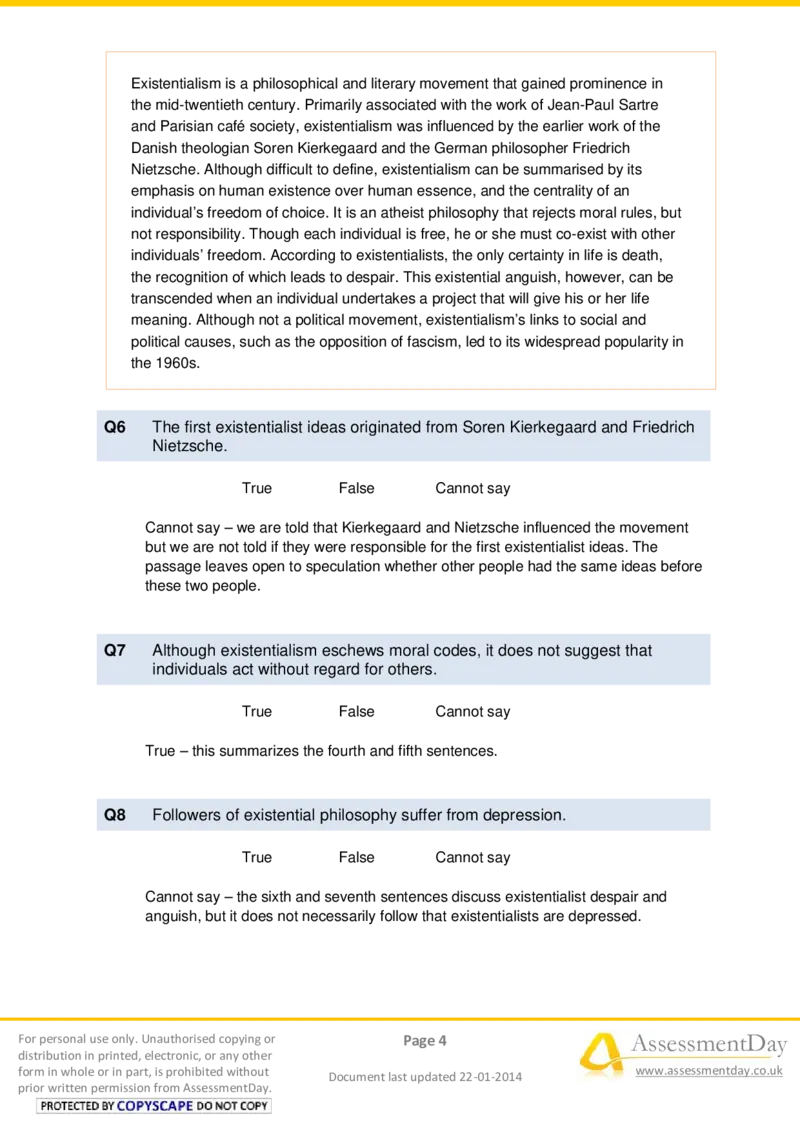
prior written permission from AssessmentDay.Existentialism is a philosophical and literary movement that gained prominence in
the mid-twentieth century. Primarily associated with the work of Jean-Paul Sartre
and Parisian café society, existentialism was influenced by theearlier work of the
Danish theologian Soren Kierkegaard and the German philosopher Friedrich
Nietzsche. Although difficult to define, existentialism can be summarised by its
emphasis on human existence over human essence, and the centrality of an
individual’s freedom of choice. It is an atheist philosophy that rejects moral rules, but
not responsibility. Though each individual is free, he or she must co-exist with other
individuals’ freedom. According to existentialists, the only certainty in life is death,
the recognition of which leads to despair. This existential anguish, however, can be
transcended when an individual undertakes a project that will give his or her life
meaning. Although not a political movement, existentialism’s links to social and
political causes, such as the opposition of fascism, led to its widespread popularity in
the 1960s.
Q6 The first existentialist ideas originated from Soren Kierkegaard and Friedrich
Nietzsche.
True False Cannot say
Cannot say– we are told that Kierkegaard and Nietzsche influenced the movement
but we are not told if they were responsible for thefirst existentialist ideas. The
passage leaves open to speculation whether other people had the same ideas before
these two people.
Q7 Although existentialism eschews moral codes, it does not suggest that
individuals act without regard for others.
True False Cannot say
True –this summarizes the fourth and fifth sentences.
Q8 Followers of existential philosophy suffer from depression.
True False Cannot say
Cannot say–the sixth and seventh sentences discuss existentialist despair and
anguish, but it does not necessarily follow that existentialists are depressed.
For personal use only. Unauthorised copying or Page4 AssessmentDay
distribution in printed, electronic, or any other
form in whole orin part, is prohibited without www.assessmentday.co.uk
Document last updated 22-01-2014
prior written permission from AssessmentDay.Q9 Existentialism views mortality as life’s sole inevitability.
True False Cannot say
True –“According to existentialists, the only certainty in life is death”.
Q10 Existentialism became a popular political movement in the 1960s.
True False Cannot say
False – the first sentence states that existentialism is a “philosophical and literary
movement”. One might be tempted to answer True based on a quick reading of the
last sentence, however the last sentence also states that existentialism was “not a
political movement…”
For personal use only. Unauthorised copying or Page5 AssessmentDay
distribution in printed, electronic, or any other
form in whole orin part, is prohibited without www.assessmentday.co.uk
Document last updated 22-01-2014
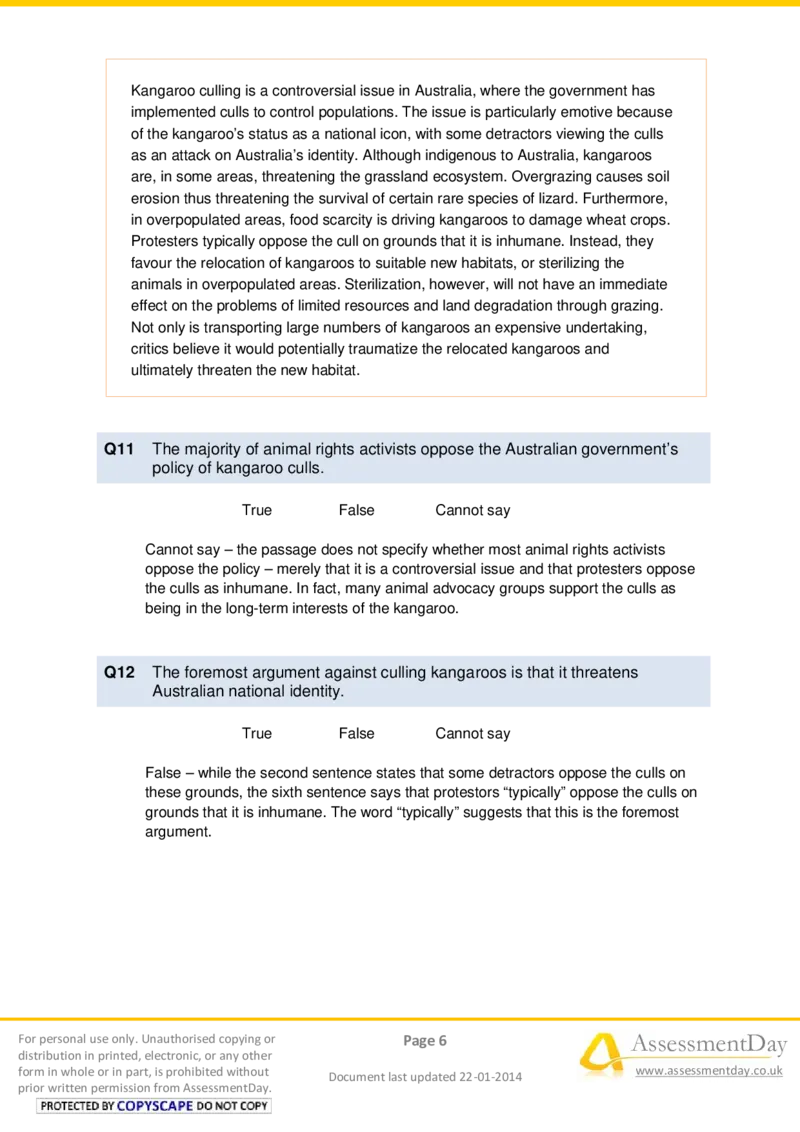
prior written permission from AssessmentDay.Kangaroo culling is a controversial issue in Australia, where the government has
implemented culls to control populations. The issue is particularly emotive because
of the kangaroo’s status as a national icon, with some detractors viewing the culls
as an attack on Australia’s identity. Although indigenous toAustralia, kangaroos
are, in some areas, threatening the grassland ecosystem.Overgrazing causes soil
erosion thus threatening the survival of certain rare species of lizard. Furthermore,
in overpopulated areas, food scarcity is driving kangaroos to damagewheat crops.
Protesters typically oppose the cull on grounds that it is inhumane. Instead, they
favour the relocation of kangaroos to suitable new habitats, or sterilizing the
animals in overpopulated areas. Sterilization, however, will not have an immediate
effect on the problems of limited resources and land degradation through grazing.
Not only is transporting large numbers of kangaroos an expensive undertaking,
critics believe it would potentially traumatize the relocated kangaroos and
ultimately threaten the new habitat.
Q11 The majority of animal rights activists oppose the Australian government’s
policy of kangaroo culls.
True False Cannot say
Cannot say–the passage does not specify whether most animal rights activists
oppose thepolicy– merely that it is a controversial issue and that protesters oppose
the culls as inhumane. In fact, many animal advocacy groups support the culls as
being in the long-term interests of the kangaroo.
Q12 The foremost argument against culling kangaroos is that it threatens
Australian national identity.
True False Cannot say
False – while the second sentence states that some detractors oppose the culls on
these grounds, the sixth sentence says that protestors “typically” oppose the culls on
grounds that it is inhumane. The word “typically” suggests that this is the foremost
argument.
For personal use only. Unauthorised copying or Page6 AssessmentDay
distribution in printed, electronic, or any other
form in whole orin part, is prohibited without www.assessmentday.co.uk
Document last updated 22-01-2014
prior written permission from AssessmentDay.Q13 Kangaroos present a threat to agriculture as well as to the ecosystem.
True False Cannot say
True –the passage states that kangaroos damage wheat crops.
Q14 In overpopulated areas where food is scarce, kangaroos are preying on rare
lizards.
True False Cannot say
Cannot say– whilst the passage tells us that some species of lizards arethreatened
because kangaroos overgraze, we are not told whether kangaroos prey on lizards.
Q15 Sterilizing kangaroos will not immediately alleviate problems of their over-
grazing.
True False Cannot say
True –sterilized kangaroos will not be able to breed, but they will continue to graze.
The eighth sentence of the passage tells us that “Sterilization, however, will not have
an immediate effect on the problems of limited resources and land degradation
through grazing".
For personal use only. Unauthorised copying or Page7 AssessmentDay
distribution in printed, electronic, or any other
form in whole orin part, is prohibited without www.assessmentday.co.uk
Document last updated 22-01-2014
prior written permission from AssessmentDay.Plastics represent thefastest-growing category of waste. Worldwide consumers
use 500 billion plastic shopping bags and drink 154 billion litres of bottled water
annually. The majority of these bags and bottles are made from polyethylene
terepthalate (PET), a plastic derived from crude oil. Because PET takes over
1,000 years to degrade and leaks dangerous chemicals into the soil, many
communities have instituted recycling programmes to reduce the amount of
plastic destined for landfill. However, recycling plastic is not a perfect solution.
Firstly, there are many different types of plastic, and sorting them makes recycling
labour-intensive. Secondly, because the quality of plastic degrades with each
reuse, recycled plastic has a low value. To reduce costs most of Europe’s plastic
is shipped to China for recycling processing. The downside to this is that the
transportation consumes large amounts of energy and working conditions in the
Chinese processing factories are poor. While recycling plastic may salve the
conscience of westernconsumers, reducing plastic proliferation is a better
solution.
Q16 It costs less money to recycle plastic in China than it does in European
countries.
True False Cannot say
True –the 8th sentence tells us that “to reduce costs” most of Europe’s plastic is
shipped to China for recycling.
Q17 The passage suggests that finding alternatives to PET is a preferable
solution to recycling.
True False Cannot say
False – in the final sentence, the passage suggests that reducing the use of plastic is
a preferable solution.
Q18 There are economic drawbacks to recycling plastic.
True False Cannot say
True –The economic drawbacks are that recycled plastic has a low value.
For personal use only. Unauthorised copying or Page8 AssessmentDay
distribution in printed, electronic, or any other
form in whole orin part, is prohibited without www.assessmentday.co.uk
Document last updated 22-01-2014
prior written permission from AssessmentDay.Q19 The proliferation of shopping bags and water bottles has made plastic the
fastest-growing category of waste.
True False Cannot say
Cannot say– while the passage cites high usage of shopping bags and water
bottles, it does not specify this as the cause for the fast growth of plastic waste.
Q20 Plastic recycling does not extend the life of the material indefinitely.
True False Cannot say
True –the passage states that “the quality of plastic degrades with eachre-use”
which means that it cannot be used forever.
For personal use only. Unauthorised copying or Page9 AssessmentDay
distribution in printed, electronic, or any other
form in whole orin part, is prohibited without www.assessmentday.co.uk
Document last updated 22-01-2014
prior written permission from AssessmentDay.Although commonly referred to as tidal waves, tsunamis are not caused by tides. A
tsunami is a series of fast-moving waves created by a disturbance above or below
sea level. Although earthquakes are the most common cause of tsunamis, volcanic
eruptions andlandslides can also trigger a tsunami. A tsunami can occur in any
large body of water, however they typically occur in the Pacific Ocean. In open
water, a tsunami travels at speeds of up to 800 km per hour, with wavelengths
several hundred kilometres long but wave heights under one metre. When it
approaches land, however, a tsunami slows, its wave length compressing and its
height increasing. In 2004, a catastrophic tsunami resulting from an earthquake in
the Indian Ocean claimed more than 200,000 lives with 20-metres-high waves.
While scientists cannot predict when a tsunami will occur, seismologists monitoring
submarine earthquakes can forecast a tsunami’s arrival and impact using wave
theory and measurement technology, thus enabling authorities to issuetsunami
warnings.
Q21 Tidal wave is a misnomer for a tsunami.
True False Cannot say
True –we are told that they are not caused by tides, and are a series of waves rather
than one wave.
Q22 Earthquakes occur most frequently in the Pacific Ocean.
True False Cannot say
Cannot say– whilst we are told that earthquakes are the“most common cause of
tsunamis”, and that tsunamis “typically occur in the Pacific Ocean”, we are told
nothing about the frequency of earthquakes in one oceancompared with another.
For example who is to say that another ocean not mentioned at all has the highest
occurrence of earthquakes.
Q23 The 2004 Indian Ocean tsunami was the most devastating tsunami in recent
history.
True False Cannot say
Cannot say–the passage states that this tsunami killed 200,000 people, but no
comparative figures are provided.
For personal use only. Unauthorised copying or Page10 AssessmentDay
distribution in printed, electronic, or any other
form in whole orin part, is prohibited without www.assessmentday.co.uk
Document last updated 22-01-2014
prior written permission from AssessmentDay.Q24 As a tsunami reaches the shore, its speed and its wave height increase.
True False Cannot say
False – while a tsunami’s waves do increase in height as it approaches land, its
speed slows.
Q25 Using wave measurement methodology, scientists can predict when a
tsunami will occur.
True False Cannot say
False – wave measurement methodology allows scientists to predict where it will hit,
and to what degree– as per the final sentence.
For personal use only. Unauthorised copying or Page11 AssessmentDay
distribution in printed, electronic, or any other
form in whole orin part, is prohibited without www.assessmentday.co.uk
Document last updated 22-01-2014
prior written permission from AssessmentDay.The United Nations was established in 1945 and today includes nearly every
recognized state, each of which has one vote in the General Assembly. The United
Nations’ Security Council, charged with maintaining international peace and
security, is comprised of five permanent members (the P5)–the United States, the
United Kingdom, France, China and Russia–as well as ten non-permanent
members, elected for two-year terms. The Security Council approves decisions
based on an affirmative vote from at least nine of its fifteen members, however
each of the five permanent members has ultimate veto power. The P5’s veto
power is widely criticized as unfair and anachronistic. In the Cold War era, the P5
were the world’s only nuclear powers, and the veto both recognized their might and
provided incentive for them to support the Security Council’s goals. Nuclear
proliferation, however, means that the P5 no longer reflects today’s geopolitical
realities. Opponents of the veto believe it is used to promote national agendas at
the expense of international security. Alternatively, rather than abolish the veto,
some commentators suggest that the veto should be extended to more countries –
for example, Germany.
Q26 The P5 were granted veto power in recognition of their disproportionate
contribution to global security.
True False Cannot say
False – the passage cites their nuclearcapacity and incentive to participate as
reasons for veto power.
Q27 Some critics argue that veto power is subject to national interests.
True False Cannot say
True –thissummarizes the 7th sentence.
Q28 The passage asserts that some people believe that the veto should be
granted to all countries with nuclear arsenals.
True False Cannot say
False – the last sentence of the passage states that some believe the veto should be
extended, but does not specify that it should be to allcountries with nuclear capacity.
Tip: if the question did not have the words "The passage asserts that" the answer
would be 'cannot say' because we are not told either way if the statement is true or
false. In this question we are actually being asked if the passage states something.
For personal use only. Unauthorised copying or Page12 AssessmentDay
distribution in printed, electronic, or any other
form in whole orin part, is prohibited without www.assessmentday.co.uk
Document last updated 22-01-2014
prior written permission from AssessmentDay.Q29 The United Nations’ Security Council was set up in 1945, with the objective
of avoiding another world war.
True False Cannot say
Cannot say– although the passage states that the UN was established in 1945, it
does not specify that the Security Council was also set up in that year.
Q30 The P5 cannot wield their veto if a resolution is backed by at least nine
members of the Security Council.
True False Cannot say
False –The third sentence tells us that each one of the P5 members has “ultimate
veto power”. The implication of “ultimate” power is that it can overrule everything
else.
-- End of Test --
For personal use only. Unauthorised copying or Page13 AssessmentDay
distribution in printed, electronic, or any other
form in whole orin part, is prohibited without www.assessmentday.co.uk
Document last updated 22-01-2014
prior written permission from AssessmentDay.