绝密★启用前
2017年全国硕士研究生招生考试
英语(二)
(科目代码:204)
☆考生注意事项众
1. 答题前,考生须在试题册指定位置上填写考生编号和考生姓名;在答题卡指
定位置上填写报考单位、考生姓名和考生编号,并涂写考生编号信息点。
2. 考生须把试题册上的“试卷条形码”粘贴条取下,粘贴在答题卡的“试卷
条形码粘贴位置”框中。不按规定粘贴条形码而影响评卷结果的,责任由
考生自负。
3. 选择题的答案必须涂写在答题卡相应题号的选项上,非选择题的答案必须
书写在答题卡指定位置的边框区域内。超出答题区域书写的答案无效;在
草稿纸、试题册上答题无效。
4. 填(书)写部分必须使用黑色字迹签字笔书写,字迹工整、笔迹清楚;涂
写部分必须使用2B铅笔填涂。
5. 考试结束,将答题卡和试题册按规定交回。
(以下信息考生必须认真填写)
考生编号
考生姓名Section I Use of English
Directions:
Read the following text. Choose the best word( s) for each numbered blank and
mark A, B, C or D on the ANSWER SHEET. (10 points)
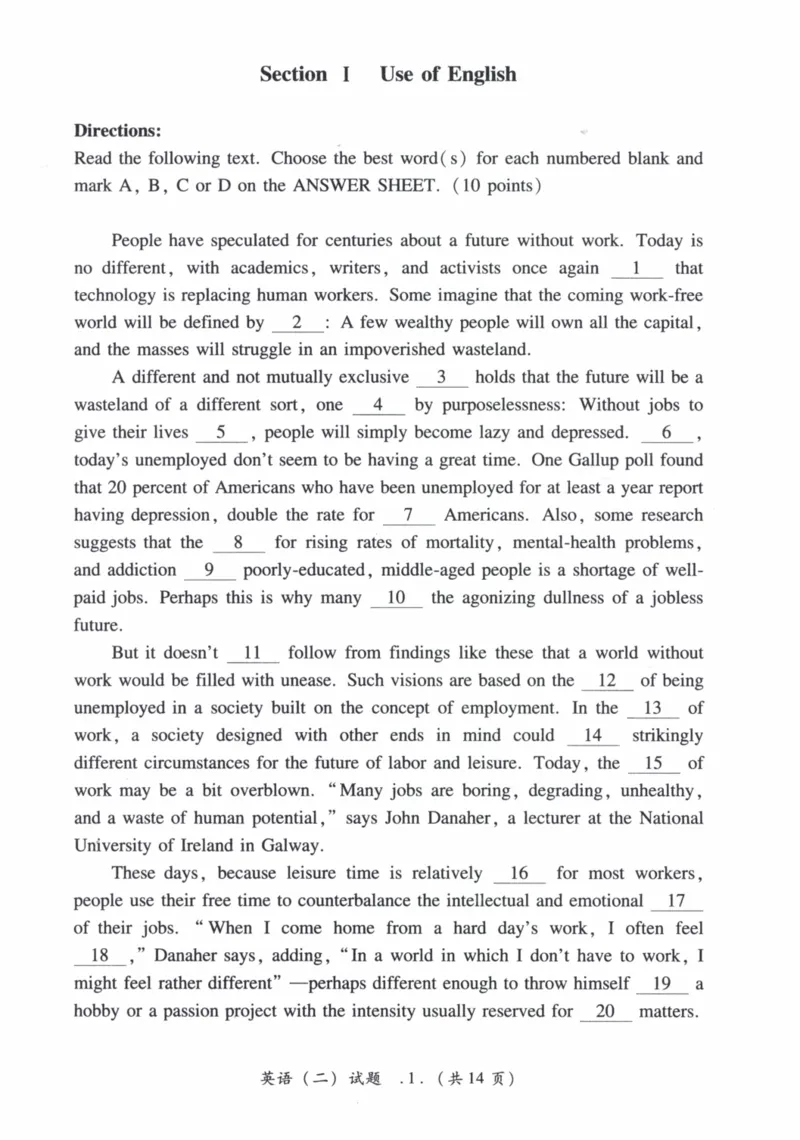
People have speculated for centuries about a future without work. Today is
no different, with academics, writers, and activists once again ] that
technology is replacing human workers. Some imagine that the coming work-free
world will be defined by 2 : A few wealthy people will own all the capital,
and the masses will struggle in an impoverished wasteland.
A different and not mutually exclusive 3 holds that the future will be a
wasteland of a different sort, one 4 by purposelessness: Without jobs to
give their lives 5 , people will simply become lazy and depressed. 6 ,
today's unemployed don't seem to be having a great time. One Gallup poll found
that 20 percent of Americans who have been unemployed for at least a year report
having depression, double the rate for 7 Americans. Also, some research
suggests that the 8 for rising rates of mortality, mental-health problems,
and addiction 9 poorly-educated, middle-aged people is a shortage of well-
paid jobs. Perhaps this is why many 10 the agonizing dullness of a jobless
future.
But it doesn't 11 follow from findings like these that a world without
work would be filled with unease. Such visions are based on the 12 of being
unemployed in a society built on the concept of employment. In the 13 of
work, a society designed with other ends in mind could 14 strikingly
different circumstances for the future of labor and leisure. Today, the 15 of
work may be a bit overblown. "Many jobs are boring, degrading, unhealthy,
and a waste of human potential," says John Danaher, a lecturer at the National
University of Ireland in Galway.
These days, because leisure time is relatively 16 for most workers,
people use their free time to counterbalance the intellectual and emotional 17
of their jobs. "When I come home from a hard day's work, I often feel
18 Danaher says, adding, “In a world in which I don't have to work, I
might feel rather differentn —perhaps different enough to throw himself 19 a
hobby or a passion project with the intensity usually reserved for 20 matters.
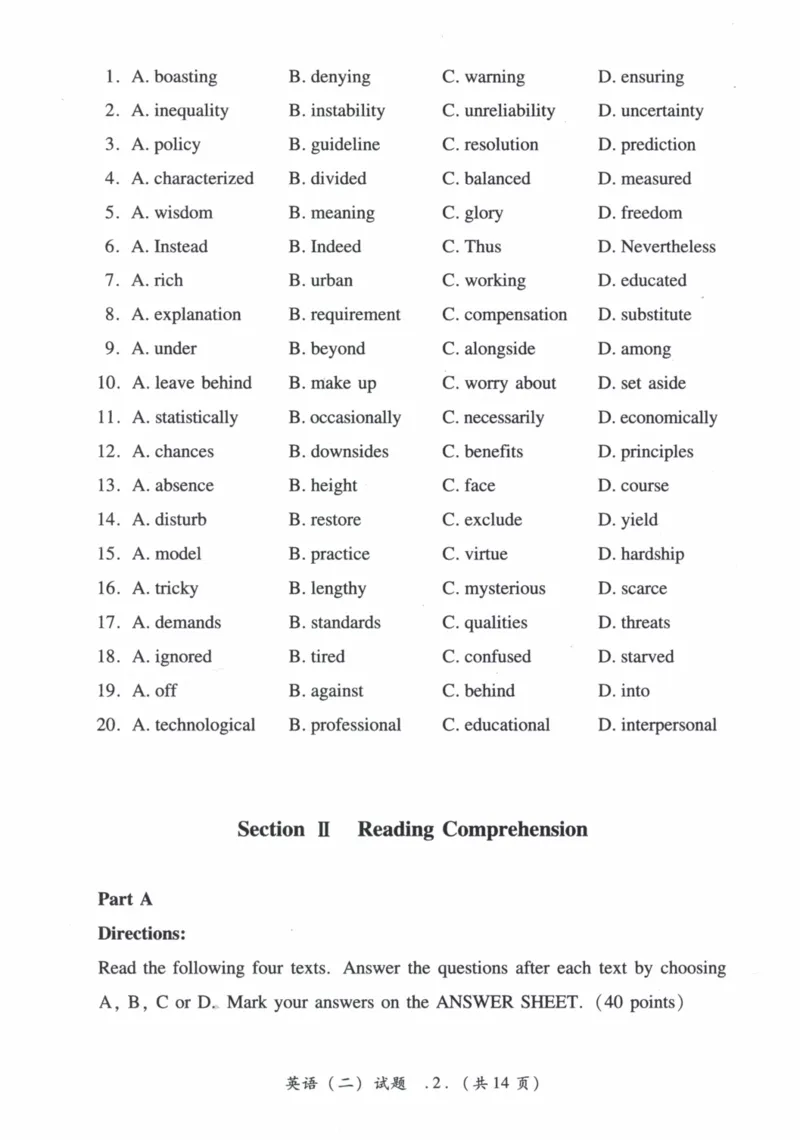
英语(二)试题.1.(共14页)1. A. boasting B. denying C. warning D. ensuring
2. A. inequality B. instability C. unreliability D. uncertainty
3. A. policy B. guideline C. resolution D. prediction
4. A. characterized B. divided C. balanced D. measured
5. A. wisdom B. meaning C. glory D. freedom
6. A. Instead B. Indeed C. Thus D. Nevertheless
7. A. rich B. urban C. working D. educated
8. A. explanation B. requirement C. compensation D. substitute
9. A. under B. beyond C. alongside D. among
10. A. leave behind B. make up C. worry about D. set aside
11. A. statistically B. occasionally C. necessarily D. economically
12. A. chances B. downsides C. benefits D. principles
13. A. absence B. height C. face D. course
14. A. disturb B. restore C. exclude D. yield
15. A. model B. practice C. virtue D. hardship
16. A. tricky B. lengthy C. mysterious D. scarce
17. A. demands B. standards C. qualities D. threats
18. A. ignored B. tired C. confused D. starved
19. A. off B. against C. behind D. into
20. A. technological B. professional C. educational D. interpersonal
Section 口 Reading Comprehension
Part A
Directions:
Read the following four texts. Answer the questions after each text by choosing
A, B, C or D. Mark your answers on the ANSWER SHEET. (40 points)
英语(二)试题.2.(共14页)Text 1
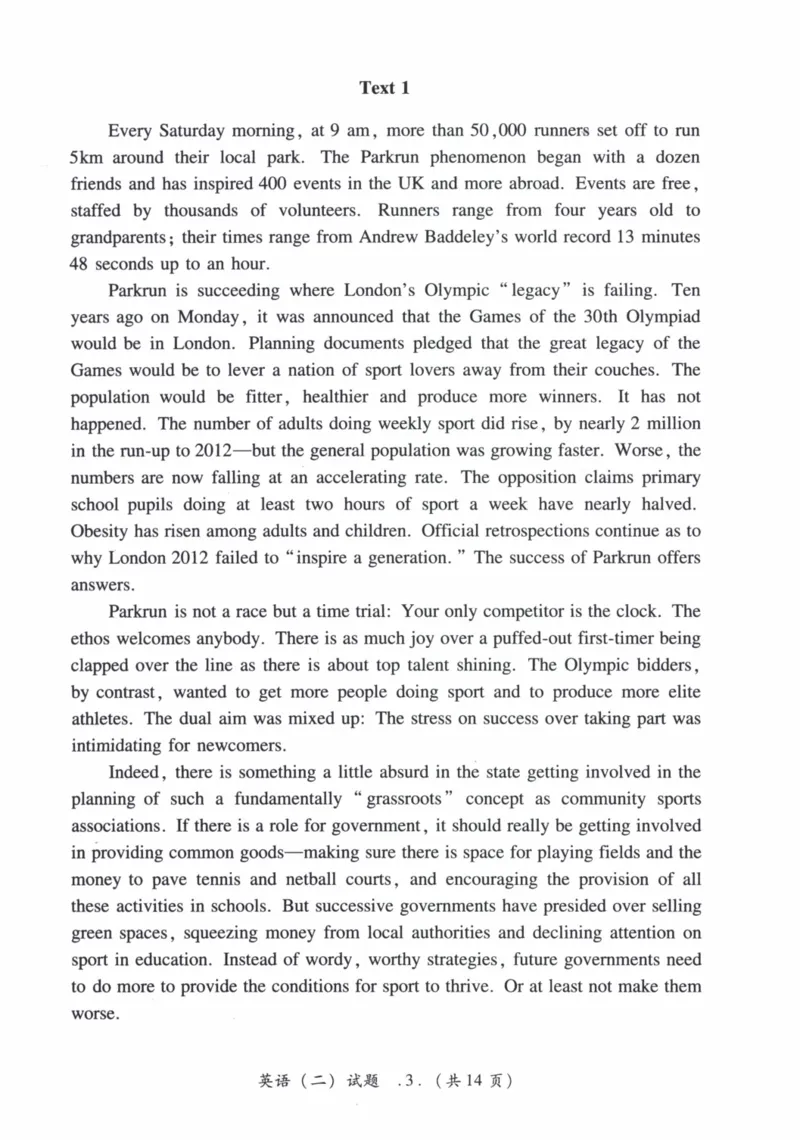
Every Saturday morning, at 9 am, more than 50,000 runners set off to run
5 km around their local park. The Parkrun phenomenon began with a dozen
friends and has inspired 400 events in the UK and more abroad. Events are free,
staffed by thousands of volunteers. Runners range from four years old to
grandparents ; their times range from Andrew Baddeley's world record 13 minutes
48 seconds up to an hour.
Parkrun is succeeding where London's Olympic "legacy” is failing. Ten
years ago on Monday, it was announced that the Games of the 30th Olympiad
would be in London. Planning documents pledged that the great legacy of the
Games would be to lever a nation of sport lovers away from their couches. The
population would be fitter, healthier and produce more winners. It has not
happened. The number of adults doing weekly sport did rise, by nearly 2 million
in the run-up to 2012—but the general population was growing faster. Worse, the
numbers are now falling at an accelerating rate. The opposition claims primary
school pupils doing at least two hours of sport a week have nearly halved.
Obesity has risen among adults and children. Official retrospections continue as to
why London 2012 failed to u inspire a generation. M The success of Parkrun offers
answers.
Parkrun is not a race but a time trial: Your only competitor is the clock. The
ethos welcomes anybody. There is as much joy over a puffed-out first-timer being
clapped over the line as there is about top talent shining. The Olympic bidders,
by contrast, wanted to get more people doing sport and to produce more elite
athletes. The dual aim was mixed up: The stress on success over taking part was
intimidating for newcomers.
Indeed, there is something a little absurd in the state getting involved in the
planning of such a fundamentally " grassroots" concept as community sports
associations. If there is a role for government, it should really be getting involved
in providing common goods—making sure there is space for playing fields and the
money to pave tennis and netball courts, and encouraging the provision of all
these activities in schools. But successive governments have presided over selling
green spaces, squeezing money from local authorities and declining attention on
sport in education. Instead of wordy, worthy strategies, future governments need
to do more to provide the conditions for sport to thrive. Or at least not make them
worse.
英语(二)试题.3.(共14页)21. According to Paragraph 1, Parkrun has.
A. gained great popularity
B. created many jobs
C. strengthened community ties
D. become an official festival
22. The author believes that London's Olympic "legacy" has failed to.
A. boost population growth
B. promote sport participation
C. improve the city's image
D. increase sport hours in schools
23. Parkrun is different from Olympic games in that it.
A. aims at discovering talents
B. focuses on mass competition
C. does not emphasize elitism
D. does not attract first-timers
24. With regard to mass sports, the author holds that governments should.
A. organize "grassroots" sports events
B. supervise local sports associations
C. increase funds for sports clubs
D. invest in public sports facilities
25. The author's attitude to what UK governments have done for sports
is.
A. tolerant
B. critical
C. uncertain
D. sympathetic
英语(二)试题.4.(共14页)Text 2
With so much focus on children's use of screens, ifs easy for parents to
forget about their own screen use. "Tech is designed to really suck you in,”
says Jenny Radesky in her study of digital play, " and digital products are there to
promote maximal engagement. It makes it hard to disengage, and leads to a lot
of bleed-over into the family routine.
Radesky has studied the use of mobile phones and tablets at mealtimes by
giving mother-child pairs a food-testing exercise. She found that mothers who
used devices during the exercise started 20 per cent fewer verbal and 39 per cent
fewer nonverbal interactions with their children. During a separate observation, she
saw that phones became a source of tension in the family. Parents would be
looking at their emails while the children would be making excited bids for their
attention.
Infants are wired to look at parents9 faces to try to understand their world,
and if those faces are blank and unresponsive—as they often are when absorbed in
a device—it can be extremely disconcerting for the children. Radesky cites the
"still face experimentn devised by developmental psychologist Ed Tronick in the
1970s. In it, a mother is asked to interact with her child in a normal way before
putting on a blank expression and not giving them any visual social feedback: The
child becomes increasingly distressed as she tries to capture her mother's
attention. u Parents don't have to be exquisitely present at all times, but there
needs to be a balance and parents need to be responsive and sensitive to a child9 s
verbal or nonverbal expressions of an emotional need," says Radesky.
On the other hand, Tronick himself is concerned that the worries about kids9
use of screens are bom out of an " oppressive ideology that demands that parents
should always be interactingwith their children: "It's based on a somewhat
fantasised, very white, very upper-middle-class ideology that says if you're
failing to expose your child to 30,000 words you are neglecting them. " Tronick
believes that just because a child isn't learning from the screen doesn't mean
there9s no value to it—particularly if it gives parents time to have a shower, do
housework or simply have a break from their child. Parents, he says, can get a
lot out of using their devices to speak to a friend or get some work out of the
way. This can make them feel happier, which lets them be more available to
their child the rest of the time.
英语(二)试题.5.(共14页)26. According to Jenny Radesky, digital products are designed to
A. simplify routine matters
B. absorb user attention
C. better interpersonal relations
D. increase work efficiency
27. Radesky's food-testing exercise shows that mothers, use of devices
A. takes away babies5 appetite
B. distracts children's attention
C. slows down babies' verbal development .
D. reduces mother-child communication
28. Radesky cites the “still face experimentM to show that.
A. it is easy for children to get used to blank expressions
B. verbal expressions are unnecessary for emotional exchange
C. children are insensitive to changes in their parents9 mood
D. parents need to respond to children's emotional needs
29. The oppressive ideology mentioned by Tronick requires parents to
A. protect kids from exposure to wild fantasies
B. teach their kids at least 30,000 words a year
C. ensure constant interaction with their children
D. remain concerned about kids5 use of screens
30. According to Tronick, kids' use of screens may.
A. give their parents some free time
B. make their parents more creative
C. help them with their homework
D. help them become more attentive
英语(二)试题.6.(共14页)Text 3
Today, widespread social pressure to immediately go to college in
conjunction with increasingly high expectations in a fast-moving world often
causes students to completely overlook the possibility of taking a gap year. After
all, if everyone you know is going to college in the fall, it seems silly to stay
back a year, doesn't it? And after going to school for 12 years, it doesn't feel
natural to spend a year doing something that isn't academic.
But while this may be true, it's not a good enough reason to condemn gap
years. There5s always a constant fear of falling behind everyone else on the
socially perpetuated " race to the finish line," whether that be toward graduate
school, medical school or a lucrative career. But despite common
misconceptions, a gap year does not hinder the success of academic pursuits—in
fact, it probably enhances it.
Studies from the United States and Australia show that students who take a
gap year are generally better prepared for and perform better in college than those
who do not. Rather than pulling students back, a gap year pushes them ahead by
preparing them for independence, new responsibilities and environmental
changes—all things that first-year students often struggle with the most. Gap year
experiences can lessen the blow when it comes to adjusting to college and being
thrown into a brand new environment, making it easier to focus on academics and
activities rather than acclimation blunders.
If you're not convinced of the inherent value in taking a year off to explore
interests, then consider its financial impact on future academic choices.
According to the National Center for Education Statistics, nearly 80 percent of
college students end up changing their majors at least once. This isn't surprising,
considering the basic mandatory high school curriculum leaves students with a
poor understanding of the vast academic possibilities that await them in college.
Many students find themselves listing one major on their college applications, but
switching to another after taking college classes. It's not necessarily a bad thing,
but depending on the school, it can be costly to make up credits after switching
too late in the game. At Boston College, for example, you would have to
complete an extra year were you to switch to the nursing school from another
department. Taking a gap year to figure things out initially can help prevent stress
and save money later on.
英语(二)试题.7.(共14页)31. One of the reasons for high-school graduates not taking a gap year is
that.
A. they think it academically misleading
B. they have a lot of fun to expect in college
C. it feels strange to do differently from others
D. it seems worthless to take off-campus courses
32. Studies from the US and Australia imply that taking a gap year helps .
A. keep students from being unrealistic
B. lower risks in choosing careers
C. ease freshmen9s financial burdens
D. relieve freshmen of pressures
33. The word “acclimation” (Para. 3) is closest in meaning to.
A. adaptation
B. application
C. motivation
D. competition
34. A gap year may save money for students by helping them.
A. avoid academic failures
B. establish long-term goals
C. switch to another college
D. decide on the right major
35. The most suitable title for this text would be.
A. In Favor of the Gap Year
B. The ABCs of the Gap Year
C. The Gap Year Comes Back
D. The Gap Year: A Dilemma
英语(二)试题.8.(共14页)Text 4
Though often viewed as a problem for western states, the growing frequency
of wildfires is a national concern because of its impact on federal tax dollars, says
Professor Max Moritz, a specialist in fire ecology and management.
In 2015, the US Forest Service for the first time spent more than half of its
$5.5 billion annual budget fighting fires—nearly double the percentage it spent
on such efforts 20 years ago. In effect, fewer federal funds today are going
towards the agency9s other work—such as forest conservation, watershed and
cultural resources management, and infrastructure upkeep—that affect the lives of
all Americans.
Another nationwide concern is whether public funds from other agencies are
going into construction in fire-prone districts. As Moritz puts it, how often are
federal dollars building homes that are likely to be lost to a wildfire?
“It's already a huge problem from a public expenditure perspective for the
whole country,n he says. "We need to take a magnifying glass to that. Like,
'Wait a minute, is this OK?' Do we want instead to redirect those funds to
concentrate on lower-hazard parts of the landscape
Such a view would require a corresponding shift in the way US society today
views fire, researchers say.
For one thing, conversations about wildfires need to be more inclusive. Over
the past decade, the focus has been on climate change一how the warming of the
Earth from greenhouse gases is leading to conditions that worsen fires.
While climate is a key element, Moritz says, it shouldn't come at the
expense of the rest of the equation.
"The human systems and the landscapes we live on are linked, and the
interactions go both ways," he says. Failing to recognize that, he notes, leads to
"an overly simplified view of what the solutions might be. Our perception of the
problem and of what the solution is becomes very limited."
At the same time, people continue to treat fire as an event that needs to be
wholly controlled and unleashed only out of necessity, says Professor Balch at the
University of Colorado. But acknowledging fire's inevitable presence in human
life is an attitude crucial to developing the laws, policies, and practices that make
it as safe as possible, she says.
“We've disconnected ourselves from living with fire," Balch says. “It is
really important to understand and try and tease out what is the human connection
with fire today."
英语(二)试题.9.(共14页)36. More frequent wildfires have become a national concern because in 2015 they
A. exhausted unprecedented management efforts
B. consumed a record-high percentage of budget
C. severely damaged the ecology of western states
D. caused a huge rise of infrastructure expenditure
37. Moritz calls for the use of “a magnifying glass" to.
A. raise more funds for fire-prone areas
B. avoid the redirection of federal money
C. find wildfire-free parts of the landscape
D. guarantee safer spending of public funds
38. While admitting that climate is a key element, Moritz notes that.
A. public debates have not settled yet
B. fire-fighting conditions are improving
C. other factors should not be overlooked
D. a shift in the view of fire has taken place
39. The overly simplified view Moritz mentions is a result of failing to
A. discover the fundamental makeup of nature
B. explore the mechanism of the human systems
C. maximize the role of landscape in human life
D. understand the interrelations of man and nature
40. Professor Balch points out that fire is something man should.
A. do away with
B. come to terms with
C. pay a price for
D. keep away from
英语(二)试题.10.(共14页)Part B
Directions:
Read the following text and match each of the numbered items in the left column
to its corresponding information in the right column. There are two extra choices
in the right column. Mark your answers on the ANSWER SHEET. (10 points)
The decline in American manufacturing is a common refrain, particularly
from Donald Trump. "We don't make anything anymore," he told Fox News,
while defending his own made-in-Mexico clothing line.
Without question, manufacturing has taken a significant hit during recent
decades, and further trade deals raise questions about whether new shocks could
hit manufacturing.
But there is also a different way to look at the data.
Across the country, factory owners are now grappling with a new challenge:
Instead of having too many workers, they may end up with too few. Despite
trade competition and outsourcing, American manufacturing still needs to replace
tens of thousands of retiring boomers every year. Millennials may not be that
interested in taking their place. Other industries are recruiting them with similar
or better pay.
For factory owners, it all adds up to stiff competition for workers—and
upward pressure on wages. "They're harder to find and they have job offers,n
says Jay Dun well, president of Wolverine Coil Spring, a family-owned firm.
uThey may be coming [into the workforce] , but they've been plucked by other
industries that are also doing as well as manufacturing. n Mr. Dunwell has begun
bringing high school juniors to the factory so they can get exposed to its culture.
At RoMan Manufacturing, a maker of electrical transformers and welding
equipment that his father cofounded in 1980, Robert Roth keeps a close eye on
the age of his nearly 200 workers. Five are retiring this year. Mr. Roth has three
community-college students enrolled in a work-placement program, with a
starting wage of $13 an hour that rises to $17 after two years.
At a worktable inside the transformer plant, young Jason Stenquist looks
flustered by the copper coils he's trying to assemble and the arrival of two
visitors. It's his first week on the job. Asked about his choice of career, he says
at high school he considered medical school before switching to electrical
engineering. "I love working with tools. I love creating,n he says.
英语(二)试题.11.(共14页)But to win over these young workers, manufacturers have to clear another
major hurdle: parents, who lived through the worst US economic downturn since
the Great Depression, telling them to avoid the factory. Millennials remember
their father and mother both were laid off. They blame it on the manufacturing
recession,n says Birgit Klohs, chief executive of The Right Place, a business
development agency for western Michigan.
These concerns aren't misplaced: Employment in manufacturing has fallen
from 17 million in 1970 to 12 million in 2015. When the recovery began, worker
shortages first appeared in the high-skilled trades. Now shortages are appearing at
the mid-skill levels.
“The gap is between the jobs that take no skills and those that require a lot
of skill,” says Rob Spohr, a business professor at Montcalm Community
College. "There're enough people to fill the jobs at McDonalds and other places
where you don't need to have much skill. It's that gap in between, and that's
where the problem is."
Julie Parks of Grand Rapids Community College points to another key to
luring Millennials into manufacturing: a work/life balance. While their parents
were content to work long hours, young people value flexibility. u Overtime is
not attractive to this generation. They really want to live their lives," she says.
A. says that he switched to electrical engineering
because he loves working with tools.
B. points out that there are enough people to fill the jobs
41. Jay Dunwell
that don't need much skill.
C. points out that the US doesn't manufacture anything
42. Jason Stenquist
anymore.
D. believes that it is important to keep a close eye on
43. Birgit Klohs
the age of his workers.
E. says that for factory owners, workers are harder to
44. Rob Spohr
find because of stiff competition.
F. points out that a work/life balance can attract young
45. Julie Parks
people into manufacturing.
G. says that the manufacturing recession is to blame for
the lay-off of the young people's parents.
英语(二)试题.12.(共14页)Section ID Translation
46. Directions:
Translate the following text into Chinese. Write your translation on the
ANSWER SHEET. (15 points)
My dream has always been to work somewhere in an area between fashion
and publishing. Two years before graduating from secondary school, I took a
sewing and design course thinking that I would move on to a fashion design
course. However, during that course I realised I was not good enough in this area
to compete with other creative personalities in the future, so I decided that it was
not the right path for me. Before applying for university I told everyone that I
would study journalism, because writing was, and still is, one of my favourite
activities. But, to be honest, I said it, because I thought that fashion and me
together was just a dream—I knew that no one could imagine me in the fashion
industry at all! So I decided to look for some fashion-related courses that included
writing. This is when I noticed the course u Fashion Media & Promotion. ”
Section IV Writing
Part A
47. Directions:
Suppose you are invited by Professor Williams to give a presentation about
Chinese culture to a group of international students. Write a reply to
1) accept the invitation, and
2) introduce the key points of your presentation.
You should write about 100 words on the ANSWER SHEET.
Do not use your own name. Use “Li Ming" instead.
Do not write your address. (10 points)
英语(二)试题,13.(共14页)Part B
48. Directions:
Write an essay based on the chart below. In your writing, you should
1) interpret the chart, and
2) give your comments.
You should write about 150 words on the ANSWER SHEET. (15 points)
2013-2015年我国博物馆数量和参观人数
10000 ---------------------------------------------------------------------------------
8000
■TW----------
- -----
7811
7177
6000
6378
■4692
4000
4165 4510
2000
0 ---------------------------------------------------------------------------------
2013 年 2014 年 2015 年
♦博物馆数量(家)-,~参观人数(十万人次)
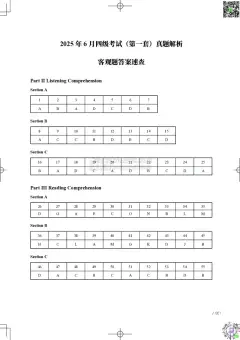
2017年考研英语(二)真题答案速查表
1〜5 CADAB 6〜10 BCADC 11 ~15 CBADC
16 〜20 DABDB 21 〜25 ABCDB 26-30 BDDCA
31 ~35 CDADA 36 ~40 BDCDB 41 〜45 EAGBF
Section HI Translation
我的梦想一直是在时尚和出版之间的领域寻找一份工作。中学毕业前两年,我选修了一
门缝纫与设计课,心想以后会继续修一门时装设计课。然而,在学习那门课程期间,我意识到
自己在这个领域不够优秀,将来不足以与其他有创造力的人竞争,因此我断定这条路并不适
合我。在申请大学之前,我告诉所有人我会选择新闻学,因为写作曾经是,现在依然是我最喜
欢的活动之一。但是,说实话,当时我之所以那样说,是因为我认为与时尚结缘只不过是一个
梦一一我知道,根本没有人能想到我会进入时尚行业。因此,我决定找一些既与时尚相关又
包含写作的课程。就在此时,我注意到了“时尚媒体与推广”这门课程。
英语(二)试题.14.(共14页)@@@@故事情节纯属虚构,仅为逗您一乐,不要“入戏”哦!