丰台区 2020-2021 学年度第一学期期末练习
初三英语
知识运用
一、单项填空
1. Peter and Mike like music. They are talking about ________favourite singers.
A. his B. her C. its D. their
2. The post office is closed ______ Saturday afternoon.
A. on B. in C. of D. at
3. — ________ do you often do in your free time?
— I often read books.
A. What B. Which C. When D. Where
4. She is very happy ________ she has got many good friends.
A. or B. because C. but D. though
5. Lucy________ her classmate Mary with her lessons every weekend.
A. helps B. will help C. is helping D. was helping
6. His suit looks ______ than the one I bought yesterday.
A. good B. better C. best D. the best
7. — Must we finish our plan this week?
—No, you________.
A. mustn't B. can't C. shouldn't D. needn't
8. John ________ a volleyball game on TV now.
A. watches B. watched C. will watch D. is watching
9. This new hospital ________ in our town last year.
A. build B. built C. was built D. is built
10. We ________ many trees along the road since 2018.
A. plant B. will plant C. have planted D. are planting
11. John's father ________ to Shanghai to attend a meeting next Sunday.
A. flies B. will fly C. has flown D. flew
12. Nobody knows ______ yesterday.
A. how the accident happens
B. how does the accident happenC. how the accident happened
D. how did the accident happen
二、完形填空
A New Friend and Perspective (视角)
I picked up the phone, slowly dialing the number to her house. All I could think was what we could possibly
have a ____13____ about. Nothing! I didn't think I could have anything in common with someone who is 50 years
older than me.
"Your grandmother won't be around forever," my mom said, so I just did what she told me and painfully
____14____ my grandmother. What I didn't know was that the phone call would change my perspective on life and
my grandmother.
When she answered the ____15____, I planned to have a small conversation. Instead, she invited me to lunch.
Hesitantly(犹豫地), I replied with a "That sounds great".
When I hung up the phone, I immediately ____16____ agreeing to the lunch date. How was I going to fit this
into my busy schedule of homework, games and friends? It was not my ideal Saturday, but I went anyway. Me and
my grandmother... nothing to talk about.
____17____, my Saturday morning wasn't painful. I was interested in listening about her recent trip to Europe
and how she saw the famous Eiffel Tower. She told me stories about her sewing class and her friends. I didn't
realize that 60-year-old people had a social life. It turned out that her life wasn't as ____18____ as I thought. For
once, I was happy and satisfied without friends and without my cell phone. We planned to meet again at her house.
This time, my mom didn't have to beg me.
During the next visit, we sorted through three shoeboxes of photographs. There was an interesting story for
each one. I learned that as humans, we shared human ____19____, no matter what age.
Ever since I made the first phone call to my grandmother, we have talked at least once a week. I regret not
calling her earlier. Her advice has taught me things that can't be learned in a textbook. She taught me to be
____20____ to new things, to enjoy the simple things, and to appreciate what life has given me. I have gained a
friend, a mentor(导师), and a new perspective.
13. A. conversation B. meeting C. greeting D. discussion
14. A. visited B. called C. helped D. left
15. A. phone B. door C. letter D. question
16. A. considered B. forgot C. regretted D. celebrated
17. A. Hopelessly B. Surprisingly C. Funnily D. Naturally
18. A. hard B. busy C. rich D. boring19. A. skills B. opportunities C. experiences D. mistakes
20. A. strict B. honest C. opposite D. open
阅读理解
三、阅读短文,从短文后各题所给的A、B、C、D四个选项中,选择最佳选项。
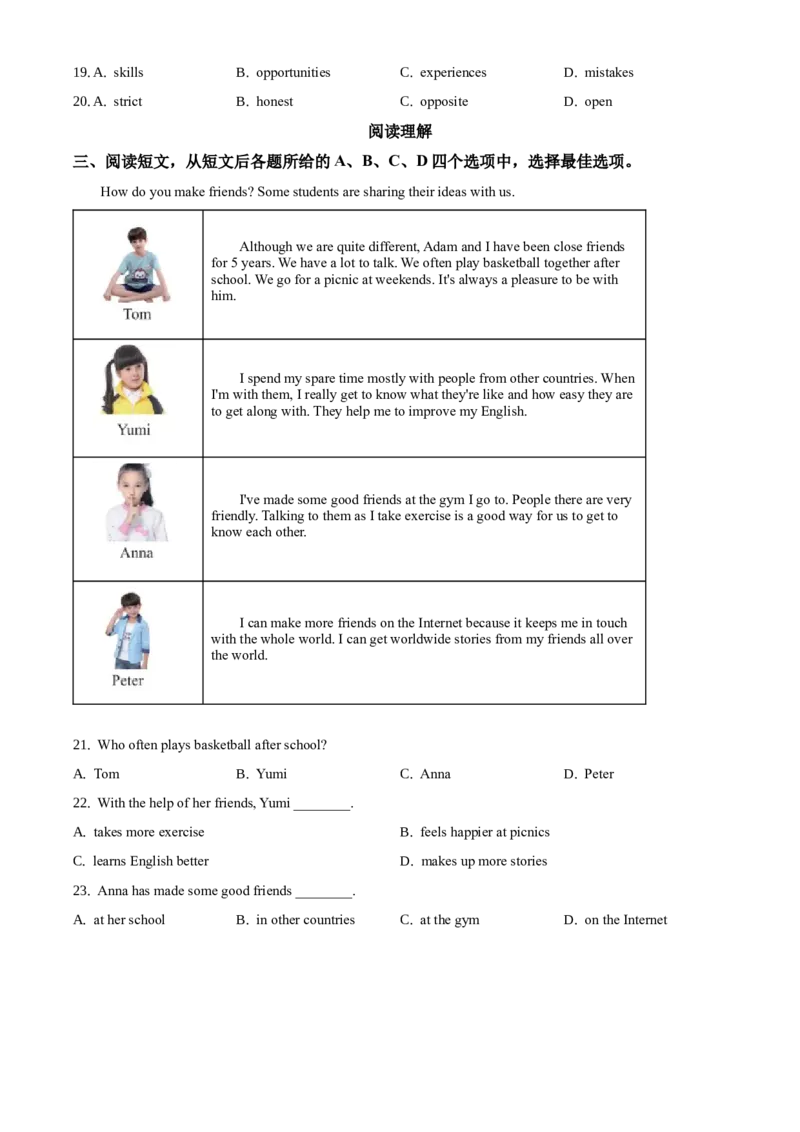
How do you make friends? Some students are sharing their ideas with us.
Although we are quite different, Adam and I have been close friends
for 5 years. We have a lot to talk. We often play basketball together after
school. We go for a picnic at weekends. It's always a pleasure to be with
him.
I spend my spare time mostly with people from other countries. When
I'm with them, I really get to know what they're like and how easy they are
to get along with. They help me to improve my English.
I've made some good friends at the gym I go to. People there are very
friendly. Talking to them as I take exercise is a good way for us to get to
know each other.
I can make more friends on the Internet because it keeps me in touch
with the whole world. I can get worldwide stories from my friends all over
the world.
21. Who often plays basketball after school?
A. Tom B. Yumi C. Anna D. Peter
22. With the help of her friends, Yumi ________.
A. takes more exercise B. feels happier at picnics
C. learns English better D. makes up more stories
23. Anna has made some good friends ________.
A. at her school B. in other countries C. at the gym D. on the InternetAs a teenager, I hated PE lessons. I was not very good at sports, and I hated team sports because I always felt
like I was disappointing the rest of the team. During these years, I sometimes felt disconnected from my body like
only my brain was "me" and my body was just a vehicle (运载工具)for carrying my brain around.
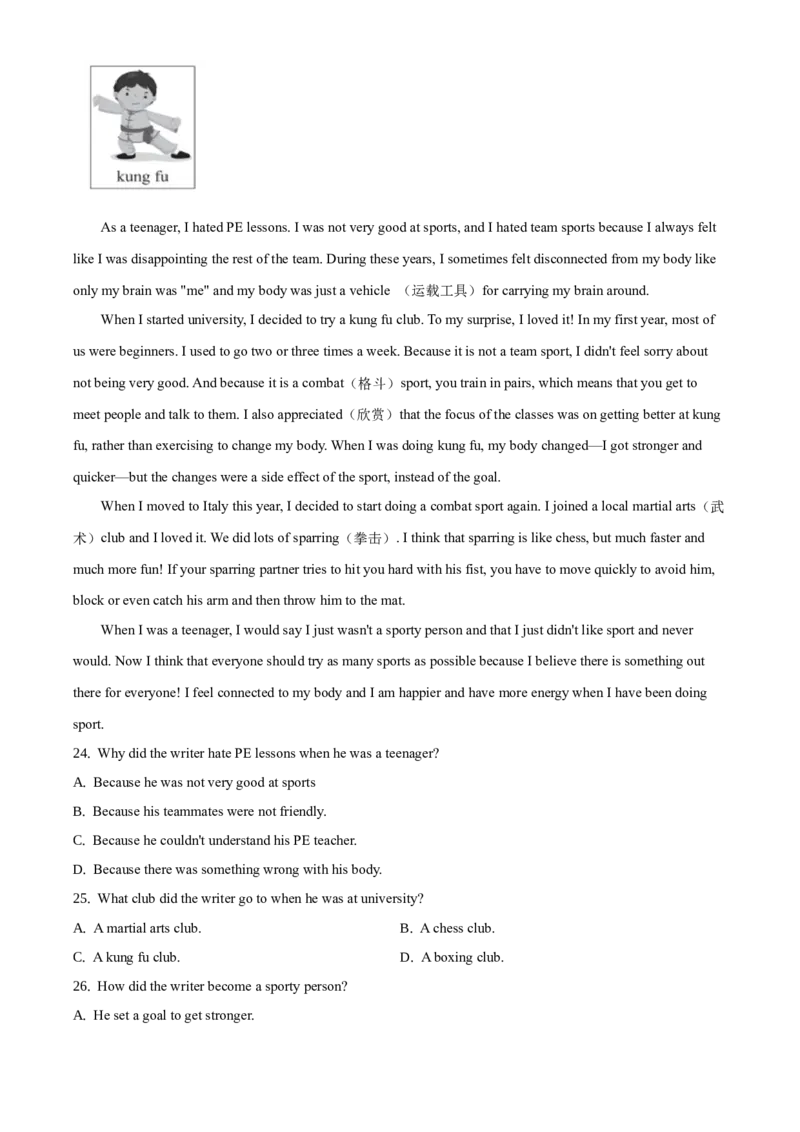
When I started university, I decided to try a kung fu club. To my surprise, I loved it! In my first year, most of
us were beginners. I used to go two or three times a week. Because it is not a team sport, I didn't feel sorry about
not being very good. And because it is a combat(格斗)sport, you train in pairs, which means that you get to
meet people and talk to them. I also appreciated(欣赏)that the focus of the classes was on getting better at kung
fu, rather than exercising to change my body. When I was doing kung fu, my body changed—I got stronger and
quicker—but the changes were a side effect of the sport, instead of the goal.
When I moved to Italy this year, I decided to start doing a combat sport again. I joined a local martial arts(武
术)club and I loved it. We did lots of sparring(拳击). I think that sparring is like chess, but much faster and
much more fun! If your sparring partner tries to hit you hard with his fist, you have to move quickly to avoid him,
block or even catch his arm and then throw him to the mat.
When I was a teenager, I would say I just wasn't a sporty person and that I just didn't like sport and never
would. Now I think that everyone should try as many sports as possible because I believe there is something out
there for everyone! I feel connected to my body and I am happier and have more energy when I have been doing
sport.
24. Why did the writer hate PE lessons when he was a teenager?
.
A. Because he was not very good at sports
B. Because his teammates were not friendly.
C. Because he couldn't understand his PE teacher.
D. Because there was something wrong with his body.
25. What club did the writer go to when he was at university?
A. A martial arts club. B. A chess club.
C. A kung fu club. D. A boxing club.
26. How did the writer become a sporty person?
A. He set a goal to get stronger.B. He played many team sports.
C. He did fast and fun sports every day.
D. He tried and found the right sport for him.
Do you get upset because you can't complete what you want to? For instance, you might want to clean out
your closets or write that novel you've been putting off. Maybe you try to focus, but you feel overwhelmed (难以
应付的).
Finding control comes down to one simple strategy (策略):developing a habit of being organized. This
means you've got to think ahead. When you can get organized, keep things under control, and live a tidy life, you
can work faster and think more creatively. Here are some tips that can help:
If it's about housework, it takes a few minutes each day to de-clutter (清除杂乱). Use small bits of time to
clean out a drawer or throw old clothes into a cardboard box for donation. Get in the habit of buying organizational
tools, like containers, for storing small things.
Group similar tasks. Clean out the refrigerator while a roast is cooking. Don't jump back and forth from room
to room or jump from one task to an unrelated one. Also, you can put similar things together. For example, look at
your bookshelf and try putting all the books about each topic in a group. Then it will be easier and faster to find the
book you need.
It's a great way to make a to-do list. Use a calendar to plan out what you need to do each month. Then at the
start of each workday, write down three important tasks you want to achieve that day quickly. Put a big star next to
the most important one. So, before you go into the busy work, start on the important task and see it through to the
end.
Getting organized should extend to your activities outside your home or office as well. Putting everything in
order leaves you a clear calendar to plan for more activities with friends.
Motivating (激励)yourself to get organized should start with the rewards you'll experience. It's much
easier to start a habit if you can imagine how the changes will make you feel.
27. According to the passage, if you get organized, ________.
A. your life will become busier
B. your imagination will be limited
C. you will finish the work more quickly
D. you will control the things around you
28. Which of the following can help you get organized?
A. Doing unrelated tasks at the same time.
B. Spending a whole weekend doing housework.C. Getting in the habit of buying more beautiful furniture.
D. Listing the things and beginning with the most important one.
29. What does the passage mainly talk about?
A. The ways of doing housework. B. The ways of getting organized.
.
C. The benefits of getting organized D. The importance of making a list.
That Susan is so funny ... I need to bring the car to the wash tomorrow ... why is this person so loud ... here
comes the sun, doo-doo-doo.
We often find ourselves in an endless thought loop(圈). And every so often, we try to stop this endless flow
of thoughts by telling ourselves to just stop thinking. But do we or can we ever really stop thinking?
It depends on your definition(定义)of "thinking", according to Michael Halassa, a researcher at MIT, the
US. We basically go through each day in one of the two states—we either realize that we’re thinking or we don't.
Our brains won't stop thinking completely until we die.
"The brain never stops thinking in a sense. Most thoughts are actually in the background without us noticing
them and there's not really a way to turn these things." Halassa said.
You can compare this to how a computer works. When you aren't using your computer while it's turned on, it
is still running operations "in the background". Your computer, much like your brain, is always "thinking”, even if
you're not actively using it.
If you see a familiar face in a crowd and think you know them, you might not be able to come up with how
you know them right away," Halassa said. "But maybe hours later, you'll suddenly remember. That's a result of your
brain thinking in the background."
We even make decisions mostly unconsciously or without realizing them. For example, some of this
background "thinking" results in what we call a "gut feeling(直觉)" . During our brain's decision-making
process, sometimes we create a story to explain the decision—sometimes it's accurate(精确的), sometimes it’s
not.
,
Even sitting here reading this thinking about "thinking" is sending messages across a chain of neurons
(神经元)in the brain. So if we somehow manage to stop ourselves from "thinking", the brain won't sign off. It
will continue to have thoughts—we just won't realize them.
,
30. When you are in an endless thought loop you________.
A. can think about a problem very clearly
B. keep thinking about one thing after another
C. cannot stop thinking about things in the past
D. keep thinking about one thing again and again31. What does Paragraph 5 try to tell us?
A. Human brains are thinking all the time.
.
B. A computer can think like a human brain
C. Human brains work faster than computers.
D. A computer can deal with plenty of information.
32. The word "unconsciously'' in Paragraph 7 probably means "________".
A. carelessly B. unknowingly C. fearlessly D. undoubtly
33. What's the best title for the passage?
A. Will We Continue to Have Thoughts after We Die?
B. How Do the Neurons in the Brain Work?
C. What Is the Definition of "Thinking"?
D. Can We Ever Really Stop Thinking?
四、阅读短文,根据短文内容回答问题。
Collector's Corner
People collect all kinds of different things. Stamps or coins are the common ones to be collected. People also
collect the less common ones, such as beer bottles or bus tickets. Some collectors spend hours looking through junk
shops and build up a collection for a few pence per object, while other collectors might spend thousands of pounds
on fine china or rare (稀有的)paintings.
Some people collect for money, but most people do it for fun. Collecting is basically illogical. If you simply
want to listen to the American singer and actor Elvis Presley's first record, you can get a copy at most record shops.
A collector, however, will want to own an original 1955 disc, and will be willing to pay for it.
What makes a collection valuable? Rarity and condition are the most important things. A coin or stamp which
is worth hundreds in perfect condition might be worth only pence in average or poor condition.
What should you collect? Most collectors begin collecting things which interest them, and as the collection
grows, knowledge of the subject grows. If you want your collection to grow in value, it is probably best to avoid
things which are sold especially for collectors. Nearly everybody who buys a set of new coins or stamps will keep
them in perfect condition, so that the new coins or stamps will never become rare. The most valuable collections
are often things which were widely available, but which were usually thrown away after use, such as Coca-Cola
bottles or toy cars. An interesting collection can be started very cheaply.
One collector has started a collection of 1950s and 1960s ball-point pens. At the moment it's worth nothing,
but she predicts it will one day be valuable. Ball-points were widely available, and were made in a large range of
colours and styles. They were often designed to be thrown away when they were empty. Many people aren't willingto throw away used pens, and put them in a drawer or box, perhaps hoping they might work again one day. So it is
possible to find unusual things, made many years ago. That even costs nothing.
34. What common things do people collect?
___________________________________________________________
35. What do people collect for?
___________________________________________________________
36. What makes a collection valuable?
___________________________________________________________
37. Why will the new coins or stamps never become rare?
___________________________________________________________
38. What does the example in the last paragraph show?
___________________________________________________________
书面表达
五、文段表达
从下面两个题目中任选一题,根据中文和英文提示,完成一篇不少于50词的文段写作。文中已给出内
容不计入总词数。所给提示词语仅供选用。请不要写出你的校名和姓名。
39. 假如你是李华,你们学校将组织一次环境保护志愿活动,你打算邀请你校交换生Peter参加。请用
英语写一封电子邮件,告诉他活动的时间和地点,活动的内容,以及需要为此做什么准备。
提示词语: pick up, rubbish, put up, posters, a rubbish bag
提示问题:
• When and where will you go?
• What will you do in the activity?
• What do you advise Peter to prepare for the activity?
Dear Peter,
How is it going?
I’m writing to invite you to take part in the school activity to volunteer for a better environment.
____________________________________________________________________________________________
____________________________________________________________________________________________
____________________________________________________________________________________________
____________________________________________________________________________________________
____________________________________________________________________________________________
__________I’m looking forward to your early reply.
Yours,
Li Hua
40. 培养独立生活能力对青少年非常重要。独立生活能力包括自主安排时间、 自觉完成作业、自己整
理房间、做饭等。
二十一世纪英文网站正在开展以“培养独立生活能力”为主题的征文活动。 假如你是李华,请用英语写
一篇短文投稿,谈谈你在生活中能独立做哪些事情,还需要在哪些方面改进。
提示词语: manage time, waste, tidy up, learn
提示问题:
• What can you do independently(独立地)in your daily life?
• What do you need to improve?
It's very important for teenagers to learn to do things independently.
____________________________________________________________________________________________
____________________________________________________________________________________________
____________________________________________________________________________________________
____________________________________________________________________________________________
____________________________________________________________________________________________
__________