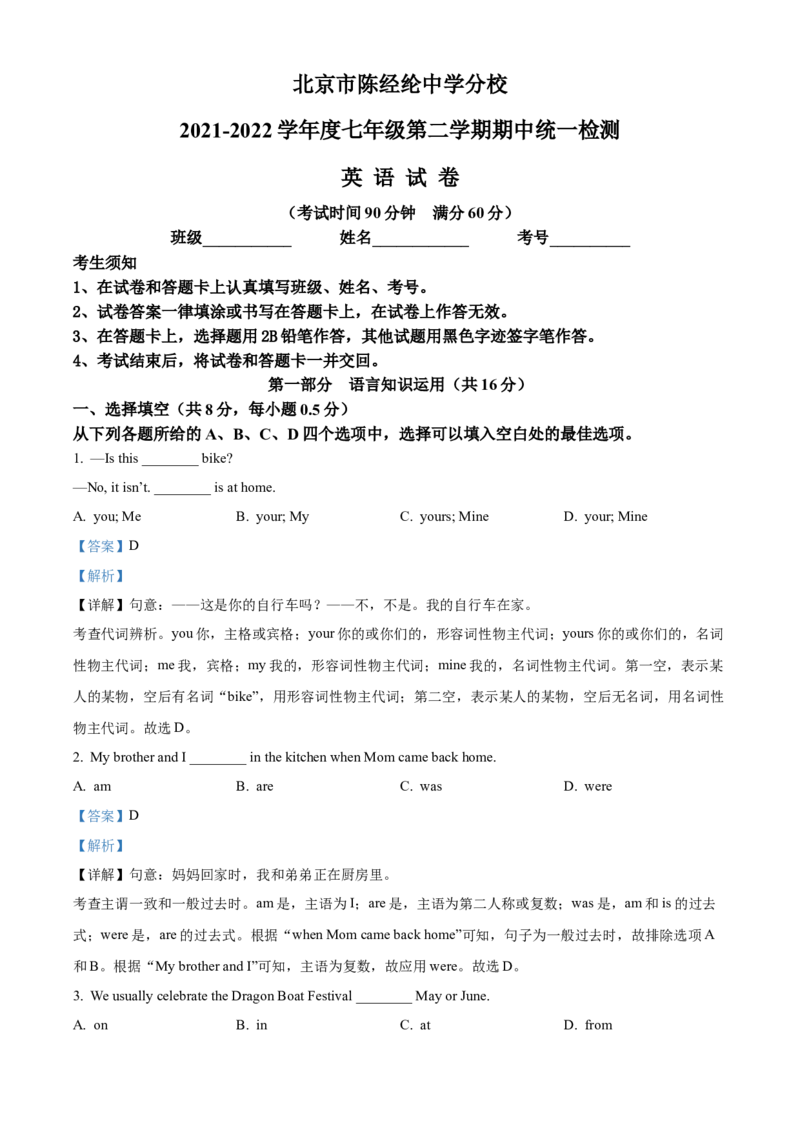
北京市陈经纶中学分校
2021-2022 学年度八年级第一学期期中
统一检测英 语 笔 试 试 卷
(考试时间 90 分钟 满分 60 分)
考生须知
1、在试卷和答题卡上认真填写班级、姓名、考号。
2、试卷答案一律填涂或书写在答题卡上,在试卷上作答无效。
3、在答题卡上,选择题用 2B 铅笔作答,其他试题用黑色字迹签字笔作答。
4、考试结束后,将试卷和答题卡一并交回。
第一部分 知识运用 (选择部分) (共 24 分)
一、 选择填空(共 8 分,每小题 0.5 分)
从下列各题所给的 A、B、C、D 四个选项中,选择可以填入空白处的最佳选项。
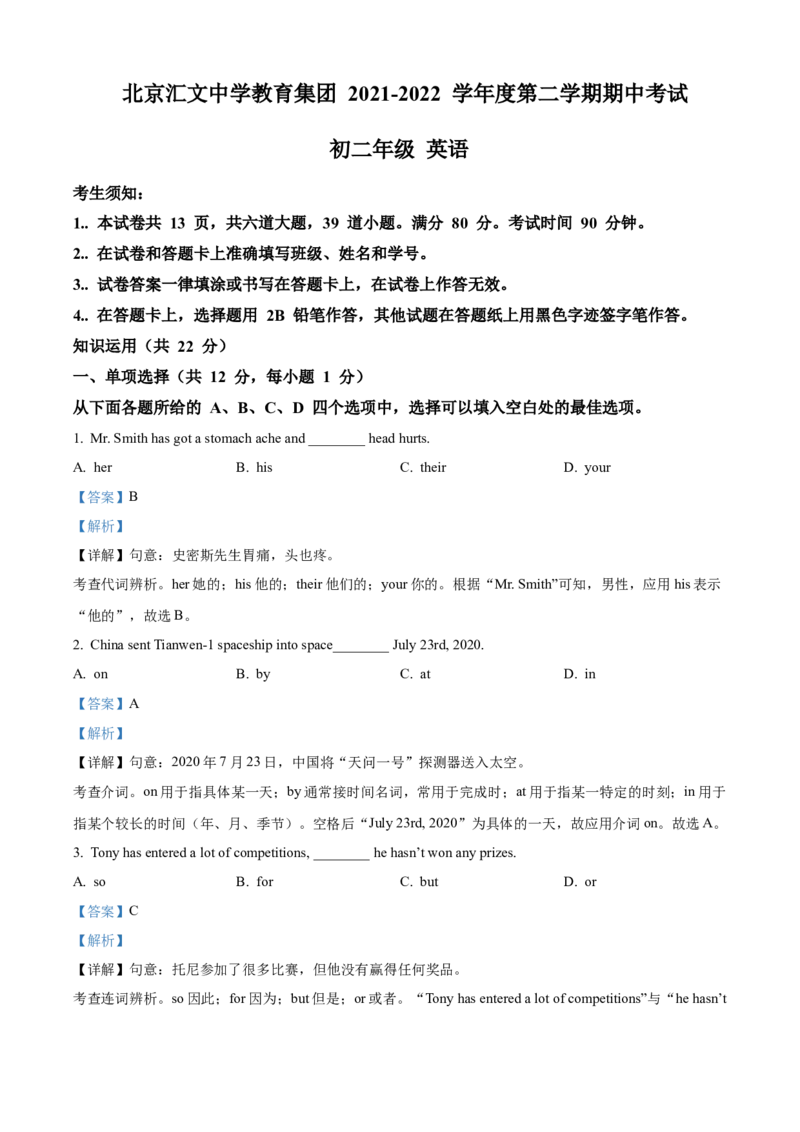
1. Guangzhou is a beautiful city ________ the south of China.
A. on B. in C. at D. over
.
2 —________ listening to the radio in English? —It’s a good idea.
A. Why not B. Shall we C. What about D. Why don’t you
3. Jenny hoped to finish her job ________ than all her friends.
A. early B. more early C. earliest D. earlier
,
4. We should read books in the place with plenty of light ________ it is good for our eyes.
A. so B. or C. because D. but
5. It is difficult for us ________ so many words in only five minutes.
A. remember B. to remember C. remembering D. remembered
6. Please be quiet! Your little sister ________ an online class now.
A. will have B. is having C. has D. had
7. Tom and Mary ________ to China next month.
A. come B. came C. coming D. will come
8. —________ is the population of your city?
—About two million.
A. How B. What C. How many D. Where
9. At first, we planned to go to a concert. But we went to see a film and had a good time.A. first of all B. in the end C. in a hurry D. from now on
10. —Which do you like ________, tea or coffee?
—Coffee.
A. good B. well C. better D. best
11. My parents allow me ________ the Internet for half an hour every weekend.
A. surf B. surfs C. surfing D. to surf
12. I wanted to see the Beiing Opera, so Lingling offered ________ me there.
A. take B. takes C. taking D. to take
13. I am very proud that our school is one of ________ schools in the city.
A. beautiful B. more beautiful C. most beautiful D. the most beautiful
14. Mr. Liu ________ his car at 5 o’clock yesterday afternoon.
A. was washing B. is washing C. washes D. will wash
15. Listening is just as _____ as speaking in language learning.
A. important B. more important
C. most important D. the most important
16. Because of COVID-19 in February, the government advised us ________ to the public places.
A. to go B. going C. not to go D. go
二、完形填空 (共 16 分,每小题 1 分)
通读下面短文,掌握其大意,然后从短文后各题所给的 A, B, C, D 四个选项中,选
择能填入相应空白处的最佳选项。
A
A Second Chance
I was in fifth grade and about to take a science test. Since first grade, I had always been good at school. Simple
science was easy for me and I always did well on tests. When it came to fifth-grade science, however, I was
struggling (挣扎). I couldn’t seem to ____17____ it no matter how hard I tried. I was anxious.
My mom and dad had always been so proud of my grade, and I didn’t want to let them down. So just before
the test I had written several ____18____ from the textbook on my desk in pencil. The writing was so light that it
could hardly be seen. I sat ____19____ as the teacher started to hand out to the test. I didn’t want to get caught,but I didn’t want to fail, either.
As the teacher was starting down my row, suddenly the fire alarm went off. It was an unscheduled fire drill (消
防演习).We all ____20____ out of the door and stood together, waiting to be allowed back into the building.
As I stood outside in the warm sunshine, I realized what a fool I had been. I knew my mom and dad would still
love me no matter what my grade was. As soon as we came into the classroom, I walked to my desk and
____21____ the notes away. I had been given a second chance, and I wasn’t going to waste it. I took the test, did
my best and felt ____22____. I don’t remember what my grade was, but what happened that day has ____23____
in my heart and mind ever since.
Life is full of second chances, but you have to be willing to take them. You have to be willing to accept your
____24____ and grow from them. Every day when you wake up, you are given a second chance at life. Treasure it!
And use it wisely!
17. A. recognize B. understand C. believe D. explain
18. A. answers B. letters C. notes D. sentences
19. A. quietly B. nervously C. happily D. excitedly
20. A. rushed B. stepped C. walked D. looked
21. A. cleaned B. sent C. threw D. took
22. A. shameful B. frightened C. peaceful D. stressed
23. A. worked B. created C. shared D. stayed
24. A. decisions B. beliefs C. feelings D. mistakes
B
Tom had a dog named Max. Max was 10 years old, which was quite old in dog years. Tom bought the dog to
protect him and his family from ___25___. When Max saw something suspicious (可疑的), he barked out
loudly. There was one time when a bad man tried to get into Tom’s house. Thankfully, Max barked loudly and Tom
was able to ___26___ the bad man in time. Sometimes though, Max would bark when he saw another dog. Tom
would go outside thinking something bad was ___27___, but it was really just another dog.
Tom went on a lot of hikes and walks with Max. Tom did not like to exercise, but he did not ___28___ if it
was with Max. Tom would also bring Max to the dog beach, where he could play with other ___29___ .
Max was considered part of the family. He was even in the family holiday postcard picture. Tom knew,
however, that Max was going to ___30___ pretty soon. He tried not to think about it.
Tom came back home from school and filled up Max’s water bowl as usual. Except this time, Max did not run
to the water like he usually did. Tom looked around the house for Max and found him lying down on the floor dead.
Tom ___31___ ran to Max and tried to feel for his pulse(脉搏). Max was really gone. Tom and his familyburied Max in their backyard. Tom cried for a long time, and would remember all his ___32___ memories with
Max.
25. A. danger B. hunger C. help D. question
26. A. help B. leave C. forget D. stop
27. A. leaving B. happening C. becoming D. knocking
28. A. want B. mind C. enjoy D. run
29. A. birds B. fish C. dogs D. people
30. A. die B. grow C. live D. come
31. A. slowly B. quickly C. carefully D. secretly
32. A. poor B. unforgettable C. terrible D. quiet
第二部分 阅读理解 (共 17 分)
三、 阅读下面 A、B、C、D 四篇短文,根据短文内容,从短文后各题所给的 A、
B、C、D 四个选项中,选择最佳选项。(共 12 分,每小题 1 分)
A
What problems do teenagers have? Here is a survey showing their main problems and some advice.
Problem Cause (原因) Advice
Too much homework. Make a plan for study and hobbies.
Feeling stressed(紧
Not having enough time for Find time to relax as possible as
张的)
their hobbies. they can.
Getting short- Too much homework. Do homework more efficiently.
sighted(近视)
Bad reading and writing habits. Read and write in a healthier way.
Feeling tired of Computer games’ bad Don’t spend too much time on
study influence. computer games.
Eating too much snacks and Eat more healthy food instead of
Getting fat junk food. junk food.
Doing little exercise. Do some sports regularly.
33. How many main problems are there in the survey?
A. Four. B. Five. C. Six. D. Seven.
34. What problems are caused by too much homework?
A. Feeling stressed and getting fat. B. Feeling tired of study and getting fat.
.
C Feeling stressed and getting short-sighted. D. Getting short-sighted and feeling tired of study.
35. If Peter is tired of study, he should ________.A. do homework as quickly as possible B. not be crazy about computer games
C. read and write in a healthier way D. do some sports regularly
B
The population of the Earth is growing faster. It is important that we look after the Earth. We need it!
The Earth gives us a lot of things. We also give the Earth a lot, but some of the things are not good.
In nature, when something dies, other animals and plants get food from it. Every animal or plant gives food for
other animals or plants. However, animals can’t get food from many of the things that we ‘give’ the Earth. Animals
and plants can’t eat metal, plastic and glass. These things will stay in the ground for many, many years.
Some rubbish is very dangerous for plants and animals. In some places, many animals live together. One
animal makes food for many more animals. If we put rubbish and chemicals in the water, the plankton(浮游生物)
can die. If there isn’t any plankton, many animals have nothing to eat.
So what can we do? Don’t leave any rubbish in the countryside! Don’t make so much rubbish!
36. The Earth gives us __________.
A. food B. rubbish
C. chemicals D. pollution
37. When something dies in nature, __________.
A. water and grass are polluted
B. plastic and wood become food
C. other animals and plants get foodD. metal and glass stay in the ground
38. We must __________ to look after the Earth.
A. put metal in the ground B. use more wood
C. keep frogs in the water D. make less rubbish
C
Many textbooks are not written in the kind of English that we speak every day. In fact, sometimes the
reading is so difficult that it almost seems like a foreign language. In a way, it is—the language of science. You
should not expect to be able to read a difficult science passage the same way you read an interesting story; you
should not expect to read it easily and all at once. Instead, you may have to read it several times through, catching
on the meaning of difficult words, going back over difficult sentences, and finally putting the whole thing
together. Do not be discouraged(灰心的)if the whole passage doesn’t make sense(讲得通)to you at first.
You need to pick it apart patiently until you can understand it.
These are the steps to follow when you are reading something difficult:
1. Start to read normally(正常地)until you run into a sentence that doesn’t make sense to you.
2. When a sentence doesn’t make sense, go back and read it again more slowly.
3. Look for any word you don’t know in the sentence. Try to understand their meanings using word parts and
context clues(上下文线索). If necessary, look them up in the dictionary.
4. Look at the next few sentences to see if they explain(解释) more about the sentence you are working on. Do
not read very much farther ahead until you understand what is being said.
5. Finally, read the sentence again. Try to put it into simpler words.
6. Read through the passage once. Try to understand all the hard parts well. Then read the whole passage once
more at a usual speed. This helps you to put all ideas together.
The steps sound a lot harder than they are. It is really just the normal way good readers understand anything
that is difficult to read. After you have done the best you can this way, you should always feel free to ask for help
from your teacher, if you have one.
39. The underlined phrase “run into” means ________ in Chinese.
A. 理解 B. 遇到 C. 翻译 D. 跑过
40. From the passage, we can know _________.
A. we should look up new words before reading
B. it is sometimes difficult to read a science passage
C. the six steps are helpful in learning spoken EnglishD. interesting stories help readers to improve their English
41. The passage is mainly about ________.
A. steps of studying science B. difficulties in reading science
C. ways of reading science passages D. researches on science and English
D
Imagine this. There’s an apple and a piece of cake on a table. Which one would you like? The delicious cake
,
or the healthy apple? A bestseller Willpower Rediscovering Our Greater Strength, suggests that willpower
(意志力) is the ability to make decisions that are better for us in the long term, rather than in the short term.
Here is a famous experiment in the book: the marshmallow (棉花糖) test. In 1972, Professor Walter Mischel
tested the willpower of 600 four-year-olds to six-year-olds. In the experiment, each child was left alone in a room
for fifteen minutes with a marshmallow on a table in front of them. They were given two choices: they could
either eat it or, if they waited fifteen minutes, they’d be given a second one and then they could eat both.
So, what did the kids do? Well, as you can imagine, 70% ate the first marshmallow within the fifteen
minutes. But the other 30% showed willpower they controlled themselves and waited for the second marshmallow.
But then Mischel discovered something really interesting. Twenty years later, he got in touch with the
children, who, by then, were in their early twenties. And he found that those who’d shown strong willpower were
getting better marks at university and were more popular.
Willpower is like a muscle (肌肉), and the more you exercise it, the stronger it gets. So, if you do daily “self-
control exercises”, such as making your bed or brushing your teeth, you’ll improve your overall willpower. And
daily willpower exercises will help you with those bigger goals, such as studying for an exam or training for a
marathon.
Be careful though. Just like any muscle, your “willpower muscle” can get tired. If you’ve had to do lots of
things that require willpower, take a break or give yourself a treat. That way, you’ll build up your willpower again.
And one last thing, the writer mentions people who learn foreign languages usually have a lot of willpower.
So, congratulations!
42. From the marshmallow test, we can learn that ______.
A. the kids felt difficult to make choices B. most of the kids showed weak willpower
C. marshmallows could help improve willpower D. the kids could eat one marshmallow every fifteenminutes
43. The writer probably agrees that ______.
A. willpower should be kept practicing without any stop
B. willpower can be built up by dealing with difficulties
C. strong willpower can help people achieve their goals
D. strong willpower can help people make right decisions
44. What is Paragraph 3 mainly about?
A. The finding of the experiment. B. The process of the experiment.
C. The purpose of the experiment. D. The background of the experiment.
四、阅读短文,根据短文内容回答问题。(共 5 分,每小题 1 分)
Some scientists were studying sea turtles in Costa Rica in Central America. Suddenly they found one turtle
had something sticking out of its nose. It could not breathe. At first, the scientists thought it was a worm. But when
they pulled the object out, it was a plastic straw.
The waste created by plastic straws is unbelievable. In the United States alone, 500 million straws are thrown
away every day. That’s enough straws to circle the Earth twice, or fill 125 school buses.
Plastic straws are almost never recycled because they’re too small and could be made from several different
types of plastic. Many of them end up as litter in our streets or worse, plastic waste in our oceans. They aren’t the
biggest polluter of our waterways, but they can be some of the most dangerous to sea animals. Their size makes
them easy for fish or birds to eat. About 71% of seabirds and 30% of turtles are found with plastic in their
stomachs. When these animals eat the plastic, they have a 50% mortality rate (死亡率).
Milo Cress is a boy from Vermont, America, who wanted to reduce (减少) and possibly end the use of plastic
straws in restaurants. In 2011, at the age of 9, he founded the Be Straw Free project, which focuses on building
awareness (意识) about plastic waste and its effect on the environment.
“I noticed that whenever I ordered a drink at a restaurant, it would usually come with a straw in it, and I don’t
usually need a straw,” Milo said. He started asking the local restaurant owners to stop providing the customer with
a straw unless he or she asks for one. Many of them agreed and joined the movement. By doing that, the restaurants
report a reduction in the number of straws they use between 50 and 80%.
Drinking with a straw is fun. But think twice. For anyone who really likes to use a straw, there are severalways to go. The best one is trying a reusable one, which can be washed along with dishes. Bamboo, metal and glass
can be used to make reusable straws. Another one is to use paper straws, which are recyclable and can be found in
attractive colors and patterns. With choices available, there’s no reason to add to the plastic straw waste problem.
45. How many straws are thrown away every day in the United States?
______________________________
46. Why are plastic straws almost never recycled?
______________________________
47. When did Milo found the Be Straw Free project?
______________________________
48. What did Milo ask the local restaurant owners to do?
______________________________
49. What are the choices for people who really like to use straws?
______________________________
第三部分 语言知识运用 (非选择部分) (共 9 分)
五、用所给词的适当形式填空:(共 9 分,每空 1分)
50. We should ________ (speak) English as much as possible in class.
51. The population of China is getting much ________ (large) than before.
52. Louder please! I can’t hear you ________ (clear).
53. The Yellow River is the second ____________ (long) river in China.
54. After ________ (have) dinner, the girl began to finish her English homework.
55. My parents agreed ________(take) me to the Forbidden City this weekend.
56. I called you yesterday, but nobody answered. What ________ you ________ (do) at this time yesterday?
57. Mr. Li is not in the office now. I saw him ________ (talk) with other teachers in the meeting room just now.
第四部分 书面表达 (共 10 分)
六、文段表达。(共 10分)
从下面两个题目中任选一题,根据中文和英文提示,完成一篇不少于 50 词的文段写作。文
中已给出内容不计入总词数。所给提示词语仅供选用。请不要写出你的校名和姓名。
题目①
58. 假如你是初二学生李华, 你的英国朋友Tommy想要了解北京。请你介绍一下北京这座城市。可
以从北京的天气、著名景点、来北京旅行的建议以及对北京未来变化的看法进行介绍。
,
提示词语:capital autumn, famous, camera, beautiful
提示问题:● What’s the weather like in Beijing?
●What famous places are there in Beijing?
●What do you think of the changes of Beijing in the future?
Dear Tommy,
I am glad that you would like to know something about Beijing.
____________________________________________________________________________________________
____________________________________________________________________________________________
____________________________________________________________________________________________
____________________________________________________________________________________________
____________________________________________________________________________________________
____________________________________________________________________________________________
____________________________________________________________________________________________
____________________________________________________________________________________________
____________________________________________________________________________________________
____________________________________________________
Best wishes,
Yours,
Li Hua
题目②
59. 假如你叫李华,某英文网站以“I love Pandas/Tigers...”为题征文,请你投稿。介绍一种濒危动物,
讲讲它的样子、现状及濒危原因、呼吁一下大家可以怎样保护它们。
提示词语:live, in danger, the number of, enough food, safe place, protect
提示问题:
●What do they look like?
●Why are they in danger now?
●How can we save them?
I love pandas
____________________________________________________________________________________________
____________________________________________________________________________________________
____________________________________________________________________________________________
____________________________________________________________________________________________
________________________________________________________________________________________________________________________________________________________________________________________
____________________________________________________________________________________________
____________________________________________________________________________________________
__________________________________________________