文档文本内容
英语专项深度练习——阅读理解(六)
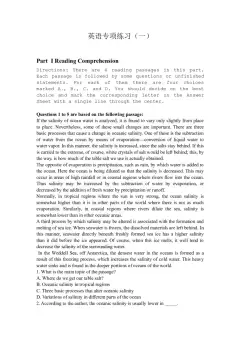
Like most parents, geologist Brain Atwater worries about his daughter‘s safety. But these
days, he has an unusual concern; The public school she___1___ in Seattle has unreinforced
brick walls, a ___2___being easy to collapse during earthquakes. The same___3___of walls
crushed hundreds of thousands of people during the 1976 Tangshan quake in China.
A decade ago, Atwater would have paid little notice to schoolroom walls. But over the last
several years, he and other scientists have found ___4___signs that the Pacific Northwest
has experienced giant quakes in the distant past and that the area may be headed for a
destructive shock in the near future.
At a meeting of the American Geophysical Union in December, researchers discussed
the___5___uncovered evidence of quake potential in the Pacific Northwest. While some remain
unconvinced that huge earthquakes—with magnitudes of 8 or higher—do indeed___6___this
region, a growing number consider such shocks a serious possibility.
What’s worrisome, they say, is that northwestern cities such as Portland, Seattle and
Vancouver have not prepared for earthquakes of this magnitude, which could shake the
region‘s ___7___centers with enough force to make the recent San Francisco area damage seem
___8___ in comparison.
“I think it’s quite true to say that nothing has really been designed with one of these
earthquakes in mind,” says seismologist Paul Somerville of Woodward. At the meeting,
Somerville and his colleagues ___9___estimates of the degree of shaking. Portland and
Seattle would suffer during such a ___10___earthquake.
A. massive B. recently C. construction D. displayed
E. relatively F. attends G. type H. strike
I. structure J. participates K. excessive L. mild
M. disturbing N. population 0. presented
答案:1. F 2. C 3. G 4. M 5. B 6. H 7. N 8. L 9. O 10. A
You are about to go to the hospital for a routine surgical procedure. Which attitude is
healthier?
A. “I‘d better find out everything I can about this operation—you can never know too
much. ”
B. “Don’t tell me the details. It‘s going to be fine. ”Answer B is supposed to be the wrong one. It’s an example of what psychologists call
“denial,” a defence mechanism that minimizes uncomfortable information. Denial, they
have argued, is stupid, self-defeating and ultimately dangerous.
But research is showing that answer B is a faster route to recovery. Denial—of a certain
sort and at certain times—can be healthy. Of course, you do need to pay attention to some
unpleasant facts. The trick is to know when it‘s helpful to worry and when it’s
counterproductive.
Out-and-out denial may be the best approach to surgery, according to Richard S. Lazarus,
professor of psychology at the University of California at Berkeley. With Frances Cohen,
Lazarus studied 61 patients about to undergo operations (all relatively common
operations)。 In general, patients followed one of two mental strategies; “avoidance” or
“vigilance. ”
Typically, avoiders had not discussed their surgery in detail with anyone, didn‘t want to
know about it and didn’t dwell upon its risks.
In contrast, vigilant types were alert to every detail. Many sought out articles about
their disorders. They wanted to know the risks of surgery, the risks if surgery was not
performed, the surgical procedures, the potential complications and the likelihood of
recurrence.
When Lazarus and Cohen compared the two groups after surgery, they found that avoiders got
on much better. They had a lower incidence of postoperative complications such as nausea
(恶心), headache, fever and infection. The net result: they were discharged sooner.
One reason may be that their denial make room for hope, or at least for a positive
outlook, even under the grimmest of conditions. “Never deny the diagnosis, but do deny
the negative opinion that may go with it,” advises Norman Cousins, author of Anatomy of
an Illness and The Healing Heart. Why? Because grim warnings about diseases come from
statistics on the average case. Cousins believes that most patients, given hope and
determination, have a good chance to transcend the averages.
Adds Dr. Hackett: “Deniers see the machines they‘re hooked up to as helping them to get
well, not as a sign of a badly functioning heart. Those who feel most positive about their
ability to get well tend to do better than those who fear and worry more. ”
Of course, none of these researchers would conclude that denial is the best approach to all
medical matters. A diabetic must monitor blood sugar; a kidney patient must keep track of
dialysis (透析) ; a woman who finds a lump in her breast must not delay in having it
diagnosed.
The question to ask yourself, Dr. Lazarus explains, is whether the information you gather
will help you solve a problem, or whether there is little you can do to change things. Inthe first case, pay attention and act. In the second case, don’t become preoccupied with
the risks; anxiety can worsen your health.
Dr. Herbert Benson, associate professor of medicine at Harvard Medical School, points out
that the overly vigilant patient‘s central nervous system becomes aroused into the fight-
or-flight response. But since all the patient can do is lie there, his body suffers the
classic damages of stress.
While studying people’s reactions to medical stress, Temple University psychologist
Suzanne Miller and University of Pennsylvania gynecologic oncologist (妇科肿瘤学 ) Charles
E. Mangan placed 40 women about to undergo colposcopy (阴道镜检查) in two different
groups, according to their coping style.
Miller‘s main interest was to see whether any of these women would cope better if they had
extra information. She gave half of each group voluminous details about what would happen
and how they would feel; she gave the rest only the basic facts. Overall, the results
reinforced the benefits of avoidance. The women given minimal information felt more relaxed
throughout the procedure than the women who knew more. (Oddly enough, the group desiring
information complained that they would have liked even more. The very act of gathering
details seemed to make them less anxious. )
Miller’s research shows that different people react to news about their situations in very
different ways. That means, she suggests, that people should seek as much or as little
information as their individual coping style dictates.
Does the research on denial mean we should regress (倒退) to the days when physicians used
to say, “Don‘t tell patients anything, because they don’t really want to know?”
Hardly. People have a right to know what is going to happen to them, and to take part in
decisions about their treatment. But patients can get necessary information without learning
a lot of nerve-racking details they don‘t need.
For example, a physician can say: “You have a suspicious Pap test. The next procedure is
called colposcopy; it will take fifteen minutes. ” The doctor doesn’t need to describe
everything a colposcope does, feels like or might find. Similarly, a woman should seek all
the options if she has a suspicious Pap test, but once she makes a decision, she should
not be obsessed about it.
You could summarize the research in a set of guidelines:
• In general, it is best to block out medical threats and worries when there is nothing you
can do about them—say, after you‘ve decided to undergo surgery. Don’t dwell on all that
could go wrong or visualize every fearful detail; concentrate instead on what is likely to
go right.• Be vigilant about matters that you can control, such as paying attention to signs of
illness.
• Find out your personal disposition to avoid details or to acquire all information
possible, and let your own inclination be your guide—but only up to a point. “Many of
those who gather any and all facts are putting themselves through more stress than they need
to,” Miller says. She advises them to learn when their approach will only increase their
anxiety. In those cases, they‘d do better to turn off their radar. On the other hand,
avoiders should recognize when it is valuable to gather more facts than they might like to.
The basic advice is clear: don’t feel guilty if you decide to take the rosy view.
Concentrating on the positive turns out to be medically sound.
1. It is suggested in the passage that if you were a vigilant patient, you should learn to
adopt a new strategy of avoidance because it brings you less stress.
2. The doctors are discovering that the best medicine is often simply to deny the worst and
expect the best.
3. Miller divided the women patients into two groups at will and provided each group with
either detailed or basic information in order to find out who would get on better.
4. Based on the findings of the researches, doctors find it hard to decide whether they
should tell patients anything about their illness.
5. Psychologists have changed their opinion that it is stupid and dangerous for people to
deny uncomfortable information.
6. A tip for both deniers and vigilant patients is: avoid details or acquire much
information following your own coping style, but only to a certain point.
7. It is unnecessary for patients to get information about their disorders because there is
nothing they can do about their illness.
8. Patients generally fall into two groups: _______and_______.
9. “A diabetic must monitor blood sugar;” helps explain that_______to all cases.
10. All patients should pay attention to_______.
答案:I. N 2. Y 3. N 4. N 5. NG 6. Y 7. N
8. avoiders, deniers 9. denial is not the best approach 10. signs of illness
Every day 25 million U. S. children ride school buses. The safety record for these buses is
much better than for passenger cars; but nevertheless, about 10 children are killed eachyear riding on large school buses, and nearly four times that number are killed outside
buses in the loading zones. By and large, however, the nation‘s school children are
transported to and from school safely.
Even though the number of school bus casualties(死亡人数) is not large, the safety of
children is always of intense public concern. While everyone wants to see children
transported safely, people are divided about what needs to be done—particularly whether
seat belts should be mandatory (强制性的)•
Supporters of seat belts on school buses argue that seat belts are necessary not only to
reduce death and injury, but also to teach children lessons about the importance of using
them routinely in any moving vehicle. A side benefit, they point out, is that seat belts
help keep children in their seats, away from the bus driver.
Opponents of seat belt installation suggest that children are already well protected by the
school buses that follow the National Highway Traffic Safety Administration’s (NHTSA)
safety requirement set in 1977. They also believe that many children won‘t wear seat belts
anyway, and that they may damage the belts or use them as weapons to hurt other children.
A new Research Council report on school bus safety suggests that there are alternate safety
devices and procedures that may be more effective and less expensive. For example, the
study committee suggested that raising seat backs four inches may have the same safety
effectiveness as seat belts.
The report sponsored by the Department of Transportation at the request of Congress,
reviews seat belts extensively while taking a broader look at safety in and around school
buses.
1. Each year, children killed outside buses in the loading zones are about_______.
A. 10 B. 40
C. 30 D. 50
2. Which of these words is nearest in meaning to the words “are divided” in Paragraph
A. disagree B. separate
C. arrange D. concern
3. According to the passage, who has the greatest degree of control of the school buses’
“safety”?
A. A New Research Council.
B. The Department of Transportation.C. The Medical Organizations.
D. National Highway Traffic Safety Administration.
4. It may be inferred from this passage that_______.
A. many of the opponents of seat belt installation are parents and officials of the
Department of Transportation
B. proposal of seat belts on school buses would be seriously considered
C. an alternate safety device (raising seat backs four inches) may be taken into
consideration
D. The Department of Transportation may either take the idea of seat belts or other measures
when it reviews the whole situation
5. The best title which expresses the idea of the passage is_______.
A. Making School Buses Even Safer for Children
B. Seat Belts Needed on School Buses
C. Alternate Safety Devices and Procedures
D. Safety in and around School Buses
答案:1. B 2. A 3. D 4. D 5. A
For as long as humans have raised crops as a source of food and other products, insects
have damaged them. Between 1870 and 1880, locusts ate millions of dollars‘ worth of crops
in the Mississippi Valley. Today in the United States the cotton boll weevil damages about
300 million dollars’ worth of crops each year. Additional millions are lost each year to
the appetites of other plant-eating insects. Some of these are corn borers, gypsy moths,
potato beetles, and Japanese beetles.
In modern times, many powerful insecticides(杀虫剂) have been used in an attempt to
destroy insects that damage crops and trees. Some kinds of insecticides, when carefully
used, have worked well. Yet the same insecticides have caused some unexpected problems. In
one large area, an insecticide was used against Japanese beetles, which eat almost any
kind of flower or leaf. Shortly afterward, the number of corn borers almost doubled. As
intended, the insecticide had killed many Japanese beetles. But it had killed many of the
insect enemies of the corn borer as well.In another case, an insecticide was used in Louisiana to kill the troublesome fire ant. The
insecticide did not kill many fire ants. It did kill several small animals. It also killed
some insect enemies of the sugarcane borer, a much more destructive pest than the fire
ants. As a result, the number of sugarcane borers increased and severely damaged the
sugarcane crop.
To be sure that one insect pest will not be traded for another when an insecticide is used,
scientists must perform careful experiments and do wide research. The experiments and
research provide knowledge of the possible hazards an insecticide may bring to plant and
animal communities. Without such knowledge, we have found that nature sometimes responds to
insecticides in unexpected ways.
1. An insecticide was used in Louisiana to kill the troublesome______.
A. corn borer B. Japanese beetle
B. gypsy moth D. fire ant
2. While it is not directly stated, the article suggests that______.
A. insecticides are not dangerous to any small animals
B. insecticides do not always accomplish their purposes
C. insecticides are no longer being used to kill insects
D. insecticides do no harm to people
3. On the whole, the article tells about______.
A. the appetites of plant-eating insects B. the best way to kill boll weevils C. the dangers
in using insecticides D. the best way to grow crops
4. Which statement does this article lead you to believe?
A. All changes are predictable. B. Nothing ever changes in nature.
C. Nature is not always predictable. D. Nature always serves man well.
5. Scientists perform careful experiments and do wide research because______.
A. they must learn to destroy all the insects that we need
B. they must be sure one insect pest is not traded for another
C. research keeps them from inventing new insecticide for the cropsD. research helps them find a way to kill all insects
答案:1. D 2. B 3. C 4. C 5. B
Growth of trade will depend greatly on availability of energy sources. There may still be a
trillion barrels of recoverable oil in the Middle East. But the oil crisis of 1974 has
____1____to renewed interest in coal and to a search for____2____ sources of energy. Solar,
geothermal, and nuclear energy will play a large role in the years to come.
Solar energy is available in ____3____ forms. Buildings can be heated and cooled by direct
use of solar radiation, crops and trees, which are the most efficient converters of
sunlight into energy, can be grown for their energy potential, wastes can be burned as
____4____, sunlight can be converted into DC (direct current) electricity, electric
power can be____5____from the sun-warmed surface waters of the ocean, and lastly, solar
radiation can be converted into heat that will drive electric power generators. Serious
problems still remain as to ____6____and storage of solar energy.
Geothermal energy is the energy contained within the earth. Heat is abundantly available
deep in the earth‘s core and is constantly being produced. However, this heat is usually
located at too deep a level for ____7____exploitation. In short, very little is known on
the use of geothermal energy, and it has____8____been exploited.
Nuclear energy is produced in nuclear power plants. At these plants atoms of uranium are
split, thus ____9____masses of energy. Another source of energy under development is the
nuclear fusion of certain atoms of hydrogen. This could eventually ____10____natural gas as
a source of energy.
A. rarely B. transformation C. fuel D. replace
E. led F. alternative G. commercial H. briefly
I. derived J. various K. relieving L. releasing
M. transportation N. financial O. described
答案:I. E 2. F 3. J 4. C 5. I 6. M 7. G 8. A 9. L 10. D