Unit 3 Could you please clean your room?
单元小结
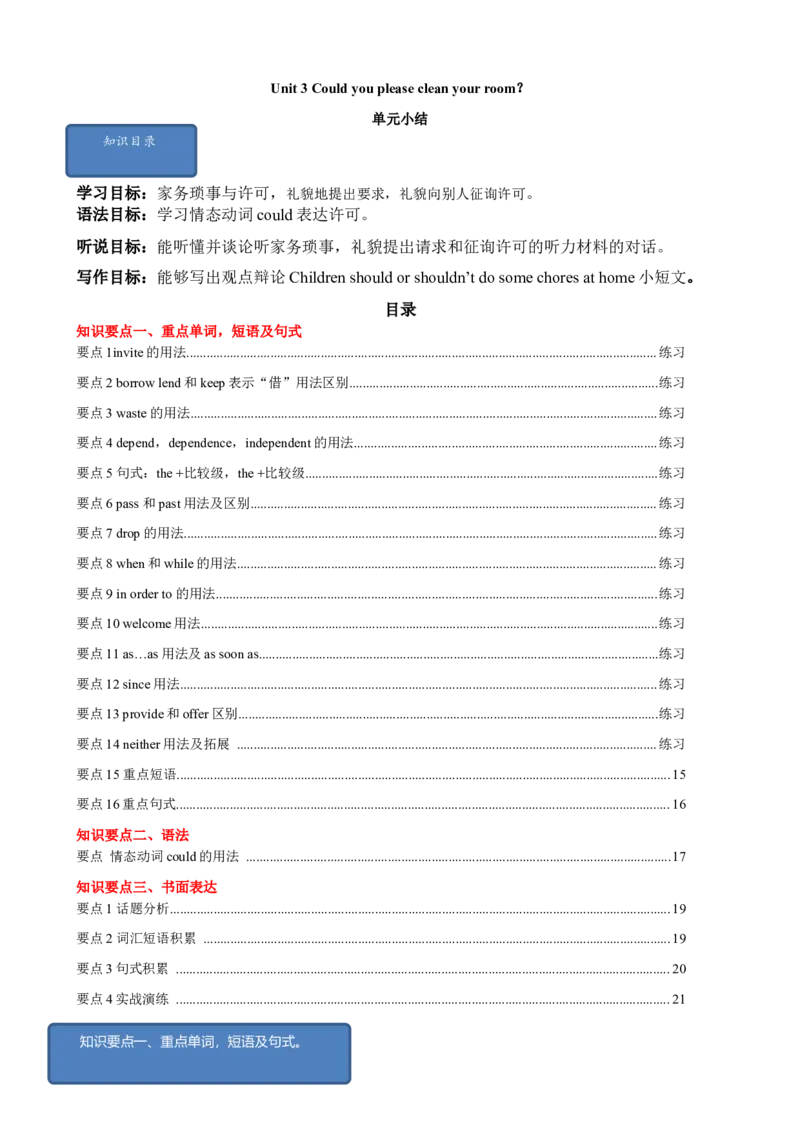
知识目录
学习目标:家务琐事与许可,礼貌地提出要求,礼貌向别人征询许可。
语法目标:学习情态动词could表达许可。
听说目标:能听懂并谈论听家务琐事,礼貌提岀请求和征询许可的听力材料的对话。
写作目标:能够写出观点辩论Children should or shouldn’t do some chores at home小短文。
目录
知识要点一、重点单词,短语及句式
要点1invite的用法............................................................................................................................................练习
要点2 borrow lend和keep表示“借”用法区别............................................................................................练习
要点3 waste 的用法...........................................................................................................................................练习
要点4 depend,dependence,independent的用法..........................................................................................练习
要点5 句式:the +比较级,the +比较级.........................................................................................................练习
要点6 pass 和past用法及区别.........................................................................................................................练习
要点7 drop的用法.............................................................................................................................................练习
要点8 when和while的用法.............................................................................................................................练习
要点9 in order to 的用法...................................................................................................................................练习
要点10 welcome用法........................................................................................................................................练习
要点11 as…as用法及as soon as.......................................................................................................................练习
要点12 since用法..............................................................................................................................................练习
要点13 provide和offer区别.............................................................................................................................练习
要点14 neither用法及拓展 .............................................................................................................................练习
要点15 重点短语...................................................................................................................................................15
要点16重点句式...................................................................................................................................................16
知识要点二、语法
要点 情态动词could的用法 ..............................................................................................................................17
知识要点三、书面表达
要点1 话题分析.....................................................................................................................................................19
要点2 词汇短语积累 ...........................................................................................................................................19
要点3句式积累 ...................................................................................................................................................20
要点4实战演练 ...................................................................................................................................................21
知识要点一、重点单词,短语及句式。【精讲精练】
要点1 invite
invite是及物动词,意为“邀请”,常用于下列结构:
1)invite sb. 邀请某人 例如:
Do you invite the friends in Beijing? 你邀请北京的朋友了吗?
2)invite sb. to some place邀请某人去某地 例如:
Why don’t you invite them to our school? 为什么不邀请他们来我们学校?
3)invite sb. to dinner邀请某人吃饭 例如:
Li Lin often invites me to dinner. 李林经常邀请我吃饭。
4)invite sb. to do sth. 邀请某人做某事 例如:
We invited our parents to come to our party. 我们邀请我们的父母来参加聚会。
invitation
1)invitation作名词,意为“邀请”时,是不可数名词;意为“请柬;邀请书”时,是可数名词,常与介词to连用,
其复数形式为invitations。例如:
I received an invitation to the party.我收到了参加聚会的请柬。
【典例分析】
1. Harry invited me ________ with him when his parents were out of town.
A. stay B. stayed C. staying D. to stay
2.—Have you got Kathy's __________to her concert?
—Yes. I'd like to go and enjoy it.
A. invention B. instruction C. invitation D. introduction
3.我们邀请她和我们一起吃感恩节晚餐。(完成句子)
We__________ her__________ _______Thanksgiving dinner with us.
4. 我经常邀请她到我家。
I often________ _______ _______my home.
5. “I can't miss this chance!” She waved the ________ (invite).
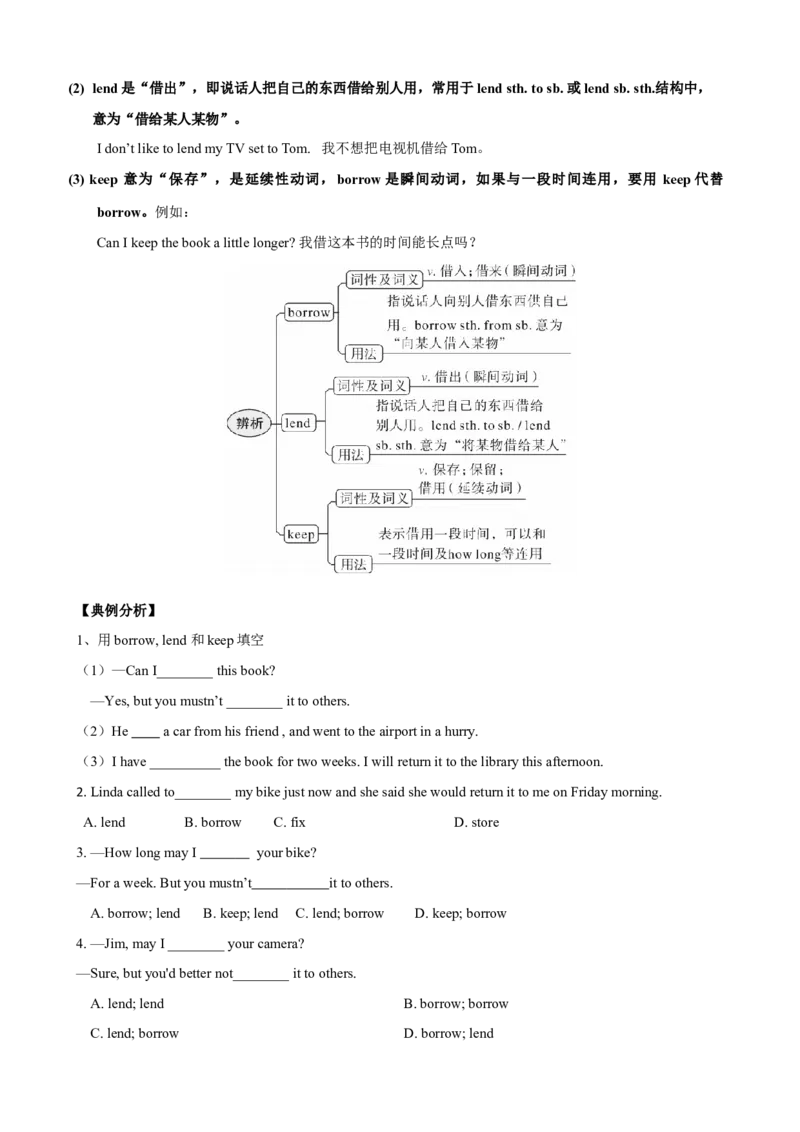
要点2 borrow; lend和keep
(1) borrow是“借进”,即说话人向别人借东西供自己用,常用于borrow sth. from sb. / somewhere结构
意为“从某人/某地借来某物”。例如:
He borrowed a lot of money from the bank. 他从银行借了很多钱。(2) lend是“借出”,即说话人把自己的东西借给别人用,常用于lend sth. to sb. 或lend sb. sth.结构中,
意为“借给某人某物”。
I don’t like to lend my TV set to Tom. 我不想把电视机借给Tom。
(3) keep 意为“保存”,是延续性动词,borrow是瞬间动词,如果与一段时间连用,要用 keep代替
borrow。例如:
Can I keep the book a little longer? 我借这本书的时间能长点吗?
【典例分析】
1、用borrow, lend 和keep填空
(1)—Can I________ this book?
—Yes, but you mustn’t ________ it to others.
(2)He a car from his friend , and went to the airport in a hurry.
(3)I have __________ the book for two weeks. I will return it to the library this afternoon.
2. Linda called to________ my bike just now and she said she would return it to me on Friday morning.
A. lend B. borrow C. fix D. store
3. —How long may I your bike?
—For a week. But you mustn’t it to others.
A. borrow; lend B. keep; lend C. lend; borrow D. keep; borrow
4. —Jim, may I ________ your camera?
—Sure, but you'd better not________ it to others.
A. lend; lend B. borrow; borrow
C. lend; borrow D. borrow; lend要点3 waste
(1)waste 作不可数名词,意为“浪费,废物,垃圾”。a waste of意为“浪费……”。
例如: I hate waste. 我讨厌浪费。
It’s a waste of time. 这就是浪费时间。
(2)waste 作形容词,意为“无用的,浪费的,荒废的”。例如:
We shouldn’t throw waste paper about. 我们不应该乱扔废纸。
A factory is pouring waste water into the river. 一家工厂正在向河里倾倒废水。
(3)waste 作及物动词,意为“浪费”。 waste time / money (in)doing / on sth. 表示“在做某事上浪费
时间 / 金钱”。
Don’t waste water! 不要浪费水。
【典例分析】
1. After dinner Mum asked me to throw the _______ in the bowls in the bag on the ground.
A. fly B. waste C. sand D. scarf
2.We all need a healthy environment, but we produce every day and it is harmful to our environment.
A. dreams B. trouble C. problems D. waste
3. 妈妈认为玩电脑游戏是浪费时间。
Mum thinks it __________ __________ __________ __________ to play computer games.
4. 这条河流被从工厂流出的废物严重污染。
The river was ___________ __________ __________ __________ from the factory
5. —The latest style of Huawei mobile phones will be on sale. I want to buy one.
—I think you shouldn’t ________ too much money on new mobile phones you don’t need.
A. waste B. put C. share D. give
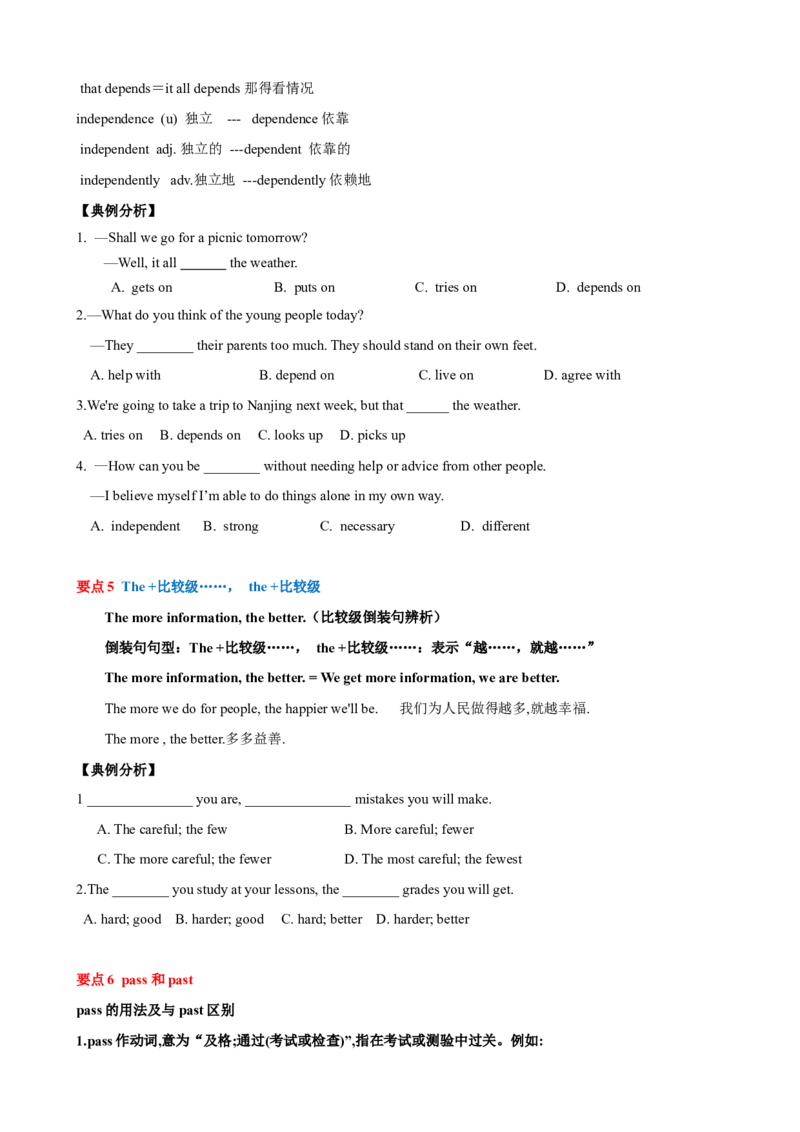
要点4 depend
1)depend v.视……而定;决定(于)
Whether we start or not depends on the weather.
我们是否开始取决于天气。
2)常用短语depend on意为“依靠”,后接名词或代词,它的主语可以是人也可以是物,但含义不同。
人+depend(s) on(依靠);物+depend(s) on(视……而定)。
The old man depends on his son. 那位老人依靠他的儿子。
Our plan depends on time. 我们的计划取决于时间。
拓展that depends=it all depends 那得看情况
independence (u) 独立 --- dependence 依靠
independent adj. 独立的 ---dependent 依靠的
independently adv.独立地 ---dependently 依赖地
【典例分析】
1. —Shall we go for a picnic tomorrow?
—Well, it all the weather.
A. gets on B. puts on C. tries on D. depends on
2.—What do you think of the young people today?
—They ________ their parents too much. They should stand on their own feet.
A. help with B. depend on C. live on D. agree with
3.We're going to take a trip to Nanjing next week, but that ______ the weather.
A. tries on B. depends on C. looks up D. picks up
4. —How can you be ________ without needing help or advice from other people.
—I believe myself I’m able to do things alone in my own way.
A. independent B. strong C. necessary D. different
要点5 The +比较级……, the +比较级
The more information, the better.(比较级倒装句辨析)
倒装句句型:The +比较级……, the +比较级……:表示“越……,就越……”
The more information, the better. = We get more information, we are better.
The more we do for people, the happier we'll be. 我们为人民做得越多,就越幸福.
The more , the better.多多益善.
【典例分析】
1 _______________ you are, _______________ mistakes you will make.
A. The careful; the few B. More careful; fewer
C. The more careful; the fewer D. The most careful; the fewest
2.The ________ you study at your lessons, the ________ grades you will get.
A. hard; good B. harder; good C. hard; better D. harder; better
要点6 pass 和past
pass的用法及与past区别
1.pass作动词,意为“及格;通过(考试或检查)”,指在考试或测验中过关。例如:She was glad to pass the Chinese exam.通过了语文考试,她很高兴。
2.pass作动词,还可意为“传递;经过”。例如:
Pass the book to me, please.请把那本书递给我。
I pass the shop every day.我每天都经过那家商店。
3.pass作名词,意为“及格;入场证;通行证”。例如:
Here is your pass, Mary.玛丽,这是你的入场证。
4.常见pass短语小结:
pass away消失;去世
pass by走过;(时间)逝去
pass on继续下去
pass sth.to sb.=pass sb. sth.把某物递给某人
past
prep. 用作介词意为“超过;到另一侧;晚于;在……之后”。
adv. 经过
n. 名词“过去 往昔“
adj. 作形容词“过去的,从前的”
词组:in the past
另外希望大家能够区分pass和past,前者是动词,而后者则是介词或副词
【典例分析】
一、指出下列各句‘past’的用法
1.I walk past the farm every day on my way to work
2.I will never forget the past days.
3.We can't change the past.
4.It is half past ten.
5.She ran past with a smile.
6.In the past, life was very hard.
二、完成句子
1.他们穿过了森林。
They _________ __________ the forest.
2.他递给我一支笔。
He passed me a pen. = He passed_______ _______ ________ me.
3.当他获得这个消息时,他继续传递给别人。When he got the message, he _________it _______ ________ others.
三、请用pass和past填空
He ran ________________ the building.
He _____________ him without a word.
四. He ________ by me but didn't notice me.
A. passes B. past C. passed D. goes past
要点7 drop
(1)作不及物动词,意为“掉下,落下,下降,减弱”。例如:
The apple dropped from the tree to the ground.
苹果从树上掉到地上。
The ball dropped out of his hand.
球从他手里掉了下来。
Prices dropped. 物价下跌了。
(2)作及物动词,意为“使掉下,使落下”。例如:
Mary dropped the vase on the floor. 玛丽失手把花瓶掉在地板上。
(3) 作及物动词,意为“放弃”。例如:
You must drop smoking (the bad habit). 你必须戒烟(戒除这个坏习惯)。
【拓展】
drop in /around探望,串门。例如:
Please drop in to see us if you are in Bradford.
如果你到布拉福特,请顺便来看看我们。
【注意】
drop in(顺便拜访)是不及物动词短语,其后不能接宾语。若语义上需要接宾语,根据情况可用 on(针对人)
或at(针对地方)。例如:
I thought I’d drop in on you while I was passing.
我曾想路过时就来看看你。
要点8 while 和when
while 连词,意思是“当……的时候”,引导时间状语从句。如:
While she was sleeping , someone knocked at the door. 当她睡觉时,有人敲门。
when 和while 都表示“当……的时候”。when 引导的时间状语从句中,谓语动词可以是延续性动词,也可以是终止性动词,表示主句的动作和从句的动作同时发生或先后发生。
While引导的时间状语从句中,谓语动词必须是延续性动词,常用进行时态,表示主句的动作和从句
的动作同时发生。When后动词一般用过去式,while后动词一般用过去进行时。
【典例分析】
1.John fell asleep _____ he was listening to the radio.
A. after B. before C. while D. as soon as
2. While we _______ the picnic, it _______ to rain.
A. are having; started B. have; is starting
C. were having; started D. were having; was starting
3. He ______ in Italy when he _______ the accident.
A. travelled; had B. was travelling; had
C. was travelling; was having D. travelled; was having
要点9
in order to 为了,后面加动词原形,表示目的。
We get up early in order to catch the early bus. 我们早起是为了赶上早班车。
in order that 为了,后接从句,作目的状语。
I get up early in order that I can catch the early bus. 我早起是为了赶上早班车。
【典例分析】
1. A lot of famous doctors gathered in Harbin______save “China's most beautiful teacher”
A. so that B. in order to C. in order that D. as a result
2. ________ stop more accidents, we should slow down the driving speed.
A. In order that B. In order to C. Thanks for D. Thanks to
要点10 welcome
welcome词意及用法辨析
(1). welcome:名词“欢迎”,常搭配:give sb a (warm) welcome = give a (warm) welcome to sb
(2). welcome:动词“欢迎”,常搭配:welcome sb to sp欢迎某人来某地
(3). welcome:形容词“受欢迎的”,常搭配:Sth be very welcome.
1. Chinese food is always ___________________ in western countries.
A. interesting B. expensive C. welcome D. awful
2. Lao She Teahouse ___________________ everyone from all over the world.A. welcome to B. gives a warm welcome C. invite to D. would like
要点11 as…as 和……一样 as soon as
as...as 可用于肯定句和否定句中。as...as 之间只能用形容词或副词的原级。
The boy is as tall as me. 这个男孩和我一样高。
so...as只能用于否定句中。
as soon as的用法
as soon as意为 “一……就……”,引导时间状语从句,如果主句是一般将来时则从句用一般现在时
表将来;如果主句是一般过去时则从句也用一般过去时。
【典例分析】
1.Wang Wei speaks English as _____ as Yang Lan. They both study English hard.
A. good B. well C. better D. best
2. —I wonder whether Brazil will win the match later tonight.
—Go to bed first. I will wake you up as soon as the match ______.
A. starts B. started C. will start D. is starting
3. I’ll go to visit my aunt in England _______ the summer holiday starts.
A. while B. since C. until D. as soon as
要点12 since的用法
(1)作为连词,还可译为“由于;既然”,引导原因状语从句,表示很明显的原因。
1.The young man hasn’t done much exercise since he got a mobile phone.
年青人自从买手机以来,就不做大量运动了。
2. Since everybody is here, let’s begin the meeting.
既然人都齐了,我们就开会吧。
(2)作为介词,意为“自……以来”,后接时间点作时间状语,常用于现在完成时,可以和“for + 时间
段”互换。
I have known him since 10 years ago.自从10年前我就认识他了。
= I have known him for 10 years.我认识他已经有10年了。
(2)作为连词,意为“自……以来”,引导时间状语从句,主句常用现在完成时,从句常用一般过去时。
【典例分析】
1.It’s almost eight years we saw each other last time.
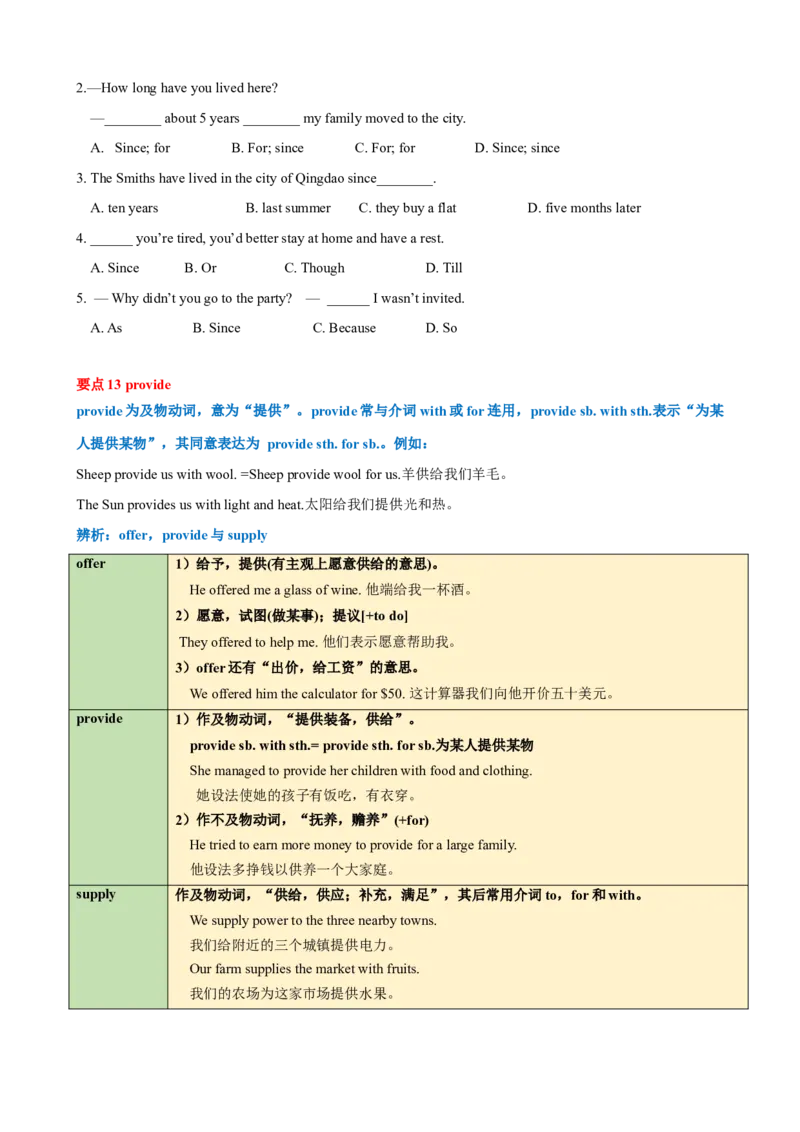
A since B. before C. after D. when2.—How long have you lived here?
—________ about 5 years ________ my family moved to the city.
A. Since; for B. For; since C. For; for D. Since; since
3. The Smiths have lived in the city of Qingdao since________.
A. ten years B. last summer C. they buy a flat D. five months later
4. ______ you’re tired, you’d better stay at home and have a rest.
A. Since B. Or C. Though D. Till
5. — Why didn’t you go to the party? — ______ I wasn’t invited.
A. As B. Since C. Because D. So
要点13 provide
provide为及物动词,意为“提供”。provide常与介词with或for连用,provide sb. with sth.表示“为某
人提供某物”,其同意表达为 provide sth. for sb.。例如:
Sheep provide us with wool. =Sheep provide wool for us.羊供给我们羊毛。
The Sun provides us with light and heat.太阳给我们提供光和热。
辨析:offer,provide与supply
offer 1)给予,提供(有主观上愿意供给的意思)。
He offered me a glass of wine. 他端给我一杯酒。
2)愿意,试图(做某事);提议[+to do]
They offered to help me. 他们表示愿意帮助我。
3)offer还有“出价,给工资”的意思。
We offered him the calculator for $50. 这计算器我们向他开价五十美元。
provide 1)作及物动词,“提供装备,供给”。
provide sb. with sth.= provide sth. for sb.为某人提供某物
She managed to provide her children with food and clothing.
她设法使她的孩子有饭吃,有衣穿。
2)作不及物动词,“抚养,赡养”(+for)
He tried to earn more money to provide for a large family.
他设法多挣钱以供养一个大家庭。
supply 作及物动词,“供给,供应;补充,满足”,其后常用介词to,for和with。
We supply power to the three nearby towns.
我们给附近的三个城镇提供电力。
Our farm supplies the market with fruits.
我们的农场为这家市场提供水果。【典例分析】
1. 他为他的家人提供食物和衣服。
He provided food and clothes for his family.
= He _________his family ________food and clothes.
2. They didn’t provide me food, so I had to find something to eat.
A. for B. to C. about D. with
3. The little boy ______ his seat to an old lady on the crowded bus.
A. lent B. offered C. took D. brought
3. The newly-opened company ________ the local people with more chances to work.
A. gives B. provides C. offers D. shows
4. —In the past five years, China has played an important role in the Belt and Road.
—It has _____ many nations a great chance to communicate.
A. offered B. supported C. included D. provided
6.他主动要把他的词典借给我
He________ _________ ________ me his dictionary.。
7.校长要把她的雨衣借给我。
The headmaster___________ ___________ her raincoat.
= The headmaster___________ her raincoat__________ ___________.
8.感谢你主动帮忙。
Thank you for__________ ___________of help.
9. When I’m in trouble, my sister always _________________.
A. offers helping me B. offers to help meC. asks me to help D. asks me at help
10.A lot of heroes ______________ their lives _____________ our country during the earthquake in Sichuan.
A. offer ; to B. offer ; for C. offered ; to D. offered ; /
要点14 neither
(1) neither作数量词,常与of连用,表示(两者)都不,其后谓语动词用单数。
我的父母都不在家。Neither of my parents is at home.
(2) neither作代词,(两者)都不
你喜欢这个红T恤还是黑色的? 两个都不喜欢,我喜欢白色的。
--- Would you like the red shirt or the black one?
--- Neither, I’d like the white one.
(3) neither 作限定词,(两者)都不,与名词单数连用两个答案都不对。Neither answer is right.
(4) neither 用作连词
neither … nor … “既不……也不…… ”
这个房间既不大也不亮。
The room is neither big nor bright.
你和我都不对。 Neither you nor I am right.
neither … nor …做主语时,就近一致原则
also, too, either, neither的用法
1. also 是比较正式的用语,语气较庄重。它通常放在句中,位于行为动词之前,连系动词之后; 如有助动
词或情态动词,一般放在助动词或情态动词之后。
Peter also has two brothers. 彼得也有两个兄弟。
I am also a student. 我也是一名学生。
2. too 是普通用词,多用于口语,语气较随便。一般用在肯定 句中,放在句末。
I’m in Row 1, too. 我也在第一排。
3. either 表示“也”时,一般只用于否定句,且置于句末。
If you don’t go there, he won’t go there, either.
如果你不去那儿,他也不会去那儿。
4. neither 表示“两个都不”,它作主语时,谓语动词常用单数
Neither of you can do it. 你们两个都不能做这件事。
辨析neither...nor...;both…and…;either…or…
这三个词组都可用作连词,但搭配和意义各不相同。总的说来,要注意它们应连接两个平行对等的句子
成分(即同为两个主语、谓语、宾语、状语等)。
(1)both…and…表示两者兼有。例如:
She was both tired and hungry.
她又累又饿。
He speaks both English and French.
他既说英语又说法语。
(2)either…or…表示两者或两种可能性中任择其一。例如:
He must be either mad or drunk.
他不是疯了就是醉了。
(3)not only…..but also
★not only … but also连接两个分句时,not only可用于句首,第一个从句主谓要倒装。Not only is he clever, but also he is hard working.
【注意】
以上连词连接主语时,both…and…一般只与复数谓语连用,either…or…和neither…nor…则通常根据就
近原则,要求谓语动词与最邻近主语的人称、数保持一致。例如:
Either you or I am wrong. 不是你错就是我错。
Neither he nor she was at home. 他和她都不在家。
Both New York and London have traffic problems. 纽约和伦敦都存在交通问题。
【典例分析】
1. —Would you like some crisps or a piece of chocolate cake, Judy?
—________. I never have anything before going to bed.
A. None B. Neither C. Both D. Either
2. —Which do you like better, bananas or pears?
—________. I want apples. Remember, one apple a day keeps the doctor away.
A. Both B. Neither C. Either D. None
3. Lin Tao doesn’t like running. Jim doesn’t, ________.
A. either B. too C. also D. neither
4.—To go abroad or not to go after graduation, it’s a question.
—You may take ________ of the roads. But being home in the end matters.
A.neither B.either C.both D.none
5 Lingling and Lucy not only do well in English but also study hard. We hope ________ of them can be a
member of the English Club.
A. neither B. both C. all D. none
6. Mike doesn’t know French. And ________.
A. so do I B. so am I C. neither do I D. neither am I
7. —Will you go to Peter’s party this Saturday evening?
—I haven’t decided yet. If you don’t go, ________.
A. so do I B. neither do I C. so will I D. neither will I
8. —Which show do you prefer, Running Man or The Reader?
—The Reader, of course. ________ I ________ my brother likes it.
A. Both; and B. Neither; nor C. Either; or D. Not only; but also
9.—How do you like the two pairs of shoes?—They don't fit me. They are ________too big ________too small.
A. not only…but also… B. neither…nor… C. either…or… D. prefer…to…
10. He speaks _________English _______French. Instead, he speaks German.
A. either; or B. not only ; but also C. both; and D. neither; nor
11.—Don’t be angry with your kids when they make mistakes again, will you?
—No, I won’t. I know that ________ of us is perfect (完美的).
A.none B.neither C.each D.every
【重点词组】
go out for dinner 出去吃晚饭
stay out late/until nine 呆到很晚
stay up (late) 熬夜
go to the movies 去看电影
get a ride 搭车
give me a ride to town送我到镇上
do the dishes=wash the dishes洗餐具
take out the rubbish 倒垃圾
fold your/the clothes 叠衣服
sweep the floor 扫地
make your/the bed 整理床铺
clean the living room 打扫客厅
help out with a few things帮助做些事
take sb. for a walk 带某人去散步
take the dog for a walk= walk dog遛狗
hang out with sb. 与某人闲逛
invite sb. to a party 邀请某人参加聚会
do chores 做杂务
take a walk= go for a walk散步
【重点句式】
1.I think two hours of TV is enough for you.我认为两个小时对你已足够。
2.She won’t be happy if she sees this mess.假如她看到这乱糟糟一团定会不高兴。
3.I’m just as tired as you are!我也和你一样的累。4.She did not do any housework and neither did I.她没有做任何家务活,我也没有。
5.I could not find a clean dish or a clean shirt.我没有发现一个干净的碗碟,一件干净的衬衫。
6.I’ll finish my homework while you help me with the dishes.
在你帮助我洗碗碟的时候,我将完成我的家庭作业。
7.I do not understand why some parents make their kids help with housework and chores at home.
我不理解为什么有些父母让他们的孩子在家帮助做家务。
8.It is the parents’ job to provide a clean and comfortable environment at home for their children.
在家给孩子们提供一个干净而舒服的环境是家长们的工作。
9.It is important for children to learn how to do chores and help their parents with housework.
对于孩子们来说,学会怎样做家务和帮助父母亲做家务是很重要的。
10.The earlier kids learn to be independent, the better it is for their future.
孩子们越早独立,对他们的未来就更好。
11. There is no need for somebody to do something对于某人来说没必要做……
12. He has no idea how to take care of himself他不知道怎样照料自己
13. It’s fair for children to do something对于孩子来说,做……是公平的。
14. Could you please do…? (礼貌请求)你可以做……吗?
15. Could I please do…? (征求意见)我可以做……吗?
知识要点二:语法
情态动词could
情态动词could 可用于有礼貌地向对方提出请求或请求对方的许可,用于疑问句中,可代替can,在时间上
与can没有区别,但语气要比can委婉、有礼貌。其答语没有固定的形式,但要符合上下文的语境。
① 表示委婉地请求别人做某事
常用句型Could you (please) do sth. ?
肯定答语:
Yes, sure. / Yes, I can. /Of course, I cam. /No problem. /With pleasure.
否定答语 (可先拒绝,再说明理由):
Sorry, I can’t. I have to... / Sorry, I'm going to...
I'm afraid I can't. I have to.../
例句:
-Could you please make your bed? 请你整理一下你的床铺好吗?
-Yes, sure.好的,当然可以。-Could you water the flowers? 你浇浇花好吗?
-Sorry, I can't. I have to do my homework.抱歉,我不行。我要做作业。
② 表示委婉地请求别人允许自己做某事
常用句型:Could I do sth. ?
肯定答语:Yes, you can./ Yes, please.等
否定答语:Sorry; you can't./I'm afraid you can’t.(然后说明理由)等
例句:-Could I sit here? 我可以坐在这儿吗?
-Yes, you can是的,你可以。
-Could I use your computer? 我可以用你的电脑吗?
-Sorry, you can't. I'm going to work on it.抱歉,你不能。我要用它工作。
③.Could you please do sth? 的否定形式为“Could you please not do sth.?”,表示委婉地批评对方,意为“请不
要某事好吗?”。
例句:-Could you please not put your bike here?
-Sorry, I'll take it away at once. 对不起,我马上把它推走。
【注】(1)“Could you (please)do sth.?”和“Could I do sth.”这两个句型的答语中一般都避免使用could,
可以替换成can。
(2)句中could都可换成can,
(3)句中please还可放在句尾,其前用逗号和前面内容隔开。
【拓展】could 的其他用法:
could为can的过去式,表示能力。
She could swim at the age of seven.她7岁时就会游泳。
表示惊讶、怀疑、不相信等态度,主要用于否定句或疑问句,此时could与can无时间上的区别,但语气比
can要弱。
He couldn't /cant be over fifty.他不可能超过五十岁。
Can/Could he be serious? 难道他会当真吗?
表示可能性,指对将来、现在或过去某种可能的推测。
The book could be Mike's. He likes reading science books.
这本书可能是迈克的,他喜欢看科学书籍。
表示建议。
You could get your sister a scarf as her birthday present.
你可以给你妹妹买条围巾作为她的生日礼物。
【典例分析】1.—________ you please give me a hand? I can’t move the box by myself.
—No problem.
A.Could B.May C.Should D.Must
2.—Mum, could I play with my classmates for a while after I finish my homework?
— ________. But you must come back before supper and keep safe.
A.Yes, you can B.Of course, you can’t C.Yes, you could
3.—Helen, could you please water the flowers in my garden?
—________. I cut my finger and I’m trying not to get it wet.
A.That’s too bad B.With pleasure C.You’re welcome D.I’m afraid not
4.— Gina, could you please help me do the dishes?
— ________. I will do it right now.
A.No, thanks B.Yes, sure C.You’re welcome D.Sorry, I don’t know
5. Would you please __________ the children __________ with snake?
A. to ask; not to play B. ask; not to play C. to ask; not play D. ask; don’t play
6.Sir, could you please put out your cigarette? This is a smoke-free(无烟的)school.
—__________________.
A. I’m sorry about this. B. Not at all. C. Sure. I’d love to.
D. Never mind.
知识要点三:书面表达
【话题分析】
本单元的话题是"家务琐事与许可"。与该话题相关的常见写作有:描述自己做过的家务劳动,写一篇介
绍同学做家务情况的报告并表达自己的观点或看法等。
【短语积累】
A 家庭琐事短语
do the dishes=wash the dishes洗餐具
take out the rubbish 倒垃圾
fold your/the clothes 叠衣服
sweep the floor 扫地
make your/the bed 整理床铺clean the living room 打扫客厅
take sb. for a walk 带某人去散步
do chores 做杂务
go to the store 购物
take the dog for a walk 遛狗
B 翻译短语
1. 为了上一所好大学___________________________________
2. 过多地依靠我们父母亲______________________________
3. 花费他们的时间做功课______________________________
4. 发展孩子们的独立性________________________________
5. 尽他们的责任保持房间整洁__________________________
6. 理解公平的想法_____________________________________
7. 提供某物给某人_____________________________________
8. 浪费时间___________________________________________
9. 没有必要担心他_____________________________________
10. 你越就越早学会独立,对你的将来越好______________________________
11.仅仅取得好成绩是不够的_____________________________________________
12.不介意做家务_______________________________________
13.有太多的学习压力___________________________________
【句型积累】
翻译下面句子
14.我认为没有必要让孩子了解这件事。
_________________________________________________________________________________
15.做家务帮助培养孩子们的独立性,教会他们如何照顾自己。
_________________________________________________________________________________
16.大家都应该尽一份力来保持教室每天干净、整洁。
_________________________________________________________________________________
17.孩子们越早学会独立,对他们的将来越有好处。
_________________________________________________________________________________
18.我们为什么应该做家务的原因是它可以发展我们的独立性。
_________________________________________________________________________________
19.我认为分担家务来保持房间的干净、整洁是我们的责任。_________________________________________________________________________________
20. 我帮父母做我力所能及的事情。我从做家务中学到很多。
_________________________________________________________________________________
【实战演练】
Sally邀请Jim周日去她家玩, 但是Jim这个周日很忙。上午近来, 学生是否应该做家务的问题引起了
一片热议。对于这个问题不同的人有不同的看法。有些人认为学生就应该把精力放在学习上, 没必要做家
务活; 而有些人则认为学生应该帮忙做家务,这有助于培养他们的公平意识。作为一名初中生, 你认为学生
们应该帮助父母做家务吗?请根据提示写一篇80词左右的短文 (短文开头已给出, 不计入总词数)。
要点提示:
1.学习压力太大,做家务是一种放松的方式;
2.上学坐着的时间太长,做家务有利于身体健康;
3.父母上班也很辛苦,与他们分担家务有利于增进我们和他们之间的关系。
Should students do housework?
Should students do housework? Different people have different ideas about this problem.
_______________________________________________________________________________________
___________________________________________________________________________________________
___________________________________________________________________________________________
___________________________________________________________________________________________
___________________________________________________________________________________________
___________________________________________________________________________________________
___________________________________________________________________________________________
___________________________________________________________________________________________
___________________________________________________________________________________________
___________________________________________________________________________________________
___________________________________________________________________________________________
___________________________________________________________________________________________
___________________________________________________________________________________________