文档文本内容
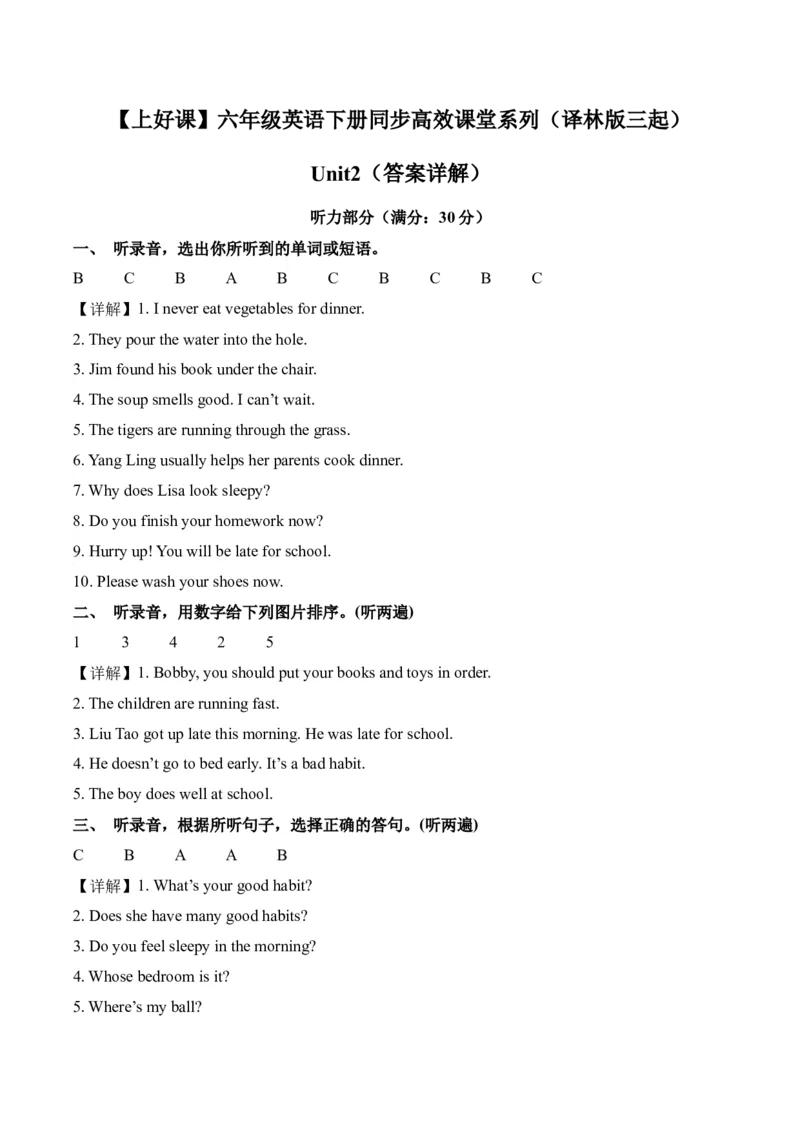
【上好课】六年级英语下册同步高效课堂系列(译林版三起)
Unit2(答案详解)
听力部分(满分:30分)
一、 听录音,选出你所听到的单词或短语。
B C B A B C B C B C
【详解】1. I never eat vegetables for dinner.
2. They pour the water into the hole.
3. Jim found his book under the chair.
4. The soup smells good. I can’t wait.
5. The tigers are running through the grass.
6. Yang Ling usually helps her parents cook dinner.
7. Why does Lisa look sleepy?
8. Do you finish your homework now?
9. Hurry up! You will be late for school.
10. Please wash your shoes now.
二、 听录音,用数字给下列图片排序。(听两遍)
1 3 4 2 5
【详解】1. Bobby, you should put your books and toys in order.
2. The children are running fast.
3. Liu Tao got up late this morning. He was late for school.
4. He doesn’t go to bed early. It’s a bad habit.
5. The boy does well at school.
三、 听录音,根据所听句子,选择正确的答句。(听两遍)
C B A A B
【详解】1. What’s your good habit?
2. Does she have many good habits?
3. Do you feel sleepy in the morning?
4. Whose bedroom is it?
5. Where’s my ball?四、 听录音,根据所听对话及问题,选择正确的答案。(听两遍)
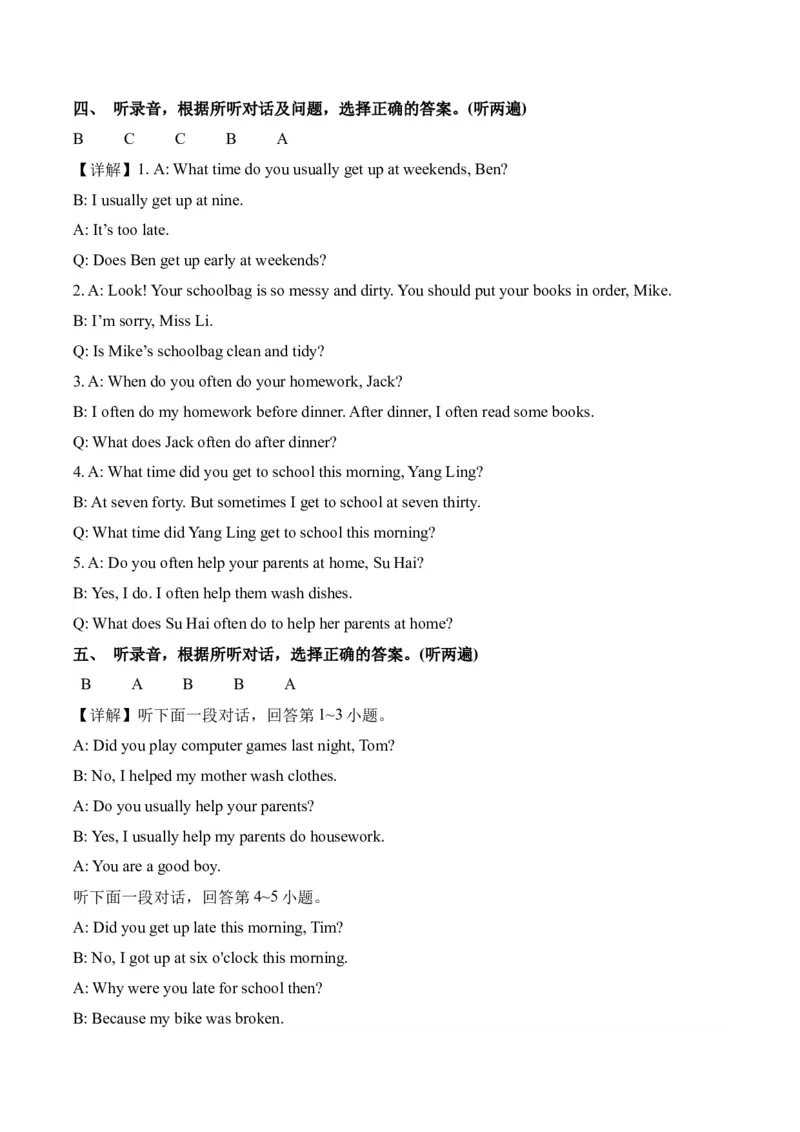
B C C B A
【详解】1. A: What time do you usually get up at weekends, Ben?
B: I usually get up at nine.
A: It’s too late.
Q: Does Ben get up early at weekends?
2. A: Look! Your schoolbag is so messy and dirty. You should put your books in order, Mike.
B: I’m sorry, Miss Li.
Q: Is Mike’s schoolbag clean and tidy?
3. A: When do you often do your homework, Jack?
B: I often do my homework before dinner. After dinner, I often read some books.
Q: What does Jack often do after dinner?
4. A: What time did you get to school this morning, Yang Ling?
B: At seven forty. But sometimes I get to school at seven thirty.
Q: What time did Yang Ling get to school this morning?
5. A: Do you often help your parents at home, Su Hai?
B: Yes, I do. I often help them wash dishes.
Q: What does Su Hai often do to help her parents at home?
五、 听录音,根据所听对话,选择正确的答案。(听两遍)
B A B B A
【详解】听下面一段对话,回答第1~3小题。
A: Did you play computer games last night, Tom?
B: No, I helped my mother wash clothes.
A: Do you usually help your parents?
B: Yes, I usually help my parents do housework.
A: You are a good boy.
听下面一段对话,回答第4~5小题。
A: Did you get up late this morning, Tim?
B: No, I got up at six o'clock this morning.
A: Why were you late for school then?
B: Because my bike was broken.笔试部分(满分:70分)
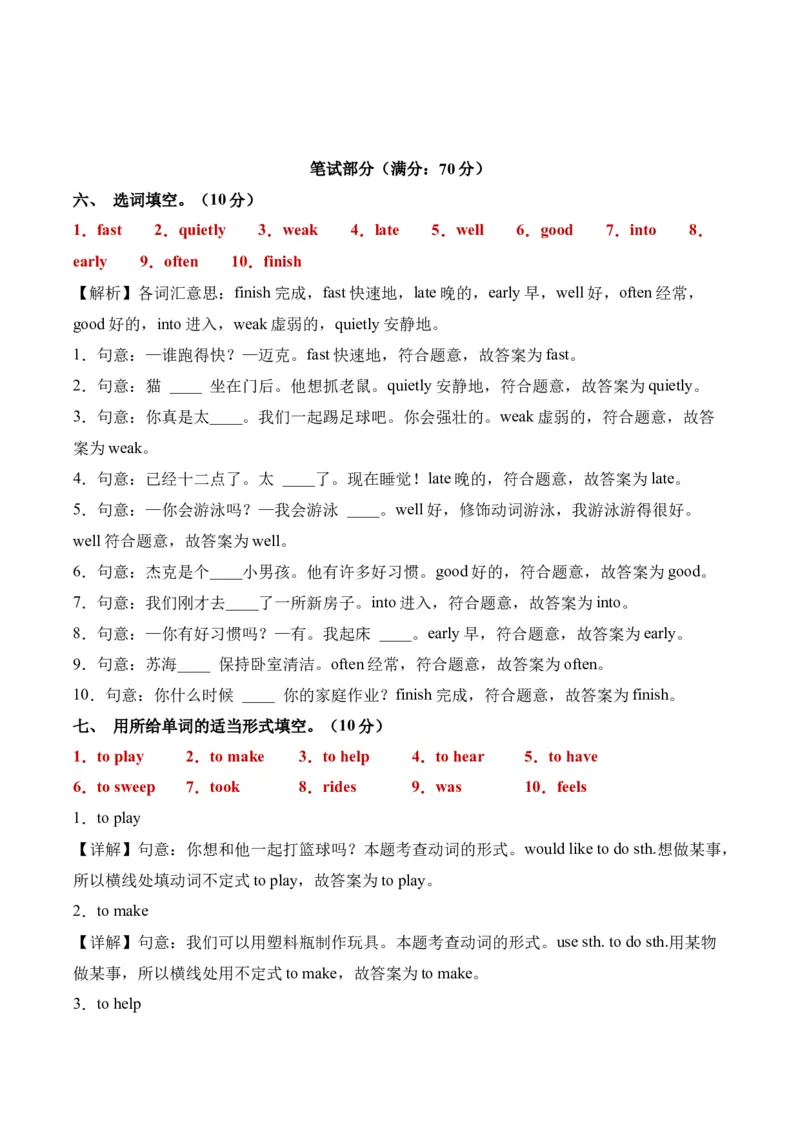
六、 选词填空。(10分)
1.fast 2.quietly 3.weak 4.late 5.well 6.good 7.into 8.
early 9.often 10.finish
【解析】各词汇意思:finish完成,fast快速地,late晚的,early早,well好,often经常,
good好的,into进入,weak虚弱的,quietly安静地。
1.句意:—谁跑得快?—迈克。fast快速地,符合题意,故答案为fast。
2.句意:猫 ____ 坐在门后。他想抓老鼠。quietly安静地,符合题意,故答案为quietly。
3.句意:你真是太____。我们一起踢足球吧。你会强壮的。weak虚弱的,符合题意,故答
案为weak。
4.句意:已经十二点了。太 ____了。现在睡觉!late晚的,符合题意,故答案为late。
5.句意:—你会游泳吗?—我会游泳 ____。well好,修饰动词游泳,我游泳游得很好。
well符合题意,故答案为well。
6.句意:杰克是个____小男孩。他有许多好习惯。good好的,符合题意,故答案为good。
7.句意:我们刚才去____了一所新房子。into进入,符合题意,故答案为into。
8.句意:—你有好习惯吗?—有。我起床 ____。early早,符合题意,故答案为early。
9.句意:苏海____ 保持卧室清洁。often经常,符合题意,故答案为often。
10.句意:你什么时候 ____ 你的家庭作业?finish完成,符合题意,故答案为finish。
七、 用所给单词的适当形式填空。(10分)
1.to play 2.to make 3.to help 4.to hear 5.to have
6.to sweep 7.took 8.rides 9.was 10.feels
1.to play
【详解】句意:你想和他一起打篮球吗?本题考查动词的形式。would like to do sth.想做某事,
所以横线处填动词不定式to play,故答案为to play。
2.to make
【详解】句意:我们可以用塑料瓶制作玩具。本题考查动词的形式。use sth. to do sth.用某物
做某事,所以横线处用不定式to make,故答案为to make。
3.to help【详解】句意:鲍比来帮助动物。本题考查动词的形式,根据 come to do sth.来做某事,可知
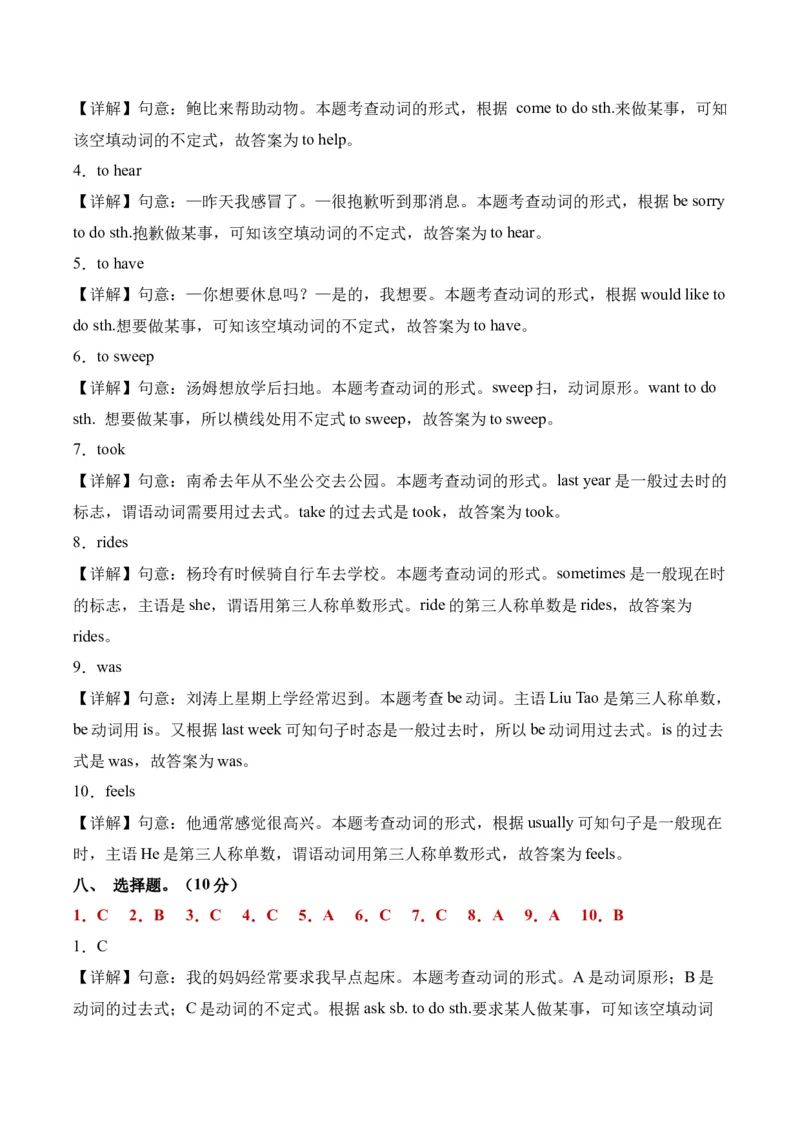
该空填动词的不定式,故答案为to help。
4.to hear
【详解】句意:—昨天我感冒了。—很抱歉听到那消息。本题考查动词的形式,根据be sorry
to do sth.抱歉做某事,可知该空填动词的不定式,故答案为to hear。
5.to have
【详解】句意:—你想要休息吗?—是的,我想要。本题考查动词的形式,根据would like to
do sth.想要做某事,可知该空填动词的不定式,故答案为to have。
6.to sweep
【详解】句意:汤姆想放学后扫地。本题考查动词的形式。sweep扫,动词原形。want to do
sth. 想要做某事,所以横线处用不定式to sweep,故答案为to sweep。
7.took
【详解】句意:南希去年从不坐公交去公园。本题考查动词的形式。last year是一般过去时的
标志,谓语动词需要用过去式。take的过去式是took,故答案为took。
8.rides
【详解】句意:杨玲有时候骑自行车去学校。本题考查动词的形式。sometimes是一般现在时
的标志,主语是she,谓语用第三人称单数形式。ride的第三人称单数是rides,故答案为
rides。
9.was
【详解】句意:刘涛上星期上学经常迟到。本题考查be动词。主语Liu Tao是第三人称单数,
be动词用is。又根据last week可知句子时态是一般过去时,所以be动词用过去式。is的过去
式是was,故答案为was。
10.feels
【详解】句意:他通常感觉很高兴。本题考查动词的形式,根据usually可知句子是一般现在
时,主语He是第三人称单数,谓语动词用第三人称单数形式,故答案为feels。
八、 选择题。(10分)
1.C 2.B 3.C 4.C 5.A 6.C 7.C 8.A 9.A 10.B
1.C
【详解】句意:我的妈妈经常要求我早点起床。本题考查动词的形式。A是动词原形;B是
动词的过去式;C是动词的不定式。根据ask sb. to do sth.要求某人做某事,可知该空填动词的不定式,故选C。
2.B
【详解】句意:我真的不知道如何游泳。本题考查固定搭配。该句缺少宾语。“疑问词+不定
式”结构,在句中作宾语,故选B。
3.C
【详解】句意:睡觉晚不是一个好习惯。本题考查动词的形式,A是动词原形;B是动词的
ing形式;C动词的不定式。根据It’s a good habit to do sth.做某事是一个好习惯,可知该空填
动词不定式,故选C。
4.C
【详解】句意:医生让我多喝水。本题考查动词的形式。A是动名词或动词的现在分词,B
是动词的过去式,C是动词不定式。ask sb. to do sth.要求某人做某事,所以横线处用动词不定
式,故选C。
5.A
【详解】句意:为了保持健康,我们应该每天吃水果和蔬菜。本题考查动词的形式。A是动
词不定式,B是动名词或动词的现在分词,C是动词原形。根据句意可知保持健康是目的,
动词不定式表目的,故选A。
6.C
【详解】句意:—我从不吃早饭。—这是个坏习惯。本题考查副词辨析。A总是,B通常,C
从不。根据答语“这是个坏习惯。”可知从不吃早饭。故选C。
7.C
【详解】句意:放学后他总是饿,所以回家前他吃了一些面包。本题考查频度副词。never从
不,always总是。根据“所以回家前他吃了一些面包”可知他总是饿,排除选项A。频度副
词放在be动词之后,排除选项B,故选C。
8.A
【详解】句意:她_______在床上,但是这对她的眼睛不好。本题考查副词辨析和副词的用法。
频度副词要用在实义动词前面,排除C选项;always总是,never从不,根据句意可知always
符合题意,排除B选项。故选A。
9.A
【详解】句意:玛丽总是不很早去上学。她上学________迟到。本题考查副词辨析,A总是,
B有时,C从不。根据句意可知A选项符合题意,故选A。10.B
【详解】句意:—刘涛足球踢得怎样?—他踢得很好。本题考查疑问词和副词的用法。what
什么,how怎样,where在哪,根据答语可知问句问踢得怎样,答语横线处填副词well修饰
动词。故选B。
九、 为句子选择合适的答语。(5分)
1.D 2.E 3.C 4.B 5.A
【解析】1.句意:昨晚你妈妈看电视了吗?一般疑问句用yes或no回答,D不,她没看。符
合题意,故选D。
2.句意:森林里有什么?答语回答有的东西,E有一头狮子和一只老鼠。符合题意,故选
E。
3.句意:你不应该上学迟到。答语应说对不起,C对不起。符合题意,故选C。
4.句意:你哥哥什么时候去上学?答语回答时间,B七点十分。符合题意,故选B。
5.句意:他们在商店里做什么?答语回答做的事情,A他们买一些花。符合题意,故选A。
十、 连词成句。(10分)
1.He brushes his teeth in the morning.
2.He also helps his parents.
3.He gets up early every morning.
4.Lisa often goes for a walk after dinner.
5.Helen always puts her things in order at home.
1.He brushes his teeth in the morning.
【详解】本题考查句子结构。brushes his teeth刷牙,he他,in the morning在早上,根据所给
句号和单词,可知句子是陈述句,根据词义连成句子:他早上刷牙。故答案为He brushes his
teeth in the morning.
2.He also helps his parents.
【详解】本题考查句子结构。helps帮助,his他的,also也,he他,parents父母,根据所给
句号和单词,可知句子是陈述句,根据词义连成句子:他也帮助他的父母。故答案为He also
helps his parents.
3.He gets up early every morning.
【详解】本题考查句子结构,gets up early起得很早,he他,every morning每天早上,根据所
给句号和单词,可知句子是陈述句,根据词义连成句子:他每天起得很早。故答案为He getsup early every morning.
4.Lisa often goes for a walk after dinner.
【详解】本题考查句子结构。after dinner晚饭后,Lisa丽萨,often经常,goes for a walk散步,
根据所给句号,可知句子是陈述句,根据词义连成句子:丽萨经常晚饭后散步。故答案为
Lisa often goes for a walk after dinner.
5.Helen always puts her things in order at home.
【详解】always总是;puts...in order把……放得井井有条;Helen海伦;at在; her她的;
things东西; home家,根据所给的句号,可知句子是一个陈述句,根据所给词义可以连成句
子:海伦在家总是把她的东西放得井井有条。故答案为Helen always puts her things in order at
home.
十一、 补全对话。(5分)
1.D 2.A 3.C 4.B 5.E
【导语】本文是A和B之间的一组对话,讨论了B的好习惯。
1.根据下一句:是的,我是一个好男孩。我早晨起得早。本题是一般疑问句,D选项“你有
好习惯吗?”符合语境,故选D。
2.根据下一句:是的,并且我早晨也刷牙。本题是刷牙问题,应该是一般疑问句,A选项
“你睡前刷牙吗?”符合语境,故选A。
3.根据上一句:你的房间乱码?这是一般疑问句,用yes或者no回答。C选项“不,它是干
净的并且整洁的。”符合语境,故选C。
4.根据上一句:你怎么放你的东西?B选项“我经常按着顺序放。”符合语境,故选B。
5.根据上一句:很好!你有好习惯。对于别人的夸奖应该是表达感谢。E选项“谢谢你。”
符合语境,故选E。
十二、 阅读理解,选择最佳答案。(10分)
1.C 2.B 3.A 4.C 5.A
【导语】本文介绍了袁隆平。
1.句意:袁隆平是一名著名的______。A老师,B医生,C科学家,根据“Yuan Longping is
a famous scientist.”,可知袁隆平是一名著名的科学家,故选C。
2.句意:在过去,大米很______。A便宜的,B昂贵的,C足够的,根据“In the old days,
rice wasn’t cheap.”,可知在过去,大米很贵,故选B。
3.句意:最后,袁隆平_______杂交水稻。A种植,B浇水,C烹饪,根据“At last heplanted the hybrid rice.”,可知最后袁隆平种植了杂交水稻,故选A。
4.句意:袁隆平擅长______。A拉小提琴,B说话,C游泳,根据“And he was good at
swimming.”,可知袁隆平擅长游泳,故选C。
5.句意:袁隆平有很多好习惯吗?根据“As a scientist, Yuan Longping had many good habits,
too.”,可知袁隆平有很多好习惯,答语为肯定回答,故选A。
十三、 书面表达。(10分)
范文:
Li Hua is a good student. He has many good habits. He often puts things in order at home.
He cleans his room every day. He always listens to teachers carefully at school. And he always
helps his classmates with their English. He keeps the classroom clean and tidy. He always waits
for the green man before crossing the road. He always helps many people in need. We all love
him very much.
【详解】1.题干分析:该题目要求介绍李华的一些情况。可以写一写他在家,在学校和公共
场合的一些情况。注意文章为一般现在时态,单词数量要符合要求。
2.参考词汇与句型:
参考词汇:habits习惯;put放置;clean清扫;listen to听;help帮助;wait for等待;
参考句型:He has…;He often…;He always…;