牛津版英语初一语法总结及练习
一、语法
1. 用be going to 描写不久将发生的事情。
例:We”re going go have a lot of delicious food. 我们将吃许多美味食
品。
2. 用情态动词提出礼貌的请求。
例:May I speak to ____, please? 我可以和……讲话吗?
3. 用need to 表示需要。
例:She needs to buy some…她需要买一些……
4. 用固定表达表示喜好。
例: I”d rather have more snacks. 我宁愿再吃一些小吃。
5. 用副词表示时间顺序和过程。
例:Firstly,… /Secondly,…/Thirdly,… 第一,……/第二,……/第三,
……
二、
1. 介词 under 在……下 under a dripping tap
for 为…… wait for sb
+一段时间 for three days
by 以某种方式 by bus
by fixing dripping tap
without 不带…… a book without pictures
2. 连词if 的用法
(1)if 表示如果,引起条件状语从句。
(2)if 引起的从句如果是一般现在时,那么主句会是将来时,祈使句或含情
态动词。
eg: If there is no rain ,there will be no water to drink.
Don”t watch too much television if something is wrong with your
eyes.
If he comes, you can go.
3. 祈使句
(1)表示命令或请求。 Come here.
(2)祈使句中动词用原形。Let”s go .
(3)分类 Don” run downstairs.
Let”s go to school by bus.
Give me an apple ,please.三、1. When的用法
(1)用作特殊疑问词,对时间段或点进行提问(什么时候)
在对时间点提问时与what time可以替换:
We get to school at six.
When(What time) do you get to school?
(2)连词when 当……时
主句是情态动词,从句用一般现在时。
What can we see when there is a typhoon?
When作连词接一般过去时从句
They were talking when the teacher came in.
与While they were talking, the teacher came in.
(3)方式副词的用法
1. 构成 adj+ly
tight—tightly紧紧地 slight –slightly轻轻地
quick—quickly迅速地 fierce—fiercely猛烈地
immediate—immediately立刻 light—lightly 轻轻地
happy—happily高兴地 gentle—gently轻柔地
用法:用于修饰动词,放在行为动词后。
eg: They flew their kite happily in the gentle breeze.
The leaves blew slightly in the wind.
四、1. 情态动词can may must的用法can may must +动词原形
can 表示能力,能够做……
may 表示可能或可以
must则表示必须,与have to 可替换,但must强调主观推测
must be 表示推测
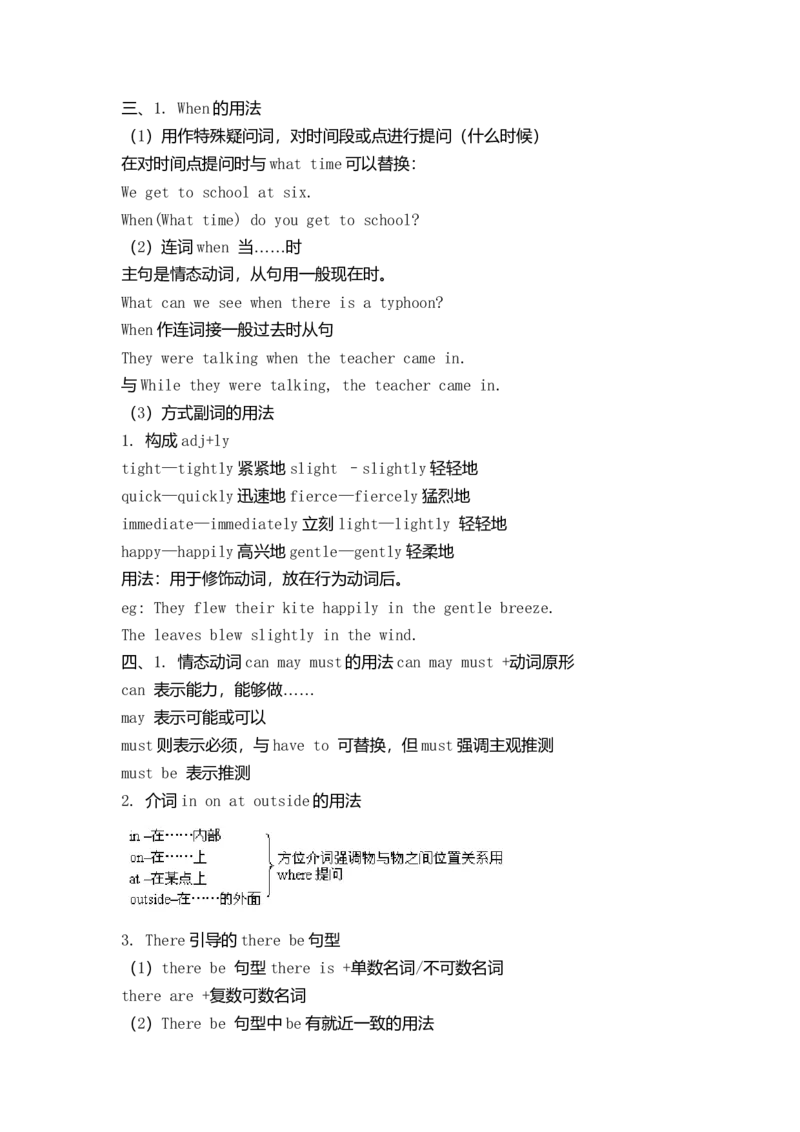
2. 介词in on at outside的用法
3. There引导的there be句型
(1)there be 句型 there is +单数名词/不可数名词
there are +复数可数名词
(2)There be 句型中be有就近一致的用法There is a pen and two rulers.
There are two rulers and a pen.
(3)There be 句型表示某地存在某物
(4)There be 与have的区别, There be 强词某地有某物,而have强调所属,
但有时可替换。
There are five floors in the building.
=The building has five floors.
五、被动语态:
▲意义:当谓语表示一个动作,主语和它可以有两种不同关系,即主动关系和
被动关系,表示被动关系时叫被动语态。
▲特点:动作执行者在被动语态中可以由介词by引导。
eg:History is made by people.
▲构成:be+动词的过去分词
eg:It is made of wood.
▲ 一般现在时的被动语态
is /are +过去分词
eg:They are respected(尊重)by everybody in the country.
▲一般将来时的被动语态
will be +动词过去分词
It will be finished next week.
▲一般过去时的被动语态
was /were +过去分词
It was built by Early men.
▲主动语态变被动语态
(1)原句中主语变为宾语,原句宾语变主语,变后的宾语由by引导
(2)注意时态,选择be的适当形式
(3)原句中动词变为过去分词
例: LuXun wrote this book in 1919.
This book was written by LuXun in 1919.
六、时态:一般现在时与一般过去时
一般现在时 一般过去时
定义 表示经常习惯的动作 表示过去经常习惯的动作构成 主+动原(或单三)+其它 主+过去式+其他
标志词 (1)every……(2)on (1)last……(2)yesterday
Sunday (3) ……ago
否定句 主+don”t /doesn”t+动原 主+didn”t+动原形+其他
+其他
一般疑问句 Does/Do+主+动原+其他 Did+主+动原+其他
注:动词过去式的构成
规则变化:
1. 动词后直接+ed �walk�walked
2. 以e结尾+d �close�closed
3. 双写词尾+ed �stop �stopped
4. 以辅音加y结尾� y变i+ed carry�carried
常见的不规则变化
is—was catch—caught
are—were drive—drove
go—went take—took
do—did find—found
七、
1. 介词 next to 紧挨着
opposite 在……对面
near在……附近
between……and…… 在……与……之间
2. 提建议的几种方法
(1)Shall we put the table next to the window?
(2)What about putting it over there?
(3)Would you like to put it over there?
(4)Let”s put it opposite the sofa.
(5)You”d better put it opposite the sofa.
八、
1. 一般疑问句
分类:(1)含有be动词的一般疑问句变法,be 动词提至主语前。
例:He is a teacher. Is he a teacher?
(2)含有情态动词的一般疑问句变法,情态动词提至主语前。
例:He can swim. Can he swim?(3)含有行为动词的一般疑问句变法,在主语前加Does/Do /Did,动词
变回原形。
例:He watches TV every day. Does he watch TV every day?
They go to school by bus. Do they go to school by bus?
They went to the beach yesterday. Did they go to the beach
yesterday?
2. 特殊疑问句
特殊疑问词+一般疑问句
常见的特殊疑问词
how long多久 what什么
how far多远 where哪里
how much多少 who谁
how many 多少 whose谁的
how soon 多久以后 which哪一个
(how)如何 when 什么时候
what colour 什么颜色 what time几点
3. 现在进行时
构成:主+be +动词ing
He is swimming.
句型转换:肯定句He is singing.
否定句 He isn”t singing.
一般疑问句 Is he singing?
提问:What is he doing?
动词ing的变法 ①直接词尾+ing sing singing
②以e结尾去e+ing take taking
③以一个辅音字母结尾重读闭音节单词sit�sitting
4. 形容词 (1)放在be动词后作表语。
(2)放在名词前做定语,It”s an interesting book.
本单元出现的形容词:
exciting/busy /interesting/convenient
/noisy /peaceful /quiet/pleasant/relaxing
九、
1. 情态动词。
(a)情态动词后动词用原形 例:We must go.(b)常用的几个情态动词
can能够,表示可能性及能力①I can swim. ②You can go there by bus.
could-can的过去式语气比could can委婉,多用于请求,Could you give me
an apple?
May 可以/可能 It may be a cat.
May I come in?
Must必须 We must go home at 5pm.
Mustn”t 一定不能(表示禁止)You mustn”t take animals to his
bedroom.
Need需要 You need go to hospital at once.
注must 引起的一般疑问句其否定回答不用mustn”t 而用needn”t
Must I go now?
No, you needn”t.
2. 祈使句(a)无主语 Open the door.
(b)动词用原形 Don”t run.
(c)常见的几种祈使句
①Open the window.
②Don”t swim in the river.
③No dogs.
④No smoking.
⑤Let”s go.
3. 介词
介词in on at
区别:(1)表示时间时 in +年/日/季节/早晚
on+星期/具体日期/具体早晚
at+具体时间点
in 1990/in May/in summer/in the morning
on Monday/on May 2nd/on a cold evening
at 7:00/at night/at noon
(2)表示地点in 在……里 in the box
on表示在表面上 on the desk
at 在具体某点 at the corner
十、
(一)提建议的几种方法1. Shall we +动词原形
Shall we go to the beach?
2. Let”s +动词原形(Let”s not+动原)
Let”s have a barbecue.
3. Would you like +to do
Would you like to go cycling?
4. Why don”t +句子
Why don”t we go to the concert?
5. Why not+动词原形
Why not have some seafood?
6. What about +动ing
What about going swimming?
7. You”d better +动原
You”d better go there by bus.
(二)Used to表示过去常常
used to +动词原形
I used to spend all my pocket money.
十一、语法
(1)wh特殊疑问句
when 表示时间 what 问内容 where 问地点
how 问情况如何 why 问原因 who 问人
根据答句补全问句
1. ________are they going to do?
They are going to have an international food festival.
2. ______are they going to do it?
It”s because they want to raise money for the SPCA.
3. ______are they going to do it?
They”re going to do it at school.
4. _____are they going to do it?
They”re going to do it on Saturday 1 March.
5. ____are they going to do it ?
They”re going to make different kinds of food.
6. ____is going to help them?
Peter”s father is going to help them.(2)一般将来时 be going to 表示打算
陈述句 主+be +going to +动词原形
否定 主+be +not + going to +动词原形
提问 特殊疑问句+be+主+going to +动原+其它。
I”m going to have a hot dog.
I”m not going to have a hot dog.
Are you going to have a hot dog ?
(3)用表示命令的动词表示命令,也是祈使句
①Sift the flour and the salt.
②Add the sugar.
③Use your hands to make it into a dough.
十二、
(一)问路与指路
1. 问路的方法
(1)How can I get to City Cinema?
(2)Which is the way to City Cinema?
(3)Could you tell me the way to City Cinema?
(4)Where is the nearest cinema?
(5)Is there a cinema near here?
2. 指路的方法
(1)Turn left / Turn right.
(2)Walk along Tree Road.
(3)Turn left into Rose street.
(4)You will find the city cinema on your right.
(二)so 与neither引起的倒装句。表示(……也是如此)
So +动词(助动词/情态动词/be动词)+主语—肯定
Neither +动词(助动词/情态动词/be动词)+主语—否定
举例:
(1)He can swim, so can I.
(2)Tom doesn”t like swimming. Neither do I.
(3)He “d rather go by bus. So would I.
十三、
(一)现在完成时
1. 构成 主语+have /has +过去分词+其它(时间)2. 句型转换 肯定句I have eaten rice for many years.
否定句 I haven”t eaten rice for many years.
一般疑问句 Have you eaten rice for many years?
3. 过去分词的构成(同过去式)��规则的
不规则的另见不规则动词表
规则的 ①直接加 ed want-wanted
②以e结尾加 d decide –decided
③双写字母最后加 ed wrap-wrapped
不规则(常见的)go –gone come- come eat-eaten have-had
sing-sung send-sent spend- spent send-sent
write-written read –read be –been see-seen
关键词 since+点时间 People have eaten turkey at Christmas since1650.
(二)which引导的句子做定语
A large log of wood which people usually burn on Christmas Eve.
(三)介词with的用法
1. with表示带有 the sweater with long sleeves
the dress with blue spots
2. with 表示与某人一致 agree with you
3. with 表示与……一起 come with me
[课堂练习]
一、a.用动词的适当形式填空
1. I ______(send)you a card in two days.
2. He ____(watch)TV last night.
3. Tom often _____(go)to school by bike.
4. Look, he _____(fly)a kite now.
5. I have _____(seen)this film.
b.用适当形式填空
1. Ben and Peter went home____(immediate).
2. The wind blew____(fierce).
3. They played ____(happy).
4. The clouds in the sky moved ___(quick).
5. The leaves blew____(slight).
c.用适当的介词
1. Put the table ______ the sofa and the TV.2. Tom sits _____ to jack.
3. The tree is in _____of the house.
4. The pen is ____the desk.
5. Put your shoes ____ the bed.
d.用适当疑问词填空
1. _______is Christmas Eve.
2. _______ don”t you go there by bus?
3. ________is my pen? It”s on the desk.
4. ______ will help us? Mum.
5. _______is the way to the park?
二、必考题型介绍
1. 单词拼写
(a)选择并抄写
(1)We”d like to take some_____(pictures /photos).
(2)Don”t fall asleep May, what”s the_____(time / matter)?
(b)根据汉语提示写出单词正确形式
(1)A _______(导游)will show you around Pairs.
(2)We had two world_______(战争)in the last century.
2. 根据图画词语配伍
3. 字母组词
(1)It”s a _____(i t p y) for Kitty not to go to Ben”s birthday
party.
(2)Put the ____(c i g n i)on the top of the cake.
4. 单词组句
(1)a lot of party the was fun
(2)book give will some the us ideas
5. 单项填空
(1)�What ___shall we have at the party?
�Let”s have some coke.
A. food B. drinks C. time D. books
(2)The scone is about 10 centimeters _____.
A. long B. tall C. wide D. thick
6. 完成对话
A: We need some money to buy computers for our school.___1_____B: I think we should have an international food festival.
A: Good idea!___2______
B: Let”s have it at our school.
A: ____3_____
B: Let”s have it on Saturday 6 June.
A: Oh, it is in two weeks” time.
B: Yes, that”s right.___4___
A: ___5______
B: We need to make different kinds of food.
7. 阅读
NAME BIRTHDAY LIKES HATES
Li Hua Fed.6.1982 dancing bread, rice
playing hamburgers,
Lily Mar.22.1956
basketball salad
vegetables,
Frank Nov.16.1978 singing talking
salad
Tina Aug.3.1966 writing, reading meat, sugar
根据图表信息,选择最佳答案
1. When is Lily”s birthday?
A. Mar.22 B. Fed.6 C. Nov.16 D. Aug.3
2. Li Hua likes______.
A. hamburgers and salad B. meat and sugar
C. singing and talking D. dancing
3. How old is Tina now(2006)?
A. Thirty-three years old. B. Forty years old.
C. Twenty years old. D. I don”t know.
4. Does Frank like vegetables and fruit?A. Yes, he does. B. Yes, she does. C. No, he doesn”t. D. No, she
doesn”t.
5. Who may like the NBA game?
A. Tina. B. Li Hua. C. Frank. D. Lily.
【模拟试题】
一、单词拼写15%
A)选择并抄写单词。(Write me word you choose)
1. Turkey has been a popular Christmas meal____(since,for) more than
300 years.
2. Do you prefer the jeans ____(to,with)the yellow belt?
3. I”d like to put some____(candles,photos)on Ben”s birthday
party.
4. Jack watched too_____(many,much)television 1ast week.
5. I used to run downstairs at schoo1. _____(But,Now)I walk
downstairs.
6. We sold different kinds of____(books,food)and drinks from
different countries.
7. Jimmy has a_____(sister,brother)called Alice.
8. Tom left and walk along Park Road,you will____(find,
look)McDonald”s on your right.
9. I”m selling American food. I”ve got some hot ________ (dogs,
apples).
10. My new ________ (shoes, socks) are too small. They hurt my feet.
根据汉语提示,写出单词的正确形式。(Write the word according to the
Chinese given in the brackets)
11. We are going to have a _________(烧烤).
12. I like gentle______(风). It makes me feel cool and comfortable.
13. There is not______(足够的) water for us to drink.
14. We”re going to have international food_____(节日) at our schoo1.
15. Which ____(电影) would you like to see this Sunday?
二、字母组词10%
16. Orange juice is too expensive. I”d _______have some water.
(thraer)
17. It”s too hot outside. Why not go to the____(hcaeb)?
18. Tim is getting____(tfa),so he has decided to eat fewer sweets.19. We need____(onmeseo)who can take care of sick people.
20. I”ll teach you how to make ice-cream. It will be
a_____(ealpsure).
21. The TV play will be____(satl)for about ten hours
22. I don”t know how to get the______(maneic)from my home.
23. Hold on. I”ll be back in a_____(tenmmo).
24. Boxing Day is a____(iclpub)holiday.
25. The changing room is_____(erov)there.
三、单词组句5%
26. don”t, them, size, I, in, have, your
_____________________________________________________
27. will, go, you, where, to, jeans, the, buy
_____________________________________________________
28. good, cooking, at, I”m
_____________________________________________________
29. on, will, you, find, the, your, shop, left
_____________________________________________________
30. can”t, it, I, then, make
_____________________________________________________
四、选择填空5%(Multiple choice)
31. 一It”s very hot. Let”s go swimming. 一____________
A.·Thank you.· B. Good idea! C. Will you? D. Perhaps not.
32.·I used to eat too many sweets when I was a child. I don”t eat
too many sweets __________.
A. any longer B. any more C. no longer D. no more
33. 一May I have something to eat? 一_____________
A. Give you. B. Over there. C. Here you are. D. There it is.
34. 一I don”t like Japanese food very much. 一____________
A.·Neither do I. B. So do I. C. Neither I do. D. So I do.
35. 一Have you studied at Rose Garden School?
一_____________
一For nearly three years.
A.·How often. B. How much. C. How many. D. How long.
五、补全对话10%A)从A—G中选出可以完成对话的最佳选项。
A:Happy New Year,James!
B:Oh,it”s you,Henry.
36_____________Do you enjoy your festival?
A:Sure. But do you know where I am?
B:37__________Tell me,please.
A:I”m in Australia.
B:Really? 38___________
A:It”s summer. It”s very hot and beautiful.
B:39______ I”m having hot pot with my family.
A:Say hello to them please.
B:OK. 40________
A:Yes,I will. And I”ll send you my postcards.
A. What a hot day it is!
B. Can you call me up later on?
C. What”s the weather like there?
D. But it”s snowing here.
E. Where are you now?
F. The same to you.
G. Where are you there?
B)填入适当的单词,使对话完整与正确。
A:Hello,Can I help you? What are you 1ooking for?
B:Good morning. Do you have any football — ___41__ of Jinde
Football Team?
A:Yes,just a minute. There are some cards over there. Take a
__42__they are great!
B:How ___43___are they?
A:They”re ¥10.
B:Oh,really? That”s 44_______expensive.
A:But we have some last year”s cards. They are only ¥6.
B:No, 45_______ you. I prefer new cards.
六、阅读理解10%(Reading Comprehension)
A)阅读短文,然后根据内容选择最佳答案。
Mei Ling has a new classmate in her class. His name is Peter. He
comes from New York. Everything is new to Peter. He doesn”t speakChinese. But he can speak English well.He can play many foreign
games,too. Miss Yang asks Mei Ling to look after him. Mei Ling is
very glad. She thinks she can learn English from Peter. Now she is
showing Peter around their schoo1. She is telling him something about
their schoo1. At noon Peter is sitting at the table with Mei Ling and
some other friends. They are having their lunch at schoo1. Mei Ling
teaches Peter how to use chopsticks. She and her friends tell him
something about Chinese food. Peter says Chinese are friendly and
Chinese food is very nice. They teach him to speak Chinese. Peter
tries so hard. Soon he can say a few Chinese words. They are friends
now.
46. Peter is Mei Ling”s new friend who comes from _________.
A. Canada B. Japan C. America D. England
47. What does Miss Yang ask Mei Ling to do?
A. Take care of Peter. B. Go around the school.
C. Cook some Chinese food. D. Help Peter with homework.
48. Where does Peter have lunch with his friends?
A. In his own house. B. At school.
C. At a big hotel. D. In Miss Yang room.
49. From the passage we know that Peter likes _______ in China.
A. the student and the schools B. the teachers and the games
C. the people and the food D. nothing to eat
50. Which of the following is not true?
A. Mei Ling feels happy to look after Peter.
B. Peter is visiting his new school with Mei Ling.
C. Mei Ling shows Peter around everywhere.
D. Peter can speak very good Chinese.
B)阅读短文,然后根据内容回答问题。
It is a beautiful spring morning. There isn”t a cold in the sky,and
the sun is warm but not too hot,so Mr. Andrews is surprised when he
sees all old gentleman at the bus stop with a big, strong black
umbrella in his hand.
Mr Andrews says to him, “Are we going to have rain today,do you
think?”
“No,” says the old gentleman,“I don”t think so.”
“Then are you keeping me umbrella to keep the sun off you?”
“No,the sun is not very hot in spring. ”Mr Andrews looks at the big umbrella again,and the gentleman says,
“I”m an old man, and my legs are not very strong,so I really need a
walking stick. But when I carry a walking stick,people say, “Look
at the poor old man”and I don”t like that. When I carry an umbrella
in fine weather,people only say, “Look at that silly man”.”
51. Where does Mr Andrews see the old gentleman?
52. What does the old gentleman take with him?
53. Does the old gentleman think it will rain?
54.Why is Mr Andrews surprised to see the old gentleman with an
umbrella in his hand?
55.Why does the old gentleman carry an umbrella?
七. 书面表达5%
用七句以上的英语给你的笔友写信或电子邮件,介绍你的家庭
1)注意书信格式
2)多运用本册所学知识点
一、1.for 2.with 3.candles 4.much 5.Now 6.food 7.sister 8.find
9.dogs 10.shoes 11.barbecue 12.wind 13.enough 14.festival 15.film
二、16.rather 17.beach 18.fat 19.someone 20.pleasure 21.last
22.cinema
23.moment 24.public 25.over
三、26.I don”t have them in your size.
27.Where will you go to buy the jeans?
28.I”m good at cooking.
29.You will find the shop on your left.
30.I can”t make it then.
四、31.B 32.A 33.C 34.A 35.D
五、36.F 37.E 38.C 39.D 40.B
41.cards 42.look 43.much 44.very(quite, too) 45.thank
六、A)46.C 47.A 48.B 49.C 50.D
B)51. At the bus stop. 52. A big, strong black umbrella in his hand.
53. No. 54. Because the weather is fine .
55. Because his legs are not very strong and he needs a walking
stick.
七、略年级 初中 学科 英语 版本 期数
内容标题 牛津版英语初一语法总结及练习、必考题型介绍
分类索引号G.622.475 分类索引描述 统考试题与题
解
主题词 牛津版英语初一语法总结及练习、必考题型介 栏目名称专题辅导
绍
供稿老师 审稿老师
录入 赵真真 一校 陈丽娜 二校 审核