Recycle 2
教材分析 本单元的主要学习内容是通过故事、活动等形式复习和巩固第4~6单元的核心词汇及句型
教学内容
·听、说、读、写并在实际情景中运用第4~6单元的核心句型
·在情景中运用句型“—What are…’s hobbies? —He / She likes + v-ing.”等简单句来询问和
描述某人的喜好
·在情景中正确运用句型“—Does he/she…? —Yes, he/she does./No, he/she doesn’t.”询问某人
是否做什么
·在情景中运用句型“—What does he/she do? —He / She is…”询问并回答某人的职业
·在情景中运用句型“Where does he work?”和“How does he go to work?”询问了解某人的
工作地点和出行方式
·运用句型“How does…feel?”询问某人的情绪并使用表示情绪的形容词来描述情绪
·运用句型“You should…”和“Don’t…”安慰他人和提供建议
·使用句型“What’s wrong?”询问他人状况
·听、说、读、写第4~6单元有关业余爱好、职业、情绪的单词或词组
·在有意义的语境中运用上述单词或词组
·知道英语句子有不同语调,并根据正确的语调朗读不同类型的句子
·知道英语句子中有连读、失去爆破,并正确朗读含有以上现象的句子
·知道句子有重音,并正确读出句子的重音
课时安排 第一课时: Page 66 & Page 67
第二课时: Page 68 & Page 69
3The first period(第一课时)
Page 66 & Page 67
教学内容
▶
Page 66 ·通过观察图片,听懂情景对话
·在情景中运用句型“—What does he/she do? —He / She is…”询问并回答某人的职业
·运用句型“—What are…’s hobbies? —He / She likes + v-ing.”来询问和描述某人的喜
好.
Page 67 ·运用句型“How does…feel?”询问某人的情绪
·使用表示情绪的形容词描述情绪
·运用句型“You should…”“Don’t…”安慰他人和提供建议
·使用句型“What’s wrong?”询问他人状况
教学重点
▶
能够在情景中复习和运用第4~6单元的核心句型。
教学难点
▶
能够在情景中合理运用所学句型。
教学准备
▶
1.预习《状元大课堂》《创优作业100分》《状元作业本》中本课时的相关内容。
2.PPT课件、课文录音等。
教学过程
▶
Step 1: Pre-learning
1. Greetings.
2. Brainstorm.① Teaching purpose①
Show some pictures of jobs on the PPT. (课件出示:一些职 PPT出示相关单词或词
业照片,附上单词或词组,如:teacher, postman, fisherman, fireman, 组,帮助学生唤醒旧知,为
后面的学习做好铺垫。
coach, scientist, pilot, businessman, factory worker, farmer, police
officer等) Help students review the words or the phrases of jobs.
3. A guessing game.
The teacher says some sentences to describe the jobs. And students
try to guess the jobs.
T:He works at sea. He likes fishing. What does he do?
S1:He’s a fisherman.
T:She works in a factory. What does she do?
S2:She’s a factory worker.
…
Ask several students to make riddles about jobs. Then say the
riddles to the class. The other students try to guess the jobs.
44. Read and do.
Show some words or phrases on the PPT. (课件出示:单词或
词组,如:happy, angry, sad, afraid, ill, worried, see a doctor, do
more exercise, take a deep breath, wear warm clothes, talk, run,
read books, play computer games, sing song等)
Ask students to make facial expressions or do actions while reading
the words or the phrases. Help students review the words of the feelings
and some activities.
5. I do, you say.
Ask some students to do actions to the class one by one. One
student asks, “What’s his/her hobby?” The other students try to guess.
Step 2: While-learning
P66② Teaching purpose②
1. Understand the background knowledge. 逐步帮助学生读懂题
Students read the background knowledge by themselves first. 目要求,引导学生学会听前
预测听力的重点内容,分步
Then the teacher introduces the background knowledge.
完成听力任务。并利用表格
T:Peter’s family are going to visit Ken’s family in another
帮助学生梳理信息,再运用
town. Peter’s father is talking about them.
这些信息进行对话练习,在
2. Guess the jobs.
情景中运用所学语言。
Students work in groups to guess the jobs of Ken’s family.
3. Listen and fill in the blanks.
(1)Play the recording. (课件出示:教材P66音频) Students
listen to the recording and try to write down their jobs on the
lines.
(2)The teacher and students check the answers together. (课件
出示:教材P66 第一题答案)
Praise the students who write the answers right.
4. Listen again. Write down the hobbies for the people.
(1)Play the recording again. (课件出示:教材P66音频) Students
listen to the recording and try to write down the hobbies for the
people on the lines.
(2)The teacher and students check the answers together. (课件
出示:教材P66 第二题答案)
Praise the students who write the answers right.
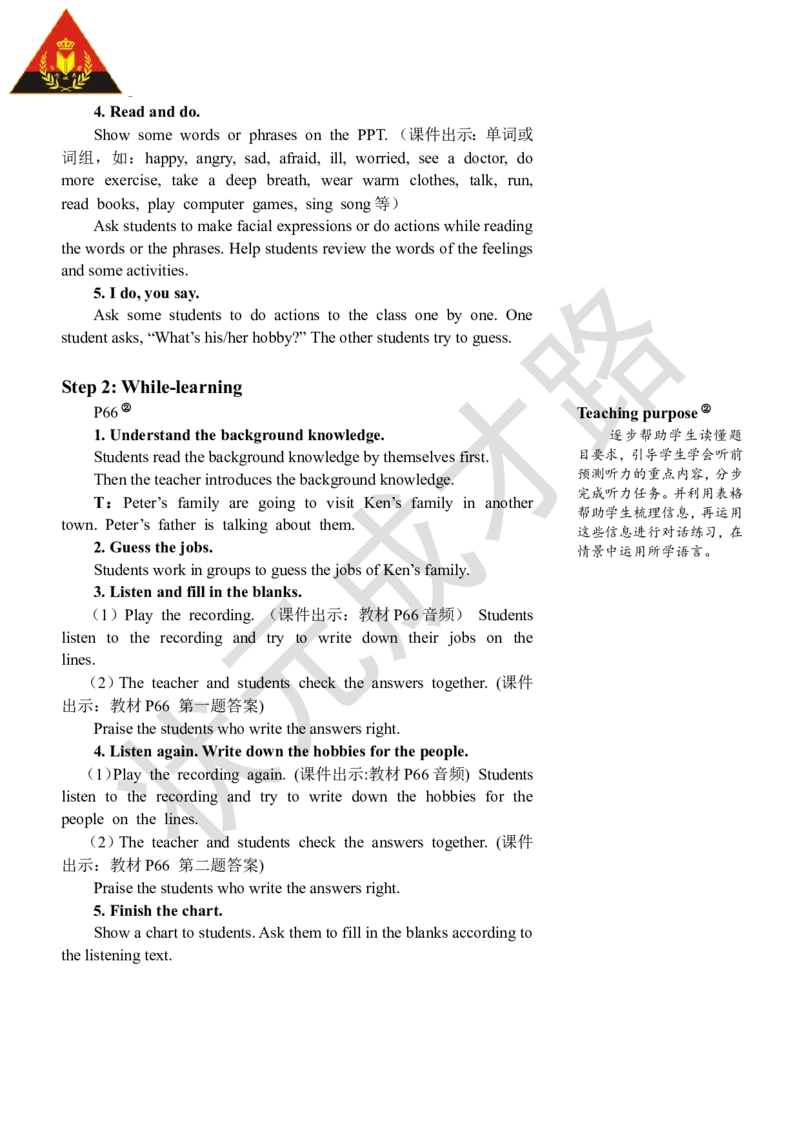
5. Finish the chart.
Show a chart to students. Ask them to fill in the blanks according to
the listening text.
56. Talk about Ken’s family.
Students work in pairs to talk about Ken’s family. Make a model:
T:Ken’s father is a farmer. What does his mother do?
S1:She’s a factory worker.
T:What’s her hobby?
S2:She likes reading.
…
P67③
Teaching purpose③
1. Look and talk.
引导学生观察和讨论
Students read the background knowledge by themselves first.
图片,并设置连线任务帮助
T:Peter’s family are on the bus. What are they doing on the
学生理解图片内容。借助完
bus? Now let’s have a look.
成后的连线任务引导学生
Point to Peter’s family in the picture and talk with students. 运用所学句型进行对话练
T:Who is she? 习,并在教学的过程中引导
Ss:She’s Peter’s mother. 学生培养安全意识。
T:What is she doing?
Ss:She’s reading.
T:How does she feel?
Ss:She feels sad.
…
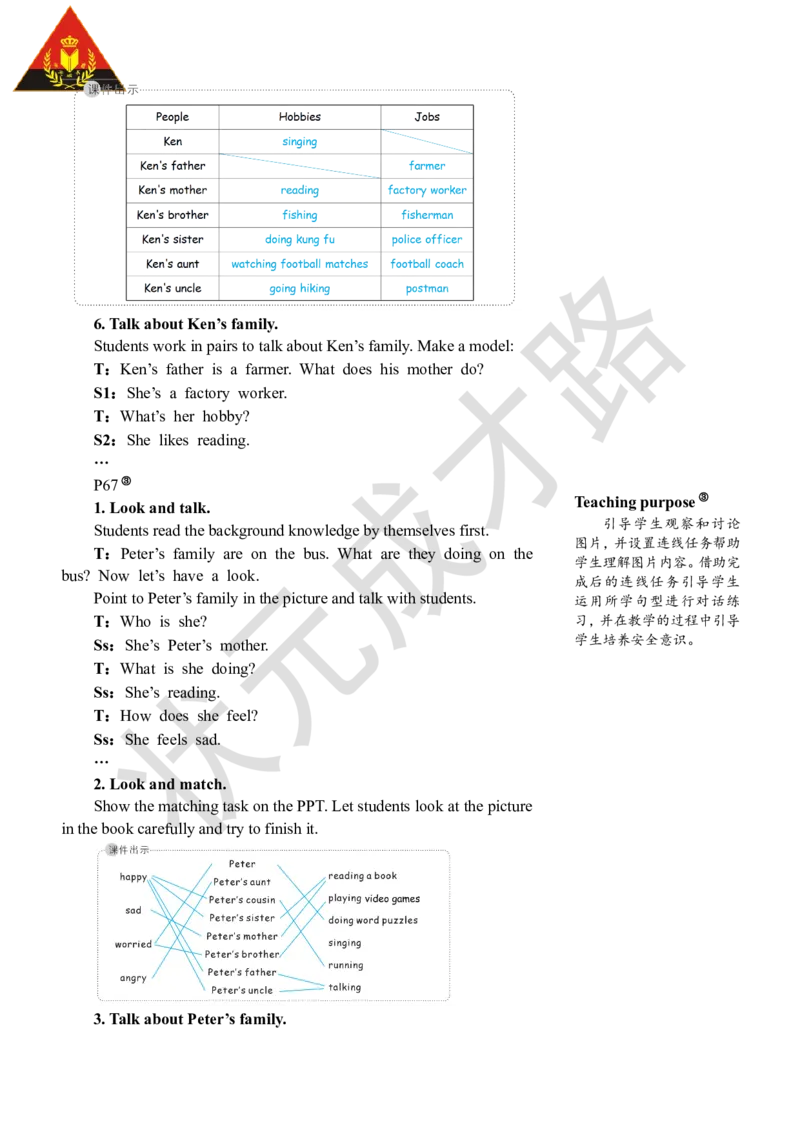
2. Look and match.
Show the matching task on the PPT. Let students look at the picture
in the book carefully and try to finish it.
3. Talk about Peter’s family.
6Ask students to talk about Peter’s family. Make a model:
T:Peter’s family are on the bus. What is his cousin doing?
S1:He’s running.
T:How does he feel?
S1:He feels happy.
T:How does Peter’s aunt feel?
S1:She feels angry.
T:Why?
S1:Because Peter’s cousin is running on the moving bus.
T:Yes. It’s very dangerous. So what can we say to him?
(Lead students to answer the question.)
S2:You should sit down.
S3:Don’t run on a moving bus.
…
Students work in pairs to talk about Peter’s family.
4. Talk about the pictures.
Show some pictures on the PPT. (出示课件) Lead students
to use the sentence structures “You should…/Don’t…” to comfort
others and give advice to others.
Step 3: Post-learning
1. Peter’s puzzle.
(1)Show the puzzle to students. (课件出示:教材P67的字谜)
T:Peter is doing word puzzles on the bus. This is Peter’s
puzzle. Let’s try to do it.
(2)Do the puzzle.
Students do the puzzle by themselves.
(3)Check the answers. (课件出示:教材P67的字谜的答案)
Praise the students who finish it quickly and well.
2. My dream career.④
(1)Create a situation.
T:There are many interesting things in our life. What do you Teaching purpose④
like to do? What’s your hobby? What do you want to be? Let’s 通过创设自然真实的
make a survey. For example, if you like fishing, you can be a 情景,让学生在情景中合理
fisherman. 运用所学语言。引导学生从
不同角度认识职业,构思自
(2)Make a demonstration.
己的理想职业,并作简单的
Show a chart to the class. (课件出示:调查表)
汇报,培养学生的语言综合
Make a demonstration with one student.
运用能力。
T:…, what’s your hobby?
S1:I like fishing.
T:What do you want to be?
7S1:I want to be a fisherman.
…
Fill in the chart according to the answers of students.
3. Work in groups.
T:Now please work in groups of four. Ask your partners’
hobbies and dream career and write down the answers in the
chart.
4Make a report.
Ask one student to make a model.
S1:I’m… I like… I want to be a/an…
…likes… He/She wants to be a/an…
Ask several students to try to make a report. The other students
listen to them and make evaluations.
板书设计
▶
作业设计
▶
1. Write down your dream career.
2. Do the exercises. (见“状元成才路”系列丛书《创优作业100分》或《状元作业本》对
应课时作业)
教学反思
▶
1. 充分发挥多媒体辅助作用,有效利用课件帮助学生学习。
2. 教学设计层次分明,逐步引导、帮助学生学习。引导学生听前预测,分步完成听力任务,并利
用表格帮助学生梳理信息,再运用这些信息进行对话练习,层层递进,引导学生逐步完成学习任务。
3. 引导学生在情境中理解,在活动中运用,突出语用功能。通过创设合理情景,帮助学生在情
景中真实自然地复习和使用所学语言,突出了教学重点。
4. 通过创设自然真实的情境,让学生在情境中合理运用所学语言,培养学生的语言综合运用能
力,从而达到学以致用的目的。
8▶Teaching Contents
Page 66
·Understand the listening material by observing the picture.
·Ask and answer about someone’s occupation by using the sentence structures “—What does
he/she do? —He / She is…” in scenes.
·Ask and describe someone\'s hobbies by using the sentence structures “—What are…’s
hobbies? —He / She likes + v-ing.”
Page 67
·Ask about someone’s feelings by using the sentence structure “How does…feel?”
·Use emotional adjectives to describe feelings.
·Use the sentence structures “You should…/Don’t… ” to comfort others and offer advice.
·Ask about other people by using the sentence “What’s wrong?”
▶Teaching Priorities
·Be able to review and use the key sentence structures of Unit 4 to Unit 6 properly.
▶Teaching Difficulties
·Be able to review and use the key sentence structures in situations properly.
▶Teaching Procedures
9Teaching
Teacher’ s Activities Students Activities Teaching Purposes
Stages
Pre-learning 1. Greetings. 1. Greetings. Show relevant words or
2. Brainstorm. 2. Review the words or phrases on the PPT.
Show some pictures of jobs the phrases of jobs. Help students activate
on the PPT. 3. Guess the jobs the old knowledge.
3. A guessing game. according to the Prepare for the later
Say some sentences to teacher’s sentences. learning.
describe the jobs. Then several students
4. Read and do. make riddles and the
Show some words or phrases other students guess the
on the PPT. jobs.
5. I do, you say. 4. Make facial expressions
Ask some students to do or do actions and
actions to the class one by review the words of
one. feelings and some
activities.
5. Do actions to the class
one by one. One student
asks, the other students
try to guess.
While-learning P66 1. Read and understand Help students
1. Understand the background the background understand the
knowledge. knowledge. requirements of the
Introduce the background 2. Work in groups to guess questions. Lead
knowledge. the jobs of Ken’s students to predict the
2. Guess the jobs. family. key content of listening
3. Listen and fill in the blanks. 3. (1) Listen and write text before listening,
(1)Play the recording. down the jobs. and then complete the
(2)Check the answers. (2) Check the answers. listening task step by
4. Listen again. Write down the 4. (1) Listen again. Write step. Help students sort
hobbies for the people. down the hobbies for out the information by
(1)Play the recording again. the people. using the chart, then
(2)Check the answers. (2) Check the answers. lead them to use the
5. Finish the chart. 5. Try to fill in the blanks information for
6. Talk about Ken’s family. according to the dialogue practice.
listening text.
6. Work in pairs to talk
about Ken’s family.
10(续表)
Teaching
Teacher’ s Activities Students’ Activities Teaching Purposes
Stages
While-learning P67 1. Read and understand the Lead students to
1. Look and talk. background knowledge. observe and discuss the
Introduce the Look at the picture and talk picture, and set the
background about it. matching task to help
knowledge. 2. Look at the picture carefully them understand the
2. Look and match. and try to finish the picture. Lead students
3. Talk about Peter’s matching task. to develop safety
family. 3. Work in pairs to talk about awareness in the
4. Talk about the Peter’s family as the model. process of teaching.
pictures. 4. Use the sentence structures
“You should…/Don’t …” to
comfort others and give
advice to others.
Post-learning 1. Peter’s puzzle. (1)Observe the puzzle. Help students practice
(1)Show the puzzle to (2)Do the puzzle. the key words and
students. (3)Check the answers. sentence structures.
(2)Ask students to do Train students’ ability
the puzzle. of expressing in scenes,
(3)Check the answers. and prepare for the
Praise the students expansion of
who finish it communication
quickly and well. activities.
2. My dream career. Work in groups of four. Ask Create a natural and
(1)Create a situation. and write down the answers in real situation. Help
(2)Make a the chart. students use the
demonstration. Then several students try to language reasonably in
3. Work in groups. make a report. The other the situation. Help them
4. Make a report. students listen to them and understand occupations
make evaluations of their from different
reports. perspectives and
conceive their own
dream career. Develop
students’
comprehensive
language using ability.
1. Write down your dream career.
Homework
2. Do the exercises.
11