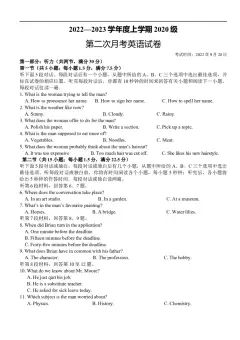
2022—2023 学年度第一学期高三级部学科练习二
英语 学科(共 5 页) 2022 年 12 月
二. 单项填空(共 15 小题;每小题 1 分,满分 15 分)
16. —Will you be able to get me a ticket to the concert?
— . I won’t let you down.
A. Think nothing of it B. Never mind C. No problem D. No way
17. As soon as the shoes that the boy wanted to buy were in the store, the salesgirl called him.
A. available B. possible C. present D. convenient
18. The movie, a poor, mountainous area where a girl works at a young age to support her family, moved
us deeply.
A. being set in B. to set in C. set in D. setting in
19. This hat looks more beautiful than that one which costs almost twice .
A. as much B. as many C. so much D. so many
20. In the country Bhutan, weather vary dramatically from place to place, day to day or even within the
same day.
A. can B. shall C. must D. need
21. As a language grows, new words are introduced _ many words fall out of use.
A. unless B. so that C. while D. in case
22. A Midsummer Night’s Dream at the Theatre Royal on 19th June, and then tours throughout Scotland.
A. opens B. is opened C. will open D. will be opened
23. —Bob isn’t feeling very well today. He has caught a cold.
—Everybody seems to have , owing to the sudden change of weather.
A. one B. it C. that D. another
24. Jack answered all the questions with ease, a confident smile throughout the interview.
A. wearing B. withdrawing C. widening D. weighing
25. All the drivers have been warned that driving after drinking shall _ serious accidents.
A. bring up B. bring about C. bring in D. bring back
26. As expected, the boy who shows great in playing badminton has been admitted to the sport university
for his talent.
A. requirement B. respect C. addition D. promise
27. I’ll ask the teacher about the subjunctive mood I’m very puzzled about; and that’s also most
of our classmates have doubt.
A. which; what B. why; that C. which; where D. that; how
28.-How are you doing with the job hunting?
-I’m still hesitating whether to accept the position I at the job fair.
A. had been offered B. was offered C. offered D. had offered
29.The voyages of travelers before the 17th century show that they were not the sea even though they didn’t
have modern navigational(航海的) aids.
A. at the expense of B. at the risk of C. in the way of D. at the mercy of
30. --Where have you been, Alice? You’re over an hour late.
--Yes, but . I was late getting off work and then I missed the bus.
A. I had no idea B. I couldn’t help it C. that’s not the point D. that didn’t count
三. 完形填空(共 20 小题;每小题 1.5 分,满分 30 分)
It was a terrible day. Snow had been falling all day long, making the trip __31 . I would rather have been in my
warm home than drive along on such a cold day, but I didn’t have a 32 . I had to have my paper work handed
in and then 33 my son.
The snow continued to fall as we drove along for the 15-mile trip back home. I slowed the car and 34at my son in his heavy coat as he looked 35 out of the window with a blank expression. In the 36 of the
world he was looked upon as a mentally disabled child. 37 , over the years what I saw was a beautiful, kind
and 38 soul. He had shown me more about love than I could have ever 39 on my own.
I slowed the car even more as we 40 a sharp curve (弯). As we rounded it I saw a shivering (颤抖的),
young woman in a 41__ jacket walking in the snow storm. I pulled over and let her in. She was heading for her
Mom’s house to visit her 42 whom she hadn’t seen for months. She had experienced a lot of disappointments
and 43 . Yet, she still held out hope for a new job and tried to 44 a new life for her son and herself.
I took her as 45__ as I was able to and dropped her off. She thanked me for the 46 and I told her I
wished I could have done more to help. Then as we were about to leave, my sweet son took off his coat, 47
down the window and gave it to her. She put it on, smiled and 48 to us as we pulled out on the road.
In this world we will 49 many problems and challenges. Sometimes it seems that our entire lives are a
trip down a curvy and dangerous road. Yet the power of 50 takes us straight back to a broad smooth highway.
31. A. smooth B. funny C. risky D. special
32. A. change B. chance C. reason D. choice
33. A. call on B. pick up C. seek for D. look up
34. A. glanced B. laughed C. stared D. shouted
35. A. excitedly B. peacefully C. sadly D. fearfully
36. A. history B. development C. eyes D. systems
37. A. However B. Therefore C. Meanwhile D. Besides
38. A. dirty B. sensitive C. painful D. merciful
39. A. dreamed B. learned C. concluded D. ignored
40. A. expected B. left C. approached D. discovered
41. A. new B. heavy C. comfortable D. light
42. A. son B. daughter C. mother D. father
43. A. adventures B. puzzles C. tragedies D. doubts
44. A. predict B. suffer C. save D. build
45. A. far B. long C. soon D. much
46. A. money B. coat C. gift D. lift
47. A. burned B. rolled C. tore D. shut
48. A. cried B. pointed C. waved D. wrote
49. A. face B. overcome C. create D. bear
50. A. nature B. love C. minds D. wills
四. 阅读理解(共 20 小题;每小题 2.5 分,满分 50 分)
A
You may be surprised to learn that one of the best steps you can take to protect your health is to step outside
and spend some time in the grass, dirt and water. Our ancestors enjoyed the healing power of nature, and now
scientists are starting to catch up. Researchers have documented how contact with nature can decrease mental
tiredness, and enhance moods, concentration and problem-solving. Just having a view of nature has been shown
to improve hospital patients’ recovery and reduce illness rates. Exposure to the open air, horseback riding, hiking,
camping can be helpful for a variety of health conditions in adults and children. Much of this type of research is
focusing on children, and in fact an entire movement has quickly developed to connect kids with the healing
power of nature.
Obesity. Rates of childhood, adult obesity and related conditions including diabetes(糖尿病) and heart
disease have grown greatly in recent years, partly because of reducing the time of outdoor activities. This problem
can be partly addressed by increasing the time students spend learning about nature, both in and outside the
classroom. Such lessons are often more engaging to students and often lead them to become more active outside.
Attention deficit hyperactivity disorder (ADHD) (注意力缺失症).An exposure to ordinary natural settings
in the course of common after•school and weekend activities may be widely effective in reducing attentionshortness symptoms( 症 状 ) in children. Participation in green activities helps ADHD patients keep focused and
complete tasks.
Stress. Access to nature, even houseplants, can help children deal with stress.
Depression and seasonal emotional disorder. Major depression requires medical treatment, but physical
activity, especially those done outdoors, can help ease symptoms. Staying in the sunshine for just a few minutes
can also help supply bone-building vitamin D. Experts say that simply walking in a city park can enjoy nature’s
benefits.
51.According to the passage, which of the following is the most important for you to keep healthy?
A. Healthy diet. B. Exercises. C. Outdoor activities. D. No smoking.
52.The underlined word “enhance” in Paragraph 1 is closest in meaning to .
A. improve B. add C. destroy D. control
53. From the first paragraph, what do we know?
A. People didn’t enjoy the healing power of nature until recent years.
B. Having a view of nature is the only way to improve health conditions.
C. Outdoors activities are good for people’s health.
D. Researchers have found out what causes people’s mental tiredness and illness.
54.The effects of outdoor activities include all of the following EXCEPT .
A. helping people to control stress
B. helping children to increase the vitamin D level
C. helping people to reduce the symptoms of ADHD
D. helping scientists to believe the rates of adult obesity and the healing power of the open air
55.What would be the best title for the passage?
A. Contact with Nature B. The Benefits of Nature to Health
C. Exposure to the Open Air D. Some Health Conditions
B
Eddie McKay, a once-forgotten pilot, is a subject of great interest to a group of history students in Canada.
It all started when Graham Broad, a professor at the University of Western Ontario, found McKay's name in a
footnote in a book about university history. Mckay was included in a list of university alumni ( 校 友 ) who had
served during the First World War, but his name was unfamiliar to Broad, a specialist in military history. Out of
curiosity, Broad spent hours at the local archives (档案馆) in a fruitless search for information on Mckay. Tired
and discouraged, he finally gave up. On his way out, Broad's glance happened to fall on an exhibiting case
showing some old newspapers. His eye was drawn to an old picture of a young man in a rugby uniform. As he
read the words beside the picture, he experienced a thrilling realization." After looking for him all day, there he
was, staring up at me out of the exhibiting case," said Broad. Excited by the find, Broad asked his students to
continue his search. They combed old newspapers and other materials for clues. Gradually, a picture came into
view.
Captain Alfred Edwin McKay joined the British Royal Flying Corps in 1916. He downed ten enemy planes,
outlived his entire squadron ( 中 队 ) as a WWI flyer, spent some time as a flying instructor in England, then
returned to the front, where he was eventually shot down over Belgium and killed in December 1917. But there's
more to his story. “For a brief time in 1916 he was probably the most famous pilot in the world," says Broad. “He
was credited with downing Oswald Boclcke, the most famous German pilot at the time." Yet, in a letter home,
McKay refused to take credit, saying that Boelcke had actually crashed into another German plane.
Mckay's war records were destroyed during a World War II air bombing on London—an explanation for why
he was all but forgotten.
But now, thanks to the efforts of Broad and his students, a marker in McKay's memory was placed on the
university grounds in November 2007. “I found my eyes filling with tears as I read the word ‘deceased’ ( 阵 亡 )
next to his name," said Corey Everrett, a student who found a picture of Mckay in his uniform. “This was such a
simple example of the fact that he had been a student just like us, but instead of finishing his time at Western, he
chose to fight and die for his country."
56.What made Professor Broad continue his search for more information on McKay?A. A uniform of McKay. B. A footnote about McKay
C. A book on McKay D. A picture of McKay
57.What did the students find out about McKay?
A. He trained pilots for some time. B. He lived longer than other pilots.
C. He died in the Second World War. D. He was downed by the pilot Boelcke.
58. McKay's flying documents were destroyed in .
A. Belgium B. Germany C. Canada D. England
59.We can learn from the last paragraph that McKay .
A. preferred fight to his study B. went to war before graduation
C. left a picture for Corey Everrett D. set an example for his fellow students
60.What is the text mainly about?
A. The research into war history. B. The finding of a forgotten hero.
C. The pilots of the two world wars. D. The importance of military studies.
C
With eco-tourism on the rise, eco-hotels are fast becoming the darling of the travel industry. These days,
however, staying at an eco-hotel doesn’t necessarily mean vacationing in a tree house in the Costa Rican jungle,
although that is certainly a choice.
The majority of eco-hotels fall into one of several categories: hotels and resorts that conserve ecologically
important habitats; “green” hotels that reduce, recycle, minimize waste, and protect water; sustainable hotels that
harvest food from gardens on the hotel property or get part or all of their power from renewable energy; hotels
that encourage community involvement such as guests taking part in trail clearing; and hotels that offer some
form of environmental education to their guests.
As such, eco-hotels are a various group. Stylish urban hotels like the Willard Inter-Continental Washington
focus on energy conservation whereas the Rosario Resort & Spa on Orcas Island in Washington State offers a
wildly popular “green” vacation package where guests can “take a hike, clear a trail”.
No matter what you call them, eco-hotel, eco-lodge, eco-resort, or green hotel, they’re all part of the
“greening” of the tourism industry.
Part of what drives this greening of the hotel industry is no doubt competition. Going green is yet another way
to distinguish a hotel from the mass of other excellent hotels that consumers have to choose from. But for many
hotels, it’s also part of their philosophy. With the concept of “going green” firmly rooted in consumers’ minds,
eco-hotels have taken it to the next level, and whether or not money is the driving factor behind the greening of
the hotel industry doesn’t matter so much as it’s good for the planet.
61.The underlined part in the first paragraph means .
A. lovers like staying at an eco-hotel when traveling
B. eco-hotels are very popular in the travel industry
C. eco-hotels are where young people love to live
D. romantic love stories often happen in eco-hotels
62.According to the pa ssage, which of the following can match the idea of eco-hotel?
A. It uses renewable energy. B. It is comfortable and fashionable.
C. It has walls of glass. D. It is home to endangered species.
63. From the passage, we know the Rosario Resort & Spa is a kind of hotel that .
A. protects important habitats
B. harvests food from its own garden.
C. has courses on the environment for its guests
D. encourages its guests to participate in its greening activities
64. From the last paragraph, we can learn that .
A. money is part of the driving force behind eco-hotels
B. eco-hotels have no advantages in competing for guests
C. eco-hotels teach their guests the philosophy of eco-hotelsD. the hotel industry cares more about money than the environment
65. People who choose to stay at eco-hotels .
A. love to take a hike B. have environmental awareness
C. want to live comfortably D. enjoy the green atmosphere
D
For those who make journeys across the world, the speed of travel today has turned the countries into a series
of villages. Distances between them appear no greater to a modern traveler than those which once faced men as
they walked from village to village. Jet planes fly people from one end of the earth to the other, allowing them a
freedom of movement undreamt of a hundred years ago.
Yet some people wonder if the revolution in travel has gone too far. A price has been paid, they say, for the
conquest (征服) of time and distance. Travel is something to be enjoyed, not endured(忍受) . The boat offers
leisure and time enough to appreciate the ever- changing sights and sounds of a journey. A journey by train also
has a special charm about it. Lakes and forests and wild, open plains sweeping past your carriage window create a
grand view in which time and distance mean nothing. On board a plane, however, there is just the blank blue of
the sky filling the narrow windows of the airplane. The soft lighting, in-flight films and gentle music make up the
only world you know, and the hours progress slowly.
Then there is the time spent being‘processed’at a modern airport. People are conveyed like robots along
walkways; baggage is weighed, tickets produced, examined and produced yet again before the passengers move
to another waiting area. Journeys by rail and sea take longer, yes, but the hours devoted to being‘processed’at
departure and arrival in airports are luckily absent. No wonder, then, that the modern high- speed trains are
winning back passengers from the airlines.
Man, however, is now a world traveler and cannot turn his back on the airplane. The working lives of too
many people depend upon it; whole new industries have been built around its design and operation. The holiday-
maker, too, with limited time to spend, patiently endures the busy airports and the limited space of the flight to
gain those extra hours and even days, relaxing in the sun. Speed controls people’s lives; time saved, in work or
play, is the important thing—or so we are told. Perhaps those first horsemen, riding free across the wild, open
plains, were enjoying a better world than the one we know today. They could travel at will, and the clock was not
their master.
66.What does the writer try to express in Paragraph 1?
A.Travel by plane has speeded up the growth of villages.
B.The speed of modern travel has made distances relatively short.
C.The freedom of movement has helped people realize their dreams.
D. Man has been fond of traveling rather than staying in one place.
67. How does the writer support the underlined statement in Paragraph 2?
A. By giving instructions. B. By analyzing cause and effect.
C. By following the order of time. D. By giving examples.
68.According to Paragraph 3, passengers are turning back to modern high- speed trains because ............
A. they pay less for the tickets B. they feel safer during the travel
C. they can enjoy higher speed of travel D. they don’t have to waste time being 'processed’
69.What does the last sentence of the passage mean?
A. They could enjoy free and relaxing travel. B. They needed the clock to tell the time.
C. They preferred traveling on horseback. D. They could travel with their master.
70.What is the main idea of the passage?
A. Air travel benefits people and industries. B. Train travel has some advantages over air travel.
C. Great changes have taken place in modern travel. D. The high speed of air travel is gained at a cost.
五. 阅读表达(共 5 小题;每小题 2 分,满分 10 分)
Elizabeth Holmes was named to last year’s TIME 100 list of the world's most influential people because she
developed a high tech approach to blood testing. She's being compared to people like Bill Gates and Steve Jobs.Just as Gates wanted a computer on every desk, Holmes wants a blood test in every drugstore. Her
company, Theranos, has created what they call a painless, needle-free way to draw blood and test it.
Instead of a needle to the arm, it's a pin prick (刺穿,扎穿) to the finger.
At 19 years old, Holmes dropped out of Stanford University. Now, at 31, she's what lots of teenagers
likely try hard to become: the youngest female billionaire in the world. Her company is now valued at
close to $10 billion. "You know, money is not what matters," Holmes said. "What matters is how well we
do in trying to make people's lives better. That's why I'm doing this. That's why I work the way that I
work. And that's why I love what I'm doing so much." Holmes is marketing Theranos as a faster and
cheaper alternative to a process that hasn't changed meaningfully in decades.
Theranos struck a partnership with drugstore chain Walgreens to build thousands of Wellness
Centers. Every center would offer a menu of blood tests — ranging from cancer to cholesterol (胆固醇)
— directly to consumers. And every test, Holmes said, would cost only a small part of what Medicare
pays.
Not everyone is sold just yet. Some critics argue the Theranos method doesn't extract enough blood
to do all the tests it claims." Every time you create something new, there should be questions, and to me
that's a sign that you've actually done something that is transformative," Holmes said.
For as much promise as those tiny samples hold, Holmes is already known as a very real and rare
example of what perseverance (坚持不懈) makes possible. She was young when she decided she wanted
to change the world, and at nine years old she wrote a letter explaining her dreams to her dad: "What I
really want out of life is to discover something new, something that mankind didn't know was possible to
do."
71.Why was Elizabeth Holmes named to last year’s TIME 100 list? (no more than 15 words)
72.According to Holmes, why does she love her work so much? (no more than 15 words)
73.Who will pay for her consumers’ blood tests? (no more than 3 words)
74. How do you understand the underlined sentence in Paragraph 5? (no more than 10 words)
75.What do you think of Holmes? Why? (no more than 20 words)
六.书面表达(满分 25 分)
76. 目前一些学生因为各种原因很少参加体育锻炼,假定你是某学校的学生会主席李华,为配合
你校正在开展的“体育运动周”活动,请你用英语写一封倡议书,号召全校同学积极参加体育锻炼。
内容包括:
1. 参加体育锻炼的好处。
2. 介绍一些适合学生做的体
育项目。注意:
1. 词数不少于 100;
2. 可适当加入细节,以使行文连贯;
3. 开头已给出,不计入总词数。
Dear fellow students,
I am Li Hua, chairman of the Student Union.
学科网(北京)股份有限公司Student Union
学科网(北京)股份有限公司