1997 年全国硕士研究生入学统一考试英语试题
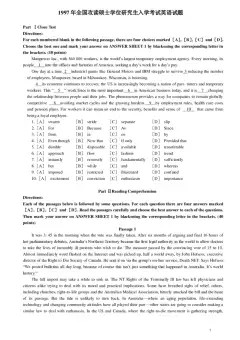
Section I Use of English
Directions:
For eachnumberedblank inthefollowingpassage, therearefourchoicesmarked [A], [B], [C]
and[D]. Choose the best one and mark your answer on ANSWER SHEET 1 by blackening the
correspondingletterinthebrackets.(10points)
Manpower Inc., with 560 000 workers, is the world’s largest temporary employment agency.
Every morning, itspeople 1 into theofficesand factories ofAmerica, seeking a day’s work for a
day’spay.
One day at a time. 2 industrial giants like General Motors and IBM struggle to survive
3 reducingthenumberofemployees,Manpower,basedinMilwaukee,Wisconsin,isbooming.
4 itseconomy continuestorecover,theUSis increasingly becoming anation of part- timers
and temporary workers. This “ 5 ” work force is the most important 6 in American business
today, and it is 7 changing the relationship between people and their jobs. The phenomenon
provides a way for companies to remain globally competitive 8 avoiding market cycles and the
growing burdens 9 by employment rules, health care costs and pension plans. For workers it can
meananendtothesecurity,benefitsandsenseof 10 thatcamefrombeingaloyalemployee.
1.[A] swarm [B] stride [C] separate [D] slip
2.[A] For [B] Because [C] As [D] Since
3.[A] from [B] in [C] on [D] by
4.[A] Eventhough [B] Nowthat [C] If only [D] Providedthat
5.[A] durable [B] disposable[C] available [D] transferable
6.[A] approach [B] flow [C] fashion [D] trend
7.[A] instantly [B] reversely [C] fundamentally[D] sufficiently
8.[A] but [B] while [C] and [D] whereas
9.[A] imposed [B] restricted [C] illustrated [D] confined
10.[A]excitement [B] conviction[C] enthusiasm [D] importance
Section Ⅱ Reading Comprehension
PartA
Directions:
Each of the passages below is followed by some questions. For each question there are four answers
marked [A], [B], [C] and [D]. Read the passages carefully and choose the best answer to each of the
questions. Then mark your answer on theANSWER SHEET 1 by blackening the corresponding letter
inthebrackets.(40points)Text 1
It was 3: 45 in the morning when the vote was finally taken. After six months of arguing and
final 16 hours of hot parliamentary debates, Australia’s Northern Territory became the first legal
authority in the world to allow doctors to take the lives of incurably ill patients who wish to die. The
measure passed by the convincing vote of 15 to 10.Almost immediately word flashed on the Internet
and was picked up, half a world away, by John Hofsess, executive director of the Right to Die Society
of Canada. He sent it on via the group’s on-line service, Death NET. Says Hofsess: “We posted
bulletins all day long, because of course this isn’t just something that happened in Australia. It’s
worldhistory.”
The full import may take a while to sink in. The NT Rights of the Terminally Ill law has left
physicians and citizens alike trying to deal with its moral and practical implications. Some have
breathed sighs of relief, others, including churches, right-to-life groups and the Australian Medical
Association, bitterly attacked the bill and the haste of its passage. But the tide is unlikely to turn back.
In Australia—where an aging population, life-extending technology and changing community
attitudes have all played their part—other states are going to consider making a similar law to deal
with euthanasia. In the US and Canada, where the right-to-die movement is gathering strength,
observersarewaitingfor thedominoestostartfalling.
Under the new Northern Territory law, an adult patient can request death—probably by a deadly
injection or pill—to put an end to suffering. The patient must be diagnosed as terminally ill by two
doctors. After a “cooling off” period of seven days, the patient can sign a certificate of request. After
48 hours the wish for death can be met. For Lloyd Nickson, a 54-year-old Darwin resident suffering
from lung cancer, the NT Rights of Terminally Ill law means he can get on with living without the
haunting fear of his suffering: a terrifying death from his breathing condition. “I’m not afraid of dying
from a spiritual point of view, but what I was afraid of was how I’d go, because I’ve watched people
dieinthehospitalfightingfor oxygen andclawingattheirmasks,”hesays.11.Fromthesecondparagraphwelearnthat .
[A] theobjectiontoeuthanasiaisslowtocomeinothercountries
[B] physiciansandcitizenssharethesameviewoneuthanasia
[C] changingtechnology ischieflyresponsiblefor thehastypassageofthelaw
[D] ittakestimetorealizethesignificanceofthelaw’spassage
12.Whentheauthorsaysthatobserversarewaitingfor thedominoestostartfalling,hemeans .
[A] observersaretakingawait-and-seeattitudetowardsthefutureofeuthanasia
[B] similarbillsarelikelytobepassedintheUS,Canadaandothercountries
[C] observersarewaitingtoseetheresultofthegameofdominoes
[D] theeffect-takingprocessofthepassedbillmayfinallycometoastop
13.WhenLloyd Nicksondies,hewill .
[A] facehisdeathwithcalmcharacteristicofeuthanasia
[B] experiencethesufferingof alungcancerpatient
[C] haveanintensefearofterriblesuffering
[D] undergoacoolingoffperiodofsevendays
14.Theauthor’sattitudetowardseuthanasiaseemstobethatof .
[A] opposition
[B] suspicion
[C] approval
[D] indifferenceText 2
A report consistently brought back by visitors to the US is how friendly, courteous, and helpful
most Americans were to them. To be fair, this observation is also frequently made of Canada and
Canadians, and should best be considered North American. There are, of course, exceptions.
Small-minded officials, rude waiters, and ill-mannered taxi drivers are hardly unknown in the US. Yet
itisanobservationmadesofrequentlythatitdeservescomment.
For a long period of time and in many parts of the country, a traveler was a welcome break in
an otherwise dull existence. Dullness and loneliness were common problems of the families who
generally lived distant from one another. Strangers and travelers were welcome sources of diversion,
andbroughtnewsoftheoutsideworld.
The harsh realities of the frontier also shaped this tradition of hospitality. Someone traveling
alone, if hungry, injured, or ill, often had nowhere to turn except to the nearest cabin or settlement. It
was not a matter of choice for the traveler or merely a charitable impulse on the part of the settlers. It
reflected the harshness of daily life: if you didn’t take in the stranger and take care of him, there was
nooneelsewhowould.Andsomeday,remember,you mightbeinthesamesituation.
Todaythere aremany charitableorganizationswhich specialize in helpingthewearytraveler.Yet,
the old tradition of hospitality to strangers is still very strong in the US, especially in the smaller cities
and towns away from the busy tourist trails. “I was just traveling through, got talking with this
American, and pretty soon he invited me home for dinner—amazing.” Such observations reported by
visitors to the US are not uncommon, but are not always understood properly. The casual friendliness
of many Americans should be interpreted neither as superficial nor as artificial, but as the result of a
historicallydevelopedculturaltradition.
As is true of any developed society, in America a complex set of cultural signals, assumptions,
and conventions underlies all social interrelationships. And, of course, speaking a language does not
necessarily mean that someoneunderstandssocialand culturalpatterns.Visitorswho fail to “translate”
cultural meanings properly often draw wrong conclusions. For example, when an American uses the
word “friend”, the cultural implications of the word may be quite different from those it has in the
visitor’s language and culture. It takes more than a brief encounter on a bus to distinguish between
courteousconvention andindividual interest.Yet, being friendly isa virtue that manyAmericansvalue
highlyandexpectfrom bothneighborsandstrangers.15.In theeyesofvisitorsfromtheoutsideworld ,.
[A] rudetaxidriversarerarelyseenintheUS
[B] small-mindedofficialsdeserveaseriouscomment
[C] Canadiansarenotsofriendlyastheirneighbors
[D] mostAmericansarereadytoofferhelp
16.Itcouldbeinferredfromthelastparagraphthat .
[A] cultureexercisesaninfluenceoversocialinterrelationship
[B] courteousconventionandindividualinterestareinterrelated
[C] variousvirtuesmanifestthemselvesexclusivelyamongfriends
[D] socialinterrelationshipsequalthecomplexsetofculturalconventions
17.Familiesinfrontiersettlementsusedtoentertainstrangers .
[A] toimprove theirhardlife
[B] inviewoftheirlong-distancetravel
[C] toaddsomeflavortotheirown dailylife
[D] outofacharitableimpulse
18.Thetraditionofhospitalitytostrangers .
[A] tendstobesuperficialandartificial
[B] isgenerallywellkeptupintheUnitedStates
[C] isalwaysunderstoodproperly
[D] hassomethingtodowiththebusytouristtrailsText 3
Technically, any substance other than food that alters our bodily or mental functioning is a drug.
Many people mistakenly believe the term drug refers only to some sort of medicine or an illegal
chemical taken by drug addicts. They don’t realize that familiar substances such as alcohol and
tobacco are also drugs. This is why the more neutral term substance is now used by many physicians
and psychologists. The phrase “substance abuse” is often used instead of “drug abuse” to make clear
thatsubstancessuchasalcoholandtobaccocanbejustasharmfullymisusedasheroinandcocaine.
We live in a society in which the medical and social use of substances (drugs) is pervasive: an
aspirin to quiet a headache, some wine to be sociable, coffee to get going in the morning, a cigarette
for the nerves. When do these socially acceptable and apparently constructive uses of a substance
become misuses? First of all, most substances taken in excess will produce negative effects such as
poisoning or intense perceptual distortions. Repeated use of a substance can also lead to physical
addiction or substance dependence. Dependence is marked first by an increased tolerance, with more
and more of the substance required to produce the desired effect, and then by the appearance of
unpleasantwithdrawalsymptomswhenthesubstanceisdiscontinued.
Drugs (substances) that affect the central nervous system and alter perception, mood, and
behavior are known as psychoactive substances. Psychoactive substances are commonly grouped
according to whether they are stimulants, depressants, or hallucinogens. Stimulants initially speed up
or activate the central nervous system, whereas depressants slow it down. Hallucinogens have their
primary effect on perception, distorting and altering it in a variety of ways including producing
hallucinations. These are the substances often called psychedelic (from the Greek word meaning
“mind-manifestation”)becausetheyseemedtoradicallyalterone’sstateofconsciousness.19.“Substanceabuse”(Line5,Paragraph1)ispreferableto“drugabuse”inthat .
[A] substancescanalterourbodilyormentalfunctioningifillegallyused
[B] “drugabuse”isonlyrelatedtoalimitednumberofdrugtakers
[C] alcoholandtobaccoareasfatalasheroinandcocaine
[D] manysubstancesotherthanheroinorcocainecanalsobepoisonous
20.Theword“pervasive”(Line1,Paragraph2)mightmean .
[A] widespread
[B] overwhelming
[C] piercing
[D] fashionable
21.Physicaldependenceoncertainsubstancesresultsfrom .
[A] uncontrolledconsumptionofthemoverlongperiodsoftime
[B] exclusiveuseofthemforsocialpurposes
[C] quantitative applicationofthemtothetreatmentofdiseases
[D] carelessemploymentofthemfor unpleasantsymptoms
22.Fromthelastparagraph wecaninferthat .
[A] stimulantsfunctionpositivelyonthemind
[B] hallucinogensareinthemselvesharmfultohealth
[C] depressantsaretheworsttypeofpsychoactivesubstances
[D] thethreetypesofpsychoactivesubstanceswerecommonlyusedingroupsText 4
No company likes to be told it is contributing to the moral decline of a nation. “Is this what you
intended to accomplish with your careers?” Senator Robert Dole asked Time Warner executives last
week. “You have sold your souls, but must you corrupt our nation and threaten our children as well?”
At Time Warner, however, such questions are simply the latest manifestation of the soul-searching
that hasinvolved the company ever since the company was born in 1990. It’s a self-examination that
has,atvarioustimes,involved issuesofresponsibility,creativefreedomandthecorporatebottomline.
At the core of this debate is chairman Gerald Levin, 56, who took over for the late Steve Ross in
1992. On the financial front, Levin is under pressure to raise the stock price and reduce the company’s
mountainous debt, which will increase to $ 17.3 billion after two new cable deals close. He has
promised to sell off some of the property and restructure the company, but investors are waiting
impatiently.
The flap over rap is not making life any easier for him. Levin has consistently defended the
company’s rap music on the grounds of expression. In 1992, when Time Warner was under fire for
releasing Ice-T’s violent rap song Cop Killer, Levin described rap as a lawful expression of street
culture, which deserves an outlet. “The test of any democratic society, ”he wrote in a Wall Street
Journal column, “lies not in how well it can control expression but in whether it gives freedom of
thought and expression the widest possible latitude, however disputable or irritating the results may
sometimesbe.Wewon’tretreatinthefaceofanythreats.”
Levin would not comment on the debate last week, but there were signs that the chairman was
backing off his hard-line stand, at least to some extent. During the discussion of rock singing verses at
last month’s stockholders’ meeting, Levin asserted that “music is not the cause of society’s ills” and
even cited his son, a teacher in the Bronx, NewYork, who uses rap to communicate with students. But
he talked as well about the “balanced struggle” between creative freedom and social responsibility,
and he announced that the company would launch a drive to develop standards for distribution and
labelingofpotentiallyobjectionablemusic.
The 15-member Time Warner board is generally supportive of Levin and his corporate strategy.
Butinsiderssay severalof themhave shown their concernsinthismatter.“Someof ushave knownfor
many, many years that the freedoms under the FirstAmendment are not totally unlimited, ” says Luce.
“I think it is perhaps the case that some people associated with the company have only recently come
torealizethis.”23.SenatorRobertDolecriticizedTimeWarnerfor .
[A] itsraisingofthecorporatestockprice
[B] itsself-examinationofsoul
[C] itsneglectofsocialresponsibility
[D] itsemphasisoncreative freedom
24.Accordingtothepassage,whichofthefollowingisTRUE?
[A] LuceisaspokesmanofTimeWarner.
[B] GeraldLevin isliabletocompromise.
[C] TimeWarnerisunitedasoneinthefaceofthedebate.
[D] SteveRossisnolongeralive
25.In faceoftherecentattacksonthecompany,thechairman .
[A] stucktoastrongstandtodefendfreedomofexpression
[B] softenedhistoneandadoptedsomenewpolicy
[C] changed hisattitudeandyieldedtoobjection
[D] receivedmoresupportfromthe15-memberboard
26.Thebesttitleforthispassagemightbe .
[A] ACompanyunderFire
[B] ADebateonMoralDecline
[C] ALawfulOutletofStreetCulture
[D] AFormofCreativeFreedomText 5
Much of the language used to describe monetary policy, such as “steering the economy to a soft
landing” or “a touch on the brakes”, makes it sound like a precise science. Nothing could be further
from the truth. The link between interest rates and inflation is uncertain. And there are long, variable
lags before policy changes have any effect on the economy. Hence the analogy that likens the conduct
of monetary policy to driving a car with a blackened windscreen, a cracked rear-view mirror and a
faultysteeringwheel.
Given all these disadvantages, central bankers seem to have had much to boast about of late.
Average inflation in the big seven industrial economies fell to a mere 2.3% last year, close to its
lowest level in 30 years, before rising slightly to 2.5% this July. This is a long way below the
double-digitrateswhichmanycountriesexperiencedinthe1970sandearly1980s.
It is also lessthan most forecasters had predicted. In late 1994 the panel of economists which The
Economist polls each month said thatAmerica’s inflation rate would average 3.5% in 1995. In fact, it
fell to 2.6% in August, and is expected to average only about 3% for the year as a whole. In Britain
and Japan inflation is running half a percentage point below the rate predicted at the end of last year.
This is no flash in the pan; over the past couple of years, inflation has been consistently lower than
expectedinBritainandAmerica.
Economists have been particularly surprised by favourable inflation figures in Britain and the
United States, since conventional measures suggest that both economies, and especially America’s,
have little productive slack. America’s capacity utilisation, for example, hit historically high levels
earlier this year, and its jobless rate (5.6% in August) has fallen below most estimates of the natural
rateofunemployment—theratebelowwhichinflationhastakenoffinthepast.
Why has inflation proved so mild? The most thrilling explanation is, unfortunately, a little
defective. Some economists argue that powerful structural changes in the world have up-ended the old
economicmodelsthatwerebaseduponthehistoricallinkbetweengrowthandinflation.27.Fromthepassagewelearnthat .
[A] thereisadefiniterelationshipbetweeninflationandinterestrates
[B] economywillalwaysfollowcertainmodels
[C] theeconomicsituationisbetterthanexpected
[D] economistshadforeseenthepresenteconomicsituation
28.Accordingtothepassage,whichofthefollowingisTRUE?
[A] Makingmonetarypoliciesiscomparabletodrivingacar.
[B] Anextremelylowjoblessratewillleadtoinflation.
[C] Ahigh unemploymentratewillresultfrominflation.
[D] Interestrateshaveanimmediateeffectontheeconomy.
29.Thesentence“Thisisnoflashinthepan”(Line5,Paragraph3)meansthat .
[A] thelowinflationratewilllastforsometime
[B] theinflationratewillsoonrise
[C] theinflationwilldisappearquickly
[D] thereisnoinflationatpresent
30.Thepassageshowsthattheauthoristhepresentsituation .
[A] criticalof
[B] puzzled by
[C] disappointedat
[D] amazedatPart B
Directions:
Read the following passage carefully and then translate the underlined segments into Chinese. Your
translationmustbewrittenclearlyonANSWER SHEET2.(15points)
Do animals have rights? This is how the question is usually put. It sounds like a useful,
ground-clearing way to start. 31)Actually, it isn’t, because it assumes that there is an agreed account
ofhumanrights,whichissomethingtheworlddoesnothave.
On one view of rights, to be sure, it necessarily follows that animals have none.32)Some
philosophers argue that rights exist only within a social contract, as part of an exchange of duties and
entitlements. Therefore animals cannot have rights. The idea of punishing a tiger that kills somebody
is absurd, for exactly the same reason, so is the idea that tigers have rights. However, this is only one
account, and by no means an uncontested one. It denies rights not only to animals but also to some
people—for instance, to infants, the mentally incapable and future generations. In addition, it is
unclear what force a contract can have for people who never consented to it: how do you reply to
somebodywhosays“Idon’tlikethiscontract”?
Thepointis this: without agreementon therights of people,arguing aboutthe rightsof animals is
fruitless.33)It leadsthediscussion toextremesattheoutset: itinvitesyou to think that animalsshould
betreatedeitherwith theconsideration humansextendtoother humans, orwith noconsideration atall.
This is a false choice. Better to start with another, more fundamental, question: is the way we treat
animalsamoralissueatall?
Manydenyit.34)Arguingfrom theviewthathumansaredifferentfrom animalsinevery relevant
respect, extremists of this kind think that animals lie outside the area of moral choice.Any regard for
the suffering of animals is seen as a mistake—a sentimental displacement of feeling that should
properlybedirectedtootherhumans.
This view, which holds that torturing a monkey is morally equivalent to chopping wood, may
seem bravely “logical”. In fact it is simply shallow: the confused centre is right to reject it. The most
elementary form of moral reasoning—the ethical equivalent of learning to crawl—is to weigh other’s
interests against one’s own.This in turn requires sympathy and imagination: without which there is no
capacity for moral thought. To see an animal in pain is enough, for most, to engage sympathy.35)
When that happens, it is not a mistake: it is mankind’s instinct for moral reasoning in action, an
instinctthatshouldbeencouragedratherthanlaughedat.Section Ⅲ Writing
36. Directions:
A. Studythefollowing cartoon carefully and write an essay in noless than 150words.
B. Youressay mustbewritten clearly ontheANSWERSHEET2.(15 points)
C. Youressay shouldmeet therequirements below:
1.Writeout themessages conveyed bythecartoon.
2.Giveyour comments.
![《1997年考研英语真题_考研真题_x_英语一真题+解析[80-25]_英语一1980-2009真题及解析_赠送:1980-1997考研英语真题》第1页预览](https://static.diaifu.net/ssd/ssd5/wenku/2026-04-17/f0dbad55a0257a61494a21d6a678b0f8/f0dbad55a0257a61494a21d6a678b0f8_1.webp)
![《1997年考研英语真题_考研真题_x_英语一真题+解析[80-25]_英语一1980-2009真题及解析_赠送:1980-1997考研英语真题》第2页预览](https://static.diaifu.net/ssd/ssd5/wenku/2026-04-17/f0dbad55a0257a61494a21d6a678b0f8/f0dbad55a0257a61494a21d6a678b0f8_2.webp)
![《1997年考研英语真题_考研真题_x_英语一真题+解析[80-25]_英语一1980-2009真题及解析_赠送:1980-1997考研英语真题》第3页预览](https://static.diaifu.net/ssd/ssd5/wenku/2026-04-17/f0dbad55a0257a61494a21d6a678b0f8/f0dbad55a0257a61494a21d6a678b0f8_3.webp)
![《1997年考研英语真题_考研真题_x_英语一真题+解析[80-25]_英语一1980-2009真题及解析_赠送:1980-1997考研英语真题》第4页预览](https://static.diaifu.net/ssd/ssd5/wenku/2026-04-17/f0dbad55a0257a61494a21d6a678b0f8/f0dbad55a0257a61494a21d6a678b0f8_4.webp)
![《1997年考研英语真题_考研真题_x_英语一真题+解析[80-25]_英语一1980-2009真题及解析_赠送:1980-1997考研英语真题》第5页预览](https://static.diaifu.net/ssd/ssd5/wenku/2026-04-17/f0dbad55a0257a61494a21d6a678b0f8/f0dbad55a0257a61494a21d6a678b0f8_5.webp)
![《1997年考研英语真题_考研真题_x_英语一真题+解析[80-25]_英语一1980-2009真题及解析_赠送:1980-1997考研英语真题》第6页预览](https://static.diaifu.net/ssd/ssd5/wenku/2026-04-17/f0dbad55a0257a61494a21d6a678b0f8/f0dbad55a0257a61494a21d6a678b0f8_6.webp)
![《1997年考研英语真题_考研真题_x_英语一真题+解析[80-25]_英语一1980-2009真题及解析_赠送:1980-1997考研英语真题》第7页预览](https://static.diaifu.net/ssd/ssd5/wenku/2026-04-17/f0dbad55a0257a61494a21d6a678b0f8/f0dbad55a0257a61494a21d6a678b0f8_7.webp)