淘宝店铺:光速考研工作室
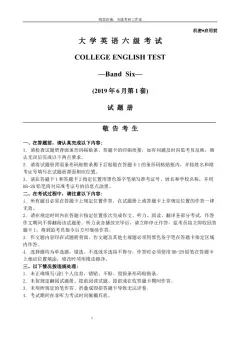
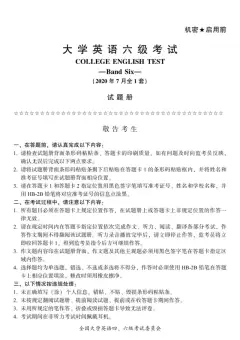
机密*启用前
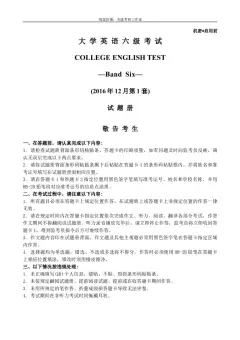
大 学 英 语 六 级 考 试
COLLEGE ENGLISH TEST
—Band Six—
(2016 年 12 月第 2 套)
试 题 册
敬 告 考 生
一、在答题前,请认真完成以下内容:
1. 请检查试题册背面条形码粘贴条、答题卡的印刷质量,如有问题及时向监考员反映,确
认无误后完成以下两点要求。
2. 请将试题册背面条形码粘贴条揭下后粘贴在答题卡 1的条形码粘贴框内,并将姓名和准
考证号填写在试题册背面相应位置。
3. 请在答题卡1和答题卡2指定位置用黑色签字笔填写准考证号、姓名和学校名称,并用
HB-2B铅笔将对应准考证号的信息点涂黑。
二、在考试过程中,请注意以下内容:
1. 所有题目必须在答题卡上规定位置作答,在试题册上或答题卡上非规定位置的作答一律
无效。
2. 请在规定时间内在答题卡指定位置依次完成作文、听力、阅读、翻译各部分考试,作答
作文期间不得翻阅该试题册。听力录音播放完毕后,请立即停止作答,监考员将立即收回答
题卡1,得到监考员指令后方可继续作答。
3. 作文题内容印在试题册背面,作文题及其他主观题必须用黑色签字笔在答题卡指定区域
内作答。
4. 选择题均为单选题,错选、不选或多选将不得分,作答时必须使用HB-2B铅笔在答题卡
上相应位置填涂,修改时须用橡皮擦净。
三、以下情况按违规处理:
1. 未正确填写(涂)个人信息,错贴、不贴、毁损条形码粘贴条。
2. 未按规定翻阅试题册、提前阅读试题、提前或在收答题卡期间作答。
3. 未用所规定的笔作答、折叠成毁损答题卡导致无法评卷。
4. 考试期间在非听力考试时间佩戴耳机。淘宝店铺:光速考研工作室
全国大学英语四、六级考试委员会淘宝店铺:光速考研工作室
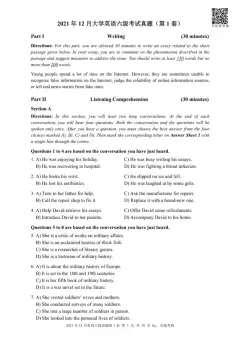
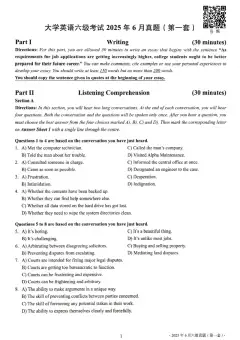
Part I Writing (30 minutes)
Directions: For this part, you are allowed 30 minutes to write a short essay on innovation. Your essay should
include the importance of innovation and measures to be taken to encourage innovation. You are required to
write at least 150 words but no more than 200 words.
Part Ⅱ Listening Comprehension (30 minutes)
Section A
Directions: In this section, you will hear two long conversations. At the end of each conversation, you will hear
four questions. Both the conversation and the questions will be spoken only once. After you hear a question, you
must choose the best answer from the four choices marked A, B, C and D.Then mark the corresponding letter on
Answer Sheet 1 with a single line through the centre.
Questions 1 to 4 are based on the conversation you have just heard.
1. A. They were all good at cooking.
B. They were particular about food.
C. They were proud of their cuisine.
D. They were fond of bacon and eggs.
2. A. His parents.
B. His friends.
C. His schoolmates.
D. His parents' friends.
3. A. No tea was served with the meal.
B. It was the real English breakfast.
C. No one of the group ate it.
D. It was a little overcooked.
4. A. It was full of excitement.
B. It was really extraordinary.
C. It was a risky experience.
D. It was rather disappointing.
Questions 5 to 8 are based on the conversation you have just heard.淘宝店铺:光速考研工作室
5. A. The woman's relationship with other shops.
B. The business success of the woman's shop.
C. The key to running a shop at a low cost.
D. The woman's earnings over the years.
6. A. Improve its customer service.
B. Expand its business scale.
C. Keep down its expenses.
D. Upgrade the goods it sells.
7. A. They are sold at lower prices than in other shops.
B. They are very-popular with the local residents.
C. They are delivered free of charge.
D. They are in great demand.
8. A. To follow the custom of the local shopkeepers.
B. To attract more customers in the neighborhood.
C. To avoid being put out of business in competition.
D. To maintain friendly relationships with other shops.
Section B
Directions: In this section, you will hear two passages. At the end of each passage, you will hear three or four
questions. Both the passage and the questions will be spoken only once.After you hear a question, you must
choose the best answer from the four choices marked A, B, C and D. Then mark the corresponding letter on
Answer Sheet 1 with a single line through the centre.
Questions 9 to 12 are based on the passage you have just heard.
9. A. They can be used to deliver messages in times of emergency.
B. They deliver pollutants from the ocean to their nesting sites.
C. They carry plant seeds and spread them to faraway places.
D. They are on the verge of extinction because of pollution.
10. A. They migrate to the Arctic Circle during the summer.
B. They originate from Devon Island in the Arctic area.
C. They travel as far as 400 kilometers in search of food.
D. They have the ability to survive in extreme weathers.
11. A. They were carried by the wind.淘宝店铺:光速考研工作室
B. They had become more poisonous.
C. They were less than on the continent.
D. They poisoned some of the fulmars.
12. A. The threats humans pose to Arctic seabirds,
B. The diminishing colonies for Arctic seabirds.
C. The harm Arctic seabirds may cause to humans.
D. The effects of the changing climate on Arctic seabirds.
Questions 13 to 15 are based on the passage you have just heard.
13. A. It has decreased.
B. It has been exaggerated.
C. It has become better understood.
D. It has remained basically the same.
14. A. It develops more easily in centenarians not actively engaged.
B. It is now the second leading cause of death for centenarians.
C. It has had no effective cure so far.
D. It calls for more intensive research.
15. A. They care more about their physical health.
B. Their quality of life deteriorates rapidly.
C. Their minds fall before their bodies do.
D. They cherish their life more than ever.
Section C
Directions: In this section, you will hear three recordings of lectures or talks followed by three or four questions.
The recordings will be played only once. After you hear a question, you must choose the best answer from the four
choices marked A, B, C and D Then mark the corresponding letter on Answer Sheet 1 with a single line through
the centre.
Questions 16 to 18 are based on the recording you have just heard.
16. A. They are focused more on attraction than love.
B. They were done by his former colleague at Yale.
C. They were carried out over a period of some thirty years.
D. They form the basis on which he builds his theory of love.淘宝店铺:光速考研工作室
17. A. The relationship cannot last long if no passion is involved.
B. Intimacy is essential but not absolutely indispensable to love.
C. It is not love if you don't wish to maintain the relationship.
D. Romance is just impossible without mutual understanding.
18. A. Which of them is considered most important.
B. Whether it is true love without commitment.
C. When the absence of any one doesn't affect the relationship.
D. How the relationship is to be defined if any one is missing.
Questions 19 to 22 are based on the recording you have just heard.
19. A. Social work as a profession.
B. The history of social work.
C. Academic degrees required of social work applicants.
D. The aim of the National Association of Social Workers.
20. A. They try to change people's social behavior.
B. They help enhance the well-being of the underprivileged.
C. They raise people's awareness of the environment.
D. They create a lot of opportunities for the unemployed.
21. A. They have all received strict clinical training.
B. They all have an academic degree in social work.
C. They are all members of the National Association.
D. They have all made a difference through their work.
22. A. The promotion of social workers' social status.
B. The importance of training for social workers.
C. Ways for social workers to meet people's needs.
D. Social workers' job options and responsibilities.
Questions 23 to 25 are based on the recording you have just heard.
23. A. To fight childhood obesity.
B. To help disadvantaged kids.
C. To encourage kids to play more sports.
D. To urge kids to follow their role models.淘宝店铺:光速考研工作室
24. A. They best boost product sales when put online.
B. They are most effective when appearing on TV.
C. They are becoming more and more prevalent.
D. They impress kids more than they do adults.
25. A. Always place kids' interest first.
B. Do what they advocate in public.
C. Message positive behaviors at all times.
D. Pay attention to their image before children.
Part Ⅲ Reading Comprehension (40 minutes)
Section A
Directions: In this section, there is a passage with ten blanks. You are required to select one word for each blank
from a list of choices given in a word bank following the passage. Read the passage through carefully before
making your choices. Each choice in the bank is identified by a letter. Please mark the corresponding letter for
each item on Answer Sheet 2 with a single line through the centre. You may not use any of the words in the bank
more than once.
Questions 26 to 35 are based on the following passage.
The tree people in the Lord of the Rings--the Ents--can get around by walking. But for real trees, it's harder
to uproot. Because they're literally rooted into the ground, they are unable to leave and go 26 .
When a tree first starts growing in a certain area, it's likely that the 27 envelope—the temperature,
humidity, rainfall patterns and so on--suits it. Otherwise, it would be unable to grow from a seedling. But as it
28, these conditions may change and the area around it may no longer be suitable for its 29 .
When that happens, many trees like walnuts, oaks and pines, rely 30 on so-called "scatter hoarders," such
as birds, to move their seeds to new localities. Many birds like to store food for the winter, which they 31
retrieve.when the birds forget to retrieve their food--and they do sometimes--a seedling has a chance to grow. The
bird Clark's nutcracker, for example, hides up to 100,000 seeds per year, up to 30 kilometers away from the seed
source, and has a very close symbiotic (共生的) relationship with several pine species, most 32 the whitebark
pine.
As trees outgrow their ideal 33 in the face of climate change, these flying ecosystem engineers could be a
big help in 34 trees. It's a solution for us--getting birds to do the work is cheap and effective--and it could
give 35 oaks and pines the option to truly "make like a tree and leave. "
A. ages D. elsewhere
B. breathing E. exclusively
C. climatic F. forever淘宝店铺:光速考研工作室
G. fruitful L. replanting
H. habitats M. subsequently
I. legacy N. vulnerable
J. notably O. withdraws
K. offspring
Section B
Directions : In this section, you are going to read a passage with ten statements attached to it. Each statement
contains information given in one of the paragraphs. Identify the paragraph from which the information is
derived. You may choose a paragraph more than once.Each paragraph is marked with a letter. Answer the
questions by marking the corresponding letter on Answer Sheet 2.
The American Workplace Is Broken. Here's How We Can Start Fixing It.
[A] Americans are working longer and harder hours than ever before.83% of workers say they're stressed about
their jobs, nearly 50% say work-related stress is interfering with their sleep, and 60% use their smartphones to
check in with work outside of normal working hours. No wonder only 13% of employees worldwide feel engaged
in their occupation.
[B] Glimmers (少许) of hope, however, are beginning to emerge in this bruising environment: Americans are
becoming aware of the toll their jobs take on them, and employers are exploring ways to alleviate the harmful
effects of stress and overwork. Yet much more work remains to be done. To call stress an epidemic isn't
exaggeration. The 83% of American employees who are stressed about their jobs--up from 73% just a year
before--say that poor compensation and an unreasonable workload are their number-one sources of stress. And if
you suspected that the workplace had gotten more stressful than it was just a few decades ago, you're right. Stress
levels increased 18% for women and 24% for men from 1983 to 2009. Stress is also starting earlier in life, with
some data suggesting that today's teens are even more stressed than adults.
[C] Stress is taking a significant toll on our health, and the collective public health cost may be enormous.
Occupational stress increases the risk of heart attack and diabetes, accelerates the aging process, decreases
longevity, and contributes to depression and anxiety, among numerous other negative health outcomes. Overall,
stress-related health problems account for up to 90% of hospital visits, many of them preventable. Your job is
"literally killing you," as The Washington Post put it. It's also hurting our relationships. Working parents say they
feel stressed, tired, rushed and short on quality time with their children, friends and partners.
[D] Seven in 10 workers say they struggle to maintain work-life balance. As technology (and with it, work emails)
seeps (渗入) into every aspect of our lives, work-life balance has become an almost meaningless term. Add a
rapidly changing economy and an uncertain future to this 24/7 connectivity, and you've got a recipe for overwork,
according to Phyllis Moen. "There's rising work demand coupled with the insecurity of mergers, takeovers,淘宝店铺:光速考研工作室
downsizing and other factors," Moen said. "Part of the work-life issue has to talk about uncertainty about the
future."
[E] These factors have converged to create an increasingly impossible situation with many employees
overworking to the point of burnout. It's not only unsustainable for workers, but also for the companies that
employ them. Science has shown a clear correlation between high stress levels in workers and absenteeism ( 旷工
), reduced productivity, disengagement and high turnover. Too many workplace policies effectively prohibit
employees from developing a healthy work-life balance by barring them from taking time off, even when they
need it most.
[F] The U. S. trails far behind every wealthy nation and many developing ones that have family-friendly work
policies including paid parental leave, paid sick days and breast-feeding support.according to a 2007 study. The U.
S. is also the only advanced economy that does not guarantee workers paid vacation time, and it's one of only two
countries in the world that does not offer guaranteed paid maternity leave. But even when employees are given
paid time off, workplace norms and expectations that pressure them to overwork often prevent them from taking
it. Fulltime employees who do have paid vacation days only use half of them on average.
[G] Our modern workplaces also operate based on outdated time constraints. The practice of clocking in for an
eight-hour workday is a leftover from the days of the Industrial Revolution, as reflected in the then-popular
saying, "Eight hours labor, eight hours recreation, eight hours rest."
[H] We've held on to this workday structure--but thanks to our digital devices, many employees never really clock
out. Today, the average American spends 8.8 hours at work daily, and the majority of working professionals spend
additional hours checking in with work during evenings, weekends and even vacations. The problem isn't the
technology itself, but that the technology is being used to create more flexibility for the employer rather than the
employee. In a competitive work environment, employers are able to use technology to demand more from their
employees rather than motivating workers with flexibility that benefits them.
[I] In a study published last year, psychologists coined the term "workplace telepressure" to describe an
employee's urge to immediately respond to emails and engage in obsessive thoughts about returning an email to
one's boss, colleagues or clients. The researchers found that telepressure is a major cause of stress at work, which
over time contributes to physical and mental burnout. Of the 300 employees participating in the study, those who
experienced high levels of telepressure were more likely to agree with statements assessing burnout, like "I've no
energy for going to work in the morning," and to report feeling fatigued and unfocused. Telepressure was also
correlated with sleeping poorly and missing work.
[J] Harvard Business School professor Leslie Perlow explains that when people feel the pressure to be always
"on," they fmd ways to accommodate that pressure, including altering their schedules, work habits and
interactions with family and friends. Perlow calls this vicious cycle the "cycle of responsiveness" : Once bosses