淘宝店铺:光速考研工作室
淘宝店铺【光速考研工作室】温馨提示:
word版真题仅校对内容,因格式无法固定,未精美排版,仅供自行复制粘贴使用,若打印
或用于电子笔记,请务必使用PDF版本真题!!!
本店PDF版真题打印无乱码,用于电子版笔记支持取词翻译,为优质版PDF。
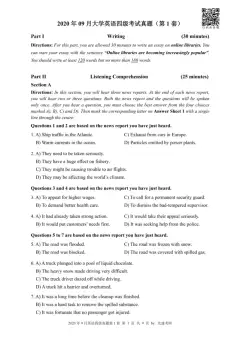
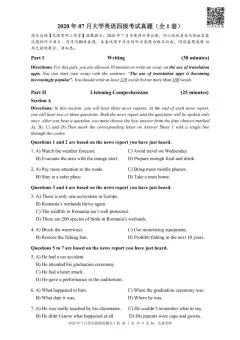
2020 年 9 月英语四级真题第 1 套
Part I Writing (30 minutes)
Directions: For this part, you are allowed 30 minutes to write an essay on the online library. You can start your
essay with the sentence “The online library is becoming increasingly popular.” You should write at least 120
words but no more than 180 words.
Part II Listening Comprehension (25 minutes)
Section A
Directions: In this section, you will hear three news reports. At the end of each news report, you will hear two or
three questions. Both the news report and the questions will be spoken only once. After you hear a
question, you must choose the best answer from the four choices marked A), B),C) and D). Then mark
the corresponding letter on Answer Sheet 1 with a single line through the center.
Questions 1 and 2 are based on the news report you have just heard.
1. A) Ship traffic in the Atlantic. B) Warm currents in the ocean.
C) Exhaust from cars in Europe. D) Particles emitted by power plants.
2. A) They need to be taken seriously.
B) They have a huge effect on fishery.
C) They might be causing trouble to air flights.
D) They may be affecting the world’s climate.
Questions 3 and 4 are based on the news report you have just heard.
3. A) To appeal for higher wages.
B) To demand better health care.
C) To call for a permanent security guard.
D) To dismiss the bad-tempered supervisor.
4. A) It had already taken strong action.
1淘宝店铺:光速考研工作室
B) It would put customers' needs first.
C) It would take their appeal seriously.
D) It was seeking help from the police.
Questions 5 to 7 are based on the news report you have just heard.
5. A) The road was flooded.
B) The road was blocked.
C) The road was frozen with snow.
D) The road was covered with spilled gas.
6. A) A truck plunged into a pool of liquid chocolate.
B) The heavy snow made driving very difficult.
C) The truck driver dozed off while driving.
D) A truck hit a barrier and overturned.
7. A) It was a long time before the cleanup was finished.
B) It was a hard task to remove the spilled substance.
C) It was fortunate that no passenger got injured.
D) It was difficult to contact the manufacturer.
Section B
Directions: In this section, you will hear two long conversations. At the end of each conversation,you will hear
four questions. Both the conversations and the questions will be spoken only once. After you hear a
question, you must choose the best answer from the four choices marked A), B), C) and D). Then
mark the corresponding letter on Answer Sheet 1 with a single line through the center.
Questions 8 to 11 are based on the conversation you have just heard.
8. A) She wanted to save for a new phone.
B) She found it much safer to use cash.
C) She could enjoy discount with cash.
D) She had been cheated using phone apps.
9. A) They can save a lot more time and trouble.
B) They find it less difficult to make purchases.
C) They derive greater pleasure from buying things.
D) They are less aware of the value of their money.
10. A) More valuable items.
B) More non-essential things.
2淘宝店铺:光速考研工作室
C) Everyday necessities.
D) Electronic devices.
11. A) It can improve shopping efficiency.
B) It is altering the way of shopping.
C) It may lead to excessive spending.
D) It appeals more to younger people.
Questions 12 to 15 are based on the conversation you have just heard.
12. A) He wanted to order some wooden furniture.
B) He had to change the furniture delivery time.
C) He had a problem with the furniture delivered.
D) He wanted the furniture store to give him a refund.
13. A) Send the furniture back to the store.
B) Describe the furniture he received.
C) Collect the furniture he ordered.
D) Buy another brand of furniture.
14. A) Correct their mistake. B) Improve their service.
C) Apologize to his wife. D) Give the money back.
15. A) She recommended a new style.
B) She offered some gift to the man.
C) She apologized to the man once more.
D) She checked all the items with the man.
Section C
Directions: In this section, you will hear three passages. At the end of each passage, you will hear three or four
questions. Both the passages and the questions will be spoken only once. After you hear a question,
you must choose the best answer from the four choices marked A), B), C) and D). Then mark the
corresponding letter on Answer Sheet 1 with a single line through the center.
Questions 16 to 18 are based on the passage you have just heard.
16. A) Reading books of wisdom. B) Tidying up one’s home.
C) Sharing with others. D) Donating to charity.
17. A) Things that make one happy.
B) Things that are becoming rare.
C) Things that occupy little space.
D) Things that cost a lot of money.
3淘宝店铺:光速考研工作室
18. A) It joined the city’s clean-up campaign.
B) It sold as many as fifty boxes of books.
C) It received an incredibly large number of donated books.
D) It did little business because of the unusual cold weather.
Questions 19 to 21 are based on the passage you have just heard.
19. A) Give free meals to the homeless.
B) Provide shelter for the homeless.
C) Help the vulnerable to cook lunches.
D) Call for change in the local government.
20. A) Strengthen co-operation.
B) Promote understanding.
C) Win national support.
D) Following his example.
21. A) Spreading news of his deeds.
B) Writing him thank-you notes.
C) Following the example he sets.
D) Sending him hand-made bags.
Questions 22 to 25 are based on the passage you have just heard.
22. A) To solve word search puzzles.
B) To send smartphone messages.
C) To test their eyesight using a phone app.
D) To install some audio equipment in a lab.
23. A) They could not go on until the ringing stopped.
B) They could no longer concentrate on their task.
C) They grabbed the phone and called back right away.
D) They asked their experimenter to hang up the phone.
24. A) A rise in emotional problems.
B) A decline in sports activities.
C) A reduction in the amount of sleep.
D) A decline in academic performance.
25. A) Protect the eyesight of the younger generation.
B) Take effective measures to raise productivity.
C) Realize the disruptive effects of technology.
D) Ensure they have sufficient sleep every day.
4淘宝店铺:光速考研工作室
Part Ⅲ Reading Comprehension (40 minutes)
Section A
Directions:In this section, there is a passage with ten blanks. You are required to select one word for each blank
from a list of choices given in a word bank following the passage. Read the passage through carefully before
making your choices. Each choice in the bank is identified by a letter. Please mark the corresponding letter for
each item on Answer Sheet 2 with a single line through the centre. You may not use any of the words in the bank
more than once.
There’re three main types of financial stress people encounter. The first type is apparent in people being
stressed about the 26 ups and downs of investment markets—actually not so much the ups, but 27 the downs.
These people are usually unable or unprepared to endure the long haul.
The next common type of financial stress is that caused by debt. In a 28 percentage of cases of debt-induced
financial stress, credit cards and loans will be a central element. Often there’ll be a car loan and perhaps a
mortgage, but credit cards often seem to be the gateway to debt-related financial difficulties for many.
The third type of stress and 29 the least known is inherited financial stress, which is the most destructive. It
is experienced by those who have grown up in households where their parents regularly 30 and fought about
money. Money therefore becomes a stressful topic, and so the thought of sitting down and planning is an
unattractive 31.
Those suffering inherited financial anxiety 32 to follow one of two patterns. Either they put their head in the
sand: they would 33 examining their financial statements, budgeting and discussing financial matters with those
closest to them. Alternatively, they would go to the other 34, and micro-analyze everything, to the point of
complete 35. They are convinced that whatever decision they make will be the wrong one.
A) appearance I) normal
B) argued J) possibly
C) avoid K) proposition
D) considerable L) repelled
E) definitely M) statement
F) extreme N) tend
G) inaction O) traditional
5淘宝店铺:光速考研工作室
H) incredibly
Section B
Directions:In this section, you are going to read a passage with ten statements attached to it. Each statement
contains information given in one of the paragraphs. Identify the paragraph from which the information is
derived. You may choose a paragraph more than once. Each paragraph is marked with a letter. Answer the
questions by making the corresponding letter on Answer Sheet 2.
Doctor’s Orders: Let Children Just Play
[A] Imagine a drug that could enhance a child’s creativity and critical thinking. Imagine that this drug were simple
to make, safe to take, and could be had for free. The nation’s leading pediatricians(儿科医生)say this miracle
compound exists. In a new clinical report, they are urging doctors to prescribe it liberally to the children in their
care.
[B] “This may seem old-fashioned, but there are skills to be learned when kids aren’t told what to do,” said Dr.
Michael Yogman, a Harvard Medical School pediatrician who led the drafting of the call to arms. Whether it’s
rough physical play, outdoor play or social or pretend play, kids derive important lessons from the chance to make
things up as they go, he said.
[C] The advice, issued Monday by the American Academy of Pediatrics, may come as a shock to some parents.
After spending years fretting(烦恼)over which toys to buy, which apps to download and which skill-building
programs to send their kids to after school, letting them simply play—or better yet, playing with them—could
seem like a step backward. The pediatricians insist that it’s not. The academy’s guidance does not include specific
recommendations for the dosing of play. Instead, it asks doctors to advise parents before their babies turn two that
play is essential to healthy development.
[D] “Play is not silly behavior,” the academy’s report declares. It fosters children’s creativity, cooperation and
problem-solving skills—all of which are critical for a 21st-century workforce. When parents engage in play with
their children, it builds a wall against the harmful effects of all kinds of stress, including poverty, the academy
says. In the pediatricians’ view, essentially every life skill that’s valued in adults can be built up with play.
“Collaboration, negotiation, decision-making, creativity, leadership, and increased physical activity are just some
6淘宝店铺:光速考研工作室
of the skills and benefits children gain through play,” they wrote. The pediatricians’ appeal comes as kids are
being squeezed by increasing academic demands at school and the constant invasion of digital media.
[E] The trends have been a long time coming. Between 1981 and 1997, detailed time-use studies showed that the
time children spent at play declined by 25 percent. Since the adoption of sweeping education reforms in 2001,
public schools have steadily increased the amount of time devoted to preparing for standardized tests. The focus
on academic “skills and drills” has cut deeply into recess(课间休息)and other time for free play.
[F] By 2009, a study of Los Angeles kindergarten classrooms found that five-year-olds were so burdened with
academic requirements that they were down to an average of just 19 minutes per day of “choice time,” when they
were permitted to play freely with blocks, toys or other children. One in four Los Angeles teachers reported there
was no time at all for “free play.” Increased academic pressures have left 30 percent of U.S. kindergarten classes
without any recess. Such findings prompted the American Academy of Pediatrics to issue a policy statement in
2013 on the “crucial role of recess in school.”
[G] Pediatricians aren’t the only ones who have noticed. In a report titled “Crisis in the Kindergarten,” a group of
educators, health professionals and child advocates called the loss of play in early childhood “a tragedy, both for
the children themselves and for our nation and world.” Kids in play-based kindergartens “end up equally good or
better at reading and other intellectual skills, and they are more likely to become well-adjusted healthy people,”
the Alliance for Childhood said in 2009. Indeed, new research demonstrates why playing with blocks might have
been time better spent, Yogman said. The trial assessed the effectiveness of an early mathematics intervention(干
预)aimed at preschoolers. The results showed almost no gains in math achievement.
[H] Another playtime thief: the growing proportion of kids’ time spent in front of screens and digital devices, even
among preschoolers. Last year, Common Sense Media reported that children up through age eight spent an
average of two hours and 19 minutes in front of screens each day, including an average of 42 minutes a day for
those under two. This increase of digital use comes with rising risks of obesity, sleep deprivation and cognitive
(认知的), language and social-emotional delays, the American Academy of Pediatrics warned in 2016.
[I] “I respect that parents have busy lives and it’s easy to hand a child an iPhone,” Yogman said. “But there’s a
cost to that. For young children, it’s much too passive. And kids really learn better when they’re actively engaged
7淘宝店铺:光速考研工作室
and have to really discover things.”
[J] The decline of play is a special hazard for the roughly 1 in 5 children in the United States who live in poverty.
These 14 million children most urgently need to develop the resilience(韧劲)that is cultivated with play.
Instead, Yogman said, they are disproportionately affected by some of the trends that are making play scarce:
academic pressures at schools that need to improve test scores, outside play areas that are limited or unsafe, and
parents who lack the time or energy to share in playtime.
[K] Yogman also worries about the pressures that squeeze playtime for more affluent kids. “The notion that as
parents we need to schedule every minute of their time is not doing them a great service,” he said. Even well-
meaning parents may be “robbing them of the opportunity to have that joy of discovery and curiosity—the
opportunity to find things out on their own.”
[L] Play may not be a hard sell to kids. But UCLA pediatrician Carlos Lerner acknowledged that the
pediatricians’ new prescription may meet with skepticism(怀疑) from parents, who are anxious for advice on
how to give their kids a leg up in the world. They should welcome the simplicity of the message, Lerner said. “It’s
liberating to be able to offer them this advice: that you spending time with your child and letting him play is one
of the most valuable things you can do,” he said. “It doesn’t have to involve spending a lot of money or time, or
joining a parenting group. It’s something we can offer that’s achievable. They just don’t recognize it right now as
particularly valuable.”
36. Increased use of digital devices steals away children’s playtime.
37. Since the beginning of this century, an increasing amount of time has been shifted in public schools from
recess to academic activities.
38. It has been acknowledged that while kids may welcome pediatrician’s recommendation, their parents may
doubt its feasibility.
39. According to some professionals, deprivation of young children’s playtime will do harm not only to children
themselves but to the country and the world.
8淘宝店铺:光速考研工作室
40. By playing with children, parents can prevent them from being harmed by stress.
41. Playing with digital device discourages kids from active discovery, according to pediatrician Dr. Michael
Yogman.
42. The suggestion of letting children simply play may sound like going backwards to parents who want to help
build their children’s skills.
43. Dr. Michael Yogman believes the idea that parents should carefully schedule children’s time may not be
helpful to their growth.
44. One quarter of teachers in an American city said that children in kindergartens had no time for playing freely.
45. According to a pediatrician, no matter what kind of play children engage in, they are learning how to create
things.
Section C
Directions:There are 2 passages in this section. Each passage is followed by some questions or unfinished
statements. For each of them there are four choices marked A), B), C) and D) .You should decide on the best
choice and mark the corresponding letter on Answer Sheet 2 with a single line through the centre.
Passage One
Questions 46 to 50 are based on the following passage.
Americans spend billions of dollars each year trying to change our weight with diets, gym memberships and
plastic surgery.
Trying to live up to the images of “perfect” models and movie heroes has a dark side: anxiety and depression,
as well as unhealthy strategies for weight loss or muscle gain. It also has a financial cost. Having an eating
disorder boosts annual health care costs by nearly US$2,000 per person.
Why is there both external and internal pressure to look “perfect”? One reason is that society rewards people
who are thin and healthy looking. Researchers have shown that body mass index is related to wages and income.
9淘宝店铺:光速考研工作室
Especially for women, there is a clear penalty at work for being overweight or obese. Some studies have also
found an impact for men, though a less noticeable one.
While the research literature is clear that labor market success is partly based on how employers and customers
perceive your body image, no one had explored the other side of question. Does a person's own perception of
body image matter to earnings and other indicators of success in the workplace?
Our recently published study answered this question by tracking a large national random sample of Americans
over a critical time period when bodies change from teenage shape into adult form and when people build their
identities.
As in other research, women in our sample tend to over-perceive their weight—they think they're heavier than
they are—while men tend to under-perceive theirs.
We found no relationship between the average person's self- perception of weight and labor market
outcomes, although self-perceived weight can influence self-esteem(自尊心), mental health and health
behaviors.
While the continued gender penalty in the labor market is frustrating, our finding that misperceived weight does
not harm workers is more heartening.
Since employers’ perception of weight is what matters in the labor market, changing discrimination laws to
include body type as a category would also help. Michigan is the only state that prohibits discrimination on the
basis of weight and height. We believe expanding such protections would make the labor market more fair and
efficient.
46. What does the author say may have an adverse impact on people?
A) Undergoing plastic surgeries in pursuit of beauty.
B) Imitating the lifestyles of heroes and role models.
C) Striving to achieve perfection regardless of financial cost.
D) Attempting to meet society’s expectation of appearance.
47. What have researchers found out about people’s earnings?
A) They are closely related to people’s social status.
B) They have to do with people’s body weight and shape.
C) They seem to matter much less to men than to women.
D) They may not be equal to people’s contributions.
10淘宝店铺:光速考研工作室
48. What does the author’s recent study focus on?
A) Previous literature on indicators of competitiveness in the workplace.
B) Traits that matter most in one’s pursuit of success in the labor market.
C) Whether self-perception of body image impacts one’s workplace success.
D) How bosses’ perception of body image impacts employees’ advancement.
49. What is the finding of the author’s recent research?
A) Being overweight actually does not do much harm to the overall well-being of employees.
B) People are not adversely affected in the workplace by false self-perception of body weight.
C) Self-esteem helps to combat gender inequality in the workplace.
D) Gender inequality continues to frustrate a lot of female employees.
50. What does the author think would help improve the condition in the labor market?
A) Banning discrimination on the basis of employees’ body image.
B) Expanding protection of women against gender discrimination.
C) Helping employees change their own perception of beauty.
D) Excluding body shape as a category in the labor contract.
Passage Two
Questions 51 to 55 are based on the following passage.
The work-life balance is dead. By this, I'm not advocating that you should give up your pursuit of having a
fulfilling career and a thriving personal life, and I’m definitely not saying that you have to give up one to have the
other. I also acknowledge that we have a work-life problem, but I'm arguing that the concept of balance has never
been helpful, because it's too limiting. You see, our language makes a difference, and how we refer to things
matters because it affects our thinking and therefore our actions.
At the minimum, most of us work because we want to be able to support ourselves, our families, and the
people around us. In the ideal world, we're all doing work that we're proud of and that provides meaning and
purpose to us. But even if your job doesn't give you shivers of joy each new day, working is a part of what each of
us does and the contribution we make to society. When you separate work and life, it’s a little bit harder to make
that connection. But when you think of work as part of a full life and a complete experience, it becomes easier to
11淘宝店铺:光速考研工作室
see that success in one aspect often supports another.
Losing your balance and falling isn’t pleasant. A goal to balance suggests that things could quickly get off the
balance, and that causes terrible outcomes. It’s more constructive to think of solutions that continue to evolve over
shifts in life and work. Rather than falling or failing, you may have good days or better days or not-so-good days.
These variations are normal, and it’s more useful to think of life as something that is ever evolving and changing,
rather than a high-risk enterprise where things could go wrong with one misstep.
How we talk to ourselves matters, and how we talk about issues makes a difference. Let’s bury “work-life
balance” and think bigger and better about work-life fulfillment to do a little less balancing and a lot more living.
51. What does the author suggest by saying “The work-life balance is dead”?
A) The hope of achieving a thriving life is impossible to realize.
B) The pursuit of a fulfilling career involves personal sacrifice.
C) The imbalance between work and life simply doesn’t exist anymore
D) The concept of work-life balance contributes little to a fulfilling life.
52. What does the author say about our use of language?
A) It impacts how we think and behave.
B) It changes with the passage of time.
C) It reflects how we communicate.
D) It differs from person to person.
53. What does the author say we do in an ideal world?
A) We do work that betters the lives of our families and friends.
B) We do work that gives us bursts of joy each new day.
C) We do meaningful work that contributes to society.
D) We do demanding work that brings our capacity into full play.
54. What does the author say about life?
A) It is cyclical.
B) It is dynamic.
C) It is fulfilling.
D) It is risky.
55. What does the author advise us to do?
A) Make life as simple as possible.
B) Talk about balance in simpler terms.
12淘宝店铺:光速考研工作室
C) Balance life and work in a new way.
D) Strive for a more filling life.
Part IV Translation (30 minutes)
Directions: For this part, you are allowed 30 minutes to translate a passage from Chinese into English. You
should write your answer on Answer Sheet 2.
茅台(Moutai)是中国最有名的白酒,在新中国成立前夕,被选为国宴用酒。
据说赤水沿岸的村民四千年前就开始酿造茅台。在西汉时期,那里的人们生产出了高质量的茅台,
并把它贡给皇帝。自唐朝开始,这种地方酒通过海上丝绸之路运往海外。
茅台味道柔和,有一种特殊的香味;适量饮用可以帮助缓解疲劳,有镇静作用,因而广受国内外消
费者的喜爱。
13淘宝店铺:光速考研工作室
2020 年 9 月英语四级真题第 2 套
Part I Writing (30 minutes)
Directions: For this part, you are allowed 30 minutes to write an essay on the use of PowerPoint(PPT) in
class. You can start your essay with the sentence “The use of PowerPoint is becoming increasingly popular in
class.” You should write at least 120 words but no more than 180 words.
Part II Listening Comprehension (25 minutes)
特别说明:由于2020年9月四级考试全国共考了1套听力,本套听力试题同第1套试题一致,因此在本
套真题中不再重复出现。
Part Ⅲ Reading Comprehension (40 minutes)
Section A
Directions:In this section, there is a passage with ten blanks. You are required to select one word for each blank
from a list of choices given in a word bank following the passage. Read the passage through carefully before
making your choices. Each choice in the bank is identified by a letter. Please mark the corresponding letter for
each item on Answer Sheet 2 with a single line through the centre. You may not use any of the words in the bank
more than once.
It can be seen from the cheapest budget airlines to the world's largest carriers:Airlines across the globe 26
various shades of blue in their cabin seats, and it is no 27. There does appear to be some psychology behind it.
Blue is 28 with the positive qualities of trust, efficiency, quietness, coolness, reflection and calm.
Nigel Goode is a leading aviation designer who works at a company which has been delivering aircraft
interiors for airlines for 30 years. “Our job as designers is to reinforce the airline’s brand and make it more 29,”
he says. “But our primary concern is to deliver an interior that 30 comfort to create a pleasant environment.”
“It’s all about making the traveling experience less 31 and blue is said to induce a feeling of calm. While
some of the budget airlines might use brighter, bolder shades, most others go with softened tones. The 32 aim is
to create a home-like relaxing feel, so airlines tend to use soft colors that feel domestic, 33 and earthy for that
14淘宝店铺:光速考研工作室
reason.”
It's also a trend that emerged decades ago and has 34 stuck. “Blue became the color of choice because it’s a
conservative, agreeable, corporate shade that 35 being trustworthy and safe. That's why you see it used in all of
the older airlines like British Airways,” Nigel Goode added.
A) associated I) maximizes
B) coincidence J) natural
C) determined K) principal
D) drastically L) recognizable
E) enormous M) simply
F) imitate N) stressful
G) indication O) symbolizes
H) integrate
Section B
Directions:In this section, you are going to read a passage with ten statements attached to it. Each statement
contains information given in one of the paragraphs. Identify the paragraph from which the information is
derived. You may choose a paragraph more than once. Each paragraph is marked with a letter. Answer the
questions by making the corresponding letter on Answer Sheet 2.
Why Are Asian Americans Missing From Our Textbooks?
[A] I still remember my fourth-grade social studies project. Our class was studying the Gold Rush, something all
California fourth-graders learned. I was excited because I had asked to research Chinese immigrants during that
era. Growing up in the San Francisco Bay Area, I had always known that “San Francisco” translated to “Gold
Mountain” in Chinese. The name had stuck ever since Chinese immigrants arrived on the shores of Northern
California in the 1850s, eager to try their luck in the gold mines. Now I’d have the chance to learn about them.
[B] My excitement was short-lived. I remember heading to the library with my class and asking for help. I
remember the librarian’s hesitation. She finally led me past row after row of books, to a corner of the library
where she pulled an oversized book off the shelf. She checked the index and turned over to a page about early
Chinese immigrants in California. That was all there was in my entire school library in San Francisco, home of the
nation’s first Chinatown. That was it.
15淘宝店铺:光速考研工作室
[C] I finally had the opportunity to learn about Asian Americans like myself, and how we became part of the
fabric of the United States when I took an introductory class on Asian-American history in college. The class was
a revelation. I realized how much had been missing in my textbooks as I grew up. My identity had been shaped by
years of never reading, seeing, hearing, or learning about people who had a similar background as me. Why, I
wondered, weren’t the stories, histories, and contributions of Asian Americans taught in K-12 schools, especially
in the elementary schools? Why are they still not taught?
[D] Our students—Asian, Latino, African American, Native American, and, yes, white—stand to gain from a
multicultural curriculum. Students of color are more engaged and earn better grades when they see themselves in
their studies. Research has also found that white students benefit by being challenged and exposed to new
perspectives.
[E] For decades, activists have called for schools to offer anti-racism or multicultural curricula. Yet a traditional
American K-12 curriculum continues to be taught from a Eurocentric point of view. Being multicultural often falls
back on weaving children of color into photographs, or creating a few supporting characters that happen to be
ethnic—an improvement, but superficial nonetheless. Elementary school classrooms celebrate cultural holidays—
Lunar New Year! Red envelopes! Lion dancers!—but they’re quick to gloss over(掩饰)the challenges and
injustices that Asian Americans have faced. Most students don’t, for example, learn about the laws that for years
excluded Asians from immigrating to the U.S. They don't hear the narratives of how and why Southeast Asian
refugees(难民) had to rebuild their lives here.
[F] Research into what students learn in school has found just how much is missing in their studies. In an analysis,
Christine Sleeter, a professor in the College of Professional Studies at California State University, Monterey Bay,
reviewed California’s history and social studies framework, the curriculum determined by state educators that
influences what is taught in K-12 classrooms. Of the nearly 100 Americans recommended to be studied, 77% were
white, 18% were African American, 4% were Native American, and 1% were Latino. None were Asian American.
[G] Worse, when Asian Americans do make an appearance in lesson books, it is often laced with problems. “There
hasn’t been much progress,” says Nicholas Hartlep, an assistant professor at Metropolitan State University. His
2016 study of K-12 social studies textbooks and teacher manuals found that Asian Americans were poorly
represented at best, and subjected to racist caricatures(拙劣的模仿)at worst. The wide diversity of Asian
16淘宝店铺:光速考研工作室
Americans was overlooked; there was very little mention of South Asians or Pacific Islanders, for example. And
chances were, in the images, Asian Americans appeared in stereotypical(模式化的)roles, such as engineers.
[H] Teachers with a multicultural background or training could perhaps overcome such curriculum challenges, but
they’re few and far between. In California, 65% of K-12 teachers are white, compared with a student population
that is 75% students of color. Nationwide, the gap is even greater. It isn’t a requirement that teachers share the
same racial or ethnic background as their students, but the imbalance poses challenges, from the potential for
unconscious bias to a lack of knowledge or comfort in discussing race and culture.
[I] How race and ethnicity is taught is crucial, says Allyson Tintiangco-Cubales, an Asian-American studies
professor at San Francisco State University. She added that it’s not so much about the teacher’s background, but
about training. “You can have a great curriculum but if you don’t have teachers dedicated(专注于) to teaching
it well,” she says, “it won’t work as well as you want it to.
[J] Some teachers are finding ways to expose students to Asian-American issues — if not during school hours, then
outside of them. This summer, Wilson Wong will lead a class of rising fifth-graders at a day camp dedicated to
Chinese culture and the Chinese-American community in Oakland, California. His students, for instance, will
learn about how Chinese immigrants built the railroads in California, and even have a chance to “experience” it
themselves: They will race each other to build a railroad model on the playground, with some students being
forced to “work” longer and faster and at cheaper wages. Wong, a middle school teacher during the school year,
hopes he’s exposing the students to how Chinese Americans contributed to the U.S., something that he didn’t get
as a student growing up in the San Francisco Bay Area. “I planted the seeds early,” he says. “That’s what I’m
hoping for.
[K] And, despite setbacks, the tide may finally be turning. California legislators passed a bill last year that will
bring ethnic studies to all its public high schools. Some school districts, including San Francisco and Los Angeles,
already offer ethnic studies at its high schools. High schools in Portland, Chicago, and elsewhere have either
implemented or will soon introduce ethnic studies classes. And, as more high schools begin teaching it, the door
could crack open for middle schools, and, perhaps inevitably, elementary schools, to incorporate a truly more
multicultural curriculum. Doing so will send an important message to the nation’s youngest citizens: Whatever
your race or ethnicity, you matter. Your history matters. Your story matters.
17淘宝店铺:光速考研工作室
36. While cultural holidays are celebrated, the injustices experienced by Asian Americans are not exposed in
elementary school classrooms.
37. Little information can be found about Chinese immigrants in the author’s school library.
38. A middle school teacher is making a great effort to help students learn about the contributions made by
Chinese immigrants to America.
39. No Asian Americans were included in the list of historical figures recommended for study in K-12 classrooms.
40. There is an obvious lack of teachers with a multicultural perspective to meet the curriculum challenges in
America.
41. Students of ethnic backgrounds learn better from a multicultural curriculum.
42. Now more and more high schools in America are including ethnic studies in their curriculums.
43. A study of some K-12 textbooks and teacher manuals showed that Asian Americans were inadequately and
improperly represented in them.
44. When taking a class in college, the author realized that a lot of information about Asian Americans was left out
of the textbooks he studied.
45. An Asian-American studies professor placed greater emphasis on teacher training than on teachers’
background.
Section C
Directions:There are 2 passages in this section. Each passage is followed by some questions or unfinished
statements. For each of them there are four choices marked A), B), C) and D) .You should decide on the best
choice and mark the corresponding letter on Answer Sheet 2 with a single line through the centre.
Passage One
Questions 46 to 50 are based on the following passage.
When is cleaning was a crime? When you’re doing it to create art, obviously. A number of street artists
around the world have started expressing themselves through a practice known as reverse graffiti (涂鸦). They
find dirty surfaces and paint them with images or messages using cleaning brushes or pressure hoses (高压水管)
. Either way, it's the same principle: the image is made by cleaning away the dirt. Each artist has their own
18淘宝店铺:光速考研工作室
individual style but all artists share a common aim: to draw attention to the pollution in our cities. The UK’s Paul
Curtis, better known as Moose, operates around Leeds and London and has been commissioned by a number of
companies to make reverse graffiti advertisements.
Brazilian artist, Alexandre Orion, turned one of Sao Paulo's transport tunnels into an amazing wall painting in
2006 by getting rid of the dirt. Made up of a series of white skulls (颅骨), the painting reminds drivers of the
effect their pollution is having on the planet. “Every motorists sits in the comfort of their car, but they don't give
any consideration to the price their comfort has for the environment and consequently for themselves,” says
Orion.
The anti-pollution message of the reverse graffiti artists confuses city authorities since the main argument
against graffiti is that it spoils the appearance of both types of property: public and private. This was what Leeds
City Council said about Moose's work: “Leeds residents want to live in clean and attractive neighbourhoods. We
view this kind of advertising as environmental damage and will take strong action against it.” Moose was ordered
to “clean up his act.” How was he supposed to do this: by making all property he had cleaned dirty again?
As for the Brazilian artist’s work, the authorities were annoyed but could find nothing to charge him with.
They had no other option but to clean the tunnel—but only the parts Alexandre had already cleaned. The artist
merely continued his campaign on the other side. The city officials then decided to take drastic action. They not
only cleaned the whole tunnel but every tunnel in Sao Paulo.
46. What do we learn from the passage about reverse graffiti?
A) It uses paint to create anti-pollution images.
B) It creates a lot of trouble for local residents.
C) It causes lots of distraction to drivers.
D) It turns dirty walls into artistic works.
47. What do reverse graffiti artists try to do?
A) Publicise their artistic pursuit.
B) Beautify the city environment.
C) Raise public awareness of environmental pollution.
D) Express their dissatisfaction with local governments.
48. What do we learn about Brazilian artist Alexandre Orion?
19淘宝店铺:光速考研工作室
A) He was good at painting white skulls.
B) He chose tunnels to do his graffiti art.
C) He suggested banning all polluting cars.
D) He was fond of doing creative artworks.
49. What does the author imply about Leeds City Council’s decision?
A) It is simply absurd.
B) It is well-informed.
C) It is rather unexpected.
D) It is quite sensible.
50. How did Sao Paulo city officials handle Alexandre Orion’s reverse graffiti?
A) They made him clean all the tunnels in Sao Paulo.
B) They took drastic action to ban all reverse graffiti.
C) They charged him with polluting tunnels in the city.
D) They made it impossible for him to practice his art.
Passage Two
Questions 51 to 55 are based on the following passage.
The practice of paying children an allowance became popular in America about 100 years ago. Nowadays,
American kids on average receive about $800 per year in allowance. But the vast majority of American parents
who pay allowance tie it to the completion of housework. Although many parents believe that paying an
allowance for completing chores benefits their children, a range of experts expressed concern that tying allowance
very closely to chores may not be ideal. In fact, the way chores work in many households worldwide points to
another way.
Suniya Luthar, a psychologist, is against paying kids for chores. Luthar is not opposed to giving allowances,
but she thinks it’s important to establish that chores are done not because they will lead to payment, but because
they keep the household running. Luthar’s suggested approach to allowance is compatible with that of writer Ron
Lieber, who advises that allowances be used as a means of showing children how to save, give, and spend on
things they care about. Kids should do chores, he writes, “for the same reason adults do, because the chores need
to be done, and not with the expectation of compensation.”
20淘宝店铺:光速考研工作室
This argument has its critics, but considering the way chores are undertaken around the world may change
people’s thinking. Professor David Lancy of Utah State University has studied how families around the world
handle chores. At about 18 months of age, Lancy says, most children become eager to help their parents, and in
many cultures, they begin helping with housework at that age. They begin with very simple tasks, but their
responsibilities gradually increase. And they do these tasks without payment. Lancy contrasts this with what
happens in America. “We deny our children’s bids to help until they are 6 or 7 years old,” Lancy says, “when
many have lost the desire to help and then try to motivate them with payment. The solution to this problem is not
to try to use money as an incentive to do housework, but to get children involved in housework much earlier,
when they actually want to do it.”
51. What do some experts think about paying children for doing chores?
A) It may benefit children in more ways than one.
B) It may help children learn the worth of labor.
C) It may not turn out to be the best thing to do.
D) It may not be accepted by low-income parents.
52. According to Suniya Luthar, doing chores will help children learn to ____.
A) share family responsibilities
B) appreciate the value of work
C) cultivate the spirit of independence
D) manage domestic affairs themselves
53. What does Ron Lieber think should be the goal of giving children allowances?
A) To help to strengthen family ties.
B) To teach them how to manage money.
C) To motivate them to do more housework.
D) To show parents’ appreciation of their help.
54. What does David Lancy say about 18-month-olds?
A) They have a natural instinct to help around the house.
B) They are too young to request money for what they do.
C) They should learn to understand family responsibilities.
21淘宝店铺:光速考研工作室
D) They need a little incentive to get involved in housework.
55. What does David Lancy advise American parents to do?
A) Set a good example for children in doing housework.
B) Make children do housework without compensation.
C) Teach children how to do housework.
D) Accept children’s early bids to help.
Part IV Translation (30 minutes)
Directions: For this part, you are allowed 30 minutes to translate a passage from Chinese into English. You
should write your answer on Answer Sheet 2.
茶拥有5000年的历史。传说,神农氏(Shen Nong)喝开水时,几片野树叶子落进壶里开水顿时散发
出宜人的香味。他喝了几口,觉得很提神。茶就这样发现了。自此,茶在中国开始流行。茶园遍布全国
茶商变得富有。昂贵、雅致的茶具成了地位的象征。今天,茶不仅是一种健康的饮品,而且是中国文化
的一个组成部分。越来越多的国际游客一边品茶,一边了解中国文化。
2020 年 9 月英语四级真题第 3 套
淘宝店铺∶光速考研工作室 温馨提示∶
本套除写作和翻译题目之外,其余题目和第 2 套完全相同,故而未再
重复。
Part I Writing (30 minutes)
22淘宝店铺:光速考研工作室
Directions: For this part,you are allowed 30 minutes to write an essay on online dictionaries.You can start
your essay with the sentence "Online dictionaries are becoming increasingly popular".You should write at least
120 words but no more than 180 words.
Part IV Translation (30 minutes)
Directions: For this part, you are allowed 30 minutes to translate a passage from Chinese into English. You
should write your answer on Answer Sheet 2.
你如果到北京旅游,必须做两件事∶一件是登长城,另一件是吃北京烤鸭。闻名遐迩的北京
烤鸭曾仅限于宫廷,而现在北京数百家餐厅均有供应。
北京烤鸭源于600 年前的明代。来自全国各地的厨师被挑选出来到京城为皇帝做饭。人们
认为在皇宫做饭是一种莫大的荣誉,只有厨艺出众者才能获得这份工作。事实上,正是这些宫
廷厨师使北京烤鸭的烹饪艺术日臻完善。
23淘宝店铺:光速考研工作室
24