2020年 7月大学英语四级考试真题试卷
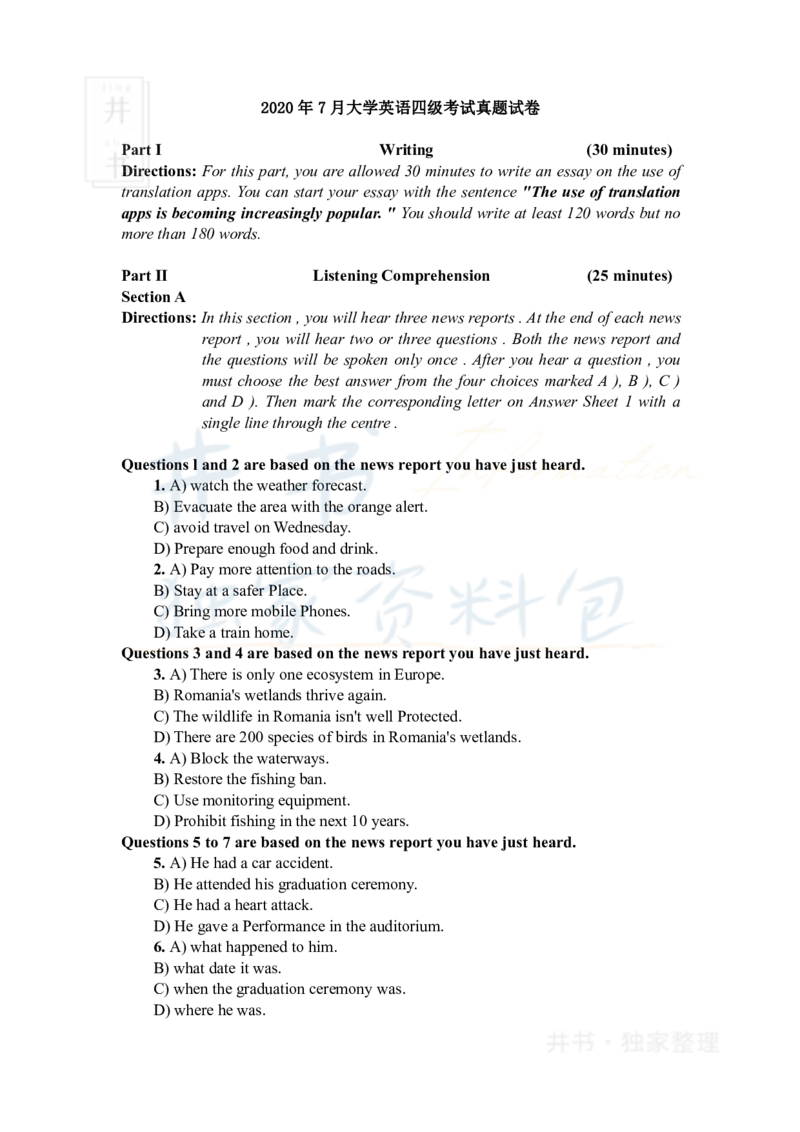
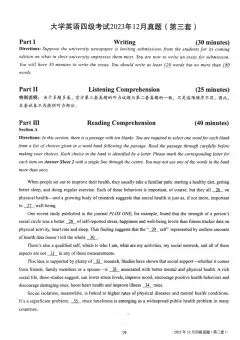
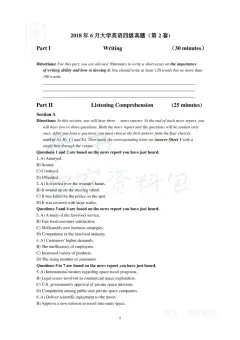
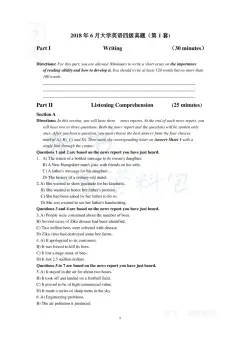
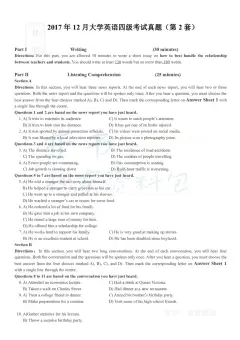
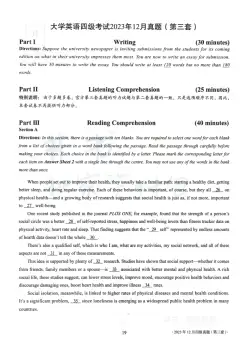
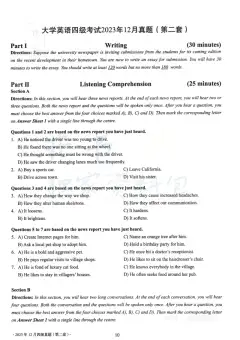
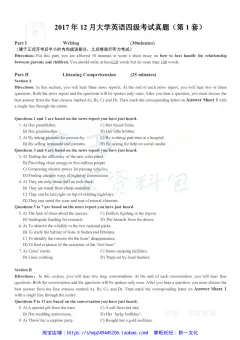
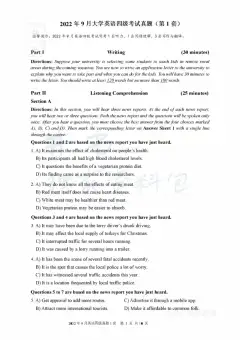
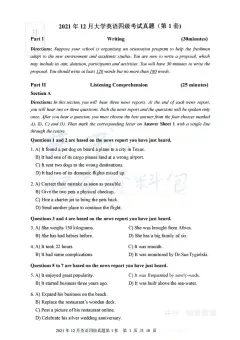
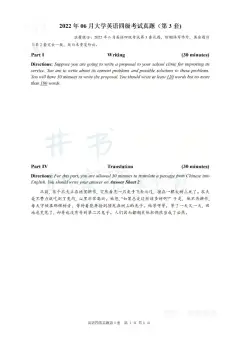
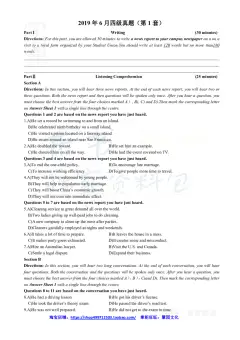
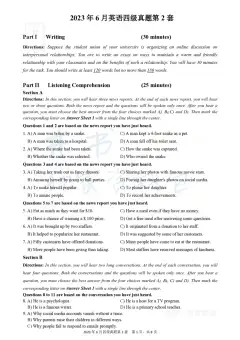
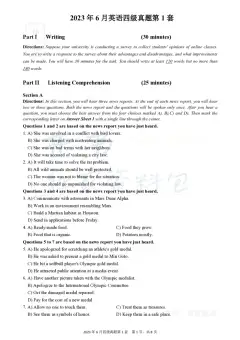
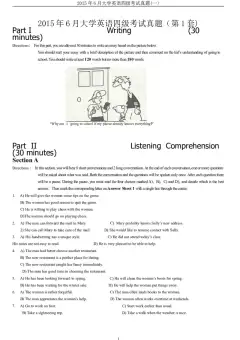
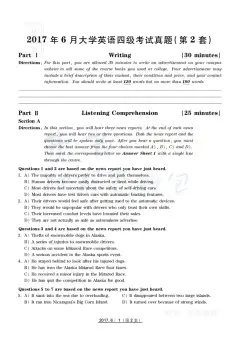
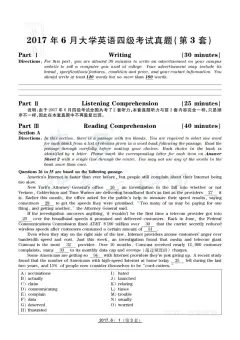
Part I Writing (30 minutes)
Directions: For this part, you are allowed 30 minutes to write an essay on the use of
translation apps. You can start your essay with the sentence "The use of translation
apps is becoming increasingly popular. " You should write at least 120 words but no
morethan 180words.
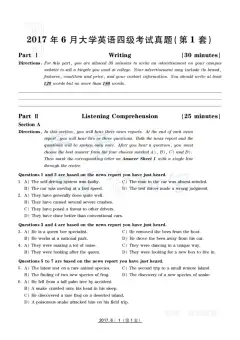
Part Ⅱ ListeningComprehension (25 minutes)
SectionA
Directions: In this section , you will hear three news reports .At the end of each news
report , you will hear two or three questions . Both the news report and
the questions will be spoken only once . After you hear a question , you
must choose the best answer from the four choices marked A ), B ), C )
and D ). Then mark the corresponding letter on Answer Sheet 1 with a
single line throughthecentre.
Questionsl and2arebasedon the newsreport you havejustheard.
1.A)watch theweatherforecast.
B) Evacuatethearea withthe orange alert.
C)avoid travel onWednesday.
D)Prepare enough foodand drink.
2.A)Pay more attention tothe roads.
B) Stayat asafer Place.
C)Bring more mobilePhones.
D)Takea train home.
Questions3and4arebased onthe news reportyou havejustheard.
3.A)There isonly oneecosystem in Europe.
B) Romania's wetlands thrive again.
C)Thewildlife inRomaniaisn't well Protected.
D)There are 200species of birds in Romania's wetlands.
4.A)Block thewaterways.
B) Restorethefishing ban.
C)Usemonitoring equipment.
D)Prohibitfishing inthenext10years.
Questions5to 7arebased onthe newsreportyou havejustheard.
5.A)He had a car accident.
B) Heattended his graduation ceremony.
C)Hehad aheart attack.
D)He gave aPerformance in theauditorium.
6.A)what happened to him.
B) what date itwas.
C)when the graduation ceremony was.
D)where hewas.7.A)He was really touched byhisclassmates.
B) Hedidn't knowwhat happened at all.
C)Hecouldn't remember what to say.
D)His Parents worecaps and gowns.
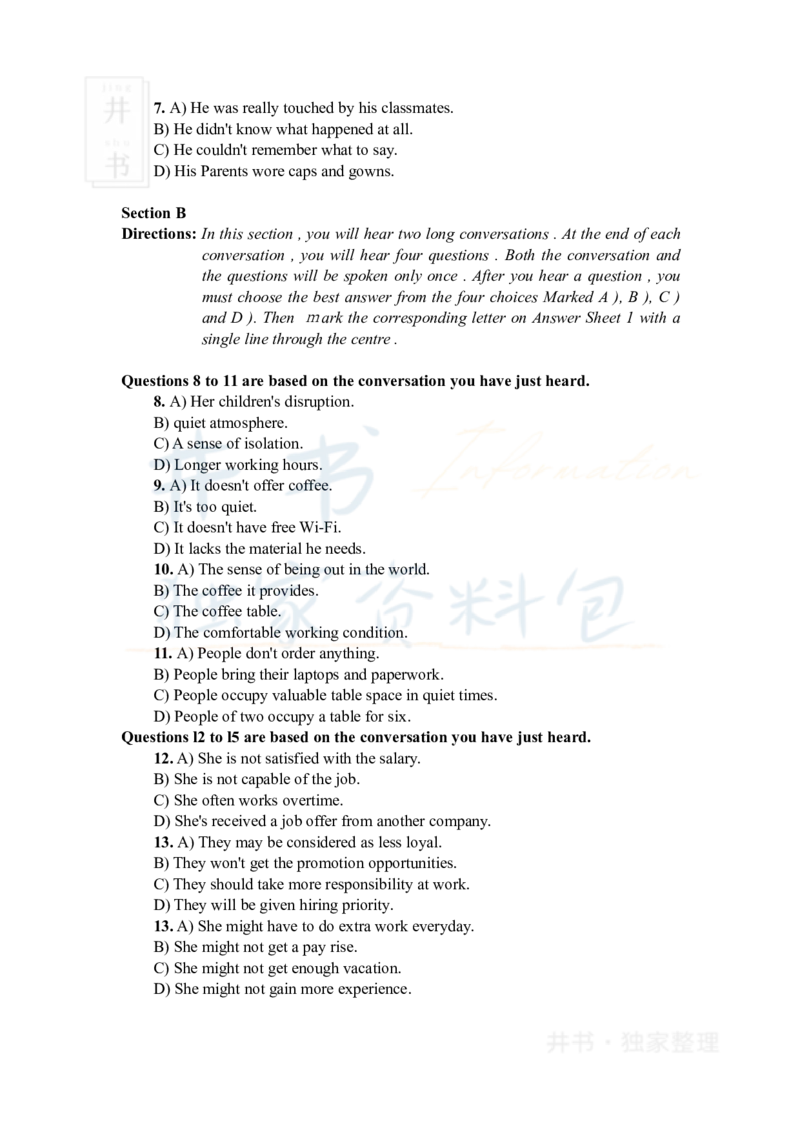
Section B
Directions: In this section , you will hear two long conversations . At the end of each
conversation , you will hear four questions . Both the conversation and
the questions will be spoken only once . After you hear a question , you
must choose the best answer from the four choices Marked A ), B ), C )
and D ). Then mark the corresponding letter on Answer Sheet 1 with a
single line throughthecentre.
Questions8to 11arebasedon theconversation youhavejustheard.
8.A)Her children's disruption.
B) quiet atmosphere.
C)Asenseof isolation.
D)Longer working hours.
9.A)It doesn't offer coffee.
B) It's tooquiet.
C)It doesn't have freeWi-Fi.
D)It lacks thematerial heneeds.
10.A)The senseof being out in theworld.
B)Thecoffee it provides.
C)Thecoffee table.
D)The comfortable working condition.
11.A) Peopledon't order anything.
B) Peoplebring theirlaptops and paperwork.
C)Peopleoccupy valuable tablespace in quiet times.
D)Peopleof two occupy atablefor six.
Questionsl2 tol5 arebasedon theconversation youhavejustheard.
12.A) Sheis notsatisfied with thesalary.
B) Sheis notcapable ofthejob.
C)Sheoften works overtime.
D)She's received ajobofferfrom another company.
13.A)They may beconsidered as less loyal.
B)They won't get thepromotionopportunities.
C)They should take moreresponsibility at work.
D)They will begiven hiring priority.
13.A) Shemight have to doextra work everyday.
B) Shemight not get apay rise.
C)Shemight not get enough vacation.
D)Shemight notgain moreexperience.14.A) Experience.
B) Confidence.
C)Fortune.
D)Opportunity.
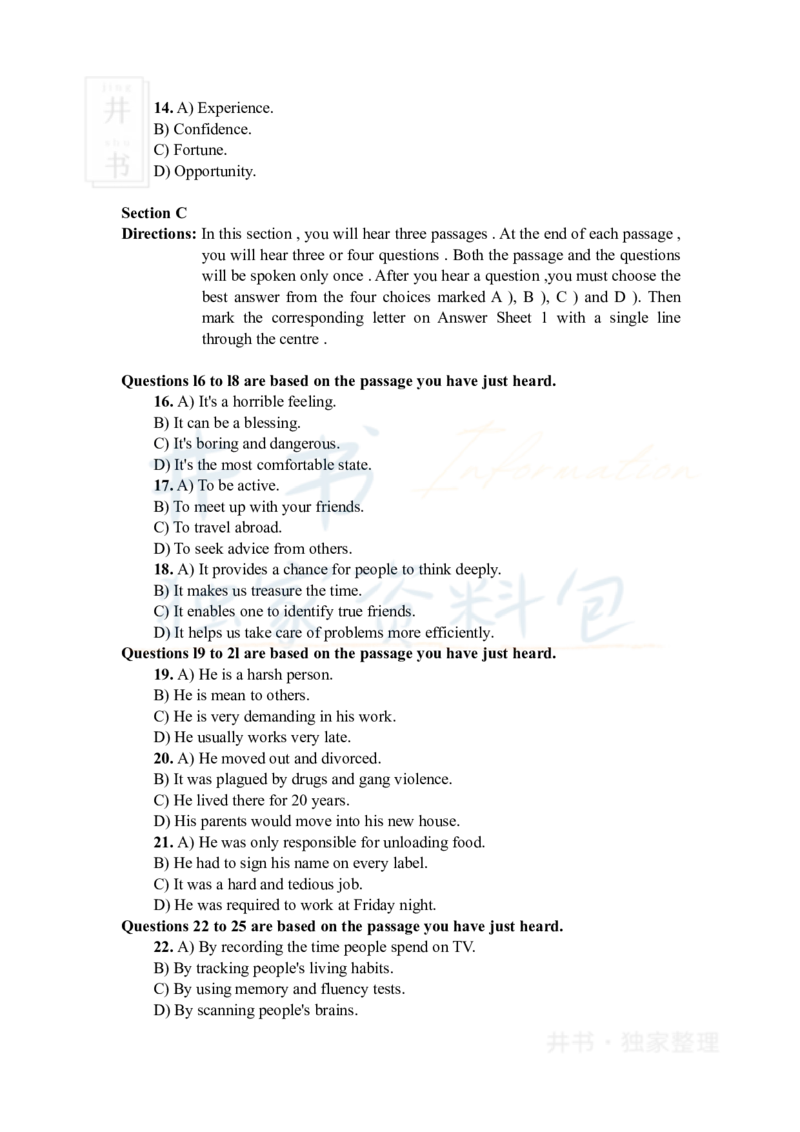
Section C
Directions: In this section , you will hear three passages .At the end of each passage ,
you will hear three or four questions . Both the passage and the questions
will be spoken only once .After you hear a question ,you must choose the
best answer from the four choices marked A ), B ), C ) and D ). Then
mark the corresponding letter on Answer Sheet 1 with a single line
throughthecentre .
Questionsl6 tol8 arebasedon thepassageyou havejustheard.
16.A)It's a horriblefeeling.
B) It can beablessing.
C)It's boring anddangerous.
D)It's themost comfortable state.
17.A)Tobe active.
B)Tomeet upwith your friends.
C)Totravel abroad.
D)Toseek advice from others.
18.A)It provides achancefor people to thinkdeeply.
B) It makes us treasure thetime.
C)It enables onetoidentify true friends.
D)It helps us take care ofproblems moreefficiently.
Questionsl9 to2l arebasedon thepassageyou havejustheard.
19.A)He is aharsh person.
B) Heis mean toothers.
C)Heis very demanding inhis work.
D)He usually works very late.
20.A)He moved out and divorced.
B) It was plagued bydrugs and gang violence.
C)Helived there for 20years.
D)His parents would moveinto hisnew house.
21.A)He was only responsible forunloading food.
B) Hehad to sign his nameon every label.
C)It was a hardand tedious job.
D)He was required towork at Friday night.
Questions22to 25arebased onthe passageyouhavejustheard.
22.A)By recording thetimepeople spend onTV.
B) By tracking people's living habits.
C)By usingmemory and fluency tests.
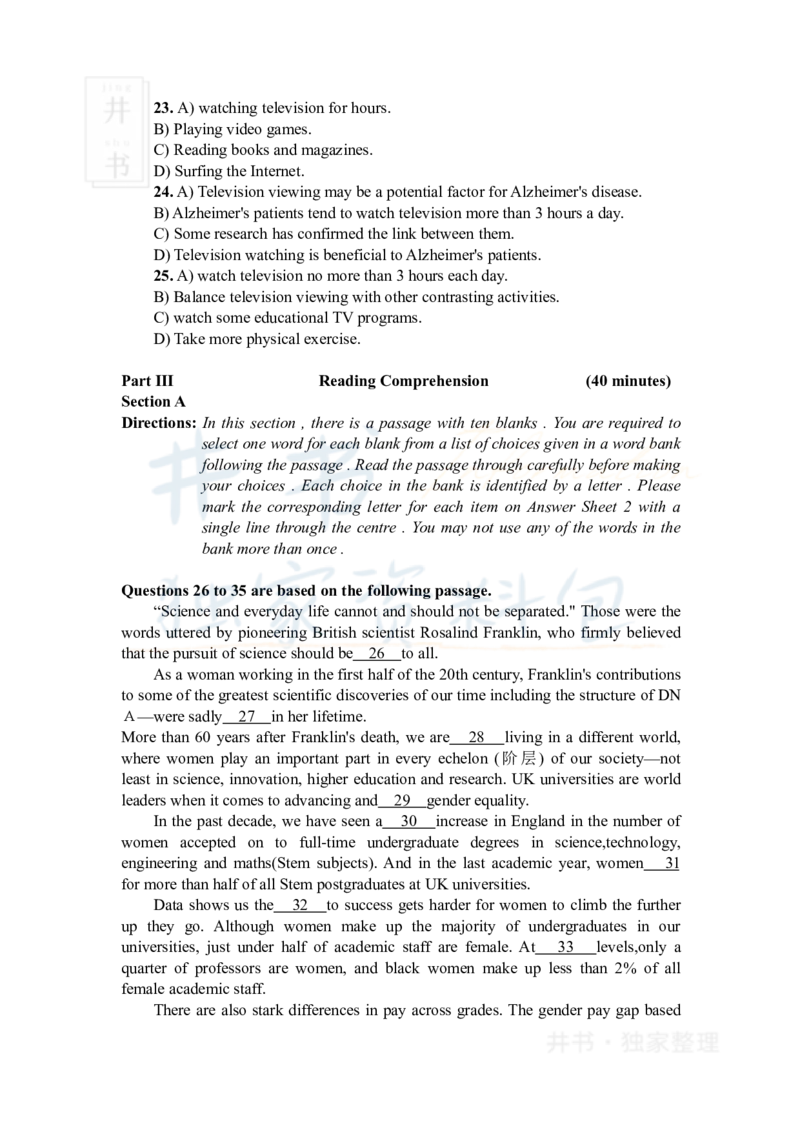
D)By scanning people's brains.23.A)watching television forhours.
B) Playing video games.
C)Reading books and magazines.
D)Surfing theInternet.
24.A)Televisionviewing may be apotential factorforAlzheimer's disease.
B)Alzheimer's patients tend to watch television morethan 3hours aday.
C)Someresearch has confirmed thelinkbetween them.
D)Television watching is beneficial toAlzheimer's patients.
25.A) watch televisionnomore than 3hours each day.
B) Balance television viewing withother contrasting activities.
C)watch someeducationalTVprograms.
D)Takemore physical exercise.
Part Ⅲ ReadingComprehension (40 minutes)
SectionA
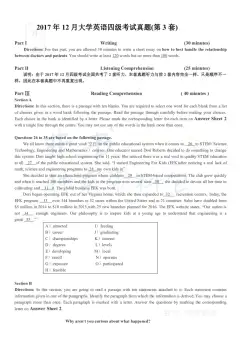
Directions: In this section , there is a passage with ten blanks . You are required to
select one word for each blank from a list of choices given in a word bank
following the passage . Read the passage through carefully beforemaking
your choices . Each choice in the bank is identified by a letter . Please
mark the corresponding letter for each item on Answer Sheet 2 with a
single line through the centre . You may not use any of the words in the
bankmorethan once.
Questions26to 35arebased onthe followingpassage.
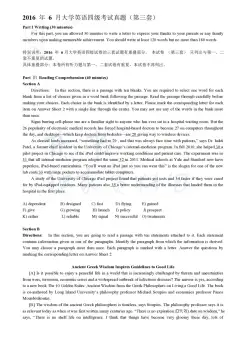
“Science and everyday life cannot and should not be separated." Those were the
words uttered by pioneering British scientist Rosalind Franklin, who firmly believed
that thepursuit ofscience should be 26 to all.
As a woman working in the first half of the 20th century, Franklin's contributions
to some of the greatest scientific discoveries of our time including the structure of DN
A—were sadly 27 inher lifetime.
More than 60 years after Franklin's death, we are 28 living in a different world,
where women play an important part in every echelon (阶层) of our society—not
least in science, innovation, higher education and research. UK universities are world
leaders when itcomes toadvancing and 29 gender equality.
In the past decade, we have seen a 30 increase in England in the number of
women accepted on to full-time undergraduate degrees in science,technology,
engineering and maths(Stem subjects). And in the last academic year, women 31
formore than half ofall Stempostgraduates at UK universities.
Data shows us the 32 to success gets harder for women to climb the further
up they go. Although women make up the majority of undergraduates in our
universities, just under half of academic staff are female. At 33 levels,only a
quarter of professors are women, and black women make up less than 2% of all
female academicstaff.
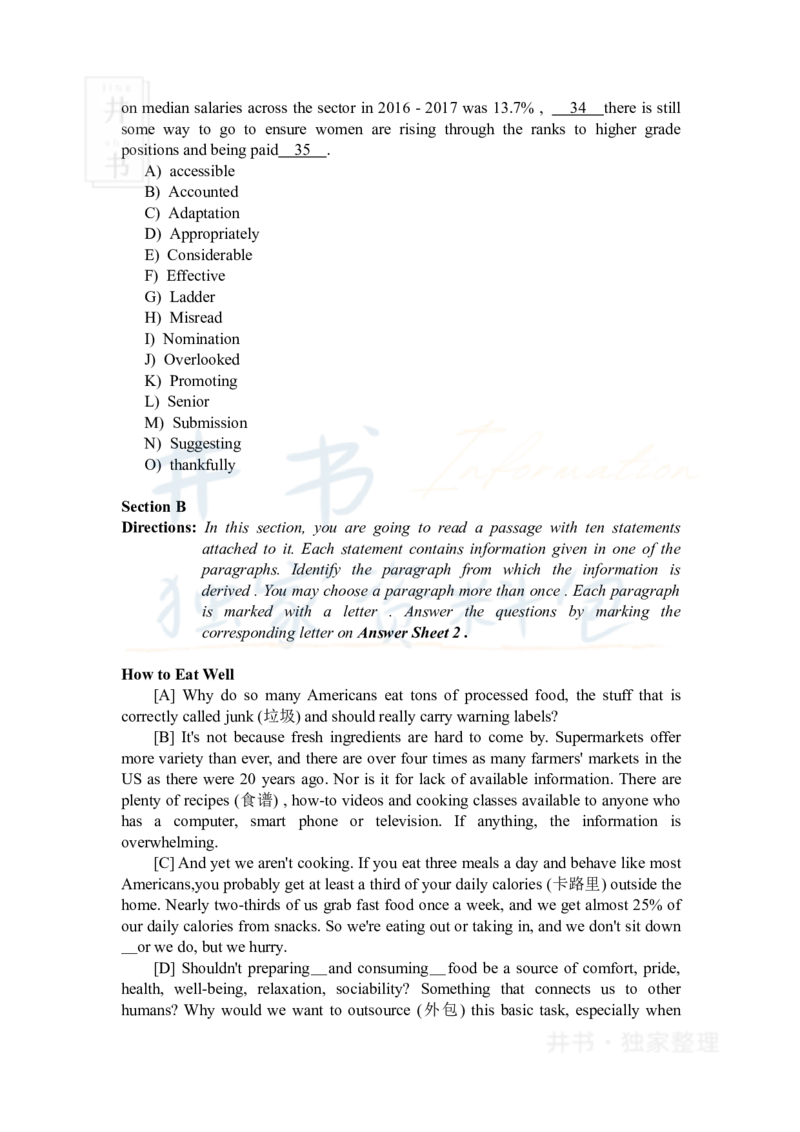
There are also stark differences in pay across grades. The gender pay gap basedon median salaries across the sector in 2016 - 2017 was 13.7% , 34 there is still
some way to go to ensure women are rising through the ranks to higher grade
positionsand being paid 35 .
A) accessible
B) Accounted
C) Adaptation
D) Appropriately
E) Considerable
F) Effective
G) Ladder
H) Misread
I) Nomination
J) Overlooked
K) Promoting
L) Senior
M) Submission
N) Suggesting
O) thankfully
Section B
Directions: In this section, you are going to read a passage with ten statements
attached to it. Each statement contains information given in one of the
paragraphs. Identify the paragraph from which the information is
derived . You may choose a paragraph more than once . Each paragraph
is marked with a letter . Answer the questions by marking the
correspondingletteronAnswer Sheet 2.
HowtoEatWell
[A] Why do so many Americans eat tons of processed food, the stuff that is
correctly called junk (垃圾)and should really carry warning labels?
[B] It's not because fresh ingredients are hard to come by. Supermarkets offer
more variety than ever, and there are over four times as many farmers' markets in the
US as there were 20 years ago. Nor is it for lack of available information. There are
plenty of recipes (食谱) , how-to videos and cooking classes available to anyone who
has a computer, smart phone or television. If anything, the information is
overwhelming.
[C]And yet we aren't cooking. If you eat three meals a day and behave like most
Americans,you probably get at least a third of your daily calories (卡路里) outside the
home. Nearly two-thirds of us grab fast food once a week, and we get almost 25% of
our daily calories from snacks. So we're eating out or taking in, and we don't sit down
_orwe do,butwe hurry.
[D] Shouldn't preparing_and consuming_food be a source of comfort, pride,
health, well-being, relaxation, sociability? Something that connects us to other
humans? Why would we want to outsource (外包) this basic task, especially whenoutsourcing itis soharmful?
[E] When I talk about cooking, I'm not talking about creating elaborate dinner
parties or three-day science projects. I'm talking about simple,easy,everyday meals.
My mission is to encourage green hands and those lacking time or money to feed
themselves. That means we need modest, realistic expectations,and we need to teach
peopleto cookfood that's good enoughto share with family and friends.
[F] Perhaps a return to real cooking needn't be far off. A recent Harris poll
revealed that 79% ofAmericans say they enjoy cooking and 30% "love it"; 14% admit
to not enjoying kitchen work and just 7% won't go near the stove at all. But this
doesn't necessarily translate to real cooking, and the result of this survey shouldn't
surprise anyone: 52% of those 65 or older cook at home five or more times per week;
onlya third ofyoung people do.
[G] Back in the 1950s most of us grew up in households where mom cooked
virtually every night. The intention to put a home-cooked meal on the table was pretty
much universal. Most people couldn't afford to dootherwise
[H] Although frozen dinners were invented in the '40s, their Popularity didn't
boom until televisions became Popular a decade or so later. Since then, Packaged,
pre-prepared meals have been what's for dinner. The microwave and fast-food chains
were the biggest catalysts (催化剂), but the big food companies—which want to sell
anything except the raw ingredients that go into cooking—made the home cook an
endangered species.
[I] Still,I find it strange that only a third of young People report preparing meals
at home regularly. Isn't this the same crowd that rails against Processed junk and
champions craft cooking? And isn't this the generation who say they're concerned
about their health and the well-being of the Planet? If these are truly the values of
many young People, then their behavior doesn't match theirbeliefs.
[J] There have been half-hearted but well-Publicized efforts by some food
companies to reduce calories in their Processed foods, but the StandardAmerican Diet
is still the Polar opposite of the healthy, mostly Plant- based diet that just about every
expert says we should be eating. Considering that the government's standards are not
nearly ambitious enough, the Picture is clear: by not cooking at home, we're not
eating theright things, and theconsequences are hard tooverstate.
[K] To help quantify (量化) the costs of a Poor diet,I recently tried to estimate
this impact in terms of a most famous food, the burger (汉堡包). I concluded that the
Profit from burgers is more than offset (抵消) by the damage they cause in health
Problemsand environmental harm.
[L] Cooking real food is the best defense—not to mention that any meal you're
likely to eat at home contains about 200 fewer calories than one you would eat in a
restaurant.
[M] To thoseAmericans for whom money is a concern,my advice is simple: Buy
what you can afford,and cook it yourself. The common Prescription is to Primarily
shop the grocery store, since that's where fresh Produce, meat and seafood, and dairy
are.And to save money and still eat well you don't need local, organic ingredients; all
you need is real food. I'm not saying local food isn't better; it is. But there is Plenty ofdecent food in thegrocery stores.
[N] The other sections you should get to know are the frozen foods and the
canned goods. Frozen Produce is still Produce; canned tomatoes are still tomatoes.
Just make sure you're getting real food without tons of added salt or sugar. Ask
yourself , would Grandma consider this food? Does it look like something that might
occur in nature? It's Pretty much common sense: you want to buy food, not
unidentifiablefoodlikeobjects.
[O] You don't have to hit the grocery store daily, nor do you need an abundance
of skill. Since fewer than half ofAmericans say they cook at an intermediate level and
only 20% describe their cooking skills as advanced, the crisis is one of confidence.
And the only remedy for that is Practice. There's nothing mysterious about cooking
the evening meal. You just have to do a little thinking ahead and redefine what
qualifies as dinner. Like any skill,cooking gets easier as you do it more; every time
you cook,you advance your level of skills. Someday you won't even need recipes. M
y advice is that you not Pay attention to the number of steps and ingredients, because
they can bedeceiving.
[P] Time,I realize,is the biggest obstacle to cooking for most People. You must
adjust your Priorities tofind
time to cook. For instance, you can move a TV to the kitchen and watch your favorite
shows while you're standing at the sink. No one is asking you to give up activities you
like,butif you'rewatching food shows onTV,try cooking instead.
36. Cooking benefits People in many ways and enables them to connect with one
another.
37.Abundant information about cooking is availableeither onlineor onTV.
38.Youngpeople doless cooking at homethan the elderly thesedays.
39.Cookingskillscan be improved with practice.
40. 1n the mid-20th century, most families ate dinner at home instead of eating
out.
41. Even those short of time or money should be encouraged to cook for
themselves andtheir family.
42.Eating food not cooked byourselves can cause serious consequences.
43. To eat well and still save money, people should buy fresh food and cook it
themselves.
44.We get afairly large portion ofcalories from fast food and snacks.
45.Thepopularity ofTVled tothe popularity offrozen food.
Section C
Directions: There are 2 passages in this section . Each passage is followed by some
questions or unfinished statements . For each of them there are four
choices Marked A), B ),C ) and D ). You should decide on the best choice
and mark the corresponding letter on Answer Sheet 2 with a sing1e 1ine
throughthecentre.PassageOne
Questions46to 50arebased onthe followingpassage.
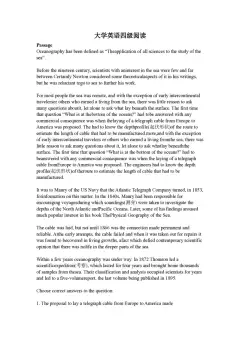
The wallet is heading for extinction.As a day-to-day essential,it will die off with
the generation who read print newspapers. The kind of shopping—where you hand
over notes and count out change in return—now happens only in the most minor of
our retail encounters, like buying a bar of chocolate or a pint of milk, from a corner
shop. At the shops where you spend any real money, that money is increasingly
abstracted.And this is more and more true, the higher up the scale you go.At themost
cutting-edge retail stores—Victoria Beckham on Dover Street, for instance—you
don't go and stand at any kind of cash register, when you decide to pay. The staff are
equipped with iPads to takeyour payment whileyou relax onasofa.
Which is nothing more or less than excellent service, if you have the money. But
across society, the abstraction of the idea of cash makes me uneasy. Maybe 1'm just
old-fashioned. But earning money isn't quick or easy for most of us. Isn't it a bit weird
that spending it should happen in half a b1ink ( 眨 眼 ) of an eye ? Doesn't a
wallet—that time-honoured Friday-night feeling of pleasing , promising
fatness—represent somethingthat matters ?
But I'll leave the economics to the experts. What bothers me about the death of
the wallet is the change it represents in our physical environment. Everything about
the look and feel of a wallet—the way the fastenings and materials wear and tear and
loosen with age, the plastic and paper and gold and silver, and handwritten phone
numbers and printed cinema tickets—is the very opposite of what our world is
becoming. The opposite of a wallet is a smart phone or an iPad. The rounded edges,
cool glass, smooth and unknowable as a pebb1e (鹅卵石). Instead of digging through
pieces of paper and peering into corners, we move our fingers left and right. No more
counting out coins. Show your wallet, if you still have one. 1t may not be here much
longer.
46.Whatis happening to thewallet?
A)Itis disappearing.
B) It isbeing fattened.
C)It isbecoming costly.
D)Itis changing instyle.
47.Howarebusinesstransactions donein bigmodern stores?
A)Individually.
B) Electronically.
C)Intheabstract.
D)Viaacash register.
48.Whatmakes theauthorfeel uncomfortablenowadays?
A)Saving money is becoming a thingof thepast.
B)Thepleasing Friday-night feeling is fading.
C)Earning moneyis getting moredifficult.
D)Spending money is so fast and easy.
49.Why doesthe authorchooseto write aboutwhat's happeningto the wallet?
A)Itrepresents achange in themodern world.B) It has something to dowitheverybody's life.
C)It marks theend ofa time-honoured tradition.
D)Itis theconcern ofcontemporary economists.
50.Whatcan weinferfromthe passageabouttheauthor?
A)He is resistant to social changes.
B) Heis against technological progress.
C)Hefeels reluctant topart with thetraditional wallet.
D)He feels insecure in theever-changing modern world.
PassageTwo
Questions5l to55arebased onthe followingpassage.
It's late in the evening: time to close the book and turn off the computer. You're
done for the day. What you may not realize, however, is that the learning process
actually continues—inyour dreams.
It might sound like science fiction, but researchers are increasingly focusing on
the relationship between the knowledge and skills our brains absorb during the day
and the fragmented, often bizarre imaginings they generate at night. Scientists have
found that dreaming about a task we've learned is associated with improved
performance in that activity (suggesting that there's some truth to the popular notion
that we're "getting" a foreign language once we begin dreaming in it). What's more,
researchers are coming to recognize that dreaming is an essential part of
understanding,organizingand retaining what we learn.
While we sleep, research indicates, the brain replays the patterns of activity it
experienced during waking hours, allowing us to enter what one psychologist calls a
neura1 (神经的) virtual reality.Avivid example of such replay can be seen in a video
researchers made recently about sleep disorders. They taught a series of dance moves
to a group of patients with conditions like sleepwalking, in which the sleeper engages
in the kind physical movement that does not normally occur during sleep. They then
videotaped the subjects as they slept. Lying in bed, eyes closed, one female patient on
thetapeperforms thedance moves shelearned earlier.
This shows that while our bodies are at rest, our brains are drawing what's
important from the information and events we've recently encountered, then
integrating that data into the vast store of what we already know. In a 20l0 study,
researchers at Harvard Medical School reported that college students who dreamed
about a computer maze (迷宫) task they had learned showed a l0-fold improvement in
their ability to find their way through the maze compared with participants who did
notdream about thetask.
Robert Stickgold , one of the Harvard researchers, suggests that studying right
before bedtime or taking a nap following a study session in the afternoon might
increase the odds of dreaming about the material. Think about that as your head hits
thepillowtonight.5l.Whatisscientists' finding aboutdreaming?
A)It involves disconnected, weird images.
B)It resembles fragments of science fiction.
C)Dreaming about alearned task betters itsperformance.
D)Dreaming about things being learned disturbs one's sleep.
52.Whathappenswhen oneenters adreamstate?
A)The bodycontinues to act as ifthesleeper were awake.
B)Theneural activity of thebrain will become intensified.
C)Thebrain behaves as ifit were playing a virtualreality videogame.
D)The brain onceagain experiences thelearning activitiesof theday.
53.Whatdoes thebraindowhileweare sleeping?
A)It systematizes all thedatacollected during the day.
B)It substitutes old information with newdata.
C)It processes andabsorbs newly acquired data.
D)It classifies information and places it indifferent files.
54.Whatdoes Robert Stickgoldsuggestaboutenhancinglearning?
A)Having alittlesleep after studying intheday.
B)Staying uplate before going to bed.
C)Having a dream about anything.
D)Thinking about the oddsof dreaming about thematerial.
55.Whatcan beinferredaboutdreaming fromthepassage?
A)Wemay enhance ourlearning through dreaming.
B)Dreaming improves your language ability.
C)Allsleepwalkers perform dance moves when they are sleeping.
D)Taking anap after learning can help you find theway through themaze.
Part Ⅳ Translation (30 minutes)
Directions: For this part , you are allowed 30 minutes to translate a passage from
ChineseintoEnglish.You shouldwriteyour answer onAnswer Sheet 2.
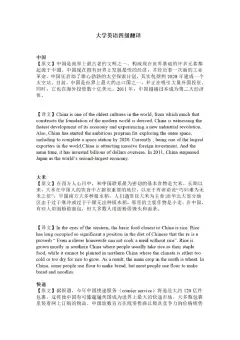
在中国,火锅已有 2,000 多年的历史,最早流行于最寒冷的地区,然后在
很多地区盛行,出现了具有地方特色的种类。吃火锅时,家人和朋友围坐在桌边,
桌子中间放着热腾腾的火锅。吃火锅时,人们可以根据自己的口味放肉、海鲜、
蔬菜和其他配料,自己烹饪。人们可以一边尽情地聊天,一边享受美餐。【 参 考 答 案 】
【参考范文】
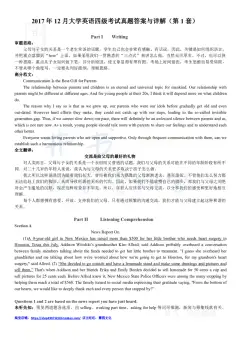
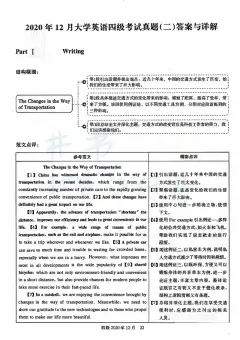
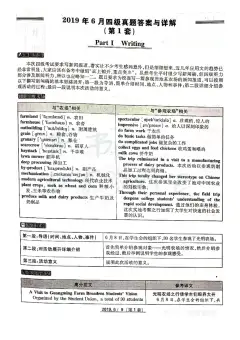
The use of translation apps is becoming increasingly popular. Translation apps
have become an essential part of people's life, especially among people who are
learning English and other foreign languages.Just as a coin has two sides, translation
apps also have theiradvantages and disadvantages.
On the one hand, they have made language learning much more convenient and
can help people who do not speak the same language communicate smoothly.On the
other hand, many people are not willing to learn to improve their language ability
because the apps are easy to use.Besides, the translation given by many translation
apps is full of grammatical errors, which is bound to seriously mislead people's
learning and communication.
Translation apps have changed people's life in many ways, but they also lead to
some negative consequences.People should discern good from bad when using
translation apps and use them reasonably and flexibly.Only in this way can translation
apps better serve peopleand not theother way around.
【1-5】CABDA 【6-10】BACBA 【11-15】DAABA 【16-20】BADCB
【21-25】CCAAB
【26-30】AJOKE 【31-35】BGLND
【36-40】DBFOG 【41-45】EJMCH
【46-50】ABDAC 【51-55】CDCAA
【翻译参考译文】
Hot pot has a history of more than 2,000 years in China. It first became popular
in the coldest regions and gradually became popular in many regions, with the
emergence of varieties with local characteristics. When having hot pot, family and
friends gather around the table with a steaming hot pot in the middle of the table.
According to personal taste, people can put vegetables, seafood, noodles and other
ingredients into the pot and then cook it by themselves. They can fully enjoy the meal
whilechatting with others.