2021年 12月大学英语六级考试真题(第 1 套)
扫码获音频
Part I Writing (30 minutes)
Directions: For this part, you are allowed 30 minutes to write an essay related to the short
passage given below. In your essay, you are to comment on the phenomenon described in the
passage and suggest measures to address the issue. You should write at least 150 words but no
more than 200 words.
Young people spend a lot of time on the Internet. However, they are sometimes unable to
recognize false information on the Internet, judge the reliability of online information sources,
or tell real news stories from fake ones.
Part II Listening Comprehension (30 minutes)
Section A
Directions: In this section, you will hear two long conversations. At the end of each
conversation, you will hear four questions. Both the conversation and the questions will be
spoken only once. After you hear a question, you must choose the best answer from the four
choices marked A), B), C) and D). Then mark the corresponding letter on Answer Sheet 1 with
a single line through the centre.
Questions 1 to 4 are based on the conversation you have just heard.
1. A) He was enjoying his holiday. C) He was busy writing his essays.
B) He was recovering in hospital. D) He was fighting a throat infection.
2. A) He broke his wrist. C) He slipped on ice and fell.
B) He lost his antibiotics. D) He was laughed at by some girls.
3. A) Turn to her father for help. C) Ask the manufacturer for repairs.
B) Call the repair shop to fix it. D) Replace it with a brand-new one.
4. A) Help David retrieve his essays. C) Offer David some refreshments.
B) Introduce David to her parents. D) Accompany David to his home.
Questions 5 to 8 are based on the conversation you have just heard.
5. A) She is a critic of works on military affairs.
B) She is an acclaimed hostess of Book Talk.
C) She is a researcher of literary genres.
D) She is a historian of military history.
6. A) It is about the military history of Europe.
B) It is set in the 18th and 19th centuries.
C) It is her fifth book of military history.
D) It is a war novel set in the future.
7. A) She visited soldiers' wives and mothers.
B) She conducted surveys of many soldiers.
C) She met a large number of soldiers in person.
D) She looked into the personal lives of soldiers.
2021年 12月英语六级真题第1套 第 1 页 共 10页 by:光速考研8. A) She doesn't have much freedom for imagination.
B) It is not easy to make her readers believe in her.
C) It is difficult to attract young readers.
D) She has to combine fact with fiction.
Section B
Directions: In this section, you will hear two passages. At the end of each passage, you will hear
three or four questions. Both the passage and the questions will be spoken only once. After you
hear a question, you must choose the best answer from the four choices marked A), B), C) and D).
Then mark the corresponding letter on Answer Sheet 1 with a single line through the centre.
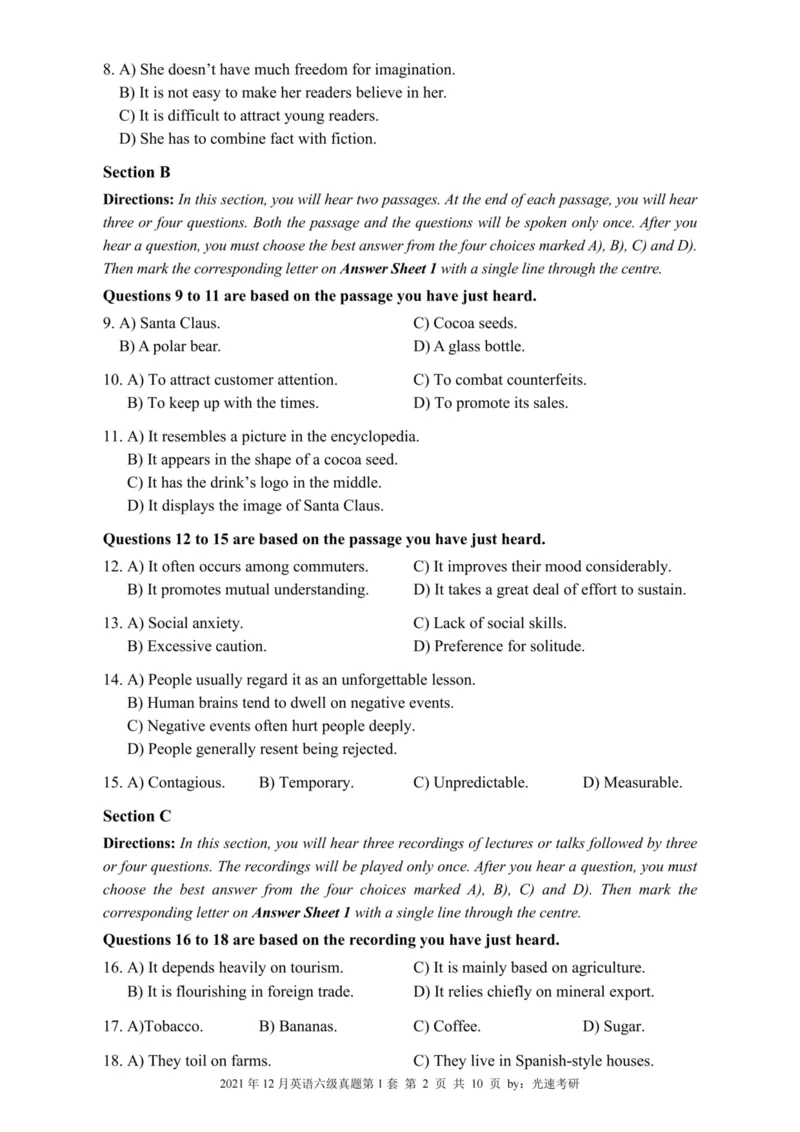
Questions 9 to 11 are based on the passage you have just heard.
9. A) Santa Claus. C) Cocoa seeds.
B) A polar bear. D) A glass bottle.
10. A) To attract customer attention. C) To combat counterfeits.
B) To keep up with the times. D) To promote its sales.
11. A) It resembles a picture in the encyclopedia.
B) It appears in the shape of a cocoa seed.
C) It has the drink's logo in the middle.
D) It displays the image of Santa Claus.
Questions 12 to 15 are based on the passage you have just heard.
12. A) It often occurs among commuters. C) It improves their mood considerably.
B) It promotes mutual understanding. D) It takes a great deal of effort to sustain.
13. A) Social anxiety. C) Lack of social skills.
B) Excessive caution. D) Preference for solitude.
14. A) People usually regard it as an unforgettable lesson.
B) Human brains tend to dwell on negative events.
C) Negative events often hurt people deeply.
D) People generally resent being rejected.
15. A) Contagious. B) Temporary. C) Unpredictable. D) Measurable.
Section C
Directions: In this section, you will hear three recordings of lectures or talks followed by three
or four questions. The recordings will be played only once. After you hear a question, you must
choose the best answer from the four choices marked A), B), C) and D). Then mark the
corresponding letter on Answer Sheet 1 with a single line through the centre.
Questions 16 to 18 are based on the recording you have just heard.
16. A) It depends heavily on tourism. C) It is mainly based on agriculture.
B) It is flourishing in foreign trade. D) It relies chiefly on mineral export.
17. A)Tobacco. B) Bananas. C) Coffee. D) Sugar.
18. A) They toil on farms. C) They live in Spanish-style houses.
2021年12月英语六级真题第1套 第 2 页 共 10页 by:光速考研B) They live a poor life. D) They hire people to do housework.
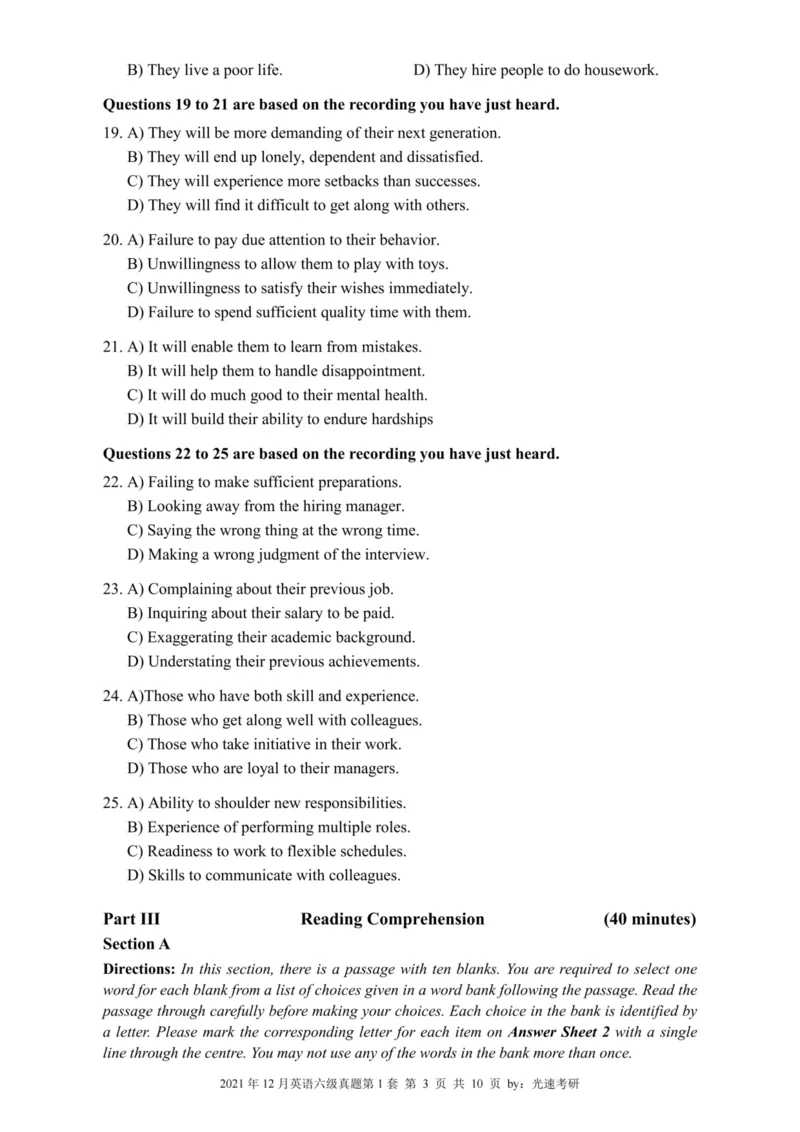
Questions 19 to 21 are based on the recording you have just heard.
19. A) They will be more demanding of their next generation.
B) They will end up lonely, dependent and dissatisfied.
C) They will experience more setbacks than successes.
D) They will find it difficult to get along with others.
20. A) Failure to pay due attention to their behavior.
B) Unwillingness to allow them to play with toys.
C) Unwillingness to satisfy their wishes immediately.
D) Failure to spend sufficient quality time with them.
21. A) It will enable them to learn from mistakes.
B) It will help them to handle disappointment.
C) It will do much good to their mental health.
D) It will build their ability to endure hardships
Questions 22 to 25 are based on the recording you have just heard.
22. A) Failing to make sufficient preparations.
B) Looking away from the hiring manager.
C) Saying the wrong thing at the wrong time.
D) Making a wrong judgment of the interview.
23. A) Complaining about their previous job.
B) Inquiring about their salary to be paid.
C) Exaggerating their academic background.
D) Understating their previous achievements.
24. A)Those who have both skill and experience.
B) Those who get along well with colleagues.
C) Those who take initiative in their work.
D) Those who are loyal to their managers.
25. A) Ability to shoulder new responsibilities.
B) Experience of performing multiple roles.
C) Readiness to work to flexible schedules.
D) Skills to communicate with colleagues.
Part III Reading Comprehension (40 minutes)
Section A
Directions: In this section, there is a passage with ten blanks. You are required to select one
word for each blank from a list of choices given in a word bank following the passage. Read the
passage through carefully before making your choices. Each choice in the bank is identified by
a letter. Please mark the corresponding letter for each item on Answer Sheet 2 with a single
line through the centre. You may not use any of the words in the bank more than once.
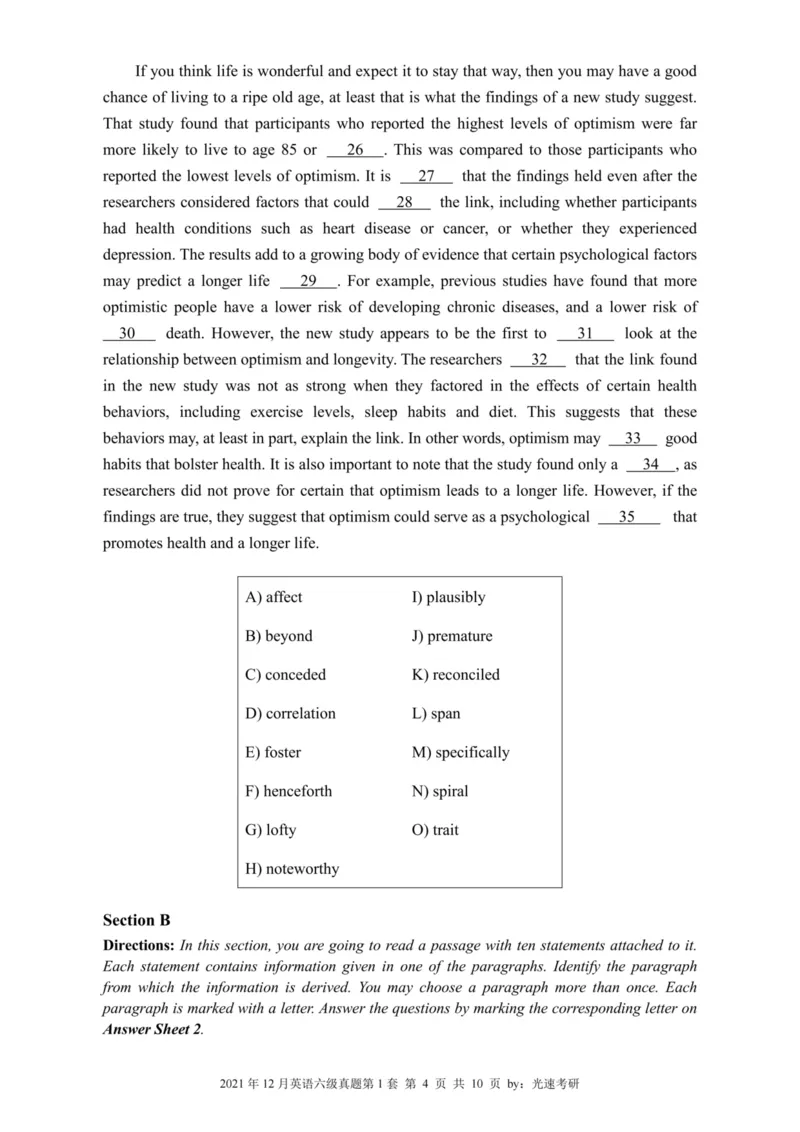
2021年12月英语六级真题第1套 第 3 页 共 10页 by:光速考研If you think life is wonderful and expect it to stay that way, then you may have a good
chance of living to a ripe old age, at least that is what the findings of a new study suggest.
That study found that participants who reported the highest levels of optimism were far
more likely to live to age 85 or 26 . This was compared to those participants who
reported the lowest levels of optimism. It is 27 that the findings held even after the
researchers considered factors that could 28 the link, including whether participants
had health conditions such as heart disease or cancer, or whether they experienced
depression. The results add to a growing body of evidence that certain psychological factors
may predict a longer life 29 . For example, previous studies have found that more
optimistic people have a lower risk of developing chronic diseases, and a lower risk of
30 death. However, the new study appears to be the first to 31 look at the
relationship between optimism and longevity. The researchers 32 that the link found
in the new study was not as strong when they factored in the effects of certain health
behaviors, including exercise levels, sleep habits and diet. This suggests that these
behaviors may, at least in part, explain the link. In other words, optimism may 33 good
habits that bolster health. It is also important to note that the study found only a 34 , as
researchers did not prove for certain that optimism leads to a longer life. However, if the
findings are true, they suggest that optimism could serve as a psychological 35 that
promotes health and a longer life.
A) affect I) plausibly
B) beyond J) premature
C) conceded K) reconciled
D) correlation L) span
E) foster M) specifically
F) henceforth N) spiral
G) lofty 0) trait
H) noteworthy
Section B
Directions: In this section, you are going to read a passage with ten statements attached to it.
Each statement contains information given in one of the paragraphs. Identify the paragraph
from which the information is derived. You may choose a paragraph more than once. Each
paragraph is marked with a letter. Answer the questions by marking the corresponding letter on
Answer Sheet 2.
2021年12月英语六级真题第1套 第 4 页 共 10页 by:光速考研No one in fashion is surprised that Burberry burnt £28 million of stock
A) Last week, Burberry's annual report revealed that £28.6 million worth of stock was
burnt last year. The news has left investors and consumers outraged but comes as little
surprise to those in the fashion industry.
B) The practice of destroying unsold stock, and even rolls of unused fabric, is
commonplace fbr luxury labels. Becoming too widely available at a cheaper price
through discount stores discourages full-price sales. Sending products for recycling
leaves them vulnerable to being stolen and sold on the black market. Jasmine Bina,
CEO of brand strategy agency Concept Bureau explains, ''Typically, luxury brands rally
around exclusivity to protect their business interests, namely intellectual property and
preservation of brand equity (资 产 )She stated she had heard rumors of stock burning
but not specific cases until this week.
C) Another reason for the commonplace practice is a financial incentive fbr brands
exporting goods to America. United States Customs states that if imported merchandise
is unused and destroyed under their supervision, 99% of the duties, taxes or fees paid on
the merchandise may be recovered. It is incredibly difficult to calculate how much dead
stock currently goes to waste. While there are incentives to do it, there5s no legal
obligation to report it.
D) A source, who chose to remain anonymous, shared her experience working in a
Burberry store in New York in October 2016. “My job was to toss items in boxes so
they could be sent to be burned. It was killing me inside because all that leather and fiir
went to waste and animals had died for nothing. I couldn't stay there any longer, their
business practices threw me off the roof." In May this year, Burberry announced it was
taking fur out of its catwalk shows and reviewing its use elsewhere in the business.
“Even though we asked the management, they refused to give us detailed answers as to
why they would do this with their collection,continued the source, who left her role
within two weeks. She has since worked with another high-profile, luxury label.
E) In an online forum post, which asked if ifs true that Louis Vuitton burned its bags,
Ahmed Bouchfaa, who claimed to work for Louis Vuitton, responded that the brand
holds sales of old stock fbr staff members twice a year. Items which have still not sold
after several sales are destroyed. t4Louis Vuitton doesn't have public sales. They either
sell a product at a given price or discontinue it. This is to make sure that everybody
pays the same price for an item he says. He goes on to disclose the strict guidelines
around the employee sales: 4tYou may buy gifts for someone, but they track each item,
and if your gift ends up online they know who to ask." One investor commenting on the
Burberry figures was reportedly outraged that the unsold goods were not even offered to
investors before they were destroyed.
F) Richemont, who owns several luxury brands, hit the headlines in May for taking back
£437 million of watches fbr destruction in the last two years to avoid marked-down
prices. Ifs not just luxury brands either. In October last year, a Danish TV show
exposed H&M fbr burning 12 tonnes of unsold clothing since 2013. In a statement, the
high street retailer defended itself by saying that the burnt clothing had failed safety
tests: "The products to which the media are referring have been tested in external
laboratories. The test results show that one of the products is mold infested and the
2021年12月英语六级真题第1套 第 5 页 共 10页 by:光速考研other product contains levels of lead that are too high. Those products have rightly been
stopped in accordance with our safety routines.In March, a report revealed that H&M
was struggling with $4.3 billion worth of unsold stock. The brand told The New York
Times that the plan was to reduce prices to move the stock, arguably encouraging
consumers to buy and throw away with little thought.
G) Over-production is perhaps the biggest concern for Burberry. While there has been
much outrage at the elitist connotation of burning goods rather than making them
affordable, executives at the British fashion house are no doubt struggling to defend
how they miscalculated production. The waste has been put down to burning old
cosmetic stock to make way for their new beauty range. However, while the value of
destroyed stock is up from £26.9 million last year, ifs an even more significant increase
from 2016's figure of £18.8 million, highlighting that this is an ongoing issue.
H) In September 2016, Burberry switched to a “see now, buy now“ catwalk show format.
The move was a switch to leverage on the coverage of their fashion week show to make
stock available immediately to consumers. This is opposed to the traditional format of
presenting to the industry, taking orders for production and becoming available in
six months, time. While Burberry announced “record-breaking“ online reach and
engagement, there has been little evidence to suggest that the strategy has had a
significant effect on sales, particularly as the hype (炒作)slows across the season. In
February they made adjustments to the format, dropping some catwalk items
immediately and promising that others would launch in the coming months.
I) In a statement, Burberry denied that switching to “see now, buy now“ has had an impact
on waste. A Burberry spokesperson further said, “On the occasions when disposal of
products is necessary, we do so in a responsible manner. We are always seeking ways to
reduce and revalue our waste. This is a core part of our strategy and we have forged
partnerships and committed support to innovative organizations to help reach this goal.^^
J) One such partnership is with Elvis & Kresse, an accessories brand working with
reclaimed materials. Co-fbunder Kresse Wesling said, “Late last year we launched an
ambitious five-year partnership with the Burberry Foundation. The main aim of this is to
scale our leather rescue project, starting with off-cuts from the production of Burberry
leather goods. We are working tirelessly to expand our solutions and would love to
welcome anyone to our workshop to come and see what we are doing.5, At the moment,
the partnership only addresses waste at the production stage and not unsold goods.
K) While these are honorable schemes, it makes it harder for Burberry to defend these
latest figures. Fifteen years ago, Burberry was at crisis point as their signature check
pattern was widely imitated by cheap, imitation brands. It deterred luxury consumers
who found their expensive clothing more closely associated with working-class youth
culture than a prestigious heritage fashion house. In the year 2004, at the height of
over-exposure of the Burberry check, the brand's turnover was £715.5 million. Under
Christopher Bailey as creative director they turned the brand around and this past year
revenue hit £2.73 billion.
L) Bina believes that brands need to readdress their exclusivity tactic. ''Exclusivity is
starting to be challenged,she says, “I think that goes hand in hand with how luxury
itself is being challenged. Access to fashion, and the brands who police it, are becoming
2021年12月英语六级真题第1套 第 6 页 共 10页 by:光速考研less and less relevant. Things like health, enlightenment, and social and environmental
responsibility are the new luxuries. These all come from within, not without. Thafs the
challenge that traditional luxury brands will have to contend with in the mid-to
long-term future.”
36. Burberry's executives are trying hard to attribute their practice of destroying old
products to miscalculated production.
37. Selling products at a discount will do greater harm to luxury brands than destroying
them.
38. Imitated Burberry products discouraged luxury consumers from buying its genuine
products.
39. Staff members of a luxury brand may buy its old stock at cheaper prices, but they are
not allowed to resell them.
40. In future traditional luxury brands will have to adapt their business strategies to the
changing concepts of luxury.
41. One luxury brand employee quit her job because she simply couldn't bear to see the
destruction of unsold products.
42. Destroying old stock is a practice not just of luxury brands but of less prestigious
fashion brands.
43. Burberry is working with a partner to make full use of leather materials to reduce waste.
44. Burberry's plan to destroy its unsold products worth millions of dollars aroused public
indignation.
45. Burberry's change of marketing strategy to make a product available as soon as
consumers see it on the fashion show did not turn out to be as effective as expected.
Section C
Directions: There are 2 passages in this section. Each passage is followed by some questions
or unfinished statements. For each of them there are four choices marked A), B), C) and D).
You should decide on the best choice and mark the corresponding letter on Answer Sheet 2
with a single line through the centre.
Passage One
Questions 46 to 50 are based on the following passage.
Social media is absolutely everywhere. Billions of people use social media on a daily
basis to create, share, and exchange ideas, messages, and information. Both individuals and
businesses post regularly to engage and interact with people from around the world. It is a
powerful communication medium that simultaneously provides immediate, frequent,
permanent, and wide-reaching information across the globe.
People post their lives on social media for the world to see. Facebook, Twitter,
Linkedln, and countless other social channels provide a quick and simple way to glimpse
into a job candidate's personal life—both the positive and negative sides of it. Social media
screening is tempting to use as part of the hiring process, but should employers make use of
it when researching a potential candidate's background?
Incorporating the use of social media to screen job candidates is not an uncommon
2021年 12月英语六级真题第1套 第 7 页 共 10页 by:光速考研practice. A 2018 survey found that almost 70% of employers use social media to screen
candidates before hiring them. But there are consequences and potential legal risks involved
too. When done inappropriately, social media screening can be considered Unethical or
even illegal.
Social media screening is essentially scrutinising a job candidate's private life. It can
reveal information about protected characteristics like age, race, nationality, disability,
gender, religion, etc., and that could bias a hiring decision. Pictures or comments on a
private page that are taken out of context could ruin a perfectly good candidate's chances of
getting hired. This process could potentially give an unfair advantage to one candidate over
another. It creates an unequal playing field and potentially provides hiring managers with
information that can impact their hiring decision in a negative way.
Ifs hard to ignore social media as a screening tool. While there are things that you
shouldn't see, there are some things that can be lawfully considered- making it a valuable
source of relevant information too. Using social media screening appropriately can help
ensure that you don't hire a toxic employee who will cost you money or stain your
company's reputation. Consider the lawful side of this process and you may be able to hire
the best employee ever. There is a delicate balance.
Screening job candidates on social media must be done professionally and responsibly.
Companies should stipulate that they will never ask for passwords, be consistent, document
decisions, consider the source used and be aware that other laws may apply. In light of this
it is probably best to look later in the process and ask human resources for help in
navigating it. Social media is here to stay. But before using social media to screen job
candidates, consulting with management and legal teams beforehand is essential in order to
comply with all laws.
46. What does the author mainly discuss in the passage?
A) The advantage of using social media in screening job candidates.
B) The potentially invasive nature of social media in everyday life.
C) Whether the benefits of social media outweigh the drawbacks.
D) Whether social media should be used to screen job candidates.
47. What might happen when social media is used to screen job candidates?
A) Moral or legal issues might arise.
B) Company reputation might suffer.
C) Sensational information might surface.
D) Hiring decisions might be complicated.
48. When could online personal information be detrimental to candidates?
A) When it is separated from context.
B) When it is scrutinised by an employer.
C) When it is magnified to a ruinous degree.
D) When it is revealed to the human resources.
49. How can employers use social media information to their advantage while avoiding
unnecessary risks?
2021年12月英语六级真题第1套 第 8 页 共 10页 by:光速考研A) By tipping the delicate balance.
B) By using it in a legitimate way.
C) By keeping personal information on record.
D) By separating relevant from irrelevant data.
50. What does the author suggest doing before screening job candidates on social media?
A) Hiring professionals to navigate the whole process.
B) Anticipating potential risks involved in the process.
C) Seeking advice from management and legal experts.
D) Stipulating a set of rules for asking specific questions.
Passage Two
Questions 51 to 55 are based on the following passage.
In recent years, the food industry has increased its use of labels. Whether the labels say
'non-GMO ( 非转基因 的),or 4no sugar/ or 'zero carbohydrates5, consumers are
increasingly demanding more information about whafs in their food. One report found that
39 percent of consumers would switch from the brands they currently buy to others that
provide clearer, more accurate product information. Food manufacturers are responding to
the report with new labels to meet that demand, and they5re doing so with an eye towards
giving their products an advantage over the competition, and bolstering profits.
This strategy makes intuitive sense. If consumers say they want transparency, tell them
exactly what is in your product. That is simply supplying a certain demand. But the
marketing strategy in response to this consumer demand has gone beyond articulating what
is in a product, to labeling what is NOT in the food. These labels are known as “absence
claims^^ labels, and they represent an emerging labeling trend that is detrimental both to the
consumers who purchase the products and the industry that supplies them.
For example, Hunfs put a “non-GMO“ label on its canned crushed tomatoes a few
years ago- despite the fact that at the time there was no such thing as a GMO tomato on
the market. Some dairy companies are using the “non-GMO“ label on their milk, despite
the fact that all milk is naturally GMO-free, another label that creates unnecessary fear
around food.
While creating labels that play on consumer fears and misconceptions about their food
may give a company a temporary marketing advantage over competing products on the
grocery aisle, in the long term this strategy will have just the opposite effect: by injecting
fear into the discourse about our food, we run the risk of eroding consumer trust in not just
a single product, but the entire food business.
Eventually, it becomes a question in consumers, minds: Were these foods ever safe?
By purchasing and consuming these types of products, have I already done some kind of
harm to my family or the planet?
For food manufacturers, it will mean damaged consumer trust and lower sales fbr
everyone. And this isn't just supposition. A recent study found that absence claims labels can
create a stigma around foods even when there is no scientific evidence that they cause harm.
Ifs clear that food manufacturers must tread carefully when it comes to using absence
claims. In addition to the likely negative long-term impact on sales, this verbal trick sends a
2021年 12月英语六级真题第1套 第 9 页 共 10页 by:光速考研message that innovations in farming and food processing are unwelcome, eventually
leading to less efficiency, fewer choices for consumers, and ultimately, more costly food
products. If we allow this kind of labeling to continue, we will all lose.
51. What trend has been observed in a report?
A) Food manufacturers? rising awareness of product safety.
B) Food manufacturers9 changing strategies to bolster profits.
C) Consumers5 growing demand fbr eye-catching food labels.
D) Consumers? increasing desire fbr clear product information.
52. What does the author say is manufacturers new marketing strategy?
A) Stressing the absence of certain elements in their products.
B) Articulating the unique nutritional value of their products.
C) Supplying detailed information of their products.
D) Designing transparent labels fbr their products.
53. What point does the author make about non-GMO labels?
A) They are increasingly attracting customers5 attention.
B) They create lots of trouble for GMO food producers.
C) They should be used more fbr vegetables and milk.
D) They cause anxiety about food among consumers.
54. What does the author say absence claims labels will do to food manufacturers?
A) Cause changes in their marketing strategies.
B) Help remove stigma around their products.
C) Erode consumer trust and reduce sales.
D) Decrease support from food scientists.
55. What does the author suggest food manufacturers do?
A) Take measures to lower the cost of food products.
B) Exercise caution about the use of absence claims.
C) Welcome new innovations in food processing.
D) Promote efficiency and increase food variety.
Part IV Translation (30 minutes)
Directions: For this part, you are allowed 30 minutes to translate a passage from Chinese into
English. You should write your answer on Answer Sheet 2.
中国共产党第一次全国代表大会会址位于上海兴业路76号,是一栋典型的上海式住宅,
建于1920年秋。1921年 7 月 23日,中国共产党第一次全国代表大会在此召开,大会通过了
中国共产党的第一个纲领和第一个决议,选举产生了中央领导机构,宣告了中国共产党的
诞生。1952年 9 月,中共一大会址修复,建立纪念馆并对外开放。纪念馆除了介绍参加一大
的代表之外,还介绍党的历史发展进程,现已成为了解党史,缅怀革命先烈的爱国主义教育
基地。
2021年12月英语六级真题第1套 第 10页 共 10页 by:光速考研2021年 12月大学英语六级考试真题(第2 套)
扫码获音频
Part I Writing (30 minutes)
Directions: For this part, you are allowed 30 minutes to write an essay related to the short
passage given below. In your essay, you are to comment on the phenomenon described in the
passage and suggest measures to address the issue. You should write at least 150 words but no
more than 200 words.
Nowadays star chasing is prevalent among many teenagers. They take pop stars as their idols,
imitating their way of talking, following their style of dressing9 and seeking every chance to
meet them in person at great expenses.
Part II Listening Comprehension (30 minutes)
Section A
Directions: In this section, you will hear two long conversations. At the end of each
conversation, you will hear four questions. Both the conversation and the questions will be
spoken only once. After you hear a question, you must choose the best answer from the four
choices marked A), B), C) and D). Then mark the corresponding letter on Answer Sheet 1 with
a single line through the centre.
Questions 1 to 4 are based on the conversation you have just heard.
1. A) It has given rise to much controversy. C) It was primarily written fbr vegetarians.
B) It has been very favorably received. D) It offends many environmentalists.
2. A) She neglects people's efforts in animal protection.
B) She tries to force people to accept her radical ideas.
C) She ignores the various benefits of public transport.
D) She insists vegetarians are harming the environment.
3. A) They are significant. C) They are rational.
B) They are revolutionary. D) They are modest.
4. A) It would help to protect the environment.
B) It would generate money fbr public health.
C) It would need support from the general public.
D) It would force poor people to change their diet.
Questions 5 to 8 are based on the conversation you have just heard.
5. A) Where successful people's strengths come from.
B) Why many people fight so hard for success.
C) How she achieved her life's goal.
D) What makes people successful.
6. A) Having someone who has confidence in them.
B) Having someone who is ready to help them.
C) Having a firm belief in their own ability.
D) Having a realistic attitude towards life.
7. A) They adjust their goals accordingly. C) They stay positive.
B) They try hard to appear optimistic. D) They remain calm.
2021年12月英语六级真题第2套 第 1 页 共 10页 by:光速考研8. A) An understanding leadership. C) Mutual respect among colleagues.
B) A nurturing environment. D) Highly cooperative teammates.
Section B
Directions: In this section, you will hear two passages. At the end of each passage, you will hear
three or four questions. Both the passage and the questions will be spoken only once. After you
hear a question, you must choose the best answer from the four choices marked A), B), C) and D).
Then mark the corresponding letter on Answer Sheet 1 with a single line through the centre.
Questions 9 to 11 are based on the passage you have just heard.
9. A) They use their sense of hearing to capture their prey.
B) Their food mainly consists of small animals and fish.
C) They have big eyes and distinctive visual centers.
D) Their ancestor is different from that of micro bats.
10. A) With the help of moonlight. C) With the aid of daylight vision.
B) By means of echolocation. D) By means of vision and smell.
11. A) To make up for their natural absence of vision.
B) To adapt themselves to a particular lifestyle.
C) To facilitate their travel over long distances.
D) To survive in the ever-changing weather.
Questions 12 to 15 are based on the passage you have just heard.
12. A) They acquire knowledge not found in books.
B) They learn how to interact with their peers.
C) They become more emotionally aggressive.
D) They get much better prepared for school.
13. A) They are far from emotionally prepared.
B) They tend to be more attracted by images.
C) They can't follow the conflicts in the show.
D) They lack the cognitive and memory skills.
14. A) Choose appropriate programs for their children.
B) Help their children understand the program;s plot.
C) Outline the program's plot for their children first.
D) Monitor their children's watching of TV programs.
15. A) Explain its message to their children.
B) Check if their children have enjoyed it.
C) Encourage their children to retell the story.
D) Ask their children to describe its characters.
Section C
Directions: In this section, you will hear three recordings of lectures or talks followed by three
or four questions. The recordings will be played only once. After you hear a question, you must
choose the best answer from the four choices marked A), B), C) and D). Then mark the
corresponding letter on Answer Sheet 1 with a single line through the centre.
Questions 16 to 18 are based on the recording you have just heard.
16. A) They are afraid of iiijuring their feet. C) They believe a little dirt harms no one.
2021年12月英语六级真题第2套 第 2 页 共 10页 by:光速考研B) They have never developed the habit. D) They find it rather troublesome to do so.
17. A) Different types of bacteria existed on public-toilet floors.
B) There were more bacteria on sidewalks than in the home.
C) Office carpets collected more bacteria than elsewhere.
D) A large number of bacteria collected on a single shoe.
18. A) The chemicals on shoes can deteriorate air quality.
B) Shoes can upset family members with their noise.
C) The marks left by shoes are hard to erase.
D) Shoes can leave scratches on the floor.
Questions 19 to 21 are based on the recording you have just heard.
19. A) It is sinful and immoral. C) It is an uncontrollable behavior.
B) It is deemed uncivilized. D) It is a violation of faith and trust.
20. A) Assess their consequences. C) Accept them as normal.
B) Guard against their harm. D) Find out their causes.
21. A) Try to understand what messages they convey.
B) Pay attention to their possible consequences.
C) Consider them from different perspectives.
D) Make sure they are brought under control.
Questions 22 to 25 are based on the recording you have just heard.
22. A) Cultivation of new varieties of crops.
B) Measures to cope with climate change.
C) Development of more effective pesticides.
D) Application of more nitrogen-rich fertilizers.
23. A) The expansion of farmland in developing countries.
B) The research on crop rotation in developing countries.
C) The cooperation of the world5 s agricultural scientists.
D) The improvement of agricultural infrastructure.
24. A) For encouraging farmers to embrace new farming techniques.
B) For aligning their research with advances in farming technology.
C) For turning their focus to the needs of farmers in poorer countries.
D) For cooperating closely with policymakers in developing countries.
25. A) Rapid transition to become a food exporter.
B) Substantial funding in agricultural research.
C) Quick rise to become a leading grain producer.
D) Assumption of humanitarian responsibilities.
Part III Reading Comprehension (40 minutes)
Section A
Directions: In this section, there is a passage with ten blanks. You are required to select one
word for each blank from a list of choices given in a word bank following the passage. Read the
passage through carefully before making your choices. Each choice in the bank is identified by
a letter. Please mark the corresponding letter for each item on Answer Sheet 2 with a single
line through the centre. You may not use any of the words in the bank more than once.
2021年12月英语六级真题第2套 第 3 页 共 10页 by:光速考研According to psychologist Sharon Draper, our clothing choices can absolutely affect
our well-being. When we wear ill-fitting clothes, or feel over- or under-dressed for an event,
ifs natural to feel self-conscious or even stressed. Conversely, she says, opting for clothes
that fit well and 26 with your sense of style can improve your confidence.
But can you improve your health through your 27 clothing, without having to
dash out and buy a whole new 28 ? ”Absolutely,“ says Draper. If your goal is to
improve your thinking, she recommends picking clothes that fit well and are unlikely to
encourage restlessness, so, avoid bows, ties and unnecessary 29 . It also helps to opt
for clothes you 30 as tying in with your goals, so, if you want to perform better at
work, select pieces you view as professional. Draper says this fits in with the concept of
behavioral activation, whereby 31 in a behavior (in this case, selecting clothes) can
set you on the path to then achieving your goals (working harder).
Another way to improve your 32 of mind is to mix things up. Draper says we
often feel stuck in a n// (常 规 )if we wear the same clothes- even if they5re our
favorites- thus opting fbr an item you don't wear often, or adding something different to an
outfit, such as a hat, can 33 shift your mood. On days when you5re really 34 to
brave the world, Draper suggests selecting sentimental items of clothing, such as ones you
wore on a special day, or given to you by a loved one, as clothes with 35 associations
can help you tap into constructive emotions.
A) accessories I) perceive
B) align J) positively
C) concurrently K) profile
D) current L) prospering
E) engaging M) reluctant
F) fond N) showcase
G) frame 0) wardrobe
H) locations
Section B
Directions: In this section, you are going to read a passage with ten statements attached to it.
Each statement contains information given in one of the paragraphs. Identify the paragraph
from which the information is derived. You may choose a paragraph more than once. Each
paragraph is marked with a letter. Answer the questions by marking the corresponding letter
on Answer Sheet 2.
2021年12月英语六级真题第2套 第 4 页 共 10页 by:光速考研Do music lessons really make children smarter?
A) A recent analysis found that most research mischaracterizes the relationship between
music and skills enhancement.
B) In 2004, a paper appeared in the journal Psychological Science, titled “Music Lessons
Enhance IQ." The author, composer and psychologist Glenn Schellenberg had
conducted an experiment with 144 children randomly assigned to four groups: one
learned the keyboard for a year, one took singing lessons, one joined an acting class,
and a control group had no extracurricular training. The IQ of the children in the two
musical groups rose by an average of seven points in the course of a year; those in the
other two groups gained an average of 4.3 points.
C) Schellenberg had long been skeptical of the science supporting claims that music
education enhances children's abstract reasoning, math, or language skills. If children
who play the piano are smarter, he says, it doesn't necessarily mean they are smarter
because they play the piano. It could be that the youngsters who play the piano also
happen to be more ambitious or better at focusing on a task. Correlation, after all, does
not prove causation.
D) The 2004 paper was specifically designed to address those concerns. And as a
passionate musician, Schellenberg was delighted when he turned up credible evidence
that music has transfer effects on general intelligence. But nearly a decade later, in 2013,
the Education Endowment Foundation funded a bigger study with more than 900
students. That study failed to confirm Schellenberg's findings, producing no evidence
that music lessons improved math and literacy skills.
E) Schellenberg took that news in stride while continuing to cast a skeptical eye on the
research in his field. Recently, he decided to formally investigate just how often his
fellow researchers in psychology and neuroscience make what he believes are
erroneous- or at least premature- causal connections between music and intelligence.
His results, published in May, suggest that many of his peers do just that.
F) For his recent study, Schellenberg asked two research assistants to look for correlational
studies on the effects of music education. They found a total of 114 papers published
since 2000. To assess whether the authors claimed any causation, researchers then
looked for telltale verbs in each paper5s title and abstract, verbs like “enhance,“
“promote,“ "facilitate," and "strengthen." The papers were categorized as neuroscience
if the study employed a brain imaging method like magnetic resonance, or if the study
appeared in a journal that had “brain,“ “neuroscience,“ or a related term in its title.
Otherwise the papers were categorized as psychology. Schellenberg didn't tell his
assistants what exactly he was trying to prove.
G) After computing their assessments, Schellenberg concluded that the majority of the
articles erroneously claimed that music training had a causal effect. The overselling, he
also found, was more prevalent among neuroscience studies, three quarters of which
mischaracterized a mere association between music training and skills enhancement as a
cause-and-effect relationship. This may come as a surprise to some. Psychologists have
been battling charges that they don't do "real" science for some time—in large part
because many findings from classic experiments have proved unreproducible.
Neuroscientists, on the other hand, armed with brain scans and EEGs (月曲电 图),have
not been subject to the same degree of critique.
2021年 12月英语六级真题第2套 第 5 页 共 10页 by:光速考研H) To argue for a cause-and-eflect relationship, scientists must attempt to explain why and
how a connection could occur. When it comes to transfer effects of music, scientists
frequently point to brain plasticity- the fact that the brain changes according to how we
use it. When a child leams to play the violin, for example, several studies have shown
that the brain region responsible for the fine motor skills of the left hand's fingers is
likely to grow. And many experiments have shown that musical training improves
certain hearing capabilities, 1 汰e filtering voices from background noise or distinguishing
the difference between the consonants (辅音)'b' and 'g '.
I) But Schellenberg remains highly critical of how the concept of plasticity has been
applied in his field. "Plasticity has become an industry of its own,^^ he wrote in his May
paper. Practice does change the brain, he allows, but what is questionable is the
assertion that these changes affect other brain regions, such as those responsible fbr
spatial reasoning or math problems.
J) Neuropsychologist Lutz Jancke agrees. "Most of these studies don't allow for causal
inferences,,, he said. For over two decades, Jancke has researched the effects of music
lessons, and like Schellenberg, he believes that the only way to truly understand their
effects is to run longitudinal studies. In such studies, researchers would need to follow
groups of children with and without music lessons over a long period of time- even if
the assignments are not completely random. Then they could compare outcomes for
each group.
K) Some researchers are starting to do just that. The neuroscientist Peter Schneider from
Heidelberg University in Germany, fbr example, has been following a group of children
for ten years now. Some of them were handed musical instruments and given lessons
through a school-based program in the Ruhr region of Germany called Jedem Kind ein
Instrument, or “an instrument for every child,“ which was carried out with government
funding. Among these children, Schneider has found that those who were enthusiastic
about music and who practiced voluntarily showed improvements in hearing ability, as
well as in more general competencies, such as the ability to concentrate.
L) To establish whether effects such as improved concentration are caused by music
participation itself, and not by investing time in an extracurricular activity of any kind,
Assal Habibi, a psychology professor at the University of Southern California, is
conducting a five-year longitudinal study with children from low-income communities
in Los Angeles. The youngsters fall into three groups: those who take after-school
music, those who do after-school sports, and those with no structured after-school
program at all. After two years, Habibi and her colleagues reported seeing structural
changes in the brains of the musically trained children, both locally and in the pathways
connecting different parts of the brain.
M) That may seem compelling, but Habibi's children were not selected randomly. Did the
children who were drawn to music perhaps have something in them from the start that
made them different but eluded the brain scanners? ”As somebody who started taking
piano lessons at the age of five and got up every morning at seven to practice, that
experience changed me and made me part of who I am today,5, Schellenberg said. "The
question is whether those kinds of experiences do so systematically across individuals
and create exactly the same changes. And I think that is that huge leap of faith.,,
N) Did he have a hidden talent that others didn't have? Or more endurance than his peers?
2021年 12月英语六级真题第2套 第 6 页 共 10页 by:光速考研Music researchers tend, like Schellenberg, to be musicians themselves, and as he noted
in his recent paper, 4tthe idea of positive cognitive and neural side effects from music
training (and other pleasurable activities) is inherently appealing.He also admits that if
he had children of his own, he would encourage them to take music lessons and go to
university. "I would think that it makes them better people, more critical, just wiser in
general,he said.
O) But those convictions should be checked at the entrance to the lab, he added. Otherwise,
the work becomes religion or faith. 4tYou have to let go of your faith if you want to be a
scientist/5
36. Glenn Schellenberg's latest research suggests many psychologists and neuroscientists
wrongly believe in the causal relationship between music and IQ.
37. The belief in the positive effects of music training appeals to many researchers who are
musicians themselves.
38. Glenn Schellenberg was doubtful about the claim that music education helps enhance
children's intelligence.
39. Glenn Schellenberg came to the conclusion that most of the papers assessed made the
wrong claim regarding music?s effect on intelligence.
40. You must abandon your unverified beliefs before you become a scientist.
41. Lots of experiments have demonstrated that people with music training can better
differentiate certain sounds.
42. Glenn Schellenberg's findings at the beginning of this century were not supported by a
larger study carried out some ten years later.
43. One researcher shares Glenn Schellenberg, view that it is necessary to conduct
long-term developmental studies to understand the effects of music training.
44. Glenn Schellenberg's research assistants had no idea what he was trying to prove in his
new study.
45. Glenn Schellenberg admits that practice can change certain areas of the brain but doubts
that the change can affect other areas.
Section C
Directions: There are 2 passages in this section. Each passage is followed by some questions
or unfinished statements. For each of them there are four choices marked A), B), C) and D).
You should decide on the best choice and mark the corresponding letter on Answer Sheet 2
with a single line through the centre.
Passage One
Questions 46 to 50 are based on the following passage.
The trend toward rationality and enlightenment was endangered long before the advent
of the World Wide Web. As Neil Postman noted in his 1985 book Amusing Ourselves to
Death, the rise of television introduced not just a new medium but a new discourse: a
gradual shift from a typographic (印用U 的) culture to a photographic one, which in turn
meant a shift from rationality to emotions, exposition to entertainment. In an image-centered
and pleasure-driven world, Postman noted, there is no place for rational thinking, because
you simply cannot think with images. It is text that enables us to “uncover lies, confusions
“ " 2021年12月英语六级真题第2套 第 7 页 共 10页 by:光速考研and overgeneralizations, and to detect abuses of logic and common sense. It also means to
weigh ideas, to compare and contrast assertions, to connect one generalization to another.”
The dominance of television was not confined to our living rooms. It overturned all of
those habits of mind, fundamentally changing our experience of the world, affecting the
conduct of politics, religion, business, and culture. It reduced many aspects of modem life
to entertainment, sensationalism, and commerce. ''Americans don't talk to each other, we
entertain each other,55 Postman wrote. "They don't exchange ideas, they exchange images.
They do not argue with propositions, they argue with good looks, celebrities and
commercials.
At first, the web seemed to push against this trend. When it emerged towards the end
of the 1980s as a purely text-based medium, it was seen as a tool to pursue knowledge, not
pleasure. Reason and thought were most valued in this garden- all derived from the project
of the Enlightenment. Universities around the world were among the first to connect to this
new medium, which hosted discussion groups, informative personal or group blogs,
electronic magazines, and academic mailing lists and fbrums. It was an intellectual project,
not about commerce or control, created in a scientific research center in Switzerland. And
for more than a decade, the web created an alternative space that threatened television's
grip on society.
Social networks, though, have since colonized the web for television's values. From
Facebook to Instagram, the medium refocuses our attention on videos and images,
rewarding emotional appeals—like' buttons—over rational ones. Instead of a quest for
knowledge, it engages us in an endless zest (热情)for instant approval from an audience,
for which we are constantly but unconsciously performing. ( Ifs telling that, while Google
began life as a PhD thesis, Facebook started as a tool to judge classmates, appearances.) It
reduces our curiosity by showing us exactly what we already want and think, based on our
profiles and preferences. The Enlightenmenfs motto (座 右 铭 )of 'Dare to know' has
become 'Dare not to care to know.'
46. What did Neil Postman say about the rise of television?
A) It initiated a change from dominance of reason to supremacy of pleasure.
B) It brought about a gradual shift from cinema going to home entertainment.
C) It started a revolution in photographic technology.
D) It marked a new age in the entertainment industry.
47. According to the passage, what is the advantage of text reading?
A) It gives one access to huge amounts of information.
B) It allows more information to be processed quickly.
C) It is capable of enriching one's life.
D) It is conducive to critical thinking.
48. How has television impacted Americans?
A) It has given them a lot more to argue about.
B) It has brought celebrities closer to their lives.
C) It has made them care more about what they say.
D) It has rendered their interactions more superficial.
2021年12月英语六级真题第2套 第 8 页 共 10页 by:光速考研49. What does the passage say about the World Wide Web?
A) It was developed primarily for universities worldwide.
B) It was created to connect people in different countries.
C) It was viewed as a means to quest for knowledge.
D) It was designed as a discussion fbrum for university students.
50. What do we learn about users of social media?
A) They are bent on looking for an alternative space for escape.
B) They are constantly seeking approval from their audience.
C) They are forever engaged in hunting for new information.
D) They are unable to fbcus their attention on tasks for long.
Passage Two
Questions 51 to 55 are based on the following passage.
According to a recent study, a small but growing proportion of the workforce is
affected to some degree by a sense of entitlement. Work is less about what they can
contribute but more about what they can take. It can lead to workplace dysfunction and
diminish their own job satisfaction. I'm not referring to employees who are legitimately
dissatisfied with their employment conditions due to, say, being denied fair pay or flexible
work practices. I'm talking about those who consistently believe they deserve special
treatment and generous rewards. Ifs an expectation that exists irrespective of their abilities
or levels of performance.
As a result of that discrepancy between the privileges they feel they're owed and their
inflated sense of self-worth, they don't work as hard for their employer. They prefer instead
to slack off. Ifs a tendency which many scholars believe begins in childhood due to parents
who overindulge their kids. This thereby leads them to expect the same kind of spoilt
treatment throughout their adult lives. And yet despite how these employees feel, ifs
obviously important fbr their manager to nonetheless find out how to keep them motivated.
And, by virtue of that heightened motivation, to perform well.
The research team from several American universities surveyed more than 240
individuals. They sampled managers as well as team members. Employee entitlement was
measured by statements such as “I honestly feel I'm just more deserving than others.
The respondents had to rate the extent of their agreement. Employee engagement,
meanwhile, was assessed with statements like “I really throw myself into my work." The
findings revealed ethical leadership is precisely what alleviates the negative effects of
employee entitlement. That's because rather than indulging employees or neglecting them,
ethical leaders communicate very direct and clear expectations. They also hold employees
accountable for their behaviors and are genuinely committed to doing the right thing.
Additionally, these leaders are consistent in their standards. They5re also less likely to
deviate in how they treat employees.
This means, when confronted by an entitled team member, an ethical leader is
significantly disinclined to accommodate their demands. He or she will instead point out,
constructively and tactfully, exactly how their inflated sense of deservingness is somewhat
distorted. They'd then go further to explain the specific, and objective, criteria the
employee must meet to receive their desired rewards. This shift away from unrealistic
2021年12月英语六级真题第2套 第 9 页 共 10页 by:光速考研expectations is successful because entitled employees feel more confident that ethical
leaders will deliver on their promises. This occurs because they5re perceived to be fair and
trustworthy.
The researchers, however, exercise caution by warning no one single response is the
perfect remedy. But there's no denying ethical leadership is at least a critical step in the
right direction.
51. What does a recent study find about a growing number of workers?
A) They attempt to make more contributions.
B) They feel they deserve more than they get.
C) They attach importance to job satisfaction.
D) They try to diminish workplace dysfunction.
52. Why don't some employees work hard according to many scholars?
A) They lack a strong sense of self-worth.
B) They were spoiled when growing up.
C) They have received unfair treatment.
D) They are overindulged by their boss.
53. What is a manager supposed to do to enable workers to do a better job?
A) Be aware of their emotions.
B) Give them timely promotions.
C) Keep a record of their performance.
D) Seek ways to sustain their motivation.
54. What do the research findings reveal about ethical leaders?
A) They are held accountable by their employees.
B) They are always transparent in their likes and dislikes.
C) They convey their requirements in a straightforward way.
D) They make it a point to be on good terms with their employees.
55. What kind of leaders are viewed as ethical by entitled employees?
A) Those who can be counted on to fulfill commitments.
B) Those who can do things beyond normal expectations.
C) Those who exercise caution in making major decisions.
D) Those who know how to satisfy their employees, needs.
Part IV Translation (30 minutes)
Directions: For this part, you are allowed 30 minutes to translate a passage from Chinese into
English. You should write your answer on Answer Sheet 2.
延安位于陕西省北部,地处黄河中游,是中国革命的圣地。毛泽东等老一辈革命家曾在这
里生活战斗了十三个春秋,领导了抗日战争和解放战争,培育了延安精神,为中国革命做出
了巨大贡献。延安的革命旧址全国数量最大、分布最广,级别最高。延安是全国爱国主义、
革命传统和延安精神教育基地。延安有9个革命纪念馆,珍藏着中共中央和老一辈革命家在
延安时期留存下来的大量重要物品,因此享有“中国革命博物馆城”的美誉。
2021年12月英语六级真题第2套 第 10页 共 10页 by:光速考研2021年 12月大学英语六级考试真题(第3 套)
Part I Writing (30 minutes)
Directions: For this part, you are allowed 30 minutes to write an essay related to the short
passage given below. In your essay, you are to comment on the phenomenon described in the
passage and suggest measures to address the issue. You should write at least 150 words but no
more than 200 words.
Some parents in China are overprotective of their children. They plan everything for their
children, make all the decisions for them, and do not allow them to explore on their own in case
they make mistakes or get hurt.
Part II Listening Comprehension (30 minutes)
淘宝店铺【光速考研工作室】温馨提示:2021年 12月大学英语六级考试全国共考了两套听力,本套的
听力内容与第二套相同,因此本套听力部分不再重复给出。
Part III Reading Comprehension (40 minutes)
Section A
淘宝店铺【光速考研工作室】温馨提示:2021年 12月六级考试共考了 2 套阅读词汇理解,本套阅读
词汇理解与全2 套内容完全一样,因此在本套真题中不再重复出现。
Section B
Directions: In this section, you are going to read a passage with ten statements attached to it.
Each statement contains information given in one of the paragraphs. Identify the paragraph
from which the information is derived. You may choose a paragraph more than once. Each
paragraph is marked with a letter. Answer the questions by marking the corresponding letter on
Answer sheet 2.
Why facts don't change our minds
A) The economist J. K. Galbraith once wrote, “Faced with a choice between changing
one's mind and proving there is no need to do so, almost everyone gets busy with the
proof.”
B) Leo Tolstoy was even bolder: "The most difficult subjects can be explained to the most
slow-witted man if he has not formed any idea of them already; but the simplest thing
cannot be made clear to the most intelligent man if he is firmly persuaded that he knows
already, without a shadow of a doubt, what is laid before
C) Whafs going on here? Why don't facts change our minds? And why would someone
continue to believe a folse or inaccurate idea anyway? How do such behaviors serve us?
Humans need a reasonably accurate view of the world in order to survive. If your model
of reality is wildly different from the actual world, then you struggle to take effective
actions each day. However, truth and accuracy are not the only things that matter to the
human mind. Humans also seem to have a deep desire to belong.
D) In Atomic Habits, I wrote, "Humans are herd animals. We want to fit in, to bond with
others, and to earn the respect and approval of our peers. Such inclinations are essential
to our survival. For most of our evolutionary history, our ancestors lived in tribes.
Becoming separated from the tribe- or worse, being cast out- was a death sentence.
2021年12月英语六级真题第3套 第 1 页 共 6 页 by:光速考研E) Understanding the truth of a situation is important, but so is remaining part of a tribe.
While these two desires often work well together, they occasionally come into conflict.
In many circumstances, social connection is actually more helpful to your daily life than
understanding the truth of a particular fact or idea. The Harvard psychologist Steven
Pinker put it this way, “People are embraced or condemned according to their beliefs, so
one function of the mind may be to hold beliefs that bring the beliei- holder the greatest
number of allies, protectors, or disciples (信徒),rather than beliefs that are most likely
to be true.”
F) We don't always believe things because they are correct. Sometimes we believe things
because they make us look good to the people we care about. I thought Kevin Simler
put it well when he wrote, t4If a brain anticipates that it will be rewarded fbr adopting a
particular belief, ifs perfectly happy to do so, and doesn't much care where the reward
comes from- whether it's pragmatic (实 用主义的)(better outcomes resulting from
better decisions), social (better treatment from one's peers), or some mix of the two.”
G) False beliefs can be useful in a social sense even if they are not useful in a factual sense.
For lack of a better phrase, we might call this approach ''factually false, but socially
accurate.When we have to choose between the two, people often select friends and
family over facts. This insight not only explains why we might hold our tongue at a
dinner party or look the other way when our parents say something offensive, but also
reveals a better way to change the minds of others.
H) Convincing someone to change their mind is really the process of convincing them to
change their tribe. If they abandon their beliefs, they run the risk of losing social ties.
You can't expect someone to change their mind if you take away their community too.
You have to give them somewhere to go. Nobody wants their worldview tom apart if
loneliness is the outcome.
I) The way to change people's minds is to become friends with them, to integrate them
into your tribe, to bring them into your circle. Now, they can change their beliefs
without the risk of being abandoned socially.
J) Perhaps it is not difference, but distance, that breeds tribalism and hostility. As
proximity increases, so does understanding. 1 am reminded of Abraham Lincoln's quote,
"I don't like that man. I must get to know him better.^^
K) Facts don't change our minds. Friendship does. Years ago, Ben Casnocha mentioned an
idea to me that I havenbeen able to shake: The people who are most likely to change
our minds are the ones we agree with on 98 percent of topics. If someone you know,
like, and trust believes a radical idea, you are more likely to give it merit, weight, or
consideration. You already agree with them in most areas of life. Maybe you should
change your mind on this one too. But if someone wildly different than you proposes
the same radical idea, well, it's easy to dismiss them as nuts.
L) One way to visualize this distinction is by mapping beliefs on a spectrum. If you divide
this spectrum into 10 units and you find yourself at Position 7, then there is little sense
in trying to convince someone at Position 1. The gap is too wide. When you're at
Position 7, your time is better spent connecting with people who are at Positions 6 and 8,
gradually pulling them in your direction.
M) The most heated arguments often occur between people on opposite ends of the
spectrum, but the most frequent learning occurs from people who are nearby. The closer
you are to someone, the more likely it becomes that the one or two beliefs you don't
2021年12月英语六级真题第3套 第 2 页 共 6 页 by:光速考研share will bleed over into your own mind and shape your thinking. The further away an
idea is from your current position, the more likely you are to reject it outright. When it
comes to changing people's minds, it is very difficult to jump from one side to another.
You can't jump down the spectrum. You have to slide down it.
N) Any idea that is sufficiently different from your current worldview will feel threatening.
And the best place to ponder a threatening idea is in a non-threatening environment. As
a result, books are often a better vehicle fbr transforming beliefs than conversations or
debates. In conversation, people have to carefully consider their status and appearance.
They want to save face and avoid looking stupid. When confronted with an
uncomfortable set of facts, the tendency is often to double down on their current
position rather than publicly admit to being wrong. Books resolve this tension. With a
book, the conversation takes place inside someone's head and without the risk of being
judged by others. Ifs easier to be open-minded when you aren't feeling defensive.
O) There is another reason bad ideas continue to live on, which is that people continue to
talk about them.Silence is death for any idea. An idea that is never spoken or written
down dies with the person who conceived it. Ideas can only be remembered when they
are repeated. They can only be believed when they are repeated. I have already pointed
out that people repeat ideas to signal they are part of the same social group. But here's a
crucial point most people miss: People also repeat bad ideas when they complain about
them. Before you can criticize an idea, you have to reference that idea. You end up
repeating the ideas you5re hoping people will forget- but, of course, people can't forget
them because you keep talking about them. The more you repeat a bad idea, the more
likely people are to believe it.
P) Lefs call this phenomenon Clear's Law of Recurrence: The number of people who
believe an idea is directly proportional to the number of times it has been repeated
during the last year- even if the idea is false.
36. According to the author, humans can hardly survive if separated from their community.
37. People often accept false beliefs because they prioritize social bonds rather than facts.
38. Most often people learn from those close to them.
39. Sometimes people adopt certain beliefs in order to leave a favorable impression on
those dear to them.
40. Compared with face-to-face communication, books often provide a better medium for
changing people's beliefs.
41. On many occasions in daily life, people benefit more from their social bonds than from
knowing the truth.
42. If you want to change somebody's beliefs, you should first establish social connection
with them.
43. Humans cannot survive without a fair knowledge of the actual world.
44. Repetition of bad ideas increases their chances of being accepted.
45. Nobody is willing to give up their beliefs at the risk of getting isolated.
Section C
Directions: There are 2 passages in this section. Each passage is followed by some questions
or unfinished statements. For each of them there are four choices marked A), B), C) and D).
2021年12月英语六级真题第3套 第 3 页 共 6 页 by:光速考研You should decide on the best choice and mark the corresponding letter on Answer Sheet 2
with a single line through the centre.
Passage One
Questions 46 to 50 are based on the following passage.
The subject of automation and its role in our economy has taken hold in American
public discourse. Technology broadly and automation specifically are dramatically
reshaping the way we work. And we need to have a plan fbr whafs still to come.
We don't have to look further than our own communities to see the devastating impact
of automation. From automated warehouses to cashierless grocery stores to neighborhood
libraries that offer self-checkout lanes instead of employing real people- automation is
increasingly replacing jobs and leaving too few good new jobs behind.
The statistics in manufacturing are staggering. Despite the widespread fears about
trade, a recent report showed that just 13 percent of jobs lost in manufacturing are due to
trade- the rest of the losses have been due to advances in technology.
That is why more people are criticizing the ever-increasing role of technology in our
economy. Our country is manufacturing more than ever before, but we are doing it with
fewer workers. However, ifs not just factories that are seeing losses- software and
information technology are also having a dramatic impact on jobs most people think are
secure from the forces of a rapidly-changing economy. Something transformative is
happening in America that is having an adverse effect on American families. Whether
policymakers and politicians admit it or not, workers have made clear their feelings about
their economic insecurity and desire to keep good jobs in America.
So why are people so insistent on ignoring the perils of automation? They are failing
to look ahead at a time when planning for the future is more important than ever. Resisting
automation is futile: it is as inevitable as industrialization was before it.I sincerely hope that
those who assert that automation will make us more effective and pave the way fbr new
occupations are right, but the reality of automation's detrimental effects on workers makes
me skeptical. No one can currently say where the new jobs are coming from or when, and
any sensible company or country should prepare for all alternatives.
I'm not overstating the danger: look at whafs happened to the labor force. According
to economic research, one in six working-age men, 25 一 54, doesn't have a job. Fifty years
ago, nearly 100 percent of men that age were working. Women's labor force participation,
meanwhile, has slipped back to the level it was at in the late 1980s.
American families and prominent business leaders are aware that there's a big problem
with automation. The value of a college degree is diminishing, and our upward mobility is
declining. If we want an economy that allows everyone to be economically secure, we need
to start thinking about how we can rightfully address automation.
46. What can we observe from the author's description of our communities?
A) The growing passion fbr automation.
B) The shift from manual jobs to IT ones.
C) Their changing views on employment.
D) Their fading employment opportunities.
47. What do we learn from a recent report?
A) The manufacturing sector is declining at a fast rate.
2021年12月英语六级真题第3套 第 4 页 共 6 页 by:光速考研B) The concerns about the effect of trade are exaggerated.
C) The fears about trade have been spreading far and wide.
D) The impact of trade on employment has been staggering.
48. What does the passage tell us about American workers in an era of transformation?
A) They feel ignored by politicians. C) They keep adapting to the changes.
B) They feel increasingly vulnerable. D) They keep complaining but to no avail.
49. What does the author think of automation?
A) It will have the same impact as industrialization.
B) It provides sensible companies with alternatives.
C) Its alleged positive effects are doubtful.
D) Its detrimental effects are unavoidable.
50. What should we attach importance to when dealing with automation?
A) College graduates9 job prospects. C) People's economic security.
B) Women's access to employment. D) People's social mobility.
Passage Two
Questions 51 to 55 are based on the following passage.
Look at the people around you. Some are passive, others more aggressive. Some work
best alone, others crave companionship. We easily recognize that there is great variation
among the individuals who live near us. Yet, when we speak of people from elsewhere, we
seem to inevitably characterize them based on their country of origin.
Statistics specialists, when they speak of national averages, often make the same
mistake.
Newly published research shows how erroneous such overviews are. Three researchers
analyzed decades of values-based surveys and found that only between 16% and 21% of the
variation in cultural values could be explained by differences between countries. In other
words, the vast majority of what makes us culturally distinct from one another has nothing
to do with our homeland.
To determine what factors really are associated with culture, the authors combined
data from 558 prior surveys that each measured one or more of Hofstede's cultural
dimensions. These are traits, such as individualism and masculinity, that describe
work-related cultural values. (They are not a measure of visible cultural traits, such as food
or dress.) Though the validity of Hofstede's dimensions has been questioned, they have the
singular benefit of having been in use for decades, which allows fbr historical and
international comparisons.
The researchers found that both demographic factors, such as age, and environmental
factors, such as long-term unemployment rates, were more correlated with cultural values
than nationality. Occupation and social economic status were the most strongly correlated,
suggesting that our values are more economically driven than we usually give them credit for.
The evidence implies that people with similar jobs and incomes are more culturally aHke,
regardless of where they live. Vas Taras, the lead author of the study, puts it this way: "Tell
me how much you make and I will make a pretty accurate prediction about your cultural
values. Tell me what your nationality is and I probably will make a wrong prediction.^^
Taras says our erroneous belief that countries are cultures has caused businesses to
teach their employees useless or even harmful ways of interacting with their international
2021年12月英语六级真题第3套 第 5 页 共 6 页 by:光速考研peers. Chinese and American lawyers might be trained to interact based on the assumption
that the Chinese person is less individualistic, even though their similar social economic
situations make it probable they are actually quite alike in that regard.
The country, as the unit of authority, is often a convenient way of generalizing about a
population.
However, our focus on countries can mask broad variations within them. In the
majority of cases we would be better off identifying people by the factors that constrain
their lives, like income, rather than by the lines surrounding them on a map.
51. What error do experts often make when describing people from other places?
A) They tend to overly rely on nationality.
B) They often exaggerate their differences.
C) They often misunderstand their cultures.
D) They tend to dwell on national averages.
52. What do we learn about Hofstede's cultural dimensions?
A) They are useful in comparing cultural values across time and space.
B) They have brought unusual benefits to people of different cultures.
C) They are widely used to identify people's individual traits.
D) They provide valuable questions fbr researchers to study.
53. What did researchers find about previous studies on factors determining people's values?
A) Environmental factors were prioritized over other factors.
B) An individual's financial status was often underestimated.
C) Too much emphasis had been placed on one's occupation.
D) The impact of social progress on one's values was ignored.
54. What is the impact on employees when cultures are identified with countries?
A) They may foil to see the cultural biases of their business partners.
B) They may fail to attach sufficient importance to cultural diversity.
C) They may not be taught how to properly interact with overseas partners.
D) They may not be able to learn the legal procedures for business transactions.
55. What does the author suggest at the end of the passage?
A) There is sufficient reason to generalize about a country's population.
B) The majority of people are still constrained by their national identity.
C) It is arguable that the country should be regarded as the unit of authority.
D) Nationality is less useful than socio-economic status as an indicator of one's values.
Part IV Translation (30 minutes)
Directions: For this part, you are allowed 30 minutes to translate a passage from Chinese into
English. You should write your answer on Answer Sheet 2.
井冈山地处湖南、江西两省交界处,因其辉煌的革命历史被誉为“中国革命红色摇篮
1927年 10月,毛泽东、朱德等老一辈革命家率领中国工农红军来到这里,开展了艰苦卓绝
的斗争,创建了第一个农村革命根据地,点燃了中国革命的星星之火,开辟了 “农村包围
(besiege)城市,武装夺取政权”这一具有中国特色的革命道路,中国革命从这里迈向胜利。
井冈山现有100多处革命旧址,成为一个“没有围墙的革命历史博物馆”,是爱国主义和革命
传统教育的重要基地。
2021年12月英语六级真题第3套 第 6 页 共 6 页 by:光速考研