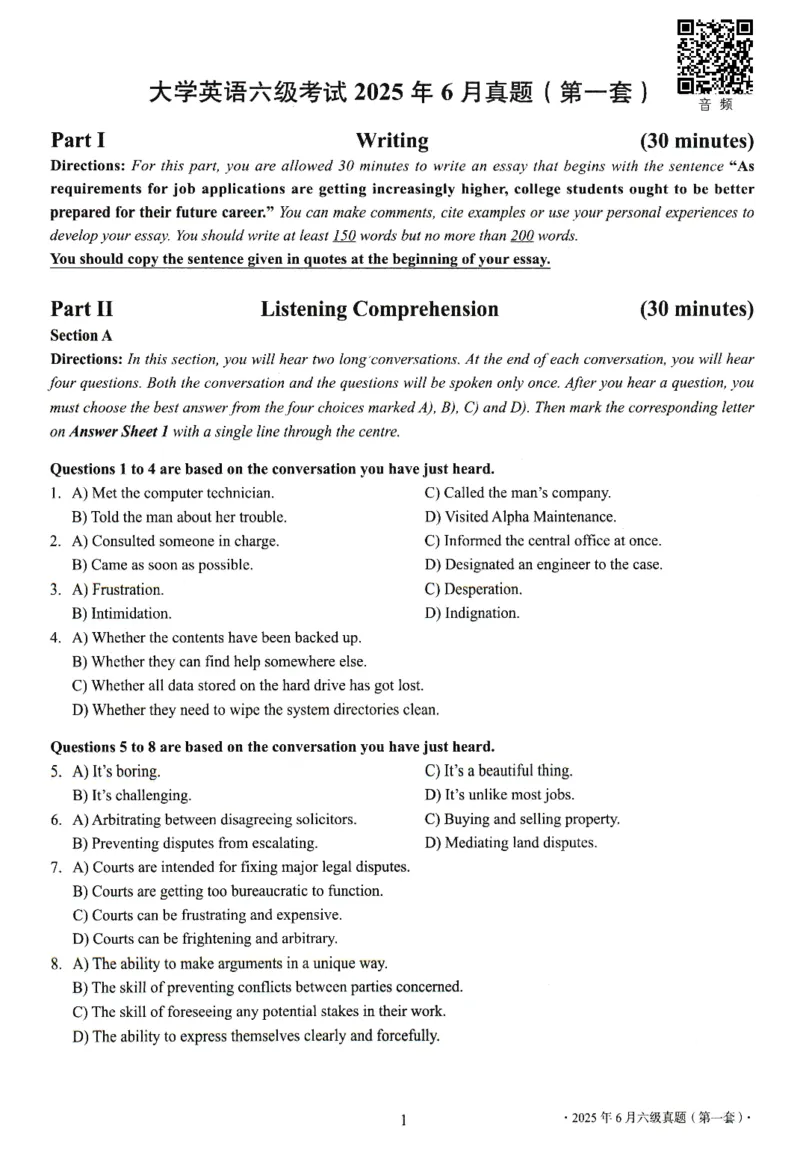
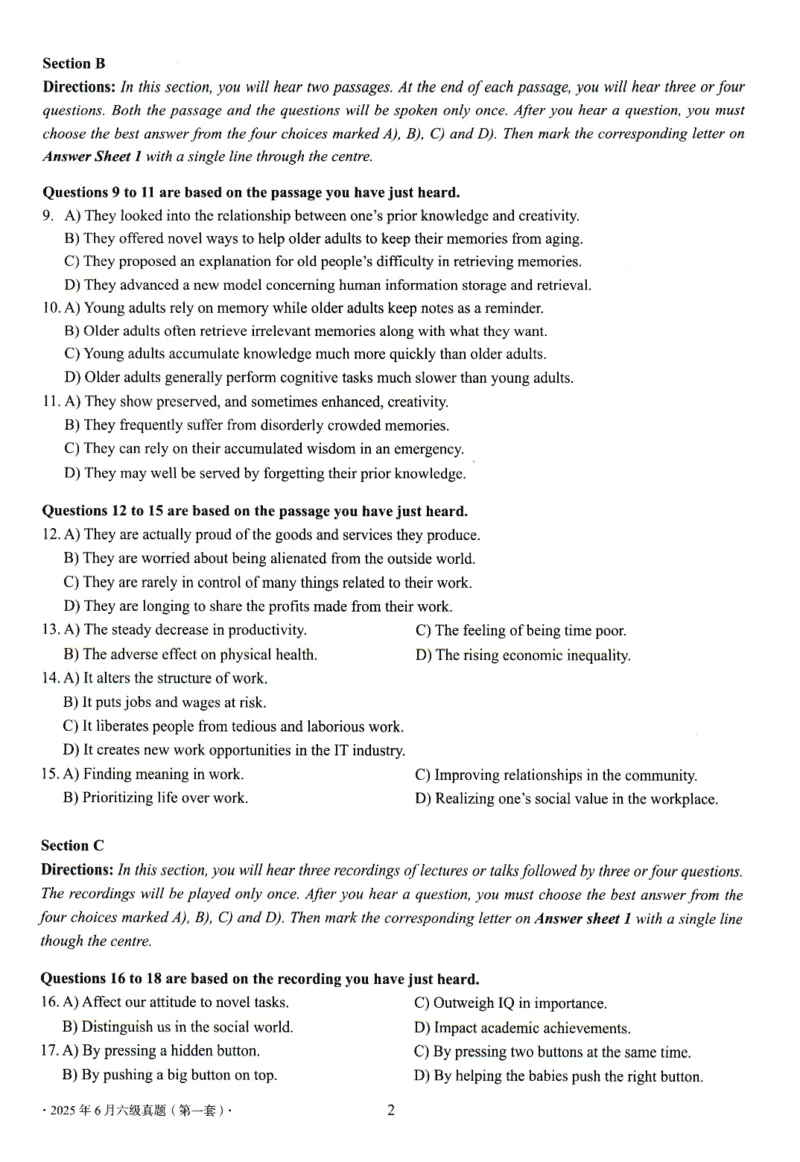
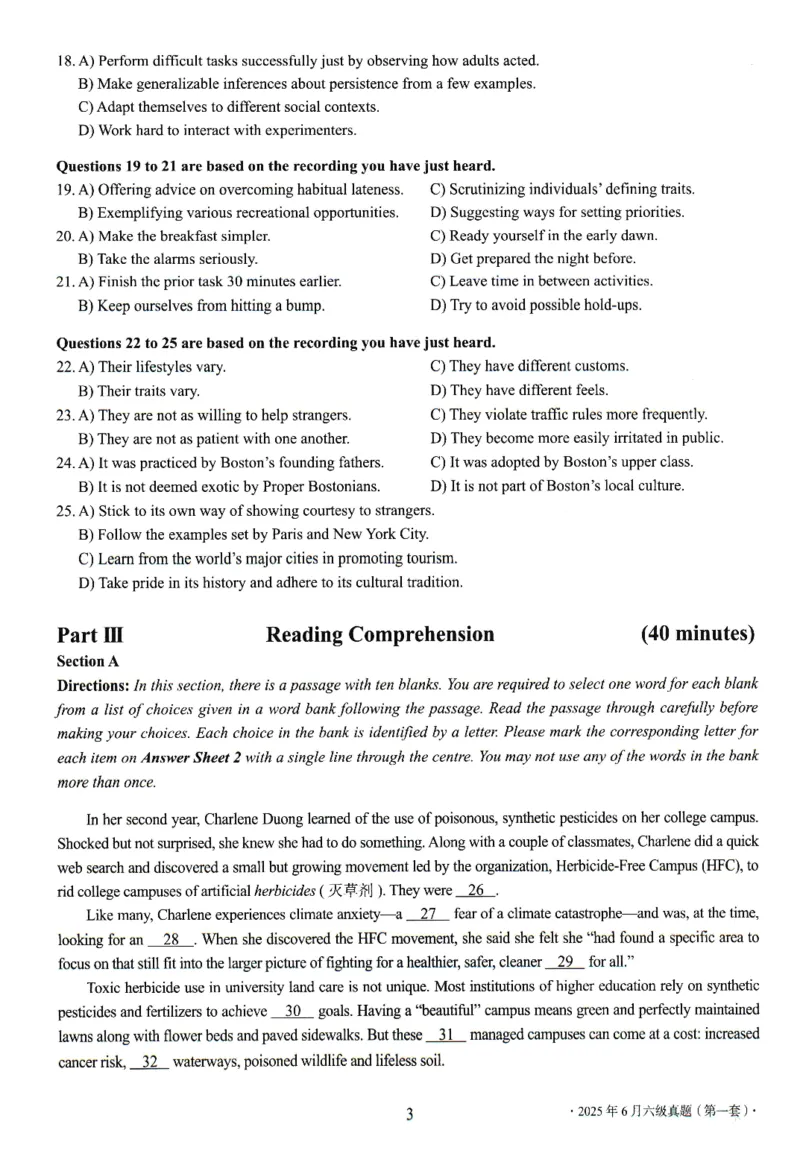
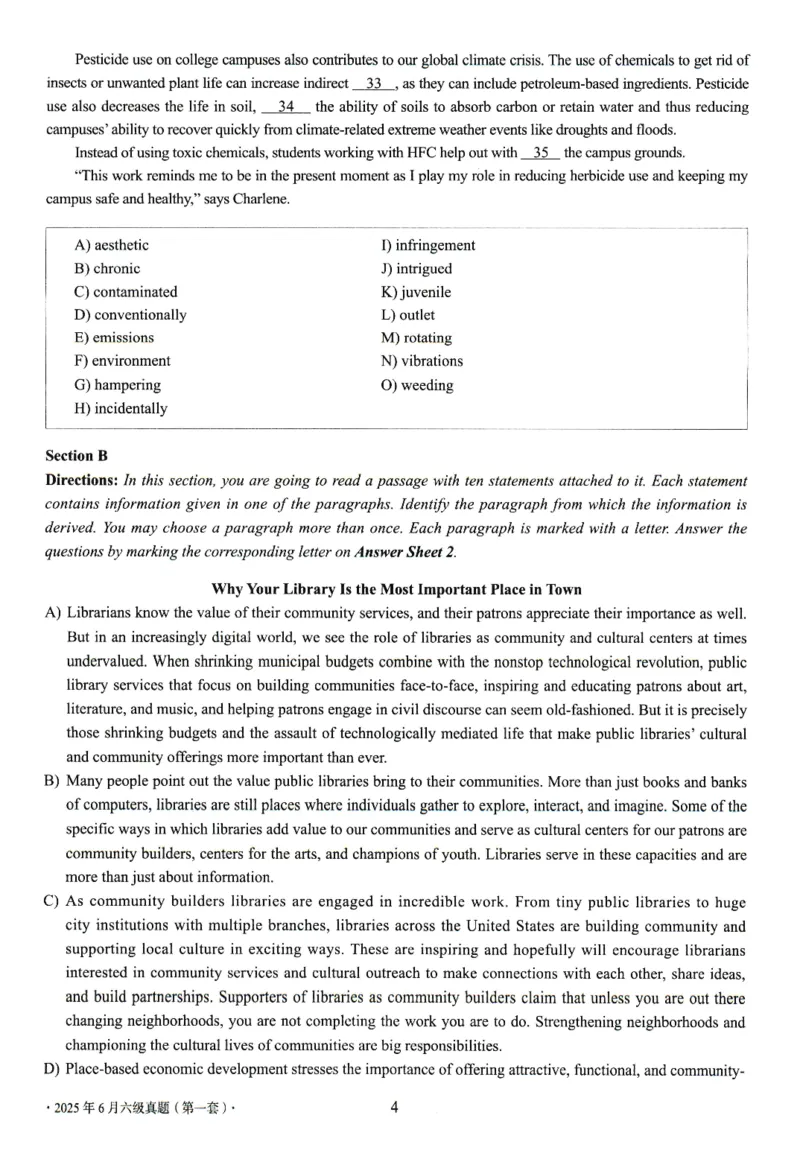
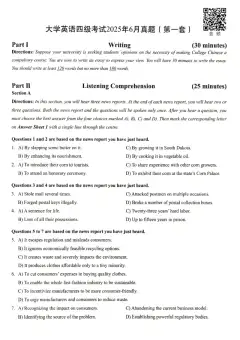
大学英语六级考试2025年 6 月真题(第一套) 五频
曰 狈
Part I Writing (30 minutes)
Directions: For this part, you are allowed 30 minutes to write an essay that begins with the sentence “As
requirements for job applications are getting increasingly higher, college students ought to be better
prepared for their future career.95 You can make comments, cite examples or use your personal experiences to
develop your essay. You should write at least 150 words but no more than 200 words.
You should copy the sentence given in quotes at the beginning of your essay.
Part II Listening Comprehension (30 minutes)
Section A
Directions: In this section, you will hear two long conversations. At the end of each conversation, you will hear
four questions. Both the conversation and the questions will be spoken only once. After you hear a question, you
must choose the best answer from the four choices marked A), B), C) and D). Then mark the corresponding letter
on Answer Sheet 1 with a single line through the centre.
Questions 1 to 4 are based on the conversation you have just heard.
1. A) Met the computer technician. C) Called the man's company.
B) Told the man about her trouble. D) Visited Alpha Maintenance.
2. A) Consulted someone in charge. C) Informed the central office at once.
B) Came as soon as possible. D) Designated an engineer to the case.
3. A) Frustration. C) Desperation.
B) Intimidation. D) Indignation.
4. A) Whether the contents have been backed up.
B) Whether they can find help somewhere else.
C) Whether all data stored on the hard drive has got lost.
D) Whether they need to wipe the system directories clean.
Questions 5 to 8 are based on the conversation you have just heard.
5. A) Ifs boring. C) Ifs a beautiful thing.
B) It's challenging. D) It's unlike most jobs.
6. A) Arbitrating between disagreeing solicitors. C) Buying and selling property.
B) Preventing disputes from escalating. D) Mediating land disputes.
7. A) Courts are intended for fixing major legal disputes.
B) Courts are getting too bureaucratic to function.
C) Courts can be frustrating and expensive.
D) Courts can be frightening and arbitrary.
8. A) The ability to make arguments in a unique way.
B) The skill of preventing conflicts between parties concerned.
C) The skill of foreseeing any potential stakes in their work.
D) The ability to express themselves clearly and forcefully.
1 • 2025年6月六级真题(第一套)・Section B
Directions: In this section, you will hear two passages. At the end of each passage, you will hear three or four
questions. Both the passage and the questions will be spoken only once. After you hear a question, you must
choose the best answer from the four choices marked A), B), C) and D). Then mark the corresponding letter on
Answer Sheet 1 with a single line through the centre.
Questions 9 to 11 are based on the passage you have just heard.
9. A) They looked into the relationship between one's prior knowledge and creativity.
B) They offered novel ways to help older adults to keep their memories from aging.
C) They proposed an explanation for old people's difficulty in retrieving memories.
D) They advanced a new model concerning human information storage and retrieval.
10. A) Young adults rely on memory while older adults keep notes as a reminder.
B) Older adults often retrieve irrelevant memories along with what they want.
C) Young adults accumulate knowledge much more quickly than older adults.
D) Older adults generally perform cognitive tasks much slower than young adults.
11. A) They show preserved, and sometimes enhanced, creativity.
B) They frequently suffer from disorderly crowded memories.
C) They can rely on their accumulated wisdom in an emergency.
D) They may well be served by forgetting their prior knowledge.
Questions 12 to 15 are based on the passage you have just heard.
12. A) They are actually proud of the goods and services they produce.
B) They are worried about being alienated from the outside world.
C) They are rarely in control of many things related to their work.
D) They are longing to share the profits made from their work.
13. A) The steady decrease in productivity. C) The feeling of being time poor.
B) The adverse effect on physical health. D) The rising economic inequality.
14. A) It alters the structure of work.
B) It puts jobs and wages at risk.
C) It liberates people from tedious and laborious work.
D) It creates new work opportunities in the IT industry.
15. A) Finding meaning in work. C) Improving relationships in the community.
B) Prioritizing life over work. D) Realizing one's social value in the workplace.
Section C
Directions: In this section, you will hear three recordings of lectures or talks followed by three or four questions.
The recordings will be played only once. After you hear a question, you must choose the best answer from the
four choices marked A), B), C) and D). Then mark the corresponding letter on Answer sheet 1 with a single line
though the centre.
Questions 16 to 18 are based on the recording you have just heard.
16. A) Affect our attitude to novel tasks. C) Outweigh IQ in importance.
B) Distinguish us in the social world. D) Impact academic achievements.
17. A) By pressing a hidden button. C) By pressing two buttons at the same time.
B) By pushing a big button on top. D) By helping the babies push the right button.
・2025年6月六级真题(第一套)・ 218. A) Perform difficult tasks successfully just by observing how adults acted.
B) Make generalizable inferences about persistence from a few examples.
C) Adapt themselves to different social contexts.
D) Work hard to interact with experimenters.
Questions 19 to 21 are based on the recording you have just heard.
19. A) Offering advice on overcoming habitual lateness. C) Scrutinizing individuals5 defining traits.
B) Exemplifying various recreational opportunities. D) Suggesting ways fbr setting priorities.
20. A) Make the breakfast simpler. C) Ready yourself in the early dawn.
B) Take the alarms seriously. D) Get prepared the night before.
21. A) Finish the prior task 30 minutes earlier. C) Leave time in between activities.
B) Keep ourselves from hitting a bump. D) Try to avoid possible hold-ups.
Questions 22 to 25 are based on the recording you have just heard.
22. A) Their lifestyles vary. C) They have different customs.
B) Their traits vary. D) They have different feels.
23. A) They are not as willing to help strangers. C) They violate traffic rules more frequently.
B) They are not as patient with one another. D) They become more easily irritated in public.
24. A) It was practiced by Boston's founding fathers. C) It was adopted by Boston's upper class.
B) It is not deemed exotic by Proper Bostonians. D) It is not part of Boston's local culture.
25. A) Stick to its own way of showing courtesy to strangers.
B) Follow the examples set by Paris and New York City.
C) Learn from the world's major cities in promoting tourism.
D) Take pride in its history and adhere to its cultural tradition.
Part ID Reading Comprehension (40 minutes)
Section A
Directions: In this section, there is a passage with ten blanks. You are required to select one word for each blank
from a list of choices given in a word bank following the passage. Read the passage through carefully before
making your choices. Each choice in the bank is identified by a letter. Please mark the corresponding letter for
each item on Answer Sheet 2 with a single line through the centre. You may not use any of the words in the bank
more than once.
In her second year, Charlene Duong learned of the use of poisonous, synthetic pesticides on her college campus.
Shocked but not surprised, she knew she had to do something. Along with a couple of classmates, Charlene did a quick
web search and discovered a small but growing movement led by the organization, Herbicide-Free Campus (HFC), to
rid college campuses of artificial herbicides (灭草剂).They were 26 .
Like many, Charlene experiences climate anxiety- a 27 fear of a climate catastrophe- and was, at the time,
looking for an 28 . When she discovered the HFC movement, she said she felt she “had found a specific area to
focus on that still fit into the larger picture of fighting for a healthier, safer, cleaner 29 for
Toxic herbicide use in university land care is not unique. Most institutions of higher education rely on synthetic
pesticides and fertilizers to achieve 30 goals. Having a ubeautifuF, campus means green and perfectly maintained
lawns along with flower beds and paved sidewalks. But these 31 managed campuses can come at a cost: increased
cancer risk, 32 waterways, poisoned wildlife and lifeless soil.
3 ・2025年6月六级真题(第一套)・Pesticide use on college campuses also contributes to our global climate crisis. The use of chemicals to get rid of
insects or unwanted plant life can increase indirect 33 . as they can include petroleum-based ingredients. Pesticide
use also decreases the life in soil, 34 the ability of soils to absorb carbon or retain water and thus reducing
campuses, ability to recover quickly from climate-related extreme weather events like droughts and floods.
Instead of using toxic chemicals, students working with HFC help out with 35 the campus grounds.
“This work reminds me to be in the present moment as I play my role in reducing herbicide use and keeping my
campus safe and healthy,says Charlene.
A) aesthetic I) infringement
B) chronic J) intrigued
C) contaminated K) juvenile
D) conventionally L) outlet
E) emissions M) rotating
F) environment N) vibrations
G) hampering 0) weeding
H) incidentally
Section B
Directions: In this section, you are going to read a passage with ten statements attached to it. Each statement
contains information given in one of the paragraphs. Identify the paragraph from which the information is
derived. You may choose a paragraph more than once. Each paragraph is marked with a letter. Answer the
questions by marking the corresponding letter on Answer Sheet 2.
Why Your Library Is the Most Important Place in Town
A) Librarians know the value of their community services, and their patrons appreciate their importance as well.
But in an increasingly digital world, we see the role of libraries as community and cultural centers at times
undervalued. When shrinking municipal budgets combine with the nonstop technological revolution, public
library services that fbcus on building communities face-to-face, inspiring and educating patrons about art,
literature, and music, and helping patrons engage in civil discourse can seem old-fashioned. But it is precisely
those shrinking budgets and the assault of technologically mediated life that make public libraries? cultural
and community offerings more important than ever.
B) Many people point out the value public libraries bring to their communities. More than just books and banks
of computers, libraries are still places where individuals gather to explore, interact, and imagine. Some of the
specific ways in which libraries add value to our communities and serve as cultural centers for our patrons are
community builders, centers fbr the arts, and champions of youth. Libraries serve in these capacities and are
more than just about information.
C) As community builders libraries are engaged in incredible work. From tiny public libraries to huge
city institutions with multiple branches, libraries across the United States are building community and
supporting local culture in exciting ways. These are inspiring and hopefully will encourage librarians
interested in community services and cultural outreach to make connections with each other, share ideas,
and build partnerships. Supporters of libraries as community builders claim that unless you are out there
changing neighborhoods, you are not completing the work you are to do. Strengthening neighborhoods and
championing the cultural lives of communities are big responsibilities.
D) Place-based economic development stresses the importance of offering attractive, functional, and community-
,2025年6月六级真题(第一套)・ 4based places, such as libraries, in town squares and depressed neighborhoods. Like a major department store
in a mall, libraries attract large numbers of people, creating economic opportunities for numerous businesses
and organizations in the surrounding area. Large cities, medium-sized ones, and even small towns have
successfully transformed their libraries into the hubs (才区纽)of vibrant neighborhoods.
E) As key municipal agencies, and focal points fbr community education, libraries are major players in creating
livable, environmentally friendly cities and towns. The Urban Libraries Council released a report detailing
the unique ways in which libraries can further sustainability at the local level. Beyond ensuring that library
construction projects consider environmental impact, libraries can take a lead in supporting local foods and
craftsmen, like the Peabody Institute Library's partnering with local businesses to pioneer a farmers5 market
in their courtyard, or the Richmond Public Library's seed lending library which "'nurtures locally-adapted
plant varieties, and fosters community resilience (韧'性),self-reliance and a culture of sharing.^^
F) Archives preserve historic artifacts, oral histories, digital history projects, and scholarly writings relevant
to the community, including minority groups. Communities lucky enough to have archivists have a great
advantage when it comes to organizing historical records and artifacts. An organized archive is a place
where people can research their ancestry and immigration history, do environmental research, and more.
An archivist is an advocate fbr preservation who, among other things, coordinates the restoration of maps
and paintings, the digitization of vital records, and the creation of oral history projects. With projects like
the Massachussets Memories Road Show and the Veterans History Project, evidence of the importance of
archives is everywhere.
G) In the words of Robert Putnam, “People may go to the library looking mainly fbr information, but they
find each other there.^^ New moms connect at baby story-times; elderly people, often facing difficult life
transitions, attend events and find that they make new friends; teenagers meet up in libraries, teen spaces
after school; and readers discuss current events in the periodicals room. In libraries, community-building
connections are happening all the time.
H) As Keith Richards said, “The public library is the great equalizer.^^ Despite the rising costs of concert and
theater tickets, public library events (including concerts, author visits, and gallery displays) are often offered
free of charge, enabling people of any income level to attend. In addition, library book groups allow people to
explore and discuss the literary arts, and the Great Stories Club introduces at-risk youth to literature. The best
part: it's all free and open to the public.
I) In a time when education is increasingly expensive, public libraries provide information and educational
opportunities free fbr all people, regardless of their socio-economic status. Offered by libraries across the
country, American Library Association's Lefs Talk about It programs are wonderful examples of scholar-
facilitated learning opportunities in libraries. In addition, many libraries present classes and discussion
programs, and some even provide online continuing education courses such as the Universal Class database.
J) Librarians know that patrons aren't just information consumers, they're information producers. Patrons use
the library to gain knowledge in order to create their own new and independent works. Increasing numbers of
libraries provide spaces and services that meet the needs of people who want to learn how to edit Wikipedia,
set up blogs or podcasts, create their own magazines, and so much more. Many libraries offer art or writing
workshops and groups, and some provide music practice rooms fbr patrons. Programs like ImaginOn in
Charlotte, North Carolina, provide exciting models that take community partnership, creativity, and creation
to a new level.
K) The decline of civil discourse stems in part from the fact that it is so easy fbr people to watch news about, buy
products from, and engage- in both the virtual and real worlds- only with those of similar backgrounds and
ideologies. Public libraries, through such programs as The Human Library and Socrates Cafe, can help build
5 ・2025年6月六级真题(第一套)・small communities of difference that encourage people to interact with and learn from each other through
dialogue. By both actively promoting civil discourse through these programs, and modeling and upholding
the principles of free inquiry and expression for all, libraries help individuals rediscover the importance of
and increased need for civil discourse in American life.
L) Free tutoring, homework help programs, and summer reading programs for kids and teens help bridge the
economic divide that impacts students5 academic performance. The cost of hiring a private tutor is well
beyond what many library patrons can afford, so libraries offer homework help and tutoring online, by phone,
in person, and even through social media and homework apps. Annual summer reading programs also have a
positive impact on student performance and, according to a 2010 study conducted by Dominican University's
Graduate School of Library and Information Science, students5 reading skills get a boost from these popular
nationwide events.
M) Through library collections, programs, and physical spaces, children learn to share, to be engaged in their
communities, to participate in the arts, and to explore their immediate world and the world at large. There
are surely endless examples of innovative library services fbr children, including the Middle Country Public
Library's Nature Explorium, which engages children in learning about the natural world.
N) These examples are just a few of the many amazing things that public libraries around the United States (and
the world) are doing to build and maintain strong community connections. We encourage you to try some of
these ideas in your own libraries, and we hope that these ideas will help you be better able to convince your
community leaders of the important role that public libraries play in communities large and small.
36. People going to the library in search of information can build connections with each other there.
37. According to advocates of libraries as community builders, librarians are not doing their job well if they do
not change their communities.
38. With the costs of education continually rising, public libraries remain places where all people can have access
to education.
39. Libraries draw large crowds, thus creating lots of business opportunities in neighboring areas.
40. With the world more and more digitalized, people sometimes underestimate the role of libraries as community
and cultural centers.
41. Various programs organized by public libraries fbr children and adolescents help narrow the gap between
students from varying economic backgrounds.
42. In an organized archive, people can do research on their family history and find out how their ancestors came
to settle in the new land.
43. Public libraries organize cultural events, often allowing people of different income levels to attend free of
charge.
44. Besides being an information provider, the library performs many other important services for the
community.
45. Public libraries can help build small communities of people with different backgrounds and ideologies.
Section C
Directions: There are 2 passages in this section. Each passage is followed by some questions or unfinished
statements. For each of them there are four choices marked A), B), C) and D). You should decide on the best
choice and mark the corresponding letter on Answer Sheet 2 with a single line through the centre.
•2025年6月六级真题(第一套)・ 6Passage One
Questions 46 to 50 are based on the following passage.
Nationally, one in six children miss 15 or more days of school in a year. Education officials have deplored
all this missed instruction.
These chronically absent students suffer academically because of all the classroom instruction they miss out
on. In 2015, the U.S. secretary of education responded to this crisis, urging communities to support every student
to attend every day and be successful in school. His open letter stated that missing 10% of school days in a year
fbr any reason- excused or unexcused- is a primary cause of low academic achievement.
Worrying about whether children attend school makes sense. After all, if students don't show up, teachers
can't teach them.
But what if America's attendance crisis is about much more than students missing class? What if, instead,
it is a reflection of family and community crises these students face- such as being ejected from the family
apartment, fearing fbr their safety in their neighborhood or suffering an illness?
As social scientists we investigated how excused and unexcused absences relate to children's academic
achievement.
We find that absences excused by a parent do little to harm children's learning. In fact, children with
no unexcused absences- but 15 to 18 excused absences- have test scores equal to their peers who have no
absences.
Meanwhile, the average child with even just one unexcused absence does much worse academically than
peers with none.
We believe unexcused absence is a strong signal of the many challenges children and families face,
including economic and medical hardships. Unexcused absences can be a powerful signal of how those out-of
school challenges affect children's academic progress.
Our evidence suggests unexcused absences are problematic, but fbr a different reason than people often
think. Absence from school, and especially unexcused absence, matters mainly as a signal of many crises
children and their families may be facing. It matters less as a cause of lower student achievement due to missed
instruction.
How we choose to think of school absences matters for educational policy. School attendance policies
typically hold schools and families accountable for the days children miss, regardless of whether they were
excused or unexcused absences.
These policies assume that missing school for any reason harms children academically because they are
missing classroom instruction. They also assume that schools will be able to effectively intervene by reducing
student absences. We find neither to be the case.
As a result, these attendance policies end up disproportionately punishing families dealing with out-of
school crises in their lives and pressuring schools who serve them to get students to school more often.
We instead suggest using unexcused absence from school as a signal to channel resources to the children and
families who need them most.
46. What does the U.S. secretary of education say in his open letter?
A) It is of vital importance to respond promptly to the school absence crisis.
B) The academic performance of chronically absent students is deplorable.
C) Low academic achievement is mainly attributed to school absences.
D) The effect of school absences on American education is worrisome.
7 •2025年6月六级真题(第一套)♦47. What do the authors find about school absences?
A) Excused school absences have little impact on children's learning.
B) There is little difference between unexcused and excused absences.
C) Excused absences lead to comparatively better school performance.
D) Unexcused absences are a big challenge to both schools and families.
48. What do the authors believe concerning unexcused school absences?
A) They are likely to cause a decrease in students5 academic achievements due to missed instruction.
B) They point directly to many of the out-of-school challenges confronting children and their families.
C) They are matters the American government typically ignores when formulating educational policies.
D) They give a clear signal to children and their families of the crises they are likely to face in the future.
49. What is the assumption underlying education policies in the U.S.?
A) Children's academic performance depends on reducing the number of absences.
B) Schools can boost children's academic performance by effective intervention.
C) Schools as well as families should be held responsible for out-of-school crises.
D) Children's academic performance is closely related to the quality of instruction.
50. What do the authors suggest doing regarding school absences?
A) Identifying their underlying causes. C) Directing resources to helping needy children.
B) Refraining school attendance policies. D) Pressuring schools to reduce unexcused ones.
Passage Two
Questions 51 to 55 are based on the following passage.
After earning a bachelor's degree, I was determined to do what I love. I headed straight to graduate school to
investigate the social problems that fascinated me.
For almost a decade, I told everyone I encountered that they should do the same. ""Follow your passion," I
counseled. 4"You can figure out the employment stuff later.^^
It wasn't until I began to research this widely accepted career advice that I understood how problematic it
really was.
As a sociologist, I interviewed college students and professional workers to learn what it really meant to
pursue their dreams, which I will refer to here as the passion principle. I was stunned by what I found out about
this principle in the research for my new book.
Surveys show the American public has long held the passion principle in high regard as a career decision
making priority. And its popularity is even stronger among those facing job instability.
Advocates of the passion principle found it compelling because they believed that following one's passion
can provide workers with both the motivation necessary to work hard and a place to find fulfillment.
Yet, what I found is that following one's passion does not necessarily lead to fulfillment, but is one of the
most powerful cultural forces perpetuating overwork. I also found that promoting the pursuit of one's passion
helps perpetuate social inequalities due to the fact that not everyone has the same economic resources to allow
them to pursue their passion with ease.
While the passion principle is broadly popular, not everyone has the necessary resources to turn their passion
into a stable, good-paying job. Passion-seekers from wealthy families are better able to wait until a job they
are passionate about comes along without worrying about student loans in the meantime. They are also better
situated to take unpaid internships to get their foot in the door while their parents pay their rent. And they often
have access to parents5 social networks to help them find jobs. Surveys revealed that working-class and first-
generation college graduates, regardless of their career field, are more likely than their wealthier peers to end up
in low-paying unskilled jobs when they pursue their passion.
・ 2025年6月六级真题(第一套)・ 8Colleges, workplaces and career counselors who promote the “follow your passion^^ path for everyone,
without leveling the playing field, help perpetuate socioeconomic inequalities among career aspirants.
Ifs not just well-off passion-seekers who benefit from the passion principle. Employers of passionate
workers do, too. Potential employers showed greater interest in passionate applicants in part because they
believed the applicants would work hard at their jobs without expecting an increase in pay. They even sacrifice a
good salaryjob stability and leisure time to work in a job they love.
51. What did the author advise people do for almost a decade?
A) Figure out what is the most fascinating job. C) Pursue their careers with passion.
B) Follow widely accepted career counsel. D) Do whatever they are zealous for.
52. How did the author feel about the passion principle through his research?
A) He was astonished by its consequences. C) He was actually right to follow it through.
B) He was further convinced of its soundness. D) He was struck by its broad popularity.
53. What is important to turning one's passion into a stable, good-paying job?
A) Willingness to take unpaid internships and low-paying jobs.
B) Full academic preparedness and sound career counseling.
C) Hard work and sacrifice of leisure time.
D) Financial backing and social connections.
54. What happens when everyone is encouraged to follow their passion?
A) Many more career aspirants end up unemployed.
B) People are less concerned with socioeconomic inequality.
C) Socioeconomic inequality is likely to persist.
D) Career counselors are going to lose credibility.
55. What does the author say about employers of passionate workers?
A) They provide these workers with job stability and a good salary.
B) They exploit these workers5 passion to benefit themselves.
C) They level the playing field for these workers to reach their goals.
D) They encourage these workers to realize their aspirations.
Part IV Translation (30 minutes)
Directions: For this part, you are allowed 30 minutes to translate a passage from Chinese into English. You
should write your answer on Answer Sheet 2.
天宫空间站(Tiangong Space Station ) 是中国首个太空实验室,拥有110多立方米使用空间,可
驻留三名宇航员,在距地球表面400-450公里的轨道上运行。天宫空间站已实施180多个科学研究与
应用项目,涉及空间生命科学、太空医学、空间材料科学等领域。天宫空间站的研究成果在我国得到
了广泛应用,产生了显著的经济效益。例如,太空育种创造的直接经济效益高达数千亿元。这不仅标
志中国在航天技术上取得了巨大进步,也表明中国为全球的太空研究和应用做出了重大贡献。
9 ・2025年6月六级真题(第一套)・大学英语六级考试2025年 6 月真 题 (第二套)
Part I Writing (30 minutes)
Directions: For this part, you are allowed 30 minutes to write an essay that begins with the sentence “As social
media is used more and more extensively, there is a growing awareness of the importance of using it
properly and responsibly." You can make comments, cite examples or use your personal experiences to develop
your essay. You should write at least 150 words but no more than 200 words.
You should copy the sentence giypn in quotes at the beginning of your essay.
Part II Listening Comprehension (30 minutes)
Section A
Directions: In this section, you will hear two long conversations. At the end of each conversation, you will hear
four questions. Both the conversation and the questions will be spoken only once. After you hear a question, you
must choose the best answer from the four choices marked A), B), C) and D). Then mark the corresponding letter
on Answer sheet 1 with a single line through the centre.
Questions 1 to 4 are based on the conversation you have just heard.
1. A) They have to make a choice by the end of the day.
B) Both candidates are very keen on getting the job.
C) They hold different views on the procedure.
D) Both candidates are quite competitive.
2. A) Both Rachel and Peter came across as respectful and professional.
B) Rachel scored moderately higher grades than Peter at school.
C) Both Rachel and Peter excelled in their academic pursuit.
D) Peter appeared slightly stronger than Rachel physically.
3. A) His use of body language. C) His unusual state of mind.
B) His accumulation of experience. D) His knowledge about the company.
4. A) Compare the candidates side by side again. C) Find a way to break the tie next time.
B) Ask the board to cast the deciding vote. D) Let John make the final decision.
Questions 5 to 8 are based on the conversation you have just heard.
5. A) The private label "L'Orange”. C) This season's new fashion.
B) The woman's latest collection. D) The head designer's role.
6. A) Something reflecting the social norms. C) Something slightly absurd.
B) Something meeting public expectations. D) Something a bit ambiguous.
7. A) Merge styles often at opposite ends of the fashion spectrum.
B) Learn from the designs of the Asian rural mountain villagers.
C) Make velvet capes look both majestic and masculine.
D) Draw intricate patterns onto a traditional power suit.
8. A) Obtaining the woman's signature. C) Incorporating indigenous aspects into his work.
B) Seeing the woman's new creations. D) Sharing more ideas with the woman next time.
・2025年6月六级真题(第二套), 10Section B
Directions: In this section, you will hear two passages. At the end of each passage, you will hear three or four
questions. Both the passage and the questions will be spoken only once. After you hear a question, you must
choose the best answer from the four choices marked A), B), C) and D). Then mark the corresponding letter on
Answer Sheet 1 with a single line through the centre.
Questions 9 to 11 are based on the passage you have just heard.
9. A) They could readily recognize their owner simply by looking.
B) They could understand the implications of human commands.
C) They could be domesticated to act as our companions.
D) They could follow pointing gestures without training.
10. A) Cultivating them to be intelligent creatures.
B) Training them to behave like domesticated dogs.
C) Understanding how humans impact their behavior.
D) Taking measures to reduce their numbers.
11. A) Tame them through repeated training. C) Make them responsive to our commands.
B) Treat them with sensitivity and respect. D) Watch their behavior and try to improve it.
Questions 12 to 15 are based on the passage you have just heard.
12. A) The temperature inside it varies from place to place.
B) Proper placement facilitates access to food products.
C) Its different shelves are designed for different purposes.
D) The space in an average fridge changes from top to bottom.
13. A) To slow the rising of temperature in it. C) To prevent germs from growing quickly.
B) To provide a big box of evenly cold air. D) To keep the food cold as long as possible.
14. A) On the top shelf. C) On the inside of its doors.
B) In the middle section. D) At the back of its bottom shelf.
15. A) They will be extra-chilly. C) They will be contaminated.
B) They will be hard to defrost. D) They will be ruined.
Section C
Directions: In this section, you will hear three recordings of lectures or talks followed by three or four questions.
The recordings will be played only once. After you hear a question, you must choose the best answer from the
four choices marked A), B), C) and D). Then mark the corresponding letter on Answer sheet 1 with a single line
though the centre.
Questions 16 to 18 are based on the recording you have just heard.
16. A) Chronic depression. C) Hip fracture.
B) Growing feebleness. D) Fatal infections.
17. A) It feels real and relevant. C) It outcompetes lots of academics5 research.
B) It contributes to psychology. D) It wins recognition outside of Birmingham.
18. A) By bringing together experts old and young. C) By making full use of her expertise.
B) By counting on advanced modem technology. D) By combining multiple perspectives.
11 ,2025年6月六级真题(第二套)・Questions 19 to 21 are based on the recording you have just heard.
19. A) They don't teach basic organization. C) They attach little importance to recipes.
B) They don't focus on teaching techniques. D) They hire very few distinguished chefs.
20. A) It's unique to celebrity chefs. C) Ifs too demanding for them.
B) It's a way of transformation. D) It's a way of life to them.
21. A) Respect others so as to be respected. C) Cultivate a habit of self-discipline.
B) Use time and resources in a wise way. D) Learn from philosophers earnestly.
Questions 22 to 25 are based on the recording you have just heard.
22. A) The motive for hard work. C) The basis for self-improvement.
B) The reason for stagnation. D) The justification fbr self-confidence.
23. A) Feel confidence, happiness and satisfaction. C) Use a key tool for setting ambitious goals.
B) Believe they have achieved their life goals. D) Stop imagining further progress in life.
24. A) We feel we are always falling behind others.
B) We have to adapt to the ever-changing goal.
C) There are various misconceptions about goal setting.
D) There are always problems with the goal originally set.
25. A) A noticeable change in the number of goals to achieve.
B) Measuring always against the gap rather than the gain.
C) Measuring where we've come from instead of measuring against the goal.
D) A proper conception of what we fail to notice in trying to achieve our goals.
Part ID Reading Comprehension (40 minutes)
Section A
Directions: In this section, there is a passage with ten blanks. You are required to select one word far each blank
from a list of choices given in a word bank fallowing the passage. Read the passage through carefully before
making your choices. Each choice in the bank is identified by a letter: Please mark the corresponding letter for
each item on Answer Sheet 2 with a single line through the centre. You may not use any of the words in the bank
more than once.
No beast on Earth is tougher than the tiny tardigrade (缓步类动物).It can 26 being frozen at -272°
Celsius, being exposed to the vacuum of outer space and even being 27 with 500 times the dose of X-rays
that would kill a human. In other words, the creature can endure conditions that don't even exist on Earth. And
researchers are looking to the microscopic animals to learn how to prepare humans and crops to handle the 28 of
space travel.
The tardigrade^ indestructibility stems from its 29 to its environment- which may seem surprising,
since it lives in 30 comfortable places, like the cool, wet patches of moss (青苔)that dot a garden wall.
But it turns out that a tardigrade5s damp, mossy home can dry out many times each year. Drying is
pretty 31 for most living things. It does damage to cells in some of the same ways that freezing, vacuum and
radiation do. Tardigrades, however, have 32 special strategies for dealing with these kinds of damage.
As a tardigrade dries out, its cells produce several strange proteins that are unlike anything found in other animals.
In water, the proteins are shapeless. But as water disappears, the proteins self^assemble into long fibers that
fill the celfs 33 . The fibers support the cell's membranes (细胞膜)and proteins, preventing them from
breaking or 34 .
•2025年6月六级真题(第二套)・ 12Emulating tardigrades could one day help humans colonize outer space. Food crops could be engineered to
produce tardigrade proteins, allowing these organisms to grow more efficiently on spacecraft where levels of radiation
are elevated compared with on Earth.
So if humans ever succeed in reaching the stars, they may accomplish this 35 , in part, by standing on the
shoulders of the tiny eight-legged endurance specialists in your backyard.
A) adaptations I) rigors
B) blasted J) seemingly
C) catastrophic K) survive
D) evolved L) tempt
E) feat M) thrill
F) interior N) unanimously
G) probing O) unfolding
H) recurrence
Section B
Directions: In this section, you are going to read a passage with ten statements attached to it. Each statement
contains information given in one of the paragraphs. Identify the paragraph from which the information is
derived. You may choose a paragraph more than once. Each paragraph is marked with a letter. Answer the
questions by marking the corresponding letter on Answer Sheet 2.
Yes, eating meat affects the environment, but cows are not killing the climate
A) As the scale and impacts of climate change become increasingly alarming, meat is a popular target for action.
Advocates for the protection of the natural environment from destruction or pollution urge the public to eat
less meat. Some activists have even called for taxing meat to reduce consumption of it.
B) A key claim underlying these arguments holds that globally, meat production generates more greenhouse
gases than the entire transportation sector. However, this claim is demonstrably wrong, as I will show. And its
persistence has led to false assumptions about the linkage between meat and climate change.
C) My recent research focuses on ways in which animal agriculture affects air quality and climate change. In my
view, there are many reasons for either choosing animal protein or opting for a vegetarian selection. However,
abandoning meat and meat products is not the environmental panacea (万灵药)many would have us believe.
And if taken to an extreme, it also could have harmful nutritional consequences.
D) A healthy portion of meafs negative reputation centers on the assertion that livestock is the largest source
of greenhouse gases worldwide. For example, an analysis published in 2009 by the World Watch Institute
based in Washington, D.C. asserted that 51 percent of global greenhouse gas emissions come from rearing
and processing livestock. According to the U.S. Environmental Protection Agency, the largest sources of U.S.
greenhouse gas emissions in 2016 were electricity production (28 percent of total emissions), transportation
(28 percent) and industry (22 percent). All of agriculture accounted for a total of 9 percent, but all of
animal agriculture contributes less than half of this amount, representing 3.9 percent of the total greenhouse
emission in the U.S. That is very different from claiming that livestock represents as much as or more than
transportation.
E) Why is there such a misconception? In 2006 the United Nations Food and Agriculture Organization (FAO)
published a study titled “Livestock's Long Shadow,“ which received widespread international attention. It
stated that livestock produced a staggering 18 percent of the world's greenhouse gas emissions. The agency
13 •2025年6月六级真题(第二套)・drew a startling conclusion that livestock was doing more to harm the climate than all modes of transportation
combined. This latter claim was wrong, and has since been corrected by Henning Stenfeld, the reporfs senior
author.
F) The problem was that analysts from the FAO used a comprehensive life-cycle assessment to study the climate
impact of livestock, but a different method when they analyzed transportation. For livestock, they considered
every factor associated with producing meat. This included emissions from fertilizer production, converting
land from forests to pastures, growing feed, and direct emissions from animals (manure as well as expelling
of gas from the stomach) from birth to death.
G) However, when they looked at transportation's carbon footprint, they ignored impacts on the climate from
manufacturing vehicle materials and parts, assembling vehicles and maintaining roads, bridges and airports.
Instead, they only considered the exhaust smoke emitted by finished cars, trucks, trains and planes. As a
result, the FAO's comparison of greenhouse gas emissions from livestock to those from transportation was
greatly distorted.
H) I pointed out this flaw during a speech to fellow scientists in San Francisco on March 22, 2010, which led to a
flood of media coverage. To its credit, the FAO immediately owned up to its error. Unfortunately, the agency's
initial claim that livestock was responsible fbr the lion's share of world greenhouse gas emissions had already
received wide coverage. To this day, we struggle to “unring“ the bell. In its most recent assessment report,
the FAO estimated that livestock produces 14.5 percent of global greenhouse gas emissions from human
activities. There is no comparable full life-cycle assessment fbr transportation. However, as Stenfeld has
pointed out, direct emissions from transportation versus livestock can be compared and amount to 14 versus 5
percent, respectively.
I) Many people continue to think that avoiding meat as infrequently as once a week will make a significant
difference to the climate. But according to one recent study, even if Americans eliminated all animal protein
from their diets, they would reduce U.S. greenhouse gas emissions by only 2.6 percent. According to our
research at the University of California, Davis, if the practice of Meatless Monday were to be adopted by all
Americans, we'd see a reduction of only 0.5 percent.
J) Moreover, technological, genetic and management changes that have taken place in U.S. agriculture over the
past 70 years have made livestock production more efficient and less greenhouse gas-intensive. According
to the FAO's statistical database, total direct greenhouse gas emissions from U.S. livestock have declined by
11.3 percent since 1961, while production of livestock meat has more than doubled.
K) Demand fbr meat is rising in developing and emerging economies, especially in the Middle East, North
Africa and Southeast Asia. For example, raising livestock such as goats in Kenya is an important source of
food and income fbr many small-scale farmers and herders. But meat consumption per person in these regions
still lags that of developed countries. In 2015, average annual meat consumption per person in developed
countries was 92 kilograms, compared to 24 kilograms in the Middle East and North Africa and 18 kilograms
in Southeast Asia. Still, given projected population growth in the developing world, there will certainly be an
opportunity fbr countries such as the United States to bring their sustainable livestock rearing practices to the
table.
L) Removing animals from U.S. agriculture would lower national greenhouse gas emissions to a small degree,
but it would also make it harder to meet people's nutritional requirements. Many critics of animal agriculture
are quick to point out that if farmers raised only plants, they could produce more pounds of food and more
calories per person. But humans also need many essential micro- and macro-nutrients fbr good health. It's
hard to make a compelling argument that the United States has a calorie deficit, given its high national rates
,2025年6月六级真题(第二套)・ 14of adult and child obesity. Moreover, not all plant parts are edible or desirable. Raising livestock is a way to
add nutritional and economic value to plant agriculture.
M) As one example, the energy in plants that livestock consume is most often contained in cellulose (纤维素),
which is indigestible fbr humans and many other mammals. But cows, sheep and other ruminant (反刍的)
animals can break cellulose down and release the solar energy contained in this vast resource. According
to the FAO, as much as 70 percent of all agricultural land globally is range land that can only be utilized as
grazing land fbr ruminant livestock.
N) The world population is currently projected to reach 9.8 billion by 2050. Feeding this many people will raise
immense challenges. Meat is more calorie-dense per serving than vegetarian options, and ruminant animals
largely thrive on feed that is not suitable fbr humans. Raising livestock also offers much-needed income fbr
small-scale farmers in developing nations. Worldwide, livestock provides a livelihood fbr 1 billion people.
O) Climate change demands urgent attention, and the livestock industry has a large overall environmental
footprint that affects air, water and land. These, combined with a rapidly rising world population, give us
plenty of compelling reasons to continue to work fbr greater efficiencies in animal agriculture. I believe the
place to start is with science-based facts.
36. The FAO concluded that farm animals were producing more greenhouse gases than all modes of
transportation combined.
37. Consumption of meat per person in developing countries is much less than that in countries like the U.S.
38. The FAO was worthy of praise in that it admitted its mistake once it was pointed out.
39. Environmentalists try hard to make people consume less meat to combat climate change.
40. Recent research has shown that even if Americans quit eating meat altogether, the resulting reduction of
greenhouse gases in the U.S. would be slight.
41. More than half of the world's farmland is suitable only for animals like cows to graze on.
42. The allegation that form animals produce the world's largest portion of greenhouse gases is responsible fbr
meafs bad reputation.
43. Raising farm animals makes it easier to meet people's nutritional needs.
44. The author doesn't believe giving up meat and meat products will be a cure-all fbr the environmental
problem.
45. Changes in America's farming technology and management in the past decades have increased efficiency and
reduced greenhouse gas emissions in meat production.
Section C
Directions: There are 2 passages in this section. Each passage is followed by some questions or unfinished
statements. For each of them there are four choices marked A), B), C) and D). You should decide on the best
choice and mark the corresponding letter on Answer Sheet 2 with a single line through the centre.
Passage One
Questions 46 to 50 are based on the following passage.
Why are we so worried about our careers? Partly ifs to do with money, but there's a psychological aspect to
our fears as well.
We worry because we suspect- not wrongly- that the world is full of a frightening sort of person ready to
judge us ruthlessly and swiftly: a person we can call a snob.
15 ・2025年6月六级真题(第二套)・A snob is anyone who takes a relatively small part of us and uses it to come to a rigid conclusion about how
much of their attention we deserve. In the past, that might be your ancestry and royal connections. Nowadays,
the snob cares about one thing only: what you do fbr a living.
This explains why the first question we will be asked in any new social context is 'What do you do?' and
according to how we answer, snobs will either welcome us with broad smiles, or leave us in the cold.
And that is why we are fired up by such a desperate urge to achieve and impress.
Sometimes our behaviour is mistaken fbr greed and vanity, but it is more than this. A lot of our interest
in fancy cars, jobs and houses has nothing to do with materialism. It has to do with a hunger fbr the respect
and esteem that is only available in our societies through the acquisition of material goods. It isn't the goods
themselves we seek, it is the love we stand to gain through our possession of them. The next time we see
someone driving a Ferrari, we shouldn't condemn them fbr their greed, we should pity them fbr the intensity of
their need fbr love from the world.
At the root of snobbery is a lack of imagination and confidence about how to decide who in the world is
valuable. The snobs are brutally misguided and slavish in their beliefs about how the superior individuals can be
identified. For snobs, it is the already acclaimed and already successful who are the only ones worthy of respect.
There is no room in their timid regimented minds to imagine that someone might be clever, kind or good- and
yet somehow have been overlooked entirely by society, their qualities lying hidden beneath an unfamiliar veil,
and having as yet discovered no obvious outlet.
The true answer to snobbery is not to say that there is no such thing as a better or worse person, but to insist
that better or worse exist in constantly unexpected places and carry none of the outward signs of distinction. And
because we are such poor judges of the worth of others, our ultimate duty remains to be kind, good, curious and
imaginative about pretty much everyone who ever crosses our path.
46. What gives rise to our worry about careers apart from money?
A) Fear of being judged in a snobbish manner. C) The ruthless way employees are often treated.
B) The prospect of facing fault-finding managers. D) Fright at the difficulty in hunting fbr a job.
47. What do we learn from the passage about today's snobs?
A) They try hard to dig into a person's past. C) They judge a person by their occupation.
B) They draw a rigid conclusion about people. D) They tend to place people in a social context.
48. What does the author say about people's interest in material goods?
A) It is the cause fbr condemnation of their greed.
B) It has a lot to do with the comforts they provide.
C) It arouses pity rather than respect from the wealthy.
D) It arises from their craving fbr social recognition.
49. What kind of people do snobs deem worth respect and esteem?
A) Those with fame and fortune. C) Those with intelligence and imagination.
B) Those with regimented minds. D) Those with qualities lying hidden in disguise.
50. What does the author imply we should do to avoid being snobbish?
A) Be aware there has never been such a thing as a better or worse person.
B) Be kind to and curious about those who we happen to meet in our lives.
C) Realize that better or worse keeps changing in unexpected ways.
D) Judge people on the basis of their distinctive character traits.
•2025年6月六级真题(第二套)・ 16Passage Two
Questions 51 to 55 are based on the following passage.
Women have historically been paid less. But in the US in the 1980s, they began to catch up—fast. During
that decade, the gender pay gap closed by about one percentage point a year. Had that trend continued, the gender
wage gap would have been closed by 2017.
But the trend didn't continue, and the gap remains yawning.
According to a new study from academics at Harvard, the stagnation can be put down, perhaps
counterintuitively, to the introduction of state and federal family leave policies.
The academics argue that during the 1990s, as governments began to introduce leave policies, it was mainly
women who took advantage of them. Though the leave policies might have helped those women to stay in the
workplace- instead of dropping out to have families- those who returned saw their wages had increased at
lower rates than the men.
After family leave was introduced in the US, in fact, the rate of gender wage convergence fell to just 0.03
percentage points per year, and has remained there ever since.
Those monitoring the process towards salary equity at work have long watched as progress slowed in many
countries around the world. In fact, that progress began to reverse during the pandemic (大流行病).
The gender pay gap is one of the most outstanding examples of that lack of parity (平等),and still exists
just about everywhere. The motherhood penalty has become a shorthand fbr describing why: In many places,
especially rich countries, women earn the same as men until they reach their childbearing years. Women who
have children begin to see their salaries slip behind their male counterparts.
Part of this is because women take on more of the unpaid labor at home, which can eat into time available
fbr work and energy fbr career advancement. But ifs also because mothers are passed over fbr raises and
promotion, and because time out of the workplace sets women back, even if that time is taken voluntarily, and
supported by company or government policy.
What would have happened if leave policies hadn't been introduced? The study doesn't go into that question,
other than to say that if the 1980s trend continued, we would have been at parity by now.
It's possible, however, that the journey towards wage parity would have stalled either way. If women5s gains
in the 1980s were made through the erasure of things like bias, once those less uncontrollable problems had been
addressed, there would still have been an issue with women- who are the ones to bear children and take care of
them in the early weeks because of biological factors like the ability to breastfeed, forcing them to take breaks,
whether or not those breaks were mandated.
51. What do we learn about the gender pay gap in the US during the 1980s?
A) It was being slowly closed. C) It started to yawn.
B) It was shrinking rapidly. D) It remained substantial.
52. What happened with the introduction of state and federal family leave policies?
A) The process towards salary equity at work began to reverse.
B) The rate of gender wage convergence started to fall noticeably.
C) The trend of women returning to work after childbirth started.
D) The narrowing of the gender pay gap attracted more attention.
53. What partly accounts fbr the slip in women's salaries?
A) The insufficient motivation women generally have fbr career advancement.
B) The opportunities numerous women give up fbr pay raise and promotion.
17 • 2025年6月六级真题(第二套)・C) The huge amounts of time and energy women spend taking care of the family.
D) The lack of policy support from government and business corporations.
54. What does the new study say about wage parity?
A) It would have stalled if those controllable problems had not been addressed.
B) It would have halted if company and government had not worked together.
C) It would have been achieved with the complete erasure of gender biases.
D) It would have been attained with the continuation of the 1980s trend.
55. What prevents women from achieving parity with men in the final analysis?
A) Ignoring biases against women in the workplace. C) Failing to mandate breaks for childbirth and care.
B) Giving birth to children and taking care of them. D) Lacking resources to address biological problems.
Part IV Translation (30 minutes)
Directions:
s h o u l d w r i t e
F
y
o
o
r
u r
h t
a
t r a p s i
r e w s n
,
o
y
n
o
A
u
n
a
s
r
w
e
e
l a
S r
l
h
o
e
w
e
e
t
3 d
. 2
0 m i n u t e s t o t r a n s l a t e a p a s s a g e f r o m C h i n e s e i n t o E n g l i s h . Y o u
粤港澳大湾区(Guangdong-Hong Kong-Macao Greater Bay Area) 具有得天独厚的地理位置,拥有
完善的交通基础设施和丰富的产业资源。大湾区是中国开放程度最高、经济活力最强的区域之一,在
国家经济发展中具有重要的战略地位。大湾区不仅将建成充满活力的世界级城市群和具有全球影响力
的国际科技创新中心,还将打造成适合工作、购物、旅游的优质生活圈。随着改革开放的不断深入,
大湾区的建设将进一步推动区域经济发展。到2035年,大湾区将实现成为国际一流湾区的目标。
・2025年6月六级真题(第二套)・ 18大学英语六级考试2025年 6 月真题(第三套)
Part I Writing (30 minutes)
Directions: For this part, you are allowed 30 minutes to write an essay that begins with the sentence “With the
increasing application of AI technology, there is a growing concern that it may negatively impact human
creativity.You can make comments, cite examples or use your personal experiences to develop your essay. You
should write at least 150 words but no more than 200 words.
You should copy the sentence given in quotes at the beginning of your essay.
Part II Listening Comprehension (30 minutes)
特别说明:由于多题多卷,官方第三套真题的听力试题与第一套真题的一致,只是选项顺序不同,因此,
本套试卷不再提供听力部分。
Part in Reading Comprehension (40 minutes)
Section A
Directions: In this section, there is a passage with ten blanks. You are required to select one word for each blank
from a list of choices given in a word bank following the passage. Read the passage through carefully before
making your choices. Each choice in the bank is identified by a letter: Please mark the corresponding letter for
each item on Answer Sheet 2 with a single line through the centre. You may not use any of the words in the bank
more than once.
The slow progress of women in elective office is frustrating for some political observers and experts一
including myself. Achieving gender equality in Congress is an important goal. This is because the number of
women involved in legislative decisions has significant 26 for all the policies that governments 27 . Female
legislators are more likely than men to introduce, speak about and work to pass policies that disproportionately
affect women and girls, such as paid family leave, pay 28 and gender-based violence.
Having more women in Congress also fosters a greater sense of connection between female voters and
government. In addition, it 29 women's sense that government cares about their concerns and inspires young
women to become more politically engaged.
While women are underrepresented in governments around the globe, it is a particularly 30 problem
in the United States. Cunently, the U.S. ranks 73rd in the world when it comes to female representation in
government.
But the reason women are so 31 underrepresented in U.S. government is not because they face resistance
from voters or struggle to raise money. On the contrary, decades of research shows that female candidates raise as
much money and win as often as male politicians with similar 32 .
Rather, the slow progress of women in politics is a tale of two political parties.
In the next Congress, there will be 107 female Democratic lawmakers and 42 female Republican lawmakers
in the Senate and House combined.
In order for women to gain half of the seats in Congress, more women need to run, 33 on Republican
tickets. This will require the Republican Party as a whole to 34 recruiting women- and not just for one
election cycle, but in a 35 way.
19 ・2025年6月六级真题(第三套)・A) bolsters I) formidable
B) consequences J) impetus
C) credentials K) lavish
D) dramatically L) prioritize
E) enact M) suffices
F) equity N) sustained
G) especially 0) tenured
H) evasively
Section B
Directions: In this section, you are going to read a passage with ten statements attached to it. Each statement
contains information given in one of the paragraphs. Identify the paragraph from which the information is
derived. You may choose a paragraph more than once. Each paragraph is marked with a letter. Answer the
questions by marking the corresponding letter on Answer Sheet 2.
The Benefits of Solitude
A) I can be a reluctant socialiser. I'm sometimes secretly pleased when social plans are called off. I get restless
a few hours into a hangout. I even once went on a free 10-day silent meditation (冥想)retreat- not for the
meditation, but for the silence.
B) So I can relate to author Anneli Rufus, who wrote in Party of One: The Loners 'Manifesto,. "When parents on TV
shows pxmished their kids by ordering them to go to their rooms, I was confused. I loved my room. Being there
behind a locked door was a treat. To me a punishment was being ordered to play games with my cousin Louis.”
C) Unsocial tendencies like these are often far from ideal. Abundant research shows the harms of social isolation,
considered a serious public health problem in countries that have rapidly ageing populations (though talk of
a 'loneliness epidemic7 may be exaggerated). In the UK, the Royal College of General Practitioners says that
loneliness has the same risk level for premature death as diabetes. Strong social connections are important for
cognitive functioning, motor function and a smoothly running immune system.
D) This is especially clear from cases of extreme social isolation. Examples of people kept in captivity, children
kept isolated in abusive orphanages, and prisoners kept in solitary confinement all show how prolonged
solitude can lead to hallucinations (幻觉)and other forms of mental instability.
E) But these are severe and involuntary cases of aloneness. For those of us who just prefer plenty of alone time,
emerging research suggests some good news: there are upsides to being alone- for both our work lives and
our emotional well-being.
F) Solitude is a time for reflection, for thinking about things more deeply. In a world increasingly focused on
speed and competitiveness, solitude is precious and something to be treasured. And there are benefits in
learning to love your solitude.
G) One key benefit of solitude is improved creativity. Gregory Feist, who focuses on the psychology of
creativity at California^ San Jose State University, has defined creativity as thinking or activity with two key
elements: originality and usefulness. He has found that personality traits commonly associated with creativity
are openness (receptiveness to new thoughts and experiences), self-confidence, and autonomy- which may
include “a lack of concern for social norms^^ and “a preference for being alone”. In fact, Feisfs research
on both artists and scientists shows that one of the most prominent features of creative folks is their lesser
interest in socialising.
H) One reason for this is that such people are likely to spend sustained time alone working on their craft.
Plus, Feist says, many artists “are trying to make sense of their internal world and a lot of internal personal
experiences that they're trying to give expression and meaning to through their art." Solitude allows for the
reflection and observation necessary for that creative process.
・2025年6月六级真题(第三套) 20I) A recent justification of these ideas came from University at Buffalo psychologist Julie Bowker, who
researches social withdrawal. Social withdrawal is usually categorised into three types: shyness caused by fear
or anxiety; avoidance, from a dislike of socialising; and unsociability, from a preference for solitude. A paper
by Bowker and her colleagues was the first to show that a type of social withdrawal could have a positive
effect——they found that creativity was linked specifically to unsociability. They also found that unsociability
had no correlation with aggression (shyness and avoidance did). This was significant because while previous
research had suggested that unsociability might be harmless, Bowker and colleagues, paper showed that it
could actually be beneficial. Unsociable people are likely to be “having just enough interaction,Bowker
says. <uThey have a preference for being alone, but they also don't mind being with others.
J) Still, it turns out that solitude is important for more than creativity. Ifs commonly believed that leaders need
to be sociable. But this depends, among other things, on the personalities of their employees. One 2011
study showed that in branches of a pizza chain where employees were more passive, outgoing bosses were
associated with higher profits. But in branches where employees were more active, introverted (内向的)
leaders were more effective. One reason for this is that introverted people are less likely to feel threatened by
strong personalities and suggestions. They're also more likely to listen.
K) Since ancient times, meanwhile, people have been aware of a link between isolation and mental focus. After
all, cultures with traditions of religious hermits (隐士)believe that solitude is important fbr enlightenment.
Recent research has given us a better understanding of why. One benefit of unsociability is the brain's state of
active mental rest, which goes hand-in-hand with the stillness of being alone. When another person is present,
your brain can't help but pay some attention. This can be a positive distraction. But it's still a distraction.
L) Daydreaming in the absence of such distractions activates the brain's default-mode network. Among other
functions, this network helps to consolidate memory and understand others5 emotions. Giving free rein to a
wandering mind not only helps with focus in the long term but strengthens your sense of both yourself and
others. Paradoxically, therefore, periods of solitude actually help when it comes time to socialise once more.
And the occasional absence of focus ultimately helps concentration in the long run.
M) A more recent advocate of thoughtful and productive solitude is Susan Cain, author of Quiet: The Power of
Introverts in a World That Can't Stop Talking and founder of Quiet Revolution, a company that promotes
quiet and introvert-friendly workplaces. uThese days, we tend to believe that creativity emerges from a
decidedly unreserved socialising process, but in fact it requires sustained attention and deep focus J she
says. "Also, humans are such absorbent social beings that when we surround ourselves with others, we
automatically take in their opinions and aesthetics. To truly chart our own path or vision, we have to be
willing to isolate ourselves, at least for some period of
N) Still, the line between useful solitude and dangerous isolation can be blurry. ''Almost anything can be adaptive
and maladaptive, depending on how extreme they get,“ Feist says. A disorder has to do with dysfunction. If
someone stops caring about people and cuts off all contact, this could point to an irrational neglect of social
relations. But creative unsociability is a far cry from this. In fact, Feist says, “there's a real danger with
people who are never alone.^^ Ifs hard to examine one's own thoughts, feelings and motives, to be self-aware,
and folly relaxed unless you have occasional solitude. In addition, introverts tend to have fewer but stronger
friendships- which has been linked to greater happiness.
O) As with many things, quality reigns over quantity. Nurturing a few solid relationships without feeling the
need to constantly populate your life with endless chatting ultimately may be better for you.
P) Thus, if your personality tends toward unsociability, you shouldn't feel the need to change. Of course, that
comes with qualifications. But as long as you have regular social contact, you are choosing solitude rather
than being forced into it, you have at least a few good friends and your solitude is good fbr your well-being
or productivity, there*s no point agonising over how to fit a square personality into a round hole.
36. Lots of research demonstrates that being socially isolated is harmful to the elderly.
37. Being alone enables artists to think and observe, which is a must for their creation.
21 ,2025年6月六级真题(第三套)・38. To one writer, being forced to play with others was a penalty while being kept alone in a room was quite a
pleasure.
39. Recent research shows for the first time that there is a specific link between being creative and being
unsociable.
40. We must be willing to stay alone at least for some time in order to plot our own course.
41. According to new research, for people who prefer being alone, solitude can be beneficial to their work lives
and emotional health.
42. It may turn out to be better for one to cultivate a few steady relationships than to busy themselves socialising.
43. Allowing your mind to wander freely is conducive to sharpening your focus in the long run.
44. Research conducted on artists and scientists indicates that creative people are less interested in hanging out
with others.
45. According to Feist, you will have difficulty knowing yourself if you do not stay alone occasionally.
Section C
Directions: There are 2 passages in this section. Each passage is followed by some questions or unfinished
statements. For each of them there are four choices marked A), B), C) and D). You should decide on the best
choice and mark the corresponding letter on Answer Sheet 2 with a single line through the centre.
Passage One
Questions 46 to 50 are based on the following passage.
Simulators are most often utilized within industries such as nuclear power, aviation and surgery where failure
results in disastrous consequences. To maximize the value from a simulation learning experience, participants
should immediately and directly apply their learning to a specific intervention within their organization.
Most organizations aspire to deploy significant change programs, only to find them nearly impossible to
implement. That is largely because successful change requires more than a vision, it requires a workforce that not
only doesn't resist change, but embraces it.
To achieve success, an organization must build a transformation program that will allow change to be
rapidly pulled across its departments and throughout its layers. Regardless of the level of senior management
commitment, unless key thought leaders at all levels embrace the change, the initiative will wither and die. To
create this kind of widespread passion, learning leaders must expose the workforce to what could be, which will
enable them to rethink their mental models, enable them to break free from their deep-rooted paradigms and
embrace the opportunity to learn.
Allowing participants to enter a simulated environment provides them with the opportunity to experience
alternative realities which can prompt them to rethink their current beliefs.
Behavioral change is not easy for most adults. Lectures, training programs and workshops can explain the
intellectual elements of transformation, but they are seldom effective at getting to the behavioral aspects that
lie at the heart of a significant change initiative. Further, under normal working conditions, managers rarely see
the full effect of their employee development efforts. As such, an intervention like a simulation can provide the
stimulus for change.
An effective simulation can be better than experience as a learning tool because it accelerates time,
compresses space, and unlike reality, is specifically designed to maximize participant learning. Simulations
provide an immersive learning experience where skills, processes and knowledge all can be highlighted in a way
reality cannot. The ability to explore, experiment and repeatedly apply new knowledge in unlimited, risk-free
models is what makes simulation one of the most productive forms of learning.
Well-designed simulations can enable individuals and groups to develop a deep level of understanding
about how their decisions and intuitive responses to business stimuli affect their fellow participants and the
organization as a whole. To reap the benefits, however, simulations must feel like reality. At the end of the
successful simulation, participants must declare “this is us." If they don't, they will view the experience as a
game, which can be difficult to apply on the job, or worse, irrelevant to everyday work tasks. To maximize
•2025年6月六级真题(第三套)・ 22benefits from simulation, participants should immediately apply the learning from the experience to forge a
smooth link between learning and doing.
46. What do we learn about successful changes in organizations?
A) They can be immediately implemented with great ease.
B) They are usually led by organization leaders of vision.
C) They call fbr enthusiastic support from the workforce.
D) They often result from simulation learning experiences.
47. What should learning leaders do to arouse learners5 passion for change?
A) Allow them to see what could possibly be achieved.
B) Help them break free from their old paradigms.
C) Encourage them to rethink their thought models.
D) Stimulate them to embrace fresh opportunities.
48. What does the passage say about lectures, training programs and workshops?
A) They are generally incapable of changing workers5 behaviors on the job.
B) They are interventions different from simulations in creating stimuli fbr change.
C) They aim at transforming the behaviors of the workers in an organization.
D) They help managers achieve the full effect of employee development efforts.
49. What makes simulation one of the most fruitful forms of learning?
A) Its capability of saving time by accelerating the immersive learning experience.
B) Its potential fbr learners to examine their skills, knowledge and learning process.
C) Its capability of providing all participants with a practical learning experience.
D) Its potential fbr learners to explore, experiment and practice without any risk.
50. What should participants do in a simulation to reap the greatest benefits possible?
A) Take the experience as a mere game. C) Develop a deep level of understanding.
B) Apply promptly what they learn to their jobs. D) Strive to connect closely with their leaders.
Passage Two
Questions 51 to 55 are based on the following passage.
GDP growth is not a good indicator of how well a country is performing, and should not be the primary goal
of governments. Unlimited growth is not sustainable, and economic thinking is moving toward the idea that we
should aim fbr sustainability in our economic models. But while a sustainable economy is vital to our future, it is
a means to an end, not an end in itself.
The idea that governments should focus on happiness has its critics. There are concerns about how
happiness can be measured. Is happiness not a fleeting and subjective psychological state? Don't different people
experience different levels of happiness? Even on the broadest interpretation of "happiness5 as prosperity or 'life
satisfaction\ people want different things.
Of course, governments cannot impose life satisfaction on citizens. But our happiness relies on collaborative
efforts as a society. A govemmenfs obligation lies in creating conditions that promote prosperity. And there is
good reason to suppose that such conditions exist, are globally applicable, and are discoverable through research.
In a recently published article, philosopher Julian Baggini suggests we should focus on 'real wealth9 for
citizens, which does not depend on GDP growth. Access is key: people do not need to own, but rather access
things that enable them to live well. Technological advances and changes in social behavior enable us to make
more efficient use of the assets that we already have. And focusing on access to the resources people need to live
better lives could help reduce inequality.
As far as it goes, this has much in common with proposals tabled by 'happiness5 advocates. But it sets the
bar far too low fbr what governments can and should be doing fbr their citizens.
For example, ifs not clear how a 'real wealth, economy would remedy the epidemic of mental ill-health
that plagues our society. In Western countries, at least- poor mental health is more detrimental to wellbeing than
23 ・ 2025年6月六级真题(第三套)・poverty. Over and above a vastly improved provision of therapeutic mental healthcare, there are preventative
measures for improving mental health that governments could and should adopt. The WHO recommends
establishing institutions that facilitate community participation——educational programs and interventions that
provide skills for promoting mental wellbeing. It says a lot, however, that the WHO feels the need to appeal
to the economic benefits of improving mental health to persuade governments that the cost of taking proposed
measures is justified. As long as the economy is their priority, governments need go no further than ensuring
citizens9 continued productivity.
To demand that governments set the 'happiness' of citizens as their highest priority is to demand that they
view citizens as ends in themselves.
51. What does the passage say is the more recent thinking of economic growth?
A) It should be made sustainable. C) It should be governments5 chief concern.
B) It is vital to the future of humanity. D) It is an indicator of government performance.
52. Why are some people opposed to the idea that governments should focus on happiness?
A) Governments cannot impose happiness on citizens. C) Happiness means different things to different people.
B) People's happiness is built upon their own endeavor. D) Happiness depends on sustainable economic growth.
53. What does philosopher Julian Baggini suggest governments do in a recently published article?
A) Try to reduce inequality between the rich and the poor.
B) Provide people with access to resources for a better life.
C) Change people's behaviors to put social wealth to better use.
D) Make use of advanced technologies to improve people's lives.
54. Why does the WHO feel the need to appeal to the economic benefits of improving mental health to justify its
recommendations?
A) Mental health programs cannot be executed without GDP growth.
B) Psychological interventions are conducive to people's wellbeing.
C) Poor mental health is detrimental to a nation's economic system.
D) Governments still take economic development as their priority.
55. What message does the author try to convey at the end of the passage?
A) Governments? goal should be prosperity-driven.
B) Governments5 goal should be people-oriented.
C) Governments should consider citizens5 views in decision-making.
D) Governments should set sustained productivity as their top priority.
Part IV Translation (30 minutes)
Directions:
s h o u l d w r i t e
F
y
o
o
r
u r
h t
a
r a p s i
e w s n
t
r
,
o
y
n
o
A
u
n
a
s
r
w
e
e
l a
S r
l
h
o
e
w
e
e
t
3 d
. 2
0 m i n u t e s t o t r a n s l a t e a p a s s a g e f r o m C h i n e s e i n t o E n g l i s h . Y o u
自古以来,中国的水资源北缺南丰,分布极不均衡。为了有效解决北方严重缺水问题,中国政府
实施了南水北调工程(the South-to-North Water Diversion Project) 这是一项跨区域配置水资源的宏
o
大水利工程。历经数十年的规划与筹备,工程于2002年开工建设,分为东、中、西三条线路,总长
4350公里,惠及人口将超过4亿。自2014年通水以来,工程向北方调水累计已超500亿立方米,为
北方地区的人民提供了可靠的水资源,同时也极大地改善了这一地区的生态环境,促进了经济的可持
续健康发展。
・2025年6月六级真题(第三套)・ 24