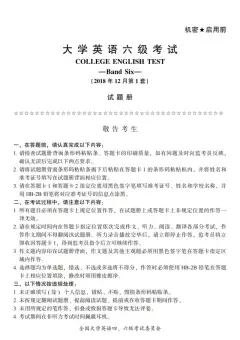
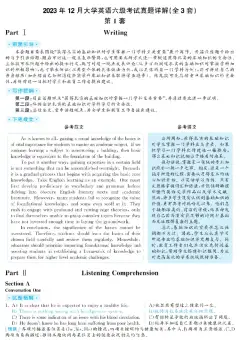
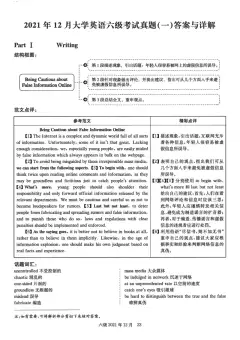
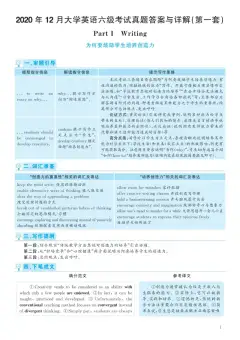
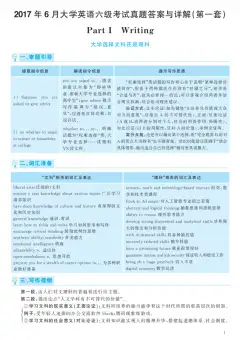
机密★启用前
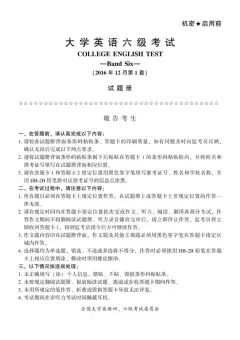
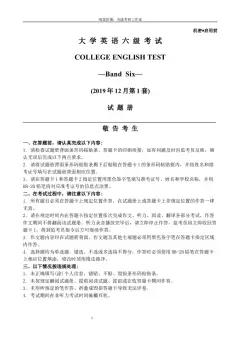
大 学 英 语 六 级 考 试
COLLEGE ENGLISH TEST
—Band Six一
(2024年 12月第 1 套 )
试 题 册
☆☆☆☆☆☆☆☆☆☆☆☆☆☆☆☆☆☆☆☆☆☆☆☆☆☆☆☆☆☆☆☆☆☆☆☆☆☆☆☆
敬 告 考 生
一、在答题前,请认真完成以下内容:
1 . 请检查试题册背面条形码粘贴条、答题卡的印刷质量,如有问题及时向监考员反映,
确认无误后完成以下两点要求。
2 .请将试题册背面条形码粘贴条揭下后粘贴在答题卡1 的条形码粘贴框内,并将姓名和
准考证号填写在试题册背面相应位置。
3 .请在答题卡1和答题卡2 指定位置用黑色签字笔填写准考证号、姓名和学校名称,并
用 HB-2B铅笔将对应准考证号的信息点涂黑。
二、在考试过程中,请注意以下内容:
1 . 所有题目必须在答题卡上规定位置作答,在试题册上或答题卡上非规定位置的作答一
律无效。
2 .请在规定时间内在答题卡指定位置依次完成作文、听力、阅读、翻译各部分考试,作
答作文期间不得翻阅该试题册。听力录音播放完毕后,请立即停止作答,监考员将立
即收回答题卡1 ,得到监考员指令后方可继续作答。
3 . 作文题内容印在试题册背面,作文题及其他主观题必须用黑色签字笔在答题卡指定区
域内作答。
4 .选择题均为单选题,错选、不选或多选将不得分,作答时必须使用HB-2B铅笔在答题
卡上相应位置填涂,修改时须用橡皮擦净。
三、以下情况按违规处理:
1 .未正确填写(涂)个人信息,错贴、不贴、毁损条形码粘贴条。
2 .未按规定翻阅试题册、提前阅读试题、提前或在收答题卡期间作答。
3 .未用所规定的笔作答、折叠或毁损答题卡导致无法评卷。
4 . 考试期间在非听力考试时间佩戴耳机。
全国大学英语四、六级考试委员会Part II Listening Comprehension (30 minutes)
Section A
Directions : In this section, you will hear two long conversations. At the end of each conversation, you
will hear four questions. Both the conversation and the questions will be spoken only once.
After you hear a question, you must choose the best answer from the four choices marked
A) , B) , C) and D). Then mark the corresponding letter on Answer Sheet 1 with a
single line through the centre.
Questions 1 to 4 are based on the conversation you have just heard.
1. A) Preparing for a job interview.
B) Writing a work report together.
C) Going through a couple of issues the company faces.
D) Discussing the woman's annual performance review.
2. A) The overall culture of the company.
B) The instruction from her supervisor.
C) The honesty of the manager.
D) The recognition of her merits.
3. A) Her inadequate language proficiency.
B) Her inability to interact with colleagues properly.
C) Her inappropriate behavior at company meetings.
D) Her simplistic approach to dealing with others.
4. A) To avoid offending the recipients.
B) To show her unique writing style.
C) To save time.
D) To be frank.
Questions 5 to 8 are based on the conversation you have just heard.
5. A) Provide medical service to the community.
B) Make healthcare in her hometown the best.
C) Obtain a doctoral degree in internal medicine.
D) Have a profound impact on people around her.
6. A) They have constantly urged her to study hard.
B) They have worked hard to finance her education.
6 • 1C) They have tried to create a positive learning environment.
D) They have pursued the family's dreams together with her.
7. A) It is a key medical branch conducive to realizing her dreams.
B) It connects many other specialties with its broad coverage.
C) It has a long history in the man's prestigious institution.
D) It is a medical branch both of her parents specialize in.
8. A) Problematic. C) Inconsistent.
B) Competitive. D) Trustworthy.
Section B
Directions : In this section, you will hear two passages. At the end of each passage, you will hear three
or four questions. Both the passage and the questions will be spoken only once. After you
hear a question, you must choose the best answer from the four choices marked A ) , B ),
C) and D). Then mark the corresponding letter on Answer Sheet 1 with a single line
through the centre.
Questions 9 to 11 are based on the passage you have just heard.
9. A) To prevent hackers from cracking our secret codes.
B) To show that all the guidelines are being followed.
C) To provide evidence that passwords are forgotten.
D) To convince our computer that we are human.
10. A) Put an end to the hacking phenomenon.
B) Help people remember their passwords.
C) Reduce the intricacy of the password itself.
D) Explain the need for different email accounts.
11. A) Innovate technologies to ensure the safety of users' accounts.
B) Provide incentives for the application of creative passwords.
C) Explore the possibility of using simpler secret codes.
D) Take steps to encourage users to log in more often.
Questions 12 to 15 are based on the passage you have just heard.
12. A) Her work no longer interested her.
B) Her training app did not fit her.
C) Her fitness fell into a slump.
D) Her business deteriorated.
6 • 213. A) Help users keep track of their fitness levels.
B) Design personalized training programmes.
C) Strengthen ties among users worldwide.
D) Select well-qualified human coaches.
14. A) They are never repeated.
B) They help enrich her life.
C) They are of no extreme intensity.
D) They keep her focused on her goal.
15. A) They will not be able to take the place of human personal trainers.
B) They will not be able to comprehend some of the profiles users put in.
C) They cannot lead to optimal results with their mathematical approach.
D) They cannot match humans in arranging meticulous workout schedules.
Section C
Directions : In this section, you will hear three recordings of lectures or talks followed by three or four
questions. The recordings will be played only once. After you hear a question, you must
choose the best answer from the four choices marked A) , B) , C) and D). Then mark the
corresponding letter on Answer Sheet 1 with a single line through the centre.
Questions 16 to 18 are based on the recording you have just heard.
16. A) All societies are built upon the cornerstones of basic values.
B) Everyone everywhere demonstrates seven character traits.
C) All societies are kept together by seven basic moral rules.
D) Everyone everywhere shares a universal moral standard.
17. A) Ascertain whether deferring to authority was confined to right-wing people.
B) Find out whether different societies had different versions of morality.
C) Make clear whether all societies faced the same moral issues.
D) Find out whether left-wing people still had a group loyalty.
18. A) Make independent descriptions of cultures around the world.
B) Strive to understand the basic differences between peoples.
C) Appreciate the foundational value of the existing data.
D) Carry out systematic field studies to gather new data.
6 • 3Questions 19 to 21 are based on the recording you have just heard.
19. A) They might be the most important part of our eating experience.
B) They can activate our brain functions in a most direct fashion.
C) They can be viewed as the windows to our soul.
D) They could mislead us in more ways than one.
20. A) It attracts food companies, growing attention.
B) It adversely impacts one's eating experience.
C) It invariably determines how food sells.
D) It changes the way people taste food.
21. A) Enhance the taste.
B) Make predictions.
C) Identify distinct flavors.
D) Enrich the eating experience.
Questions 22 to 25 are based on the recording you have just heard.
22. A) Social status.
B) Financial resources.
C) Meaning.
D) Happiness.
23. A) Their effect on people's happiness has long been overstated.
B) Their influence on people's life varies with social contexts.
C) They can affect people's experience of meaning.
D) They can ensure people's overall wellbeing.
24. A) It used questions totally different from those in their first study.
B) It focused on the sense of meaning of French participants.
C) It analysed cases from a daily poll of US residents.
D) It examined data collected from multiple countries.
25. A) They might have more access to external sources of happiness.
B) They might focus on an individual sense of satisfaction or meaning.
C) They might be less easily affected by a community's overall feeling.
D) They might be less adversely impacted by failure to achieve a purpose.
6 • 4Part HI Reading Comprehension (40 minutes)
Section A
Directions : In this section, there is a passage with ten blanks. You are required to select one word for
each blank from a list of choices given in a word bank fallowing the passage. Read the
passage through carefully before making your choices. Each choice in the bank is identified
by a letter. Please mark the corresponding letter for each item on Answer Sheet 2 with a
single line through the centre. You may not use any of the words in the bank more than once.
About 23% of the global population lives in absolute poverty. In developing countries there is a
low life expectancy, a high infant 26 rate, high levels of unemployment and illiteracy, nutritional
levels below acceptable standards and widespread disease with very little or poor quality medical
assistance. Others live 27 wealthy and luxurious lives and so the wealth is distributed in a very
28 manner. These are the central problems to questions of charity though charity also includes
many other areas such as assisting the elderly.
We all 29 when very rich people pledge to give away most of their billions, but they are
usually left with millions to pass on, still much more than most people would expect to earn in their
lifetime. Even comparatively 30 salaries in the west are very high when compared globally.
Someone on £ 20,000 could easily afford to give away £ 2,000 per year and still have plenty to live
on plus some luxuries.
Most people agree that giving to charity is morally 31 but charitable behaviour tends to be
regarded as above and beyond the call of duty. Some argue, however, that charitable behaviour is
morally required. This means that to fail to behave charitably would be wrong. The majority of
arguments in this vein refer to giving aid to poorer nations but they may also refer to giving time
within one's 32 community. Arguments tend to place different requirements on people in
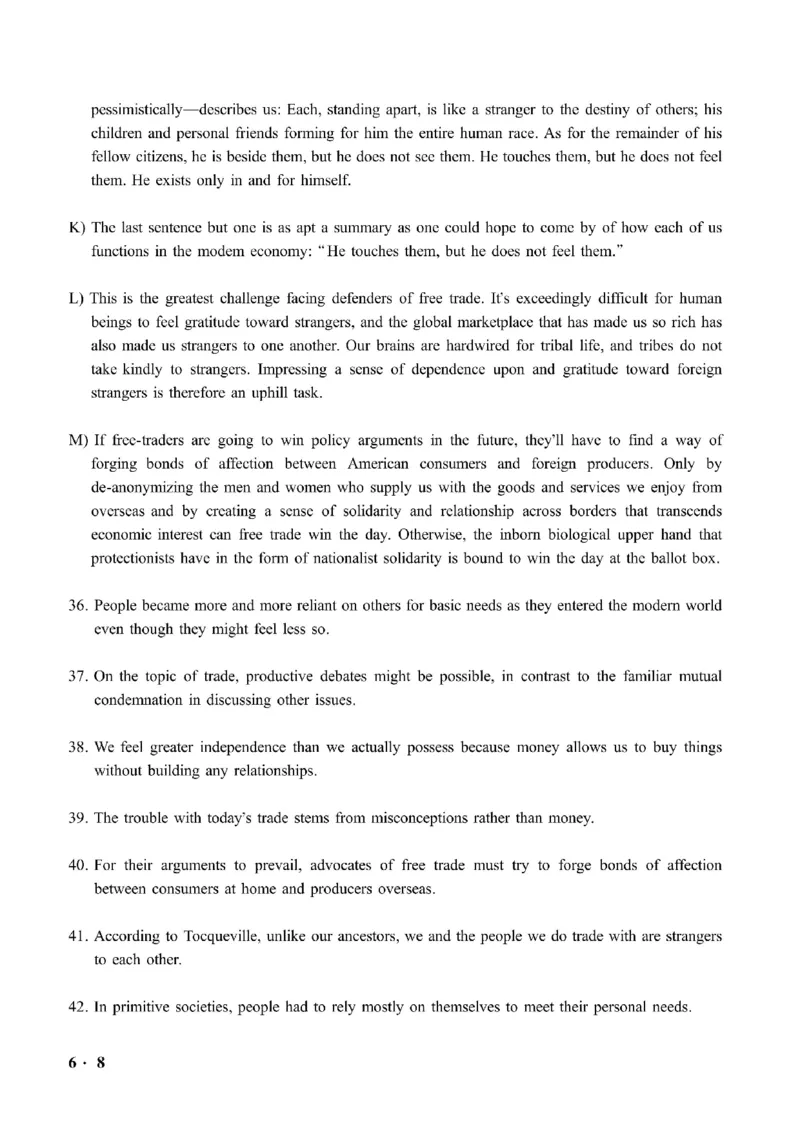
different income brackets and 33 entirely people who are merely making ends meet. Some argue
that people should all contribute a certain percentage of their earnings. I will 34 together all
those arguments that place a moral requirement on people to give to charity, despite the fact that there
is wide disagreement as to the 35 of that moral requirement.
A) applaud I) moderate
B) casualty J) mortality
C) exclude K) overt
D) extent L) praiseworthy
E) group M) probe
F) hierarchical N) sceptically
G) immediate O) unequal
H) incredibly
6 • 5Section B
Directions : In this section, you are going to read a passage with ten statements attached to it. Each
statement contains information given in one of the paragraphs. Identify the paragraph from
which the information is derived. You may choose a paragraph more than once. Each
paragraph is marked with a letter. Answer the questions by marking the corresponding letter
on Answer Sheet 2.
The Free-Trade Paradox
A) Trade is one of the policy areas where the hostility that exists between populists (民粹主义者)and
classical liberals is most visible. Free-traders point to the undeniable good that tariff-free trade has
done for consumers across the world and to the observable alleviation of poverty in comers of the
world where previously closed markets have been opened up. Protectionists point to the domestic
producers who've paid the price for this globalized economy in the form of lost livelihoods and
hollowed-out communities.
B) The ongoing conservative civil war often degenerates into content-free tribal warfare, but trade is a
rare exception. There are substantial, thought-out policy proposals on both sides of the argument.
C) Consequently, trade as a topic of discussion provides an opportunity for liberals and populists to
have a real meeting of minds. Fruitful debates might actually take place in this area, as opposed to
the familiar ritual we've become accustomed to of condemnation met with counter-condemnation.
D) Strange as it might sound, the problem with trade in the modem world isn't a matter of dollars and
cents. Ifs a matter of false consciousness. This observation is bound to set Marxist alarm bells
ringing in the minds of some readers, but it was first made by Alexis de Tocqueville in 1840.
E) Tracking the economic development of mankind from primitive to modem societies, Tocqueville
observed a paradox unfolding over the centuries as economic realities and human experience of
those realities strayed further and further from each other. In primitive societies, he notes, the
division of labor was as yet undeveloped for the most part, requiring each person, family, or tribe
to be relatively independent when it came to meeting their own basic material needs. Men built
their own dwellings, farmed their own land, tended to their own livestock. This is not to deny that
basic forms of trade took place, but, for the most part, our primitive ancestors lived fairly self-
reliant, if crushingly poor, lives.
F) However, the exclusively local and face-to-face nature of economic and political organization in
the ancient and prehistoric worlds constantly impressed upon these primitive peoples the
uncontrollable reality of others and their needs. As Tocqueville notes, 44 as soon as a man begins to
deal with common affairs in public, he begins to perceive that he is not so independent of his
6 • 6fellow men as he had first imagined, and that in order to obtain their support he must often lend
them his cooperation.
G) At the advent of the modem world, the division of labor spread further and further throughout
society. Each person became more and more dependent on others for their basic needs. And yet,
robbed of the engagement with our neighbors and with our local communities that our ancestors
were forced into by circumstance, we feel ourselves to be more and more independent of one
another. As we become more and more dependent on others, we become less and less conscious
of our dependence on others. This is the paradox of trade in the modem world.
H) The false consciousness that this paradox generates causes havoc on the debates we have about
free trade. There is scarcely a single commodity in any American household that isn't dependent
for its manufacture and sale, through one supply chain or another, on scores of different people
spread out across the entire globe. But as Tocqueville already foresaw in 1840, we do not feel
dependent on these strangers for our way of life. No sense of the dependence of our own material
welfare on their work ever strikes our national consciousness. We rarely contemplate the
globalized avenues of free trade with gratitude.
I) There are two reasons for this. The first, to put it bluntly, is money. Money allows us to purchase
the work of others without giving any thought to them as human beings. Unlike our ancestors in
their primitive townships, we rarely have to meet face-to-face the people who've invented, built,
shipped, or supplied our goods. No relationship has to be built before an exchange can take place.
Simply agree on a price, and you can have any goods you wish without taking a second thought
for the human being involved on the other side of the transaction. In this way, money makes us
feel more independent than we actually are. Each of us senses the hold that it has over our
fellows. We know that if we bid highly enough we can buy ourselves out of the time-consuming
labor of building relationships. Money is kind of like magic in that way. It gives us a set of rituals
to perform and promises that if we do so we'll be able to wield power over others. The illusion is
created that having enough money to buy something is the equivalent of knowing how to make it
yourself. Gratitude for the anonymous men and women who make up the supply chain rarely
makes its way into our consciousness.
J) Anonymity, in fact, is the second root cause of the free-trade paradox. Modernity has emancipated
everyone from the limits of location and community. By and large, when we trade, we trade with
strangers; when we vote, we vote for strangers; when we watch, read, or listen to stories, the
tellers of the tales are strangers. As opposed to the ancestors Tocqueville compares us to, we do
not know the people with whom we have to do, in either the economic or the political sphere.
This is simply the shadow side of the miracle of markets, which, for the first time in history, have
allowed strangers to look after each other. They've also allowed each of us to live more and more
of our lives exclusively as strangers to other people. This is how Tocqueville- rather
6 • 7pessimistically- describes us: Each, standing apart, is like a stranger to the destiny of others; his
children and personal friends forming for him the entire human race. As for the remainder of his
fellow citizens, he is beside them, but he does not see them. He touches them, but he does not feel
them. He exists only in and for himself.
K) The last sentence but one is as apt a summary as one could hope to come by of how each of us
functions in the modem economy: "He touches them, but he does not feel them.”
L) This is the greatest challenge facing defenders of free trade. It's exceedingly difficult for human
beings to feel gratitude toward strangers, and the global marketplace that has made us so rich has
also made us strangers to one another. Our brains are hardwired for tribal life, and tribes do not
take kindly to strangers. Impressing a sense of dependence upon and gratitude toward foreign
strangers is therefore an uphill task.
M) If free-traders are going to win policy arguments in the future, they'll have to find a way of
forging bonds of affection between American consumers and foreign producers. Only by
de-anonymizing the men and women who supply us with the goods and services we enjoy from
overseas and by creating a sense of solidarity and relationship across borders that transcends
economic interest can free trade win the day. Otherwise, the inborn biological upper hand that
protectionists have in the form of nationalist solidarity is bound to win the day at the ballot box.
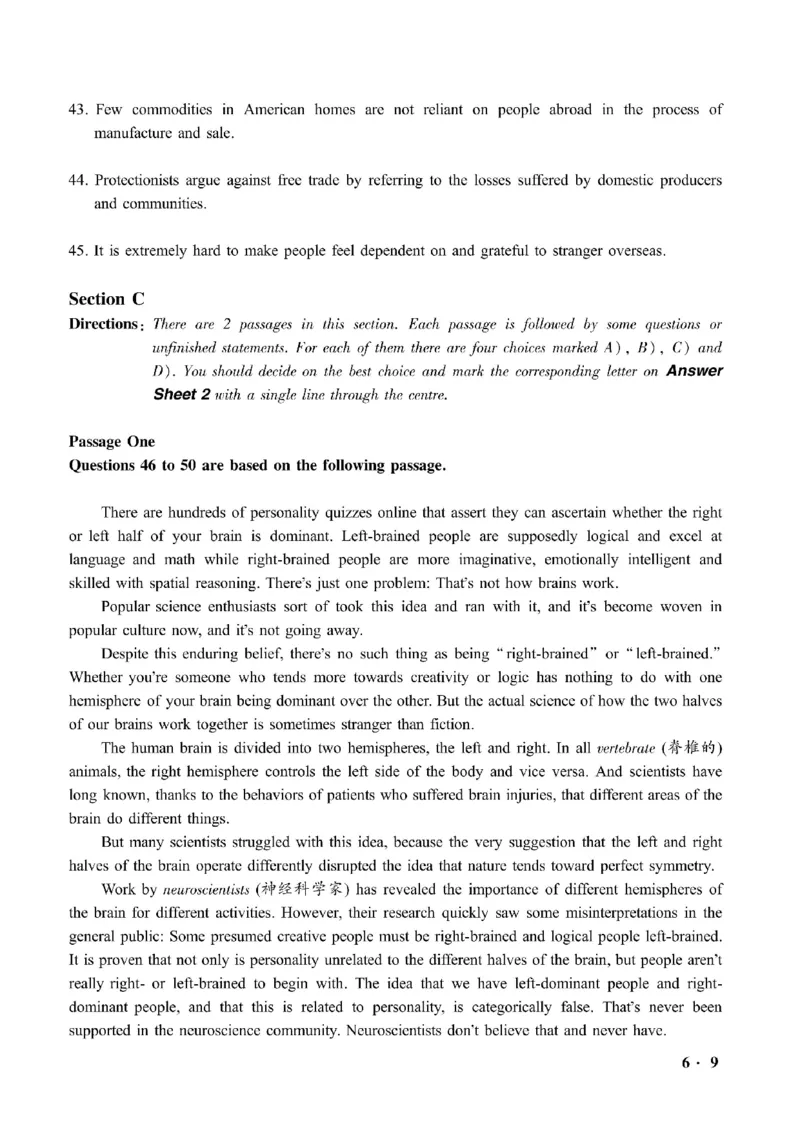
36. People became more and more reliant on others for basic needs as they entered the modem world
even though they might feel less so.
37. On the topic of trade, productive debates might be possible, in contrast to the familiar mutual
condemnation in discussing other issues.
38. We feel greater independence than we actually possess because money allows us to buy things
without building any relationships.
39. The trouble with today's trade stems from misconceptions rather than money.
40. For their arguments to prevail, advocates of free trade must try to forge bonds of affection
between consumers at home and producers overseas.
41. According to Tocqueville, unlike our ancestors, we and the people we do trade with are strangers
to each other.
42. In primitive societies, people had to rely mostly on themselves to meet their personal needs.
6 • 843. Few commodities in American homes are not reliant on people abroad in the process of
manufacture and sale.
44. Protectionists argue against free trade by referring to the losses suffered by domestic producers
and communities.
45. It is extremely hard to make people feel dependent on and grateful to stranger overseas.
Section C
Directions : There are 2 passages in this section. Each passage is followed by some questions or
unfinished statements. For each of them there are four choices marked A) , B ) , C) and
D). You should decide on the best choice and mark the corresponding letter on Answer
Sheet 2 with a single line through the centre.
Passage One
Questions 46 to 50 are based on the following passage.
There are hundreds of personality quizzes online that assert they can ascertain whether the right
or left half of your brain is dominant. Left-brained people are supposedly logical and excel at
language and math while right-brained people are more imaginative, emotionally intelligent and
skilled with spatial reasoning. There's just one problem: Thafs not how brains work.
Popular science enthusiasts sort of took this idea and ran with it, and ifs become woven in
popular culture now, and it's not going away.
Despite this enduring belief, there's no such thing as being uright-brainedn or “left-brained.”
Whether you're someone who tends more towards creativity or logic has nothing to do with one
hemisphere of your brain being dominant over the other. But the actual science of how the two halves
of our brains work together is sometimes stranger than fiction.
The human brain is divided into two hemispheres, the left and right. In all vertebrate (脊椎的)
animals, the right hemisphere controls the left side of the body and vice versa. And scientists have
long known, thanks to the behaviors of patients who suffered brain injuries, that different areas of the
brain do different things.
But many scientists struggled with this idea, because the very suggestion that the left and right
halves of the brain operate differently disrupted the idea that nature tends toward perfect symmetry.
Work by neuroscientists (不中经科学家)has revealed the importance of different hemispheres of
the brain for different activities. However, their research quickly saw some misinterpretations in the
general public: Some presumed creative people must be right-brained and logical people left-brained.
It is proven that not only is personality unrelated to the different halves of the brain, but people aren,t
really right- or left-brained to begin with. The idea that we have left-dominant people and right
dominant people, and that this is related to personality, is categorically false. Thafs never been
supported in the neuroscience community. Neuroscientists don't believe that and never have.
6 • 9What scientists learned is that there are really important differences between the left hemisphere
and the right hemisphere. Ifs just that they have nothing to do with personality or whether cognitive
strategy is more logical or free spirited or creative. While researchers have shown the limitations of
how the hemispheres of our brains influence our lives, it's not difficult to understand the appeal of
such ideas. People are endlessly fascinated by themselves and their friends, and the subtle differences
in how people think about the world are really meaningful to them. When you come up with an
online quiz that tells us something about ourselves, we're drawn to that. It's irresistible. But you have
to take it with an enormous grain of salt.
46. What do numerous personality quizzes online claim they are able to do?
A) Distinguish between the two hemispheres of one's brain.
B) Determine whether one is left-brained or right-brained.
C) Tell if one is more of a linguist or of a mathematician.
D) Ascertain how one's brain performs different tasks.
47. What does the author say is sometimes stranger than fiction?
A) How one hemisphere of the brain impacts creativity.
B) How the two halves of our brains work alternately.
C) How the two hemispheres of our brains cooperate.
D) How one half of the brain dominates the other.
48. Why did many scientists have difficulty endorsing the idea that different areas of the brain do
different things?
A) It contradicts the assumption that the two hemispheres of the brain are symmetrical.
B) It dismisses the view that the universe has been evolving in a consistent manner.
C) It is in conflict with the suggestion that the left and right halves of the brain work together.
D) It disrupts the idea that the right hemisphere of the brain controls the left side of the body.
49. What belief have neuroscientists long rejected according to the passage?
A) There are left-dominant people and right-dominant people with different personalities.
B) There are noticeable differences between the left and right hemispheres of the brain.
C) One's personality is hardly related to the different halves of the brain.
D) Different areas of the brain are responsible for different activities.
50. What are we advised to do with an online quiz that tells us something about ourselves?
A) Challenge its authority.
B) Scrutinize its originality.
C) Evaluate its popularity.
D) Question its reliability.
6 • 10Passage Two
Questions 51 to 55 are based on the following passage.
One hundred thirty-five students, four teachers, one giant classroom: This is what 9th grade
looks like at Westwood High School, in Mesa, Arizona's largest school system. There, an innovative
teaching model has taken hold, and is spreading to other schools in the district and beyond.
Five years ago, faced with high teacher turnover and declining student enrollment, Westwood's
leaders decided to try something different. Working with professors at Arizona State University's
teachers college, they piloted a classroom model known as team teaching which allows teachers to
dissolve the walls that separate their classes across physical or grade divides.
The teachers share large groups of students- sometimes 100 or more- and rotate between group
instruction, one-on-one interventions, small study groups, or whatever the teachers as a team agree is
a priority that day. What looks at times like chaos is in fact a carefully orchestrated plan: Each
morning, the Westwood teams meet to hammer out a personalized program for every student the team
will focus on that day.
By giving teachers more opportunity to collaborate, Mesa's administrators hoped to fill staffing
gaps and boost teacher morale and retention. Initial research suggests the gamble could pay off.
“ Teachers are doing fantastic things, but ifs very rare a teacher walks into another room to see
whafs happening,“ said Andi Fourlis, superintendent of Mesa Public Schools. u Our profession is so
slow to advance because we are working in isolation.”
Of course, overhauling teaching approaches can't fix all the frustrations teachers have, such as
low pay, but early results from Mesa show team teaching may be helping to reverse low morale. In a
survey of hundreds of the districfs teachers, researchers found those who worked on teams reported
greater job satisfaction, more frequent collaborations with colleagues, and more positive interactions
with students.
Another benefit of teams, teachers say, is that they can help each other improve their instruction.
During one planning session, English teacher Jeff Hall shared a performance appraisal with a science
teacher: Her recent lecture on something she called “the central dogma of biology“ had bewildered
him and their other teammates.
“If the science is too confusing for me, can you imagine the frustration you feel as kids?” Hall
said. But the science teacher, he said, wouldn,t have known about the confusion on her own.
The model is not for everyone. Some teachers approached about volunteering for a team have
said they prefer to work alone. Team teaching can also be a scheduling nightmare, especially at
schools like Westwood where only some staff work in teams. There are also thorny questions like
how to evaluate four teachers on the performance of 135 students. But for the time being, it seems to
be working.
51. What do we learn about team teaching from the passage?
A) It is generally conducted in classrooms without walls.
B) It allows students to choose teachers they favor most.
6 • 11C) It prioritizes peer work over classroom instruction.
D) It is closely coordinated despite seeming confusion.
52. What does initial research suggest regarding Westwood's innovative teaching model?
A) It could help raise teachers5 pay.
B) It could turn out to be a success.
C) It could cut down overall costs.
D) It could end up like a gamble.
53. What did superintendent Andi Fourlis say about the teaching profession?
A) Morale cannot be boosted until teaching models are overhauled.
B) Teachers are simply too busy to visit classes of their colleagues.
C) Progress is slow due to lack of collaboration among teachers.
D) Teachers often do fantastic things without being noticed.
54. What does the author want to show by citing English teacher Jeff HalFs experience?
A) English teachers and science teachers are complementary in performing their tasks.
B) A teacher of arts and letters is completely puzzled by what a science teacher teaches.
C) The new teaching model helps inform the teacher how their instruction is received.
D) Science teachers will hardly know the confusion they create without a performance appraisal.
55. What does the author think is one of the difficult problems in implementing the new teaching
model?
A) What to do with teachers working alone.
B) What to include in teaching schedules.
C) How to recruit volunteers for a team.
D) How to assess each teachefs performance.
Part IV Translation (30 minutes)
Directions : For this part, you are allowed 30 minutes to translate a passage from Chinese into English.
You should write your answer on Answer Sheet 2.
洋山港(Yangshan Port)是上海航运中心的重要组成部分,是中国第一个深水港,也是世界上
规模最大的深水港之一。经过近20年的发展,洋山港已实现高度自动化。数字技术和人工智
能的使用大大减少了用工成本和碳排放。自主研发的码头管理系统可以在百公里之外对大型
设备进行远程操控。洋山港看上去一片繁忙,现场却见不到人工操作,而且能够24小时不间断
运作。洋山港将不断发展,为把上海建成一个全球航运中心做出更大贡献。
6 • 12未得到监考教师指令前,不得翻阅该试题册!
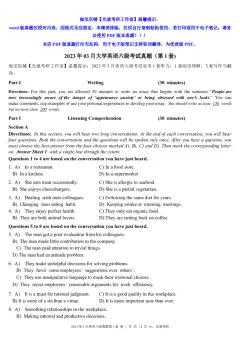
Part I Writing (30 minutes)
(请于正式开考后半小时内完成该部分,之后将进行听力考试)
Directions : For this part, you are allowed 30 minutes to write an essay that begins with the
sentence u Nowadays, more and more students have realized the importance of
self-discipline in their personal growth." You can make comments, cite examples or
use your personal experiences to develop your essay. You should write at least 150 words
but no more than 200 words.
You should copy the sentence given in quotes at the beginning of your essay.
请用黑色签字笔在答题卡1指定区域内作答作文题,在试题册上的作答无效!
请认真填写以下信息:
nn——
准考证号:
姓 名 : ________________________________
错填、未填以上信息,按违规处理!机密★启用前
大 学 英 语 六 级 考 试
COLLEGE ENGLISH TEST
—Band Six一
(2024年 12月第 2 套 )
试 题 册
☆☆☆☆☆☆☆☆☆☆☆☆☆☆☆☆☆☆☆☆☆☆☆☆☆☆☆☆☆☆☆☆☆☆☆☆☆☆☆☆
敬 告 考 生
一、在答题前,请认真完成以下内容:
1 . 请检查试题册背面条形码粘贴条、答题卡的印刷质量,如有问题及时向监考员反映,
确认无误后完成以下两点要求。
2 .请将试题册背面条形码粘贴条揭下后粘贴在答题卡1 的条形码粘贴框内,并将姓名和
准考证号填写在试题册背面相应位置。
3 .请在答题卡1和答题卡2 指定位置用黑色签字笔填写准考证号、姓名和学校名称,并
用 HB-2B铅笔将对应准考证号的信息点涂黑。
二、在考试过程中,请注意以下内容:
1 . 所有题目必须在答题卡上规定位置作答,在试题册上或答题卡上非规定位置的作答一
律无效。
2 .请在规定时间内在答题卡指定位置依次完成作文、听力、阅读、翻译各部分考试,作
答作文期间不得翻阅该试题册。听力录音播放完毕后,请立即停止作答,监考员将立
即收回答题卡1 ,得到监考员指令后方可继续作答。
3 . 作文题内容印在试题册背面,作文题及其他主观题必须用黑色签字笔在答题卡指定区
域内作答。
4 .选择题均为单选题,错选、不选或多选将不得分,作答时必须使用HB-2B铅笔在答题
卡上相应位置填涂,修改时须用橡皮擦净。
三、以下情况按违规处理:
1 .未正确填写(涂)个人信息,错贴、不贴、毁损条形码粘贴条。
2 .未按规定翻阅试题册、提前阅读试题、提前或在收答题卡期间作答。
3 .未用所规定的笔作答、折叠或毁损答题卡导致无法评卷。
4 . 考试期间在非听力考试时间佩戴耳机。
全国大学英语四、六级考试委员会Part II Listening Comprehension (30 minutes)
Section A
Directions : In this section, you will hear two long conversations. At the end of each conversation, you
will hear four questions. Both the conversation and the questions will be spoken only once.
After you hear a question, you must choose the best answer from the four choices marked
A) , B) , C) and D). Then mark the corresponding letter on Answer Sheet 1 with a
single line through the centre.
Questions 1 to 4 are based on the conversation you have just heard.
. 回;
1. A) Changing his major, 微信扫码获音频
B) His family situation.
C) Revising his graduation thesis.
D) His passion for Art History.
2. A) He doesn't think it legitimate to depend on his father.
B) He thinks his financial situation has now changed.
C) He doesn't think it will provide him with a living.
D) He thinks it nourishes the financially secure only.
3. A) Try his best to socialize and build a network in the art industry.
B) Seek financially viable employment opportunities after graduation.
C) Investigate all possible ways to become a celebrity in the art world.
D) Strike a balance between intellectual pursuits and financial security.
4. A) Money. C) Determination.
B) Time. D) Optimism.
Questions 5 to 8 are based on the conversation you have just heard.
5. A) Their decision on investigating beef consumption.
B) Their original ideas about the domestic market.
C) Their different approaches to a case study.
D) Their end-of^semester business projects.
6. A) Expanding farmland out west.
B) Importing most of the beef.
C) Raising cattle domestically.
D) Continuing to boost economic growth.
6 • 17. A) Technical equipment. C) Beef.
B) Business consultancy. D) Carwashing.
8. A) Car owners of all walks of life.
B) High-end customers in big cities.
C) Consumers craving for professional service.
D) Well-off dealers seeking a profitable markup.
Section B
Directions : In this section, you will hear two passages. At the end of each passage, you will hear three
or four questions. Both the passage and the questions will be spoken only once. After you
hear a question, you must choose the best answer from the four choices marked A) , B ),
C) and D). Then mark the corresponding letter on Answer Sheet 1 with a single line
through the centre.
Questions 9 to 11 are based on the passage you have just heard.
9. A) Parents9 talking with them during TV time raises their curiosity levels.
B) Their daily television exposure cuts parent-child conversation time.
C) The more TV they watch the poorer their progress in development.
D) Their socioeconomic levels impact their academic achievement.
10. A) Kids' enhanced learning. C) Kids' reading and math.
B) Kids' curiosity levels. D) Kids' behavioral development.
11. A) It can hinder kids from getting on with their peers.
B) It can cut into kids' time on exploratory activities.
C) It can arouse kids' interest in how people interact in real life.
D) It can widen the gap between kids from different economic statuses.
Questions 12 to 15 are based on the passage you have just heard.
12. A) Exerting ourselves too hard in order to attain our life's goals.
B) Being possessed with a single thought of professional success.
C) Trying every means to beat others in terms of personal aspirations.
D) Being mindlessly driven to possess more and more material things.
13. A) We might isolate ourselves from our fellow beings.
B) We might acquire an incorrect sense of well-being.
C) We might end up pursuing all the wrong things.
D) We might make a mess of our personal lives.
6 • 214. A) They should be based on solid theoretical concepts.
B) They should take personal interests into account.
C) They should include goals to help other people.
D) They should increase our sense of worthiness.
15. A) Drifting through life aimlessly.
B) Giving up the chance to fulfill yourself.
C) Abandoning all that life has to offer.
D) Spoiling your character and integrity.
Section C
Directions : In this section, you will hear three recordings of lectures or talks followed by three or four
questions. The recordings will be played only once. After you hear a question, you must
choose the best answer from the four choices marked A) , B) , C) and D). Then mark the
corresponding letter on Answer Sheet 1 with a single line through the centre.
Questions 16 to 18 are based on the recording you have just heard.
16. A) Grade-raising ways and means.
B) Pressure-alleviating exercise.
C) Revision-conducting approaches.
D) Brain-boosting food and drink.
17. A) Buying it from coffee shops.
B) Building up a tolerance of it.
C) Drinking it after 2 pm.
D) Consuming it with sugar.
18. A) By taking varied vitamin supplements.
B) By consuming a rich variety of foods.
C) By eating both oranges and frozen berries.
D) By getting components packaged in tablets.
Questions 19 to 21 are based on the recording you have just heard.
19. A) Many people across advanced economies think the world is going from bad to worse.
B) The news focuses on reporting catastrophes that occur across the world.
C) A significant part of the world is experiencing another great recession.
D) Many people have no idea of those living under miserable conditions.
6 • 320. A) It has experienced ups and downs like any other historical trend.
B) It is hailed as a miracle by both economists and ordinary people.
C) It is the only way fbr all countries to share economic prosperity.
D) It has given more and more countries a rare chance to thrive.
21. A) Their fortunes may take a downturn.
B) They can be classified as middle class.
C) Their living standards have been deteriorating.
D) They are experiencing a radical transformation.
Questions 22 to 25 are based on the recording you have just heard.
22. A) Why smells can activate emotional memories.
B) How powerful the sense of smell can become.
C) How scent particles revive memories forgotten.
D) Why the scent of bread has a strong mental impact.
23. A) The brain cells' processing of memories experienced as strongly emotional.
B) The activation of the brain's emotion processing area by chemical particles.
C) The interaction between chemical particles and the brain cells responsible for smell.
D) The sensations of scents going directly to the brain's emotional and memory centers.
24. A) Imagination. C) Experience.
B) Association. D) Context.
25. A) Inaccuracy and alterability.
B) Susceptibility to polar interpretations.
C) Being personal and individualistic.
D) Being dependent on relevant scenarios.
Part HI Reading Comprehension (40 minutes)
Section A
Directions : In this section, there is a passage with ten blanks. You are required to select one word for
each blank from a list of choices given in a word bank following the passage. Read the
passage through carefully before making your choices. Each choice in the bank is identified
by a letter. Please mark the corresponding letter for each item on Answer Sheet 2 with a
single line through the centre. You may not use any of the words in the bank more than once.
6 • 4Ever been talking about something important with someone you care about and found the
discussion frustrating instead of fruitful? Negative energy can then cast a 26 over your efforts to
build a shared understanding.
In fact, collaborative problem-solving conversations require skills. Strong listening skills are
essential. Sprinkling in positivity via appreciation, 27 smiles, and warm comments helps. So does
the essential ability to keep your emotional tone in the calm zone. If the tone of a dialogue heats up
and anger erupts, the dialogue 28 from collaborative to adversarial, and progress is likely to
come to an immediate 29 .
In addition, effective dialogue generally has another important characteristic: symmetry.
Symmetry in dialogue refers to the balance of how much each partner talks. Are you each
getting equal airtime? When one participant does most of the talking, this asymmetry or lack of
balance tends to become annoying to one or both of you. The silent partner 30 tires of only
listening, while the talker can feel 31 Usually, both would prefer more equal give and take.
Different rates of speech and levels of voice volume can 32 symmetry as well. The faster or
louder partner can easily begin taking up more airtime. The slower-talking or softer-voiced one can
have trouble getting the floor.
Conversations also lose balance when one partner's opinions count more than the othefs. One
person's input may carry more sway because their style of expression is more 33 . One viewpoint
may tend to get lost because it is expressed more 34 .
If either partner fairly consistently 35 or evaporates, modifying the pattern will be helpful.
The dialogue will feel more productive, and at the same time, the relationship overall is likely to feel
more positive.
A) affectionate I) predominates
B) approximately J) propagate
C) elapses K) scenario
D) erode L) shadow
E) flattered M) tentatively
F) flips N) typically
G) halt 0) vigorous
H) overburdened
Section B
Directions : In this section, you are going to read a passage with ten statements attached to it. Each
statement contains information given in one of the paragraphs. Identify the paragraph from
which the information is derived. You may choose a paragraph more than once. Each
paragraph is marked with a letter. Answer the questions by marking the corresponding letter
on Answer Sheet 2.
6 • 5What is a super blood wolf moon?
A) Blue moons, rose moons, supermoons. For some reason all the websites seem to think you really
want to know all about these moons. u Catch This Weekend's AMAZING SUPERMOON," one
headline will announce. " The Supermoon Isn't Actually A Big Deal And You're All Ruining
Astronomy,,, another will complain.
B) The latest example is the super blood wolf moon eclipse which sounds like the name of an
emotional song I would have performed a modem dance routine to in 9th grade, but is, in fact, an
astronomical event set to occur on January 20. As well explain below, there is nothing truly
mysterious or otherwise special about this moon, and it will not look like a bloody wolf head in
the sky or anything wild like that. We get these super lunar events by smashing together all the
qualifiers we've historically used to keep track of full moons throughout the year, and in the age
of the internet we can get a little too enthusiastic.
C) Consider this your go-to resource for all moon-gazing news. Here's what you need to know about
the latest lunar event.
D) Look, it's okay if you don't know. There are probably loads of folks who walk around pretending
they totally know why that thing in the sky seems to get bigger and smaller at regular intervals
but who totally do not.
E) The moon orbits Earth, and it's tidally locked- that means it always shows us the same face,
instead of spinning around like our planet does. Thafs why you can always see the man on the
moon (or the moon rabbit, depending on your cultural preferences) even as it spins around us.
But while the moon is big and bright in the sky when ifs full, thafs only because it's reflecting
light from the sun. But the moon is always moving, so it's getting hit with sunlight at different
angles. It's invisible to us during the new moon, because our satellite is parked right between us
and the sun; the so-called dark side of the moon is lit up like Las Vegas, but the side we can see
is in shadow. A full moon happens when the earth is right between the sun and the moon, so
sunlight hits the part we can see. And all the other phases are just the transition from one of those
extremes to the other.
F) The moon isn't always exactly the same distance from Earth, because its orbit isn't perfectly
circular. We call the closest point perigee (近地点),and the most distant point is apogee (远地点).
2018's closest perigee and most distant apogee both happened in January, and the difference was
about 30,000 miles.
6 • 6G) The reason you care about this ordinary change in distance is that it turns a moon super. When a
full moon happens close to perigee, ifs going to look a bit bigger. Honestly, the difference is not
that profound, but if you're in a position to photograph the supermoon next to something that
shows the slight increase in scale, it can look pretty cool. January's super blood wolf moon
eclipse is super because the date lines up with the closest the moon will get to us during January,
but the moon won't actually be at its closest for the year until February's supermoon, which you
can expect plenty of undue excitement over.
H) Blood moons only occur during total lunar eclipses (which can happen a few times a year in any
given location). When the moon slips through our shadow, we give it a reddish coloring. The
moon can also look orange whenever it's rising or setting, or if it hangs low in the horizon all
night- the light bouncing off of it has to travel through a thicker atmosphere there, which scatters
more blue light away. But you'll probably only see that deep, sinister red during an eclipse.
I) A lot of headlines about moons are just ridiculous (you do not need to be particularly excited
about a blue moon, it just looks like a regular full moon), but you should definitely roll out of
bed to look at a blood moon if one is going to be visible in your region, even though they're just
lunar eclipses and not evidence of bloody battles between the sky gods.
J) In March of 2018, we had our second ublue moon^^ of the year, to much acclaim. And while thafs
not necessarily special in an oh-gosh-get-out-and-look-at-it way, it's certainly special: a blue
moon is a nickname for when two full moons fall in the same calendar month, and we hadn't
previously had two in one year since 1999. We won't have it happen again until 2037.
Astronomer David Chapman explained that this is merely a peculiarity of our calendar; once we
stopped doing things based on the moon and started trying to follow the sun and the seasons, we
stopped having one reliable full moon per month. The moon cycle is 29.53 days long on average,
so in most months we still end up with a single new moon and a single full one. But every once
in a while, one month steals a full moon from another. In 2018 (and in 1999, and again in 2037)
both January and March stacked full moons on the first and last nights of the month, leaving
February in the dark.
K) Getting two blue moons a year is rare, but we have individual blue moons every few years. Also,
fun fact: not actually blue. A moon can indeed take on a moody blue color, but this only happens
when particles of just the right size disperse through the sky- and it has nothing to do with the
moon's status as "blue." Big clouds of ash from volcanic eruptions or fires can do the trick, but
it doesn't happen often, and the stars would certainly have to align fbr two such rare instances to
occur at once.
L) You may have heard that the super special second blue moon of 2018 was also a Paschal moon.
This is true! That just means it was the first full moon of spring, which is often used to determine
6 • 7the date of Easter Sunday. All of this is just calendar nonsense and we refuse to go into it further.
M) Sometimes you'll see a headline that promises a moon with so many qualifiers it makes your
head spin. A super blue blood worm moon, perhaps? Or a super blood wolf moon? Lots of
websites will tell you that “wolf moon“ is the traditional name of the first full moon of the year
in u Native Americann cultures, which is kind of a weird thing to claim given that there are 573
registered Tribal Nations in the U. S. alone today, not to mention historically. The idea that
hungry, howling wolves were such a universal constant in January that all of North America with
its different cultures, geographies, and languages spontaneously came up with the same nickname
is illogical.
N) Many cultures have traditional names for the full moon in a given month or season, so there's
quite a list to draw from if you're trying to really juice up a story on a slightly-bigger-than-
average view of the moon. But these are all based on human calendars and activities and folklore;
you will not go outside and see a pink moon in April, though I wish it were so.
36. We cannot see the moon at times when it is positioned right between the earth and the sun.
37. Volcanic eruptions may cause the moon to assume a moody blue color.
38. The moon will be closest to the earth when the supermoon occurs in February.
39. There is nothing unusual about the super blood wolf moon, which will bear no resemblance to a
bloody wolf head.
40. The moon will appear orange when the light reflecting from it travels through an atmosphere
thicker than usual.
41. It is contrary to logic to claim the name of wolf moon originates from the cultures of American
Indians.
42. As the moon's orbit is not a hundred-percent circle, its distance from the earth changes.
43. A full moon in a given month or season gets a specific name in different cultures.
44. There are likely lots of people who know absolutely nothing about why the moon appears to
change its size regularly but act like they know.
45. When a full moon appears twice in the same month, it is nicknamed a blue moon.
6 • 8Section C
Directions : There are 2 passages in this section. Each passage is followed by some questions or
unfinished statements. For each of them there are four choices marked A) , B) , C) and
D). You should decide on the best choice and mark the corresponding letter on Answer
Sheet 2 with a single line through the centre.
Passage One
Questions 46 to 50 are based on the following passage.
With population increases and global urbanisation ever accelerating, much attention is focused on
the sustainability of our cities and scarce attention is paid to the countryside.
Rural life is associated with closely-knit communities, sense of belonging, and a simple, tranquil
life. Yet whilst some or all of these elements exist in the countryside, so do conservatism and a lack
of employment opportunities. And it is mostly due to the latter that rural communities are suffering.
Attracted by the improved economics of urban areas, country-dwellers across the world are moving
out, contributing to the excessive crowdedness of densely populated cities, and leaving the
countryside in desolation.
So how can the countryside ensure its survival among these changes, or should it at all? Due to
both the distance between residences and facilities and often intermittent public transport, those living
in the countryside are heavier automobile users. Rural dwellers also use more energy maintaining their
mostly detached buildings. We may be piled up like boxes in the city, but this brings energy
efficiency that the countryside cannot match. Rural energy requirements result in higher carbon
emissions per person than in the city, so it is actually irresponsible to endorse such a lifestyle choice.
Protecting the countryside is a hot topic. Those who have made their fortunes in the city often
buy second homes in the countryside, visiting intermittently fbr a sample of a supposedly simple life.
The side-effect of this is that house prices are pushed up due to increased demand, leaving them
unaffordable fbr local people. A solution has yet to be found for this challenge, for market forces are
further forcing residents out of the countryside. For those who believe in rural preservation, this is
deplorable.
Whilst an idealised view of the countryside is common, the reality is that rural life has
continuously evolved. Industrialisation brought an increase in divisions of labour, changing social
links between rural people. The internet has introduced once foreign cultures into the countryside.
Improved travel connections and affordability have made the world more accessible, creating a
' global village) . Considering these changes, surely an evolving countryside is inevitable.
Perhaps the countryside should also prepare itself for massive population increases in the future.
With cities across the world growing rapidly, how will the current urban generation respond to the
inevitable social changes of mass urbanisation? Will the longing for a simpler life become stronger,
fueling a rural renaissance?
As the world continues to urbanise, the voices calling for rural preservation may well grow
6 • 9louder. But change is inevitable. We know that the world is going to see new cities emerging from the
dust and current cities growing into megacities, but the future of the countryside is less clear.
46. What has become of the rural areas nowadays?
A) They are becoming somewhat deserted.
B) They are being increasingly urbanised.
C) They are closely-knit communities.
D) They are haunted by conservatism.
47. What does the author think of the rural lifestyle?
A) It is unlikely to survive given the on-going changes.
B) It is less energy-efficient compared to that in cities.
C) It is highly dependent upon heavy automobiles.
D) It is a choice more affluent people will endorse.
48. What does the author think of rich urban residents buying a second home in the countryside?
A) It is bound to mar the traditional rural life.
B) It adversely impacts rural social stability.
C) It hinders rural economies, revitalisation.
D) It is detrimental to rural preservation.
49. What do we learn about the countryside with industrialisation and technological advances?
A) It is destined to change gradually.
B) It will present an idealised way of life.
C) It is likely to embrace foreign cultures.
D) It will become increasingly diversified.
50. What does the author think of the future of the countryside compared with cities?
A) It is going to be harder for the locals.
B) It is going to resemble that of cities.
C) It is less likely to stay static.
D) It is less easy to envisage.
Passage Two
Questions 51 to 55 are based on the following passage.
Statements, like beauty is in the eye of the beholder (观看者)are rarely questioned. They've
become so embedded in our consciousness that people think ifs absurd to think otherwise. It might be
useful, however, to at least push back on this assumption because people evaluate environment,
6 • 10situations, and people aesthetically. We may find that we still believe it is correct, but we may also
find that there is a lot more to the situation than you suppose.
A recent study exploring aesthetic taste was published in Cognition. The results from this study
show that people agree very much in their aesthetic evaluation of natural objects, but they disagree
more about artifacts, or human-made objects.
The study found that shared taste was most common for faces and natural landscapes, but least
common among works of architecture and art. The hypothesis is the commonly pleasing features, like
proportion or symmetry, are at work.
Preferences for natural scenes might be learned through life experiences. Factors like habitability,
safety, and openness might be preferred as people develop. Some of the details of landscapes change,
but the basics are more common, e.g., water, open spaces, and signs of care.
Art and architecture, unlike natural spaces, do not have the same level of exposure. So, people
do not have the same level of shared taste.
Ifs possible that the lower amount of agreement in the shared taste of artifacts has to do more
with elements of style, rather than ' behavioral consequences?
All of the consequences seem reasonable (or at least possible), but I think there might be an
interesting philosophical conclusion that they did not draw. It seems that there is an objective ground
to our aesthetic preferences or evaluations. I am not saying this would mean beauty is completely
objective, just that there could possibly be general objective principles at work, i.e., beauty is not
simply in the eye of the beholder.
Nature exhibits some of the universal aesthetic features, such as radiance, in a common way
throughout the world. It's not exactly the same everywhere, but it is common. For example, a sunset
is similar enough in different places to warrant almost universal appeal.
Possible universal principles of beauty- such as proportion, fittingness, radiance, and others一
are general categories, which allow for a wide array of embodiments. When people get involved in
making artifacts in architecture or art, they apply these very general concepts in unique ways. But the
way they applied the principle may not have universal appeal.
This is why it's important to experience diverse cultures and their artifacts because it opens us up
to different ways of approaching or constructing beauty. And it is always good to question our
assumptions.
51. What does the passage say about the statement “ beauty is in the eye of the beholder,, ?
A) It has hardly ever been disputed.
B) It can be interpreted aesthetically.
C) Many people have found it absurd.
D) People have long been misled by it.
6 • 1152. What does a recent study exploring aesthetic taste show?
A) Aesthetic tastes tend to differ from person to person.
B) Natural beauty is rarely surpassed by artificial beauty.
C) There is less consensus on objects shaped by human craft.
D) There is general agreement on what is pleasing to the eye.
53. Why do people differ in their aesthetic appraisal of artifacts?
A) They come out in a great variety of designs.
B) They lead to varying behavioral consequences.
C) They take up much less natural space than landscapes.
D) They come into people's view less often than natural spaces.
54. What does the example of sunset tell about nature?
A) It creates a powerful appeal through its brilliant radiance.
B) It displays aesthetic traits in a similar way the world over.
C) It embodies beauty with a wide array of aesthetic features.
D) It establishes the principles of beauty in a number of ways.
55. Why do artifacts not always hold universal appeal?
A) The appreciation of their beauty is not subject to objective standards.
B) The universal principle of beauty prevents a wide array of embodiments.
C) The way their creators apply the principle of beauty may not be pleasing to everybody.
D) Their creators interpret the universal principle of beauty each in their preferred way.
Part IV Translation (30 minutes)
Directions : For this part, you are allowed 30 minutes to translate a passage from Chinese into English.
You should write your answer on Answer Sheet 2.
遨游太空历来是中华民族的梦想。2003年,神舟五号飞船发射成功,杨利伟成为第一个飞
人太空的中国宇航员。2008年,神舟七号升空,翟志刚成为中国历史上首位进行太空行走的宇
航员。近年来,中国航天进入创新发展“快车道”,太空基础设施建设稳步推进,中国空间站于
2022年全面建成。中国航天事业的迅速发展在中华民族的历史上写下了辉煌一页,也为人类
文明进步做出了巨大贡献。未来,中国探索太空的脚步将迈得更稳、更远。
6 • 12未得到监考教师指令前,不得翻阅该试题册!
Part I Writing (30 minutes)
(请于正式开考后半小时内完成该部分,之后将进行听力考试)
Directions : For this part, you are allowed 30 minutes to write an essay that begins with the
sentence “ To increase the likelihood of success, one should set realistic goals and
work persistently towards them. " You can make comments, cite examples or use
your personal experiences to develop your essay. You should write at least 150 words but
no more than 200 words.
You should copy the sentence given in quotes at the beginning of your essay.
请用黑色签字笔在答题卡1指定区域内作答作文题,在试题册上的作答无效!
请认真填写以下信息:
准考证号: ——
姓 名 : ________________________________
错填、未填以上信息,按违规处理!机密★启用前
大 学 英 语 六 级 考 试
COLLEGE ENGLISH TEST
—Band Six一
(2024年 12月第3套)
试 题 册
☆☆☆☆☆☆☆☆☆☆☆☆☆☆☆☆☆☆☆☆☆☆☆☆☆☆☆☆☆☆☆☆☆☆☆☆☆☆☆☆
敬 告 考 生
一、在答题前,请认真完成以下内容:
1 . 请检查试题册背面条形码粘贴条、答题卡的印刷质量,如有问题及时向监考员反映,
确认无误后完成以下两点要求。
2 .请将试题册背面条形码粘贴条揭下后粘贴在答题卡1 的条形码粘贴框内,并将姓名和
准考证号填写在试题册背面相应位置。
3 .请在答题卡1和答题卡2 指定位置用黑色签字笔填写准考证号、姓名和学校名称,并
用 HB-2B铅笔将对应准考证号的信息点涂黑。
二、在考试过程中,请注意以下内容:
1 . 所有题目必须在答题卡上规定位置作答,在试题册上或答题卡上非规定位置的作答一
律无效。
2 .请在规定时间内在答题卡指定位置依次完成作文、听力、阅读、翻译各部分考试,作
答作文期间不得翻阅该试题册。听力录音播放完毕后,请立即停止作答,监考员将立
即收回答题卡1 ,得到监考员指令后方可继续作答。
3 . 作文题内容印在试题册背面,作文题及其他主观题必须用黑色签字笔在答题卡指定区
域内作答。
4 .选择题均为单选题,错选、不选或多选将不得分,作答时必须使用HB-2B铅笔在答题
卡上相应位置填涂,修改时须用橡皮擦净。
三、以下情况按违规处理:
1 .未正确填写(涂)个人信息,错贴、不贴、毁损条形码粘贴条。
2 .未按规定翻阅试题册、提前阅读试题、提前或在收答题卡期间作答。
3 .未用所规定的笔作答、折叠或毁损答题卡导致无法评卷。
4 . 考试期间在非听力考试时间佩戴耳机。
全国大学英语四、六级考试委员会Part II Listening Comprehension (30 minutes)
4
l < <
特别说明 < 八
八
l <
八
六级考试每次仅考两套听力
八
I <
八
第三套听力试题同第一套或第二套试题一致 <
公
Part HI Reading Comprehension (40 minutes)
Section A
Directions : In this section, there is a passage with ten blanks. You are required to select one word for
each blank from a list of choices given in a word bank following the passage. Read the
passage through carefully before making your choices. Each choice in the bank is identified
by a letter. Please mark the corresponding letter for each item on Answer Sheet 2 with a
single line through the centre. You may not use any of the words in the bank more than once.
With the rapid progress in the economy, it is natural that people's ideology is bound for change.
Being 26 is no longer a virtue to some people, and they are not alone in holding this view. Each
might have different viewpoints on how to lead one's lifestyle: some prefer simplicity, some love
luxuries, some spend 27 , some accumulate as much as they can like a country mouse. As I was
bom poor and in the countryside, the simple rural life seldom loses its 28 to me, but as my
station changes, I have an opportunity to 29 with the newly rich, an experience which has
revolutionized my view of lifestyle.
It is evil or sinful to spend little and to save much, an idea only recently being revealed to me.
Actually the whole world is in a 30 to borrow and to spend, with the USA leading the trend. The
USA is still the richest and most powerful country in the world, but the 31 is that they borrow
money from us. Though a 32 of economics, at least I know that investing with borrowed money
will turn the borrower into the 33 rather than the decent and kind lender. An apparent case is real
estate. Those who are 34 and have got loans from the bank become relatively rich by selling
their purchased home at a price several folds higher. Even education is not immune from this theory.
Many of those poor parents who have the vision to send their children to college have benefited from
this investment, even though they have to 35 a living. It is reasonable to conclude that spending
is praiseworthy, supposing it is not beyond your means.
6 • 1A) appeal I) meadow
B) extravagantly J) mingle
C) intrinsically K) predator
D) irony L) rage
E) layman M) scrape
F) literally N) shrewd
G) majestic O) thrifty
H) malicious
Section B
Directions : In this section, you are going to read a passage with ten statements attached to it. Each
statement contains information given in one of the paragraphs. Identify the paragraph from
which the information is derived. You may choose a paragraph more than once. Each
paragraph is marked with a letter. Answer the questions by marking the corresponding letter
on Answer Sheet 2.
Are forgotten crops the future of food?
A) On a small fruit farm near the Straits of Malacca, Lim Kok Ann is down to just one tree growing
kedondong, a crunchy, sour berry that Malaysians mostly use in pickles (庵 菜 )and salads. "It's
not very well-known,“ says the 45-year-old, who is instead focusing on longan (龙目艮)berries
and pineapples, which have bigger markets. uWe have to grow what is profitable,“ he says.
B) But less than an hour away in the Malaysian countryside, inside three giant, silver domes, scientists
are trying to change the future of food. They're pushing the boundaries of what humans eat by
growing and processing so-called ' alternative5 crops- such as kedondong. At the headquarters of
global research centre Crops For the Future (CFF) this particular under-used fruit has been turned
into a sugar-free juice, high in vitamin C and getting top marks in sensory evaluations. u Anything
you see here is a forgotten crop,“ says Sayed Azam-Ali of the abundant plants weaving through
the gardens of CFF outside Malaysia's capital Kuala Lumpur.
C) Prof Azam-Ali explains that just four crops- wheat, maize, rice and soybean- provide two-thirds
of the world's food supply. "We're dependent on these four/ he says. "But actually there's 7,000
crops we've been farming for thousands of years. We ignore all of those." Researchers are trying
to unlock the potential of these ignored crops- plants they describe as forgotten, under-used or
' alternative? as they are displaced by increasingly uniform diets fuelled by processed ingredients
from the major crops.
D) It's a timely quest. The food sector is already responsible for nearly a third of global greenhouse
gas emissions. By 2050 it estimates the world must produce 50% more food to feed the projected
global population of 10 billion. Meeting this demand without contributing to climate change calls
for urgent solutions.
6 • 2E) Forgotten crops hold key answers. By investing in neglected local plants, countries can reduce
their reliance on imported crops and their carbon-heavy supply chains. Bringing back the variety
of crops humans once ate also boosts food security at a time warming climates threaten existing
crops. On top of that forgotten crops are among the most climate-resilient (具有气候韧,性的)and
nutritious, argues Azam-Ali. His summary is plain: u Dietary diversification is critical to the future
of humanity.,,
F) Food security experts agree. u There is no food insecurity in the world, there is food ignorance,v
says Cecilia Tortajada, a senior research fellow at the Institute of Water Policy at the National
University of Singapore. " Whenever we have native crops we tend to disregard them as if they
were not valuable but they are,“ she adds.
G) Azam-Ali knows that scepticism firsthand. He came across alternative crops in the 1980s through
the work of women farmers he met in Niger. The then-PhD student remembers marvelling at the
crops they grew in their backyards, without the benefits of technology, to feed their families when
the big crops failed. He saw a tremendous opportunity to build alternative food systems. But "the
resistance was enormous,“ he recalls.
H) Undeterred, he ploughed on. Project after project helped prove these crops were viable in different
environments as alternatives to the staple ones. But the question of whether these crops would be
marketable remained.u Thafs the critical thing,“ he says. In one of the centre's domes, food
technologist Tan Xinlin uses powdered moringa (辣 木 )leaves in place of some wheat flour to
bake a cake lower in gluten (谷 胶 )and higher in nutrients. Tan's job is to create recipes with
these still-unfamiliar ingredients that will appeal to both local and international tastes. In recent
years she has used some of the forgotten crops grown at CFF, such as moringa and bambara
groundnut, to make everything from instant soup to Indian snacks. u I try to modernise forgotten
crops instead of using old recipes,“ says Tan, who is also a trained chef. It's a strategy to appeal
to the world's growing middle classes who are increasingly turning to the fast and processed food
industries. Ifs also a way to help counter perceptions of local crops as “ old or poor people's
fbod,, or as inferior “women's crops",adds Tan.
I) The roots of these connotations about local foods can run deep. The bambara groundnut, a protein
rich native crop of sub-Saharan Africa that is also grown in parts of southeast Asia, can trace its
marginalisation to colonial rule. " African women who grew bambara groundnut were actually
punished for growing it,“ says Azam-Ali. " Colonial powers said you can't grow that because
there's no oil. We can't get a market for it." But today the bambara murukku is one of CFF's best-
reviewed foods and they are aiming to get it into grocery stores, pointing to the success of crops
like quinoa to potential investors. Some 30 years ago, quinoa was virtually unheard of outside its
native mountains in Bolivia and Peru. Today the nutritious grain is found on the menus of lavish
restaurants across the world.
6 • 3J) Measuring crops by nutrition instead of yield is at the heart of the forgotten foods enterprise. Ever
since the u green revolutionn of the 1960s, high-yielding crops have dominated modem agriculture.
That was in part a crucial response to devastating famines at a time when the world needed to
increase its food supply. Today unutrition is becoming a time bomb",says Azam-Ali, as growing
carbon dioxide levels strip crops of their minerals. Instead of bio-fortifying major crops we should
be investing in those forgotten crops that are already more nutritious, he asserts.
K) In the bowels of CFF's third dome, lab manager Gomathy Sethuraman opens a window into the
centre's "crown jewels",revealing vines of winged beans growing under a bright yellow light. Ifs
one of multiple chambers where scientists are studying the impact of higher temperatures and
carbon dioxide levels on the nutritional make-up of alternative crops. This research is “the game
changer",says Azam-Ali, ensuring that ' future crops, are also the healthiest ones in warmer
climates.
L) There is a growing global momentum around forgotten foods, says Danielle Nierenberg, president
of Food Tank, a US-based think tank. Other than CFF, which bills itself as the world's first
research centre dedicated solely to under-utilised crops, there are other key groups championing
agricultural diversity including Crop Trust, Slow Food, Icrisat and Bioversity International. Add to
that more middle-income consumers searching for nutritious foods and others eager to try the
unprocessed foods their grandparents once ate, she says.
M) But the rising interest in forgotten foods in some quarters is overtaken by the global spread of
Western-style diets heavy in sugar, fat and processed foods in others.
N) A key obstacle to promoting fading local crops in Malaysia, for example, is “the obsession with
imported products",says Jenifer Kuah, co-founder of a restaurant that champions locally-sourced
food in an affluent suburb of Kuala Lumpur. Customers at Sitka, regarded as a pioneer in the
country's small farm-to-table dining scene, still seek foreign ingredients as a u status symbol”,she
says.
O) The argument for forgotten foods feels intuitive. Some analysts say it is in fact inevitable.
u Climate change is going to mean almost certainly tastes are going to be forced to change,“ says
Tim Lang, professor of food policy at City University of London. We “have to get used to eating
other crops“ as yields of staple crops fall, he says.
36. According to a senior researcher, we will have secure food supply if we rid ourselves of ignorance
about native crops.
37. Most of the world's food supply comes from a tiny number out of thousands of crops that have
been grown for centuries.
38. To provide their family with food when the staple crops failed, some African women farmers
grew local crops in their backyards.
6 • 439. High-yielding crops have occupied a dominant position in modem agriculture since the green
revolution in the last century.
40. Growing alternative crops proved feasible in a variety of environments, but the critical question
was whether they would be marketable.
41. According to a professor, when the yields of staple crops fall, we will have to adapt to eating
foods from alternative crops.
42. Urgent measures have to be taken to provide food for the projected world population without
aggravating the climate.
43. Colonial rule marginalised local crops by punishing Africans who grew them.
44. As existing crops are endangered by global warming, we can increase food security by bringing
back the many forgotten food crops.
45. Researchers are trying to find out how higher temperatures and CO levels affect the nutritional
2
composition of alternative crops.
Section C
Directions : There are 2 passages in this section. Each passage is followed by some questions or
unfinished statements. For each of them there are four choices marked A) , B) , C) and
D). You should decide on the best choice and mark the corresponding letter on Answer
Sheet 2 with a single line through the centre.
Passage One
Questions 46 to 50 are based on the following passage.
Imagine you're an alien sent to Earth to document the behaviour of the mammals inhabiting the
planet. You stumble into a movie theatre thafs showing the latest Hollywood horror film.
Several dozen humans are gathered together in a dark, undecorated room. They're all staring at a
rectangular area on which patterns of light change rapidly.
They are clearly in a state of high arousal. Their heart rate is elevated, they occasionally glance
around nervously, and they sometimes jump collectively in their seats, and emit high-pitched warning
calls.
Eventually, the lights come up and the rectangular screen goes black. The humans stand up and
leave the room, chatting and laughing, and showing signs of pleasure.
Why do these humans voluntarily expose themselves to what appears to be a deeply unpleasant
experience? And why do they react so strongly to those patterns of light on a screen?
I am fascinated with the paradox of horror- the strange fact that many people seek out scary
entertainment.
6 • 5I think the answer to the puzzle lies in human nature.
My research suggests that we humans evolved to find pleasure in situations that allow us to
experience negative emotions in a safe context. You can see these elements of horror in children's games.
Take hide-and-seek for example, which is a simulation of a predator-prey interaction. The kid hides and
the adult pretends to be a predator, searching for the child while howling like a dangerous beast.
This simulation gives the child crucial information about how to avoid becoming prey, and
children tend to find that kind of activity deeply satisfying, presumably because it gives them a safe
experience of a potentially catastrophic scenario.
They find it pleasurable, and pleasure is evolution's way of motivating us toward adaptive behaviour.
Horror is pleasurable to many people because it lets us play with negative emotions and develop
coping strategies. We learn what it feels like to be truly afraid, and we learn how to handle negative
emotion.
How, then, does horror work? My research suggests that horror works by exploiting an ancient
set of biological defence mechanisms- an evolved fear system, which we share with other animals.
But humans are uniquely imaginative, and we use our evolved imagination to travel into virtual
worlds that are full of danger.
There are good reasons for watching a horror film, even if you're not a loyal horror fan. If you
make it through the film in one piece, you'll probably experience a strong sense of mastery, a sense that
you were able to make it through an appalling experience. Anyway, watching a horror film makes you
better at handling your own fear, and who knows when that will become critically relevant?
46. The alien finds the audience in the movie theatre clearly in a state o f .
A) total mindfulness C) spiritual elevation
B) extreme excitement D) intense curiosity
47. Why do many people seek out scary entertainment, according to the authofs research?
A) They gain experience in overcoming horror in real life.
B) They find joy in going through simulated horrible experiences.
C) They have learned from hide-and-seek as kids the thrill involved.
D) They have evolved to gain pleasure in escaping life-threatening situations.
48. What do children learn from hide-and-seek?
A) How to avoid falling prey to an attacker.
B) How to simulate a predator-prey interaction.
C) How to keep themselves from catastrophic errors.
D) How to turn a dangerous scenario into a safe one.
49. Why is horror gratifying to many people?
A) It reminds them of an ancient set of biological defence mechanisms.
B) It triggers their imagination to travel into dangerous virtual worlds.
C) It allows them to learn what fear feels like and how to tackle it.
D) It activates their evolved fear system and their unique fantasy.
6 ・ 650. What will one experience if they watch a horror film through without being hurt?
A) A strong sense of clear relevance. C) A profound sense of intense relief.
B) A profound sense of good fortune. D) A strong sense of being in control.
Passage Two
Questions 51 to 55 are based on the following passage.
An awakening has been taking place in the physical world against the beauty model that has been
dictated to us for years. But in the digital arena, social media determines what is considered beautiful.
The two opposing struggles are taking place in parallel. In the physical world, the struggle goes
against the underlying pressure exerted on women to conform to an unrealistic beauty ideal. As part
of the struggle, various media outlets have presented women whose bodies don't correspond to the so-
called ideal. All those women who had previously been excluded from the covers of magazines,
television series and the public agenda, have become “legitimate." At the same time, a group of
influencers have begun to upload to social media photos of themselves without makeup, and even
photos in which they highlight supposed flaws.
Technology has reshaped our beauty ideal and is doing a great job communicating that message
to the masses. One of the bizarre legacies of the past decade is the popularity of the u cyborg look,“
which illustrates what Americans will look like in 2050.
The cyborg look spread rapidly. Today, however, the Instagram face has become the new beauty ideal.
The internalization of accepted beauty norms is much more effective when there is active
involvement in the learning process. The active involvement of users is reflected in the gamified (游
戏 d七的)interaction offered by the social media platforms- the ability to like, write a comment,
compare, share.
Once the desired beauty ideal has been internalized, users are given tools or features to change
their appearance to suit the accepted beauty ideal such as editing the image, choosing the ideal filter,
the right background.
A survey conducted in the United States revealed that more than 50% filter the images before
posting them. And you will not be surprised to hear that the majority of them are women. One of the
significant consequences of obsessive filtering is the emerging tendency to treat oneself as an object to
be observed and valued, in the same way another person observes and judges from the side.
The effect of the filters is already far beyond amiable amusement. The filters and the entire game
played on the networks affect the mental health of the users. According to a study, apps like
Instagram, Snapchat and FaceTune allow users to achieve a level of perfection that was previously
only observed in beauty magazines.
Even though humanity has always cherished beauty, in the last decade our obsession with looks
has reached an unprecedented peak. The time spent on social media creates an urge to achieve an
impossible beauty ideal so powerful that the only thing that can fix it is not cosmetic intervention, but
mental health care.
6 • 751. What do we learn about beauty in the digital arena?
A) It dictates the taste of digital media. C) It has ushered in a new awakening.
B) It has been in the making for years. D) It is defined by social media.
52. What does the passage say about beauty in the physical world?
A) Women are under constant pressure to keep up with beauty models.
B) Women are encouraged to pursue a beauty ideal that has never existed.
C) A fight is going on to remove pressure on women to conform to an absurd beauty ideal.
D) Media outlets have begun to present as beauty models trendy women without any makeup.
53. What do we learn from the passage about the Instagram face?
A) It is now regarded as the new beauty ideal.
B) It is what most women will go after in 2050.
C) It is being much talked about on social media.
D) It is a perfect illustration of the ultimate beauty.
54. What has obsessive filtering resulted in?
A) A good many women striving to reach an impossible level of perfection.
B) An urge to turn the entire game played on the network to one's advantage.
C) A tendency to regard one's body as an object of observation and judgment.
D) An increasing number of women filtering their images before uploading them.
55. What does the author want to emphasize at the end of the passage regarding Americans, obsession
with looks?
A) Cosmetic surgery should be made more accessible to the masses.
B) Psychological intervention should be introduced to alleviate it.
C) Their time spent on social media should be strictly controlled.
D) Its root cause should be meticulously examined and analyzed.
Part IV Translation (30 minutes)
Directions : For this part, you are allowed 30 minutes to translate a passage from Chinese into English.
You should write your answer on Answer Sheet 2.
北斗(Beidou)卫星导航系统的成功研制是中国自改革开放以来取得的一项重大科技成就。
研发人员经过不懈努力,攻克了一系列技术难题,北斗系统最终实现了全球覆盖和高精度定位,
使中国成为世界上少数几个独立拥有全球卫星导航系统的国家之一。北斗系统已广泛应用于
交通运输、灾害救援、天气预报、公共安全等诸多领域。北斗系统现在已经在国际上得到广泛认
可,开始为越来越多的国家和地区提供优质服务。
6 • 8未得到监考教师指令前,不得翻阅该试题册!
Part I Writing (30 minutes)
(请于正式开考后半小时内完成该部分,之后将进行听力考试)
Directions : For this part, you are allowed 30 minutes to write an essay that begins with the
sentence College provides a great opportunity for students to explore various
possibilities and find the right path for themselves.n You can make comments, cite
examples or use your personal experiences to develop your essay. You should write at
least 150 words but no more than 200 words,
Yuu should copy the sentence given in quotes at the beginning of your essay.
请用黑色签字笔在答题卡1指定区域内作答作文题,在试题册上的作答无效!
请认真填写以下信息:
准考证号: ——
姓 名 : __________________________________
错填、未填以上信息,按违规处理!