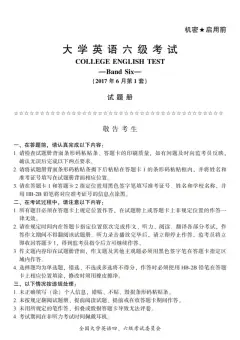
机密★启用前
大 学 英 语 六 级 考 试
COLLEGE ENGLISH TEST
—Band Six一
(2017年 12月第1套)
试 题 册
☆☆☆☆☆☆☆☆☆☆☆☆☆☆☆☆☆☆☆☆☆☆☆☆☆☆☆☆☆☆☆☆☆☆☆☆☆☆☆☆
敬 告 考 生
一、在答题前,请认真完成以下内容:
1 .请检查试题册背面条形码粘贴条、答题卡的印刷质量,如有问题及时向监考员反映,
确认无误后完成以下两点要求。
2 .请将试题册背面条形码粘贴条揭下后粘贴在答题卡1的条形码粘贴框内,并将姓名和
准考证号填写在试题册背面相应位置。
3 .请在答题卡1和答题卡2 指定位置用黑色签字笔填写准考证号、姓名和学校名称,并
用HB-2B铅笔将对应准考证号的信息点涂黑。
二、在考试过程中,请注意以下内容:
1 .所有题目必须在答题卡上规定位置作答,在试题册上或答题卡上非规定位置的作答一
律无效。
2 .请在规定时间内在答题卡指定位置依次完成作文、听力、阅读、翻译各部分考试,作
答作文期间不得翻阅该试题册。听力录音播放完毕后,请立即停止作答,监考员将立
即收回答题卡1 ,得到监考员指令后方可继续作答。
3 .作文题内容印在试题册背面,作文题及其他主观题必须用黑色签字笔在答题卡指定区
域内作答。
4 .选择题均为单选题,错选、不选或多选将不得分,作答时必须使用HB-2B铅笔在答题
卡上相应位置填涂,修改时须用橡皮擦净。
三、以下情况按违规处理:
1 .未正确填写(涂)个人信息,错贴、不贴、毁损条形码粘贴条。
2 .未按规定翻阅试题册、提前阅读试题、提前或在收答题卡期间作答。
3 .未用所规定的笔作答、折叠或毁损答题卡导致无法评卷。
4 .考试期间在非听力考试时间佩戴耳机。
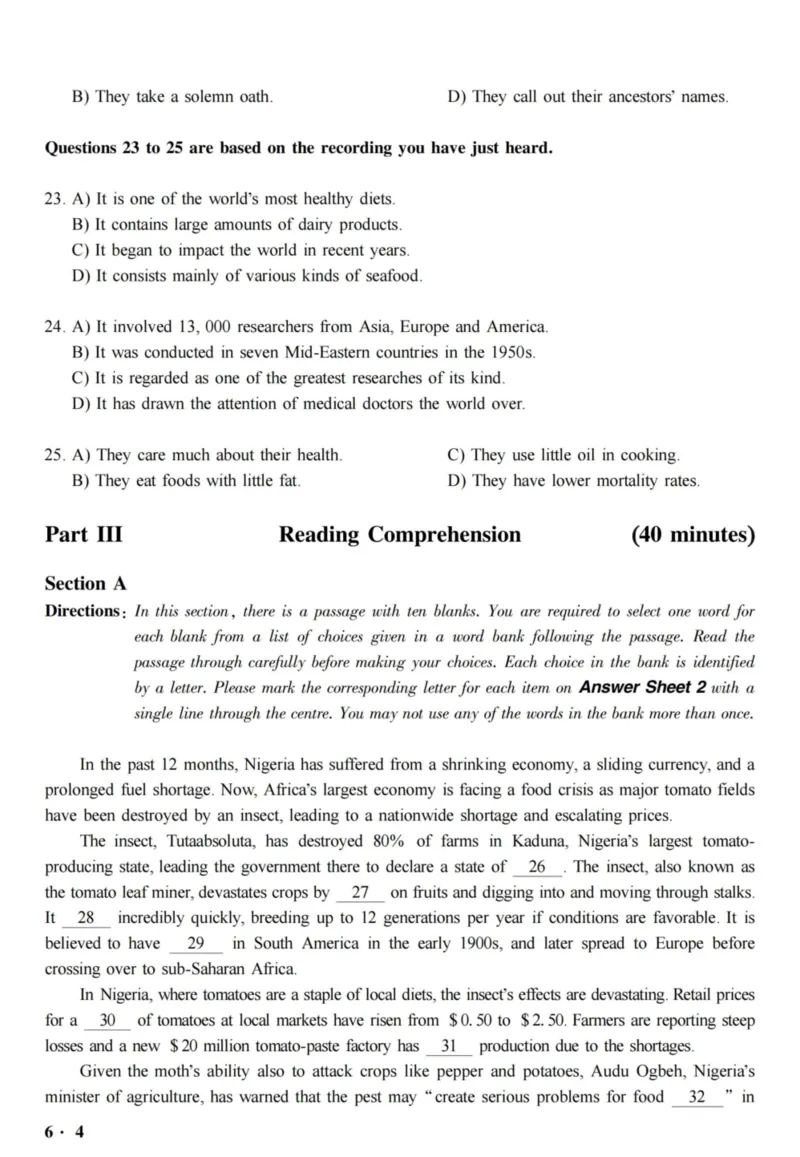
全国大学英语四、六级考试委员会Part II Listening Comprehension (30 minutes)
Section A
Directions : In this section, you will hear two long conversations. At the end of each conversation, you
will hear four questions. Both the conversation and the questions will be spoken only once.
After you hear a question, you must choose the best answer from the four choices marked A ) ,
B) , C)and D). Then mark the corresponding letter on Answer Sheet 1 with a single line
through the centre.
饕
Questions 1 to 4 are based on the conversation you have just heard.
扫码获音频
1. A) They reward businesses that eliminate food waste.
B) They prohibit the sale of foods that have gone stale.
C) They facilitate the donation of unsold foods to the needy.
D) They forbid businesses to produce more foods than needed.
2. A) It imposed penalties on businesses that waste food.
B) It passed a law aiming to stop overproduction.
C) It voted against food import from outside Europe.
D) It prohibited the promotion of bulk food sales.
3. A) It has warned its people against possible food shortages.
B) It has penalized businesses that keep overproducing foods.
C) It has started a nationwide campaign against food waste.
D) It has banned supermarkets from dumping edible foods.
4. A) The confusion over food expiration labels. C) Americans, habit of buying food in bulk.
B) The surplus resulting from overproduction. D) A lack of regulation on food consumption.
Questions 5 to 8 are based on the conversation you have just heard.
5. A) It has started a week-long promotion campaign.
B) It has just launched its annual anniversary sales.
C) It oflers regular weekend sales all the year round.
D) It specializes in the sale of ladies' designer dresses.
6. A) Price reductions for its frequent customers.
B) Coupons for customers with bulk purchases.
C) Free delivery of purchases for senior customers.
D) Price adjustments within seven days of purchase.
6 - 17. A) Mail a gift card to her. C) Credit it to her account.
B) Allow her to buy on credit. D) Give her some coupons.
8. A) Refunding for goods returned. C) Prolonged goods warranty.
B) Free installing of appliances. D) Complimentary tailoring.
Section B
Directions : In this section, you will hear two passages. At the end of each passage, you will hear three
or four questions. Both the passage and the questions will be spoken only once. After you
hear a question, you must choose the best answer from the four choices marked A) , B),
C} and D). Then mark the corresponding letter on Answer Sheet 1 with a single line
through the centre.
Questions 9 to 11 are based on the passage you have just heard.
9. A) They are thin, tall, and unlike real human beings.
B) They have more than twenty different hair textures.
C) They have twenty-four different body shapes in total.
D) They represent people from virtually all walks of life.
10. A) They do not reflect young girls' aspirations. C) Their flat feet do not appeal to adolescents.
B) They are not sold togetherw ith the original. D) Their body shapes have not changed much.
11. A) In toy stores. C) On the Internet.
B) In shopping malls. D) At Barbie shops.
Questions 12 to 15 are based on the passage you have just heard.
12. A) Moveable metal type began to be used in printing.
B) Chinese printing technology was first introduced.
C) The earliest known book was published.
D) Metal type was imported from Korea.
13. A) It had more than a hundred printing presses.
B) It was the biggest printer in the 16th century.
C) It helped the German people become literate.
D) It produced some 20 million volumes in total.
14. A) It pushed handwritten books out of circulation. C) It made writing a very profitable career.
B) It boosted the circulation of popular works. D) It provided readers with more choices.
6 • 215. A) It accelerated the extinction of the Latin language.
B) It standardized the publication of grammar books.
C) It turned translation into a welcome profession.
D) It promoted the growth of national languages.
Section C
Directions : In this section, you will hear three recordings of lectures or talks followed by three or four
questions. The recordings will be played only once. After you hear a question, you must
choose the best answer from the four choices marked A) , B ) , C) and D). Then mark the
corresponding letter on Answer Sheet 1 with a single line through the centre.
Questions 16 to 18 are based on the recording you have just heard.
16. A) They get bored after working fbr a period of time.
B) They spend an average of one year finding a job.
C) They become stuck in the same job fbr decades.
D) They choose a job without thinking it through.
17. A) See if there will be chances forp romotion. C) Watch a film about ways of job hunting.
B) Find out what job choices are available. D) Decide which job is most attractive to you.
18. A) The qualifications you have. C) The culture of your target company.
B) The pay you are going to get. D) The work environment you will be in.
Questions 19 to 22 are based on the recording you have just heard.
19. A) It is as important as Christmas fbr African-Americans.
B) It is a cultural festival founded for African-Americans.
C) It is an ancient festival celebrated by African-Americans.
D) It is a religious festival celebrated by African-Americans.
20. A) To urge African-Americans to do more for society.
B) To call on African-Americans to worship their gods.
C) To help African-Americans to realize their goals.
D) To remind African-Americans of their sufferings.
21. A) Faith in self-determination. C) Unity and cooperative economics.
B) The first fruits of the harvest. D) Creative work and achievement.
22. A) They recite a principle. C) They drink wine from the unity cup.
6 • 3B) They take a solemn oath. D) They call out their ancestors5 names.
Questions 23 to 25 are based on the recording you have just heard.
23. A) It is one of the world's most healthy diets.
B) It contains large amounts of dairy products.
C) It began to impact the world in recent years.
D) It consists mainly of various kinds of seafood.
24. A) It involved 13, 000 researchers from Asia, Europe and America.
B) It was conducted in seven Mid-Eastern countries in the 1950s.
C) It is regarded as one of the greatest researches of its kind.
D) It has drawn the attention of medical doctors the world over.
25. A) They care much about their health. C) They use little oil in cooking.
B) They eat foods with little fat. D) They have lower mortality rates.
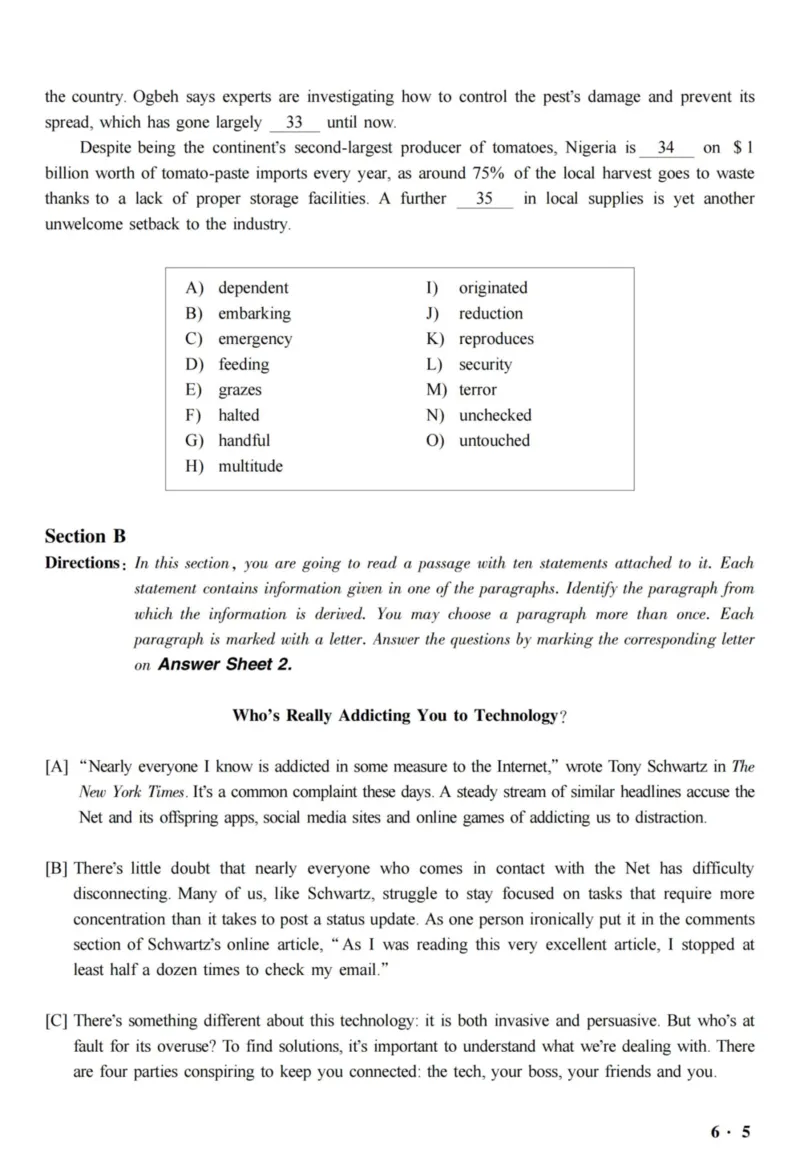
Part III Reading Comprehension (40 minutes)
Section A
Directions : In this section, there is a passage with ten blanks. You are required to select one word for
each blank from a list of choices given in a word bank following the passage. Read the
passage through carefully before making your choices. Each choice in the bank is identified
by a letter. Please mark the corresponding letter for each item on Answer Sheet 2 with a
single line through the centre. You may not use any of the words in the hank more than once.
In the past 12 months, Nigeria has suffered from a shrinking economy, a sliding currency, and a
prolonged fuel shortage. Now, Africa^ largest economy is facing a food crisis as major tomato fields
have been destroyed by an insect, leading to a nationwide shortage and escalating prices.
The insect, Tutaabsoluta, has destroyed 80% of farms in Kaduna, Nigeria's largest tomato
producing state, leading the government there to declare a state of 26 . The insect, also known as
the tomato leaf miner, devastates crops by 27 on fruits and digging into and moving through stalks.
It 28 incredibly quickly, breeding up to 12 generations per year if conditions are favorable. It is
believed to have 29 in South America in the early 1900s, and later spread to Europe before
crossing over to sub-Saharan Africa.
In Nigeria, where tomatoes are a staple of local diets, the insecfs effects are devastating. Retail prices
for a 30 of tomatoes at local markets have risen from $ 0. 50 to $ 2. 50. Farmers are reporting steep
losses and a new $ 20 million tomato-paste factory has 31 production due to the shortages.
Given the moth's ability also to attack crops like pepper and potatoes, Audu Ogbeh, Nigeria's
minister of agriculture, has warned that the pest may u create serious problems for food 32 in
6 , 4the country. Ogbeh says experts are investigating how to control the pesfs damage and prevent its
spread, which has gone largely 33 until now.
Despite being the continents second-largest producer of tomatoes, Nigeria is 34 on $ 1
billion worth of tomato-paste imports every year, as around 75% of the local harvest goes to waste
thanks to a lack of proper storage facilities. A further 35 in local supplies is yet another
unwelcome setback to the industry.
A) dependent I) originated
B) embarking J) reduction
C) emergency K) reproduces
D) feeding L) security
E) grazes M) terror
F) halted N) unchecked
G) handful 0) untouched
H) multitude
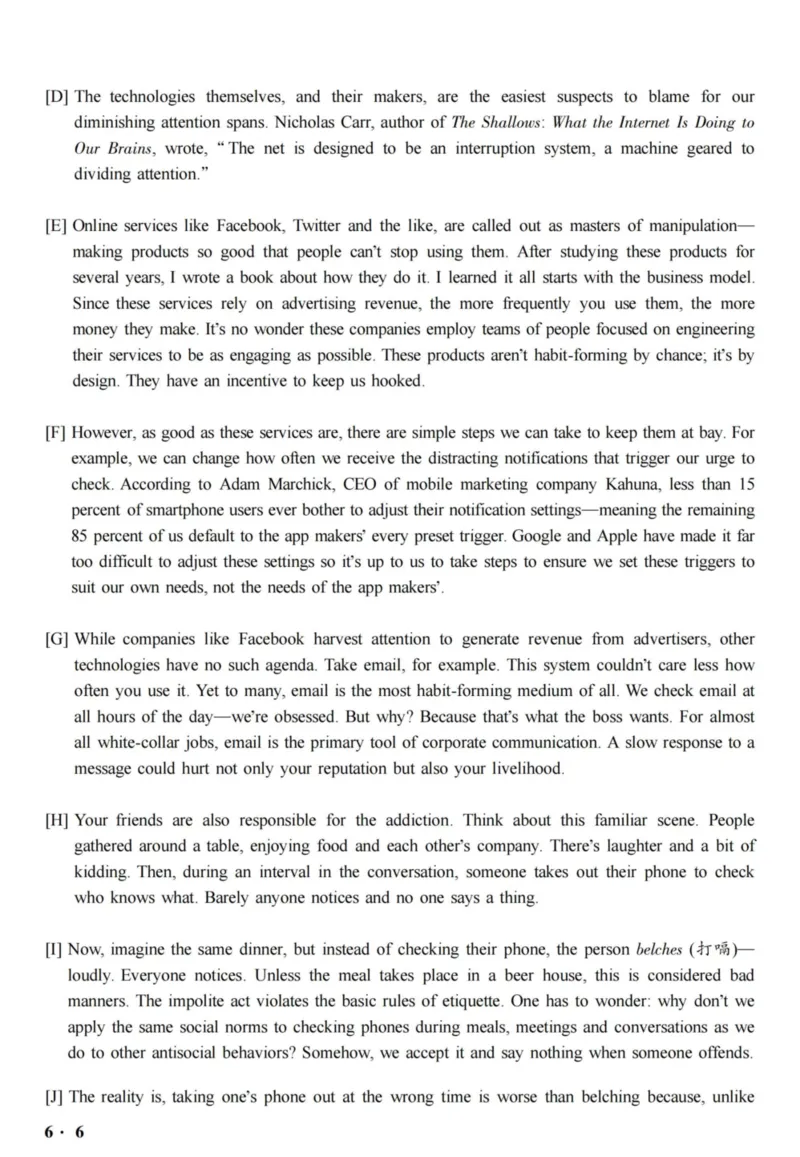
Section B
Directions : In this section, you are going to read a passage with ten statements attached to it. Each
statement contains information given in one of the paragraphs. Identify the paragraph from
which the information is derived. You may choose a paragraph more than once. Each
paragraph is marked with a letter. Answer the questions by marking the corresponding letter
on Answer Sheet 2.
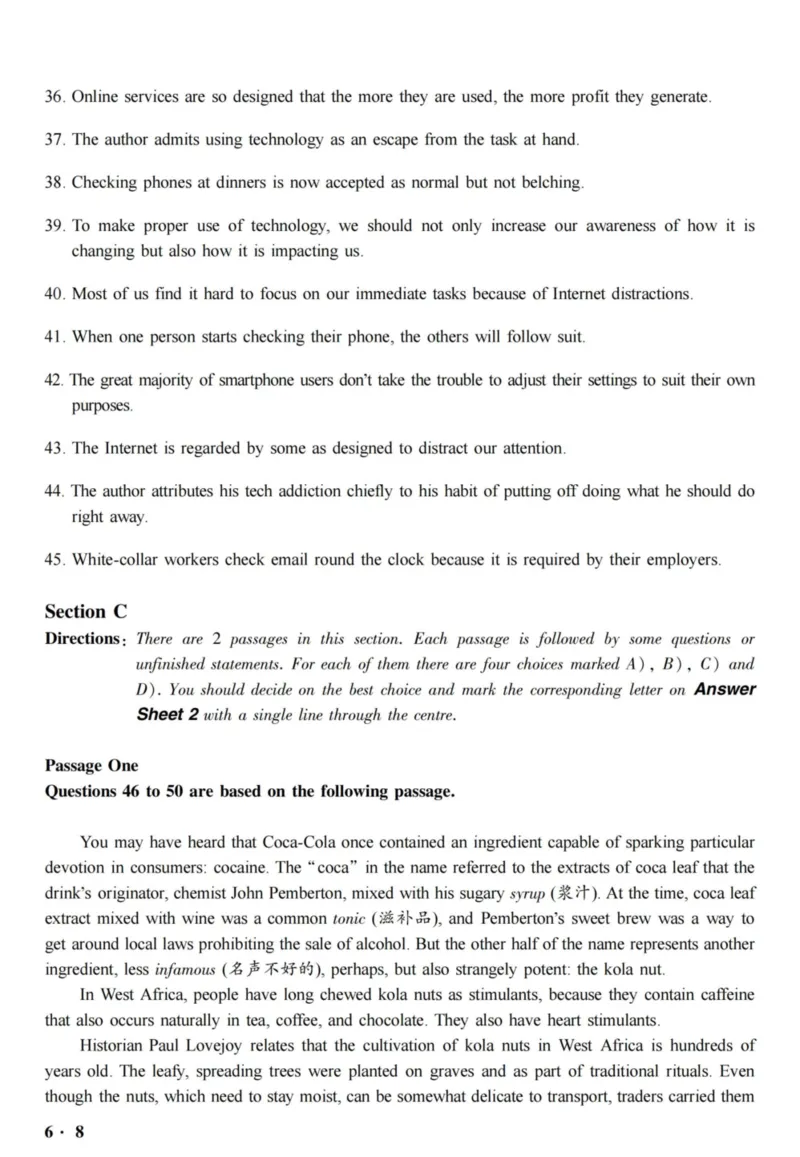
Who's Really Addicting You to Technology?
[A] uNearly everyone I know is addicted in some measure to the Internet/' wrote Tony Schwartz in The
New York Times. Ifs a common complaint these days. A steady stream of similar headlines accuse the
Net and its offspring apps, social media sites and online games of addicting us to distraction.
[B] There's little doubt that nearly everyone who comes in contact with the Net has difficulty
disconnecting. Many of us, like Schwartz, struggle to stay focused on tasks that require more
concentration than it takes to post a status update. As one person ironically put it in the comments
section of Schwartz's online article, “ As I was reading this very excellent article, I stopped at
least half a dozen times to check my email.n
[C] There's something different about this technology: it is both invasive and persuasive. But who's at
fault for its overuse? To find solutions, it's important to understand what we're dealing with. There
are four parties conspiring to keep you connected: the tech, your boss, your friends and you.
6 - 5[D] The technologies themselves, and their makers, are the easiest suspects to blame for our
diminishing attention spans. Nicholas Carr, author of The Shallows: What the Internet Is Doing to
Our Brains, wrote, “ The net is designed to be an interruption system, a machine geared to
dividing attention.n
[E] Online services like Facebook, Twitter and the like, are called out as masters of manipulation——
making products so good that people can't stop using them. After studying these products for
several years, I wrote a book about how they do it. I learned it all starts with the business model.
Since these services rely on advertising revenue, the more frequently you use them, the more
money they make. Ifs no wonder these companies employ teams of people focused on engineering
their services to be as engaging as possible. These products aren't habit-forming by chance; ifs by
design. They have an incentive to keep us hooked.
[F] However, as good as these services are, there are simple steps we can take to keep them at bay. For
example, we can change how often we receive the distracting notifications that trigger our urge to
check. According to Adam Marchick, CEO of mobile marketing company Kahuna, less than 15
percent of smartphone users ever bother to adjust their notification settings—meaning the remaining
85 percent of us default to the app makers' every preset trigger. Google and Apple have made it far
too difficult to adjust these settings so it's up to us to take steps to ensure we set these triggers to
suit our own needs, not the needs of the app makers5.
[G] While companies like Facebook harvest attention to generate revenue from advertisers, other
technologies have no such agenda. Take email, fbr example. This system couldn't care less how
often you use it. Yet to many, email is the most habit-forming medium of all. We check email at
all hours of the day- we're obsessed. But why? Because thafs what the boss wants. For almost
all white-collar jobs, email is the primary tool of corporate communication. A slow response to a
message could hurt not only your reputation but also your livelihood.
[H] Your friends are also responsible for the addiction. Think about this familiar scene. People
gathered around a table, enjoying food and each other's company. There's laughter and a bit of
kidding. Then, during an interval in the conversation, someone takes out their phone to check
who knows what. Barely anyone notices and no one says a thing.
[I] Now, imagine the same dinner, but instead of checking their phone, the person belches (打嗝)—
loudly. Everyone notices. Unless the meal takes place in a beer house, this is considered bad
manners. The impolite act violates the basic rules of etiquette. One has to wonder: why don't we
apply the same social norms to checking phones during meals, meetings and conversations as we
do to other antisocial behaviors? Somehow, we accept it and say nothing when someone offends.
[J] The reality is, taking one's phone out at the wrong time is worse than belching because, unlike
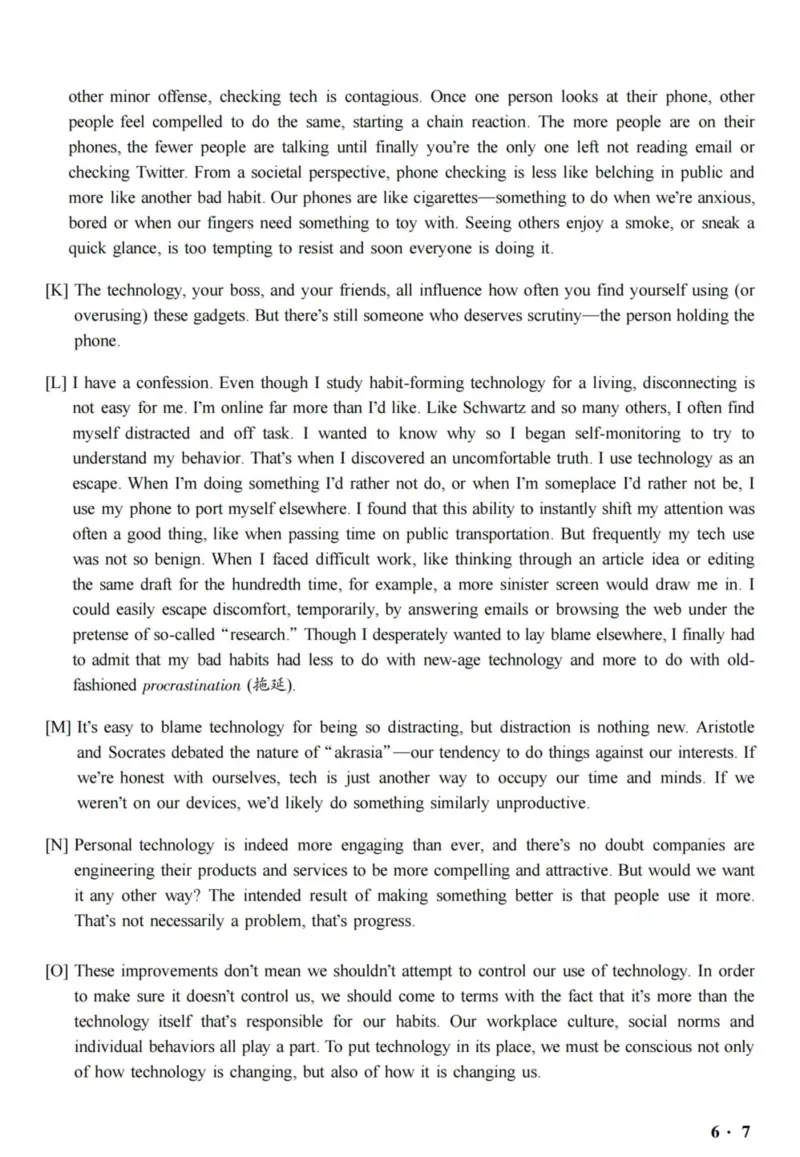
6 • 6other minor offense, checking tech is contagious. Once one person looks at their phone, other
people feel compelled to do the same, starting a chain reaction. The more people are on their
phones, the fewer people are talking until finally you're the only one left not reading email or
checking Twitter. From a societal perspective, phone checking is less like belching in public and
more like another bad habit. Our phones are like cigarettes——something to do when we're anxious,
bored or when our fingers need something to toy with. Seeing others enjoy a smoke, or sneak a
quick glance, is too tempting to resist and soon everyone is doing it.
[K] The technology, your boss, and your friends, all influence how often you find yourself using (or
overusing) these gadgets. But there's still someone who deserves scrutiny- the person holding the
phone.
[L] I have a confession. Even though I study habit-forming technology for a living, disconnecting is
not easy for me. I'm online far more than I'd like. Like Schwartz and so many others, I often find
myself distracted and off task. I wanted to know why so I began self-monitoring to try to
understand my behavior. Thafs when I discovered an uncomfortable truth. I use technology as an
escape. When I'm doing something I'd rather not do, or when I'm someplace I'd rather not be, I
use my phone to port myself elsewhere. I found that this ability to instantly shift my attention was
often a good thing, like when passing time on public transportation. But frequently my tech use
was not so benign. When I faced difficult work, like thinking through an article idea or editing
the same draft for the hundredth time, for example, a more sinister screen would draw me in. I
could easily escape discomfort, temporarily, by answering emails or browsing the web under the
pretense of so-called “research." Though I desperately wanted to lay blame elsewhere, I finally had
to admit that my bad habits had less to do with new-age technology and more to do with old-
fashioned procrastination (拖延).
[M] Ifs easy to blame technology for being so distracting, but distraction is nothing new. Aristotle
and Socrates debated the nature of “akrasia”- our tendency to do things against our interests. If
we're honest with ourselves, tech is just another way to occupy our time and minds. If we
weren't on our devices, we'd likely do something similarly unproductive.
[N] Personal technology is indeed more engaging than ever, and there's no doubt companies are
engineering their products and services to be more compelling and attractive. But would we want
it any other way? The intended result of making something better is that people use it more.
Thafs not necessarily a problem, thafs progress.
[O] These improvements don't mean we shouldn't attempt to control our use of technology. In order
to make sure it doesn't control us, we should come to terms with the fact that it's more than the
technology itself thafs responsible for our habits. Our workplace culture, social norms and
individual behaviors all play a part. To put technology in its place, we must be conscious not only
of how technology is changing, but also of how it is changing us.
6 ・ 736. Online services are so designed that the more they are used, the more profit they generate.
37. The author admits using technology as an escape from the task at hand.
38. Checking phones at dinners is now accepted as normal but not belching.
39. To make proper use of technology, we should not only increase our awareness of how it is
changing but also how it is impacting us.
40. Most of us find it hard to focus on our immediate tasks because of Internet distractions.
41. When one person starts checking their phone, the others will follow suit.
42. The great majority of smartphone users don't take the trouble to adjust their settings to suit their own
purposes.
43. The Internet is regarded by some as designed to distract our attention.
44. The author attributes his tech addiction chiefly to his habit of putting off doing what he should do
right away.
45. White-collar workers check email round the clock because it is required by their employers.
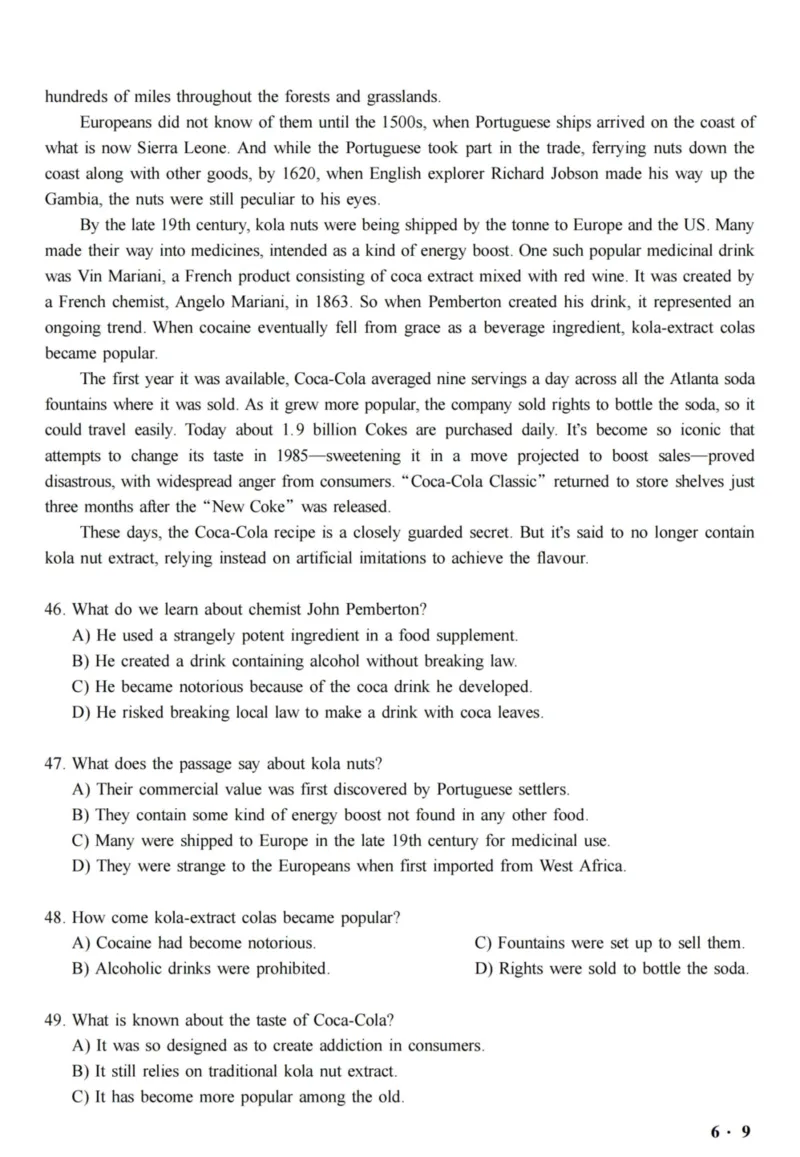
Section C
Directions : There are 2 passages in this section. Each passage is followed by some questions or
unfinished statements. For each of them there are four choices marked A ) , B ) , C) and
D). You should decide on the best choice and mark the corresponding letter on Answer
Sheet 2 with a single line through the centre.
Passage One
Questions 46 to 50 are based on the following passage.
You may have heard that Coca-Cola once contained an ingredient capable of sparking particular
devotion in consumers: cocaine. The "coca" in the name referred to the extracts of coca leaf that the
drink's originator, chemist John Pemberton, mixed with his sugary syrup (浆汁).At the time, coca leaf
extract mixed with wine was a common tonic (滋未卜品),and Pemberton's sweet brew was a way to
get around local laws prohibiting the sale of alcohol. But the other half of the name represents another
ingredient, less infamous (名声不好的),perhaps, but also strangely potent: the kola nut.
In West Africa, people have long chewed kola nuts as stimulants, because they contain caffeine
that also occurs naturally in tea, coffee, and chocolate. They also have heart stimulants.
Historian Paul Lovejoy relates that the cultivation of kola nuts in West Africa is hundreds of
years old. The leafy, spreading trees were planted on graves and as part of traditional rituals. Even
though the nuts, which need to stay moist, can be somewhat delicate to transport, traders carried them
6 - 8hundreds of miles throughout the forests and grasslands.
Europeans did not know of them until the 1500s, when Portuguese ships arrived on the coast of
what is now Sierra Leone. And while the Portuguese took part in the trade, ferrying nuts down the
coast along with other goods, by 1620, when English explorer Richard Jobson made his way up the
Gambia, the nuts were still peculiar to his eyes.
By the late 19th century, kola nuts were being shipped by the tonne to Europe and the US. Many
made their way into medicines, intended as a kind of energy boost. One such popular medicinal drink
was Vin Mariani, a French product consisting of coca extract mixed with red wine. It was created by
a French chemist, Angelo Mariani, in 1863. So when Pemberton created his drink, it represented an
ongoing trend. When cocaine eventually fell from grace as a beverage ingredient, kola-extract colas
became popular.
The first year it was available, Coca-Cola averaged nine servings a day across all the Atlanta soda
fountains where it was sold. As it grew more popular, the company sold rights to bottle the soda, so it
could travel easily. Today about 1.9 billion Cokes are purchased daily. Ifs become so iconic that
attempts to change its taste in 1985—sweetening it in a move projected to boost sales―proved
disastrous, with widespread anger from consumers. 41 Coca-Cola Classic5, returned to store shelves just
three months after the “New Coke“ was released.
These days, the Coca-Cola recipe is a closely guarded secret. But it's said to no longer contain
kola nut extract, relying instead on artificial imitations to achieve the flavour.
46. What do we learn about chemist John Pemberton?
A) He used a strangely potent ingredient in a food supplement.
B) He created a drink containing alcohol without breaking law.
C) He became notorious because of the coca drink he developed.
D) He risked breaking local law to make a drink with coca leaves.
47. What does the passage say about kola nuts?
A) Their commercial value was first discovered by Portuguese settlers.
B) They contain some kind of energy boost not found in any other food.
C) Many were shipped to Europe in the late 19th century for medicinal use.
D) They were strange to the Europeans when first imported from West Africa.
48. How come kola-extract colas became popular?
A) Cocaine had become notorious. C) Fountains were set up to sell them.
B) Alcoholic drinks were prohibited. D) Rights were sold to bottle the soda.
49. What is known about the taste of Coca-Cola?
A) It was so designed as to create addiction in consumers.
B) It still relies on traditional kola nut extract.
C) It has become more popular among the old.
6 - 9D) It has remained virtually unchanged since its creation.
50. What is the passage mainly about?
A) The evolution of Coca-Cola. C) The medicinal value of Coca-Cola.
B) The success story of Coca-Cola. D) The business strategy of Coca-Cola.
Passage Two
Questions 51 to 55 are based on the following passage.
Twenty years ago, the Urban Land Institute defined the two types of cities that dominated the US
landscape: smaller cities that operated around standard 9-5 business hours and large metropolitan
areas that ran all 24 hours of the day. Analyzing and comparing cities using the lens of this basic
divide gives interesting context to how investment capital flows and housing prices have shifted.
In recent years, many mid-sized cities have begun to adopt a middle-of-the-road approach
incorporating the excitement and opportunity of large cities with small cities, quiet after midnight. These
18-hour cities are beginning to make waves in real estate rankings and attract more real estate investment.
What is underlying this new movement in real estate, and why do these cities have so much appeal?
18-hour cities combine the best of 24-hour and 9-5 cities, which contributes to downtown
revitalization. For decades, many downtown cores in small to mid-sized cities were abandoned after work
hours by workers who lived in the suburbs. Movement out of city centers was widespread, and downtown
tenants were predominantly made up of the working poor. This generated little commerce for downtown
businesses in the evenings, which made business and generating tax revenue fbr municipal upkeep difficult.
With the rise of a new concept in urban planning that aims to make life easier and more convenient,
however, increasing popularity for urban areas that caused the real estate pushes, in major cities like San
Francisco or New York, has inspired a type of forward thinking urbanity and policy in smaller cities.
Transforming downtown areas so that they incorporate modern housing and improved
walkability to local restaurants, retail, and entertainment- especially when combined with improved
infrastructure fbr cyclists and public transit- makes them appeal to a more affluent demographic.
These adjustments encourage employers in the knowledge and talent industries to keep their offices
downtown. Access to foot traffic and proximity to transit allow the type of entertainment-oriented
businesses such as bars and restaurants to stay open later, which attracts both younger, creative
workers and baby boomers nearing retirement alike. Because of their smaller size, most keep hours
that allow people to enjoy themselves, then have some quiet after midnight, as opposed to large major
cities like New York, where the buzz of activity is ongoing.
These 18-hour cities are rapidly on the rise and offer great opportunities for homeowner
investment. In many of these cities such as Denver, a diverse and vigorous economy attracted to the
urban core has offered stable employment for residents. The right urban mix has propped up home
occupancy, increased property values, and attracted significant investment capital.
6 - 1051. What do we learn about American cities twenty years ago?
A) They were divided into residential and business areas.
B) Their housing prices were linked with their prosperity.
C) There was a clear divide between large and small cities.
D) They were places where large investment capital flowed.
52. What can be inferred from the passage about 18-hour cities?
A) They especially appeal to small businesses. C) They have replaced quiet with excitement.
B) They have seen a rise in property prices. D) They have changed America's landscape.
53. Years ago, many downtown cores in small to mid-sized c i t i e s .
A) had hardly any business activity C) exhibited no signs of prosperity
B) were crowded in business hours D) looked deserted in the evenings
54. What characterizes the new downtown areas in 18-hour cities?
A) A sudden emergence of the knowledge industry.
B) Flooding in of large crowds of migrant workers.
C) Modernized housing and improved infrastructure.
D) More comfortable life and greater upward mobility.
55. What have 18-hour cities brought to the local residents?
A) More chances for promotion. C) Greater cultural diversity.
B) Healthier living environment. D) Better job opportunities.
Part IV Translation (30 minutes)
Directions : For this part, you are allowed 30 minutes to translate a passage from Chinese into English.
You should write your answer on Answer Sheet 2.
太湖是中国东部的一个淡水湖,占地面积2250平方公里,是中国第三大淡水湖,仅次于鄱
阳和洞庭。太湖约有90个岛屿,大小从几平方米到几平方公里不等。太湖以其独特的“太湖
石”而闻名,太湖石常用于装饰中国传统园林。太湖也以高产的捕鱼业闻名。自上世纪70年代
后期以来,捕捞鱼蟹对沿湖的居民来说极为重要,并对周边地区的经济作出了重大贡献。太湖
地区是中国随官(ceramics)业基地之一,其中宜兴的陶瓷厂家生产举世闻名的宜兴紫砂壶
(clay teapot)
o
6 • 11未得到监考教师指令前,不得翻阅该试题册!
Part I Writing (30 minutes)
(请于正式开考后半小时内完成该部分,之后将进行听力考试)
Directions : For this part, you are allowed 30 minutes to write an essay commenting on the saying
u Respect others, and you will be respected. " You can cite examples to illustrate
your views. You should write at least 150 words but no more than 200 words.
请用黑色签字笔在答题卡1指定区域内作答作文题,在试题册上的作答无效!
请认真填写以下信息:
准考证号:
姓 名:_
错填、未填以上信息,按违规处理!机密★启用前
大 学 英 语 六 级 考 试
COLLEGE ENGLISH TEST
—Band Six一
(2017年 12月第2套)
试 题 册
☆☆☆☆☆☆☆☆☆☆☆☆☆☆☆☆☆☆☆☆☆☆☆☆☆☆☆☆☆☆☆☆☆☆☆☆☆☆☆☆
敬 告 考 生
一、在答题前,请认真完成以下内容:
1 .请检查试题册背面条形码粘贴条、答题卡的印刷质量,如有问题及时向监考员反映,
确认无误后完成以下两点要求。
2 .请将试题册背面条形码粘贴条揭下后粘贴在答题卡1的条形码粘贴框内,并将姓名和
准考证号填写在试题册背面相应位置。
3 .请在答题卡1和答题卡2 指定位置用黑色签字笔填写准考证号、姓名和学校名称,并
用HB-2B铅笔将对应准考证号的信息点涂黑。
二、在考试过程中,请注意以下内容:
1 .所有题目必须在答题卡上规定位置作答,在试题册上或答题卡上非规定位置的作答一
律无效。
2 .请在规定时间内在答题卡指定位置依次完成作文、听力、阅读、翻译各部分考试,作
答作文期间不得翻阅该试题册。听力录音播放完毕后,请立即停止作答,监考员将立
即收回答题卡1 ,得到监考员指令后方可继续作答。
3 .作文题内容印在试题册背面,作文题及其他主观题必须用黑色签字笔在答题卡指定区
域内作答。
4 .选择题均为单选题,错选、不选或多选将不得分,作答时必须使用HB-2B铅笔在答题
卡上相应位置填涂,修改时须用橡皮擦净。
三、以下情况按违规处理:
1 .未正确填写(涂)个人信息,错贴、不贴、毁损条形码粘贴条。
2 .未按规定翻阅试题册、提前阅读试题、提前或在收答题卡期间作答。
3 .未用所规定的笔作答、折叠或毁损答题卡导致无法评卷。
4 .考试期间在非听力考试时间佩戴耳机。
全国大学英语四、六级考试委员会Part II Listening Comprehension (30 minutes)
Section A
Directions : In this section, you will hear two long conversations. At the end of each conversation, you
will hear four questions. Both the conversation and the questions will be spoken only once.
After you hear a question, you must choose the best answer from the four choices marked A ),
B) , C) and D). Then mark the corresponding letter on Answer Sheet 1 with a single line
through the centre.
Questions 1 to 4 are based on the conversation you have just heard.
扫码获音频
1. A) Say a few words to thank the speaker. C) Give a lecture on the history of the town.
B) Introduce the speaker to the audience. D) Host a talk on how to give a good speech.
2. A) He was the founder of the local history society.
B) He has worked with Miss Bligh for 20 years.
C) He has published a book on public speaking.
D) He joined the local history society when young.
3. A) She was obviously better at talking than writing.
B) She had a good knowledge of the town's history.
C) Her speech was so funny as to amuse the audience.
D) Her ancestors came to the town in the 18th century.
4. A) He read exactly what was written in his notes. C) He made an embarrassing remark.
B) He kept forgetting what he was going to say. D) He was too nervous to speak up.
Questions 5 to 8 are based on the conversation you have just heard.
5. A) What their retailers demand. C) How they are going to beat their rivals.
B) What their rivals are doing. D) How dramatically the market is changing.
6. A) They should be taken seriously. C) Their business strategy is quite effective.
B) They are rapidly catching up. D) Their potential has been underestimated.
7. A) She had given it to Tom. C) She had not seen it yet.
B) It simply made her go frantic. D) It was not much of a big concern.
8. A) Restructuring the whole company. C) Promoting cooperation with Jayal Motors.
B) Employing more forwarding agents. D) Exporting their motorbikes to Indonesia.
6 • 1Section B
Directions : In this section, you will hear two passages. At the end of each passage, you will hear three or
four questions. Both the passage and the questions will be spoken only once. After you hear a
question, you must choose the best answer from the four choices marked A) , B) , C) and D).
Then mark the corresponding letter on Answer Sheet 1 with a single line through the centre.
Questions 9 to 11 are based on the passage you have just heard.
9. A) It makes claims in conflict with the existing research.
B) It focuses on the link between bedtime and nutrition.
C) It cautions against the overuse of coffee and alcohol.
D) It shows that “ night owls“ work much less efficiently.
10. A) They pay greater attention to food choice. C) They run a higher risk of gaining weight.
B) They tend to achieve less than their peers. D) They stand a greater chance to fall sick.
11. A) Get up late. C) Exercise more.
B) Sleep 8 hours a day. D) Go to bed earlier.
Questions 12 to 15 are based on the passage you have just heard.
12. A) All of the acting nominees are white. C) It is prejudiced against foreign films.
B) It has got too much publicity on TV. D) Only 7% of the nominees are female.
13. A) 22 percent of movie directors were people of color.
B) Half of the TV programs were ethnically balanced.
C) Only one-fifth of TV shows had black characters.
D) Only 3.4 percent of film directors were women.
14. A) Non-white males. C) Females of color over 40.
B) Program creators. D) Asian speaking characters.
15. A) They constitute 17% of Hollywood movie characters.
B) They are most underrepresented across TV and film.
C) They contribute little to the U.S. film industry.
D) They account for 8.5% of the U.S. population.
Section C
Directions : In this section, you will hear three recordings of lectures or talks followed by three or four
questions. The recordings will be played only once. After you hear a question, you must
6 • 2choose the best answer from the four choices marked A) , B) , C) and D). Then mark the
corresponding letter on Answer Sheet 1 with a single line through the centre.
Questions 16 to 18 are based on the recording you have just heard.
16. A) One that can provide for emergency needs.
B) One that can pay for their medical expenses.
C) One that covers their debts and burial expenses.
D) One that ensures a healthy life for their later years.
17. A) Purchase insurance fbr their children. C) Buy a home with a small down payment.
B) Save sufficient money for a rainy day. D) Add more insurance on the breadwinner.
18. A) When their children grow up and leave home.
B) When they have saved enough fbr retirement.
C) When their family move to a different place.
D) When they have found better-paying jobs.
Questions 19 to 22 are based on the recording you have just heard.
19. A) They do more harm than good. C) They do not help build friendship.
B) They have often been ignored. D) They may not always be negative.
20. A) Biased sources of information. C) Misinterpretation of Shakespeare.
B) Ignorance of cultural differences. D) Tendency to jump to conclusions.
21. A) They are hard to dismiss once attached to a certain group.
B) They may have a negative impact on people they apply to.
C) They persist even when circumstances have changed.
D) They are often applied to minorities and ethnic people.
22. A) They impact people more or less in the same way.
B) Some people are more sensitive to them than others.
C) A positive stereotype may help one achieve better results.
D) A negative stereotype sticks while a positive one does not.
Questions 23 to 25 are based on the recording you have just heard.
23. A) Use some over-the-counter medicine instead.
B) Quit taking the medicine immediately.
6 • 3C) Take some drug to relieve the side effect.
D) Ask your pharmacist to explain why it occurs.
24. A) It may help patients fall asleep. C) It may cause serious harm to one's liver.
B) It may lead to mental problems. D) It may increase the effect of certain drugs.
25. A) Tell their children to treat medicines with respect.
B) Keep medicines out of the reach of their children.
C) Make sure their children use quality medicines.
D) Ask their children to use legitimate medicines.
Part III Reading Comprehension (40 minutes)
Section A
Directions : In this section, there is a passage with ten blanks. You are required to select one word for
each blank from a list of choices given in a word bank following the passage. Read the
passage through carefully before making your choices. Each choice in the bank is identified
by a letter. Please mark the corresponding letter for each item on Answer Sheet 2 with a
single line through the centre. You may not use any of the words in the hank more than once.
The Pacific island nation of Palau has become home to the sixth largest marine sanctuary in the
world. The new marine reserve, now the largest in the Pacific, will 26 no fishing or mining. Palau
also established the world's first shark sanctuary in 2009.
The tiny island nation has set aside 500,000 square kilometres —— 80 percent —— of its maritime
27 , for full protection. Thafs the highest percentage of an 28 economic zone devoted to
marine conservation by any country in the world. The remaining 20 percent of the Palau seas will be
reserved for local fishing by individuals and small-scale 29 fishing businesses with limited
exports.
u Island 30 have been among the hardest hit by the threats facing the ocean," said President
Tommy Remengesau Jr. in a statement. u Creating this sanctuary is a bold move that the people of Palau
recognise as 31 to our survival. We want to lead the way in restoring the health of the ocean for
future generations.
Palau has only been an 32 nation for twenty years and has a strong history of environmental
protection. It is home to one of the world's finest marine ecosystems, with more than 1,300 species of
fish and 700 species of coral.
Senator Hokkons Baules, lead 33 of the Palau National Marine Sanctuary Act, said the
sanctuary will “ help build a 34 future for the Palauan people by honoring the conservation
traditions of our past". These include the centuries-old custom of "bul", where leaders would call a
temporary stop to fishing for key species in order to give fish 35 an opportunity to replenish(补Q.
6 • 4A) allocate I) permit
B) celebrities J) secure
C) commercial K) solitary
D) communities L) spectacle
E) essential M) sponsor
F) exclusive N) stocks
G) independent 0) territory
H) indulge
Section B
Directions : In this section, you are going to read a passage with ten statements attached to it. Each
statement contains information given in one of the paragraphs. Identify the paragraph from
which the information is derived. You may choose a paragraph more than once. Each
paragraph is marked with a letter. Answer the questions by marking the corresponding letter
on Answer Sheet 2.
Data sharing : An open mind on open data
[A] It is a movement building steady momentum: a call to make research data, software code and
experimental methods publicly available and transparent. A spirit of openness is gaining
acceptance in the science community, and is the only way, say advocates, to address a ' crisis' in
science whereby too few findings are successfully reproduced. Furthermore, they say, it is the
best way for researchers to gather the range of observations that are necessary to speed up
discoveries or to identify large-scale trends.
[B] The open-data shift poses a confusing problem for junior researchers. On the one hand, the drive
to share is gathering official steam. Since 2013, global scientific bodies have begun to back
policies that support increased public access to research. On the other hand, scientists disagree
about how much and when they should share data, and they debate whether sharing it is more
likely to accelerate science and make it more robust, or to introduce vulnerabilities and problems.
As more journals and funders adopt data-sharing requirements, and as a growing number of
enthusiasts call for more openness, junior researchers must find their place between adopters and
those who continue to hold out, even as they strive to launch their own careers.
[C] One key challenge facing young scientists is how to be open without becoming scientifically
vulnerable. They must determine the risk of jeopardizing a job offer or a collaboration proposal
from those who are wary of - or unfamiliar with - open science. And they must learn how to
capitalize on the movemenfs benefits, such as opportunities for more citations and a way to build a
reputation without the need for conventional metrics, such as publication in high-impact journals.
6 - 5[D] Some fields have embraced open data more than others. Researchers in psychology, a field rocked
by findings of irreproducibility in the past few years, have been especially vocal supporters of the
drive for more-open science. A few psychology journals have created incentives to increase
interest in reproducible science - for example, by affixing an ' open-data' badge to articles that
clearly state where data are available. According to social psychologist Brian Nosek, executive
director of the Center fbr Open Science, the average data-sharing rate for the journal
Psychological Science, which uses the badges, increased tenfold to 38% from 2013 to 2015.
[E] Funders, too, are increasingly adopting an open-data policy. Several strongly encourage, and some
require, a data-management plan that makes data available. The US National Science Foundation
is among these. Some philanthropic (慈善的)funders, including the Bill & Melinda Gates
Foundation in Seattle, Washington, and the Wellcome Trust in London, also mandate open data
from their grant recipients.
[F] But many young researchers, especially those who have not been mentored in open science, are
uncertain about whether to share or to stay private. Graduate students and postdocs, who often are
working on their lab head's grant, may have no choice if their supervisor or another senior
colleague opposes sharing.
[G] Some fear that the potential impact of sharing is too high, especially at the early stages of a
career. u Everybody has a scary story about someone getting scooped (被抢先)," says New York
University astronomer David Hogg. Those fears may be a factor in a lingering hesitation to share
data even when publishing in journals that mandate it.
[H] Researchers at small labs or at insitutions focused on teaching arguably have the most to lose
when sharing hard-won data. "With my institution and teaching load, I don't have postdocs and
grad students," says Terry McGlynn, a tropical biologist at California State University,
Dominguez Hills. "The stakes are higher fbr me to share data because ifs a bigger fraction of
whafs happening in my lab."
[I] Researchers also point to the time sink that is involved in preparing data for others to view. Once
the data and associated materials appear in a repository (存储库),answering questions and
handling complaints can take many hours.
[J] The time investment can present other problems. In some cases, says data scientist Karthik Ram, it
may be difficult for junior researchers to embrace openness when senior colleagues - many of
whom head selection and promotion committees - might ridicule what they may view as
misplaced energies. uFve heard this recently - that embracing the idea of open data and code
makes traditional academics uncomfortable,v says Ram. " The concern seems to be that open
advocates don't spend their time being as productive as possible."
6 • 6[K] An open-science stance can also add complexity to a collaboration. Kate Ratliff, who studies
social attitudes at the University of Florida, Gainesville, says that it can seem as if there are two
camps in a field — those who care about open science and those who don't. "There's a new area
to navigate — ' Are you cool with the fact that ril want to make the data open?) 一 when
talking with somebody about an interesting research idea,“ she says.
[L] Despite complications and concerns, the upsides of sharing can be significant. For example, when
information is uploaded to a repository, a digital object identifier (DOI) is assigned. Scientists can
use a DOI to publish each step of the research life cycle, not just the final paper. In so doing, they
can potentially get three citations — one each for the data and software, in addition to the paper
itself. And although some say that citations fbr software or data have little currency in academia,
they can have other benefits.
[M] Many advocates think that transparent data procedures with a date and time stamp will protect
scientists from being scooped. "This is the sweet spot between sharing and getting credit for it,
while discouraging plagiarism (票J 窃) says Ivo Grigorov, a project coordinator at the National
Institute of Aquatic Resources Research Secretariat in Charlottenlund, Denmark. Hogg says that
scooping is less of a problem than many think. uThe two cases I'm familiar with didn't involve
open data or code,“ he says.
[N] Open science also offers junior researchers the chance to level the playing field by gaining better
access to crucial data. Ross Mounce, a postdoc studying evolutionary biology at the University of
Cambridge, UK, is a vocal champion of open science, partly because his fossil-based research
depends on access to others5 data. He says that more openness in science could help to discourage
what some perceive as a common practice of shutting out early-career scientists, requests for data.
[O] Communication also helps for those who worry about jeopardizing a collaboration, he says.
Concerns about open science should be discussed at the outset of a study. " Whenever you start a
project with someone, you have to establish a clear understanding of expectations for who owns
the data, at what point they go public and who can do what with them," he says.
[P] In the end, sharing data, software and materials with colleagues can help an early-career
researcher to gain recognition — a crucial component of success. 41 The thing you are searching
fbr is reputation," says Titus Brown, a genomics (基因组学)researcher at the University of
California, Davis. " To get grants and jobs, you have to be relevant and achieve some level of
public recognition. Anything you do that advances your presence - especially in a larger sphere,
outside the communities you know - is a net win."
36. Astronomer David Hogg doesn't think scooping is as serious a problem as generally thought.
6 - 737. Some researchers are hesitant to make their data public for fear that others might publish
something similar before them.
38. Some psychology journals have offered incentives to encourage authors to share their data.
39. There is a growing demand in the science community that research data be open to the public.
40. Sharing data offers early-career researchers the chance to build a certain level of reputation.
41. Data sharing enables scientists to publish each step of their research work, thus leading to more
citations.
42. Scientists hold different opinions about the extent and timing of data sharing.
43. Potential problems related to data sharing should be made known to and discussed by all
participants at the beginning of a joint research project.
44. Sharing data and handling data-related issues can be time-consuming.
45. Junior researchers may have no say when it comes to sharing data.
Section C
Directions : There are 2 passages in this section. Each passage is followed by some questions or
unfinished statements. For each of them there are four choices marked A ) , B ) , C) and
D). You should decide on the best choice and mark the corresponding letter on Answer
Sheet 2 with a single line through the centre.
Passage One
Questions 46 to 50 are based on the following passage.
In the beginning of the movie /, Robot, a robot has to decide whom to save after two cars plunge
into the water- Del Spooner or a child. Even though Spooner screams uSave her! Save her!” the robot
rescues him because it calculates that he has a 45 percent chance of survival compared to Sarah's 11
percent. The robofs decision and its calculated approach raise an important question: would humans
make the same choice? And which choice would we want our robotic counterparts to make?
Isaac Asimov evaded the whole notion of morality in devising his three laws of robotics, which
hold that 1. Robots cannot harm humans or allow humans to come to harm; 2. Robots must obey
humans, except where the order would conflict with law 1; and 3. Robots must act in self
preservation, unless doing so conflicts with laws 1 or 2. These laws are programmed into Asimov's
robots- they don't have to think, judge, or value. They don't have to like humans or believe that
6 • 8hurting them is wrong or bad. They simply don't do it.
The robot who rescues Spoonefs life in I, Robot follows Asimov's zeroth law: robots cannot harm
humanity (as opposed to individual humans) or allow humanity to come to harm- an expansion of the
first law that allows robots to determine whafs in the greater good. Under the first law, a robot could
not harm a dangerous gunman, but under the zeroth law, a robot could kill the gunman to save others.
Whether ifs possible to program a robot with safeguards such as Asimov's laws is debatable. A
word such as "harm" is vague (what about emotional harm? Is replacing a human employee harm?),
and abstract concepts present coding problems. The robots in Asimov's fiction expose complications
and loopholes in the three laws, and even when the laws work, robots still have to assess situations.
Assessing situations can be complicated. A robot has to identify the players, conditions, and
possible outcomes for various scenarios. It's doubtful that a computer program can do that- at least,
not without some undesirable results. A roboticist at the Bristol Robotics Laboratory programmed a
robot to save human proxies (替身)called "H-bots" from danger. When one H-bot headed fbr
danger, the robot successfully pushed it out of the way. But when two H-bots became imperiled, the
robot choked 42 percent of the time, unable to decide which to save and letting them both "die." The
experiment highlights the importance of morality: without it, how can a robot decide whom to save or
what's best for humanity, especially if it can't calculate survival odds?
46. What question does the example in the movie raise?
A) Whether robots can reach better decisions. C) How robots may make bad judgments.
B) Whether robots follow Asimov's zeroth law. D) How robots should be programmed.
47. What does the author think of Asimov's three laws of robotics?
A) They are apparently divorced from reality.
B) They did not follow the coding system of robotics.
C) They laid a solid foundation fbr robotics.
D) They did not take moral issues into consideration.
48. What does the author say about Asimov's robots?
A) They know what is good or bad fbr human beings.
B) They are programmed not to hurt human beings.
C) They perform duties in their owners5 best interest.
D) They stop working when a moral issue is involved.
49. What does the author want to say by mentioning the word "harm" in Asimov's laws?
A) Abstract concepts are hard to program.
B) It is hard for robots to make decisions.
C) Robots may do harm in certain situations.
D) Asimov's laws use too many vague terms.
6 - 950. What has the roboticist at the Bristol Robotics Laboratory found in his experiment?
A) Robots can be made as intelligent as human beings some day.
B) Robots can have moral issues encoded into their programs.
C) Robots can have trouble making decisions in complex scenarios.
D) Robots can be programmed to perceive potential perils.
Passage Two
Questions 51 to 55 are based on the following passage.
Our world now moves so fast that we seldom stop to see just how far we have come in just a
few years. The latest iPhone 6s, for example, has a dual-core processor and fits nicely into your
pocket. By comparison, you would expect to find a technological specification like this on your
standard laptop in an office anywhere in the world.
Ifs no wonder that new applications fbr the Internet of Things are moving ahead fast when
almost every new device we buy has a plug on the end of it or a wireless connection to the internet.
Soon, our current smartphone lifestyle will expand to create our own smart home lifestyle too.
All researches agree that close to 25 billion devices, things and sensors will be connected by 2020
which incidentally is also the moment that Millennials (千禧一代)are expected to make up 75 percent
of our overall workforce, and the fully connected home will become a reality for large numbers of
people worldwide.
However, this is just the tip of the proverbial iceberg as smart buildings and even cities
increasingly become the norm as leaders and business owners begin to wake up to the massive
savings that technology can deliver through connected sensors and new forms of automation coupled
with intelligent energy and fecilities management.
Online security cameras, intelligent lighting and a wealth of sensors that control both temperature
and air quality are offering an unprecedented level of control, efficiency, and improvements to what
were once classed necessary costs when running a business or managing a large building.
We can expect that the ever-growing list of devices, systems and environments remain
connected, always online and talking to each other. The big benefit will not only be in the housing of
this enormous and rapidly growing amount of data, but will also be in the ability to run real time data
analytics to extract actionable and ongoing knowledge.
The biggest and most exciting challenge of this technology is how to creatively leverage this
ever-growing amount of data to deliver cost savings, improvements and tangible benefits to both
businesses and citizens of these smart cities.
The good news is that most of this technology is already invented. Lefs face it, it wasn't too
long ago that the idea of working from anywhere and at anytime was some form of a distant utopian
(乌托邦式的)dream, and yet now we can perform almost any office-based task from any location in
the world as long as we have access to the internet.
Ifs time to wake up to the fact that making smart buildings, cities and homes will dramatically
improve our quality of life in the years ahead.
6 - 1051. What does the example of iPhone 6s serve to show?
A) The huge capacity of the smartphones people now use.
B) The widespread use of smartphones all over the world.
C) The huge impact of new technology on people's everyday life.
D) The rapid technological progress in a very short period of time.
52. What can we expect to see by the year 2020?
A) Apps for the Internet of Things. C) The emergence of Millennials.
B) The popularization of smart homes. D) Total globalization of the world.
53. What will business owners do when they become aware of the benefits of the Internet of Things?
A) Employ fewer workers in their operations.
B) Gain automatic control of their businesses.
C) Invest in more smart buildings and cities.
D) Embrace whatever new technology there is.
54. What is the most exciting challenge when we possess more and more data?
A) How to turn it to profitable use. C) How to link the actionable systems.
B) How to do real time data analysis. D) How to devise new ways to store it.
55. What does the author think about working from anywhere and at anytime?
A) It is feasible with a connection to the internet.
B) It will thrive in smart buildings, cities and homes.
C) It is still a distant utopian dream for ordinary workers.
D) It will deliver tangible benefits to both boss and worker.
Part IV Translation (30 minutes)
Directions : For this part, you are allowed 30 minutes to translate a passage from Chinese into English.
You should write your answer on Answer Sheet 2.
青海湖位于海拔3,205米、青海省省会西宁以西约100公里处,是中国最大的咸水湖,面积
4,317平方公里,最深处25.5米。有23条河注入湖中,其中大部分是季节性的。百分之八十的
湖水源于五条主要河流。青海湖位于跨越亚洲的几条候鸟迁徙路线的交叉处。许多鸟类把青
海湖作为迁徙过程中的暂息地。湖的西侧是著名的“鸟岛”,吸引着来自全世界各地的观鸟者。
每年夏天,游客们也来这里观看国际自行车比赛。
6 • 11未得到监考教师指令前,不得翻阅该试题册!
Part I Writing (30 minutes)
(请于正式开考后半小时内完成该部分,之后将进行听力考试)
Directions : For this part, you are allowed 30 minutes to write an essay commenting on the saying
“Seek to understand others, and you will be understood. " You can cite examples to
illustrate your views. You should write at least 150 words but no more than 200 words.
请用黑色签字笔在答题卡1指定区域内作答作文题,在试题册上的作答无效!
请认真填写以下信息:
准考证号:
姓 名:_
错填、未填以上信息,按违规处理!机密★启用前
大 学 英 语 六 级 考 试
COLLEGE ENGLISH TEST
—Band Six一
(2017年 12月第3套)
试 题 册
☆☆☆☆☆☆☆☆☆☆☆☆☆☆☆☆☆☆☆☆☆☆☆☆☆☆☆☆☆☆☆☆☆☆☆☆☆☆☆☆
敬 告 考 生
一、在答题前,请认真完成以下内容:
1 .请检查试题册背面条形码粘贴条、答题卡的印刷质量,如有问题及时向监考员反映,
确认无误后完成以下两点要求。
2 .请将试题册背面条形码粘贴条揭下后粘贴在答题卡1的条形码粘贴框内,并将姓名和
准考证号填写在试题册背面相应位置。
3 .请在答题卡1和答题卡2 指定位置用黑色签字笔填写准考证号、姓名和学校名称,并
用HB-2B铅笔将对应准考证号的信息点涂黑。
二、在考试过程中,请注意以下内容:
1 .所有题目必须在答题卡上规定位置作答,在试题册上或答题卡上非规定位置的作答一
律无效。
2 .请在规定时间内在答题卡指定位置依次完成作文、听力、阅读、翻译各部分考试,作
答作文期间不得翻阅该试题册。听力录音播放完毕后,请立即停止作答,监考员将立
即收回答题卡1 ,得到监考员指令后方可继续作答。
3 .作文题内容印在试题册背面,作文题及其他主观题必须用黑色签字笔在答题卡指定区
域内作答。
4 .选择题均为单选题,错选、不选或多选将不得分,作答时必须使用HB-2B铅笔在答题
卡上相应位置填涂,修改时须用橡皮擦净。
三、以下情况按违规处理:
1 .未正确填写(涂)个人信息,错贴、不贴、毁损条形码粘贴条。
2 .未按规定翻阅试题册、提前阅读试题、提前或在收答题卡期间作答。
3 .未用所规定的笔作答、折叠或毁损答题卡导致无法评卷。
4 .考试期间在非听力考试时间佩戴耳机。
全国大学英语四、六级考试委员会Part II Listening Comprehension (30 minutes)
$ 特别说明 分
l 六级考试每次仅考两套听力 I
I 第三套听力试题同第一套或第二套试题一致I
^ » » » » » » » » » » » » » » » » » » » » » » » » » » » » ^
Part III Reading Comprehension (40 minutes)
Section A
Directions : In this section, there is a passage with ten blanks. You are required to select one word for
each blank from a list of choices given in a word bank following the passage. Read the
passage through carefully before making your choices. Each choice in the bank is identified
by a letter. Please mark the corresponding letter for each item on Answer Sheet 2 with a
single line through the centre. You may not use any of the words in the bank more than
once.
Many European countries have been making the shift to electric vehicles and Germany has just
stated that they plan to ban the sale of vehicles using gasoline and diesel as fuel by 2030. The country
is also planning to reduce its carbon footprint by 80-95% by 2050, 26 a shift to green energy in
the country. Efifectively, the ban will include the registration of new cars in the country as they will
not allow any gasoline 27 vehicle to be registered after 2030.
Part of the reason this ban is being discussed and 28 is because energy officials see that
they will not reach their emissions goals by 2050 if they do not 29 a large portion of vehicle
emissions. The country is still 30 that it will meet its emissions goals, like reducing emissions by
40% by 2020, but the 31 of electric cars in the country has not occurred as fast as expected.
Other efforts to increase the use of electric vehicles include plans to build over 1 million hybrid
and electric car battery charging stations across the country. By 2030, Germany plans on having over
6 million charging stations 32 According to the International Business Times, electric car sales
are expected to increase as Volkswagen is still recovering from its emissions scandal.
There are 33 around 155,000 registered hybrid and electric vehicles on German roads,
dwarfed by the 45 million gasoline and diesel cars driving there now. As countries continue setting
goals of reducing emissions, greater steps need to be taken to have a 34 effect on the
surrounding environment. While the efforts are certainly not 35 , the results of such bans will
likely only start to be seen by generations down the line, bettering the world for the future.
6 - 1A) acceptance I) incidentally
B) currently J) installed
C) disrupting K) noticeable
D) eliminate L) powered
E) exhaust M) restoration
F) futile N) skeptical
G) hopeful 0) sparking
H) implemented
Section B
Directions : In this section, you are going to read a passage with ten statements attached to it. Each
statement contains information given in one of the paragraphs. Identify the paragraph from
which the information is derived. You may choose a paragraph more than once. Each
paragraph is marked with a letter. Answer the questions by marking the corresponding letter
on Answer Sheet 2.
Apple's Stance Highlights a More Confrontational Tech Industry
[A] The battle between Apple and law enforcement officials over unlocking a terrorists smartphone is
the culmination of a slow turning of the tables between the technology industry and the United
States government.
[B] After revelations by the former National Security Agency contractor Edward J Snowden in 2013
that the government both cozied up to (讨好)certain tech companies and hacked into others to
gain access to private data on an enormous scale, tech giants began to recognize the United States
government as a hostile actor. But if the confrontation has crystallized in this latest battle, it may
already be heading toward a predictable conclusion: In the long run, the tech companies are
destined to emerge victorious.
[C] It may not seem that way at the moment. On the one side, you have the United States
governmenfs mighty legal and security apparatus fighting for data of the most sympathetic sort:
the secrets buried in a dead mass murderefs phone. The action stems from a federal court order
issued on Tuesday requiring Apple to help the Federal Bureau of Investigation (FBI) to unlock an
iPhone used by one of the two attackers who killed 14 people in San Bernardino, California, in
December.
[D] In the other corner is the world's most valuable company, whose chief executive, Timothy Cook,
has said he will appeal the court's order. Apple argues that it is fighting to preserve a principle
that most of us who are addicted to our smartphones can defend: Weaken a single iPhone so that
6 • 2its contents can be viewed by the American government and you risk weakening all iPhones fbr
any government intruder, anywhere.
[E] There will probably be months of legal confrontation, and it is not at all clear which side will
prevail in court, nor in the battle fbr public opinion and legislative favor. Yet underlying all of this
is a simple dynamic: Apple, Google, Facebook and other companies hold most of the cards in this
confrontation. They have our data, and their businesses depend on the global public's collective
belief that they will do everything they can to protect that data.
[F] Any crack in that front could be fatal fbr tech companies that must operate worldwide. If Apple is
forced to open up an iPhone for an American law enforcement investigation, what is to prevent it
from doing so fbr a request from the Russians or the Iranians? If Apple is forced to write code
that lets the FBI get into the iPhone 5c used by Syed Rizwan Farook, the male attacker in the San
Bernardino attack, who would be responsible if some hacker got hold of that code and broke into
its other devices?
[G] Apple's stance on these issues emerged post-Snowden, when the company started putting in place
a series of technologies that, by default, make use of encryption (力口密)to limit access to people's
data. More than that, Apple — and, in different ways, other tech companies, including Google,
Facebook, Twitter and Microsoft — have made their opposition to the governmenfs claims a
point of corporate pride.
[H] Apple's emerging global brand is privacy; it has staked its corporate reputation, not to mention the
investment of considerable technical and financial resources, on limiting the sort of mass
surveillance that was uncovered by Mr. Snowden. So now, for many cases involving governmental
intrusions into data, once-lonely privacy advocates find themselves fighting alongside the most
powerful company in the world.
[I] "A comparison point is in the 1990s battles over encryption,v said Kurt Opsahl, general counsel
of the Electronic Frontier Foundation, a privacy watchdog group. "Then you had a few companies
involved, but not one of the largest companies in the world coming out with a lengthy
and impassioned post, like we saw yesterday from Timothy Cook. Its profile has really
been raised.n
[J] Apple and other tech companies hold another ace: the technical means to keep making their
devices more and more inaccessible. Note that Apple's public opposition to the governmenfs
request is itself a hindrance to mass government intrusion. And to get at the contents of a single
iPhone, the government says it needs a court order and Apple's help to write new code; in earlier
versions of the iPhone, ones that were created before Apple found religion on (热衷于)privacy,
the FBI might have been able to break into the device by itself.
6 • 3[K] You can expect that noose (束缚)to continue to tighten. Experts said that whether or not Apple
loses this specific case, measures that it could put into place in the future will almost certainly be
able to further limit the governments reach.
[L] That is not to say that the outcome of the San Bernardino case is insignificant. As Apple and
several security experts have argued, an order compelling Apple to write software that gives the
FBI access to the iPhone in question would establish an unsettling precedent. The order essentially
asks Apple to hack its own devices, and once it is in place, the precedent could be used to justify
law enforcement efforts to get around encryption technologies in other investigations far removed
from national security threats.
[M] Once armed with a method fbr gaining access to iPhones, the government could ask to use it
proactively (先发制人地),before a suspected terrorist attack — leaving Apple in a bind as to
whether to comply or risk an attack and suffer a public-relations nightmare. u This is a brand-
new move in the war against encryption,v Mr. Opsahl said. uWe have had plenty of debates in
Congress and the media over whether the government should have a backdoor, and this is an end,
run (迂回战术)around that —— here they come with an order to create that backdoor."
[N] Yet it is worth noting that even if Apple ultimately loses this case, it has plenty of technical
means to close a backdoor over time. 44 If they are anywhere near worth their salt as engineers, I
bet they are rethinking their threat model as we speak,n said Jonathan Zdziarski, a digital expert
who studies the iPhone and its vulnerabilities.
[O] One relatively simple fix, Mr. Zdziarski said, would be fbr Apple to modify future versions of the
iPhone to require a user to enter a passcode before the phone will accept the sort of modified
operating system that the FBI wants Apple to create. That way, Apple could not unilaterally
introduce a code that weakens the iPhone 一 a user would have to consent to it.
[P] u Nothing is 100 percent hacker-proof,,T Mr. Zdziarski said, but he pointed out that the judge's
order in this case required Apple to provide u reasonable security assistance ” to unlock Mr.
Farook's phone. If Apple alters the security model of future iPhones so that even its own
engineers7 44reasonable assistance" will not be able to crack a given device when compelled by
the government, a precedent set in this case might lose its lasting force. In other words, even if the
FBI wins this case, in the long run, it loses.
36. It is a popular belief that tech companies are committed to protecting their customers, private data.
37. The US government believes that its access to people's iPhones could be used to prevent terrorist
attacks.
6 , 438. A federal court asked Apple to help the FBI access data in a terrorisfs iPhone.
39. Privacy advocates now have Apple fighting alongside them against government access to personal
data.
40. Snowden revealed that the American government had tried hard to access private data on a
massive scale.
41. The FBI might have been able to access private data in earlier iPhones without Apple's help.
42. After the Snowden incident, Apple made clear its position to counter government intrusion into
personal data by means of encryption.
43. According to one digital expert, no iPhone can be entirely free from hacking.
44. Timothy Cook's long web post has helped enhance Apple's image.
45. Apple's CEO has decided to appeal the federal court's order to unlock a user's iPhone.
Section C
Directions : There are 2 passages in this section. Each passage is followed by some questions or
unfinished statements. For each of them there are four choices marked A ) , B ) , C) and
D). You should decide on the best choice and mark the corresponding letter on Answer
Sheet 2 with a single line through the centre.
Passage One
Questions 46 to 50 are based on the following passage.
At the base of a mountain in Tanzania's Gregory Rift, Lake Natron burns bright red, surrounded
by the remains of animals that were unfortunate enough to fall into the salty water. Bats, swallows
and more are chemically preserved in the pose in which they perished, sealed in the deposits of
sodium carbonate in the water. The lake's landscape is bizarre and deadly 一 and made even more so
by the fact that ifs the place where nearly 75 percent of the world's flamingos (火烈、鸟)are born.
The water is so corrosive that it can burn the skin and eyes of unadapted animals. Flamingos,
however, are the only species that actually makes life in the midst of all that death. Once every three
or four years, when conditions are right, the lake is covered with the pink birds as they stop flight to
breed. Three-quarters of the world's flamingos fly over from other salt lakes in the Rift Valley and
nest on salt-crystal islands that appear when the water is at a specific level - too high and the birds
can't build their nests, too low and predators can move briskly across the lake bed and attack. When
the water hits the right level, the baby birds are kept safe from predators by a corrosive ditch.
6 - 5“Flamingos have evolved very leathery skin on their legs so they can tolerate the salt water/ says
David Harper, a professor at the University of Leicester. u Humans cannot, and would die if their legs
were exposed for any length of time." So far this year, water levels have been too high for the
flamingos to nest.
Some fish, too, have had limited success vacationing at the lake as less salty lagoons (泻:胡)form
on the outer edges from hot springs flowing into Lake Natron. Three species of tilapia (罗 mE 鱼)
thrive there part-time. uFish have a refuge in the streams and can expand into the lagoons when the
lake is low and the lagoons are separate/' Harper said. 41 All the lagoons join when the lake is high
and fish must retreat to their stream refuges or die." Otherwise, no fish are able to survive in the
naturally toxic lake.
This unique ecosystem may soon be under pressure. The Tanzanian government has once again
started mining the lake fbr soda ash, used for making chemicals, glass and detergents. Although the
planned operation will be located more than 40 miles away, drawing the soda ash in through
pipelines, conservationists worry it could still upset the natural water cycle and breeding grounds. For
now, though, life prevails - even in a lake that kills almost everything it touches.
46. What can we learn about Lake Natron?
A) It is simply uninhabitable fbr most animals.
B) It remains little known to the outside world.
C) It is a breeding ground for a variety of birds.
D) It makes an ideal habitat fbr lots of predators.
47. Flamingos nest only when the lake water is at a specific level so that their babies c a n .
A) find safe shelter more easily C) stay away from predators
B) grow thick feathers on their feet D) get accustomed to the salty water
48. Flamingos in the Rift Valley are unique in t h a t .
A) they can move swiftly across lagoons C) they breed naturally in corrosive ditches
B) they can survive well in salty water D) they know where and when to nest
49. Why can certain species of tilapia sometimes survive around Lake Natron?
A) They can take refuge in the less salty waters.
B) They can flee quick enough from predators.
C) They can move freely from lagoon to lagoon.
D) They can stand the heat of the spring water.
50. What may be the consequence of Tanzanian governmenfs planned operation?
A) The accelerated extinction of flamingos.
B) The change of flamingos' migration route.
C) The overmining of Lake Natron's soda ash.
6 • 6D) The disruption of Lake Natron's ecosystem.
Passage Two
Questions 51 to 55 are based on the following passage.
It is the season for some frantic last-minute math 一 across the country, employees of all stripes
are counting backward in an attempt to figure out just how much paid time-off they have left in their
reserves. More of them, though, will skip those calculations altogether and just power through the
holidays into 2017: More than half of American workers don't use up all of their allotted vacation days
each year.
Not so long ago, people would have turned up their noses at that kind of dedication to the job.
As marketing professors Silvia Bellezza, Neeru Paharia, and Anat Keinan recently explained in
Harvard Business Review (HBR), leisure time was once seen as an indicator of high social status,
something attainable only for those at the top. Since the middle of the 20th century, though, things
have turned the opposite way - these days, punishing hours at your desk, rather than days oflf, are
seen as the mark of someone important.
In a series of several experiments, the researchers illustrated just how much we've come to
admire busyness, or at least the appearance of it. Volunteers read two passages, one about a man who
led a life of leisure and another about a man who was over-worked and over-scheduled; when asked
to determine which of the two had a higher social status, the majority of the participants said the
latter. The same held true for people who used products that implied they were short on time: In one
experiment, for example, customers of the grocery-delivery service Peapod were seen as of higher
status than people who shopped at grocery stores that were equally expensive; in another, people
wearing wireless headphones were considered further up on the social ladder than those wearing
regular headphones, even when both were just used to listen to music.
In part, the authors wrote in HBR, this pattern may have to do with the way work itself has
changed over the past several decades.
We think that the shift from leisure-as-status to busyness-as-status may be linked to the
development of knowledge-intensive economies. In such economies, individuals who possess the
human capital characteristics that employers or clients value (e.g. , competence and ambition) are
expected to be in high demand and short supply on the job market. Thus, by telling others that we are
busy and working all the time, we are implicitly suggesting that we are sought after, which enhances
our perceived status.
Even if you feel tempted to sacrifice your own vacation days fbr feke busyness, though, at least
consider leaving your weekends unscheduled. Ifs for your own good.
51. What do most employees plan to do towards the end of the year?
A) Go for a vacation. C) Set an objective for next year.
B) Keep on working. D) Review the year's achievements.
6 - 752. How would people view dedication to work in the past?
A) They would regard it as a matter of course.
B) They would consider it a must for success.
C) They would look upon it with contempt.
D) They would deem it a trick of businessmen.
53. What did the researchers find through a series of experiments?
A) The busier one appears, the more respect one earns.
B) The more one works, the more one feels exploited.
C) The more knowledge one has, the more competent one will be.
D) The higher one's status, the more vacation time one will enjoy.
54. What may account fbr the change of people's attitude towards being busy?
A) The fast pace of life in modern society.
B) The fierce competition in the job market.
C) The widespread use of computer technology.
D) The role of knowledge in modern economy.
55. What does the author advise us to do at the end of the passage?
A) Schedule our time properly for efficiency.
B) Plan our weekends in a meaningful way.
C) Find time to relax however busy we are.
D) Avoid appearing busy when we are not.
Part IV Translation (30 minutes)
Directions : For this part, you are allowed 30 minutes to translate a passage from Chinese into English.
You should write your answer on Answer Sheet 2.
洞庭湖位于湖南省东北部,面积很大,但湖水很浅。洞庭湖是长江的蓄洪池,湖的大小很大
程度上取决于季节变化。湖北和湖南两省因其与湖的相对位置而得名:湖北意为“湖的北边”,
而湖南则为“湖的南边”。洞庭湖作为龙舟赛的发源地,在中国文化中享有盛名。据说龙舟赛
始于洞庭湖东岸,为的是搜寻楚国爱国诗人屈原的遗体。龙舟赛与洞庭湖及周边的美景,每年
都吸引着成千上万来自全国和世界各地的游客。
6 - 8未得到监考教师指令前,不得翻阅该试题册!
Part I Writing (30 minutes)
(请于正式开考后半小时内完成该部分,之后将进行听力考试)
Directions : For this part, you are allowed 30 minutes to write an essay commenting on the saying
“Help others, and you will be helped when you are in need.v You can cite
examples to illustrate your views. You should write at least 150 words but no more than
200 words.
请用黑色签字笔在答题卡1指定区域内作答作文题,在试题册上的作答无效!
请认真填写以下信息:
准考证号:
姓 名:_
错填、未填以上信息,按违规处理!